Recent Articles

  • The way we are now – why ‘avant garde’ is now an obsolete term

    McQueen copyThe Times – God bless its little cotton socks – has just been celebrating the triumphal return of the 1990s as a creative force. “Suddenly contemporary art” it crows, “was part of popular culture. The Royal Academy’s landmark Sensation show in 1997 was a turning point.”

    It was so indeed, but not exactly in the terms the article intends. Here in Britain, Sensation marked perhaps the very last moment when it was possible to talk about an avant-garde in the visual arts with any appearance of authenticity. The show was widely hailed as the beginning of something – as the moment when the visual arts in Britain turned over a new leaf, as the moment indeed when British artists surged to the very forefront of innovation, displacing both the French and the Americans, who, each in turn, had carried forward the baton in the race to create what was entirely and indubitably new.

    Looking back now, the exhibition seems, on the contrary, to have marked the instant when the hands of the clock moved on, and the whole notion of avant-gardism ran out of steam. To quote the Times once again: “The beginning of the decade was all about exhibitions in abandoned warehouses and empty office blocks. By the end, thanks to Damien Hirst and his gang of barricade-storming rebels and Charles Saatchi, the ad-man-turned-art-dealer, it was more champagne and cocaine and exploding auction prices.” Only a little further on was the day when Tracey Emin RA, once high priestess of the YBA Movement, would celebrate her 50th at Annabel’s, London’s most establishment nightclub, in the company of Princess Eugenie, granddaughter of H.M. the Queen.

    The avant-garde came late to Britain, and imploded late. Long before 1997 there had been signs that the impetus to innovate was beginning to falter. It is, I think fair to say that most of its energy was already exhausted towards the end of the 1970s, when the terms Post Modern and Post Modernism came into vogue. Art was no longer defined by its urge towards novelty, by its eager embrace of some definition of the new. Instead, it was characterized by its relationship to what already existed in the recent past. This impulse has been further defined by the fashion for ‘appropriation’ – that is, for making exact copies of images that already exist as a paradoxically innovative act.

    It is possible to look at the present situation in the visual arts using several different perspectives. One is the immense expansion of the contemporary art world. The old avant-gardes were confined to Western Europe and the United States, with perhaps an acknowledgement of what happened in Russia in the first two decades of the 20th century, and a dim consciousness of certain developments in Latin America. This expansion owes much to modern communications – first to the fact that colour printing became radically cheaper, which led in turn to the birth of the musée imaginaire or museum without walls. Secondly, to the digital revolution and the birth and rapid growth of the Internet, which has made possible the immediate diffusion of images from a huge variety of different sources. Google, and ye shall find.

    This means that it is increasingly hard to see any clear direction in the general progression of art. If we are looking for the proverbial ‘shock of the new’, it often seems that the shock of the exotic (something unfamiliar, coming from a culture very different from our own) will do just as well instead. It is, of course, necessary to acknowledge, when saying this, that the original 20th century avant-garde made free use of certain exotic sources – look for example at the relationship between Cubism and what Picasso described as “l’art négre”.

    Of course there is yet another paradox here, which is that the appeal of African tribal art to Picasso and a group of his artistic contemporaries was precisely its (to them) hermeticism – the fact that they in fact knew little and cared less about what the tribal artists were trying to express. Now we not only see too much – we are also in a position to know too much. Just go to Google, and ask the right questions. It is impossible to resist asking, knowing that the answers are within such easy reach. Today there is really no such thing as an innocent eye.

    Another important factor here has been the influence of official institutions – in particular museums of modern and contemporary art. These offer one of the main channels through which contemporary art now reaches a mass public. One may argue that television and the Internet are in practical terms just as important, but the fact is that these institutions see themselves as being entitled to govern the agenda. Their priorities are set by two things. First, those in charge of them (though they may vigorously deny this) see themselves as the high priests of a cult. A lot of the more characteristic manifestations of contemporary art, as presented by official organizations, now quite openly call for the response, “Lord, I believe – help Thou mine unbelief.” Or, in more demotic form, “I believe you – thousands wouldn’t.” There are, notoriously, often no objective correlatives that can be used as measures of quality, or even of interest.

    Secondly, museums – not surprisingly – feel a strong sense of responsibility towards those who supply their funding. The problem here is that the givers of money often tend to measure success in brutally populist terms. How many people are coming through the doors? What is the demographic breakdown, in terms both of generation and of class. Are a full range of taxpayers getting their money’s worth?

    The result has been a rush towards supposedly populist forms, chief among them performance art and video. The problem here is that what museums deliver using these media, often in spaces not very suitable for the purpose, compares unfavourably with what the audience gets from better established forms of artistic expression that overlap – i.e. with theatrical performance (nowadays often very radical and imaginative, in addition to being a great deal more disciplined), and things seen in cinemas and on television. In addition to this, where film is concerned, the technical resources available outside the museum or fine-art context are often much richer and more sophisticated. Money talks ­– this is why the best television commercials often far outstrip, in terms of technical finesse, anything presented as ‘artist’s video’.  It is no wonder that a number of artists who made their reputations in that field have now made the transition to being career film directors. The recent career of Sam Taylor-Johnson offers a case in point.

    It is worth noting, in this context, that looking at painting or sculptures is, in general, a different kind of looking from looking at video or even at performance. Video demands that you look from a fixed point of view, and the same is true of many, though not absolutely all, examples of performance art. Video and performance both impose a fixed time span on the audience. With paintings and sculptures the situation is different. You look from the angle and distance you choose. You look for a moment, or for a much longer span. You are free to walk away, then look again from a different viewpoint. Both physically and psychologically it is a very different kind of experience.

    In this connection it is perhaps worth noting that Tate Modern’s current director, Chris Dercon, is due to leave the institution in 2017, to become director of the  experimental Volksbühne theatre in Berlin. In recent months, Tate Modern, having made a big deal about providing new spaces for performance art, has gone rather quiet on the subject. One wonders if its enthusiasm for this art-form will survive Mr Dercon’s departure?

    A conspicuous feature of the contemporary art world as we now have it is its close alliance to the fashion industry. To a large extent, this is something inherited from the earliest phases of the Modern Movement. One thinks in particular of the huge impact made by Diaghilev’s Ballets Russes on the Paris fashion industry. The impact of the Ballets Russes on the leading pre-World war couturier Paul Poiret is well known, but the influence was more general than this. Maison Paquin, for example, hired Leon Bakst, one of the chief Ballets Russes designers, to sketch ensembles for its collections. Chanel had a Russian phase, with outfits that echoed the shapes of Russian peasant tunics.

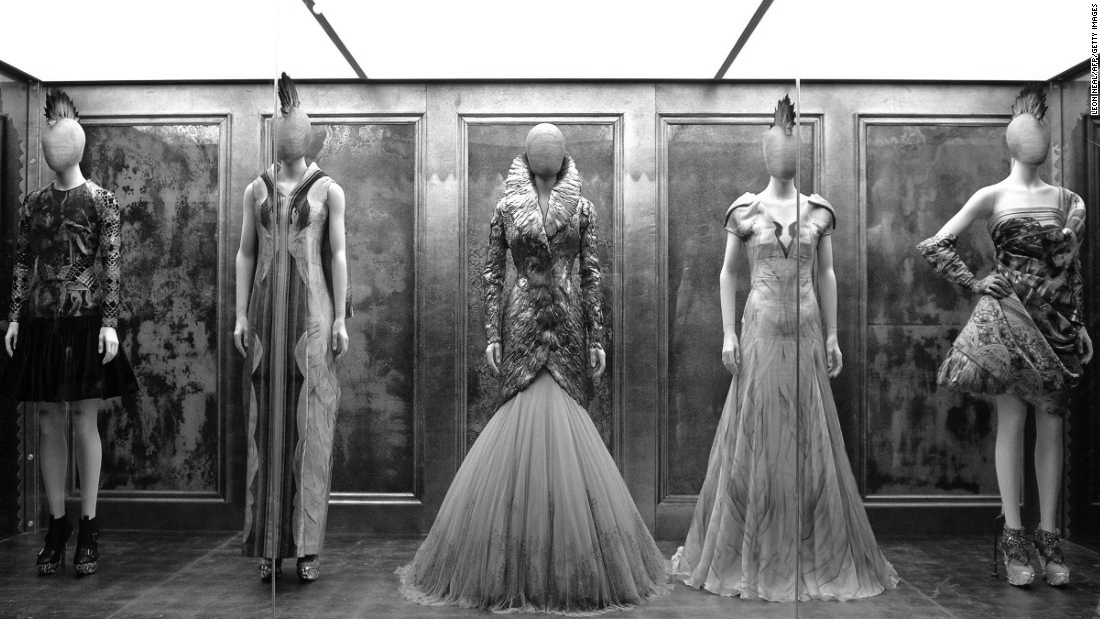
    During the past year, probably the most successful exhibition staged by any major London museum has been Savage Beauty (see illustration) at the V & A, a retrospective devoted to the work of the designer Alexander McQueen. More than 480,000 people saw it, and special late-night showings had to be laid on for the two weekends at the end of its run. Public enthusiasm for the event is, in current circumstances, not surprising. The fashion industry commands powerful PR. It is also much less bound by theories and intellectual constraints than the art world and it certainly has no inhibitions about luxury, and no shame about the money required to support luxury. Yet fashion is conservative in this sense – it gives you something to ‘see’. However ridiculous some of its visual inventions may be, fashion design never neglects the purely visual effect.

    Wear it if you can afford it. Wear it if you dare. And you can be damn sure that people are going to look at you and that they will probably remember what they saw.

    Fashion designers also, as it happens, have much less self-consciousness about ‘appropriation’ than today’s would-be avant-gardists. Fashion designers have always been magpies – they borrow without shame and recycle without inhibition. The point, for them, is to give what is borrowed a new twist. If the audience doesn’t recognise where a particular idea or effect originated, so much the better. With appropriation-art the opposite is the case. You have to know what is being so sedulously copied, otherwise you’re out of the loop.

    One refuge for avant-garde aspirationists, lacking visual inventiveness, has been to take refuge in supposedly radical politics. The visual arts have had an uneasy relationship with politics ever since the French Revolution. It was particularly strong in France during the first two-thirds of the 19th century, and reached a kind of climax in the days of the Paris Commune. This involvement, and the price that could be paid for it, is illustrated by the career of Gustave Courbet.

    There was certainly political involvement between some elements of the visual arts avant-garde and the political left during the first half of the 20th century, but the relationship was always uneasy, as the history of the Surrealist Movement amply illustrates. One still gets a great deal of talk on this subject today. The current Venice Biennale, due to finish on November 22nd, features continuous readings from the three volumes of Karl Marx’s Das Kapital. Whether anyone will pay attention to the words of this text – anymore than most of the traditionally religious pay attention to the actual words of the Mass when recited in Latin – must, I think, be seriously in doubt. In fact, left wing events, safely quarantined in museums, are now a familiar form of preaching to the converted. A good example, here in London, was Mark Wallinger’s installation, State Britain, which won the Turner Prize in 2007. This was a faithful reconstruction of the Peace Camp by the late Brian Haw, which existed for a while out in the open, directly in front of the Houses of Parliament. The Tate Britain web site rather smugly notes that: “Mark Wallinger’s work is noted for its succinct social commentary and political resonance.”

    Yes, indeed. And forgive my asking, but if this now almost-forgotten work ever had any real political impact, in which location would that have been more likely to happen?

    The avant-garde, as we once knew it, is as dead as the proverbial dodo. It is not going to rise again like Lazarus. It’s time we looked for something else, even if we don’t yet know what that is. London is now, for better or worse, a world metropolis. It is full of bright young artists from everywhere you can think of, all enthusiastically making work – much of which can be at least loosely described by the two nouns ‘painting’ and ‘sculpture’. Definitions can wait. Forget the museums. Go to the bustling galleries in Shoreditch and take a look.

    Edward Lucie-Smith

    September/October 2015

  • ‘Sculpture’ v. sculpture

    Martin Jennings

    Among the least impressive legacies of arts administrators’ obsession with Modernism and its aftermath is the impossibility of predicting a work’s status solely from its appearance. You might form your own view about it, but you can’t predict what State Art’s opinion will be because there are no published criteria or guidelines for making such a judgement. You can’t second guess a whim. The bottom line is that we have allowed a body of ‘experts’ to evolve who unashamedly make it up as they go along. This gullibility on our part for allowing it to happen, and the smug charlatanism of those in authority who are impervious to and ignoring of criticism, is the inevitable result of being for decades under the thumb of an establishment which – for all its daily protestations to the contrary – is not only awash with cash and therefore patronage, but has decided, god-like, that anything at all can be art if it says it is. In its way State Art’s is as extreme a form of capricious and intolerant dictatorship as any regime in North Korea.

    There is a useful current example of how fossilised prejudice and arbitrariness inform establishment policy. It concerns two works of public art each designed for city locations. Both are, on the face of it, conventional figurative bronzes. Superficially similar though they may seem, to the Arts Council there is an enormous gulf in acceptability between the two, a difference invisible to you and I. One of these works, that recently unveiled outside the tacky new public library in Birmingham and called A Real Birmingham Family, is a ‘challenging’ piece presenting two local women and their children. The other, depicting women in overalls and commemorating the crucial contribution of female workers to the steel industry during the World Wars, will soon be unveiled in Sheffield.

    The Birmingham sculpture is by former Tate trustee Gillian Wearing. Obviously she didn’t make the sculpture herself, a skilful craftsman will have run it up from snaps. The result is a hideous, styleless simulacrum of real people, the point of it being to promote the view that nuclear families are not now the norm – how very trendy, how perfectly BBC. This sort of conceptual conceit must of necessity be a sculpture-free zone because the last thing Wearing wants is for the object to be gauged by its form rather than for its ‘idea’ – albeit one which, to the rest of us, would be so small as to be not worth the effort and expense of illustration. As sculpture it stinks, it’s stillborn.

    In contrast, the Sheffield piece is a work of imagination and looks like a sculpture because it was made, with his own hands, by Martin Jennings, a renowned specialist in this area of modelling and invention. To State Art this sort of traditional approach is vile anathema.

    But here’s the real rub. Conceptual art, even when it comes in the otherwise despised bronze figurative form, is funded by the Arts Council, to whom Wearing is well known. She has had two national touring shows and has exhibited in every ACE-funded gallery. ACE also bought in 1999, for £30,000, her Turner Prize winning film in which two dozen coppers stand silently still for an hour. Confirmation of her A-list status is supported by the fact that 31 of her works are in the Tate, Arts Council, British Council and Government collections: curiously, all four own an edition of the same print, unnecessary duplication of a kind that ought to have been outlawed years ago. Wearing’s family sculpture was administered by local Ikon Gallery, which itself receives over half a million a year from the public.

    In contrast, Sheffield had to find all the money through public donations because Martin Jennings is the wrong kind of artist.

    State Art always prefers ears to eyes and has never based funding decisions on the merit of what you actually see. Why artists nationwide are not campaigning about ACE’s continued unfair discrimination and casuistry is baffling.

    Here is yet another filthy, indefensible racket.

    David Lee

    Jan/Feb 2016

    http://www.martinjennings.com/Biography.aspx

  • Do you feel patronised?

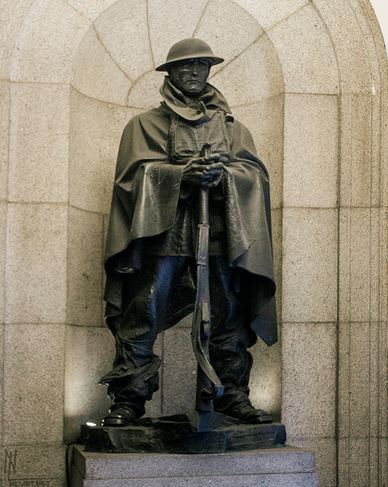
    Jagger SentryCrossing the centre of Manchester recently heading for the match, an old friend asked me to step inside a handsome Victorian mill considered the Medici Palace of Cottonopolis.  He’d worked on the conversion of this pile years before and hadn’t forgotten the impression a particular bronze made on him as he entered the building each morning. Although he admits to knowing nothing about art no one needed to tell him this statue was remarkable. He could see it and feel it for himself. It had left its mark.

    Between the grand arched entrance, so typical of quattrocento Florentine palazzi, and the high lobby are matching shrines hidden from the street. On the right is the domineering silhouette of a figure instantly recognisable to fans like myself as Charles Sargeant Jagger’s The Sentry. This was a most pleasant surprise. There’s no mistaking the gravity of an encounter with Jagger’s work, recognition is immediate, the signature unique. His pieces celebrate the staunch resolve and dignity of ordinary blokes. I tried to locate this piece decades ago but never managed to see it, the building having for years been boarded up. Surviving calls from rapacious developers for its demolition, the 1856 edifice eventually reopened in 1982 as the Britannia Hotel, since when its ground floor bars and cafés have become popular night haunts.

    In the matching chapel opposite the imposing figure are inscribed in granite the names of 87 employees of S and J Watts, the wholesale haberdashers for whom the mill had originally been built, who had been killed in the Great War. Erected in 1921 the sculpture was among Jagger’s first commissions following the delayed start to his career caused by his own exemplary military service.

    Though undeniably impressive few of those entering the complex will notice the sculpture. They are probably too eager to avail themselves of, among other thrills awaiting, a ‘Happy Hour’ offer of two pizzas and two pints for fifteen quid, the advertising board for which stands a few feet from Jagger’s plinth.

    Eight years ago the bayonet was hacked off in a drunken prank and has never been replaced despite this being an important detail of a Grade II* listed work. To check on the original appearance including bayonet (the maquette is inset opposite), there are reduced versions in Liverpool’s Walker Art Gallery, at Eltham Palace in south-east London (Stephen Courtauld, who lived there, was a fellow officer with Jagger in the Royal Worcesters and, coincidentally, it was his family’s textile firm which eventually bought the Watts building), and in the museum at Rotherham where Jagger was born, the son of a colliery manager.

    Exactly 100 years ago, Jagger (1886-1938), who had on declaration of war instantly volunteered with the Artists Rifles, arrived back in England from Gallipoli via a Malta hospital having been shot through the shoulder, a potentially disastrous injury for a carver and modeller. But Charles recovered quickly and was re-posted to the Western Front where, in April 1918 during the German Spring offensive, he was sniped through the chest two inches above his heart. Astonishingly, he survived and was awarded an MC for conspicuous bravery. This wound undoubtedly contributed to a cruelly early death due to heart failure accelerated by overwork.

    When the war ended he took up the Rome Scholarship won before the outbreak when graduating from the RCA. Recommended by George Frampton, he was soon making war memorials, a job for which, given his experiences, no one could have been better qualified. Jagger famously said: “I got to love the Tommy in the Trenches and I’ve tried to show him as I knew him – not as he looked on parade at home.” The caped sentry’s legs are protectively swaddled in sack cloth against the cold and wet, an informal addition to uniform permitted during frontline duty.

    When The Sentry was unveiled opinion was split down the middle. Liverpool architect Charles Reilly remarked: “It is extraordinarily impressive as it stands there with intense immobility, a little large and crude perhaps for its surroundings; such a figure makes one understand the rock of national character against which the German flood broke in vain. It is truly monumental in its combined steadfastness and power. It is sculpture like this, and this only, free from any trivial suggestions, that can at all express the depth of feeling the war called forth.”

    Meanwhile, Roger Fry, who was always proud to know better than anyone else and who had already established himself as chief standard bearer for the avant garde, wrote of Jagger’s figure: “Nothing approaches the commonness, the effective, brutal, catch-penny vulgarity of his work”.

    Fry and his fixer followers won the subsequent taste war hands down. Jagger, Ledward, Frampton were forgotten, their works neglected, even wantonly ruined in the case of Jagger’s Unilever carvings. Understanding how the Establishment operated Fry was the first of a breed – today totally victorious – whose addiction to artistic novelty, whatever character it takes, is all and absolute. He was the first to proclaim loudly his low opinion of everything traditional, a view which eventually became so uncritically accepted as to become a basic qualification for anyone seeking preferment in the visual arts – Fry is the Vito Corleone of State Art. Those who refused to follow where Fry, Clark, Keynes and Co. led were dismissed as so many reactionary simpletons. To be an apostle of the avant garde was to be right – no argument. Thus, Fry’s heirs have learnt over decades of ascendancy to assume a patronising aesthetic and intellectual superiority over the rest of us. They treat us like blind children who are too thick to learn the big secret to which they themselves, alone, exclusively, enjoy special privileged access and insight.

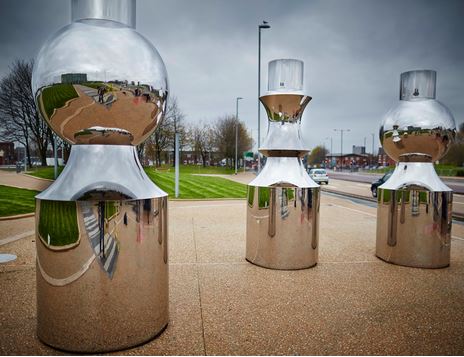
    All I would ask is that you look for yourselves and are not cowed by those claiming to know best. Because they don’t. Perhaps Manchester’s Jagger really is vulgar, meritless and pedestrian. And perhaps Ryan Gander’s reflective bollards are, truly, “a world masterpiece”. What do you think?

    Leaving Jagger behind, as chance would have it our route to the ground took us past Gander’s chromium cruet. (It was a very cultural evening.) “What do you make of that?”, I enquired casually. “What’s it for?”, my friend asked.

    David Lee

    March/April 2016

    Ryan Gander Manchester


  • Museums – our national genius

    PompeiiI may frequently express criticisms about their finer workings but British museums and galleries are generally superbly run. Heroic efforts are made to minimise the impact of funding cuts so that even regular visitors will notice little or no impact. From looking at the outward face of our museums you would never guess the country was in anything like the mess the numbers would indicate. They open on time: they have excellent facilities; their staffs are visible, willing and helpful; their experts are sought after the world over; they are clean; they have disability access to the ceiling; their bookshelves cater to all types of reader and interest; and their collections are by and large well maintained, sensitively exhibited and most supply informative captions. Many of them have for centuries been kept open free of charge for everyone, often against all odds and arguments. They are exemplary resorts of enlightened thinking about education and the preservation of history. This quiet effectiveness is a substantial achievement which is easy to take for granted. The truth is that when it comes to museums, in Britain we have been spoilt.

    This native genius was recognised recently when the Italian Culture Minister announced a fundamental shake-up in his own country’s major museums by throwing open twenty directorships to all-comers. Heading the published lists of dream candidates were many Britons. That Italy desperately needs help running its museums can not be in any doubt in the minds of those who have recently visited that country.

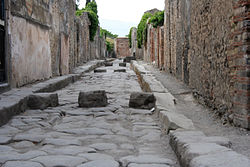
    Newspapers have lately reported that Pompeii is at last rising from the ashes of incompetence and corrupt administration. Having been partially rescued from beneath the sludge of AD79, in recent years other man-made ravages have befallen this astounding place –  structures have collapsed, excavation has ceased, and the site has been subjected to looting and vandalism. All of that, we are proudly informed, is now in the past. Sanity has set in and the place is safe in Italian hands. Millions of euros (doubtless originating in Germany) are being lavished to turn Pompeii into less than the unloved disgrace it has been in the recent past.

    Don’t believe a word of it. If Pompeii is typical of how Italy runs its museums – and it does seem to be – no wonder British and German experts are being wooed, because even organising the basics efficiently defeats Italians.

    The situation is hopeless and it starts as soon as you arrive. Gates open half an hour late, which especially annoys those scores who have arrived early to steal a march on a punishing summer sun. Once admitted, crowds jostle forever to buy a ticket because only two people are taking money. Matters are made worse because neither has any change. They accept only the correct money which must involve coins. In Italy it is virtually impossible to have coins not least because no one will give them to you: they hoard them like juju beads. The inevitable chaos is entirely avoidable and compounded when concessionary cards are not accepted unless accompanied by a passport. Endless negotiations ensue with each now sweating and thoroughly exasperated visitor. You then try the bookshop for a guide and detailed map. They don’t have any change either and diagrams in the Blue Guide are better than the childish plan costing a euro. So extreme is the provocative indifference of staff it can only be intended as a calculated insult. It’s as though they don’t want you here.

    In general museum bookshops and cafés are, throughout Italy, not seen as important revenue earners or as crucial a part of further education as we treat them in Britain. At Reggio’s museum they provide a rudimentary brochure for 7 euros about the Riace bronzes, the most precious sculptures of the ancient Greek world. Many of those making the trek to this furthest bunion of land will be willing to pay a premium for something more detailed. There is no bookshop at Tiberius’s villa in Sperlonga, the remarkable Villa Poppeia at Oplontis, or at the Agrigento Museum with its stunning collection of red and black ware.

    The anarchy characterising admission to Pompeii follows you about the site. In nearly all the most treasured areas there is no visible security. At the distant Villa of the Mysteries, to which I arrived in advance of everyone else, not a soul was there to protect what are among the most important paintings in the history of classical art. Perfect for me, despite the fact that they weren’t properly visible because unlit, but I fear dwelling on the damage parties of Europe’s and Asia’s squealing, uninterested and accessoried oiks might wreak on a place like this – they look with their hands.

    They say that Pompeii is the place in which to wander, get lost and release your imagination. Indeed it is, but you can’t do this because too little of even the excavated area is open. Crime-scene tape forces you to remain on thoroughfares which rapidly become Wembley Way on cup final day.

    At the farthest extremities of the site there are no services. There is nowhere to sit comfortably or to buy the fluid necessary when, as on my recent visit, the temperature soars beyond forty degrees centigrade. There are water fountains if you are prepared to trust the liquid coming out of them in a city with a pervasive smell of drains and where essential social infrastructure of hygiene and refuse collection have disintegrated. (Naples is a memorable city but filthier even than Oldham.) A third of my eight hours were spent sitting reading either Mary Beard or an old guidebook while trying to satisfy unquenchable thirst. An air-conditioned café on the periphery near the amphitheatre with coins in the till, simple food and cold drinks, and ice cream, would have cleaned up. By the time they’ve beaten the long procession around to the theatres, all visitors are as stripped and dessicated as Peter O’Toole staggering across the Devil’s Anvil. It would be so easy to make this unique place even more of a memorable experience than it is.

    Beside its serial inconveniences, the site’s main offence has to be a new building of which administrators are so proud as to make it a feature of all publicity material. As with many European museum extensions, this contract has gone to a person with no visual sense at all. It is a large pyramid whose job is to display in a sort of cock pit the famous plaster casts of the perished. This structure should have been built almost anywhere other than where it has been. Placed bang in the middle of the amphitheatre, the full effect of that otherwise special place is thus ruined. Visitors are not allowed on to the terraces so the only panoramic experience of it is as you enter the arena, only to find the view impeded by a structure which has ‘Brussels’ written all over its design and materials.

    Pompeii’s amphitheatre is significant. It was built in the first century BC (160 years before the Colosseum) and was the first permanent stone Roman amphitheatre; other similar arenas are a refinement of the incipient form found here. It has two sets of external diagonal staircases giving access to upper tiers. On a previous visit I’d had been struck by the impact of the interior, and was looking forward to seeing it again, a spectacle now regrettably sacrificed to a populist stunt.

    Pompeii is not unusual in Italy. Other sites seem equally to be run for the benefit of anyone except visitors. Lack of facilities are routine. At Herculaneum closed areas include the Villa of the Papyri, the quayside wharves housing all the skeletons of those attempting to flee by boat, the still underground cruciform pool as well as numerous insulae. Visitor services are rudimentary and limited to what can be dispensed from a machine. The ‘bookshop’ is hopeless for anything but souvenir trash. Even the National Archaeological Museum in Naples has whole wings and floors closed and, again, vending machines and few seats in place of a cafeteria.

    Italian museums are throwing away money whose collection would allow them respite from EU- and IMF-imposed cuts to Government and local expenditure. The Tate self-generates an astonishing 63% of its own income. The National Gallery makes three times more from cafés and shops than it does from exhibition admissions. The Royal Academy rakes in almost twice as much from retail activities than it does from ticket sales.

    Also, as with Pompeii, the protection of priceless treasures is generally so disgraceful it’s almost an invitation to looting and theft. At the museum of Tiberius’s villa near Sperlonga, which contains some of the most important Augustan sculpture, four middle-aged attendants, obviously recipients of some local authority sinecure, are slumped in the entrance indifferent to what is happening throughout the otherwise unprotected museum and grounds. Hardly any information is provided on this amazing site which has a massive coastal grotto – now busy with the aerobatics of rare pallid swifts – originally housing sculptures possibly by Polidorus of Rhodes, to whom some attribute the Laocoon. The same is true at the great museum in Agrigento where only the celebrated eponymous Ephebe – a close relative of the Kritios Boy in Athens (and which recently cropped up on the cover of Private Eye) – has its personal attendant playing games on a mobile telephone. In four hours at Hadrian’s Villa, in a complex the size of a large village, there was no security at all. Apart from the ticket office lady it was a ghost town. This is a definite advantage, as it allows furtive exploration of decorated areas inside the baths which are inexplicably taped off.

    A word of advice for cultural tourists to the Campagna. For the first time I visited the atmospheric Villa Poppeia, ten minutes from Pompeii in Torre Annunziata (Oplontis). Also interred in 79 this is not on tourist routes yet houses the finest collection of frescoes in the four Pompeiian styles you’ll see anywhere. Go in the evening and you’ll wander undisturbed. Its murals should be compulsory viewing for any art history student, and especially for those with a developed interest in the evolution of how a third dimension is depicted. Steep recessions and trompe l’oeil effects are dazzling and the drawing, particularly of figures, is flawless and exhibits complete assurance. Being Imperial in origin – Poppeia, poor lass, was Mrs Nero – these paintings are of a quality which knocks spots off most decoration encountered in the urban houses of Pompeii and, to a lesser degree, Herculaneum. Poppeia could afford artists for whom foreshortened figures in complicated groupings and poses were second nature. Natural history scenes of flowers, insects and birds in a long painted trellis and arcade beside a swimming pool are thrilling beyond description, the most magical work of its type I’ve ever seen.

    Any defence of Britain’s museums should start with the magnificent fundamental principle underpinning every aspect of their existence: this is that we actually want those who own them and their contents, the public, to benefit from their existence. Everything is done to further this aim. We encourage attendance and hope that some, whose curiosity is roused, may often return. Many have argued, including myself, that the commercialising of British museums is a disgrace. Having experienced the alternative I take it all back. In difficult conditions our national museums are doing a tremendous job. They now need to address urgently problems caused by their own success, most notably that of overcrowding.

    David Lee

    2015

  • Fibres torn from the brain

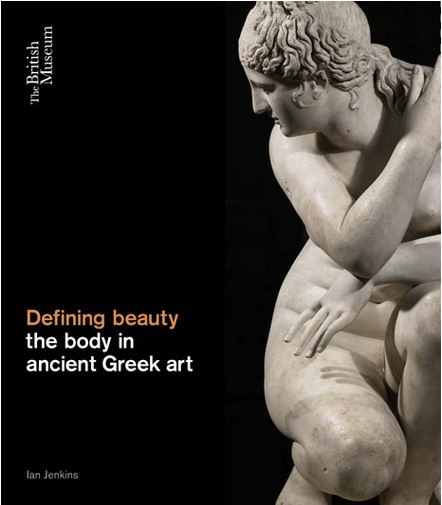
    Body in ancient Greek artIn all the doting coverage of ‘Defining Beauty: The Body in Ancient Greek Art’ at the British Museum, no mention was made of the fact that the bulk of major exhibits featured were from the museum’s own collection. Stupidly, I had believed – and perhaps was even misled by advance publicity – that the exhibition would feature a range of major sculptures I hadn’t seen before. I should have known better. During the months before the display opened, regular visitors would have noticed a weekly disappearance of prize pieces from the Greek and Roman galleries. Indeed, for two months in advance of the show half the Duveen gallery exhibiting Parthenon material was crudely boarded off like a building site. Art critics, many of whom nowadays are at sea dealing with anything made before last weekend, were bowled middle stump by Defining Art. They didn’t know the BM sufficiently well to realise that many works for which they were recommending the public pay handsomely could have been seen free any time in the preceding 262 years and will be free again after July 5th when the spectacle closes. It serves the museum right that attendance for what was doubtless planned as a cash-cow blockbuster hasn’t risen above a trickle. A sad irony is that works are better appreciated in the deserted exhibition than they are normally when enveloped by noisy swarms of disaffected foreigners shuffling along with scarcely a glance at anything deemed unworthy of a selfie. It goes without saying that the more important works illustrated in the accompanying book (which isn’t a catalogue), indeed the crucial ones to the show’s thesis, were not included in the exhibition: they live in Greece, a country with whom regrettably we have no dealings.

    We’ve become inured to the scam operated by many museums whereby they demand payment for what should be gratis. And the Department of Culture, the House of Commons’ Select Committee, and assorted museum trustees, all otherwise so proudly defensive of our free museums, let them get away with it. However, Defining Beauty set new standards in such fraud. With the exception of a rare bronze of middling quality recently trawled from the Adriatic off Croatia, the influential Belvedere torso from the Vatican and a few oddments, I emerged feeling well and truly robbed of £16.50.

    In previous issues I’ve criticised the BM for misrepresenting the experience of a visit there. We’ve been told often, mainly by the Director, that the museum tells a definitive story of classical sculpture and civilisation and shouldn’t be tampered with – this is their Elgin Marbles Sicilian defence. The collection is too patchy to attempt any such thing. And even if it were not, all the galleries are not open at the same time anyway. Visitors are never allowed to see the full story. Recently, I was ejected from two rooms in quick succession as they were closing only minutes after opening. They claim shortage of cash but in the last 15 years the BM has spent hundreds of millions on two major building projects, one of which is a shopping mall with a vile swimming pool roof. Constant closures ensure that many of the more fascinating pieces are off bounds every day. On my most recent visit galleries housing the Bassae frieze and the Mausoleum of Halicarnassus were, as usual, shut. But at least the wondrous, blissfully empty architecture galleries, in my experience closed for years, were open ­– a red letter day indeed.

    ­ As I write, news arrives that the BM has leased for five years 500 works to a Qatari museum for an undisclosed fee. Depletions to galleries of the sort mentioned above will, it seems, become a permanent fixture as the museum realises its main financial asset is the quality of collections they can pimp to the highest bidder (which, conveniently, fucks Greece). Am I the only one who thinks renting masterpieces in bulk to the Middle East is just a tad risky?

    We are entering a different age to that post-war world of museums where I discovered escape, solitude, inspiration and willing expertise on tap. Museums no longer principally exist to benefit those dedicated to what they preserve. I regret this loss of innocence and its replacement by venal opportunism. At the same time, I’m grateful to have experienced the best of it while it lasted.

    David Lee

    July/August 2015

  • Are you disadvantaged?

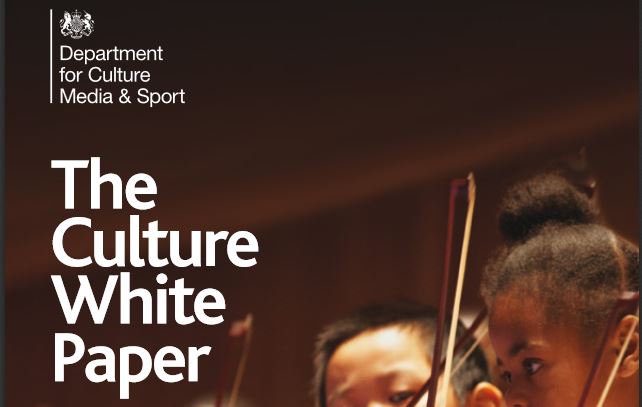
    The Department of Culture recently published a White Paper, the first from that department since Jennie Lee’s in 1965, and apparently only its second ever. This chic pamphlet, in truth more PR exercise than policy document, prominently contains that new-age mantra, “access must be increased for those from disadvantaged backgrounds”. The Arts Council also write this sort of optimistic guff, and they don’t mean it either. They only mean it if the ‘disadvantaged’ are prepared to like what the Arts Council want them to like. God forbid that the ‘disadvantaged’ should actually express preferences of their own. And this must echoes its 1965 predecessor – they were on message then too: “The best must be made more widely available.” Imperative or not, nothing happened. The disadvantaged, and presumably they mean anyone who doesn’t visit museums, weren’t seduced by free admission then and they won’t be today, or tomorrow.

    If contemporary art fanatics had their way they’d make gallery attendance compulsory, requiring a form of mass re-education: “You will watch this interminable video by our favourite and extremely challenging blurry filmmaker from Kazakhstan … who we got plastered with three nights running at the Gwangdong Biennale.”

    Access to museums already being free, how might the disadvantaged be forced into submission? Two possible answers suggest themselves. You could round up pasty-faced skulkers on a sink estate, deposit them outside a museum and have the director and his staff fire kalashnikovs round their feet until they flee into the galleries. Alternatively, you could exhibit the sort of stuff which might appeal to these disadvantaged folk. A display of assault rifles, stillettos and machetes perhaps, or violent video games and snuff movies, or panoramic tellies with full Sky Sports and pornography packages. You might scatter burger boxes, skunk butts, crisp bags and beer tins under the pictures in order to make everyone feel at home. And why not offer them a couple of free ten-pound bets? That seems to work.

    Curiously, there’s no word in the White Paper about the ‘advantaged’ who don’t visit museums. This includes most aristocrats. They’re also thick, inbred, ill-mannered, drug-crazed and unemployable. And do tell me Squire Vaizey – while I’ve got you on – am I disadvantaged because I’d rather have my teeth pulled by Hogarth’s dentist than sit through an opera? Give me Buddy Holly any day than some caterwauling eyetie. And I’d rather divebomb naked with my mouth open into a slurry pit than sit through a ballet or a ‘modern dance’, whatever that is. Give me a Sergio/Yaya one-two every time. No, let me go a-disadvantaging myself cabbing Deltics at Barrow Hill, or trudging across Rivvie Pike, or tending the world’s most expensive courgettes, or watching whimbrels where they’re not supposed to be, or just having a few pints in the Cheshire Cheese (again). Rather any of these pastimes than visit a palace of bogus crap like Tate Modern. Am I disadvantaged? Are you talking to me? Well are you talking to me?

    This White Paper has the self-congratulatory, de-haut-en-bas tone associated with all Arts Council literature, which, suspiciously, this document closely resembles in appearance. Every page tells its own tinted porky-pie diagram and the most obsequious political correctness oozes like dripping from every letter. It has also decided, again like the Arts Council in its own PR, what the outcomes will be even before policies have been implemented: “They will be inspired by their experiences and will be encouraged to inspire others.” Talk about the Gestapo: “You vill be spired-in! Or you vill be shot!”

    Will this White Paper alter the social demographic of museum attendance which has remained static for decades? Not a hope.

    Squire, I’ve been in more museums than you’ve had hot dinners and, yes, I am still seriously disadvantaged. Throughout my entire adult life I’ve been cheated by State Art’s monopoly force-feeding me a diet of conceptual and minimal trash of no discernible merit. The only thing I’ve been seriously disadvantaged by is State Art’s prejudice against the sort of work which – for all my peasant upbringing and scummy tastes – I’ve always preferred to look at.

    David Lee

    DCMS White Paper disadvantaged editorialMay/June 2016


  • Brian Sewell (1931-2015)

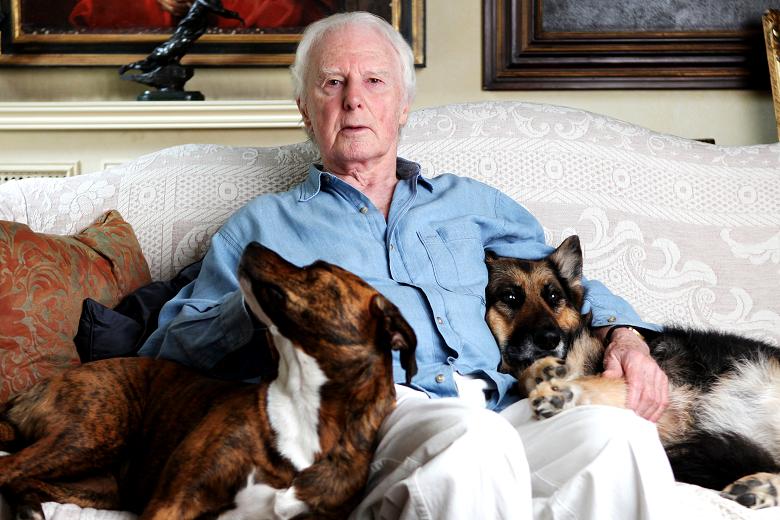
    beautifulbrianwithdogsIt isn’t my intention to repeat the tediously familiar stories peddled by obituarists relating controversies which Brian’s inclination to mischief and provocation helped encourage. Instead I want to address two issues unconsidered elsewhere: his astonishing generosity and the disgraceful but typical hypocrisy of the BBC towards him. Brian was a working man. He called himself ‘working class’, a description some dismissed as affectation. It wasn’t. Like his commuter readers he needed to work in order to survive. Neither was he rich. Nevertheless, he still donated liberally to promising but needy art history students and charities, in particular those dealing with homelessness and the welfare of animals, and he encouraged friends to do the same. Equally, buying work from promising youngsters in order to get them started was to him a duty. He was also selflessly free with his time, knowledge and contacts. When he was your friend you felt it.

    In early 2000 I quit editing Art Review, for which Brian had contributed many superb pieces on 20th century art’s main figures and which always arrived in uncorrected typescript as though having emerged perfectly like a Mozart manuscript. He telephoned and asked me what I would do now. I told him that I was devising the inaugural issue of The Jackdaw, which would continue the opposition to State Art’s absurd and damaging monopoly I’d begun only tentatively (for commercial reasons) at Art Review. He mused a second and said that to give such a venture any chance of long-term survival it would be very expensive. I disagreed, arguing that I could keep costs down by not employing anyone, including myself, or renting an office and having poncy stationery. I’d tried to raise investment for the idea but no one took the bait. The next morning I received in the post from Brian a cheque for £10,000. This staggering act of generosity and confidence was undeserved and his insistence I accept it terrified me. I told him I’d pay it back as soon as I could. Circumstances – including my unique hopelessness as a capitalist – meant that it took me thirteen years to honour my words – thirteen! – and only then as a result of an unexpected legacy. It was a relief to be able to redeem the debt not least because, in consequence of a change in the Standard’s ownership leading to revised employment conditions for the staff, Brian was having to do the same work for a fraction of what he’d formerly been paid. He needed the money. But never once in all those years did he raise the subject of my debt let alone ask for it to be repaid. And, of course, he refused any interest on the grounds that, as he wrote to me, ‘my failings are many but they do not include usury’.

    Without Brian The Jackdaw would not have survived beyond a handful of issues. I don’t think many who follow the terrain would disagree with the assessment that, of all his contemporaries in art criticism, in art historical terms he was easily the most knowledgeable. Given his ability to speak clearly and articulately – without artbollocks (which he always pedantically insisted to me should be properly spelt artballocks) – and because of his reputation as an elegant and amusing essayist – don’t forget he won both the Orwell and Hawthornden Prizes – he was hurt by the fact that Radio 4 never once asked him to appear in a review role on either of its main art programmes, Front Row or its predecessor Kaleidoscope. The list of waffling no-hopers in art criticism those programmes have employed would fill pages, but they never asked him. He would never have admitted it publicly but this omission hurt. What a surprise then that not six hours after his last difficult breath, his death made the main BBC news where he was lauded as an influential leading critic, blah blah. If they thought this was true why did they so rarely use him? The answer is simple. The BBC’s programmes, which in the visual arts are uncritical advertisements for their subjects, are willing promoters of the disgraceful sewer that is State Art, about which Brian held damning views. Over the years he suggested many programmes, all rejected. It speaks volumes that the BBC asked Grayson Perry to give the Reith Lectures, but not Brian. Of all the many independent voices we never hear, his cruel neglect in particular demonstrates that in visual art you will be marginalised unless you toe the establishment line.

    David Lee

    The Jackdaw November/December 2015


  • Freedom of expression

    freedom of speech


    ALEXANDER ADAMS rehearses recent arguments concerning freedom of expression before arriving at his own conclusion.


    “One person with a belief is equal to a force of 99 who have only interests.”

    JOHN STUART MILL


    On February 14th, 2015 an Islamist gunman attacked a café in Copenhagen where a debate on free speech was being held. Speaking at the meeting was Swedish artist Lars Vilks, who had been issued with death threats because in 2007 he drew cartoons of the prophet Mohammed that were considered insulting by some Muslims (and some non-Muslims). Vilks was unhurt but a documentary filmmaker Finn Nørgaard was killed. A month earlier, Islamists murdered cartoonists at Charlie Hebdo in Paris. On one level, the Danish attack was prosaically ineffective. The attacker could not gain entry to the building so he sprayed bullets through a glass door. On another level, it marks a new standard, where anyone associating with “insulters of the prophet” can expect to be a target for extremists.

    The cartoons of Vilks and Charlie Hebdo will not be discussed. That has been done elsewhere. We should, perhaps, evaluate what recent assaults on controversial art and satirical journalism – and the assaults yet to come – will mean for arts in the West. It is worth considering how Islamists – some of them born and raised in wholly (or largely) secular European countries – have rejected Western values but have also absorbed aspects of secular culture. This essay cannot be a full account. Though arguments and positions here are simplified, they are not – hopefully – misrepresented. Footnotes have been kept to a minimum, omitting many news sources and much background material.

    Here, “Islamism” is used to refer to “the assertive application of Islamic principles to political and social spheres” as differentiated from Islam practiced as a private ethical code; “extremist” is a personal will to use violence and the threat of violence to achieve his aims; “post-liberal” (1) is used as an adjective to describe the uneasy consensus between mainstream socio-political strands in Western societies, one which accommodates identity politics and encourages constraints on speech, voluntary and otherwise.

    Civility and Censorship

    In recent weeks a common refrain of many commentators and journalists has been “The murder of the Charlie Hebdo cartoonists was wrong but…”. Many felt that cartoonists who had freedom to ridicule Mohammed should not have exercised that right. The inference is that freedom to be irresponsible is not freedom from consequences of irresponsibility. Some of the cartoons were puerile and juvenile but there is plenty of material in that class; public lavatory walls and Internet websites are full of it. The difference is that the cartoons had authors’ names attached and there was a particular address where they could be found.

    It seems that today people who deliberately set out to insult Islam can expect reprisals. Although there is a case to put that we should protect reckless individuals as a matter of principle – and this essay will not argue against that – it is more important that we consider the murders as (at least partly) an extreme manifestation of the climate of accommodation that already compromises our liberty and affects us as citizens, readers and makers of art.

    As we have seen in the pages of arts journals (notably The Jackdaw and The Art Newspaper) and on the website Spiked, the practice of pre-emptive censorship has become an ever-present reality. Nowadays, institutions do not react to criticism but anticipate it. Formerly (in what we must now consider a brief post-War heyday), we relied on institutions to promote and protect difficult art. Institutions introduced new stimulating art and would defend it. Difficult art would at least be shown, allowing us to judge for ourselves. Now institutions fight shy of presenting anything which might cause “community tension”. What has happened to John Latham’s collage of Bible, Talmud and Koran   (2) owned by the Tate? Will it ever go on public display?

    What goes undiscussed is the self-censorship which occurs daily in the lives of satirists, artists and writers. We have all held our tongues in everyday life when we thought speaking out would cause more harm than it would do good. In some respects that is human nature – the desire to avoid conflict and let sleeping dogs lie. When standing up for one’s ideas involves placing others in harm’s way, one naturally grows more tentative. Where you might risk your own safety, you often find you cannot risk that of your family and colleagues. This is something everyone from school bullies to mafia godfathers understand. If intimidators intend to become martyrs, and there is no certain way to protect the lives of you and those dear to you, speech seems impossibly dangerous – which is the calculated effect. Though – in at least some cases – isn’t the protecting-my-colleagues/family defence (albeit a legitimate one) actually a way of excusing oneself from taking an unpopular stand?

    One problem with the on-their-heads-be-it reasoning is that it implicitly accepts that violent retaliation to an actual (or perceived) slight is regrettable but inevitable. Does that line of reasoning also apply if militant Jews were to firebomb publishers of the Koran or radical socialists were to murder BNP members? Doesn’t such reasoning, however indirectly, excuse intimidation and vengeance by any self-identifying group of victims against their putative insulters? Are Muslims not to be held to the same standards as the society they are a part of? (3) Are we to consider Muslims incapable of exercising self-restraint or obeying state laws? On-their-heads-be-it reasoning implies Muslims are less in control of their emotions than non-Muslims and have a tendency to react with violence in response to provocation. This sounds similar to patronising colonialist stereotypes about “savage natives” and “inferior races”. Yet this special pleading – that outsiders can never understand the members or culture of a subset, something which renders that culture unknowable and beyond universal principles – is very much a part of identity politics which robs individuals of autonomy, turning them into puppets of social conditions and hereditary circumstance.

    Another problem with pre-emptive censorship for protection is that it is effectively impossible. The Charlie Hebdo cartoonists knew they were creating provocative images and could expect a backlash. Consider the case of Salman Rushdie; his The Satanic Verses is a work of literary fiction. The novel included references to Mohammed dreamed by a fictional character in a delirium. The novel led to a fatwa being issued against its author and subsequent attacks against publishers and the murder of a Japanese translator. Rushdie and his colleagues had no reason to expect that instances of blasphemous delirium in a work of fiction might provoke violent hostility. Due-caution caveats cannot be applied in practice as there is no way of predicting how any work of fiction or art touching on Islam may be represented or misrepresented by extremists. The only way to be safe from extremists is to never say anything that touches upon religious culture, never associate with anyone who has and never be in the vicinity of an exploding bomb.

    But even that position will not hold.

    Even if you avoid opposing extremists, restrictions they force on others will affect you. Furthermore, accommodation will not work because Islamist demands will never end. Even if another image of Mohammed is never exhibited or published in the UK again, extremist pressure will continue, applied in other areas of the arts. Images seen as denigrating Muslims (especially Muslim women) will be targeted; “disrespectful” art by artists of Muslim heritage will be threatened; artists who take an avowedly atheist stance will be subject to violent protest. There is no way of following “rules of safe speech” because extremists make rules arbitrarily, opportunistically and unilaterally (4). What may be halal today may tomorrow be retrospectively considered haram (5) with no possibility of reasoned appeal.

    To understand demands and expectations of Islamism as a political movement we must examine the psychology of the extremist.

    The Psychology of Extremism

    For the pious man, religious teaching gives a feeling of superiority through wisdom; ritual gives his life structure; repetition brings comfort and order; moral injunctions give him an ethical framework. He observes dietary restrictions, prays at the prescribed times using exactly the wording necessary. He is fastidious about cleaning, fasting and the way he dresses. Infraction causes him to experience guilt and shame. An extremist is a pious man driven by anger, often prompted by injustice. He is angry at society for failing to be sufficiently pious; he is angry at himself for failing to meet impossible standards of thought and deed; most of all, he is angry at constraints which prevent him from remaking the entire world in the mirror image of the ideal world in his head. Even should he perfect himself – which is never possible – it is the imperfection of those around him which antagonises him most. He cannot bear to exist surrounded by lack of belief and observance. For the Muslim, his religion urges him to jihad – a struggle to change the world around him. In an extremist’s case, he chooses not to perform acts of charity but to combat impiety through any means available to him.

    Whereas a moderately (or even very) religious person can live in relative contentment in a secular society, an extremist never can. The extremist cannot avert his gaze. Religious extremists cannot be accommodated within a secular society by way of reasonable concessions because religious extremism is essentially unreasonable in that it rests on belief not reason. A religious extremist can never be satisfied because he lives a perpetual state of discontent and anger. He encounters obstacles in the form of co-religionists who do not follow his outlook and in secular laws and values which fail to recognise divine truth. He takes pride in being more dissatisfied than his co-religionists, whom he considers complacent. A religious extremist’s struggle is unending because there will always be ways in which the world falls short of the ideal. Hence the religious extremist will never be checked by practical concessions because his aspirations are nothing less than complete obedience to holy laws.

    Enabled by the fiat of imams and encouraged by fellow jihadists, the extreme Islamist becomes so dissociated from the social norms that he ceases to recognise the legitimacy of any restraint other than his own beliefs. The extremist is capable of astounding brutality, avenging a catalogue of injustices which have humiliated him. He becomes desensitised to violence, even relishes committing atrocities in order to lose his humanity and, driven to ecstasy, he becomes a holy instrument of God. An extremist defines his existence by being at the extreme of his society. If he lived in an Islamic theocracy, he would be the enforcer of religious observance; he would volunteer to be an executioner. His devotion can only be proved by the extremities he can endure and which he can impose on others.

    Compared to the executions in ISIS territory, the dispatching of a few cartoonists is a very small matter to Islamists. The Islamist admits no responsibility for the violence – it is the actions of the blasphemer which prompted the inevitable vengeance and if innocent blood is spilled then that is the fault of the transgressor.

    How can such an apparently alien outlook find any succour in secular Western society? To understand how an extremist can be nurtured by a schismatic environment – part Muslim immigrant culture, part secular European – we have to consider the way social discourse in modern Britain changed in the 1970s and 1980s.

    Identity Politics

    Identity politics came to prominence in the late 1960s as a response to the failure in the West of agitation by the political left for fundamental social and economic reform. The disillusionment with the ideology and Marxist economic analysis of the Old Left – particularly after the failed protests of 1968 and in the light of increasingly militant civil-rights and gay-rights movements – gave birth to the New Left. The New Left asserted that – contrary to the Old Left principles of Universality extolled by the Enlightenment, which held that inalienable rights sprang from shared humanity and that one made allegiances by choosing a political stance rather than conforming to oppressive and debilitating division along national, gender and religious lines – rights reform relating to sub-groups could be a more effective means to drive social change (6).

    From this point on, social conventions began to change in ways that have been accepted even by the political right. People are increasingly evaluated as constituents of subset classification by race, ethnicity, national origin, religion, gender, disability and sexuality. Social constraints that were loathed by the Universalist Old Left are fetishized by the factionalist New Left. Certain subsets are resented by the right, other subsets resented by the left but what neither side does is question the validity of identity politics, merely the value of advantaged/disadvantaged groups and which factional interests should be resisted/promoted.

    Crucially, these determining labels are matters over which individuals have little or no agency. Humanity is no longer seen as a uniting quality; the worth of an individual was measured by the assumed privilege or disadvantage of his or her subset(s). When individuals’ worth is measured by their birth subsets, individuals become essentially passive. He/she no longer gains respect and authority through education, skills, building relationships and contributing to society. Identity politics is exactly the opposite of empowerment – it infantilises by reducing individuals to passive victims in need of protection. Individuals are encouraged to reduce themselves to sheer helplessness. They become unable to avoid distasteful material, unable to bear the thought of others experiencing it, unable to allow it to even exist: and that final sentiment leads to censorship.

    The preface “As a woman/African American/Muslim/gay man, I…” is used as a priori authority for subsequent statements. Being a member of minority subsets lends supposed authoritative or authentic insight and leads the speaker to demanding redress as a victim of systematic oppression, institutional discrimination or casual offence. Conversely, certain subsets (male, heterosexual, white) are viewed by post-liberals as less authentic and valued due to historically inherited privilege (7). The language of victimhood now dominates political discourse. The statement “I am offended by…” now carries weight in debates when all it demonstrates is the capacity of the speaker to articulate a temporary and subjective position that is as incontrovertible and inarguable as it is substantially meaningless. Rather than points being argued between equals on the basis of logic and evidence, common discourse is now between representatives of inherently unequal subsets and hinges on depth of feeling (8).

    Now that emotional response has been accorded the status of a legitimate, quasi-legal grievance, why should a religious person who expresses genuine (or tactical) offence be denied redress? When a fundamentalist is denied parity by authorities that advocate “a respect agenda” but cannot legally curtail blasphemy, is it any wonder he sees double standards? Post-liberal identity politics promises emotional justice but betrays partiality by supporting favoured minorities under the auspices of “hate speech” but hesitating to censor blasphemy. Encouraging individuals to validate themselves through identifying with cultural subsets and maintaining a double standard separating anti-religious speech from hate speech are both practices that strengthen the agenda of Western Islamists.

    The way to establish impartiality and strengthen free speech is 1) for state organisations and politicians to disengage from identity politics and to refuse to endorse emotional grievance as a matter for civil or criminal legislation, and 2) for the rescinding of laws regarding hate speech, prevention of “glorification of terrorism”, blasphemy and all restrictions on speech which fall short of incitement, with existing laws on harassment, threatening behaviour and other criminal acts being applied to those who infringe the safety and liberty of others.

    There is little likelihood of this proposal being taken up, as these changes conflict with the will of the (apparent) majority of the populace and political class. Notwithstanding, the principles of identity politics and restrictions on free speech deserve to be opposed because they are intellectually flawed, morally invidious and practically counterproductive.

    Towards Thought Reform

    If that picture of identity politics and policed civility seems exaggerated, think back twenty or thirty years. Would you then have expected people to be sacked from positions in public and private organisations for expressing contentious political or social opinions, even in private settings? Would the use of certain forbidden words have led to public outcries which would force the speaker to publically recant? Aren’t those accused of infractions of civility offered the possibility of rehabilitation only if they express sufficient contrition? Don’t those sound like the tactics of totalitarian regimes, where enforced self-criticism and public shaming were used to suppress dissent and discredit troublesome individuals? Aren’t these now the norms we have grown to expect in Western democracies? Isn’t “hate speech” today akin to the catch-all terms such as “counter-revolutionary activity” used to smother political criticism in dictatorships? In today’s Britain it is unremarkable to be publically shamed for a drunken remark, not so much for the words but the thought they express. Whether or not speech crime is punished as a matter of politics or politesse makes no practical difference. Likewise, it is immaterial whether punitive sanction is enforced by legal authorities or social opprobrium. It is the imposition of the tyranny of the majority on the minority who express harmless (albeit unpleasant) ideas.

    The point is not whether we adjudge racism, creationism, Islamism, banning abortion and so forth to be wrong; what matters is whether we are allowed to discuss such things openly because once we forfeit our right to speak (and listen to) controversial matters we forgo our critical intelligence. In allowing the limitation of free speech we give up an important part of what makes us human and such a restriction will soon enough be used against the leftists and liberals who champion enforced civility (9). Listening to a foolish opinion is not “giving it legitimacy” in the post-liberal parlance, for how can we test our ideas without arguing for them and against their opposites? (10) How is an untested principle qualitatively different from an inherited prejudice? How can we know the truth without investigating a spectrum of possibility? How can we improve and educate ourselves without encountering new ideas, even incorrect ones?

    We live in a multicultural society where people do not mix but live parallel lives surrounded by their own kind, educated in single-faith schools, at a time when the public arena has become ever more anodyne. This is today’s political and social climate, where rather than ridicule and out-argue opinions we consider wrong, we suppress them. The Enlightenment principle of freedom for people to speak as they wish within the law is now supported by only a minority of politicians. University debate societies have a “no platform” policy for politically radical speakers, when speech is seen as so dangerous and hurtful it cannot be tolerated. In class, American academics issue “trigger warnings” which flag up potentially disturbing material so students can absent themselves in order to avoid experiencing distress. Books, magazines and songs are banned from campuses and student-union speech codes forbid the use of certain words. As Greg Lukianoff puts it, students demand not freedom of speech but freedom from speech (11).

    This essay’s argument looks illogical, yoking as it does apparent opponents – religious fundamentalists and proponents of socially progressive policy. Yet if one examines the tendencies, it is possible to see they overlap. Both groups believe their moral certainties trump the rights of others to contest those certainties. Both are attached to emotional ideas of justice rather than application of rationalism. Both believe ends justify means and are strongly paternalistic. Both use group pressure to suppress dissent. Neither considers free speech an inviolable right and both seek to use legal means to outlaw transgressive speech and action. Both believe that there are correct ways not only of acting but of thinking. Neither wishes to examine too deeply their idées fixes. Both are averse to reassessing core ideas in the light of new information.

    These supposed opponents share common roots; they share aims and collaborate. Witness the political alliance of Respect, a party of self-identifying Muslims (including a splinter of extremists) working alongside Feminists, environmentalists, disaffected Marxists and supporters of the New Left. There are extensive formal and informal links between far-left groups and Islamic political organisations for the purposes of opposing imperialism and global capitalisation. On campuses, student unions and religious societies uneasily act in concert to oppose dissent through hate-speech policies. It is in the interests of both tendencies to maintain official mechanisms to gag criticism.

    Resisting Enforced Civility

    In many Western nations we are living under de facto sharia law with regard to images of Mohammed. We are routinely told that “the depiction of Mohammed in any form is deeply offensive”; actually depictions of Mohammed were historically made by members of Shia and African Muslim traditions and were not considered offensive or even noteworthy. The prohibitions derive from interpretations in the hadith (12) rather than the Koran itself and the common acceptance of the prohibition may be due to the influence of Wahhabism (13). Yet despite this, museum curators in the UK censor historical images of Mohammed by Muslim artists, deleting images on museum websites and not publically displaying examples (14). British newspapers refused to reprint the Danish and Charlie Hebdo cartoons. This rigid observance of a partial (and contested) cultural injunction displays the zealously cautious management of post-liberal-led institutions (15) and is an example of a concession to religion which has already curtailed freedom of expression.

    Advocating voluntary restraint of speech (on grounds of common civility, community harmony or fear of violence) ultimately establishes a climate of silence in which any criticism of Islam can be dismissed as provocation (racism qua Islamophobia), a label used to discredit critics (16). When valuable articulate comment of a critical nature needs to be expressed it may search in vain for newspapers and book proprietors willing publish it. The cartoons of Mohammed were anything but reasoned critique, and may be considered to have “poisoned the well” for moderate critics, but extremists are not reasonable people. Islamists seek to suppress critical opinions (17). Extremists exploit identity politics through use of argument or legal recourse to further their cause but they do not consider these channels to have authority – only their God has authority – and some of them will burn buildings and books and cut throats.

    In coming years, not only extreme but moderate Muslims too will press for blasphemy laws and warn that offensive material will (regrettably) be countered by acts of violence; post-liberals will urge restraint on speech for the sake of community harmony; satirists and critics will grow ever more cautious. If makers and consumers of the arts, and the public more generally, do not assert that free speech is non-negotiable and that any legal speech (even distasteful speech) is permitted, then post-liberals will offer further concessions and anti-free-speech activists will make further advances. Extremists will occupy any territory vacated by others.

    While many of us may feel confident that the evident extremeness of religious fundamentalism means it will never make inroads into our way of life, we overlook the willingness with which post-liberals (who are in the mainstream of society and in positions of power) offer concessions to religious sentiment and give away our freedoms to assuage their guilt, in a form of emotional reparations. The freedom to speak your mind has already been snipped away by post-liberals, religious extremists, New Left supporters, commercial lobbyists, social conservatives and paternalistic government.

    The only way to preserve free speech is to exercise it. Otherwise, the opportunity to use it will be taken from you (by means both overt and covert), the channels of speech will atrophy, and when your time to speak comes you will be unable to do so.

    Notes

    1. Alternative adjectives are unsatisfactory: redefining “liberal” is problematic, as well as time-consuming in a short essay; “neo-liberal” refers to a specific school of economic thought; “illiberal” is merely an insult; “Politically Correct” is idiomatically awkward and has particular connotations of campaigning leftism (though a largely pejorative term, it accurately indicates genuine intolerance towards opposing political ideas); “post-liberal” is a workable though inadequate neologism indicating an outlook that claims to be liberal but no longer conforms to liberal founding principles (see “Identity politics” below).
    2. God is Great (no. 2) (1991), presented 2005.
    3. ComRes poll of British Muslims, conducted for the BBC, 25 February 2015: those who believe British law must be obeyed 93%; those who “have some sympathy for the Charlie Hebdo killers” 27%; those who say violence against publishers of [presumably offensive] images of Mohammed is never justified 68%, disagree 24%.
    4. On the role of anger, insecurity, humiliation, lack of power and other aspects in the psychology of extremists see Arno Gruen, Peter Coleman & Andrea Bartoli. For a view of extremist violence as primarily tactic strategy see Eli Berman. Coleman & Bartoli also discuss extremism as strategy.
    5. “Halal”: permitted; “Haram”: forbidden
    6. For discussion of this transition in the context of the visual arts, see Paul Wood, Western Art & the Wider World (2014), Wiley Blackwell.
    7. Respectively, the argument-from-authority and argument-against-authority logic fallacies.
    8. See John Stuart Mill’s analysis of the way dissent is silenced by social oppression, On Liberty (1859).
    9. Note that this essay argues only the utilitarian case for free expression; there is an entirely separate argument in favour of free expression as a human right; see Thomas Paine, et al.
    10. On the wrongness of people suppressing opposition: “If the [opposing] opinion is right, they are deprived of the opportunity of exchanging error for truth: if wrong, they lose, what is almost as great a benefit, the clearer perception and livelier impression of truth, produced by its collision with error.” Mill, On Liberty ch. II.
    11. Greg Lukianoff, Freedom From Speech (2014), Encounter Broadside.
    12. Interpretative commentaries on the Koran.
    13. Wahhabism is an ultra-orthodox interpretation of Islam native to the Arabian Peninsula, which has been promoted internationally by the Saudi royal family.
    14. The Victoria & Albert Museum removed an image of Mohammed by a Persian artist from its website in the wake of the Charlie Hebdo attack.
    15. The BBC has issued conflicting statements about whether or not images of Mohammed are prohibited for broadcast or simply avoided. The point is a moot one as the BBC does not show images of Mohammed, regardless of being the result of official guideline or unspoken consensus.
    16. An example of argumentum ad hominem, an attack on the proposer of an idea rather than the idea itself.
    17. This discussion centres on Islamist expansionism and largely omits discussion of the position of moderate Muslims. Do moderates wish to oppose the sectarianisation of the secular West or are they in favour of some (or all) additional restraints on free speech? There will be as many views on this as there are Western Muslims. It is worth remembering that many moderates suffer soonest and most from pressure and influence of Islamists in their own communities and families. This is especially true of adherents of Shia and Sufi traditions who are persecuted by Wahhabi extremists.

    Alexander Adams, 2015


  • Giles Auty: Modernism and the Novelty Trap

    Giles Auty: Modernism and the Novelty Trap

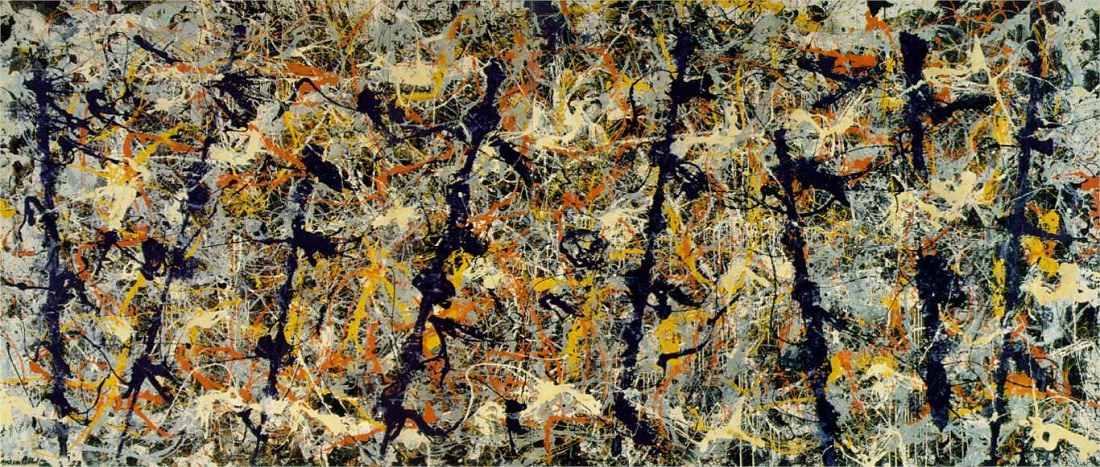
    Giles Auty considers the purchase of Jackson Pollock’s Blue Poles by the National Gallery of Australia in Canberra in 1973 and what such an acquisition signifies.

    A few months back, a rash of articles appeared in the press which commemorated the dismissal of the Whitlam government thirty years ago and commented on the continuing sense of grievance felt by his supporters. At the time, I wondered how much more could usefully be written on the subject.
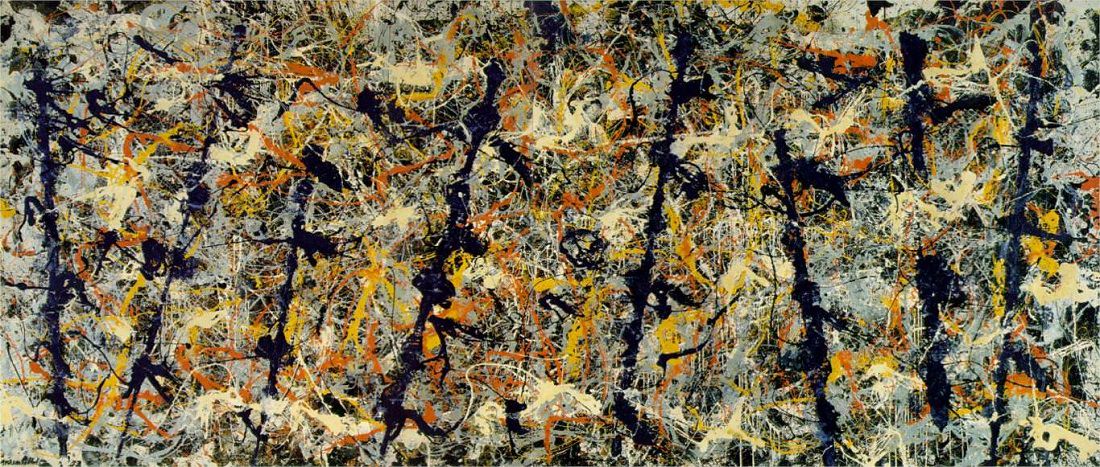
    By contrast, an event of almost equal notoriety if not importance had taken place in Australia some two years before the dismissal which has never been explored or explained satisfactorily. I refer to the purchase of Jackson Pollock’s Blue Poles in August 1973 by what was then called the Australian National Gallery.

    In the ten years that I have lived in Australia so far, I have often heard the view expressed – in leftist circles especially – that the buying of Blue Poles provided a catalyst for Australia’s cultural coming-of-age. According to this received wisdom an increasingly confident nation – inspired by the leadership of Gough Whitlam – not only bought itself a wonderful work of art but an outstanding bargain at the same time.

    Many might feel disappointed if neither of these facts proved true. Indeed, until the significance or otherwise of the painting itself and the circumstances surrounding its purchase are dragged belatedly into sharper focus, Blue Poles may yet prove to have been a hindrance to the attainment of national cultural maturity rather than the reverse.

    Perhaps the first part of the myth to dispel is that Australia plucked an outstanding bargain from under the noses of older and more established museums overseas. What Australia really seems to have done is buy itself a monument to a formerly fashionable but highly questionable notion of artistic progress. Indeed, no sooner had the painting arrived here than this notion found itself the subject of increasingly vocal international critical attack.

    To put it another way, Blue Poles could be said to represent a kind of last hurrah for an outdated and weirdly monolinear conception of the evolution of art. Indeed, by the time Pollock had painted it, he and his friends were openly declaring that painting had “nowhere left to go” and could be followed henceforward only by “performance” art.

    I will return to this issue of evolution a little later. For the present, I should begin perhaps with a subject which seems to grab public attention much more readily than the vested and supposedly insoluble issue of artistic merit. In short, how much exactly is the damned thing worth?

    Guesses – and that is all any of them are – about the current market value of Blue Poles range from US$20 million to a highly improbable US$100 million but the accuracy or otherwise of these guesses cannot, of course, ever be tested unless the work is offered for sale. At the time of its purchase in 1973, the price paid – US$2 million – represented only A$1.3 million.

    So if we take US$20 million as a realistic starting point for the current market value of Blue Poles, it becomes apparent that it has increased in value by at least ten times during the thirty-three years Australia has owned it. However, this by no means represents the greatest recorded acceleration in its market value. In 1953, three years before Jackson Pollock’s untimely demise, the American dealer Sidney Janis sold Blue Poles to Dr Fred Olsen for $6,000. But shortly after Pollock managed to kill himself and one other by driving when unfit to do so, Ben Heller – another American dealer – was prepared to pay $32,000 for the work.

    In art, nothing can compare with death as a means of jacking up market prices. But if we take 1953 as our starting point, the next twenty years, culminating with the purchase of Blue Poles for the Australian nation, saw its price rise by a giddy 166 times. Even in the sixteen years after Heller bought it its market price rose thirty times. In other words, the last thirty-three years have witnessed a sharp slowing down of the rate of increase of its supposed market worth.

    I am tempted to suggest that if the Australian National Gallery had forked out US$2 million in 1973 on purchasing housing in the Canberra area – in preference to Blue Poles – the gross return on its investment might well have been greater. Yet the notion that Australia made a uniquely inspired purchase in monetary terms is only part of a greater myth which continues to surround Blue Poles. Surely no less to the point is whether Blue Poles really is an outstanding work of art.

    Where might we turn for informed opinions? What about starting with the artist himself? In Florence Rubenfeld’s biography of the American art critic Clement Greenberg (Clement Greenberg: A Life, 1997) we have Greenberg’s word that Pollock himself considered Blue Poles “a failure”. But Greenberg, who was probably Pollock’s most consistent supporter, was even more dismissive, declaring unequivocally that Blue Poles was “an absolute failure and a ridiculous thing to buy”. This comment is reported in Patricia Anderson’s biography of the late Elwyn Lynn, Elwyn Lynn’s Art World (2001). Lynn was my predecessor as art critic for the Australian.

    But Blue Poles did not lack professional supporters at the time of its purchase. Indeed yet another former art critic for the Australian, whose tenure there (1972–84) comfortably exceeded my own, certainly did not share any of Pollock’s or Greenberg’s misgivings about Blue Poles. Writing in the Weekend Australian of August 25th, 1973, Sandra McGrath evidently preferred the enthusiasm shown by New York-based Australian art dealer Max Hutchinson – who personally brokered the sale of Blue Poles to the Australian National Gallery – to the reservations expressed by Pollock himself and Greenberg.

    Dipping deep into her handbag of superlatives, McGrath proclaimed that “the purchase of Blue Poles is the most momentous event in the cultural history of Australia” and “Jackson Pollock is … the artist whose work made it impossible for painting ever to look quite the same again”. Max Hutchinson proposed that “Blue Poles, along with Picasso’s Guernica and Monet’s waterlilies, is one of the five or six great works of art painted since the Renaissance”. Perhaps embarrassed by the enormity of her colleague’s claim, McGrath nevertheless chipped in with “it is certainly one of the five or six great paintings of the twentieth century”.

    These are certainly extravagant claims which cannot begin to be taken seriously unless both Hutchinson and McGrath were known to have an unusually encyclopaedic grasp of art history. This would certainly be unusual in the case of a dealer. If I had been working here at the time, I would have been keen indeed to ask Mr Hutchinson which particular artists he would have picked to fill his last two or three available slots as producers of “the five or six great works of art painted since the Renaissance”.

    The task of choosing between the lifetime productions of the likes of Caravaggio, Velazquez, Rembrandt, Vermeer, Veronese, Tiepolo, Goya, van Gogh, Cézanne, Manet, Matisse and Picasso – to name just a handy dozen – would certainly be a daunting one even for someone thoroughly familiar with the greatest works of all twelve.

    An altogether more sensible question might be whether Blue Poles could be said to rank even in the top five or six of Pollock’s own productions. On the basis of the definitive exhibition of Pollock’s art I saw when it was staged by the Tate Gallery in London in 1999, I would argue that it could not. I imagine that a number of other professional commentators who are similarly familiar with Pollock’s work would agree with me.

    Yet evidently most of those who gawp daily at Blue Poles on the walls of what is now called the National Gallery of Australia cannot be expected to share this degree of familiarity with Pollock’s work. Indeed, few members of the public who have seen Blue Poles at that venue will ever come face to face with any other work by Pollock. Unavoidably, therefore, most members of the public will be largely reliant on hearsay and the fact that the work is seemingly legitimised by where it hangs in forming any conclusion at all about its merits.

    In the event, the fact that anything hangs on the walls of the National Gallery of Australia or on those of the principal galleries of Australia’s states should not be looked on as any guarantee of anything, since all have proved pretty fallible at times in their buying policies.
    As recently as 1999, for instance, the National Gallery of Australia made a colossal error of judgment not just by buying David Hockney’s huge (744 centimetre) and weakly conceived A Bigger Grand Canyon but by paying a grossly inflated price for it (over A$4 million). No less to the point, that same institution only months earlier had turned down the chance to acquire a truly magnificent giant landscape (810 centimetre) by a home-bred artist. This was William Robinson’s Creation Series: The Ancient Trees, which also carried a rather more realistic price tag of A$250,000. (For more about William Robinson see http://www.ogh.qut.edu.au/wrgallery/past/realms.jsp.)

    What I am suggesting with regret is that the standards of judgment shown by Australia’s national and principal state galleries are frequently inept. Generally this is because judgment is skewed by predilections for fashion and temporary fame and because curators and directors have managed to persuade themselves somehow that novelty must be a virtue in itself.

    The reason why the latter trait has become so firmly entrenched deserves urgent investigation. My own explanation centres on the insidious role played by what I call “the rhetoric of radicalism” in creating current and recent artistic climates.

    Rhetoric, as we know, describes language designed to persuade or impress. Its natural habitat is politics and advertising but, in both of those fields, long acquaintance has led intelligent minds to recognise its nature and dilute its effectiveness. Regrettably, the full toxicity of such language still takes effect in areas where the ubiquity of its use remains unrecognised. In no area is this truer than in the visual arts.

    The twentieth century, which was dominated by modernism in the visual arts, saw the rise and fall of about forty readily identifiable and supposedly significant art movements in the Western world alone. Can there really have been an art movement for every two and a half years of an entire century? No other hundred-year period can even begin to compare with the twentieth century in this regard. And who today, other than specialist art historians, can give an accurate account of what Orphism, say, or Rayonism were? Yet in their heydays many people believed wholeheartedly in the significance of both movements.

    So what was it precisely that first led to the obsession with novelty in art which has never gone away?

    Though few seem to have made a serious effort to define what does or does not constitute modernism in any of the arts, its most evident and unifying characteristic clearly has to be rejection of past ideas and practices. Indeed, if such rejection is absent we are not really talking about modernism at all. For a modernist label to apply, the break with past practice has to be total.

    Thus when, at the conclusion of the First World War, Picasso – whom many might consider the epitome of the modern artist – embarked on a series of neo-classical works as an oblique tribute to Renoir, his erstwhile collaborator in Cubism, Georges Braque, was quick to accuse him of “betraying modernism”.

    From the outset, modernism in art, which liked to portray itself as a liberating force, had its own rigid set of prohibitions. In short, modernism’s paid-up followers were free to do anything they chose with the exception of maintaining any overt links with a pre-modern past.

    Two linked factors underlay the seemingly inexorable elevation of formal radicalism in art to a position of effective dominance. The more obvious of the two was the conscious or subconscious but ultimately unjustified connection many people made naively between the evident and very real advances which were taking place in other, unrelated disciplines – in medicine, say, or powered flight – with what was happening in art roughly at the same time. Yet the less obvious of the two factors was certainly no less influential. This was the way radical practices in the arts – taking their cue from technology – first attracted to themselves and then virtually annexed a wholly favourable rhetorical language.

    In short, to situate oneself on the side of what many claimed was “inevitable” progress – or advance, development, evolution, breakthrough or “fearless” experimentation – was to place oneself, rhetorically at least, fairly and squarely in the camp of the angels. By seizing for its own purposes the positive, propagandist language associated with claimed progress in other fields, modernism in art ensured for itself for the foreseeable future a very unlevel playing field wherein even the most acute and perceptive criticism could be dismissed airily as conservative, reactionary or – worst of all perhaps – as being “opposed to progress”.

    Carried away by its borrowed rhetoric, the elementary truth that modernism chose to ignore here is that there are two equally vital traditions and sources of influence in art – as well as in all other aspects of human behaviour – the radical and the continuous. Perhaps the most damaging legacy of modernism has thus been the part radicalist rhetoric has played in obscuring so obvious a truth from so many for so long. To cite merely one obvious example, it would be impossible to be wholly modernistic or radical in one’s ideas and at the same time be a committed Christian. Christianity antedates modernism by a little matter of 1900 years and thus is part of a continuous tradition.

    Perhaps the most apt parallel one might find for modernism is Marxism, since both, in a sense, attempted to rewrite history by subverting and stamping out existing ideas and practices. Although both ideologies had their roots in nineteenth-century thinking, neither came to full flower before the first and second decades of the twentieth century. Both also held out explicit or implicit promises of the future triumphs which would attend their causes: the final victory of the proletariat and a kind of artistic apotheosis which would mark the culmination of the oddly one-track model of artistic evolution which modernists favoured.

    There is little doubt that it was this kind of crowning achievement which the modernist faithful believed they discerned in the subconsciously-driven “action” paintings of Jackson Pollock. It is this apotheosis, rather than a fairly incoherent mass of paint which attempts to redeem itself through the use of unusual vertical bars, which all of us are supposed to see when gazing at Blue Poles.

    Yet I doubt whether even one in a hundred visitors to the National Gallery of Australia has the least inkling of this. Indeed, I am reminded of a comment made when Blue Poles was first revealed to an expectant Australian public: “I had rather hoped it would be bluer.”

    When Australia managed to “beat down” Ben Heller in 1973 from an asking price of US$3 million to a “bargain” price of $2 million, both figures were plucked strictly from fantasy-land. As expatriate Australian art critic Robert Hughes remarked somewhat sourly when delivering the Harold Rosenberg Lecture at the University of Chicago in 1984: “My fellow countrymen were rather proud of beating Ben Heller’s creative asking price down from $3 million. Nobody had even thought of asking so much for a Pollock; but of course the market gratefully rallied behind this heroic example and every Pollock in the world quintupled in price overnight, thus enabling the National Gallery of Australia to announce that Blue Poles was really cheap …”

    Clearly the National Gallery of Australia has a vested interest in maintaining its self-created myth of prescience and inspired financial acumen in the matter of Blue Poles. But surely the time has come now to put the merits or otherwise of the painting itself into some more credible perspective.

    What is basically wrong with the Pollock is also what is wrong with the arguments for modernism themselves: to wit, to suggest that the narrative of Western art should be read as a kind of art-historical relay race which culminates in the death of painting simply because there are no more apparent avenues of novelty left to explore is both spurious and infantile. If a map of modernism is largely a chart of cul-de-sacs then the time has come to admit this.

    Jackson Pollock, despite his long history of alcoholism and failed attempts at remedial therapy, had a much more cogent appreciation of the dangers of artistic dead ends than that shown subsequently by his apologists. Blue Poles belongs to a period of his work of which the artist himself had grown weary. In fact, the type of “all-over” abstract painting to which Blue Poles broadly belongs occupied only a relatively brief interlude even within the parameters of Pollock’s truncated career. Ample evidence exists that if he had lived longer he would have worked very differently. Before and after Blue Poles and the short era of other poured and dripped paintings, Pollock’s work featured a variety of clearly recognisable imagery drawn –  or perhaps wrestled – from his troubled subconscious.

    Pollock taught himself to pour and drip paint with a singular, highly developed and concentrated skill and in so doing successfully sidestepped the relative clumsiness of his more directly manual mark-making. As Robert Hughes remarked in 1982, Pollock “was by no means a natural draftsman and his best paintings of the early forties … are set down with earnestness by no graphic facility”.

    No one with any knowledge of the subject would deny that there is a validity of a kind in abstract painting and that attempts to resolve wholly abstract works seem to bring into play processes of “pure” intuition which can be extraordinarily exhilarating for the artist involved. At times the artist’s hand seems to be a direct conduit for unknown forces; out of the blue, the receptive artist suddenly feels a “need” for a small, bright yellow, triangular shape near the top right hand corner of his canvas …

    But the question remains as to whether such a process can genuinely be said to mark the culmination of all the centuries of much more deliberate-seeming and humanistically relevant painting which had gone before. Then, too, there is the matter of the belief that modernists hold that the history of art should be read largely in the light of the supposed contributions earlier artists made to a process which culminated in “total” abstraction. Major artists as various as Whistler and Turner are regularly recruited posthumously – and thus involuntarily – to this cause.

    As someone who sees the history of art as seamless, I would argue strenuously against both of these propositions. Let us imagine for a moment that I am stood simultaneously in front of Blue Poles, Titian’s The Flaying of Marsyas (1570–76), The Surrender of Breda (1634-35) by Velazquez, and Goya’s Fantastic Vision (1819–23) – to cite merely three points of comparison from thousands available – could I put my hand on my heart and say I see Pollock’s painting as an “advance” on the other three? The simple answer is I could not, and suspect that many others who are familiar with all four works would agree with me.


    The big problem here from the point of view of the Australian public is that any such exercise becomes harder to imagine because of the relative inaccessibility of major works by earlier generations of European artists. Two of the four paintings I have cited can normally be seen only in Madrid while a third, by Titian, is more inaccessible still.

    It seems to me the whole notion of modernism and modernistic “progress” can survive only in a kind of vacuum where all evidence of the staggering artistic feats of the past is deliberately ignored, or misunderstood, or expunged from memory, or – as is the tragic case of Australia – is largely unavailable for assessment. To believe Blue Poles is one of “the five or six great works of art painted since the Renaissance” – as Max Hutchinson averred – can stem only from infantile delusion or utter unfamiliarity with the world’s great collections of art.

    As I suggested earlier, ignorant idolisation of Blue Poles locks Australia into a situation of cultural backwardness which only the conscientious teaching of art history and compulsory visits to the world’s great collections of art could even begin to address.

    The basic reason why I do not believe Blue Poles represents any kind of qualitative advance on the three paintings I chose above, more or less at random, from three earlier centuries, lies beyond anything in its incoherence and self-absorption. I cannot imagine for a moment that Titian, Velazquez and Goya would ever have believed that a day would come when simply dribbling or pouring paint onto a support might be looked on as a worthwhile end in itself.

    The very late Titian I have chosen, painted between the artist’s eighty-fifth year and his death at ninety-one, is extraordinarily expressive and free yet also brilliantly considered in the way it organises seven figures and a dog in portraying a terrifying subject from pagan mythology. The degree of imagination shown is stupendous, as it is in the relatively early Velazquez I have cited, painted when the artist was just thirty-five.

    The huge Velazquez, which chronicles an actual historical event, is no less brilliant in its organisation of multiple figures, landscape and complex sky. The clarity, painterly intelligence and graphic skill shown are similarly staggering. How can an incoherent mass of marks by Pollock, covering roughly the same surface area as the Velazquez, possibly be said to compare with it?

    Regress, rather than progress, leaps to mind here, yet the great claim made by Pollock’s apologists is that he “went beyond” Velazquez’s fellow countrymen Miro and Picasso. But was the direction in which Pollock supposedly “went further” ever remotely worth travelling? In my experience this is just the sort of question which modernists avoid.

    From quite an early stage Pollock’s art was rooted in the subconscious yet contributes nothing in particular to our knowledge of the subject. Contrast this with the intriguing, metaphysical nature of Goya’s Fantastic Vision, which features two flying figures – or witches – who are being shot at by earthbound soldiers. One of the flying figures gestures towards a citadel on a hill. Although fantastic, the scene is hauntingly credible, like a miraculously direct delineation of a meaningful dream.

    I do not wish to single out Australia as displaying anything nationally unique in the way of uninformed artistic attitudes. Without intelligent programs of education, confidently pursued, ignorant artistic attitudes are more than likely to be internationally widespread.

    As some small evidence of this, the following conversation took place recently in Britain between David Lee, an art historian and admirably forthright art critic, and someone who sounds like a youngish if invincibly opinionated artist. The conversation was reported in the July-August 2005 edition of The Jackdaw, a newsletter for the visual arts edited by Lee: “During a recent meeting I received a damn good ticking off from an artist. “Art can’t stand still,” she asserted as though rote-repeating a Commandment. “We have to progress and move on.” “Move on?” I enquired, baffled. “Where to?” She believed it to be an incontrovertible truth that in order for a work of art to be taken seriously it had to “progress” beyond what had been done before. If it didn’t it wasn’t worth registering; indeed to repeat what had already happened was in her eyes scarcely less than a crime. I told her I had no idea what she was talking about and that her conviction that only “the new” could be important or enjoyable played no part in the way I looked at or interpreted any kind of art past or present.”

    This conversation epitomises the worrying way in which the basic thoughtlessness of the classic modernist standpoint continues to remain entrenched. In saying that, the sentiments expressed by the young artist could be encountered just as easily at the Australia Council or National Gallery of Australia. I intend no particular disparagement to either body. As is clear from the confidence of the young artist’s attitude, she feels – so far as art goes – that the idea that novelty is automatically a virtue in itself has been legitimised sufficiently to make further debate unnecessary. In pursuit of this notion, it may be instructive to look at the kind of means which first seemed to legitimise and thus institutionalise such an idea. I quote from Herbert Read, who later received a knighthood and was a highly influential figure in promoting the basic precepts of modernism not only in Britain but internationally. The words are taken from Read’s A Concise History of Modern Painting (1959), a

    book which for decades was not merely a standard textbook but also something of a bible on art history courses. The author explains why he has excluded various highly respected artists from his book: “For a similar reason I have excluded realistic painting, by which I mean the style of painting that continues with little variation the academic traditions of the nineteenth century. I do not deny the great accomplishment and permanent value of the work of such painters as Edward Hopper, Balthus, Christian Bérard, or Stanley Spencer (to make a random list); they certainly belong to the history of art in our time. But not to the style of painting that is specifically “modern”.”

    The crucial point to note here is that, of the two legitimate and commonly encountered meanings given to the word modern, Read chose style and attitude rather than period as the basis for his exclusions. Thus artists who are clearly – and unavoidably – modern in other respects, such as Hopper and Balthus, are excluded solely on the grounds of style, thus effectively making formal radicalism the most important index of quality whether for inclusion in Read’s own book, a “modern” collection or a “modern” museum.

    Read, of course, was not solely to blame for what has subsequently happened. Yet, as a direct consequence of attitudes like Read’s, there is not a single painting by Edward Hopper in a British public collection and only one damaged example by Balthus. In short, we see how easily one of the two great traditions in art – the continuous – was effectively marginalised and banished. By contrast to the treatment of Hopper and Balthus – two of the great figurative artists of the twentieth century – by British public galleries, even the most inconsequential and third-rate artists from overseas have been collected avidly and in depth for British public collections provided only that they met with Read’s canon of style.

    A further, contributing factor to a profoundly unsatisfactory state of affairs is that it has been widely believed by the unthinking that endless formal novelty was inexorably dragging art onward and upward to some unspecified apotheosis. Indeed, that is what the “rhetoric of radicalism” has been consistently promising all of us but which has, of course, never been fulfilled.

    The meaning we attach to the word modern is vital to the future of art; in short, contrary to what modernists believe, novelty of style and attitude is not and never can be a virtue in itself in art or in any other area of life, since all change can always just as easily be for the worse as for the better.

    Such a point ought to be self-evident philosophically and – if you are tempted to doubt me – ask yourself whether you believe that radical moral behaviour is automatically superior to established moral codes.

    Sadly for the health of our culture, the fallacy inherent in what I describe as the “novelty trap” has been welcomed and endorsed by almost any cultural body you can think of and most notably, of course, by our Western “modern” museum culture itself.

    What is wrong with such culture boils down, as I have suggested already, to a harmfully erroneous idea of what modern ought to be held to mean in relation to the arts. In fact, the meaning we attach to the word needs to be entirely neutral – that is, favouring neither radicalism nor continuity in art over each other. In order for this to happen, the meaning we give to the word modern in such a context has to relate solely to period and nothing else.

    I sense that such a fundamental change of emphasis would be favoured not only by most interested members of the public but also by a majority of working artists of all kinds. In short, it is in the interests of only a small – if extremely vocal – minority to try to sell novelty in any of the arts as an automatic virtue.

    Imagine for a moment what might have happened if all the publicly funded art galleries in the world which have collected the art of the past 100 years had been obliged by their charters to deal even-handedly in their collecting policies between art which reflected the best of the continuous as well as radical traditions. One certain result would be that the art on view would be much more varied and interesting – as well as less inaccessible and irritating, on the whole – to those who are obliged, whether they like it or not, to fund such institutions through their taxes. I am not advocating anything which could be described as a greater degree of populism here. Proper standards of achievement should be demanded of those who work in more traditional and continuous ways just as they should be – but frequently are not – of those who flirt consciously and often for advantage with the latest fashions.

    The storerooms of Australia’s state and national galleries are full to overflowing already with embarrassingly ephemeral art “bought in haste and repented at leisure” by curators, committees and directors who have convinced themselves that novelty must be a virtue somehow, especially where works lack any other obvious merits. Another instant and highly beneficial effect of my suggested change of emphasis would be on art education. Artists desperate to learn time-honoured skills would no longer need to feel disadvantaged academically – as they certainly do now – or in terms of their subsequent careers by not being at the “cutting edge”. Indeed, as an absolutely typical example of the tiresomely familiar “rhetoric of radicalism”, expressions such as “cutting edge” are overdue for permanent banishment – along with the entire delusion in art of modernistic “progress” itself.

    In relation to Blue Poles, imagine the relief of many who might no longer feel any obligation to see in it qualities which were never there, but to view it rather as an interesting example of a formerly fashionable way of regarding the evolution of art, once promoted vigorously by an American cultural establishment desperate to create credibility for itself.

    To those fortunate enough to be familiar with the greater history of art, both Blue Poles itself and the whole, aberrant notion of “total” abstraction in art will continue to appear as very small blips on a very large screen. For the rest, a serious attempt to get the history of art into some kind of focus represents an ideal starting point for showing genuine concern for the future of art in this, or any other country.

    This article first appeared in Quadrant, a literary and cultural journal published in Australia (10 issues a year): https://quadrant.org.au/

    Giles Auty

    The Jackdaw March-April 2015