Tag: Reith Lectures

  • Brian Sewell (1931-2015)

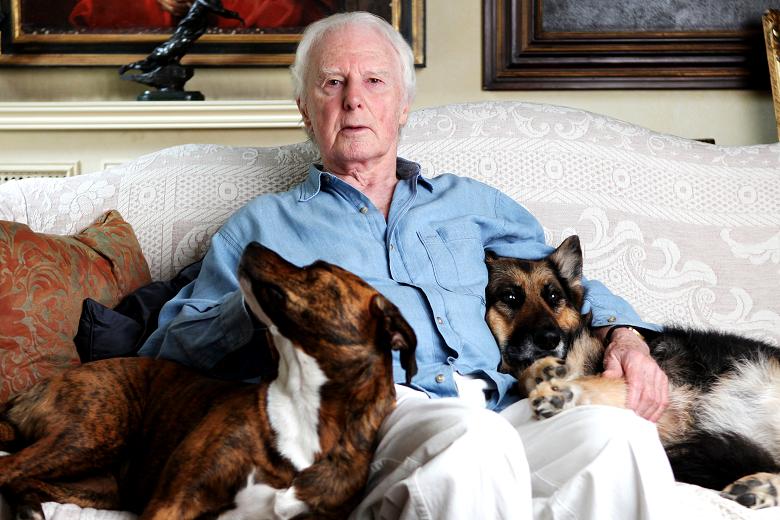
    beautifulbrianwithdogsIt isn’t my intention to repeat the tediously familiar stories peddled by obituarists relating controversies which Brian’s inclination to mischief and provocation helped encourage. Instead I want to address two issues unconsidered elsewhere: his astonishing generosity and the disgraceful but typical hypocrisy of the BBC towards him. Brian was a working man. He called himself ‘working class’, a description some dismissed as affectation. It wasn’t. Like his commuter readers he needed to work in order to survive. Neither was he rich. Nevertheless, he still donated liberally to promising but needy art history students and charities, in particular those dealing with homelessness and the welfare of animals, and he encouraged friends to do the same. Equally, buying work from promising youngsters in order to get them started was to him a duty. He was also selflessly free with his time, knowledge and contacts. When he was your friend you felt it.

    In early 2000 I quit editing Art Review, for which Brian had contributed many superb pieces on 20th century art’s main figures and which always arrived in uncorrected typescript as though having emerged perfectly like a Mozart manuscript. He telephoned and asked me what I would do now. I told him that I was devising the inaugural issue of The Jackdaw, which would continue the opposition to State Art’s absurd and damaging monopoly I’d begun only tentatively (for commercial reasons) at Art Review. He mused a second and said that to give such a venture any chance of long-term survival it would be very expensive. I disagreed, arguing that I could keep costs down by not employing anyone, including myself, or renting an office and having poncy stationery. I’d tried to raise investment for the idea but no one took the bait. The next morning I received in the post from Brian a cheque for £10,000. This staggering act of generosity and confidence was undeserved and his insistence I accept it terrified me. I told him I’d pay it back as soon as I could. Circumstances – including my unique hopelessness as a capitalist – meant that it took me thirteen years to honour my words – thirteen! – and only then as a result of an unexpected legacy. It was a relief to be able to redeem the debt not least because, in consequence of a change in the Standard’s ownership leading to revised employment conditions for the staff, Brian was having to do the same work for a fraction of what he’d formerly been paid. He needed the money. But never once in all those years did he raise the subject of my debt let alone ask for it to be repaid. And, of course, he refused any interest on the grounds that, as he wrote to me, ‘my failings are many but they do not include usury’.

    Without Brian The Jackdaw would not have survived beyond a handful of issues. I don’t think many who follow the terrain would disagree with the assessment that, of all his contemporaries in art criticism, in art historical terms he was easily the most knowledgeable. Given his ability to speak clearly and articulately – without artbollocks (which he always pedantically insisted to me should be properly spelt artballocks) – and because of his reputation as an elegant and amusing essayist – don’t forget he won both the Orwell and Hawthornden Prizes – he was hurt by the fact that Radio 4 never once asked him to appear in a review role on either of its main art programmes, Front Row or its predecessor Kaleidoscope. The list of waffling no-hopers in art criticism those programmes have employed would fill pages, but they never asked him. He would never have admitted it publicly but this omission hurt. What a surprise then that not six hours after his last difficult breath, his death made the main BBC news where he was lauded as an influential leading critic, blah blah. If they thought this was true why did they so rarely use him? The answer is simple. The BBC’s programmes, which in the visual arts are uncritical advertisements for their subjects, are willing promoters of the disgraceful sewer that is State Art, about which Brian held damning views. Over the years he suggested many programmes, all rejected. It speaks volumes that the BBC asked Grayson Perry to give the Reith Lectures, but not Brian. Of all the many independent voices we never hear, his cruel neglect in particular demonstrates that in visual art you will be marginalised unless you toe the establishment line.

    David Lee

    The Jackdaw November/December 2015


  • Grayson Perry’s 2014 Reith Lectures – a missed opportunity

    Patrick Cullen explains why Grayson Perry missed an opportunity by avoiding the important issues he claimed to be addressing.

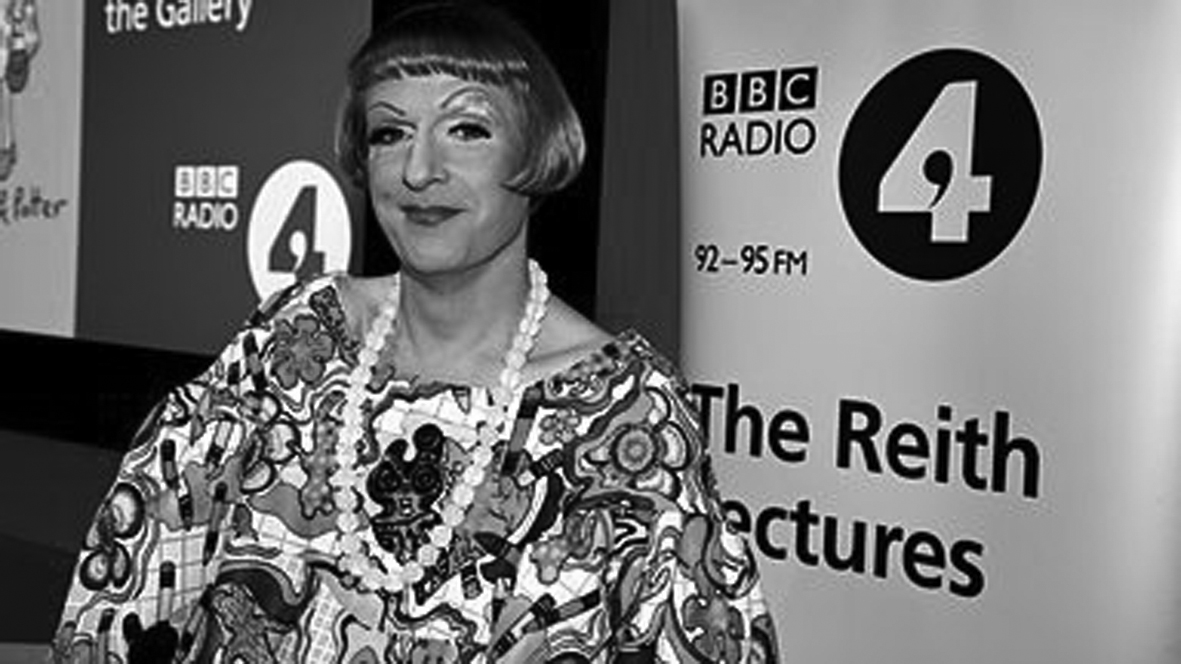
    Grayson Perry was a surprising choice to deliver the Reith Lectures given the list of senior academics, elder statesmen and those at the top of their profession preceding him in the job. One wondered why, when it came to contemporary art it was decided to break with tradition and hand the spotlight to one of its middle ranking practitioners with no track record as an intellectual heavyweight. But many enjoyed the change. Think of the Reith lectures and people tend to think dry, dull and probably pompous to boot. With his pantomime outfit and, in the second talk, brandishing a whip, Perry was anything but boring. The jokes came thick and fast, the lectures were even called “Playing to the Gallery”. Perry may be no John Berger but he’s a lot smarter and more articulate than all those YBAs he is keen to distance himself from. What we lost was any sustained argument about the nature of contemporary art, what justifies it as art and why. More than anything Perry reminded me of a court jester, clever enough to make his audience laugh and to tease the powers that be with the odd dig, yet never forgetting that he is part of this modern day art circus which has been very good to him. He acknowledged this at several points, in a humorous self– deprecating way, encouraging others to join this world that even allowed him, a transvestite potter, into its ranks. A classic court jester moment came in the second lecture (he was even wearing what Sue Lawley described as a jester’s hat). He teased Nicholas Serota (who was in the audience) about the often expressed criticism that Serota’s personal tastes are determining to an excessive degree the nation’s purchases of contemporary art. “Impossible” said the Fool leaping to his King’s defence, he had been to Serota’s home and admired his extensive collection of Cliff Richard memorabilia. It was a swipe but a pretty gentle one.

    Lecture 2 was supposed to be the one where Perry really addressed what art is and what it isn’t and especially the boundary lines between the two. Introducing it Sue Lawley said “Today’s lecture will explore what the boundaries of art are. Can it really be anything we like from a pile of sweets to a soundscape?” This is difficult territory for any contemporary artist wanting to be seen as contemporary. Ever since Duchamp and his urinal the idea of trying to define art by putting boundaries round it has seemed increasingly old fashioned. Perry began by admitting that if you asked people in the art world to define art “there’d be a lot of eye rolling and sort of like – Oh God! – you know – Not that question again. Like it’s been answered … You know there’s a kind of complacent idea in the art world that anything can be art now… We’re in a state now where anything goes… But the thing is I think there are boundaries still about what can and cannot be art…”  I was beginning to warm to his theme. If the art world complacently thinks anything can be art, but Grayson doesn’t agree, perhaps he was going to tell us what those essential qualities are that distinguish art from the merely banal and common place. He informed us that he wanted to establish the boundaries of art a bit like in mediaeval times people marked the territory of their parishes by a primitive process called “beating the bounds” (the title of this 2nd Reith Lecture). Hence the whip.

    Just prior to listing what he saw as the boundaries beyond which things ceased to be art, he paused to imagine how “his friends in the art world” would laugh at him for wanting to establish the limits of art. “But,” parried Grayson rather pathetically, “I want to know when to put my art goggles on. I want to know when – you know – when I’m going to look at something as if it’s art”. This was quite a confession. Only by knowing when to put his art goggles on would he be able to start looking at something “as if it’s art”. The idea that real art might just possibly have the power to announce itself as art because it moved you, took your breath away, was amazingly beautiful or wonderfully thought provoking was not considered. No, Grayson needs to know when to put on his art goggles or he’ll be unaware of what’s in front of him, rather like all those museum sheep who have no idea how to judge a painting unless someone is distracting them via headphones with a lot of facts to reassure them that what they are looking at is indeed important art. I don’t believe for a moment that Grayson Perry is so insecure about his responses to art, so perhaps it was just a cleverly timed piece of humility to allow the audience to identify with him, for in all probability many of them would have been part of “ the headphones brigade”. Now, brandishing that whip, he would tell them how to recognize this thing called art, which even he has difficulty spotting without some special goggles. “Afterwards,” he assured them to much laughter, “you might know when you’re looking at a work of art and not just at some old rubbish”. There would be nine boundary markers or tests to help them in this task.

    Test number one: “Is it in a gallery or an art context?” LAUGHTER. Well, you had to laugh. It’s the equivalent of saying, a few decades ago perhaps, “if you’re not sure if it’s art, has it got a big gilt frame round it?” Or try this one: How do you know if someone is a criminal? Helpful test: are they in a prison? It might just have been an initial bit of farce before the more serious stuff, if so many of his other tests hadn’t turned out to be in a similar vein. Yes, statistically, pieces of visual art are quite likely to be found in art galleries – surprise, surprise – but this tells you nothing about what makes them art, or how to distinguish them from the things in art galleries that aren’t art.

    Test number two: started off as “Is it a boring version of something else?” This might have led into whether art has to be original which would have been a serious line of inquiry, but he left off before he’d started on this one and it morphed into…

    … Test number three: “Is it entertaining? If so it may not be art because art is a serious business.” Perry immediately mocks this test, telling us that it reminds him how the worst thing you can call an artwork is decorative – a bit of a leap that, but no doubt this is a jibe he must at some time have had to contend with himself, unfairly in my view. Then he says: “I think it’s a very noble thing to be decorative”. So we got a glimpse of Perry’s differences of opinion from the dominant art world views on what is proper art. Prejudices he has encountered as a mere potter being another one he touched upon. But these differences featured very little in this light-hearted tour of the contemporary art world’s boundaries. He pursued the idea that a sense of dullness and lack of pleasure, (he cites all those video installations with uncomfortable benches to sit on), might be a sign that we are looking at art. This clearly struck a humorous chord with his audience, but it was beginning to feel like a very unenlightening way of teaching us how to know if a piece of contemporary art merits that appellation. Was it all going to be jokes?

    Test number four: “Is it made by an artist?” This is clearly of no use either since it begs the question of what an artist is. If an artist is defined as someone who makes art but we haven’t yet establish what art is, looking for artists means we’re just going round in circles. Perry offers no new definition of an artist to help us out. Reading between his lines it looks like artists are people that this cosy art world he delights in belonging to, recognizes as artists. These boundaries, far from revealing anything, were beginning to sound like the already established parish boundaries of the self same art world whose judgements about art we wanted Grayson to explain. But there were no explanations, just a series of markers (e.g. – it’s in the Serpentine Gallery, it’s rather dull and it’s by Cornelia Parker, a known artist, ergo it’s probably art).

    Test number five: this boundary marker concerns the question: “Is  photography art?” If Perry had made a stab at a definition of art in the first place he might have been able to say whether a photograph could fit within it. But without ever nailing his colours to any mast he could only make more jokes; e.g. a photo might be art if the people in the photo aren’t smiling. Or: it might be art if it’s bigger than two metres and priced higher than five figures. Plenty of laughs but zero insight.

    Test number six: “The limited edition test.” Another crack of Perry’s whip to indicate another boundary to this thing called art. He points out, as if we didn’t know, that if something is part of an endless edition, it loses some of its monetary value by virtue of the laws of supply and demand, and then goes on to declare that therefore “it’s giving away part of its qualification as art”. He draws this conclusion as if it were obvious and says no more on the subject. Actually it’s not at all clear why, because there is more than one of it, an object should be deemed any less a work of art. Less expensive probably, but why less a work of art? This could have been an interesting discussion and one which would have touched upon many things: the importance of uniqueness for the art world, the problem of multiples, the conflation of artistic and financial worth and the ways by which the latter is protected. The criteria lying behind Perry’s tests were turning out to be uncannily in tune with the vested interests of the contemporary art world. Since Duchamp the notion that anything can be art may well have won the day in theory, but limits and boundaries there must be in order to protect art’s monetary value. Duchamp himself, authorised a limited edition of his urinal (which was originally a standard mass produced one – and an important point about it, being that it was just that). Nearly five decades after the first urinal had been destroyed and when it had become a legendary (but, alas, unmarketable) landmark in the history of the avant-garde, Duchamp, agreed, in total contradiction to the spirit of the original, that ceramicists (i.e. potters Perry reminded us) should hand make an edition of “his” urinal, each of which he personally “validated” as art, whilst excluding all similar extant urinals. There are eleven “genuine” “Duchamp urinals”, each worth somewhere around a million quid, essentially because Duchamp waved his wand at them. (Think about the magical powers invoked here. How gullible the world to fall for such brazen sophistry!). The artificial limit placed on an edition of an art work is a classic case of how the art world establishes its “parish” boundaries for good old financial reasons. Perry probed this not one bit.

    Test number seven: “Who’s looking at it and is there a queue?” More jokes about the kind of people who go to galleries and look at art. If there are a lot of people with beards and glasses and single speed bikes……etc. If so, and if there’s a queue (contemporary art being so popular) there might be some art involved. I laughed along with the audience for I’d long since given up gaining any insight into what the intrinsic qualities are that make something art.

    Test number eight: “The rubbish dump test” Perry explains: “Throw it on a rubbish dump and if people walking by notice that it’s there and say “oh what’s that artwork doing on that rubbish dump?” it’s passed.” For a moment I thought he was on to something. May be, just may be, one defining quality of an artwork is its capacity to arrest you, make you stop in your tracks and gaze in wonder or surprise or even just puzzlement. But no, once again Perry undercut this possible signifier by another joke which got a big laugh: many good artworks would fail this test because the rubbish dump itself might be the art work.

    This time I realised I wasn’t laughing too. It was too near the truth. Yes, it was now official, from no less an authority than the giver of the Reith Lectures: there is no way of distinguishing between art and rubbish, the very thing he had promised to enable us to do. So Perry in effect told us to forget the rubbish dump test, the only one so far I thought of any use. The really sad thing about all this was that so many people – in relation to any other field of enquiry, perfectly intelligent people – thought Perry’s lectures not just funny (they were that), but thought provoking and insightful too. Also sad was the fact that Perry can express views at odds with State Art orthodoxy, but apart from his words in praise of the decorative in art, he kept them to himself.

    Test number nine: “The Computer Art Test” Grayson cracked his whip for the last time. As if knowing he’d really dodged the question with his suggestion that we drew a venn diagram of all his tests and where they met in the middle is pretty well guaranteed to be art, Grayson finally threw in a just about plausible definition of art from a friend of his called Charlie Gere. Gere says that you might be able to distinguish between a piece of web art and just an interesting website as follows: “You know it might be art when it has the grip of porn without the possibility of consummation or a happy ending” Perry then expanded on this: “In other words it’s all about frustrating our urgent need to double click our way to satisfaction whether in the form of a joke, an opinion, a fact, a sale, or indeed an onanistic experience, and to detain and suspend us in a state of frustration and ambivalence and to make us pause and think rather than simply react.”

    Well, well! Here at last, in the final gasps of his lecture, was an attempt at a definition. It begs as many questions as it answers, but at least it’s a start. Had he begun any one of his four lectures with this provocative definition he might have moved on into an inquiry about the true nature of art and why, although quite a lot of things may be art (when manipulated creatively) most things, like urinals, are probably not. At least I’ve never met one that had the grip of pornography but which suspended me in a state of frustration and ambivalence. On the contrary they tend to facilitate double clicking one’s way to instant relief in the form of a much needed bladder evacuation. Perhaps that’s why they’re not art. And perhaps that’s why all those people who claim not to know much about art but who know what they like, would at least recognise when a guy like Duchamp was taking the piss.

    Patrick Cullen

    The Jackdaw, 2014

  • Performance before content – Eric Coombes is disappointed…

    Performance before content – Eric Coombes is disappointed…

    …by the frivolity and lack of ambition and academic rigour in the 2014 Reith Lectures.
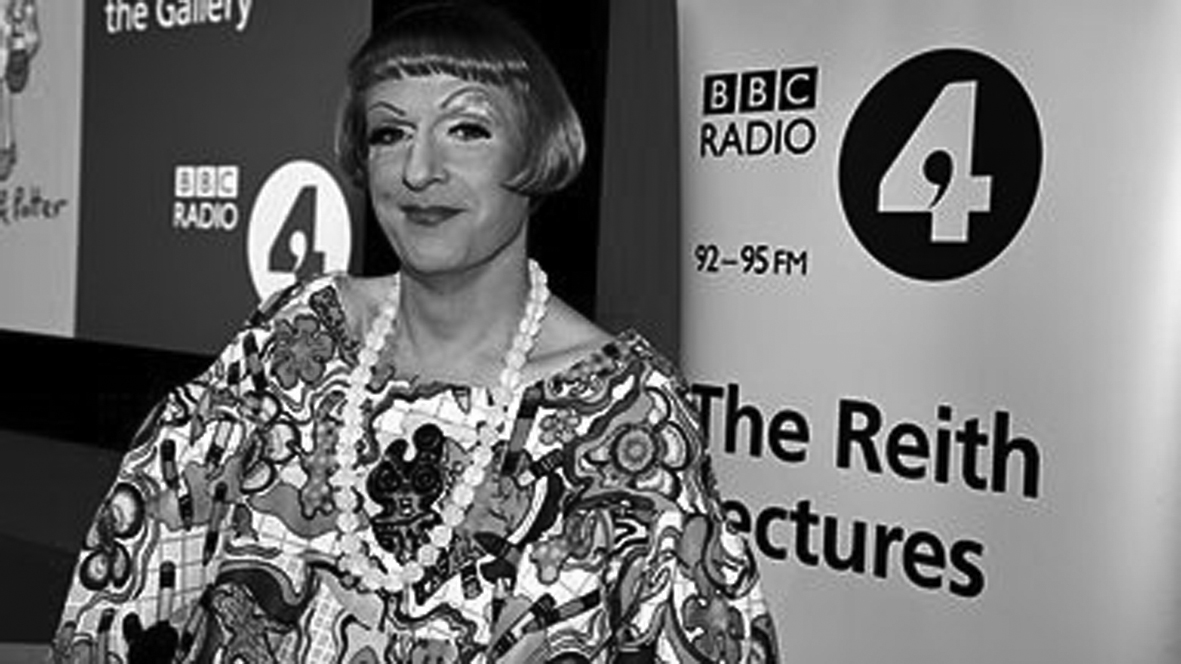
    Immediately after his predictably rapturous greeting at the first performance, Grayson Perry raised the question of why he was asked to give this year’s Reith Lectures. Well, for the first time in their sixty-six years, they were to be given by a “visual artist”. Could one imagine the BBC not to have chosen a winner of, or at least nominee for, the Turner Prize? Gormley having withdrawn a couple of years ago, how many remotely entertainable candidates lay in that small heap of the capriciously favoured? “Professor” Tracey Emin?  Damien Hirst? Even the BBC might have balked at the near-catatonic inarticulacy of a Martin Creed. But Perry vacuously claimed that his selection was explained by his being “a practising artist” – which, in reality, was not even a sufficient condition of eligibility.

    This limitation of the field of candidates was not, of course, mentioned. Does inadvertency, naïvety or cheek account for his drawing our attention to another factor a few minutes later, when he said “… anybody can have a life in the arts ­– even me! An Essex transvestite potter … the mafia has even let me in”?  As he proclaimed this, dressed and painted in a flamboyant caricature of femininity, Perry basked in the sycophantic admiration of that “mafia”, including such luminaries as Nicholas Serota. In a video clip, we glimpse the Lord Patten, laughing with respectful indulgence. Was Perry, brazenly, knowingly but deniably, mocking the ideological conformism of his audience? Far from erecting an obstacle to advancement, his ostentation of social and sexual deviance augmented his value for an establishment delighted to advertise the orthodoxy of its ideological commitment to “inclusiveness”. He is surely far too intelligent not to understand this.

    This is not to say that he was or is acting out a pretence. I have no reason to suppose that he exaggerates his compulsion to indulge in cross-dressing, either for the purpose of publicity, or to exploit the politically correct fashion that inverts the cruelty towards deviance often prevailing in the past. There is neither reason nor need to question his own account of his idiosyncrasies. But a pretence that matters very much lay in the BBC’s affecting to suppose a series of pantomime acts to be the vehicle of serious thought. There is no surprise in the corporation’s colluding with that dispiriting regime of compulsory frivolity, which everywhere imposes itself. But the Reith Lectures have had a special symbolic significance in upholding the BBC’s claim to “enrich the intellectual and cultural life of the nation”, despite the tinyness of their contribution to its total output. They constitute a significant test of the corporation’s commitment to its responsibilities. Previous lecturers have been a somewhat mixed bunch, and, as well as very eminent thinkers, the list includes some whom the criterion of intellectual integrity might have excluded. And one wonders about obvious absences, such as Isaiah Berlin or Ernst Gombrich, whether they were ever invited. Nevertheless, there seems to have been, hitherto, a serious effort to recruit serious thinkers – even if, in some cases, their seriousness might be questionable. There has, of course, been a relaxation of tone in recent years, the talks being given before live audiences and sweetened by the familiarity of their compère, Sue Lawley. But their presentation for the first time this year as pantomime suggests that the assertion of the high-flown sentiments in the foregoing quotation is the bluster of pretence.

    The background to this pantomime is the dominating cult of celebrity, which now draws everything into its moral ambit, where the very notion of an argument’s requiring an attention span longer than a five-year old’s becomes an elitist affront to the general public. With its huge resources, the BBC has not only the duty, but also the capacity to resist this dominance. The blame for the debacle of this year’s Reith Lectures therefore falls squarely on the BBC and, of course, on the state-art establishment to which it complacently defers. Perry himself, like his largely fawning reviewers, was probably unaware of how far he was out of his intellectual depth.

    What was said in the “lectures”?  Many matters connected with the visual arts – practical, sociological, financial etc. – were raised, often autobiographically, and usually flippantly. Specific observations were sometimes shrewd, but never enlightening to the undeluded; and no path of consequentiality led from one to another. Essentially, there was no argument at all, although individual points of unconsummated discussion were half identified by confused gestures. And the failure to take the slightest trouble to get things right, would – or would not that long ago – have disgraced a sixth-former.

    One illustration: In the first “lecture” he announced himself to be “very sceptical of the idea that you can find a kind of empirical way of judging quality, particularly in art”. How bizarre! Would we say of a sonnet by Shakespeare, or a painting by Turner, that it achieved “high quality”? Are these samples of a commodity? His “scepticism” amounts to doubting that there could be non-aesthetic criteria, readily and “empirically” applicable, by which to determine an aesthetic judgement. Who exactly has ever held such an “idea”? The manifest impossibility of such criteria has standardly been taken as central to the philosophical discussion of aesthetic judgement. His confusion here exemplifies a characteristic inability of the uneducated to understand that there is a distinction between empirical and conceptual questions (a distinction that may not be easy to make in a particular case). To be “sceptical” about the existence of such criteria is a little like being “sceptical” about the possibility that two plus two equals five. Since it is not the kind of thing about which further information might show us to be mistaken, it is idle to fuss about purported practical examples. Nevertheless, we should perhaps note that it would be difficult to imagine anything better chosen to illustrate his state of confusion, or his failure to get things right, than his main example of the supposed acceptance of such “empirical” criteria. This was the content of the “Venetian Secret”, a notorious hoax played on Royal Academicians in the late 18th century. But the “Venetian Secret” did not even purport to offer criteria of aesthetic judgement, being concerned only with the technique of painting.

    To the extent that a unifying theme can be discerned, it was identified in the toe-curling words of the embarrassingly unembarrassable Sue Lawley, introducing the third “lecture”.  “So far we’ve tried to assess the nature of what art is”.  Oh dear.  What is art?  A dauntingly big question one might think. Or possibly a small and unimportant question. If a genuine question at all, it is a philosophical question, and the questionability of its genuineness might itself raise philosophical questions, as could the question of whether, if genuine, it is big and grand or small but noisy.

    Such big (or small) questions have, together with their gratuitously assumed burden of objects and practices, entered and colonized the world of state art, as if the philosophy of art – or rather, one part of it, eccentrically construed – were central to, or even constitutive of, the work of artists, qua artists. It is not obvious why competence in this subject should be conferred by the practice of art, nor why it should purport to feature as central to the education of art students, as if directly relevant to artistic practice; rather than arising, if arising at all, in a complementary area of study, established to enhance the humane benefits of that education. When that still happened, these matters were sometimes in the hands of the intellectually competent.

    One consequence of the comprehensive destruction of our system of higher education in the visual arts, from which Perry emerged as a graduate, is a glut of people who deludedly suppose themselves competent in matters entirely beyond their intellectual scope. In the second “lecture” Perry asserted “anything can be art … but I think the boundaries are sociological, tribal, philosophical and maybe even financial.”  Well, can anything “be” art or not? What does that mean?  Does one and the same thing become or cease to be “art” according to whether it falls under the jurisdiction of one or other of this strange ragbag of disparate conceptual regimes? Or is this just a confused way of noticing the obvious point that what is accepted, valued or promoted may vary with circumstances or interests? In this “lecture”, Perry did not notice himself making two crucial but eminently challengeable assumptions: first, that to ask what is art is equivalent to asking how to determine whether some object is a work of art; and secondly, that such a determination would be a matter of definition, or decision procedure, to establish the boundary of a category.  Those assumptions provided Perry with his title “Beating the Bounds” and hence with his pantomime prop, a riding crop, which he brandished at intervals to signify “beating” at some supposedly significant “landmark” on the boundary of art.

    This amused an easily amused audience; but it was hardly enlightening. First: the concept of art cannot properly be considered without some attention to other arts besides the visual, even if the latter is one’s main concern. Secondly, the concept of art is a mental capacity which we exercise in certain kinds of human activity: it is not primarily a principle for categorizing objects in the world. The question of how objects are identified as works of art, if interesting at all, is interesting only if it throws light on that capacity – and that cannot be simply presupposed. And thirdly, though widely assumed, the notion that we grasp a concept only if we can adequately define a corresponding word, or precisely determine the boundary of a category, is fallacious. A distinguished philosopher suggested that it should be dubbed “Socrates’ fallacy”. With much of human life, especially in the arts, it is the central areas that matter: the boundaries are often indeterminable, precisely because their determination is unimportant.

    There is a large philosophical literature on these issues, only some of which is difficult. But the foregoing points are very simple; and although they might not occur spontaneously to every educated person, they would be encountered in the course of a modest dip into that literature, which is enjoined – one might have supposed – by the responsibility of maintaining the intellectual standing of the Reith Lectures. But Perry is not an educated person. I hope that this is not interpreted as a sneer, for I have a good deal of sympathy with him. To learn about his appalling childhood and abusive upbringing – recounted without self pity – is to admire him for defeating the power of conditions which deprived him of most of what we normally take to be needed for healthy mental growth. (I assume that the published account is essentially truthful.) Despite those squalid circumstances, he gained a place at one of the most successfully academic schools in the country, and, for a while, did very well. He is certainly not stupid.

    But these “lectures” exhibit, in some respects, the limitations of an intelligent but previously uneducated first-year student: inability to sustain argument, or even to understand what it would mean, or the need, to do so; complete unawareness of important distinctions; and so on. They also betray that ignorance of one’s own ignorance which imprisons the minds of many beginning students and prevents their progress – an imprisonment from which, of its nature, it is hard to escape, since awareness of the need to escape is absent. It is, of course, impossible here to consider why much of alleged “higher education” not only fails to deal with this problem, but in many areas actually aggravates it – perhaps by continuing that practice of systematically flattering intellectual immaturity which, especially in the arts, appears to constitute a significant part of secondary schooling. The intellectual level of this year’s Reith Lectures surely reflects the diseducation Perry received in the chaos of fraudulence which has engulfed “higher education” in the visual arts.

    And they betray not in content, but in form, the destructive effect on humane discourse of the crass utilitarianism destroying us, which can understand only linear explanations, in which everything is reduced to something other than itself – something simpler and grosser.  In his supposed tour of art’s boundaries, Perry considered not what art is, but only which “art” is most promoted, sold or otherwise rewarded, or what is, for any reason, accepted as art. (And if this is held to be a false distinction, then that needs to be argued.) He was, perhaps, not so much the fraudster in this ridiculous pantomime of pretence, as the contentedly defrauded – the victim of what we laughingly call “higher education” and of the BBC’s irresponsible frivolity.

    Eric Coombes

    The Jackdaw, 2014