Tag: Arts Council

  • Charles Thomson: Lies, Damned Lies and Serota at the BBC

    Sir Nicholas Serota, director of the Tate Gallery, has used the platform of the BBC in a blatant attempt to deceive the nation. Either that or he is genuinely deluded himself. Both options render him unfit for major public office.

    He was confronted on Radio 4 programme The Reunion: Tate Modern on September 23rd by Sue MacGregor, regarding the Tate’s purchase in 2005 of its trustee Chris Ofili’s work The Upper Room. She observed with wry understatement, “The Charity Commission said you didn’t quite follow the rules here.”

    In 2006, as the BBC then reported, Charity Commission chief executive Andrew Hind said there were “serious shortcomings … In any charity we would be concerned that such basic matters were neglected, but in a charity of the size and stature of the Tate we are very disappointed.”

    The Guardian expounded, “The Tate has broken the law … By law, trustees cannot receive monetary benefit from their charity without express permission, usually from the commission. The Tate failed to seek permission … The Charity Commission’s full recommendations and criticisms, laid out in a lengthy document, also said the Tate failed to manage conflicts of interest … Failed to seek independent valuation of works by artist-trustees … Had no defined policy relating to purchases from artist-trustees … Had insufficiently clear acquisition policies … Kept insufficient records of trustee meetings.”

    The Daily Telegraph called this verdict “one of the most serious indictments of the running of one of the nation’s major cultural institutions in living memory”.

    “After an in-depth review lasting ten months by the Commission”, stated The Times, Serota “accepted the criticisms” and “was genuinely contrite”. The Evening Standard confirmed, “Sir Nicholas said today he accepted all the Charity Commission’s findings”.

    In stark contrast, his response to Sue Macgregor ten years later was an astonishing and shameless attempt to hoodwink the nation and evade blame with a trivialising revisionism that implied gross misconduct by the Charity Commission. To the supportive laughter of his entourage on the programme, Serota declared smoothly – as if it were established fact – the evasive nonsense, “The rules of course were invented after we had flouted them.”

    Serota has a history of obfuscation, whether lies, half-truths, delusions, evasions or omissions. In 2004, he applied for a grant from the Art Fund towards the purchase of The Upper Room. He signed a form saying that there had been no prior commitment to the purchase of the work (a condition of funding). Thanks to journalist Chris Hastings and the Freedom of Information Act, it was revealed that, eight months prior to the application, the Tate had paid a £250,000 deposit. Serota blamed it on “a failing in my head”.

    In 2005, I was quoted in The Observer: “Serota, as the director, chooses the trustees, and the trustees are then responsible for reappointing the director. The director then buys the trustees’ work.” In 2008, this was brought up in Varsity (the Cambridge Student Newspaper), where Serota defended himself with another flagrant falsehood: “I don’t have any part to play in their appointment.”

    The September 2005 Tate board minutes state: “The Director [Serota] reported that two strong candidates were to be interviewed for the position of Artist Trustee by a panel comprising himself, Paul Myners and the Independent Assessor.” In the May 2007 minutes, another trustee interview is on record with a panel of three trustees, the independent assessor and Serota.

    The Board of Trustees of the Tate Gallery Annual Accounts 2005-2006, 2006-2007, 2007-2008, and 2008-2009 all say in the section on trustees: “The key stages of the appointment are overseen by a panel, which will normally include the Director.”

    Also in Varsity, Serota said about the trustees, “Why would I want to win their support?” The simple answer to that is that he is their employee, as he explained in 1993 in the Independent on Sunday, when he hoped to be appointed for a second seven-year term as Tate Director: “Tate trustees fall in and out of love with their director and I’ll only discover whether they have fallen out of love with me in 1995 when they discuss my contract … The jury’s out.”

    On the Radio 4 programme, MacGregor confronted Serota about an event in October 2003 that became public the following year, namely “that Charles Saatchi offered you his entire collection … it was worth 200 million – for nothing.” Serota denied this: “I wish he had … he did have a great collection. Sadly he never did offer it to us.”

    This response is consistent with Serota’s version to the press in 2004, when he said that Saatchi’s offer was not for a gift but for a loan of work, which he (Serota) immediately rejected (none of which was mentioned to MacGregor).

    Surprisingly, Serota’s reply was immediately contradicted on the programme by former Tate trustee, Michael Craig-Martin, who admitted there had in fact been an offer of work: “Unfortunately what was offered to the Tate was not the great collection with the great things in it, most of which were already gone by that time. They had been sold by that time.”


    As it happens, that is incorrect. At the time of the offer in 2003, Saatchi still had in his collection iconic Brit art works, including Damien Hirst’s shark, Tracey Emin’s bed, Rachel Whiteread’s plaster cast of a room, Mark Quinn’s head made from frozen blood, Sarah Lucas’s table with two fried eggs and a kebab, Marcus Harvey’s Myra Hindley painting with children’s hand prints, Ron Mueck’s sculpture of his dead father, the Chapman’s penis-nosed mannequins and Chris Ofili’s Virgin Mary painting with elephant dung.

    Serota continued about Saatchi: “Michael [Craig-Martin] and I with Janet De Botton spent a great deal of time in the late nineties trying to persuade him to give, not his collection, but maybe ten works from his collection as a founding collection for Tate Modern. But I’m afraid he didn’t feel for one reason or another able to do that.”

    This is obviously another failing in Serota’s head. In 2004, the Evening Standard reported that in 1998, “Saatchi offered 86 works by 57 British artists – including Langlands & Bell, Turner Prize winner Martin Creed and Glenn Brown” (as well as Richard Billingham, Richard Wilson and Chantal Joffé). A Tate spokeswoman confirmed the offer of 86 works, which were rejected as “The trustees felt on this occasion the works would be better suited in a collection elsewhere.”

    Regarding The Upper Room scandal, Christopher McCall QC wrote to the press in 2005 condemning “expediency … which has an appeal to an overbearing executive”. The Times said of the Tate: “If it had been a company, the verdict would have sent shareholders into a panic.” No doubt if it had been a government, resignations or sackings would have followed the public outcry. Surely we have the right to expect the same standards across the board in public life, including the arts.

    Serota has not displayed a level of behaviour and integrity to remain a figurehead and step into another prime position as Chairman of the Arts Council. His record is tarnished and far from admitting to his mistakes, he has the blinkered arrogance to pretend they never happened.

    We need leaders who do not have recurrent failings in their head.

    Charles Thomson
    The Jackdaw
  • Art under kleptocracy


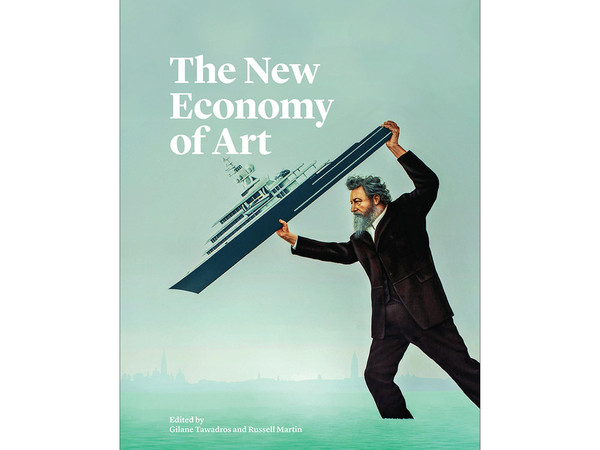
    Another month, another book on the contemporary art economy, this time from an overlooked perspective. The New Economy of Art, a joint publication by DACS and Artquest, looks at the art market from the POV of the average artist. Not surprisingly, it finds plenty to puzzle over.

    The conundrum it addresses is clearly set out in the preface by editors Gilane Tawadros and Russell Martin. “The art world is in crisis,” begins the first paragraph; “The art world is in the best shape it has ever been,” begins the second. The question of how these conflicting statements can both be true at the same time – “the disconnect between how artworks gain financial value even while their makers are poorly, or hardly, paid.” – is the mystery the authors of its six essays try to solve.

    Two weeks before the book came out, Christie’s New York achieved an all-time auction record for its November postwar and contemporary art sale, in which a Warhol Triple Elvis hit the jackpot – kerchung! – at £51.6m – and a row of Four Marlons paid out a further £43.9m. Both, appropriately, had previously hung in a casino in Aachen. The result was hailed by international head of post-war and contemporary art Brett Gorvy as confirmation of “a virtuous cycle of confidence in the art market”. Another season, another reason for making whoopee.

    On the other side of the art market, meanwhile, a more vicious cycle is in operation. The book’s authors quote the usual dismal statistics. It’s depressing enough to learn from the 2011 survey by the Centre for Intellectual Property, Policy and Management at Bournemouth University that UK artists earn a median wage of £10,000 – unchanged for 20 years – without discovering that the statistic includes designers, illustrators and photographers, and that the top 7% earn 40% of the total. Artists now officially rank as ‘marginalised makers’, a marginal constituency politicians aren’t fighting over. The economist Alan Freeman quotes figures showing our ‘creative economy’ growing faster than any other UK production industry, employing 2.5 million people and accounting for 5.2% of gross value added – but take out all the advertising, marketing, fashion, IT and other people he counts as ‘creative specialists’, and the fine artists are still scratching around on the margins.

    The book’s cover reminds us that there is nothing new in this. It reproduces Jeremy Deller’s mural from the 2013 Venice Biennale picturing William Morris as a Victorian Poseidon hurling Roman Abramovich’s superyacht into the Venetian Lagoon. The mural’s title ‘We sit starving amidst our gold’ encapsulates the argument at the heart of the book while reminding us that Morris said it all before, and better. Compare Freeman’s dewy vision of a creative utopia “in which shared values, achievements, hopes and aspirations replace brute greed to lay foundations on which the true individuals of the future can confidently build the new worlds of their choosing” with this trenchant passage from Morris’s lecture Art Under Plutocracy: “So long as the system of competition in the production and exchange of the means of life goes on, the degradation of the arts will go on; and if that system is to last for ever, then art is doomed, and will surely die”. Only the substitution of association for competition, believed Morris, could “give an opportunity for the new birth of art, which is now being crushed to death by the moneybags of competitive commerce.” In the war of words, Morris wins hands down.

    Still, the book contains material which, if not revolutionary, is astonishingly inflammatory for a publication part-funded by the Arts Council. Have they read it? It has a quiet way of dropping bombshells. One is the casual mention by management consultant Keir McGuinness of the apparently generally accepted practice whereby “the decision of whether a [public] gallery will take a show or not depends upon whether you [the artist’s dealer] will make a financial contribution and the person who makes the largest financial contribution gets the shows”. Another is a statistic cited from AN’s recent Paying Artists report that “71% of artists receive no fee for publicly funded exhibitions and nearly 60% do not even have their expenses covered”. This against the background of an international art industry which, arts consultant John Kieffer points out, has a turnover of just under £40bn, with the UK’s market share of 20% amounting to three times the combined budgets of the English, Welsh, Scottish and Northern Irish culture departments.

    But the real eye-opener is the essay by curator Lynda Morris. Born in 1947, Morris is old enough to remember the heady days of the 1960s when a newly international avant-garde was promoted by dealers who were themselves artists, lived like artists on air and were perceived as having ‘moral authority’. What an antiquated concept that now sounds. After reading Morris’s analysis of the process whereby the present nexus of curators, industrialists, bankers and property developers took control of the art world, it seems to belong to another era.

    Morris pinpoints Thatcher’s appointment of Richard Rogers as chair of Tate Trustees in the 1980s as the start of the cultural ascendancy of architecture over art. “It was the moment in late Thatcherism when the State no longer provided social housing and, instead, the national lottery, a new arm of the gambling industry, enabled museum directors and their trustees to start to plan Palaces of Culture.” A proposal to regenerate derelict buildings for low-cost studios, housing and artist-led galleries put forward by officers of the then Arts Council of Great Britain – in association with artists’ collectives ACME and SPACE – was kyboshed by property developer Peter Palumbo, who as chair of the ACGB from 1988-94 presided over the drafting of the rules for National Lottery funding, including the ‘subsidiarity’ clause ensuring that money is allocated only to new projects and thus funneled towards developers and architects rather than artists. Artists are wonderful at sprinkling the fairy dust that turns urban wastelands into developers’ goldmines, but once the gold has been extracted the fairies can piss off and take their dust elsewhere. Prices for a ‘premium apartment’ in Neo Bankside, the new residential development overlooking Tate Modern designed by Rogers Stirk Harbour – formerly Richard Rogers Partnership – start at £4.5m.

    “We seem to have drifted from a market economy to a market society,” comments John Kieffer. It’s a form of society Margaret Thatcher would have recognised, but not William Morris. “It is this superstition of commerce being an end in itself, of man made for commerce, not commerce for man, of which art has sickened,” he wrote in Art under Plutocracy. Art under kleptocracy has brought no improvement. It has been left to President Xi Jinping to uphold moral values, warning Chinese artists last October not to follow the “stench of money” or “lose themselves in the tide of market economy” which the rest of the People’s Republic is happily riding.

    Are artists and Gordon Brown now the only people on the planet still expected to possess a moral compass? That could explain the disconnect highlighted by this book. If our market society is wholly reliant on artists for moral orientation, it has good reason not to seduce them with the stench of money, ie pay them. You could almost call it a virtuous cycle.

    Laura Gascoigne  

    The New Economy of Art, edited by Gilane Tawadros and Russell Martin, published by DACS, £14.99


  • ‘Sculpture’ v. sculpture

    Martin Jennings

    Among the least impressive legacies of arts administrators’ obsession with Modernism and its aftermath is the impossibility of predicting a work’s status solely from its appearance. You might form your own view about it, but you can’t predict what State Art’s opinion will be because there are no published criteria or guidelines for making such a judgement. You can’t second guess a whim. The bottom line is that we have allowed a body of ‘experts’ to evolve who unashamedly make it up as they go along. This gullibility on our part for allowing it to happen, and the smug charlatanism of those in authority who are impervious to and ignoring of criticism, is the inevitable result of being for decades under the thumb of an establishment which – for all its daily protestations to the contrary – is not only awash with cash and therefore patronage, but has decided, god-like, that anything at all can be art if it says it is. In its way State Art’s is as extreme a form of capricious and intolerant dictatorship as any regime in North Korea.

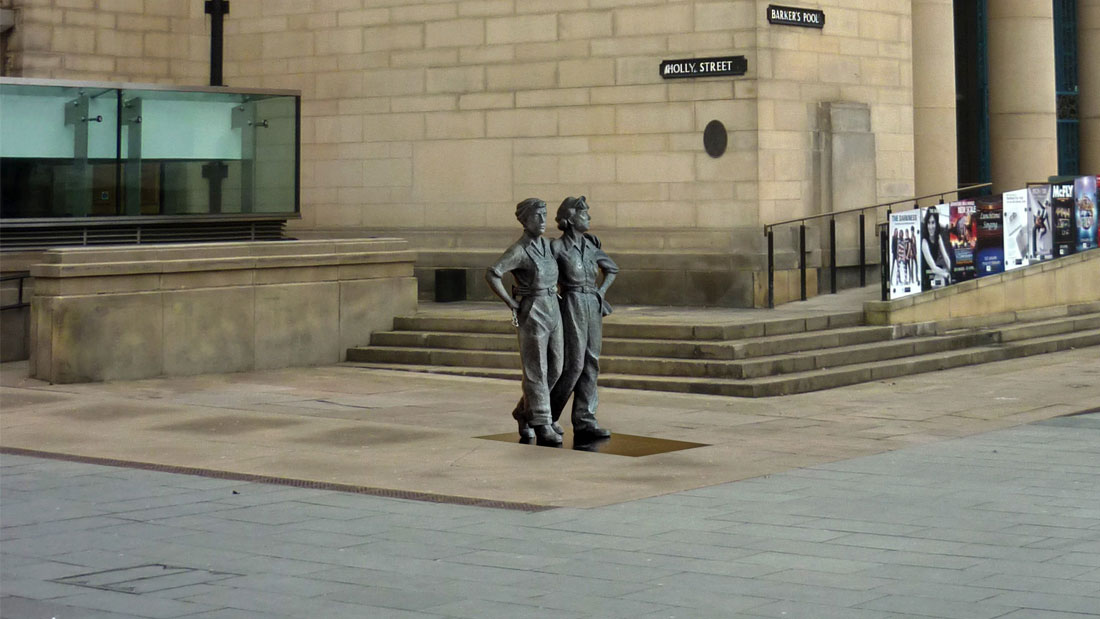
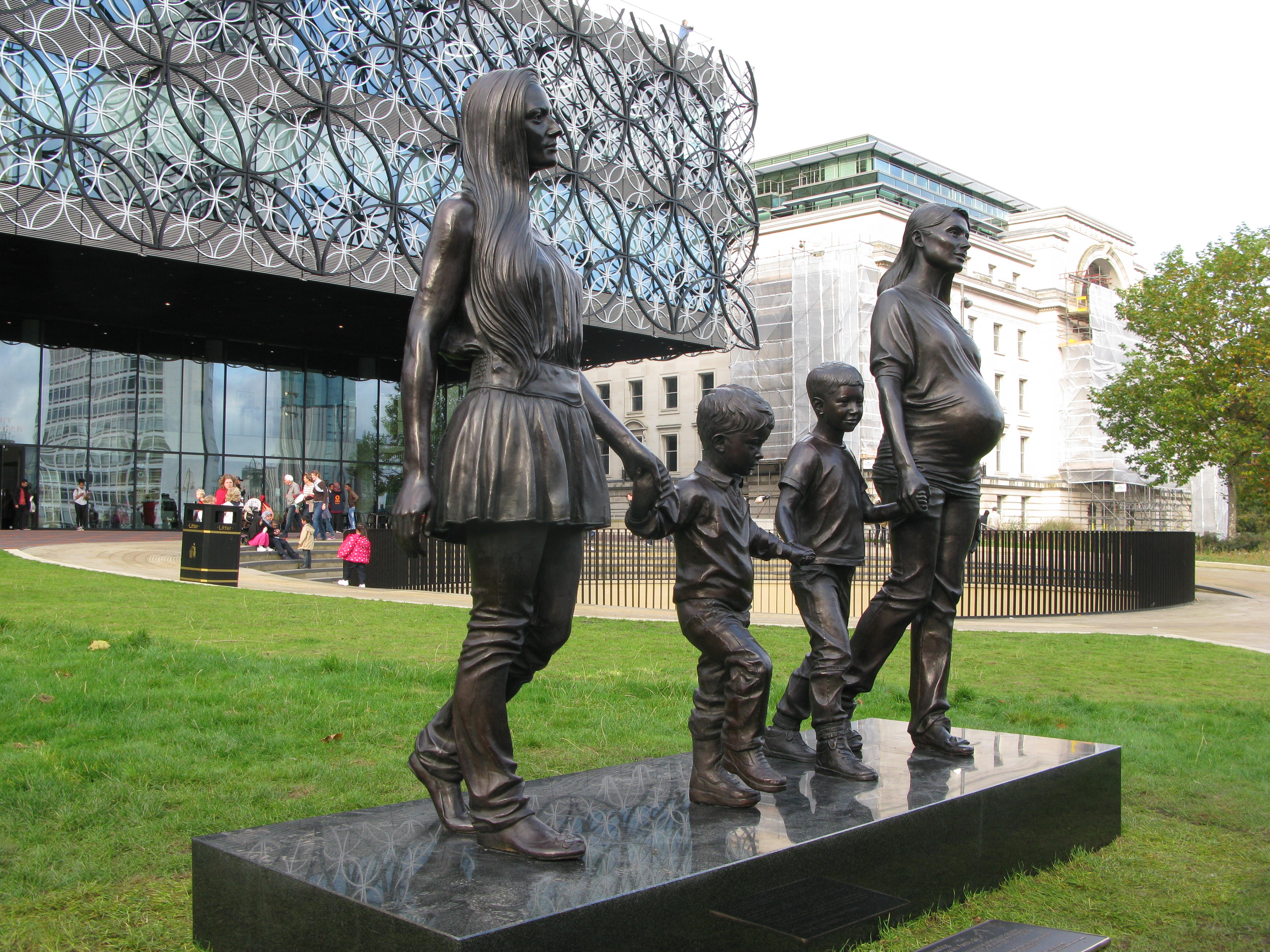
    There is a useful current example of how fossilised prejudice and arbitrariness inform establishment policy. It concerns two works of public art each designed for city locations. Both are, on the face of it, conventional figurative bronzes. Superficially similar though they may seem, to the Arts Council there is an enormous gulf in acceptability between the two, a difference invisible to you and I. One of these works, that recently unveiled outside the tacky new public library in Birmingham and called A Real Birmingham Family, is a ‘challenging’ piece presenting two local women and their children. The other, depicting women in overalls and commemorating the crucial contribution of female workers to the steel industry during the World Wars, will soon be unveiled in Sheffield.

    The Birmingham sculpture is by former Tate trustee Gillian Wearing. Obviously she didn’t make the sculpture herself, a skilful craftsman will have run it up from snaps. The result is a hideous, styleless simulacrum of real people, the point of it being to promote the view that nuclear families are not now the norm – how very trendy, how perfectly BBC. This sort of conceptual conceit must of necessity be a sculpture-free zone because the last thing Wearing wants is for the object to be gauged by its form rather than for its ‘idea’ – albeit one which, to the rest of us, would be so small as to be not worth the effort and expense of illustration. As sculpture it stinks, it’s stillborn.

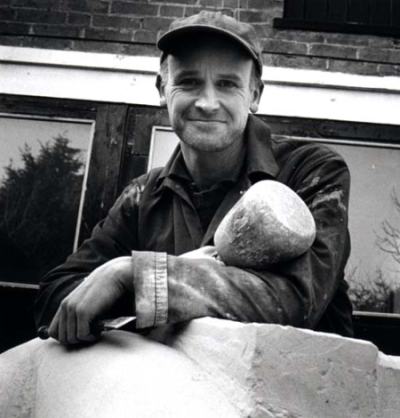
    In contrast, the Sheffield piece is a work of imagination and looks like a sculpture because it was made, with his own hands, by Martin Jennings, a renowned specialist in this area of modelling and invention. To State Art this sort of traditional approach is vile anathema.

    But here’s the real rub. Conceptual art, even when it comes in the otherwise despised bronze figurative form, is funded by the Arts Council, to whom Wearing is well known. She has had two national touring shows and has exhibited in every ACE-funded gallery. ACE also bought in 1999, for £30,000, her Turner Prize winning film in which two dozen coppers stand silently still for an hour. Confirmation of her A-list status is supported by the fact that 31 of her works are in the Tate, Arts Council, British Council and Government collections: curiously, all four own an edition of the same print, unnecessary duplication of a kind that ought to have been outlawed years ago. Wearing’s family sculpture was administered by local Ikon Gallery, which itself receives over half a million a year from the public.

    In contrast, Sheffield had to find all the money through public donations because Martin Jennings is the wrong kind of artist.

    State Art always prefers ears to eyes and has never based funding decisions on the merit of what you actually see. Why artists nationwide are not campaigning about ACE’s continued unfair discrimination and casuistry is baffling.

    Here is yet another filthy, indefensible racket.

    David Lee

    Jan/Feb 2016

    http://www.martinjennings.com/Biography.aspx

  • ‘Sculpture’ versus Sculpture

    ‘Sculpture’ versus Sculpture

    Women of Steel by Martin Jennings

    Among the least impressive legacies of arts administrators’ obsession with Modernism and its aftermath is the impossibility of predicting a work’s status solely from its appearance. You might form your own view about it, but you can’t predict what State Art’s opinion will be because there are no published criteria or guidelines for making such a judgement. You can’t second guess a whim. The bottom line is that we have allowed a body of ‘experts’ to evolve who unashamedly make it up as they go along. This gullibility on our part for allowing it to happen, and the smug charlatanism of those in authority who are impervious to and ignoring of criticism, is the inevitable result of being for decades under the thumb of an establishment which – for all its daily protestations to the contrary – is not only awash with cash and therefore patronage, but has decided, god-like, that anything at all can be art if it says it is. In its way State Art’s is as extreme a form of capricious and intolerant dictatorship as any regime in North Korea.

    There is a useful current example of how fossilised prejudice and arbitrariness inform establishment policy. It concerns two works of public art each designed for city locations. Both are, on the face of it, conventional figurative bronzes. Superficially similar though they may seem, to the Arts Council there is an enormous gulf in acceptability between the two, a difference invisible to you and I. One of these works, that recently unveiled outside the tacky new public library in Birmingham and called A Real Birmingham Family, is a ‘challenging’ piece presenting two local women and their children. The other, depicting women in overalls and commemorating the crucial contribution of female workers to the steel industry during the World Wars, will soon be unveiled in Sheffield.

    The Birmingham sculpture is by former Tate trustee Gillian Wearing. Obviously she didn’t make the sculpture herself, a skilful craftsman will have run it up from snaps. The result is a hideous, styleless simulacrum of real people, the point of it being to promote the view that nuclear families are not now the norm – how very trendy, how perfectly BBC. This sort of conceptual conceit must of necessity be a sculpture-free zone because the last thing Wearing wants is for the object to be gauged by its form rather than for its ‘idea’ – albeit one which, to the rest of us, would be so small as to be not worth the effort and expense of illustration. As sculpture it stinks, it’s stillborn.

    In contrast, the Sheffield piece is a work of imagination and looks like a sculpture because it was made, with his own hands, by Martin Jennings, a renowned specialist in this area of modelling and invention. To State Art this sort of traditional approach is vile anathema.

    But here’s the real rub. Conceptual art, even when it comes in the otherwise despised bronze figurative form, is funded by the Arts Council, to whom Wearing is well known. She has had two national touring shows and has exhibited in every ACE-funded gallery. ACE also bought in 1999, for £30,000, her Turner Prize winning film in which two dozen coppers stand silently still for an hour. Confirmation of her A-list status is supported by the fact that 31 of her works are in the Tate, Arts Council, British Council and Government collections: curiously, all four own an edition of the same print, unnecessary duplication of a kind that ought to have been outlawed years ago. Wearing’s family sculpture was administered by local Ikon Gallery, which itself receives over half a million a year from the public.

    In contrast, Sheffield had to find all the money through public donations because Martin Jennings is the wrong kind of artist.

    State Art always prefers ears to eyes and has never based funding decisions on the merit of what you actually see. Why artists nationwide are not campaigning about ACE’s continued unfair discrimination and casuistry is baffling.

    Here is yet another filthy, indefensible racket.

    David Lee

    The Jackdaw Jan/Feb 2015

    A Real Birmingham Family by Gillian Wearing


  • Arts Council – time for action

    A submission to the House of Commons’ Select Committee for Culture concerning their short enquiry into the commissioning criteria used by the Arts Council of England.

    From the editor of The Jackdaw

    Your interest in the artistic criteria underpinning ACE’s funding decisions is a subject which has long exercised me. I wish to demonstrate here that where they are not clouded in the secrecy of woolly definitions, the artistic criteria used by ACE in the visual arts are partial and excluding of most artists in Britain whose interests the Council should be representing.

    During the 35 years I have been writing about art, the last 20 spent editing two magazines, Art Review and The Jackdaw, I have watched the Arts Council become an oppressive dictatorship of narrow taste. No other phrase adequately describes the stranglehold they exercise over the visual arts.

    The Council does not respond objectively to what is being made by artists. Far from it. Instead, it prescribes the kind of work it wishes to support. This partiality has been allowed to develop because politicians hide behind the ‘arms–length principle’ by which they distance themselves from artistic decision making. ACE has used this convenient indifference to promote its beliefs unhindered. It is long overdue that this ‘arm’ was cut off.

    So entrenched has this system now become that if you were devising a means of dispensing public money to visual arts you would look at the way we do it today as a demonstration of what to avoid. The Arts Council has encouraged an unhealthy ‘us’ and ‘them’ mentality.

    In a perfect world a body spending enormous sums of public cash would at least attempt to make a show of even-handedness. It would recognise the diversity of excellence existing in visual art styles across the whole of the fine art spectrum; that is, from those at the more traditional end to the innovators at the other. Both ends, and all those markers in between, have their place in a healthy system appealing to audiences of different expectations and with different tastes.

    For a generation after its foundation in 1946, the Arts Council did precisely this. It recognised the full range of possible styles. But not any longer. Now it is willing to support only what it calls in its literature “challenging” or “cutting edge” work.  In a booklet published five years ago, supposedly to define its objectives in visual art, it used the word “challenging” over 50 times in 80 pages but failed to say precisely what “challenging” actually means when they use it. In my view they leave it sufficiently vague so they might conveniently make it up as they go along.

    By experience we know that “challenging” to them means the kind of work loosely dubbed ‘Conceptual’. This means the type of art which, since 1984, is nominated for the Turner Prize. What we get from the Arts Council through its gallery network is the visual equivalent of being fed porridge for every meal. You only have to examine the programmes of the nine major art galleries in London funded by the Council to see the truth of this policy in operation. Only very rarely do they show anything else but conceptual work. This is the reason why so many artists whose efforts are not deemed sufficiently “challenging” feel that the Arts Council does not represent them; indeed, I know from received correspondence that many feel it has failed them utterly.

    The ACE in its visual arts policy has become an Academy representing what it claims is the avant-garde. And like all orthodoxies it is intolerant of anything else.

    A topical example of their policy in practice is the case of First Sight, a £40 million art centre opened two years ago in Colchester. It is revenue-funded by the Arts Council. Attendance at the gallery dropped dramatically in the last year because the programme of work that the Arts Council makes contingent on their continued funding is limited to what most locals do not want to see all the time – correspondence columns in local newspapers are clear on this. As far as I can recall, for the first time in the history of an ACE funded gallery, the director of First Sight has admitted that as far as the exhibition programme is concerned his hands are tied. If he varies the diet to include what some locals might wish to see the Arts Council will discontinue support. Such autocratic behaviour is threatening the very survival of the gallery. First Sight is beginning to smell like a re-run of The Public in West Bromwich, that ghastly Arts Council mistake which closed recently having swallowed close on £50 million. It seems that the Arts Council never learns.

    Not only is the ACE selection criterion dictatorial it is also unnecessarily duplicating. I draw your attention to the current exhibition of work by the Chapman Brothers at the Serpentine Gallery, which is funded by the Arts Council. These artists, who are among the more original in the conceptual fold, have shown recently in many public art galleries, from the Tate to the British Museum. The brothers are represented by a commercial dealer, White Cube, which is among the wealthiest contemporary art businesses in the world; indeed, they run two large galleries in London. Why is it necessary to show the work of these artists in a publicly funded space when they are already widely exhibited and their own dealer has larger nearby premises of its own than the Serpentine can offer? When so many other artists go unexhibited this obsession with the same few names is indefensible.

    The process by which public galleries promote and further endorse a few successful brand names is one which should be investigated at the earliest opportunity. It stinks.

    As stated above, in the distant past ACE galleries staged mixed programmes in which innovation found its place alongside historical surveys and retrospectives of artists of all descriptions and ages. This is no longer the case. ACE has inflicted upon us a virtual tyranny of youth and has ensured that the generations of British artists over 50 have been betrayed and abandoned by the Council.

    I wish you to consider the following:

    1. No publicly funded body should ever be allowed to state, as has the Arts Council, that there are “the wrong kinds of artists” and, therefore, by implication “the right kind”. This is an insult. Yes there are ‘good’ and ‘bad’ artists but there are no ‘right’ and ‘wrong’ ones.

    2. A publicly funded Arts Council should not be a blunt instrument for promoting brand name stars represented by a handful of wealthy commercial dealerships.

    3. ACE should not be allowed to blackmail or dictate selection policy to galleries they help support. Directors should be free to show whatever they deem worthy in order to attract diverse audiences to their venues. Indeed, directors should be encouraged to surprise us by showing the rich wealth of work being produced in the country, as well as in their locality. The prevailing attitude, adopted by the Council, that ‘You will have to like what we give you’ must stop.

    4. The programmes of ACE galleries should reflect the diversity of what is being produced by artists and equally encourage proposals from outsiders for historical exhibitions and retrospectives and surveys of older British artists.

    David Lee

  • The Art Fund subverted: they were only playing leapfrog

    The separate bodies contributing to State Art are now so interrelated, so cosily acquainted, their personnel so readily interchangeable and of identical mindset, that they might as well join forces. (… Liz Forgan is sacked from the Arts Council but remains a Trustee of the Art Fund; James Lingwood swallows his annual  million from the Arts Council and also sits as a Trustee of the Art Fund which has bought a work he commissioned, and so on – I could fill this column ten times over with similar complacent overlaps.) Imagine the savings on personnel and rent alone if the Contemporary Art Society (now funded and run by a former employee of the Arts Council), The Art Fund (headed by an ex-director of the Tate), the Arts and British Councils and the Tates (also directed by a former Arts Council employee) stopped pretending they pursued distinct objectives and pooled resources.

    The Art Fund is the latest to dump any semblance of independence. It is nominally a charity, if, that is, you count bankrolling the already well supplied as ‘charitable’. If the Salvation Army doled out caviare to nobs in Mayfair there would be a fuss. But the Art Fund regularly does the equivalent.

    It was founded by altruists in 1903 solely to help museums buy works of art. It gives £6.3 million a year in grants, spreading it thinly across scores of acquisitions, including some important ones. Its core activities are still nobly worthwhile and more than ever necessary.

    Recently, it announced it would fund two British tours: Jeremy Deller’s ‘immersive works’ (don’t ask) created for the British pavilion at this summer’s Venice Biennale, and Grayson Perry’s six large caricature tapestries on the subject of British life and taste. Why is a charity sponsoring the promotion of Perry and of a Tate trustee, Deller, who are among the most visible, wealthy and successful of recent British artists? And why aren’t their dealers paying for these tours from which they will all benefit? Deller’s exhibition in Venice, funded by the British Council (the tour of his inflatable Stonehenge is already, by the way, covered by the Arts Council), cost over half a million of public money to stage. Why is Deller worth even more from the limited resources of yet another much tinier charity? None of this makes sense. Unless of course there is a privately agreed national consensus between a raft of organisations, public and private, whose objectives – for whatever reason – are to promote the same few reputations.

    In their recent accounts the Fund crows its contribution of £200,000 towards Rachel Whiteread’s infantile defacement of a listed masterpiece, Charles Townsend’s Whitechapel Art Gallery. Again, here is lavish support of a successful, regularly exhibited artist represented by a leading world dealer. Charity? Really? Additionally, they funded the Tate’s purchase for £125,000 of five Whiteread ‘drawings’, or diagrams as they used to be known – they now have 30 of her works.

    The Fund also oversees the annual £100,000 Gulbenkian Museum of the Year whose judges are perennially lazy, predictable and uninspired. It is responsible too for administering ‘Artists’ Rooms’, an overpriced and dubious blunt instrument of State Art which ensures the circulation of work by top brands around regional museums, apparently ­– God help us – in perpetuity.

    The Fund’s magazine, Art Quarterly, formerly a purveyor of scholarly articles, is now a yappy promotional brochure for State Art. The current issue advertises three artist trustees of the Tate, each of whom receives the Fund’s cash. In the case of Wolfgang Tillmans, they contributed £95,000 towards buying 15 of his pictures for Glasgow Art Gallery having the previous year given £62,000 for the purchase of nine others of his works by the Arts Council, which has £450 million a year of its own to spend. The Tate already owns 62 works by Tillmans. Why this obsession with an indifferent German photographer?

    But all is not bleak. In 2011 when the Fund announced public purchase of Yinka Shonibare’s Fourth Plinth bottle the published cost was £362,500. As we demonstrated at the time this was a lie repeated in all newspapers. In their recent accounts the figure has now shot up to £650,000. They’re getting there, slowly.

    David Lee

    The Jackdaw, September/October 2013

  • Olympic legacy: money for nothing

    Olympic legacy: money for nothing

    I am not happy again. We have become used to hearing weekly wails of distress from the Arts Council about how broke they are followed by melodramatic predictions of the cultural desert awaiting as punishment for state parsimony. It is their belief they should be exempted from the austerity allegedly endured elsewhere. Their moans receive sympathetic hearings from a press many of whose specialist commentators are reliant on the Council for an assortment of free trips, home and abroad, and other thinly veiled junketry and blackmail.

    Last month the Council announced quietly that one of their long-delayed projects for the Olympics – a jet of air fired up over the Mersey estuary off Birkenhead – was not going to happen after all, despite having already spent £535,000; that is, £35,000 more than the original budget intended for the finished, installed work. This sum included £40,000 as a personal fee plus £15,000 expenses for the artist, one Anthony McCall. He promised something he couldn’t deliver but won’t be sued or expected to repay any of the money. Apart from low-key reporting of the failure, papers omitted to comment on its wider significance. And it goes without saying that no one at the Arts Council will carry the can for this entirely avoidable fiasco.

    In fact, this was only part of a story concerning the disgraceful waste of £5.4 million which the Council allocated for commissioning special works during Olympic year. Now, a year on from the Olympics, we can evaluate more clearly what we received – the ‘legacy’ if you insist – for a sum approaching the Council’s entire annual visual arts budget. The short answer is nothing; nothing memorable or of any enduring artistic merit, for it was frittered away on ‘community’ trivia. Not a single painting, print, sculpture or ceramic in any gallery or museum. Not a single mural or stained glass window in any civic building. No public sculpture of genuine worth. No, not even a sprawling installation or a soporific video destined for the gallery warehouse. Where anything at all concrete remains from this project it is entirely frivolous. The sum total is three crocheted lions at Twycroft Zoo and a boat made from 1,200 donated wooden objects currently moored … well you tell me.

    In January 2010 the Arts Council announced that as its contribution to the Cultural Olympics it would earmark £5.4 million for 12 works, one each in nine regions of England (£500,000 each) and one each for Scotland (£460,000), Wales (£230,000) and Northern Ireland (£190,000). The object of these commissions, which were collectively dubbed ‘Artists Taking the Lead’ (the Piss, more like), was “to surprise and delight the world with their extraordinary artistic vision”.

    Scotland’s wedge bought them a temporary football pitch in the middle of a forest near Selkirk, on which were played two matches in kits designed by local children – a site now overgrown. (God only knows how they managed to get through half a million on that.) Wales got the fuselage of a DC9 which was towed to four locations; present whereabouts unknown. Northern Ireland got Nest, a warehouse full of donated objects labelled with personal reminiscences. Eastern England got a community event called Home. In Yorkshire they bent the regulations so that those choosing the winner were themselves the recipients of the cash. Their excuse? “It would have been impossible to appoint regional arts experts that did not have these relationships.” You didn’t try hard enough you corrupt bastards! The result was some sort of street happening in Leeds. The north west got its half-million’s-worth of nowt, not even the promised hot air. The south west got Nowhereisland, some soil from the arctic circle towed by boat around the West Country. The West Midlands marched a big puppet of Godiva (now clothed owing to political correctness) down to London. The south east got the wooden boat. The East Midlands is now the proud owner of some knitted lions. The north east got the best piece, ‘Flow’ by Ed Carter, a pontoon on the Tyne complete with original electronic music.

    There is not an atom of visual art in any of this rubbish. It is money which should have been better spent on permanent serious commissions. Why are the Arts Council allowed continually to get away with such shocking waste whilst constantly pleading poverty?

    David Lee

    The Jackdaw, July/Aug 2013

  • Evelyn Williams, and another case of the public denied

    Evelyn Williams, and another case of the public denied

    In the last issue I considered the case of a single-minded good artist,  David Mulholland from Middlesbrough, whose memory, in the absence of any official recognition or support, has to be kindled for posterity’s sake by friends and family. By The Jackdaw’s usual standard of eliciting no comment whatsoever, this caused a considerable mailbag from many mentioning other artists who deserved better than the obscurity and indifference they receive. Owing to the recent death of a special artist, there is cause for reiterating this line of criticism of an art establishment hopelessly out of touch with anything but ‘The Contemporary’, such as they choose to see it.

    Grief felt at the death of a memorable artist is mitigated always by the fact that their work – if it is properly accomplished and not merely the species that is famous for fifteen minutes – will live forever. Giotto didn’t need an ‘artist’s statement’ or incomprehensible catalogue introductions for his work to last, because his paintings speak for themselves in a universal language understood across the centuries. His work will continue to communicate clearly its observations of character and stories just as long as human beings are prepared to see,  feel and respond. This is the case also with the art of Evelyn Williams who died aged 83 on November 14th. Her work will endure in spite of the neglect she received from officialdom during a long and productive career. In the same Tate Collection which stores 274 works by Andy Warhol no space can be found for a single piece by Evelyn Williams, who is a far more interesting artist if not so much of a business-minded celebrity phenomenon whose market is carefully rigged. Even in the last two years alone, when 516 works were acquired by the Tate, there was no room for a single one by this important woman artist. There are even ten works in our national collection by American minimalist Robert Ryman, all of them white and doubtless extremely challenging to those of a devoutly all-whiteist fanaticism; but nothing by Evelyn Williams. Here is further evidence that at the nucleus of State Art breeds a deeply entrenched prejudice against anything but pseudo-intellectual nonsense.

    It is an appalling truth that the Tate has ceased to be a collection of British art preserving the very best of what is being done. Instead, it has been stealthily subverted under Serota to become a private collecting fief promoting a narrow orthodoxy related to a handful of dealers and auctioneers. Why is it that so much about today’s Tate stinks? Evelyn Williams is in a long line of single-minded British artists who refuse to run along the pre-ordained tramlines of conceptualism and modernism. She was a thoughtful, modest, intelligent and vulnerable person alive in a world – as she perceived and experienced it – of imminent dangers. Her paintings, sculptures and reliefs are about the fear and anxiety, the affections and frictions, of what it is to have lived the life of an anxious woman and mother. Hers is first and last a woman’s art, an uncompromising take on post-war relationships, intimacy, cares, depression, failure and even alienation. Her subjects take you inside the realm of senses and feelings, probing the unspoken secrecies behind the masks of propriety we all wear. In the way that art has of redeeming the awful, these are beautiful explorations of states of mind most try to avoid. Her work can be relentlessly intense, no question about that, but it is pure in spirit and purpose.

    Three of the more serious newspapers, the Times, the Telegraph and the Guardian, were eventually persuaded to publish obituaries of Williams. As with so many significant but neglected artists who are nevertheless considered worthy of an obituary, her exhibitions were scarcely even acknowledged let alone reviewed in the arts pages of these same papers. Critically, it was as if her work didn’t exist. She is, of course, among the many accomplished artists whose work is ignored for being conventional in appearance and technique and declamatory about emotions. To today’s State Art tyrants such characteristics are considered embarrassing drawbacks.

    Williams was, however, appreciated in the past. As a youngish artist in 1961 she won the sculpture prize (for Two Heads) at the John Moores in Liverpool, when other winners were Peter Blake, David Hockney and Ron Kitaj. These were the days when the Moores was worth winning, well before it was subverted to the cause of State Art where daubs of no merit are greeted by fools with preposterous superlatives. A retrospective exhibition was held in 1972 at Whitechapel Art Gallery; once again well before that gallery’s prostration before the winds of Biennale bluster. Williams continued her brave exploration of inner places that made her work then so widely admired. She worked every day of her life and although her commercial exhibitions continued, sometimes at long intervals owing to the complexity of ideas and their necessarily prolix gestation, a retrospective was never offered in her lifetime. Approached by friends in the last decade of her life, the Walker Art Gallery turned her down for such an honour. She couldn’t exert the pulling power of a Rolf Harris or Paul McCartney.

    Will Williams now receive the lifetime retrospective her work deserves, and which a wide audience should see? It isn’t likely.

    But why should this be, when there are more galleries nationwide which are more spacious than ever before? The answer is that as the public gallery network expands the same orthodoxy is spread across even more outlets. More galleries does not mean a wider selection of work on display; it means the same work by the same few artists spread across even more galleries even more frequently.

    What are called ‘Artists’ Rooms’ are a symbolic example of what is wrong with this rotten system. These ‘Rooms’ are organised by the Tate, the Scottish National Gallery of Modern Art and the Art Fund (how long will it be before the Art Fund can only be contacted via the Tate switchboard?), and they resulted from a bulk purchase, jointly by the Tate and the SNGMA in 2008. We bought for £42 million (£27 million in cash – the figure varies in different reports; we’ve never been told the exact sum – and £15 million in waived tax) retiring art dealer Anthony d’Offay’s gallery stock, which he called his private collection.  A cynic might say that Artists’ Rooms is the process by which the personal collection of one commercially motivated individual now dictates what a large proportion of the art-seeking population is allowed to see in the name of recent art. The same cynic might further add that Artists’ Rooms is the opportunity by which established reputations – such as Warhol’s – are constantly hammered home, and for the smaller ‘Room’ names, it is the instrument by which a more significant brand name can be nurtured.

    Under the auspices of the Art Fund, an organisation which luckily is headed by a former director of Tate Britain, 30 rooms featuring 760 works by 26 artists have been touring the country for four years, mostly as small one-man retrospectives. Some of these are marvellous, not least the extensive collection of photographs by August Sander. There are 232 works by Warhol alone, who gets two rooms to himself travelling at the same time. At the moment they are in Sheffield and Hull, and then Birmingham for four months. That is apart from relatively recent major exhibitions for the same artist at the Tate, the Hayward and other Arts Council galleries.  Warhol is showing somewhere all the time. We will not be allowed to ignore him.

    One of the Artists’ Rooms deals, inevitably, with Damien Hirst. This is currently on show in Walsall Art Gallery. It has been there for two months already and will remain in place for another year. What is happening when a fifty-year-old artist, already over-exhibited at a time when so many unexposed artists can’t get their work shown, is having a thirteen-month long exhibition? What is the reason for such indoctrination? Too often the Artists’ Rooms represent those who are already widely exhibited and who are bastions of the art market.

    Artists Rooms are a blunt instrument whereby approved taste is circulated (inflicted) from the centre. They constitute cheap exhibitions for Arts Council venues up and down the country, whose curators don’t have to originate their own programme. The laziness and ready compliance of these jobsworths is a godsend to State Art.  They can merely exhibit the same few approved brand names for ever. And make no mistake their career will depend upon them favouring these “right” kinds of artists for no individual prospers in State Art by demonstrating initiative or investigating the unorthodox.

    Visit the Hepworth Gallery in Wakefield and you will discover the other reason, besides the dreaded Artists’ Rooms, why thought and broad knowledge among curators is unnecessary. There is a new species of art collectors who caught the disease of wholesale, apparently random acquisition from Saatchi. These people fuel the market for State Art which they buy in quite staggering quantities. Their houses, full of wince-inducing tat bought for eye-watering sums, feature frequently in glossy magazines. Usually they are rewarded for their commitment to the State Art cause with the accolade of a position on a Tate committee, of which there are now dozens. At Serota’s Tate money not knowledge is the essential qualification for co-option.

    One such überbuyer – who has not yet been brought on to any Tate committee – is one David Roberts, a property developer, who has accumulated so much clutter he’s opened his own ‘space’ and has begun feeding pieces to regional galleries, Wakefield being the first venue. Works selected are linked as follows: “This exhibition examines ways in which modern and contemporary artists represent the human

    body in various media to explore psychological and emotional life.” What a perfect criterion that is for the inclusion of a major work by Evelyn Williams. Unfortunately, the trouble is that among Roberts’s 3,000 plus works there is nothing by Williams. But have a guess whose work he does own and whose efforts are on show in Wakefield: enter Warhol and Hirst.

    David Lee

    The Jackdaw January-February 2013

    http://www.evelynwilliams.com/index.htm

  • Top people

    Top people

    The new Culture Minister is Maria Miller. Her background is in marketing (Texaco and an ad agency) which means she’ll be in heaven when blather is required. She was born in Wolverhampton and is MP for Basingstoke, both places whose connections to Culture are so obvious they don’t need repeating here. She joined the Conservative Party aged 21 when Mrs Thatcher was PM – the year after the miner’s strike. Not surprisingly, therefore, nothing in her constituency notes suggests even the remotest interest in art, though she is instrumental in the Campaign for a Phosphate Free Basingstoke. We recommend she begins her job by inserting a hand grenade firmly up Ed Vaizey’s arse and watching closely for signs of life.

    http://www.culture.gov.uk/news/news_stories/9320.aspx

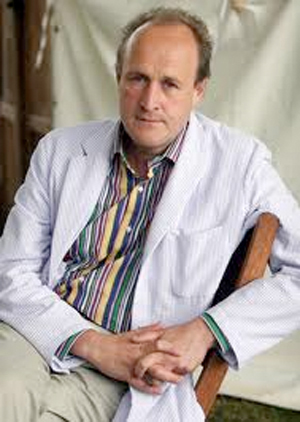
    Peter Bazalgette, the television auteur who brought you Big Brother, has been appointed Chairman of the Arts Council. He will probably do nothing at all and replaces the previous person who did nothing at all next January. A monkey could be an effective Chairman of the Arts Council. Let’s face it, how difficult is it to give money to the same recipients every year?

    http://www.artscouncil.org.uk/news/arts-council-news/sir-peter-bazalgette-new-chair/

    David Lee

    The Jackdaw September 2012

  • Hitting the bottle

    Hitting the bottle

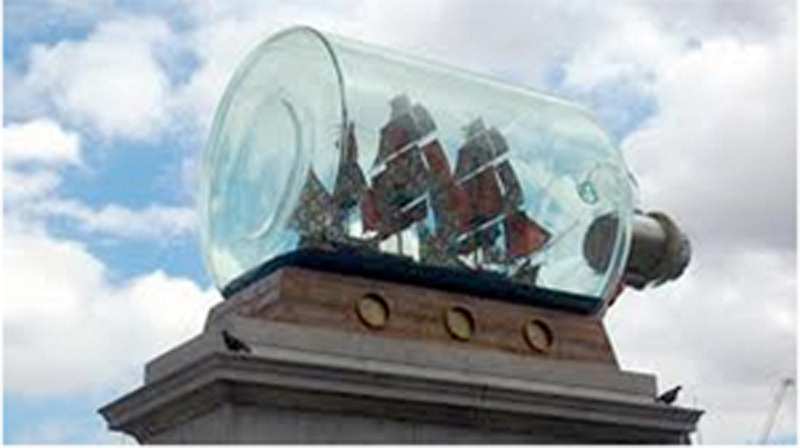
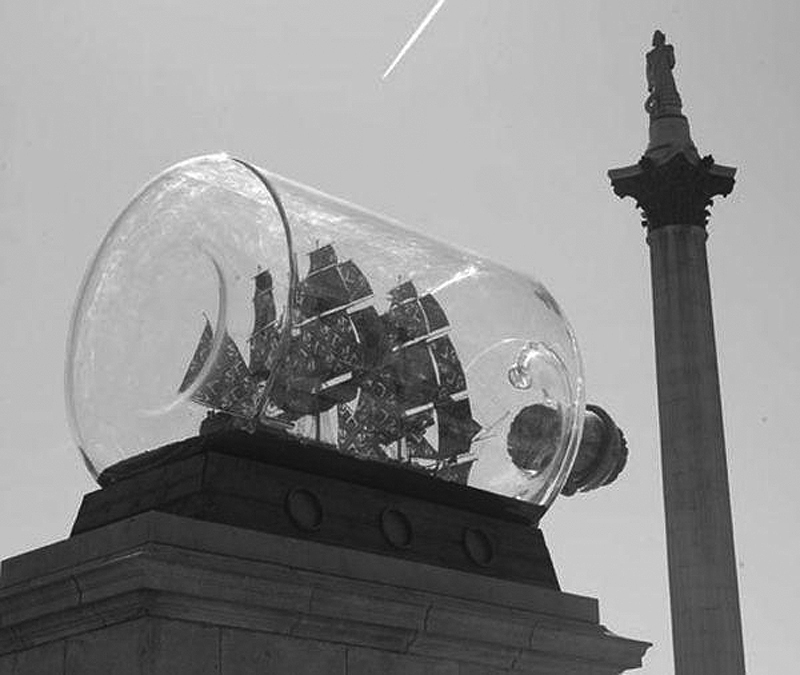
    The National Maritime Museum in Greenwich has bought for £362,500 the ship in a bottle by Yinka Shonibare which had sat ornamentally becalmed on the fourth plinth in Trafalgar Square for the previous 18 months. It is the Greenwich museum’s job to collect ships and related tackle and, lately, any sea-related nonsense deemed  ‘challenging’ by State Art’s omniscient spivs. It is significant, if you hadn’t realised, that the ship’s sails are made from patterned ethnic material of the sort usually swathed around gigantic arses in Dalston market. This encourages what one of the Tate’s finest drivellers grandly declares as “a transformation of perception”. Elsewhere, the same stuff is said to make an incisive comment on Britain’s nasty maritime heritage, “an exploration of colonialism and post-colonialism” no less. Needless to say we are not informed into what our “perception” is “transformed”, nor how “colonialism” is “explored” by deploying some patterned swatches purchased from a Brixton stall. I suppose we must now accept this species of commentary as the naturally occurring guff which will in perpetuity follow conceptual art wherever it goes.

    The sculpture, dubbed Nelson’s Ship in a Bottle, has recently been unveiled on a plain ziggurat base bang outside the National Maritime Museum’s main entrance. Here its presence will doubtless be interpreted as a Blair-like mea culpa for the historical misdeeds of our racist, slave-driving antecedents. Others may interpret its prominence and worship as illustrative of an abject and risible political correctness. Whatever, the bottle is a pretty enough toy untroubled by art. I wish to investigate briefly this apparently straightforward purchase because it reveals the questionable ways in which contemporary art is conducted by a small number of people for the benefit of an equally small number of other people who pop up ubiquitously pulling strings in proceedings such as these. It is curious indeed how the names are always the same ones. These ‘questionable ways’ may be baldly summarised as follows:

    1. We are never told the whole truth, even by public relations’ companies paid to deal with inquiries, and especially concerning the actual cost of anything. State Art is terrified of you knowing the truth, which is the reason why so frequently it is caught out lying.

    2. Obtaining accurate and complete information from arts bodies requires Kafkaesque determination and, when finally a morsel is vouchsafed, it is always uncooperatively partial and might easily contradict what has been released before.

    3. State Art has to be secretive in order to make the public believe that the visual arts are kept cruelly on the breadline and are not, as is the truth, awash with quite staggering amounts of cash which miraculously come available for the right people. If you are a Yinka Shonibare, with access to the engines of State Art, whose institutions you have dutifully served, this system is a licence to print money.

    4. The number of bodies dealing with contemporary art is far too numerous and wastefully duplicating of effort and resources, and any independence in their policies and actions is compromised by frequent interchange between them of the same few personnel.

    Three issues ago Moping Owl asked why we needed to buy Shonibare’s ship when, she thought, we already owned it. Didn’t we?  Had we not already commissioned and paid for it to sit on the plinth?  Well yes, sort of. Owl’s was a natural mistake, especially in view of what we had already been led to believe by what, up to that point, we now know had been an economical rationing of information. £362,500 is three times the record price paid at auction for any work by Shonibare. To pay apparently so much over the odds is surely just a little questionable, but the truth is that this figure is nowhere near what was actually paid for it. The real price far exceeded the published number, but you won’t have found the full, accurate cost in any newspaper because even now we can’t be certain we know all the amounts involved.

    When the purchase was gleefully trumpeted, as though we’d just acquired for peanuts a lost masterpiece by Praxiteles, a breakdown of the cost was supplied. This was based on the interesting claim put about by the artist’s dealer that an unnamed South Korean businessman had been prepared to pay £1.25 million in order to display the bottle in his garden. This outcome was described as “a real possibility” – which sounds to me a bit like the belief among, say, QPR fans that there is ‘a real possibility’ of their team winning the Premiership next season. This sum was apparently accepted even though, at that time, the price was ten times more than had ever previously been paid for a work by the artist. Complicated tax concessions applicable to a purchase by a British museum meant that the top line price was reduced to £650,000, the Treasury having waived the difference. This lower sum was made up as follows:

    £140,000: production costs funded by the Greater London Authority

    £97,500: 15% museum discount from Stephen Friedman Gallery

    £50,000: Grant from the Art Fund ***

    £264,300: Contributions from the public via a fundraising appeal ***

    £49,100: National Maritime Museum contribution ***

    £49,100: Matched contribution by Stephen Friedman Gallery and James Cohan Gallery, New York, on behalf of Yinka Shonibare, MBE

    (*** These sums total £363,400; that is, close to £362,500.)

    As far as I can ascertain at least three additional sums that were paid have not been included in this final account. The Arts Council awarded £70,000 for this project, as it does for all fourth plinth commissions; the Greater London Authority, in addition to its £140,000 production costs, gave an “artist’s fee” of £30,000; and the Henry Moore Foundation gave a grant of £20,000 to the artist for this project. In the privileged wonderland of State Art these additional sums, a mere £120,000, are pocket money. But we still paid them, and the total involved is five times the average Briton’s annual income. I can see no reason why these omitted additional sums should not have been deducted from the price paid by the Museum. Why were they not included in the reckoning? And how many other charities, trusts etc., contributed amounts which disappeared into the coffers when first the project was mooted? The £140,000 contributed by the Mayor’s office for production costs was, according to the initial agreement, to be repaid if the work sold. This is apparently true of all works made for the plinth, though we are unaware of any sums ever having been repaid from previous occupancies.We must assume that Boris is sat waiting eagerly for his refund (after all he can buy one-tenth of a new Routemaster for £140,000). Despite repeated requests for information nothing remotely resembling candour has emerged from the Mayor’s office. The fact is that the GLA alone paid Shonibare in production costs and fees a sum far is excess of the highest amount the artist’s work had ever previously sold for. And we didn’t even get to own it. Is the Arts Council’s £70,000 equally reimbursable upon the sale of a work? If not, it should be. The Arts Council, perennially bleating about its poverty, should surely be on the case for a return of its investment. As usual our requests to them for information have been ignored. They are far too busy producing worthless pamphlets of self-congratulation.

    The price paid by the NMM was independently assessed by Haunch of Venison and Roche Court, a minor secondary market sculpture dealer in the West Country. Haunch of Venison is a gallery owned by Christie’s who, coincidentally, sold the previously highest priced work of Shonibare, a large installation, for $194,500 last November. (Another installation was sold by Christie’s in April this year for as little as $98,500.) It is hard to see how any objective person could have verified a price of £1.25 million ($1.94 million) for a sculpture by this artist, even one which had sat prominently hawking itself in the centre of London for the previous year and a half. Given that they have a monopoly of sale on Shonibare’s sculpture (Sotheby’s has never offered a work by him) it was not in Christie’s – of course I mean in Haunch of Venison’s – interest to undervalue this piece. In other walks of life we might call this a conflict of interest. Shonibare was handsomely reimbursed twice for this bottle; once when he made it and a second time when he sold it. Additionally, we had a right to expect a knockdown price from the 50-year-old artist whose career has been generously supported by the State. Shonibare is an executive member of the Usual Suspects Club. He was nominated for the Turner Prize in 2004, the year Jeremy Deller won (Deller, incidentally, is one of two artists on the selection committee for the Fourth Plinth, both of them Turner Prize winners). His fledgeling career was made easier by cash grants from both the Arts Council and the Greater London Arts Board and he has enjoyed exhibitions in virtually every Arts Council-funded gallery throughout the country, as well as at the Tate. He has also served on Arts Council committees and bought works of his choice for the Arts Council collection. His present visibility would have been inconceivable without expensive public promotion. This should have been reflected in the price for the bottle. After all, we didn’t owe Shonibare anything, quite the reverse. He has made a strong career on the back of crucial public investment in him and, in my view, he has used that reputation to inflate the bottle’s price when selling it back to us. What a marvellous system this is if you are, as the Arts Council put it, “the right kind of artist”.

    At the very minimum we paid the following for the bottle:

    £362,500 published cost

    £140,000 Greater London Assembly

    £30,000 fee also from the GLA

    £70,000 Arts Council grant

    £20,000 Moore Foundation grant

    (£622,500 in total).

    When the work’s sale to Greenwich was completed Shonibare said: “I am absolutely delighted and touched by the public’s generosity.” I bet he is.

    David Lee

    The Jackdaw, Jul-Aug 2012