 I may frequently express criticisms about their finer workings but British museums and galleries are generally superbly run. Heroic efforts are made to minimise the impact of funding cuts so that even regular visitors will notice little or no impact. From looking at the outward face of our museums you would never guess the country was in anything like the mess the numbers would indicate. They open on time: they have excellent facilities; their staffs are visible, willing and helpful; their experts are sought after the world over; they are clean; they have disability access to the ceiling; their bookshelves cater to all types of reader and interest; and their collections are by and large well maintained, sensitively exhibited and most supply informative captions. Many of them have for centuries been kept open free of charge for everyone, often against all odds and arguments. They are exemplary resorts of enlightened thinking about education and the preservation of history. This quiet effectiveness is a substantial achievement which is easy to take for granted. The truth is that when it comes to museums, in Britain we have been spoilt.
This native genius was recognised recently when the Italian Culture Minister announced a fundamental shake-up in his own country’s major museums by throwing open twenty directorships to all-comers. Heading the published lists of dream candidates were many Britons. That Italy desperately needs help running its museums can not be in any doubt in the minds of those who have recently visited that country.
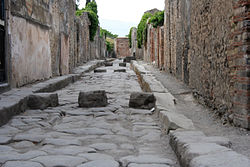
Newspapers have lately reported that Pompeii is at last rising from the ashes of incompetence and corrupt administration. Having been partially rescued from beneath the sludge of AD79, in recent years other man-made ravages have befallen this astounding place – structures have collapsed, excavation has ceased, and the site has been subjected to looting and vandalism. All of that, we are proudly informed, is now in the past. Sanity has set in and the place is safe in Italian hands. Millions of euros (doubtless originating in Germany) are being lavished to turn Pompeii into less than the unloved disgrace it has been in the recent past.
Don’t believe a word of it. If Pompeii is typical of how Italy runs its museums – and it does seem to be – no wonder British and German experts are being wooed, because even organising the basics efficiently defeats Italians.
The situation is hopeless and it starts as soon as you arrive. Gates open half an hour late, which especially annoys those scores who have arrived early to steal a march on a punishing summer sun. Once admitted, crowds jostle forever to buy a ticket because only two people are taking money. Matters are made worse because neither has any change. They accept only the correct money which must involve coins. In Italy it is virtually impossible to have coins not least because no one will give them to you: they hoard them like juju beads. The inevitable chaos is entirely avoidable and compounded when concessionary cards are not accepted unless accompanied by a passport. Endless negotiations ensue with each now sweating and thoroughly exasperated visitor. You then try the bookshop for a guide and detailed map. They don’t have any change either and diagrams in the Blue Guide are better than the childish plan costing a euro. So extreme is the provocative indifference of staff it can only be intended as a calculated insult. It’s as though they don’t want you here.
In general museum bookshops and cafés are, throughout Italy, not seen as important revenue earners or as crucial a part of further education as we treat them in Britain. At Reggio’s museum they provide a rudimentary brochure for 7 euros about the Riace bronzes, the most precious sculptures of the ancient Greek world. Many of those making the trek to this furthest bunion of land will be willing to pay a premium for something more detailed. There is no bookshop at Tiberius’s villa in Sperlonga, the remarkable Villa Poppeia at Oplontis, or at the Agrigento Museum with its stunning collection of red and black ware.
The anarchy characterising admission to Pompeii follows you about the site. In nearly all the most treasured areas there is no visible security. At the distant Villa of the Mysteries, to which I arrived in advance of everyone else, not a soul was there to protect what are among the most important paintings in the history of classical art. Perfect for me, despite the fact that they weren’t properly visible because unlit, but I fear dwelling on the damage parties of Europe’s and Asia’s squealing, uninterested and accessoried oiks might wreak on a place like this – they look with their hands.
They say that Pompeii is the place in which to wander, get lost and release your imagination. Indeed it is, but you can’t do this because too little of even the excavated area is open. Crime-scene tape forces you to remain on thoroughfares which rapidly become Wembley Way on cup final day.
At the farthest extremities of the site there are no services. There is nowhere to sit comfortably or to buy the fluid necessary when, as on my recent visit, the temperature soars beyond forty degrees centigrade. There are water fountains if you are prepared to trust the liquid coming out of them in a city with a pervasive smell of drains and where essential social infrastructure of hygiene and refuse collection have disintegrated. (Naples is a memorable city but filthier even than Oldham.) A third of my eight hours were spent sitting reading either Mary Beard or an old guidebook while trying to satisfy unquenchable thirst. An air-conditioned café on the periphery near the amphitheatre with coins in the till, simple food and cold drinks, and ice cream, would have cleaned up. By the time they’ve beaten the long procession around to the theatres, all visitors are as stripped and dessicated as Peter O’Toole staggering across the Devil’s Anvil. It would be so easy to make this unique place even more of a memorable experience than it is.
Beside its serial inconveniences, the site’s main offence has to be a new building of which administrators are so proud as to make it a feature of all publicity material. As with many European museum extensions, this contract has gone to a person with no visual sense at all. It is a large pyramid whose job is to display in a sort of cock pit the famous plaster casts of the perished. This structure should have been built almost anywhere other than where it has been. Placed bang in the middle of the amphitheatre, the full effect of that otherwise special place is thus ruined. Visitors are not allowed on to the terraces so the only panoramic experience of it is as you enter the arena, only to find the view impeded by a structure which has ‘Brussels’ written all over its design and materials.
Pompeii’s amphitheatre is significant. It was built in the first century BC (160 years before the Colosseum) and was the first permanent stone Roman amphitheatre; other similar arenas are a refinement of the incipient form found here. It has two sets of external diagonal staircases giving access to upper tiers. On a previous visit I’d had been struck by the impact of the interior, and was looking forward to seeing it again, a spectacle now regrettably sacrificed to a populist stunt.
Pompeii is not unusual in Italy. Other sites seem equally to be run for the benefit of anyone except visitors. Lack of facilities are routine. At Herculaneum closed areas include the Villa of the Papyri, the quayside wharves housing all the skeletons of those attempting to flee by boat, the still underground cruciform pool as well as numerous insulae. Visitor services are rudimentary and limited to what can be dispensed from a machine. The ‘bookshop’ is hopeless for anything but souvenir trash. Even the National Archaeological Museum in Naples has whole wings and floors closed and, again, vending machines and few seats in place of a cafeteria.
Italian museums are throwing away money whose collection would allow them respite from EU- and IMF-imposed cuts to Government and local expenditure. The Tate self-generates an astonishing 63% of its own income. The National Gallery makes three times more from cafés and shops than it does from exhibition admissions. The Royal Academy rakes in almost twice as much from retail activities than it does from ticket sales.
Also, as with Pompeii, the protection of priceless treasures is generally so disgraceful it’s almost an invitation to looting and theft. At the museum of Tiberius’s villa near Sperlonga, which contains some of the most important Augustan sculpture, four middle-aged attendants, obviously recipients of some local authority sinecure, are slumped in the entrance indifferent to what is happening throughout the otherwise unprotected museum and grounds. Hardly any information is provided on this amazing site which has a massive coastal grotto – now busy with the aerobatics of rare pallid swifts – originally housing sculptures possibly by Polidorus of Rhodes, to whom some attribute the Laocoon. The same is true at the great museum in Agrigento where only the celebrated eponymous Ephebe – a close relative of the Kritios Boy in Athens (and which recently cropped up on the cover of Private Eye) – has its personal attendant playing games on a mobile telephone. In four hours at Hadrian’s Villa, in a complex the size of a large village, there was no security at all. Apart from the ticket office lady it was a ghost town. This is a definite advantage, as it allows furtive exploration of decorated areas inside the baths which are inexplicably taped off.
A word of advice for cultural tourists to the Campagna. For the first time I visited the atmospheric Villa Poppeia, ten minutes from Pompeii in Torre Annunziata (Oplontis). Also interred in 79 this is not on tourist routes yet houses the finest collection of frescoes in the four Pompeiian styles you’ll see anywhere. Go in the evening and you’ll wander undisturbed. Its murals should be compulsory viewing for any art history student, and especially for those with a developed interest in the evolution of how a third dimension is depicted. Steep recessions and trompe l’oeil effects are dazzling and the drawing, particularly of figures, is flawless and exhibits complete assurance. Being Imperial in origin – Poppeia, poor lass, was Mrs Nero – these paintings are of a quality which knocks spots off most decoration encountered in the urban houses of Pompeii and, to a lesser degree, Herculaneum. Poppeia could afford artists for whom foreshortened figures in complicated groupings and poses were second nature. Natural history scenes of flowers, insects and birds in a long painted trellis and arcade beside a swimming pool are thrilling beyond description, the most magical work of its type I’ve ever seen.
Any defence of Britain’s museums should start with the magnificent fundamental principle underpinning every aspect of their existence: this is that we actually want those who own them and their contents, the public, to benefit from their existence. Everything is done to further this aim. We encourage attendance and hope that some, whose curiosity is roused, may often return. Many have argued, including myself, that the commercialising of British museums is a disgrace. Having experienced the alternative I take it all back. In difficult conditions our national museums are doing a tremendous job. They now need to address urgently problems caused by their own success, most notably that of overcrowding.
David Lee
2015