Tag: Edward Lucie-Smith

  • The way we are now – why ‘avant garde’ is now an obsolete term

    McQueen copyThe Times – God bless its little cotton socks – has just been celebrating the triumphal return of the 1990s as a creative force. “Suddenly contemporary art” it crows, “was part of popular culture. The Royal Academy’s landmark Sensation show in 1997 was a turning point.”

    It was so indeed, but not exactly in the terms the article intends. Here in Britain, Sensation marked perhaps the very last moment when it was possible to talk about an avant-garde in the visual arts with any appearance of authenticity. The show was widely hailed as the beginning of something – as the moment when the visual arts in Britain turned over a new leaf, as the moment indeed when British artists surged to the very forefront of innovation, displacing both the French and the Americans, who, each in turn, had carried forward the baton in the race to create what was entirely and indubitably new.

    Looking back now, the exhibition seems, on the contrary, to have marked the instant when the hands of the clock moved on, and the whole notion of avant-gardism ran out of steam. To quote the Times once again: “The beginning of the decade was all about exhibitions in abandoned warehouses and empty office blocks. By the end, thanks to Damien Hirst and his gang of barricade-storming rebels and Charles Saatchi, the ad-man-turned-art-dealer, it was more champagne and cocaine and exploding auction prices.” Only a little further on was the day when Tracey Emin RA, once high priestess of the YBA Movement, would celebrate her 50th at Annabel’s, London’s most establishment nightclub, in the company of Princess Eugenie, granddaughter of H.M. the Queen.

    The avant-garde came late to Britain, and imploded late. Long before 1997 there had been signs that the impetus to innovate was beginning to falter. It is, I think fair to say that most of its energy was already exhausted towards the end of the 1970s, when the terms Post Modern and Post Modernism came into vogue. Art was no longer defined by its urge towards novelty, by its eager embrace of some definition of the new. Instead, it was characterized by its relationship to what already existed in the recent past. This impulse has been further defined by the fashion for ‘appropriation’ – that is, for making exact copies of images that already exist as a paradoxically innovative act.

    It is possible to look at the present situation in the visual arts using several different perspectives. One is the immense expansion of the contemporary art world. The old avant-gardes were confined to Western Europe and the United States, with perhaps an acknowledgement of what happened in Russia in the first two decades of the 20th century, and a dim consciousness of certain developments in Latin America. This expansion owes much to modern communications – first to the fact that colour printing became radically cheaper, which led in turn to the birth of the musée imaginaire or museum without walls. Secondly, to the digital revolution and the birth and rapid growth of the Internet, which has made possible the immediate diffusion of images from a huge variety of different sources. Google, and ye shall find.

    This means that it is increasingly hard to see any clear direction in the general progression of art. If we are looking for the proverbial ‘shock of the new’, it often seems that the shock of the exotic (something unfamiliar, coming from a culture very different from our own) will do just as well instead. It is, of course, necessary to acknowledge, when saying this, that the original 20th century avant-garde made free use of certain exotic sources – look for example at the relationship between Cubism and what Picasso described as “l’art négre”.

    Of course there is yet another paradox here, which is that the appeal of African tribal art to Picasso and a group of his artistic contemporaries was precisely its (to them) hermeticism – the fact that they in fact knew little and cared less about what the tribal artists were trying to express. Now we not only see too much – we are also in a position to know too much. Just go to Google, and ask the right questions. It is impossible to resist asking, knowing that the answers are within such easy reach. Today there is really no such thing as an innocent eye.

    Another important factor here has been the influence of official institutions – in particular museums of modern and contemporary art. These offer one of the main channels through which contemporary art now reaches a mass public. One may argue that television and the Internet are in practical terms just as important, but the fact is that these institutions see themselves as being entitled to govern the agenda. Their priorities are set by two things. First, those in charge of them (though they may vigorously deny this) see themselves as the high priests of a cult. A lot of the more characteristic manifestations of contemporary art, as presented by official organizations, now quite openly call for the response, “Lord, I believe – help Thou mine unbelief.” Or, in more demotic form, “I believe you – thousands wouldn’t.” There are, notoriously, often no objective correlatives that can be used as measures of quality, or even of interest.

    Secondly, museums – not surprisingly – feel a strong sense of responsibility towards those who supply their funding. The problem here is that the givers of money often tend to measure success in brutally populist terms. How many people are coming through the doors? What is the demographic breakdown, in terms both of generation and of class. Are a full range of taxpayers getting their money’s worth?

    The result has been a rush towards supposedly populist forms, chief among them performance art and video. The problem here is that what museums deliver using these media, often in spaces not very suitable for the purpose, compares unfavourably with what the audience gets from better established forms of artistic expression that overlap – i.e. with theatrical performance (nowadays often very radical and imaginative, in addition to being a great deal more disciplined), and things seen in cinemas and on television. In addition to this, where film is concerned, the technical resources available outside the museum or fine-art context are often much richer and more sophisticated. Money talks ­– this is why the best television commercials often far outstrip, in terms of technical finesse, anything presented as ‘artist’s video’.  It is no wonder that a number of artists who made their reputations in that field have now made the transition to being career film directors. The recent career of Sam Taylor-Johnson offers a case in point.

    It is worth noting, in this context, that looking at painting or sculptures is, in general, a different kind of looking from looking at video or even at performance. Video demands that you look from a fixed point of view, and the same is true of many, though not absolutely all, examples of performance art. Video and performance both impose a fixed time span on the audience. With paintings and sculptures the situation is different. You look from the angle and distance you choose. You look for a moment, or for a much longer span. You are free to walk away, then look again from a different viewpoint. Both physically and psychologically it is a very different kind of experience.

    In this connection it is perhaps worth noting that Tate Modern’s current director, Chris Dercon, is due to leave the institution in 2017, to become director of the  experimental Volksbühne theatre in Berlin. In recent months, Tate Modern, having made a big deal about providing new spaces for performance art, has gone rather quiet on the subject. One wonders if its enthusiasm for this art-form will survive Mr Dercon’s departure?

    A conspicuous feature of the contemporary art world as we now have it is its close alliance to the fashion industry. To a large extent, this is something inherited from the earliest phases of the Modern Movement. One thinks in particular of the huge impact made by Diaghilev’s Ballets Russes on the Paris fashion industry. The impact of the Ballets Russes on the leading pre-World war couturier Paul Poiret is well known, but the influence was more general than this. Maison Paquin, for example, hired Leon Bakst, one of the chief Ballets Russes designers, to sketch ensembles for its collections. Chanel had a Russian phase, with outfits that echoed the shapes of Russian peasant tunics.

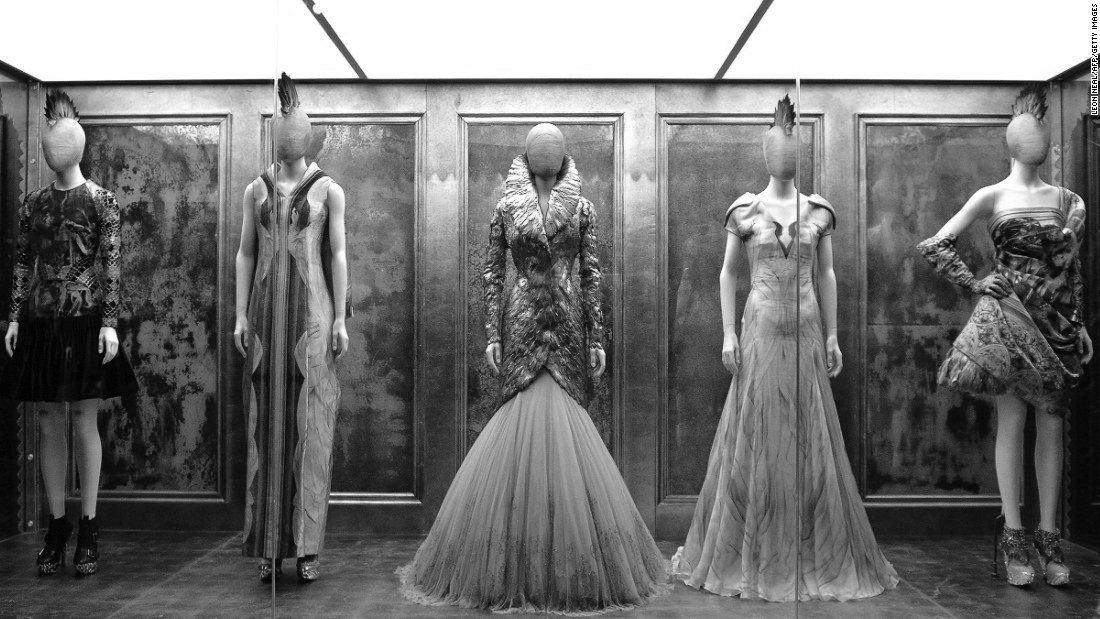
    During the past year, probably the most successful exhibition staged by any major London museum has been Savage Beauty (see illustration) at the V & A, a retrospective devoted to the work of the designer Alexander McQueen. More than 480,000 people saw it, and special late-night showings had to be laid on for the two weekends at the end of its run. Public enthusiasm for the event is, in current circumstances, not surprising. The fashion industry commands powerful PR. It is also much less bound by theories and intellectual constraints than the art world and it certainly has no inhibitions about luxury, and no shame about the money required to support luxury. Yet fashion is conservative in this sense – it gives you something to ‘see’. However ridiculous some of its visual inventions may be, fashion design never neglects the purely visual effect.

    Wear it if you can afford it. Wear it if you dare. And you can be damn sure that people are going to look at you and that they will probably remember what they saw.

    Fashion designers also, as it happens, have much less self-consciousness about ‘appropriation’ than today’s would-be avant-gardists. Fashion designers have always been magpies – they borrow without shame and recycle without inhibition. The point, for them, is to give what is borrowed a new twist. If the audience doesn’t recognise where a particular idea or effect originated, so much the better. With appropriation-art the opposite is the case. You have to know what is being so sedulously copied, otherwise you’re out of the loop.

    One refuge for avant-garde aspirationists, lacking visual inventiveness, has been to take refuge in supposedly radical politics. The visual arts have had an uneasy relationship with politics ever since the French Revolution. It was particularly strong in France during the first two-thirds of the 19th century, and reached a kind of climax in the days of the Paris Commune. This involvement, and the price that could be paid for it, is illustrated by the career of Gustave Courbet.

    There was certainly political involvement between some elements of the visual arts avant-garde and the political left during the first half of the 20th century, but the relationship was always uneasy, as the history of the Surrealist Movement amply illustrates. One still gets a great deal of talk on this subject today. The current Venice Biennale, due to finish on November 22nd, features continuous readings from the three volumes of Karl Marx’s Das Kapital. Whether anyone will pay attention to the words of this text – anymore than most of the traditionally religious pay attention to the actual words of the Mass when recited in Latin – must, I think, be seriously in doubt. In fact, left wing events, safely quarantined in museums, are now a familiar form of preaching to the converted. A good example, here in London, was Mark Wallinger’s installation, State Britain, which won the Turner Prize in 2007. This was a faithful reconstruction of the Peace Camp by the late Brian Haw, which existed for a while out in the open, directly in front of the Houses of Parliament. The Tate Britain web site rather smugly notes that: “Mark Wallinger’s work is noted for its succinct social commentary and political resonance.”

    Yes, indeed. And forgive my asking, but if this now almost-forgotten work ever had any real political impact, in which location would that have been more likely to happen?

    The avant-garde, as we once knew it, is as dead as the proverbial dodo. It is not going to rise again like Lazarus. It’s time we looked for something else, even if we don’t yet know what that is. London is now, for better or worse, a world metropolis. It is full of bright young artists from everywhere you can think of, all enthusiastically making work – much of which can be at least loosely described by the two nouns ‘painting’ and ‘sculpture’. Definitions can wait. Forget the museums. Go to the bustling galleries in Shoreditch and take a look.

    Edward Lucie-Smith

    September/October 2015
  • Preaching to the converted – Victoria and Albert Museum

    Preaching to the converted – Victoria and Albert Museum

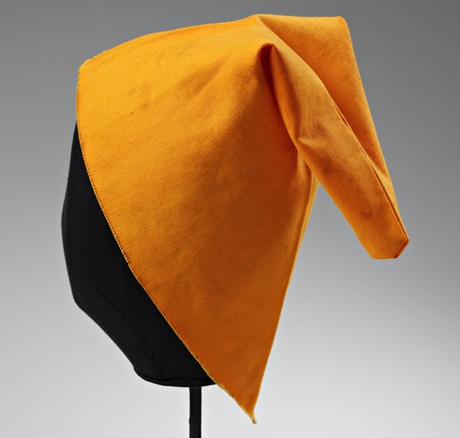
    A dwarf’s hat, as worn by 10,000 protesters at a 1988 march against communism in Poland

    It is understandable that, in current circumstances, major arts institutions should try to ally themselves with the more anarchic, contrarian elements in contemporary culture. Perhaps this is especially true of those dealing with the contemporary visual arts, committed as these still are to the myth of ‘avant-gardism’. One problem that immediately presents itself, of course, is that this myth is not itself contemporary – it is rooted in the very earliest years of the century before ours, and first blossomed before the outbreak of World War I. The myth has become so diversified in the course of more than a century of growth that what is indisputably avant garde today has become very difficult to define. One man’s ‘avant garde’ can easily be his neighbour’s idea of ho-hum, follow-my-leader conservatism.

    Another problem, allied to the first, is that the history of the 20th century avant garde was rather specifically a history of élites. Avant-garde artists relied on élite patrons for financial support – independently wealthy, high status individuals who were conscious of the fact that their championship of the radically new distinguished them from the mass. There is also the fact that the now-classical avant-garde art movements initially embraced right wing politics more enthusiastically than they did left wing ones. This was the case with Italian Futurism, the most publicised of the early avant-gardes. Later, when avant-garde artists began to identify with the left, it was nevertheless would-be mass movements, Nazism and Soviet Communism, which were particularly hostile to avant-garde art. When Surrealism tried to sustain an alliance with Communism, the relationship was always extremely uneasy.

    Disobedient Objects at the V&A (until February 1st) shows that this uneasiness has not gone away. Housed in one of London’s most important museums, its organisers have gone to some lengths to emphasise its democratic status. It is free entry, like the rest of the permanent collection (but unlike the other special exhibitions the museum offers as part of its regular programme), and it has been given an unusually long run – six months in all.

    What it offers is an anthology of objects connected will all sorts of anarchic projects, from the anti-nuclear protests at Greenham Common in England, to the Mothers of the Disappeared in Buenos Aires – all challenges to some kind of existing status quo, made in many different contemporary societies and national entities, democratic and non-democratic. Most of the objects concerned would not normally be classified as art, or even as craft or design. In fact, what one has here is a kind of religious treasury – the holy relics of a number of recent episodes of social agitation, some of which succeeded in their aims and some of which failed. If Christ had lived in our own times, it wouldn’t be surprising to find a relic of the True Cross as part of the display – always remembering that this now sacred item wasn’t, and was never intended to be, a work of art, despite the numberless times it has since been depicted in art. I say this in the full consciousness that, to anyone who reads the Gospels carefully, the texts do in fact seem to advocate a radical egalitarian revolution in society. This despite the famous verse that tells the convert to: “Render unto Cesar the things that are Cesar’s, and unto God the things that are God’s.”  [Matthew 22:21].

    The introduction to the catalogue, by the two curators, Catherine Flood and Gavin Grindon, shows a queasy consciousness of this situation. On the one hand they say:

    “The position of this project, both ‘within and against’ an institution, emerges principally from careful attention to these objects [included] and their own and their own instituent power.”

    On the other they declare:

    “Exhibitions are moments of collective meaning-making. Bringing these objects and histories together, and presenting them to an audience that never encounters them outside the mass media, makes the museum a site for difficult questions and tests it claim to be a public space.”

    The phrase that betrays something here is “never encounters them outside the mass media”. The assumption seems to be that what is experienced within the sanctified space of the museum must necessarily be superior to the same thing experienced outside it. In other words, the official framework, just because it is official, offers a validation unobtainable in the non-official circumstances in which these ‘disobedient objects’ were first made. This paradox is a step too far. The objects concerned have, on the whole, no aesthetic value. They may have had force within the very specific contexts that provoked their production. But not here. They are dead fish on a slab. In an interview given in conjunction with the show, Catherine Flood claimed that the items displayed had not been ‘museumified’ – her word, not mine. I beg to differ. That is exactly what has happened.

    One reason for this is the kind of public that great museums attract. They like to pretend that they are for ‘everyone’, and this is indeed why, in democratic Western European societies, they are given large sums of taxpayers’ money. Any observant person knows, however, that this ‘everyone’ is not completely universal. Museums attract the kind of citizens every democracy would like to have, perhaps to the exclusion of other, more difficult cases. They pull in the bien pensants – people who get a nice glow from the idea of going there. Certainly not the bulk of the truly disadvantaged, the real outsiders. They get a much higher proportion of middle-class visitors than working-class ones, though this distinction is slowly breaking down.

    Where immediate, visceral access to the ideas being put forward in the show is concerned, the mass media win the contest, hands down. They know how to hit the public in the gut, and they operate in a fully public arena. You run up against them in your daily life, whether you want to or not.

    What the museum does here is to try to organise the ‘disobedient’ material to make it palatable to the kind of visitors museums already get. Having heard about the show, you have to make the decision to go, even though you don’t have to pay a fee for the experience. Which means, in turn, that your mind is probably made up about the ideas it puts forward, long before you arrive.

    As it happens, London has already seen a rather similar exhibition – Mark Wallinger’s Turner Prize-winning exhibit at Tate Britain in 2007. This, entitled State Britain, was a meticulous reconstruction of the ‘Peace Camp’ set up by the late activist Brian Haw in front of the Houses of Parliament, in protest against the Iraq War, and subsequently dismantled by the police because it contravened a hastily passed law against “unauthorised demonstrations within a one kilometre radius of Parliament Square”. Much play was made with the fact that the site of the installation within the museum building also seemed to fall within the forbidden zone. However, as the critic Tim Teeman, writing in The Times, remarked, “moving Haw’s protest from the street to the hallowed hush of the Tate denudes it of rawness and energy. The riot of colour, the anarchy of words and images, are dimmed; the weatherbeaten plastic coverings aren’t flapping in the wind anymore, but listlessly reflecting gallery spotlights.” He concluded by asking: “Does it ask new questions or challenge our preconceptions?” And answered his own query: “No, it merely confirms the liberal consensus.” This is exactly what has happened at the V & A, the second time round.

    In fact Disobedient Objects is a very good example of that hallowed middle-class liberal pastime – preaching to the converted. It claims to be radical and is in fact deeply conventional and self-congratulatory. It won’t change anyone’s mind.

    Edward Lucie-Smith

    The Jackdaw Nov/Dec 2014

  • The triumph of avant-garde lite

    Edward Lucie-Smith charts the decline of contemporary art from Modernism and the avant garde to being a mere epiphenomenon of the fashion industry

    Ten days or so ago, before beginning to write this, I was idly browsing a slightly out-of-date copy of the Evening Standard Magazine. Anything to avoid the toil of having to write something myself. Faute de mieux, my eye fell on a piece that was ostensibly about the demise of the so-called ‘It-Bag’ – something about as far from my own usual range of interests as one can conveniently get.

    It began as follows: “As I navigated the giant Carsten Holler mushroom sculptures and the sleeping security guard who may or may not have been a work of art at the VIP preview of Frieze art fair earlier this month, my focus drifted from the exhibits to the people standing studiously in front of them. Take away the art and you’d be forgiven for thinking you were at London Fashion Week – every turn revealed a glossy gallerist or collector with a Céline coat draped over her shoulders, power-walking the halls in Chanel trainers. There’s a reason that Alexander McQueen and Gucci are both sponsors of the fair. Designer stores report bigger sales during Frieze week than at any other time of year (even Christmas). Now in its 11th year, Frieze has evolved into and unbeatable style barometer.”

    This paragraph crystallized a thought that had been already hovering in my mind for some time. The fact is that there is no real visual arts avant-garde any more, despite all the strenuous efforts being made by those who see themselves as the guardians and prophets of contemporary culture to persuade us to the contrary.

    Serendipity has it that The Museum of Modern Art in New York is currently celebrating the activity of a woman artist, previously unknown to me, who worked under the name of Sturtevant (American 1924-2014). The MOMA press release proclaims that this retrospective show “identifi[es] her as a pioneering and pivotal figure in the history of modern and post modern art.”

    What did Sturtevant do? Essentially she made versions of works by better-known artists who were her contemporaries – Johns, Warhol, Lichtenstein, Gonzalez-Torres, Keith Haring and Anselm Kiefer among others. MOMA celebrates this process as follows:

    “Though her “repetitions” may appear to be simply mimetic exercises in proto-appropriation, Sturtevant is better understood as an artist who adopted style as her medium and took the art of her time as a loose score to be enacted and reinterpreted. Far more than mere copies, her versions of Johns’s flags, Warhol’s flowers, and Joseph Beuys’s fat chair are studies in the action of art that expose aspects of its making, reception, circulation, and canonization.”

    It would be hard to devise a more comprehensive and emphatic endorsement of today’s mandarin culture.

    The fashonistas and the mandarins are allied. What they promote is a kind of art that assumes the trappings of ‘traditional avant-gardism’ (an oxymoron if ever there was one), but which in fact runs away from real innovation just as fast at its pattering little paws will carry it.

    A process of this kind is not entirely new. If one looks at Chinese literati culture for example, one sees how Chinese ink painting ossified, after the fall of the Ming dynasty, into endless paraphrases of older masters. What counted was not the image actually created, but the nuances of style, the echoes of what had gone before.

    What the MOMA statement quoted above assumes is that the ideal spectator will already be immersed in the previous history of ‘approved’ avant-garde art. He or she will be able to read, not only the actual text presented, but also the sub-text that lies beneath it. It is, for instance, noticeable that the numerous artists Sturtevant has chosen to paraphrase have no stylistic relationship. What they do have in common is, yes, their gender (Sturtevant is taking them on as the champion of her sex), but also, and perhaps more importantly, their celebrity – the fact that they are all famous and, what is more, famous in a characteristically contemporary way, certified by mechanisms of publicity that came into existence only recently.

    The challenge offered to the lay person is not the one originally offered by the Modern Movement, as it existed during the first seven decades or so of the last century. That challenge was: “Allow your mind and your sensibility to be opened to something entirely new, unthought of in all the previous centuries of culture.” Now the lay person is asked a different question: “Are you one of us or one of them? Chav or non-chav? Elite or hoi-polloi? If you want to be on-message, you’d better step up quick and join us.”

    Responses to this challenge are further complicated by the degree to which what is supposedly avant-garde has become embedded in the mechanisms of today’s official culture.

    This culture, in the western European democracies at least, and also (with certain nuances) in the United States, is determined to be popular. It is supported with large sums of public money, and must therefore reach out as directly as possible to as many people as possible. Hence much of the recent emphasis on what is both immediate and ephemeral, qualities encapsulated in performance art. The alliance between supposedly traditional forms of expression, such as painting and sculpture, and performance is in fact much older than enthusiasts for the radically contemporary are prepared to admit. One thinks of the Dance of Death performances held in churchyards during the Middle Ages, which only somewhat later found a more permanent form, as sequences of prints – a form which, of course, had to wait for the invention of the printing press.

    Throughout the Middle Ages the more ambitious expressions of the visual arts were more usually than not addressed to a mass public, not simply to an elite, though they relied on elite patronage. The reason for this was their link to a universal faith. The bedrock was a common system of beliefs.

    To a limited extent, one must admit, things have now come full circle. The supposedly avant-garde visual arts are placed before an audience of every taxpayer, just as the sacred art of the Middle Ages was made accessible to every worshipper. This offers a telling contrast to the private, conspiratorial rituals of the early years of the Modern Movement, when experimental art was in retreat, both voluntarily and involuntarily, from the glare of publicity offered by the official Salons of the same epoch. In fact, it was the brutally hostile Entartete Kunst exhibition organized by the Nazi regime in Munich in 1937 that finally brought Modernism in art to a wider public. One million people attended the show in the course of its first six weeks. It is safe to guess that the attendees represented a much wider social spread, in terms of both class and education, than any audience Modernist work had attracted previously.

    What is different now, from the situation in the Christian Middle Ages, is the lack of a secure, firmly held belief system about what art is, and what it is supposed to do within the social context. We still, however, retain a curious, atavistic attachment to the idea that art is a charismatic product, with a mysterious impact on our psyches. Very often, we now transfer this belief from the object to the personality responsible for producing the object. This has been developed to the point where celebrated artists are regarded as the equivalents of primitive shamans – Joseph Beuys and, more recently, Marina Abramovic are cases in point.

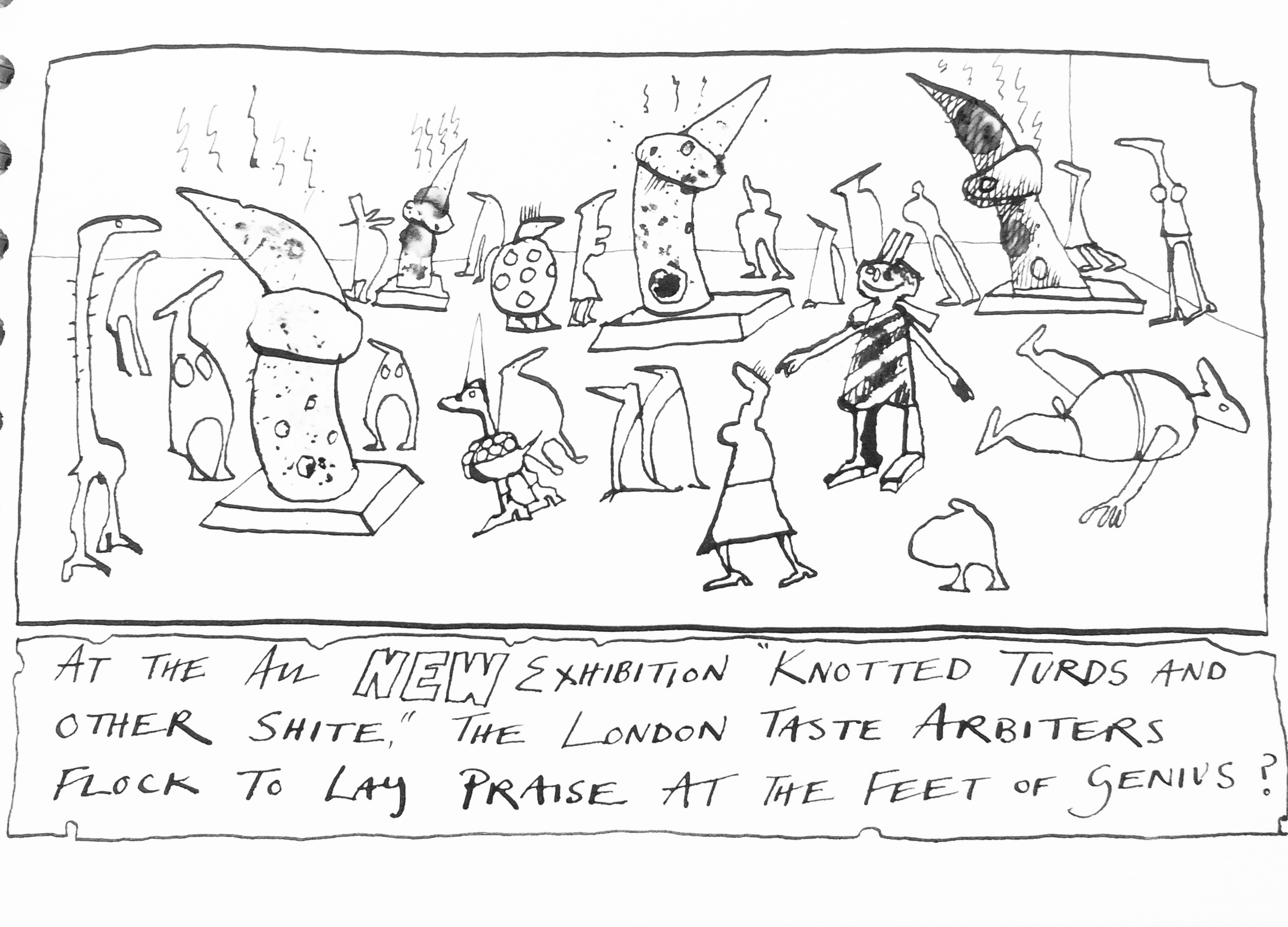
    This lack of a belief system has had a powerful and often catastrophic impact on public art. For example, even now we instinctively expect public sculptures to convey some kind of message, other than a purely aesthetic one. Yet the message, in new monuments of this kind, commonly seems so shallow and clichéd that it doesn’t have any effect. Purely abstract public sculptures – ‘art about art’ – usually fail even more catastrophically. They become simply large-scale open-air ornaments, pretty enough in their way, but with little, or even no, emotional impact. Hence the appearance, in common parlance, of the derogatory term “plop sculpture”, implying that the artwork in question is not much higher in status than a giant dog turd.

    It is notable, in this connection, that the one public image, here in Britain, that did quite recently move and energize a mass audience was the huge display of ceramic poppies, temporarily planted in the moat of the venerable Tower of London to commemorate the dead of World War I. The project was created by two relative unknowns ­– a ceramic artist working with a theatrical set designer. Part of its point was that it was intentionally ephemeral.

    Now that Modernism has apparently run its course, and when the sequence of identifiable Modernist art movements has reached a full stop, we are confronted with a situation in which the art of our own times seems directionless. Attempts to define its salient qualities rely very largely on negative formulations. It is Post Modern. Or Post Post Modern. Or even (in desperation) Post Pop. It often relies heavily on Appropriation – self-consciously copying pre-existing art, stressing its own lack of original invention – in order to make its points.

    The characteristic art of our time also tends to rely very heavily on context. If we encounter a particular object, group of objects or event in a place where we expect to see art, such as in a museum, a contemporary gallery, or at an art fair, then – sure enough, art it is: the context guarantees it. If the place where we encounter it isn’t defined as a space for art, our reactions are not triggered in the same fashion.

    There is also the fact that the knee-jerk reactions that the pioneer Modernists relied on to make their points for them are harder and harder to evoke. The same buttons have been pushed too often.

    Basically once art loosened its age-old ties with religion, and at the same time increasingly ceased to be credibly involved in the celebration of wealth and power, it relied increasingly on being contrarian – on telling its audience things it didn’t necessarily want to hear. Uproar, and frantic opposition to the message, were the first steps towards eventual acceptance and celebrity. If one looks at the development of the 20th century avant gardes (in the plural), one sees that this was largely cyclic. A tendency or style or set of aesthetic ideas established itself after a period of struggle. As soon as the sandcastle was fully built, however, a wave came racing up the beach to overthrow it. It is amusing in retrospect to note how furiously the reigning critics and theoreticians who established the dominance of Abstract Impressionism opposed the rise of Pop Art.

    In crude terms, controversies about art, since the birth of the Modern Movement, have relied on four things. The two most fundamental were, first, the insistence that the world could be seen in new ways – that the established processes whereby what the artist saw could be translated to make an art work that other people were going to see could be radically re-jigged. Secondly, linked to this, but not entirely identified with it, there was the idea that art could be its own subject, entirely self-reflexive. Neither of those impulses seems to be in any way dominant in the art world we now have, though the fashion for Appropriation shows maybe some last, distorted traces of the doctrine of art for art’s sake.

    The third and fourth impulses were cruder. Art threw itself into politics, and it became increasingly candid about sex.

    The political impulse goes a long way back. It began at least a century before the rise of the Modern Movement. One can trace its trajectory from the political masterpieces of J-L David (Marat Assassiné) and Delacroix (The Massacre at Chios) to, perhaps, Picasso’s Guernica. Now it seems to have lost pretty well all of its impetus. The Disobedient Objects show, currently on view at the V & A, offers a classic instance of preaching to the converted.

    Much the same things can be said about aggressive eroticism. The erotic impulse has been present in art ever since men began to make art. In the 20th century, erotic representations and brutally obvious erotic allusions became one of the ways through which artists tried to trademark their work as being ‘radical’ – something opposed to the social conventions of their time. This endured till comparatively recently. Remember those Chapman Brothers figures in the R.A.’s Sensation! show of 1997, with penises for noses? Remember – also from the 1990s – Jeff Koons’ sculptures of himself screwing his then-wife, the Italian porn-star La Cicciolina? You can still find one or two of them on the Web, if you care to look.

    All that seems to be over. Shock tactics no longer shock. Avant-garde art has been gobbled up by the fashion world, and by today’s celebrity culture. What’s it for? It’s for posing in front of, wearing a nice frock. It quotes, daintily, from the avant-garde styles that entertained and enlightened us in the past, but as for trying to change the world – “Have another caviar canapé, darling – all that stuff seems sooo boring now.”

  • ‘The Late’ shows

    Edward Lucie-Smith considers the phenomenon of ‘The Late Style’ in relation to Rembrandt and Turner

    The new Rembrandt show at the National Gallery in London (until January 18th) is clearly meant to challenge the enormous success the same institution enjoyed with its recent exhibition devoted to Leonardo da Vinci. It is a populist homage to one of the undoubted giants of Western European visual culture.

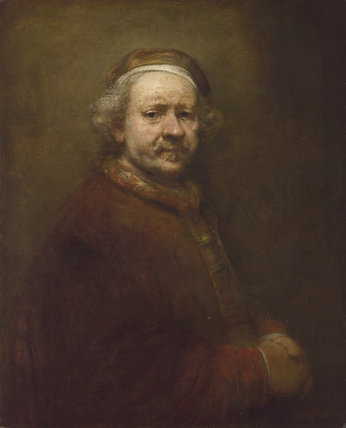
    Instead of trying to embrace the whole man, or at any rate the whole artist, as the Leonardo exhibition did, it focuses on a very specific period of the artist’s life – his last decade and a half, roughly speaking from the time he went bankrupt in 1656 to his death in October 1669, aged 63 (his self-portrait at that age is illustrated here).

    The show has a very particular context, perhaps the result of happenstance. London is currently playing host to another major exhibition devoted to a great master from the past – a painter as well known, and as much of a universal culture hero, as Rembrandt himself.

    This, at Tate Britain, is devoted to the British landscape painter, J.M.W. Turner. Entitled ‘Late Turner – Painting Set Free’ (until January 25th) it focuses on the productions of Turner’s final years, from 1835, when the artist was 40, to his death in 1851, aged 76. Turner began his final phase at an earlier age than Rembrandt, and lasted somewhat longer.

    The idea of the ‘late style’, as a very special, magical phase in the evolution of the work of a great artist, is a comparatively modern invention. To the credit of the organizers, the catalogue of the Rembrandt exhibition is careful to spell this out. As Jonathan Bikker and Gregor J.M. Weber write in an essay entitled ‘Explaining Late Rembrandt’: “At the beginning of the twentieth century the search for specific rules governing the evolution of styles gave rise to a mythology of the aged artistic genius, driven to produce outstanding works in the face of his approaching death.” They add to this: “The concept of ‘Alterstil’ (old age style) emerged to account for late-life creativity…According to the authors who coined the term, the characteristics that defined Alterstil… were a tendency towards abstraction and formal simplicity, combined with greater depth in the subjective and intellectual content. The assumption was that these characteristics can be identified in all art forms and eras.”

    With these two exhibitions, as also with the release in Britain of Mike Leigh’s much lauded new film Mr. Turner, one is therefore dealing with a new phase in the evolution of a myth not as yet formulated in either of the two artists’ own lifetimes. The myth, endorsed by the two museums concerned as instruments of official culture, inevitably affects our own reactions to what is shown.

    One of its effects is to bring the works we are looking at closer to our own contemporary sensibilities. We are certainly not seeing them in the same way as that of the audiences to which they were originally addressed. We are, instead, being presented within a framework where that can confidently be regarded as the productions of genius. It must be immediately noted that the idea of the ‘genius’ – artistic, musical or literary – was itself not fully evolved until, at its earliest, the later years of the 18th century, the period of the Sturm und Drang. There is considerable evidence that Rembrandt’s contemporaries, were often puzzled, or made to feel uneasy, by the stylistic evolution that both artists underwent in the concluding phases of their respective careers.

    The Rembrandt show, held in the cramped basement spaces of the National Gallery’s modern extension, suffers from curatorial overkill. A good selection of paintings from Rembrandt’s last fifteen years is on view, among them a number of acknowledged masterpieces, such as the Jewish Bride from the Rijksmuseum in Amsterdam, which may also be a marital double portrait, and the huge (though still cut down) Conspiracy of the Batavians under Claudius Civilis borrowed from Stockholm.

    There is also an array of self-portraits, which do much to explain why Rembrandt is today regarded as an ‘honorary contemporary’, in a fashion denied to other major painters of the same epoch, such as Rubens. We seem to be offered direct access to the artist’s innermost thoughts and feelings.

    The impact of the show is nevertheless diminished by the fact that the general effect is so cluttered. The paintings are accompanied by a mass of late period drawings and prints, impossible to examine in any detail in the thronging crowd of spectators. One longs to be able to stand back and take an unobstructed look at the major items.

    The Late Turner show at Tate Britain occupies more spacious quarters and is much more logically hung. The artist’s magically vaporous late landscape paintings have long been revered as the very pinnacle of British achievement in the visual arts, and it is an enormous pleasure to see them so generously presented. The catalogue leaves one no doubt, however, about the negative reactions of many of the artist’s contemporaries. His two Venetian scenes dated 1846, Going to the Ball and Returning from the Ball, were exhibited more or less pre-sold at the Royal Academy – Turner was of course a member, an Academician in the strict sense of that term. Yet the buyers pulled out, after unfavourable reactions in the press. The paintings remained unsold, and formed part of the artist’s estate when he died.

    Turner emerges not merely as a visionary, but as someone who had a sophisticated awareness of the processes of change in the Britain of the first half of the 19th century. The celebrated Rain, Steam and Speed – The Great Western Railway (1844) is a good example. The catalogue note on the painting appositely remarks that: “Nature’s sublimity is controlled and condensed by the new industrial paradigm, when water is transformed by heat to produce motive power.”

    Nevertheless, as the exhibition is at some pains to establish, Turner’s art also had deep roots in the classic landscape painting of the past, in particular in the work of Claude and Poussin. There are frequent references to mythological themes, and to be fully understood what he did often needs to be seen within the intellectual framework of an old-fashioned classical education. To force Turner into a totally different mould, as the forerunner of Abstract Expressionism – the prophet of splish, splosh and splash – doesn’t really make sense.

    The fact is that both shows need to be examined with a degree of caution. They propagate an idea, that of the predestined superiority of the Alterstil, as this has been elaborated during the past hundred years or so, which would have been entirely unfamiliar to the two great artists concerned, and also to their contemporaries. The curators concerned offer warnings and qualifications, but the actual titles given to both exhibitions make it plain that the concept lives on. The invitation is to make Rembrandt and Turner over in our own present-day image. For me, that doesn’t work. We need to look at them on their own terms.

  • Disobedient Objects – Edward Lucie-Smith at the Victoria and Albert Museum

    A dwarf’s hat, as worn by 10,000 protesters at a 1988 march against communism in Poland

    It is understandable that, in current circumstances, major arts institutions should try to ally themselves with the more anarchic, contrarian elements in contemporary culture. Perhaps this is especially true of those dealing with the contemporary visual arts, committed as these still are to the myth of ‘avant-gardism’. One problem that immediately presents itself, of course, is that this myth is not itself contemporary – it is rooted in the very earliest years of the century before ours, and first blossomed before the outbreak of World War I. The myth has become so diversified in the course of more than a century of growth that what is indisputably avant garde today has become very difficult to define. One man’s ‘avant garde’ can easily be his neighbour’s idea of ho-hum, follow-my-leader conservatism.

    Another problem, allied to the first, is that the history of the 20th century avant garde was rather specifically a history of élites. Avant-garde artists relied on élite patrons for financial support – independently wealthy, high status individuals who were conscious of the fact that their championship of the radically new distinguished them from the mass. There is also the fact that the now-classical avant-garde art movements initially embraced right wing politics more enthusiastically than they did left wing ones. This was the case with Italian Futurism, the most publicised of the early avant-gardes. Later, when avant-garde artists began to identify with the left, it was nevertheless would-be mass movements, Nazism and Soviet Communism, which were particularly hostile to avant-garde art. When Surrealism tried to sustain an alliance with Communism, the relationship was always extremely uneasy.

    Disobedient Objects at the V&A (until February 1st) shows that this uneasiness has not gone away. Housed in one of London’s most important museums, its organisers have gone to some lengths to emphasise its democratic status. It is free entry, like the rest of the permanent collection (but unlike the other special exhibitions the museum offers as part of its regular programme), and it has been given an unusually long run – six months in all.

    What it offers is an anthology of objects connected will all sorts of anarchic projects, from the anti-nuclear protests at Greenham Common in England, to the Mothers of the Disappeared in Buenos Aires – all challenges to some kind of existing status quo, made in many different contemporary societies and national entities, democratic and non-democratic. Most of the objects concerned would not normally be classified as art, or even as craft or design. In fact, what one has here is a kind of religious treasury – the holy relics of a number of recent episodes of social agitation, some of which succeeded in their aims and some of which failed. If Christ had lived in our own times, it wouldn’t be surprising to find a relic of the True Cross as part of the display – always remembering that this now sacred item wasn’t, and was never intended to be, a work of art, despite the numberless times it has since been depicted in art. I say this in the full consciousness that, to anyone who reads the Gospels carefully, the texts do in fact seem to advocate a radical egalitarian revolution in society. This despite the famous verse that tells the convert to: “Render unto Cesar the things that are Cesar’s, and unto God the things that are God’s.”  [Matthew 22:21].

    The introduction to the catalogue, by the two curators, Catherine Flood and Gavin Grindon, shows a queasy consciousness of this situation. On the one hand they say:

    “The position of this project, both ‘within and against’ an institution, emerges principally from careful attention to these objects [included] and their own and their own instituent power.”

    On the other they declare:

    “Exhibitions are moments of collective meaning-making. Bringing these objects and histories together, and presenting them to an audience that never encounters them outside the mass media, makes the museum a site for difficult questions and tests it claim to be a public space.”

    The phrase that betrays something here is “never encounters them outside the mass media”. The assumption seems to be that what is experienced within the sanctified space of the museum must necessarily be superior to the same thing experienced outside it. In other words, the official framework, just because it is official, offers a validation unobtainable in the non-official circumstances in which these ‘disobedient objects’ were first made. This paradox is a step too far. The objects concerned have, on the whole, no aesthetic value. They may have had force within the very specific contexts that provoked their production. But not here. They are dead fish on a slab. In an interview given in conjunction with the show, Catherine Flood claimed that the items displayed had not been ‘museumified’ – her word, not mine. I beg to differ. That is exactly what has happened.

    One reason for this is the kind of public that great museums attract. They like to pretend that they are for ‘everyone’, and this is indeed why, in democratic Western European societies, they are given large sums of taxpayers’ money. Any observant person knows, however, that this ‘everyone’ is not completely universal. Museums attract the kind of citizens every democracy would like to have, perhaps to the exclusion of other, more difficult cases. They pull in the bien pensants – people who get a nice glow from the idea of going there. Certainly not the bulk of the truly disadvantaged, the real outsiders. They get a much higher proportion of middle-class visitors than working-class ones, though this distinction is slowly breaking down.

    Where immediate, visceral access to the ideas being put forward in the show is concerned, the mass media win the contest, hands down. They know how to hit the public in the gut, and they operate in a fully public arena. You run up against them in your daily life, whether you want to or not.

    What the museum does here is to try to organise the ‘disobedient’ material to make it palatable to the kind of visitors museums already get. Having heard about the show, you have to make the decision to go, even though you don’t have to pay a fee for the experience. Which means, in turn, that your mind is probably made up about the ideas it puts forward, long before you arrive.

    As it happens, London has already seen a rather similar exhibition – Mark Wallinger’s Turner Prize-winning exhibit at Tate Britain in 2007. This, entitled State Britain, was a meticulous reconstruction of the ‘Peace Camp’ set up by the late activist Brian Haw in front of the Houses of Parliament, in protest against the Iraq War, and subsequently dismantled by the police because it contravened a hastily passed law against “unauthorised demonstrations within a one kilometre radius of Parliament Square”. Much play was made with the fact that the site of the installation within the museum building also seemed to fall within the forbidden zone. However, as the critic Tim Teeman, writing in The Times, remarked, “moving Haw’s protest from the street to the hallowed hush of the Tate denudes it of rawness and energy. The riot of colour, the anarchy of words and images, are dimmed; the weatherbeaten plastic coverings aren’t flapping in the wind anymore, but listlessly reflecting gallery spotlights.” He concluded by asking: “Does it ask new questions or challenge our preconceptions?” And answered his own query: “No, it merely confirms the liberal consensus.” This is exactly what has happened at the V & A, the second time round.

    In fact Disobedient Objects is a very good example of that hallowed middle-class liberal pastime – preaching to the converted. It claims to be radical and is in fact deeply conventional and self-congratulatory. It won’t change anyone’s mind.

    Edward Lucie-Smith

    The Jackdaw Nov/Dec 2014

  • Kenneth Clark at Tate Britain: the great panjandrum

    Edward Lucie-Smith discovers that their tribute to Kenneth Clark is not as complimentary as the Tate thinks it is

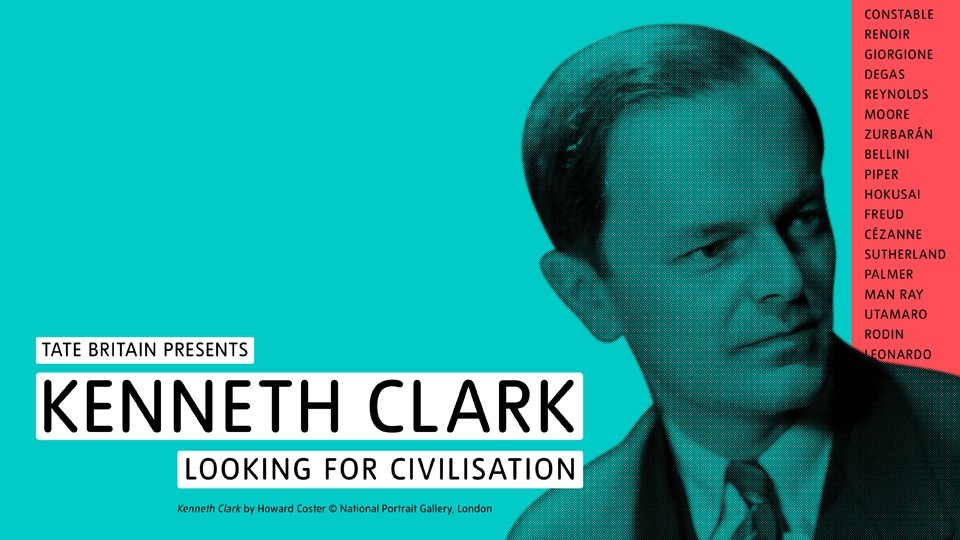
    The Tate Britain show devoted to Sir Kenneth Clark – ‘Lord Clark of Civilisation’, as he came to be called – was a slightly strange phenomenon. It defined a whole tract of the recent history of the visual arts here in Britain, but in the end fell short of being a genuine celebration. Going round it, examining what was on view, one noted how much things have changed. And at the same time, how much they haven’t.

    Clark’s career can be thought of as making a bridge between Roger Fry and the Bloomsberries on the one hand and the achievements (and failings) of Sir Nicholas Serota on the other. Brought up in what seems to have been gilded solitude – the only child of a very rich man whom the Tate catalogue describes as an idler – he was the privileged inhabitant of a variety of different but related social worlds.

    His ascent through the pre-war British art world, also through at least one major tribe of the international art world, was extremely rapid. From the circle surrounding Roger Fry he passed, with remarkable ease, into that surrounding Bernard Berenson at I Tatti on the outskirts of Florence. The famously formidable Berenson asked Clark, who was still in his early twenties, to work on a new edition of his celebrated catalogue of drawings by Florentine painters, first published in 1903, the year of Clark’s birth.

    The Tate catalogue makes some significant remarks about this, worth quoting here at some length, though with a bit of necessary compression: “The time Clark spent at I Tatti with Berenson was an education in a very different approach to art: that of connoisseurship. Having an ‘eye’ meant the ability to discern on the basis of simply looking at a work, who might have made it and when… Attribution was a gentleman’s sport, and for Clark it seemed at the time ‘the only game worth playing’. Not, he was careful to add, for the money, but for the glory of having an eye and being right.”

    Read in the context of what was actually on view at the Tate, this paragraph made a very peculiar effect. True, Clark at this period wrote an authoritative catalogue of the Leonardo drawings in the Royal Collection at Windsor. As the Tate catalogue rather smugly remarks: “[It] remains unsurpassed (if in a quite specialised genre). And many of his identifications, both attributions and de-attributions, as well as datings of the drawings, have stood the test of time.” Two genuine Leonardo drawings, plus a non-Leonardo with the same provenance, were included to prove the point.

    It was the other Old Master items that formed part of the Tate’s exhibition that supplied a bucket – several buckets – of cold water. What one got was a parade of duds. The show included, for example, the four little panels by the very minor Andrea Previtali that Clark bought for the National Gallery during his period as Director, in the belief that they were by Giorgione. Worse were some items that the great panjandrum had actually owned himself. For example, a much scraped and over-restored School of Pontormo Madonna and Child that Clark thought was an original Rosso, and a dreary John Wootton landscape that he believed to be by Claude. Also a battered fresco fragment representing a putto that he hoped was the work of Giorgione. Even undoubtedly genuine works were sometimes the dullest possible examples of a particular master.

    Clark, for example, owned two paintings by Seurat. The one shown at the Tate, The Forest of Pontaubert, was painted in 1881, when Seurat was just 21 years old. It’s an uncertain, obviously juvenile work. I don’t think Clark himself thought much of it by the time he reached old age. I met him once, in his last years, to do an interview about Graham Sutherland, one of the British artists who benefited from his support and patronage. He was then living in a spacious but curiously characterless bungalow built at the gates of Saltwood Castle, which had been handed over to his son Alan. The Seurat was not on a wall, but was propped up on the floor of a cloakroom where I went to pee. It was fairly obvious that nobody loved it or bothered to look at it.

    There were some good things in Clark’s possession, notably a group of paintings and drawings by Cézanne that he had the good fortune to buy from the artist’s heirs in the 1930s. He also once owned (but it wasn’t in the show), a large icing-sugar sweet Renoir nude from the early 1880s, now in the Pinacoteca Agnelli in Turin. This flamboyantly vulgar object would undoubtedly excite new-rich billionaire collectors if it appeared today in a Sotheby’s or Christie’s auction. Clark’s protégé Victor Pasmore said the Renoir nude set his teeth on edge, and painted a hostile paraphrase to prove it. Clark was sporting enough to buy it.

    As a practical demonstration of Clark’s pre-eminence as a connoisseur, a supreme aesthete, the exhibition was a bust.

    On the whole, the show served instead as a refutation of a once-powerful but now largely discredited myth, sedulously propagated by Berenson and his circle, and also by a platoon of other professional ‘art experts’ covering about three generations, that there existed, occupying deservedly privileged positions in civilised western societies, oracular figures who could produce the right attribution for almost any Old Master painting, drawing or sculpture, simply by gazing at it steadfastly for a few moments. Almost nobody believes that today.

    Kenneth Clark’s importance to the art world was quite other, and had nothing to do with his failings as a connoisseur. His gifts were as an administrator and, above all, as a communicator. As director of the National Gallery during the war years he saw to the safety of the collection and yet kept the gallery alive as a cultural focal point in a London battered by bombing. He brought a group of leading British artists together – prominent among them Henry Moore, John Piper and Graham Sutherland – who seemed to express some kind of national essence.  During the war they made works that successfully heroised and commemorated the national ordeal, drawing on pre-Modernist roots in the English Romantic tradition. This development did a great deal to reconcile a previously sceptical middle-class public to the ideas and theories of the 20th century Modern Movement.


    Above all, he wrote books that communicated ideas and theories about art in clear, non-specialist terms– The Nude and Landscape into Art are cases in point. And he engaged with the new mass medium of television. The Nude, with its crucial distinction between ‘the naked’ and ‘the nude’, remains influential today, though it was published as long ago as 1956. Some scholar needs perhaps to go through it now, and calibrate what it says with the rise of Pop Art, where representations of the nude play no inconsiderable a part. Are Pop nudes ‘ideal forms’? In a way, yes, they are. Come to think of it the sugar sweet Renoir nude that Clark once owned takes on a different inflection if one examines it in the light cast by the Pop movement.

    Most of all, Clark embraced the new medium of television. The marriage was at first sight a curious one. While being obviously at ease in front of the camera, he lost no trace of his grandee manner. In fact, it qualified him to tell us what he was confident we didn’t know.

    Looked at now, Clark’s conception of ‘Civilisation’ seems limited. It is essentially Western, though he had an early taste for Japanese art – Japanese prints were almost the first things he collected. André Malraux’s concept of an ‘imaginary museum’ or ‘museum without walls’, embracing all visual cultures, was first presented to the public in 1947. Clark’s Civilisation series began transmission as late as 1969, a whole generation after that.

    It is possible to see Civilisation as a very successful attempt made by the then existing establishment to retain control of the cultural narrative. A similar sort of attempt, though with somewhat less success, is currently being made by the collective of Tate galleries. One is the very space where the exhibition devoted to Clark took place.

    Something that has changed quite radically since the reign of Clark is the way in which ideas about art – indeed ideas about everything – are communicated. Television centralised communication, but its period of total domination was remarkably short. The Internet has instigated a rapid devolution, a change from the hierarchical to the democratically lateral. Our taste in presenters has changed too. In October 2013 Grayson Perry gave the first of the most recent series of Reith Lectures, one of the BBC’s most sacred occasions. It was recorded, sure enough, in the equally sacred halls of Tate Modern. Perry was as much at ease as his predecessor Sir Kenneth, while performing a very similar task, and addressing, one is permitted to think, a similar audience. The visual aspect of the event did at first seem quite different. What you got when you looked at the screen was not a grandee in a Saville Row suit, but the Widow Twanky in her best frock. Shut your eyes, however, and the slightly posh accent was exactly the same. Clark’s legacy lives on, despite the evolution of technology.

  • Matisse at the Tate: cut and paste

    Edward Lucie-Smith admires an ambitious exhibition but with the reservation that something is missing

    The big new exhibition of Matisse’s Cut-Outs at Tate Modern in London is, certainly on the face of it, everything that a major museum of Modern and Contemporary Art should be doing. It is beautifully presented, very professionally curated, has an extremely thorough, excellently illustrated catalogue and has been greeted with ecstatic reviews. It is thronged with visitors, but fortunately not to the point of suffocation (as was the case, alas, with the National Gallery’s recent Leonardo da Vinci exhibition). The rooms in which it is shown are big enough to allow the visitor enough space to view the exhibits from a variety of distances, and the works themselves are often on a suitably grand scale.

    I departed from it thinking that here was exactly the kind of show that an institution of this kind ought to present. Tate Modern is, currently, the most visited gallery of modern art in the world, outstripping both the Museum of Modern Art in New York and the Pompidou in Paris, although, to be frank, its own permanent collection is not on a par with the stellar holdings of either of these rivals. It was only after I left that doubts began to make themselves felt, and I’m not sure that these doubts are the fault of Tate Modern or of the organizers of the occasion. Perhaps they are inherent in our present cultural situation, where the creative force of the Modern Movement seems to be inexorably dwindling away.

    Just over 113 years ago, in November 1910, the Grafton Galleries in London opened a show called Manet and the Post-Impressionists. It was apparently the first time that the term ‘Post-Impressionist’ was used in English. Matisse, who had sprung to fame at the Paris Salon des Indépendants of 1905, was one of the artists included. The British press was excoriating about the exhibition. The anonymous reviewer in The Times of London commented that the work shown “throws away all that the long-developed skills of past artists had acquired and bequeathed. It begins all over again – and stops where a child would stop.” How times have changed!

    Yet it is immediately obvious that in some respects Matisse’s work during his last years did not move very far from what was shown in Paris in 1905 and in 1910 and in London. The famous Luxe, calme et volupté, shown at the Indépendants in 1905, and now in the collection of the Musée d’Orsay in Paris, is a very recognizable ancestor of the compositions with nudes shown in London.

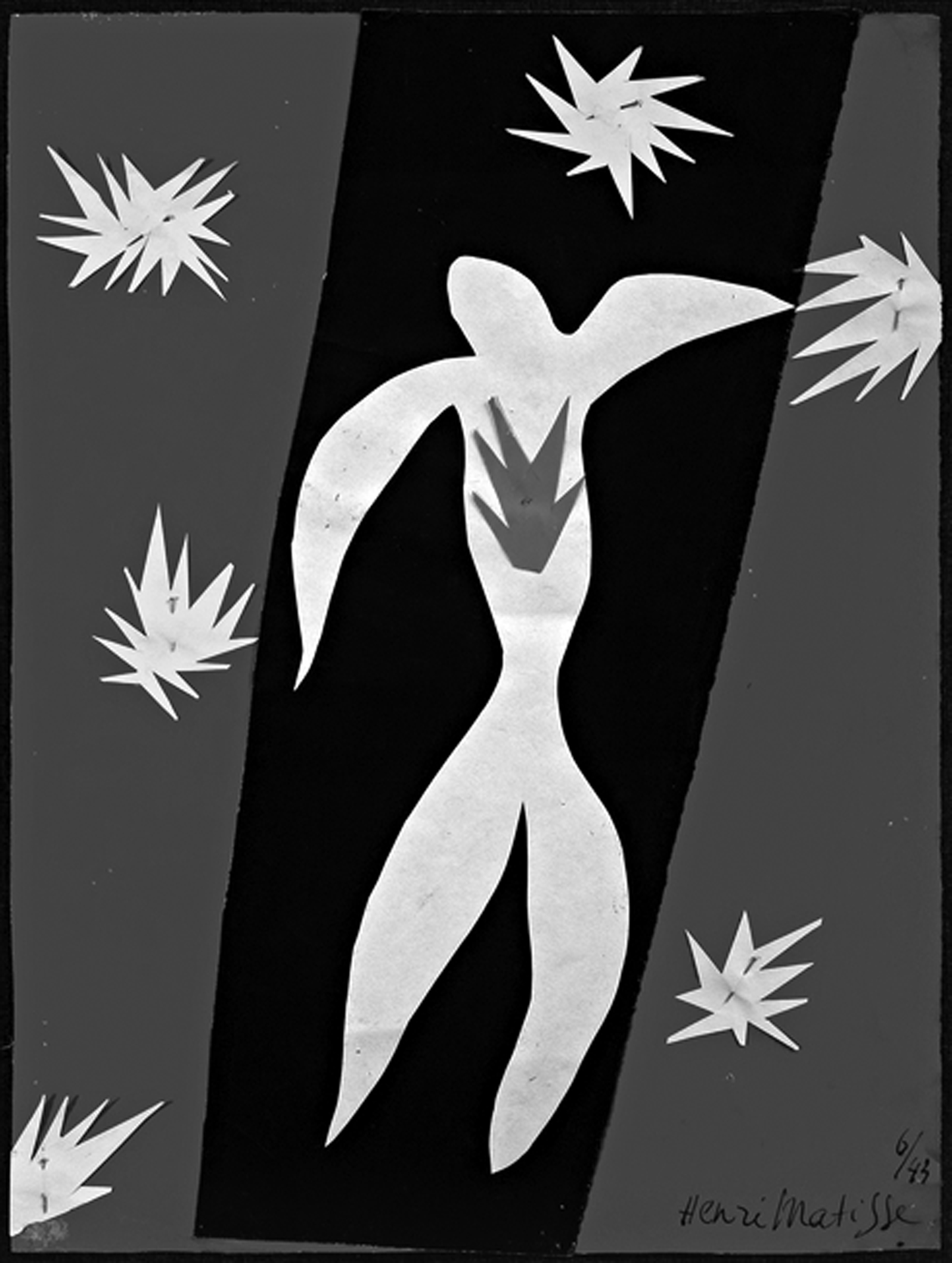
    What changed was the technique. The compositions were no longer painted, they were made with pieces of cut paper. Matisse did the cutting, and the papers he used were painted in gouache to his exact specifications. Once cut, they were pinned in place according to his directions.

    Matisse had already experimented with designs made from cut and pasted paper in the 1930s – the projects he tackled included decors for the ballet and maquettes for book covers. When he did these collage was already long established as one of the typically ‘modernist’ methods of image making. Picasso and other Cubists had made radically experimental use of it. Collage techniques had also been extensively employed by amateur artists throughout the 19th century. Interestingly the word ‘collage’ seems to be absent from the catalogue. Matisse was not completely an innovator in this phase of his work.

    The real starting point for the Cut-Outs was the serious illness that Matisse suffered from in 1941. He was operated on for duodenal cancer and nearly died from resultant complications. As a result he was unable to stand up for long periods, and had to make art while seated in a wheel chair, from another specially adapted chair, or reclining in his bed. Using scissors and cut paper he could, with the help of assistants, continue to create work on an ambitious scale.

    Because of Matisse’s long-established celebrity the process of making these works and the various stages they went through were extensively documented photographically. The catalogue published in connection with the current Tate Modern exhibition has a very rich series of illustrations of this kind, made by various photographers, some working under the artist’s direction, and some not.

    If one reads the Tate catalogue attentively, it is possible to detect a certain note of nostalgic regret that appears when these records of the images in situ in Matisse’s several studios are discussed. What the authors of the various essays seem to long for is permission to hail Matisse as the pioneer, perhaps even the God the Father, of the current Post Modernist tendency to promote installation as the pinnacle or ne plus ultra of late Modernist and Post-Modernist creativity. The problem is that they can’t quite bring themselves to say this in so many words. As it happens, their silence is justified by what one actually sees at the Tate.

    Wonderfully decorative as many of them are, it is clear that a certain loss of freshness took place when the Cut-Outs were removed from Matisse’s studio and made ready for public exhibition. All too often, one feels as if one is looking at an exquisitely beautiful, immaculately preserved corpse. There is another problem as well. The aged Matisse, armed with a pair of scissors, confidently slicing through the sheets of coloured paper prepared for him, was wonderfully skilful at simplifying natural forms – nude female bodies, birds, fish, leaves, even algae floating in water. Yet the compositions only occasionally add up to something more than decoration. Some extra dimension of emotion is missing.

    Towards the end of the presentation there is something not technically a Cut-Out – a stained glass window called Christmas Eve, commissioned by Time Inc. in New York. The composition is curiously perfunctory – banal symbolism for a safely ecumenical Christmas card.

    Despite the fame of the Matisse-designed chapel at Vence – maquettes for its windows are also included in the show – religious emotion was clearly not part of Matisse’s temperament. With this exhibition ‘What you see is what you get’. Exactly what you get – don’t ask for more. I left thinking it was 99% wonderful, and regretting the missing one per cent perhaps more than I should have done.

  • Painting Now – an alternative view

    Inspired by the lacklustre, boring effort of the Tate in their exhibition Painting Now, Edward Lucie-Smith nominates his own five painters

    Contemporary painting, according to many critics and curators, is a dying art form. In the big Biennales it gets pushed aside by more ‘relevant’ forms of expression – installation, video, achingly fashionable performance art. We are encouraged to go to the major official galleries not to look but to think. In other words, to have conversations about economics with the likes of Tino Seghal and his acolytes (winner of the Golden Lion at the most recent Venice Biennale, then narrowly pipped for this year’s Turner Prize). In Seghal’s case, you could even get cash for participating – £2 for engaging in conversation, and thus being part of the show. There’s no way you can get paid just for looking at a painting. As an activity, this still ranks as self-indulgence, rather than as self-improvement.

    It’s therefore been interesting, in more ways than one, to look at one of Tate Britain’s current exhibitions, demurely entitled Painting Now. Interesting to see the works themselves. Interesting to note the reactions of various reviewers. More interesting still to fantasize about what might have been. For the fact is that the art of painting has probably never been more alive in Britain than it is today. London’s studios are thronged with interesting young artists, and probably the majority of these are practitioners of this supposedly effete way of making art. If any one doubts this, they should look at the first volume of the iBook called 100 London Artists, which I recently put together in collaboration with Zavier Ellis, one of London’s savviest younger dealers. There are lots more who don’t live and work in the metropolis. You’ll find worthy contenders, already with established careers and reputations, almost wherever you look in contemporary Britain – in Glasgow, for example, in Liverpool, in Manchester and in Wales. They belong to an art world that is growing more and more isolated from that of our official institutions, but they are certainly not starving miserably in garrets. They hold exhibitions, they attract supportive collectors and they exist successfully within the framework of a capitalist society, where goods are produced in exchange for money. Which of course has been the basic pattern of the art market, at least since the later years of the 16th century. It’s the sort of world, economically, that Rembrandt and Vermeer were familiar with, not to mention our own Turner and Constable.

    The problem is not any lack of talented artists who are practitioners of painting, but the way in which the social context has become skewed. There are, I think, two reasons for this, rather than just one. The first is the slightly unholy alliance between the world of ‘official art’, as represented by museums and increasingly numerous and ambitious biennials, and art that is supposedly innovatory. The avant-garde has triumphed, and the price of its success is that it has lost its mojo. It has become the pacificatory element in a ‘bread and circuses’ culture. Its job is to entertain – to keep our minds off the more depressing aspects of contemporary society, even when apparently criticizing it. It has to embrace a slightly fictional credo of democratization, despite something we all know, but don’t always like to say, which is that museums of contemporary art remain the playgrounds of the middle-class. Painting Now at Tate Britain is a case in point. The price of a standard ticket is £10. This reduces to £5 if you are in possession of a National Art Pass, which will cost you £53 a year for a singleton membership, reducing to £25 if you are under 25. The current National Minimum Wage for adults is £6.31 per hour. For 18-20 year olds it reduces to £5.03, and for 16-17 years olds it is £3.72, The job-seekers allowance is £56.80 per week. You can visit both the Tates for free, but not their supposedly cutting-edge exhibitions. If you are in a crap job, or out of work, these events are pretty certainly too much of a luxury.

    The other factor is the ever-increasing emphasis on personal charisma, which, I think, at least partially explains the current fashion for Performance Art. A successful artist – the kind of successful artist who increasingly finds a showcase at major institutions – does not necessarily have to produce, only to be, like a certain type of medieval saint. With the decline of traditional faiths, contemporary art has become a kind of alternative religion. Yet this doesn’t alter the fact that, while an artist of this new charismatic type may convincingly display the stigmata, those eager to take a closer look at him or her usually need to have a bit of cash to jingle in their pockets. Medieval societies were more down to earth. If you enjoyed performances replete with subversive messages, you got to watch Dance of Death masquerades in your local churchyard. With any luck, you could also encounter an out-to-lunch high-as-a-kite visionary holy man right there in the street.

    Given the situation I have outlined here, it is not surprising that critical responses to Painting Now have been somewhat confused. In his piece for the Sunday Times, Waldemar Januszczak began on a high note, saying “The curation and concept of this exhibition is fantastic and we wish other institutions would take gambles on shows like this…” Yet the review concludes with a savage parting shot: “This, then is a collection of painters who paint for the wrong reasons: not because they feel the joy or exhilaration of paint, but because using it is a means to an end.”

    Richard Dorment, in the Daily Telegraph, took an almost diametrically opposite route. He begins where Januszczak leaves off: “What strikes me about these five artists is how suspicious they are about the expressive possibilities of painting, how they distance themselves from their subjects, damp down emotion, and refuse to use colour, texture or dynamic brushwork to seduce the viewer with an easy visual fix.” But then he changes tack: “I’d call them cerebral, but that’s not quite right. Nearer to the mark is the word integrity. This is painting you can respect.”

    What does this all add up to? Basically, if you take the two reviews together, a sub-text emerges. What the two panjandrums are telling us is this: “Excuse me, folks, I really don’t want to say it outright in the columns of my big-circulation newspaper, but this is a thoroughly boring show. Not exactly bad, but very limited and – er, boring. Now will somebody please bring me a stiff drink.”

    Reader, I went to see Painting Now, and believe me, this reaction was spot on.

    Lucy McKenzie, also singled out by Januszczak, is the most engaging artist in the exhibition – apart that is from a galumphing and rather tacky installation in the middle of her space. The booklet informs one that this “painted architectural structure [is] a model of the marble cladding of the central living room of the Villa Müller in Prague, designed by the Austrian architect Adolf Loos (1870-1933).” To which the only relevant reaction is ‘So what?’ The rest of her offerings are smaller but much more skilful examples of the ancient art – or craft – of trompe l’oeil.

    The interesting thing here is that stories about, and indeed debates about, trompe l’oeil effects form part of the very earliest literature about painting. The Historia Naturalis of Pliny the Elder, who died in the eruption that destroyed Pompeii, contains a famous story about a contest, long before Pliny’s own time, between the two Ancient Greek artists Zeuxis and Parrhasius, as to which was the more gifted artist. Zeuxis painted a still life of grapes so realistically that the birds flew down to peck them. Parrhasius then produced a work that was apparently concealed by a curtain. When Zeuxis asked him to pull the curtain aside, it turned out that this was in fact a painted illusion. Zeuxis conceded defeat, admitting that “I have deceived the birds, but Parrhasius has deceived Zeuxis.”

    There is a modern footnote to this story. Discussing it in a seminar held not so recently – in 1964 – the innovative French psychoanalyst Jacques Lacan suggested that it represents the fundamental difference between human and animal cognition – animals are attracted by superficial appearances, while human beings are enticed by what is apparently hidden.

    It does, however, occur to me to apply Lacan’s analogy in a different way. Januszczak, in his review, offered a fairly deadly quote from the catalogue of the show. Here it is again: “As painting is no longer in a position of autonomy — alone and apart — this also entails a move away from an idea of medium specificity, defining a practice as ‘painting’ or ‘film’, and towards a post-medium age, what a recent conference at Harvard examined as the ‘medium under the condition of its de-specification’ ”

    One glance tells you that this is a prime example of contemporary curator-speak. It is designed to hide meaning rather than to clarify an aesthetic and philosophical situation. Does it, however, arouse curiosity, like Parrhasius’s fictive curtain? I fear not.

    It does, however, offer clues why Painting Now has such a blank, repressive effect. It is in fact an elitist show that attempts to convince the audience that it is, on the contrary, populist, because that is the remit that our great official galleries now have to follow. To translate: this is the condition that central government imposes when it gives them the money. Curators (of a certain sort) feel that painting is past it, no longer viable, hardly worthy of their notice. To survive, they think, it has to ape, however clumsily, the supposed higher values of more contemporary forms of ‘art’ – the inverted commas because this art, like the activity of Tino Seghal, whose contribution to the recent Turner prize show I cited earlier, may not be visual in any recognisable sense, while painting remains stubbornly addressed to the eye. What I carried away from Painting Now was a sense that the organisers – no fewer than three curators for just five artists – were muttering to themselves “I wish we didn’t have to do this kind of stupid show, but the public, dammit, persists in liking this old-fashioned past-it stuff, so let’s make it as close to respectable avant-garde intellectualising as we can get.”

    I’m conscious, at this point, that the retort I am likely to provoke here is “Do you really think, given the present situation in British art, that you could do any better?” Well, yes, I believe I can – although the show I’m now going to propose is most unlikely to find itself on the walls of any gallery here in Britain. If it were to be presented abroad, I think well-informed spectators on the continent of Europe, or in the United States, would immediately recognise it as offering a fairly convincing image of what is happening in British painting today. For the time being, however, an imaginary museum in my head, and perhaps in that of the reader, will have to suffice. The five artists I now suggest all seem currently significant on the British art scene, though they are so for different reasons. They are, of course, not the only possible choices, but they do give an idea about how rich the British art scene currently is, and what some of its key preoccupations are. One thing it is not is timid and repressed, which is what the Tate Britain show benightedly suggests.

    My first pick for such an event would be the work of Charming Baker. Baker is a recent phenomenon who seems to have passed the Tate and its acolytes by, while having a very considerable impact elsewhere. His career has been a slow burn. He was born in 1964, and thus belongs to exactly the same generation as the now declining YBAs. After working for a while as a manual labourer, he enrolled at Central St Martin’s, and later held a post there as a lecturer. For many years, however, his main source of income was derived from working as a commercial artist. Things changed for him when he attracted the attention of an American management company whose main business was not art but popular music. Since then he has done a series of high profile, hit-and-run type exhibitions, usually lasting just a few days. The most recent took place last March, at Milk Studios in Los Angeles, and lasted just three days. Milk Studios is a converted aircraft hangar, and describes itself as a creative hub, standing “at the crossroads of the fashion, music, photography and film worlds”. Usually he sells out, though Tate Britain, tellingly enough, has yet to acquire a work, even a print, by an artist who has attracted many of the most savvy collectors of contemporary art.

    The basic attractions of Charming Baker’s work are easy enough to see. He is extremely fluent and inventive technically, but uses a wide array of skills with wit, combined with lightness of touch. He is, like many contemporary artists, interested in appropriation, but never in the rather crude fashion exemplified by Richard Prince’s versions of billboards advertising Marlborough cigarettes or Glenn Brown’s enlarged copies of SF book covers. What he does is to trawl the vast ocean of the Internet, finding unconsidered trifles, and magically transforming them. For example, a photo of a dead cat – road kill – found on some teenager’s web site – is magically transformed so as to bring the creature to life again.

    My second pick would be Iain Andrews (b. 1974). Andrews is an example of the increasing vitality of art outside the all-devouring metropolis. He did not train at a London art school, and now lives and works in Manchester. He too is an appropriationist of a sort. He describes his creative process in this way: “My paintings begin as a dialogue with an image from art history – a painting by an Old Master that may be rearranged or used as a starting point from which to playfully but reverently deviate.”

    In addition to working as a painter, he also works as an art psychotherapist with emotionally damaged children. It is not surprising to find him saying this: “My recent work is concerned with the struggle to capture the relationship between the spirit and the flesh, incongruous subjects that are expressed in my work through the conflict of high religious themes with sensuous painterly marks. I look to the tradition of great religious painting throughout art history, and often reference particular images through my work. This is done in a way that plays between the borders of figuration and abstraction, and hopefully presents the audience with new possibilities of viewing the work. Paintings are often stained or blurred to create the effect of an image viewed through the faded layers of time and history and to further disrupt the literalness of what is depicted.”

    For me his work has resonances that are completely absent from anything I saw in Tate Britain’s Painting Now.

    My third choice is the work of Joe Machine (b. 1973). Machine, born Joe Stokes, was nurtured by the Medway Arts scene – a provincial avant-garde entity that originally sprang out of the Punk Rock upsurge of the 1970s. Tracey Emin, unsinkable queen of the YBAs, came from the same background. Machine is a founder member of the Stuckist Group, inveterate opponents of Tate’s self-congratulatory Turner Prize. He, like, Iain Andrews, has strong links with the world of therapy. After a troubled adolescence and early manhood, including a spell in Borstal, he has used his art as a way of recognising and controlling his own demons. He has recently produced two remarkable series of paintings – one about the Book of Genesis “as the account of a failure”, the other about the Russian Revolution, also considered as a failure.

    Machine belongs to a couple of important traditions in the history of British culture. One is that of radical provincial efforts to challenge the complacency of the centre. The Medway Scene was the successor of the Liverpool Scene of the 1960s. Both were as much about poetry and pop music as about involvement with the visual arts. The other is that Britain has always produced powerful Outsider artists, with little or no formal training. Francis Bacon, now the darling of the great auction rooms, had no training of this sort. Lucian Freud had very little. The artist Joe Machine most reminds me of, however, especially in the Genesis series, is William Blake. And he, like Blake, is also a poet.

    My roster of artists – five, to equal the number whose work is now on show at the Tate – is completed by two figurative painters, John Stark (b. 1979) and Emma Bennett (b. 1974). Both are intensely interested in the work of the Old Masters. Stark says, for example: “Zurbaran’s monks in meditation have always struck me. They are mirrors which I literally fall into, and they become Avatar. David Teniers alluring paintings of caves with Saints in penitence fighting off demons and alchemists toiling away in their grottos have always captivated my imagination. I’m intensely drawn to the Flemish painter Joachim Patinir and his depictions of St. Jerome as a scholar in study, a hermit retired to the rocky wilderness of the Syrian desert in search of divine consciousness and sublime union. The landscapes are like models of earth, maps on kilter, a stage for the narrative of existence.”

    The press release for a recent solo exhibition held in Milan declares: “The pursuit of truth through the creation or perception of these works leads us towards an experience of the true meaning of occult: that which is clandestine, recondite, and perhaps inherently unknowable. Here, within foreign lands, Stark becomes the foreigner offering us images that operate between immersion and reinterpretation, fragmentation and the whole, and which ultimately confront the apparent self with the necessity of its dependence upon the vertiginously unfathomable.”

    Bennett makes faithful transcriptions of things borrowed from Dutch 17th century still life and marine painters, presented in fragmented form against a black background, with occasional disruptive interventions borrowed from the 20th century Abstract Expressionists.

    Both painters use their borrowings to create fascinating and slightly troubling metaphysical universes. Bennett says: “I describe my paintings as personal explorations of the emotions associated with death and the fact that we die, yet also as contemplations of the value of life and of living things, and – again – as amusing explorations of paint and the act of painting.”

    I admire their work, just as I admire that of the other three painters I have cited, because it resonates in my imagination. This is exactly what the paintings presented in Tate Britain’s Painting Now fail to do. There is also the fact that it very obviously reflects a much broader and more complex cultural situation than anything that exhibition has to offer.

  • London: the place for a painter

    This article is essentially a follow-up to a piece by The Jackdaw’s editor David Lee, published in The Times on July 25th of this year. In it he detailed just what a fiasco the Arts Council’s contribution to an otherwise successful Olympic year was with £5.4 million spent, and nothing to show for it.

    “Twelve months on,” he noted, “[and] we can evaluate more clearly what we received for a sum that approaches the council’s entire visual arts budget. The short answer is nothing; nothing memorable or of enduring merit – it was all frittered away on trivia. Not a single painting, print, sculpture or ceramic in any gallery. Not a mural or stained glass window in any civic building. No worthy public sculpture. Not even a sprawling installation or soporific video destined for a gallery warehouse. The sum total is three crocheted lions at Twycross Zoo and a boat made from 1200 donated wooden objects currently moored… somewhere.”

    As he also noted, it’s remarkable that this series of abject failures has generated so little concern. Clearly no one is going to be held responsible. The standard reaction, in the cosy world of Britain’s culturati, has been a shrug of the shoulders and a murmured aside: “Poor things, they didn’t really have that much to work with – they did their best.”

    Much of the support material for the Arts Council’s Cultural Olympiad is still up on the Council web site. What one notices about it now is a certain jolly Blue Peter quality, a note of “won’t this be fun for the kiddies”. Also, elsewhere, a note of Pooterish self-satisfaction. This is how the Cultural Olympiad was originally heralded:

    “The London 2012 Olympic and Paralympic Games will be a global event with enormous potential to help deliver our mission of great art for everyone. We have been closely involved in the development of the Cultural Olympiad programme since the bid stage. As a result of our investment, we hope to achieve three things: increased participation in the arts; increased profile for our artists on the world stage; and new collaborations that push boundaries, and leave a legacy of a strengthened sector.”

    Yeah, sure – look at the results: fiasco on every count.

    The context within which this failure, or series of failures, took place is fascinating – also in many respects bizarre and unsettling, though it gives some room for hope. The top end of the market for contemporary art remained strong throughout the early years of the global recession, though some elements are now showing signs of weakness. Sales in China are down, despite a continuing push by major auction houses to find new clients. In mid June, Christie’s announced that it would be the first international fine art auction company to be given a license to operate independently in mainland China. Their first sales in Shanghai will take place this autumn. “In addition to fine art auctions,” they announced, “we will also bring exhibitions, art forums, private sales and other exciting events to Shanghai, offering collectors in China a more direct access to our global network and expertise.”

    The big international art stars, some of them British, on the whole continue to flourish, supported by what one can only describe as warehouse collectors – hoarders and accumulators of work by a relatively small group of ‘approved’ contemporary artists, though it is increasingly noticeable that most of those who reliably make huge prices are now safely dead: Andy Warhol, Francis Bacon, Lucian Freud, Roy Lichtenstein, Jean-Michel Basquiat. There was a delicious incident last May when the extremely rich London diamond dealer Laurence Graff (net worth $4.3 billion according to Forbes) fought off considerable saleroom competition to buy a Lichtenstein canvas entitled Woman with Flowered Hat for $56.1 million including fees. The painting, dated 1963, is in fact just a fairly faithful copy of a Picasso of the same title dated 1939-40, though now with cartoon-strip dots. The Picasso itself probably wouldn’t have fetched quite as much.

    There are, nevertheless, a few signs of cracks in the cement. Damien Hirst, once a darling of this market, is opening a hugely ambitious exhibition in Qatar this coming October, even bigger and grander than the one he held in Olympic Year at Tate Modern. However, as Jonathan Brown, once a big fan of Damien, reported in The Guardian in November of last year: “According to figures from the international art company Artnet quoted in an article in Bloomberg Businessweek works by Hirst produced in his most lucrative period between 2005 and the £111m direct sale of his art in 2008 have sold for nearly 30 per cent less than their original purchase price. Since 2009 one in three of the 1,700 pieces offered at auction has failed to sell at all.”

    There are other indications of stress. Hirst has parted company with the powerful Gagosian Gallery, which used to represent him worldwide. Recently, both the press and the Internet have been strangely silent about Hirst’s project for a personal museum in Vauxhall. This was announced with a great flourish of publicity in May of last year. It is meant to open in 2014. The most recent mention I can find on the Web dates from as long ago as October 2012. There is currently no mention of the museum on Hirst’s elaborate personal web site, either in the News section or the Projects section, or elsewhere.

    Meanwhile the Tate, which was quite a faithful supporter of Hirst during the boom years, and which owns a not inconsiderable number of examples of his work, though usually fairly trivial ones, has been seized with a huge enthusiasm for Performance Art. One can quite see the rationale for this – it is in intention populist. No inconvenient legacy of objects is attached to the programme – one gets the impression that the Tate’s storerooms are bursting at the seams. Each Performance Art event is just that – an event, which supplies a springboard for another burst of publicity, and makes the institution look active not passive, virtuous and involved with society.

    Cultural Olympiad launch

    The problem is that this initiative, though it hasn’t fallen quite as catastrophically flat as the Cultural Olympiad, has failed to catch fire with the public. If you are looking for ‘official’ successes then the German-Punjabi (but born in Britain) Tino Sehgal, who did an ambitious interactive performance piece at Tate Modern last year, is the hottest thing there is: Golden Lion at the current Venice Biennale, nomination for the Turner Prize, five-star review from The Guardian. Yet major public enthusiasm has been lacking. Maybe the reason for this was nailed down in another (but only three-star) review, by Alastair Sooke in the Daily Telegraph. “There is an atmosphere of ritual, “ he said, “but the rules of the game are not apparent.”

    This, perhaps without the writer being completely aware of it, puts a finger on an aspect of contemporary art that I find disturbing. It is well on its way to becoming a substitute religion, with museums as its cathedrals (Tate Modern, Pompidou, MOMA in New York), curators as its priesthood, and charismatic or would-be charismatic artists as its shamans and miracle workers. The process started with Joseph Beuys and reached a recent peak of publicity with Marina Abramovic’s 2010 retrospective at the Museum of Modern Art in New York. Random visitors to the show were invited to sit on a hard chair directly opposite the artist, seated on a similar chair, and to stare at her for as long as they liked, though they were forbidden to talk. Many of the participants – but not the artist – were so moved by the experience that they burst into tears.

    Today you don’t have to go barefoot and in rags to make a useful reputation doing this kind of thing. Living in a modern capitalist society you can retain your charismatic aura while wearing Prada and Armani. You can make serious dosh without having to hide the fact. No need to paint the stigmata on your palms with a bit of red nail polish. Abramovic, for example, sold a Soho loft for $3.2 million in June 2012, and this year a two-family townhouse in the same trendy part of New York for just over $3 million. Nice work if you can get it.

    Given what has just been said here, it may seem surprising when I go on to say that London seems, at the present moment, to be the most vibrant art city in the world – a present day equivalent of Paris in the 1920s. One reason for this is that it has the most complete roster of facilities – world-class museums, major commercial galleries, art fairs catering to every level, from the big names to artists just at the beginning of their careers, who are trying to find representation. It also has other necessary facilities, though some of these are under threat. Artists can still find affordable studios in the less popular parts of the capital, because London is so spread out. This situation is, however, under threat – there is a growing exodus. There are major art colleges in London, but often staffed with people who are better at theories expressed in immaculate art-speak than they are at passing on skills. In fact, in some institutions there is hostility to passing on skills of any sort. The cry is “Oh, we have to let them find themselves!” Do the mentors now, after several generations of this kind of thing, have any practical skills of their own to pass on?

    Nevertheless, when one looks at London it is visibly better equipped than possible rivals. Berlin has cheaper studios and a city government that encourages artists to settle there – but not a strong commercial scene. In New York, the once vibrant Soho art scene is long gone. Its loft apartments, smartened up, are in the hands of A-list film stars, escaping from Hollywood, or the heroes and heroines of high-end couture. Abramovic sold her Soho town house to Ricardo Tisci, who designs for Givenchy, and her loft to Melissa Ormond, a president at Madison Square Garden Entertainment. Artists are lucky if they can find a place they can afford in some corner of Brooklyn or the Bronx. As for Paris, where’s that? It’s hard enough to find a French artist who is a major contemporary figure. Harder still to find a real community of younger artists in Paris. There are still some older ones who live in the Bateau-Lavoir, though most of it burned down in 1970.

    The really fascinating thing when one examines the London art community is the way it diverges from the official or bureaucratic view of what is happening, or ought to be happening. The Arts Council may lust after a certain kind of populism, framed in their own, unconsciously condescending terms. Tracey and Damien may still be capable of causing a flurry in the tabloids, or be ready to star in an issue of Hello! Their credibility among the younger generation of London artists has long departed. It’s not so much that their juniors dislike what they do – it’s more that they feel no real connection with the once dominant YBAs. “The past is a foreign country: they do things differently there,” as the novelist L.P. Hartley once said. In this case a country where the 1997 Sensation! show looked  wonderfully new and exciting. Three years from now there will be kids starting in art school who weren’t born when Sensation! happened.

    It’s the fate of all once-established avant-gardes to be overtaken and left behind. The one constant in the art world we now have is a perpetual appetite for change. Radical change is what seems to be happening now. Zavier Ellis, of the gallery Charlie Smith London, who is the best informed person I know when it comes to surveying the younger end of the London art world, and I have been preparing an iBook called 100 London Artists. For reasons of space and convenience,‘100 London Artists’ has been divided into two volumes, each featuring the work of 50 artists, mostly in their twenties and thirties. It should appear in time for the upcoming Frieze art fair. These fifty artists are all painters – not because we have any particular bias in favour of painting, as opposed to other forms of visual expression, but because there is now such an abundance of gifted young painters at work here in London. So much so that it has been really difficult to choose. Zavier and I are the technological radicals, choosing to make a digital book rather than something in print on paper. Our subjects have found something new – to be exact, many new things – in this most traditional of mediums. Far be it from us to contradict their radically creative impulses. This number of painters also implies the existence of solid, if non-official, financial support. Much of this isn’t British. London has found a new way to sell to the world.

    Edward Lucie-Smith

  • 100 Works of Art That Will Define Our Age

    Kelly Grovier, Thames & Hudson, £35

    Every now and then a book about contemporary art appears which informs it audience in ways that neither the author nor the publisher probably quite intended. This seems to be the case with Kelly Grovier’s 100 Works of Art That Will Define Our Age, newly published by Thames & Hudson, just in time for this year’s Frieze Art Fair. This is, without a doubt, a book that no one interested in contemporary artistic manifestations should ignore. Adorned with a cover that suggests the blurred double vision one suffers after a bad knock on the head, it has a comprehensive suite of illustrations, well reproduced in good colour. The choice of names is extremely informative concerning the state of the art world right now. It is perhaps a little more difficult to be complimentary about the text. The flavour of this is well illustrated by this, the final paragraph of Grovier’s description of Damien Hirst’s diamond encrusted skull, For the Love of God:

    “What a strange geometrical hinge Hirst’s outrageous jaw is. It defines our age eloquently, an era of recycled retro that forgot it was retro. When the skull was first unveiled as part of the British artist’s exhibition ‘Beyond Belief’, the lavish security it enjoyed as though it were the rediscovered crown jewels of a legendary realm, led many to attach to it an invincibility that could laugh in the face of time’s ravaging, as though a work of art that could conquer death had at last been found. Others may have seen little more than a gaudy trick, which the slightest wrinkle of a gallery rug might send smashing into eight thousand broken engagement rings.”

    This at least avoids the total opacity of academic Art English, though the first sentence is baffling enough. The description is energetically hyperbolic, but manages to have its cake and eat it. The author adroitly dodges questions about the ultimate importance of the piece described, whether within a contemporary context or out of it.

    What the book, and its author, can’t avoid are the results of simple statistical analysis. For example, look at these figures: counting occasional pairs – artists who work together – as a single entity, 32 of those listed are based in Britain, mostly it seems in London. A high proportion – perhaps two-thirds ­– are British born. An almost equally large proportion are associated with the so-called YBA movement.

    The next largest group comes from the United States – 26 in all, though seven were not originally American. To this one might add the name of Cy Twombly, always considered to be an American artist, though he spent most of his career in Italy. A conspicuous omission is James Turrell, surely one of the most poetic and fascinating artists now living.

    Conclusion: just short of 60% of the artists who made ‘defining’ artworks in the period under review came from the Anglophone art world. Among these were more Brits than Americans. And the YBA movement, according to the choices offered here, was far and away the most important art movement of its time, regarded in global terms. Does anyone really believe that?

    Other well-represented countries are Germany and France. For Germany, however, the list contains only four German-born artists out of nine – Gursky, Richter, Gregor Schneider and Neo Rauch. The others come from elsewhere – for example, Sean Scully, now completely cosmopolitan, with studios in Bavaria, Barcelona and New York. Scully, who is of Irish extraction, began his career in Britain, and had his first exhibitions here. Other artists living and working in Germany come from Argentina, the Lebanon, Denmark and Italy. To the list of German artists one can add Anselm Kiefer, indelibly German, though he now lives and works in Paris, and Martin Kippenberger, who was born in Dortmund, travelled restlessly, and died in Vienna. Other celebrated German artists are absent – Baselitz, Immendorf, Penck, Fettting. So is Sigmar Polke. Conclusion: German Neo-Expressionism must be thought of as largely a spent force.

    Five French artists are listed, plus Kiefer and also Thomas Hirschhorn, who comes from Switzerland. None of those native to France are primarily painters. Conclusion: the long tradition of French dominance in painting is now in its coffin. In fact, the steep fall in French representation, compared to the situation say fifty or sixty years ago, is a marker for how far French cultural prestige has now declined. Germany counts for far more creatively. Berlin has attracted quite a number of non-German artists who once might have settled in Paris, to be near the centre of things. So, for that matter, has London.

    There is a scattering of artists from Latin America – one from Brazil (Ernesto Neto), one from Colombia (Doris Salcedo), one from Mexico (Gabriel Orozco). Two more artists included, now living in Mexico – Francis Alys, and Santiago Sierra – did not originate there.

    After that: three artists from China (one, inevitably, is Ai Weiwei), Two from India. Two from Poland. Two from Canada. One from Spain. One from Belgium. There is a sole representative from Italy – apart, that is, from Twombly. The book suggests that the only major artistic personality that this traditional home of the visual arts now has to offer is the arch-jester Maurizio Cattelan. One artist from Japan. One from the Netherlands – Marlene Dumas, who, though born in South Africa, has spent her entire career in Amsterdam. And just one from Africa itself – the white South African William Kentridge. There is no black African artist. Chris Ofili, who might seem like a candidate, is British born. He now lives and works in Trinidad. Nobody at all from Russia. The enthusiasm for Russian contemporary art that flourished in the 1980s, at the time of Gorbachev’s perestroika initiative, has now apparently evaporated, displaced, perhaps, by an enthusiasm for China. Clearly the vaunted internationalism of contemporary art world has its limits.

    The book scores fairly high in terms of making a place for female artists. In all, there are 23 inclusions – almost a quarter of the total. Rather strangely, however, no fewer than nine of these are British. Evidently we now, here in Britain, do ‘politically correct’ better than anyone else. Yet the most important feminist artist now living – still very active – is the American Judy Chicago, far more of a pioneer than any of these Brits. However, her epoch-defining installation, The Dinner Party, is some time ago now, which may be a reason for her omission. The Dinner Party is, nevertheless, still available today at the Brooklyn Museum.

    100 Works is extremely interesting and informative about the media used by the hundred artists selected for immortality – or at any rate selected for their potential historical significance. Forty of them – 40% – can be defined as makers of installations. Not quite 18% are painters. The rest are occupied with other creative forms, with photography and video occupying a rather smaller place than one might expect. There are very few old-school public monuments, with a message for anyone who might encounter them. The most conspicuous are Antony Gormley’s Angel of the North, and Rachel Whiteread’s Nameless Library, Holocaust Memorial at the Judenplatz in Vienna.

    There are several points to be made about current installation art. First, it is extremely dependent on official support – it is representative, in most of its manifestations, of that paradoxical entity, the ‘official avant-garde’. Many of the installations celebrated here have been presented at major museums of contemporary art, or as part of major art biennials. That is, they are an accepted component – the ‘circuses’ – of our present ‘bread and circuses’ official culture, characteristic of Western European democracies and also of the United States, but not so prevalent or firmly established elsewhere. The installations are also physically ephemeral for the most part. That is, if you missed them when they were initially shown, you will probably never now catch up with them again. Not even those where the mechanisms involved are almost childishly simple, such as Martin Creed’s The Lights Going On and Off. This means that these art works can only ‘define our age’ through the operation of perhaps unreliable individual memory. Who, in any case, can have managed to see them all at first hand?

    The only way most of us can hope to see them now is through books such as this one, which also attempt to tell us what opinions we should form. Yet wait – there is another paradox here. The conventional art book, text and illustrations on paper, is not nearly as efficient in conveying information about large, often labyrinthine three dimensional objects as film. Meanwhile hybrid art ‘books’ – so called – are increasingly available on portable tablet computers through the use of Apple’s iBook software. If these forty installations were all visible on an iBook, each represented by a film clip or a series of film clips, one would have a much better idea of what they are really like, and therefore of both their strengths and their deficiencies as works of art. This is dinosaur technology inefficiently trying to convey information about what is proclaimed to be a new age.

    I called this a bad book, yet also said that it was a book that no one interested in contemporary art should miss. The reasons are twofold. First, it does undoubtedly offer a lot of information about the current state of contemporary art, though not always information that tends to raise one’s enthusiasm for the subject, nor one’s respect for the artists concerned, nor for the curators and institutions who promote this vision of what the art world should currently be doing. Secondly, the information it offers is radically skewed, but skewed in an interesting way.

    The implicit claim here is that Britain, London in particular, is now the unchallenged centre of the contemporary art world. Bold of Thames & Hudson to publish an ambitious book that says this, as their important American market is not going to like it. Yet the fact that over 30% of the artists included in the book are British or British resident is enough to certify that this is the direction it takes. Accumulating evidence shows that the claim may possibly be true. London has the great museums, the major public spaces for contemporary art, art dealers of all kinds, trusts that supply studio spaces. It also has an enormous number of gifted younger artists, some born here, some foreign. Nevertheless, trying to certify Britain’s new status by a celebration of the fast fading YBAs doesn’t help to make the case. In fact, it tends to undermine it.

    Further, the official museum-supported avant-garde that Kelly Grovier seems keen to celebrate is bizarrely akin, certainly in organizational terms, to the world of the great official Salons, dominant during the closing years of the 19th century. Did Bouguereau and Alma-Tadema define the art of their time? Yes, in a way that’s just what they did.

    http://www.thamesandhudson.com/100_Works_of_Art_That_Will_Define_Our_Age/9780500239070

    Reviewed by Edward Lucie-Smith

    The Jackdaw, October 2013