Tag: National Gallery

  • Laura Gascoigne: Tangled Web – September 2017

    “Why is there so much sewing?” demanded The Art Newspaper’s Christina Ruiz after visiting Christine Macel’s exhibition at this year’s Venice Biennale. “I get it: domestic work, women’s work, is important and undervalued. But is it in itself art? No it is not.”

    There was a time when so-called textile arts were prized above all others; when first unveiled in 1519, Raphael’s tapestries for the Sistine Chapel threatened to eclipse the fame of Michelangelo’s ceiling. But in the 18th century tapestry began to feel fusty as audiences warmed to the immediacy of paint. A work’s value no longer resided in the price of the wool, the skill of the weavers, the total hours spent in production and associated cost, but in the artist’s touch, the signature of authenticity that connected audiences with the creator of the work, usually male.

    In the 1980s, when Rozsika Parker wrote The Subversive Stitch, she pinpointed “the separation of the craft of embroidery from the fine arts” as “a major force in the marginalisation of women’s work”. But on the coattails of conceptualism, ‘women’s work’ has come back from the margins. Since the personal signature of the pen or brush fell under suspicion the needle has returned, not always in the hands of women. While the women are bent over their embroidery frames, the men are stealing the limelight, à la Raphael, with tapestries woven by others to their designs. Chris Ofili’s Weaving Magic has just been the focus of an exhibition at the National Gallery, and there are more tapestries than pots in Grayson Perry’s The Most Popular Art Exhibition Ever! at the Serpentine Gallery (until September 10th).

    If Hockney wants to keep his place as top national treasure, he’d better put down his iPad and pick up a needle. Tapestry, embroidery, knitting, crocheting are all back in the frame and proving highly popular with a public tired of the self-conscious cack-handedness of so much contemporary art. This is art like granny used to make, sweet as apple pie and absolved of the obligation to be serious. From Vidya Gastaldon & Jean-Michel Wicker’s knitted octopus, titled Sex Is Good (1999), shown in Tate St Ives 2013 exhibition Aquatopia to Shauna Richardson’s three 9m lions, crocheted from 36 miles of Swaledale wool and displayed in a glass cage at Twycross Zoo in 2012 as part of the Cultural Olympiad, it’s all a bit of folksy fun.

    Naturally, education departments love it. Imagine the jollity at The Exchange in Newlyn in 2010 when artist Jonty Lees donned a Montgolfier flying helmet and goggles to lead a sewing circle and basket-weaving group in the construction of a full-size hot air balloon. The following year the Science Museum went one better and got participants in its Stitched Science weekend to create an entire Solar System Art Installation from ‘various fibre arts’. True, the results looked a bit of a mess, but sew what? Fibre arts have therapeutic benefits. According to the organisers of the Crafts Council’s ‘cinema knit-along events’ in 2012, “knitting has been proven to enhance cognitive development in children, and well-being in both children and adults.” Sew there.

    It’s not all child’s play: serious issues can be addressed with needles. ‘Political statement knits’ by Lisa Anne Auerbach were a highlight of Wasteland, an exhibition of young Los Angelino artists at the Mona Bismarck American Centre in Paris last year. More ambitiously, at the Minories Gallery, Colchester in 2015 Clare Sams’s installation Knitting Fever recreated the devastation caused by the 2009 floods when a wool shop of that name in Cockermouth spilled its guts through the Cumbrian town. The gallery complimented the artist on using a process “stereotypically viewed as a feminine past-time [sic]” to represent “cataclysmic forces not normally associated with the practice”. Sams’ ‘total knitted environment’ looked a little twee for a cataclysm – acts of God produce more dramatic results than needlework – but she wasn’t going to let that stop her, having already knitted her way through the Hackney Riots and Guantanamo Bay. No knit-wit she.

    Other artist-knitters are not so outward-looking or gender-neutral in their choice of subjects. Given the vogue for ‘bedroom painting’, bedroom knitting was almost bound to follow and, sure enough, in 2012 the Polish-born New Yorker Agata Olek transformed Tony’s Gallery in Brick Lane into a crocheted replica of her boudoir, with walls and floor emblazoned with explicit texts from former lovers. “It is not just another apartment installation,” she assured Metro, “it is the reflection of life, love, trust and lust in current time.” Its tear-jerking title I do not expect to be a mother but I do expect to die alone was a quote from, you’ve guessed it, the queen of the misery stitchers, Tracey Emin. But no artist has taken intimate needlework quite so far as Casey Jenkins in her 2013 performance Casting Off My Womb, in which she knitted a menstrual cycle-length scarf from skeins of wool secreted in her fanny. The work, she told The Guardian, was “primarily about casting off the need for validation from external sources” and “forging a path of self-determination in the face of society’s expectations”.

    Maria Balshaw would say aye to that. Unlike Christina Ruiz, she congratulated Venice Biennale curator Christine Macel in The Art Newspaper on doing “a really good job in challenging some of the gender stereotypes around textiles,” singling out male artist David Medalla for praise for his participatory work A Stitch in Time, first shown in 1968. Medalla’s early lead in removing the sexual stigma from stitching may have laid the ground for the Crafts Council’s 2004 exhibition Boys Who Sew, at which Fernando Penteado established the butch credentials of needlework with a display of samplers embroidered by tattooed inmates of Wandsworth Prison. Since then the social enterprise Fine Cell Work has climbed on the prison wagon and trained 300 prisoners in 20 gaols to spend their lock-up time productively embroidering cushion covers. There’s precious little bunce in it for the lags, but more job satisfaction than stitching mailbags.

    It’s no discovery that men are nimble-fingered (not a lot of people know this, but the young Malevich upset his father with his unhealthy aptitude for Ukrainian cross-stitch). The danger for women of challenging gender stereotypes around textiles is that male artists will seize the initiative. Not content with getting tapestries woven to their designs, brothers are doing it for themselves. In Art Now at Tate Britain in 2010 Andy Holden showed The Pyramid Piece, a 10ft-high knitted replica of a chip off the Great Pyramid of Cheops that he had illegally smuggled home from a family holiday to Egypt at the age of 12. Along with its benefits for cognitive development, knitting is obviously a good way of assuaging guilt.

    The main drawback of needlework, for unreconstructed individualists, is its inflexibility as a means of expression, which is why most attempts to employ it as one, Tracey Emin’s included, have been sew-so. The notable exception is Mr and Mrs Pope, Knitted, Shrunk and Hung (2012), a truly heart-wringing piece of work that – sorry girls! – was created by a male sculptor, Nicholas Pope, with his own fair hands.

    Laura Gascoigne
    The Jackdaw Sept/Oct 2017
  • Editorial – July 2017

    WHOLESALE GRATIFICATION 

    In the last issue I noted the gradual but relentless erosion of space allocated to historical pictures in Tate Britain. This contraction will now accelerate because the collection is to be re-hung, yet again, on this occasion thematically – a policy undoubtedly designed to demonstrate the State Art Commandment that all roads shall lead to the Usual Suspects. Long gone are the reassuring days of my youth when a regular visitor to Millbank would know exactly where to find the enduring gems of British art. This trend of squeezing the historical is also inevitable because new art increases as a percentage of the collection. Hedging their bets, and in order not to miss something the future decides is important, the Tate now acquires anything by anyone. To them the idea of exhibiting discernment is as damningly reactionary as the idea of figurative art itself. The result is that Serota’s true legacy is not really all those expensive new buildings and extensions but his total surrender to mediocrity.

    A well-researched article on the Guardian website recently arrived at the startling, though not entirely surprising conclusion that during Serota’s recently concluded 28-year tenure the number of works in the Tate’s holding – excluding the Turner Bequest – doubled. Serota added over 30,000 new items, the majority of them box fresh. We’ve pointed out previously in these pages that the Tate’s stock has grown every two years by more works than the National Gallery has acquired in total in the 193 years of its existence. The irony here is that this massive growth, both of the collection and the galleries in which to house some of it, has taken place during a period when scarcely a month passed without warnings of dire consequences if more public subsidy wasn’t found. On the evidence of the collection alone, and for all Serota’s gloomy predictions to the contrary, the Tate has enjoyed a golden age of expansion during which it swallowed far more than its fair share of the national arts budget.

    Most of the work acquired during the Serota years is by a roll call of artists you’ve never heard of, many of whom are not only living but young, and whose efforts wouldn’t have merited preservation in what at least in theory, until Serota took over, had always been a repository for choice works of proven quality. Not any more. Today, the collection is home to the kind of instantly forgettable trivia we see in Tate Modern’s latest extension.

    Serota’s reign was also responsible for a serious reorientation in the way we must approach art. State-approved styles and mediums now require a different way of looking. Established criteria of judgement were replaced by a new ‘vision’ discouraging of knowledge and preconceptions. Dinosaurs, such as myself, who were trained in stylistic comparisons and the identification and explanation of minute visual subtleties, have been mystified by this, confounded by the obvious feebleness of what is relentlessly marketed as the acme of achievement. It took me longer than it ought to have done to realise that if you start with any assumptions at all about what the Arts Council dubs ‘Challenging Contemporary Art’ you are certain to be disappointed. Even the lowest demands will lead to bewilderment. Another of Serota’s legacies is, therefore, that in looking at contemporary art we must all start with no expectations whatsoever, and, what is more, from the furthest extremity of ignorance and credulity. Only then might we not be disappointed, for in these Year-Zero days even the equivalent of a baby spluttering to communicate can be sold as progress.

    As Alexander Adams points out in his thoughtful review concerning the material poverty of many artists (see page 8), the probability of low incomes has not, as one might have predicted, caused a reduction in numbers. Far from it. Students have been sold the pup that anyone can do it with the result that a massive surplus is being produced, too little is worth the time spent looking at it, and too much that is self-evidently stillborn is speculatively hoarded by national institutions.

    Generally, Serota’s legacy is a beautifully polished reflection of his age, in so far as it was one of unsustainable, undiscriminating acquisitiveness. Our population was addicted – a serious sickness – to shopping, fashion, momentary gratification and the instantly obsolete, and so was Serota. And just as ‘Austerity Chancellor’ Osborne borrowed more money than all his predecessors since Robert Walpole combined, so Serota acquired more stuff than all the previous seven Tate directors put together.

    David Lee
    The Jackdaw Jul/Aug 2017

  • Dick French: On The Town – July 2016

    Who now remembers the fashion for wearing your trousers backwards? It was all the rage in Camden Town about ten years ago. They had to be the very baggy “gangsta” variety. You rarely see it nowadays. So fashion changes… except in the Art World, which has been stagnant for fifty years.

    I’m looking forward to seeing the new film about Florence Foster Jenkins. It occurs to me that you could make a similar film about Tracey Emin, although there are some who claim to detect real merit in her produce. To paraphrase Boswell: “To think we are the dupes of a common strumpet.”

    To Davies Street to see the exhibition of large drawings by Jenny Saville. The man on the door wouldn’t let me in because the artist was being interviewed for the telly. “Come back in half an hour,” he said.

    It was pissing down and although I had an umbrella I was moistening sideways. I was tempted to give up and take the bus to Bradley’s when I noticed a pub at the top of the street. It’s to be avoided – £6.50 for a pint of nothing special.

    The Gagosian is completely glass-fronted and you can see most things from the street except smaller pictures in a rear gallery and an inner sanctum where the posh totty file their nails. I asked for a price list. “Which particular one are you interested in, Sir?” “I don’t want to buy one. I’m just curious.” “Oh, we can’t possibly divulge that kind of information to the general public.” I bet they can’t.

    Saville can certainly draw. There are some beautifully rendered hands, but she still hasn’t learned to “kill her babies”, as they say in scriptwriting. So what you get is a palimpsest, a collection of “good bits”. Or is she just trying to make them look more “artistic”, as I feel she was doing years ago by embellishing her nudes with diagrams.

    Muse on a Stool I liked. A single image, great knees … but generally there was too much fudging and smudging. I wonder if she ever saw the drawings of the Carracci brothers which were on show at the National Gallery in ’96, The Loves of the Gods. Large scale drawings are rare. In the old days they were pricked through and blown with charcoal in preparation for the finished work, and then perhaps discarded. The Carracci drawings were beautifully restored and are far superior to the finished frescoes in the Farnese Gallery in Rome. This is often the case, as Delacroix was always pointing out.

    Nowadays the ability to draw is often referred to as ‘mere facility’. It’s good to see that Savile’s pushed on without abandoning her natural talent. I admire her work while at the same time feeling a bit sorry for her. It must be dreadful to be within the clutches of the Trump of the art world. I’d hate to be making money for that bastard, but then I’m so noble and we artists live for beauty alone, as Edward Burra so memorably said.

    Looking for an opportunity to vent my spleen I decided to have a look at the Koons exhibition at that cunning little peasant’s place. On the way I popped into the Salisbury and met Mrs Cravat and her daughter who reminded me that there was a one-day show of Bacon’s paintings on Lexington Street. A no-brainer, so we trolled up to Soho via the French. What a curious show it was. Scrappy things from the early ’50s to the ’80s. Beautifully framed, as always. The most unusual piece was an army of stick men marching under the supervision of a giant polar bear or shaggy dog. Mrs C’s daughter thought it looked like a giant tooth and called it a ‘molar bear’.

    There were some nicely observed cornadas, or matador’s wounds, which usually occur in the groin or upper thigh, giving Bacon an opportunity for some soft focus pricks. He’s good at them. As always with late Bacon the canvases were unsuitably large for the motif.

    I’m still an admirer but I wish he’d packed it in around the late ’60s. I suppose it’s difficult when people are chucking money at you. My favourite Bacon has always been what is called The Guggenheim Triptych of 1962. I’ll never forget the last time I saw it reproduced in a Sunday Times colour supplement. I’d never seen or felt anything like it and I can still look at it with complete fascination.

    In the later works he doesn’t seem to have a clue. There’s even a sense of desperation … all that silly letraset, the arrows and the habitual spunk shot to finish off. And what about the cricket pads?

    The most important thing about Bacon was that he occasionally produced work of enormous interest over a period of four decades. Most artists manage about ten years and then go into full production. A young chap in Bradley’s recently asked me if I was retired. I explained to him that I was an artist and artists never retire, they just get worse and worse without noticing.

    These ‘Pop Up’ shows are becoming all the rage. I recently took part in one on Old Queen Street (!). It was well presented in a large office block. Invitation only or £25 at the door. There were lots of exotic cocktails and the food was excellent ‘for them as likes eating’. It was only on for one night and nobody sold anything. Caspar Hornack, one of the organisers, paid me an enormous compliment.

    “Dick”, he asked, “did you ever go to art school?” So it was worth it.

    From Haydon’s Diaries: “Sir Joshua used to say that there was nothing more injurious than the pursuit of health. What are the consequences of following books on health? You find you have been doing wrong all your life. You must break up the habits of fifty years and live the remaining twenty in vain longings, which must not be gratified according to your new system, and in all probability you die at the end of ten because you have been undoing all that brought you to fifty.”

    Haydon was always campaigning for state assistance for art. If only he’d known where it would lead. Be careful what you wish for. Like Bacon, Haydon was a sporadically brilliant artist, suffering bouts of crippling insanity made worse by being out of his time. “The nipple should always be a little above the centre. In Rubens and common nature it is below, which gives a flabby, infirm look.” How true that is, how very true.

    A walk through Hyde Park. I was on my way to the Serpentine to see paintings by Alex Katz, who is highly regarded in America for some reason. I’ve only ever seen one in the life, at the NPG. It was of that fashion woman with a helmet on. Dreadful. It was a Monday and the gallery was closed so I walked along the lake. I remembered the Rolling Stones concert in 1969, and I thought of Pete Brown and his Battered Ornaments, possibly the worst band I’ve ever heard. At college we often used to take the afternoon off and go boating. I always think the best work is done in the mornings.

    There’s a swimming area on the Serpentine cordoned off by a floating barrier. I was once rowing down with an old friend when a girl ducked under the barrier and swam up to our boat. She was wearing a yellow bikini. After chatting for a while as she clung on to the side, she hauled herself out of the water and into the boat. Her top came down, as I’m sure she knew it would – it was 1969. She told us about her life as the ‘kept woman’ of what she called a ‘sugar daddy’. At night she worked as a bunny girl in the Playboy Club. We pulled into the bank under a weeping willow. It’s not easy in a rowing boat. Is this beginning to sound like Tape’s Last Krapp?

    It seems I’ve been thwarted twice to see two of the most “banal, trite and meretricious” artists of all time. I got that expression from a Temperance Seven programme around 1962. It comes in handy from time to time. I was just reading that “Whispering” Pete McDowell had died. He was their vocalist and always sang through a megaphone.

    It’s an expression that could usefully apply to this year’s RA Summer Exhibition. Out of 1,240 exhibits I liked two of them, a beautiful small Bernard Dunstan and a curious metal rocket called Woodburner by Guy Allott. Andrew McIntosh’s caravan was all right and Anthony Eyton was well worth looking at. There were two execrable prints by Biffa Bacon’s mother at £1,100 each, in editions of 100. What can you do with a deluded creature like that? The purpose of a drawing is to define form and suggest space, both of which are extremely difficult. Her drawings do neither of these things.

    And I think that Anselm Kiefer is rather a pompous little man. Trademark stuff, although I liked his rusty submarines last year.

    Few voices are raised at the parlous state of the art world. I can’t understand it. As Philip Larkin wrote: “Why aren’t they screaming?”

    Dick French

    The Jackdaw Jul/Aug 2016

  • Museums – our national genius

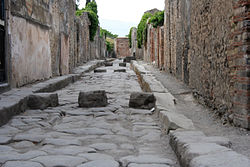
    PompeiiI may frequently express criticisms about their finer workings but British museums and galleries are generally superbly run. Heroic efforts are made to minimise the impact of funding cuts so that even regular visitors will notice little or no impact. From looking at the outward face of our museums you would never guess the country was in anything like the mess the numbers would indicate. They open on time: they have excellent facilities; their staffs are visible, willing and helpful; their experts are sought after the world over; they are clean; they have disability access to the ceiling; their bookshelves cater to all types of reader and interest; and their collections are by and large well maintained, sensitively exhibited and most supply informative captions. Many of them have for centuries been kept open free of charge for everyone, often against all odds and arguments. They are exemplary resorts of enlightened thinking about education and the preservation of history. This quiet effectiveness is a substantial achievement which is easy to take for granted. The truth is that when it comes to museums, in Britain we have been spoilt.

    This native genius was recognised recently when the Italian Culture Minister announced a fundamental shake-up in his own country’s major museums by throwing open twenty directorships to all-comers. Heading the published lists of dream candidates were many Britons. That Italy desperately needs help running its museums can not be in any doubt in the minds of those who have recently visited that country.

    Newspapers have lately reported that Pompeii is at last rising from the ashes of incompetence and corrupt administration. Having been partially rescued from beneath the sludge of AD79, in recent years other man-made ravages have befallen this astounding place –  structures have collapsed, excavation has ceased, and the site has been subjected to looting and vandalism. All of that, we are proudly informed, is now in the past. Sanity has set in and the place is safe in Italian hands. Millions of euros (doubtless originating in Germany) are being lavished to turn Pompeii into less than the unloved disgrace it has been in the recent past.

    Don’t believe a word of it. If Pompeii is typical of how Italy runs its museums – and it does seem to be – no wonder British and German experts are being wooed, because even organising the basics efficiently defeats Italians.

    The situation is hopeless and it starts as soon as you arrive. Gates open half an hour late, which especially annoys those scores who have arrived early to steal a march on a punishing summer sun. Once admitted, crowds jostle forever to buy a ticket because only two people are taking money. Matters are made worse because neither has any change. They accept only the correct money which must involve coins. In Italy it is virtually impossible to have coins not least because no one will give them to you: they hoard them like juju beads. The inevitable chaos is entirely avoidable and compounded when concessionary cards are not accepted unless accompanied by a passport. Endless negotiations ensue with each now sweating and thoroughly exasperated visitor. You then try the bookshop for a guide and detailed map. They don’t have any change either and diagrams in the Blue Guide are better than the childish plan costing a euro. So extreme is the provocative indifference of staff it can only be intended as a calculated insult. It’s as though they don’t want you here.

    In general museum bookshops and cafés are, throughout Italy, not seen as important revenue earners or as crucial a part of further education as we treat them in Britain. At Reggio’s museum they provide a rudimentary brochure for 7 euros about the Riace bronzes, the most precious sculptures of the ancient Greek world. Many of those making the trek to this furthest bunion of land will be willing to pay a premium for something more detailed. There is no bookshop at Tiberius’s villa in Sperlonga, the remarkable Villa Poppeia at Oplontis, or at the Agrigento Museum with its stunning collection of red and black ware.

    The anarchy characterising admission to Pompeii follows you about the site. In nearly all the most treasured areas there is no visible security. At the distant Villa of the Mysteries, to which I arrived in advance of everyone else, not a soul was there to protect what are among the most important paintings in the history of classical art. Perfect for me, despite the fact that they weren’t properly visible because unlit, but I fear dwelling on the damage parties of Europe’s and Asia’s squealing, uninterested and accessoried oiks might wreak on a place like this – they look with their hands.

    They say that Pompeii is the place in which to wander, get lost and release your imagination. Indeed it is, but you can’t do this because too little of even the excavated area is open. Crime-scene tape forces you to remain on thoroughfares which rapidly become Wembley Way on cup final day.

    At the farthest extremities of the site there are no services. There is nowhere to sit comfortably or to buy the fluid necessary when, as on my recent visit, the temperature soars beyond forty degrees centigrade. There are water fountains if you are prepared to trust the liquid coming out of them in a city with a pervasive smell of drains and where essential social infrastructure of hygiene and refuse collection have disintegrated. (Naples is a memorable city but filthier even than Oldham.) A third of my eight hours were spent sitting reading either Mary Beard or an old guidebook while trying to satisfy unquenchable thirst. An air-conditioned café on the periphery near the amphitheatre with coins in the till, simple food and cold drinks, and ice cream, would have cleaned up. By the time they’ve beaten the long procession around to the theatres, all visitors are as stripped and dessicated as Peter O’Toole staggering across the Devil’s Anvil. It would be so easy to make this unique place even more of a memorable experience than it is.

    Beside its serial inconveniences, the site’s main offence has to be a new building of which administrators are so proud as to make it a feature of all publicity material. As with many European museum extensions, this contract has gone to a person with no visual sense at all. It is a large pyramid whose job is to display in a sort of cock pit the famous plaster casts of the perished. This structure should have been built almost anywhere other than where it has been. Placed bang in the middle of the amphitheatre, the full effect of that otherwise special place is thus ruined. Visitors are not allowed on to the terraces so the only panoramic experience of it is as you enter the arena, only to find the view impeded by a structure which has ‘Brussels’ written all over its design and materials.

    Pompeii’s amphitheatre is significant. It was built in the first century BC (160 years before the Colosseum) and was the first permanent stone Roman amphitheatre; other similar arenas are a refinement of the incipient form found here. It has two sets of external diagonal staircases giving access to upper tiers. On a previous visit I’d had been struck by the impact of the interior, and was looking forward to seeing it again, a spectacle now regrettably sacrificed to a populist stunt.

    Pompeii is not unusual in Italy. Other sites seem equally to be run for the benefit of anyone except visitors. Lack of facilities are routine. At Herculaneum closed areas include the Villa of the Papyri, the quayside wharves housing all the skeletons of those attempting to flee by boat, the still underground cruciform pool as well as numerous insulae. Visitor services are rudimentary and limited to what can be dispensed from a machine. The ‘bookshop’ is hopeless for anything but souvenir trash. Even the National Archaeological Museum in Naples has whole wings and floors closed and, again, vending machines and few seats in place of a cafeteria.

    Italian museums are throwing away money whose collection would allow them respite from EU- and IMF-imposed cuts to Government and local expenditure. The Tate self-generates an astonishing 63% of its own income. The National Gallery makes three times more from cafés and shops than it does from exhibition admissions. The Royal Academy rakes in almost twice as much from retail activities than it does from ticket sales.

    Also, as with Pompeii, the protection of priceless treasures is generally so disgraceful it’s almost an invitation to looting and theft. At the museum of Tiberius’s villa near Sperlonga, which contains some of the most important Augustan sculpture, four middle-aged attendants, obviously recipients of some local authority sinecure, are slumped in the entrance indifferent to what is happening throughout the otherwise unprotected museum and grounds. Hardly any information is provided on this amazing site which has a massive coastal grotto – now busy with the aerobatics of rare pallid swifts – originally housing sculptures possibly by Polidorus of Rhodes, to whom some attribute the Laocoon. The same is true at the great museum in Agrigento where only the celebrated eponymous Ephebe – a close relative of the Kritios Boy in Athens (and which recently cropped up on the cover of Private Eye) – has its personal attendant playing games on a mobile telephone. In four hours at Hadrian’s Villa, in a complex the size of a large village, there was no security at all. Apart from the ticket office lady it was a ghost town. This is a definite advantage, as it allows furtive exploration of decorated areas inside the baths which are inexplicably taped off.

    A word of advice for cultural tourists to the Campagna. For the first time I visited the atmospheric Villa Poppeia, ten minutes from Pompeii in Torre Annunziata (Oplontis). Also interred in 79 this is not on tourist routes yet houses the finest collection of frescoes in the four Pompeiian styles you’ll see anywhere. Go in the evening and you’ll wander undisturbed. Its murals should be compulsory viewing for any art history student, and especially for those with a developed interest in the evolution of how a third dimension is depicted. Steep recessions and trompe l’oeil effects are dazzling and the drawing, particularly of figures, is flawless and exhibits complete assurance. Being Imperial in origin – Poppeia, poor lass, was Mrs Nero – these paintings are of a quality which knocks spots off most decoration encountered in the urban houses of Pompeii and, to a lesser degree, Herculaneum. Poppeia could afford artists for whom foreshortened figures in complicated groupings and poses were second nature. Natural history scenes of flowers, insects and birds in a long painted trellis and arcade beside a swimming pool are thrilling beyond description, the most magical work of its type I’ve ever seen.

    Any defence of Britain’s museums should start with the magnificent fundamental principle underpinning every aspect of their existence: this is that we actually want those who own them and their contents, the public, to benefit from their existence. Everything is done to further this aim. We encourage attendance and hope that some, whose curiosity is roused, may often return. Many have argued, including myself, that the commercialising of British museums is a disgrace. Having experienced the alternative I take it all back. In difficult conditions our national museums are doing a tremendous job. They now need to address urgently problems caused by their own success, most notably that of overcrowding.

    David Lee

    2015

  • Tate trustees and the public interest

    Tate trustees and the public interest

    In 2011 the Tate named two new trustees, one of whom is painter Tomma Abts. She is a 44-year-old German, recently appointed Professor of Painting at the Kunstakademie in Düsseldorf, who won the Turner Prize in 2006. As an artist trustee, she replaced Jeremy Deller, who won the Turner Prize in 2004. Abts’s paintings are all the same small size (48 x 38 cms) – it is claimed this tic is conceptually crucial for a reason never convincingly explained – and consist of polite abstract designs which might have looked original on curtains at the 1954 Ideal Home Exhibition. So much for the Cutting Edge. The Tate claims her pictures “possess a formal definition and coherence that suggests that they could never have existed any other way … [and] seem to achieve what only painting can, inhabiting both this reality as an object or ‘thing’, and a parallel world with its own set of rules and relationships that demand to be judged on their own terms.” As per with their interpretive literature, all helpful stuff. Am I being cynical? Yes. Why? Because using any sensible criteria Abts doesn’t deserve to be a trustee of an important British museum.

    The job of Tate trustees is to oversee the efficient running of the gallery “as guardians of the public interest” – and please note that it says ‘the public interest’ not ‘State Art’s interest’, for as you will discover these two mutually exclusive agendas tend to become blurred in the minds of certain individuals. Improbable as it sounds, guidelines for the functions of trustees are drawn up by the Tate itself, not by  independent arbiters. Such complacency hardly reassures an outsider that the public interest, rather than the Tate’s, is being looked after. Indeed, such self-scrutiny is hardly better than the continuing disgrace of policemen investigating their own mistakes.

    In 2008 the number of trustees was increased from 12 to 14 and as required by the Museums and Galleries Act 1992 “at least three” of these must be artists. Thirteen are appointed by the Prime Minister and the last is nominated by the trustees of the National Gallery from among their own membership. Unlike their fellow trustees, who are mainly those with business expertise, and who can serve up to two terms of four years (a period of office trimmed recently from five), artist trustees currently serve only one term of four years. You may find it odd – I certainly do – that while there are three contemporary artists with gilt-edged State Art credentials on the Tate’s board of trustees there is no place for a single art historian. I’m obviously old-fashioned because a museum of historical art with no art historians sitting on its governing board seems verging on the perverse.

    When an artist trusteeship becomes vacant it is widely advertised in the papers, giving the impression that any capable, knowledgeable, articulate artist of repute might apply. Nothing could be further from the truth, for there is a codicil written in invisible ink along the bottom of these ads, which reads: “If you have not won or at the very least been nominated for the Turner Prize, kindly fuck off and don’t waste our time.” The Tate squanders scarce cash paying for these advertisements which are nothing short of a calculated deception. Artist trustees are in fact a self-appointed clique comprising only winners of the Turner Prize with a couple of reliable also-rans chucked in. Since new regulations were imposed in 1992 the only exceptions to this rule have been Julian Opie, who famously refused his nomination for the Turner on the grounds that the prize “had become a frivolous publicity stunt”, and Bob and Roberta Smith, the sobriquet of a dimwit called Patrick Brill, who is otherwise a regular purveyor of infantile stunts at Millbank – you may recall his Tate Christmas tree whose lights visitors were asked to illuminate by peddling a generator. He’s very concerned about the environment apparently.

    Being a trustee involves attending six meetings a year and is said to require a day a month in reading and preparation. I must point out that the Tate’s artist trustees are easily the worst attenders at these meetings, and are frequently absent. In the case of Anish Kapoor (Turner Prize winner, 1991) his absenteeism, which included missing half the meetings in two consecutive years and scarpering early from others, would have surely seen him sacked from the board of any efficiently run private enterprise.

    Of currently serving artist trustees two are Germans – besides Abts the other is magazine photographer Wolfgang Tillmans (Turner Prize winner, 2000). Could they really not find a British photographer, or even a British abstract painter, worthy of these positions? Admittedly, Germans do most things better than we do but surely this is insulting to British artists. And how can a professor at a German art school, which presumably requires her to actually attend some of the week, perform the duties of a trustee required to be resident here?

    The process by which artist trustees are selected ­– laughably characterised as “an open competition” or “an open competitive process” – is indicative of what happens when a clique achieves a complacent monopoly and is allowed by servile arts commentators to get away with it. Minutes of meetings make it clear that artist trustees are encouraged to invite applications from those they consider suitable as their own replacements, especially when candidates who have responded to the ads are not considered worthy, which one may reasonably surmise is always. Indeed, I wonder if there was ever a case of a successful artist trustee having responded to the ads rather than having been – that weasel word – ‘invited’ to apply… And so Turner Prize winners beget other Turner Prize winners, or at the very least other near-misses of that persuasion.

    Candidates for artist trusteeships are interviewed by a panel comprising trustees, including the artists, plus an “independent assessor” who is present to ensure that legal niceties, “best practice” etc., are observed and everything looks above board. But how can it be above board when only Turner Prize winners are appointed? Perhaps this independent assessor ought to be involved from the start of the process in order that more than Turner Prize nominees might be seriously considered, if for no other reason than to keep up appearances of openness. Eyebrows would be raised at such a narrowness of potential candidates in any other sphere of public life: imagine, for example, the Commander-in-Chief of the armed forces always being selected from the same regiment.

    You may ask why is it so important for the convenient running of the Tate that its artist trustees are always winners of the Turner Prize. The answer is for the obvious reason that having been awarded a career-changing gong by the institution of which they are now overseers, they will never rock the boat by asking too many tricky questions about the Tate’s direction in its dealings with contemporary art. This is one of many ways by which State Art has become institutionalised: no one but the reliably subservient is ever allowed on the inside to question Tate, or indeed Arts Council, policies.

    On the other hand these parti pris trustees can be useful when outside criticism of the Tate becomes noisy. For example, in July 2004 Trustees discussed newspaper coverage of a Tate work, Rodin’s The Kiss, which Cornelia Parker (who was nominated for the Turner in 1997, the year it was won by Gillian Wearing, inevitably herself a recent artist trustee), had the previous year controversially wrapped up with a mile of string. This stunt was claimed by the artist to be “challenging the claustrophobic nature of relationships”. Artist trustees present in the meeting (which included the aforementioned Wearing) were able to defend their fellow artist for the benefit of other sceptical trustees. They pointed out that it was the job of the Tate to provoke controversy and discussion, which this work did.

    It is in the interests of these artist trustees to support the Director. They know they will be serving only for a brief period following which they might reasonably look forward to the reward of a Tate retrospective or other continued patronage, purchases etc..

    Serota has stated a preference for such younger trustees. Referring to the trusteeship of Anthony Caro many years before, he remarked in 1998 to the Sunday Times: “Tony was well over 60 when he became a trustee. He was a very effective trustee, actually. He cared passionately about certain things and was a powerful force … but it just seems to work better when you have artists who are a new generation, or indeed erring on the younger side, really.” And we know why he thinks it “seems to work better”, because older artists of a more independent, more knowledgeable, more experienced character might argue cogently for a policy or direction other than the one being pursued by the Director. They have nothing to lose by disagreeing with him. Let’s face it, the current crop of artist trustees is in Serota’s pocket. They owe him and he knows it. He can rely on their support without a second thought.

    In a 2008 interview Serota said of his trustees: “I don’t have any part to play in their appointment”. Remember this, it’s important and we’ll return to it in a second.

    Many years ago Serota said that public nominations for the Turner Prize (perhaps you don’t remember that ridiculous charade whereby we all wasted our stamps and faxes) were seriously considered by the judges. We discovered in 2006 what we already knew, courtesy of an indiscreet Turner Prize judge, that this was in fact a lie and they were binned with risible disregard. We also discovered at the same time, and from the same source, that Turner Prize judges were given a list of appropriate artists and exhibitions – just to help them along you know, point them in the right direction. And there we were thinking in the innocence of our ignorance that they might nominate anyone…

    Serota also stated in 2005 that the Tate only rarely acquired work by serving trustees. The Jackdaw checked up on that and discovered (see the editorial for Dec/Jan 2006 on our website) that he wasn’t telling the truth. Indeed, this whopper cost him a bollocking from the Charity Commission. There were also a number of other flagrant economies with the truth concerning the Tate’s acquisition of work by serving trustee Chris Ofili, who was naturally a Turner Prize winner (1998), which also resulted in another six of the best from the CC. (I almost mentioned here the fact that in the last editorial – also on our website – we indicated how the Tate recently misled us over their attendance figures, but you must be getting fed up with that one.)

    So, bearing in mind Serota’s far from perfect form, when he remarks “I don’t have any part to play in their appointment” I need to ask myself: ‘Do I give him the benefit of the doubt and believe him this time?’ Well, as it happens, no I don’t. Even cursory familiarity with the Trustees’ minutes betrays this one as untrue. On the contrary he is frequently involved in their appointment; indeed, the process of Trustee appointment is administered by his own office. He even attends candidate interviews “in an advisory capacity”. Presumably he offers ‘advice’ which plays no material part in the process, so why is he there in the first place? Indeed, we read on: “The key stages of the appointment are overseen by a panel which will normally include the Director.” (Who, presumably, doesn’t play any part.) On one recent occasion he encourages artist trustees to nominate likely candidates for their replacement knowing only too well the sort of artists they are likely to suggest. No part?

    Let’s have this one straight: Serota is ‘advising’ on the appointment of someone, a trustee, who will function as his own employer. This is a wretched abuse of the supposed ‘independence’ of process and would be considered as much in any other public body. It is, as usual, as blatant a conflict of interest (not to mention a betrayal of ‘the public interest’ about which the process purports to be so concerned) as you would expect to find at the Tate, whose management of conflicts of interest, incidentally, was declared woefully inadequate by none other than the Charities Commission.

    The Tate should not be involved with either the compiling of its own trustees’ duties, or in the nomination or selection of Trustees themselves. How can ‘the public interest’ be considered served when the organisation under scrutiny is writing the job description of its own scrutineers. If we are to have artist trustees let’s have them from a cross-section of the artist community and not just those representing the Turner Prize. And let’s have some eminent art historians in there too.

    David Lee

    The Jackdaw May-June 2011

  • Olympic posters: our native genius

    Olympic posters: our native genius

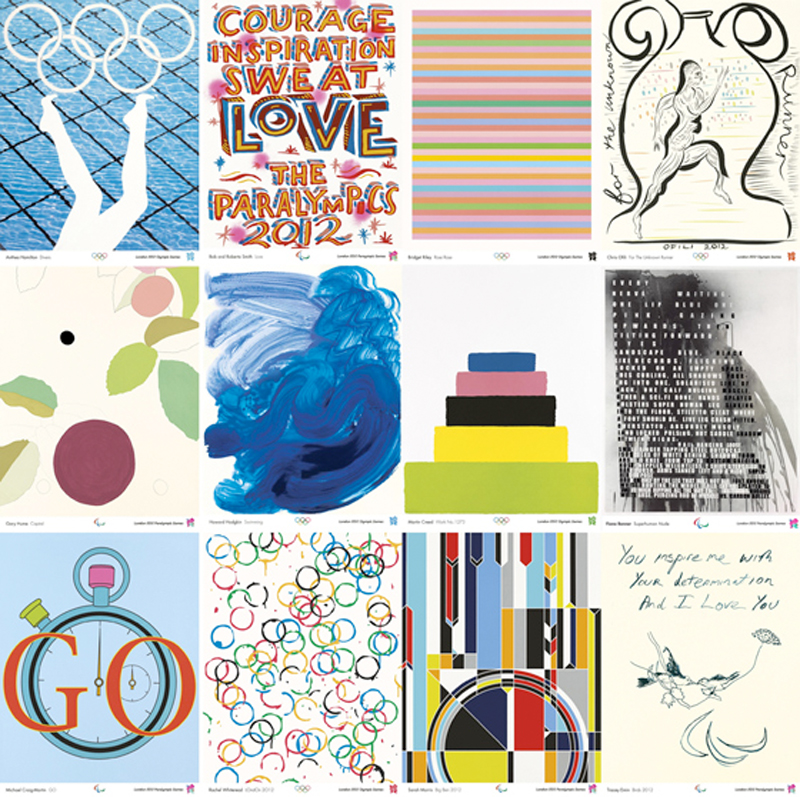
    The Turner Prize nominees and winners came up with a predictable set of embarrassing posters for the Olympics. Apart from the perpetrators themselves, no one could be found to say a good word about their efforts. Someone needs to get a grip. First we were presented with an inept logo which had cost £400,000 for what looked like two minutes work; then there was an artless rollercoaster sculpture selected by the President-For-Life; and now this lot of fashionable scribblers who couldn’t design a wheel from blueprints have done their worst, also, very conveniently, courtesy of the President-For-Life. Inevitably, as with Gibbereesh’s rollercoaster the PFL chose his reliable lackeys from the Turner Prize not to mention a serving Tate Trustee, Bob and Roberta Smith, i.e. one of those currently responsible for employing him.

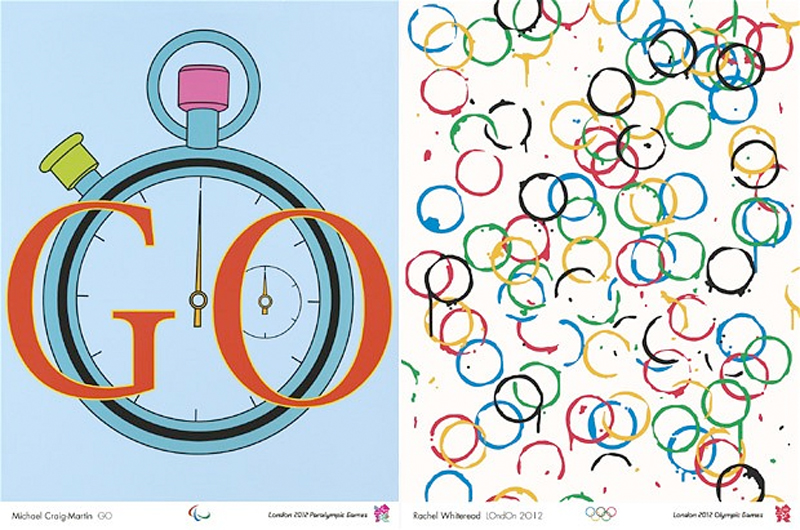
    Rachel Whiteread and Gary Hume excelled themselves with lovely colouring in – if their efforts had arrived crumpled from the nursery you might have fixed them proudly to the fridge. Bridget Riley knocked off her usual stripes. Each small poster – and these are nothing like the grand sheets of Lautrec – will be available to buy for £7 when an exhibition of the works opens at the Tate next summer.

    Now for the good news, that is if you are one of the participating artists. The posters are being released as signed prints courtesy of Counter Editions, thus enabling the artists to reward themselves in the manner to which they have become accustomed. Bridget Riley’s stripes, for example, is in an edition of 250 and started at £3,000 an impression – yes, that’s a gross of £750,000 for one signed screenprint, and it has already sold out. The Margate Express has hers in an edition of 300 at a throwaway £1,800 apiece – a mere £540,000… It is also sold out. The gross will, of course, have been far greater than the sums cited here as the cost of each print increased as the edition sold out. Still available however are ‘Professor’ Gary Hume’s blots (near right), a snip at £540 in an edition of 250 (£135,000 minimum gross) and Howard Hodgkin’s blue wave (£1,300, ed 300, minimum gross £394,000 – far right). No wonder the artists stood in a line laughing when their works were unveiled.

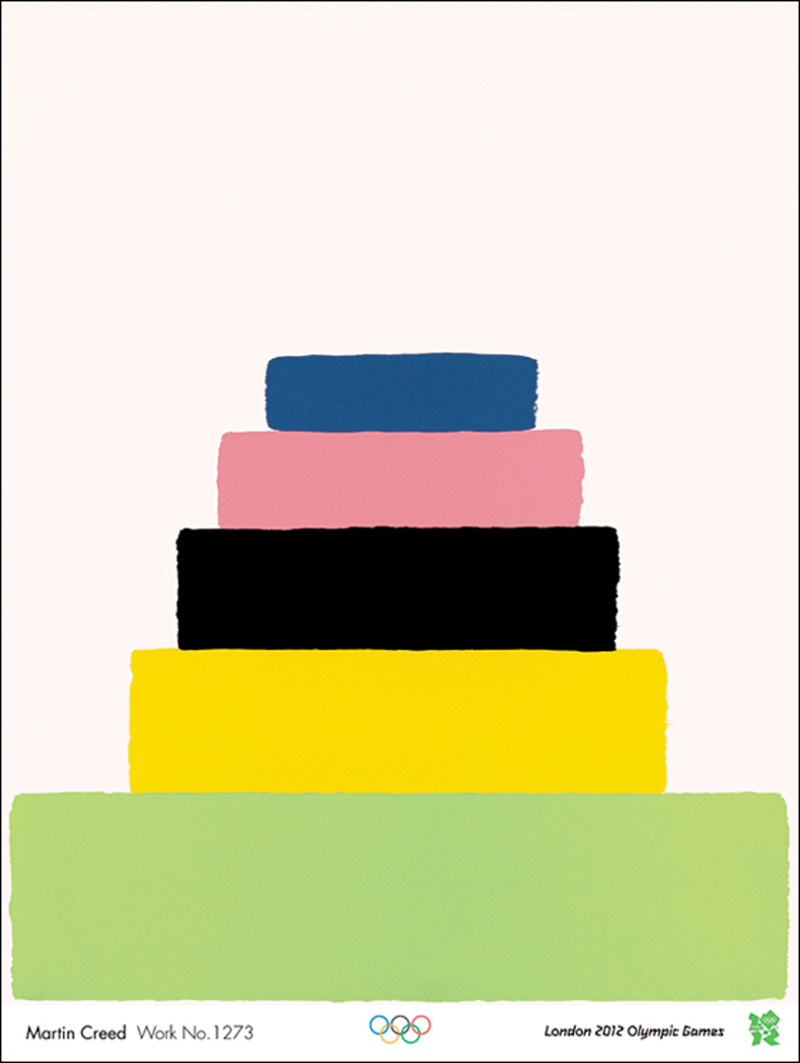
    Martin Creed, at last now widely regarded as educationally subnormal, said of his inspired marvel (£490, lithograph edition 250, minimum gross £122,500): “The colours are based on the Olympic colours but they are changed to make them nicer.” Here is the Mental Paralympian of State Art talking.

    What we got in this project was the usual bunch of over-rated contemporary artists promoting themselves and their art and not the Olympics. We can’t discover from anywhere what the deal was with the artists; were they actually paid to come up with their contributions or was their remuneration to be the loud ker-ching of limited editions? If you come across any information please let us know.

    … And then there was the dear old Margate Express. No are event is nowadays complete without her embonpoint rippling over the proceedings. On the same page of the papers when these Olympic efforts were announced you could look across from the Express’s maudlin scribble to Leonardo da Vinci’s drawing of hands on show in the National Gallery. An unfair comparison, yes, but it is surely impossible to look from one to the other and not think what a catastrophic deterioration has occurred not only in the technical ability of artists but in the willingness of those responsible for protecting standards in art to promote such conspicuous rubbish.

    By the way, if you wish to purchase all 12 of the posters you can buy the set in a nice box for £11,805. A commemorative heirloom for all the family to enjoy, and what a bargain.

     David Lee

    The Jackdaw, Jan-Feb 2012

    Latest News

    These posters are beginning to reappear on the market.

    Three editions sold out within days: they were Tracey Emin, Rachel Whiteread and Bridget Riley.  Now , one of the Rileys is being sold  at auction with an estimate of  £2,000-£3,000. This poster racket was not only a scam to line the pockets of already well-to-do artists but also to allow a quick turnover to collectors eager to cash in on the fever generated by the actual events.

    The complete set of posters are no on view/on sale at Tate Britain until September  23rd. So buy now. They’re crap, but what an investment.

  • Selling England by the pound

    Selling England by the pound

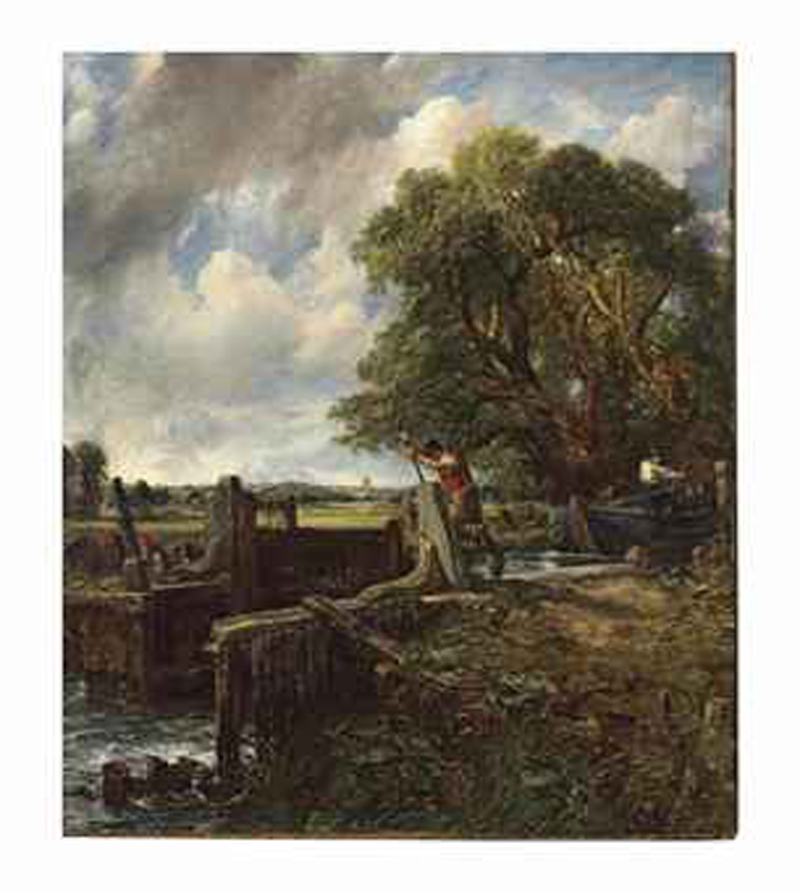
    Today John Constable’s The Lock, painted in 1824, sold at Christie’s for £22.4 million. In the current art market of silly prices some lucky person got the bargain of their lives. Let us hope the picture will be placed in a museum, where people might enjoy it, instead of disappearing into a Swiss warehouse as the investment bauble of some gold-tap billionaire vulgarian. It is the same price as that commanded by ordinary works by the top price sellers in British painting, Turner and Bacon, both of whom have sold work for significantly higher amounts than this. It is the same price a collector might pay for an off-the-peg Monet one wouldn’t inflict even on an enemy. The Lock, being one of the six major works deliberately painted by the artist between 1819 and 1825 for the Royal Academy exhibition in order to cement his reputation, presented the last opportunity for a collector to own one of the major works by the artist of the quintessential English landscape. All the other major pictures are already off the market in museums.

    Why so low a price? Of the top 50 most expensive paintings ever sold either privately or at auction only five are Old Masters, and of the remaining 45 ten are by Picasso, seven by Van Gogh and four by Warhol. The new billionaires, who are not old fashioned men of discernment and discrimination but those who buy conspicuously in order to impress friends, are uninterested in works not instantly recognisable for their “wall power”. Even the most knuckle-dragging mate of a Russian oligarch can recognize Warhol or Picasso but they wouldn’t know a Constable from a concertina and couldn’t recognise anything before 1850, all brown paintings looking alike to them.

    Who bought it? Assuming that The Lock is too sophisticated a picture for nouveau squillionaires, the only two museums in the market at this kind of price are the Getty in California, which two years ago paid £29 million for a Turner view of Rome, and the museum being built from scratch by the Qatari royal family, who are hotly rumoured to have bought the record-breaking The Scream by Munch a couple of months ago. No British gallery could afford a square centimetre of such a work, not that our museums actually need any more examples from Constable’s brush. For example, on the day of The Lock’s sale the Tate, which owns 261 works by the Suffolk miller’s boy, had 13 works on display. It always likes to keep plenty in reserve. There were more works by Constable on show at the Victoria and Albert Museum than at the Tate – the V&A owns 802 items relating to the artist including the full-size oil sketch for the Hay Wain. The National Gallery has nine works by Constable, all of them on display every day of the week free of charge.

    “Painting,” wrote Constable, “is but another word for feeling.”

    David Lee

    The Jackdaw, 3 July 2012

    http://www.bbc.co.uk/news/entertainment-arts-18702667

  • Tate Trustees and the public interest

    The Tate recently named two new trustees, one of whom is painter Tomma Abts. She is a 44-year-old German, recently appointed Professor of Painting at the Kunstakademie in Düsseldorf, who won the Turner Prize in 2006. As an artist trustee, she replaced Jeremy Deller, who won the Turner Prize in 2004. Abts’s paintings are all the same small size (48 x 38cms) – it is claimed this tic is conceptually crucial for a reason never convincingly explained – and consist of polite abstract designs which might have looked original on curtains at the 1954 Ideal Home Exhibition. So much for the Cutting Edge. The Tate claims her pictures “possess a formal definition and coherence that suggests that they could never have existed any other way … [and] seem to achieve what only painting can, inhabiting both this reality as an object or ‘thing’, and a parallel world with its own set of rules and relationships that demand to be judged on their own terms.” As per with their interpretive literature, all helpful stuff. Am I being cynical? Yes. Why? Because using any sensible criteria Abts doesn’t deserve to be a trustee of an important British museum.

    The job of Tate trustees is to oversee the efficient running of the gallery “as guardians of the public interest” – and please note that it says  ‘the public interest’ not ‘State Art’s interest’, for as you will discover these two mutually exclusive agendas tend to become blurred in the minds of certain individuals. Improbable as it sounds, guidelines for the functions of trustees are drawn up by the Tate itself, not by independent arbiters. Such complacency hardly reassures an outsider that the public interest, rather than the Tate’s, is being looked after. Indeed, such self-scrutiny is hardly better than the continuing disgrace of policemen investigating their own mistakes.

    In 2008 the number of trustees was increased from 12 to 14 and as required by the Museums and Galleries Act 1992 “at least three” of these must be artists. Thirteen are appointed by the Prime Minister and the last is nominated by the trustees of the National Gallery from among their own membership. Unlike their fellow trustees, who are mainly those with business expertise, and who can serve up to two terms of four years (a period of office trimmed recently from five), artist trustees currently serve only one term of four years. You may find it odd – I certainly do – that while there are three contemporary artists with gilt-edged State Art credentials on the Tate’s board of trustees there is no place for a single art historian. I’m obviously old-fashioned because a museum of historical art with no art historians sitting on its governing board seems verging on the perverse.

    When an artist trusteeship becomes vacant it is widely advertised in the papers, giving the impression that any capable, knowledgeable, articulate artist of repute might apply. Nothing could be further from the truth, for there is a codicil written in invisible ink along the bottom of these ads, which reads: “If you have not won or at the very least been nominated for the Turner Prize, kindly fuck off and don’t waste our time.” The Tate squanders scarce cash paying for these advertisements which are nothing short of a calculated deception. Artist trustees are in fact a self-appointed clique comprising only winners of the Turner Prize with a couple of reliable also-rans chucked in. Since new regulations were imposed in 1992 the only exceptions to this rule have been Julian Opie, who famously refused his nomination for the Turner on the grounds that the prize “had become a frivolous publicity stunt”, and Bob and Roberta Smith, the sobriquet of a dimwit called Patrick Brill, who is otherwise a regular purveyor of infantile stunts at Millbank – you may recall his Tate Christmas tree whose lights visitors were asked to illuminate by peddling a generator. He’s very concerned about the environment apparently.

    Being a trustee involves attending six meetings a year and is said to require a day a month in reading and preparation. I must point out that the Tate’s artist trustees are easily the worst attenders at these meetings, and are frequently absent. In the case of Anish Kapoor (Turner Prize winner, 1991) his absenteeism, which included missing half the meetings in two consecutive years and scarpering early from others, would have surely seen him sacked from the board of any efficiently run private enterprise.

    Of currently serving artist trustees two are Germans – besides Abts the other is magazine photographer Wolfgang Tillmans (Turner Prize winner, 2000). Could they really not find a British photographer, or even a British abstract painter, worthy of these positions? Admittedly, Germans do most things better than we do but surely this is insulting to British artists. And how can a professor at a German art school, which presumably requires her to actually attend some of the week, perform the duties of a trustee required to be resident here?

    The process by which artist trustees are selected – laughably characterised as “an open competition” or “an open competitive process” – is indicative of what happens when a clique achieves a complacent monopoly and is allowed by servile arts commentators to get away with it. Minutes of meetings make it clear that artist trustees are encouraged to invite applications from those they consider suitable as their own replacements, especially when candidates who have responded to the ads are not considered worthy, which one may reasonably surmise is always. Indeed, I wonder if there was ever a case of a successful artist trustee having responded to the ads rather than having been – that weasel word – ‘invited’ to apply… And so Turner Prize winners beget other Turner Prize winners, or at the very least other near-misses of that persuasion.

    Candidates for artist trusteeships are interviewed by a panel comprising trustees, including the artists, plus an “independent assessor” who is present to ensure that legal niceties, “best practice” etc., are observed and everything looks above board. But how can it be above board when only Turner Prize winners are appointed? Perhaps this independent assessor ought to be involved from the start of the process in order that more than Turner Prize nominees might be seriously considered, if for no other reason than to keep up appearances of openness. Eyebrows would be raised at such a narrowness of potential candidates in any other sphere of public life: imagine, for example, the Commander-in-Chief of the armed forces always being selected from the same regiment.

    You may ask why is it so important for the convenient running of the Tate that its artist trustees are always winners of the Turner Prize. The answer is for the obvious reason that having been awarded a career-changing gong by the institution of which they are now overseers, they will never rock the boat by asking too many tricky questions about the Tate’s direction in its dealings with contemporary art. This is one of many ways by which State Art has become institutionalised: no one but the reliably subservient is ever allowed on the inside to question Tate, or indeed Arts Council, policies.

    On the other hand these parti pris trustees can be useful when outside criticism of the Tate becomes noisy. For example, in July 2004 Trustees discussed newspaper coverage of a Tate work, Rodin’s The Kiss, which Cornelia Parker (who was nominated for the Turner in 1997, the year it was won by Gillian Wearing, inevitably herself a recent artist trustee), had the previous year controversially wrapped up with a mile of string. This stunt was claimed by the artist to be “challenging the claustrophobic nature of relationships”. Artist trustees present in the meeting (which included the aforementioned Wearing) were able to defend their fellow artist for the benefit of other sceptical trustees. They pointed out that it was the job of the Tate to provoke controversy and discussion, which this work did.

    It is in the interests of these artist trustees to support the Director. They know they will be serving only for a brief period following which they might reasonably look forward to the reward of a Tate retrospective or other continued patronage, purchases etc.

    Serota has stated a preference for such younger trustees. Referring to the trusteeship of Anthony Caro many years before, he remarked in 1998 to the Sunday Times: “Tony was well over 60 when he became a trustee. He was a very effective trustee, actually. He cared passionately about certain things and was a powerful force … but it just seems to work better when you have artists who are a new generation, or indeed erring on the younger side, really.” And we know why he thinks it “seems to work better”, because older artists of a more independent, more knowledgeable, more experienced character might argue cogently for a policy or direction other than the one being pursued by the Director. They have nothing to lose by disagreeing with him. Let’s face it, the current crop of artist trustees is in Serota’s pocket. They owe him and he knows it. He can rely on their support without a second thought.

    In a 2008 interview Serota said of his trustees: “I don’t have any part to play in their appointment”. Remember this, it’s important and we’ll return to it in a second.

    Many years ago Serota said that public nominations for the Turner Prize (perhaps you don’t remember that ridiculous charade whereby we all wasted our stamps and faxes) were seriously considered by the judges. We discovered in 2006 what we already knew, courtesy of an indiscreet Turner Prize judge, that this was in fact a lie and they were binned with risible disregard. We also discovered at the same time, and from the same source, that Turner Prize judges were given a list of appropriate artists and exhibitions – just to help them along you know, point them in the right direction. And there we were thinking in the innocence of our ignorance that they might nominate anyone…

    Serota also stated in 2005 that the Tate only rarely acquired work by serving trustees. The Jackdaw checked up on that and discovered (see the editorial for Dec/Jan 2006 on our website) that he wasn’t telling the truth. Indeed, this whopper cost him a bollocking from the Charity Commission. There were also a number of other flagrant economies with the truth concerning the Tate’s acquisition of work by serving trustee Chris Ofili, who was naturally a Turner Prize winner (1998), which also resulted in another six of the best from the CC. (I almost mentioned here the fact that in the last editorial – also on our website – we indicated how the Tate recently misled us over their attendance figures, but you must be getting fed up with that one.)

    So, bearing in mind Serota’s far from perfect form, when he remarks “I don’t have any part to play in their appointment” I need to ask myself: ‘Do I give him the benefit of the doubt and believe him this time?’ Well, as it happens, no I don’t. Even cursory familiarity with the Trustees’ minutes betrays this one as untrue. On the contrary he is frequently involved in their appointment; indeed, the process of Trustee appointment is administered by his own office. He even attends candidate interviews “in an advisory capacity”. Presumably he offers ‘advice’ which plays no material part in the process, so why is he there in the first place? Indeed, we read on: “The key stages of the appointment are overseen by a panel which will normally include the Director.” (Who, presumably, doesn’t play any part.) On one recent occasion he encourages artist trustees to nominate likely candidates for their replacement knowing only too well the sort of artists they are likely to suggest. No part?

    Let’s have this one straight: Serota is ‘advising’ on the appointment of someone, a trustee, who will function as his own employer. This is a wretched abuse of the supposed ‘independence’ of process and would be considered as much in any other public body. It is, as usual, as blatant a conflict of interest (not to mention a betrayal of ‘the public interest’ about which the process purports to be so concerned) as you would expect to find at the Tate, whose management of conflicts of interest, incidentally, was declared woefully inadequate by none other than the Charities Commission.

    The Tate should not be involved with either the compiling of its own trustees’ duties, or in the nomination or selection of Trustees themselves. How can ‘the public interest’ be considered served when the organisation under scrutiny is writing the job description of its own scrutineers. If we are to have artist trustees let’s have them from a cross-section of the artist community and not just those representing the Turner Prize. And let’s have some eminent art historians in there too.

    David Lee

    The Jackdaw May-Jun 2011