Tag: State Art

  • Art: Cool and Uncool – William Varley Reviews Addicted to Sheep

    So, as all cool sentences begin, I think that the best TV programme I saw last was Addicted to Sheep. In many ways this BBC4 documentary was reminiscent of the French film Être et Avoir about a remarkable teacher in a school in the remote Auvergne, although a good deal less winsome. It focused on the lives of the Hutchinson family, tenant farmers in Upper Teesdale. In their remote valley ewes are called “yowes” and at the children’s school they still sing “There is a green hill far away”. The Hutchinson children help with the lambing, including the gruesome task of dealing with still-born lambs.

    What is so admirable about them is that they have an uncomplaining, unflinching attitude to a life that is harsh and elemental. I doubt whether they have recently visited their nearest gallery, the Bowes Museum at Barnard Castle, or the Baltic at Gateshead. I also suspect that the issues which so exercise the post modern, post Christian urban élites: multiculturalism, egalitarianism, transnational progressivism (no borders), environmentalism, feminism and the rest of that plethora of right-on attitudes, don’t preoccupy them. For a start, they don’t have the time. Without wishing to patronise them, they probably believe that the acronym L.G.B.T. stands for a brand of sheep dip. All of this, in the opinion of the ‘enlightened’, particularly art world instrumentalists, makes them seriously uncool.

    How does one define ‘cool’? There are still people around who think that it’s a gently meandering style of jazz, but most of us know that it’s simply a matter of a self-appointed élite determining what is acceptable and unacceptable. It’s a phenomenon which transcends ages and classes, from the tiny tyrant berating her parents for not recognising the world significance of ‘One Direction’ to the State Art apparatchik wincing as he patiently fields one’s less than enthusiastic reaction to a ‘challenging’ new installation. In Jonathon Rose’s brilliant book, The Intellectual Life of the British Working Classes, the anthropologist Mary Douglas describes it thus:


    Art trends may have as brief a shelf life as stock exchange trends, and they depreciate rapidly if one fails to catch the latest wave in architecture, or literary theory. The names that Bohemia adopted for itself – avant-garde, advanced, progressive, le dernier cri, new wave, cutting edge, modernist, postmodernist – all reflect the Anxiety of Cool, the relentless struggle to get out in front and control the production of new cultural information. Bohemia is ‘subversive’ only in that it seeks to wean consumers away from older cultural products in order to sell them new ones.


    That description is one of brash economics but, of course, we’re all familiar with the broader pattern of Cool, the Godfather of which is Marcel Duchamp.

    Ad Reinhardt once remarked that all artists had to make a choice between Mondrian and Duchamp, between advocates of the hand- made, and those of the ready-made. As Jackdaw readers know, Duchamp, asserting that all art was mere taste, allegedly exhibited a urinal under the title of Fountain at the Armory Show in New York in 1913. Actually, as Jackdaw readers also know, that anarchic gesture was performed by one of his girlfriends as the Armory Show was ‘unselected’. Still, as someone who was intoxicated by word-play, puns and conceits, he was the epitome of the intellectual dandy. Apparently effortlessly, he invented kinetic art, optical art, conceptual art, and his great hermetic narrative, The Large Glass. Consolidating these innovations he left to allegedly mediocre followers.

    His biographer Robert Lebel wrote that he regarded the ready-mades as sacralisation or transubstantiation. (How God-like is that?) However, “His real motive with them was to depreciate our ordinary and tacitly accepted notions of value in order to exalt the strictly private and sovereign choice which is accountable to no one. With the ready-mades”, said Lebel, “he meta-ironically demonstrated his incontestable power to be TAKEN AT HIS OWN WORD which is the unmitigated artist’s privilege.” You can see where that gets us: art is anything you say it is, a situation that leads inexorably to the empty stunts of the Turner Prize and the vulgar extravagances of the Pinault Collection. Still, for his loyal disciples in the State Art Establishment his reputation is unassailable. There have been notable heretics from the general orthodoxy though. In his book The Banquet Years, examining the pioneering days of Modernism, Roger Shattuck remarked that Duchamp’s strategy of ‘nominating’ useful objects to art status was “essentially self-consuming, a reversion to dead level after an initial shock.” More recently, in The Winter of our Culture, Jean Clair (real name Gérard Régnier) the former Director of the Picasso Museum in Paris, described Duchamp’s Armory Show as “works of provocation and derision presented by a cynical dandy”.

    The High Priestess of Cool was, of course, Susan Sontag. During the ’60s and ’70s she was the doyenne of American intellectuals and in her seminal book Against Interpretation, she issued two decrees that in retrospect seem to have underpinned the visual art that developed afterwards. Attacking the discrimination between hierarchies of art as ‘philistine’, she effectively substituted a plateau view of culture for the existing pyramidal order. Henceforth, there was to be no qualitative distinction to be made between high and popular culture, art and entertainment. In this scenario, Elvis Presley could give Mozart a friendly wave across a level playing field. The ‘dumbing down’ consequences of this were, of course, appalling and eventually she could see it. She died 12 years ago, but shortly before her death she condemned ‘the triumph of a pernicious relativism.’

    I am not prepared to say the satisfactions derived by art are no different structurally, in context, or in quality or in importance, from other kinds of satisfactions. I am not prepared to think that the satisfaction I might get in front of a Chardin, a Vermeer or a Vuillard is in any way similar to the satisfaction I would get watching a beautifully pitched baseball or inspecting a shoe collection.

    Her recantation was welcome, but it was too little, too late: the damage to the impermeability of high culture had already been done.

    The other hugely influential aspect of her ‘new sensibility’ was the idea (echoing Matthew Arnold perhaps) that art should concern itself with the moral criticism of life and be used as ‘a tool for changing consciousness’. Whether or not her writings were the cause or whether the true believers in an art for use developed their own ideology, in subsequent decades a veritable deluge of issues appeared. They mostly consisted of that left liberal menu of Goodthink favoured by the BBC that I’ve already mentioned: multiculturalism etc.. They are very useful for ‘virtue signalling’. “Let’s do the Holocaust”, artists would say, “or perhaps child abuse”. This is empty posturing, a bit like wearing Aids ribbons. It’s also about as far removed from Kathe Kollwitz’s nightmare visions as it’s possible to be. As the wife of a Berlin doctor Kollwitz knew poverty and illness at first hand. Her emotion was earned, not affected. Still, quangocrats and councillors who dole out funding love emotional incontinence. Current affairs and politics are things they can understand: the structural music of painting invariably remains a mystery to them. And insofar as they reinforce the fallacy that visual art is simply a medium or receptacle of a socio-political statement, it’s a godsend to those media hacks deputed to discuss them.

    Some issues, however, are so uncool that they’re off limits. Take the case of Kamel Daoud, for instance. This distinguished Algerian (Muslim) novelist wrote an article in Le Monde in late January denouncing the wave of sexual assaults that had occurred during Cologne’s New Year’s Eve celebrations. He didn’t temporise, calling the assailants Muslim men:

    The refugee-immigrants come from the vast universe of sorrow and horror which is the sexual misery of the Arab-Muslim world. The subjugation of women is the psychological Gordian knot at the core of the world of Allah, and hence the inspiration of the death cult that claims to defend it.

    You can easily guess the reaction to that: an academic fatwa; and erstwhile friends telling him, with the greatest kindness, to stick to writing novels and, politically, to shut up. Our politicians, of course, favour the ‘Religion of Peace’ narrative and as far as our art world is concerned, in contrast to the scathing visual indictments of Abu Ghraib how many denunciations of suicide, bombings, jihadist beheadings and the like can you think of? None? I can think of one. A couple of years ago in an exhibition in Rome I saw a small black singlet in the form of a hijab presented by the Egyptian feminist Ghada Amer. Unsurprisingly she now lives in New York.

    Another aspect of cool is the cult of novelty. I remember Lawrence Gowing back in the ’60s presenting the imperative to many young artists “to make it new”. At the time it worried me, being far too prescriptive. As someone who believes that originality should be involuntary rather than willed, I would have advised “Make it good”. Giles Auty in The Jackdaw was scathing in identifying the ‘novelty trap’ in which ‘ism’ inexorably succeeds ‘ism’ and thereby invalidates its predecessor. (Auty estimated that about 40 ‘isms’ occurred in the 20th century, each having about 2.25 years of life.) In his irreverent article he suggested that, according to the novelty narrative, “western art should be read as a kind of art-historical relay race which culminates in the death of painting … because there are no more apparent avenues left to explore”, a process which he maintained was “both spurious and infantile”. Astutely, he demonstrated how the art world had hijacked from science the rhetoric of progress with the consequence that anyone who refused to embrace it was certifiably reactionary and uncool. Of course there are some exceptional exponents of hybrid media such as the prodigious William Kentridge, but the strategy of State Art is to impose novelty on a baffled public. Amongst that public there are some blasphemers, though. The late Henning Mankell believed that “One of the tasks of art is to provide people with companions. I have seen people in paintings who I hope to meet in the street one of these days…” How uncool can you get? The Scottish prose-poet Nan Shepherd, ‘married’ one might say, to the Cairngorms, had a similar capacity for empathy. The ‘technoscape’ may be cool but engaging with actual landscape is extraordinarily rewarding. Like Wordsworth in The Prelude, she believed that “sustained contemplation of outer landscapes led to a subtle understanding of the spirit.” Her attitudes correspond almost exactly with those of several painters I respect. All of her senses were engaged when experiencing landscape and art, of course, should be enjoyed through the senses. She could smell the rain: so could Constable. (Those experiences and spiritual rewards are also shared by the Hutchinsons.)

    When I reflect on State Art’s prioritising of novelty, however, I recall Andrew Brighton’s observations in Consumed by the Political in which he said, “The propagating of serious art amongst people who are relatively uneducated is an act of cultural aggression” and, emphasising the underlying totalitarianism of this ostensibly generous agenda suggested that, “The idea that people without art are lesser or inferior beings is a ridiculous assumption, a piece of moral vanity akin to a religionist’s belief that only those of their faith or sect are capable of real virtue.”

    Hard it may be for the quangocrats to grasp this, but there are thousands of people who live happy, fulfilled lives entirely without art. The irony is that the attempt of the Kulturkampf to dragoon people into an involvement with art is founded more upon a campaign of exclusion rather than inclusion. But to return to the Hutchinsons. My lingering image of the Addicted to Sheep documentary is of their eldest daughter, about 10 years old, sitting in the landscape making a painting by using her eyes – and making a pretty good fist of it (above). All is not lost.

    William Varley
    The Jackdaw
  • Giles Auty: Review of The New Philistines by Sihrab Ahmari

    Although I no longer live permanently in Britain, I have been fascinated to learn about the apparent stir caused there recently by this worthy and unusual little book.

    The feelings of indignation and outrage which underwrite it are understandable. Yet even the fiercest cultural arguments seldom seem to stir much in the way of violent emotions in Britain. By custom we generally prefer to ignore such supposedly ‘irrelevant’ matters as our culture more or less completely – or sweep them as swiftly as possible under the carpet.

    As a relatively recent newcomer to Britain, Mr. Ahmari’s lack of experience of such ingrained attitudes not only insulates him but possibly encourages him to believe that sentiments such as his really do deserve to be heard. To a large extent I agree with him. Yet if the history of our world in the past 100 years teaches us anything it must surely be that deeply flawed ideas and notions prevail all too often and sometimes for much too long even in ostensibly democratic Western societies. Thus somewhere – if only on the campus of a Western university – some group or other will surely be planning to celebrate the centenary of the October Revolution in Russia during the latter part of this year.

    Indeed, it is the kind of New Left, postmodernist brainwashing which has taken place largely unresisted for decades now in Western academic institutions which is the true cause of almost everything to which Mr. Ahmari so rightly objects.

    But was such brainwashing something our Western populations either requested or desired? The answer to that is a resounding no. Instead the almost total destruction of the teaching of the arts and humanities in Britain and other Western countries in recent times was, in fact, a direct consequence of the largely unresisted ‘Long March’ which began its sweep through the soft underbelly of Western life and culture nearly half a century ago now.

    Who then were the prime movers and founding fathers of the so-called ‘Long March Through The Institutions’? All were scions of the Extreme Left of course – think Gramsci and Marcuse as typical examples – rather than any kind of believers at all in what most of us would understand by democracy let alone by the word culture.

    One of the first objects of Mr. Ahmari’s criticism, Director of the Globe Theatre Emma Rice, seems to me to be a typical example of the result of such brainwashing. Indeed whenever her ideas diverge from those even of Shakespeare himself she does not hesitate to believe she is ‘automatically’  in the right.  That is because she actually believes a very high percentage of the cultural propaganda to which, at some point, she seems to have been dangerously exposed. Thus the Bard can, of course, only be right on almost any issue when he agrees with her.  Indeed, as Ms. Rice admits: “I have tried to sit down with Shakespeare but it doesn’t work. I get sleepy and then suddenly I want to listen to The Archers”.

    In short the great playwright’s plays are apparently a bit too long, the language a bit too archaic and many of those who claim to enjoy him are now merely ‘faking’ it. Indeed, does not the description ‘new philistine’ begin to seem even rather mild and generous in the unusual case of Ms.Rice?

    I also cannot help wondering whether such a familiar adjective as ‘timeless’ has any intelligible meaning at all for her? Yet it is precisely because the famous playwright’s human insights were and are so utterly ageless – as well as beautifully and tellingly expressed – that so many traditionally educated people continue to revere him internationally more than four centuries after his death. Like so many of her ilk Ms. Rice seems to lack even the most elementary grasp of the essential difference between truth and opinion. Indeed, all she does seem to have, for the moment at least, is the degree of power which she shares with a large number of other, oddly unsuitable-seeming people who run the arts in Britain today in the supposed name of ‘our’ nation.  In truth, the arts and culture in general have not ‘belonged’ to any normal members of our society now for some generations past. They belong instead to an unelected arts autocracy and its fellow travellers which has formed its very own, generally coercive and pseudo-revolutionary agenda.

    Just how undemocratic, misguided and mad can we get? You may not wish to answer that question. Since Mr. Ahmari is apparently a recent convert to Catholicism I sense that truth in the singular is a notion with which he, by contrast, is both entirely familiar and comfortable.

    To return to the basic theme of his book, I agree thoroughly with Mr. Ahmari’s right to feel thoroughly outraged. He expected something much better from Britain than an infantilisation of our once flourishing culture by power-mad followers of New Left fashions – to say nothing of its almost total degradation now via the forces of the state.

    In the middle section of the book its author finds time for apposite historical, political and philosophical reflections until at last venturing forth into the uneasy realm of the visual arts. If Mr. Ahrami’s ventures into the Globe Theatre seemed hard for him to credit imagine his shock on entering the portals of a few of the heavily subsidised public outlets for visual art such as the ICA and South London Gallery. These and even stranger venues were formerly on my own regular visiting rounds.  Indeed at a massive international women’s convention held in the early 1980s at the ICA I once provided unintentional evidence of the once widely held contention by feminists that ‘all men are potential rapists’. This occurred when I embraced the only person there I thought that I knew: the wife of a close friend. However, it was not my friend’s wife at all but her identical twin sister – an ardent feminist – who I had greeted with such enthusiasm.

    To Mr. Ahmari, as to me, there appears no good reason why a nation with a noted historic culture should by now seem so intent on destroying it. What unimaginable perversity of mind could possibly be responsible for such an action?

    Fortunately for Mr. Ahmari – and every other inhabitant of Britain – a relatively brief and entirely credible answer does exist now to this question. This gem was luckily provided for me recently, in the course of a letter, by the editor of this very magazine: “State art is an invention of my lifetime.  I’ve watched it evolve.  It has successfully infiltrated and now controls every corner of contemporary art, funding only what it deems challenging, conceptual, minimal etc.. It is an outrageous travesty of what public funding for art should be. No artist should be excluded from assistance simply by virtue of a stylistic path, or the use of a medium, which officialdom deems misguided. State art discriminates against any traditional styles, favours the contemporary over the traditional and colludes in a sleazy manner with the marketplace. It has contributed to the ruin of the Fine Art college system, which now teaches practically nothing but the transparent pretence of ‘intellectualism’, and produces ‘artists’ only fit for the State Art treadmill. Artists excluded by State Art, a very large majority, must fend for themselves. Some do this successfully against the odds: but they will be denied acclaim, they won’t be collected by the state, they won’t have books published about them by mainstream publishers and they will be condemned to having their work reviewed only rarely because print and broadcast media are also on message with State Art.”

    Should Mr. Ahmari require a concise answer to at least some of the questions he raises in his book then this single paragraph supplies it.  However, if he wishes to venture a step or two further he may also care to read a recently published book Culture at Crisis Point which has recently become available internationally via sales@connorcourt.com

    Giles Auty
    The Jackdaw

  • Editorial – May 2017

    TATE BRITAIN NEEDS ITS IDENTITY BACK

    In recent issues I’ve described how since 1945 the education, bureaucracy and exponentially increasing cash for the visual arts have been usurped and dominated by an evolving one-track mindset which, in these pages, is called State Art. This sinister subversion of the institutions, predicted before and after the last war by Eliot, Wyndham Lewis and Orwell among others, is complete with the recent appointment of Doctor Balshaw as overall Director of the Tate (see last editorial). She understands nothing but that which is ‘Contemporary’, a qualification (if that is an appropriate description) which makes her uniquely unsuitable for running three galleries with what should be historical and scholarly functions.

    The sad truth now is that the Tate has become a gallery of contemporary art with a marginalised historical concession on the side, whereas its original function was the reverse of this. The revolution that has taken place for this to happen over the last half century is an object lesson in change by incremental stealth. It is the perfect demonstration of what Rudi Dutschke meant when, confronted with the fact that a successful immediate proletarian revolution was impossible in western Europe, he referred to the necessity to operate clandestinely from inside, a process he famously dubbed “the long march through the institutions”. This would, he predicted, lead to the eventual substitution of one establishment by another independent of any popular support. And in the case of the contemporary visual arts this means a far more repressive, hidebound and authoritarian regime than the one it replaced.

    Writing in 1971 political scientist Leonard Schapiro observed: “[T]he true object of propaganda is neither to convince nor even to persuade. But to produce a uniform pattern of public utterances in which the first trace of unorthodox thought reveals itself as a jarring dissonance.” He was referring to Stalinism but he might just as easily have said it about an equally dictatorial State Art. Such is the blind faith in the New Scripture for Contemporary Art, and the impossibility of apostasy from it (like membership of the Euro the only exit from State Art is a door marked Disaster), that any attempt to question the evolving orthodoxy and monopoly has condemned any would-be non-conformist to immediate ostracism. The predictable chorus of positive opinion at the appointment of Dr Quack is evidence of this common fear of being targeted as a “jarring dissonant” and the career disaster it portends. Her inadequacies are blindingly obvious but who in the arts commentariat actually mentioned them? There is now a terror in the visual arts of telling even a fraction of the truth. Thus has State Art been allowed to prosper in a parallel universe impenetrable to public interest and criticism which renders its functionaries untouchable and self-perpetuating, and – like Moonies – eternally pleased with themselves.

    With Dr Q’s appointment, and the earlier elevation of a contemporary art specialist to head Tate Britain, the takeover of the institutions is complete. We have arrived at Dutschke’s Year Zero. The art of Now has become its own justification, as if nothing before matters. This is the curious process by which an uncoupled past has become an irrelevance. If it goes in any direction at all the story of art now travels backwards, and not very far back at that. State Art-approved galleries have become locked in the bubble of a continuous present inside which nearly all recent ‘masterpieces’ and ‘challenges’, ‘subversions’ and ‘explorations’ are almost instantly forgotten because really they were meritless to start with and their importance routinely overstated. Yesterday’s work is replaced swiftly by today’s and accompanied by the now familiar hyperbole, for in the visual arts we are trapped on the treadmill of perpetual mediocrity.

    Consider this. In 1946 there were two curators and one director at the Tate. There are now 17 directors alone. On the Tate’s website they don’t publish a full staff organisation chart, most probably because that would give away the scale of empire-building that has recently gone on there (despite its predictable annual cries of poverty). Instead 46 staff are listed as examples of what they call “the broad range of academic and professional expertise in the organisation”. In fact, the ‘range’ it describes is the narrowest of bottlenecks. Over two thirds of the staff on this list are modern and contemporary curators, mainly the latter; a fifth relate to art before 1920; and the rest are dedicated to conservation and managerial wonks with mystifying job titles.

    Such a bias in favour of the contemporary is justified at Tate Modern but it isn’t a prejudice appropriate at Tate Britain or the two satellites reliant on its historical collection. These galleries should show and research what is established and not that which is either speculative, market driven or the current whim of a dominant, highly prejudiced clique of curators and their favourite dealers.


    And so it is urgently necessary to split off Tate Modern from the rest of the franchise. A different ethos must apply at Tate Britain, a gallery whose historical works should be its justification not its embarrassment. Not all the Tate’s galleries should have to pay the necessary lip service to Schapiro’s “uniform pattern” demanded by State Art, as is currently the case.

    This dismantling of Serota’s unwieldy empire has been mooted before but now he’s gone for good it’s an urgent necessity, especially when we have a scholarly nobody in charge of the world’s most important collection of historical British art. It is a serious crime of negligence to abandon the organisation to the leadership it has. Having someone in charge of Tate Britain who has no credibility in the history of British Art might be fine in a gallery of contemporary art – even then it’s not exactly desirable – but it is perverse in an institution which began life in 1897 as the National Gallery of British Art ­– which was, incidentally, run until 1954 by the National Gallery.

    Tate Britain today is heading relentlessly in the direction of becoming a museum of Modern and Contemporary British art with some history attached. If you have a person in charge whose knowledge stretches back only to the week before last this continued drift is inevitable.

    The space for work before 1920 is constantly being squeezed. Currently the building is split into three parts. The vast middle strip, the Duveen Galleries, is customarily wasted promoting an over-rated contemporary. At the moment it is White Cuber Cerith Wyn Evans with sprawling, incoherent patterns of white neon tubing signifying only he knows what. A ‘Senior Curator of Contemporary Art’ writes of this piece on an ‘information’ board: “In this commission CWE has responded to the space of the Duveen Galleries by creating a neon installation which focuses on ideas around the folds and flows of energy via material and immaterial conduits.” Only the author knows what that means. So the gallery’s middle third is wasted.

    The eastern third is modern British art since roughly 1920, much of it minor and nearly all of it illustrative of the Modernist Creed. At the far end Hockney currently occupies galleries which usually act as a graveyard for the latest Turner Prize. In the front corner is the Turner annexe, now also used to house Constables which used to live in what is a new ‘installation’ space.

    The western third used to be all history and is the most popular section. Visited but not crowded it is a perfect place to study those pictures which are hung well enough for the purpose; that is, low enough and not skied as many paintings are here. A shop has intruded at the south end to make way for an ‘Art Now’ gallery on the ‘modern’ side where the shop used to be. Large installation spaces and a photography gallery have also cut sizeable chunks out of this wing. The impression is of a distant history tolerated by being piled high in a restricted space, but which is far from celebrated.

    Tate Britain urgently needs it own identity. The current regime will not deliver this because all they are capable of understanding is “material and immaterial conduits”.

    David Lee
    The Jackdaw May/Jun 2017

  • Editorial – March 2017

    Is There A Doctor in the House?

    Dennis Skinner once quipped loudly across the Commons to a faltering Cecil Parkinson at the Despatch Box, ‘It’s the in-breeding that does it!’ I was reminded of this amusing sneer when Doctor Maria Balshaw was announced as Serota’s replacement, an elevation met with the customary uncritical lauding with which a fawning Fourth Estate now greets all State Art appointments.

    Balshaw comes with all the genetic defects of the State Art clone. She’s boyishly “enthusiastic”, has “energy and excitement”, does daily yoga and charity triathlons and has even won a ‘Personality of the Year’ award. She has mounted “exhibitions of international significance” i.e. of the usual suspects. She has taught ‘art theory’, albeit at a pretend university. She is also adept at “campaigning” and beyond reproach at self-congratulation and the exaggeration of what she understands as her achievements. And she knows the State Art Political Correctness scriptures, all sixteen volumes, by rote and quotes fluently from them at every opportunity.

    In charge since 2006, she has wrecked the Whitworth Art Gallery with an unnecessary and ugly extension. She claims she transformed it into “a triumph on the international stage”, “a truly state of the art space”. I think this latter means it’s double the size whilst giving the impression there’s hardly anything to look at. She filled it with over-exhibited conceptual art of no discernible distinction. And if her vandalistic hanging of the historic watercolour collection is anything to go by she has neither feeling nor understanding for the display of traditional and historical work – a frightening omen. On the other hand she is extremely good at spreading thin material even more thinly, and is, therefore, tailor-made to lead the Switch House whose purpose would appear to be precisely that. For outside the café windows she commissioned a metal tree from Anya Gallaccio, Ms Freeze. It might look like demolition-site scrap but it is of “international significance” because she says so. She also commissioned Marina Abramovic, Sarah Lucas and Cornelia Parker – and what imaginative programming that was. How brave to venture down paths so rarely trod. She’s incapable of thinking with originality beyond a list of two dozen familiar brands, so the dealers who rely on the Tate for ‘co-operation’ may sleep easy. Incidentally, her feeble additions to the Whitworth collection will, in the future, embarrass even her.

    She left the City Art Gallery more or less alone (she was placed in charge there as well in 2011), though pictures have inexplicably disappeared. I’ve not seen Tim Clifford’s expensive ‘Duccio’ for ages. Where is it? She’s also susceptible to puerile stabs at populism: placing Banksy’s infantile agitprop alongside Etty’s brilliant soft-porn masterpiece of Ulysses and The Sirens shows, for example, an unerring gift for the fatuous juxtaposition.

    Naturally, with her grounding in State Art, conflicts of interests are water off a duck’s back: since 2014 she has served on the Arts Council … which funds the Whitworth.

    She is now in charge of the national collection of British art and the scholarship of its history, or what’s left of it at the Tate. Don’t be thrown by the ‘Doctor’ tag, her contribution to scholarship is nil. It’s a frightening thought that the supremacy of State Art has brought us from the academic peaks of Professor Bowness to this in under a generation. Needless to say she writes eighty-proof drivel.

    With those like Balshaw who’ll do and say anything to get on, you see them in their true colours when, like the snake-oil salesmen they are, they try to convince you to disbelieve your eyes. But the expensive haircut, the pushy clothes, the bouncy arm-flapping, these cut no ice at such moments. It was Balshaw Manchester can thank for spending £400,000 on the silliest of stunts. (I’ve discussed this before, it’s on the website.) This was Ryan Gander’s ‘sculpture’ described as “a world masterpiece”, and is another of her “internationally significant” accomplishments. It’s not just that it’s a tawdry piece of trash, that much is obvious, but that she was prepared to lie so brazenly about its importance. Like Serota, then, she will be prepared to deceive for the cause. Her appointment is a disaster.

    David Lee
    The Jackdaw Mar/Apr 2017


  • Editorial – November 2016

    Art Education is Stuck

    Two years ago someone suggested I answer the question ‘What Happened to Art Education?’. This appealed slightly because it was a subject about which I thought I ought to know more than was the case. Something is clearly awry when so many complaints are aired about the poverty of tuition and when degree shows have become such forgettable, even laughable accumulations of artless clutter.

    My own experience of teaching in art colleges has been limited. In the 1980s I was a tutor in the Photography Department at the Royal College of Art. Admittedly I was hopeless at it. Eventually I quit because of personal embarrassment that my contribution was inadequate and that students deserved better. One problem was that I couldn’t discover precisely how judgements of quality were arrived at – so much seemed arbitrary and capricious, obvious to others but opaque to me. During those years, and subsequently, I lectured and talked at many colleges around the country without ever considering myself an educationalist. Despite overwhelming feelings of being a charlatan imminently in danger of humiliating exposure, to my shame I never refused offers of work – infrequent as these were I needed the paltry fees they generated.

    Not surprisingly the possibility of researching the story of how art education had come to be the way it is aroused my curiosity. As a functionary on art papers for over 25 years I’ve received hundreds of complaints from art students about the absence of practical instruction and of the coercion applied to force students to work in ways contrary to their natural instincts.

    In contemporary art’s administration and education a dead end has undoubtedly been reached. For example, we’ve had nearly thirty years of sameness from the Turner Prize (see page 26). The kind of stunt featured in it now is much the same as it was decades ago. The unchallenged authority of State Art means that indifferent, instantly forgettable work will endure apparently in perpetuity. This year it’s a pile of coins, a few years back it was a pile of ash, and before that piles of second-hand furniture, clothes, rice and stones. Who now recalls (or cares) what all these pile-stunts ‘challenged’ or ‘subverted’? I know I can’t. For the first time stylistic evolution has stopped dead. We’ve reached the end of art history and the beginning of terminal boredom.

    In fine art education we have also attained the equivalent nihilist cul de sac courtesy of State Art’s stranglehold. Those who were taught to do nothing practical now demand others do the same, because this is all they know and their continued employment depends on conformity to an intolerant and self-satisfied orthodoxy. Around 1980, for the first time in 140 years, art education stopped evolving. Everything associated with the past had been dropped and replaced by the ultimate democratic liberty of everyone doing whatever they please.

    In this issue I am publishing my research findings. I’ve tried to précis the story of fine art education from its origins, concentrating on England, and particularly since 1945 when the downhill slalom began.

    I encourage those with greater experience and knowledge to correct any errors and misapprehensions. Within reason I’ll publish all replies. The detailed story of what has happened to lead us to the present dead end needs telling. Regrettably, the inconvenient truth is that at the moment the Government can only afford to issue art students with a vocationally worthless but very costly piece of paper.

    I haven’t been able to propose any way forward because I’m not sure there is one, the current system being so securely rooted in the Establishment. No improvement will take place while a convenient consensus continues to exist between political parties that State Art is all there is. The Left supports State Art because it wants to be seen as progressive, anti-élitist and open-minded while the Right is terrified of being labelled stuffy, reactionary and uncool. Thus, whoever is wielding power State Art will always remain the art of the State.

    At the end of the piece I’ve made some recommendations. If adopted these would make it easier for those who wish to receive a traditional art education without having to experience the prejudice which currently prevents them receiving equal treatment.

    David Lee
    The Jackdaw Nov/Dec,  2016

  • Editorial – September 2016

    Pictures of Nothing and Very Like

    John Moores Exhibition 2016

    Most of Europe’s countries are either bankrupt or in economic meltdown, their infrastructure crumbling and public services reduced; the Middle East and Levant are in post-apocalyptic ruin, in part the result of lies told in our own Parliament; an exodus of desperate humanity is seeking refuge from a criminal death-cult; innocents are being slaughtered in streets all over Europe by brainwashed loonies; across the globe are pockets of strategically induced and entirely avoidable famine; infant mortality in parts of Africa is at worse levels than in Georgian Britain; meanwhile, at home we have thousands of steelworkers needlessly losing their jobs; pension pots of the poorest being robbed wholesale by bloated ocean-going bellies; armies of formerly skilled artisans reduced to wearing hairnets in order to package fatty swill fuelling an obesity epidemic; we have a political élite who are out of touch with what voters think and who award themselves large pay increases and eyewatering expenses and property perks; we are returning to the bad old days of increasing numbers sleeping rough on the streets; we have an education system – 13 years of free, full-time tuition – which is the envy of the Third World but at the end of which a large proportion of our children still can’t read, write or speak their own language properly; pension companies and fat cats steal our money and get away with it, their bosses paying themselves 130 times what their average worker earns; we stand watching powerlessly as an age of repellent inequality in finance, housing and opportunity runs out of control; a materially obsessed populace is beset by mass addictions to alcohol, shopping and virtual reality; our highly educated young adults, already burdened with colossal debts before they’ve done a day’s work, can’t find anywhere decent, affordable or secure to live, public housing for some irrational reason having been killed off; we have profitable companies who employ a disgraceful but fashionable new form of exploitation called ‘internship’, slavery by any other name; and many adults can’t even afford to live on their minimum wages because of engineered restrictions placed on the hours they are allowed to work.

    If ever there were importunate subjects and narratives for visual artists to address surely it is now. But where are the Hogarths, Herkomers, Fildes, Greens, Dorés, Millais’, Bretons, Bastien-Lepages, L’Hermittes, Holls, Caton-Woodvilles, Sickerts, Dixes, Groszs and Kitchen-Sinkers of today? Of all the places they really ought to be, they are not to be found in Liverpool. As far as the latest John Moores (Walker Art Gallery until November 27th) is concerned the world outside might as well not exist.

    What then are the painters in this exhibition up to? With the exception of three of the 54 works (selected from 2,500 entries) they are concerned with aspects of painting itself. They seem exclusively devoted to navel-gazing irrelevance, and in some instances even seem deranged by it. Encouraged by post-modernism, coercive institutions, weak museums and the debased state of art education, they have been reduced to paranoia to the extent of painting pictures of nothing. And so inadequately limited has been their expensive further education that even if they wanted to they own no means of communicating to others.

    All the painters in the John Moores can come up with is variants of the following drivel, and I quote from the catalogue:


    “My paintings are visual fictions with concrete reality.”

    “I shift from one painting to another, experimenting playfully with mark making.”

    “My practice is to construct paintings that fix colour and form in various, tense economies.”

    “As I work, a painting’s alchemical make up, and the substance and process, is reflected in sync with my ideas and experiences.”

    “My work revolves around the merging of private and public spaces.”

    “My practice explores perceptions of pictorial space and the extent to which figuration can be used as a tool for pictorial enquiries.”

    “As a painter, I enjoy the problem of using two dimensions to convey an experience of time and space in the physical world.”

    “My works are explorations of the art world.”

    “My current paintings are an exploration of the intangible within the human condition.”

    “My practice takes up aspects of inherently human activity that begin with the hand.”

    “In my interrogations of the technical problems of the medium, I frequently conceive of painting as a two-dimensional stage space that curtails fictive distance as it represents it.”


    The judges are no better. Here is Ansel Krut, who used to be a serious painter, describing the winner (above): “The painting uses an almost minimal vocabulary to open up a world of great sympathetic imagination. It touches on the nature of silence, on distance and on exclusion. But most importantly, it touches on the privileges of looking.” Ansel, old chap, you’ve caught the disease. Who seriously gives tuppence for “the privileges of looking”, whatever they might be? I spent six years at some of the best universities in the world in order to have not the faintest idea what you’re on about. Who have you written this crap for? People are they? How many? Three?

    The catalogue introduction is the work of another judge, one Richard Davey, an art critic who is also a priest. Suffice to say what he has written will be incomprehensible to his parishioners, if he has any left. As far as State Art is concerned priests make perfect critics. They already believe a pile of fantastical tripe so it’s no real sweat to convince themselves – by using the religious blind faith State Art always demands of its adherents – that incompetent daubing irrelevant to everything except itself is highly significant. The winner’s work is described by Davey in that phrase beloved of desperate State Art hacks – “deceptively simple”. That one always makes me laugh. Believe me there is nothing deceptive about this picture. There are no hidden depths, veiled revelations or secret corners. Pure and simple it is simple. What you see is all there is. There is nothing of life here. It was born quite dead.

    Artists have been hand-picked for their credulity in having fallen for the irrelevant precepts of an incompetent art education. Surely a good artist is by definition someone who communicates, not just to three others in the know but to everyone. They should consider it their duty to be involving, otherwise what’s the point? These painters don’t seem to realise that they’ve been thoroughly cheated by charlatans.


    Being part of the Establishment, State Art has taught and encouraged those in its seminaries to surrender the right to be important and to make lasting work. This disgraceful orthodoxy has condemned its painters to be fashionable for seconds but irrelevant in perpetuity. Fine art ‘university’ education is the most outrageous  failure, but it is a disaster we seem incapable of escaping.

    For what it’s worth the thoughtful pictures are Steph Goodger’s crude efforts based on famous 1871 photographs of Parisian communards ranged in tiers of coffins, a subject with obvious modern echoes; a decent enough account by Mandy Payne of a concrete landing on a grim housing estate; and a Polaroid-size monochrome by Nicholas Middleton showing a group of people staring into a tunnel used as a fly-tipping site. These works all committed the sin of having a subject other than what happens if you subject paint to this, that or the other means of application. They weren’t great paintings but their authors were at least making some effort to refer to life.

    I’m the sort of non-academic simpleton dismissed as unsophisticated and disadvantaged by those who select and show this sort of stuff. They tell me that I’m not looking hard enough or often enough, and that I’m not ‘poetic’ or ‘sympathetic’. In truth my failing is to like pictures that are beautifully painted and which move me about failings and fragilities,  love, tenderness and fear, death too, and which open my eyes and senses to things I haven’t seen or felt. Why should anyone give a toss about how paint behaves under this or that condition, any more than if a great writer uses two, three or all eight fingers to type with? Such matters are an impertinence. We’ve now had more than a generation of this stagnation and it’s become boring beyond endurance.

    The John Moores is what you get if you don’t teach people to look beyond themselves and the insularity of Serota’s frightened and petrified art world. It’s also what you get if you allow an important prize to be kidnapped by an intolerant doctrine like State Art.

    May I suggest that in 2018 the prejudging of the John Moores be conducted exclusively online by a programme which automatically eliminates entrants using any of the following words; ‘exploring’, ‘exploiting’, ‘challenging’, ‘testing’, ‘examining’, experimenting’ – and especially if these precede ‘notions’, ‘practices’, ‘aspects’ or ‘theories’. No accomplished artist ever used any of these descriptions because genuine artistic intelligence precludes such nonsense.

    An extraordinary paradox in recent art, including the paintings featured in the current John Moores, is that the Left staunchly defends allegedly ‘progressive’ artists who paint nothing comprehensible or recognisable. As art has travelled further away from appreciation by the masses (a phenomenon first noticed by a troubled William Coldstream in the mid-1930s), so the Left has supported more avidly art’s increased exclusiveness. Don’t you find that odd? 

    David Lee
    The Jackdaw Sept/Oct 2017


  • ‘Sculpture’ v. sculpture

    Martin Jennings

    Among the least impressive legacies of arts administrators’ obsession with Modernism and its aftermath is the impossibility of predicting a work’s status solely from its appearance. You might form your own view about it, but you can’t predict what State Art’s opinion will be because there are no published criteria or guidelines for making such a judgement. You can’t second guess a whim. The bottom line is that we have allowed a body of ‘experts’ to evolve who unashamedly make it up as they go along. This gullibility on our part for allowing it to happen, and the smug charlatanism of those in authority who are impervious to and ignoring of criticism, is the inevitable result of being for decades under the thumb of an establishment which – for all its daily protestations to the contrary – is not only awash with cash and therefore patronage, but has decided, god-like, that anything at all can be art if it says it is. In its way State Art’s is as extreme a form of capricious and intolerant dictatorship as any regime in North Korea.

    There is a useful current example of how fossilised prejudice and arbitrariness inform establishment policy. It concerns two works of public art each designed for city locations. Both are, on the face of it, conventional figurative bronzes. Superficially similar though they may seem, to the Arts Council there is an enormous gulf in acceptability between the two, a difference invisible to you and I. One of these works, that recently unveiled outside the tacky new public library in Birmingham and called A Real Birmingham Family, is a ‘challenging’ piece presenting two local women and their children. The other, depicting women in overalls and commemorating the crucial contribution of female workers to the steel industry during the World Wars, will soon be unveiled in Sheffield.

    The Birmingham sculpture is by former Tate trustee Gillian Wearing. Obviously she didn’t make the sculpture herself, a skilful craftsman will have run it up from snaps. The result is a hideous, styleless simulacrum of real people, the point of it being to promote the view that nuclear families are not now the norm – how very trendy, how perfectly BBC. This sort of conceptual conceit must of necessity be a sculpture-free zone because the last thing Wearing wants is for the object to be gauged by its form rather than for its ‘idea’ – albeit one which, to the rest of us, would be so small as to be not worth the effort and expense of illustration. As sculpture it stinks, it’s stillborn.

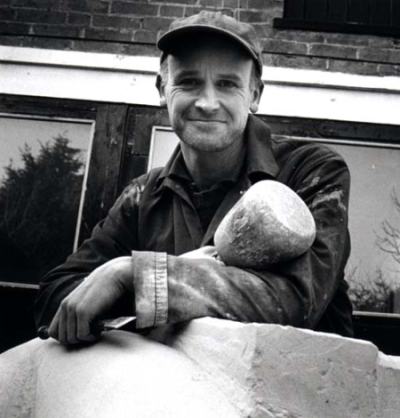
    In contrast, the Sheffield piece is a work of imagination and looks like a sculpture because it was made, with his own hands, by Martin Jennings, a renowned specialist in this area of modelling and invention. To State Art this sort of traditional approach is vile anathema.

    But here’s the real rub. Conceptual art, even when it comes in the otherwise despised bronze figurative form, is funded by the Arts Council, to whom Wearing is well known. She has had two national touring shows and has exhibited in every ACE-funded gallery. ACE also bought in 1999, for £30,000, her Turner Prize winning film in which two dozen coppers stand silently still for an hour. Confirmation of her A-list status is supported by the fact that 31 of her works are in the Tate, Arts Council, British Council and Government collections: curiously, all four own an edition of the same print, unnecessary duplication of a kind that ought to have been outlawed years ago. Wearing’s family sculpture was administered by local Ikon Gallery, which itself receives over half a million a year from the public.

    In contrast, Sheffield had to find all the money through public donations because Martin Jennings is the wrong kind of artist.

    State Art always prefers ears to eyes and has never based funding decisions on the merit of what you actually see. Why artists nationwide are not campaigning about ACE’s continued unfair discrimination and casuistry is baffling.

    Here is yet another filthy, indefensible racket.

    David Lee

    Jan/Feb 2016

    http://www.martinjennings.com/Biography.aspx

  • The Art Fund subverted: they were only playing leapfrog

    The separate bodies contributing to State Art are now so interrelated, so cosily acquainted, their personnel so readily interchangeable and of identical mindset, that they might as well join forces. (… Liz Forgan is sacked from the Arts Council but remains a Trustee of the Art Fund; James Lingwood swallows his annual  million from the Arts Council and also sits as a Trustee of the Art Fund which has bought a work he commissioned, and so on – I could fill this column ten times over with similar complacent overlaps.) Imagine the savings on personnel and rent alone if the Contemporary Art Society (now funded and run by a former employee of the Arts Council), The Art Fund (headed by an ex-director of the Tate), the Arts and British Councils and the Tates (also directed by a former Arts Council employee) stopped pretending they pursued distinct objectives and pooled resources.

    The Art Fund is the latest to dump any semblance of independence. It is nominally a charity, if, that is, you count bankrolling the already well supplied as ‘charitable’. If the Salvation Army doled out caviare to nobs in Mayfair there would be a fuss. But the Art Fund regularly does the equivalent.

    It was founded by altruists in 1903 solely to help museums buy works of art. It gives £6.3 million a year in grants, spreading it thinly across scores of acquisitions, including some important ones. Its core activities are still nobly worthwhile and more than ever necessary.

    Recently, it announced it would fund two British tours: Jeremy Deller’s ‘immersive works’ (don’t ask) created for the British pavilion at this summer’s Venice Biennale, and Grayson Perry’s six large caricature tapestries on the subject of British life and taste. Why is a charity sponsoring the promotion of Perry and of a Tate trustee, Deller, who are among the most visible, wealthy and successful of recent British artists? And why aren’t their dealers paying for these tours from which they will all benefit? Deller’s exhibition in Venice, funded by the British Council (the tour of his inflatable Stonehenge is already, by the way, covered by the Arts Council), cost over half a million of public money to stage. Why is Deller worth even more from the limited resources of yet another much tinier charity? None of this makes sense. Unless of course there is a privately agreed national consensus between a raft of organisations, public and private, whose objectives – for whatever reason – are to promote the same few reputations.

    In their recent accounts the Fund crows its contribution of £200,000 towards Rachel Whiteread’s infantile defacement of a listed masterpiece, Charles Townsend’s Whitechapel Art Gallery. Again, here is lavish support of a successful, regularly exhibited artist represented by a leading world dealer. Charity? Really? Additionally, they funded the Tate’s purchase for £125,000 of five Whiteread ‘drawings’, or diagrams as they used to be known – they now have 30 of her works.

    The Fund also oversees the annual £100,000 Gulbenkian Museum of the Year whose judges are perennially lazy, predictable and uninspired. It is responsible too for administering ‘Artists’ Rooms’, an overpriced and dubious blunt instrument of State Art which ensures the circulation of work by top brands around regional museums, apparently ­– God help us – in perpetuity.

    The Fund’s magazine, Art Quarterly, formerly a purveyor of scholarly articles, is now a yappy promotional brochure for State Art. The current issue advertises three artist trustees of the Tate, each of whom receives the Fund’s cash. In the case of Wolfgang Tillmans, they contributed £95,000 towards buying 15 of his pictures for Glasgow Art Gallery having the previous year given £62,000 for the purchase of nine others of his works by the Arts Council, which has £450 million a year of its own to spend. The Tate already owns 62 works by Tillmans. Why this obsession with an indifferent German photographer?

    But all is not bleak. In 2011 when the Fund announced public purchase of Yinka Shonibare’s Fourth Plinth bottle the published cost was £362,500. As we demonstrated at the time this was a lie repeated in all newspapers. In their recent accounts the figure has now shot up to £650,000. They’re getting there, slowly.

    David Lee

    The Jackdaw, September/October 2013

  • Serpentine Gallery extension: limousines are good causes

    Serpentine Gallery extension: limousines are good causes

    What is the difference between a line of black limousines at a Mob funeral in Brooklyn and an identical cavalcade at the opening party of the new Serpentine Gallery annexe in Hyde Park? Well, not as much as you’d think. Although Cosa Nostra are undoubtedly the subtler of the two coteries represented, both have a common interest in protection rackets. In the case of the Serpentine this means inflating the reputation and value of the deluxe ‘branded’ art which will be shown there and will have originated, or will end up, in the collections of the limousines’ occupants.

    Unaware that a shindig was in progress I cycled past the Serpentine while the limos were chrome-to-chrome outside. At first this didn’t register as unusual: another evening, another hoolie for the vain and vulgar at the Serpentine… One has got used to it. But the image of those black limousines, just that few inches too long, that shade too opaque, that chauffeur-wipe too shiny, lingered until it formed an indelible symbol for everything that stinks about State Art. What is passed off as ‘public interest’ and ‘the public appetite for contemporary art’ (the latter is the often repeated favourite lie of President-For-Life Serota himself) is yet another means by which the wealthy protect their interests. The public has no say in what is shown in the Serpentine despite the fact we have always paid for it. And if we don’t like it we can eat cake.

    Here is a publicly funded art gallery which specializes in showing recent art of negligible visible quality, that the public couldn’t care a toss about, which is hawked by the world’s wealthiest and most powerful shopkeepers, has its value maintained by salerooms who rig prices during glamorous soirées, is traded in by billionaire collectors who purport to like it but treat it merely as a secure commodity of exchange, and is endorsed using a new language written by “international curators” no literate outsider can fathom. You couldn’t invent a more perfectly rounded system of self-interest and exclusion.

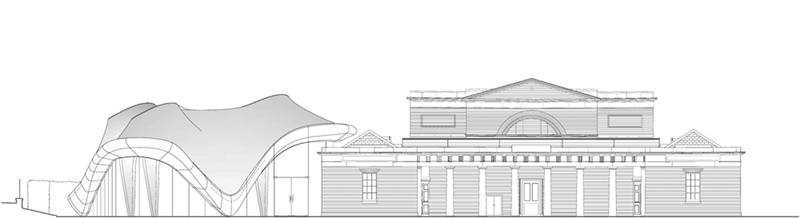
    The limos were celebrating the Serpentine’s latest expansion. A listed neo-classical building of agreeable proportions by Decimus Burton, formerly an arsenal close to the main gallery, has had a café and restaurant designed by Zaha Hadid attached to it. Enjoying limitless freedoms of manoeuvre as it does, State Art never has any problem acquiring permission for one of its chosen architects to tamper with the historically important and therefore supposedly protected. In this case what resembles the roots of a gigantic wisdom tooth have been impacted on the side of a Doric portico. It couldn’t be less sympathetic and like everything gratuitously eye-catching it is unnecessary. New gallery spaces are poky and the café charges £3.38 for a small cup of waiter-delivered coffee. How very charitable – come to think of it just like those other exemplary, public-spirited ‘charities’, the Royal Academy and The Art Fund.

    Between them the limousines paid the £14 million cost for the expansion, as well they might as many of them will be its main beneficiaries. Running costs and an exhibition programme have been underwritten with a £3 million endowment from the Lottery. This comes on top of the minimum £1.3 million a year the gallery has always received from the Arts Council. In fact, in the 19-year history of the National Lottery, the Serpentine has received no fewer than twelve awards totalling £6.8 million. Thus is the Serpentine the means by which money from the poorest, those who buy lotto tickets and scratch cards, is laundered to assist the wealthiest (non-doms many of them) in the appreciation of their investment portfolios. This revolting system is defended by the all-purpose State Art lie that the likes of the Serpentine “provide a public service”. Up to a point, but the real winners are behind all that dark glass.

    The Serpentine is run by a pair perfectly suited to their task: one is a dim socialite who does as she’s told, while the other is a Swiss “international curator” who speaks six languages and has neither penned nor spoken a clear sentence in any one of them.

    So who pays for the Serpentine? You do. Who is it for? Definitely not you. What is its purpose? Mind your own business.

    David Lee

    The Jackdaw, November 2013


  • Evelyn Williams, and another case of the public denied

    Evelyn Williams, and another case of the public denied

    In the last issue I considered the case of a single-minded good artist,  David Mulholland from Middlesbrough, whose memory, in the absence of any official recognition or support, has to be kindled for posterity’s sake by friends and family. By The Jackdaw’s usual standard of eliciting no comment whatsoever, this caused a considerable mailbag from many mentioning other artists who deserved better than the obscurity and indifference they receive. Owing to the recent death of a special artist, there is cause for reiterating this line of criticism of an art establishment hopelessly out of touch with anything but ‘The Contemporary’, such as they choose to see it.

    Grief felt at the death of a memorable artist is mitigated always by the fact that their work – if it is properly accomplished and not merely the species that is famous for fifteen minutes – will live forever. Giotto didn’t need an ‘artist’s statement’ or incomprehensible catalogue introductions for his work to last, because his paintings speak for themselves in a universal language understood across the centuries. His work will continue to communicate clearly its observations of character and stories just as long as human beings are prepared to see,  feel and respond. This is the case also with the art of Evelyn Williams who died aged 83 on November 14th. Her work will endure in spite of the neglect she received from officialdom during a long and productive career. In the same Tate Collection which stores 274 works by Andy Warhol no space can be found for a single piece by Evelyn Williams, who is a far more interesting artist if not so much of a business-minded celebrity phenomenon whose market is carefully rigged. Even in the last two years alone, when 516 works were acquired by the Tate, there was no room for a single one by this important woman artist. There are even ten works in our national collection by American minimalist Robert Ryman, all of them white and doubtless extremely challenging to those of a devoutly all-whiteist fanaticism; but nothing by Evelyn Williams. Here is further evidence that at the nucleus of State Art breeds a deeply entrenched prejudice against anything but pseudo-intellectual nonsense.

    It is an appalling truth that the Tate has ceased to be a collection of British art preserving the very best of what is being done. Instead, it has been stealthily subverted under Serota to become a private collecting fief promoting a narrow orthodoxy related to a handful of dealers and auctioneers. Why is it that so much about today’s Tate stinks? Evelyn Williams is in a long line of single-minded British artists who refuse to run along the pre-ordained tramlines of conceptualism and modernism. She was a thoughtful, modest, intelligent and vulnerable person alive in a world – as she perceived and experienced it – of imminent dangers. Her paintings, sculptures and reliefs are about the fear and anxiety, the affections and frictions, of what it is to have lived the life of an anxious woman and mother. Hers is first and last a woman’s art, an uncompromising take on post-war relationships, intimacy, cares, depression, failure and even alienation. Her subjects take you inside the realm of senses and feelings, probing the unspoken secrecies behind the masks of propriety we all wear. In the way that art has of redeeming the awful, these are beautiful explorations of states of mind most try to avoid. Her work can be relentlessly intense, no question about that, but it is pure in spirit and purpose.

    Three of the more serious newspapers, the Times, the Telegraph and the Guardian, were eventually persuaded to publish obituaries of Williams. As with so many significant but neglected artists who are nevertheless considered worthy of an obituary, her exhibitions were scarcely even acknowledged let alone reviewed in the arts pages of these same papers. Critically, it was as if her work didn’t exist. She is, of course, among the many accomplished artists whose work is ignored for being conventional in appearance and technique and declamatory about emotions. To today’s State Art tyrants such characteristics are considered embarrassing drawbacks.

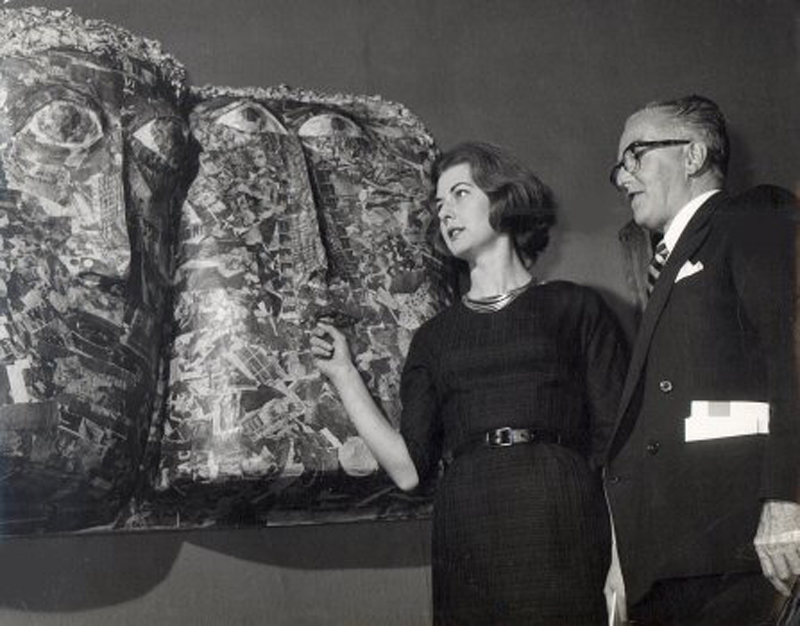
    Williams was, however, appreciated in the past. As a youngish artist in 1961 she won the sculpture prize (for Two Heads) at the John Moores in Liverpool, when other winners were Peter Blake, David Hockney and Ron Kitaj. These were the days when the Moores was worth winning, well before it was subverted to the cause of State Art where daubs of no merit are greeted by fools with preposterous superlatives. A retrospective exhibition was held in 1972 at Whitechapel Art Gallery; once again well before that gallery’s prostration before the winds of Biennale bluster. Williams continued her brave exploration of inner places that made her work then so widely admired. She worked every day of her life and although her commercial exhibitions continued, sometimes at long intervals owing to the complexity of ideas and their necessarily prolix gestation, a retrospective was never offered in her lifetime. Approached by friends in the last decade of her life, the Walker Art Gallery turned her down for such an honour. She couldn’t exert the pulling power of a Rolf Harris or Paul McCartney.

    Will Williams now receive the lifetime retrospective her work deserves, and which a wide audience should see? It isn’t likely.

    But why should this be, when there are more galleries nationwide which are more spacious than ever before? The answer is that as the public gallery network expands the same orthodoxy is spread across even more outlets. More galleries does not mean a wider selection of work on display; it means the same work by the same few artists spread across even more galleries even more frequently.

    What are called ‘Artists’ Rooms’ are a symbolic example of what is wrong with this rotten system. These ‘Rooms’ are organised by the Tate, the Scottish National Gallery of Modern Art and the Art Fund (how long will it be before the Art Fund can only be contacted via the Tate switchboard?), and they resulted from a bulk purchase, jointly by the Tate and the SNGMA in 2008. We bought for £42 million (£27 million in cash – the figure varies in different reports; we’ve never been told the exact sum – and £15 million in waived tax) retiring art dealer Anthony d’Offay’s gallery stock, which he called his private collection.  A cynic might say that Artists’ Rooms is the process by which the personal collection of one commercially motivated individual now dictates what a large proportion of the art-seeking population is allowed to see in the name of recent art. The same cynic might further add that Artists’ Rooms is the opportunity by which established reputations – such as Warhol’s – are constantly hammered home, and for the smaller ‘Room’ names, it is the instrument by which a more significant brand name can be nurtured.

    Under the auspices of the Art Fund, an organisation which luckily is headed by a former director of Tate Britain, 30 rooms featuring 760 works by 26 artists have been touring the country for four years, mostly as small one-man retrospectives. Some of these are marvellous, not least the extensive collection of photographs by August Sander. There are 232 works by Warhol alone, who gets two rooms to himself travelling at the same time. At the moment they are in Sheffield and Hull, and then Birmingham for four months. That is apart from relatively recent major exhibitions for the same artist at the Tate, the Hayward and other Arts Council galleries.  Warhol is showing somewhere all the time. We will not be allowed to ignore him.

    One of the Artists’ Rooms deals, inevitably, with Damien Hirst. This is currently on show in Walsall Art Gallery. It has been there for two months already and will remain in place for another year. What is happening when a fifty-year-old artist, already over-exhibited at a time when so many unexposed artists can’t get their work shown, is having a thirteen-month long exhibition? What is the reason for such indoctrination? Too often the Artists’ Rooms represent those who are already widely exhibited and who are bastions of the art market.

    Artists Rooms are a blunt instrument whereby approved taste is circulated (inflicted) from the centre. They constitute cheap exhibitions for Arts Council venues up and down the country, whose curators don’t have to originate their own programme. The laziness and ready compliance of these jobsworths is a godsend to State Art.  They can merely exhibit the same few approved brand names for ever. And make no mistake their career will depend upon them favouring these “right” kinds of artists for no individual prospers in State Art by demonstrating initiative or investigating the unorthodox.

    Visit the Hepworth Gallery in Wakefield and you will discover the other reason, besides the dreaded Artists’ Rooms, why thought and broad knowledge among curators is unnecessary. There is a new species of art collectors who caught the disease of wholesale, apparently random acquisition from Saatchi. These people fuel the market for State Art which they buy in quite staggering quantities. Their houses, full of wince-inducing tat bought for eye-watering sums, feature frequently in glossy magazines. Usually they are rewarded for their commitment to the State Art cause with the accolade of a position on a Tate committee, of which there are now dozens. At Serota’s Tate money not knowledge is the essential qualification for co-option.

    One such überbuyer – who has not yet been brought on to any Tate committee – is one David Roberts, a property developer, who has accumulated so much clutter he’s opened his own ‘space’ and has begun feeding pieces to regional galleries, Wakefield being the first venue. Works selected are linked as follows: “This exhibition examines ways in which modern and contemporary artists represent the human

    body in various media to explore psychological and emotional life.” What a perfect criterion that is for the inclusion of a major work by Evelyn Williams. Unfortunately, the trouble is that among Roberts’s 3,000 plus works there is nothing by Williams. But have a guess whose work he does own and whose efforts are on show in Wakefield: enter Warhol and Hirst.

    David Lee

    The Jackdaw January-February 2013

    http://www.evelynwilliams.com/index.htm