Tag: mainfeature
-
The Philistine – July 2021
Bristol University is building a new library. The very idea is enough to send shivers down the spine: any British institution that decides to build something new is almost certain to add to the accumulated ugliness of the world.
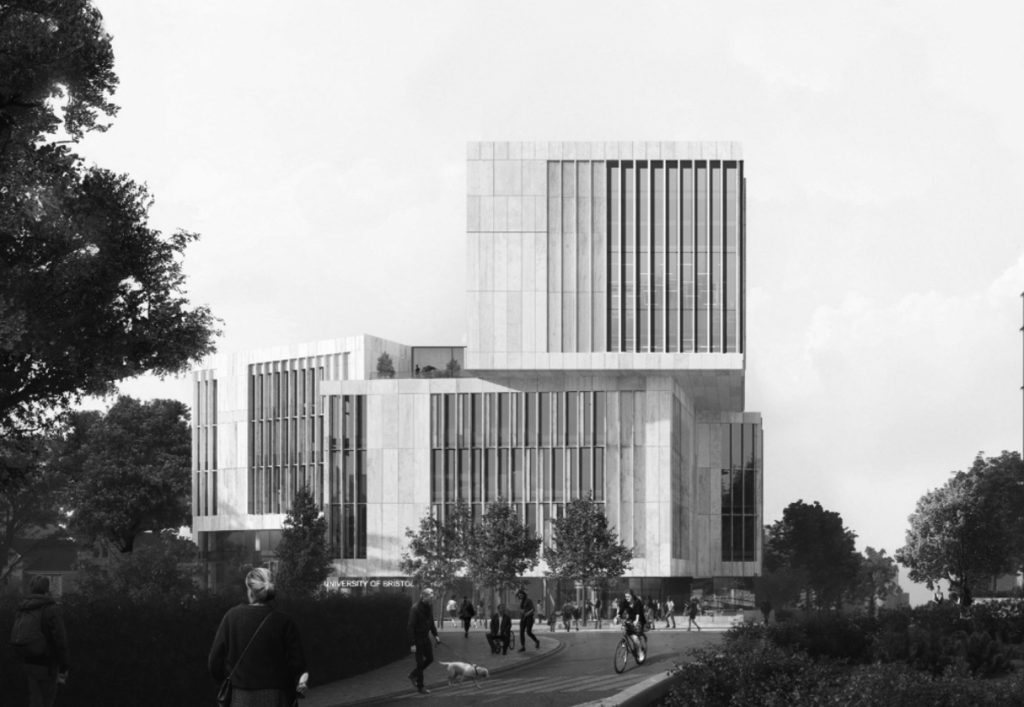
And so it is in this case. The design that the University has accepted combines banality with monstrosity: a combination that, I suppose, requires talent of a kind to achieve. The building already looks a good candidate for demolition, probably within thirty years, and it hasn’t even been built yet. One can only hope that Bristol’s pullers-down of statues will get to work on it straight away: though of course they prefer to demolish only those things which have some aesthetic value.
One of the partners of the architectural partnership that designed the building was reported as having said: “This inspirational new landmark for Bristol will provide world-class facilities in an inclusive and welcoming environment.†It is worth lingering a moment on this horrible sentence.
In the first place, it is not for the designer of a building to say that it inspires anybody or anything, any more than for me to say that this is a good article. That is for others to decide. In fact, the new library will indeed be inspirational: but only of contempt and despair at the aesthetic incompetence, insensibility and egotism of the architects and their client alike who have inflicted such a thing on a city.
That it will be a landmark is, alas, true, for it is so large that it will be visible from all over the city. But being a landmark is not a good in itself, any more than is originality a good in itself. In the absence of aesthetic quality, it is, rather, a fault, and a grave one. I note that even the architect, who is by no means modest, makes no claim of beauty for the proposed building.
Then comes that terrible word that sounds as a tocsin: ‘world-class’. What does world-class mean? It means second-rate, mediocre, boastful, and aspiring to something that is certain not to be reached. Who would say of Chartres, ‘It is a world-class cathedral?’ or of the Taj Mahal, ‘It is a world-class mausoleum’? Even to think in these terms is to have a mind that makes greeting-card poetry seem profound by comparison.
Then comes the teddy-bear word ‘inclusive’ that is supposed bring comfort to the reader and induce a warm glow of approbation of its utterer. Who can be against inclusion? Dr Verwoerd? But who or what is to be included? Biblioclasts? Illiterates? Terrorists? Fascists? Paedophiles? Drunks? Drug dealers? Prostitutes? Pimps? Graffitists? Vandals? Swindlers? Thieves? Murderers? The word ‘inclusive’ is a lie, when it is not shorthand for deeply-ingrained but shallow ideology.
Here is what another partner is reported to have said: “While we set out to create a contemporary design that echoes the sense of civic dignity imbued with timeless sculptural qualities, the new library is deeply contextual and deliberately responsive to the historical environment of Bristol.†This is the kind of language with which anyone who reads architectural writers in our magazines and newspapers is only too familiar. Trying to fix a meaning to it is like trying to grasp the more slippery kind of seaweed. Someone should write a glossary, for example:
Contemporary – Fit for demolition within twenty years
Contextual – Standing out from its surroundings like a
fungating cancer
Responsive to historical environment – Destructive once and for
all of its surroundings.
There is one thing to be said for architects such as those of the new Bristol University library: they reconcile one to one’s advancing age.
-
A Line in the Sand
State Art is like a virus, it knows no boundaries and spreads like wildfire. In fact, it’s worse than a virus because once it’s arrived you can’t get rid of it because there’s seemingly no cure. And there are plenty of students actually volunteering to contract it. And national boundaries are no protection for it spreads by telepathic brainwashing. This leads to many curious anomalies. Why, for example, should peoples of different cultures and traditions, all as equally rich as our own ‘western’ one, be interested in the brand names of State Art? A good example of this is currently doing the rounds. This piece (above) by Richard Serra comprises four large slabs of metal, each 45 feet high, spread over a thousand yards of a nature reserve in Qatar. A nature reserve! How could anyone in that country believe that an Arab population could possibly see and understand this as a “breathtaking national assetâ€. One can only conclude that the proliferation of State Art has caused a global pandemic of acute self-delusion. The reason why East/West West/East is in the news is because it’s being cleaned of graffiti. Authorities in Qatar are appalled that locals can’t understand the sculptures’ world significance. It was unveiled in 2014 and the artist hoped it would become a landmark, as if everywhere needs a landmark. Surely this is the fate of anything at all you might plonk in an expanse of desert.
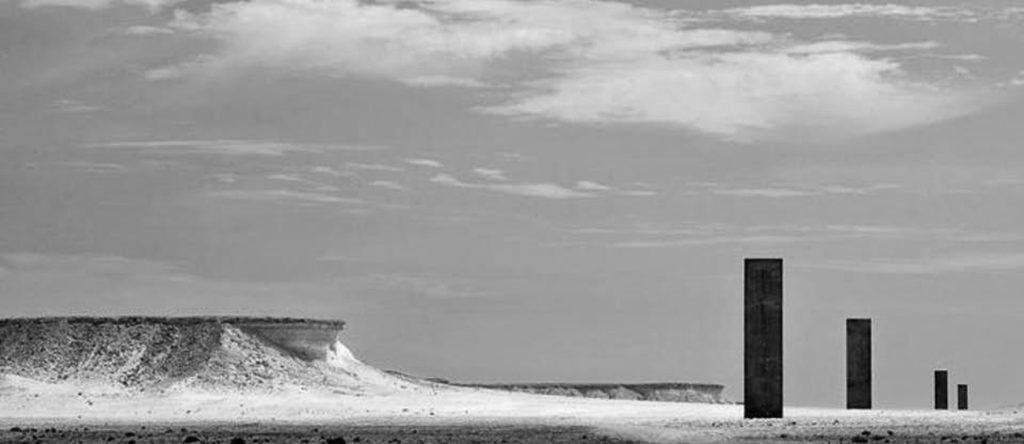
As an addict of the sweeping non-sequitur, Serra has clearly been listening in while Gormless, occupying the next hotel room, practices in front of the mirror. He said: “I attempt to use sculptural form to make space distinct… What that piece does is give you a point of reference in relationship to a line, and your upstanding relationship to a vertical plane, and infinity, and a personal relationship to a context – and pulls that context together. It makes it graspable. That’s actually a place out there now, and there certainly wasn’t one before. We did that simply by putting up four plates.â€
Talk about stating the bleeding obvious. You could make the same claim for a line of telegraph poles.
Overlooking the conceit of an artist prepared to inflict his lack of imagination on a nature reserve… was it Moore or Caro who said “More often than not sculpture spoils landscape�
-
The Philistine: Nîmes Old and New
Anthony Daniels
I see that the architect, Richard Rogers, is to retire at the age of 87. This is an excellent thing, of course, but unfortunately it comes seventy years too late. Rogers has done as much as anyone to make the world a little uglier (and locally, much uglier); in that sense he has been very successful. He has been a powerful and effective propagandist for inhumanity in his chosen field. No one could deny that he had an ultimate vision: namely, that of the world as a giant airport terminal.
Of course, he is not the only architect whose life would have been much better spent doing nothing on social security than in employment. I will mention in this connection only another two, Norman Foster and Elizabeth de Portzamparc. I name them because I happened to pass through Nîmes the other day, and I never cease to wonder at the effectiveness of their subversion of beauty there. But if I had to award the palm, it would be to the female of the species.
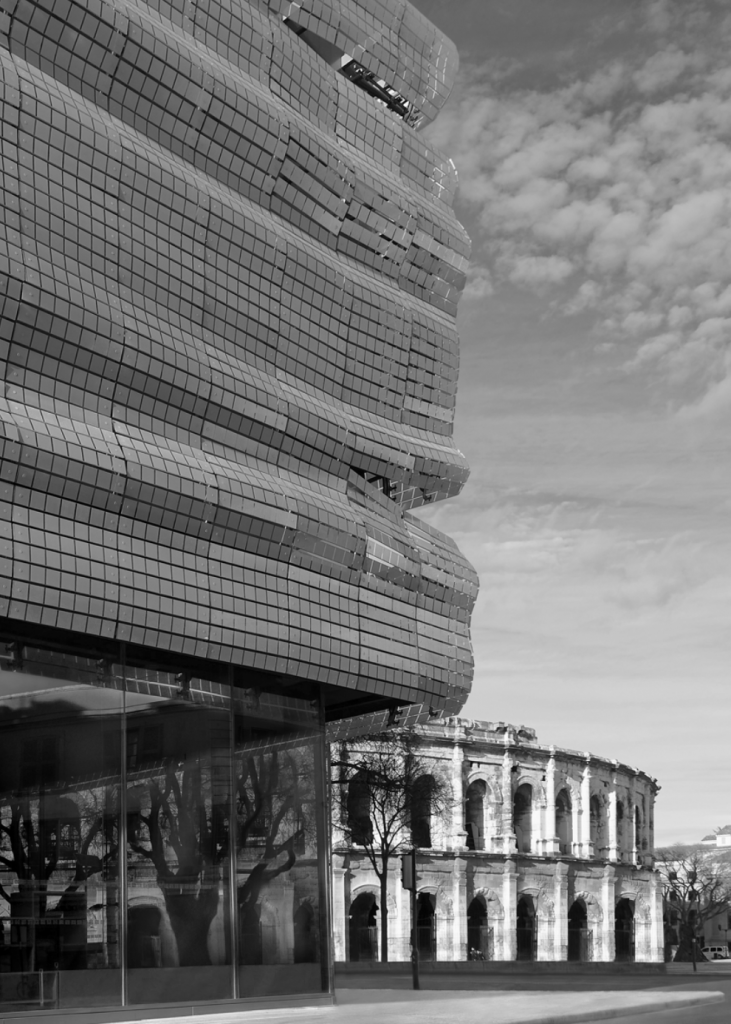
One of the characteristics of their type of architecture is that it is always expensive financially while cheap aesthetically. The architects have the sense of economy of Louis XIV and the taste of the magpie. For example, Elizabeth de Portzamparc’s Musée de la romanité (above), placed with maximum eyesore-ness opposite Nîmes’ magnificent Roman arena, is covered with bright silvery scales that look as if they have slipped from their moorings, or from a half-scaled fish. Is the building finished? The most one can say is that it is open to the public.
If Elizabeth de Portzamparc had been a cook, she would have invented dishes such as herring and vanilla ice-cream or oysters in raspberry jam. Her restaurant wouldn’t have lasted a week. As it is, she evidently believes that the greater the clash between what she builds – which is in any case inherently incompatible with anything except itself – and its surroundings, the more valuable it is as provocation, and the greater the monument to herself. She teaches architecture, incidentally: talk about corrupting youth!
But it takes two to tango, as the cliché has it. Even the worst of architects, such as Foster and Rogers, could have done nothing without powerful patrons. The question is therefore not only one of how architects came to be so destructive of civilized cities, indeed this is the less important question, but how it came about that patrons came to have so little taste. Ortega y Gasset answers implicitly in his essay The Dehumanization of Art: It has been said that the new style, taken in the widest sense, consists of eliminating those elements that are human, all too human, retaining only material that is purely artistic. This seems to imply a great enthusiasm for art. But looking at it from another angle, we are surprised to see an opposite face, that of weariness and disdain.
Ortega says, moreover, that the new style divides the population into an elite that understands, and an ignorant philistine mass that does not. (Le Corbusier is quite explicit about it.) No one, not even a nouveau riche tycoon, wants to put himself into the category of the ignorant or philistine, and so he goes along with whatever the self-appointed representative of the enlightened elite tells him. Bestriding the world like a colossus from the purely economic point of view, he is also but a humble flatterer at the court of the emperor with no clothes. Even humbler are the municipal councillors, who are aware of their own nullity.
The explanation, then, is the triumph of the propaganda campaign of the modernists. But there is never a final or ultimate explanation of anything, and so we must then go on to ask, why was the propaganda so effective?
The political and cultural magazine, Standpoint, has a regular two-page feature at its rear, one page describing somebody or something overrated, and the opposite page somebody or something underrated. In the May/June issue of this year, the two things compared were classicism and modernism in architecture. The author was Stephen Bayley, a prominent commentator on such matters.
Modernism, he tells us, ‘revels in optimism and opportunity’. That, of course, is precisely what members of totalitarian parties, communist or Nazi, like about them, and it is no coincidence (as the Stalinists used to say) that there are obvious connections between the modernist sensibility and totalitarianism. Mr Bayley, no doubt unintentionally, makes this clear when he says:
“It was the poet Arthur Rimbaud who said “Il faut être absolument moderne.†For the first time in history, from about 1870, there was a compulsion to make poetry, art and architecture which owed nothing to tradition, but were, instead, uniquely expressive of contemporary sensibility.â€
Ah yes, the tabula rasa and the New Man, what crimes are committed in thy name! The fact that Arthur Rimbaud said something doesn’t make it true. In fact, what he said was both wrong and vicious: first because it fails to appreciate that no quality (by definition) is more fleeting than modernity, and that creatures such as we who live in time cannot but be modern; and second because it is an open invitation to egotism, insensibility, self-worship and ignorance. Before us nothing, after us, who cares? It is the content of modernity that counts.
Mr Bayley almost agrees. He tells us ‘terrible buildings – Grenfell, the French banlieues – are terrible not because they are modern but because they are terrible.’ But do they really owe nothing to modernism, rather than from modernity per se, and do they not take their inspiration, if that is quite the word I seek, from it? Mr Bayley once said, in his review of Professor James Stevens Curl’s book, Making Dystopia, ‘there is only a sliver of difference between Walter Gropius’s lofty Bauhaus ideal and a crap council estate’. Even if it were allowed that among the scores of thousands of modernist buildings in the world there are a handful that are not a thorn in the eye, surely the correct response to architectural modernism is Si monumentum requiris circumspice. What a devastating aesthetic effect if you do!
But Mr Bayley cares nothing for aesthetics, only for ‘optimism and opportunity.’ He tells us:
“In fact, modernism is the most complete expression of the will to design, a definition of what it is to be human, of making buildings which are appropriate, efficient, comfortable and, if at all possible, beautiful too.â€
Here is the admission that for him beauty is a kind of optional extra, like electrically-heated seats in a car. It is very low on his list of priorities, as if beauty along with truth and goodness were of but minor importance in human existence.
Everything that Mr Bayley says is both philistine and inaccurate, teetering on the edge of idiocy. ‘The glory of the modernist mentality is that it is optimistic,’ he tells us. ‘It revels in the beauty and the opportunity of the here and now and the tomorrow.’ It does not occur to him that our today is tomorrow’s yesterday. Why should tomorrow’s people who revel in the beauty and the opportunity of the here and now care about what we did? No wonder so many modernist buildings are worthy only of demolition.
With regard to classicism, he says that ‘you can tell the quality of an idea by the company it keeps.’ This is a reference to Mr Trump’s executive order that from now on classicism should be the default style for new Federal buildings. But Mr Bayley is a great admirer of Le Corbusier. Le Corbusier was a fascist in the most literal sense. Et alors?
-
Alexander Adams: The Colston Statue Affair
Alexander Adams
This article briefly outlines what happened with the toppling of the Edward Colston statue in Bristol, why it happened and its ramifications.
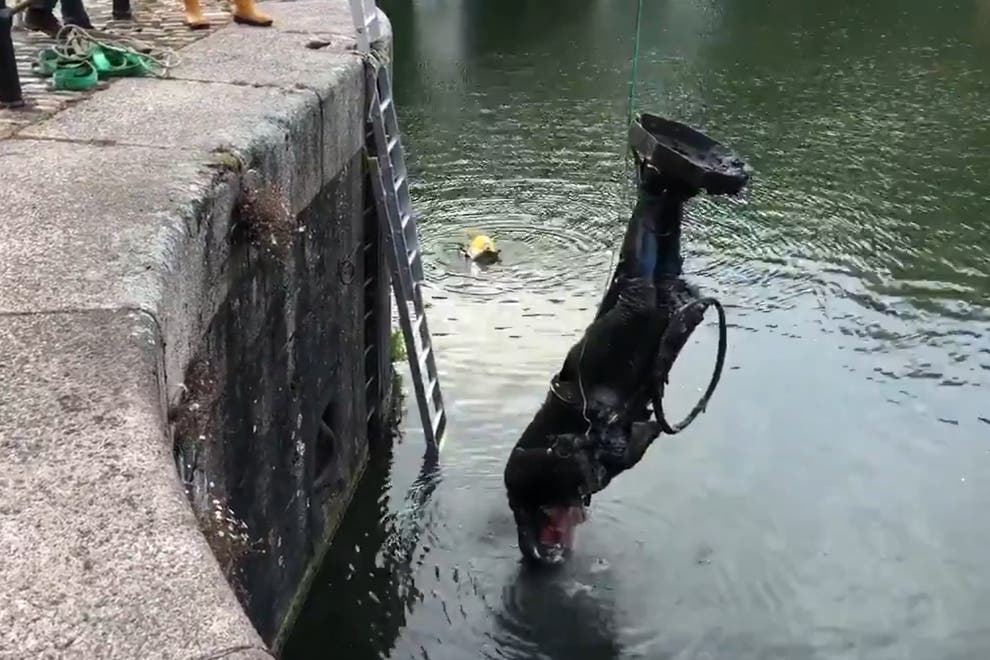
On 7 June 2020, a large protest took place in the centre of Bristol, ostensibly against racism. The large gathering was in contravention on national and local restrictions on public gatherings due to COVID-19. No dispersal was attempted by police. Some protesters formed a mob that attacked the statue of MP Edward Colston, erected in 1895. It was sprayed with paint, damage and toppled. It was then rolled into the nearby harbour. There were no arrests. The statue was later retrieved by the Council.
Just as the mob did not detain itself over the personal record of Edward Colston, neither shall we. The heart of the matter is mob violence, threats of violence, vandalism and intimidation. The cause is irrelevant. Ask members of the social-justice mobs that attacked the statues of President Lincoln and Frederick Douglass why they chose those targets and they could not tell you. (A member of the mob that attacked Churchill’s statue in Westminster admitted in a television interview that she “had never met the manâ€.) The vastness of the mob’s anger is matched only by its ignorance.
The police watched but did nothing. Apparently, some officers wanted to prevent the attack but were instructed by commanders not to intervene. The mayor was in the police control room. Bristol City Council has long wanted to remove the statue but was not able to force through the political decision. A majority of the polled population of Bristolians opposed removal of the statue. However, the left-wing council and mayor saw the opportunity to use the mob to act on their behalf. Rather than defying authority, the mob was acting in accordance with the wishes of authority in committing this crime and was successful in doing this with the connivance of Council, mayor and police commanders, who all shared a progressive political outlook. The council, which currently has on its website pages the legend #blacklivesmatter, tweeted its approval of the demonstration.
It was not a statue celebrating slavery. It was not, notwithstanding the hysteria of the defilers, a device for perpetrating or restoring slavery. It was a monument to a respected gentleman, trader, employer, Member of Parliament and benefactor of his home city who happened to be caught up in a legal but ethically reprehensible business. One could not have devised a more perfect embodiment of the moral quagmire that ordinary men and women of good standing became enmeshed within because they were born into a particular era. The individuals that destroyed the statue would, if they had been born three hundred years earlier, have been caught up in exactly the same moral predicament and given it barely a thought. The statue was the ideal tool with which one could teach about how our morals are shaped by our era and how society gives sanction to dubious practices. By destroying the Colston statue, the mob refused to confront the awkward truth it presented: that we are all morally culpable due to the moral constriction of circumstances.
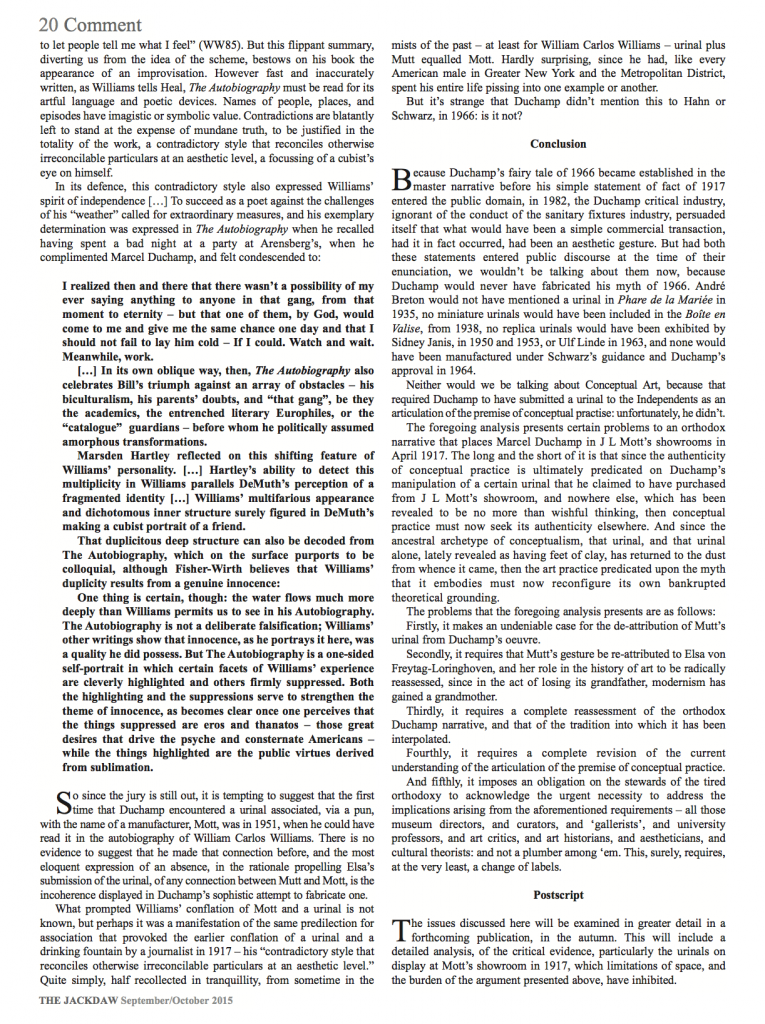
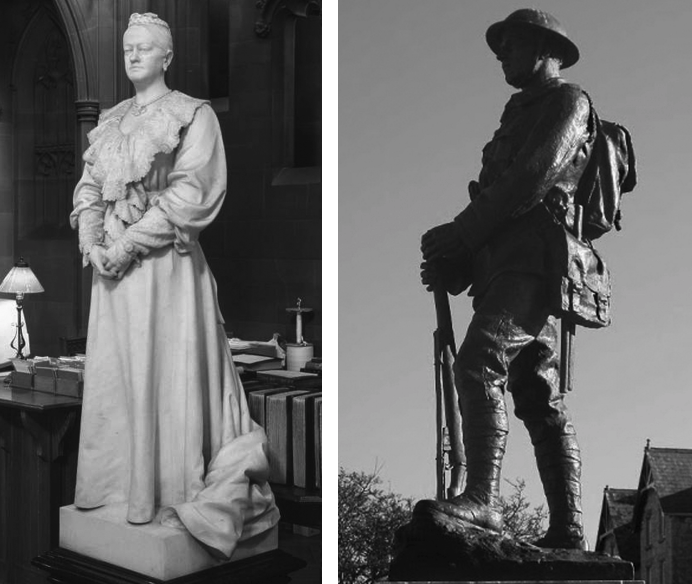
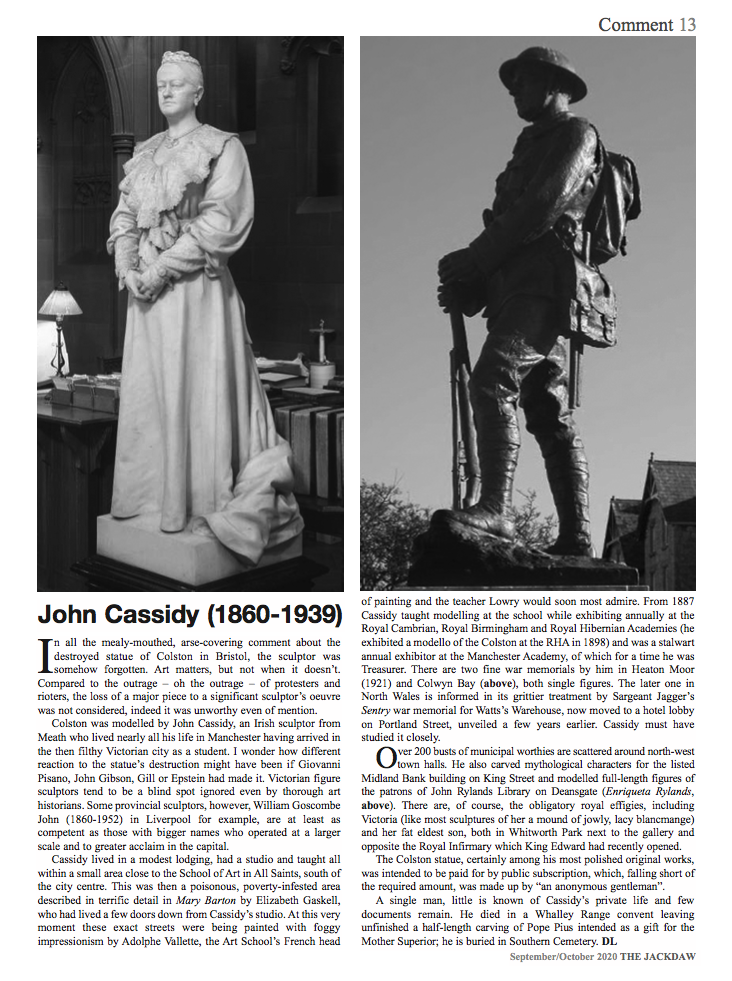
The following month, serial opportunist Marc Quinn unveiled on the empty plinth without permission a 3D-printed statue of one of the protestors giving a black-power salute. It was taken down after one day. As a sculpture it was a failure – as all one-to-one replications are. (I know because I saw it in person.) It was a chance for a rich, state-supported London artist to wag his finger at Bristolians by (dare one say) colonising the vacant plinth in order to assert his moral superiority. It was half condescending stunt, half replacement tender. While the original Colston statue was a piece of serious artistry and a very handsome piece (see opposite and page 12), the Quinn effort was feeble. However, replacing an accomplished piece of public statuary honouring contributions of an important person with a plastic representation of a protestor who had been duped by local authorities into participating in an act of criminal vandalism is not an inapposite symbol of our era.
Collective Guilt
The justification for destruction of part of the city’s heritage was that the statue celebrated a slaver. I have yet to hear the Council, mayor or protestors condemn the city’s mosques dedicated to a religion founded by a slave-owner. How many of those “anti-slavery activists†have debated Muslim theologians on the tenets that (under some interpretations) countenance slavery today? How many of them wrote letters of protest to the embassies of Chad, Mali and Sudan, where slavery still persists? In truth, there was no “anti-slavery activism†on 7 June; it was a carnival of virtue signalling that culminated in criminal-damage-as-performative-anti-racism.
If the council puts Colston’s statue in the local museum in its vandalised state as a tourist attraction (rather than returning it to its plinth), I propose they replace it with a memorial to the Atlantic slave trade. Let us have an African slave in chains and with him his African slave-owner. This represents the historical reality that European slavery of Africans relied upon active participation of Africans, who sold to Europeans (and Arabs) prisoners of war, members of other tribes and unwanted members of their own tribes. And slavery wasn’t something only Africans endured – there were many “white†slaves too, including homeless children taken from the streets of London and sent to work in appalling conditions in the Tobacco Plantations in Virginia along with convicts who weren’t all serious felons but were imprisoned because of the consequences of extreme poverty. According to Don Jordan’s book White Cargo: The Forgotten History of Britain’s White Slaves in America, if you were transported from Britain and unlucky enough to end up in a Virginian plantation you could have a red hot bodkin pushed through your tongue before being hanged for stealing a rose from the owner’s garden. It is a must-read book for anyone concerned about Slavery. This portrayal would conflict with those who think in exclusive terms of Westerners as predators and non-Westerners as prey; such a proposal would likely not find favour with Bristol City Council.
The overriding aim of social-justice activists is to impose upon the population a narrative of inherited collective guilt: white British people (historically and now) are complicit in the unique evils of colonialism and slavery. Thus, all action that collectively punishes this group is acceptable. This includes the destruction of their culture, public humiliation, rote apologies and reparations. None of us (whatever our colour) has experienced slavery or supported it; none of us should be forced to apologise for something our ancestors may (or may not) have approved of. Remember that we are also descendants of people who abolished slavery, forbade it abroad and patrolled the seas to curtail the Atlantic slave trade. Slavery in the Americas under the British took place at a time when there was no universal suffrage and therefore it was not a matter that could be approved of electorally by the British public. After initially participating in slavery abroad, no people ever did more to oppose slavery than the British.
When a half-educated firebrand lectures you on slavery, ask her what year Britain abolished slavery and you will get no answer. Anti-slavery and anti-racism – in the current forms we see most publicly – are nothing more than excuses for a deep hatred of our society and its founding pillars of tradition, patriotism, capitalism, Christianity and colonialism. Social-justice activists delight in destruction, motivated by moral fervour and burning malice. They are not horrified by racism but secretly delighted, using it as a weapon as against well-meaning ordinary people, getting them to participate in broad coalitions. Activists invent new forms of “institutional/systemic†racism to maintain the illusion that non-racist people are inherently and implicitly racist and thus deserving of the elite’s control and castigation. This is the triumph of the righteous (mainly white) middle-class, university-educated allies of “marginalised minorities†over the hordes of (mainly white) working-class “racist thugsâ€. It is another manifestation of the class snobbery that refuted – then concealed – the mass rape of children and young women in cities across Britain because they were the “wrong†colour, religion and class.
It could hardly be clearer than the Communist symbols sprayed on statues to Robert Peel, Churchill and Queen Victoria. Middle-class, university-educated vandals attack patriotic symbols that may not be revered but are widely respected by traditional patriotic, white working-class people. The general sentimental attachment to Baden-Powell, Churchill and Queen Victoria does not entail a complete acceptance of their opinions regarding race but now – in our hyper-charged, social-network-facilitated, emotionally labile cancel culture – accusations are enough to get a person or artefact removed from the public square. Cancel-culture definitions are ever expanding, ever changing, never appealable, never reversible. Offence-taking is used insincerely and tactically to claim territory (via cancellation) and to put people on the defensive; this process intimidates the majority, who become fearful, silent and compliant.
Take a look at the hundreds of thousands of published pages and hours of lectures/speeches delivered by professionals in education and you will encounter a distorting mirror universe of social justice, where minorities in the West live hunted lives and ordinary social interaction are atrocities upon their dignity. This is a frighteningly alien world where there is talk of “human beings/Brown skins/Black bodies/marginalised voices†because to use the word “people†admits the possibility of a plurality of experiences, lives, viewpoints, tastes, wealth and politics. Social-justice activists literally talk of “skins†as if they were big-game trophy hunters. For activists, the “Black experience†is uniformly monolithic, invariably oppressed, irrefutably one of suffering; it is a narrative they use for material gain and political advantage.
What we can do?
Do you think that taking down statues of Rhodes and Colston will satisfy activists or just encourage them? When actions are not goal-focused, limited and pragmatic but instead a hubristic religious crusade driven by spite and utopianism then they will be unremitting. When you have been trained by school, university and media to believe your society is founded upon injustices of slavery, rape and genocide of other peoples, then no price is too high and no reparations will suffice. Do you think that your culture is safe in the hands of groups which think this way? If these activists – so pliant, so poorly informed, so easily moved to incontinent fury – undeniably forgo empathy for people of the past, can they tolerate contradiction by the living?
In these pages you will read of the onslaught on historical monuments and cultural artefacts committed by zealots, mainly in the USA. The events of this summer will not end in autumn; they have only just started. All across Britain, there are moves to destroy our culture, especially in London under the direction of the mayor. We must retain our statues. Even if they commemorate individuals we do not agree with, their presence reminds us of how our society has changed. How can we state that slavery was once acceptable if we have erased all public traces of it? Isn’t such action opening the doors to tomorrow’s conspiracy theorists? Either way, erasing history is not a practice that ends well for anyone.
Across the country, hectoring agitators, paid lobbyists, obsessive cranks and cynical politicians are (through legal means) attempting to remove public art that belongs to you. Defend physical culture by getting involved. Share this article. Subscribe to The Jackdaw and The Critic. Attend council meetings. Sign petitions. A website to monitor threats to public monuments and co-ordinate resistance is at www.saveourstatues.org.uk. Visit and share it; consider contributing.
Should anyone think me partisan on this, I remind him/her that I have publicly deplored dismantlement of the Palast der Republik in Berlin, removal of GDR murals and statues, wrote in favour of many architectural projects in Communist countries and currently oppose removal of statues to Marx in the UK. Regardless of whatever you may assume my beliefs to be, I trust even critics will concede it would be misrepresentation to claim I have not consistently defended free expression and opposed iconoclasm. If you believe in these principles, I invite you to do the same and act, especially locally. Apathy and inaction will result in your culture being controlled and the history of your nation (good and bad) being erased.
Alexander Adams’s book Iconoclasm, Identity Politics & the Erasure of History is published by Imprint Academic on 6 October.
-
Moping Owl: Nem Con
Goodness knows we have more than enough to mope about these dark days, even without the current plague, what with the evenings drawing in and the weather on the turn, again. It seems to happen every year, Winter. Was it always like this, this cold, wet, windy, foggy, snowy thing, with a spot of flu thrown in for good measure? I blame Global Warming, or Climate Change as everyone now calls it, hedging their bets.
Of course the plague doesn’t help, especially at my age, and I can’t say I’m looking forward to being confined to barracks yet again, alone and warming my five wits as best I can in this draughty old belfry, to venture out only at risk of neighbourly denunciation by the horrid old crow next door, and possible debility and death. I know it’s for my own good and, if I didn’t, I know I’d soon be told so by lovely Fiona Gloom or sweet Sophie Despondency on the evening News. Get a grip they’d say, think of others, and do your bit of shielding, whatever that is.
It is a public duty, I know. It makes me almost ashamed to mope at all, though only almost. But then life is strange, and rather wonderful too, and, blow me off my twig, what should happen but that Art appears, smack on cue, to take my mind off such selfish introspection and despair and give me, as I knew it would, something really worth moping about. And, just so, across the wire the message comes, Chantal Joffe (say no more, I hear you cry) is to have another show to follow the one she had, when was it now? – ah yes, the week before last. Gosh, how Time flies.
I’m not sure quite which is the more dispiriting. One can just about understand, though not necessarily forgive, a Barrow Boy, Spiv or Snake-oil Salesman for making a few bob flogging off dodgy goods. After all, there’s always been more than something of the back-street market to the art trade, good times or bad: caveat emptor and all that. And, again, who can really blame an artist for cashing in on a manifest lack of talent given half a chance. Take it while it’s going I say. After all, no one’s forced to buy the stuff.
So no: it’s not the chancers who make my very heart faint and my poor soul grieve so much as the fellow travellers, useful idiots, critics, administrators and curators and, not least, self-serving artists, who by their abandonment of critical judgement keep the whole sad charade on the road. Theirs is the greater betrayal. Trahison des clercs says it all.
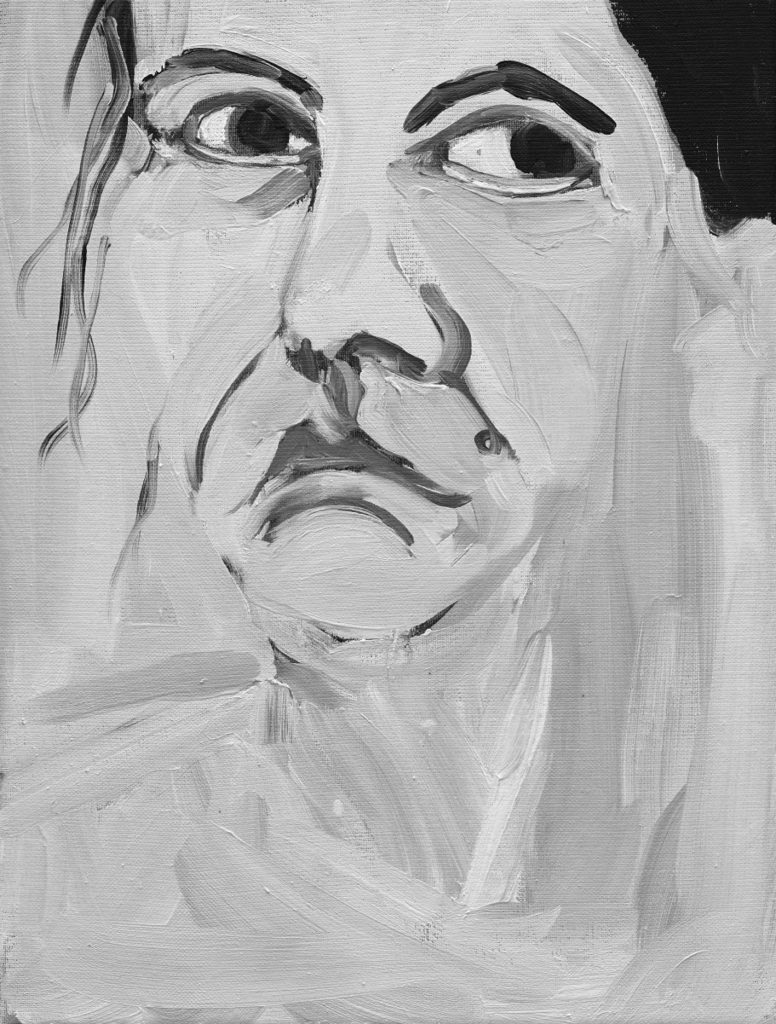
I’ve nothing against Miss Joffe, who has shown all over the world, has works in pretty well every major collection, clearly can’t draw or paint to save her life, and is not all that bright if what follows is anything to go by. Along with her new paintings, the show, we’re told (wait for it), ‘premieres’ (no, don’t laugh) some pastel self-portraits (illustrated), about which she has this to say: “You can get a kind of brutality with pastel that you can’t with paint. With paint there’s always an extension of your arm and brush. Whereas pastel is so primitive. You can’t draw hard enough.†Well, I mean to say, I know we now see through a glass darkly but what on earth is all that about? I still feel quite dizzy, and I’ve only read it twice.
The show is called Story, and many of the paintings are of her mother. They consider, so Victoria Miro’s in-house hack helpfully informs us – chez whom the show of course takes place – “consider issues of aging, motherhood and invisibilityâ€, doubtless with profound conclusions drawn, albeit un-vouchsafed as yet. She brings a “combination of insight and integrity, as well as psychological and emotional force, to the genre of figurative artâ€: at which point I feel we should all take a deep breath and put our heads between our knees for minute or two. Whew. Figurative art a genre, eh? Roll over Rembrandt, Rubens, Velasquez what?
But on we plough: “Defined by its clarity, honesty and empathetic warmth (one can never have too much empathy) her work is attuned to our awareness as both observers and observed beings, apparently simple yet always questioning, complex and emotionally rich.†No, nor do I.
A book accompanies the show in which we find Olivia Laing, novelist and soi disant cultural critic, treading water somewhat, and not exactly waving: “Over the years, a kind of hardening takes place, a process of separation and individuation on both sides… The mother recedes inch by inch, becoming smaller and harder, emerging as a person with needs and sadnesses in her own right.†Receding and emerging, smaller and harder: I don’t like the sound of that. Let’s hope there’s a vaccine soon.
Back with the scribe, Chantal’s “is a deceptively casual brushstrokeâ€, though I’m not so sure that deceptive is quite the word: casual will do. “Her paintings only waveringly adhere to their source (yes: we can see that) – be it a photograph, magazine page, or even a reflection in a mirror – instead reminding us that distortions of scale and form can often make a subject seem more realâ€, or perhaps not. “Notions of sensuality and self-disclosure (sounds interesting) are parcelled up in works of mobile immediacy.†Mobile immediacy – well there’s something to set the imagination adrift, I must say: swings and chandeliers spring to the febrile, hopeful mind. Mobile immediacy – I shall try to remember that, if not for long. “Hers are deeply questioning images about ever-shifting human connections (those chandeliers again) and the endless intricacies of looking.†Answers on one side of the paper only, the deeper the better.
So there we have it: what justification there is rests either on the narrative alone, as read in the imagery, or on the artist’s subjective experience of its making: of the actual technical quality and resolution of the work as work, painting as painting, drawing as drawing, not a word.
Chantal is a graduate of Camberwell and the RCA, both renowned painting schools in their time, and now a Royal Academician, its Professor of Painting no less, elected by a body that nowadays counts amongst its number such as Our Tracy, Yinka Shinybone, Bob-n’Rob, Young Grayson, and the Misses Dean and Wearing. Some years ago it gave her its Wollaston Prize, nem. con. – which is to say 25,000 of the best and brightest for ‘the most distinguished painting in the summer show’ – worthy heir indeed to the shades of Reynolds, Turner, Lawrence, Millais, Spencer… Perhaps trahison des clercs isn’t strong enough.
-
Michael Daley: Selling a Leonardo with Oomph
Michael Daley
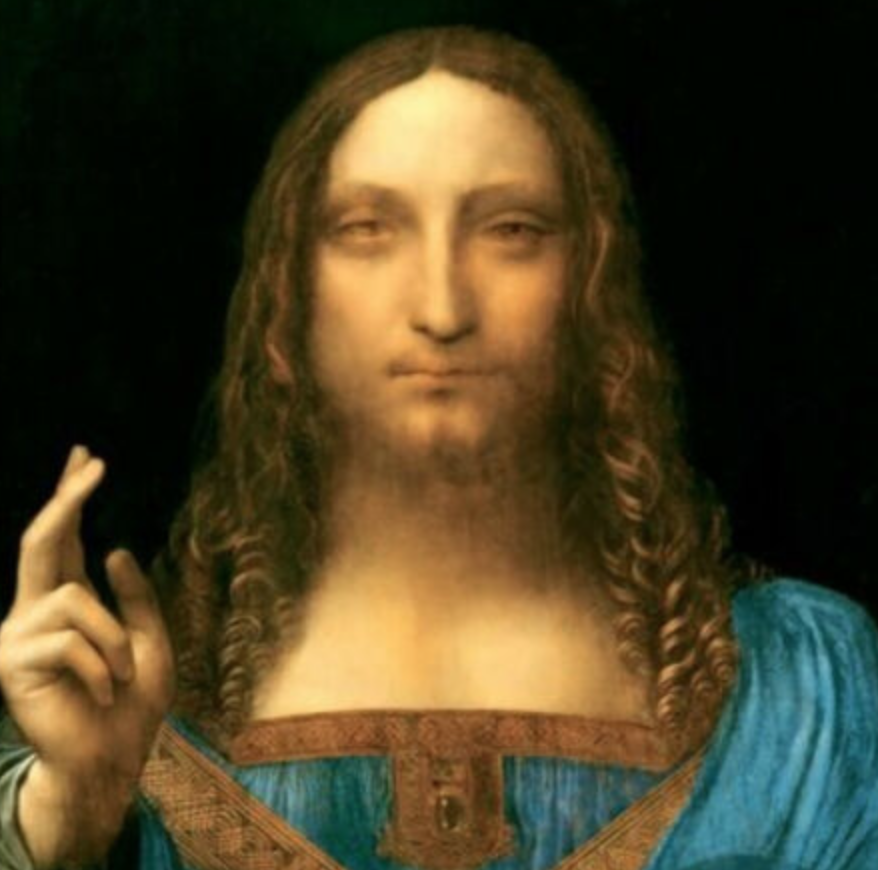
Questions proliferate on the disappeared $450 million Leonardo Salvator Mundi. Where is it? Who owns it? Who still believes it a Leonardo? Will it be exhibited this year at the Paris Louvre’s big Leonardo exhibition, as promised? Can it be true, as an artnet blogger now claims (on the claimed say-so of “two principals involved in†Christie’s 2017 sale) that the painting was removed on the night of the sale to be installed on the yacht of Saudi Arabia’s supreme ruler, Mohammad Bin Salman? Does Christie’s know more about this imbroglio than it has disclosed? Will the Salvator Mundi ever be seen again?
In The Last Leonardo, Ben Lewis contributes hugely to knowledge of the picture’s shadowy emergence and subsequent near-mythic elevation. We now know the picture was bought not for “around $10,000â€, as claimed, but for $1,175 – for less than the low estimate of $1,200-1,800 on a work described as being “after Leonardo da Vinci†at the St Charles Gallery, New Orleans. We now know that gallery closed down after the Salvator Mundi’s sale and reappeared under the same name but without previous records. We now know Christie’s turned the picture down in 2005. We know the “consortium†of buyers initially comprised Robert Simon, a New York dealer and Alex Parish (a freelance dealer and online picture scout for the Richard Green dealership). We know that before, during and after being exhibited at the National Gallery in 2011-12 as an undisputed autograph Leonardo, the picture was on the market and numerous attempts to sell it privately to museums for between $80 million and $250 million failed.
Lewis discloses that it was variously rejected by: the Qatari royal family; the Hermitage; the Getty Museum; the Museum of Fine Arts Boston; the Vatican; Berlin’s Gemäldegalerie; and a German auction house whose Leonardo advisor, Professor Hans Ost, was and remains “very sceptical about the attributionâ€. The initial consortium was running out of money and afraid to offer the picture for auction. As Parish put it to Lewis, “there’s not a deader-in-the-water [work?] than a picture which you put up to auction and then bombs… where do you go from there? Absolutely dead.†Somehow, despite all failures, unimaginable success was to follow.
Deliverance began with a third consortium member: “An offer of help came in 2010 from a reputedly well-connected New York old master dealer, Warren Adelson, who has a gallery in a magnificent uptown townhouse. ‘I made a proposal to Robert and Alex to buy a share of the picture,’ Adelson says, ‘because I wanted to run with the ball and help them sell it.’ He negotiated a 33 per cent stake in the painting in return for a $10 million advance payment. It was accepted. As Robert Simon put it ‘there were a lot of expenses. The photography and the storage were expensive. When we insured at its value the insurers wouldn’t allow me to keep it in the gallery. It had to be kept in a vault at an art storage facility. There were my research costs, going to Europe five times, and Milan five times, and London and New York, and going and checking the libraries. Dianne [Modestini, the restorer] was helpful in not requiring us to pay everything in advance.’â€
Lewis wryly observes “nothing in the known universe, no item, no object or quantity of material, has ever appreciated as fast as the Salvator Mundi attributed to Leonardo da Vinci†but, even with a war chest, and Adelson on board, the going remained rough. The picture was offered to the Dallas Museum (for a rumoured $125 – $200 million). The museum’s new director, Max Anderson, was enthusiastic about the chance to “‘acquire a destination painting’ that would draw crowds to the museum.†Parish told Lewis: “We were strung along by him for some time … at the eleventh hour they offered just $40 million and $25 million of that was meant to be a swap with another painting. Apparently some of those Bible Belt people had little or nothing good to say about the picture. One guy – I won’t tell you who – said, ‘Boy, that is one faggy-looking picture of Jesus’ or something to that effect. I was really like, ‘O-o-oh, great. This is going so well.â€
Despite the astronomical leg-up inclusion in the National Gallery’s major Leonardo exhibition as a rediscovered lost autograph Leonardo prototype painting, this Salvator Mundi remained unwanted by museums and could not be risked at auction. Partial success – in the consortium’s inflated terms – was only achieved in 2013 with a controversial lawsuits-generating private sale through Sotheby’s to a Freeport owner who bought at $80 million and immediately sold on to a Russian oligarch for $127 million.
What then would carry the picture over the line so spectacularly in 2017? When Christie’s got its second chance, it launched a global promotional blitz that rested on two planks: the authority of a claimed unusually broad consensus of endorsement among art historians; and, an absurdly inflated and unfounded provenance taken from the National Gallery’s own unfounded claims that rested on the then – and still – unpublished researches of Robert Simon. ArtWatch UK exposed the unsoundness of Christie’s provenance the day before the sale.
Lewis gives an especially attentive account of the precisely focussed means by which this seeming sufficiency of art experts was enlisted. With the single exception of Professor Martin Kemp (who spouted statements galore and made a promotional video for Christie’s immediately ahead of the sale to counter our criticisms) almost none of the listed scholars and curators had then – or has since – gone on record giving reasons for holding the painting to be an authentic autograph Leonardo prototype for all other Salvator Mundi versions. When Lewis asked the consensual scholars he “was not able to verify the verdicts of all the art historians listed in Christie’s catalogue.†His account of how the tongue-tied dozen scholars were assembled is molten:
“Robert Simon was well aware that he needed to be strategic and accumulate the right allies if his painting was to be authenticated as a fully-fledged Leonardo. ‘Part of the reason for the secrecy was the mechanics, if you will, that Bob had to employ in order to get the utterly fantastic consensus that he compiled,’ says Alex Parish … After the initial period of restoration [there being quite a number – see Figs. 2 to 8], Simon and Parish began showing the picture to close contacts. The first to see it was Mina Gregori, not a Leonardo expert but a close friend of Simon’s who had made some hotly contested attributions to Caravaggio in the past. She came to see the picture in New York in November 2007, and said nothing at all while she was standing in front of it, but as Simon walked back to the lift she turned to him and said, with an Italian sense for melodrama, ‘È lui’ – It’s him.â€
Gregori was a good first choice. The owner of the Martin Kemp-supported La Bella Principessa drawing, Peter Silverman, gave this account of Gregori’s endorsement of that other would-be Leonardo in his 2012 memoir Leonardo’s Lost Princess: One Man’s quest to Authenticate an Unknown Portrait by Leonardo da Vinci:
“We had become close friends with Mina over the years, and she frequently stayed with us when she visited Paris … I asked her to look at the portrait again, telling her, ‘Mina, people are saying it could be Leonardo. Please sit and study it carefully and give me your honest opinion’ … Mina remained bent over the portrait for a very long time. Finally she called me to her side. ‘Yes,’ she said. ‘It is Leonardo. Allow me to be the first to say so formally.’ I handed her a black-and-white photo, and she wrote the attribution on the back. I still have it.â€
Lewis frequently encountered un-clarity and contradictions: “Several curators and restorers from the Metropolitan Museum saw the partially restored Salvator Mundi in early 2008, but it is not clear what exactly was said about the painting. According to Robert Simon and Christie’s, a majority of the Met experts agreed they were looking at a Leonardo. One of its Italian renaissance specialists, Keith Christiansen, certainly did, and still does. Another senior staff member, Andrea Bayer, deputy director for collections, told me she would not comment on the painting. One senior academic source close to the Met told me, on condition of anonymity, that ‘The Met curators don’t believe that it is by Leonardo. One curator told Simon that the Met would be glad to accept the painting as a gift for study purposes. That means they thought it was a wreck and not by Leonardo.’ Another highly placed museum source informed that one of the Met’s curators ‘judged the painting a Leonardo but didn’t want it in his collection because of its condition’. If the museum’s specialists did consider the possibility that it was a Leonardo, it’s unusual that they made no attempt to make Simon an offer for it at the time – or since.â€
Next stop for Simon was Nicholas Penny, then head of sculpture at the Washington National Gallery who had recently bought a sculpture for the museum from Simon. “‘Robert’s had quite a lot of dealings with me, and I think he probably knew that I was not frightened to stick my neck out,’ Penny told me. Simon showed Penny the painting, and he responded, ‘You have a really interesting problem.’ By that, he did not mean the attribution was an issue. He was referring to the difficulty of establishing widespread agreement in the art historical community for new attributions.†Penny passed the baton to Luke Syson who was organising the National Gallery’s Leonardo exhibition. Syson shared his newly appointed boss’s judgement, telling Lewis in Kempian language: “It had that sense of how the natural is assembled to make the supernatural. The picture seemed to hover somewhere between our realm and the supernatural.â€
Syson and Penny saw an opportunity for a dramatic pictorial debut and an accompanying risk: “They knew that exhibiting a painting such as the Salvator – newly discovered, with uncertain attribution and on the market – would break a universally accepted convention of public collections not to legitimise or promote entrants to the field. To overcome this hurdle, Syson came up with a high-stakes solution. He organised a seminar, a gathering of the world’s top art historians to examine the Salvator in London ‘with an open mind’.†So, a disinterested scholarly perusal was in prospect? Here’s how Lewis saw it:
“Five great Leonardo experts attended this meeting. From Milan came Professor Pietro Marani, who had supervised arguably the most challenging restoration in art history, that of the Last Supper … Also from Milan was Maria Teresa Fiorio, who had run two of that city’s major museums and was an unrivalled specialist in Leonardo’s assistants and pupils. Carmen Bambach, the curator of drawings at the Met, had already seen the Salvator in New York on several occasions. [And was one of a quartet of distinguished scholars who rejected the attribution in reviews of the National Gallery exhibition.] From Washington, DC … came David Alan Brown, the revered curator of Italian paintings at the National Gallery of Art, who had long ago in his PhD thesis expressed his belief in the existence of a ‘lost Salvator Mundi’ by Leonardo, depicting ‘a mature bearded Christ … frontally posed and strongly lit from the left against a dark background with his right hand raised in blessing and his left hand holding a globe’.â€
In so contending, the student was then putting down a challenge to the great Leonardo scholar, Ludwig Heydenreich who, in a major study on the Salvator Mundi problem had concluded there was no indication that Leonardo had painted a prototype Salvator Mundi from which all other versions derived. In 1978 another American student, Joanne Snow-Smith, proposed that one version – the de Ganay – was the missing autograph Leonardo prototype painting. In 1982 she produced a book of advocacy (The Salvator Mundi of Leonardo da Vinci), which also failed to gain acceptance. However and astonishingly, much of her unsupported confection of a French royal provenance for the de Ganay version was lifted and applied by Syson in his catalogue entry. (Lewis believes the National Gallery had mistakenly switched versions and that Christie’s simply followed suit: “Luke Syson has since told me that he was mistaken to include this in his catalogue entryâ€. Lewis reports that research he commissioned shows that, contrary to Snow-Smith’s claim after Heydenreich’s death, the great scholar had not endorsed her thesis and, in truth, had rejected it in scholarly code.
The last scholar to arrive at the Syson seminar (Penny did not attend) was Martin Kemp. Conspicuously absent, Lewis notes, was (our colleague) Jacques Franck, “a Leonardo expert who was a trained painter rather than an academic, and who had advised Syson on the restoration of the Rocks.†Another omission “the most surprising, was Frank Zöllner. A professor of art history at Leipzig, Zöllner was the author of the best-selling, multi-edition catalogue raisonné of Leonardo’s paintings.†Lewis suggests a possible reason for Zöllner’s absence. He had recently written: “mention must be made of the increasing attempts, above all in recent years, to attribute second and third-class paintings to Leonardo’s hand. In this context it should be noted that the catalogue of paintings presented here is definitive. While there may be works circulating in the fine art trade that stem from Leonardo’s pupils, the likelihood of an original by the master himself is extremely small.’ Syson says that leaving Zöllner off the guest list in London was, in retrospect, ‘a mistake’.â€
A mistake of a not uncommon kind at the National Gallery, it would seem, when attributions are afoot. On 8/9 November 2002 a symposium was held at the Gallery at which 25 art scholars and experts examined another small painting in the conservation department to determine whether a version of the very many Raphaelesque Madonna of the Pinks was the autograph Raphael original, as was being proposed by the Gallery’s Italian Paintings curator, Nicholas Penny. The Gallery later claimed that all present shared Penny’s judgement that the Northumberland version, which had been on display at the Gallery for ten years, was the original autograph Raphael. One Raphael expert excluded from the occasion was our late colleague in ArtWatch, Professor James Beck of Columbia University. As Beck wrote in his 2006 book, From Duccio to Raphael: Connoisseurship in Crisis, “Since the picture … was essentially on the market, a consensus among experts was highly desirable. An undocumented object that lacks the appearance of a consensus will not bring top prices and will rarely be treated seriously. In the past such an accord might have taken years to accomplish, but in today’s globalized world it can occur quickly, especially with the prodding of the public relations apparatus, amply available in world-class museums like New York’s Metropolitan and London’s National Gallery.â€
At the National Gallery’s Salvator Mundi seminar, Lewis notes, “No minutes were taken … No declaration of any kind was signed … No official announcement was issued after it ended. There was no formal process by which the attribution of the painting was conducted. The National Gallery did not ask to have the painting left with it to be examined … as the Albertina Museum and the Academy of Fine Arts in Vienna had done with the Bella Principessa, before reaching a negative conclusion … After the meeting, Syson informed Nicholas Penny that the experts had agreed that the painting was indeed by Leonardo himself … Two weeks after the meeting, Penny contacted Simon and told him that the art historians had judged his painting to be a Leonardo … Penny formally asked if the National Gallery could borrow the painting for its exhibition three years hence, and also asked him to keep it a secret until then.â€
The members of the National Gallery Salvator Mundi seminar had also been sworn to secrecy – as Kemp puts it in his memoir, Living with Leonardo, “All of the witnesses in the gallery’s conservation studio were sworn to confidentiality, and the painting travelled back to New York with Robert. It was becoming a ‘Leonardo’.†Beck had observed with the National Gallery’s Raphael symposium, “No polling of the invitees’ views concerning the putative author of the Northumberland Madonna was conducted … at least as far as I have been able determine. The National Gallery director reasoned that since none of the people who attended … expressed doubts at that time about Raphael’s authorship, they all favoured it, interpreting silence as agreement.†Lewis continues, “However the art historians who attended the National Gallery meeting did not in fact reach an official attribution or an informal consensus about the Salvator Mundi. Nor were they asked to. ‘I have never issued an official opinion on the Salvator Mundi, and in any case, I have never been asked to do so,’ Maria Teresa Fiorio told me. ‘I discussed the painting informally with colleagues, and I do not know by what means my opinion was made known. If the Salvator Mundi was exhibited as an autograph work at the National Gallery, then that was an autonomous decision by my London colleagues.’â€
On the Penny Raphael symposium, Beck reported: “Although an overwhelming majority of the participants were persuaded, and hence a credible consensus was achieved, the claim of unanimity is unwarranted. I learned that at least three of the original 25 do not agree that picture is an autograph painting by Raphael. Indeed, one participant told me with indignation that he had spoken out against the attribution at the symposium itself* [*It is indicative of the climate of such encounters this dissenter insisted that I not identify him]. For the connoisseur the lesson of the Northumberland Madonna must be: beware of the consensus. Factors outside the specific issue can be determining factors, including personal friendships, national and institutional loyalties, and the distinction and power of the museums represented. Arguably in the case of the Northumberland Madonna the entire Anglo-American Art Establishment was co-opted, including Christie’s auction house by the presence of one of its staff, while Sotheby’s was directly involved and did take credit for the sale to the National Gallery, according to its own advertisements. What makes this consensus attribution so intriguing is that until 1991 an equally solid consensus among Raphael scholars held that the picture was nothing more than a good copy **[**The observation was made to me by Michael Daley.]â€
Lewis noted “The final score from the National Gallery meeting seems to have been two Yeses, one No, and two No comments.†He adds “For three years nothing was heard of the National Gallery meeting. Then in the summer of 2011, a few months before the blockbuster Leonardo exhibition opened, the curtain was finally drawn back. Simon issued a press release on 7 July. ‘A lost painting by Leonardo da Vinci has been identified in an American collection,’ it began. He then carefully listed the names of the illustrious art historians to whom he had shown the painting … Simon claimed that there had been ‘an unequivocal consensus that the Salvator Mundi was painted by Leonardo, and that it is the single original painting from which the many copies and versions depend … The Salvator Mundi is now privately owned and not for sale.’†Penny was to be hoist with his own petard: “Penny and Syson knew that this was not factually correct, although it is highly unusual for a public institution to show a painting that it knows is for sale. ‘I did know, of course, that the picture was potentially on the market when we borrowed it,’ says Penny. ‘Some people have professed to be astonished by this, but I’m pretty sure I would have discussed this with the relevant trustees and the chairman’ … Luke Syson told me, ‘I catalogued it more firmly in the exhibition as a Leonardo because my feeling was that I was making a proposal and I could make it cautiously or with some degree of scholarly oomph.’†David Ekserdjian, a Gallery trustee at the time, confirmed to Lewis that he supported the attribution. The Board Chairman was Mark Getty.
Lewis’s conclusion startles: “Where the institutions of art have rules they are often the wrong ones – out of date, no longer fit for purpose. Museums, for example, are not by convention, allowed to exhibit a work of art that is on the market or to show a newly discovered one with a doubtful attribution – the source of much of the controversy over the Salvator Mundi. But as exhibitions and museums multiply, while the stock of old paintings remains much the same, it is unreasonable to expect curators not to look for pictures with surprises and controversial backstories to put into their shows. Such disputes are part of the reality show of art …â€
Best to treat art as its own reality. Cutting corners on connoisseurship would do the art world no favours.
-
Laura Gascoigne: Institutional Rationalism – November 2020
Laura Gascoigne
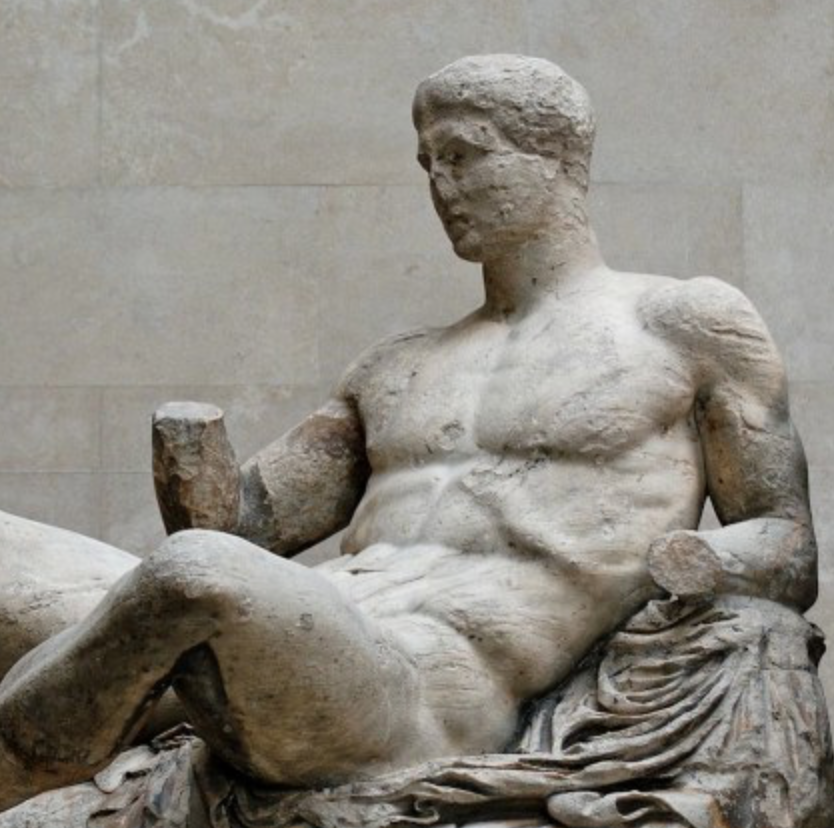
November/December 2020In the introduction to his 1951 book The Greeks and the Irrational, the classicist E R Dodds recalled a chance meeting in front of the Parthenon marbles with a young man who confessed: “This Greek stuff doesn’t move me one bitâ€. When Dodds asked him why, he replied: “Well, it’s all so terribly rational, if you know what I mean.†Dodds thought he did. “The young man was only saying what had been said more articulately by Roger Fry and others. To a generation whose sensibilities have been trained on African and Aztec art… the art of the Greeks… is apt to appear lacking in the awareness of mystery and in the ability to penetrate to the deeper, less conscious levels of human experience.â€
The conversation inspired Dodds to write his influential collection of lectures demonstrating that the Greeks were not really rational at all but as prone to magical thinking as any other culture. What Dodds didn’t say – or didn’t notice – was that the brand of modernism practised by Roger Fry and others was hardly an example of penetrating to the deeper, less conscious levels of human experience. There was nothing irrational about the British interpretation of the modernist concept of significant form, but then British art – with the rule-proving exception of William Blake – has always tended towards the ploddingly rational.
I haven’t read Dodds’ book since I was a student, but its title came back to me when I visited the Hayward Gallery Touring exhibition Not Without My Ghosts at the Drawing Room. The show (which tours in different editions to Blackpool, Sheffield and Swansea) is a small survey of art inspired by spiritualism or allegedly made under direction from spirit guides, starting with a loopy watercolour drawing by the Victorian medium Georgiana Houghton, who counted Titian and Correggio among her celestial controllers. Believe that if you will. But setting its makers’ claims aside, the work itself – apart from a couple of stylised surrealist drawings by Tanguy and Masson – has a rare quality: freshness. Every artist’s approach is utterly different. To judge by their paintings the Pas-de-Calais coalminer Augustin Lesage and the Walthamstow housewife Madge Gill inhabited different planets, even though they were roughly contemporary and only separated by the same English Channel that European modernism so easily crossed.
Lesage and Gill are both accredited ‘outsider artists’ represented in Dubuffet’s collection of Art Brut, but not all the contributors to this show were untrained. The historical section includes a visionary portrait of The Spirit of Voltaire by Blake and an astonishingly accomplished evocation of the stuff of nightmares by Austin Osman Spare, a working class prodigy who won a scholarship to the Royal College, caught the occultist bug from Aleister Crowley and languished on the margins ever after. Neither Blake nor Spare were technically outsiders, they were simply too irrational to fit in.
The show’s second half features contemporary artists inspired by the idea of spiritualism rather than the experience, aside from Susan Hiller whose Sisters of Menon series records an attack of automatic writing. Lea Porsager has repainted illustrations from a 1901 investigation into clairvoyance; Ann Lislegaard has made drawings under hypnosis; Olivia Plender has recast a seminal spiritualist text of the 1860s as a graphic novel. The records of a séance held last January by Suzanne Treister to contact an imaginary Museum of Black Hole Spacetime Collective in outer space are more entertaining, but none of the imagery is visually arresting. The only exceptions are two paintings by Ann Churchill, a self-taught artist inspired by Spare whose vibrant, tapestry-like works are packed with esoteric meanings.
The Hayward could be onto a winner here. While the South Bank gallery lays off all its front-of-house staff and shuts for the winter after the closure of its exhibition Among the Trees (emptier on a weekday than any London park) I’ve got a feeling people will flock to this touring show. The public loves mad artists, especially when they’re safely six feet under. The Guggenheim scored a succès fou two years ago with its retrospective of Swedish spirit artist Hilma af Klint (1862-1944), which broke all attendance records at the New York gallery and spawned a follow-up film released this October. Like Blake and Spare, af Klint was a trained artist who went off piste after becoming involved in spiritualism and is now being hailed as a female pioneer of abstraction. Rational male abstractionists can expect recognition in their lifetimes; irrational women must wait until they’re dead.
I wonder how visitor figures for Not Without My Ghosts will compare with footfall in our reopened national galleries, running at 12% of normal levels according to DCMS summer stats. An investigation by The Art Newspaper in September found that 70% of the National Gallery’s booking slots still had vacancies the day before and 100% of Tate Britain’s. It’s hardly surprising if people won’t risk infection to visit galleries. Applying the Covid-test to exhibition visits only proves, if proof were needed, that for most people the consumption of art is not a priority, let alone a matter of life and death. Even Bendor Grosvenor admitted in September’s Art Newspaper that his enjoyment of pictures at the Covid-proofed National Gallery was spoiled by fear. “I recoiled at every cough echoing through the galleries… I felt I was in an alien place – more well-appointed hospital than museumâ€. His fears were justified; he contracted Covid and made his admission from isolation.
I know how he felt. I’m picking and choosing my exhibitions; while prepared to risk my life for Artemisia Gentileschi, I missed the press view of the Royal Academy’s delayed Summer Exhibition. I couldn’t face the prospect of wading through room after room of routine works rendered obsolete by Covid. Ben Luke in the Evening Standard confessed to finding the usual submissions “oddly comfortingâ€; I feared I would find them more than usually depressing. Jackdaw readers will probably throw up their hands in horror when I confess to having preferred Grayson Perry’s 2018 selection of nutters, but the public agreed and went in record-breaking numbers. With a deficit of £8m and the Taddei Tondo under threat of the hammer, it was a success the RA may want to repeat.
As Dodds argues in support of the irrational, human beings don’t just think, we also feel. Galleries would be far more popular with the public if they dropped the institutional rationalism: what most people want from exhibitions is to be surprised, amused, moved, intrigued, shocked, even disgusted – anything that provokes an emotional response. They don’t want an endless diet of representational painting, but neither do they want the sort of socio-political commentary dressed as art that won this year’s Turner Prize finalists bursaries of £10,000 each. Art made to any formula is formulaic: it needs a dose of irrationalism to liven it up.
We’re living in an arsy-versy world in which rationalism has taken over art and abandoned politics. But here’s a suggestion: why not let the Turner Prize winners run the country and give Dominic Cummings a pot of paint and a brush? He has the classic profile of the mad artist – angry, rude and monomaniac – and his track tops would look much cooler spattered with paint. Then Dom could channel fellow slaphead Jackson Pollock while Boris made outsider-arty buses out of wine crates and filled them with little passengers wearing face masks. Sorted.