Tag: V&A

  • The way we are now – why ‘avant garde’ is now an obsolete term

    McQueen copyThe Times – God bless its little cotton socks – has just been celebrating the triumphal return of the 1990s as a creative force. “Suddenly contemporary art” it crows, “was part of popular culture. The Royal Academy’s landmark Sensation show in 1997 was a turning point.”

    It was so indeed, but not exactly in the terms the article intends. Here in Britain, Sensation marked perhaps the very last moment when it was possible to talk about an avant-garde in the visual arts with any appearance of authenticity. The show was widely hailed as the beginning of something – as the moment when the visual arts in Britain turned over a new leaf, as the moment indeed when British artists surged to the very forefront of innovation, displacing both the French and the Americans, who, each in turn, had carried forward the baton in the race to create what was entirely and indubitably new.

    Looking back now, the exhibition seems, on the contrary, to have marked the instant when the hands of the clock moved on, and the whole notion of avant-gardism ran out of steam. To quote the Times once again: “The beginning of the decade was all about exhibitions in abandoned warehouses and empty office blocks. By the end, thanks to Damien Hirst and his gang of barricade-storming rebels and Charles Saatchi, the ad-man-turned-art-dealer, it was more champagne and cocaine and exploding auction prices.” Only a little further on was the day when Tracey Emin RA, once high priestess of the YBA Movement, would celebrate her 50th at Annabel’s, London’s most establishment nightclub, in the company of Princess Eugenie, granddaughter of H.M. the Queen.

    The avant-garde came late to Britain, and imploded late. Long before 1997 there had been signs that the impetus to innovate was beginning to falter. It is, I think fair to say that most of its energy was already exhausted towards the end of the 1970s, when the terms Post Modern and Post Modernism came into vogue. Art was no longer defined by its urge towards novelty, by its eager embrace of some definition of the new. Instead, it was characterized by its relationship to what already existed in the recent past. This impulse has been further defined by the fashion for ‘appropriation’ – that is, for making exact copies of images that already exist as a paradoxically innovative act.

    It is possible to look at the present situation in the visual arts using several different perspectives. One is the immense expansion of the contemporary art world. The old avant-gardes were confined to Western Europe and the United States, with perhaps an acknowledgement of what happened in Russia in the first two decades of the 20th century, and a dim consciousness of certain developments in Latin America. This expansion owes much to modern communications – first to the fact that colour printing became radically cheaper, which led in turn to the birth of the musée imaginaire or museum without walls. Secondly, to the digital revolution and the birth and rapid growth of the Internet, which has made possible the immediate diffusion of images from a huge variety of different sources. Google, and ye shall find.

    This means that it is increasingly hard to see any clear direction in the general progression of art. If we are looking for the proverbial ‘shock of the new’, it often seems that the shock of the exotic (something unfamiliar, coming from a culture very different from our own) will do just as well instead. It is, of course, necessary to acknowledge, when saying this, that the original 20th century avant-garde made free use of certain exotic sources – look for example at the relationship between Cubism and what Picasso described as “l’art négre”.

    Of course there is yet another paradox here, which is that the appeal of African tribal art to Picasso and a group of his artistic contemporaries was precisely its (to them) hermeticism – the fact that they in fact knew little and cared less about what the tribal artists were trying to express. Now we not only see too much – we are also in a position to know too much. Just go to Google, and ask the right questions. It is impossible to resist asking, knowing that the answers are within such easy reach. Today there is really no such thing as an innocent eye.

    Another important factor here has been the influence of official institutions – in particular museums of modern and contemporary art. These offer one of the main channels through which contemporary art now reaches a mass public. One may argue that television and the Internet are in practical terms just as important, but the fact is that these institutions see themselves as being entitled to govern the agenda. Their priorities are set by two things. First, those in charge of them (though they may vigorously deny this) see themselves as the high priests of a cult. A lot of the more characteristic manifestations of contemporary art, as presented by official organizations, now quite openly call for the response, “Lord, I believe – help Thou mine unbelief.” Or, in more demotic form, “I believe you – thousands wouldn’t.” There are, notoriously, often no objective correlatives that can be used as measures of quality, or even of interest.

    Secondly, museums – not surprisingly – feel a strong sense of responsibility towards those who supply their funding. The problem here is that the givers of money often tend to measure success in brutally populist terms. How many people are coming through the doors? What is the demographic breakdown, in terms both of generation and of class. Are a full range of taxpayers getting their money’s worth?

    The result has been a rush towards supposedly populist forms, chief among them performance art and video. The problem here is that what museums deliver using these media, often in spaces not very suitable for the purpose, compares unfavourably with what the audience gets from better established forms of artistic expression that overlap – i.e. with theatrical performance (nowadays often very radical and imaginative, in addition to being a great deal more disciplined), and things seen in cinemas and on television. In addition to this, where film is concerned, the technical resources available outside the museum or fine-art context are often much richer and more sophisticated. Money talks ­– this is why the best television commercials often far outstrip, in terms of technical finesse, anything presented as ‘artist’s video’.  It is no wonder that a number of artists who made their reputations in that field have now made the transition to being career film directors. The recent career of Sam Taylor-Johnson offers a case in point.

    It is worth noting, in this context, that looking at painting or sculptures is, in general, a different kind of looking from looking at video or even at performance. Video demands that you look from a fixed point of view, and the same is true of many, though not absolutely all, examples of performance art. Video and performance both impose a fixed time span on the audience. With paintings and sculptures the situation is different. You look from the angle and distance you choose. You look for a moment, or for a much longer span. You are free to walk away, then look again from a different viewpoint. Both physically and psychologically it is a very different kind of experience.

    In this connection it is perhaps worth noting that Tate Modern’s current director, Chris Dercon, is due to leave the institution in 2017, to become director of the  experimental Volksbühne theatre in Berlin. In recent months, Tate Modern, having made a big deal about providing new spaces for performance art, has gone rather quiet on the subject. One wonders if its enthusiasm for this art-form will survive Mr Dercon’s departure?

    A conspicuous feature of the contemporary art world as we now have it is its close alliance to the fashion industry. To a large extent, this is something inherited from the earliest phases of the Modern Movement. One thinks in particular of the huge impact made by Diaghilev’s Ballets Russes on the Paris fashion industry. The impact of the Ballets Russes on the leading pre-World war couturier Paul Poiret is well known, but the influence was more general than this. Maison Paquin, for example, hired Leon Bakst, one of the chief Ballets Russes designers, to sketch ensembles for its collections. Chanel had a Russian phase, with outfits that echoed the shapes of Russian peasant tunics.

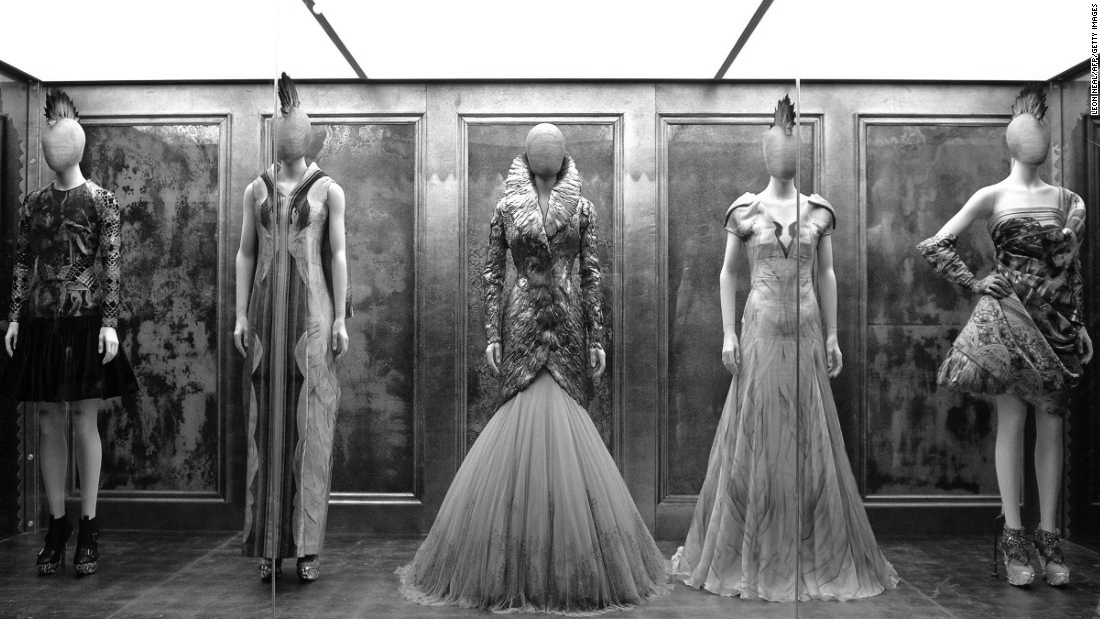
    During the past year, probably the most successful exhibition staged by any major London museum has been Savage Beauty (see illustration) at the V & A, a retrospective devoted to the work of the designer Alexander McQueen. More than 480,000 people saw it, and special late-night showings had to be laid on for the two weekends at the end of its run. Public enthusiasm for the event is, in current circumstances, not surprising. The fashion industry commands powerful PR. It is also much less bound by theories and intellectual constraints than the art world and it certainly has no inhibitions about luxury, and no shame about the money required to support luxury. Yet fashion is conservative in this sense – it gives you something to ‘see’. However ridiculous some of its visual inventions may be, fashion design never neglects the purely visual effect.

    Wear it if you can afford it. Wear it if you dare. And you can be damn sure that people are going to look at you and that they will probably remember what they saw.

    Fashion designers also, as it happens, have much less self-consciousness about ‘appropriation’ than today’s would-be avant-gardists. Fashion designers have always been magpies – they borrow without shame and recycle without inhibition. The point, for them, is to give what is borrowed a new twist. If the audience doesn’t recognise where a particular idea or effect originated, so much the better. With appropriation-art the opposite is the case. You have to know what is being so sedulously copied, otherwise you’re out of the loop.

    One refuge for avant-garde aspirationists, lacking visual inventiveness, has been to take refuge in supposedly radical politics. The visual arts have had an uneasy relationship with politics ever since the French Revolution. It was particularly strong in France during the first two-thirds of the 19th century, and reached a kind of climax in the days of the Paris Commune. This involvement, and the price that could be paid for it, is illustrated by the career of Gustave Courbet.

    There was certainly political involvement between some elements of the visual arts avant-garde and the political left during the first half of the 20th century, but the relationship was always uneasy, as the history of the Surrealist Movement amply illustrates. One still gets a great deal of talk on this subject today. The current Venice Biennale, due to finish on November 22nd, features continuous readings from the three volumes of Karl Marx’s Das Kapital. Whether anyone will pay attention to the words of this text – anymore than most of the traditionally religious pay attention to the actual words of the Mass when recited in Latin – must, I think, be seriously in doubt. In fact, left wing events, safely quarantined in museums, are now a familiar form of preaching to the converted. A good example, here in London, was Mark Wallinger’s installation, State Britain, which won the Turner Prize in 2007. This was a faithful reconstruction of the Peace Camp by the late Brian Haw, which existed for a while out in the open, directly in front of the Houses of Parliament. The Tate Britain web site rather smugly notes that: “Mark Wallinger’s work is noted for its succinct social commentary and political resonance.”

    Yes, indeed. And forgive my asking, but if this now almost-forgotten work ever had any real political impact, in which location would that have been more likely to happen?

    The avant-garde, as we once knew it, is as dead as the proverbial dodo. It is not going to rise again like Lazarus. It’s time we looked for something else, even if we don’t yet know what that is. London is now, for better or worse, a world metropolis. It is full of bright young artists from everywhere you can think of, all enthusiastically making work – much of which can be at least loosely described by the two nouns ‘painting’ and ‘sculpture’. Definitions can wait. Forget the museums. Go to the bustling galleries in Shoreditch and take a look.

    Edward Lucie-Smith

    September/October 2015
  • Preaching to the converted – Victoria and Albert Museum

    Preaching to the converted – Victoria and Albert Museum

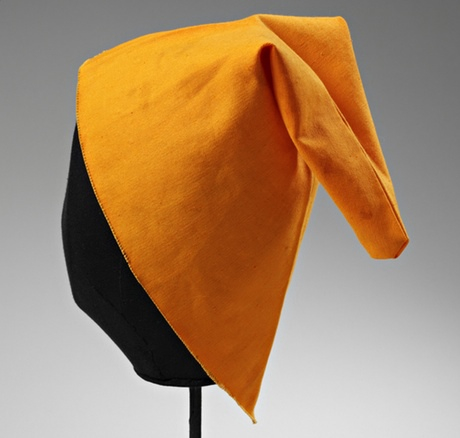
    A dwarf’s hat, as worn by 10,000 protesters at a 1988 march against communism in Poland

    It is understandable that, in current circumstances, major arts institutions should try to ally themselves with the more anarchic, contrarian elements in contemporary culture. Perhaps this is especially true of those dealing with the contemporary visual arts, committed as these still are to the myth of ‘avant-gardism’. One problem that immediately presents itself, of course, is that this myth is not itself contemporary – it is rooted in the very earliest years of the century before ours, and first blossomed before the outbreak of World War I. The myth has become so diversified in the course of more than a century of growth that what is indisputably avant garde today has become very difficult to define. One man’s ‘avant garde’ can easily be his neighbour’s idea of ho-hum, follow-my-leader conservatism.

    Another problem, allied to the first, is that the history of the 20th century avant garde was rather specifically a history of élites. Avant-garde artists relied on élite patrons for financial support – independently wealthy, high status individuals who were conscious of the fact that their championship of the radically new distinguished them from the mass. There is also the fact that the now-classical avant-garde art movements initially embraced right wing politics more enthusiastically than they did left wing ones. This was the case with Italian Futurism, the most publicised of the early avant-gardes. Later, when avant-garde artists began to identify with the left, it was nevertheless would-be mass movements, Nazism and Soviet Communism, which were particularly hostile to avant-garde art. When Surrealism tried to sustain an alliance with Communism, the relationship was always extremely uneasy.

    Disobedient Objects at the V&A (until February 1st) shows that this uneasiness has not gone away. Housed in one of London’s most important museums, its organisers have gone to some lengths to emphasise its democratic status. It is free entry, like the rest of the permanent collection (but unlike the other special exhibitions the museum offers as part of its regular programme), and it has been given an unusually long run – six months in all.

    What it offers is an anthology of objects connected will all sorts of anarchic projects, from the anti-nuclear protests at Greenham Common in England, to the Mothers of the Disappeared in Buenos Aires – all challenges to some kind of existing status quo, made in many different contemporary societies and national entities, democratic and non-democratic. Most of the objects concerned would not normally be classified as art, or even as craft or design. In fact, what one has here is a kind of religious treasury – the holy relics of a number of recent episodes of social agitation, some of which succeeded in their aims and some of which failed. If Christ had lived in our own times, it wouldn’t be surprising to find a relic of the True Cross as part of the display – always remembering that this now sacred item wasn’t, and was never intended to be, a work of art, despite the numberless times it has since been depicted in art. I say this in the full consciousness that, to anyone who reads the Gospels carefully, the texts do in fact seem to advocate a radical egalitarian revolution in society. This despite the famous verse that tells the convert to: “Render unto Cesar the things that are Cesar’s, and unto God the things that are God’s.”  [Matthew 22:21].

    The introduction to the catalogue, by the two curators, Catherine Flood and Gavin Grindon, shows a queasy consciousness of this situation. On the one hand they say:

    “The position of this project, both ‘within and against’ an institution, emerges principally from careful attention to these objects [included] and their own and their own instituent power.”

    On the other they declare:

    “Exhibitions are moments of collective meaning-making. Bringing these objects and histories together, and presenting them to an audience that never encounters them outside the mass media, makes the museum a site for difficult questions and tests it claim to be a public space.”

    The phrase that betrays something here is “never encounters them outside the mass media”. The assumption seems to be that what is experienced within the sanctified space of the museum must necessarily be superior to the same thing experienced outside it. In other words, the official framework, just because it is official, offers a validation unobtainable in the non-official circumstances in which these ‘disobedient objects’ were first made. This paradox is a step too far. The objects concerned have, on the whole, no aesthetic value. They may have had force within the very specific contexts that provoked their production. But not here. They are dead fish on a slab. In an interview given in conjunction with the show, Catherine Flood claimed that the items displayed had not been ‘museumified’ – her word, not mine. I beg to differ. That is exactly what has happened.

    One reason for this is the kind of public that great museums attract. They like to pretend that they are for ‘everyone’, and this is indeed why, in democratic Western European societies, they are given large sums of taxpayers’ money. Any observant person knows, however, that this ‘everyone’ is not completely universal. Museums attract the kind of citizens every democracy would like to have, perhaps to the exclusion of other, more difficult cases. They pull in the bien pensants – people who get a nice glow from the idea of going there. Certainly not the bulk of the truly disadvantaged, the real outsiders. They get a much higher proportion of middle-class visitors than working-class ones, though this distinction is slowly breaking down.

    Where immediate, visceral access to the ideas being put forward in the show is concerned, the mass media win the contest, hands down. They know how to hit the public in the gut, and they operate in a fully public arena. You run up against them in your daily life, whether you want to or not.

    What the museum does here is to try to organise the ‘disobedient’ material to make it palatable to the kind of visitors museums already get. Having heard about the show, you have to make the decision to go, even though you don’t have to pay a fee for the experience. Which means, in turn, that your mind is probably made up about the ideas it puts forward, long before you arrive.

    As it happens, London has already seen a rather similar exhibition – Mark Wallinger’s Turner Prize-winning exhibit at Tate Britain in 2007. This, entitled State Britain, was a meticulous reconstruction of the ‘Peace Camp’ set up by the late activist Brian Haw in front of the Houses of Parliament, in protest against the Iraq War, and subsequently dismantled by the police because it contravened a hastily passed law against “unauthorised demonstrations within a one kilometre radius of Parliament Square”. Much play was made with the fact that the site of the installation within the museum building also seemed to fall within the forbidden zone. However, as the critic Tim Teeman, writing in The Times, remarked, “moving Haw’s protest from the street to the hallowed hush of the Tate denudes it of rawness and energy. The riot of colour, the anarchy of words and images, are dimmed; the weatherbeaten plastic coverings aren’t flapping in the wind anymore, but listlessly reflecting gallery spotlights.” He concluded by asking: “Does it ask new questions or challenge our preconceptions?” And answered his own query: “No, it merely confirms the liberal consensus.” This is exactly what has happened at the V & A, the second time round.

    In fact Disobedient Objects is a very good example of that hallowed middle-class liberal pastime – preaching to the converted. It claims to be radical and is in fact deeply conventional and self-congratulatory. It won’t change anyone’s mind.

    Edward Lucie-Smith

    The Jackdaw Nov/Dec 2014

  • Disobedient Objects – Edward Lucie-Smith at the Victoria and Albert Museum

    A dwarf’s hat, as worn by 10,000 protesters at a 1988 march against communism in Poland

    It is understandable that, in current circumstances, major arts institutions should try to ally themselves with the more anarchic, contrarian elements in contemporary culture. Perhaps this is especially true of those dealing with the contemporary visual arts, committed as these still are to the myth of ‘avant-gardism’. One problem that immediately presents itself, of course, is that this myth is not itself contemporary – it is rooted in the very earliest years of the century before ours, and first blossomed before the outbreak of World War I. The myth has become so diversified in the course of more than a century of growth that what is indisputably avant garde today has become very difficult to define. One man’s ‘avant garde’ can easily be his neighbour’s idea of ho-hum, follow-my-leader conservatism.

    Another problem, allied to the first, is that the history of the 20th century avant garde was rather specifically a history of élites. Avant-garde artists relied on élite patrons for financial support – independently wealthy, high status individuals who were conscious of the fact that their championship of the radically new distinguished them from the mass. There is also the fact that the now-classical avant-garde art movements initially embraced right wing politics more enthusiastically than they did left wing ones. This was the case with Italian Futurism, the most publicised of the early avant-gardes. Later, when avant-garde artists began to identify with the left, it was nevertheless would-be mass movements, Nazism and Soviet Communism, which were particularly hostile to avant-garde art. When Surrealism tried to sustain an alliance with Communism, the relationship was always extremely uneasy.

    Disobedient Objects at the V&A (until February 1st) shows that this uneasiness has not gone away. Housed in one of London’s most important museums, its organisers have gone to some lengths to emphasise its democratic status. It is free entry, like the rest of the permanent collection (but unlike the other special exhibitions the museum offers as part of its regular programme), and it has been given an unusually long run – six months in all.

    What it offers is an anthology of objects connected will all sorts of anarchic projects, from the anti-nuclear protests at Greenham Common in England, to the Mothers of the Disappeared in Buenos Aires – all challenges to some kind of existing status quo, made in many different contemporary societies and national entities, democratic and non-democratic. Most of the objects concerned would not normally be classified as art, or even as craft or design. In fact, what one has here is a kind of religious treasury – the holy relics of a number of recent episodes of social agitation, some of which succeeded in their aims and some of which failed. If Christ had lived in our own times, it wouldn’t be surprising to find a relic of the True Cross as part of the display – always remembering that this now sacred item wasn’t, and was never intended to be, a work of art, despite the numberless times it has since been depicted in art. I say this in the full consciousness that, to anyone who reads the Gospels carefully, the texts do in fact seem to advocate a radical egalitarian revolution in society. This despite the famous verse that tells the convert to: “Render unto Cesar the things that are Cesar’s, and unto God the things that are God’s.”  [Matthew 22:21].

    The introduction to the catalogue, by the two curators, Catherine Flood and Gavin Grindon, shows a queasy consciousness of this situation. On the one hand they say:

    “The position of this project, both ‘within and against’ an institution, emerges principally from careful attention to these objects [included] and their own and their own instituent power.”

    On the other they declare:

    “Exhibitions are moments of collective meaning-making. Bringing these objects and histories together, and presenting them to an audience that never encounters them outside the mass media, makes the museum a site for difficult questions and tests it claim to be a public space.”

    The phrase that betrays something here is “never encounters them outside the mass media”. The assumption seems to be that what is experienced within the sanctified space of the museum must necessarily be superior to the same thing experienced outside it. In other words, the official framework, just because it is official, offers a validation unobtainable in the non-official circumstances in which these ‘disobedient objects’ were first made. This paradox is a step too far. The objects concerned have, on the whole, no aesthetic value. They may have had force within the very specific contexts that provoked their production. But not here. They are dead fish on a slab. In an interview given in conjunction with the show, Catherine Flood claimed that the items displayed had not been ‘museumified’ – her word, not mine. I beg to differ. That is exactly what has happened.

    One reason for this is the kind of public that great museums attract. They like to pretend that they are for ‘everyone’, and this is indeed why, in democratic Western European societies, they are given large sums of taxpayers’ money. Any observant person knows, however, that this ‘everyone’ is not completely universal. Museums attract the kind of citizens every democracy would like to have, perhaps to the exclusion of other, more difficult cases. They pull in the bien pensants – people who get a nice glow from the idea of going there. Certainly not the bulk of the truly disadvantaged, the real outsiders. They get a much higher proportion of middle-class visitors than working-class ones, though this distinction is slowly breaking down.

    Where immediate, visceral access to the ideas being put forward in the show is concerned, the mass media win the contest, hands down. They know how to hit the public in the gut, and they operate in a fully public arena. You run up against them in your daily life, whether you want to or not.

    What the museum does here is to try to organise the ‘disobedient’ material to make it palatable to the kind of visitors museums already get. Having heard about the show, you have to make the decision to go, even though you don’t have to pay a fee for the experience. Which means, in turn, that your mind is probably made up about the ideas it puts forward, long before you arrive.

    As it happens, London has already seen a rather similar exhibition – Mark Wallinger’s Turner Prize-winning exhibit at Tate Britain in 2007. This, entitled State Britain, was a meticulous reconstruction of the ‘Peace Camp’ set up by the late activist Brian Haw in front of the Houses of Parliament, in protest against the Iraq War, and subsequently dismantled by the police because it contravened a hastily passed law against “unauthorised demonstrations within a one kilometre radius of Parliament Square”. Much play was made with the fact that the site of the installation within the museum building also seemed to fall within the forbidden zone. However, as the critic Tim Teeman, writing in The Times, remarked, “moving Haw’s protest from the street to the hallowed hush of the Tate denudes it of rawness and energy. The riot of colour, the anarchy of words and images, are dimmed; the weatherbeaten plastic coverings aren’t flapping in the wind anymore, but listlessly reflecting gallery spotlights.” He concluded by asking: “Does it ask new questions or challenge our preconceptions?” And answered his own query: “No, it merely confirms the liberal consensus.” This is exactly what has happened at the V & A, the second time round.

    In fact Disobedient Objects is a very good example of that hallowed middle-class liberal pastime – preaching to the converted. It claims to be radical and is in fact deeply conventional and self-congratulatory. It won’t change anyone’s mind.

    Edward Lucie-Smith

    The Jackdaw Nov/Dec 2014

  • Selling England by the pound

    Selling England by the pound

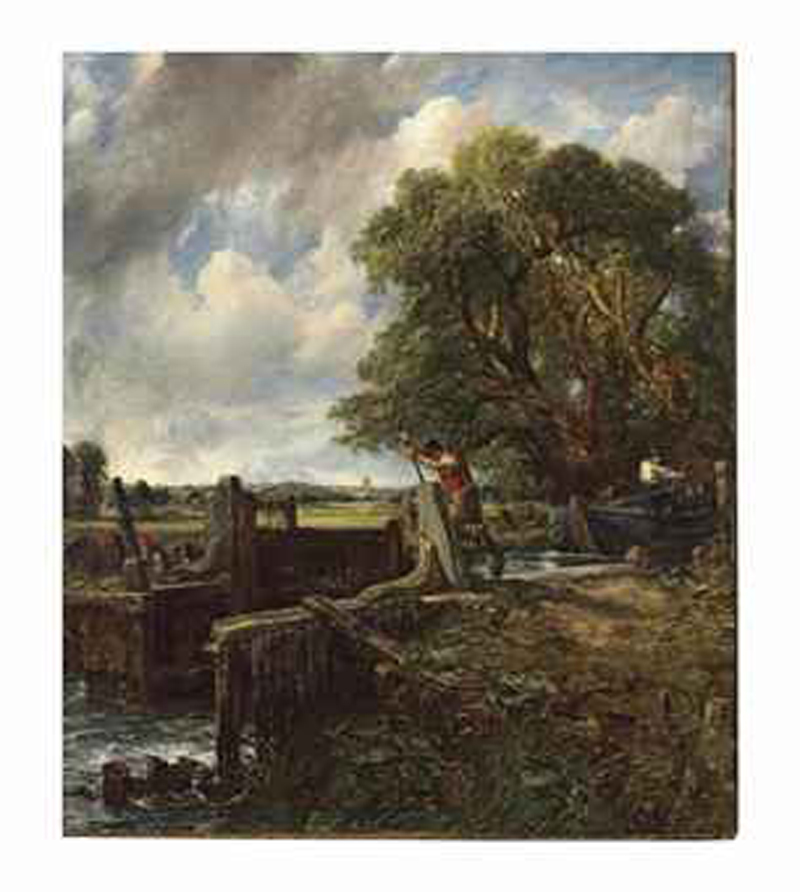
    Today John Constable’s The Lock, painted in 1824, sold at Christie’s for £22.4 million. In the current art market of silly prices some lucky person got the bargain of their lives. Let us hope the picture will be placed in a museum, where people might enjoy it, instead of disappearing into a Swiss warehouse as the investment bauble of some gold-tap billionaire vulgarian. It is the same price as that commanded by ordinary works by the top price sellers in British painting, Turner and Bacon, both of whom have sold work for significantly higher amounts than this. It is the same price a collector might pay for an off-the-peg Monet one wouldn’t inflict even on an enemy. The Lock, being one of the six major works deliberately painted by the artist between 1819 and 1825 for the Royal Academy exhibition in order to cement his reputation, presented the last opportunity for a collector to own one of the major works by the artist of the quintessential English landscape. All the other major pictures are already off the market in museums.

    Why so low a price? Of the top 50 most expensive paintings ever sold either privately or at auction only five are Old Masters, and of the remaining 45 ten are by Picasso, seven by Van Gogh and four by Warhol. The new billionaires, who are not old fashioned men of discernment and discrimination but those who buy conspicuously in order to impress friends, are uninterested in works not instantly recognisable for their “wall power”. Even the most knuckle-dragging mate of a Russian oligarch can recognize Warhol or Picasso but they wouldn’t know a Constable from a concertina and couldn’t recognise anything before 1850, all brown paintings looking alike to them.

    Who bought it? Assuming that The Lock is too sophisticated a picture for nouveau squillionaires, the only two museums in the market at this kind of price are the Getty in California, which two years ago paid £29 million for a Turner view of Rome, and the museum being built from scratch by the Qatari royal family, who are hotly rumoured to have bought the record-breaking The Scream by Munch a couple of months ago. No British gallery could afford a square centimetre of such a work, not that our museums actually need any more examples from Constable’s brush. For example, on the day of The Lock’s sale the Tate, which owns 261 works by the Suffolk miller’s boy, had 13 works on display. It always likes to keep plenty in reserve. There were more works by Constable on show at the Victoria and Albert Museum than at the Tate – the V&A owns 802 items relating to the artist including the full-size oil sketch for the Hay Wain. The National Gallery has nine works by Constable, all of them on display every day of the week free of charge.

    “Painting,” wrote Constable, “is but another word for feeling.”

    David Lee

    The Jackdaw, 3 July 2012

    http://www.bbc.co.uk/news/entertainment-arts-18702667