An article about Graham Sutherland’s bequest of art to Wales (The Jackdaw, no. 90) raised a number of points which further research has – partially – answered. To recap: Sutherland donated work to a purpose-formed Graham Sutherland Trust (the “Trustâ€) in 1976, which displayed the art in a gallery housed in Picton Castle, Pembrokeshire. When the cost of maintaining the gallery became unsupportable the Bequest was transferred to the National Museum of Wales (“NMWâ€).
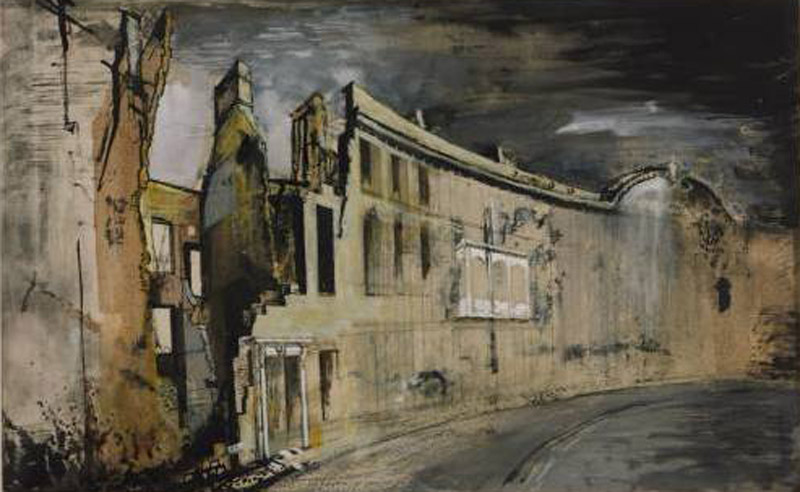
Recently, I was able to view some of the works on paper and key documentation relating to the Trust at NMW in Cardiff. Items in the original Marlborough Gallery frames are kept in those frames; loose material is now stored in archive boxes. One box contained landscape sketches on perforated sheets from sketchbooks. These pages were mostly early (1930s), largely drawn in black ink with a fine nib and given washes of ink, watercolour or dilute oil (or a combination of those). Some of them were squared for transfer. Another box held sketches from Sutherland’s time as a war artist and showed the ruined Masonic Hall in Swansea and buildings in and around Cardiff. Some were versions of the same composition. Many were coloured pungent acid and moss greens, purple and pink. These sheets, a mere handful, demonstrate the excellent quality of some of NMW’s Sutherland collection. Unfortunately, it is not easy to ascertain which articles came via the Bequest, the Ministry of War or NMW acquisition, something that ongoing research by Rachel Flynn will establish.
Viewing the contents of the archive (including Sutherland’s will and the 1989 agreement between the Trustees and NMW) demonstrates how convoluted the tale of the Sutherland Bequest is. We can now flesh out a basic timeline. Sutherland deeded the original Bequest (valued at £500,000) to the Trust on February 12th, 1976. The Trust comprised a number of distinguished figures, including Lord Goodman and Ronald Alley; others were representatives of local municipalities. The driving force behind the running of the Trust was Gordon Bennett MBE, a retired civil engineer and friend of the artist. The lease of part of Picton Castle began on June 9th, 1976. It opened to the public on June 18th, 1976. By 1978, repair, alteration and maintenance of the property had cost £80-90,000.
What is obvious from studying the archive is that at the conception of the Bequest, NMW was seen as playing an active part in the custodianship and promotion of the gallery and NMW was a signatory in various agreements during the 1970s. From the beginning the project was hamstrung by critical divisions between the Trust, NMW, local council authorities and the owners of Picton Castle (the  “Landlordsâ€). Additionally, ticket revenues for castle and gallery (both charged entry fees) were never combined and opening hours not coordinated, confusing visitors and sparking protracted negotiation between Trustees and Landlords. Sutherland died in February 1980, leaving everything to his wife. The Trust is not mentioned in his will. During September 1980 the Trust severed links with NMW.
The chronic financial problems of the Trust deepened over the 1980s, relying as it did on a combination of donations, entry revenue and merchandise profits. The relatively remote location severely limited the contribution of the latter two components. Urgent deliberation began to find a solution. Two clear-cut options were complete dispersal of the Bequest by auction and assigning the Bequest to NMW. Trustees could delay no further: the Charity Commission stated in no uncertain terms that the Trust, a charitable body, could not be allowed to function insolvent. By 1989, save for certain sums inextricably committed to particular minor projects, the Trust was effectively bankrupt. Minutes record that at a board meeting on June 11th, 1989 Trustees authorised unconditional transfer of all art and some other properties to NMW.
NMW signed a five-year extension to the lease of the Picton Castle gallery in 1989. The intention was to streamline the gallery, reduce property rented (some of which had become dangerously dilapidated) and manage from Cardiff while maintaining the Bequest and gallery in the original forms. This proved unworkable and the gallery closed in October 1995. Abolition of entry fees to museums has since limited NMW’s room for manoeuvre regarding a dedicated gallery in Pembrokeshire for the Bequest. Current developments (cataloguing by NMW and Ms Flynn and a planned public database of all works in the collection) combined with the current regime of exhibiting canvases on a near permanent basis at Oriel y Parc, St. David’s alongside a rotating selection of works on paper, seem a viable, though imperfect, response to the troubled legacy of the Sutherland Bequest.
The author wishes to thank Oliver Fairclough, Keeper of Art, NMW, for his assistance in the preparation of this article.
Alexander Adams is an artist and writer based in Berlin.
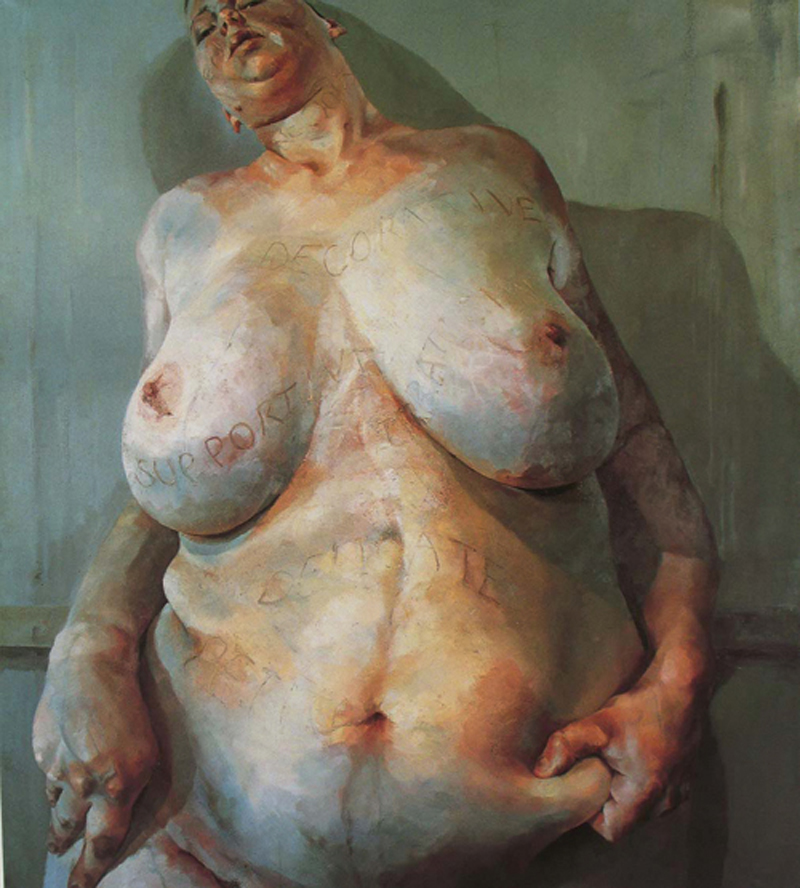
Branded, one of Saville’s earliest pictures, painted in 1992, fetched £1,497,250, double its low estimate, when sold at Christie’s
Most YBAs achieved prominence by recasting genuine avant-garde art in a palatable commercial form, influenced by advertising and pop culture, and served up to a credulous public largely ignorant of the original sources of the art. (Something Julian Stallabrass discusses in his book High Art Lite.) Jenny Saville was seen as one exception by virtue of the facts she studied in Glasgow, not Goldsmith’s College, and painted figures representationally in a non-ironic manner. Yet on closer study, Saville is not dissimilar to her YBA peers. Since paintings were acquired from her college studio,  Saville’s paintings have changed from billboard Lucian Freuds to hybrids of Freud, Bacon and de Kooning. Her painting rests upon adapting recent art and presenting it in a more extreme form (larger than that by the original artists), shorn of the original art’s foundations and complex origins, just as the art of other YBAs does.
The paintings have been described as “monumental†by writers who cannot differentiate between monumental and big. Likewise, painting something from a very close viewpoint (a Saville tic) does not convey monumentality or help us comprehend the mass of a figure.  Monumentality has nothing to do with size; it has do with the impression of size, which can be conveyed through adjusting the size of a motif relative to the picture surface, elimination of detail, lowering the observer’s viewpoint of the motif, reduction of colour, simplification of form and emphasis on the mass of a motif. Picasso could achieve this concisely in modestly sized paintings and drawings  (those of the Boisgeloup period, the Dinard bathers and the Gosol figures), as can any artist who applies the principles. Painting fat figures on large surfaces tells us nothing about fatness but it reveals the painter’s insecurity, her need to bolster insubstantial depictions of bodies by expanding them to cinema-screen scale.
Looking at Saville’s paintings is like opening the sketchbook of a teenage art student. There is the preoccupation with “body issuesâ€, a reliance on photographs, the modish twist of gender-change surgery and emulation of the most obvious recent painters of the nude. Saville fails to realise that some great painters are bad influences and looking at artists you paint like (or aspire to paint like) can be damaging practice. (The recent drawn pastiches of Leonardo da Vinci show that Saville emulates rather than assimilates.) Saville’s imagery often relates to surgery, including blood and wounds. (Bacon spoke about the beauty of wounds thus Saville paints from surgical photographs.) Louise Bourgeois can make shocking and gripping images of bodies in small rough sculptures lacking virtuosity. Bourgeois’s metaphors can slip under the skin while Saville hammers away with ponderous literalness, emphatically insisting on the seriousness of her subject. There is neither setting nor context for figures because Saville likes painting flesh, so that is what she paints and it is all she paints.Yet flesh – like all substances – exists in context.
Freud may have trouble with composition and proportion but he understands, and can paint, flesh. Saville cannot. Regardless of the ostensible subject, the appearance of flesh is dictated by the period of her style not any close observation and differentiation of subject. Her early paintings employ cloudy masses of conventional “flesh†tones.  Tangles of brushmarks, arranged to give an impression of impetuosity,  make up her later paintings. The seeming absence of pentimenti in the later paintings is because Saville’s formula is designed to give the impression of exploration and boldness. There is no need for revision because the subject is not a figure; the subject is Jenny Saville’s brushmarks. Saville is the Singer Sargent of the self-harming generation.
Why do all her figures tend towards sameness? Where is the concentration on describing the essence of an individual or situation? Â Where is modest and patient observation? For sure, these qualities are sometimes missing from great figure paintings but those are paintings by artists of a magnitude of achievement and accomplishment many times that of Saville, artists with substantial range. Rembrandt could paint with consummate accomplishment but that never overwhelmed his humanity, empathy and breadth of understanding.
For example, consider Saville’s Passage (2004) a painting of a preoperative transsexual and Christian Schad’s Agosta, the Pigeon-Chested Man, and Rasha, the Black Dove (1929).While both paintings are nominally about human objects of curiosity, Saville’s painting is prurient and self-indulgent, filling in a canvas over 3 metres high, whereas Schad’s is a restrained, clear-eyed yet sympathetic, touching depiction of outcasts, on a canvas slightly higher than 1 metre. Schad has painted diligently and self-effacingly, the very model of a painter of humanity and has made a testament to the dignity of his subjects.
Flesh is such a various and vivid landscape that it is incomprehensible that a painter supposedly dedicated to depicting it could reduce this rich spectrum to the bloody slatherings Saville serves us with. Saville has remained a painter with an adolescent’s taste for sensation and self-absorption, her progress stymied by being taken seriously when she was an undergraduate. Collectors, dealers and critics are partly culpable for Saville’s failures. For those who appreciate and revere great painters of the flesh, Saville’s bombastic and egotistical pictures, her simulacra of adventurous figuration, will not bear prolonged scrutiny.
Alexander Adams is an artist and writer based in Berlin.
If you have heard of Belgian painter Paul Delvaux (1897-1994) then it is likely to have been in connection with Surrealism. He gets a couple of illustrations in thematic surveys of Surrealism, rarely more. Unless you locate a specialist publication on the artist, it is hard to get an overview of his development. Delvaux is poorly represented in British public collections.
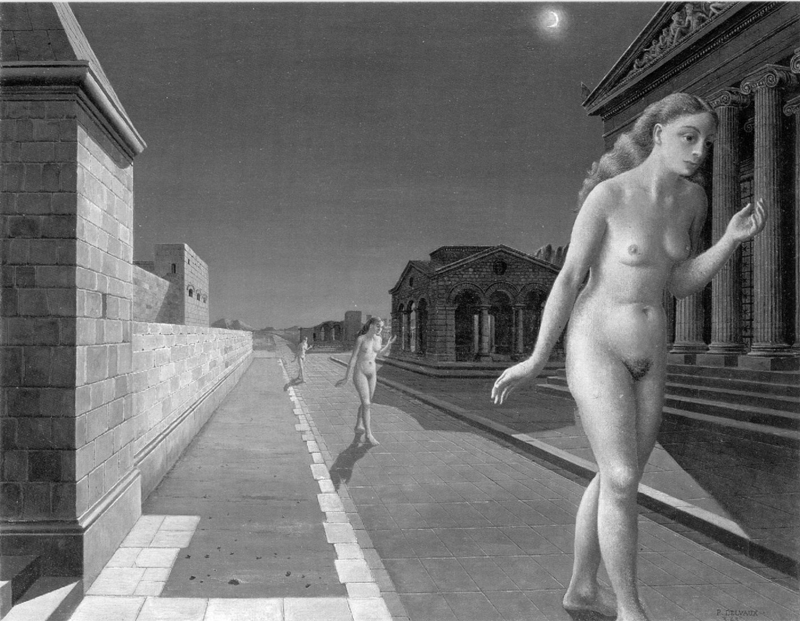
What is the typical Delvaux? Although there are distinct phases, we can make some generalisations: the subjects are females, often nude, with dreamlike repose in the surrounding of fantastic architecture, generally a blend of classical, neo-classical and 19th century Belgian. Frequently used settings included train stations, town squares, beaches and temples, often nocturnal and deserted and almost exclusively urban rather than pastoral. The technique is direct, the lighting pellucid, the brushwork unobtrusive.
A typical work is Echo (1943) (currently in a Japanese museum): between ancient buildings at night time a woman walks along a road towards the picture plane; behind her are her echoes – two identical versions of her in the same pose. The ground is arid, indicating we are in Near East or Mediterranean lands. Nothing will ever change, no rain fall, no building deteriorate any further. The world we see is in a state of perfect stasis. Of all paintings (Surrealist or otherwise) these come closest to capturing dreamlike states. There is very little here that is literally impossible – no burning giraffes or floating rocks. The poetry resides in the mood evoked by arranging legible motifs.
Delvaux’s personal collection (as one might have guessed, the largest collection of Delvaux paintings in the world) is housed in a museum in St.-Idesbald, on the coast. To get to Museum Delvaux one takes the tram from Ostend south-west to Koksijde-St.-Idesbald (direction De Panne, zone 7, €2 per journey). During summer the one-hour journey with the dunes on one side and the sea on the other must be picturesque but out of season it is rather bleak. The museum is a low brick building in a residential lane less than ten minutes’ walk from the seafront. It was established in 1982, two years before Delvaux (who lived in Brussels most of his life and spent long periods on the coast) moved permanently to the area. The opening rooms cover the early years of tenebrism and Impressionism. A room is dedicated to views in watercolour of St. -Idesbald and its environs. There is a wall of various small drawn studies and sketches, none labelled, a collection of fragments more or less.
A masterpiece from a private collection, In Praise of Melancholy (1948), shows the painter at the height of his powers. This is one of a series of great reclining nudes that are marked by serene grandeur. Delvaux never painted figures larger or with more detail. The drapery is intensely coloured and the contrast crisp. Delvaux is an artist who used the nude but – great or not – he could not be called a great painter of the nude in the way Balthus might be described. Balthus is curious about the body – both its reality and its plastic potential when manipulated – whereas Delvaux wants to capture the essence that attracts him. Delvaux paints nudes but never nudity, figures but never flesh. Delvaux does enough to evoke the presence of a figure without going so far as to become naturalistic, something true for every element depicted. It is very rare for any sexual feeling to makes its presence felt and this only happens in a few drawings, never in the oil paintings.
The more one sees the more one understands that Delvaux was deeply involved with pre-Modern art, more so than any other Surrealist. He used the vocabulary, and to a lesser degree the technique, of Classical art with a Modern syntax. He employed motifs lifted from found sources and collaged them into settings where the motifs never quite settle. The first (and so far only) serious study of Delvaux’s art written in English is David Scott’s Surrealizing the Nude (1992). Scott’s thesis is that the artist set out to “problematise†academic Classicism. This confuses means for motive. Delvaux did not intend to agitate; in order to achieve the pictorial effects he wanted he had to distort norms of academic practice and naturalism. Although incongruities and irregularities are woven into the fabric of the pictures they are not the subject. Indeed, although these unorthodox combinations are not elided they are not expected to be noticed other than subliminally.
In 1941 Delvaux revived a conceit from ten years earlier and had skeletons acting as protagonists, inhabiting real domestic interiors – something his female nudes never do. He also tackled episodes of the Passion with skeletons: The Crucifixion, Deposition, Entombment and Lamentation  (though notably not the redeeming, mystical parts: the Resurrection and Ascension). These are very peculiar works – intense, bleak, detached yet not ironic and not notably pious – which paraphrase Netherlandish altarpieces. By prematurely curtailing the development of a scene at this stage – or by stripping flesh from Rogier van der Weyden’s Deposition (c. 1435) – the artist leaves the armature of religious iconography nakedly incomplete, thereby short circuiting viewer-subject empathy.
There are paintings including skeletons and female nudes. Delvaux’s encounter with the Spitzner Museum in 1932, a travelling show which juxtaposed lifelike Venuses in somnolent states with anatomical casts, postmortem photographs and skeletons, made a deep impression and led to immediate attempts to capture that frisson in two unsuccessful paintings.
Perhaps the most psychologically charged painting (and, to my mind, his most remarkable picture) is not here. La Visite (1939), the title of which can be translated as The Visit or more properly as The Visitation, the latter with religious overtones, is in a private collection. In a room a naked (rather than nude) woman holds her breasts as a naked young boy enters. He gazes at her breasts and she gazes at his pre-pubertal genitals. Overhead tiny angels trumpet the occurrence. It bears comparison with Balthus’s Guitar Lesson (1934) as a study of psychic tension and sexual discovery. It must have taken a degree of courage for Delvaux to paint such a picture. It is a tremendous, fraught, haunting image, all the more so for being unforced.
A painting such as Horizons (1962) shows what a playful painter Delvaux could be, beyond being a consummate image maker. It is one of a group of strongly horizontally orientated paintings of railways. Cadmium yellow powerfully illuminates the horizon and only slowly does one notice myriad sources of light: streetlamps, lanterns, house lights, train lights, signals, a paraffin lamp, the moon. Â Seats from old-fashioned train carriages have been situated in the galleries. (Tellingly most of the few British visitors to Museum Delvaux are train enthusiasts rather than art enthusiasts.)
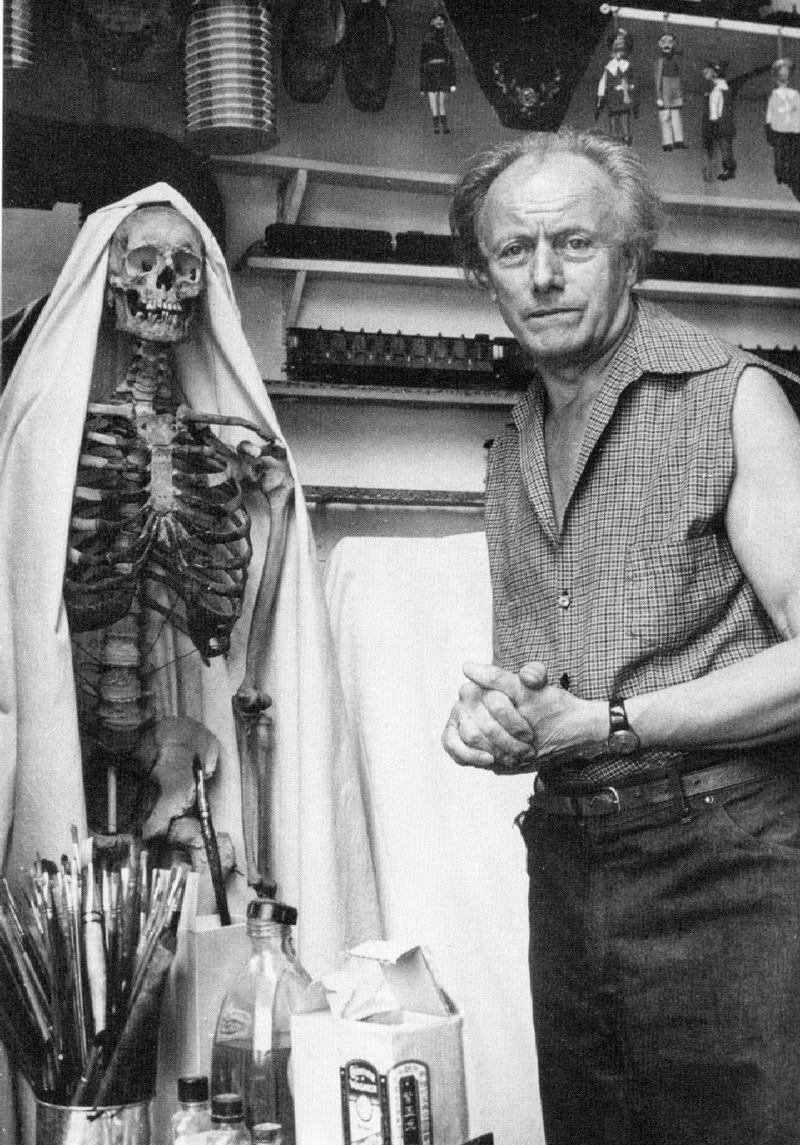
In a number of lit niches are puppets and model trains that Delvaux made while young, as well as spiral-bound sketchpads in which compositions are roughed out in ballpoint. Â On large sheets he used the laborious technique of cross-hatching in ink then applying washes of ink or watercolour.
The painter’s eyesight deteriorated badly in his late eighties and eventually was extinguished totally. He painted his last oil in 1986 but continued making drawings until 1989, aged 92. Some of the framing of works on paper is unsympathetic and the lighting would benefit from an upgrade. Although the paintings suffer a little visually from a lack of natural light, the windowless isolation proves immersive. These aspects do not seriously detract from the charm of the museum. The great range and depth of the collection is remarkable. There are genuine masterpieces from all periods in spacious galleries with plenty of supporting material including models, source books, painting paraphernalia and personal documents. There is a recreation of Delvaux’s studio as it was at Avenue des Campanules, Boitsfort, Brussels.
Various figures marginal to Surrealism  (Leonor Fini, Claude Cahun and Hans Bellmer, with Louise Bourgeois reclaimed as a Surrealist) have enjoyed renewed attention of late. Delvaux is no less complex than Fini and Bellmer. Delvaux’s art, rich and sophisticated, can be best appreciated detached from Surrealism. Delvaux’s blend of Classicism, Symbolism and Surrealism will never be as popular as the art of Dalà or as accessible as Magritte’s. It deserves to be taken more seriously than it has been. If we assess the status of artist in relation to his ability to compel and fascinate then Delvaux truly is a great artist.
Museum Paul Delvaux, Avenue Paul Delvaux Laan 42, 8670 St.-Idesbald- Koksijde, Belgium, entrance €8. Check for opening hours. www.delvauxmuseum.com, e-mail: info@delvauxmuseum.com
Alexander Adams is an artist and writer based in Berlin.
The house-museums of two Belgian masters of the 19th Century shed light on artistic and social concerns of the era. As case studies they exemplify dominant thematic trends in both halves of that century – Romanticism in the first half and Realism in the second.
Antoine Wiertz (1806-1865) was born to an impoverished family in Dinant, Wallonia (later Belgium). After studying at Antwerp Art Academy, he won the (Belgian) Prix de Rome at a second try, in 1832. His grand manner was Romantic and painterly, derived from Rubens. His subjects anticipate those of the Symbolists. Though Wiertz made his name with historical and religious compositions, the allegories and (often gruesome) scenes of contemporary life are his most distinctive contributions to art.
In 1850, partly in order to establish Belgian art as independent of French influence (led by the School of David; J-L David (1714-1825) spent his last years in Brussels) the newly formed state agreed to build a studio and dwelling for the benefit of Wiertz, the first truly “Belgian†artist. The initial agreement was that the artist would donate works to the state but it seems Wiertz early on had the idea of turning the studio into a permanent museum. The government drew the line at Wiertz’s proposal to fund the construction of a ruined temple in the studio grounds. Upon the artist’s death the combined house and studio became possessions of the state. Both building and grounds have remained unchanged since 1868, now a fragment of a lost age lodged under the glass towers of the European Parliament.
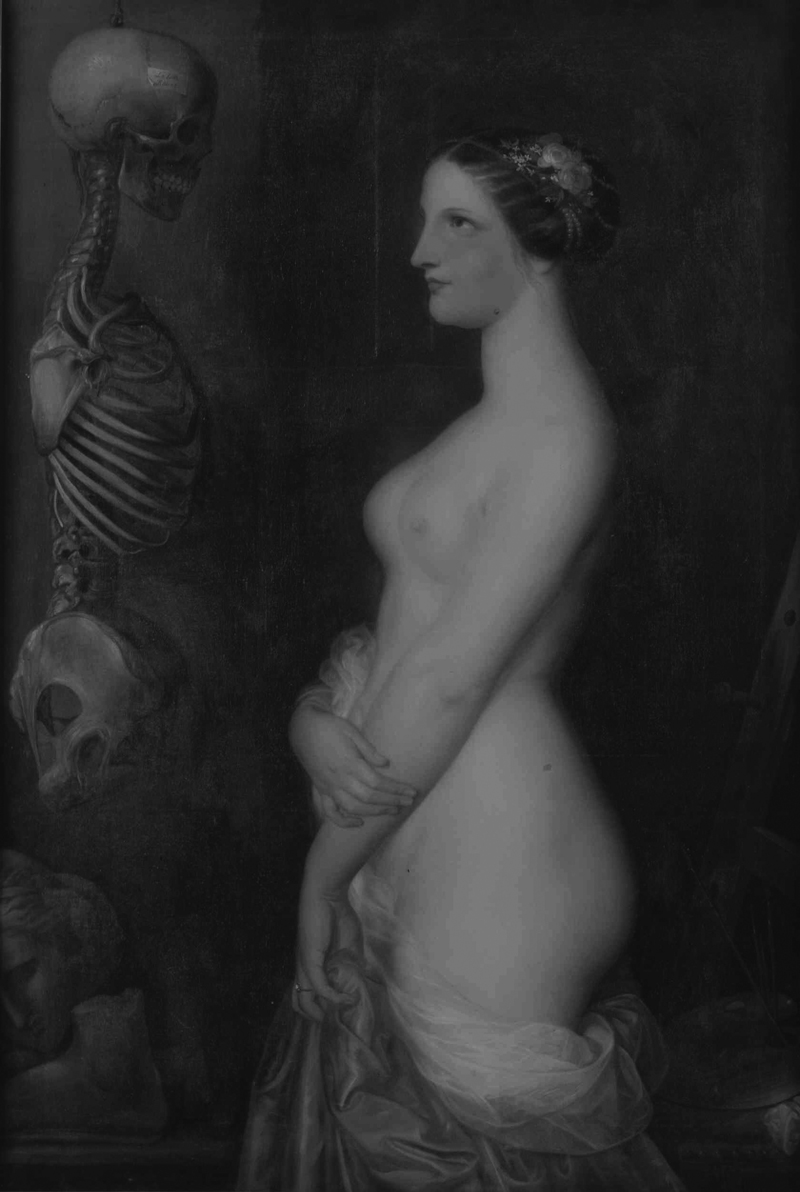
The only good word anyone seems to have is for La Belle Rosine (1847), Wiertz’s most famous invention. This painting, influential and much reproduced, is excepted as “a good chord on a bad pianoâ€. It shows a nude woman contemplating a skeleton. The alternative title is Two Young Women. Now very fragile, the painting is unlikely to leave Brussels again. Death and the Maiden is an oft-reprised subject but there can’t have been a more compelling version than this. The woman, garland in her hair, gazes with hypnotic calmness into the vacant eye sockets of the anatomist’s specimen. Below the suspended partial skeleton (missing its leg bones) are fragments of an ancient statue. A label on the skull carries the inscription “La Belle Rosineâ€. One might interpret this two ways. The painter is using a graphic intervention to insert the title of the picture or – more likely – the label identifies the skeleton as that of Rosine. (The issue of titling is a curious one. Wiertz did give certain pictures exact titles. It seems fixed, artist-given titles only began in earnest with the advent of the Paris salons in the early 18th Century. Before then works were discussed by topic. Vasari refers to “a Madonna by the hand of…â€; “a Dead Christ in the lap of Our Lady, surrounded by many figuresâ€; “a panel made for the Duke of Urbinoâ€; and so forth. The idea that paintings should have a definite title is essentially a modern construction, in that it derives from the practice of organised temporary public exhibitions. Some scenes of a narrative or anecdotal character can depend to a degree on a title. Think of When did you last see your Father? by WF Yeames in the Walker Art Gallery.)
Little work is at the level of La Belle Rosine, though there are other paintings worth attention. La Liseuse de Romans (The Novel Reader) (1853) has a recumbent female nude reading on a bed, unaware of the figure reaching towards a book beside her. The Devil’s Mirror (1856) adapts Goya’s Maja paintings, with one canvas showing a clothed woman at a mirror and the pendant with the woman unclothed, the Devil hidden behind her mirror. A modest trompe l’oeil still-life painted when Wiertz was a student is skilfully designed and realised. There is a sensitive painting of the artist’s dog asleep on a chair.
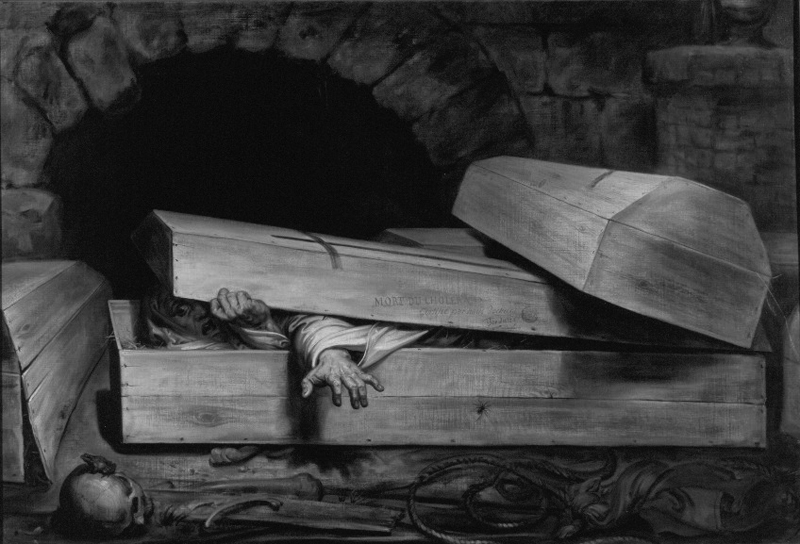
Wiertz was a committed humanitarian and campaigner for social reform. The Burnt Child was originally entitled If there were Crêches and was inspired by a newspaper report of an unmarried mother who left her child by a fire to keep warm while she worked. When she returned she discovered the child burned. The Premature Burial (1854) shows a terrified man forcing open his own coffin marked “MORT DU CHOLERAâ€. It is both a sensational scene of horror and social criticism of the not-infrequent phenomenon of premature interment of cholera victims. Doctors could be lax about distinguishing between death and coma. Some victims were regarded as hopeless cases and deliberately consigned to the tomb while still alive.
The evidence of carved versions of Wiertz’s models suggests he was an able sculptor. His Triumph of Light (1860-2) is said to have inspired Bartholdi’s Statue of Liberty (1876/1886), though the resemblance seems coincidental.
To describe Wiertz as inconsistent is an understatement. His triptych of Christ in the Tomb (1839), with wing panels of female nudes, is badly misjudged. The Suicide (1854) shows a man shooting himself in the head with a pistol. A praying attendant angel has closed her eyes, as well she might. There are many other pictures that prompt a viewer to wonder “What could he have been thinking?†There can hardly have been another artist who has failed and succeeded to such extreme degrees.
The depiction of a guillotining may have been well meant (the artist apparently attended a public execution and was appalled) but the result is incoherent and ineffective. Additionally, it is painted in Wiertz’s essence technique and has deteriorated appreciably. Noting the troublesome reflection from conventional varnished oil paintings, Wiertz devised a technique to combat sheen. He used essence, which is oil paint with the binder largely extracted (usually done by allowing the oil medium to soak into an absorbent substance, such as blotting paper), mixing it with turpentine or a mineral thinner and applying it directly to unprimed flax. This technique effectively removed gloss but over the years it has proved prone to fading. Worse still, the low proportion of binder to pigment has left the paint powdery. These fragile paintings are not possible to frame or clean, prohibitively expensive to restore and now impossible to move.
Alongside criticisms of morbidity, hubris and sensationalism (all reasonable reproaches) is another charge, that of titillation. (A current guidebook mentions “saucy girls in a state of undressâ€.) This is more debatable. If one looks at the figures in question, there is less nudity than one finds in Rubens, the female anatomies are not entirely convincing and there is nothing overtly sexual in the poses, even for the period. It comes as no surprise to discover Wiertz was homosexual (or at least bisexual); an idea first publicly aired by the critic Camille Lemonnier, who lived very close to the artist.
Drawings and small painted sketches are strongly reminiscent of Blake’s in their muscular Mannerism, though Wiertz understood anatomy better. The two artists share many characteristics (ambition, stubbornness, independence, keen social conscience and admiration for Michelangelo), though at his best Wiertz is more than Blake’s equal in inventiveness, power and skill. On consideration, the received views of “Blake the Visionary†and “Wiertz the Deluded†turn out to be not only disputable but reversible. Didn’t Wiertz put his sense of justice into his art rather than into theological disquisitions at 12 shillings apiece?
Wiertz’s aspirations may have been grandiose but his own circumstances were straitened. He painted allegories for political and artistic reasons and kept them in his studio for the nation. To eke out a living he painted portraits. The decorative edges of some canvases came about because he could not afford frames. Upon his death his possessions were found to be few, his furniture to be borrowed and his clothes to be much mended.
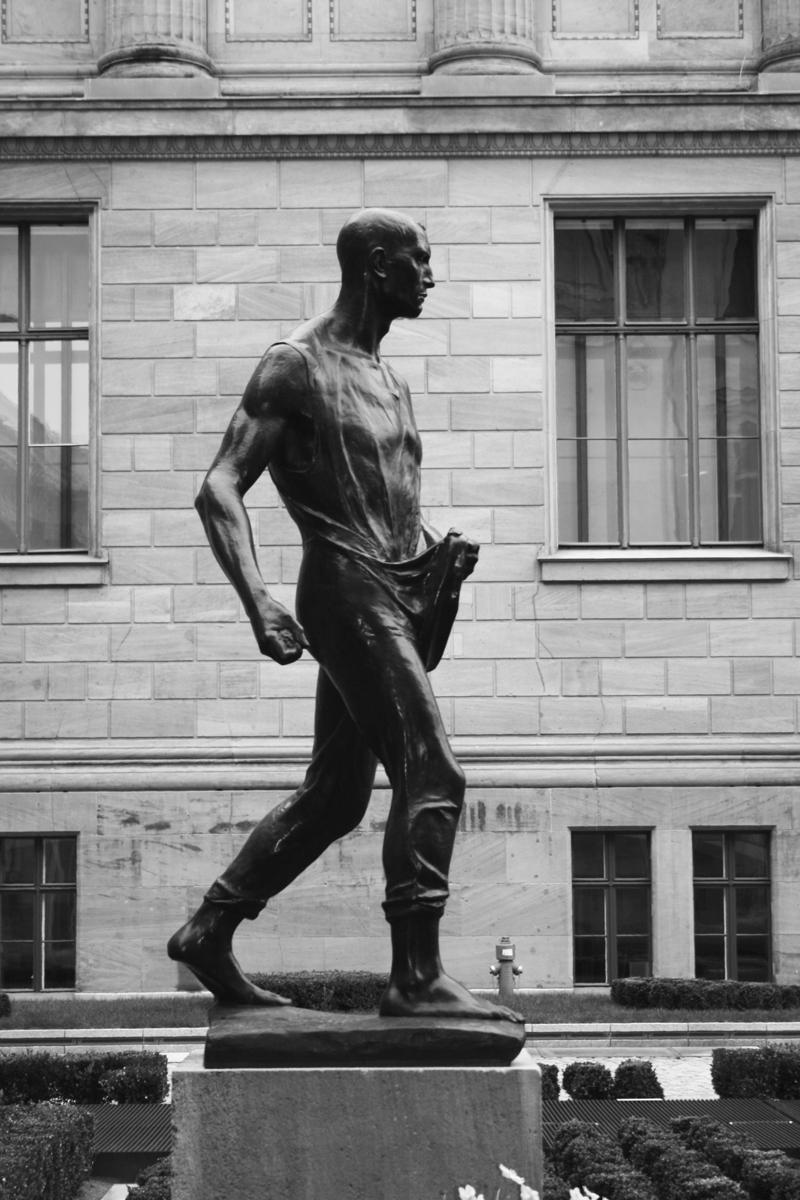
Meunier Reaccessioned. A statue formerly in the collection of the Berlin Museums has been reacquired. The Sower (1896), (above) by Constantin Meunier was appropriated from a private collection by the GDR. The work, one among a number of bronzes by Rodin, Degas and Maillol, was returned to the ownership of the family of the original owner. At an auction of the works this year The Sower was purchased on behalf of the Alte Nationalgalerie. It is now sited in the colonnaded courtyard between the Alte Nationalgalerie and the newly opened Neues Museum
Meunier is an artist of a different stamp. The only things Meunier and Wiertz shared were a nationality, profession and an interest in social reform. Constantin Meunier (1831-1905) took the plight of workers in Belgium’s farms and heavy industries as his principal subject relatively late in his career (around 1875). (The few early History and travel scenes on display in the museum are undistinguished.)  His principal medium was sculpture, though he was a skilled draughtsman and a competent painter. His slightly over-life-size bronze figures have the heroism of Rodin tempered by the Realism of Courbet’s Stone Breakers  (1849-1850; exhibited at the Brussels Salon of 1851). The coalminers and iron workers of the Borinage are ennobled through working for the common good. The sculptor then further dignifies them by raising them to art. By so doing the artist himself works for the benefit of his subjects and for society more generally.
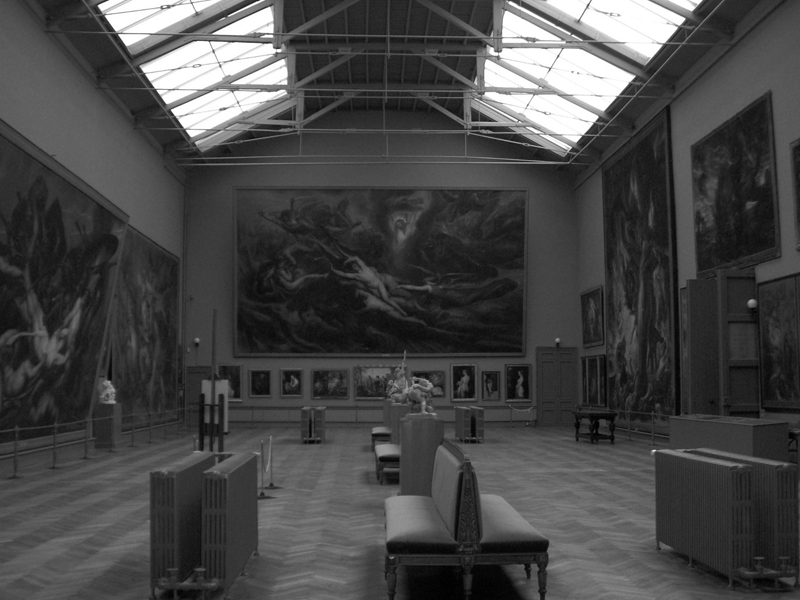
The house and studio were purpose built for the sculptor over 1899-1900. The main salon is connected via a long corridor to the sculpture studio built in the grounds of the house. The studio accommodates a number of statues and maquettes, with a few larger paintings. Only a fraction of the collection is on show. The property and collection were acquired by the state from Meunier’s heirs in 1936.
The sculptures are all well conceived and executed with a blend of verisimilitude and idealism that became adopted as the template for Socialist Realist public monuments throughout the following century. Few of those sculptors had the talent or sensitivity necessary to attain Meunier’s consistently high standards. Full-bas reliefs, executed in bronze and smaller than life size, convey the volume and presence of figures and the interaction of them with their environment. In the mine one feels the claustrophobic closeness of the rough walls; in the field one sees the toilers against the swaying striations of tall wheat stalks. His pictures are effective but the unremitting earth hues – though honest – are obvious and deadening. (Van Gogh was an admirer of his, making 13 references to Meunier’s art in his letters.) A large triptych on the subject of coal mining has little of the energy and economy of the drawings.
Let us hope these old-fashioned museums remain unchanged while becoming better known. Both are windows on a past well worth looking through.
The author would like to thank Dr Brita Velghe for her assistance in researching this article.
Alexander Adams is an artist and writer based in Berlin.
 An article about Graham Sutherland’s bequest of art to Wales (The Jackdaw, no. 90) raised a number of points which further research has – partially – answered. To recap: Sutherland donated work to a purpose-formed Graham Sutherland Trust (the “Trustâ€) in 1976, which displayed the art in a gallery housed in Picton Castle, Pembrokeshire. When the cost of maintaining the gallery became unsupportable the Bequest was transferred to the National Museum of Wales (“NMWâ€).