Tag: artbollocks

  • Brian Sewell (1931-2015)

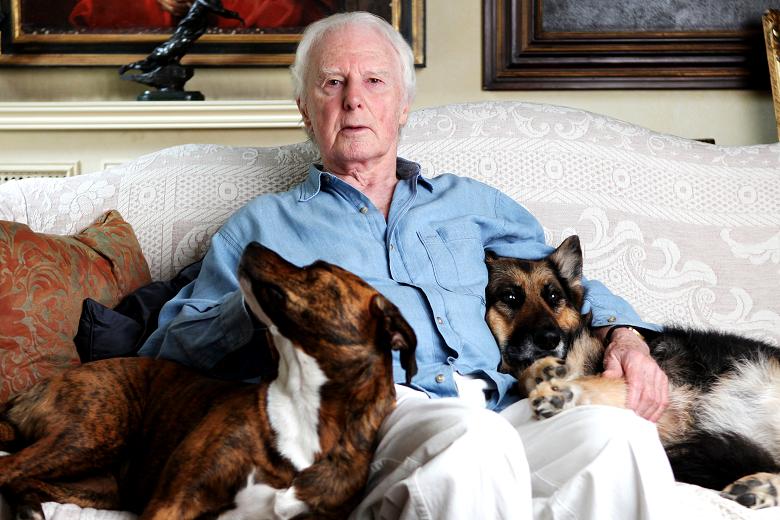
    beautifulbrianwithdogsIt isn’t my intention to repeat the tediously familiar stories peddled by obituarists relating controversies which Brian’s inclination to mischief and provocation helped encourage. Instead I want to address two issues unconsidered elsewhere: his astonishing generosity and the disgraceful but typical hypocrisy of the BBC towards him. Brian was a working man. He called himself ‘working class’, a description some dismissed as affectation. It wasn’t. Like his commuter readers he needed to work in order to survive. Neither was he rich. Nevertheless, he still donated liberally to promising but needy art history students and charities, in particular those dealing with homelessness and the welfare of animals, and he encouraged friends to do the same. Equally, buying work from promising youngsters in order to get them started was to him a duty. He was also selflessly free with his time, knowledge and contacts. When he was your friend you felt it.

    In early 2000 I quit editing Art Review, for which Brian had contributed many superb pieces on 20th century art’s main figures and which always arrived in uncorrected typescript as though having emerged perfectly like a Mozart manuscript. He telephoned and asked me what I would do now. I told him that I was devising the inaugural issue of The Jackdaw, which would continue the opposition to State Art’s absurd and damaging monopoly I’d begun only tentatively (for commercial reasons) at Art Review. He mused a second and said that to give such a venture any chance of long-term survival it would be very expensive. I disagreed, arguing that I could keep costs down by not employing anyone, including myself, or renting an office and having poncy stationery. I’d tried to raise investment for the idea but no one took the bait. The next morning I received in the post from Brian a cheque for £10,000. This staggering act of generosity and confidence was undeserved and his insistence I accept it terrified me. I told him I’d pay it back as soon as I could. Circumstances – including my unique hopelessness as a capitalist – meant that it took me thirteen years to honour my words – thirteen! – and only then as a result of an unexpected legacy. It was a relief to be able to redeem the debt not least because, in consequence of a change in the Standard’s ownership leading to revised employment conditions for the staff, Brian was having to do the same work for a fraction of what he’d formerly been paid. He needed the money. But never once in all those years did he raise the subject of my debt let alone ask for it to be repaid. And, of course, he refused any interest on the grounds that, as he wrote to me, ‘my failings are many but they do not include usury’.

    Without Brian The Jackdaw would not have survived beyond a handful of issues. I don’t think many who follow the terrain would disagree with the assessment that, of all his contemporaries in art criticism, in art historical terms he was easily the most knowledgeable. Given his ability to speak clearly and articulately – without artbollocks (which he always pedantically insisted to me should be properly spelt artballocks) – and because of his reputation as an elegant and amusing essayist – don’t forget he won both the Orwell and Hawthornden Prizes – he was hurt by the fact that Radio 4 never once asked him to appear in a review role on either of its main art programmes, Front Row or its predecessor Kaleidoscope. The list of waffling no-hopers in art criticism those programmes have employed would fill pages, but they never asked him. He would never have admitted it publicly but this omission hurt. What a surprise then that not six hours after his last difficult breath, his death made the main BBC news where he was lauded as an influential leading critic, blah blah. If they thought this was true why did they so rarely use him? The answer is simple. The BBC’s programmes, which in the visual arts are uncritical advertisements for their subjects, are willing promoters of the disgraceful sewer that is State Art, about which Brian held damning views. Over the years he suggested many programmes, all rejected. It speaks volumes that the BBC asked Grayson Perry to give the Reith Lectures, but not Brian. Of all the many independent voices we never hear, his cruel neglect in particular demonstrates that in visual art you will be marginalised unless you toe the establishment line.

    David Lee

    The Jackdaw November/December 2015
     

  • Beyond criticism

    Beyond criticism

    Laura Gascoigne demonstrates how Artbollocks is now recognised as a joke among almost everyone excepting the time-serving devotees of State Art.

    In January the Guardian’s G2 section published an article by Andy Beckett titled ‘Er, anyone know what transversal means’? It reported on the publication in an American art journal last year of an essay identifying a unique form of English peculiar to the gallery press release. The authors David Levine, an artist, and Alix Rule, a critic and sociology PhD student, had spent two years collating examples in the attempt to codify the language’s distinguishing features. “We’d find some super-outrageous sentence and crack up about it,” said Levine. “Then we’d try to understand the reality conveyed by that sentence.”

    Well whaddya know? The press has finally woken up to Artbollocks, three years after The Jackdaw lost the will to anatomise it. And we thought newspapers were in the business of breaking news. But Levine and Rule had a more newsworthy name for it – International Art English – and a more modern methodology. Their use of language-analysing software gave them a technological edge on The Jackdaw’s researchers, who regard the filing cabinet as an innovation.

    They discovered some interesting things. They noted, for example, that ‘the real’ was mentioned 179 times more often in IAE than Standard English (a figure that sounds suspiciously like a multiple of one). They also detected in its post-structural structure a genetic resemblance to “inexpertly translated French”. They observed that it “has everything to do with English, but is emphatically not English”. They also found it “oddly pornographic” and concluded that, like pornography, it was basically about power – an insider’s coded language that “has made art harder for non-professionals”.

    What their research didn’t explain is how the arts desks of our English-language newspapers have allowed this abstruse verbiage to wash over them for twenty years without objecting – worse, have privileged press releases that use it over those that don’t. For some reason which I’d like to have explained to me – in Standard English – the artists favoured by our leading contemporary galleries, public and private, and reviewed in our national press are invariably promoted in what we old-fashioned types at The Jackdaw still think of as Artbollocks. The language of the press release has become another means of perpetuating artistic class divisions whereby two contemporary art worlds run on parallel tracks, with no points or crossings. The wrong sort of artists come up through the wrong sort of galleries promoted by the wrong sort of press releases written in the wrong sort of language – a language otherwise known as Standard English.

    Nine years ago, John Keane wrote a letter to the Guardian in which he distinguished between three categories of contemporary art: 1) Searle approved (and so reviewed); 2) non-Searle approved but bearing the imprimatur of the art establishment of Charles Saatchi (and so reviewed); 3) the rest (ignored). His conclusion was that, for all the critical attention they got, category three artists might as well be on the planet Tharg. He signed off: “What’s the collective noun for art critics? Herd, I think.” The Guardian’s Letters editor published his letter under the heading Art on Tharg; the paper’s arts editor didn’t commission a review of his exhibition The Inconvenience of History, despite the fact that ideologically speaking – with its focus on Israel and the Occupied Territories – it was core Guardian readership material. If critics are a herd, then arts editors are the cowboys controlling their movements.

    Since Keane wrote his letter things have got worse, not just for artists but for art critics too. Critics are not bad-hearted people. Most of them, left to themselves, like nothing better than to dilate on the merits of the artists they admire, given space to do so. Many are old enough to have started out believing that a critic’s job was to introduce the public to interesting artists they didn’t know about. Keane was himself once a beneficiary of this old belief system, and it’s not really the critics’ fault that he is no longer. The system itself no longer exists. Arts editors, most of whom have little personal interest in or knowledge of the visual arts and regard them as a tiresomely hard sell to a general readership, no longer trust art critics to go out on a limb with reviews of artists they themselves haven’t heard of. They feel safer confining them to critiques of celebrity artists in major galleries. While pop music critics are allowed to write about pub gigs by unknown bands and theatre critics can review fringe productions, it’s considered too risky to let art critics introduce readers to artists whose names might be new to them. But isn’t that’s half the point of being a critic? Surely that’s what arts pages are for.

    I’ve read the Guardian loyally for 20 years and never in all that time do I remember it introducing me to an interesting artist I hadn’t heard of – the only exception being The Guide on Saturdays, with its 100-word reviews of nationwide exhibitions by critics who mostly haven’t been able to see the show. I can’t believe this is all Adrian Searle’s fault. Searle knows what art criticism is about, even if he doesn’t often practise it. “Small events count in painting,” he once wrote, “and still do count, even if writing about such a thing smacks of a kind of connoisseurship that is not just out of fashion, but feels somehow discredited as a way of looking.” The admission, in a review of the RA’s Derain to Kandinsky show in 2002, had more than a whiff of nostalgia about it.

    Most critics in the national press have long since stopped struggling. Waldemar Januszczak made a brief attempt in 2005 at a one-man boycott of exhibitions at the various Tates in protest at their hogging of half the review space – during which time he discovered William Orpen at the Imperial War Museum – but he soon gave up. Younger critics who have never known any different see their job as translating press releases into English. Meanwhile freelances, the last hope of the category three artist, are being squeezed out of the mainstream press by shrinking budgets and left clinging by their fingernails to online perches that are only visited by other critics and the artists being reviewed.

    “The art world is dominated in people’s minds by the thousand artists that are very successful, that are handled by the top fifty dealers around the world. They’re the ones that get all the attention but the real art world is hundreds of thousands of artists around the world who don’t have dealers and are pretty much unrepresented.” Who said that? Not the culture minister from planet Tharg. Charles Saatchi.

    What’s to be done? The cranky old Critics’ Circle of which I’m a member is striking a tiny blow for independence with an exhibition called Critics’ Secrets at the Mall Galleries in June, for which two dozen critics have each selected an established artist they feel the public ought to know about. As a test of the depths of our own ignorance, the experiment has succeeded beyond expectations. Of the 25 names put forward by my fellow critics I’d only heard of seven, this despite spending my waking hours attached to a drip-feed of press releases. Whether their names ever reach the ears of the public is another matter. That will depend on the arts editors.

    Laura Gascoigne


  • Courses for horses

    Courses for horses

    62 pictures, the most ever in its 60-year history, have been selected for this year’s John Moores Prize, the winner of which is announced on September 13th. The Jackdaw had heard of five of the 62. 40 years ago we would have heard of all fifty artists, and each represented by one of their better efforts. The exhibition at the Walker Art Gallery runs from September 15th to January 6th and, as we have pointed out in the recent past, it has been subverted to the cause of State Art such that it’s now in all but name a Turner Prize for painting.

    Curiously for a painting prize there is no gifted painter on the selection panel: this includes Yentob, who doesn’t know the first thing about painting; Blazwick, the Whitechapel director and State Art board member who will doubtless be referring all decisions to the top; George Shaw, who paints council estates by numbers in enamel; Angela de la Cruz, a sculptor-cum-assembler; and Fiona Banner, who writes stories in longhand on canvases. The three artists on the panel have all been nominated for that passe-partout State Art membership card, the Turner Prize.

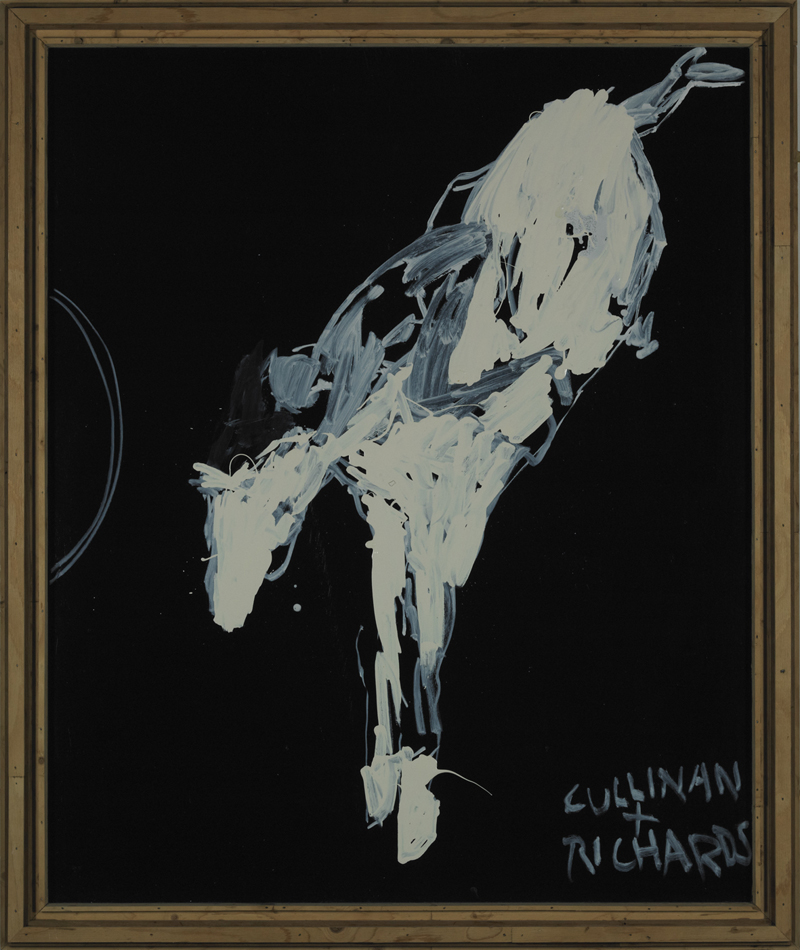
    Illustrated here is Cullinan Richards’ Collapse into Abstract (Black), which with a title like that will surely be a challenging investigation into the nature of painting qua painting. Over 3,000 artists entered a work for consideration, which means that 47 other pictures were rejected for each of those chosen. Were all 47 really worse than Richards’s collapsing abstract?

    No question this will be – like the last one – a bloody awful collection of wince-inducing daubs but one will have to attend in order to enjoy a hearty laugh at the artbollocks written about each entry, always a highlight of the exhibition. And there’s always the permanent collection of the Walker, which is easily the best in England outside London.

    David Lee

    The Jackdaw, June 2012