Category: Editorials

  • Olympic legacy: money for nothing

    Olympic legacy: money for nothing

    I am not happy again. We have become used to hearing weekly wails of distress from the Arts Council about how broke they are followed by melodramatic predictions of the cultural desert awaiting as punishment for state parsimony. It is their belief they should be exempted from the austerity allegedly endured elsewhere. Their moans receive sympathetic hearings from a press many of whose specialist commentators are reliant on the Council for an assortment of free trips, home and abroad, and other thinly veiled junketry and blackmail.

    Last month the Council announced quietly that one of their long-delayed projects for the Olympics – a jet of air fired up over the Mersey estuary off Birkenhead – was not going to happen after all, despite having already spent £535,000; that is, £35,000 more than the original budget intended for the finished, installed work. This sum included £40,000 as a personal fee plus £15,000 expenses for the artist, one Anthony McCall. He promised something he couldn’t deliver but won’t be sued or expected to repay any of the money. Apart from low-key reporting of the failure, papers omitted to comment on its wider significance. And it goes without saying that no one at the Arts Council will carry the can for this entirely avoidable fiasco.

    In fact, this was only part of a story concerning the disgraceful waste of £5.4 million which the Council allocated for commissioning special works during Olympic year. Now, a year on from the Olympics, we can evaluate more clearly what we received – the ‘legacy’ if you insist – for a sum approaching the Council’s entire annual visual arts budget. The short answer is nothing; nothing memorable or of any enduring artistic merit, for it was frittered away on ‘community’ trivia. Not a single painting, print, sculpture or ceramic in any gallery or museum. Not a single mural or stained glass window in any civic building. No public sculpture of genuine worth. No, not even a sprawling installation or a soporific video destined for the gallery warehouse. Where anything at all concrete remains from this project it is entirely frivolous. The sum total is three crocheted lions at Twycroft Zoo and a boat made from 1,200 donated wooden objects currently moored … well you tell me.

    In January 2010 the Arts Council announced that as its contribution to the Cultural Olympics it would earmark £5.4 million for 12 works, one each in nine regions of England (£500,000 each) and one each for Scotland (£460,000), Wales (£230,000) and Northern Ireland (£190,000). The object of these commissions, which were collectively dubbed ‘Artists Taking the Lead’ (the Piss, more like), was “to surprise and delight the world with their extraordinary artistic vision”.

    Scotland’s wedge bought them a temporary football pitch in the middle of a forest near Selkirk, on which were played two matches in kits designed by local children – a site now overgrown. (God only knows how they managed to get through half a million on that.) Wales got the fuselage of a DC9 which was towed to four locations; present whereabouts unknown. Northern Ireland got Nest, a warehouse full of donated objects labelled with personal reminiscences. Eastern England got a community event called Home. In Yorkshire they bent the regulations so that those choosing the winner were themselves the recipients of the cash. Their excuse? “It would have been impossible to appoint regional arts experts that did not have these relationships.” You didn’t try hard enough you corrupt bastards! The result was some sort of street happening in Leeds. The north west got its half-million’s-worth of nowt, not even the promised hot air. The south west got Nowhereisland, some soil from the arctic circle towed by boat around the West Country. The West Midlands marched a big puppet of Godiva (now clothed owing to political correctness) down to London. The south east got the wooden boat. The East Midlands is now the proud owner of some knitted lions. The north east got the best piece, ‘Flow’ by Ed Carter, a pontoon on the Tyne complete with original electronic music.

    There is not an atom of visual art in any of this rubbish. It is money which should have been better spent on permanent serious commissions. Why are the Arts Council allowed continually to get away with such shocking waste whilst constantly pleading poverty?

    David Lee

    The Jackdaw, July/Aug 2013

  • Bob Dylan at the National Portrait Gallery

    Bob Dylan at the National Portrait Gallery

    THE LINE IT IS DRAWN … BADLY
    The now routine phenomenon of paintings by celebrities shown in serious galleries defies belief. You’d think they’d be sniffy about this sort of populist stunt; and you’d be wrong. However bad the work is people swarm to see it, hexed by the name. Photos and paintings by pop stars and television personalities attract record crowds of worshipers. The best attendance at the 170-year-old Walker Art Gallery in Liverpool, for example, is paintings by Rolf (“do you know what it is yet?”… “nope”) Harris.

    Thus in straitened times are museum principles sacrificed in order to sell coffee and muffins. Celebrity daubing is the one area of museum policy where any semblance of honesty flies out the window. Critics and curators lose all sense of propriety and become blinking rabbits trapped in headlights. The thrill of brushing with fame is addictive. Just maybe if we heap on the praise with a bulldozer we’ll get the personal call. Perhaps we’ll become friends. What other reason could there be for this adolescent fawning over the incompetent and conceited?

    So Sarah Howgate, a curator at the National Portrait Gallery appears on the television – a clip is on the BBC news website and will embarrass all concerned for as long as it remains in the archive – either talking gibberish or praising qualities in works brazenly lacking anything resembling accomplishment. Why? Because they are by Bob Dylan. Well Bob, you of all publicity avoiders should know better than to play ball with this demeaning exploitation of your fame. The person who persuaded you into this lapse of judgement and propriety is possibly the same one who talked you into the wince-inducing train crash of that Christmas song album four years ago. Here comes Santa ho ho ho, indeed.

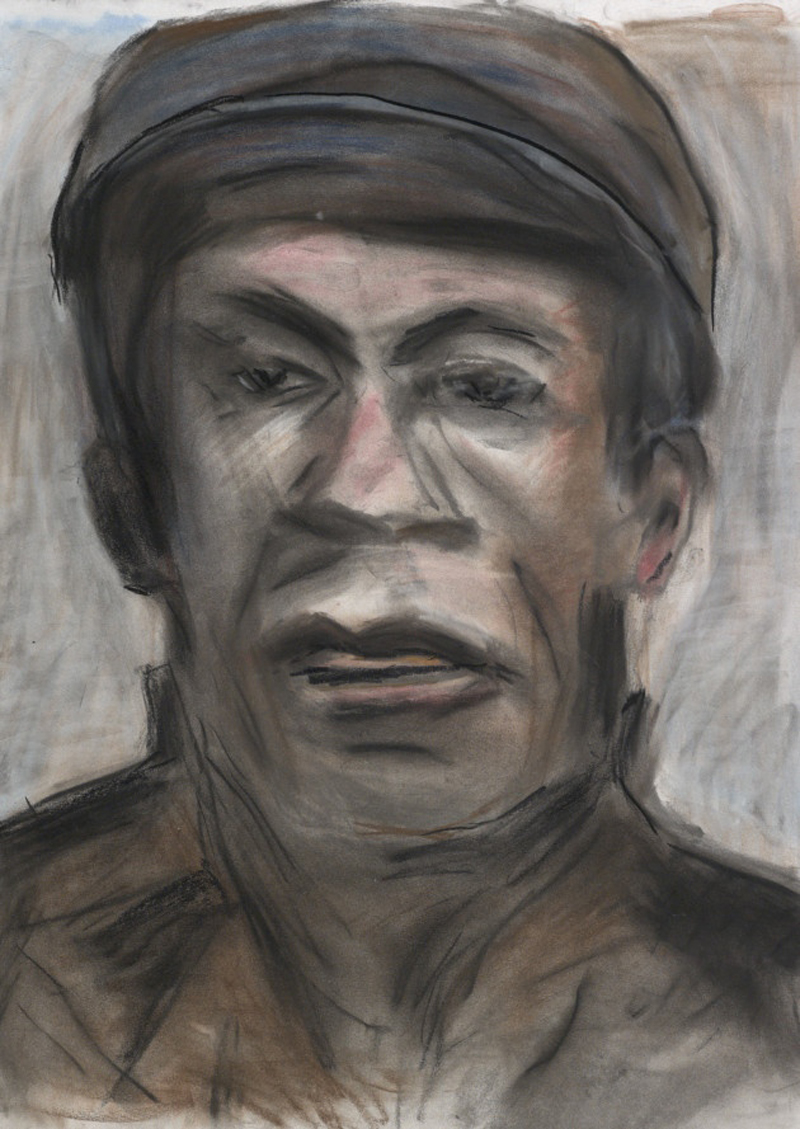
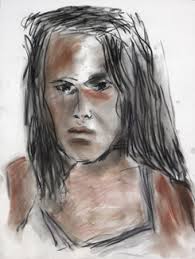
    When not rolling thunder from continent to continent or writing songs of genius (and no one comes near him as the greatest artist of my lifetime), Bob relaxes with a spot of drawing, don’t yer know, and in the last year has done a dozen imaginary pastel ‘portraits’ – one of which, captioned Ivan Steinbeck, is clearly based on his own face. All the same size, they are as crude as Wild West ‘Dead or Alive’ posters – though poor old ‘Red Flanagan’ already looks like a decomposing stiff. The works are so obviously those of an amateur that they might, if entered for an art contest in a scout hut, elicit praise and encouragement if only out of sympathy for the effort made. The only thing missing is the untidy grittiness of pastel, the textural scuffs and drawing-pin holes in the corners. These sheets look suspiciously perfect, as though made by a machine, and the pastel is applied more like make-up or lipstick – it’s horrible. Either Howgate was deliberately lying when she praised this rubbish or she doesn’t have a clue what she’s talking about: neither is an advertisement for her career prospects. The probability is that she was lying having been, as they say in American films, hung out to dry by superiors.

    Then along trots art critic Jonathan Jones of the Guardian, who blogs for England with instant opinions on everything. He told us that “Dylan draws well, with feeling and hard-won accuracy”. He doesn’t. He doesn’t draw any better than literally millions of others. GCSE teenagers have better portfolios of drawings than this. And as for ‘accuracy’? What does that mean in the context of the imagined? That he got the number of eyes and ears right? Why did Jones write this? It’s hard to explain.

    Dylan draws with all the mistakes which are second nature to untutored dabblers, faults too many to enumerate. Typically at this level, errors are duplicated like incurable tics. No improvement occurs from one drawing to the next, nothing having been learned by self-criticism or devoted practice. And because Dylan isn’t in full expressive control of what he does, anything readable into these faces has to be accidental.

    Apart from their status as curiosities no point is served exhibiting this stuff. They would not be shown anywhere, least of all the National Portrait Gallery, were they not by Bob Dylan. If a would-be artist showed Sarah Howgate a portfolio of scribbles like these he’d be on the pavement faster than Usain Bolt.

    Bob, my dear hero, these are intriguing ephemera, but they are without art and best kept to yourself as a little secret between you and your family. And may I humbly suggest that next time you should know your song a little better before you start singing.

    Bob Dylan is at the National Portrait Gallery until January 5th

    David Lee

    The Jackdaw September 2013


  • Another great artist ignored

    Another great artist ignored

    Of the 183 works by John Piper in the Tate’s collection none is currently on display. One of the major British artists of early Modernism does not have a single item of his work on show in the national collection of British art, of which, incidentally, he was once considered sufficiently eminent to serve as a trustee. How could such an aberration occur?

    As an apostate Modernist, Piper has been marginalised as a glib illustrator of churches and grand houses in a vaguely modish idiom. He is perhaps a victim of his divers interests and abilities; he was writer, typographer, photographer, textile and stage designer, stained glass maker, muralist, printmaker, painter, but ­– especially – a lover of England, its idiosyncracies of belief, custom and culture, and especially of its history, in which he was thoroughly well-read. As a forgotten man he is perhaps the first example of an important artist who, by deviating from the consensus of an official taste which would later emerge as State Art, spoke out and stuck to his convictions. Thus, he managed to get himself on the wrong, ‘Betjeman’ side of the debate when Modernism began to rule the critical roost in English art and commenced its relentless infiltration and systematic cleansing of institutions. There was no schism with his former vanguard friends, Piper simply moved in his own direction rather than following trends and styles he considered useful and intellectually stimulating but limiting as far as his own ambitions were concerned. He inclined towards the deadly sin of Romanticism, being spellbound by land, its natural evolution and the alterations that Man’s brief occupancy had so far wrought upon it. Crucially, he wished to convey his affections to as many as possible, whereas his youthful espousal of Surrealism and Abstraction, though fascinating, were ultimately exclusive, remote and too dismissive of past art. Art, he felt, had become in danger of isolating itself, of communicating only to its few devotees rather than to a wider audience. Most of all Piper relished observation. His concentration was informed by a probing intelligence typical of the genuinely curious.

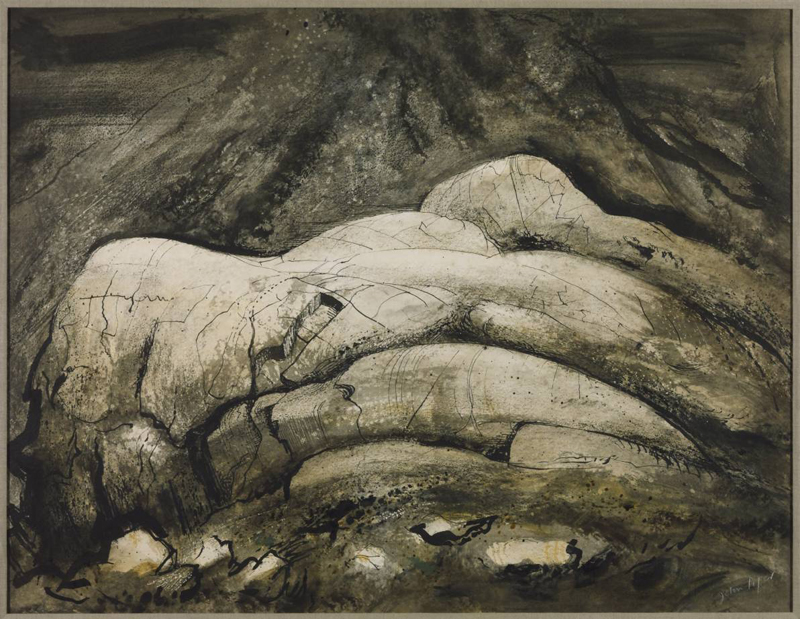
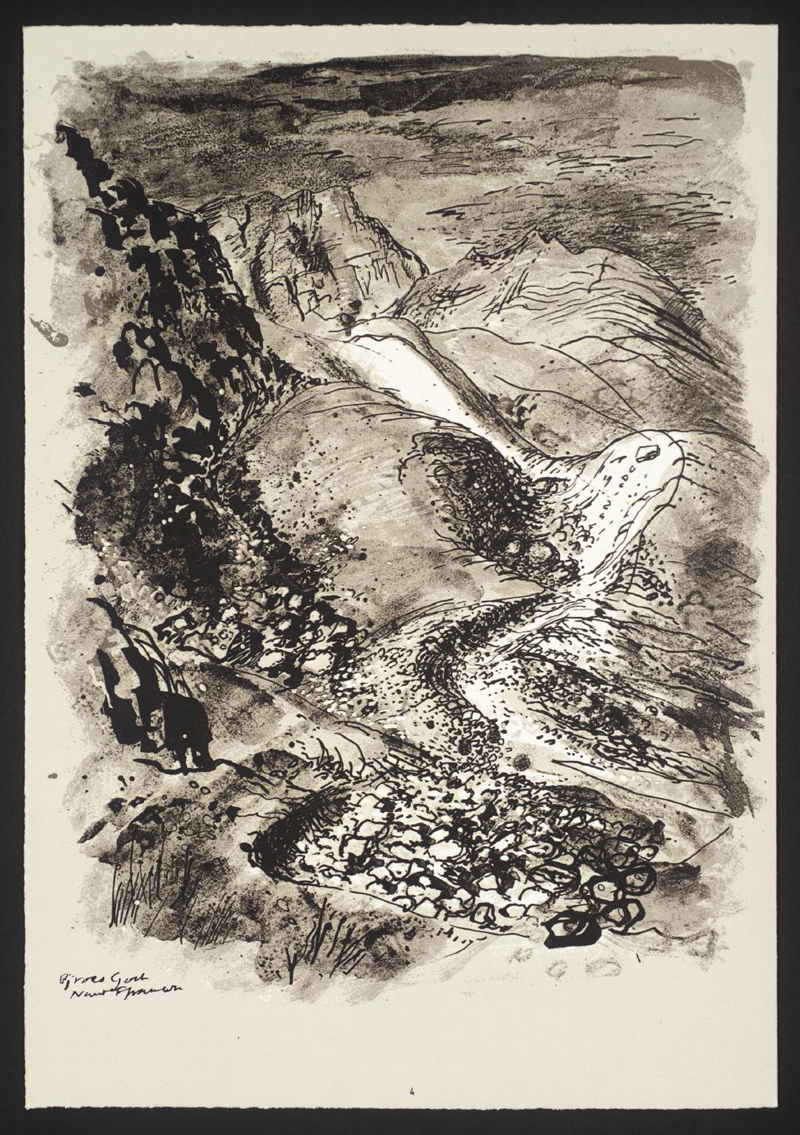
    A small exhibition at Whitworth Art Gallery in Manchester (9 February to 16 June) displayed Piper’s paintings done during the artist’s visits to Snowdonia in the 1940s. It reminds us of what a powerful and original artist he was. Of several outstanding pictures, which are as good as anything by other British artists from this time, one in particular seemed to encapsulate everything Piper sought and stood for. It depicts the Nant Ffrancon valley as a living, dramatic place whose appearance is dictated by its slow forming by glaciation. In such places Piper’s imagination and speculation ran riot. Rock is alive, work in progress. The experience of such a picture encourages even seasoned lookers to see and appreciate more intensely any genius loci. http://www.whitworth.manchester.ac.uk/whatson/exhibitions/johnpiper/

    This astonishing picture was sold two years ago for £17,000 – that is, under half what Hirst was charging at his recent Tate Mart for a signed poster exhibiting no discernible artistic merit. Good luck to the perceptive individual who acquired this modest treasure. But why is it so obviously a silly question to ask if a single British gallery or museum had noticed this profound painting and bothered to bid for it. There is a similar though inferior example from the same series depicting a nearby motif in the Tate’s collection, which needless to say is not on show. £17,000 for a masterpiece when signature decorative froth by Picasso sells for over a hundred million…

    We have the wrong brainwashed curators frightened to acknowledge diversity and following the wrong narrow trends; the wrong art market rigged solely for investment and profit; the wrong craven museum directors too willing to toe the establishment line; and we are constantly force-fed the wrong art which boasts so much yet delivers so little. Piper should be on show and permanently celebrated. He died in 1992, and there has been mounted no retrospective of his work since 1982.

    If your interest in the history of British art extends beyond the fashionable and you haven’t yet read Frances Spalding’s beautifully written joint biography of John and Myfanwy Piper (Oxford University Press, £16.99 pb, a tenner on Amazon) then it’s about time you did: you’re in for a most edifying journey.

    David Lee

    May/June 2013


  • Carl Randall – easel words

    Carl Randall – easel words

    Recent paintings made in Japan will be showing at my exhibition ‘In The Footsteps of Hiroshige: The Tokaido Highway and Portraits of Modern Japan’, at the National Portrait Gallery from June 20th to September 15th (then touring the UK until May 2014). The exhibition is the result of being awarded the 2012 BP Portrait Award.

    My proposal for the award was to travel in the footsteps of the Japanese woodblock print artist Ando Hiroshige (1797–1858), who in 1832 travelled along the Tokaido Highway, an old trading route that ran from Tokyo to Kyoto, producing a series of woodblock prints showing the people he met and the landscapes he experienced along the path. The prints now serve as a valuable artistic document of life in Japan at that time. I was interested in producing contemporary equivalents, documenting the people and places of modern Japan, 180 years after Hiroshige made the same journey.

    The journey started in the bustling capital city of Tokyo, and, drawn to its densely crowded streets, I painted hundreds of residents one by one, directly from life. Visiting other major cities along the route, I painted other features of modern Japan such as salary men, sushi restaurants and department stores. As the highway moves out of cities and into rural areas, elderly rice farmers work their fields, their backs permanently bowed, skin leathery and wrinkled from a lifetime of farming. While visiting these areas, I also had the opportunity to experience aspects of traditional Japanese scenes such as hot springs, fireflies and red autumn leaves.

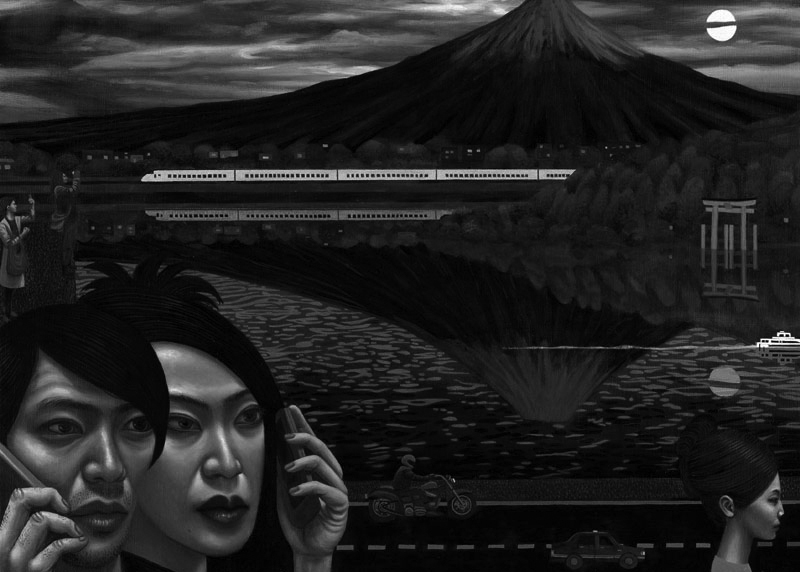
    Finding the modern and urban ever present in the rural, I included elements of the industrial within images of nature: bullet trains cut through mountains, telegraph poles dot the landscape, tetrapods line the coastline. These, and other motifs, such as the mobile phone, are used to place the images in the contemporary world, while also helping to avoid nostalgic depictions of historical Japan. I would hope that my portrayal of familiar Japanese icons such as Mount Fuji, Geisha, Kabuki, Zen gardens and Sumo wrestlers have been presented in a fresh light.

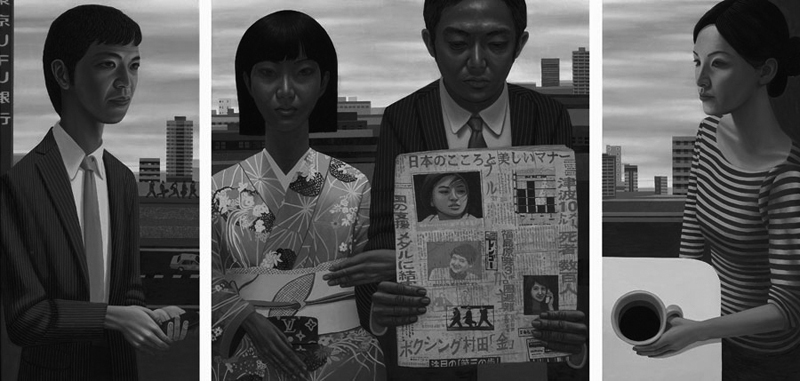
    Combining a sense of the real and unreal in these paintings was important to me, with realistically painted figures set against flattening space and illogical scale. I painted some works in monotone, to imbue them with a feeling of solitude and silence, which relates to my interest in urban alienation – the idea of people sharing the same close physical space, but mentally existing in separate worlds.

    This exciting opportunity allowed me to develop my interest in portraiture and create personal interpretations of Japan, while following in the footsteps of a great artist. I felt privileged to be the first portrait painter to respond to this subject matter, and I would hope that this exhibition generates further public interest in this fascinating country.

    Japan Portraits, a 120-page colour hardback catalogue of work made in Japan, is available at The National Portrait Gallery – foreword by Desmond Morris with an introduction by Donald Richie. A documentary about the artist painting in Japan is at www.vimeo.com/carlrandall/japanportraits.

    Artist’s website: www.carlrandall.com

  • Evelyn Williams, and another case of the public denied

    Evelyn Williams, and another case of the public denied

    In the last issue I considered the case of a single-minded good artist,  David Mulholland from Middlesbrough, whose memory, in the absence of any official recognition or support, has to be kindled for posterity’s sake by friends and family. By The Jackdaw’s usual standard of eliciting no comment whatsoever, this caused a considerable mailbag from many mentioning other artists who deserved better than the obscurity and indifference they receive. Owing to the recent death of a special artist, there is cause for reiterating this line of criticism of an art establishment hopelessly out of touch with anything but ‘The Contemporary’, such as they choose to see it.

    Grief felt at the death of a memorable artist is mitigated always by the fact that their work – if it is properly accomplished and not merely the species that is famous for fifteen minutes – will live forever. Giotto didn’t need an ‘artist’s statement’ or incomprehensible catalogue introductions for his work to last, because his paintings speak for themselves in a universal language understood across the centuries. His work will continue to communicate clearly its observations of character and stories just as long as human beings are prepared to see,  feel and respond. This is the case also with the art of Evelyn Williams who died aged 83 on November 14th. Her work will endure in spite of the neglect she received from officialdom during a long and productive career. In the same Tate Collection which stores 274 works by Andy Warhol no space can be found for a single piece by Evelyn Williams, who is a far more interesting artist if not so much of a business-minded celebrity phenomenon whose market is carefully rigged. Even in the last two years alone, when 516 works were acquired by the Tate, there was no room for a single one by this important woman artist. There are even ten works in our national collection by American minimalist Robert Ryman, all of them white and doubtless extremely challenging to those of a devoutly all-whiteist fanaticism; but nothing by Evelyn Williams. Here is further evidence that at the nucleus of State Art breeds a deeply entrenched prejudice against anything but pseudo-intellectual nonsense.

    It is an appalling truth that the Tate has ceased to be a collection of British art preserving the very best of what is being done. Instead, it has been stealthily subverted under Serota to become a private collecting fief promoting a narrow orthodoxy related to a handful of dealers and auctioneers. Why is it that so much about today’s Tate stinks? Evelyn Williams is in a long line of single-minded British artists who refuse to run along the pre-ordained tramlines of conceptualism and modernism. She was a thoughtful, modest, intelligent and vulnerable person alive in a world – as she perceived and experienced it – of imminent dangers. Her paintings, sculptures and reliefs are about the fear and anxiety, the affections and frictions, of what it is to have lived the life of an anxious woman and mother. Hers is first and last a woman’s art, an uncompromising take on post-war relationships, intimacy, cares, depression, failure and even alienation. Her subjects take you inside the realm of senses and feelings, probing the unspoken secrecies behind the masks of propriety we all wear. In the way that art has of redeeming the awful, these are beautiful explorations of states of mind most try to avoid. Her work can be relentlessly intense, no question about that, but it is pure in spirit and purpose.

    Three of the more serious newspapers, the Times, the Telegraph and the Guardian, were eventually persuaded to publish obituaries of Williams. As with so many significant but neglected artists who are nevertheless considered worthy of an obituary, her exhibitions were scarcely even acknowledged let alone reviewed in the arts pages of these same papers. Critically, it was as if her work didn’t exist. She is, of course, among the many accomplished artists whose work is ignored for being conventional in appearance and technique and declamatory about emotions. To today’s State Art tyrants such characteristics are considered embarrassing drawbacks.

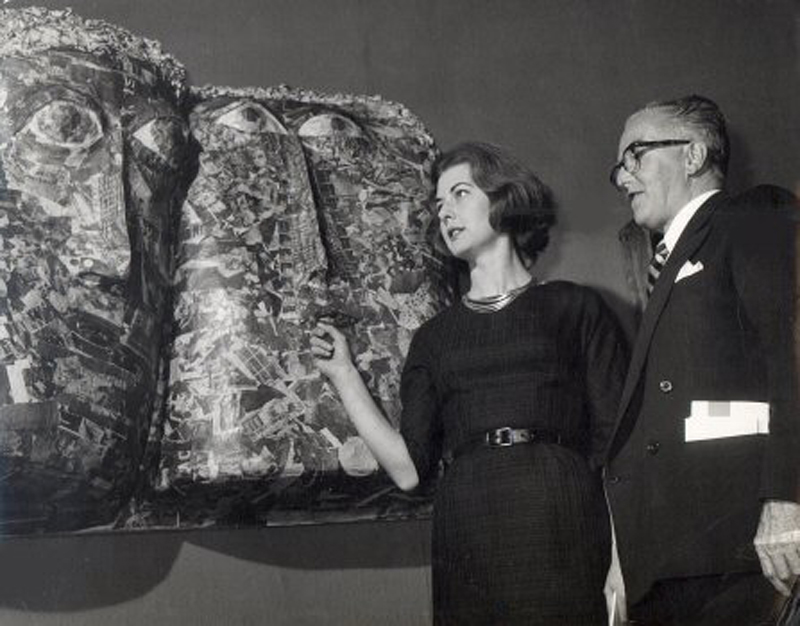
    Williams was, however, appreciated in the past. As a youngish artist in 1961 she won the sculpture prize (for Two Heads) at the John Moores in Liverpool, when other winners were Peter Blake, David Hockney and Ron Kitaj. These were the days when the Moores was worth winning, well before it was subverted to the cause of State Art where daubs of no merit are greeted by fools with preposterous superlatives. A retrospective exhibition was held in 1972 at Whitechapel Art Gallery; once again well before that gallery’s prostration before the winds of Biennale bluster. Williams continued her brave exploration of inner places that made her work then so widely admired. She worked every day of her life and although her commercial exhibitions continued, sometimes at long intervals owing to the complexity of ideas and their necessarily prolix gestation, a retrospective was never offered in her lifetime. Approached by friends in the last decade of her life, the Walker Art Gallery turned her down for such an honour. She couldn’t exert the pulling power of a Rolf Harris or Paul McCartney.

    Will Williams now receive the lifetime retrospective her work deserves, and which a wide audience should see? It isn’t likely.

    But why should this be, when there are more galleries nationwide which are more spacious than ever before? The answer is that as the public gallery network expands the same orthodoxy is spread across even more outlets. More galleries does not mean a wider selection of work on display; it means the same work by the same few artists spread across even more galleries even more frequently.

    What are called ‘Artists’ Rooms’ are a symbolic example of what is wrong with this rotten system. These ‘Rooms’ are organised by the Tate, the Scottish National Gallery of Modern Art and the Art Fund (how long will it be before the Art Fund can only be contacted via the Tate switchboard?), and they resulted from a bulk purchase, jointly by the Tate and the SNGMA in 2008. We bought for £42 million (£27 million in cash – the figure varies in different reports; we’ve never been told the exact sum – and £15 million in waived tax) retiring art dealer Anthony d’Offay’s gallery stock, which he called his private collection.  A cynic might say that Artists’ Rooms is the process by which the personal collection of one commercially motivated individual now dictates what a large proportion of the art-seeking population is allowed to see in the name of recent art. The same cynic might further add that Artists’ Rooms is the opportunity by which established reputations – such as Warhol’s – are constantly hammered home, and for the smaller ‘Room’ names, it is the instrument by which a more significant brand name can be nurtured.

    Under the auspices of the Art Fund, an organisation which luckily is headed by a former director of Tate Britain, 30 rooms featuring 760 works by 26 artists have been touring the country for four years, mostly as small one-man retrospectives. Some of these are marvellous, not least the extensive collection of photographs by August Sander. There are 232 works by Warhol alone, who gets two rooms to himself travelling at the same time. At the moment they are in Sheffield and Hull, and then Birmingham for four months. That is apart from relatively recent major exhibitions for the same artist at the Tate, the Hayward and other Arts Council galleries.  Warhol is showing somewhere all the time. We will not be allowed to ignore him.

    One of the Artists’ Rooms deals, inevitably, with Damien Hirst. This is currently on show in Walsall Art Gallery. It has been there for two months already and will remain in place for another year. What is happening when a fifty-year-old artist, already over-exhibited at a time when so many unexposed artists can’t get their work shown, is having a thirteen-month long exhibition? What is the reason for such indoctrination? Too often the Artists’ Rooms represent those who are already widely exhibited and who are bastions of the art market.

    Artists Rooms are a blunt instrument whereby approved taste is circulated (inflicted) from the centre. They constitute cheap exhibitions for Arts Council venues up and down the country, whose curators don’t have to originate their own programme. The laziness and ready compliance of these jobsworths is a godsend to State Art.  They can merely exhibit the same few approved brand names for ever. And make no mistake their career will depend upon them favouring these “right” kinds of artists for no individual prospers in State Art by demonstrating initiative or investigating the unorthodox.

    Visit the Hepworth Gallery in Wakefield and you will discover the other reason, besides the dreaded Artists’ Rooms, why thought and broad knowledge among curators is unnecessary. There is a new species of art collectors who caught the disease of wholesale, apparently random acquisition from Saatchi. These people fuel the market for State Art which they buy in quite staggering quantities. Their houses, full of wince-inducing tat bought for eye-watering sums, feature frequently in glossy magazines. Usually they are rewarded for their commitment to the State Art cause with the accolade of a position on a Tate committee, of which there are now dozens. At Serota’s Tate money not knowledge is the essential qualification for co-option.

    One such überbuyer – who has not yet been brought on to any Tate committee – is one David Roberts, a property developer, who has accumulated so much clutter he’s opened his own ‘space’ and has begun feeding pieces to regional galleries, Wakefield being the first venue. Works selected are linked as follows: “This exhibition examines ways in which modern and contemporary artists represent the human

    body in various media to explore psychological and emotional life.” What a perfect criterion that is for the inclusion of a major work by Evelyn Williams. Unfortunately, the trouble is that among Roberts’s 3,000 plus works there is nothing by Williams. But have a guess whose work he does own and whose efforts are on show in Wakefield: enter Warhol and Hirst.

    David Lee

    The Jackdaw January-February 2013

    http://www.evelynwilliams.com/index.htm
  • Manet at the Royal Academy

    Manet at the Royal Academy

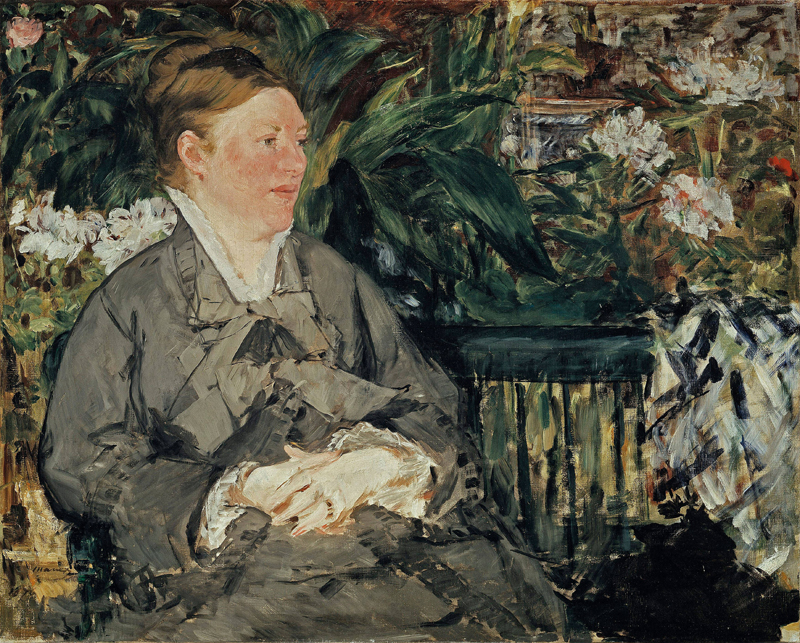
    Seven years ago the Courtauld Institute mounted a thrilling exhibition by showing only two works by Manet. Admittedly they were both undoubted masterpieces, the Barmaid at the Folies Bergere of 1883 and The Luncheon from Munich of 1868. It demonstrated that an absorbing experience could be staged with the import of only one picture. We all know what a brilliant, enigmatic piece the Barmaid is, but the earlier scene of post-prandial insouciance was equally dazzling and also ambiguous, even mysterious, in subject. Of both pictures one asks in genuine bewilderment: ‘What is going on here?’ And the answer is up to you to make of them what you will by considering every last detail.

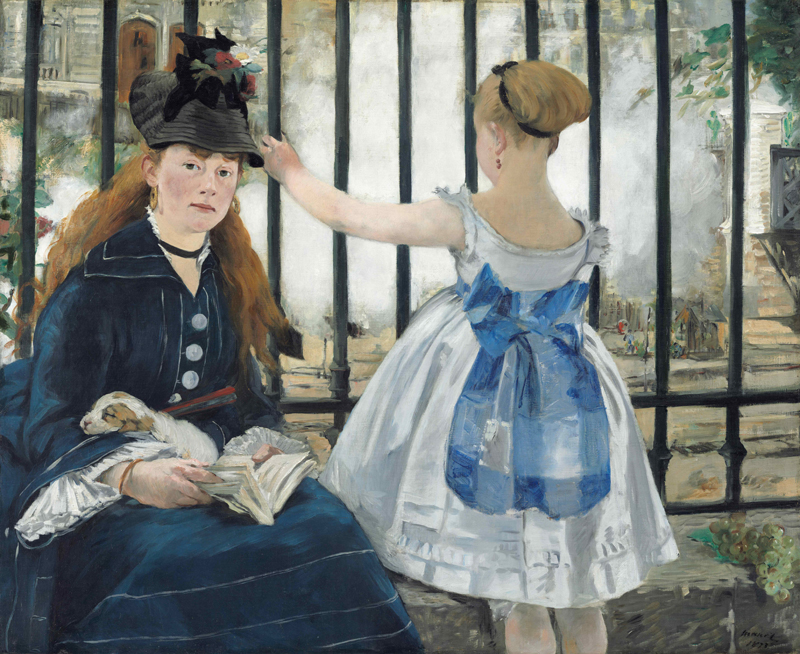
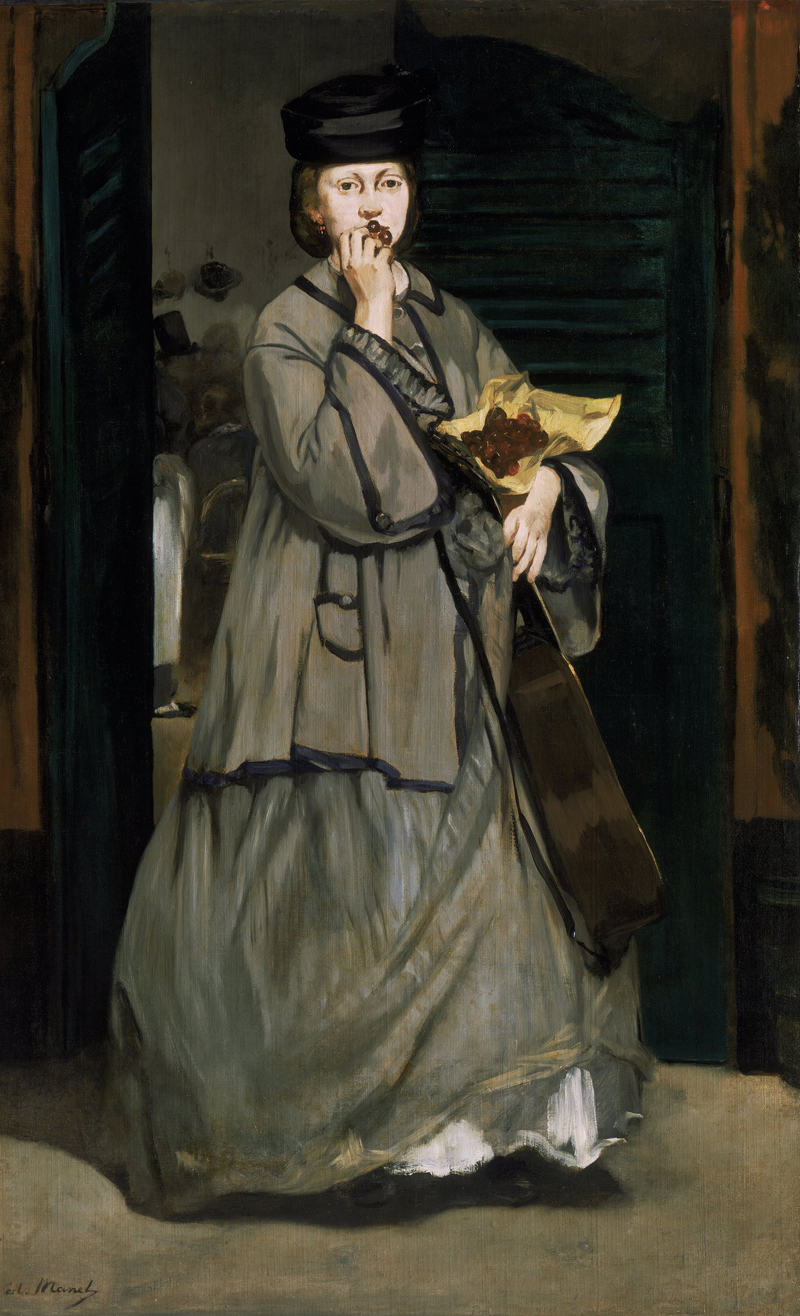
    Manet’s best paintings rarely fall easily into any genre; an ulterior motive, even in what might appear to be a straightforward portrait, is never far away. For example, what is this interrupted reader in The Railway doing beside the track with a bunch of grapes on the parapet, a puppy dog, a hissing loco and an apparently bored daughter? Whatever it is, there is clearly more than meets the eye in the painter’s relationship with his favourite model Victorine Meurent, for it is she who appears in many of the better works, including The Street Singer.

    The Luncheon features again in the Manet exhibition at the Royal Academy (until April 14th) and by itself is worth the £15 admission fee. The right hand vertical quarter of the painting showing an unknown man still wearing a hat and smoking a cigar beside the wreckage of lunch, itself a still life so brilliant it’s hard to recall anything anywhere comparably so fine, has got to be among the most amazing passages of painting on show in London.

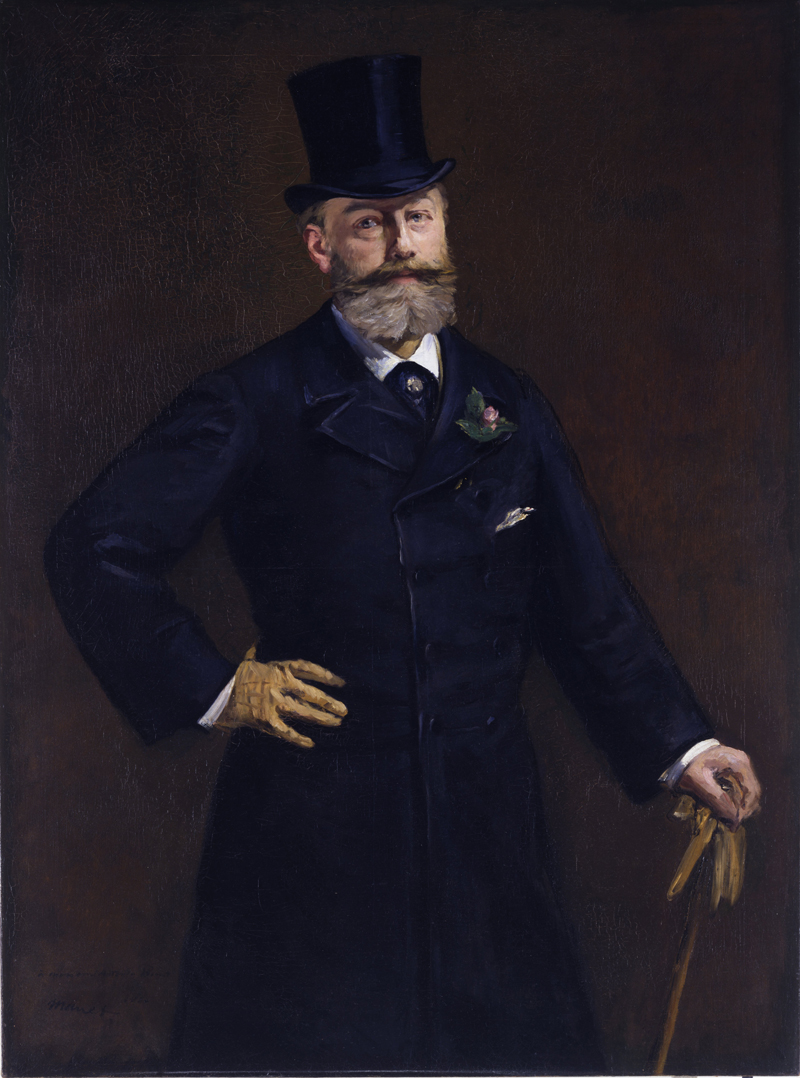
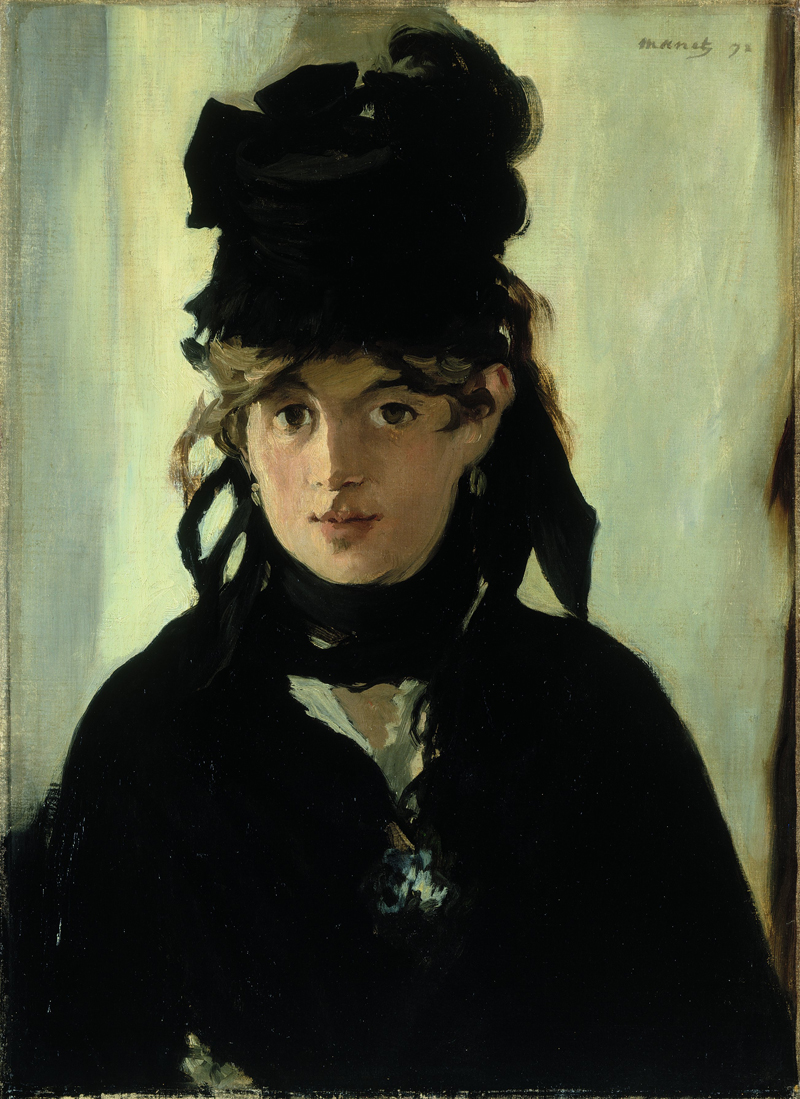
    The exhibition as a collection is a mixed bag. Besides The Luncheon there are half a dozen masterpieces – the aforementioned Street Singer (from Boston), which knocks spots off anything even roughly equivalent by Whistler; The Railway (from Washington), which looks to have been disadvantageously cleaned to a jarring sheen; and four portraits depicting Zola, Astruc, Mallarmé (no larger than A4, this picture is breathtaking, and a brilliant character study) and Duret are all you really want to trouble yourself with. The rest are varying degrees of stocking filler. The poor old RA, struggling desperately on its uppers and fending off poverty, had to fill up the rooms somehow and this is what the dears could get. Most of it isn’t much to write home about but it will be perfectly sufficient to get the nuke-proof knicker brigade of Adelstrop reaching for their rail passes and lorgnettes and gagging to fork out fifteen quid.

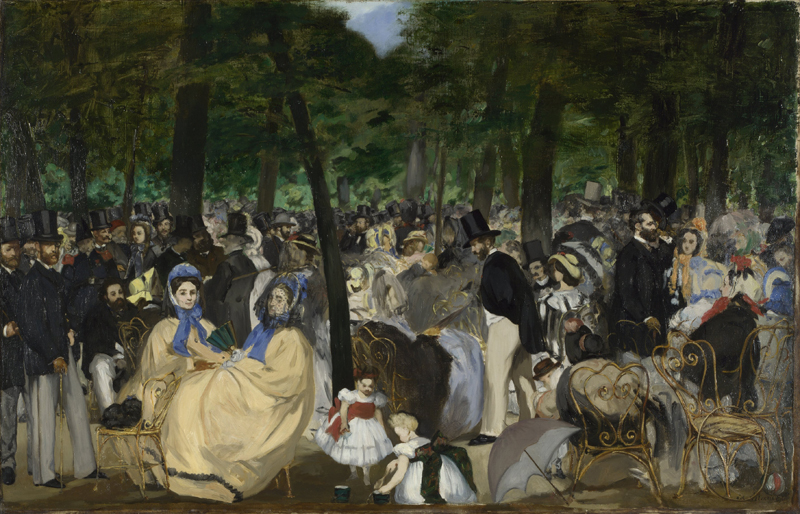
    The best Manet in London, the Barmaid, is not here, though familiar items from the National Gallery are; the uniformed Tuileries consortium of stuffed shirts for some reason receiving a room to itself. An invented gathering of Manet’s friends from every sphere of progressive cultural life (and what an anal bunch they look) in the familiar setting of ornamental gardens in central Paris, this must be some sort of assertion of class or caste pride, for there’s no sense here of bohemianism or the avant-garde at play. Looking at this bunch, with their underpants full of thistles, it’s hard to think of them getting up the Establishment’s nose.

    Most intriguing is the lack of finish evident in many pictures, some of which  were not exhibited during Manet’s lifetime; perhaps he was fearful of the inevitable opprobrious response. As early as Degas came to the same conclusion, Manet also discovered that a painting might reach fruition well before it appeared complete in conventional terms. Thus begins here with genius the reductiveness which soon descended into absurdity.

    Ever respectful of its charitable obligations, the Academy is offering a chance for a few to view the exhibition on a Sunday evening throughout the run in a less crowded gathering conducive to actually seeing the work on display. For thirty quid the ever-giving institution will even chuck in a glass of wine, doubtless from its own cave.

    David Lee

    The Jackdaw January 2013

    http://www.royalacademy.org.uk/exhibitions/manet/


  • Bargain basement royal portraiture

    Bargain basement royal portraiture

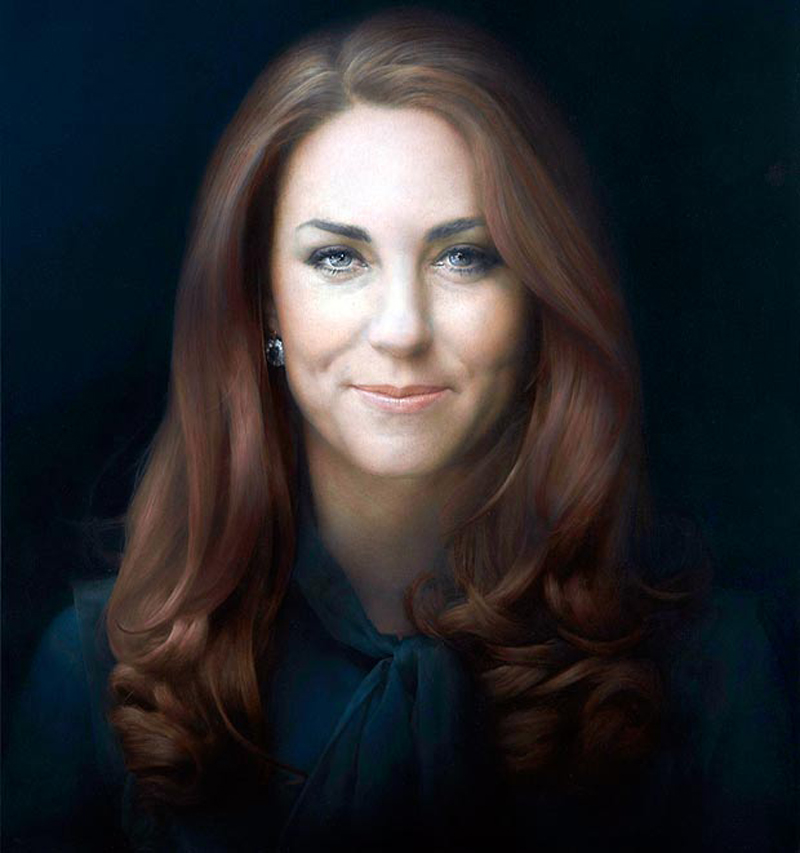
    This is the portrait of an intelligent, thoughtful and educated sitter with no less than a degree in art history. It is perfectly adequate for the boardroom of a supermarket but entirely inadequate for a national collection. Kate deserves better. We deserve better too, and so does the future.

    This commission – Kate’s first official portrait – demanded an artist, not a slavish and banal illustrator and certainly not the bargain basement of royal portraiture. It is an artless mistake that should have been foreseeable by those who commissioned it. Emsley was the wrong painter. He is essentially a wildlife artist used to painting every hair on a gorilla. We have fine portrait painters in this country – Ben Sullivan, Phil Hale, Stuart Pearson Wright and Paul Benney among them. Any of these artists would have produced something more taxing, deeper, and interesting than this. We could have been surprised by an artist with something to say.

    We are not asking for any surreal or bizarre interpretation but merely for something beyond a bog-standard likeness. This is the most bland and predictable royal portrait in living memory. It is the sort of safe, uncomplicated, pedestrian image one might expect to see in a high street photographer’s window. It looks as if the painter asked the subject to “Say cheese!” and then told her to scram and buy some clothes while he painted the photograph.

    It would have been cheaper and more honest to exhibit a photograph; indeed this portrait adds nothing that we didn’t already know from a million photographs. Even her smile is half-hearted.  There is neither character nor personality here beyond the obvious. Neither is there gravitas, profundity or any sense of narrative. Instead it is the image we see repeated daily in our newspapers and magazines.

    Saving grace? It is not by Rolf Harris.

    David Lee

    The Jackdaw January 2013

  • Faking it

    Faking it

    “Maybe a man’s name doesn’t matter all that much.” (Orson Welles in F For Fake)


    As so many gifted painters have discovered to their cost, having an unusual talent is not necessarily a passport to a meteoric career. So many whose abilities deserve to be recognised, or at the very least acknowledged, struggle cruelly in obscurity if not in the proverbial garret. Such neglect may drive certain temperaments to desperate measures. The inability of the meritorious to make a living is doubly harsh when the infantile antics and stunts of contemporary art are plastered daily across the newspapers. When only the most strident and outrageous get noticed the world of art becomes a strange and unfair place.

    An art college lecturer recently advised her imminently graduating painters and sculptors that if they wished for a successful career they should employ with immediate effect the most expensive public relations company they could afford. She was effectively informing her charges of the unpleasant truth that in contemporary art it’s not the quality of the work produced that will make you famous, but more importantly how shrewdly and relentlessly you are marketed and branded as an individual. In terms of high sales and escalating prices, success in art is unfortunately directly proportionate to the public visibility of the artist. Thus has our age of mindless celebrity worship sullied even the hallowed halls of art.

    As the last hundred years have proved, dealers in Modern Art can sell any old rubbish against the perception of success and a secure investment. In the world of those collectors desperate to be fashionable it won’t matter what a work looks like, because to them art is like so many shoes, cars, handbags or jewels – they will buy anything if the label is recognisably expensive and their friends are suitably impressed by them having paid so much for so little. These few words tell you most of what you need to know about the depressing condition of official contemporary art and its market. It is also why good artists of more conventional abilities have a harder time of it than they deserve.

    There is, however, another way to make it as an artist, though it is not one recommended for those of a nervous disposition. This requires being that increasing rare species a gifted painter … and serving four months in Brixton for wholesale faking of works by famous artists. No better way exists of getting noticed and nothing on an artist’s CV looks quite so impressive as a stretch for forgery. It is hard for many of us to resist a talented and essentially harmless rogue. The names of these great fakers live in folklore: Hans van Meegeren (Vermeer), Elmyr de Hory (Picasso, Modigliani, van Dongen), Tom Keating (Samuel Palmer, Cornelius Krieghoff), Eric Hebborn (old master drawings, including Leonardo da Vinci), the great Shaun Greenhalgh (Lowry, Gauguin, Hepworth) – and in the case of the avuncular and telegenic Keating he became better known to the public than the names of the artists he faked. In a world where publicity is the key to artistic success, money can’t buy the quantity of front-page publicity received for perpetrating an infamous crime. Ironically, fakers frequently enjoy stellar careers once they are going straight. Cynics might even argue that it’s well worth enduring a brief diet of bread and water in order to enjoy a comfortable career thereafter.

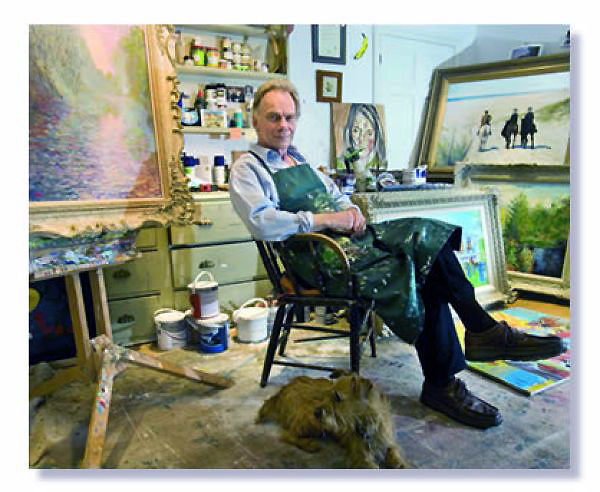
    John Myatt is only the latest in a long line of great British forgers with notoriety and infamy as his calling cards. The extent and audacity of his crime were breathtaking – I still can’t believe he got away with it. He was part of arguably the most sophisticated fraud in the faking of paintings ever perpetrated, and certainly the most impressive in recent memory. Over a period of nine years beginning in 1986 he faked as many as 200 works by assorted 20th century painters and draughtsmen, only sixty of which have ever been recovered by police. Some of the remainder are undoubtedly still hanging in museums and private collections where they are being revered and enjoyed as originals.

    Many puritans will find John’s record objectionable. He was, after all, polluting the oeuvres of famous artists with lies: is there a more serious crime against art than this? Perhaps not. Others may sympathise, and even admire his exposure of bogus expertise among those claiming special insight. Let’s face it, few revelations are as satisfying as seeing a self-important connoisseur covered in egg. Unfortunately, I have personal experience of this. Awarding first prize in a landscape painting competition to an unknown artist for a work far more accomplished than the amateurish standard of the other entries, I remarked to the organisers how the picture looked vaguely familiar. Indeed, the winner had copied accurately a work from the reserve collection of the Tate Gallery and passed it off as his own invention. I ought to have recognised it instantly, but didn’t. When the deceit emerged, newspapers and colleagues enjoyed sport at my expense.

    John reminded us how the apparent superiority and invulnerability of those in the art trade is in fact all too often a trick of the light, and the flash suit. He deserves our thanks for that.

    Always a keen painter at school John moved on logically to art college and for a while thereafter he was – like so many frustrated painters – a teacher of art in a secondary modern. Confident in his technique, he fell into faking at a time when, as a single parent, he was struggling to support his children. Then, like so many other fakers, once illegality and its ready profits had him in its clutches he couldn’t extricate himself. There is no question he boasts all the requisite qualifications for a top forger, principle among which is being able to examine the works of a celebrated artist and absorb their subjects, forms and colours to the degree that he is then able to create a convincing new work from scratch. He came unstuck only when his ‘Giacomettis’ and ‘Ben Nicholsons’ were shown to scholars so steeped in the work of these artists they were probably as adept at identifying a fake as the artist himself would have been.

    Since he came out of prison John has turned his dishonesty to honest profit, producing versions of masterpieces for those who admire but can’t afford the multi-million pound originals. And he is brilliant at it, the adopted styles being instantly recognisable. A fascinating aspect of what John does is the way looking at what he paints is complicated by a personal history one can’t overlook. You aren’t just getting a copy of a masterpiece or an interpretation of a style by a great copier, you’re getting the work of someone whose efforts were at one time actually confused with the real thing. He is asking us to decide for ourselves if the authenticity of what we see is quite as important as we are led to believe it is. Scholars and historians will, naturally, want to know they can rely on the veracity of what they are looking at, but for the rest of us does it really matter that much? Most of us can live with a harmless deception. Viewing a work which is not by the artist you suppose is hardly the end of the world.

    Ask yourself this: what is the difference between looking at a Monet and viewing something which you believe to be a real Monet? The answer is nothing; that is, at least while ignorance prevails. It has recently been proven by psychological experiment that belief in the authorship of a painting is not only crucial to its appreciation but also seriously affects how long we are prepared to look at it. Belief in the originality of what we are looking at, its association with a famous name, causes greater enjoyment. But if we appreciate a painting why do we not continue to like the same painting when its authorship is downgraded. Should it really make so much difference?

    Consider this very recent example of faking. A wealthy resident of Venice from a noted family visited his friends’ houses socially for years and coveted their collections of Old Masters. Using quite exceptional guile and planning, he had created exact facsimiles of their works and placed the copy in the original frame while the owners were out of town. Over a period of years he amassed several dozen original old masters using this method, which he proceeded to sell. So brilliant were the copies that the paintings’ owners were none the wiser that they weren’t looking at the originals, until police alerted them to the truth. The perpetrator of this crime realised that for most people who look, or glance, at art there is no difference in impact between an original and a copy. How many of us could honestly tell the difference? Where art is concerned most of us believe what we are told by those we assume know more than ourselves. We accept appearances at face value, and are happy to enjoy innocently.

    So why not indulge yourself in a little self-deception with an original John Myatt? If you can’t afford a real Monet, Matisse or Modigliani then a Myatt is undoubtedly the next best thing. It is expertly done, pleasing to look at … and just think of the stories, true or false, you might tell your friends about it. http://www.washingtongreen.co.uk/artists/john_myatt/

    David Lee
    October 2012


  • Rothko vandalism

    Rothko vandalism

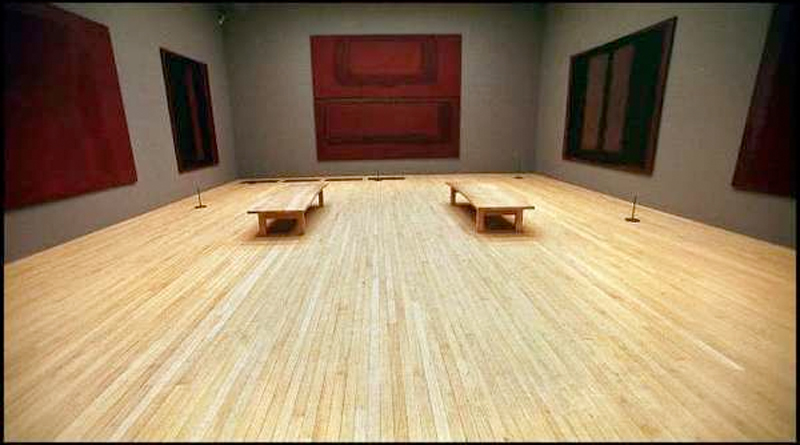
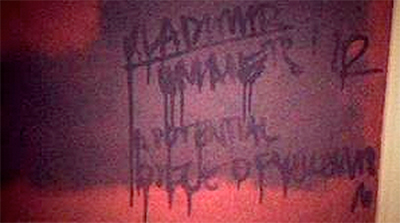
    Last year it was Poussin in the National Gallery, this year Rothko at the Tate. There will have been other examples of vandalism in between these which galleries hushed up, and it is likely that you wouldn’t have known about the Rothko episode had it not been witnessed and photographed. Museums don’t like admitting to attacks on their collections because they wouldn’t want to suggest it’s easy to get away with… The truth is that vandalism is undoubtedly more prevalent than is admitted.

    Outrage is the knee-jerk reaction on such occasions, but by now we should expect damage. Every work of art in every museum is a sitting duck to unintended injury as well as to deliberate vandalism. This is because museum visitors, and especially children, are ignorant and ill-mannered. They get too close and prefer to look with their fingers. Sculpture is especially at risk. Simply by putting art on show so it can be seen properly ensures its vulnerability. Vandalism, and the ease with which it can be perpetrated, are risks that have to be taken despite the potential for disaster.

    The perpetrator of the Rothko graffiti is wearyingly typical of  the Identikit gallery vandal. He is a white, male, disgruntled, barely sane ‘artist’ of no discernible ability. His website, Yellowism, is in the grand tradition of Modernist art manifestos, it being a ragbag of  pompous, semi-literate gibberish. He is also without the true courage of his proclaimed anarchic convictions. Scribbling half-heartedly in the bottom corner of a painting for no good reason other than ephemeral self-advertisement is a feeble stunt. Whatever happened to the grand statement born of blind belief? When suffragette Mary Richardson savagely attacked Velasquez’s Rokeby Venus in the National Gallery with a kitchen knife in 1914 she was perhaps misguided in her choice of target but my word there’s no doubting her vehement commitment to the cause. In comparison to Richardson, this Rothko attacker is a pathetic wimp. They should film him being given a good thrashing outside Tate Modern, call it a ‘Conceptual Video’ and enter it for the Turner Prize.

    With the arsenal of chemicals and sci-fi gadgetry at a modern restorer’s disposal, the painting will be back on display within weeks and exhibit no evidence of its recent tribulations. And alarmist headlines about the financial value of the picture being affected are just crass populism. The Rothko will never be sold, therefore it can have no financial value. If anything the picture’s artistic stock will have risen, given the notoriety it has now achieved and the fatuous incentives some people require to visit museums.

    More perplexing is the accelerating frequency with which damage to important works is occurring. With museums having annual grants from central and local government frozen or reduced, security may not be what it should be. The idiot responsible for damaging the Rothko was able to do his worst and then calmly walk out of the Tate unhindered. This suggests laxity. When the Poussin was damaged last summer in the National Gallery, wardens had only weeks before been instructed to oversee two galleries instead of one. At the time it was suggested the damage would not have happened had the gallery been fully patrolled as before. Maintaining proper surveillance despite cutbacks will not eliminate vandalism, but it might impede its worryingly increased incidence.

    It would appear that enhanced searches at the entrance of national museums, like the airport security imposed already in some continental galleries, is inevitable here also. It may help, but sadly nothing will stop determined unhinged artists from getting through.

    David Lee

    October 2012

  • How state art robs the people

    How state art robs the people

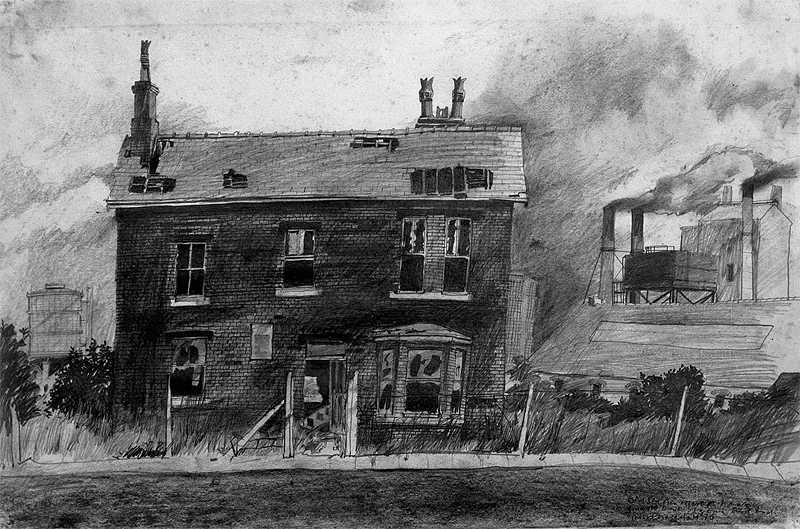
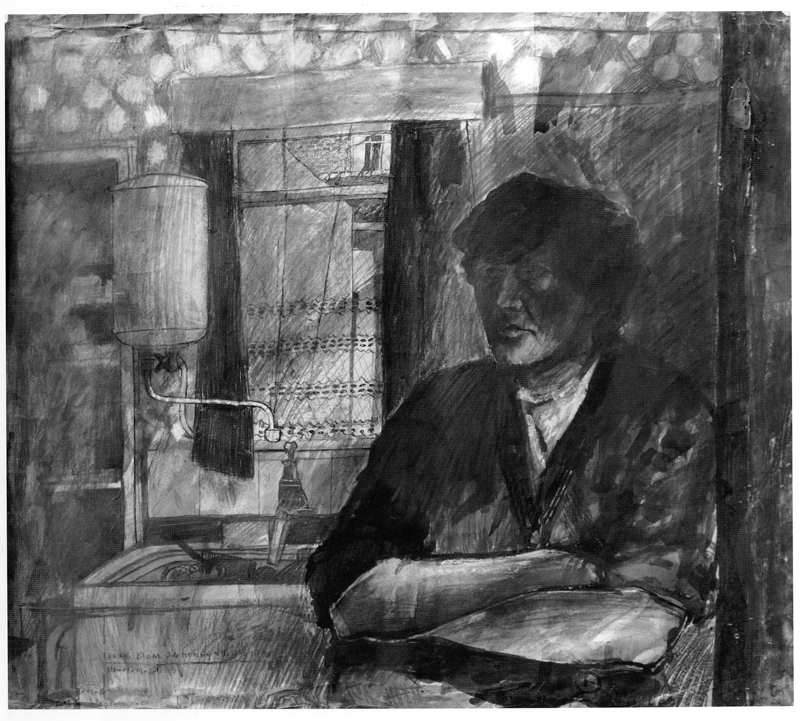
    Chances are you won’t have heard of David Mulholland (1946-2005), a painter of and from Middlesbrough. Until last year, when a group of friends devoted to the preservation of his memory sent me some of his pictures, neither had I. The work hit me immediately as authentic, born of intimate feeling for its subject. Most affecting were powerful graphite and wash drawings of blackened industrial places populated by persevering working people. Having edited a couple of art papers for over twenty years, I felt that if anyone had a right to have heard of David Mulholland then it was at the very least someone in my position.

    What follows is a lament for the establishment’s theft of the richness of our culture. Over decades now, by advancing its prejudices to the exclusion of everything else, art authorities have conspired to deny us sight of so many whose works were valuable testimonies of their time and experience. For their own ends, these all-powerful administrators have kept us in the dark.

    David Mulholland is typical of many accomplished and original 20th century British artists whose names are deservedly kept alive by friends who loved him and knew his worth as both commentator and poet, but who is unknown to the rest of us. No galleries funded by the Arts Council, for example, would dare show the work of these artists even if they wanted to. Mulholland is typical of painters derided by the self-appointed in State Art and sneered at by decision makers. By arts bodies obsessed with ‘innovation’ and the ‘cutting edge’ he is, in that infamous Arts Council phrase “the wrong kind of artist”. Yes, those are the words they use – the wrong kind of artist. What right have they to use a phrase like that? Who do these people think they are?

    As one who described with affection his experience of the hard lives and resilience of poor people, and evoked the gaunt beauty of the tough places in which they lived and worked, Mulholland was “the right kind of artist”. The only kind of artist. He is certainly among those whose work is likely to survive appreciated long into the future. His work was done because it needed to be made, because the observations of a brutal working life and cruel industry, of pleasures and strifes, of hard graft and redundancy, demanded interpretation by an artist. Mulholland’s work doesn’t need a page of unreadable tosh by one of Serota’s army of scribblers in order for you to know what it’s about. Its love for a location and people speaks for itself. In the future, say a century or more from now, those looking at Mulholland’s work will understand without prompting its concerns and causes, what stories it has to tell, and why it has lasted. In all good art, these qualities are self-evident, although in some artists they may take longer to appreciate.

    Mulholland was born in South Bank, a community on the Tees built around quaysides, three blast furnaces, steel rolling mills and fingers of cindery railway sidings. In photographs of the place in its heyday, and before the works closed, it looks smokily Soviet in its concentration of polluting ad hoc production. It’s the sort of place which, if you are born there, is in your blood forever. As landscape painter Len Tabner, another important local and friend of Mulholland, said at the recent opening of his memorial exhibition at the Dorman Museum in Middlesbrough, “Dave went all the way to Byam Shaw and to the Royal College of Art in London but only ever painted South Bank.” Apart from a brief foray as a young seaman, when he painted foreign scenes, it remained that way. He eventually returned home, taught art unconventionally in a secondary school, painted his life and friends, and sometimes the surrounding countryside. His work records a personal journey and history.

    Given the enormous sums now thrown uncritically and unchallenged at contemporary art, one ought to feel safe that excellence in whatever style or medium is somewhere being brought to our attention. But despite the fact that, courtesy of the National Lottery, there are expensive immense new galleries all over the country, the opposite continues to be true. The same few artists dominate news, features and critical coverage. They also dominate all the new galleries because these are controlled exclusively by State Art believers. For them, a foreign artist of no discernible distinction, spotted amidst the trendy jumble and waffle of an international biennale, will always take precedence over the likes of Mulholland.

    If you live in the north, as I do increasingly, you can find Anish Kapoor signing books in Middlesbrough – where his £2.5 million ‘regenerating’ fishing net was unveiled two years ago and still stands bleakly abandoned and pointless in wasteland – and at a retrospective in the Yorkshire Sculpture Park (see Moping Owl, p. 10). In London he is at Lisson Gallery, all over the Royal Academy, and even lording it over the Olympics’ site. No wonder he needs 25 assistants and three studios to churn out his coloured holes and facile shiny mirrors to meet demand. Such a monoculture as is represented by Kapoor doesn’t add to the diversity we deserve, because the rooms he and his ilk occupy with stupefying frequency are denied to others. Newspaper profiles of Kapoor last aired only three months ago when The Orbit was unveiled – having already appeared on dozens of occasions over the last twenty years –  have again been warmed up and paraphrased by others for his new shows in London and Yorkshire. This insulting process of indoctrination goes unmentioned elsewhere, as though it’s taken for granted that only a handful of artists merit such relentless promotion. The only difference in these disgustingly fawning and uncritical pieces is the sentence where they state what Kapoor is currently worth – and it keeps getting bigger, the last number cited being £80 million. For the rest of us, it is impossible not to know Kapoor’s life story off by heart. If only it were interesting. If only all this approbation were the result of his having produced something truly outstanding and comparable with the best from the past… But all that emerges is more of the same branded deluxe ornaments for the grotesque mansions of the immodest rich. And please believe me when I say there is no point in visiting his exhibition at the Yorkshire Sculpture Park, because you’ve seen it many many times before. It takes seconds to walk around. And, do you know what, some of the holes are so dark you can’t be quite sure where the bottom is. How clever is that?

    The neglect of so many for the sake of so few is a phenomenon of the celebrity culture. How long will it be before this system is exposed as a monumental racket dreamed up by a cabal of public officials, commercial dealers and auctioneers with the aim of creating false gods, rigging the market and handsomely feathering the nests of all concerned. Watching this process as it unfolds is sickening and the fact that they have not seen fit to investigate this monopoly brings disgrace on the Culture Select Committee of the House of Commons. They could have made a difference, if only by establishing once and for all that such an all-powerful orthodoxy exists in contemporary art, whose purpose is to discriminate against the likes of David Mulholland.

    Increasingly, I resent this editing of what we’ve been allowed to see, dictated as it is by the tastes of half a dozen bureaucrats with Serota at their head. This President-For-Life has singlehandedly done more damage than anyone in the history of British art to the public’s ability to see the work of a wide range of British artists. He is a self-important scourge building ever greater monuments to his own vanity and tastes, and yet he receives an uncritical press. When is this fellow going to go, and leave us alone? How long will it be before curators in regional galleries can see all art again for its qualities and not be forced to follow trends out of fear for their careers?

    If it is not the work of regional galleries to show the work of their best local artists what is it their job to do? And what an irony it is that the modern art gallery in Middlesbrough is showing coincident with Mulholland’s memorial show an exhibition dealing with “concepts of ‘home’” … starring Tate trustee Jeremy Deller.

    David Mulholland spoke a local language, a ‘home’ language, which is understood internationally by all people. No human being is excluded from its sentiments. State artists talk an international language which, like esperanto, is understood by hardly anyone. There ought to be room for both persuasions, but we are force fed only one.

    David Lee

    The Jackdaw November-December 2012

    www.davidmulholland.co.uk