Tag: David Hockney

  • Laura Gascoigne: Photography, Wrong Sort Of – January 2017

    “And the Praemium Imperiale Award for Painting goes to… a photographer!” Yep, Cindy Sherman has won the Imperial Japanese gong for mastery of greasepaint for that interminable string of selfies in fancy dress we all wearied of circa 1980. If not for greasepaint, it would have to be for psychological insight – and despite her readiness to raid the dressing-up box and make her ageing self look ridiculous in the name of art, Rembrandt she ain’t.

    Sherman is the least qualified non-painter to win the award so far, but she’s not the first. Bill Viola won it in 2011 and Japan’s own Hiroshi Sugimoto in 2009 – both non-painters who piggyback on the history of painting. But no hard feelings; it’s all water under the interdisciplinary bridge. As Frances Morris established at the opening of Tate Modern’s Switch House: “We don’t any longer have a hierarchy where painting is at the top.”

    As if to settle the point beyond dispute, last year the Tate awarded its annual IK Prize for creative talent in the digital industry to a team from Treviso for an experimental project using artificial intelligence to compare news photographs with works in the collection. Titled Re][cognition – potty punctuation is de rigeur in the digi-world – it set out to answer the question: “Can a machine make us look afresh at great art through the lens of today’s world?”

    The way it worked was this. Every day, a crop of current news photos shot by Reuters’ photographers were shown to the machine, which then scanned the collection at the rate of thousands of images a minute and spat out matches based on object, facial, compositional and context recognition.

    Now this is an area I’ve long been interested in, so I went along to Tate Britain to have a look. For years I’ve been collecting news photographs that echo the compositions of old master paintings. Some subjects are naturally fertile territory – almost every refugee mother and baby is a Madonna and Child, every grieving mother a Mater Dolorosa – but the parallels go further. I was particularly pleased to find a photo of Mick Philpott and his wife Mairead at a press conference following the self-started house fire that killed their six children in 2014 doing a perfect impersonation of Adam and Eve in Masaccio’s Expulsion from Eden.

    Are these coincidences? I don’t think the borrowings are deliberate; it’s more that the educated eye of the photographer, making a snap decision in the heat of the moment, matches the scene with a meaningful image in the memory, and frames it. Photographers, being blessed with human brains – and emotional intelligence – can make split-second calculations machines can’t. (If they could, CCTV would produce prize-winning photographs of people breaking open cash points or mugging old ladies.)

    Of course the matches in Recognition were nonsensical. The machine was reliable enough (though not 100%) at identifying ‘a man wearing a white shirt’ or ‘a woman with dark hair’, but despite its programmers’ claims that it could determine “the age, gender and emotional state of each subject it finds”, it was defeated by the most basic of facial expressions. It saw smiles on the faces of Matteo Renzi at a press conference and Francis Bacon in a portrait by Lucian Freud because their mouths were slightly turned up at the corners. A month-old baby would not have made the same mistake; it would probably have cried. Nor, if consulted, would it have drawn a comparison between a photo of Brazilian President Michel Temer attending the launch of a banking initiative at the Planalto Palace with Anthony Caro’s 1980s sculpture Night Movements, on the basis of “prominent shapes and structures, visual layout, and colours”. If it had, its mother would have worried.

    So it was sensible to include an interactive section where visitors could tap a screen and make their own connections “to see if Recognition can learn from the many personal responses humans have when looking at images”. I had some fun matching a Black Friday photo of a frenzy of red and white shopping bags with Patrick Heron’s Azalea Garden. But I was disappointed to find that visitors’ choices were not recorded on the website, where they would have exposed the machine’s inadequacies. It seems that while a computer can be programmed to fudge a fair approximation of a Rembrandt portrait, left to itself it can’t tell one thing from another.

    If this experiment taught us anything, it was that however anti-hierarchical we may be, it’s too soon to open up the competition to artificial intelligence. Yet in the field of photography, that day may not be far off. I’m not talking about news photographers, who do a job no machine could possibly do and bring an acute visual intelligence to it. I’m talking about ‘fine art photographers’ as exemplified by Wolfgang Tillmans, the first photographer to be awarded the Turner Prize, who (having recently finished a stint as a Tate Trustee) has a solo show opening at Tate Modern in February. Tillmans takes egalitarianism to its logical conclusion, refusing to distinguish between motifs: if the geeks from Treviso programmed a computer to take photographs, they would look like his.

    While Tillmans is larging it at Tate Modern, the work of Roger Mayne will be showing at Graves Art Gallery, Sheffield in the exhibition Street View: Photographs of Urban Life (until March 11th). Mayne, a chemistry graduate of Balliol College Oxford, was egalitarian enough to want to devote five years of his life to photographing slum children on the streets of West London. The slums have long gone, but the photographs look as fresh as the day they were taken – which may be why one was chosen as the poster image for Tate Britain’s photographic survey How We Are. In Mayne’s case the past tense would have been more accurate. In 1956 he was given a one-man-show at the ICA. Today he might take photographs for Reuters, but he would never be given a show at Tate Modern because he is the wrong sort of photographer.

    Photography is now the ultimate democratic medium: anyone and everyone can click a shutter. But which images will last? In 60 years’ time, will people feel a jolt of recognition on seeing a photograph by Tillmans, or blank indifference? For a photographer who calls himself a fine artist, impartial records of reality aren’t enough: to lodge in the human mind, a photograph must mean more to a flesh-and-blood viewer than to a Recognition machine. Here painting still retains the emotional edge that the painter doesn’t have to wait for the ‘decisive moment’ to reveal meaning, since meaning is built into the composition. For what it’s worth, Sherman composes her portraits down to the last hair, which could, I suppose, be thought to bring them halfway towards meeting the criteria for a painting prize. But halfway isn’t far enough. There is still the small matter of artistic expression.

    “Photography doesn’t get nearer experience. Painting gets nearer to it because it can do far more,” said David Hockney in a 1984 interview, before quoting Man Ray: “I photograph what you can’t paint, and I paint what you can’t photograph.” A wise judgment, and one the imperial family would do well to consider when awarding the next Praemium Imperiale.

    Laura Gascoigne
    The Jackdaw Jan/Feb 2017
  • Dick French: On The Town – September 2016

    There’s a room in my flat that I rather grandly refer to as ‘The Library’. About 20 years ago I had it fitted out with shelves up to the ceiling with nicely boxed-in corners. It’s painted deep red. For a few years it looked splendid, then it gradually started filling up with junk. Now it’s waist-deep in motorcycle parts, leather trousers, helmets, exhaust pipes and tins of oil. I’ve been trying to excavate it recently as my son has gone off to work in New York, and now the whole flat resembles a junk yard. The book I’m trying to find is the collected writings of Sir Thomas Lawrence. So far I’ve had no luck. I remember it was dark green with faded gold lettering and quite thick. The reason I’m keen to find it is the exhibition Painters’ Paintings at the National Gallery. The great treat of this show is a preparatory drawing by Carracci for The Loves of the Gods, A Woman Being Carried Off by a Sea Monster, which used to belong to Lawrence. It’s such a fantastic piece that I’m sure he must have written about it at some length. What condition was it in before he bought it? Was it rolled up or crumpled? Where did he get it from? How much did he pay for it?

    When I find the book I’m going to be like Lieutenant Columbo when he started to whistle ‘This old man…’, but until then I’ll just consider the exhibition, which is interesting but puzzling.

    How could such a great draughtsman as Degas have lived with Cézanne’s cack-handed Bather with Outstretched Arms? The universal veneration offered up to Cézanne has always been a mystery to me. He did some lovely still lives, but get him away from the fruit and veg and the wonky bottle and jug and he’s just dreadful. Matisse owned a horrible small Cézanne of three bathers, quite ill drawn and formless – viridian, yellow ochre and navy blue. Lucien Freud also lived with a nasty little number by Cézanne, L’Après midi à Naples. Freud’s own self-portrait in this show was dismal. Thick paint, once it is dry should never be painted over. It made me itch. Lord Leighton had a dubious small Tintoretto and Van Dyck had a wonderful Titian.

    Well, so much for art.

    I wandered up to the National Portrait Gallery to see ‘The Beep’. It’s worse than ever this year. The most revolting thing of all was a photo-realist job of Andrew Motion. Motion is an unfortunate name for a poet but it’s a good description of his portrait, and from the little I’ve read of them, his verses as well. Oh, and I nearly forgot. After the Painters’ Paintings show I popped upstairs to see the Humbrol bloke from Coventry and his woodscapes. To paraphrase Richard Dawkins: “This exhibition fills a much-needed gap.”

    After another search of the library I’ve accepted that Sir Thomas Lawrence is no longer there. It’s funny how books go missing. It can be of hardly any interest to anybody but in the process of looking I’ve discovered a few old favourites: The Biggles Omnibus and a fat book of Maigret stories (illustration: Jean Gabin as the sleuth). I’m looking forward to reading these again. A few years ago Penguin started re-publishing some of the early Maigret stories and I didn’t find them all that interesting. In those early pieces Simenon had yet to discover the importance of digression which is one of the great pleasures of his later stories. I’m really interested in what Maigret had for breakfast, whether he has a demi-blanc with his croissants, and I love the way he is always sending down to the Brasserie Dauphine on the Quai des Orfèvres for beer and sandwiches when he’s in the middle of a long interrogation.

    Back to the Humbrol Man. At no point during his rather complicated tree pictures does he take advantage of a slip of the brush. Nothing is allowed to enliven his initial intention. You will search in vain for the “free gift”, and they would have looked much better on wood. The interesting piece among his life drawings was one of Aphrodite at the Waterhole, Tony Hancocks’ great sculpture from The Rebel.

    A large, shell-off crustacean with a head-mounted penis emerges from Barry Humphries’ left sleeve. It’s heading for the Dame’s face with her mismatched eyes. I am of course attending the new exhibition of David Hockney’s portraits at the Royal Academy. Hockney should be congratulated for making a little go a long way. I suppose it’s his Yorkshire thrift. Squeeze out the shrimp paste and mix it here and there with a bit of white. It should be called The Prawn Show. He has an electric motor to make his easel go up and down and employs a “studio manager”. Maybe I should get one ­– that must be where I’ve been going wrong. He even has someone to squeeze his tubes – and that’s not intended as a double entendre. He’s quite good at shoes. I think these portraits are meant to be seen as an ‘installation’ and not individually ‘interrogated’. It’s just as well. Hockney is another painter who has never let a happy accident enliven his pictures. What a plodder.

    But who am I to slag off a national treasure. Well, I suppose it’s because I’m so bitter and twisted I recommend a good slagging off. It’s much more fun.

    A few years ago an artist and good friend of mine, Whingeing Loser in fact, wrote a critical piece about some aspects of the art business, which he showed to someone connected with his local arts council. “You do realise,” this worthy said, “that if you publish this your career will be over.” To which my friend replied, “What career?”.

    Thus was born The Dreadnoughts, we who will slag off anyone. Fear us, we are the future.

    Now, some notes on my recent beauty panels…

    I like to have things unfinished and go back to them later, sometimes years later, and then I know exactly what to do with them. It’s a good way of avoiding the demon of preciosity which can creep up on you and has a paralysing effect.

    Every 20 minutes or so I like to take a break, wander into the front room, see what’s going on in the street. Check how the sukebind is coming on. It’s slow to flower this year but the beans are doing well.

    I do a lot of work from the video screen these days. You have to work fast because if your equipment is anything like mine it jumps after about ten minutes. It’s just like working from life without the chalk. I get a lot of films from my friend Kenny, who runs an exotic shop on Goodge Street, and I’ve done a fair bit of ‘Gonzo’ stuff but I find it rather formulaic. I prefer the transitional movements when the figures are moving between partners and may be a bit off-balance. It would be hard to capture any other way except through photographs but that means you are using someone else’s choice – by stopping the films the choice becomes your own.

    I’ve been working on my men recently ever since Laura Gascoigne described mine as ‘cyphers’. I think she was right but they’re much better now. I got into this way of working because I like to draw the nude, but my nudes have to be doing something. I can’t stand pictures of some poor woman shivering by a radiator.

    In the past the use of nude models served to illustrate mythological themes but those times are long gone. So what, I ask you, do people do with their clothes off? I recommend that you pop along to Kenny’s and discover some rare and wonderful things.

    Dick French
    The Jackdaw Sept/Oct 2016

  • Evelyn Williams, and another case of the public denied

    Evelyn Williams, and another case of the public denied

    In the last issue I considered the case of a single-minded good artist,  David Mulholland from Middlesbrough, whose memory, in the absence of any official recognition or support, has to be kindled for posterity’s sake by friends and family. By The Jackdaw’s usual standard of eliciting no comment whatsoever, this caused a considerable mailbag from many mentioning other artists who deserved better than the obscurity and indifference they receive. Owing to the recent death of a special artist, there is cause for reiterating this line of criticism of an art establishment hopelessly out of touch with anything but ‘The Contemporary’, such as they choose to see it.

    Grief felt at the death of a memorable artist is mitigated always by the fact that their work – if it is properly accomplished and not merely the species that is famous for fifteen minutes – will live forever. Giotto didn’t need an ‘artist’s statement’ or incomprehensible catalogue introductions for his work to last, because his paintings speak for themselves in a universal language understood across the centuries. His work will continue to communicate clearly its observations of character and stories just as long as human beings are prepared to see,  feel and respond. This is the case also with the art of Evelyn Williams who died aged 83 on November 14th. Her work will endure in spite of the neglect she received from officialdom during a long and productive career. In the same Tate Collection which stores 274 works by Andy Warhol no space can be found for a single piece by Evelyn Williams, who is a far more interesting artist if not so much of a business-minded celebrity phenomenon whose market is carefully rigged. Even in the last two years alone, when 516 works were acquired by the Tate, there was no room for a single one by this important woman artist. There are even ten works in our national collection by American minimalist Robert Ryman, all of them white and doubtless extremely challenging to those of a devoutly all-whiteist fanaticism; but nothing by Evelyn Williams. Here is further evidence that at the nucleus of State Art breeds a deeply entrenched prejudice against anything but pseudo-intellectual nonsense.

    It is an appalling truth that the Tate has ceased to be a collection of British art preserving the very best of what is being done. Instead, it has been stealthily subverted under Serota to become a private collecting fief promoting a narrow orthodoxy related to a handful of dealers and auctioneers. Why is it that so much about today’s Tate stinks? Evelyn Williams is in a long line of single-minded British artists who refuse to run along the pre-ordained tramlines of conceptualism and modernism. She was a thoughtful, modest, intelligent and vulnerable person alive in a world – as she perceived and experienced it – of imminent dangers. Her paintings, sculptures and reliefs are about the fear and anxiety, the affections and frictions, of what it is to have lived the life of an anxious woman and mother. Hers is first and last a woman’s art, an uncompromising take on post-war relationships, intimacy, cares, depression, failure and even alienation. Her subjects take you inside the realm of senses and feelings, probing the unspoken secrecies behind the masks of propriety we all wear. In the way that art has of redeeming the awful, these are beautiful explorations of states of mind most try to avoid. Her work can be relentlessly intense, no question about that, but it is pure in spirit and purpose.

    Three of the more serious newspapers, the Times, the Telegraph and the Guardian, were eventually persuaded to publish obituaries of Williams. As with so many significant but neglected artists who are nevertheless considered worthy of an obituary, her exhibitions were scarcely even acknowledged let alone reviewed in the arts pages of these same papers. Critically, it was as if her work didn’t exist. She is, of course, among the many accomplished artists whose work is ignored for being conventional in appearance and technique and declamatory about emotions. To today’s State Art tyrants such characteristics are considered embarrassing drawbacks.

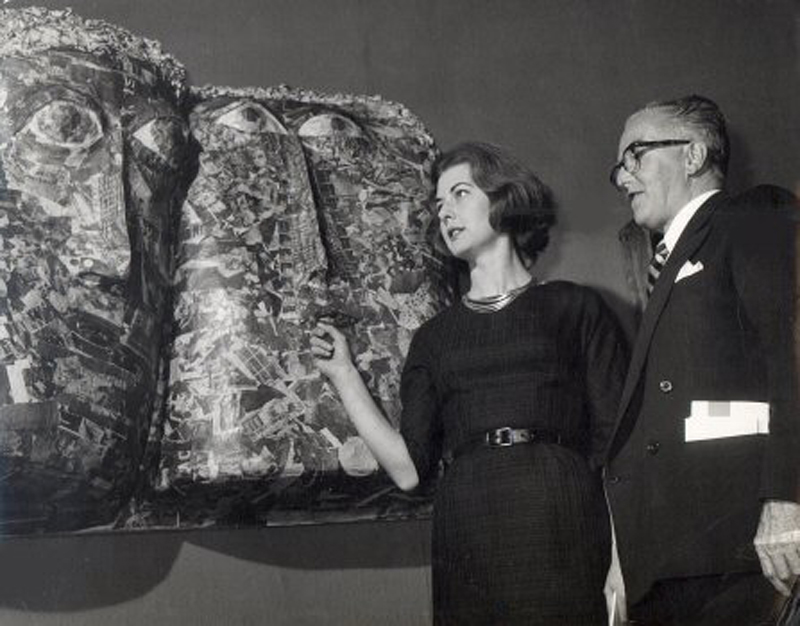
    Williams was, however, appreciated in the past. As a youngish artist in 1961 she won the sculpture prize (for Two Heads) at the John Moores in Liverpool, when other winners were Peter Blake, David Hockney and Ron Kitaj. These were the days when the Moores was worth winning, well before it was subverted to the cause of State Art where daubs of no merit are greeted by fools with preposterous superlatives. A retrospective exhibition was held in 1972 at Whitechapel Art Gallery; once again well before that gallery’s prostration before the winds of Biennale bluster. Williams continued her brave exploration of inner places that made her work then so widely admired. She worked every day of her life and although her commercial exhibitions continued, sometimes at long intervals owing to the complexity of ideas and their necessarily prolix gestation, a retrospective was never offered in her lifetime. Approached by friends in the last decade of her life, the Walker Art Gallery turned her down for such an honour. She couldn’t exert the pulling power of a Rolf Harris or Paul McCartney.

    Will Williams now receive the lifetime retrospective her work deserves, and which a wide audience should see? It isn’t likely.

    But why should this be, when there are more galleries nationwide which are more spacious than ever before? The answer is that as the public gallery network expands the same orthodoxy is spread across even more outlets. More galleries does not mean a wider selection of work on display; it means the same work by the same few artists spread across even more galleries even more frequently.

    What are called ‘Artists’ Rooms’ are a symbolic example of what is wrong with this rotten system. These ‘Rooms’ are organised by the Tate, the Scottish National Gallery of Modern Art and the Art Fund (how long will it be before the Art Fund can only be contacted via the Tate switchboard?), and they resulted from a bulk purchase, jointly by the Tate and the SNGMA in 2008. We bought for £42 million (£27 million in cash – the figure varies in different reports; we’ve never been told the exact sum – and £15 million in waived tax) retiring art dealer Anthony d’Offay’s gallery stock, which he called his private collection.  A cynic might say that Artists’ Rooms is the process by which the personal collection of one commercially motivated individual now dictates what a large proportion of the art-seeking population is allowed to see in the name of recent art. The same cynic might further add that Artists’ Rooms is the opportunity by which established reputations – such as Warhol’s – are constantly hammered home, and for the smaller ‘Room’ names, it is the instrument by which a more significant brand name can be nurtured.

    Under the auspices of the Art Fund, an organisation which luckily is headed by a former director of Tate Britain, 30 rooms featuring 760 works by 26 artists have been touring the country for four years, mostly as small one-man retrospectives. Some of these are marvellous, not least the extensive collection of photographs by August Sander. There are 232 works by Warhol alone, who gets two rooms to himself travelling at the same time. At the moment they are in Sheffield and Hull, and then Birmingham for four months. That is apart from relatively recent major exhibitions for the same artist at the Tate, the Hayward and other Arts Council galleries.  Warhol is showing somewhere all the time. We will not be allowed to ignore him.

    One of the Artists’ Rooms deals, inevitably, with Damien Hirst. This is currently on show in Walsall Art Gallery. It has been there for two months already and will remain in place for another year. What is happening when a fifty-year-old artist, already over-exhibited at a time when so many unexposed artists can’t get their work shown, is having a thirteen-month long exhibition? What is the reason for such indoctrination? Too often the Artists’ Rooms represent those who are already widely exhibited and who are bastions of the art market.

    Artists Rooms are a blunt instrument whereby approved taste is circulated (inflicted) from the centre. They constitute cheap exhibitions for Arts Council venues up and down the country, whose curators don’t have to originate their own programme. The laziness and ready compliance of these jobsworths is a godsend to State Art.  They can merely exhibit the same few approved brand names for ever. And make no mistake their career will depend upon them favouring these “right” kinds of artists for no individual prospers in State Art by demonstrating initiative or investigating the unorthodox.

    Visit the Hepworth Gallery in Wakefield and you will discover the other reason, besides the dreaded Artists’ Rooms, why thought and broad knowledge among curators is unnecessary. There is a new species of art collectors who caught the disease of wholesale, apparently random acquisition from Saatchi. These people fuel the market for State Art which they buy in quite staggering quantities. Their houses, full of wince-inducing tat bought for eye-watering sums, feature frequently in glossy magazines. Usually they are rewarded for their commitment to the State Art cause with the accolade of a position on a Tate committee, of which there are now dozens. At Serota’s Tate money not knowledge is the essential qualification for co-option.

    One such überbuyer – who has not yet been brought on to any Tate committee – is one David Roberts, a property developer, who has accumulated so much clutter he’s opened his own ‘space’ and has begun feeding pieces to regional galleries, Wakefield being the first venue. Works selected are linked as follows: “This exhibition examines ways in which modern and contemporary artists represent the human

    body in various media to explore psychological and emotional life.” What a perfect criterion that is for the inclusion of a major work by Evelyn Williams. Unfortunately, the trouble is that among Roberts’s 3,000 plus works there is nothing by Williams. But have a guess whose work he does own and whose efforts are on show in Wakefield: enter Warhol and Hirst.

    David Lee

    The Jackdaw January-February 2013

    http://www.evelynwilliams.com/index.htm