Tag: Rothko

  • Martin Lang: Against life drawing

    Advocating life drawing at art school is a deeply conservative and reactionary position. Arguments in favour of life drawing usually fall into one of two camps (or sometimes both). I am utterly unconvinced by both.

    The first, and weaker, argument contends that it is necessary to learn the rules before you can break them. This is an authoritarian position where you must learn to draw “properly” before you can make other kinds of art. We can almost dismiss this argument out of hand. Imagine discovering a great artist, falling in love with her work, telling others how wonderful it is, but then finding out that her life drawing wasn’t up to much. Would you re-assess your judgement and decide that the art you once loved must be substandard? You probably wouldn’t dismiss your favourite musician if you discovered that he couldn’t read music: this is irrelevant if the music is good. Perhaps cinema might be a better comparison, since artists also work in film. Most people wouldn’t rubbish their favourite director upon finding out that he couldn’t draw very well. So why would you apply this criterion to an artist film maker? In both cases it is irrelevant if the films are good.

    This first argument shifts the focus away from the artwork and onto the artist’s training. To accept the argument is to accept that you are unable to judge the quality of the artwork without knowing something about the artist’s education. This is a useful argument if you do not like Modern or contemporary art, where such training is not discernible. Under this perspective, Mondrian’s grid paintings or Rothko’s colour fields are acceptable only if they can first prove that they are able to make more conservative kinds of art. This is the concession to Modern and contemporary art that the conservative authoritarian makes, reminding us that Picasso was an excellent draftsman before he dedicated his life to learning to draw like a child. If you value any kind of non-representational art (such as abstraction), any kind of de-skilled art, performance or relational art, then the argument that the prior mastery of life drawing is necessary falls short.

    The second, and more sophisticated, argument claims that mastery of life drawing is not necessary, but that it should be learnt anyway. Even if, after hours of classes, the art student is useless at drawing the figure, and even if she has no intention of making any kind of figurative drawing, painting or sculpture, there are still fundamental benefits to studying life drawing. These benefits include discipline (turning up on time, prepared with the necessary equipment), concentration (the ability to work on one thing for extended periods) and looking (training the eye). Proponents of this argument contend that these skills are just as useful for making non-representational and deskilled practices, because they provide the student with a greater sense of aesthetic awareness and a robust work ethic. But I have never once heard anyone who has made this argument call for the reintroduction of still life classes. Imagine bragging that your fine art degree programme obliges students to spend one day a week drawing fruit to enhance their concentration and observational ability. Why not also teach geometry, perspective and colour theory on a weekly, compulsory basis? You could do this, but you would have a deeply reactionary course that would churn out conservative artists. Readers might note that this second argument is also an authoritarian one, since it assumes that all art students learn in the same way. Whatever the student’s learning style, background (religious sensibilities come to the fore here) and whatever their artistic aims, their training must be grounded in observation of the nude human figure.

    Another strand to the second argument maintains that life drawing can be taught in an experimental manner to produce more cutting-edge artists. Examples include where life drawing concentrates on experiential drawing or experimentation with materials, methods and techniques (there are other examples). But this is no longer life drawing, for to teach these things there is no need for a model. Terming it as such only reinforces the assumption that the underlying tradition of life drawing is something that must be preserved, even when it is irrelevant to the tutor’s pedagogic aims and the student’s artistic ambitions.

    Life drawing was developed as a pedagogical tool to train Western artists to make figurative painting and sculpture. The reason that it still exists in some art schools is mostly down to tradition. While life drawing may be useful for some types of artist, it is not applicable to all. I am not saying that its teaching necessarily prohibits the development of good, exciting and relevant artists. My argument is that it is not necessary and does more to hinder the development of such artists than it does to encourage them. To teach it is to enforce a hierarchy: representation over abstraction, traditional forms of art over more avant-garde kinds. It is also to deny art’s radical potential: must art activists first learn such conservative lessons? Embedded within this hierarchical and authoritarian position lies a reactionary and conservative politics. Nostalgia and fascism have always walked hand in hand. Think of Mussolini harking back to the Roman Empire, or Hitler’s love of classical art and architecture. Today we might think of Trump’s slogan “make America great again” and Brexit talk of “taking back control”. We urgently need free thinking artists able to critique contemporary nostalgia, populism and even outright racism and sexism. For that we need a pedagogical approach that is progressive, inclusive, and libertarian. This will allow for more progressive forms of art to develop and emerge – including non-Western kinds. For these reasons, I am against the teaching of life drawing.

    Martin Lang is a lecturer in Fine Art at the University of Lincoln.
    E-mail: mlang@lincoln.ac.uk
  • Dick French: On The Town – November 2016

    Well done Fabienne Jenny Jacquet for her Easel Words in the last issue. She writes very clearly, which is rare for an artist. She is concerned with artists and their dealers’ demands for a neat visual package and a personal ‘brand’. I liked her piece very much. I don’t bother with dealers these days. If anyone is interested in my work I’m quite easy to find. Just ask in Bradley’s Spanish Bar or you could try and see my agent Gregorio who has an office next door … but be warned he’s a very busy man. Madame Jacquet’s paintings look quite interesting. They seem to be knifed on. I must try to get to see them properly. Sock it to the spivs madame. I deeply resent handing over half my hard-earned to some wide boy who runs an art shop.

    To Fortnum and Mason’s to purchase some Gentleman’s Relish. I’m running low and Christmas is coming. On the way I met Dirty Harry in The Chequers. He reminded me that there was a big art show going on in Fortnum’s, the collection of ‘Saatchi of the North’ Frank Cohen, so we popped in. The door was opened by a friendly Irishman in a top hat who explained that the collection was distributed throughout the store on all floors. It was an interesting but puzzling display, but then I’m always saying that.

    How can someone who has bought Edward Burra with his idiosyncratic draughtsmanship, wit and mischief possibly be interested in the feeble, self-important gesturings of Howard Hodgkin? There’s also a creature called Charming Baker extensively represented, whose sculptures must be made for middle-eastern clients – they’ll look good on the dashboard. The ‘Geometry of Fear’ sculptors are also here in force, Armitage, Chadwick, etc.. They seemed to blend into the background.

    The best things were the Burras, especially a magnificent gloomy pub scene from 1946. You can feel the damp and foggy chill and a bit of reeking warmth from the gas stove. Burra himself seems to be standing at the bar as a flame-like ghost floats off towards the left, probably one of those ‘free gifts’ he’s turned to advantage. I’m sure it’s a self-portrait although the nose suggests otherwise.

    I’m also totally baffled by the inclusion of Marc Quinn and his ludicrous travesty of Degas’s ballet dancer. I can only assume that Cohen has a team of advisors, as there is no indication of a personal ‘eye’. It’s a bit of a rag bag really, or, as Edward Burra would say: “It’s all a proper cunt and no mistake dearie.”

    I managed to find the Gentleman’s Relish but these days it comes in a lovely blue porcelain pot at £16.50 a go, and it’s now called Fortnum’s Relish. I wonder if they still do it in Sainsbury’s.

    There were also three paintings by William Roberts that were worth looking at. A chap I once knew who had a small collection of W. Roberts used to say of him, “poor fellow, the world’s passed him by”. He also had a hideous late Picasso hanging over the mantlepiece. It was a cavalier smoking a pipe about five feet by four. I advised him to flog it off while it was still worth something. I’ve not been asked back. Picasso has been highly regarded and sought after for over a hundred years. It can’t go on forever. The tedious old clown will surely be rumbled soon. Don’t forget what happened to Lord Leighton. “But Lord Leighton had a revival” I hear you say. He also had a romantic sensibility and a true appreciation of form.

    To the Royal Academy to see the Abstract Expressionist show. Pride of place is given over to the murderous, shirtlifting old cowpoke Jackson Pollock. I was surprised by the condition of Blue Poles. The last time I saw it was in his retrospective at the Tate 20 years ago and it looked dreadful, the colours not so much faded as intensified in crudity. The colours are paradoxically much more agreeable now. It must have been restored, some task I imagine, or maybe it’s the Aussie air. The cheap cotton duck had yellowed and cracked.

    There was an enormous oriental fellow in a heavy black overcoat and a homburg hat, his arms extended towards it, palms to the painting. I just had to see him from the front. His eyes were tightly shut and he resembled Odd Job in the James Bond film, the chap with the lethal bladed hat brim. I’ll never forget that. It was a perfect example of how people can become deluded by reputation. “It was the vibes man, the vibes.” Oh shut up.

    Blue Poles (opposite), now highly regarded, was considered a failure by Pollock, a retrograde step from what many considered the groundbreaking black and white paintings of his previous series. It was a collaboration. He called in Barnett Newman and an Irishman called Tony Smith. The ‘poles’ were applied by a six-foot length of four by two. Apparently he was anxious not to waste the expensive Belgian linen. Well it doesn’t look like Belgian linen to me. Using oil-based household paint on raw cotton duck, as he invariably did, it’s a wonder they haven’t rotted and fallen apart.

    Most of these pioneering, free-spirited artists were in thrall to Clement Greenberg. This is odd because Greenberg’s qualifications as an art guru were very slight – a summer session at the Art Student’s League and a few lectures at the Hoffman Institute. Previously he had worked on the Partisan Review, trying to make a name for himself in the literary world, in which he was regarded as pompous and intellectually mediocre. He was a posturing fraud but they hung on to his every word. It is said that he’d walk into an artist’s studio, look at a painting and declare “You can’t do that!” And they actually stopped doing it!

    He it was, who conferred the mantle of “greatness” from time to time, on this one or that one. At first Pollock was the man, but his time on the sunlit uplands was surprisingly brief. After a couple of years they all turned against him. That article in Time magazine put everybody’s back up. He became a ghastly bore from whom everyone wanted to escape. Poor man. Whatever you think of his work or his behaviour he was deeply serious.

    There’s a story that all his life he urinated in the sitting position, like most women, and another story about how he pissed into the fieplace at a swanky art party. I hope he didn’t do that sitting down.

    Numbering the paintings was also a Greenberg idea, the problem being that the numbers were not consecutive but picked at random. Then Greenberg changed his mind and proposed titles. Hence Lavender Mist … (‘Sorry about last night darling I must have been a bit lavender.’)

    Greenberg was a Marxist with a belief in the historical inevitability of artistic progress, or was he just flying a kite? Maybe a bit of both, but a sly boots if ever there was one. Someone described his approach as ‘puritanical nonsense applied with Talmudic intensity’. It was all to do with the ‘integrity of the picture plane’ you see.

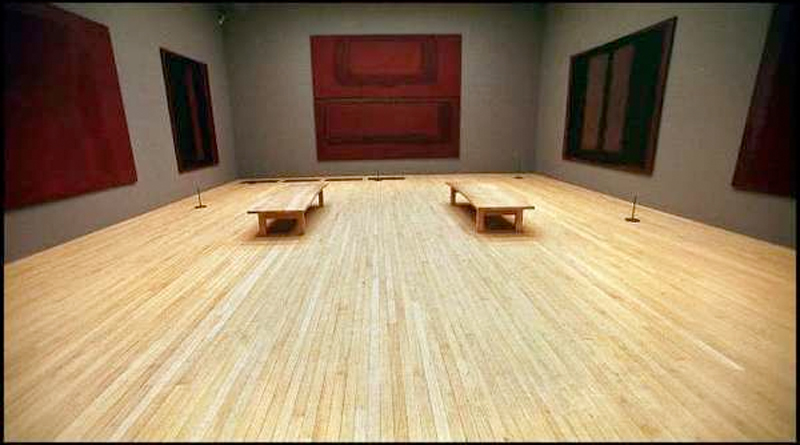
    There are seven paintings by Rothko in the rotunda and although I didn’t have an epiphany I liked three of them very much, the dark, close-toned ones with the glowing bass lines. Rothko was another one of those ghastly bores who became shunned.

    A stellar bit of hyperbole in the catalogue about Clyfford Still … “The upright living being and spiritual transcendence. Its nemeses are the yawning abysses – by turns molten and glacial which interlock with his upthrusts. An almost Manichean play of luminosity and darkness heightens this dramaturgy, intensified by Still’s scabrous surfaces.” Nice. I like that ‘upthrusts’.

    De Kooning’s paintings have something which sets them apart from the others. You sense a compositional ability and draughtsmanship, particularly in his ‘Women’ series, although the best of these are not included. They’re very strong but he went off badly in the 1960s becoming pale and wishy-washy, chalky abstract landscapes with no tonality.

    There’s a sense of ‘The All American Boy’ about this period and almost everything that came afterwards. An inability to draw was elevated to a virtue along with scorn for the sensuous application of paint. But look back fifty years to George Bellows and the Ashcan School of New York painters and they could draw beautifully and paint as well as any European. What came after this was, of course, Rauschenberg, Johns and Pop Art. That’s historical inevitability for you.

    It’s also interesting that the fashion for ‘tough guy’ artists crossed the Atlantic. We don’t have cowboys in England but at the Royal College of Art in the ’60s there was a fashion for behaving like an East End gangster. Elective mutism or self-imposed thickness was common, along with the sophistry that led to conceptualism.

    Dick French
    The Jackdaw Nov/Dec 2016

    www.frenchonpaper.tumblr.com
    www.vimeo.com/12538534

  • Rothko vandalism

    Rothko vandalism

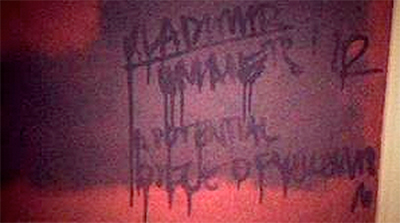
    Last year it was Poussin in the National Gallery, this year Rothko at the Tate. There will have been other examples of vandalism in between these which galleries hushed up, and it is likely that you wouldn’t have known about the Rothko episode had it not been witnessed and photographed. Museums don’t like admitting to attacks on their collections because they wouldn’t want to suggest it’s easy to get away with… The truth is that vandalism is undoubtedly more prevalent than is admitted.

    Outrage is the knee-jerk reaction on such occasions, but by now we should expect damage. Every work of art in every museum is a sitting duck to unintended injury as well as to deliberate vandalism. This is because museum visitors, and especially children, are ignorant and ill-mannered. They get too close and prefer to look with their fingers. Sculpture is especially at risk. Simply by putting art on show so it can be seen properly ensures its vulnerability. Vandalism, and the ease with which it can be perpetrated, are risks that have to be taken despite the potential for disaster.

    The perpetrator of the Rothko graffiti is wearyingly typical of  the Identikit gallery vandal. He is a white, male, disgruntled, barely sane ‘artist’ of no discernible ability. His website, Yellowism, is in the grand tradition of Modernist art manifestos, it being a ragbag of  pompous, semi-literate gibberish. He is also without the true courage of his proclaimed anarchic convictions. Scribbling half-heartedly in the bottom corner of a painting for no good reason other than ephemeral self-advertisement is a feeble stunt. Whatever happened to the grand statement born of blind belief? When suffragette Mary Richardson savagely attacked Velasquez’s Rokeby Venus in the National Gallery with a kitchen knife in 1914 she was perhaps misguided in her choice of target but my word there’s no doubting her vehement commitment to the cause. In comparison to Richardson, this Rothko attacker is a pathetic wimp. They should film him being given a good thrashing outside Tate Modern, call it a ‘Conceptual Video’ and enter it for the Turner Prize.

    With the arsenal of chemicals and sci-fi gadgetry at a modern restorer’s disposal, the painting will be back on display within weeks and exhibit no evidence of its recent tribulations. And alarmist headlines about the financial value of the picture being affected are just crass populism. The Rothko will never be sold, therefore it can have no financial value. If anything the picture’s artistic stock will have risen, given the notoriety it has now achieved and the fatuous incentives some people require to visit museums.

    More perplexing is the accelerating frequency with which damage to important works is occurring. With museums having annual grants from central and local government frozen or reduced, security may not be what it should be. The idiot responsible for damaging the Rothko was able to do his worst and then calmly walk out of the Tate unhindered. This suggests laxity. When the Poussin was damaged last summer in the National Gallery, wardens had only weeks before been instructed to oversee two galleries instead of one. At the time it was suggested the damage would not have happened had the gallery been fully patrolled as before. Maintaining proper surveillance despite cutbacks will not eliminate vandalism, but it might impede its worryingly increased incidence.

    It would appear that enhanced searches at the entrance of national museums, like the airport security imposed already in some continental galleries, is inevitable here also. It may help, but sadly nothing will stop determined unhinged artists from getting through.

    David Lee

    October 2012