Tag: BP Portrait Award

  • Champagne feminist

    Sixteen years ago, I wrote an article for a short-lived women’s art magazine called Make responding to a complaint on the letters page that only childless women could succeed as artists. Off the top of my head, I immediately thought of half a dozen artists who disproved this rule and I interviewed them for a piece called A Woman’s Work. They included Shani Rhys-James, Evelyn Williams, Susan Wilson and Sarah Raphael. A quote from Raphael, who had just had a third child, appeared to clinch the argument: “Motherhood is such an overwhelming purpose that it has to be very powerful, the urge to do the other thing. It cuts the crap. I just haven’t got the time to sit around wondering what sort of artist I am. The kids get their trainers, that’s the main thing. I think it’s horseshit, personally, that you can’t be both.”

    Gender studies have since moved on, along with definitions of mother and womanhood. We’ve had handbags at dawn between David Furnish – or was it Elton John? – and Domenico Dolce – or was it Stefano Gabbana? – over the dress designer’s suggestion that men can’t be proper Italian mammas, and Germaine Greer has been sent into purdah for refusing to recognise transgender women as women. This throws up some interesting artistic questions. If Caitlin Jenner re-reinvented herself as a woman artist, would she produce women’s art? Given that artists draw on their life experiences and Jenner’s, up till now, have been a man’s, her artistic perspective ought to be male. But who knows? These days there’s really no way of telling until s/he is imprisoned for violent assault, when a decision can be made according to the gender of the prison.

    It’s legitimate to talk about ‘women’s fiction’ because women buy it, but is it invidious to talk about ‘women’s art’ when the vast majority of collectors with disposable incomes to spend on art are men? (Interestingly no one talks about ‘gay art’, perhaps because if you removed all the homosexuals from art history it would knock a huge hole, so to speak, in the male art pantheon.) We live in an increasingly touchy world. Such are our sensitivities on gender issues that some in the trans community – smaller than the community of giant pandas, but more visible – are calling for gender specification to be dropped from official forms. Since one of the presumed points of official forms is to ensure fairness, others in the feminist community have complained that this will make it harder, all things being unequal, to monitor sexual equality. No sex, no equality – we’re British.

    It hardly seems worth getting one’s knickers in a twist when all the data on gender collected to date has had no visible impact on the only significant measure of equality, the pay packet. But now women artists have found a surprising champion in Charles Saatchi. The wife-throttling philanthropist has chosen to mark his gallery’s 30th anniversary with Champagne Life (until March 6th), an exhibition of 14 emerging women artists from around the world. In the wake of the gallery’s recent series of exhibitions of contemporary art from Africa and Latin America, Russia, Germany, the Middle East and China, comes a show of art from the planet Venus. Any Martian glancing through the recent programme might be forgiven for thinking the female sex was a foreign country.

    Aware of the problem, the show’s publicity stresses that it “does not offer an overarching vista of ‘female’ artistic practice, nor does it presume to state that there is such a thing”. There are plenty of people around, however, who assume there is. Most wouldn’t dare go as far as Brian Sewell and claim: “There has never been a first rank woman artist. Only men are capable of aesthetic greatness”. But Sewell did agree with the Make magazine moaner: “Maybe it’s something to do with bearing children.”

    Historically, this was obviously true. Greer’s The Obstacle Race is a catalogue of female artistic ambitions hobbled or snuffed out by childbearing; between domestic commitments to children, husbands, fathers and brothers, a woman’s work as an artist was never done. Equally damaging, in her view, was the imitative hero-worship squandered by women artists on male teachers or husbands – or both, in cases where love-struck women students married their masters. “The artistic ego is to most women repulsive in themselves, and compelling in men,” is Greer’s analysis of the situation. Or as Degas put it to Suzanne Valadon: “You must have more pride.”

    Male ‘aesthetic greatness’ often goes with showing off; the problem is that the public can’t tell one from the other. Not being natural show-offs, women artists are too easily diverted from the self-satisfaction of making reputations by the deeper satisfaction of making things. “No artistic success has given me as much pleasure,” said Liubov Popova, “as the sight of a peasant buying a length of material designed by me.” The artist of ambition, argues Greer, “must have a masterful attitude not only to his subject, but also to the beholder whose attention he claims”. This, she suggests, is why women have tended to work small.

    Not any longer. There are no small works in Champagne Life, with the exception of two little heads hanging amongst Jelena Bulajic’s monumental portraits of old women. Still in her 20s, this young Serbian artist – who had two paintings in last year’s RA Summer Exhibition – is something of a prodigy. Although shortlisted for the BP Portrait Award, her magnified grisaille faces showing every wrinkle are not photorealist: from close to, they break down into pointilliste confections of marble dust, ground granite and limestone, kaolin, graphite and charcoal. In terms of technique, most of the paintings in this show ­– from the densely patterned mythological images of American Mequitta Ahuja, executed in acrylic, coloured pencil, oil, watercolour and wax crayon on vellum, to the nude body landscapes of Korean Seung Ah Paik, with their perfect nipples stippled in pigment sealed with rabbit skin glue – are in a different class from the slapdash efforts of the mostly male artists in the gallery’s recent Pangaea exhibitions. These women artists take a pride in their work: they like making things.

    Is it patronising of a male patron to stage a women-only exhibition? The Tate has been promoting women’s art, but only through safe solo shows of established artists. Saatchi, meanwhile, has brought together 14 strikingly different young women artists in a group exhibition whose effect, intentional or not, is to blow the idea of ‘women’s art’ out of the water. Yet on the most basic measure of equality – money – art by women still ranks a distant second. In 2014 the holy cow of American modernism, Georgia O’Keeffe, broke auction records for a woman artist with the sale of Jimson Weed/White Flower No 1 for $44 million at Sotheby’s New York; the following year Picasso’s Women of Algiers sold for almost exactly four times as much at Christie’s. It puts the 20% gender pay gap in the workplace into proportion.

    One glass ceiling leads to another. As long as the art market is dominated by male collectors on whom a sniff of senescent Picasso acts like rhino horn, nothing’s going to change. Saatchi’s gesture is welcome, but any celebration would be premature. Until women’s work commands equal prices, the champagne can stay on ice.

    Laura Gascoigne
     

  • Carl Randall – easel words

    Carl Randall – easel words

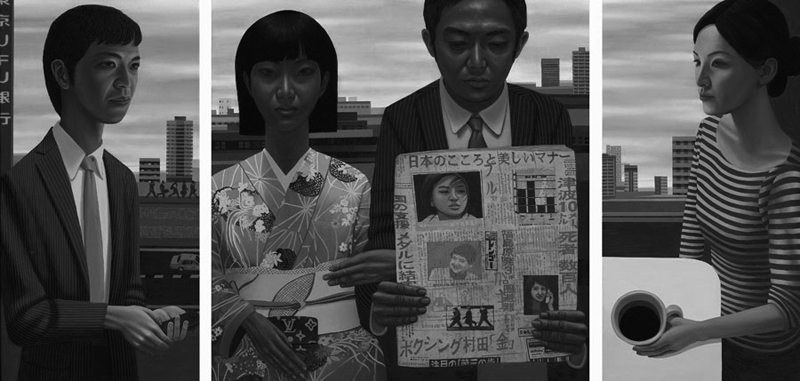
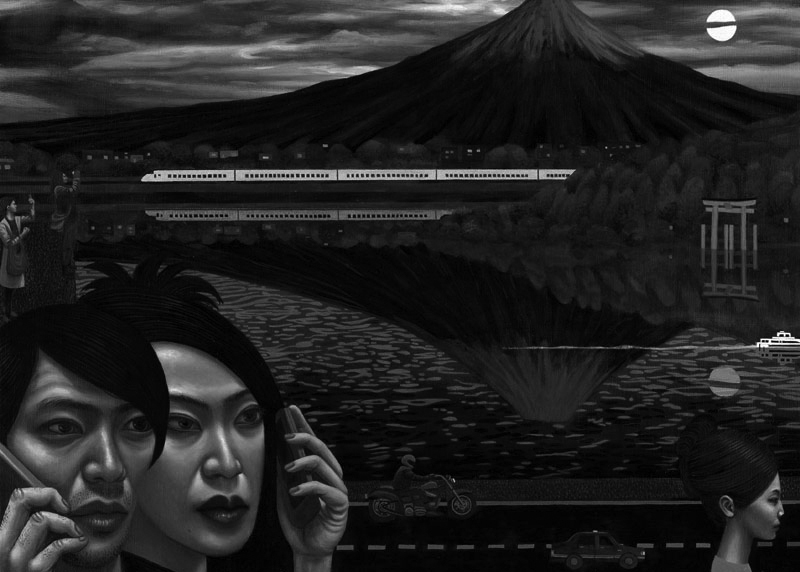
    Recent paintings made in Japan will be showing at my exhibition ‘In The Footsteps of Hiroshige: The Tokaido Highway and Portraits of Modern Japan’, at the National Portrait Gallery from June 20th to September 15th (then touring the UK until May 2014). The exhibition is the result of being awarded the 2012 BP Portrait Award.

    My proposal for the award was to travel in the footsteps of the Japanese woodblock print artist Ando Hiroshige (1797–1858), who in 1832 travelled along the Tokaido Highway, an old trading route that ran from Tokyo to Kyoto, producing a series of woodblock prints showing the people he met and the landscapes he experienced along the path. The prints now serve as a valuable artistic document of life in Japan at that time. I was interested in producing contemporary equivalents, documenting the people and places of modern Japan, 180 years after Hiroshige made the same journey.

    The journey started in the bustling capital city of Tokyo, and, drawn to its densely crowded streets, I painted hundreds of residents one by one, directly from life. Visiting other major cities along the route, I painted other features of modern Japan such as salary men, sushi restaurants and department stores. As the highway moves out of cities and into rural areas, elderly rice farmers work their fields, their backs permanently bowed, skin leathery and wrinkled from a lifetime of farming. While visiting these areas, I also had the opportunity to experience aspects of traditional Japanese scenes such as hot springs, fireflies and red autumn leaves.

    Finding the modern and urban ever present in the rural, I included elements of the industrial within images of nature: bullet trains cut through mountains, telegraph poles dot the landscape, tetrapods line the coastline. These, and other motifs, such as the mobile phone, are used to place the images in the contemporary world, while also helping to avoid nostalgic depictions of historical Japan. I would hope that my portrayal of familiar Japanese icons such as Mount Fuji, Geisha, Kabuki, Zen gardens and Sumo wrestlers have been presented in a fresh light.

    Combining a sense of the real and unreal in these paintings was important to me, with realistically painted figures set against flattening space and illogical scale. I painted some works in monotone, to imbue them with a feeling of solitude and silence, which relates to my interest in urban alienation – the idea of people sharing the same close physical space, but mentally existing in separate worlds.

    This exciting opportunity allowed me to develop my interest in portraiture and create personal interpretations of Japan, while following in the footsteps of a great artist. I felt privileged to be the first portrait painter to respond to this subject matter, and I would hope that this exhibition generates further public interest in this fascinating country.

    Japan Portraits, a 120-page colour hardback catalogue of work made in Japan, is available at The National Portrait Gallery – foreword by Desmond Morris with an introduction by Donald Richie. A documentary about the artist painting in Japan is at www.vimeo.com/carlrandall/japanportraits.

    Artist’s website: www.carlrandall.com

  • Hitting the right tone (or tits first)

    Hitting the right tone (or tits first)

    Almost part of The Season now, the only surprise these days about the annual BP Portrait Award is that the Queen doesn’t cut the ribbon and hand out the rosettes. As ever, this year is as popular with the public as any art exhibition, with large numbers jostling and genuinely engaging with the work eagerly discussing merits and demerits of more conspicuous pieces.

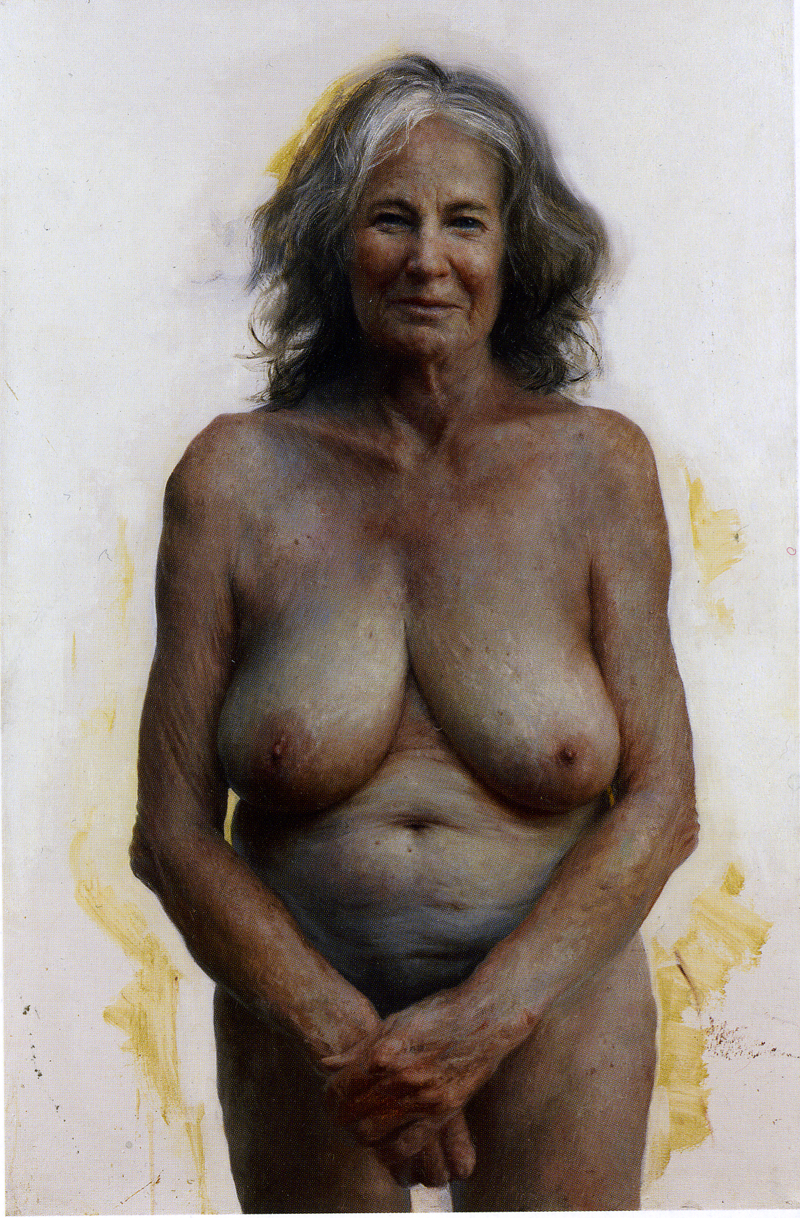
    As usual the winning picture, Auntie by 26-year-old American Aleah Chapin, is not the most refined effort though it deserves commendation –­ if only because the sitter has comfortably the noisiest breasts in the show. One subject of the picture is perhaps what the ageing process does to flesh and muscle, although the painter has presented it in an original and not necessarily unflattering way, suggesting that while the run in to death might be sad it is not always unsightly.

    Somewhat off sharp focus and pinned specimen-like to an unfinished background to which the figure’s outline is here and there uncomfortably cut, the sitter confronts us very slightly as if from the past, as though the painter has approached her subject wistfully. Auntie seems not to be fully in the present and invites thoughts of how in old age personalities, histories, gradually dissolve. It is a nicely judged picture, and there’s love in it.

    Isabella Watling presents The Importance of Being Glenn. Less conspicuous and subtler than the winner, it is duller but arguably more artfully painted. Watling is the more impressive painter for having been classically trained at the Charles H Cecil Academy in Florence, where she is still a student. Indeed, the winner of the Young Artist’s prize, Jamie Routley, is also a graduate of this school, as is another potentially successful young artist Tim Gatenby, for a portrait of his grandmother. Any of these three might win the prize in the future. The work of the Cecil Academy’s graduates – the impressive Frances Bell is another – stands out in the context of those paintings which use overbearing narratives, a cornucopia of details, sloppy painting and overblown heads copied from photographs or projections. Look out for this quartet, their pictures sit back and wait for the discerning passer-by.

    There were also convincing efforts by Antonio Barahona, Roni Taharlev, Benjamin Sullivan and Ben Ashton, all of whom rely on expression through observation rather than deliberate sloppiness and vulgar gimmicks.

    An intriguing oddity is a stylised scene in a Japanese sushi restaurant, painted by Carl Randall (who won the Travel Award), which is not strictly speaking a portrait so much as a novel documentary. Seen almost from above, assorted diners are trapped in their own worlds and silhouettes while troughing busily with chopsticks.

    One welcome addition this year is the judges’ statements – albeit too brief – as to why they selected the prizewinners. This should be done as a matter of routine in all competitions of this sort. If organisers are to continue with such elaboration it must be better done next year. Third-prize winner, Alan Coulson, is praised as follows: “The modulation of tone and attention to detail successfully brought the style and subject together.” ‘Modulation of tone’ is a cliché, doubly unhelpful in this instance because Coulson’s isn’t a tonal painting. Perhaps what is really meant here is the even gradation from light to dark, which is indeed carefully modulated in the sitter’s white T-shirt, but nowhere else. Looking at the list of judges, it occurs that there isn’t a painter present, an accomplished sculptor yes, but not a painter. A painter as a judge in a painting prize may be too obvious a step for the State Art establishment but it would have saved them making such a ham-fisted mistake.

    The second prizewinner, meanwhile, was chosen because it was “intensely atmospheric, thoughtful and focused” – “murky” seems more appropriate. If you’re desperately trying to find something to say this is the kind of adaptable phrase applicable to most paintings. When justifying a choice, it must be done more convincingly than this by avoiding such flannel, so that we viewers enjoy the benefit of the judge’s greater expertise – then we are able to say “Oh yes, well spotted, so it is”, and not respond with a bewildered “Eh?”. As it stands with this year’s explanatory efforts one can have no confidence that the judges have a clue why those selected for honour are outstanding in the company.

    For all its usual failings – not least the fact that a good twenty pictures don’t deserve to be hung at all – this is a moderately diverting exhibition in which to dodge the showers.

    The BP Portrait Award is at the National Portrait Gallery until September 23rd; the Scottish National Portrait Gallery, Edinburgh from November 3rd to January 27th; and the Royal Albert Memorial Museum in Exeter from February 9th to May 19th, 2013.

    David Lee

    The Jackdaw, June 2012