Tag: Hirst

  • Overkill: art rising from the dead

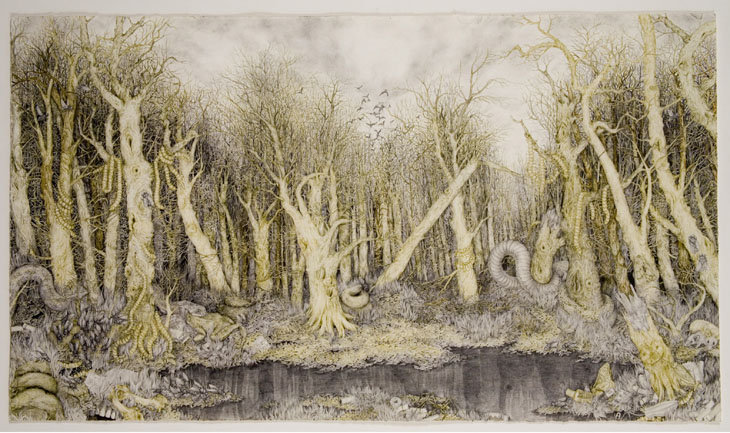
    aurel_schmidt_body_swallows worldThings have gone rather quiet on the mortality front since queues stretched around the White Cube block in Mason’s Yard for a sight of Damien Hirst’s £50m sculpture For the Love of God. In those days of skulls and diamonds, Paul Wilks wrote a letter to The Jackdaw lamenting the morbidity of contemporary art, wondering why two horrific world wars had produced “art infused with LIFE” while a record period of peace and prosperity had left a legacy of art obsessed with death.

    He had a point – there was a lot of it about. From Ron Mueck’s Dead Dad and the Chapmans’ Hell to Sam Taylor Wood’s time-lapse films of decomposing fruit and furry animals and Marc Quinn’s endless stream of Blood Head selfies, the art world mood music of the turn of the century was the bells of hell going tingalingaling and the tills chachinging. In those halcyon years of boom before the bust, vanitas, vanitas, all was vanitas. Since then, however, things seem to have moved on. Sam Taylor Wood has graduated from death to sex and Marc Quinn, for his new exhibition at White Cube Bermondsey (until 13 September), has turned his attention from reflections on his own mortality to wider considerations of time and tide in big lumpy sculptures of Frozen Waves à la Maggi Hambling.

    While it’s still too early to speak of a full recovery, the morbidity does seem to be receding. We’ve heard less from the media about that ghoulish reincarnation of Joseph Beuys, Gunther von Hagens, still trotting his plastinated corpses around the globe, and there’s been mercifully little mention of his Russian fellow-ghoul Andrei Molodkin and his plans to boil down human volunteers into oil. Either the volunteers got cold-pressed feet or Molodkin dropped off the media radar. Either way, it seems to confirm the surmise that economic hardship promotes positive art. Good news for Greece, where we can now look forward to a revival of the Age of Pheidias.

    Meanwhile back in Blighty Charles Saatchi – the former financier of the YBA death merchants who made possible The Impossibility of Death in the Mind of Someone Living – has been bucking the trend with a silly season exhibition Dead: A Celebration of Mortality at the Saatchi Gallery, timed to publicise the launch of his book of the same title. Bound like a mini-tombstone between fake marble covers with incised gold lettering, this tasteful little tome relays a selection of the Evening Standard newspaper columns in which Saatchi has been jotting his weekly musings on life and death in that strangely disjointed style that makes you think of a clerk in a green visor tapping away at a vintage telegraph machine. Either that or it makes you wonder whether there might not be some connections missing in his brain.

    All the same, he does have a tinder-dry sense of humour (though if he’s advertising for the next Mrs S, ‘DSOH’ may not be enough to swing it) and his chapter headings are chuckle-worthy. Some are laugh-out-loud funny in a Seth MacFarlane cartoonish sort of way – ‘Run Over by Your Own Car, Driven by Your Own Dog’. Some are on the Goyaesque side of macabre – ‘The Answer to Population Expansion and Food Shortages: Eat Children.’ Some are sensibly practical – ‘If You Want to Murder Your Spouse, Use Arsenic’ (don’t throttle her in public). Some are Jesuitical – ‘Get to Heaven an Hour before the Devil Knows You’re Dead’ – and some disarmingly self-mocking – ‘Are You Being Bored to Death by this Book?’

    This is what Saatchi is good at: the attention-grabbing one-liner that sells the product. Like his ES pieces, his exhibition was a string of loosely associated thin ideas. He collects art works like he collects facts, in bulk, and presents them in a similarly disconnected way, without argument. One gallery contained photographs of Russian mafia graves, a bomb in a suitcase and a floral tribute made of scrunched-up copies of the Daily Mail stained with blood and tea. Another displayed a pillar formed of resin casts of dead mice, a fake stuffed skunk in a museum case and a pair of genuine animal skins of a cat and dog. A third was a morgue of grotesque human dummies made of urethane wax, old sweaters and bandages, littered around in a range of abject poses. The only exhibit anyone lingered over was Body Swallows World (2006), a truly terrifying drawing of a forest of creepy crawlies by Aurel Schmidt that made Richard Dadd look like Grandma Moses and the Chapmans look ham-fisted. Otherwise, far from striking mortal terror into visitors (most of whom were too young to have begun to think of death) the tone of the exhibition was as insouciant as the small boy leapfrogging a tombstone in the vintage photograph outside the entrance.

    My father used to tell a story of a 19th century actor whose onstage deaths were so convincing that the audience would clamour: “Die again, Sam!” and he would oblige. The trouble with Dead: A Celebration of Mortality is that the clamour for its brand of snuff stuff has died down. Almost all the work in the show was pre-financial crash and to post-recessionary eyes it looked like death warmed up. Today’s audiences may not have lived through two world wars, but the past seven years have been no party and they want art which, if not life-affirming, has a bit of depth. Young artists have stopped making schlock art about death and older ones with any sense have grown out of it. The former YBA Mat Collishaw – who came to fame with the gory Bullet Hole shown at Freeze and now in the collection of the Saatchi of the Southern Hemisphere, David Walsh – has progressed to subtler meditations on mortality in his 2013 series of photographic still lifes, Last Meal on Death Row.

    One essay in Saatchi’s book tells the cautionary tale of American news anchor Christine Chubbuck who shot herself on screen in 1974 in protest at her channel’s obsession with gore. There’s only so much death a body can take. Even Damien Hirst, whose obsession with mortality may well be genuine, has stopped trying to flog a dead horse – with or without golden hooves – and started looking on the bright side of the life cycle. It began with that hideous series of Fact Paintings (2005-6) painted from photographs of the caesarian birth of his third son Cyrus and has continued in The Miraculous Journey, the recent sequence of equally hideous bronzes of developing foetuses commissioned as street furniture by the Qatari Royal Family in the run-up (they hope) to the 2022 Doha World Cup. Ironically, this is one case where funerary monuments to dead Nepalese workers might be more appropriate.

    Washed-up celebrity artistes end up in Vegas; washed-up celebrity artists end up in Doha. It’s no coincidence that both are deserts. On home turf, meanwhile, Hirst is following in the footsteps of his old patron Saatchi and seeking a new form of artistic immortality as a philanthropic museum owner. His free gallery in Newport Street, Lambeth, opening in October, is being built to house his morbidly titled Murderme Collection, but its inaugural show will be a life-affirming exhibition of paintings by his old adversary John Hoyland. Cheer, up everyone! There may be life after death.

    Laura Gascoigne


  • Evelyn Williams, and another case of the public denied

    Evelyn Williams, and another case of the public denied

    In the last issue I considered the case of a single-minded good artist,  David Mulholland from Middlesbrough, whose memory, in the absence of any official recognition or support, has to be kindled for posterity’s sake by friends and family. By The Jackdaw’s usual standard of eliciting no comment whatsoever, this caused a considerable mailbag from many mentioning other artists who deserved better than the obscurity and indifference they receive. Owing to the recent death of a special artist, there is cause for reiterating this line of criticism of an art establishment hopelessly out of touch with anything but ‘The Contemporary’, such as they choose to see it.

    Grief felt at the death of a memorable artist is mitigated always by the fact that their work – if it is properly accomplished and not merely the species that is famous for fifteen minutes – will live forever. Giotto didn’t need an ‘artist’s statement’ or incomprehensible catalogue introductions for his work to last, because his paintings speak for themselves in a universal language understood across the centuries. His work will continue to communicate clearly its observations of character and stories just as long as human beings are prepared to see,  feel and respond. This is the case also with the art of Evelyn Williams who died aged 83 on November 14th. Her work will endure in spite of the neglect she received from officialdom during a long and productive career. In the same Tate Collection which stores 274 works by Andy Warhol no space can be found for a single piece by Evelyn Williams, who is a far more interesting artist if not so much of a business-minded celebrity phenomenon whose market is carefully rigged. Even in the last two years alone, when 516 works were acquired by the Tate, there was no room for a single one by this important woman artist. There are even ten works in our national collection by American minimalist Robert Ryman, all of them white and doubtless extremely challenging to those of a devoutly all-whiteist fanaticism; but nothing by Evelyn Williams. Here is further evidence that at the nucleus of State Art breeds a deeply entrenched prejudice against anything but pseudo-intellectual nonsense.

    It is an appalling truth that the Tate has ceased to be a collection of British art preserving the very best of what is being done. Instead, it has been stealthily subverted under Serota to become a private collecting fief promoting a narrow orthodoxy related to a handful of dealers and auctioneers. Why is it that so much about today’s Tate stinks? Evelyn Williams is in a long line of single-minded British artists who refuse to run along the pre-ordained tramlines of conceptualism and modernism. She was a thoughtful, modest, intelligent and vulnerable person alive in a world – as she perceived and experienced it – of imminent dangers. Her paintings, sculptures and reliefs are about the fear and anxiety, the affections and frictions, of what it is to have lived the life of an anxious woman and mother. Hers is first and last a woman’s art, an uncompromising take on post-war relationships, intimacy, cares, depression, failure and even alienation. Her subjects take you inside the realm of senses and feelings, probing the unspoken secrecies behind the masks of propriety we all wear. In the way that art has of redeeming the awful, these are beautiful explorations of states of mind most try to avoid. Her work can be relentlessly intense, no question about that, but it is pure in spirit and purpose.

    Three of the more serious newspapers, the Times, the Telegraph and the Guardian, were eventually persuaded to publish obituaries of Williams. As with so many significant but neglected artists who are nevertheless considered worthy of an obituary, her exhibitions were scarcely even acknowledged let alone reviewed in the arts pages of these same papers. Critically, it was as if her work didn’t exist. She is, of course, among the many accomplished artists whose work is ignored for being conventional in appearance and technique and declamatory about emotions. To today’s State Art tyrants such characteristics are considered embarrassing drawbacks.

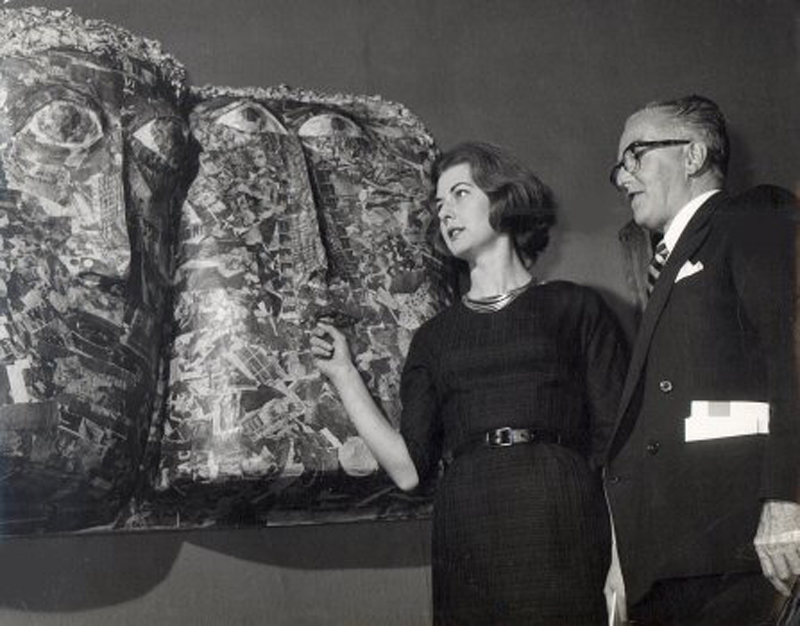
    Williams was, however, appreciated in the past. As a youngish artist in 1961 she won the sculpture prize (for Two Heads) at the John Moores in Liverpool, when other winners were Peter Blake, David Hockney and Ron Kitaj. These were the days when the Moores was worth winning, well before it was subverted to the cause of State Art where daubs of no merit are greeted by fools with preposterous superlatives. A retrospective exhibition was held in 1972 at Whitechapel Art Gallery; once again well before that gallery’s prostration before the winds of Biennale bluster. Williams continued her brave exploration of inner places that made her work then so widely admired. She worked every day of her life and although her commercial exhibitions continued, sometimes at long intervals owing to the complexity of ideas and their necessarily prolix gestation, a retrospective was never offered in her lifetime. Approached by friends in the last decade of her life, the Walker Art Gallery turned her down for such an honour. She couldn’t exert the pulling power of a Rolf Harris or Paul McCartney.

    Will Williams now receive the lifetime retrospective her work deserves, and which a wide audience should see? It isn’t likely.

    But why should this be, when there are more galleries nationwide which are more spacious than ever before? The answer is that as the public gallery network expands the same orthodoxy is spread across even more outlets. More galleries does not mean a wider selection of work on display; it means the same work by the same few artists spread across even more galleries even more frequently.

    What are called ‘Artists’ Rooms’ are a symbolic example of what is wrong with this rotten system. These ‘Rooms’ are organised by the Tate, the Scottish National Gallery of Modern Art and the Art Fund (how long will it be before the Art Fund can only be contacted via the Tate switchboard?), and they resulted from a bulk purchase, jointly by the Tate and the SNGMA in 2008. We bought for £42 million (£27 million in cash – the figure varies in different reports; we’ve never been told the exact sum – and £15 million in waived tax) retiring art dealer Anthony d’Offay’s gallery stock, which he called his private collection.  A cynic might say that Artists’ Rooms is the process by which the personal collection of one commercially motivated individual now dictates what a large proportion of the art-seeking population is allowed to see in the name of recent art. The same cynic might further add that Artists’ Rooms is the opportunity by which established reputations – such as Warhol’s – are constantly hammered home, and for the smaller ‘Room’ names, it is the instrument by which a more significant brand name can be nurtured.

    Under the auspices of the Art Fund, an organisation which luckily is headed by a former director of Tate Britain, 30 rooms featuring 760 works by 26 artists have been touring the country for four years, mostly as small one-man retrospectives. Some of these are marvellous, not least the extensive collection of photographs by August Sander. There are 232 works by Warhol alone, who gets two rooms to himself travelling at the same time. At the moment they are in Sheffield and Hull, and then Birmingham for four months. That is apart from relatively recent major exhibitions for the same artist at the Tate, the Hayward and other Arts Council galleries.  Warhol is showing somewhere all the time. We will not be allowed to ignore him.

    One of the Artists’ Rooms deals, inevitably, with Damien Hirst. This is currently on show in Walsall Art Gallery. It has been there for two months already and will remain in place for another year. What is happening when a fifty-year-old artist, already over-exhibited at a time when so many unexposed artists can’t get their work shown, is having a thirteen-month long exhibition? What is the reason for such indoctrination? Too often the Artists’ Rooms represent those who are already widely exhibited and who are bastions of the art market.

    Artists Rooms are a blunt instrument whereby approved taste is circulated (inflicted) from the centre. They constitute cheap exhibitions for Arts Council venues up and down the country, whose curators don’t have to originate their own programme. The laziness and ready compliance of these jobsworths is a godsend to State Art.  They can merely exhibit the same few approved brand names for ever. And make no mistake their career will depend upon them favouring these “right” kinds of artists for no individual prospers in State Art by demonstrating initiative or investigating the unorthodox.

    Visit the Hepworth Gallery in Wakefield and you will discover the other reason, besides the dreaded Artists’ Rooms, why thought and broad knowledge among curators is unnecessary. There is a new species of art collectors who caught the disease of wholesale, apparently random acquisition from Saatchi. These people fuel the market for State Art which they buy in quite staggering quantities. Their houses, full of wince-inducing tat bought for eye-watering sums, feature frequently in glossy magazines. Usually they are rewarded for their commitment to the State Art cause with the accolade of a position on a Tate committee, of which there are now dozens. At Serota’s Tate money not knowledge is the essential qualification for co-option.

    One such überbuyer – who has not yet been brought on to any Tate committee – is one David Roberts, a property developer, who has accumulated so much clutter he’s opened his own ‘space’ and has begun feeding pieces to regional galleries, Wakefield being the first venue. Works selected are linked as follows: “This exhibition examines ways in which modern and contemporary artists represent the human

    body in various media to explore psychological and emotional life.” What a perfect criterion that is for the inclusion of a major work by Evelyn Williams. Unfortunately, the trouble is that among Roberts’s 3,000 plus works there is nothing by Williams. But have a guess whose work he does own and whose efforts are on show in Wakefield: enter Warhol and Hirst.

    David Lee

    The Jackdaw January-February 2013

    http://www.evelynwilliams.com/index.htm