Tag: Jeremy Deller

  • Art under kleptocracy


    Another month, another book on the contemporary art economy, this time from an overlooked perspective. The New Economy of Art, a joint publication by DACS and Artquest, looks at the art market from the POV of the average artist. Not surprisingly, it finds plenty to puzzle over.

    The conundrum it addresses is clearly set out in the preface by editors Gilane Tawadros and Russell Martin. “The art world is in crisis,” begins the first paragraph; “The art world is in the best shape it has ever been,” begins the second. The question of how these conflicting statements can both be true at the same time – “the disconnect between how artworks gain financial value even while their makers are poorly, or hardly, paid.” – is the mystery the authors of its six essays try to solve.

    Two weeks before the book came out, Christie’s New York achieved an all-time auction record for its November postwar and contemporary art sale, in which a Warhol Triple Elvis hit the jackpot – kerchung! – at £51.6m – and a row of Four Marlons paid out a further £43.9m. Both, appropriately, had previously hung in a casino in Aachen. The result was hailed by international head of post-war and contemporary art Brett Gorvy as confirmation of “a virtuous cycle of confidence in the art market”. Another season, another reason for making whoopee.

    On the other side of the art market, meanwhile, a more vicious cycle is in operation. The book’s authors quote the usual dismal statistics. It’s depressing enough to learn from the 2011 survey by the Centre for Intellectual Property, Policy and Management at Bournemouth University that UK artists earn a median wage of £10,000 – unchanged for 20 years – without discovering that the statistic includes designers, illustrators and photographers, and that the top 7% earn 40% of the total. Artists now officially rank as ‘marginalised makers’, a marginal constituency politicians aren’t fighting over. The economist Alan Freeman quotes figures showing our ‘creative economy’ growing faster than any other UK production industry, employing 2.5 million people and accounting for 5.2% of gross value added – but take out all the advertising, marketing, fashion, IT and other people he counts as ‘creative specialists’, and the fine artists are still scratching around on the margins.

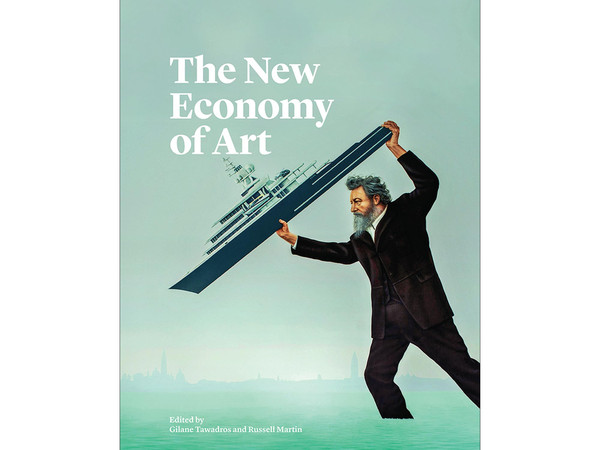
    The book’s cover reminds us that there is nothing new in this. It reproduces Jeremy Deller’s mural from the 2013 Venice Biennale picturing William Morris as a Victorian Poseidon hurling Roman Abramovich’s superyacht into the Venetian Lagoon. The mural’s title ‘We sit starving amidst our gold’ encapsulates the argument at the heart of the book while reminding us that Morris said it all before, and better. Compare Freeman’s dewy vision of a creative utopia “in which shared values, achievements, hopes and aspirations replace brute greed to lay foundations on which the true individuals of the future can confidently build the new worlds of their choosing” with this trenchant passage from Morris’s lecture Art Under Plutocracy: “So long as the system of competition in the production and exchange of the means of life goes on, the degradation of the arts will go on; and if that system is to last for ever, then art is doomed, and will surely die”. Only the substitution of association for competition, believed Morris, could “give an opportunity for the new birth of art, which is now being crushed to death by the moneybags of competitive commerce.” In the war of words, Morris wins hands down.

    Still, the book contains material which, if not revolutionary, is astonishingly inflammatory for a publication part-funded by the Arts Council. Have they read it? It has a quiet way of dropping bombshells. One is the casual mention by management consultant Keir McGuinness of the apparently generally accepted practice whereby “the decision of whether a [public] gallery will take a show or not depends upon whether you [the artist’s dealer] will make a financial contribution and the person who makes the largest financial contribution gets the shows”. Another is a statistic cited from AN’s recent Paying Artists report that “71% of artists receive no fee for publicly funded exhibitions and nearly 60% do not even have their expenses covered”. This against the background of an international art industry which, arts consultant John Kieffer points out, has a turnover of just under £40bn, with the UK’s market share of 20% amounting to three times the combined budgets of the English, Welsh, Scottish and Northern Irish culture departments.

    But the real eye-opener is the essay by curator Lynda Morris. Born in 1947, Morris is old enough to remember the heady days of the 1960s when a newly international avant-garde was promoted by dealers who were themselves artists, lived like artists on air and were perceived as having ‘moral authority’. What an antiquated concept that now sounds. After reading Morris’s analysis of the process whereby the present nexus of curators, industrialists, bankers and property developers took control of the art world, it seems to belong to another era.

    Morris pinpoints Thatcher’s appointment of Richard Rogers as chair of Tate Trustees in the 1980s as the start of the cultural ascendancy of architecture over art. “It was the moment in late Thatcherism when the State no longer provided social housing and, instead, the national lottery, a new arm of the gambling industry, enabled museum directors and their trustees to start to plan Palaces of Culture.” A proposal to regenerate derelict buildings for low-cost studios, housing and artist-led galleries put forward by officers of the then Arts Council of Great Britain – in association with artists’ collectives ACME and SPACE – was kyboshed by property developer Peter Palumbo, who as chair of the ACGB from 1988-94 presided over the drafting of the rules for National Lottery funding, including the ‘subsidiarity’ clause ensuring that money is allocated only to new projects and thus funneled towards developers and architects rather than artists. Artists are wonderful at sprinkling the fairy dust that turns urban wastelands into developers’ goldmines, but once the gold has been extracted the fairies can piss off and take their dust elsewhere. Prices for a ‘premium apartment’ in Neo Bankside, the new residential development overlooking Tate Modern designed by Rogers Stirk Harbour – formerly Richard Rogers Partnership – start at £4.5m.

    “We seem to have drifted from a market economy to a market society,” comments John Kieffer. It’s a form of society Margaret Thatcher would have recognised, but not William Morris. “It is this superstition of commerce being an end in itself, of man made for commerce, not commerce for man, of which art has sickened,” he wrote in Art under Plutocracy. Art under kleptocracy has brought no improvement. It has been left to President Xi Jinping to uphold moral values, warning Chinese artists last October not to follow the “stench of money” or “lose themselves in the tide of market economy” which the rest of the People’s Republic is happily riding.

    Are artists and Gordon Brown now the only people on the planet still expected to possess a moral compass? That could explain the disconnect highlighted by this book. If our market society is wholly reliant on artists for moral orientation, it has good reason not to seduce them with the stench of money, ie pay them. You could almost call it a virtuous cycle.

    Laura Gascoigne  

    The New Economy of Art, edited by Gilane Tawadros and Russell Martin, published by DACS, £14.99
     

  • The Art Fund subverted: they were only playing leapfrog

    The separate bodies contributing to State Art are now so interrelated, so cosily acquainted, their personnel so readily interchangeable and of identical mindset, that they might as well join forces. (… Liz Forgan is sacked from the Arts Council but remains a Trustee of the Art Fund; James Lingwood swallows his annual  million from the Arts Council and also sits as a Trustee of the Art Fund which has bought a work he commissioned, and so on – I could fill this column ten times over with similar complacent overlaps.) Imagine the savings on personnel and rent alone if the Contemporary Art Society (now funded and run by a former employee of the Arts Council), The Art Fund (headed by an ex-director of the Tate), the Arts and British Councils and the Tates (also directed by a former Arts Council employee) stopped pretending they pursued distinct objectives and pooled resources.

    The Art Fund is the latest to dump any semblance of independence. It is nominally a charity, if, that is, you count bankrolling the already well supplied as ‘charitable’. If the Salvation Army doled out caviare to nobs in Mayfair there would be a fuss. But the Art Fund regularly does the equivalent.

    It was founded by altruists in 1903 solely to help museums buy works of art. It gives £6.3 million a year in grants, spreading it thinly across scores of acquisitions, including some important ones. Its core activities are still nobly worthwhile and more than ever necessary.

    Recently, it announced it would fund two British tours: Jeremy Deller’s ‘immersive works’ (don’t ask) created for the British pavilion at this summer’s Venice Biennale, and Grayson Perry’s six large caricature tapestries on the subject of British life and taste. Why is a charity sponsoring the promotion of Perry and of a Tate trustee, Deller, who are among the most visible, wealthy and successful of recent British artists? And why aren’t their dealers paying for these tours from which they will all benefit? Deller’s exhibition in Venice, funded by the British Council (the tour of his inflatable Stonehenge is already, by the way, covered by the Arts Council), cost over half a million of public money to stage. Why is Deller worth even more from the limited resources of yet another much tinier charity? None of this makes sense. Unless of course there is a privately agreed national consensus between a raft of organisations, public and private, whose objectives – for whatever reason – are to promote the same few reputations.

    In their recent accounts the Fund crows its contribution of £200,000 towards Rachel Whiteread’s infantile defacement of a listed masterpiece, Charles Townsend’s Whitechapel Art Gallery. Again, here is lavish support of a successful, regularly exhibited artist represented by a leading world dealer. Charity? Really? Additionally, they funded the Tate’s purchase for £125,000 of five Whiteread ‘drawings’, or diagrams as they used to be known – they now have 30 of her works.

    The Fund also oversees the annual £100,000 Gulbenkian Museum of the Year whose judges are perennially lazy, predictable and uninspired. It is responsible too for administering ‘Artists’ Rooms’, an overpriced and dubious blunt instrument of State Art which ensures the circulation of work by top brands around regional museums, apparently ­– God help us – in perpetuity.

    The Fund’s magazine, Art Quarterly, formerly a purveyor of scholarly articles, is now a yappy promotional brochure for State Art. The current issue advertises three artist trustees of the Tate, each of whom receives the Fund’s cash. In the case of Wolfgang Tillmans, they contributed £95,000 towards buying 15 of his pictures for Glasgow Art Gallery having the previous year given £62,000 for the purchase of nine others of his works by the Arts Council, which has £450 million a year of its own to spend. The Tate already owns 62 works by Tillmans. Why this obsession with an indifferent German photographer?

    But all is not bleak. In 2011 when the Fund announced public purchase of Yinka Shonibare’s Fourth Plinth bottle the published cost was £362,500. As we demonstrated at the time this was a lie repeated in all newspapers. In their recent accounts the figure has now shot up to £650,000. They’re getting there, slowly.

    David Lee

    The Jackdaw, September/October 2013

  • Tate trustees and the public interest

    Tate trustees and the public interest

    In 2011 the Tate named two new trustees, one of whom is painter Tomma Abts. She is a 44-year-old German, recently appointed Professor of Painting at the Kunstakademie in Düsseldorf, who won the Turner Prize in 2006. As an artist trustee, she replaced Jeremy Deller, who won the Turner Prize in 2004. Abts’s paintings are all the same small size (48 x 38 cms) – it is claimed this tic is conceptually crucial for a reason never convincingly explained – and consist of polite abstract designs which might have looked original on curtains at the 1954 Ideal Home Exhibition. So much for the Cutting Edge. The Tate claims her pictures “possess a formal definition and coherence that suggests that they could never have existed any other way … [and] seem to achieve what only painting can, inhabiting both this reality as an object or ‘thing’, and a parallel world with its own set of rules and relationships that demand to be judged on their own terms.” As per with their interpretive literature, all helpful stuff. Am I being cynical? Yes. Why? Because using any sensible criteria Abts doesn’t deserve to be a trustee of an important British museum.

    The job of Tate trustees is to oversee the efficient running of the gallery “as guardians of the public interest” – and please note that it says ‘the public interest’ not ‘State Art’s interest’, for as you will discover these two mutually exclusive agendas tend to become blurred in the minds of certain individuals. Improbable as it sounds, guidelines for the functions of trustees are drawn up by the Tate itself, not by  independent arbiters. Such complacency hardly reassures an outsider that the public interest, rather than the Tate’s, is being looked after. Indeed, such self-scrutiny is hardly better than the continuing disgrace of policemen investigating their own mistakes.

    In 2008 the number of trustees was increased from 12 to 14 and as required by the Museums and Galleries Act 1992 “at least three” of these must be artists. Thirteen are appointed by the Prime Minister and the last is nominated by the trustees of the National Gallery from among their own membership. Unlike their fellow trustees, who are mainly those with business expertise, and who can serve up to two terms of four years (a period of office trimmed recently from five), artist trustees currently serve only one term of four years. You may find it odd – I certainly do – that while there are three contemporary artists with gilt-edged State Art credentials on the Tate’s board of trustees there is no place for a single art historian. I’m obviously old-fashioned because a museum of historical art with no art historians sitting on its governing board seems verging on the perverse.

    When an artist trusteeship becomes vacant it is widely advertised in the papers, giving the impression that any capable, knowledgeable, articulate artist of repute might apply. Nothing could be further from the truth, for there is a codicil written in invisible ink along the bottom of these ads, which reads: “If you have not won or at the very least been nominated for the Turner Prize, kindly fuck off and don’t waste our time.” The Tate squanders scarce cash paying for these advertisements which are nothing short of a calculated deception. Artist trustees are in fact a self-appointed clique comprising only winners of the Turner Prize with a couple of reliable also-rans chucked in. Since new regulations were imposed in 1992 the only exceptions to this rule have been Julian Opie, who famously refused his nomination for the Turner on the grounds that the prize “had become a frivolous publicity stunt”, and Bob and Roberta Smith, the sobriquet of a dimwit called Patrick Brill, who is otherwise a regular purveyor of infantile stunts at Millbank – you may recall his Tate Christmas tree whose lights visitors were asked to illuminate by peddling a generator. He’s very concerned about the environment apparently.

    Being a trustee involves attending six meetings a year and is said to require a day a month in reading and preparation. I must point out that the Tate’s artist trustees are easily the worst attenders at these meetings, and are frequently absent. In the case of Anish Kapoor (Turner Prize winner, 1991) his absenteeism, which included missing half the meetings in two consecutive years and scarpering early from others, would have surely seen him sacked from the board of any efficiently run private enterprise.

    Of currently serving artist trustees two are Germans – besides Abts the other is magazine photographer Wolfgang Tillmans (Turner Prize winner, 2000). Could they really not find a British photographer, or even a British abstract painter, worthy of these positions? Admittedly, Germans do most things better than we do but surely this is insulting to British artists. And how can a professor at a German art school, which presumably requires her to actually attend some of the week, perform the duties of a trustee required to be resident here?

    The process by which artist trustees are selected ­– laughably characterised as “an open competition” or “an open competitive process” – is indicative of what happens when a clique achieves a complacent monopoly and is allowed by servile arts commentators to get away with it. Minutes of meetings make it clear that artist trustees are encouraged to invite applications from those they consider suitable as their own replacements, especially when candidates who have responded to the ads are not considered worthy, which one may reasonably surmise is always. Indeed, I wonder if there was ever a case of a successful artist trustee having responded to the ads rather than having been – that weasel word – ‘invited’ to apply… And so Turner Prize winners beget other Turner Prize winners, or at the very least other near-misses of that persuasion.

    Candidates for artist trusteeships are interviewed by a panel comprising trustees, including the artists, plus an “independent assessor” who is present to ensure that legal niceties, “best practice” etc., are observed and everything looks above board. But how can it be above board when only Turner Prize winners are appointed? Perhaps this independent assessor ought to be involved from the start of the process in order that more than Turner Prize nominees might be seriously considered, if for no other reason than to keep up appearances of openness. Eyebrows would be raised at such a narrowness of potential candidates in any other sphere of public life: imagine, for example, the Commander-in-Chief of the armed forces always being selected from the same regiment.

    You may ask why is it so important for the convenient running of the Tate that its artist trustees are always winners of the Turner Prize. The answer is for the obvious reason that having been awarded a career-changing gong by the institution of which they are now overseers, they will never rock the boat by asking too many tricky questions about the Tate’s direction in its dealings with contemporary art. This is one of many ways by which State Art has become institutionalised: no one but the reliably subservient is ever allowed on the inside to question Tate, or indeed Arts Council, policies.

    On the other hand these parti pris trustees can be useful when outside criticism of the Tate becomes noisy. For example, in July 2004 Trustees discussed newspaper coverage of a Tate work, Rodin’s The Kiss, which Cornelia Parker (who was nominated for the Turner in 1997, the year it was won by Gillian Wearing, inevitably herself a recent artist trustee), had the previous year controversially wrapped up with a mile of string. This stunt was claimed by the artist to be “challenging the claustrophobic nature of relationships”. Artist trustees present in the meeting (which included the aforementioned Wearing) were able to defend their fellow artist for the benefit of other sceptical trustees. They pointed out that it was the job of the Tate to provoke controversy and discussion, which this work did.

    It is in the interests of these artist trustees to support the Director. They know they will be serving only for a brief period following which they might reasonably look forward to the reward of a Tate retrospective or other continued patronage, purchases etc..

    Serota has stated a preference for such younger trustees. Referring to the trusteeship of Anthony Caro many years before, he remarked in 1998 to the Sunday Times: “Tony was well over 60 when he became a trustee. He was a very effective trustee, actually. He cared passionately about certain things and was a powerful force … but it just seems to work better when you have artists who are a new generation, or indeed erring on the younger side, really.” And we know why he thinks it “seems to work better”, because older artists of a more independent, more knowledgeable, more experienced character might argue cogently for a policy or direction other than the one being pursued by the Director. They have nothing to lose by disagreeing with him. Let’s face it, the current crop of artist trustees is in Serota’s pocket. They owe him and he knows it. He can rely on their support without a second thought.

    In a 2008 interview Serota said of his trustees: “I don’t have any part to play in their appointment”. Remember this, it’s important and we’ll return to it in a second.

    Many years ago Serota said that public nominations for the Turner Prize (perhaps you don’t remember that ridiculous charade whereby we all wasted our stamps and faxes) were seriously considered by the judges. We discovered in 2006 what we already knew, courtesy of an indiscreet Turner Prize judge, that this was in fact a lie and they were binned with risible disregard. We also discovered at the same time, and from the same source, that Turner Prize judges were given a list of appropriate artists and exhibitions – just to help them along you know, point them in the right direction. And there we were thinking in the innocence of our ignorance that they might nominate anyone…

    Serota also stated in 2005 that the Tate only rarely acquired work by serving trustees. The Jackdaw checked up on that and discovered (see the editorial for Dec/Jan 2006 on our website) that he wasn’t telling the truth. Indeed, this whopper cost him a bollocking from the Charity Commission. There were also a number of other flagrant economies with the truth concerning the Tate’s acquisition of work by serving trustee Chris Ofili, who was naturally a Turner Prize winner (1998), which also resulted in another six of the best from the CC. (I almost mentioned here the fact that in the last editorial – also on our website – we indicated how the Tate recently misled us over their attendance figures, but you must be getting fed up with that one.)

    So, bearing in mind Serota’s far from perfect form, when he remarks “I don’t have any part to play in their appointment” I need to ask myself: ‘Do I give him the benefit of the doubt and believe him this time?’ Well, as it happens, no I don’t. Even cursory familiarity with the Trustees’ minutes betrays this one as untrue. On the contrary he is frequently involved in their appointment; indeed, the process of Trustee appointment is administered by his own office. He even attends candidate interviews “in an advisory capacity”. Presumably he offers ‘advice’ which plays no material part in the process, so why is he there in the first place? Indeed, we read on: “The key stages of the appointment are overseen by a panel which will normally include the Director.” (Who, presumably, doesn’t play any part.) On one recent occasion he encourages artist trustees to nominate likely candidates for their replacement knowing only too well the sort of artists they are likely to suggest. No part?

    Let’s have this one straight: Serota is ‘advising’ on the appointment of someone, a trustee, who will function as his own employer. This is a wretched abuse of the supposed ‘independence’ of process and would be considered as much in any other public body. It is, as usual, as blatant a conflict of interest (not to mention a betrayal of ‘the public interest’ about which the process purports to be so concerned) as you would expect to find at the Tate, whose management of conflicts of interest, incidentally, was declared woefully inadequate by none other than the Charities Commission.

    The Tate should not be involved with either the compiling of its own trustees’ duties, or in the nomination or selection of Trustees themselves. How can ‘the public interest’ be considered served when the organisation under scrutiny is writing the job description of its own scrutineers. If we are to have artist trustees let’s have them from a cross-section of the artist community and not just those representing the Turner Prize. And let’s have some eminent art historians in there too.

    David Lee

    The Jackdaw May-June 2011

  • How state art robs the people

    How state art robs the people

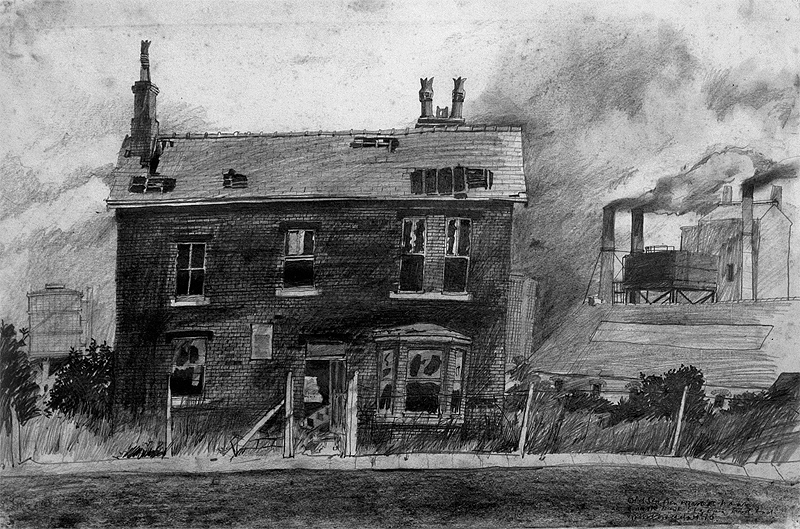
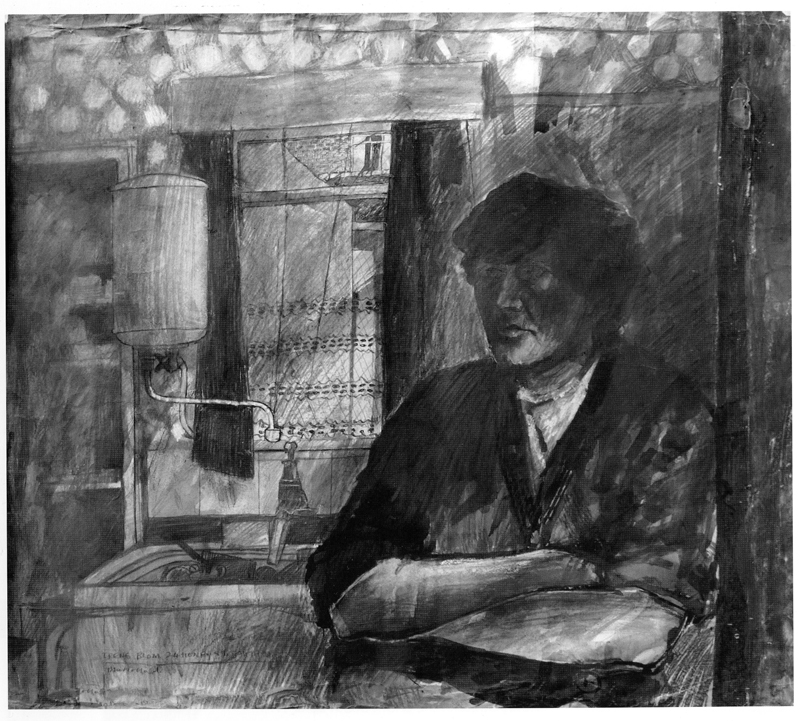
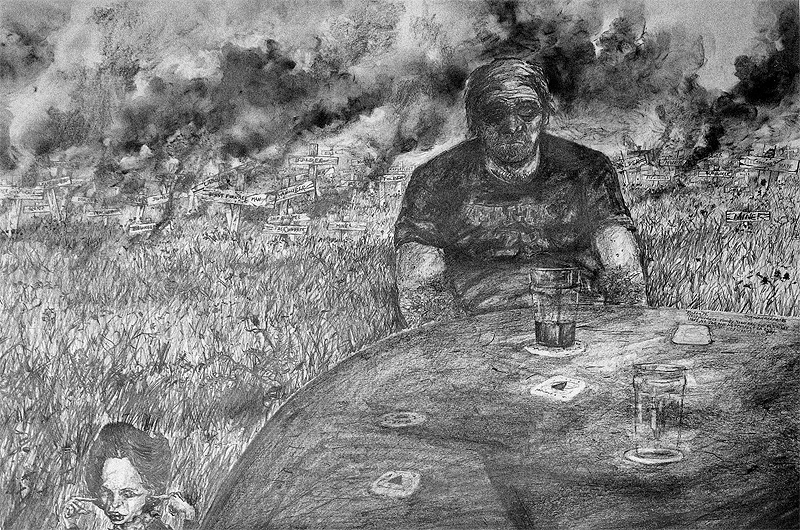
    Chances are you won’t have heard of David Mulholland (1946-2005), a painter of and from Middlesbrough. Until last year, when a group of friends devoted to the preservation of his memory sent me some of his pictures, neither had I. The work hit me immediately as authentic, born of intimate feeling for its subject. Most affecting were powerful graphite and wash drawings of blackened industrial places populated by persevering working people. Having edited a couple of art papers for over twenty years, I felt that if anyone had a right to have heard of David Mulholland then it was at the very least someone in my position.

    What follows is a lament for the establishment’s theft of the richness of our culture. Over decades now, by advancing its prejudices to the exclusion of everything else, art authorities have conspired to deny us sight of so many whose works were valuable testimonies of their time and experience. For their own ends, these all-powerful administrators have kept us in the dark.

    David Mulholland is typical of many accomplished and original 20th century British artists whose names are deservedly kept alive by friends who loved him and knew his worth as both commentator and poet, but who is unknown to the rest of us. No galleries funded by the Arts Council, for example, would dare show the work of these artists even if they wanted to. Mulholland is typical of painters derided by the self-appointed in State Art and sneered at by decision makers. By arts bodies obsessed with ‘innovation’ and the ‘cutting edge’ he is, in that infamous Arts Council phrase “the wrong kind of artist”. Yes, those are the words they use – the wrong kind of artist. What right have they to use a phrase like that? Who do these people think they are?

    As one who described with affection his experience of the hard lives and resilience of poor people, and evoked the gaunt beauty of the tough places in which they lived and worked, Mulholland was “the right kind of artist”. The only kind of artist. He is certainly among those whose work is likely to survive appreciated long into the future. His work was done because it needed to be made, because the observations of a brutal working life and cruel industry, of pleasures and strifes, of hard graft and redundancy, demanded interpretation by an artist. Mulholland’s work doesn’t need a page of unreadable tosh by one of Serota’s army of scribblers in order for you to know what it’s about. Its love for a location and people speaks for itself. In the future, say a century or more from now, those looking at Mulholland’s work will understand without prompting its concerns and causes, what stories it has to tell, and why it has lasted. In all good art, these qualities are self-evident, although in some artists they may take longer to appreciate.

    Mulholland was born in South Bank, a community on the Tees built around quaysides, three blast furnaces, steel rolling mills and fingers of cindery railway sidings. In photographs of the place in its heyday, and before the works closed, it looks smokily Soviet in its concentration of polluting ad hoc production. It’s the sort of place which, if you are born there, is in your blood forever. As landscape painter Len Tabner, another important local and friend of Mulholland, said at the recent opening of his memorial exhibition at the Dorman Museum in Middlesbrough, “Dave went all the way to Byam Shaw and to the Royal College of Art in London but only ever painted South Bank.” Apart from a brief foray as a young seaman, when he painted foreign scenes, it remained that way. He eventually returned home, taught art unconventionally in a secondary school, painted his life and friends, and sometimes the surrounding countryside. His work records a personal journey and history.

    Given the enormous sums now thrown uncritically and unchallenged at contemporary art, one ought to feel safe that excellence in whatever style or medium is somewhere being brought to our attention. But despite the fact that, courtesy of the National Lottery, there are expensive immense new galleries all over the country, the opposite continues to be true. The same few artists dominate news, features and critical coverage. They also dominate all the new galleries because these are controlled exclusively by State Art believers. For them, a foreign artist of no discernible distinction, spotted amidst the trendy jumble and waffle of an international biennale, will always take precedence over the likes of Mulholland.

    If you live in the north, as I do increasingly, you can find Anish Kapoor signing books in Middlesbrough – where his £2.5 million ‘regenerating’ fishing net was unveiled two years ago and still stands bleakly abandoned and pointless in wasteland – and at a retrospective in the Yorkshire Sculpture Park (see Moping Owl, p. 10). In London he is at Lisson Gallery, all over the Royal Academy, and even lording it over the Olympics’ site. No wonder he needs 25 assistants and three studios to churn out his coloured holes and facile shiny mirrors to meet demand. Such a monoculture as is represented by Kapoor doesn’t add to the diversity we deserve, because the rooms he and his ilk occupy with stupefying frequency are denied to others. Newspaper profiles of Kapoor last aired only three months ago when The Orbit was unveiled – having already appeared on dozens of occasions over the last twenty years –  have again been warmed up and paraphrased by others for his new shows in London and Yorkshire. This insulting process of indoctrination goes unmentioned elsewhere, as though it’s taken for granted that only a handful of artists merit such relentless promotion. The only difference in these disgustingly fawning and uncritical pieces is the sentence where they state what Kapoor is currently worth – and it keeps getting bigger, the last number cited being £80 million. For the rest of us, it is impossible not to know Kapoor’s life story off by heart. If only it were interesting. If only all this approbation were the result of his having produced something truly outstanding and comparable with the best from the past… But all that emerges is more of the same branded deluxe ornaments for the grotesque mansions of the immodest rich. And please believe me when I say there is no point in visiting his exhibition at the Yorkshire Sculpture Park, because you’ve seen it many many times before. It takes seconds to walk around. And, do you know what, some of the holes are so dark you can’t be quite sure where the bottom is. How clever is that?

    The neglect of so many for the sake of so few is a phenomenon of the celebrity culture. How long will it be before this system is exposed as a monumental racket dreamed up by a cabal of public officials, commercial dealers and auctioneers with the aim of creating false gods, rigging the market and handsomely feathering the nests of all concerned. Watching this process as it unfolds is sickening and the fact that they have not seen fit to investigate this monopoly brings disgrace on the Culture Select Committee of the House of Commons. They could have made a difference, if only by establishing once and for all that such an all-powerful orthodoxy exists in contemporary art, whose purpose is to discriminate against the likes of David Mulholland.

    Increasingly, I resent this editing of what we’ve been allowed to see, dictated as it is by the tastes of half a dozen bureaucrats with Serota at their head. This President-For-Life has singlehandedly done more damage than anyone in the history of British art to the public’s ability to see the work of a wide range of British artists. He is a self-important scourge building ever greater monuments to his own vanity and tastes, and yet he receives an uncritical press. When is this fellow going to go, and leave us alone? How long will it be before curators in regional galleries can see all art again for its qualities and not be forced to follow trends out of fear for their careers?

    If it is not the work of regional galleries to show the work of their best local artists what is it their job to do? And what an irony it is that the modern art gallery in Middlesbrough is showing coincident with Mulholland’s memorial show an exhibition dealing with “concepts of ‘home’” … starring Tate trustee Jeremy Deller.

    David Mulholland spoke a local language, a ‘home’ language, which is understood internationally by all people. No human being is excluded from its sentiments. State artists talk an international language which, like esperanto, is understood by hardly anyone. There ought to be room for both persuasions, but we are force fed only one.

    David Lee

    The Jackdaw November-December 2012

    www.davidmulholland.co.uk

  • Hitting the bottle

    Hitting the bottle

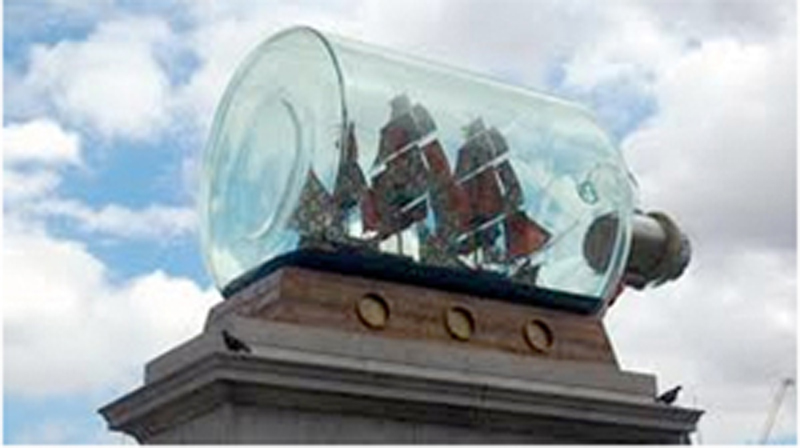
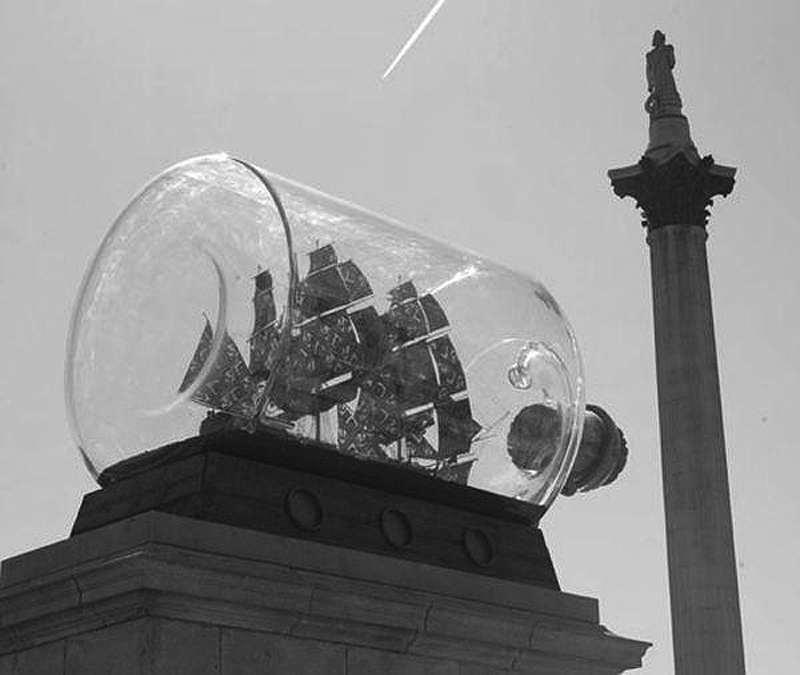
    The National Maritime Museum in Greenwich has bought for £362,500 the ship in a bottle by Yinka Shonibare which had sat ornamentally becalmed on the fourth plinth in Trafalgar Square for the previous 18 months. It is the Greenwich museum’s job to collect ships and related tackle and, lately, any sea-related nonsense deemed  ‘challenging’ by State Art’s omniscient spivs. It is significant, if you hadn’t realised, that the ship’s sails are made from patterned ethnic material of the sort usually swathed around gigantic arses in Dalston market. This encourages what one of the Tate’s finest drivellers grandly declares as “a transformation of perception”. Elsewhere, the same stuff is said to make an incisive comment on Britain’s nasty maritime heritage, “an exploration of colonialism and post-colonialism” no less. Needless to say we are not informed into what our “perception” is “transformed”, nor how “colonialism” is “explored” by deploying some patterned swatches purchased from a Brixton stall. I suppose we must now accept this species of commentary as the naturally occurring guff which will in perpetuity follow conceptual art wherever it goes.

    The sculpture, dubbed Nelson’s Ship in a Bottle, has recently been unveiled on a plain ziggurat base bang outside the National Maritime Museum’s main entrance. Here its presence will doubtless be interpreted as a Blair-like mea culpa for the historical misdeeds of our racist, slave-driving antecedents. Others may interpret its prominence and worship as illustrative of an abject and risible political correctness. Whatever, the bottle is a pretty enough toy untroubled by art. I wish to investigate briefly this apparently straightforward purchase because it reveals the questionable ways in which contemporary art is conducted by a small number of people for the benefit of an equally small number of other people who pop up ubiquitously pulling strings in proceedings such as these. It is curious indeed how the names are always the same ones. These ‘questionable ways’ may be baldly summarised as follows:

    1. We are never told the whole truth, even by public relations’ companies paid to deal with inquiries, and especially concerning the actual cost of anything. State Art is terrified of you knowing the truth, which is the reason why so frequently it is caught out lying.

    2. Obtaining accurate and complete information from arts bodies requires Kafkaesque determination and, when finally a morsel is vouchsafed, it is always uncooperatively partial and might easily contradict what has been released before.

    3. State Art has to be secretive in order to make the public believe that the visual arts are kept cruelly on the breadline and are not, as is the truth, awash with quite staggering amounts of cash which miraculously come available for the right people. If you are a Yinka Shonibare, with access to the engines of State Art, whose institutions you have dutifully served, this system is a licence to print money.

    4. The number of bodies dealing with contemporary art is far too numerous and wastefully duplicating of effort and resources, and any independence in their policies and actions is compromised by frequent interchange between them of the same few personnel.

    Three issues ago Moping Owl asked why we needed to buy Shonibare’s ship when, she thought, we already owned it. Didn’t we?  Had we not already commissioned and paid for it to sit on the plinth?  Well yes, sort of. Owl’s was a natural mistake, especially in view of what we had already been led to believe by what, up to that point, we now know had been an economical rationing of information. £362,500 is three times the record price paid at auction for any work by Shonibare. To pay apparently so much over the odds is surely just a little questionable, but the truth is that this figure is nowhere near what was actually paid for it. The real price far exceeded the published number, but you won’t have found the full, accurate cost in any newspaper because even now we can’t be certain we know all the amounts involved.

    When the purchase was gleefully trumpeted, as though we’d just acquired for peanuts a lost masterpiece by Praxiteles, a breakdown of the cost was supplied. This was based on the interesting claim put about by the artist’s dealer that an unnamed South Korean businessman had been prepared to pay £1.25 million in order to display the bottle in his garden. This outcome was described as “a real possibility” – which sounds to me a bit like the belief among, say, QPR fans that there is ‘a real possibility’ of their team winning the Premiership next season. This sum was apparently accepted even though, at that time, the price was ten times more than had ever previously been paid for a work by the artist. Complicated tax concessions applicable to a purchase by a British museum meant that the top line price was reduced to £650,000, the Treasury having waived the difference. This lower sum was made up as follows:

    £140,000: production costs funded by the Greater London Authority

    £97,500: 15% museum discount from Stephen Friedman Gallery

    £50,000: Grant from the Art Fund ***

    £264,300: Contributions from the public via a fundraising appeal ***

    £49,100: National Maritime Museum contribution ***

    £49,100: Matched contribution by Stephen Friedman Gallery and James Cohan Gallery, New York, on behalf of Yinka Shonibare, MBE

    (*** These sums total £363,400; that is, close to £362,500.)

    As far as I can ascertain at least three additional sums that were paid have not been included in this final account. The Arts Council awarded £70,000 for this project, as it does for all fourth plinth commissions; the Greater London Authority, in addition to its £140,000 production costs, gave an “artist’s fee” of £30,000; and the Henry Moore Foundation gave a grant of £20,000 to the artist for this project. In the privileged wonderland of State Art these additional sums, a mere £120,000, are pocket money. But we still paid them, and the total involved is five times the average Briton’s annual income. I can see no reason why these omitted additional sums should not have been deducted from the price paid by the Museum. Why were they not included in the reckoning? And how many other charities, trusts etc., contributed amounts which disappeared into the coffers when first the project was mooted? The £140,000 contributed by the Mayor’s office for production costs was, according to the initial agreement, to be repaid if the work sold. This is apparently true of all works made for the plinth, though we are unaware of any sums ever having been repaid from previous occupancies.We must assume that Boris is sat waiting eagerly for his refund (after all he can buy one-tenth of a new Routemaster for £140,000). Despite repeated requests for information nothing remotely resembling candour has emerged from the Mayor’s office. The fact is that the GLA alone paid Shonibare in production costs and fees a sum far is excess of the highest amount the artist’s work had ever previously sold for. And we didn’t even get to own it. Is the Arts Council’s £70,000 equally reimbursable upon the sale of a work? If not, it should be. The Arts Council, perennially bleating about its poverty, should surely be on the case for a return of its investment. As usual our requests to them for information have been ignored. They are far too busy producing worthless pamphlets of self-congratulation.

    The price paid by the NMM was independently assessed by Haunch of Venison and Roche Court, a minor secondary market sculpture dealer in the West Country. Haunch of Venison is a gallery owned by Christie’s who, coincidentally, sold the previously highest priced work of Shonibare, a large installation, for $194,500 last November. (Another installation was sold by Christie’s in April this year for as little as $98,500.) It is hard to see how any objective person could have verified a price of £1.25 million ($1.94 million) for a sculpture by this artist, even one which had sat prominently hawking itself in the centre of London for the previous year and a half. Given that they have a monopoly of sale on Shonibare’s sculpture (Sotheby’s has never offered a work by him) it was not in Christie’s – of course I mean in Haunch of Venison’s – interest to undervalue this piece. In other walks of life we might call this a conflict of interest. Shonibare was handsomely reimbursed twice for this bottle; once when he made it and a second time when he sold it. Additionally, we had a right to expect a knockdown price from the 50-year-old artist whose career has been generously supported by the State. Shonibare is an executive member of the Usual Suspects Club. He was nominated for the Turner Prize in 2004, the year Jeremy Deller won (Deller, incidentally, is one of two artists on the selection committee for the Fourth Plinth, both of them Turner Prize winners). His fledgeling career was made easier by cash grants from both the Arts Council and the Greater London Arts Board and he has enjoyed exhibitions in virtually every Arts Council-funded gallery throughout the country, as well as at the Tate. He has also served on Arts Council committees and bought works of his choice for the Arts Council collection. His present visibility would have been inconceivable without expensive public promotion. This should have been reflected in the price for the bottle. After all, we didn’t owe Shonibare anything, quite the reverse. He has made a strong career on the back of crucial public investment in him and, in my view, he has used that reputation to inflate the bottle’s price when selling it back to us. What a marvellous system this is if you are, as the Arts Council put it, “the right kind of artist”.

    At the very minimum we paid the following for the bottle:

    £362,500 published cost

    £140,000 Greater London Assembly

    £30,000 fee also from the GLA

    £70,000 Arts Council grant

    £20,000 Moore Foundation grant

    (£622,500 in total).

    When the work’s sale to Greenwich was completed Shonibare said: “I am absolutely delighted and touched by the public’s generosity.” I bet he is.

    David Lee

    The Jackdaw, Jul-Aug 2012