Tag: Anish Kapoor

  • Alexander Adams: Why are artists poor?

    Imagine the most absurd and outrageous provocations about art that you can. For example: there is no such thing as a pure work of art; artists are unusually ill-informed; there is no market reward for good art; government subsidies make artists poor. Both defensive supporters of state funding and critical traditionalists will be muttering that art should not be viewed as an economic product or an investment. Both sides believe that art and money should be separated; the influence of money in the art market is deleterious to the production/appreciation of art. Yet how many of these assumptions are accurate and where is the economic evidence to back up these views?

    Artist and social economist, Professor Hans Abbing has looked at the fine arts (encompassing dance, classical – not pop – music, opera and theatre but primarily concentrating on the visual fine arts) and sees an economy that does not function like any other. In Why Are Artists Poor? Abbing seeks to understand how this singular market operates, drawing on academic research and statistics and demonstrating through anecdotal examples. Some of Abbing’s findings make profoundly uncomfortable reading for people who accept many common assumptions about the arts. Here are Abbing’s main findings:


    Art is used as a social marker


    Abbing states that class largely determines one’s attitude to high and low art. “As long as there is social stratification and as long as art products are used to mark a person’s position on the social ladder, an asymmetric judgment of art products will exist. People higher on the ladder look down on the art of people lower than them, while the latter do not look down on, but look up to the art of the former.” Those ascending the social ladder will wish to consume high art while those descending will cling to high art despite straitened circumstances. This explains why a carpet tycoon in China buys an Andy Warhol as a symbol of his improved social status and great wealth, while an unemployed professor will still love Mondrian and Mahler even if deprived of his former position.

    The fine/high arts are largely consumed and produced by the middle and upper classes. One could also view it another way: art of amateur and unqualified makers (produced by a constituency with a greater proportion of lower-class producers) is categorised as low, hobby or folk art not as high art. There seems a consensus that less-educated people believe that high-brow art is “not for them”; in other words, it is made for the middle and upper classes. It may also be that they feel alienated by contemporary art. We can all think of individual exceptions but data about exhibition attendance bears out Abbing’s thesis.

    Abbing admits in an appendix that attitudes towards the high/low divide are changing and that this lower-class deference and upper-class disdain has altered over recent years.


    The art economy is self-deceiving


    The sensitivity, self-deceit and hypocrisy about the connection between aesthetic appreciation and financial value are distinctive to the arts. This comes from the peculiarities of the special economy of high-status luxuries and the quasi-sacred status of items which are also commodities. We love and value art because it seems to stand apart from monetary considerations; the more we love particular examples of art, the more valuable they become as commodities. Knowledge of the value of items makes us uneasy and suspicious of their quality as art. Yet we do not find the enormous value of rare gemstones impairs our aesthetic appreciation of them. A fan of gems would not decide to boycott a display of gemstones because they were too famous and valuable, yet art lovers often are swayed by such considerations. In the art economy so much is paradoxical.

    Abbing notes that denial of economic value (or sabotaging of marketability) is used to maintain/emphasise material’s high-art status, in contrast to low art, which is popular and commercial in nature. Self-abnegating behaviour can drive up the monetary value of an artist’s products. It is not necessarily (or even primarily) a deliberate economic strategy, though it could be used that way; it is most likely the result of scarcity pricing and the market’s craving for iconic “authenticity”. Greater non-marketability > increased perceived authenticity > elevated status > increased demand > increased price.


    Winners take all


    The rewards of the arts are not proportionately distributed. If famous Anish Kapoor has 10 exhibitions, less famous Julian Schnabel does not get to 9 exhibitions (equivalent to 90% of Kapoor’s recognition). Schnabel gets maybe 2 exhibitions even though his name recognition is perhaps 90% of Kapoor’s. There is a limit to the number of exhibition slots available. Likewise, magazines and newspapers have a limited capacity to review exhibitions and averagely educated members of the public may recognise the names of only 10 living artists. The difference in recognition between being 9 and 10 on that list is small; the difference between being number 10 and 11 on that list may be huge. Similarly, a graph of all living artists’ income per annum would be flat at zero and near-zero for almost the entire X axis showing the low income of the majority, grow slightly for the small number who make a living income and then reach a sheer wall for the tiny number of super-rich artists. This is a form of winner-take-all situation.

    Negative as they may seem, winner-takes-all conditions provide opportunity for great fame and income in contrast to the poverty of most practitioners, which in turn adds to the excitement and appeal of being an artist. Artists, especially professional ones, are risk-takers. If unionisation or an income-equalising scheme were proposed, neutral risk calculation suggests a way to equalise income disparity should be in most artists’ best interests. However, human instinct being what it is, most artists would conclude that they are talented and lucky enough to benefit from a win-big economy rather than a share-small one. It is the calculation of every person who ever laid a wager.    


    Artists are ill-informed gamblers


    Abbing posits “more than other professionals, the average artist is inclined to overestimate his or her skills” and “the average artist is less well informed [about his profession] than other professionals”. Considering the way adolescents form an attachment to art (due to emotional rather than pragmatic considerations without even the vaguest of overviews of the career prospects available to artists), it is hardly surprising that future artists are often ignorant of the factors that will determine their likely income and success. In a time when most of the standard aesthetic/skill measurements are no longer indicators of potential success, how can any art student assess his career prospects? In such circumstances, the decision to enter the profession cannot be anything other than a hopeful gamble made by people who consider themselves unfit for “normal” jobs (even though numerous artists actually have second jobs which they perform competently). Artists cleave to a life in the arts not despite the poverty but partly because of poverty which acts as a badge of authenticity and a demonstration of unwillingness to compromise. The lack of reward in a perverse way validates a financially unsuccessful career: it shows how selfless and dedicated an artist has been, when in reality it might just indicate that this artist is no good. Entrants to art schools are also ill-informed about the many hidden, informal and unspoken barriers that exist in the art world, with its web of gatekeepers, conventions, rules and social contacts.  

    I would add that artists think they are more in control of their careers than they actually are. Changing taste, external market conditions and luck are all beyond an individual’s control.


    Subsidies create poverty


    A large number of artists earn nothing at all from their art; in fact a significant number incur overall debts to pay for material costs while failing to sell art (admittedly, some may not be offering art for sale). Artists are much more impoverished today than in previous eras because many function in a market detached from selling. In terms of income from gifts/subsidies (private and public) compared to income from the market, artists rely on the former to a degree unparalleled in any other profession with the exception of the clergy – another example of low-earning professionals being subsidised for the public good. Thus the exceptionality of the art economy is again apparent.  

    The arts is a paradoxical economy because for a long period (at least since 1945) the majority of artists have had low incomes from art; according to economic theory this commonly known information should cause a contraction in the number of people entering the profession, which would lead the overall consumption of art being spread between a smaller number of producers, thereby raising the average income. Yet, clearly, this has never happened. In fact, the reverse: there are evermore art graduates at a time when incomes from art are at an all-time low. Apparently, the social cachet, personal satisfaction and tiny possibility of great wealth outweigh the statistics.  

    Due to the general esteem in which the high arts are held, it is deemed socially beneficial to subsidise art and artists, partly in order to alleviate poverty. This is a contributory factor in establishing and maintaining a web of government support, patronage and material advantage afforded the arts.

    Abbing writes: “The total amount of financial assistance for artists has no effect on artists’ incomes. […] Irrespective of developments in spending, donations, subsidies and social benefits, the incomes of artists have remained relatively low throughout the West for more than a century now, and most pronouncedly since the Second World War. If there is a trend in the second half of the twentieth century, it is a downward one. […] In countries like the Netherlands where there is extensive subsidisation of the arts, the artist’s average income is the same or lower than of artists in countries like the US and England, where subsidisation levels are lower.”

    This conclusion contradicts most received wisdom. “If the sole aim is to reduce poverty in the arts then the best policy is to reduce overall subsidisation of the arts”. That sets aside the issue of the social benefits of subsidisation. The bare figures suggest that if the purpose of government art subsidies is to benefit artists financially, it is not working.   


    The state encourages the oversupply of artists


    The Dutch BKR plan bought art for local government bodies directly from artists as a form of subsidy; it operated between 1949 and 1987. Spending on the plan escalated to unsustainable levels as the number of participating artists grew. When the plan was cancelled, there was a reduction in the number of students applying for fine-art courses, an increase in the number of artists leaving the profession and a cooling effect on the general increase in the number of artists joining the profession.

    The past restrictions of academic and guild membership – which restricted the number of producers and set certain standards and conditions and kept prices relatively high – no longer apply. Educational artistic qualification in terms of BA and MA degrees is abundant and easily obtained. Government policy is to encourage the provision of ever-wider art education.

    The public subsidisation of the arts – insofar as it reaches artists directly – encourages people to join the art profession and contributes to commercially unsuccessful artists staying in their careers, which artificially sustains a high number of producers and perpetuates the impoverishment of artists in general. Income from the state allows artists to cut back on their second jobs to devote more time to artistic production. Although society as a whole considers sponsorship (direct and indirect) of artists a social benefit, it may actually be harming artists by swelling the production of art there is no market for. Increased state funding increases the number of artists and art production.


    Art funding goes to the middle class


    The common goal of expanding the reach of the arts to groups which under-consume them is not efficiently met through public subsidy (such as support for artists, venues, ticket discounts, tax relief, etc.). Subsidies tend to disproportionately reach the middle-class white producers and consumers who are already engaged by the arts, thus sustaining the status quo rather than bringing in consumers from other demographic groups. Government arts policy may be explicitly oriented towards social outreach but its effects channel money into the arts consumed by policy administrators and their milieu.


    The state has artistic preferences


    The patronage system of local and central government and public arts bodies replaced the patronage of monarchy, nobility and church; nowadays the arts serve their state patrons in an indirect manner. When a king won a battle he would commission depictions to commemorate his triumph and impress visiting ambassadors; the British Council does not commission propagandist art but it does select art that conforms to certain expectations, which it uses in a form of soft power in its cultural diplomacy. This art indirectly says “Britain is a liberal, tolerant, multi-cultural nation exploding with technical and artistic innovation (and is a great holiday destination and good place to trade with)”. The art is made independently but is often chosen because it conforms to – or at least, does not contradict – the establishment consensus. State-supported art is national and political marketing, directly both domestically and internationally. We could imagine the Arts Council funding a theatre production excoriating white patriarchal hegemony but it would be unthinkable that a White Supremacist play would be subsidised even though the latter might be more artistically provocative, more politically challenging and more in need of financial support. In the arts, “diversity” never means true diversity.

    Without state sponsorship fully staged ballet and opera with live orchestras would likely become extinct, but a reduction in grants which caused the closure of Turner Contemporary, The Baltic and some other venues, would result in Wolfgang Tillmans and Gillian Wearing exhibiting slightly less often. In some areas subsidies keep an entire art form financially viable, in others they promote art which is already self-sustaining or already saturating the market.

    As David Lee has suggested, the Arts Council in itself is not the problem; the problem is the narrowness of the art it perceives as worthy of subsidy and – even within the State Art range – the disproportionate favouritism shown to a handful of practitioners already well supported by commercial galleries and foreign state sponsorship.


    The amateur-professional divide


    There is an important deficiency in Abbing’s analysis, which he admits. What is the status of the amateur-art economy? All manner of visual art material is made, consumed and circulated – and in quantities that far outweigh the traded art in the professional art world – which does not obey the economic rules that apply to professional art. That art is children’s art, hobby and recreational art, copying, private sketching, artefacts from art therapy and other types of art which generally go unexamined through professional channels. Talented amateurs often produce work as good as – or better than – their professional counterparts and are often more risk-averse, financially savvy and better informed than others who have whole-heartedly committed to making art.

    Abbing makes a distinction between the fine arts and applied arts, noting that the income imbalances, reward range and oversupply of makers in proportion to consumers in the applied-art field is much closer to a normal economy than the singular fine-art economy, an intelligent distinction. Abbing states “in practice the distinction [between amateur and professional] is socially constructed”. Perhaps the emphasis could be not upon the status of the producer but the status of the economic activity.

    Abbing’s approach does not deal with art that is produced for (relatively) private consumption and which has negligible monetary value. Is this amateur art also part of the same economy as art produced professionally or semi-professionally? Just because material has no measurable financial value, does not mean it has no economic worth; economics embraces non-monetary transactions, as Abbing notes. Amateur art fulfils some of the criteria of (professional) fine art yet also does not fulfil other criteria. Amateur producers are often not professionally trained/qualified, tend to avoid risk, produce erratically, do not seek/receive income for producing, do not need the approval of venues/collectors, do not interact with the public, are ineligible for subsidies, prizes and public gifts, etc. Yet, in purely material terms, amateur producers can produce items identical to those made by professionals, albeit lacking the cachet and monetary value. Abbing suggests that low, amateur and poorly regarded fine art actually has greater aesthetic qualities than high – or what our editor would call “state” – art. High-art producers are marked by their disregard for – or spurning of – aesthetic qualities, whereas low-art producers strive to create beautiful or attractive art involving the use of craft skills.

    The most obvious answer to this conundrum is that the art economy is a spectrum rather than distinct field, with amateur art falling between fine and applied arts (with artists periodically moving between amateur and professional statuses). This raises the difficulty of definition and whether or not Abbing’s fine-art economic criteria apply in a binary fashion or in variable degrees. Abbing’s thesis is that the fine-art economy is distinctly different because of a) the extreme degree of inequality, barriers to entry, the consumption and production, etc. in that field and b) the unique paradigms that apply to that field and not to others. In various ways, amateur art seems to contradict both distinctions of Abbing’s posited economic model.  


    Conclusions


    Abbing seeks to overturn many of our assumptions about the relationship between money and art. This book raises two questions: 1. How true/accurate are Abbing’s conclusions (some of which he admits are in need of further data)? 2. Would interested parties be willing to accept his conclusions? The findings go against many of our common cultural assumptions, vested interests and current socio-economic structures. It is quite possible that Abbing is right on many points – and logic, evidence and intuition suggest that most of the economic observations are correct – but that we simply refuse to accept them or act upon them.

    Do not think that Abbing is pushing a political agenda in favour of free-market capitalism or abandonment of artistic subsidy. Abbing admits that there are many legitimate reasons why the arts are subsidised but he suggests that the many common justifications for art subsidies are spurious. The true reasons for art subsidies are rather too self-interested and elitist to be made plain.

    Why Are Artists Poor? should be required reading for everyone in arts administration and planning, and it is recommended reading for any serious-minded person thinking of becoming an artist.

    Alexander Adams
    The Jackdaw Jul/Aug 2017
  • Out of touch

    I spent a month recently in a 12th-floor ward of the new Royal London Hospital in Whitechapel. Except for the thrilling views of the capital it provides, it is an undistinguished public building, not least because like all hospitals nowadays its corridors are lined with ‘Art’. Not even I could raise a flicker of interest as I was wheeled, sitting or prone, backwards and forwards along passages lined with studio fillers and eyesores. Indeed, more than once I felt an urge to damage the more bombastic abstract daubs which I grew to loathe: their irrelevant avoidance of a subject was an insulting imposition in the context of such lived anxiety and discomfort. Who do these hospital administrators and self-styled ‘curators’ think they’re kidding about the therapeutic value of this stuff? And in all the weeks I didn’t see a single other person stop to look at anything – in this respect it reminded me of the National Gallery. Fortunately, my ward was spared this nonsense. The only visual interest was in the picture window views of what for those of us peering out was a very distant seeming and wistful outside world.

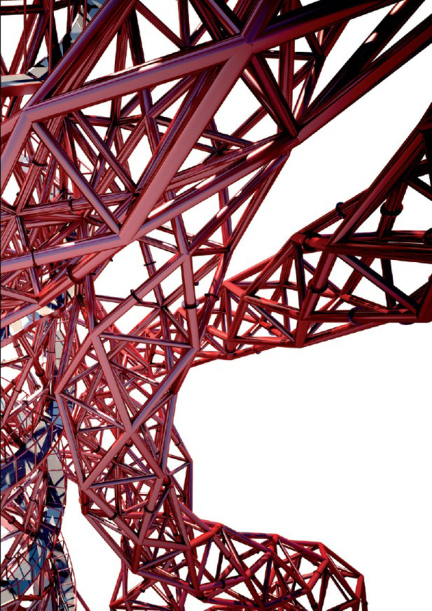
    From my bed I had the worst possible view, a panorama restricted by the hideous wing opposite. It looked north east away from our great meandering river, City monoliths, pretty Wren churches and Greenwich majesty, towards the suburban wasteland of Walthamstow and Gant’s Hill. Central to this limited aspect was our Airfix Olympic stadium with its pet cancer … Anish Kapoor’s Orbit. Disappearing anonymously among cranes and building sites, the little Indian’s inoperable whimsy looked as helpless as any other unfinished structure. Every time I opened my eyes there it was, drug-induced hallucination having the power to transform it into visionary torture. I knew exactly how Macbeth felt at the banquet – “quit my sight”. And every time I wondered what the hell it was there for.

    To discover if it owned any sense I tried drawing it, but it was formless and ungainly, without distinctive mark or symbol, rhyme or reason. Nothing commended it. Neither were the nurses any more insightful. Most hadn’t noticed its existence and of the remainder not one had a kind word, the most frequent observation being: “What’s it supposed to be?” (Incidentally, this is an intelligent question.) Given the shortages, abuse and poor conditions under which these generally marvellous carers toil, this ‘sculpture’ seemed a public folly too far.

    Orbit is a perfect example of the trash you get if you allow art to be governed by a small number of people with mutual interests, none of which concerns public desires or needs. For this is specialist gallery art foisted on a bemused populace. Orbit is and will remain meaningless to everyone who looks at it. It will never become a source of national pride or a rousing emblem because, unlike, say, the Peel Monument on the Pennine ridge above my home town, it is not assertive, commemorative or instantly recognisable, and being asymmetrical, it has no fixed image in memory, no face, no charm. It is the opposite of beautiful and it tells no story and invites no thought. Also, it fails the important Lavender Hill Mob Test: no one will buy a souvenir Orbit in the way that millions own dinky Eiffel Towers, whether of stolen gold, base metal or otherwise.

    Like all the art commissioned for the Olympics which was supposed to form part of the event’s legacy, Orbit is a characterless failure and represents a missed opportunity precisely because it was the result of a State Art establishment stitch-up. Wherever you look into its evolution, all over it are the mucky fingerprints of President-For-Life Serota and his Usual Suspects. Whenever this shower is involved you just know you’re going to get overhyped, over-rated, overpriced shit.

    An essential of public art is that you know what you are looking at and why it was put there. This demands that an artist explores beyond his own motivations and aspires to tap a collective spirit. But, of course, this is precisely the self-effacing quality of which tenth-raters in contemporary art are incapable.

    David Lee

  • Tate trustees and the public interest

    Tate trustees and the public interest

    In 2011 the Tate named two new trustees, one of whom is painter Tomma Abts. She is a 44-year-old German, recently appointed Professor of Painting at the Kunstakademie in Düsseldorf, who won the Turner Prize in 2006. As an artist trustee, she replaced Jeremy Deller, who won the Turner Prize in 2004. Abts’s paintings are all the same small size (48 x 38 cms) – it is claimed this tic is conceptually crucial for a reason never convincingly explained – and consist of polite abstract designs which might have looked original on curtains at the 1954 Ideal Home Exhibition. So much for the Cutting Edge. The Tate claims her pictures “possess a formal definition and coherence that suggests that they could never have existed any other way … [and] seem to achieve what only painting can, inhabiting both this reality as an object or ‘thing’, and a parallel world with its own set of rules and relationships that demand to be judged on their own terms.” As per with their interpretive literature, all helpful stuff. Am I being cynical? Yes. Why? Because using any sensible criteria Abts doesn’t deserve to be a trustee of an important British museum.

    The job of Tate trustees is to oversee the efficient running of the gallery “as guardians of the public interest” – and please note that it says ‘the public interest’ not ‘State Art’s interest’, for as you will discover these two mutually exclusive agendas tend to become blurred in the minds of certain individuals. Improbable as it sounds, guidelines for the functions of trustees are drawn up by the Tate itself, not by  independent arbiters. Such complacency hardly reassures an outsider that the public interest, rather than the Tate’s, is being looked after. Indeed, such self-scrutiny is hardly better than the continuing disgrace of policemen investigating their own mistakes.

    In 2008 the number of trustees was increased from 12 to 14 and as required by the Museums and Galleries Act 1992 “at least three” of these must be artists. Thirteen are appointed by the Prime Minister and the last is nominated by the trustees of the National Gallery from among their own membership. Unlike their fellow trustees, who are mainly those with business expertise, and who can serve up to two terms of four years (a period of office trimmed recently from five), artist trustees currently serve only one term of four years. You may find it odd – I certainly do – that while there are three contemporary artists with gilt-edged State Art credentials on the Tate’s board of trustees there is no place for a single art historian. I’m obviously old-fashioned because a museum of historical art with no art historians sitting on its governing board seems verging on the perverse.

    When an artist trusteeship becomes vacant it is widely advertised in the papers, giving the impression that any capable, knowledgeable, articulate artist of repute might apply. Nothing could be further from the truth, for there is a codicil written in invisible ink along the bottom of these ads, which reads: “If you have not won or at the very least been nominated for the Turner Prize, kindly fuck off and don’t waste our time.” The Tate squanders scarce cash paying for these advertisements which are nothing short of a calculated deception. Artist trustees are in fact a self-appointed clique comprising only winners of the Turner Prize with a couple of reliable also-rans chucked in. Since new regulations were imposed in 1992 the only exceptions to this rule have been Julian Opie, who famously refused his nomination for the Turner on the grounds that the prize “had become a frivolous publicity stunt”, and Bob and Roberta Smith, the sobriquet of a dimwit called Patrick Brill, who is otherwise a regular purveyor of infantile stunts at Millbank – you may recall his Tate Christmas tree whose lights visitors were asked to illuminate by peddling a generator. He’s very concerned about the environment apparently.

    Being a trustee involves attending six meetings a year and is said to require a day a month in reading and preparation. I must point out that the Tate’s artist trustees are easily the worst attenders at these meetings, and are frequently absent. In the case of Anish Kapoor (Turner Prize winner, 1991) his absenteeism, which included missing half the meetings in two consecutive years and scarpering early from others, would have surely seen him sacked from the board of any efficiently run private enterprise.

    Of currently serving artist trustees two are Germans – besides Abts the other is magazine photographer Wolfgang Tillmans (Turner Prize winner, 2000). Could they really not find a British photographer, or even a British abstract painter, worthy of these positions? Admittedly, Germans do most things better than we do but surely this is insulting to British artists. And how can a professor at a German art school, which presumably requires her to actually attend some of the week, perform the duties of a trustee required to be resident here?

    The process by which artist trustees are selected ­– laughably characterised as “an open competition” or “an open competitive process” – is indicative of what happens when a clique achieves a complacent monopoly and is allowed by servile arts commentators to get away with it. Minutes of meetings make it clear that artist trustees are encouraged to invite applications from those they consider suitable as their own replacements, especially when candidates who have responded to the ads are not considered worthy, which one may reasonably surmise is always. Indeed, I wonder if there was ever a case of a successful artist trustee having responded to the ads rather than having been – that weasel word – ‘invited’ to apply… And so Turner Prize winners beget other Turner Prize winners, or at the very least other near-misses of that persuasion.

    Candidates for artist trusteeships are interviewed by a panel comprising trustees, including the artists, plus an “independent assessor” who is present to ensure that legal niceties, “best practice” etc., are observed and everything looks above board. But how can it be above board when only Turner Prize winners are appointed? Perhaps this independent assessor ought to be involved from the start of the process in order that more than Turner Prize nominees might be seriously considered, if for no other reason than to keep up appearances of openness. Eyebrows would be raised at such a narrowness of potential candidates in any other sphere of public life: imagine, for example, the Commander-in-Chief of the armed forces always being selected from the same regiment.

    You may ask why is it so important for the convenient running of the Tate that its artist trustees are always winners of the Turner Prize. The answer is for the obvious reason that having been awarded a career-changing gong by the institution of which they are now overseers, they will never rock the boat by asking too many tricky questions about the Tate’s direction in its dealings with contemporary art. This is one of many ways by which State Art has become institutionalised: no one but the reliably subservient is ever allowed on the inside to question Tate, or indeed Arts Council, policies.

    On the other hand these parti pris trustees can be useful when outside criticism of the Tate becomes noisy. For example, in July 2004 Trustees discussed newspaper coverage of a Tate work, Rodin’s The Kiss, which Cornelia Parker (who was nominated for the Turner in 1997, the year it was won by Gillian Wearing, inevitably herself a recent artist trustee), had the previous year controversially wrapped up with a mile of string. This stunt was claimed by the artist to be “challenging the claustrophobic nature of relationships”. Artist trustees present in the meeting (which included the aforementioned Wearing) were able to defend their fellow artist for the benefit of other sceptical trustees. They pointed out that it was the job of the Tate to provoke controversy and discussion, which this work did.

    It is in the interests of these artist trustees to support the Director. They know they will be serving only for a brief period following which they might reasonably look forward to the reward of a Tate retrospective or other continued patronage, purchases etc..

    Serota has stated a preference for such younger trustees. Referring to the trusteeship of Anthony Caro many years before, he remarked in 1998 to the Sunday Times: “Tony was well over 60 when he became a trustee. He was a very effective trustee, actually. He cared passionately about certain things and was a powerful force … but it just seems to work better when you have artists who are a new generation, or indeed erring on the younger side, really.” And we know why he thinks it “seems to work better”, because older artists of a more independent, more knowledgeable, more experienced character might argue cogently for a policy or direction other than the one being pursued by the Director. They have nothing to lose by disagreeing with him. Let’s face it, the current crop of artist trustees is in Serota’s pocket. They owe him and he knows it. He can rely on their support without a second thought.

    In a 2008 interview Serota said of his trustees: “I don’t have any part to play in their appointment”. Remember this, it’s important and we’ll return to it in a second.

    Many years ago Serota said that public nominations for the Turner Prize (perhaps you don’t remember that ridiculous charade whereby we all wasted our stamps and faxes) were seriously considered by the judges. We discovered in 2006 what we already knew, courtesy of an indiscreet Turner Prize judge, that this was in fact a lie and they were binned with risible disregard. We also discovered at the same time, and from the same source, that Turner Prize judges were given a list of appropriate artists and exhibitions – just to help them along you know, point them in the right direction. And there we were thinking in the innocence of our ignorance that they might nominate anyone…

    Serota also stated in 2005 that the Tate only rarely acquired work by serving trustees. The Jackdaw checked up on that and discovered (see the editorial for Dec/Jan 2006 on our website) that he wasn’t telling the truth. Indeed, this whopper cost him a bollocking from the Charity Commission. There were also a number of other flagrant economies with the truth concerning the Tate’s acquisition of work by serving trustee Chris Ofili, who was naturally a Turner Prize winner (1998), which also resulted in another six of the best from the CC. (I almost mentioned here the fact that in the last editorial – also on our website – we indicated how the Tate recently misled us over their attendance figures, but you must be getting fed up with that one.)

    So, bearing in mind Serota’s far from perfect form, when he remarks “I don’t have any part to play in their appointment” I need to ask myself: ‘Do I give him the benefit of the doubt and believe him this time?’ Well, as it happens, no I don’t. Even cursory familiarity with the Trustees’ minutes betrays this one as untrue. On the contrary he is frequently involved in their appointment; indeed, the process of Trustee appointment is administered by his own office. He even attends candidate interviews “in an advisory capacity”. Presumably he offers ‘advice’ which plays no material part in the process, so why is he there in the first place? Indeed, we read on: “The key stages of the appointment are overseen by a panel which will normally include the Director.” (Who, presumably, doesn’t play any part.) On one recent occasion he encourages artist trustees to nominate likely candidates for their replacement knowing only too well the sort of artists they are likely to suggest. No part?

    Let’s have this one straight: Serota is ‘advising’ on the appointment of someone, a trustee, who will function as his own employer. This is a wretched abuse of the supposed ‘independence’ of process and would be considered as much in any other public body. It is, as usual, as blatant a conflict of interest (not to mention a betrayal of ‘the public interest’ about which the process purports to be so concerned) as you would expect to find at the Tate, whose management of conflicts of interest, incidentally, was declared woefully inadequate by none other than the Charities Commission.

    The Tate should not be involved with either the compiling of its own trustees’ duties, or in the nomination or selection of Trustees themselves. How can ‘the public interest’ be considered served when the organisation under scrutiny is writing the job description of its own scrutineers. If we are to have artist trustees let’s have them from a cross-section of the artist community and not just those representing the Turner Prize. And let’s have some eminent art historians in there too.

    David Lee

    The Jackdaw May-June 2011

  • How state art robs the people

    How state art robs the people

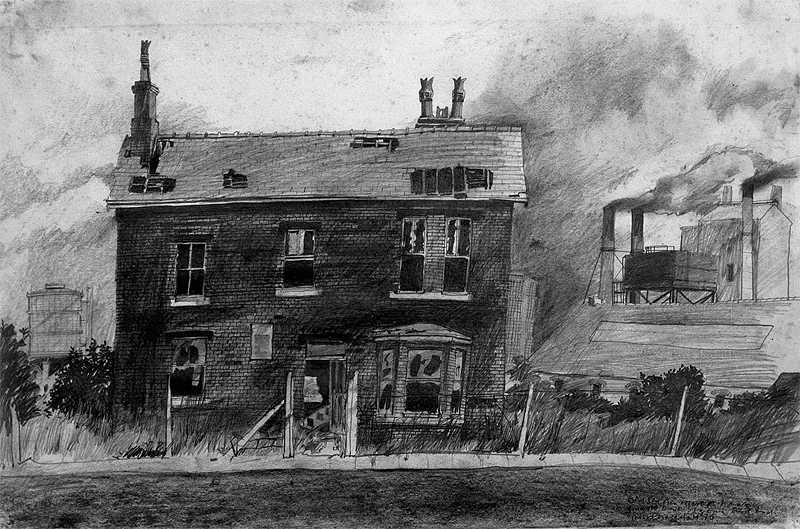
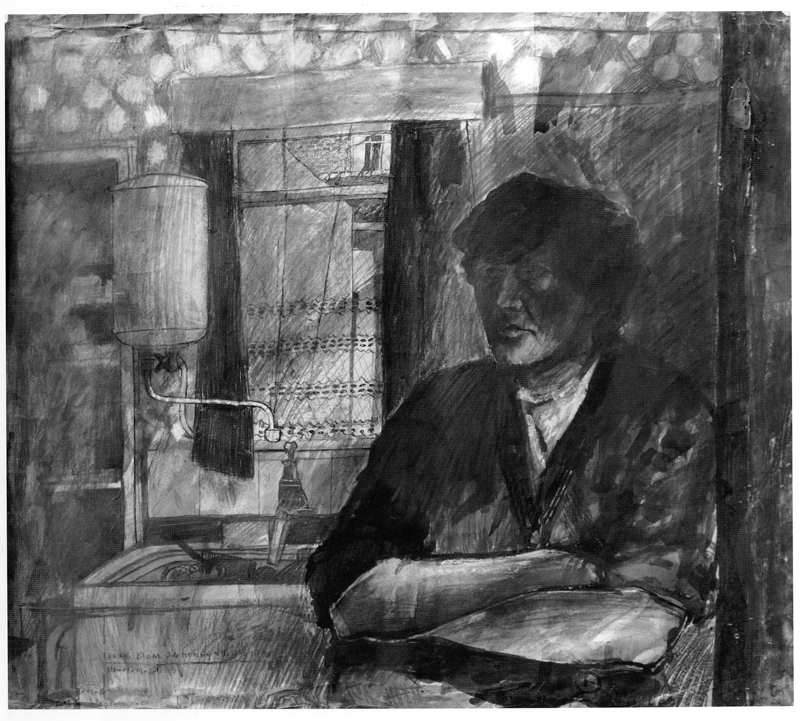
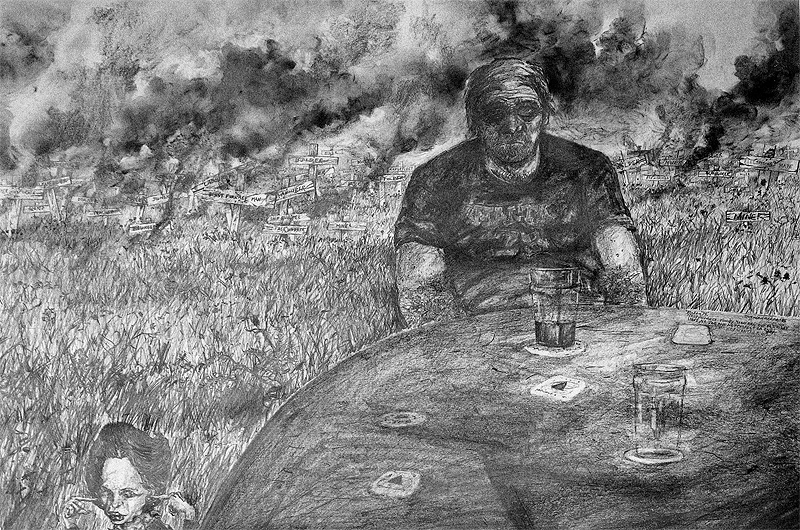
    Chances are you won’t have heard of David Mulholland (1946-2005), a painter of and from Middlesbrough. Until last year, when a group of friends devoted to the preservation of his memory sent me some of his pictures, neither had I. The work hit me immediately as authentic, born of intimate feeling for its subject. Most affecting were powerful graphite and wash drawings of blackened industrial places populated by persevering working people. Having edited a couple of art papers for over twenty years, I felt that if anyone had a right to have heard of David Mulholland then it was at the very least someone in my position.

    What follows is a lament for the establishment’s theft of the richness of our culture. Over decades now, by advancing its prejudices to the exclusion of everything else, art authorities have conspired to deny us sight of so many whose works were valuable testimonies of their time and experience. For their own ends, these all-powerful administrators have kept us in the dark.

    David Mulholland is typical of many accomplished and original 20th century British artists whose names are deservedly kept alive by friends who loved him and knew his worth as both commentator and poet, but who is unknown to the rest of us. No galleries funded by the Arts Council, for example, would dare show the work of these artists even if they wanted to. Mulholland is typical of painters derided by the self-appointed in State Art and sneered at by decision makers. By arts bodies obsessed with ‘innovation’ and the ‘cutting edge’ he is, in that infamous Arts Council phrase “the wrong kind of artist”. Yes, those are the words they use – the wrong kind of artist. What right have they to use a phrase like that? Who do these people think they are?

    As one who described with affection his experience of the hard lives and resilience of poor people, and evoked the gaunt beauty of the tough places in which they lived and worked, Mulholland was “the right kind of artist”. The only kind of artist. He is certainly among those whose work is likely to survive appreciated long into the future. His work was done because it needed to be made, because the observations of a brutal working life and cruel industry, of pleasures and strifes, of hard graft and redundancy, demanded interpretation by an artist. Mulholland’s work doesn’t need a page of unreadable tosh by one of Serota’s army of scribblers in order for you to know what it’s about. Its love for a location and people speaks for itself. In the future, say a century or more from now, those looking at Mulholland’s work will understand without prompting its concerns and causes, what stories it has to tell, and why it has lasted. In all good art, these qualities are self-evident, although in some artists they may take longer to appreciate.

    Mulholland was born in South Bank, a community on the Tees built around quaysides, three blast furnaces, steel rolling mills and fingers of cindery railway sidings. In photographs of the place in its heyday, and before the works closed, it looks smokily Soviet in its concentration of polluting ad hoc production. It’s the sort of place which, if you are born there, is in your blood forever. As landscape painter Len Tabner, another important local and friend of Mulholland, said at the recent opening of his memorial exhibition at the Dorman Museum in Middlesbrough, “Dave went all the way to Byam Shaw and to the Royal College of Art in London but only ever painted South Bank.” Apart from a brief foray as a young seaman, when he painted foreign scenes, it remained that way. He eventually returned home, taught art unconventionally in a secondary school, painted his life and friends, and sometimes the surrounding countryside. His work records a personal journey and history.

    Given the enormous sums now thrown uncritically and unchallenged at contemporary art, one ought to feel safe that excellence in whatever style or medium is somewhere being brought to our attention. But despite the fact that, courtesy of the National Lottery, there are expensive immense new galleries all over the country, the opposite continues to be true. The same few artists dominate news, features and critical coverage. They also dominate all the new galleries because these are controlled exclusively by State Art believers. For them, a foreign artist of no discernible distinction, spotted amidst the trendy jumble and waffle of an international biennale, will always take precedence over the likes of Mulholland.

    If you live in the north, as I do increasingly, you can find Anish Kapoor signing books in Middlesbrough – where his £2.5 million ‘regenerating’ fishing net was unveiled two years ago and still stands bleakly abandoned and pointless in wasteland – and at a retrospective in the Yorkshire Sculpture Park (see Moping Owl, p. 10). In London he is at Lisson Gallery, all over the Royal Academy, and even lording it over the Olympics’ site. No wonder he needs 25 assistants and three studios to churn out his coloured holes and facile shiny mirrors to meet demand. Such a monoculture as is represented by Kapoor doesn’t add to the diversity we deserve, because the rooms he and his ilk occupy with stupefying frequency are denied to others. Newspaper profiles of Kapoor last aired only three months ago when The Orbit was unveiled – having already appeared on dozens of occasions over the last twenty years –  have again been warmed up and paraphrased by others for his new shows in London and Yorkshire. This insulting process of indoctrination goes unmentioned elsewhere, as though it’s taken for granted that only a handful of artists merit such relentless promotion. The only difference in these disgustingly fawning and uncritical pieces is the sentence where they state what Kapoor is currently worth – and it keeps getting bigger, the last number cited being £80 million. For the rest of us, it is impossible not to know Kapoor’s life story off by heart. If only it were interesting. If only all this approbation were the result of his having produced something truly outstanding and comparable with the best from the past… But all that emerges is more of the same branded deluxe ornaments for the grotesque mansions of the immodest rich. And please believe me when I say there is no point in visiting his exhibition at the Yorkshire Sculpture Park, because you’ve seen it many many times before. It takes seconds to walk around. And, do you know what, some of the holes are so dark you can’t be quite sure where the bottom is. How clever is that?

    The neglect of so many for the sake of so few is a phenomenon of the celebrity culture. How long will it be before this system is exposed as a monumental racket dreamed up by a cabal of public officials, commercial dealers and auctioneers with the aim of creating false gods, rigging the market and handsomely feathering the nests of all concerned. Watching this process as it unfolds is sickening and the fact that they have not seen fit to investigate this monopoly brings disgrace on the Culture Select Committee of the House of Commons. They could have made a difference, if only by establishing once and for all that such an all-powerful orthodoxy exists in contemporary art, whose purpose is to discriminate against the likes of David Mulholland.

    Increasingly, I resent this editing of what we’ve been allowed to see, dictated as it is by the tastes of half a dozen bureaucrats with Serota at their head. This President-For-Life has singlehandedly done more damage than anyone in the history of British art to the public’s ability to see the work of a wide range of British artists. He is a self-important scourge building ever greater monuments to his own vanity and tastes, and yet he receives an uncritical press. When is this fellow going to go, and leave us alone? How long will it be before curators in regional galleries can see all art again for its qualities and not be forced to follow trends out of fear for their careers?

    If it is not the work of regional galleries to show the work of their best local artists what is it their job to do? And what an irony it is that the modern art gallery in Middlesbrough is showing coincident with Mulholland’s memorial show an exhibition dealing with “concepts of ‘home’” … starring Tate trustee Jeremy Deller.

    David Mulholland spoke a local language, a ‘home’ language, which is understood internationally by all people. No human being is excluded from its sentiments. State artists talk an international language which, like esperanto, is understood by hardly anyone. There ought to be room for both persuasions, but we are force fed only one.

    David Lee

    The Jackdaw November-December 2012

    www.davidmulholland.co.uk

  • Tate Trustees and the public interest

    The Tate recently named two new trustees, one of whom is painter Tomma Abts. She is a 44-year-old German, recently appointed Professor of Painting at the Kunstakademie in Düsseldorf, who won the Turner Prize in 2006. As an artist trustee, she replaced Jeremy Deller, who won the Turner Prize in 2004. Abts’s paintings are all the same small size (48 x 38cms) – it is claimed this tic is conceptually crucial for a reason never convincingly explained – and consist of polite abstract designs which might have looked original on curtains at the 1954 Ideal Home Exhibition. So much for the Cutting Edge. The Tate claims her pictures “possess a formal definition and coherence that suggests that they could never have existed any other way … [and] seem to achieve what only painting can, inhabiting both this reality as an object or ‘thing’, and a parallel world with its own set of rules and relationships that demand to be judged on their own terms.” As per with their interpretive literature, all helpful stuff. Am I being cynical? Yes. Why? Because using any sensible criteria Abts doesn’t deserve to be a trustee of an important British museum.

    The job of Tate trustees is to oversee the efficient running of the gallery “as guardians of the public interest” – and please note that it says  ‘the public interest’ not ‘State Art’s interest’, for as you will discover these two mutually exclusive agendas tend to become blurred in the minds of certain individuals. Improbable as it sounds, guidelines for the functions of trustees are drawn up by the Tate itself, not by independent arbiters. Such complacency hardly reassures an outsider that the public interest, rather than the Tate’s, is being looked after. Indeed, such self-scrutiny is hardly better than the continuing disgrace of policemen investigating their own mistakes.

    In 2008 the number of trustees was increased from 12 to 14 and as required by the Museums and Galleries Act 1992 “at least three” of these must be artists. Thirteen are appointed by the Prime Minister and the last is nominated by the trustees of the National Gallery from among their own membership. Unlike their fellow trustees, who are mainly those with business expertise, and who can serve up to two terms of four years (a period of office trimmed recently from five), artist trustees currently serve only one term of four years. You may find it odd – I certainly do – that while there are three contemporary artists with gilt-edged State Art credentials on the Tate’s board of trustees there is no place for a single art historian. I’m obviously old-fashioned because a museum of historical art with no art historians sitting on its governing board seems verging on the perverse.

    When an artist trusteeship becomes vacant it is widely advertised in the papers, giving the impression that any capable, knowledgeable, articulate artist of repute might apply. Nothing could be further from the truth, for there is a codicil written in invisible ink along the bottom of these ads, which reads: “If you have not won or at the very least been nominated for the Turner Prize, kindly fuck off and don’t waste our time.” The Tate squanders scarce cash paying for these advertisements which are nothing short of a calculated deception. Artist trustees are in fact a self-appointed clique comprising only winners of the Turner Prize with a couple of reliable also-rans chucked in. Since new regulations were imposed in 1992 the only exceptions to this rule have been Julian Opie, who famously refused his nomination for the Turner on the grounds that the prize “had become a frivolous publicity stunt”, and Bob and Roberta Smith, the sobriquet of a dimwit called Patrick Brill, who is otherwise a regular purveyor of infantile stunts at Millbank – you may recall his Tate Christmas tree whose lights visitors were asked to illuminate by peddling a generator. He’s very concerned about the environment apparently.

    Being a trustee involves attending six meetings a year and is said to require a day a month in reading and preparation. I must point out that the Tate’s artist trustees are easily the worst attenders at these meetings, and are frequently absent. In the case of Anish Kapoor (Turner Prize winner, 1991) his absenteeism, which included missing half the meetings in two consecutive years and scarpering early from others, would have surely seen him sacked from the board of any efficiently run private enterprise.

    Of currently serving artist trustees two are Germans – besides Abts the other is magazine photographer Wolfgang Tillmans (Turner Prize winner, 2000). Could they really not find a British photographer, or even a British abstract painter, worthy of these positions? Admittedly, Germans do most things better than we do but surely this is insulting to British artists. And how can a professor at a German art school, which presumably requires her to actually attend some of the week, perform the duties of a trustee required to be resident here?

    The process by which artist trustees are selected – laughably characterised as “an open competition” or “an open competitive process” – is indicative of what happens when a clique achieves a complacent monopoly and is allowed by servile arts commentators to get away with it. Minutes of meetings make it clear that artist trustees are encouraged to invite applications from those they consider suitable as their own replacements, especially when candidates who have responded to the ads are not considered worthy, which one may reasonably surmise is always. Indeed, I wonder if there was ever a case of a successful artist trustee having responded to the ads rather than having been – that weasel word – ‘invited’ to apply… And so Turner Prize winners beget other Turner Prize winners, or at the very least other near-misses of that persuasion.

    Candidates for artist trusteeships are interviewed by a panel comprising trustees, including the artists, plus an “independent assessor” who is present to ensure that legal niceties, “best practice” etc., are observed and everything looks above board. But how can it be above board when only Turner Prize winners are appointed? Perhaps this independent assessor ought to be involved from the start of the process in order that more than Turner Prize nominees might be seriously considered, if for no other reason than to keep up appearances of openness. Eyebrows would be raised at such a narrowness of potential candidates in any other sphere of public life: imagine, for example, the Commander-in-Chief of the armed forces always being selected from the same regiment.

    You may ask why is it so important for the convenient running of the Tate that its artist trustees are always winners of the Turner Prize. The answer is for the obvious reason that having been awarded a career-changing gong by the institution of which they are now overseers, they will never rock the boat by asking too many tricky questions about the Tate’s direction in its dealings with contemporary art. This is one of many ways by which State Art has become institutionalised: no one but the reliably subservient is ever allowed on the inside to question Tate, or indeed Arts Council, policies.

    On the other hand these parti pris trustees can be useful when outside criticism of the Tate becomes noisy. For example, in July 2004 Trustees discussed newspaper coverage of a Tate work, Rodin’s The Kiss, which Cornelia Parker (who was nominated for the Turner in 1997, the year it was won by Gillian Wearing, inevitably herself a recent artist trustee), had the previous year controversially wrapped up with a mile of string. This stunt was claimed by the artist to be “challenging the claustrophobic nature of relationships”. Artist trustees present in the meeting (which included the aforementioned Wearing) were able to defend their fellow artist for the benefit of other sceptical trustees. They pointed out that it was the job of the Tate to provoke controversy and discussion, which this work did.

    It is in the interests of these artist trustees to support the Director. They know they will be serving only for a brief period following which they might reasonably look forward to the reward of a Tate retrospective or other continued patronage, purchases etc.

    Serota has stated a preference for such younger trustees. Referring to the trusteeship of Anthony Caro many years before, he remarked in 1998 to the Sunday Times: “Tony was well over 60 when he became a trustee. He was a very effective trustee, actually. He cared passionately about certain things and was a powerful force … but it just seems to work better when you have artists who are a new generation, or indeed erring on the younger side, really.” And we know why he thinks it “seems to work better”, because older artists of a more independent, more knowledgeable, more experienced character might argue cogently for a policy or direction other than the one being pursued by the Director. They have nothing to lose by disagreeing with him. Let’s face it, the current crop of artist trustees is in Serota’s pocket. They owe him and he knows it. He can rely on their support without a second thought.

    In a 2008 interview Serota said of his trustees: “I don’t have any part to play in their appointment”. Remember this, it’s important and we’ll return to it in a second.

    Many years ago Serota said that public nominations for the Turner Prize (perhaps you don’t remember that ridiculous charade whereby we all wasted our stamps and faxes) were seriously considered by the judges. We discovered in 2006 what we already knew, courtesy of an indiscreet Turner Prize judge, that this was in fact a lie and they were binned with risible disregard. We also discovered at the same time, and from the same source, that Turner Prize judges were given a list of appropriate artists and exhibitions – just to help them along you know, point them in the right direction. And there we were thinking in the innocence of our ignorance that they might nominate anyone…

    Serota also stated in 2005 that the Tate only rarely acquired work by serving trustees. The Jackdaw checked up on that and discovered (see the editorial for Dec/Jan 2006 on our website) that he wasn’t telling the truth. Indeed, this whopper cost him a bollocking from the Charity Commission. There were also a number of other flagrant economies with the truth concerning the Tate’s acquisition of work by serving trustee Chris Ofili, who was naturally a Turner Prize winner (1998), which also resulted in another six of the best from the CC. (I almost mentioned here the fact that in the last editorial – also on our website – we indicated how the Tate recently misled us over their attendance figures, but you must be getting fed up with that one.)

    So, bearing in mind Serota’s far from perfect form, when he remarks “I don’t have any part to play in their appointment” I need to ask myself: ‘Do I give him the benefit of the doubt and believe him this time?’ Well, as it happens, no I don’t. Even cursory familiarity with the Trustees’ minutes betrays this one as untrue. On the contrary he is frequently involved in their appointment; indeed, the process of Trustee appointment is administered by his own office. He even attends candidate interviews “in an advisory capacity”. Presumably he offers ‘advice’ which plays no material part in the process, so why is he there in the first place? Indeed, we read on: “The key stages of the appointment are overseen by a panel which will normally include the Director.” (Who, presumably, doesn’t play any part.) On one recent occasion he encourages artist trustees to nominate likely candidates for their replacement knowing only too well the sort of artists they are likely to suggest. No part?

    Let’s have this one straight: Serota is ‘advising’ on the appointment of someone, a trustee, who will function as his own employer. This is a wretched abuse of the supposed ‘independence’ of process and would be considered as much in any other public body. It is, as usual, as blatant a conflict of interest (not to mention a betrayal of ‘the public interest’ about which the process purports to be so concerned) as you would expect to find at the Tate, whose management of conflicts of interest, incidentally, was declared woefully inadequate by none other than the Charities Commission.

    The Tate should not be involved with either the compiling of its own trustees’ duties, or in the nomination or selection of Trustees themselves. How can ‘the public interest’ be considered served when the organisation under scrutiny is writing the job description of its own scrutineers. If we are to have artist trustees let’s have them from a cross-section of the artist community and not just those representing the Turner Prize. And let’s have some eminent art historians in there too.

    David Lee

    The Jackdaw May-Jun 2011