Category: Uncategorized

  • Northern Lights

    JANUARY/FEBRUARY, 2023

    National Portfolio Organisations are those whose conformity the Arts Council has decided it can rely on sufficiently to allocate annual grants three years ahead of time. Getting on the NPO roster constitutes the blue riband of subsidy. Under normal circumstances once you’re in, and you follow orders to the letter, it’s doubles all round. This year, however, under pressure from Government to spread its money more widely than the usual suspects, and in the cause of the slogan Levelling Up, the Arts Council had to throw some reliable, treasured recipients under the bus, decisions the poor old President-for-Life found ‘invidious’. London and the South East having customarily gobbled up more than their fair portion of the national wedge, Levelling Up means more cash for other areas of the country which are said hitherto to have been financially and therefore culturally neglected. If you wish to understand fully how this nebulous idea works in practice don’t bother reading the ‘Levelling Up White Paper’. It is dense with vague drivel divorced from reality of the sort only the BBC takes seriously, such as “giving everyone the opportunity to flourish”. The penpushers who write this guff must live in a parallel universe to the rest of us.

    Thus 276 of the 990 on the latest roster of NPOs are first-timers and qualify for a share of £446 million. Many of these newcomers indicate a dangerous move away from serious art into the realms of popular culture. Being interested in Art as I am, I wouldn’t have given a farthing to most of them because they are more concerned with ephemeral community entertainment than they are organisations likely to produce anything serious and lasting.

    One of these lucky recipients is Blackpool Illuminations, or ‘The Lights’ as Lancastrians like myself know them. They will get £700,000 over three years – which represents a sizeable pile of coloured bulbs. Since 1879 The Lights have been a popular annual escape for working people chasing a few hours of release. They run from the end of September to early November and were a shrewd tactic devised by the local council to extend the holiday season six weeks beyond the traditional summer holidays, so exploiting earlier evenings of darkness. I’ve been going to The Lights every few years since my first trip in 1956. Coaches, weighed down with rattling crates of Light Ale for blokes and Babycham for the girls, were run from Pennine mill towns specifically to see The Lights. An afternoon at the funfair or in the bar (different towns were allocated their own pubs to avoid punch-ups) would be followed by fish and chips – the Blue Lagoon at South Shore opposite the Pleasure Beach is my personal recommendation. Traditionally, and with faces flashing, there was the stroll up the Golden Mile prom, buying daft stuff and teeth-rotting confectionery while enjoying animated lights telling familiar stories … Then home into the night carousing all the way across Belmont Moor. Illuminated Art Deco trams clanking past, dressed up as Spanish galleons or Mississippi riverboats with turning wheels, were a special treat, unforgettable. I loved it all, and still do.
    The importance of The Lights in Lancashire tradition and lore should not be underestimated. In the late ’60s I worked on a Bolton building site helping a craftsman joiner of mesmerising skill called Pete – honestly, he could hang a door complete with hinges, handles and double locks inside five minutes so it fitted like a glove. One morning sat on wood shavings having a brew and reading the horses, Pete suddenly broke the silence. He mused slowly out loud about the suspiciously large number of ‘legovers’, as he put it, he was currently enjoying from his wife. Then, revelation, he jabbed his finger at me, winked and confided “She’ll be after a trip t’t Lights!”

    Blackpool’s seven hundred grand is to be used to commission ‘Light Artists’ – don’t you find that phrase alone sufficient to make you groan and die inside? The one thing The Lights do not need is an Arts Council grant arriving in the form of pretentious artists messing with something whose pleasurable simplicity they couldn’t fathom in a million years. The Lights are one of few examples of popular culture whose purity can only be poisoned by AC interference, and especially by those ‘artists’ trained (if at all) only in peddling the most feeble of ‘concepts’. And I don’t doubt there are many other companies in the north, also newly appointed NPOs, for whom the same is true. They will all get used to having a few quid to spend on what they have always done anyway, and then the blackmail will start.
    Blackpool should reconsider and tell the President-for-Life where he can shove his stick of rock.
  • A Line in the Sand

    A Line in the Sand

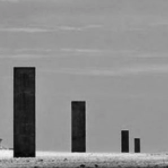
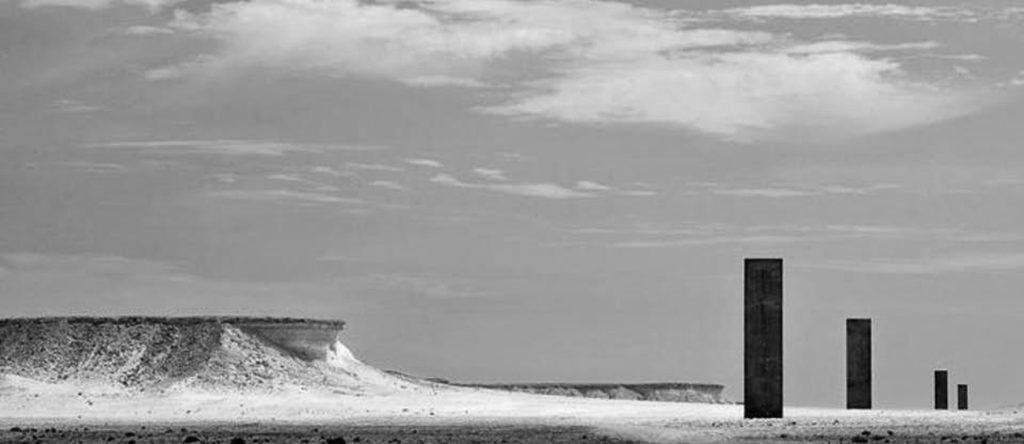
    State Art is like a virus, it knows no boundaries and spreads like wildfire. In fact, it’s worse than a virus because once it’s arrived you can’t get rid of it because there’s seemingly no cure. And there are plenty of students actually volunteering to contract it. And national boundaries are no protection for it spreads by telepathic brainwashing. This leads to many curious anomalies. Why, for example, should peoples of different cultures and traditions, all as equally rich as our own ‘western’ one, be interested in the brand names of State Art? A good example of this is currently doing the rounds. This piece (above) by Richard Serra comprises four large slabs of metal, each 45 feet high, spread over a thousand yards of a nature reserve in Qatar. A nature reserve! How could anyone in that country believe that an Arab population could possibly see and understand this as a “breathtaking national asset”. One can only conclude that the proliferation of State Art has caused a global pandemic of acute self-delusion. The reason why East/West West/East is in the news is because it’s being cleaned of graffiti. Authorities in Qatar are appalled that locals can’t understand the sculptures’ world significance. It was unveiled in 2014 and the artist hoped it would become a landmark, as if everywhere needs a landmark. Surely this is the fate of anything at all you might plonk in an expanse of desert. 

    As an addict of the sweeping non-sequitur, Serra has clearly been listening in while Gormless, occupying the next hotel room, practices in front of the mirror. He said: “I attempt to use sculptural form to make space distinct… What that piece does is give you a point of reference in relationship to a line, and your upstanding relationship to a vertical plane, and infinity, and a personal relationship to a context – and pulls that context together. It makes it graspable. That’s actually a place out there now, and there certainly wasn’t one before. We did that simply by putting up four plates.”

    Talk about stating the bleeding obvious. You could make the same claim for a line of telegraph poles.

    Overlooking the conceit of an artist prepared to inflict his lack of imagination on a nature reserve… was it Moore or Caro who said “More often than not sculpture spoils landscape”?

  • Mary Wollstonecraft Memorial, Newington Green

    Mary Wollstonecraft Memorial, Newington Green

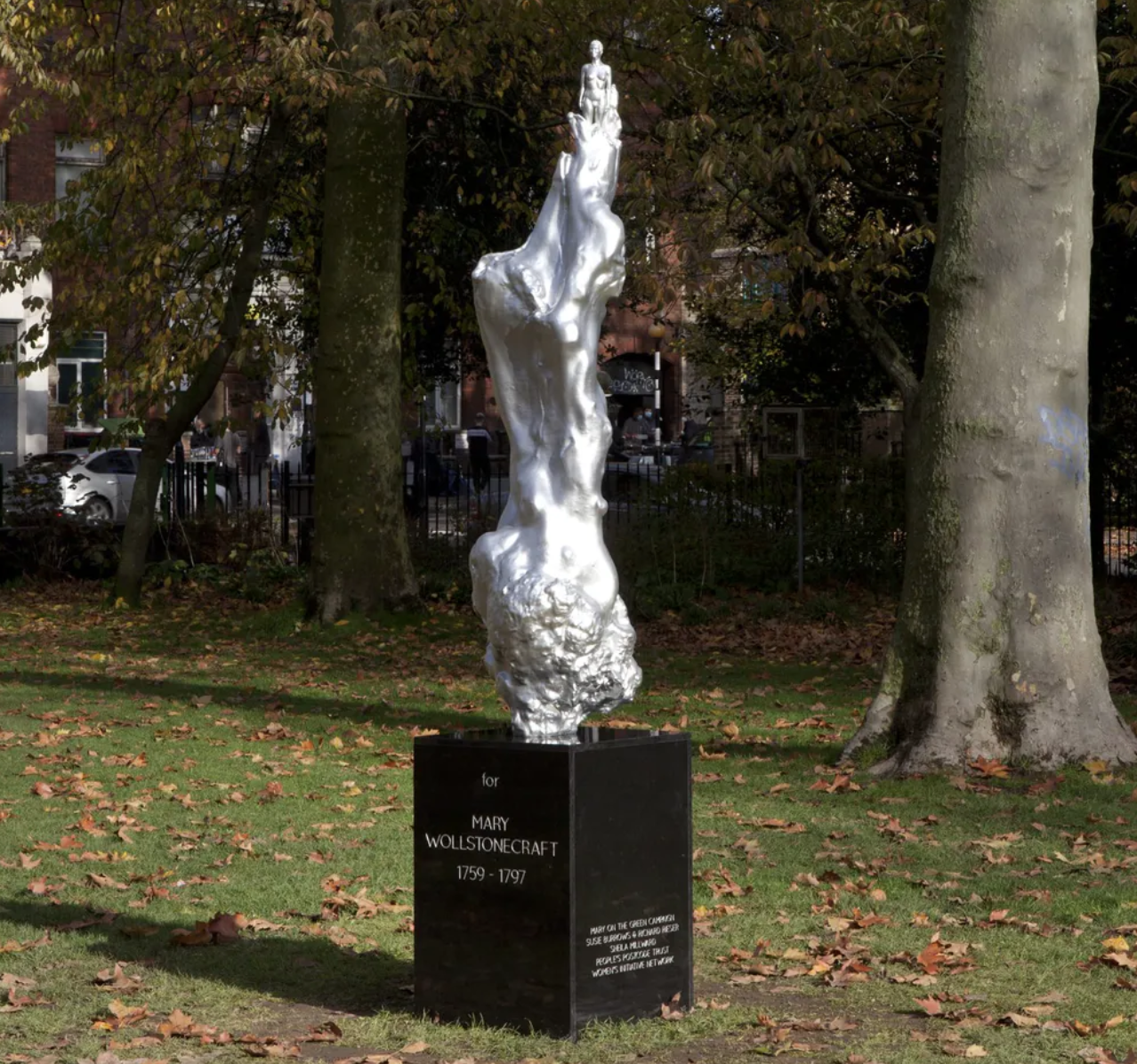
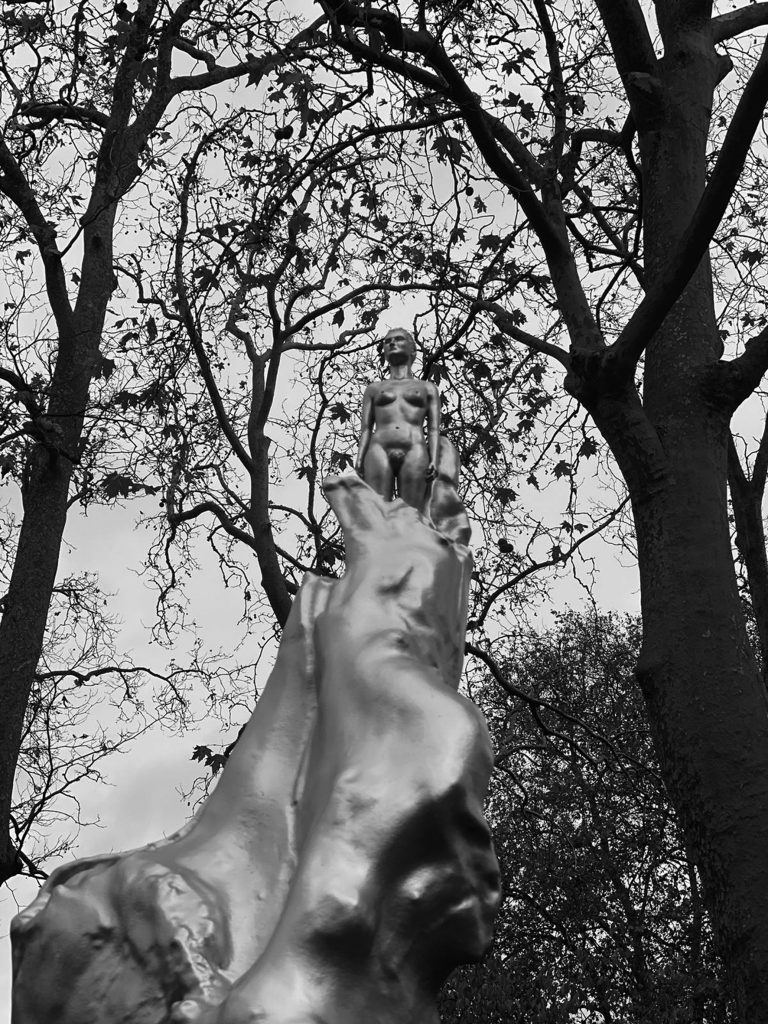
    A silvery bronze sculpture of pioneer feminist Mary Wollstonecraft (1759-1797) by Maggi Hambling has been unveiled on Newington Green in north London. Revolutionary thinker Wollstonecraft lived nearby. The  £143,000 cost, which took ten years to collect, was raised by public subscription, some of which donors may now be wishing they had more productively spent their cash on drugs from dealers trading nearby. Hambling is the author of the equally tacky piece in Covent Garden dedicated to Oscar Wilde, and also that corrugated flotsam, a scallop shell apparently, on the beach at Aldeburgh to Benjamin Britten.

    This one is another publicity seeking effort. How long will it take before those who make these decisions realise Hambling is no sculptor? It is hard to second guess the thinking of those who selected her for this commission Now let’s rehearse the points one by one … Yes, that’s right, all of the wrong reasons for choosing any artist. What we have is a nude woman who closely resembles one of those heroic athletes from the Soviet era. It is insulting to women to characterise them as a sideboard sports trophy. From the back it looks like a half-chewed caramel. Squirting from the top the figure is akin to the memorial of Yuri Gagarin which used to stand in the centre of Moscow, where the tiny stylised figure is launched from the end of a great arc of shiny metal – in that instance a piece of magnificent kitsch. This work isn’t just bad it’s repellent, the commemorated person deserving of so much better. Where are the anarchist statue topplers when you need them? (By the way, we didn’t really mean that.) Whatever your views of Colston as a good or bad individual his statue was a decent piece of sculpture and perhaps even the best work by the artist who made it. We prefer to think of Wollstonecraft as the original thinker presented in the Tate’s agreeable portrait of her, one of John Opie’s more memorable character studies.

    The other entry considered for the commission was by Martin Jennings.

    Local resident, architect Matthew Lloyd, comments:

    This statue by Hambling is so very sad. Even since its unveiling it has been slated, and, yes, by the Guardian too. The Spectator has just now written about it, rather politely I thought, although in clear opposition to it.

    Firstly it is ugly and badly made. The base looks like a budget graveyard memorial – and why is it not in the same material as the upper part? Then there is the middle silver blob and then this extraordinary machete of a naked woman on top. These physical and material mistakes are relatively easy to note when speaking from a design background.

    What I find most regrettable is what ordinary people around here will think and say. And what are local kids – often from poor backgrounds (the very run down/notorious Shakespeare estate is next door) – supposed to make of this sculpture? Will they be able to relate it to their history lessons in any way at all? Will they not be utterly confused by its frank sexuality – instead of seeing it as a worthwhile piece of social/historical commentary? This piece will just add to the constantly confused messaging that, say, schoolgirls (given that this concerns a brave, original and radical historical figure) now have to deal with every day.

    Those of us who live locally now have to put up with this object for the rest of our lives. Maggie Hambling and her commissioners will no doubt be pleased by the furore it has already caused. But this tells us more about them than it considers any response by locals. This is an over-clever, elite public installation that is unskilled and a wasted opportunity.