Tag: Serota

  • Selby Whittingham: Tate Modern or Tate Theatre

    A survey by the Office for National Statistics in May revealed that the British are changing their spending habits. Instead of filling our homes to the rafters with consumer durables and not-so-durables, we’re spending our spare cash on ‘experiences’, including recreation and, yes, culture. “People are interested in servicing a lifestyle rather than buying stuff,” one trend forecaster commented in The Guardian, while a senior executive from IKEA predicted gloomily: “In the west, we have probably hit peak stuff”.

    Does this mean fewer family trips to the mall and more museum visits? The contemporary museum sector certainly hopes so, and to bring the hope closer to reality it is doing it best to make the two experiences as similar as possible. This is an ambition not confined to Britain. Is it any coincidence that Rome’s two contemporary art museums, MACRO and MAXXI, have names like megastores? It wouldn’t surprise me if the Pompidou called its next outlet Géant Casino.

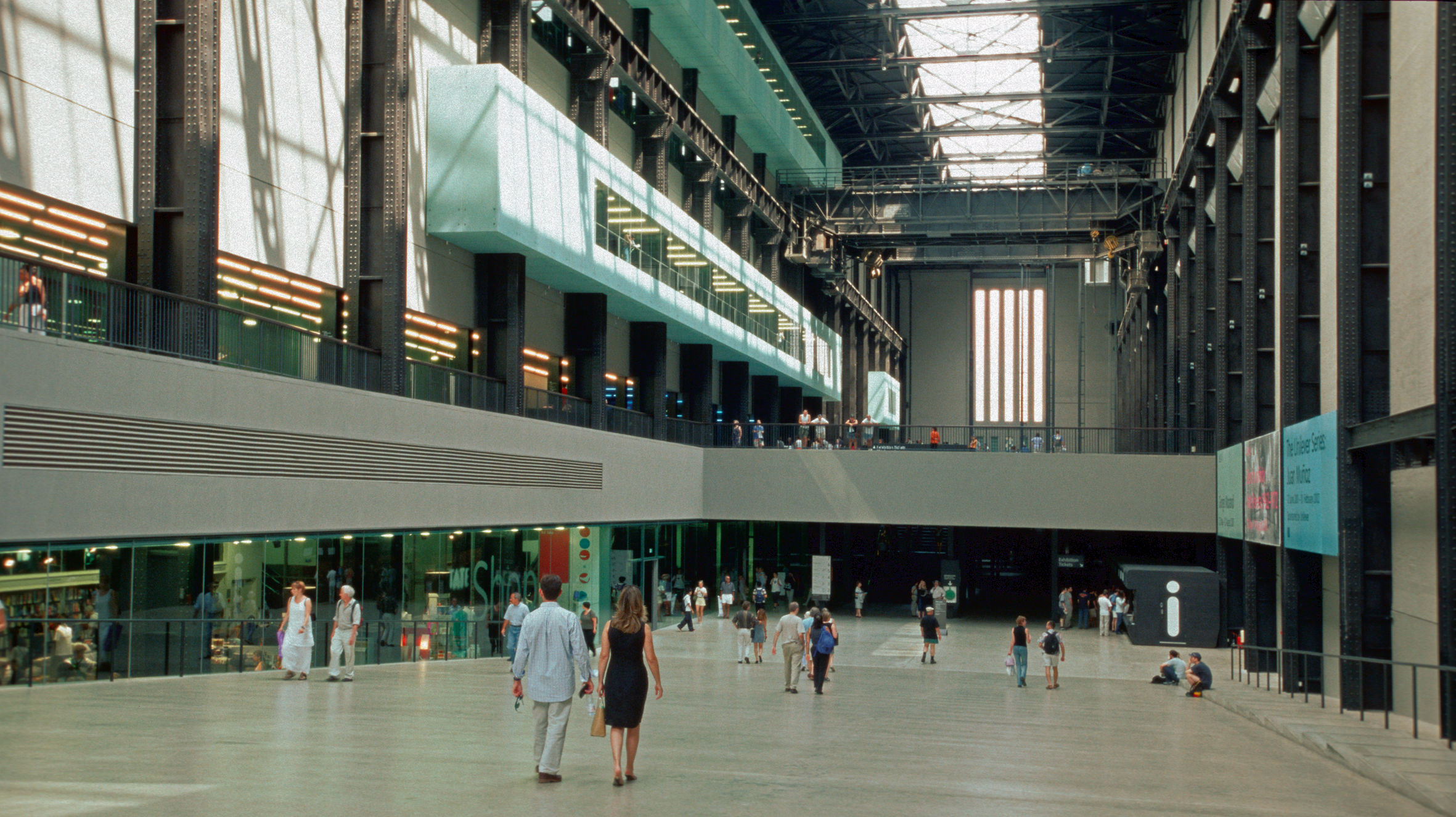
    The mallification of the contemporary art experience is international, but here in Britain, where entry is free, we lead the world. Last year Tate Modern logged 5.7 million visitors (don’t you love the precision of the decimal point?) and this year, with the added attraction and capacity of Herzog & de Meuron’s new Switch house extension, it’s hoping to swell attendance figures to over 6 million.

    Architecturally, malls and contemporary art galleries have much in common: both incorporate awesomely large atria designed to instill a sense of limitless possibility, and both feature fancy escalators and rubbish cafés run by stressed and underpaid staff. Ah yes, you say, but here your parallel hits the buffers: people go to shopping malls to shop. Not strictly true, is my reply: visiting malls is a leisure activity. People go to malls to look at stuff and at each other, especially when travelling up and down the escalators, much as the ancient Greeks did in the agora, though without the escalators. Window-shopping is a group activity, a sociable way of servicing a lifestyle. As an experience, the ONS might well put it in the same category as visiting Tate Modern.

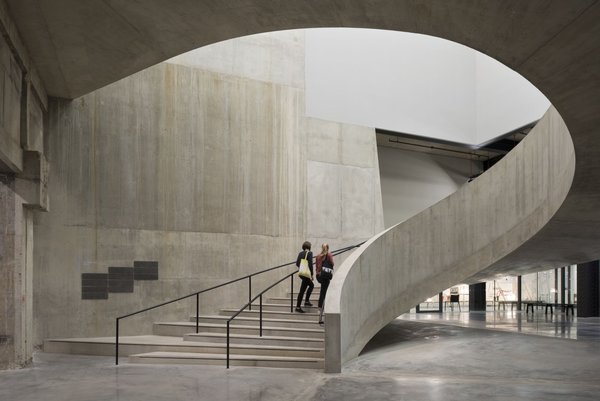
    In the run-up to the Switch House’s opening we were forewarned that much of its 60% of extra space would be devoted to social interaction. Museums used to be about conservation. Now, with a minor anagrammatic rearrangement, they’re about conversation. Like shopping malls, contemporary galleries are places to hang out in, with the shop window or exhibition displays serving as talking points. As Jacques Herzog explained to The Observer about the design of the Switch House, “the stairs are wider than we need them; we want to invite people to have a different kind of experience than to rush from one gallery to another”.

    Lee Mawdsley

    All well and good, but you can’t get round a gallery this size without rushing, especially not if you linger on the stairs. I lost the ability to focus less than halfway through, and I call myself an art critic. The problem is not just one of scale; the trouble starts, ironically, with the gallery’s departure from the mall model. Art galleries, like shops, used to be full of covetable objects ordinary people could fantasise about owning – modest-sized works, originally made for private consumption, put on public display for the benefit of the general population. The Switch House galleries are mostly full of large-scale works created with public display in mind. Like public sculptures, they are made for rushing past.

    The mystery of this so-called gallery extension which has so far cost £58 million of public money is how relatively little art there is in it: only three of its ten floors are exhibition galleries, four if you count the Tanks. But this didn’t stop the panel assembled for the press launch – including poor little Sadiq, whistled up at short notice as a multicultural mascot – from harping on about how transformative it would all be. It’s unfortunate that the most conspicuous evidence of the economic transformation so far triggered by the old Tate Modern should be Richard Rogers’s Neo Bankside luxury apartments with their litter of posh nosh outlets underneath. Looking south from Switch House’s 10th floor viewing platform, it’s hard to imagine the Tate’s regenerative effect rippling out towards the North Downs without the swathes of intervening social housing being swept away and replaced with Tory nastytecture and overpriced cafés.

    Bilbao has a lot to answer for. If the Basque government hadn’t hit the community jackpot with Frank Gehry’s Guggenheim Museum none of this would have happened. As it is, any city council in need of an economic boost reaches for the starchitects. The only city manfully resisting the tide seems to be Helsinki, still refusing to give the go-ahead to its Guggenheim outlet more than a year after the Paris-based architects Moreau Kusunoki won the competition to design it.

    Bilbao claims to have recouped the Guggenheim’s construction costs within three years of opening. Even allowing for some prestidigitous book-balancing on Bilbao’s part, there’s precious hope of Tate Modern repeating this feat, with a £30 million funding hole that still needs filling. On the eve of the Switch House’s opening, Serota as good as admitted to The Art Newspaper that if the Tate didn’t seize the opportunity of “unwrapping the building” to hook some late donations it would be this year, next year, sometime, never before the debt was paid. Slim chance of our new tightwad PM delivering on Osborne’s previous promise of an extra £6.8 million of annual funding – and extra funding will be needed, not just to service the debt.


    As with any expanded operation, the elephant in the gallery extension is the payroll. Billionaire donors who will happily part with capital to get their names on a museum building don’t give a stuff about the extra numbers of staff needed to keep it open. They leave such practicalities to museum administrators and the public bodies that fund them. If it came to keeping museum staff in jobs and pensions, your average billionaire would hand straight over to Dominic Chapell.

    In America, where more than $5 billion has been spent on museum expansion in the past nine years, administrators are getting wise. The Met, which reported a $10 million deficit this year, has mothballed plans for a David Chipperfield-designed modern and contemporary wing and, along with MoMA and the Brooklyn Museum, has announced plans to cut staff. The Met’s 2,300 staff – who, unlike museum staff in Britain, are properly paid – cost $200 million in salaries and benefits in 2013. MoMA, which spent $87 million on its 800 employees in the same year, has scaled back plans for a new extension.

    Double your gallery space and you double your warding costs, at least in theory. One reason, I suspect, why Tate Modern’s Switch House galleries are almost entirely given over to large sculptural installations is that they require less security – the worst you can do is steal a Carl André brick. Meanwhile the more vulnerable paintings and nickable sculptures have been squeezed into a few crowded galleries in the old Boiler House to save on warders.

    The dawn of the artist’s statement was bad enough; the arrival of the statement building has made things worse. Combine the two, and you get a tower of babble. Is the new Tate Modern worth the £260 million investment? If it ever has to charge for entry, we’ll find out.

    Selby Whittingham
    The Jackdaw 

  • Laura Gascoigne: Reach for the Starchitects – The Switch House

    A survey by the Office for National Statistics in May revealed that the British are changing their spending habits. Instead of filling our homes to the rafters with consumer durables and not-so-durables, we’re spending our spare cash on ‘experiences’, including recreation and, yes, culture. “People are interested in servicing a lifestyle rather than buying stuff,” one trend forecaster commented in The Guardian, while a senior executive from IKEA predicted gloomily: “In the west, we have probably hit peak stuff”.

    Does this mean fewer family trips to the mall and more museum visits? The contemporary museum sector certainly hopes so, and to bring the hope closer to reality it is doing it best to make the two experiences as similar as possible. This is an ambition not confined to Britain. Is it any coincidence that Rome’s two contemporary art museums, MACRO and MAXXI, have names like megastores? It wouldn’t surprise me if the Pompidou called its next outlet Géant Casino.

    The mallification of the contemporary art experience is international, but here in Britain, where entry is free, we lead the world. Last year Tate Modern logged 5.7 million visitors (don’t you love the precision of the decimal point?) and this year, with the added attraction and capacity of Herzog & de Meuron’s new Switch house extension, it’s hoping to swell attendance figures to over 6 million.

    Architecturally, malls and contemporary art galleries have much in common: both incorporate awesomely large atria designed to instill a sense of limitless possibility, and both feature fancy escalators and rubbish cafés run by stressed and underpaid staff. Ah yes, you say, but here your parallel hits the buffers: people go to shopping malls to shop. Not strictly true, is my reply: visiting malls is a leisure activity. People go to malls to look at stuff and at each other, especially when travelling up and down the escalators, much as the ancient Greeks did in the agora, though without the escalators. Window-shopping is a group activity, a sociable way of servicing a lifestyle. As an experience, the ONS might well put it in the same category as visiting Tate Modern.

    In the run-up to the Switch House’s opening we were forewarned that much of its 60% of extra space would be devoted to social interaction. Museums used to be about conservation. Now, with a minor anagrammatic rearrangement, they’re about conversation. Like shopping malls, contemporary galleries are places to hang out in, with the shop window or exhibition displays serving as talking points. As Jacques Herzog explained to The Observer about the design of the Switch House, “the stairs are wider than we need them; we want to invite people to have a different kind of experience than to rush from one gallery to another”.

    All well and good, but you can’t get round a gallery this size without rushing, especially not if you linger on the stairs. I lost the ability to focus less than halfway through, and I call myself an art critic. The problem is not just one of scale; the trouble starts, ironically, with the gallery’s departure from the mall model. Art galleries, like shops, used to be full of covetable objects ordinary people could fantasise about owning – modest-sized works, originally made for private consumption, put on public display for the benefit of the general population. The Switch House galleries are mostly full of large-scale works created with public display in mind. Like public sculptures, they are made for rushing past.

    The mystery of this so-called gallery extension which has so far cost £58 million of public money is how relatively little art there is in it: only three of its ten floors are exhibition galleries, four if you count the Tanks. But this didn’t stop the panel assembled for the press launch – including poor little Sadiq, whistled up at short notice as a multicultural mascot – from harping on about how transformative it would all be. It’s unfortunate that the most conspicuous evidence of the economic transformation so far triggered by the old Tate Modern should be Richard Rogers’s Neo Bankside luxury apartments with their litter of posh nosh outlets underneath. Looking south from Switch House’s 10th floor viewing platform, it’s hard to imagine the Tate’s regenerative effect rippling out towards the North Downs without the swathes of intervening social housing being swept away and replaced with Tory nastytecture and overpriced cafés.

    Bilbao has a lot to answer for. If the Basque government hadn’t hit the community jackpot with Frank Gehry’s Guggenheim Museum none of this would have happened. As it is, any city council in need of an economic boost reaches for the starchitects. The only city manfully resisting the tide seems to be Helsinki, still refusing to give the go-ahead to its Guggenheim outlet more than a year after the Paris-based architects Moreau Kusunoki won the competition to design it.

    Bilbao claims to have recouped the Guggenheim’s construction costs within three years of opening. Even allowing for some prestidigitous book-balancing on Bilbao’s part, there’s precious hope of Tate Modern repeating this feat, with a £30 million funding hole that still needs filling. On the eve of the Switch House’s opening, Serota as good as admitted to The Art Newspaper that if the Tate didn’t seize the opportunity of “unwrapping the building” to hook some late donations it would be this year, next year, sometime, never before the debt was paid. Slim chance of our new tightwad PM delivering on Osborne’s previous promise of an extra £6.8 million of annual funding – and extra funding will be needed, not just to service the debt.

    As with any expanded operation, the elephant in the gallery extension is the payroll. Billionaire donors who will happily part with capital to get their names on a museum building don’t give a stuff about the extra numbers of staff needed to keep it open. They leave such practicalities to museum administrators and the public bodies that fund them. If it came to keeping museum staff in jobs and pensions, your average billionaire would hand straight over to Dominic Chapell.

    In America, where more than $5 billion has been spent on museum expansion in the past nine years, administrators are getting wise. The Met, which reported a $10 million deficit this year, has mothballed plans for a David Chipperfield-designed modern and contemporary wing and, along with MoMA and the Brooklyn Museum, has announced plans to cut staff. The Met’s 2,300 staff – who, unlike museum staff in Britain, are properly paid – cost $200 million in salaries and benefits in 2013. MoMA, which spent $87 million on its 800 employees in the same year, has scaled back plans for a new extension.

    Double your gallery space and you double your warding costs, at least in theory. One reason, I suspect, why Tate Modern’s Switch House galleries are almost entirely given over to large sculptural installations is that they require less security – the worst you can do is steal a Carl André brick. Meanwhile the more vulnerable paintings and nickable sculptures have been squeezed into a few crowded galleries in the old Boiler House to save on warders.

    The dawn of the artist’s statement was bad enough; the arrival of the statement building has made things worse. Combine the two, and you get a tower of babble. Is the new Tate Modern worth the £260 million investment? If it ever has to charge for entry, we’ll find out.

    Laura Gascoigne
    The Jackdaw

  • Editorial – July 2017

    WHOLESALE GRATIFICATION 

    In the last issue I noted the gradual but relentless erosion of space allocated to historical pictures in Tate Britain. This contraction will now accelerate because the collection is to be re-hung, yet again, on this occasion thematically – a policy undoubtedly designed to demonstrate the State Art Commandment that all roads shall lead to the Usual Suspects. Long gone are the reassuring days of my youth when a regular visitor to Millbank would know exactly where to find the enduring gems of British art. This trend of squeezing the historical is also inevitable because new art increases as a percentage of the collection. Hedging their bets, and in order not to miss something the future decides is important, the Tate now acquires anything by anyone. To them the idea of exhibiting discernment is as damningly reactionary as the idea of figurative art itself. The result is that Serota’s true legacy is not really all those expensive new buildings and extensions but his total surrender to mediocrity.

    A well-researched article on the Guardian website recently arrived at the startling, though not entirely surprising conclusion that during Serota’s recently concluded 28-year tenure the number of works in the Tate’s holding – excluding the Turner Bequest – doubled. Serota added over 30,000 new items, the majority of them box fresh. We’ve pointed out previously in these pages that the Tate’s stock has grown every two years by more works than the National Gallery has acquired in total in the 193 years of its existence. The irony here is that this massive growth, both of the collection and the galleries in which to house some of it, has taken place during a period when scarcely a month passed without warnings of dire consequences if more public subsidy wasn’t found. On the evidence of the collection alone, and for all Serota’s gloomy predictions to the contrary, the Tate has enjoyed a golden age of expansion during which it swallowed far more than its fair share of the national arts budget.

    Most of the work acquired during the Serota years is by a roll call of artists you’ve never heard of, many of whom are not only living but young, and whose efforts wouldn’t have merited preservation in what at least in theory, until Serota took over, had always been a repository for choice works of proven quality. Not any more. Today, the collection is home to the kind of instantly forgettable trivia we see in Tate Modern’s latest extension.

    Serota’s reign was also responsible for a serious reorientation in the way we must approach art. State-approved styles and mediums now require a different way of looking. Established criteria of judgement were replaced by a new ‘vision’ discouraging of knowledge and preconceptions. Dinosaurs, such as myself, who were trained in stylistic comparisons and the identification and explanation of minute visual subtleties, have been mystified by this, confounded by the obvious feebleness of what is relentlessly marketed as the acme of achievement. It took me longer than it ought to have done to realise that if you start with any assumptions at all about what the Arts Council dubs ‘Challenging Contemporary Art’ you are certain to be disappointed. Even the lowest demands will lead to bewilderment. Another of Serota’s legacies is, therefore, that in looking at contemporary art we must all start with no expectations whatsoever, and, what is more, from the furthest extremity of ignorance and credulity. Only then might we not be disappointed, for in these Year-Zero days even the equivalent of a baby spluttering to communicate can be sold as progress.

    As Alexander Adams points out in his thoughtful review concerning the material poverty of many artists (see page 8), the probability of low incomes has not, as one might have predicted, caused a reduction in numbers. Far from it. Students have been sold the pup that anyone can do it with the result that a massive surplus is being produced, too little is worth the time spent looking at it, and too much that is self-evidently stillborn is speculatively hoarded by national institutions.

    Generally, Serota’s legacy is a beautifully polished reflection of his age, in so far as it was one of unsustainable, undiscriminating acquisitiveness. Our population was addicted – a serious sickness – to shopping, fashion, momentary gratification and the instantly obsolete, and so was Serota. And just as ‘Austerity Chancellor’ Osborne borrowed more money than all his predecessors since Robert Walpole combined, so Serota acquired more stuff than all the previous seven Tate directors put together.

    David Lee
    The Jackdaw Jul/Aug 2017

  • Editorial – May 2017

    TATE BRITAIN NEEDS ITS IDENTITY BACK

    In recent issues I’ve described how since 1945 the education, bureaucracy and exponentially increasing cash for the visual arts have been usurped and dominated by an evolving one-track mindset which, in these pages, is called State Art. This sinister subversion of the institutions, predicted before and after the last war by Eliot, Wyndham Lewis and Orwell among others, is complete with the recent appointment of Doctor Balshaw as overall Director of the Tate (see last editorial). She understands nothing but that which is ‘Contemporary’, a qualification (if that is an appropriate description) which makes her uniquely unsuitable for running three galleries with what should be historical and scholarly functions.

    The sad truth now is that the Tate has become a gallery of contemporary art with a marginalised historical concession on the side, whereas its original function was the reverse of this. The revolution that has taken place for this to happen over the last half century is an object lesson in change by incremental stealth. It is the perfect demonstration of what Rudi Dutschke meant when, confronted with the fact that a successful immediate proletarian revolution was impossible in western Europe, he referred to the necessity to operate clandestinely from inside, a process he famously dubbed “the long march through the institutions”. This would, he predicted, lead to the eventual substitution of one establishment by another independent of any popular support. And in the case of the contemporary visual arts this means a far more repressive, hidebound and authoritarian regime than the one it replaced.

    Writing in 1971 political scientist Leonard Schapiro observed: “[T]he true object of propaganda is neither to convince nor even to persuade. But to produce a uniform pattern of public utterances in which the first trace of unorthodox thought reveals itself as a jarring dissonance.” He was referring to Stalinism but he might just as easily have said it about an equally dictatorial State Art. Such is the blind faith in the New Scripture for Contemporary Art, and the impossibility of apostasy from it (like membership of the Euro the only exit from State Art is a door marked Disaster), that any attempt to question the evolving orthodoxy and monopoly has condemned any would-be non-conformist to immediate ostracism. The predictable chorus of positive opinion at the appointment of Dr Quack is evidence of this common fear of being targeted as a “jarring dissonant” and the career disaster it portends. Her inadequacies are blindingly obvious but who in the arts commentariat actually mentioned them? There is now a terror in the visual arts of telling even a fraction of the truth. Thus has State Art been allowed to prosper in a parallel universe impenetrable to public interest and criticism which renders its functionaries untouchable and self-perpetuating, and – like Moonies – eternally pleased with themselves.

    With Dr Q’s appointment, and the earlier elevation of a contemporary art specialist to head Tate Britain, the takeover of the institutions is complete. We have arrived at Dutschke’s Year Zero. The art of Now has become its own justification, as if nothing before matters. This is the curious process by which an uncoupled past has become an irrelevance. If it goes in any direction at all the story of art now travels backwards, and not very far back at that. State Art-approved galleries have become locked in the bubble of a continuous present inside which nearly all recent ‘masterpieces’ and ‘challenges’, ‘subversions’ and ‘explorations’ are almost instantly forgotten because really they were meritless to start with and their importance routinely overstated. Yesterday’s work is replaced swiftly by today’s and accompanied by the now familiar hyperbole, for in the visual arts we are trapped on the treadmill of perpetual mediocrity.

    Consider this. In 1946 there were two curators and one director at the Tate. There are now 17 directors alone. On the Tate’s website they don’t publish a full staff organisation chart, most probably because that would give away the scale of empire-building that has recently gone on there (despite its predictable annual cries of poverty). Instead 46 staff are listed as examples of what they call “the broad range of academic and professional expertise in the organisation”. In fact, the ‘range’ it describes is the narrowest of bottlenecks. Over two thirds of the staff on this list are modern and contemporary curators, mainly the latter; a fifth relate to art before 1920; and the rest are dedicated to conservation and managerial wonks with mystifying job titles.

    Such a bias in favour of the contemporary is justified at Tate Modern but it isn’t a prejudice appropriate at Tate Britain or the two satellites reliant on its historical collection. These galleries should show and research what is established and not that which is either speculative, market driven or the current whim of a dominant, highly prejudiced clique of curators and their favourite dealers.


    And so it is urgently necessary to split off Tate Modern from the rest of the franchise. A different ethos must apply at Tate Britain, a gallery whose historical works should be its justification not its embarrassment. Not all the Tate’s galleries should have to pay the necessary lip service to Schapiro’s “uniform pattern” demanded by State Art, as is currently the case.

    This dismantling of Serota’s unwieldy empire has been mooted before but now he’s gone for good it’s an urgent necessity, especially when we have a scholarly nobody in charge of the world’s most important collection of historical British art. It is a serious crime of negligence to abandon the organisation to the leadership it has. Having someone in charge of Tate Britain who has no credibility in the history of British Art might be fine in a gallery of contemporary art – even then it’s not exactly desirable – but it is perverse in an institution which began life in 1897 as the National Gallery of British Art ­– which was, incidentally, run until 1954 by the National Gallery.

    Tate Britain today is heading relentlessly in the direction of becoming a museum of Modern and Contemporary British art with some history attached. If you have a person in charge whose knowledge stretches back only to the week before last this continued drift is inevitable.

    The space for work before 1920 is constantly being squeezed. Currently the building is split into three parts. The vast middle strip, the Duveen Galleries, is customarily wasted promoting an over-rated contemporary. At the moment it is White Cuber Cerith Wyn Evans with sprawling, incoherent patterns of white neon tubing signifying only he knows what. A ‘Senior Curator of Contemporary Art’ writes of this piece on an ‘information’ board: “In this commission CWE has responded to the space of the Duveen Galleries by creating a neon installation which focuses on ideas around the folds and flows of energy via material and immaterial conduits.” Only the author knows what that means. So the gallery’s middle third is wasted.

    The eastern third is modern British art since roughly 1920, much of it minor and nearly all of it illustrative of the Modernist Creed. At the far end Hockney currently occupies galleries which usually act as a graveyard for the latest Turner Prize. In the front corner is the Turner annexe, now also used to house Constables which used to live in what is a new ‘installation’ space.

    The western third used to be all history and is the most popular section. Visited but not crowded it is a perfect place to study those pictures which are hung well enough for the purpose; that is, low enough and not skied as many paintings are here. A shop has intruded at the south end to make way for an ‘Art Now’ gallery on the ‘modern’ side where the shop used to be. Large installation spaces and a photography gallery have also cut sizeable chunks out of this wing. The impression is of a distant history tolerated by being piled high in a restricted space, but which is far from celebrated.

    Tate Britain urgently needs it own identity. The current regime will not deliver this because all they are capable of understanding is “material and immaterial conduits”.

    David Lee
    The Jackdaw May/Jun 2017

  • Editorial – March 2017

    Is There A Doctor in the House?

    Dennis Skinner once quipped loudly across the Commons to a faltering Cecil Parkinson at the Despatch Box, ‘It’s the in-breeding that does it!’ I was reminded of this amusing sneer when Doctor Maria Balshaw was announced as Serota’s replacement, an elevation met with the customary uncritical lauding with which a fawning Fourth Estate now greets all State Art appointments.

    Balshaw comes with all the genetic defects of the State Art clone. She’s boyishly “enthusiastic”, has “energy and excitement”, does daily yoga and charity triathlons and has even won a ‘Personality of the Year’ award. She has mounted “exhibitions of international significance” i.e. of the usual suspects. She has taught ‘art theory’, albeit at a pretend university. She is also adept at “campaigning” and beyond reproach at self-congratulation and the exaggeration of what she understands as her achievements. And she knows the State Art Political Correctness scriptures, all sixteen volumes, by rote and quotes fluently from them at every opportunity.

    In charge since 2006, she has wrecked the Whitworth Art Gallery with an unnecessary and ugly extension. She claims she transformed it into “a triumph on the international stage”, “a truly state of the art space”. I think this latter means it’s double the size whilst giving the impression there’s hardly anything to look at. She filled it with over-exhibited conceptual art of no discernible distinction. And if her vandalistic hanging of the historic watercolour collection is anything to go by she has neither feeling nor understanding for the display of traditional and historical work – a frightening omen. On the other hand she is extremely good at spreading thin material even more thinly, and is, therefore, tailor-made to lead the Switch House whose purpose would appear to be precisely that. For outside the café windows she commissioned a metal tree from Anya Gallaccio, Ms Freeze. It might look like demolition-site scrap but it is of “international significance” because she says so. She also commissioned Marina Abramovic, Sarah Lucas and Cornelia Parker – and what imaginative programming that was. How brave to venture down paths so rarely trod. She’s incapable of thinking with originality beyond a list of two dozen familiar brands, so the dealers who rely on the Tate for ‘co-operation’ may sleep easy. Incidentally, her feeble additions to the Whitworth collection will, in the future, embarrass even her.

    She left the City Art Gallery more or less alone (she was placed in charge there as well in 2011), though pictures have inexplicably disappeared. I’ve not seen Tim Clifford’s expensive ‘Duccio’ for ages. Where is it? She’s also susceptible to puerile stabs at populism: placing Banksy’s infantile agitprop alongside Etty’s brilliant soft-porn masterpiece of Ulysses and The Sirens shows, for example, an unerring gift for the fatuous juxtaposition.

    Naturally, with her grounding in State Art, conflicts of interests are water off a duck’s back: since 2014 she has served on the Arts Council … which funds the Whitworth.

    She is now in charge of the national collection of British art and the scholarship of its history, or what’s left of it at the Tate. Don’t be thrown by the ‘Doctor’ tag, her contribution to scholarship is nil. It’s a frightening thought that the supremacy of State Art has brought us from the academic peaks of Professor Bowness to this in under a generation. Needless to say she writes eighty-proof drivel.

    With those like Balshaw who’ll do and say anything to get on, you see them in their true colours when, like the snake-oil salesmen they are, they try to convince you to disbelieve your eyes. But the expensive haircut, the pushy clothes, the bouncy arm-flapping, these cut no ice at such moments. It was Balshaw Manchester can thank for spending £400,000 on the silliest of stunts. (I’ve discussed this before, it’s on the website.) This was Ryan Gander’s ‘sculpture’ described as “a world masterpiece”, and is another of her “internationally significant” accomplishments. It’s not just that it’s a tawdry piece of trash, that much is obvious, but that she was prepared to lie so brazenly about its importance. Like Serota, then, she will be prepared to deceive for the cause. Her appointment is a disaster.

    David Lee
    The Jackdaw Mar/Apr 2017


  • Editorial – January 2017

    Has The Arts Council Betrayed Its Origins?

    Serota takes over at the Arts Council this month, 47 years after first being employed by the same body as a regional arts officer in what was his first job after university. In the interval the Council has developed into a blunt instrument by which State Art, an ethos it co-authored with Serota during his 27-year dictatorship at the Tate, has been forcibly imposed throughout the contemporary art field. Assisted by less important bodies (including a number of charities who ought to know better), half a dozen influential dealers and a legion of devoted apostles and brand-obsessed superrich collectors, the Arts Council and Serota’s Tate evolved a common purpose. It now feels almost pre-ordained that these Yin and Yangs of a disreputable system should be united under the President-For-Life to inflict upon us more of the same.

    By concisely rehearsing the Arts Council’s genesis I want to examine how a body, which didn’t start life with an exclusively extremist agenda, became the principal funding agent for what they themselves call a ‘challenging’, ‘innovative’ art; an art from which hardly anyone else but those professionally involved in it benefits, and in which the wider public – who pay for it – express no interest save indifference or derision.

    So what happened to produce the monster we have today, with its Westminster HQ, exaggerated sense of entitlement, uniforms, swanky websites, overmanning, pretentious drivel, gender and ethnic obsessions, and self-promoting literature concerned only with the decaying rump of the avant garde?

    The Arts Council (I’ll persist with this name though it has changed regularly) evolved out of the Committee (later Council) for the Encouragement of Music and the Arts formed in December 1939. The first general Treasury grant ever for the arts, £25,000, was offered in April 1940 for classical music, drama and art. This matched £25,000 given by The Pilgrim Trust for touring concerts and exhibitions, seven-eighths of the money going on music. Government subsidy was increased to £85,000 in 1942 when the Pilgrim Trust pulled out and when opera and ballet were added to the roll-call of recipients; it was £175,000 a year by the war’s end.

    Before CEMA was established arguments had reverberated for 20 years as to whether art should be publicly funded. A more compelling case for subsidy arrived with the war. The first awards were considered shrewd commercial investments by Exchequer mandarins. For the tiny sums cited above the morale boosting potential of art and music (especially sing-songs) for an undernourished and overworked civilian population of mainly women was considered more than compensation. The impact of these touring plays, concerts and exhibitions was so overwhelming, the public reaction so vocally grateful, that the continuation of Government support in peace time seemed a no-brainer. Additionally, throughout the war, and especially from 1942 when he took over CEMA, Maynard Keynes lobbied tirelessly for the post-war continuation of subsidy.

    And things undoubtedly had to change. As William Coldstream explained in the mid-’30s, artists didn’t expect to sell work except occasionally to their friends or, if they were lucky enough to have one, to a patron. Recession had destroyed any impulse for art sales. In the wake of the 1930s Depression and then the second great war, the market for modern work being dead, the need to help painters and sculptors survive had become an imperative. Even well-known artists struggled to live. Most scraped a subsistence by teaching and from occasional sales to a few wealthy supporters. A process of rigorous, almost cruel natural selection by quality was in place. In 1939 writer Raymond Mortimer pleaded that artists “need saving”. Soon after the war critic Cyril Connolly described the practice of private art collecting as “extinct”. In proposing State subsidy Keynes suggested that “We must learn by trial and error. But anything [that is, any policy of State assistance for the visual arts] would be better than the present system. The position of artists today is disastrous”. Unless you happen to be one of those The Jackdaw calls ‘the usual suspects’, those magnificent few of State Art, a cynic might shout ‘No change there then!’.

    The end of the war, with its promise of a better place for the exhausted and beaten down, provided the impetus for the creation of a supportive organization which would circulate the arts widely and thereby – crucially – stimulate over time a desire to collect artists’ work among a much broader population.

    The Arts Council was founded in August 1946 and given £235,000 to spend (the equivalent of £29 million today), the bulk of which went (as before) on classical music, opera, ballet and drama with art a distant fifth – touring exhibitions and artists’ materials were altogether cheaper than the backing required by travelling orchestras, bands, troupes and reps. By the mid-’50s classical music alone received six times the subsidy spent on the visual arts. In 2015/16, the last published report available, the Arts Council spent £463 million of which a small fraction (it’s a difficult figure even to guess but it settled at between 5% and 10% in the ’70s) is spent on the visual arts. In addition, the Council is also responsible for disbursing their slice of lottery cash, £268 million a year, a sizeable portion of which throughout its 20-year history has been spent on capital visual arts projects and also, more recently, on revenue grants to favoured ‘core’ clients (the Serpentine Gallery, for example, has received no fewer than twelve lottery awards).

    In the 70 years of the Council’s existence the State has effectively assumed complete control of visual art, whereas prior to 1939, and with the exception of funding for the national museums, the creation of the National Theatre and a one-off grant for the creating an orchestra in Birmingham, the influence of Government was non-existent: painting and sculpture had in those days been left to the market, then understood to be the best arbiter. Some, of course, argue that it still is.

    On the founding of the Arts Council, early commentators (Orwell among them) expressed serious concerns that state patronage would quickly come to imply censorship and a dictatorship of taste – obviously bad things. With hindsight how perceptive were their fears.

    A lengthy discussion of precisely this potential problem took place in March 1944 when a letter appeared in The Times signed by MPs and artists, condemning what they perceived as an obvious ‘Modernistic’ bias in the selection of CEMA’s exhibitions. Signatories included printmakers D Y Cameron and Frank Short, painters Alfred Munnings (soon to be elected PRA) and Frank Salisbury and sculptor Richard Garbe. They berated the poor quality of exhibitions circulated by CEMA as being “devised to carry on the baleful influence of what is known as ‘Modernistic’ art” at the expense of “traditional glories”. Keynes’s reply to this charge is highly revealing. He lists the 25 exhibitions circulated to date, only six of which had been mixed shows of modern artists – the only two one-man shows featured Sickert and Wilson Steer, neither of whom would have considered themselves remotely ‘Modernistic’. The list also included historical surveys from national collections and selections from Royal Academy Summer Exhibitions. Among the “mixed bunch of fogeys” (this is Keynes in self-deprecating mode) selecting the exhibitions were artists Tom Monnington, Duncan Grant and Henry Moore. Keynes could not have stated CEMA’s policy more clearly when he wrote in conclusion: “Our own practice and deliberate policy is to allow every form of serious endeavour its opportunity.” Supporting Keynes, other correspondents praised the “wide and catholic” choices from “modernistic to academic”. The most enthusiastic and moving letter of commendation for the touring shows came ironically from the Ashington Art Group of miner painters in Northumberland, who testified that in their community they had received three exhibitions which elicited “golden opinions” from schoolchildren, youth groups, women’s organisations and church parties. They especially enjoyed seeing original work of a kind only previously known through bad reproductions.

    There is no evidence here ­­– not a scrap ­– to suggest that the precursors and founders of the Arts Council had any intention of showing only ‘Modernistic’ art, or of favouring vanguard styles at the expense of others. The reverse is demonstrably true. Their intention was to show everything of merit and the positive response of the Ashington Group is testimony of their success.

    Throughout the Arts Council’s existence, and especially in its later maturity, it has undoubtedly taken to an extreme the private views and preferences of those who willed it into existence. Today the Arts Council does precisely what Fry, Bell, Keynes, Clark, Read and others wanted it to do in encouraging appreciation of the avant garde, except that it now does it to the exclusion of everything else. The Arts Council’s founding principles, written by Keynes almost word for word, were, however, pragmatic for having been argued over. In the Royal Charter for the Arts Council of August 9th 1946 (three months after Keynes’s death), this is what it says should be developed: “a greater knowledge, understanding and practice of the fine arts exclusively and in particular to increase the accessibility of the fine arts to the public throughout Our Realm, to improve the standard of execution of the fine arts and to advise and co-operate with Our Government Departments, local authorities and other bodies on any matters concerned directly or indirectly with those objects.”

    Such slippery bureaucratic flannel is now irrelevant and has anyway long since been superseded by tinkerings and other vague ‘forms of words’, through which calculating fixers could drive their carriage and fours. The fact is the Council now exhibits, encourages and buys for its collection only what it describes as “innovative” and “challenging” work. Naturally, the Council itself decides what these words mean and to what and to whom they can be applied. The effect is that everything else has had to fight its own battle for survival. The Council no longer represents the visual arts as a naturally divers entity, as Keynes intended, but only a corner of this potentially rich tapestry. And the Council is comfortable with this. It no longer makes any show of even-handedness where style is concerned, to the extent that it has become the censoring organization Orwell feared it might. Whereas in the beginning it may have paid lip service to balanced provision of styles and techniques, it now tells us to accept what we’re given whether we like it or not. Additionally, there are now also the Council’s sinister and prurient obsessions with ‘diversity’, ‘accessibility’ and gender/minority quotas. If only in place of this puerile stab at social engineering they were as interested in exhibiting a representative ‘diversity’ of approaches and mediums instead of so relentlessly monotonous a diet of conceptualism.

    With the creation of the Arts Council, for the first time the State took on responsibility for funding Contemporary Art, a phrase in which ‘Contemporary’ would come to mean ‘Extreme’.

    One other inheritance from CEMA requiring acknowledgement is the collecting of art. In 1942, in an attempt to increase the number of exhibitions they were capable of preparing quickly, CEMA allocated £750 for the purchase of works by living British artists. Some of this cash was spent commissioning limited edition prints from the most famous artists in order that they might circulate the same collection to different venues simultaneously. All these works (including numerous items inherited from the The Pilgrim Trust bought for the same purpose) were passed on to the Arts Council who continued with the policy of buying works from a gamut of painters and sculptors. The early collections are online in full. Look at them, their range is faultless. Selection was omnivorous and over the collection’s history it became an important means of assisting young artists at the fragile incipient phase of their careers. In 1975 when the Council was driving headlong towards greater control of its clients, and when it was still claiming that its job was to “maintain and improve the traditional arts” (already then a barefaced lie), the Council’s budget for purchases was increased by 300%. As with other aspects of Arts Council policies in the visual arts the works bought today are only those considered, yes, ‘innovative’, ‘cutting edge’ and ‘challenging’. To ensure compliance purchasing is now done by six officials who are most often either directly or indirectly employed by the Council itself. Naturally, they don’t buy modern figurative painting, except in rare cases where it ticks ethnic or other minority boxes.

    Equally important, in the touring exhibitions of CEMA and those of the British Institute of Adult Education in the 1930s, was the need to decentralise and to circulate modern art to regions where it was unknown. It was always the intention of the Council’s founders to use the shows as a vehicle to encourage greater public participation in the visual arts, especially with more difficult recent work for which exhibition selectors themselves were important advocates and patrons. Despite the misguided concerns of bias raised in 1944 mentioned above, when the Arts Council appeared selection continued to be even-handed. The varied list of exhibitions the Arts Council supported initially and throughout the 1950s and ’60 are testimony to this. Even from as late as the founding in 1968 of the Hayward Gallery (Arts Council created and funded) the diversity of work was exemplary in providing something for everyone. Indeed, until this century the Hayward was an indispensable part of my own education, until, that is, it shut the door on the past and other aspects of the present with which its hierarchy exhibited no sympathy. At this point the Hayward started showing the same international conceptualism by a seemingly limitless supply of foreign unknowns as the Serpentine, South London Art Gallery, the Whitechapel, Camden Arts Centre and the godfather of them all, the Institute of Contemporary Art, more about which below.

    This desire to engineer a new audience for art has also been a headline aim of the Arts Council. Initially they were still idealistic enough to believe their own laudably democratic rhetoric: at that stage they couldn’t have known any better. The fact that this ‘widening of access’ mantra is still, 70 years later, burning brightly throughout their self-promotional literature is an indication of the Council’s lack of success in establishing an audience for the work it wishes to show. Over the lifetime of the Arts Council the demographic of those interested in art, and especially in extreme art, is unchanged. Art remains the preserve of the well-educated and those professionally involved with culture industries. However impossible it is to engender participation in the otherwise uninterested, and despite knowing by now that such efforts are anyway perennially doomed to failure, the Government like to hear this often repeated ambition – and so it is destined forever to remain a stalwart of the Council’s principles in order to please political masters who then allow them ‘arms-length’ freedom to spend taxpayer cash on their own fascinations. We have seen sufficient evidence over recent decades to know that attempts at implementing deterministic policies are doomed to failure if they are – without wholesale populist debasement of content – to preserve what makes museums and galleries worth visiting in the first place.

    The first time that what the Arts Council stood for in the visual arts had been written down in detail was in Labour’s document called A Policy for the Arts published by the first Minister for the Arts, Jennie Lee, in 1965. This is the matrix for any art policy statements published since. All the old boilerplate favourites are here Brassoed to a high shine: “the arts being made more widely available” especially in “drabber industrial areas”; the financial difficulties of artists must be immediately addressed; to follow universal education and universal national health there must be universal art provision; the removal of “the cheerless, unwelcoming air” of galleries; new art centres for all; grants to help young artists get started; “a new social climate … is essential”; everyone deserves the best … and so on. We’ve heard this litany myriad times since – they are now the default phrases programmed into the computer of every Arts Council drone.

    Also in A Policy for the Arts, indeed in its very first paragraph, it states: “No one would wish State patronage to dictate taste…”  Oh no definitely not. God forbid. Perish the thought. Unfortunately, in subsequent literature, and despite it being echoed by Arts Council chief Lord Goodman in 1970, this estimable sentiment was soon toed under the settee while no one was looking. It never re-appeared.

    In the immediate aftermath of Jennie Lee’s aspirational document a significant development took place in the Council’s relationship to the visual arts. Policies which until this time had concentrated on touring exhibitions, artists’ bursaries and purchases for the collection were expanded to include the gallery domain itself. From now on the Council would try to control not only what was exhibited but the venues themselves, including their programmes. Even better they would start their own galleries. This was a crucial strategy in furtherance of revised objectives to control every aspect of visual art provision. It was the tactic by which taste dictatorship specifically disqualified as anathema by the Labour policy document emerged as a clear though unstated aim. This change did not result from any single decision (not that we should ever have known because Arts Council meetings have scandalously never been minuted). Instead, it evolved gradually as the number of new galleries increased. These were created specifically to give outlets for those making Modern Art. Indeed, new galleries would eventually be designed so that no other kind of work except conceptualism and installations could be shown properly. Significant increases in Government funds to the Arts Council promised in Lee’s document allowed them to effect this important change.

    The original outlet of this franchise system was the ICA, the first “rallying ground” for extremism as Wyndham Lewis called it, which had been helped before (since its foundation in 1948) but which from 1968 received an annual subvention. This has continued to date and currently runs at £1.5 million a year with the add-ons of bail-outs (due to maladministration) and Lottery funds. What started only as ad hoc assistance in the case of the Institute of Contemporary Art moved into top gear with the founding of the Hayward Gallery (also 1968), the Serpentine (1970), the Whitechapel (from the mid-’70s), Camden Arts Centre, Matt’s Gallery (1971), Chisenhale Studios (1983) and, later, South London Art Gallery. Other galleries opened in the provinces, Ikon in Birmingham for example as early as 1965, though state subsidy came later. By 1975 the Council was keeping afloat three London galleries, the ICA, the Hayward and the Serpentine, and six regional ones. Additionally, a national network of Council-funded photography galleries followed the founding of The Photographers’ Gallery in London in 1971. The Council also soon began subsidising new art magazines whose purpose was to write about what was shown in its own galleries. And so the Council’s approach to visual art quickly evolved into a neat self-contained operation which outsiders might easily have believed was independent.

    This process of opening franchise galleries quickened after the introduction of the National Lottery in 1994, that jackpot for the arts whose funds led to a rash of arts centres around the country with similar agendas dictated by the Council. Some of these were notorious white elephants and led to the wasting of tens of millions. (Like the bankers in 2008, Arts Council/Lottery functionaries never get sacked even for the most egregious mismanagement.) It is an irony that the appalling wastes of money of which the Council has been guilty have coincided with their predictable annual complaints about Government parsimony. If you were starting from scratch a process of public funding for the visual arts you’d look at the Arts Council as a risible demonstration of how not to do it.

    The Council was now also susceptible to the growing and irresistible current of Modernistic novelties, that selling out to ‘progress’ for its own sake described in the last issue (What Happened to Art Education?, The Jackdaw, 130), which affected all national institutions after the war. In The Demon of Progress in the Arts Wyndham Lewis identified this current as early as 1954 and had described it as “a contagion that hurries an artist to zero and to the death of talent” and “a mad bug which has entered into the body of the arts”. He said the relentless drift was towards “infantile extremist sensationalism”. Considered a crank by many, Wyndham Lewis’s views were in hindsight astutely prophetic.

    Official zeal for more avant-garde approaches to making art expressed by the early godfathers of the Arts Council would find its apogee in the exhibition policies of these new Arts Council franchises. The previously feared prescriptiveness and censorship would blossom here. For the first time the Arts Council could exercise complete control over who and what was shown, and where, by placing these financially dependant clients under the directorship of their own staff. This was key. Of course they continued paying lip service to the politically expedient phrases listed above, whilst ignoring them completely. An early example of how Arts Council philosophy could be maintained within house is the fact that the next Chairman of the Arts Council, Serota, who, as has been stated above, from 1970 had been groomed in the Council’s offices, started his gallery career in 1973 as the director of one of these new outlets, the Museum of Modern Art (as it was then called) in Oxford, which had opened the year after Jennie’s Lee’s document and had been created by the Arts Council to promote its own policies. Three years later Serota moved up to another burgeoning Arts Council client, Whitechapel Art Gallery, which though it had existed since the 19th century had been gradually repositioned as a gallery of the avant garde. Having one of its own in charge meant that the right kind of work by the right kinds of artists would be shown, Serota having already proved himself reliably on message.

    Accompanying Arts Council cheques came the inevitable coercion. For the Council, paying the piper now meant calling the tune and by the early ’80s strings had become blackmail with menaces. I had personal knowledge of this now ubiquitous practice. During the ’80s I contributed to a photography magazine whose existence relied exclusively on Arts Council subsidy. This money, a pittance, was not awarded because this was a seriously edited publication with an international reputation commanding tremendous devotion among informed devotees. It was given in order to further the Council’s own ends in what might crudely be termed its snowballing social engineering agenda. The editor of Creative Camera, who was a friend and a person of considerably greater knowledge and accomplishments than anyone then working in the Council’s visual art and photography departments, was told that continuation of his grant depended on demonstrable conformity to what would later become known as Political Correctness. He once casually confided to me that he had been asked by his paymasters to supply immediately the names of black photographers whose works had appeared on the cover. As he explained to me, he didn’t know the answer because it had never occurred to him to ask. Flippant non-compliance, he was told, would seriously affect his next annual application. The Council also demanded representation on the magazine’s governing board. This now insidious and common  tactic is employed by the Council as a first step to takeover. A short time afterwards my friend quit in disgust, the magazine becoming a shadow of what it had been, forced as it now was into chasing approval from its paymasters. The Council’s determinism was now shameless.

    Also during the Thatcher years Arts Council policy in the visual arts overlapped exactly with activist leftism. As a common enemy  Thatcher unified in animosity everybody of other political persuasions. In the visual arts the Arts Council became nakedly left wing. It said it wasn’t, but you didn’t need to look further than the revolutionary agendas of some of their revenue clients, especially in the photographic field, for evidence of the contrary.

    This politicising bias wasn’t the only area for which the Arts Council began to attract regular mockery. They were now prepared to support anything at all Progressive, especially if it endorsed the Council’s anti-bourgeois credentials. Increasingly public subsidy became associated with stunts that offered nothing remotely interesting to the public. From the ’80s onwards newspapers were weekly exposing the ridiculous antics the taxpayer was funding. The fact that there were scores of these enormities, all of which were claimed as significant by their protagonists, and which now are forgotten, is indicative of the shocking waste of scarce resources they represented. Nothing has remained of them. The most infamous incident, and the harbinger of what was to come, was the award in 1975 given to three men to walk around the countryside with poles on their heads. The Council later admitted its mistake. Unfortunately, having nailed their colours to the mast of novelty for its own sake, it was an error their regional outposts couldn’t resist repeating in pursuit of vanguard credibility.

    From the early ’80s onwards newspaper and magazine readers were treated to regular exposés of the Council’s perverse modus operandi in the visual arts. In a series of articles in Art Monthly Michael Daley demonstrated the relationships between recipients of funds and those who were on the Council’s committees; too often, he discovered by meticulous research, they were the same person. Membership of the Council’s visual arts committee had also been engineered to be doctrinally compliant. They comprised directors of Council-created and -funded galleries who were now among the major recipients of Council funds. Not surprisingly they awarded themselves more and more money. Exposed by a Sunday newspaper as corrupt conflicts of interest these committees were quietly disbanded.

    When Serota, the Council’s own man, went to the Tate in 1989 and institutionalised Contemporary Art in a new version of the Turner Prize, publicity about which would monopolise visual art coverage throughout the year, the emergence of State Art was complete. Its disconnection from anything wider society might recognise as art was achieved. From now on it would be four legs good. We entered the New Age of the Modern Art Evangelist, the robot who floats about in black trying to look and sound like ‘one of us’ and whose career depends on saying and writing the right things. There was no longer any pretence in Arts Council galleries that they would show all contemporary art or even acknowledge that any recent art history other than their own had ever existed. We had entered the Year Zero age when Contemporary Art fixers believed art history had begun the previous week. They no longer wanted or needed to know anything that had happened prior to that. Another small matter was the language they invented in order to explain their preferences to the rest of us: unfortunately it wasn’t English.

    And this is the condition we find ourselves in now. Fuelled by the taxpayer and the working class gambler here is the finished article of State Art, whose functionaries operate with impunity and who are knighted and medalled, and whose policies both main political parties cravenly support.

    The crucial position of the Arts Council in dictating what we see in the visual arts is not likely to be relaxed whilst absolutist Serota is in charge, for he is State Art. More likely, under him power will be centralised even further. As local authority funding is squeezed to a drip, help from the Arts Council will become even more essential and, therefore, the potential for coercion and dictatorship proportionately increased.

    If ever there was an intended attempt to socially engineer a new constituency for visual art it has failed miserably. In order to achieve this an audience is needed and this is precisely what the State Art exhibited by the Arts Council doesn’t have. Indeed, it is even more exclusive than the allegedly old fashioned, class-exclusive work it replaced. There is no audience for the style of Contemporary Art the Arts Council favours and this is the reason why its galleries, especially those in the provinces, are eerily empty.

    The Arts Council was started with brave aims. It now bears no resemblance either to what it was or what its fathers intended it to be.

    For 70 years the State has poured money into visual arts in order to produce mountains of what is stillborn and instantly forgettable: the Switch House, State Art’s new Parnassus, is an expensive monument to the indifferent. The effect has been first to encourage and then to institutionalise a truly epic quantity of local, national and international mediocrity hardly anyone cares about but which costs a small fortune to store, conserve and transport and wouldn’t exist without public subsidy. Serota will make a perfect figurehead for such a flabby, wasteful, complacent and self-important system.

    And finally, when it comes to prescience in anticipating the failure of publicly funded extremism, the gold medal with laurel cluster must go to T. S. Eliot. In the 1930s he expressed anxiety that public funding of the arts would too easily lead to state control and a proliferation of mediocrity in place of the prospering of what was then a genuinely unpredictable avant garde. Some crystal ball!

    David Lee
    The Jackdaw Jan/Feb 2017
  • Multinational art

    Multinational art

    In the dash to internationalism the national is trampled underfoot, argues Laura Gascoigne.

    In November, Lund Humphries celebrated 75 years of publishing books on British art with an anniversary talk at the ICA titled ‘Is there such a thing as British art?’ It was chaired by Tim Marlow, now of the Royal Academy, and debated by a panel composed of Iwona Blazwick from the Whitechapel, Emma Dexter from the British Council and artists Nathan Coley and Yinka Shonibare. Don’t ask me what was said, as the event was so oversubscribed I couldn’t get a ticket.

    British art is on a bit of a roll. True, no YBAs made it onto ArtReview’s Power 100 list last year, but Cameron’s gift to his new ‘bro’ Obama of a Henry Moore print of Stonehenge did seem to reflect a newfound confidence in our national art. It certainly upped the ante on the special gift-giving relationship after the boxed set of classic American film DVDs presented by Obama to Gordon Brown in 2009. But while national pride in the art of the past still seems permissible, it has started to look iffy when applied to the present. Patriotism has no place in a global art world. Hence the further questions raised by the Lund Humphries debate: “Is there an inherent, identifiable ‘Britishness’ in the art made in these islands today? Or is any notion of a culturally significant Britishness now redundant?”

    In his autumn pep talk to participants in the 56th Venice Biennale, President Paolo Baratta recalled the reaction against national pavilionism in 1999 that prompted the creation of the International Exhibition “to offer the world a global sounding board”. The man in charge of this year’s sounding board is Nigerian Okwui Enwezor and his exhibition, inclusively titled All the World’s Futures, will invite visitors to “read the Giardini with its [sic] ramshackle assemblage of pavilions as the ultimate site of a disordered world, of national conflicts, as well as territorial and geopolitical explorations.”

    In a disordered world, blowing one’s national art trumpet is obviously out; the polite thing to do is to tootle on the trumpets of one’s fellow nations. And currently auditioning for the post of international trumpeter-in-chief is the director of our very own Tate Modern, which has been scrambling to diversify its collections in preparation for the post-pavilionist age. In November 2012 a special report on Tate’s International Activities announced the formation over the previous decade of a series of Acquisitions Committees supporting “Tate’s global reach”. Between them, the North American (2001), Latin American (2002), Asia-Pacific (2007), Middle East and North Africa (2009) and African (2011) committees have added over 100 works to the collection. Two more committees – South Asia and Russia & Eastern Europe – are in the pipeline.

    It was Serota’s cultivation of a global powerbase, rather than his winning personality, that won him top spot in last year’s Power 100. “Tate Modern very aggressively internationalized quite quickly,” explained ArtReview’s editor Mark Rappolt. “It is not a national collection, it is an international collection that happens to be in London.” Like the British Museum, in other words, except that the nations from which the Tate is acquiring this stuff are unlikely to hire Mrs Clooney to get it back.

    In our hyper-connected world, global art is a development as unavoidable as global terrorism. But whereas global terrorism has a clear idea what it’s about, global art is undecided. At the moment it’s professing anti-capitalism in a general, innocuous sort of way. Enwezor’s Venice exhibition will open with a live reading of all four volumes of Marx’s Das Kapital, “building into an epic display of orality”. Groan if you will, but Enwezor is a global player with a bunch of biennials under his belt. He curated the Lagos section of Tate Modern’s Century City in 2001 and was responsible for fellow-Nigerian Meschac Gaba’s Museum of Contemporary African Art 1997-2002 – “challenging ideas of an authentic ‘African’ experience” – that took over several rooms of Tate Modern in 2013. I remember it as a pleasantly shambolic collection of brightly coloured ephemera with interleaved bank notes representing capital. When the rooms were cleared, the Museum was put into storage. It was an early purchase by the African Acquisitions Committee.

    I’m wary of art acquisition by committee, believing that great collections are formed by individuals, but acquisition by foreign art committee – if you can still say ‘foreign’ – is far more worrying. On its leader page the Russian-owned London Evening Standard welcomed the Tate’s 2012 announcement of its international activities on the grounds that its ambition to “build itself up as an international brand… can only help to add to London’s image in the world”. Hang on there, Lebedev. Tate & Lyle is an international brand. The Tate is, or was, a national art gallery. It is responsible to the nation for many images, but London’s isn’t one of them. It is also expected to maintain ethical standards a notch or two higher than your average multinational. Two more reasons given by ArtReview for Serota’s global domination of its Power 100 were the amount of income the Tate receives from foreign private sources and the number of collectors on its international acquisitions committees – collectors who are presumably honour bound to recommend the artists in their own collections.

    Are these acquisitions really necessary? If the object is to introduce audiences to art from around the world – and ‘ART FROM AROUND THE WORLD’ is what it is currently advertised on the builders’ hoardings outside Tate Modern – there are cheaper alternatives to acquisitions, known as loans. But as you will have noticed, this spurt of international collecting activity coincides with the tacking of Herzog & de Meuron’s multistorey starship park onto the back of Giles Gilbert Scott’s former power station. The Tate is looking to its international committees and foreign income sources to solve the problem of filling this vast unwanted space on the cheap by shopping in relatively undeveloped markets. But it could shop even more cheaply at home if it was prepared to look at national artists without international reputations.

    “Real Art history is always part of national history,” wrote the Russian critic Boris Groys a few years ago. “There is a global art market, but there are no international institutions.” The Tate aims to change that. Assuming its extension is ever finished – and mothballing it would take a mountain of camphor – its internationalism may give it short-term novelty appeal. If it succeeds, other national galleries will follow and the world will be dotted with multinational outlets offering sameness rather than diversity in the name of universality. What will be lost in translation will be local dialects, the nuances of expression peculiar to art that is rooted in a shared culture in a particular place.

    The test of universality in art is not its ubiquity but its ability to communicate on a human level across cultures. Here’s what the cosmopolitan Kitaj had to say on the subject: “I have a hunch that pictures only achieve universal interest by way of the muddle of obsessed attentions (the stuff that excites one in life) to which a very skilled painter exposes his or her picture… That attention might be variously Christian, African, Neurotic, Alien, Decorative, deeply English or any complex sensibility – you name it, but I wouldn’t trust an art too much if it was damn well determined to be universal like Esperanto, which a lot of art now looks like… because you are what you are and what can be more human than that?”

  • Evelyn Williams, and another case of the public denied

    Evelyn Williams, and another case of the public denied

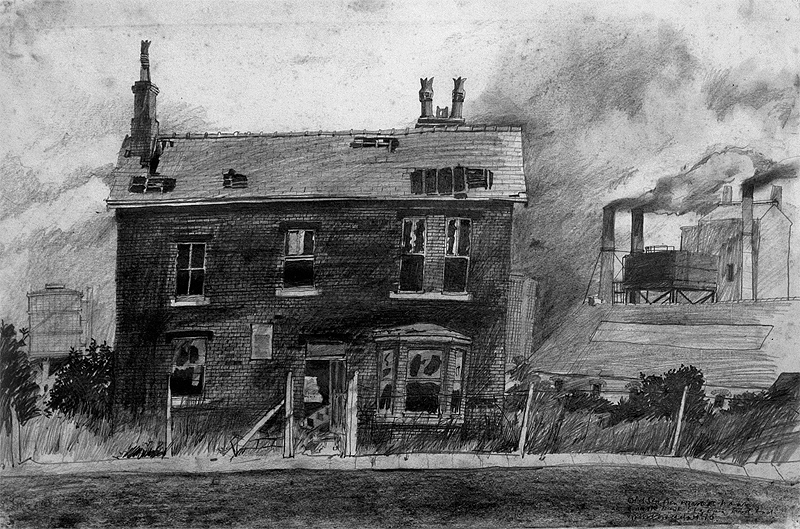
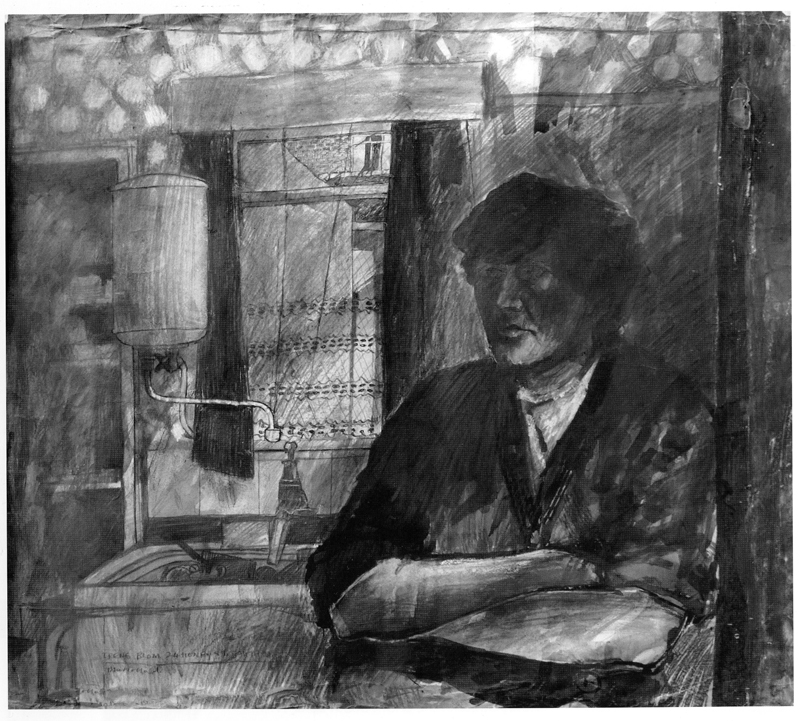
    In the last issue I considered the case of a single-minded good artist,  David Mulholland from Middlesbrough, whose memory, in the absence of any official recognition or support, has to be kindled for posterity’s sake by friends and family. By The Jackdaw’s usual standard of eliciting no comment whatsoever, this caused a considerable mailbag from many mentioning other artists who deserved better than the obscurity and indifference they receive. Owing to the recent death of a special artist, there is cause for reiterating this line of criticism of an art establishment hopelessly out of touch with anything but ‘The Contemporary’, such as they choose to see it.

    Grief felt at the death of a memorable artist is mitigated always by the fact that their work – if it is properly accomplished and not merely the species that is famous for fifteen minutes – will live forever. Giotto didn’t need an ‘artist’s statement’ or incomprehensible catalogue introductions for his work to last, because his paintings speak for themselves in a universal language understood across the centuries. His work will continue to communicate clearly its observations of character and stories just as long as human beings are prepared to see,  feel and respond. This is the case also with the art of Evelyn Williams who died aged 83 on November 14th. Her work will endure in spite of the neglect she received from officialdom during a long and productive career. In the same Tate Collection which stores 274 works by Andy Warhol no space can be found for a single piece by Evelyn Williams, who is a far more interesting artist if not so much of a business-minded celebrity phenomenon whose market is carefully rigged. Even in the last two years alone, when 516 works were acquired by the Tate, there was no room for a single one by this important woman artist. There are even ten works in our national collection by American minimalist Robert Ryman, all of them white and doubtless extremely challenging to those of a devoutly all-whiteist fanaticism; but nothing by Evelyn Williams. Here is further evidence that at the nucleus of State Art breeds a deeply entrenched prejudice against anything but pseudo-intellectual nonsense.

    It is an appalling truth that the Tate has ceased to be a collection of British art preserving the very best of what is being done. Instead, it has been stealthily subverted under Serota to become a private collecting fief promoting a narrow orthodoxy related to a handful of dealers and auctioneers. Why is it that so much about today’s Tate stinks? Evelyn Williams is in a long line of single-minded British artists who refuse to run along the pre-ordained tramlines of conceptualism and modernism. She was a thoughtful, modest, intelligent and vulnerable person alive in a world – as she perceived and experienced it – of imminent dangers. Her paintings, sculptures and reliefs are about the fear and anxiety, the affections and frictions, of what it is to have lived the life of an anxious woman and mother. Hers is first and last a woman’s art, an uncompromising take on post-war relationships, intimacy, cares, depression, failure and even alienation. Her subjects take you inside the realm of senses and feelings, probing the unspoken secrecies behind the masks of propriety we all wear. In the way that art has of redeeming the awful, these are beautiful explorations of states of mind most try to avoid. Her work can be relentlessly intense, no question about that, but it is pure in spirit and purpose.

    Three of the more serious newspapers, the Times, the Telegraph and the Guardian, were eventually persuaded to publish obituaries of Williams. As with so many significant but neglected artists who are nevertheless considered worthy of an obituary, her exhibitions were scarcely even acknowledged let alone reviewed in the arts pages of these same papers. Critically, it was as if her work didn’t exist. She is, of course, among the many accomplished artists whose work is ignored for being conventional in appearance and technique and declamatory about emotions. To today’s State Art tyrants such characteristics are considered embarrassing drawbacks.

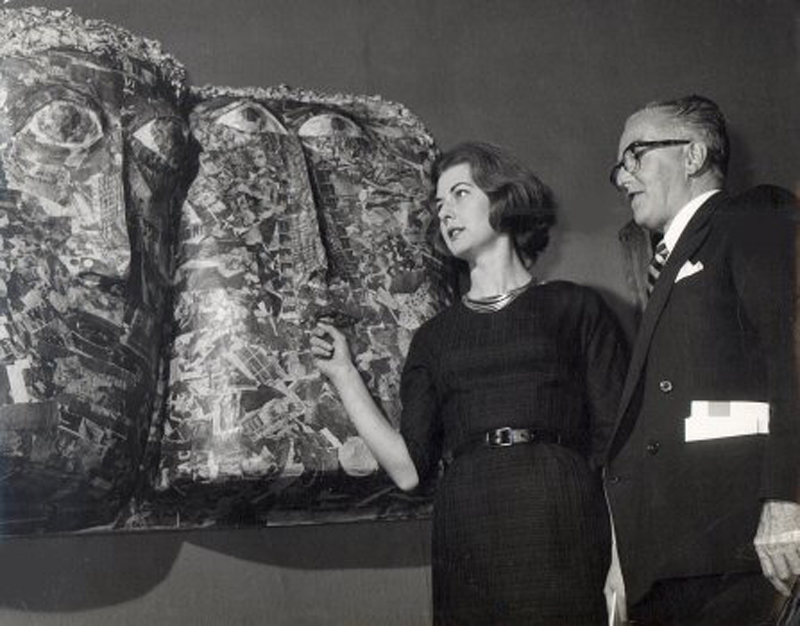
    Williams was, however, appreciated in the past. As a youngish artist in 1961 she won the sculpture prize (for Two Heads) at the John Moores in Liverpool, when other winners were Peter Blake, David Hockney and Ron Kitaj. These were the days when the Moores was worth winning, well before it was subverted to the cause of State Art where daubs of no merit are greeted by fools with preposterous superlatives. A retrospective exhibition was held in 1972 at Whitechapel Art Gallery; once again well before that gallery’s prostration before the winds of Biennale bluster. Williams continued her brave exploration of inner places that made her work then so widely admired. She worked every day of her life and although her commercial exhibitions continued, sometimes at long intervals owing to the complexity of ideas and their necessarily prolix gestation, a retrospective was never offered in her lifetime. Approached by friends in the last decade of her life, the Walker Art Gallery turned her down for such an honour. She couldn’t exert the pulling power of a Rolf Harris or Paul McCartney.

    Will Williams now receive the lifetime retrospective her work deserves, and which a wide audience should see? It isn’t likely.

    But why should this be, when there are more galleries nationwide which are more spacious than ever before? The answer is that as the public gallery network expands the same orthodoxy is spread across even more outlets. More galleries does not mean a wider selection of work on display; it means the same work by the same few artists spread across even more galleries even more frequently.

    What are called ‘Artists’ Rooms’ are a symbolic example of what is wrong with this rotten system. These ‘Rooms’ are organised by the Tate, the Scottish National Gallery of Modern Art and the Art Fund (how long will it be before the Art Fund can only be contacted via the Tate switchboard?), and they resulted from a bulk purchase, jointly by the Tate and the SNGMA in 2008. We bought for £42 million (£27 million in cash – the figure varies in different reports; we’ve never been told the exact sum – and £15 million in waived tax) retiring art dealer Anthony d’Offay’s gallery stock, which he called his private collection.  A cynic might say that Artists’ Rooms is the process by which the personal collection of one commercially motivated individual now dictates what a large proportion of the art-seeking population is allowed to see in the name of recent art. The same cynic might further add that Artists’ Rooms is the opportunity by which established reputations – such as Warhol’s – are constantly hammered home, and for the smaller ‘Room’ names, it is the instrument by which a more significant brand name can be nurtured.

    Under the auspices of the Art Fund, an organisation which luckily is headed by a former director of Tate Britain, 30 rooms featuring 760 works by 26 artists have been touring the country for four years, mostly as small one-man retrospectives. Some of these are marvellous, not least the extensive collection of photographs by August Sander. There are 232 works by Warhol alone, who gets two rooms to himself travelling at the same time. At the moment they are in Sheffield and Hull, and then Birmingham for four months. That is apart from relatively recent major exhibitions for the same artist at the Tate, the Hayward and other Arts Council galleries.  Warhol is showing somewhere all the time. We will not be allowed to ignore him.

    One of the Artists’ Rooms deals, inevitably, with Damien Hirst. This is currently on show in Walsall Art Gallery. It has been there for two months already and will remain in place for another year. What is happening when a fifty-year-old artist, already over-exhibited at a time when so many unexposed artists can’t get their work shown, is having a thirteen-month long exhibition? What is the reason for such indoctrination? Too often the Artists’ Rooms represent those who are already widely exhibited and who are bastions of the art market.

    Artists Rooms are a blunt instrument whereby approved taste is circulated (inflicted) from the centre. They constitute cheap exhibitions for Arts Council venues up and down the country, whose curators don’t have to originate their own programme. The laziness and ready compliance of these jobsworths is a godsend to State Art.  They can merely exhibit the same few approved brand names for ever. And make no mistake their career will depend upon them favouring these “right” kinds of artists for no individual prospers in State Art by demonstrating initiative or investigating the unorthodox.

    Visit the Hepworth Gallery in Wakefield and you will discover the other reason, besides the dreaded Artists’ Rooms, why thought and broad knowledge among curators is unnecessary. There is a new species of art collectors who caught the disease of wholesale, apparently random acquisition from Saatchi. These people fuel the market for State Art which they buy in quite staggering quantities. Their houses, full of wince-inducing tat bought for eye-watering sums, feature frequently in glossy magazines. Usually they are rewarded for their commitment to the State Art cause with the accolade of a position on a Tate committee, of which there are now dozens. At Serota’s Tate money not knowledge is the essential qualification for co-option.

    One such überbuyer – who has not yet been brought on to any Tate committee – is one David Roberts, a property developer, who has accumulated so much clutter he’s opened his own ‘space’ and has begun feeding pieces to regional galleries, Wakefield being the first venue. Works selected are linked as follows: “This exhibition examines ways in which modern and contemporary artists represent the human

    body in various media to explore psychological and emotional life.” What a perfect criterion that is for the inclusion of a major work by Evelyn Williams. Unfortunately, the trouble is that among Roberts’s 3,000 plus works there is nothing by Williams. But have a guess whose work he does own and whose efforts are on show in Wakefield: enter Warhol and Hirst.

    David Lee

    The Jackdaw January-February 2013

    http://www.evelynwilliams.com/index.htm

  • Tate trustees and the public interest

    Tate trustees and the public interest

    In 2011 the Tate named two new trustees, one of whom is painter Tomma Abts. She is a 44-year-old German, recently appointed Professor of Painting at the Kunstakademie in Düsseldorf, who won the Turner Prize in 2006. As an artist trustee, she replaced Jeremy Deller, who won the Turner Prize in 2004. Abts’s paintings are all the same small size (48 x 38 cms) – it is claimed this tic is conceptually crucial for a reason never convincingly explained – and consist of polite abstract designs which might have looked original on curtains at the 1954 Ideal Home Exhibition. So much for the Cutting Edge. The Tate claims her pictures “possess a formal definition and coherence that suggests that they could never have existed any other way … [and] seem to achieve what only painting can, inhabiting both this reality as an object or ‘thing’, and a parallel world with its own set of rules and relationships that demand to be judged on their own terms.” As per with their interpretive literature, all helpful stuff. Am I being cynical? Yes. Why? Because using any sensible criteria Abts doesn’t deserve to be a trustee of an important British museum.

    The job of Tate trustees is to oversee the efficient running of the gallery “as guardians of the public interest” – and please note that it says ‘the public interest’ not ‘State Art’s interest’, for as you will discover these two mutually exclusive agendas tend to become blurred in the minds of certain individuals. Improbable as it sounds, guidelines for the functions of trustees are drawn up by the Tate itself, not by  independent arbiters. Such complacency hardly reassures an outsider that the public interest, rather than the Tate’s, is being looked after. Indeed, such self-scrutiny is hardly better than the continuing disgrace of policemen investigating their own mistakes.

    In 2008 the number of trustees was increased from 12 to 14 and as required by the Museums and Galleries Act 1992 “at least three” of these must be artists. Thirteen are appointed by the Prime Minister and the last is nominated by the trustees of the National Gallery from among their own membership. Unlike their fellow trustees, who are mainly those with business expertise, and who can serve up to two terms of four years (a period of office trimmed recently from five), artist trustees currently serve only one term of four years. You may find it odd – I certainly do – that while there are three contemporary artists with gilt-edged State Art credentials on the Tate’s board of trustees there is no place for a single art historian. I’m obviously old-fashioned because a museum of historical art with no art historians sitting on its governing board seems verging on the perverse.

    When an artist trusteeship becomes vacant it is widely advertised in the papers, giving the impression that any capable, knowledgeable, articulate artist of repute might apply. Nothing could be further from the truth, for there is a codicil written in invisible ink along the bottom of these ads, which reads: “If you have not won or at the very least been nominated for the Turner Prize, kindly fuck off and don’t waste our time.” The Tate squanders scarce cash paying for these advertisements which are nothing short of a calculated deception. Artist trustees are in fact a self-appointed clique comprising only winners of the Turner Prize with a couple of reliable also-rans chucked in. Since new regulations were imposed in 1992 the only exceptions to this rule have been Julian Opie, who famously refused his nomination for the Turner on the grounds that the prize “had become a frivolous publicity stunt”, and Bob and Roberta Smith, the sobriquet of a dimwit called Patrick Brill, who is otherwise a regular purveyor of infantile stunts at Millbank – you may recall his Tate Christmas tree whose lights visitors were asked to illuminate by peddling a generator. He’s very concerned about the environment apparently.

    Being a trustee involves attending six meetings a year and is said to require a day a month in reading and preparation. I must point out that the Tate’s artist trustees are easily the worst attenders at these meetings, and are frequently absent. In the case of Anish Kapoor (Turner Prize winner, 1991) his absenteeism, which included missing half the meetings in two consecutive years and scarpering early from others, would have surely seen him sacked from the board of any efficiently run private enterprise.

    Of currently serving artist trustees two are Germans – besides Abts the other is magazine photographer Wolfgang Tillmans (Turner Prize winner, 2000). Could they really not find a British photographer, or even a British abstract painter, worthy of these positions? Admittedly, Germans do most things better than we do but surely this is insulting to British artists. And how can a professor at a German art school, which presumably requires her to actually attend some of the week, perform the duties of a trustee required to be resident here?

    The process by which artist trustees are selected ­– laughably characterised as “an open competition” or “an open competitive process” – is indicative of what happens when a clique achieves a complacent monopoly and is allowed by servile arts commentators to get away with it. Minutes of meetings make it clear that artist trustees are encouraged to invite applications from those they consider suitable as their own replacements, especially when candidates who have responded to the ads are not considered worthy, which one may reasonably surmise is always. Indeed, I wonder if there was ever a case of a successful artist trustee having responded to the ads rather than having been – that weasel word – ‘invited’ to apply… And so Turner Prize winners beget other Turner Prize winners, or at the very least other near-misses of that persuasion.

    Candidates for artist trusteeships are interviewed by a panel comprising trustees, including the artists, plus an “independent assessor” who is present to ensure that legal niceties, “best practice” etc., are observed and everything looks above board. But how can it be above board when only Turner Prize winners are appointed? Perhaps this independent assessor ought to be involved from the start of the process in order that more than Turner Prize nominees might be seriously considered, if for no other reason than to keep up appearances of openness. Eyebrows would be raised at such a narrowness of potential candidates in any other sphere of public life: imagine, for example, the Commander-in-Chief of the armed forces always being selected from the same regiment.

    You may ask why is it so important for the convenient running of the Tate that its artist trustees are always winners of the Turner Prize. The answer is for the obvious reason that having been awarded a career-changing gong by the institution of which they are now overseers, they will never rock the boat by asking too many tricky questions about the Tate’s direction in its dealings with contemporary art. This is one of many ways by which State Art has become institutionalised: no one but the reliably subservient is ever allowed on the inside to question Tate, or indeed Arts Council, policies.

    On the other hand these parti pris trustees can be useful when outside criticism of the Tate becomes noisy. For example, in July 2004 Trustees discussed newspaper coverage of a Tate work, Rodin’s The Kiss, which Cornelia Parker (who was nominated for the Turner in 1997, the year it was won by Gillian Wearing, inevitably herself a recent artist trustee), had the previous year controversially wrapped up with a mile of string. This stunt was claimed by the artist to be “challenging the claustrophobic nature of relationships”. Artist trustees present in the meeting (which included the aforementioned Wearing) were able to defend their fellow artist for the benefit of other sceptical trustees. They pointed out that it was the job of the Tate to provoke controversy and discussion, which this work did.

    It is in the interests of these artist trustees to support the Director. They know they will be serving only for a brief period following which they might reasonably look forward to the reward of a Tate retrospective or other continued patronage, purchases etc..

    Serota has stated a preference for such younger trustees. Referring to the trusteeship of Anthony Caro many years before, he remarked in 1998 to the Sunday Times: “Tony was well over 60 when he became a trustee. He was a very effective trustee, actually. He cared passionately about certain things and was a powerful force … but it just seems to work better when you have artists who are a new generation, or indeed erring on the younger side, really.” And we know why he thinks it “seems to work better”, because older artists of a more independent, more knowledgeable, more experienced character might argue cogently for a policy or direction other than the one being pursued by the Director. They have nothing to lose by disagreeing with him. Let’s face it, the current crop of artist trustees is in Serota’s pocket. They owe him and he knows it. He can rely on their support without a second thought.

    In a 2008 interview Serota said of his trustees: “I don’t have any part to play in their appointment”. Remember this, it’s important and we’ll return to it in a second.

    Many years ago Serota said that public nominations for the Turner Prize (perhaps you don’t remember that ridiculous charade whereby we all wasted our stamps and faxes) were seriously considered by the judges. We discovered in 2006 what we already knew, courtesy of an indiscreet Turner Prize judge, that this was in fact a lie and they were binned with risible disregard. We also discovered at the same time, and from the same source, that Turner Prize judges were given a list of appropriate artists and exhibitions – just to help them along you know, point them in the right direction. And there we were thinking in the innocence of our ignorance that they might nominate anyone…

    Serota also stated in 2005 that the Tate only rarely acquired work by serving trustees. The Jackdaw checked up on that and discovered (see the editorial for Dec/Jan 2006 on our website) that he wasn’t telling the truth. Indeed, this whopper cost him a bollocking from the Charity Commission. There were also a number of other flagrant economies with the truth concerning the Tate’s acquisition of work by serving trustee Chris Ofili, who was naturally a Turner Prize winner (1998), which also resulted in another six of the best from the CC. (I almost mentioned here the fact that in the last editorial – also on our website – we indicated how the Tate recently misled us over their attendance figures, but you must be getting fed up with that one.)

    So, bearing in mind Serota’s far from perfect form, when he remarks “I don’t have any part to play in their appointment” I need to ask myself: ‘Do I give him the benefit of the doubt and believe him this time?’ Well, as it happens, no I don’t. Even cursory familiarity with the Trustees’ minutes betrays this one as untrue. On the contrary he is frequently involved in their appointment; indeed, the process of Trustee appointment is administered by his own office. He even attends candidate interviews “in an advisory capacity”. Presumably he offers ‘advice’ which plays no material part in the process, so why is he there in the first place? Indeed, we read on: “The key stages of the appointment are overseen by a panel which will normally include the Director.” (Who, presumably, doesn’t play any part.) On one recent occasion he encourages artist trustees to nominate likely candidates for their replacement knowing only too well the sort of artists they are likely to suggest. No part?

    Let’s have this one straight: Serota is ‘advising’ on the appointment of someone, a trustee, who will function as his own employer. This is a wretched abuse of the supposed ‘independence’ of process and would be considered as much in any other public body. It is, as usual, as blatant a conflict of interest (not to mention a betrayal of ‘the public interest’ about which the process purports to be so concerned) as you would expect to find at the Tate, whose management of conflicts of interest, incidentally, was declared woefully inadequate by none other than the Charities Commission.

    The Tate should not be involved with either the compiling of its own trustees’ duties, or in the nomination or selection of Trustees themselves. How can ‘the public interest’ be considered served when the organisation under scrutiny is writing the job description of its own scrutineers. If we are to have artist trustees let’s have them from a cross-section of the artist community and not just those representing the Turner Prize. And let’s have some eminent art historians in there too.

    David Lee

    The Jackdaw May-June 2011

  • How state art robs the people

    How state art robs the people

    Chances are you won’t have heard of David Mulholland (1946-2005), a painter of and from Middlesbrough. Until last year, when a group of friends devoted to the preservation of his memory sent me some of his pictures, neither had I. The work hit me immediately as authentic, born of intimate feeling for its subject. Most affecting were powerful graphite and wash drawings of blackened industrial places populated by persevering working people. Having edited a couple of art papers for over twenty years, I felt that if anyone had a right to have heard of David Mulholland then it was at the very least someone in my position.

    What follows is a lament for the establishment’s theft of the richness of our culture. Over decades now, by advancing its prejudices to the exclusion of everything else, art authorities have conspired to deny us sight of so many whose works were valuable testimonies of their time and experience. For their own ends, these all-powerful administrators have kept us in the dark.

    David Mulholland is typical of many accomplished and original 20th century British artists whose names are deservedly kept alive by friends who loved him and knew his worth as both commentator and poet, but who is unknown to the rest of us. No galleries funded by the Arts Council, for example, would dare show the work of these artists even if they wanted to. Mulholland is typical of painters derided by the self-appointed in State Art and sneered at by decision makers. By arts bodies obsessed with ‘innovation’ and the ‘cutting edge’ he is, in that infamous Arts Council phrase “the wrong kind of artist”. Yes, those are the words they use – the wrong kind of artist. What right have they to use a phrase like that? Who do these people think they are?

    As one who described with affection his experience of the hard lives and resilience of poor people, and evoked the gaunt beauty of the tough places in which they lived and worked, Mulholland was “the right kind of artist”. The only kind of artist. He is certainly among those whose work is likely to survive appreciated long into the future. His work was done because it needed to be made, because the observations of a brutal working life and cruel industry, of pleasures and strifes, of hard graft and redundancy, demanded interpretation by an artist. Mulholland’s work doesn’t need a page of unreadable tosh by one of Serota’s army of scribblers in order for you to know what it’s about. Its love for a location and people speaks for itself. In the future, say a century or more from now, those looking at Mulholland’s work will understand without prompting its concerns and causes, what stories it has to tell, and why it has lasted. In all good art, these qualities are self-evident, although in some artists they may take longer to appreciate.

    Mulholland was born in South Bank, a community on the Tees built around quaysides, three blast furnaces, steel rolling mills and fingers of cindery railway sidings. In photographs of the place in its heyday, and before the works closed, it looks smokily Soviet in its concentration of polluting ad hoc production. It’s the sort of place which, if you are born there, is in your blood forever. As landscape painter Len Tabner, another important local and friend of Mulholland, said at the recent opening of his memorial exhibition at the Dorman Museum in Middlesbrough, “Dave went all the way to Byam Shaw and to the Royal College of Art in London but only ever painted South Bank.” Apart from a brief foray as a young seaman, when he painted foreign scenes, it remained that way. He eventually returned home, taught art unconventionally in a secondary school, painted his life and friends, and sometimes the surrounding countryside. His work records a personal journey and history.

    Given the enormous sums now thrown uncritically and unchallenged at contemporary art, one ought to feel safe that excellence in whatever style or medium is somewhere being brought to our attention. But despite the fact that, courtesy of the National Lottery, there are expensive immense new galleries all over the country, the opposite continues to be true. The same few artists dominate news, features and critical coverage. They also dominate all the new galleries because these are controlled exclusively by State Art believers. For them, a foreign artist of no discernible distinction, spotted amidst the trendy jumble and waffle of an international biennale, will always take precedence over the likes of Mulholland.

    If you live in the north, as I do increasingly, you can find Anish Kapoor signing books in Middlesbrough – where his £2.5 million ‘regenerating’ fishing net was unveiled two years ago and still stands bleakly abandoned and pointless in wasteland – and at a retrospective in the Yorkshire Sculpture Park (see Moping Owl, p. 10). In London he is at Lisson Gallery, all over the Royal Academy, and even lording it over the Olympics’ site. No wonder he needs 25 assistants and three studios to churn out his coloured holes and facile shiny mirrors to meet demand. Such a monoculture as is represented by Kapoor doesn’t add to the diversity we deserve, because the rooms he and his ilk occupy with stupefying frequency are denied to others. Newspaper profiles of Kapoor last aired only three months ago when The Orbit was unveiled – having already appeared on dozens of occasions over the last twenty years –  have again been warmed up and paraphrased by others for his new shows in London and Yorkshire. This insulting process of indoctrination goes unmentioned elsewhere, as though it’s taken for granted that only a handful of artists merit such relentless promotion. The only difference in these disgustingly fawning and uncritical pieces is the sentence where they state what Kapoor is currently worth – and it keeps getting bigger, the last number cited being £80 million. For the rest of us, it is impossible not to know Kapoor’s life story off by heart. If only it were interesting. If only all this approbation were the result of his having produced something truly outstanding and comparable with the best from the past… But all that emerges is more of the same branded deluxe ornaments for the grotesque mansions of the immodest rich. And please believe me when I say there is no point in visiting his exhibition at the Yorkshire Sculpture Park, because you’ve seen it many many times before. It takes seconds to walk around. And, do you know what, some of the holes are so dark you can’t be quite sure where the bottom is. How clever is that?

    The neglect of so many for the sake of so few is a phenomenon of the celebrity culture. How long will it be before this system is exposed as a monumental racket dreamed up by a cabal of public officials, commercial dealers and auctioneers with the aim of creating false gods, rigging the market and handsomely feathering the nests of all concerned. Watching this process as it unfolds is sickening and the fact that they have not seen fit to investigate this monopoly brings disgrace on the Culture Select Committee of the House of Commons. They could have made a difference, if only by establishing once and for all that such an all-powerful orthodoxy exists in contemporary art, whose purpose is to discriminate against the likes of David Mulholland.

    Increasingly, I resent this editing of what we’ve been allowed to see, dictated as it is by the tastes of half a dozen bureaucrats with Serota at their head. This President-For-Life has singlehandedly done more damage than anyone in the history of British art to the public’s ability to see the work of a wide range of British artists. He is a self-important scourge building ever greater monuments to his own vanity and tastes, and yet he receives an uncritical press. When is this fellow going to go, and leave us alone? How long will it be before curators in regional galleries can see all art again for its qualities and not be forced to follow trends out of fear for their careers?

    If it is not the work of regional galleries to show the work of their best local artists what is it their job to do? And what an irony it is that the modern art gallery in Middlesbrough is showing coincident with Mulholland’s memorial show an exhibition dealing with “concepts of ‘home’” … starring Tate trustee Jeremy Deller.

    David Mulholland spoke a local language, a ‘home’ language, which is understood internationally by all people. No human being is excluded from its sentiments. State artists talk an international language which, like esperanto, is understood by hardly anyone. There ought to be room for both persuasions, but we are force fed only one.

    David Lee

    The Jackdaw November-December 2012

    www.davidmulholland.co.uk