Tag: Warhol

  • Dick French: On The Town – May 2017

    Mr Wu was on the wireless last night. A very long programme on the World Service, but still I learned very little about him. He speaks as one heavily sedated. Talk about insclutable. He dwells in a large bunker under Berlin with 6,000 three-legged stools and some lifejackets. There was no mention of the poison beans, maybe he’s sold them all. The trailer described him as “one of the world’s most powerful artists”. It is puzzling how an aesthetic black hole can achieve such eminence. His career is enough to make even the most sceptical of us start subscribing to conspiracy theories. He’s one of these artistic accumulators who head things up. There’s a lot of them about. One thinks of MacFisheries, the bloke at the RA who makes animals out of coathangers and map pins. I suppose you could call it a modular approach which prevents you from making a mess… Now what can I heap up next?

    In the 19th century it took a long time for the French to latch on to the importance of Baudelaire. The Parnassian ideal was ascendant and accordingly it was possible to compose what was considered the highest poetry about almost nothing. Plus ça change.

    Art establishments have a primordial and instinctive terror of change. When Baudelaire wrote about “une oasis d’horreur dans un desert d’ennui” he could have been describing Mr Wu and the Art World.

    To the National Gallery for the exhibition of Michelangelo and Sebastiano del Piombo. Sebastiano was from Cesenatico, most famous nowadays for being the birthplace and training ground of ‘Il Pirata’, Marco Pantani, still adored by the tifosi even though almost his entire career was fuelled by coke and EPO. Contrast this with Lance Armstrong who is considered a disgrace.

    An impressive show, although two of the most interesting pieces are already in the National Gallery. One of them, The Raising of Lazarus, is among the earliest purchases of the NG. Something I’d never noticed in this painting is that a group of women close to the raising itself are holding their noses. This I learned from the wall chart, but closer inspection shows this to be untrue. They are raising their veils across the lower parts of their faces to avoid contagion. The plague, both bubonic and pneumonic, had been raging on and off for many years when this painting was being worked on and such a gesture was commonplace. Besides, after three days underground Lazarus must have been a tad smelly.

    Sebastiano composes on the diagonal and the triangle. A striking example of his triangular approach is The Judgment of Solomon. The darkening of the central figure’s head is extremely dramatic but this could be due to deterioration. In some of his paintings he lets the sfumato disintegrate the forms rather in the manner of Beccafumi. The black starts to creep in, especially in a painting of the Virgin and Child in which the infant resembles Charlie Drake. The Virgin’s head is also unsatisfactory – too much face.

    In The Visitation the foetal St John the Baptist is said to be leaping for joy in his mother’s womb during her encounter with the Virgin Mary. A difficult subject to depict. One can almost hear Sir Arthur Streeb-Greebling drawling “Well I think the word difficult is awfully well chosen”.

    There are some wonderful drawings and letters in this show. Michelangelo often worked on both sides of the paper which was expensive in those days. I think he was probably a bit of a skinflint. It’s interesting that Michelangelo drew mostly with the hand when nowadays we are encouraged to draw mostly with the arm.

    Many of these paintings have dramatic bits of landscape in the background in the red-tinged sky. I couldn’t take to The Lamentation. I think it’s the expression on the Virgin’s face. Those upturned eyes and the horizontal body seem insufficiently scourged with its immaculate underpants. Still I suppose this is no place for realism.

    “People don’t buy pictures because they admire them, they buy them because others covet them.” Advice given to Constable, but I can’t remember by whom. An Andy Warhol painting of Chairman Mao has just sold in Hong Kong for $1l million. How long can this crap persist? Warhol was once described as “an ambulant black hole”. And now we’ve got another one in Mr Wu.

    To the Mall to see the painter/stainers exhibition. At the opening I met no less than the Chief Stain himself. He seemed a nice chap. Sporting his enormous bling on a chain round his neck he looked a bit like a sommelier. For once the 1st prize was worth looking at. A large, elaborate, patched-together drawing by Chris Green. Bernadette Tinko showed a small picture of a filthy brown sink, which I rather liked, while opposite Alex Rooney showed a similarly sized clean white sink. I wonder if they know each other. Cherry Pickles shows another rear view mirror piece, A487, and Peter Archer’s Cliff Edge is sensitive.

    The Scrapyard Queen shows another of her car wrecks; as always very well done but I’m always hoping she’ll ring a few changes – naked men draped over the bonnet sipping from golden cans perhaps. But I don’t think she takes me seriously.

    My friend The Sage writes from his grotto in the Yorkshire Dales sending me a copy of the Royal Academy Spring Magazine. I can’t imagine how he gets hold of such things. (Age Concern apparently.) He’s very cross about this woman who’s been appointed Professor of Sculpture at the Royal Academy. She’s called Cathie Pilkington and makes the most atrocious plaster dolls which are supposed to be based on the Little Dancer by Degas. As always in this kind of work the exegesis is of more importance than the thing you have to look at. And there can be few things more unpleasant than what she makes. That such an incompetent can be put in charge of students astonishes me. But it shouldn’t really. After all they have Huge Mary in charge of painting. The Sage described them as “sugar sculptures for cake decorations”. She also intends to “dress, drape, protect or obscure with soft coverings” the RA’s collection of historic casts. She means to display her dolls in a way that will make them seem “tiny but vibrant” against lush velvet curtains. Does that mean she’s going to paint them black?

    To the John Soanes, always one of my favourite places. Unfortunately it was infested by a load of plaster body castings by Marc Quinn. “The museum is an unfinished total artwork. We’re continuing the process.” Oh yeah?

    Even though these things are body casts he’s managed to get them out of proportion. The separate upper and lower parts don’t fit together properly. Someone should grab him by the beard (I imagine he’s got one) and point out shoulder to nipple, nipple to navel, naval to the foothills of the fanny – same distance. Variations do occur of course but with the rather perfect specimen he has grabbed from behind this rule would hold. If her bum was a drug it would be Class A. Her tits too, petite.

    “I think that great art is time travel. Emotional time travel.” What on earth can he mean by this? “Quinn’s works invite us to reflect on the nature and meaning of time”. I should be used to such gnomic utterances by now but I can still be surprised and puzzled.

    And here’s my version of the grab from behind…

    Dick French
    The Jackdaw May/Jun 2017
  • Art under kleptocracy


    Another month, another book on the contemporary art economy, this time from an overlooked perspective. The New Economy of Art, a joint publication by DACS and Artquest, looks at the art market from the POV of the average artist. Not surprisingly, it finds plenty to puzzle over.

    The conundrum it addresses is clearly set out in the preface by editors Gilane Tawadros and Russell Martin. “The art world is in crisis,” begins the first paragraph; “The art world is in the best shape it has ever been,” begins the second. The question of how these conflicting statements can both be true at the same time – “the disconnect between how artworks gain financial value even while their makers are poorly, or hardly, paid.” – is the mystery the authors of its six essays try to solve.

    Two weeks before the book came out, Christie’s New York achieved an all-time auction record for its November postwar and contemporary art sale, in which a Warhol Triple Elvis hit the jackpot – kerchung! – at £51.6m – and a row of Four Marlons paid out a further £43.9m. Both, appropriately, had previously hung in a casino in Aachen. The result was hailed by international head of post-war and contemporary art Brett Gorvy as confirmation of “a virtuous cycle of confidence in the art market”. Another season, another reason for making whoopee.

    On the other side of the art market, meanwhile, a more vicious cycle is in operation. The book’s authors quote the usual dismal statistics. It’s depressing enough to learn from the 2011 survey by the Centre for Intellectual Property, Policy and Management at Bournemouth University that UK artists earn a median wage of £10,000 – unchanged for 20 years – without discovering that the statistic includes designers, illustrators and photographers, and that the top 7% earn 40% of the total. Artists now officially rank as ‘marginalised makers’, a marginal constituency politicians aren’t fighting over. The economist Alan Freeman quotes figures showing our ‘creative economy’ growing faster than any other UK production industry, employing 2.5 million people and accounting for 5.2% of gross value added – but take out all the advertising, marketing, fashion, IT and other people he counts as ‘creative specialists’, and the fine artists are still scratching around on the margins.

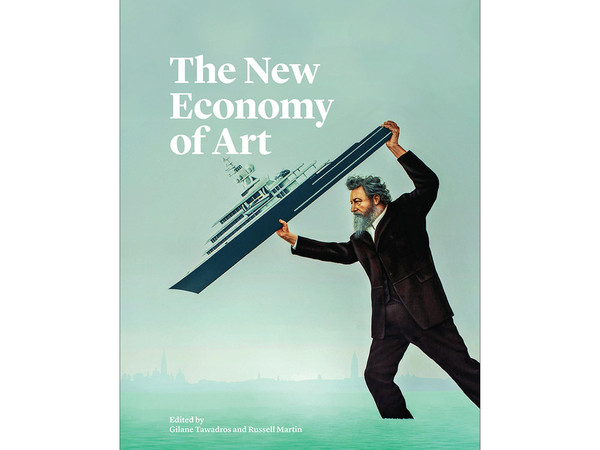
    The book’s cover reminds us that there is nothing new in this. It reproduces Jeremy Deller’s mural from the 2013 Venice Biennale picturing William Morris as a Victorian Poseidon hurling Roman Abramovich’s superyacht into the Venetian Lagoon. The mural’s title ‘We sit starving amidst our gold’ encapsulates the argument at the heart of the book while reminding us that Morris said it all before, and better. Compare Freeman’s dewy vision of a creative utopia “in which shared values, achievements, hopes and aspirations replace brute greed to lay foundations on which the true individuals of the future can confidently build the new worlds of their choosing” with this trenchant passage from Morris’s lecture Art Under Plutocracy: “So long as the system of competition in the production and exchange of the means of life goes on, the degradation of the arts will go on; and if that system is to last for ever, then art is doomed, and will surely die”. Only the substitution of association for competition, believed Morris, could “give an opportunity for the new birth of art, which is now being crushed to death by the moneybags of competitive commerce.” In the war of words, Morris wins hands down.

    Still, the book contains material which, if not revolutionary, is astonishingly inflammatory for a publication part-funded by the Arts Council. Have they read it? It has a quiet way of dropping bombshells. One is the casual mention by management consultant Keir McGuinness of the apparently generally accepted practice whereby “the decision of whether a [public] gallery will take a show or not depends upon whether you [the artist’s dealer] will make a financial contribution and the person who makes the largest financial contribution gets the shows”. Another is a statistic cited from AN’s recent Paying Artists report that “71% of artists receive no fee for publicly funded exhibitions and nearly 60% do not even have their expenses covered”. This against the background of an international art industry which, arts consultant John Kieffer points out, has a turnover of just under £40bn, with the UK’s market share of 20% amounting to three times the combined budgets of the English, Welsh, Scottish and Northern Irish culture departments.

    But the real eye-opener is the essay by curator Lynda Morris. Born in 1947, Morris is old enough to remember the heady days of the 1960s when a newly international avant-garde was promoted by dealers who were themselves artists, lived like artists on air and were perceived as having ‘moral authority’. What an antiquated concept that now sounds. After reading Morris’s analysis of the process whereby the present nexus of curators, industrialists, bankers and property developers took control of the art world, it seems to belong to another era.

    Morris pinpoints Thatcher’s appointment of Richard Rogers as chair of Tate Trustees in the 1980s as the start of the cultural ascendancy of architecture over art. “It was the moment in late Thatcherism when the State no longer provided social housing and, instead, the national lottery, a new arm of the gambling industry, enabled museum directors and their trustees to start to plan Palaces of Culture.” A proposal to regenerate derelict buildings for low-cost studios, housing and artist-led galleries put forward by officers of the then Arts Council of Great Britain – in association with artists’ collectives ACME and SPACE – was kyboshed by property developer Peter Palumbo, who as chair of the ACGB from 1988-94 presided over the drafting of the rules for National Lottery funding, including the ‘subsidiarity’ clause ensuring that money is allocated only to new projects and thus funneled towards developers and architects rather than artists. Artists are wonderful at sprinkling the fairy dust that turns urban wastelands into developers’ goldmines, but once the gold has been extracted the fairies can piss off and take their dust elsewhere. Prices for a ‘premium apartment’ in Neo Bankside, the new residential development overlooking Tate Modern designed by Rogers Stirk Harbour – formerly Richard Rogers Partnership – start at £4.5m.

    “We seem to have drifted from a market economy to a market society,” comments John Kieffer. It’s a form of society Margaret Thatcher would have recognised, but not William Morris. “It is this superstition of commerce being an end in itself, of man made for commerce, not commerce for man, of which art has sickened,” he wrote in Art under Plutocracy. Art under kleptocracy has brought no improvement. It has been left to President Xi Jinping to uphold moral values, warning Chinese artists last October not to follow the “stench of money” or “lose themselves in the tide of market economy” which the rest of the People’s Republic is happily riding.

    Are artists and Gordon Brown now the only people on the planet still expected to possess a moral compass? That could explain the disconnect highlighted by this book. If our market society is wholly reliant on artists for moral orientation, it has good reason not to seduce them with the stench of money, ie pay them. You could almost call it a virtuous cycle.

    Laura Gascoigne  

    The New Economy of Art, edited by Gilane Tawadros and Russell Martin, published by DACS, £14.99


  • Evelyn Williams, and another case of the public denied

    Evelyn Williams, and another case of the public denied

    In the last issue I considered the case of a single-minded good artist,  David Mulholland from Middlesbrough, whose memory, in the absence of any official recognition or support, has to be kindled for posterity’s sake by friends and family. By The Jackdaw’s usual standard of eliciting no comment whatsoever, this caused a considerable mailbag from many mentioning other artists who deserved better than the obscurity and indifference they receive. Owing to the recent death of a special artist, there is cause for reiterating this line of criticism of an art establishment hopelessly out of touch with anything but ‘The Contemporary’, such as they choose to see it.

    Grief felt at the death of a memorable artist is mitigated always by the fact that their work – if it is properly accomplished and not merely the species that is famous for fifteen minutes – will live forever. Giotto didn’t need an ‘artist’s statement’ or incomprehensible catalogue introductions for his work to last, because his paintings speak for themselves in a universal language understood across the centuries. His work will continue to communicate clearly its observations of character and stories just as long as human beings are prepared to see,  feel and respond. This is the case also with the art of Evelyn Williams who died aged 83 on November 14th. Her work will endure in spite of the neglect she received from officialdom during a long and productive career. In the same Tate Collection which stores 274 works by Andy Warhol no space can be found for a single piece by Evelyn Williams, who is a far more interesting artist if not so much of a business-minded celebrity phenomenon whose market is carefully rigged. Even in the last two years alone, when 516 works were acquired by the Tate, there was no room for a single one by this important woman artist. There are even ten works in our national collection by American minimalist Robert Ryman, all of them white and doubtless extremely challenging to those of a devoutly all-whiteist fanaticism; but nothing by Evelyn Williams. Here is further evidence that at the nucleus of State Art breeds a deeply entrenched prejudice against anything but pseudo-intellectual nonsense.

    It is an appalling truth that the Tate has ceased to be a collection of British art preserving the very best of what is being done. Instead, it has been stealthily subverted under Serota to become a private collecting fief promoting a narrow orthodoxy related to a handful of dealers and auctioneers. Why is it that so much about today’s Tate stinks? Evelyn Williams is in a long line of single-minded British artists who refuse to run along the pre-ordained tramlines of conceptualism and modernism. She was a thoughtful, modest, intelligent and vulnerable person alive in a world – as she perceived and experienced it – of imminent dangers. Her paintings, sculptures and reliefs are about the fear and anxiety, the affections and frictions, of what it is to have lived the life of an anxious woman and mother. Hers is first and last a woman’s art, an uncompromising take on post-war relationships, intimacy, cares, depression, failure and even alienation. Her subjects take you inside the realm of senses and feelings, probing the unspoken secrecies behind the masks of propriety we all wear. In the way that art has of redeeming the awful, these are beautiful explorations of states of mind most try to avoid. Her work can be relentlessly intense, no question about that, but it is pure in spirit and purpose.

    Three of the more serious newspapers, the Times, the Telegraph and the Guardian, were eventually persuaded to publish obituaries of Williams. As with so many significant but neglected artists who are nevertheless considered worthy of an obituary, her exhibitions were scarcely even acknowledged let alone reviewed in the arts pages of these same papers. Critically, it was as if her work didn’t exist. She is, of course, among the many accomplished artists whose work is ignored for being conventional in appearance and technique and declamatory about emotions. To today’s State Art tyrants such characteristics are considered embarrassing drawbacks.

    Williams was, however, appreciated in the past. As a youngish artist in 1961 she won the sculpture prize (for Two Heads) at the John Moores in Liverpool, when other winners were Peter Blake, David Hockney and Ron Kitaj. These were the days when the Moores was worth winning, well before it was subverted to the cause of State Art where daubs of no merit are greeted by fools with preposterous superlatives. A retrospective exhibition was held in 1972 at Whitechapel Art Gallery; once again well before that gallery’s prostration before the winds of Biennale bluster. Williams continued her brave exploration of inner places that made her work then so widely admired. She worked every day of her life and although her commercial exhibitions continued, sometimes at long intervals owing to the complexity of ideas and their necessarily prolix gestation, a retrospective was never offered in her lifetime. Approached by friends in the last decade of her life, the Walker Art Gallery turned her down for such an honour. She couldn’t exert the pulling power of a Rolf Harris or Paul McCartney.

    Will Williams now receive the lifetime retrospective her work deserves, and which a wide audience should see? It isn’t likely.

    But why should this be, when there are more galleries nationwide which are more spacious than ever before? The answer is that as the public gallery network expands the same orthodoxy is spread across even more outlets. More galleries does not mean a wider selection of work on display; it means the same work by the same few artists spread across even more galleries even more frequently.

    What are called ‘Artists’ Rooms’ are a symbolic example of what is wrong with this rotten system. These ‘Rooms’ are organised by the Tate, the Scottish National Gallery of Modern Art and the Art Fund (how long will it be before the Art Fund can only be contacted via the Tate switchboard?), and they resulted from a bulk purchase, jointly by the Tate and the SNGMA in 2008. We bought for £42 million (£27 million in cash – the figure varies in different reports; we’ve never been told the exact sum – and £15 million in waived tax) retiring art dealer Anthony d’Offay’s gallery stock, which he called his private collection.  A cynic might say that Artists’ Rooms is the process by which the personal collection of one commercially motivated individual now dictates what a large proportion of the art-seeking population is allowed to see in the name of recent art. The same cynic might further add that Artists’ Rooms is the opportunity by which established reputations – such as Warhol’s – are constantly hammered home, and for the smaller ‘Room’ names, it is the instrument by which a more significant brand name can be nurtured.

    Under the auspices of the Art Fund, an organisation which luckily is headed by a former director of Tate Britain, 30 rooms featuring 760 works by 26 artists have been touring the country for four years, mostly as small one-man retrospectives. Some of these are marvellous, not least the extensive collection of photographs by August Sander. There are 232 works by Warhol alone, who gets two rooms to himself travelling at the same time. At the moment they are in Sheffield and Hull, and then Birmingham for four months. That is apart from relatively recent major exhibitions for the same artist at the Tate, the Hayward and other Arts Council galleries.  Warhol is showing somewhere all the time. We will not be allowed to ignore him.

    One of the Artists’ Rooms deals, inevitably, with Damien Hirst. This is currently on show in Walsall Art Gallery. It has been there for two months already and will remain in place for another year. What is happening when a fifty-year-old artist, already over-exhibited at a time when so many unexposed artists can’t get their work shown, is having a thirteen-month long exhibition? What is the reason for such indoctrination? Too often the Artists’ Rooms represent those who are already widely exhibited and who are bastions of the art market.

    Artists Rooms are a blunt instrument whereby approved taste is circulated (inflicted) from the centre. They constitute cheap exhibitions for Arts Council venues up and down the country, whose curators don’t have to originate their own programme. The laziness and ready compliance of these jobsworths is a godsend to State Art.  They can merely exhibit the same few approved brand names for ever. And make no mistake their career will depend upon them favouring these “right” kinds of artists for no individual prospers in State Art by demonstrating initiative or investigating the unorthodox.

    Visit the Hepworth Gallery in Wakefield and you will discover the other reason, besides the dreaded Artists’ Rooms, why thought and broad knowledge among curators is unnecessary. There is a new species of art collectors who caught the disease of wholesale, apparently random acquisition from Saatchi. These people fuel the market for State Art which they buy in quite staggering quantities. Their houses, full of wince-inducing tat bought for eye-watering sums, feature frequently in glossy magazines. Usually they are rewarded for their commitment to the State Art cause with the accolade of a position on a Tate committee, of which there are now dozens. At Serota’s Tate money not knowledge is the essential qualification for co-option.

    One such überbuyer – who has not yet been brought on to any Tate committee – is one David Roberts, a property developer, who has accumulated so much clutter he’s opened his own ‘space’ and has begun feeding pieces to regional galleries, Wakefield being the first venue. Works selected are linked as follows: “This exhibition examines ways in which modern and contemporary artists represent the human

    body in various media to explore psychological and emotional life.” What a perfect criterion that is for the inclusion of a major work by Evelyn Williams. Unfortunately, the trouble is that among Roberts’s 3,000 plus works there is nothing by Williams. But have a guess whose work he does own and whose efforts are on show in Wakefield: enter Warhol and Hirst.

    David Lee

    The Jackdaw January-February 2013

    http://www.evelynwilliams.com/index.htm

  • Selling England by the pound

    Selling England by the pound

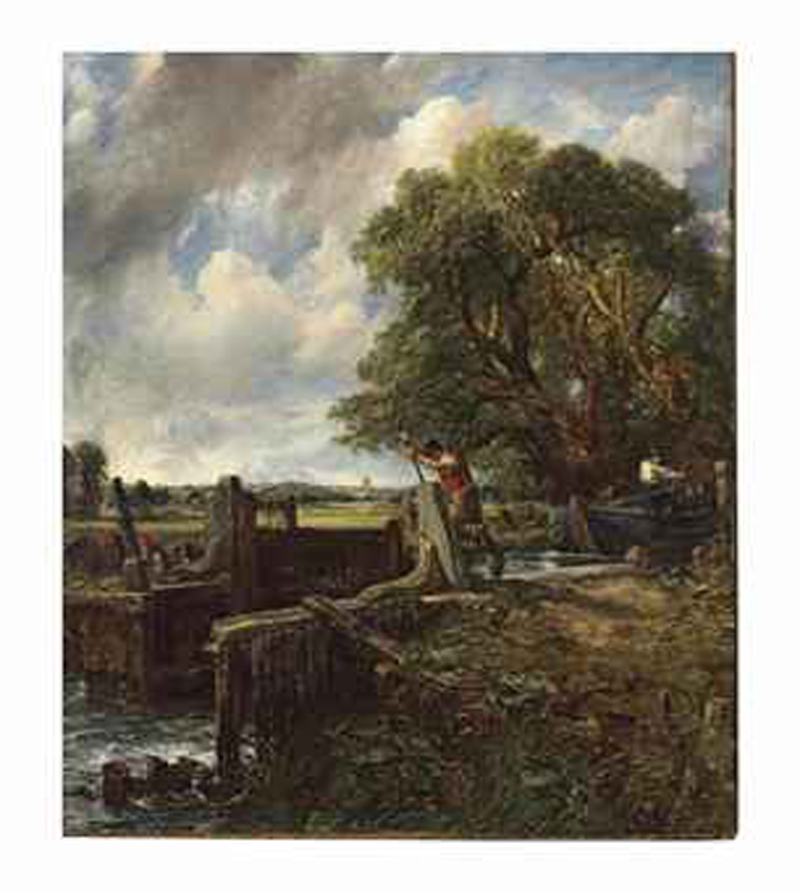
    Today John Constable’s The Lock, painted in 1824, sold at Christie’s for £22.4 million. In the current art market of silly prices some lucky person got the bargain of their lives. Let us hope the picture will be placed in a museum, where people might enjoy it, instead of disappearing into a Swiss warehouse as the investment bauble of some gold-tap billionaire vulgarian. It is the same price as that commanded by ordinary works by the top price sellers in British painting, Turner and Bacon, both of whom have sold work for significantly higher amounts than this. It is the same price a collector might pay for an off-the-peg Monet one wouldn’t inflict even on an enemy. The Lock, being one of the six major works deliberately painted by the artist between 1819 and 1825 for the Royal Academy exhibition in order to cement his reputation, presented the last opportunity for a collector to own one of the major works by the artist of the quintessential English landscape. All the other major pictures are already off the market in museums.

    Why so low a price? Of the top 50 most expensive paintings ever sold either privately or at auction only five are Old Masters, and of the remaining 45 ten are by Picasso, seven by Van Gogh and four by Warhol. The new billionaires, who are not old fashioned men of discernment and discrimination but those who buy conspicuously in order to impress friends, are uninterested in works not instantly recognisable for their “wall power”. Even the most knuckle-dragging mate of a Russian oligarch can recognize Warhol or Picasso but they wouldn’t know a Constable from a concertina and couldn’t recognise anything before 1850, all brown paintings looking alike to them.

    Who bought it? Assuming that The Lock is too sophisticated a picture for nouveau squillionaires, the only two museums in the market at this kind of price are the Getty in California, which two years ago paid £29 million for a Turner view of Rome, and the museum being built from scratch by the Qatari royal family, who are hotly rumoured to have bought the record-breaking The Scream by Munch a couple of months ago. No British gallery could afford a square centimetre of such a work, not that our museums actually need any more examples from Constable’s brush. For example, on the day of The Lock’s sale the Tate, which owns 261 works by the Suffolk miller’s boy, had 13 works on display. It always likes to keep plenty in reserve. There were more works by Constable on show at the Victoria and Albert Museum than at the Tate – the V&A owns 802 items relating to the artist including the full-size oil sketch for the Hay Wain. The National Gallery has nine works by Constable, all of them on display every day of the week free of charge.

    “Painting,” wrote Constable, “is but another word for feeling.”

    David Lee

    The Jackdaw, 3 July 2012

    http://www.bbc.co.uk/news/entertainment-arts-18702667