Tag: John Moores

  • Editorial – September 2016

    Pictures of Nothing and Very Like

    John Moores Exhibition 2016

    Most of Europe’s countries are either bankrupt or in economic meltdown, their infrastructure crumbling and public services reduced; the Middle East and Levant are in post-apocalyptic ruin, in part the result of lies told in our own Parliament; an exodus of desperate humanity is seeking refuge from a criminal death-cult; innocents are being slaughtered in streets all over Europe by brainwashed loonies; across the globe are pockets of strategically induced and entirely avoidable famine; infant mortality in parts of Africa is at worse levels than in Georgian Britain; meanwhile, at home we have thousands of steelworkers needlessly losing their jobs; pension pots of the poorest being robbed wholesale by bloated ocean-going bellies; armies of formerly skilled artisans reduced to wearing hairnets in order to package fatty swill fuelling an obesity epidemic; we have a political élite who are out of touch with what voters think and who award themselves large pay increases and eyewatering expenses and property perks; we are returning to the bad old days of increasing numbers sleeping rough on the streets; we have an education system – 13 years of free, full-time tuition – which is the envy of the Third World but at the end of which a large proportion of our children still can’t read, write or speak their own language properly; pension companies and fat cats steal our money and get away with it, their bosses paying themselves 130 times what their average worker earns; we stand watching powerlessly as an age of repellent inequality in finance, housing and opportunity runs out of control; a materially obsessed populace is beset by mass addictions to alcohol, shopping and virtual reality; our highly educated young adults, already burdened with colossal debts before they’ve done a day’s work, can’t find anywhere decent, affordable or secure to live, public housing for some irrational reason having been killed off; we have profitable companies who employ a disgraceful but fashionable new form of exploitation called ‘internship’, slavery by any other name; and many adults can’t even afford to live on their minimum wages because of engineered restrictions placed on the hours they are allowed to work.

    If ever there were importunate subjects and narratives for visual artists to address surely it is now. But where are the Hogarths, Herkomers, Fildes, Greens, Dorés, Millais’, Bretons, Bastien-Lepages, L’Hermittes, Holls, Caton-Woodvilles, Sickerts, Dixes, Groszs and Kitchen-Sinkers of today? Of all the places they really ought to be, they are not to be found in Liverpool. As far as the latest John Moores (Walker Art Gallery until November 27th) is concerned the world outside might as well not exist.

    What then are the painters in this exhibition up to? With the exception of three of the 54 works (selected from 2,500 entries) they are concerned with aspects of painting itself. They seem exclusively devoted to navel-gazing irrelevance, and in some instances even seem deranged by it. Encouraged by post-modernism, coercive institutions, weak museums and the debased state of art education, they have been reduced to paranoia to the extent of painting pictures of nothing. And so inadequately limited has been their expensive further education that even if they wanted to they own no means of communicating to others.

    All the painters in the John Moores can come up with is variants of the following drivel, and I quote from the catalogue:


    “My paintings are visual fictions with concrete reality.”

    “I shift from one painting to another, experimenting playfully with mark making.”

    “My practice is to construct paintings that fix colour and form in various, tense economies.”

    “As I work, a painting’s alchemical make up, and the substance and process, is reflected in sync with my ideas and experiences.”

    “My work revolves around the merging of private and public spaces.”

    “My practice explores perceptions of pictorial space and the extent to which figuration can be used as a tool for pictorial enquiries.”

    “As a painter, I enjoy the problem of using two dimensions to convey an experience of time and space in the physical world.”

    “My works are explorations of the art world.”

    “My current paintings are an exploration of the intangible within the human condition.”

    “My practice takes up aspects of inherently human activity that begin with the hand.”

    “In my interrogations of the technical problems of the medium, I frequently conceive of painting as a two-dimensional stage space that curtails fictive distance as it represents it.”


    The judges are no better. Here is Ansel Krut, who used to be a serious painter, describing the winner (above): “The painting uses an almost minimal vocabulary to open up a world of great sympathetic imagination. It touches on the nature of silence, on distance and on exclusion. But most importantly, it touches on the privileges of looking.” Ansel, old chap, you’ve caught the disease. Who seriously gives tuppence for “the privileges of looking”, whatever they might be? I spent six years at some of the best universities in the world in order to have not the faintest idea what you’re on about. Who have you written this crap for? People are they? How many? Three?

    The catalogue introduction is the work of another judge, one Richard Davey, an art critic who is also a priest. Suffice to say what he has written will be incomprehensible to his parishioners, if he has any left. As far as State Art is concerned priests make perfect critics. They already believe a pile of fantastical tripe so it’s no real sweat to convince themselves – by using the religious blind faith State Art always demands of its adherents – that incompetent daubing irrelevant to everything except itself is highly significant. The winner’s work is described by Davey in that phrase beloved of desperate State Art hacks – “deceptively simple”. That one always makes me laugh. Believe me there is nothing deceptive about this picture. There are no hidden depths, veiled revelations or secret corners. Pure and simple it is simple. What you see is all there is. There is nothing of life here. It was born quite dead.

    Artists have been hand-picked for their credulity in having fallen for the irrelevant precepts of an incompetent art education. Surely a good artist is by definition someone who communicates, not just to three others in the know but to everyone. They should consider it their duty to be involving, otherwise what’s the point? These painters don’t seem to realise that they’ve been thoroughly cheated by charlatans.


    Being part of the Establishment, State Art has taught and encouraged those in its seminaries to surrender the right to be important and to make lasting work. This disgraceful orthodoxy has condemned its painters to be fashionable for seconds but irrelevant in perpetuity. Fine art ‘university’ education is the most outrageous  failure, but it is a disaster we seem incapable of escaping.

    For what it’s worth the thoughtful pictures are Steph Goodger’s crude efforts based on famous 1871 photographs of Parisian communards ranged in tiers of coffins, a subject with obvious modern echoes; a decent enough account by Mandy Payne of a concrete landing on a grim housing estate; and a Polaroid-size monochrome by Nicholas Middleton showing a group of people staring into a tunnel used as a fly-tipping site. These works all committed the sin of having a subject other than what happens if you subject paint to this, that or the other means of application. They weren’t great paintings but their authors were at least making some effort to refer to life.

    I’m the sort of non-academic simpleton dismissed as unsophisticated and disadvantaged by those who select and show this sort of stuff. They tell me that I’m not looking hard enough or often enough, and that I’m not ‘poetic’ or ‘sympathetic’. In truth my failing is to like pictures that are beautifully painted and which move me about failings and fragilities,  love, tenderness and fear, death too, and which open my eyes and senses to things I haven’t seen or felt. Why should anyone give a toss about how paint behaves under this or that condition, any more than if a great writer uses two, three or all eight fingers to type with? Such matters are an impertinence. We’ve now had more than a generation of this stagnation and it’s become boring beyond endurance.

    The John Moores is what you get if you don’t teach people to look beyond themselves and the insularity of Serota’s frightened and petrified art world. It’s also what you get if you allow an important prize to be kidnapped by an intolerant doctrine like State Art.

    May I suggest that in 2018 the prejudging of the John Moores be conducted exclusively online by a programme which automatically eliminates entrants using any of the following words; ‘exploring’, ‘exploiting’, ‘challenging’, ‘testing’, ‘examining’, experimenting’ – and especially if these precede ‘notions’, ‘practices’, ‘aspects’ or ‘theories’. No accomplished artist ever used any of these descriptions because genuine artistic intelligence precludes such nonsense.

    An extraordinary paradox in recent art, including the paintings featured in the current John Moores, is that the Left staunchly defends allegedly ‘progressive’ artists who paint nothing comprehensible or recognisable. As art has travelled further away from appreciation by the masses (a phenomenon first noticed by a troubled William Coldstream in the mid-1930s), so the Left has supported more avidly art’s increased exclusiveness. Don’t you find that odd? 

    David Lee
    The Jackdaw Sept/Oct 2017
     

  • Evelyn Williams, and another case of the public denied

    Evelyn Williams, and another case of the public denied

    In the last issue I considered the case of a single-minded good artist,  David Mulholland from Middlesbrough, whose memory, in the absence of any official recognition or support, has to be kindled for posterity’s sake by friends and family. By The Jackdaw’s usual standard of eliciting no comment whatsoever, this caused a considerable mailbag from many mentioning other artists who deserved better than the obscurity and indifference they receive. Owing to the recent death of a special artist, there is cause for reiterating this line of criticism of an art establishment hopelessly out of touch with anything but ‘The Contemporary’, such as they choose to see it.

    Grief felt at the death of a memorable artist is mitigated always by the fact that their work – if it is properly accomplished and not merely the species that is famous for fifteen minutes – will live forever. Giotto didn’t need an ‘artist’s statement’ or incomprehensible catalogue introductions for his work to last, because his paintings speak for themselves in a universal language understood across the centuries. His work will continue to communicate clearly its observations of character and stories just as long as human beings are prepared to see,  feel and respond. This is the case also with the art of Evelyn Williams who died aged 83 on November 14th. Her work will endure in spite of the neglect she received from officialdom during a long and productive career. In the same Tate Collection which stores 274 works by Andy Warhol no space can be found for a single piece by Evelyn Williams, who is a far more interesting artist if not so much of a business-minded celebrity phenomenon whose market is carefully rigged. Even in the last two years alone, when 516 works were acquired by the Tate, there was no room for a single one by this important woman artist. There are even ten works in our national collection by American minimalist Robert Ryman, all of them white and doubtless extremely challenging to those of a devoutly all-whiteist fanaticism; but nothing by Evelyn Williams. Here is further evidence that at the nucleus of State Art breeds a deeply entrenched prejudice against anything but pseudo-intellectual nonsense.

    It is an appalling truth that the Tate has ceased to be a collection of British art preserving the very best of what is being done. Instead, it has been stealthily subverted under Serota to become a private collecting fief promoting a narrow orthodoxy related to a handful of dealers and auctioneers. Why is it that so much about today’s Tate stinks? Evelyn Williams is in a long line of single-minded British artists who refuse to run along the pre-ordained tramlines of conceptualism and modernism. She was a thoughtful, modest, intelligent and vulnerable person alive in a world – as she perceived and experienced it – of imminent dangers. Her paintings, sculptures and reliefs are about the fear and anxiety, the affections and frictions, of what it is to have lived the life of an anxious woman and mother. Hers is first and last a woman’s art, an uncompromising take on post-war relationships, intimacy, cares, depression, failure and even alienation. Her subjects take you inside the realm of senses and feelings, probing the unspoken secrecies behind the masks of propriety we all wear. In the way that art has of redeeming the awful, these are beautiful explorations of states of mind most try to avoid. Her work can be relentlessly intense, no question about that, but it is pure in spirit and purpose.

    Three of the more serious newspapers, the Times, the Telegraph and the Guardian, were eventually persuaded to publish obituaries of Williams. As with so many significant but neglected artists who are nevertheless considered worthy of an obituary, her exhibitions were scarcely even acknowledged let alone reviewed in the arts pages of these same papers. Critically, it was as if her work didn’t exist. She is, of course, among the many accomplished artists whose work is ignored for being conventional in appearance and technique and declamatory about emotions. To today’s State Art tyrants such characteristics are considered embarrassing drawbacks.

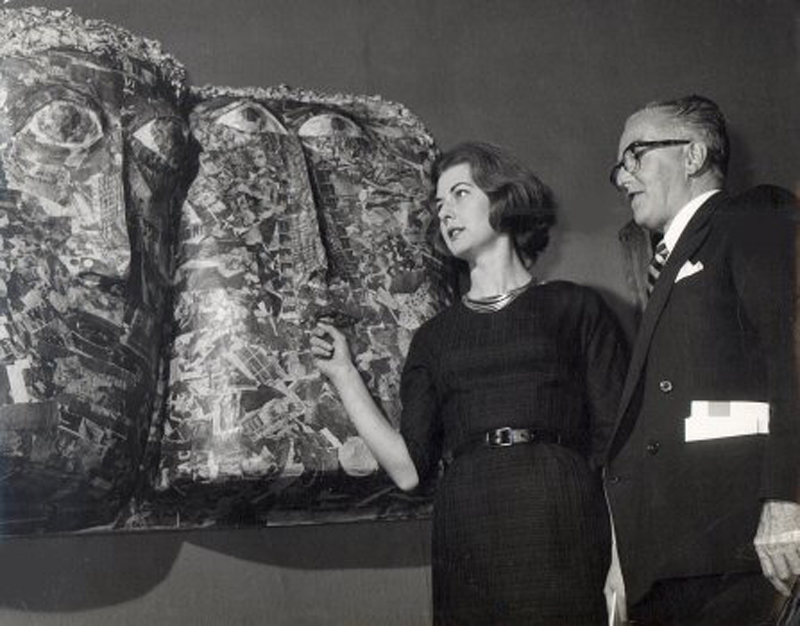
    Williams was, however, appreciated in the past. As a youngish artist in 1961 she won the sculpture prize (for Two Heads) at the John Moores in Liverpool, when other winners were Peter Blake, David Hockney and Ron Kitaj. These were the days when the Moores was worth winning, well before it was subverted to the cause of State Art where daubs of no merit are greeted by fools with preposterous superlatives. A retrospective exhibition was held in 1972 at Whitechapel Art Gallery; once again well before that gallery’s prostration before the winds of Biennale bluster. Williams continued her brave exploration of inner places that made her work then so widely admired. She worked every day of her life and although her commercial exhibitions continued, sometimes at long intervals owing to the complexity of ideas and their necessarily prolix gestation, a retrospective was never offered in her lifetime. Approached by friends in the last decade of her life, the Walker Art Gallery turned her down for such an honour. She couldn’t exert the pulling power of a Rolf Harris or Paul McCartney.

    Will Williams now receive the lifetime retrospective her work deserves, and which a wide audience should see? It isn’t likely.

    But why should this be, when there are more galleries nationwide which are more spacious than ever before? The answer is that as the public gallery network expands the same orthodoxy is spread across even more outlets. More galleries does not mean a wider selection of work on display; it means the same work by the same few artists spread across even more galleries even more frequently.

    What are called ‘Artists’ Rooms’ are a symbolic example of what is wrong with this rotten system. These ‘Rooms’ are organised by the Tate, the Scottish National Gallery of Modern Art and the Art Fund (how long will it be before the Art Fund can only be contacted via the Tate switchboard?), and they resulted from a bulk purchase, jointly by the Tate and the SNGMA in 2008. We bought for £42 million (£27 million in cash – the figure varies in different reports; we’ve never been told the exact sum – and £15 million in waived tax) retiring art dealer Anthony d’Offay’s gallery stock, which he called his private collection.  A cynic might say that Artists’ Rooms is the process by which the personal collection of one commercially motivated individual now dictates what a large proportion of the art-seeking population is allowed to see in the name of recent art. The same cynic might further add that Artists’ Rooms is the opportunity by which established reputations – such as Warhol’s – are constantly hammered home, and for the smaller ‘Room’ names, it is the instrument by which a more significant brand name can be nurtured.

    Under the auspices of the Art Fund, an organisation which luckily is headed by a former director of Tate Britain, 30 rooms featuring 760 works by 26 artists have been touring the country for four years, mostly as small one-man retrospectives. Some of these are marvellous, not least the extensive collection of photographs by August Sander. There are 232 works by Warhol alone, who gets two rooms to himself travelling at the same time. At the moment they are in Sheffield and Hull, and then Birmingham for four months. That is apart from relatively recent major exhibitions for the same artist at the Tate, the Hayward and other Arts Council galleries.  Warhol is showing somewhere all the time. We will not be allowed to ignore him.

    One of the Artists’ Rooms deals, inevitably, with Damien Hirst. This is currently on show in Walsall Art Gallery. It has been there for two months already and will remain in place for another year. What is happening when a fifty-year-old artist, already over-exhibited at a time when so many unexposed artists can’t get their work shown, is having a thirteen-month long exhibition? What is the reason for such indoctrination? Too often the Artists’ Rooms represent those who are already widely exhibited and who are bastions of the art market.

    Artists Rooms are a blunt instrument whereby approved taste is circulated (inflicted) from the centre. They constitute cheap exhibitions for Arts Council venues up and down the country, whose curators don’t have to originate their own programme. The laziness and ready compliance of these jobsworths is a godsend to State Art.  They can merely exhibit the same few approved brand names for ever. And make no mistake their career will depend upon them favouring these “right” kinds of artists for no individual prospers in State Art by demonstrating initiative or investigating the unorthodox.

    Visit the Hepworth Gallery in Wakefield and you will discover the other reason, besides the dreaded Artists’ Rooms, why thought and broad knowledge among curators is unnecessary. There is a new species of art collectors who caught the disease of wholesale, apparently random acquisition from Saatchi. These people fuel the market for State Art which they buy in quite staggering quantities. Their houses, full of wince-inducing tat bought for eye-watering sums, feature frequently in glossy magazines. Usually they are rewarded for their commitment to the State Art cause with the accolade of a position on a Tate committee, of which there are now dozens. At Serota’s Tate money not knowledge is the essential qualification for co-option.

    One such überbuyer – who has not yet been brought on to any Tate committee – is one David Roberts, a property developer, who has accumulated so much clutter he’s opened his own ‘space’ and has begun feeding pieces to regional galleries, Wakefield being the first venue. Works selected are linked as follows: “This exhibition examines ways in which modern and contemporary artists represent the human

    body in various media to explore psychological and emotional life.” What a perfect criterion that is for the inclusion of a major work by Evelyn Williams. Unfortunately, the trouble is that among Roberts’s 3,000 plus works there is nothing by Williams. But have a guess whose work he does own and whose efforts are on show in Wakefield: enter Warhol and Hirst.

    David Lee

    The Jackdaw January-February 2013

    http://www.evelynwilliams.com/index.htm

  • Courses for horses

    Courses for horses

    62 pictures, the most ever in its 60-year history, have been selected for this year’s John Moores Prize, the winner of which is announced on September 13th. The Jackdaw had heard of five of the 62. 40 years ago we would have heard of all fifty artists, and each represented by one of their better efforts. The exhibition at the Walker Art Gallery runs from September 15th to January 6th and, as we have pointed out in the recent past, it has been subverted to the cause of State Art such that it’s now in all but name a Turner Prize for painting.

    Curiously for a painting prize there is no gifted painter on the selection panel: this includes Yentob, who doesn’t know the first thing about painting; Blazwick, the Whitechapel director and State Art board member who will doubtless be referring all decisions to the top; George Shaw, who paints council estates by numbers in enamel; Angela de la Cruz, a sculptor-cum-assembler; and Fiona Banner, who writes stories in longhand on canvases. The three artists on the panel have all been nominated for that passe-partout State Art membership card, the Turner Prize.

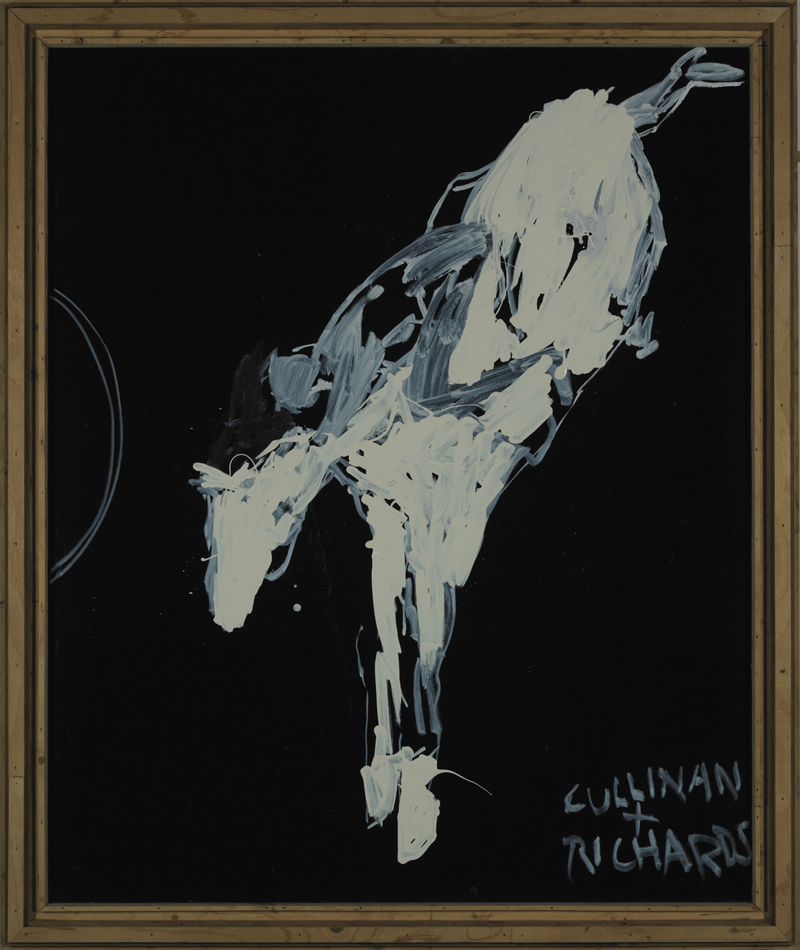
    Illustrated here is Cullinan Richards’ Collapse into Abstract (Black), which with a title like that will surely be a challenging investigation into the nature of painting qua painting. Over 3,000 artists entered a work for consideration, which means that 47 other pictures were rejected for each of those chosen. Were all 47 really worse than Richards’s collapsing abstract?

    No question this will be – like the last one – a bloody awful collection of wince-inducing daubs but one will have to attend in order to enjoy a hearty laugh at the artbollocks written about each entry, always a highlight of the exhibition. And there’s always the permanent collection of the Walker, which is easily the best in England outside London.

    David Lee

    The Jackdaw, June 2012