Tag: David Lee

  • Is this the masterpiece of British land art?

    Is this the masterpiece of British land art?

    The Jackdaw was given exclusive advance access to a grand project which seems certain to become a place of pilgrimage for intrepid devotees of Land Art. Dixon Smith reports.

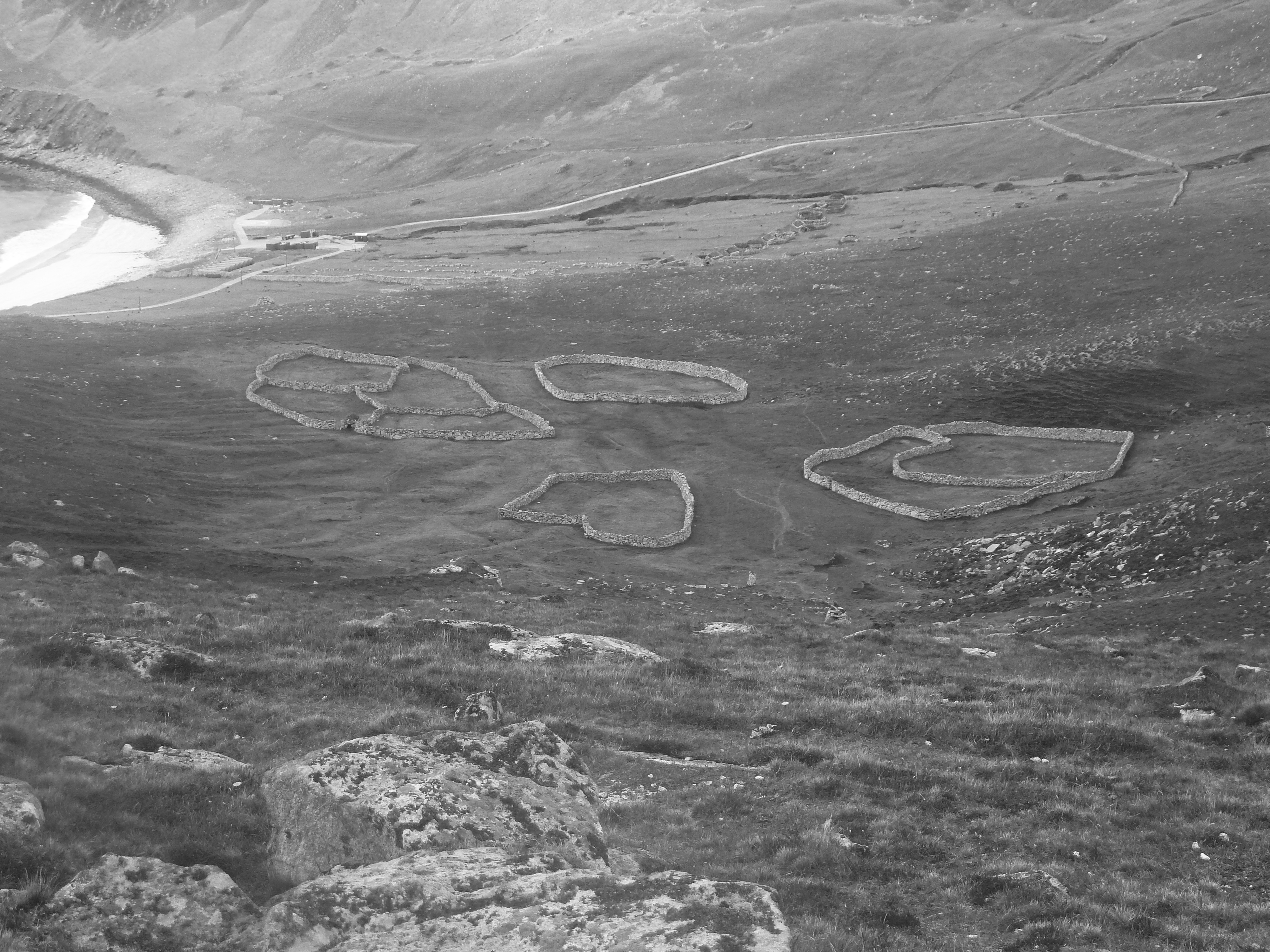
    Already being hailed by the few allowed to see it as the masterpiece of Land Art in the British Isles, In Transit  has been one of public art’s best kept secrets. The Jackdaw was given an advanced sighting before the official unveiling later in the autumn – the work’s location and the identity of the artist are strict secrets until the piece is unveiled to the press. We can reveal however that it is in an extremity of Scotland so remote only the most energetic and intrepid of art anoraks will find it: and it is not a disappointment. The name of the artist should not defeat most art aficionados: he is well-known for the solitary remoteness of his previous exploits.

    The site was offered as private land, and therefore not subject to complicated and delaying planning permission. When first approached four years ago, the artist responded enthusiastically to the genius loci, its natural deserted beauty and exposure to the unpredictable Atlantic climate. For the construction he was assisted by a team of artisans, and adopted a looser, more rustic style of dry stone wall-building than the sterile precision more typical of his oeuvre: he used available hillside material as quarry and for authenticity. The work’s title refers to the transient occupation of land and the maker’s insistence that the work should weather and settle, even collapse, naturally in the future, eventually to disappear. It was important to him that the finished piece should echo the work of farmers to cause ambivalence in the mind of those encountering it. The precise shape and spacing of the rough rectangles, their subdividing into writhing shapes, evolved gradually. Decisive planning informed the apparent randomness. Crucial in the calculations is that the eventual accidental discoverers of the work might be ambiguous to the significance of what they see; for example, is it art or nature, decorative or functional? Is it the work of a peasant or of an artist?

    No other land artist has worked before on such an epic scale, nor with such freedom and so grand a simplicity of effect. This is seen to best impact from flanking mountainsides which viewers must negotiate gingerly to approach closer. The underlying concept was to echo the original use of the land as a place for farming hill sheep but to add the artist’s twist of making the result less geometric and therefore less obviously functional to the eye.

    “The asymmetry is its most inventive aspect,” remarked project curator Phil Muir. “It challenges the viewer to work out the artist’s performative purpose and practice. The shapes of the folds are taken straight from the biology microscope and are demonstrative of the microcosm becoming macro. These gateless enclosures threaten to divide like cells and then spread.” There is no doubt that first seeing the piece as you approach along a precipitous ridge, they seem more to do with abstract art than the graft of shepherding and winter shelter for the flock.

    “This is a historic place,” says Muir, “with evidence of occupation since at least the Bronze Age. Life here was tough, the hardship unimaginable today, and the eventual clearances cruel. It has been completely abandoned for a century, and the artist was attracted to this opportunity precisely because he was able to reflect the former function of this place while introducing art to a location in which it is unfamiliar. We are hoping people will encounter it by accident and be inspired to ponder its enigmas. We want it to form a lyrical, uplifting contrast to what is barren, unforgiving land.”

    The Jackdaw, August 2012

  • Olympic posters: our native genius

    Olympic posters: our native genius

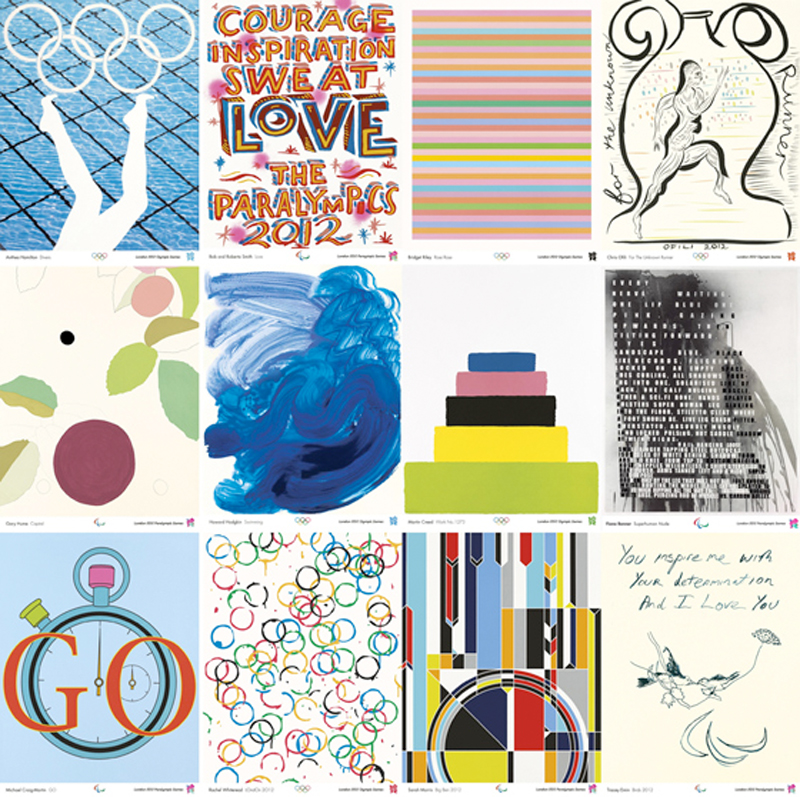
    The Turner Prize nominees and winners came up with a predictable set of embarrassing posters for the Olympics. Apart from the perpetrators themselves, no one could be found to say a good word about their efforts. Someone needs to get a grip. First we were presented with an inept logo which had cost £400,000 for what looked like two minutes work; then there was an artless rollercoaster sculpture selected by the President-For-Life; and now this lot of fashionable scribblers who couldn’t design a wheel from blueprints have done their worst, also, very conveniently, courtesy of the President-For-Life. Inevitably, as with Gibbereesh’s rollercoaster the PFL chose his reliable lackeys from the Turner Prize not to mention a serving Tate Trustee, Bob and Roberta Smith, i.e. one of those currently responsible for employing him.

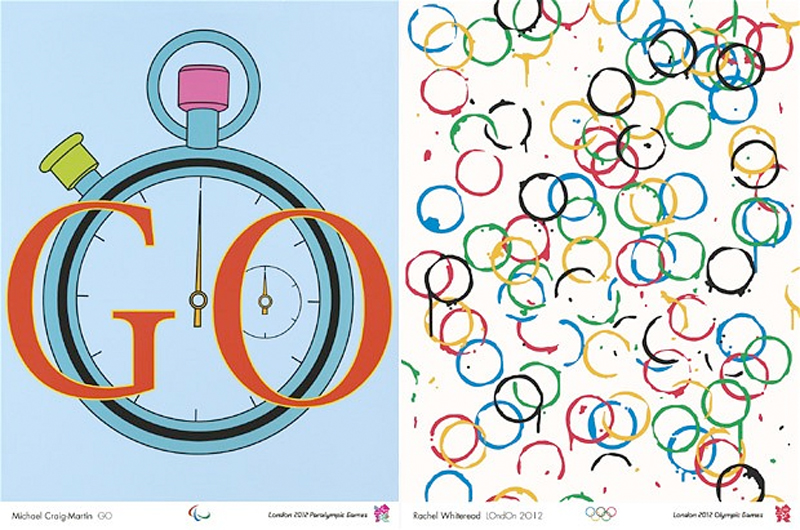
    Rachel Whiteread and Gary Hume excelled themselves with lovely colouring in – if their efforts had arrived crumpled from the nursery you might have fixed them proudly to the fridge. Bridget Riley knocked off her usual stripes. Each small poster – and these are nothing like the grand sheets of Lautrec – will be available to buy for £7 when an exhibition of the works opens at the Tate next summer.

    Now for the good news, that is if you are one of the participating artists. The posters are being released as signed prints courtesy of Counter Editions, thus enabling the artists to reward themselves in the manner to which they have become accustomed. Bridget Riley’s stripes, for example, is in an edition of 250 and started at £3,000 an impression – yes, that’s a gross of £750,000 for one signed screenprint, and it has already sold out. The Margate Express has hers in an edition of 300 at a throwaway £1,800 apiece – a mere £540,000… It is also sold out. The gross will, of course, have been far greater than the sums cited here as the cost of each print increased as the edition sold out. Still available however are ‘Professor’ Gary Hume’s blots (near right), a snip at £540 in an edition of 250 (£135,000 minimum gross) and Howard Hodgkin’s blue wave (£1,300, ed 300, minimum gross £394,000 – far right). No wonder the artists stood in a line laughing when their works were unveiled.

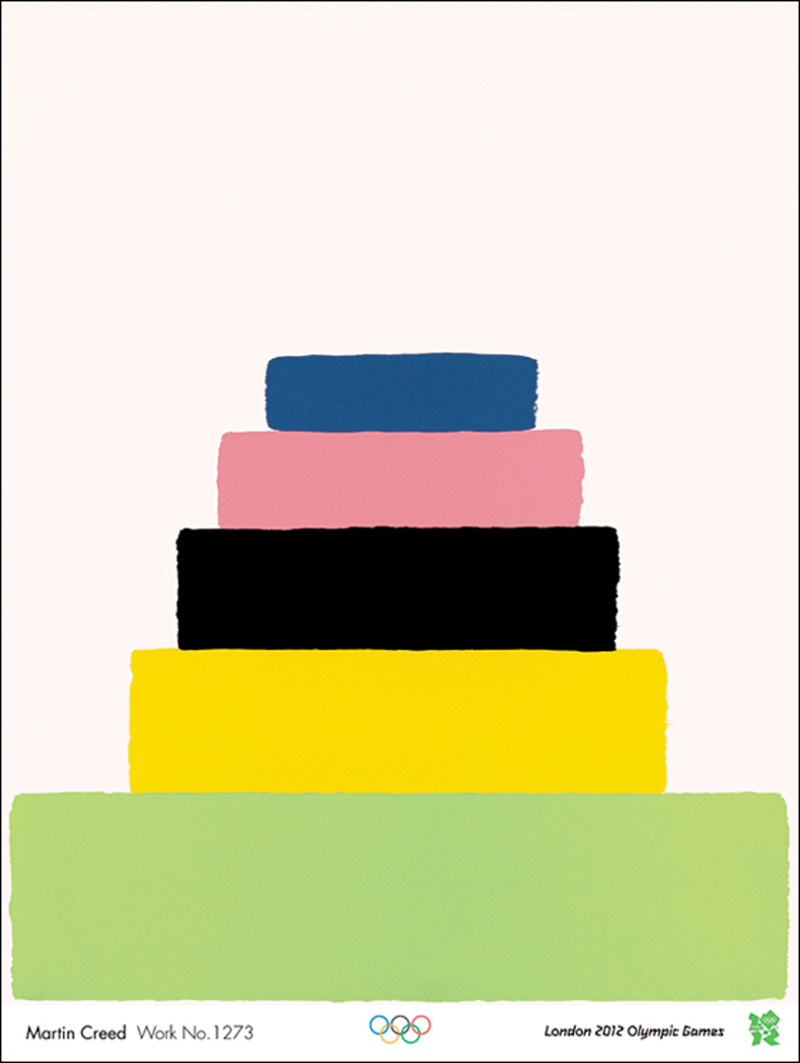
    Martin Creed, at last now widely regarded as educationally subnormal, said of his inspired marvel (£490, lithograph edition 250, minimum gross £122,500): “The colours are based on the Olympic colours but they are changed to make them nicer.” Here is the Mental Paralympian of State Art talking.

    What we got in this project was the usual bunch of over-rated contemporary artists promoting themselves and their art and not the Olympics. We can’t discover from anywhere what the deal was with the artists; were they actually paid to come up with their contributions or was their remuneration to be the loud ker-ching of limited editions? If you come across any information please let us know.

    … And then there was the dear old Margate Express. No are event is nowadays complete without her embonpoint rippling over the proceedings. On the same page of the papers when these Olympic efforts were announced you could look across from the Express’s maudlin scribble to Leonardo da Vinci’s drawing of hands on show in the National Gallery. An unfair comparison, yes, but it is surely impossible to look from one to the other and not think what a catastrophic deterioration has occurred not only in the technical ability of artists but in the willingness of those responsible for protecting standards in art to promote such conspicuous rubbish.

    By the way, if you wish to purchase all 12 of the posters you can buy the set in a nice box for £11,805. A commemorative heirloom for all the family to enjoy, and what a bargain.

     David Lee

    The Jackdaw, Jan-Feb 2012

    Latest News

    These posters are beginning to reappear on the market.

    Three editions sold out within days: they were Tracey Emin, Rachel Whiteread and Bridget Riley.  Now , one of the Rileys is being sold  at auction with an estimate of  £2,000-£3,000. This poster racket was not only a scam to line the pockets of already well-to-do artists but also to allow a quick turnover to collectors eager to cash in on the fever generated by the actual events.

    The complete set of posters are no on view/on sale at Tate Britain until September  23rd. So buy now. They’re crap, but what an investment.

  • Melting in the sun

    Melting in the sun

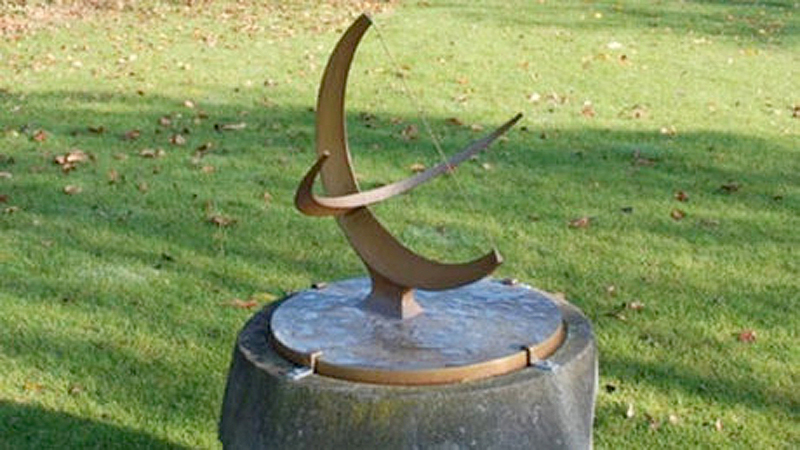
    After a large sculpture was stolen from the Henry Moore Foundation in Hertfordshire in 2005 security was tightened up. They have obviously enjoyed some success, if only because the works now getting stolen are a little smaller. The latest to disappear is a bronze sundial from the Yorkshire sculptor’s garden. Melted down, the 1965 piece will net the marvellous, highly cultural folk who nicked it several pounds. After the theft of the first work it was discovered that the £3 million sculpture had been melted down into three grand’s worth of raw metal.

    Despite the return last year of a Moore stolen in 2001, the chances of the sundial being found are negligible. It’s probably already on the shelves of souvenir shops in the form of London buses and Olympic fridge magnets. The theft of outdoor bronze plaques and sculpture is now an epidemic precisely because it is so easy and, doubtless, because the penalties for conviction a mere rap on the knuckles. There are no easy solutions to the problem. Meanwhile, we can have confidence in Hertfordshire’s finest Clouseaus who are hot on the present case: “It could have been stolen to be melted down,” said the top man using both his brain cells. “We take our care of Henry Moore’s sculptures very seriously,” announced a sober director of the Foundation. Well then Mr Calvocoressi, instead of giving the Foundation’s money in grants to those who are already among the richest sculptors in the world you could try investing in a nightwatchman.

    http://www.independent.co.uk/news/uk/crime/henry-moore-sundial-stolen-from-former-garden-7941456.html

    The Jackdaw, July 2012


  • Griselda and Moondance

    Griselda and Moondance

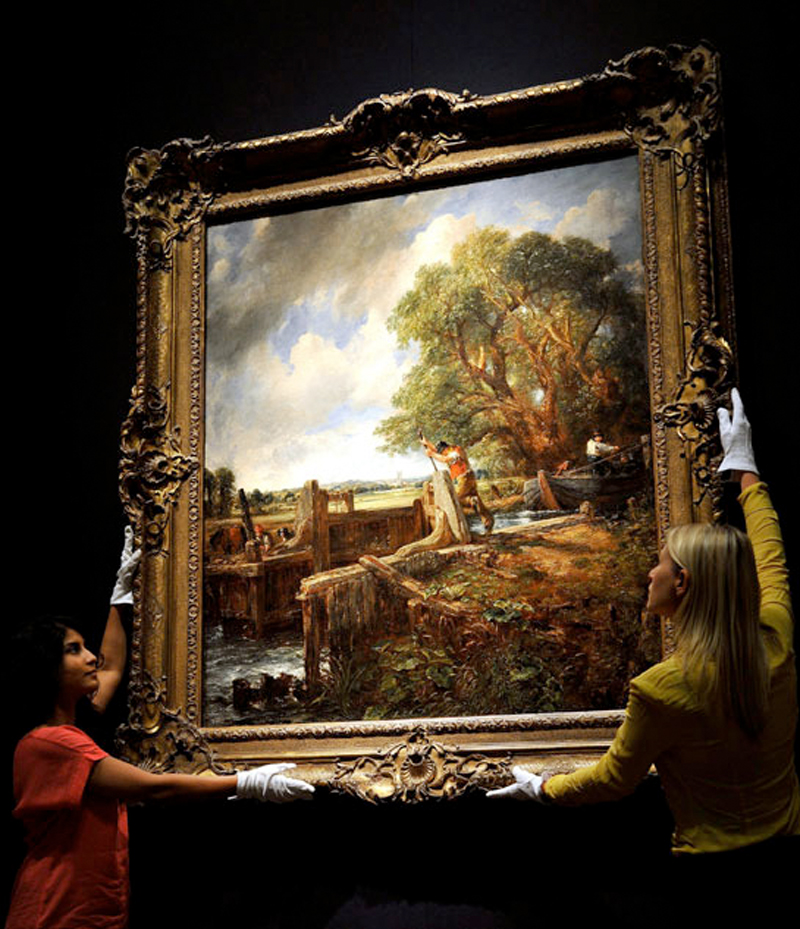
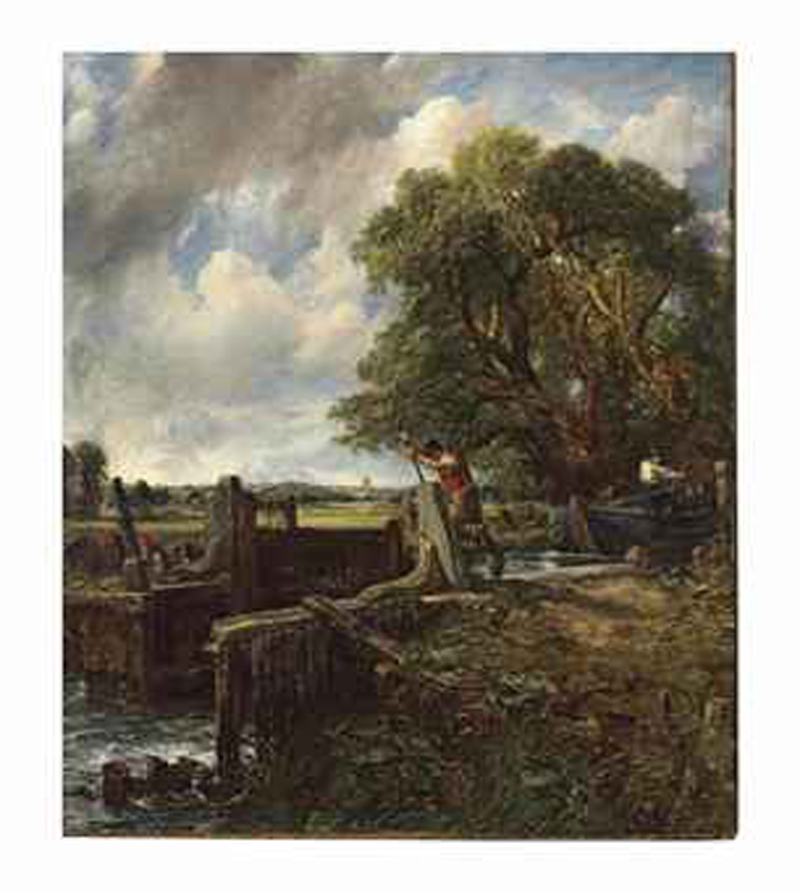
    It won’t have escaped the eagle eyes of either of The Jackdaw’s readers that our favourite bit of raven-tressed gallery fluff, Griselda van Bonkhorst, resurfaced pretending to hold up Constable’s The Lock. She was last found swooning over a Rembrandt and before that upstaging a Stubbs with her impeccable embonpoint. What with her fashionably unironed T-shirt and sexy rubber gloves she was looking quite the oil painting you’d expect. Knowing his daughter’s childhood dream of running her own little farm shop in the Cotswolds, her father’s plan to buy her into an auctioneers in order to see GvB married off to a quality suit has not yet paid dividends: she still awaits Mr Right.

    She is assisted here by fellow ornament Moondance van Dongen, a distant relative of the atrocious Dutch Modernist. Employed for her looks and Low Country subtleties and savoir faire, Moondance actually has to work for a living, her daddy having lost all his money speculating in Spanish property – currently she is heir to three miles of weed-cracked concrete the wrong side of Almeria.

    Griselda is not too chuffed about this competition for the eligibles of the Square Mile and is hatching secret plans to cause Moondance a nasty accident with a priceless ceramic. Meanwhile, dear old Grizzy looks dreamily up the Stour valley and sees her Range Rover splashing mud over the strawsuckers as she races to open her emporium where, don’t ya know, today’s special bargain is muddy carrots at ten guineas a pound. You can’t hold back a nice bit of skirt.

    COME ON LADS WHAT’S IT WORTH?

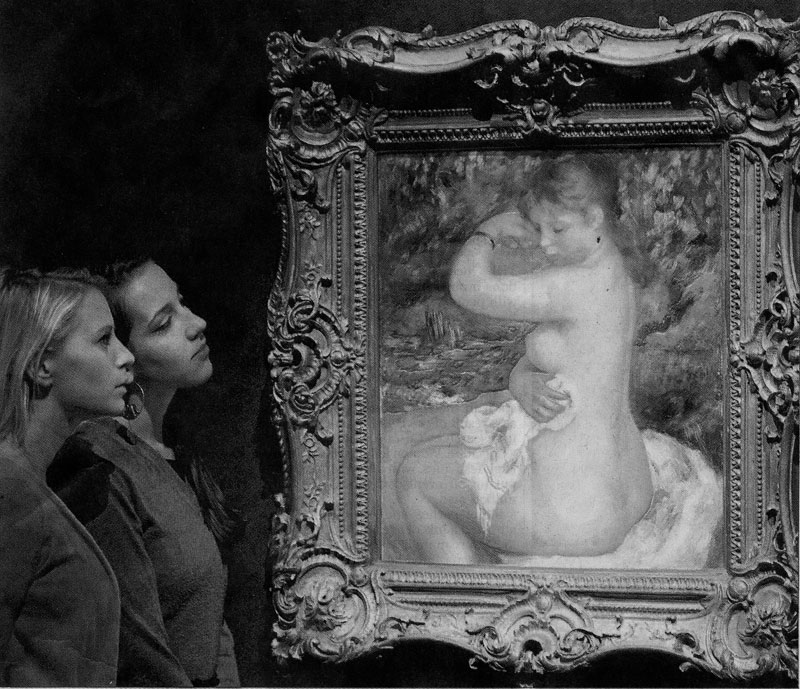
    Having so far failed to attract their beaux, Griselda and Moondance agreed with the publicity stills man that for the Renoir they would be shot close up to expose their aristocratic profiles in contrast to that of the undressed plebeian model. They might then make the society pages of Country Life or The Lady or any of the other publications in which fillies of the van Bonkhorst and van Dongen pedigree can offer themselves for gentleman suitors of comfortable means.

    Griselda looks disapprovingly at the pie-eating Impressionist hussy and can only wonder if the artist set up his mistress with a little shop in Normandy selling calvados and cider produced locally (in Bulgaria). Moondance, meanwhile, peers quizzically at individual brushstrokes having just been informed by mischievous porter Bentley (himself in search of a rich old suit) that Renoir was famous for having said that he painted with his dick. Poor old Moondance, never the brightest penny in the till, will eventually get the meaning but at the moment she is stuck imagining the blisters on poor old Pierre’s peashooter.

    David Lee

    The Jackdaw, Jul-Aug 2012

  • Hitting the bottle

    Hitting the bottle

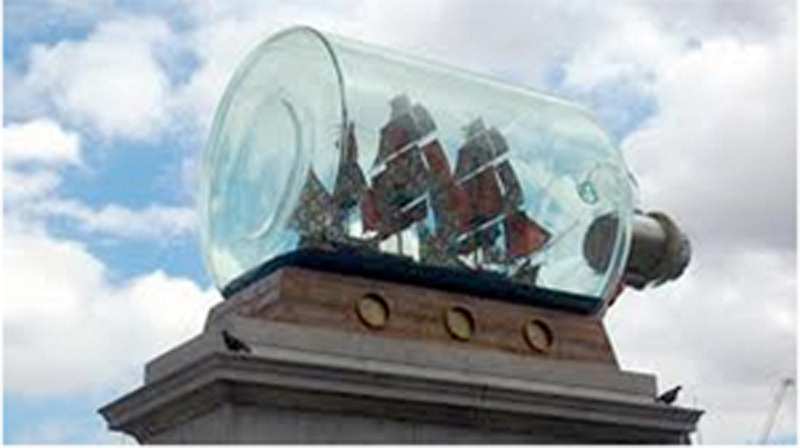
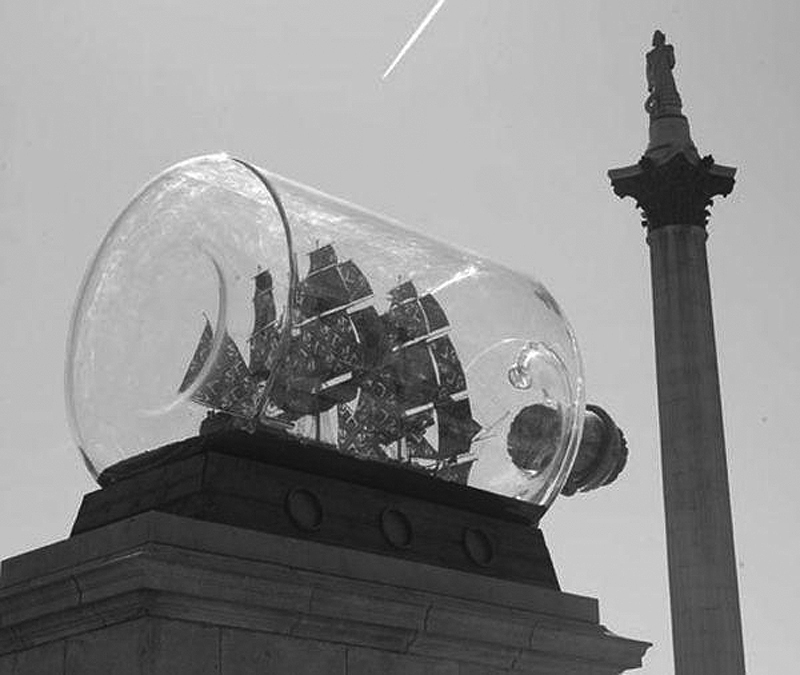
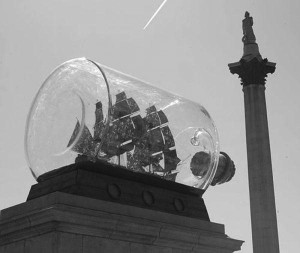
    The National Maritime Museum in Greenwich has bought for £362,500 the ship in a bottle by Yinka Shonibare which had sat ornamentally becalmed on the fourth plinth in Trafalgar Square for the previous 18 months. It is the Greenwich museum’s job to collect ships and related tackle and, lately, any sea-related nonsense deemed  ‘challenging’ by State Art’s omniscient spivs. It is significant, if you hadn’t realised, that the ship’s sails are made from patterned ethnic material of the sort usually swathed around gigantic arses in Dalston market. This encourages what one of the Tate’s finest drivellers grandly declares as “a transformation of perception”. Elsewhere, the same stuff is said to make an incisive comment on Britain’s nasty maritime heritage, “an exploration of colonialism and post-colonialism” no less. Needless to say we are not informed into what our “perception” is “transformed”, nor how “colonialism” is “explored” by deploying some patterned swatches purchased from a Brixton stall. I suppose we must now accept this species of commentary as the naturally occurring guff which will in perpetuity follow conceptual art wherever it goes.

    The sculpture, dubbed Nelson’s Ship in a Bottle, has recently been unveiled on a plain ziggurat base bang outside the National Maritime Museum’s main entrance. Here its presence will doubtless be interpreted as a Blair-like mea culpa for the historical misdeeds of our racist, slave-driving antecedents. Others may interpret its prominence and worship as illustrative of an abject and risible political correctness. Whatever, the bottle is a pretty enough toy untroubled by art. I wish to investigate briefly this apparently straightforward purchase because it reveals the questionable ways in which contemporary art is conducted by a small number of people for the benefit of an equally small number of other people who pop up ubiquitously pulling strings in proceedings such as these. It is curious indeed how the names are always the same ones. These ‘questionable ways’ may be baldly summarised as follows:

    1. We are never told the whole truth, even by public relations’ companies paid to deal with inquiries, and especially concerning the actual cost of anything. State Art is terrified of you knowing the truth, which is the reason why so frequently it is caught out lying.

    2. Obtaining accurate and complete information from arts bodies requires Kafkaesque determination and, when finally a morsel is vouchsafed, it is always uncooperatively partial and might easily contradict what has been released before.

    3. State Art has to be secretive in order to make the public believe that the visual arts are kept cruelly on the breadline and are not, as is the truth, awash with quite staggering amounts of cash which miraculously come available for the right people. If you are a Yinka Shonibare, with access to the engines of State Art, whose institutions you have dutifully served, this system is a licence to print money.

    4. The number of bodies dealing with contemporary art is far too numerous and wastefully duplicating of effort and resources, and any independence in their policies and actions is compromised by frequent interchange between them of the same few personnel.

    Three issues ago Moping Owl asked why we needed to buy Shonibare’s ship when, she thought, we already owned it. Didn’t we?  Had we not already commissioned and paid for it to sit on the plinth?  Well yes, sort of. Owl’s was a natural mistake, especially in view of what we had already been led to believe by what, up to that point, we now know had been an economical rationing of information. £362,500 is three times the record price paid at auction for any work by Shonibare. To pay apparently so much over the odds is surely just a little questionable, but the truth is that this figure is nowhere near what was actually paid for it. The real price far exceeded the published number, but you won’t have found the full, accurate cost in any newspaper because even now we can’t be certain we know all the amounts involved.

    When the purchase was gleefully trumpeted, as though we’d just acquired for peanuts a lost masterpiece by Praxiteles, a breakdown of the cost was supplied. This was based on the interesting claim put about by the artist’s dealer that an unnamed South Korean businessman had been prepared to pay £1.25 million in order to display the bottle in his garden. This outcome was described as “a real possibility” – which sounds to me a bit like the belief among, say, QPR fans that there is ‘a real possibility’ of their team winning the Premiership next season. This sum was apparently accepted even though, at that time, the price was ten times more than had ever previously been paid for a work by the artist. Complicated tax concessions applicable to a purchase by a British museum meant that the top line price was reduced to £650,000, the Treasury having waived the difference. This lower sum was made up as follows:

    £140,000: production costs funded by the Greater London Authority

    £97,500: 15% museum discount from Stephen Friedman Gallery

    £50,000: Grant from the Art Fund ***

    £264,300: Contributions from the public via a fundraising appeal ***

    £49,100: National Maritime Museum contribution ***

    £49,100: Matched contribution by Stephen Friedman Gallery and James Cohan Gallery, New York, on behalf of Yinka Shonibare, MBE

    (*** These sums total £363,400; that is, close to £362,500.)

    As far as I can ascertain at least three additional sums that were paid have not been included in this final account. The Arts Council awarded £70,000 for this project, as it does for all fourth plinth commissions; the Greater London Authority, in addition to its £140,000 production costs, gave an “artist’s fee” of £30,000; and the Henry Moore Foundation gave a grant of £20,000 to the artist for this project. In the privileged wonderland of State Art these additional sums, a mere £120,000, are pocket money. But we still paid them, and the total involved is five times the average Briton’s annual income. I can see no reason why these omitted additional sums should not have been deducted from the price paid by the Museum. Why were they not included in the reckoning? And how many other charities, trusts etc., contributed amounts which disappeared into the coffers when first the project was mooted? The £140,000 contributed by the Mayor’s office for production costs was, according to the initial agreement, to be repaid if the work sold. This is apparently true of all works made for the plinth, though we are unaware of any sums ever having been repaid from previous occupancies.We must assume that Boris is sat waiting eagerly for his refund (after all he can buy one-tenth of a new Routemaster for £140,000). Despite repeated requests for information nothing remotely resembling candour has emerged from the Mayor’s office. The fact is that the GLA alone paid Shonibare in production costs and fees a sum far is excess of the highest amount the artist’s work had ever previously sold for. And we didn’t even get to own it. Is the Arts Council’s £70,000 equally reimbursable upon the sale of a work? If not, it should be. The Arts Council, perennially bleating about its poverty, should surely be on the case for a return of its investment. As usual our requests to them for information have been ignored. They are far too busy producing worthless pamphlets of self-congratulation.

    The price paid by the NMM was independently assessed by Haunch of Venison and Roche Court, a minor secondary market sculpture dealer in the West Country. Haunch of Venison is a gallery owned by Christie’s who, coincidentally, sold the previously highest priced work of Shonibare, a large installation, for $194,500 last November. (Another installation was sold by Christie’s in April this year for as little as $98,500.) It is hard to see how any objective person could have verified a price of £1.25 million ($1.94 million) for a sculpture by this artist, even one which had sat prominently hawking itself in the centre of London for the previous year and a half. Given that they have a monopoly of sale on Shonibare’s sculpture (Sotheby’s has never offered a work by him) it was not in Christie’s – of course I mean in Haunch of Venison’s – interest to undervalue this piece. In other walks of life we might call this a conflict of interest. Shonibare was handsomely reimbursed twice for this bottle; once when he made it and a second time when he sold it. Additionally, we had a right to expect a knockdown price from the 50-year-old artist whose career has been generously supported by the State. Shonibare is an executive member of the Usual Suspects Club. He was nominated for the Turner Prize in 2004, the year Jeremy Deller won (Deller, incidentally, is one of two artists on the selection committee for the Fourth Plinth, both of them Turner Prize winners). His fledgeling career was made easier by cash grants from both the Arts Council and the Greater London Arts Board and he has enjoyed exhibitions in virtually every Arts Council-funded gallery throughout the country, as well as at the Tate. He has also served on Arts Council committees and bought works of his choice for the Arts Council collection. His present visibility would have been inconceivable without expensive public promotion. This should have been reflected in the price for the bottle. After all, we didn’t owe Shonibare anything, quite the reverse. He has made a strong career on the back of crucial public investment in him and, in my view, he has used that reputation to inflate the bottle’s price when selling it back to us. What a marvellous system this is if you are, as the Arts Council put it, “the right kind of artist”.

    At the very minimum we paid the following for the bottle:

    £362,500 published cost

    £140,000 Greater London Assembly

    £30,000 fee also from the GLA

    £70,000 Arts Council grant

    £20,000 Moore Foundation grant

    (£622,500 in total).

    When the work’s sale to Greenwich was completed Shonibare said: “I am absolutely delighted and touched by the public’s generosity.” I bet he is.

    David Lee

    The Jackdaw, Jul-Aug 2012
     

  • Selling England by the pound

    Selling England by the pound

    Today John Constable’s The Lock, painted in 1824, sold at Christie’s for £22.4 million. In the current art market of silly prices some lucky person got the bargain of their lives. Let us hope the picture will be placed in a museum, where people might enjoy it, instead of disappearing into a Swiss warehouse as the investment bauble of some gold-tap billionaire vulgarian. It is the same price as that commanded by ordinary works by the top price sellers in British painting, Turner and Bacon, both of whom have sold work for significantly higher amounts than this. It is the same price a collector might pay for an off-the-peg Monet one wouldn’t inflict even on an enemy. The Lock, being one of the six major works deliberately painted by the artist between 1819 and 1825 for the Royal Academy exhibition in order to cement his reputation, presented the last opportunity for a collector to own one of the major works by the artist of the quintessential English landscape. All the other major pictures are already off the market in museums.

    Why so low a price? Of the top 50 most expensive paintings ever sold either privately or at auction only five are Old Masters, and of the remaining 45 ten are by Picasso, seven by Van Gogh and four by Warhol. The new billionaires, who are not old fashioned men of discernment and discrimination but those who buy conspicuously in order to impress friends, are uninterested in works not instantly recognisable for their “wall power”. Even the most knuckle-dragging mate of a Russian oligarch can recognize Warhol or Picasso but they wouldn’t know a Constable from a concertina and couldn’t recognise anything before 1850, all brown paintings looking alike to them.

    Who bought it? Assuming that The Lock is too sophisticated a picture for nouveau squillionaires, the only two museums in the market at this kind of price are the Getty in California, which two years ago paid £29 million for a Turner view of Rome, and the museum being built from scratch by the Qatari royal family, who are hotly rumoured to have bought the record-breaking The Scream by Munch a couple of months ago. No British gallery could afford a square centimetre of such a work, not that our museums actually need any more examples from Constable’s brush. For example, on the day of The Lock’s sale the Tate, which owns 261 works by the Suffolk miller’s boy, had 13 works on display. It always likes to keep plenty in reserve. There were more works by Constable on show at the Victoria and Albert Museum than at the Tate – the V&A owns 802 items relating to the artist including the full-size oil sketch for the Hay Wain. The National Gallery has nine works by Constable, all of them on display every day of the week free of charge.

    “Painting,” wrote Constable, “is but another word for feeling.”

    David Lee

    The Jackdaw, 3 July 2012

    http://www.bbc.co.uk/news/entertainment-arts-18702667

  • Erro erro erro

    Erro erro erro

    The Weiwei soap opera continues with more plots than Highgate Cemetery. He has now been refused permission to attend his own tax hearing. He is, of course, contesting the imposition of a fine made by the Chinese Government for alleged tax evasion and other financial exoticisms. In his turn Weiwei has issued a writ against the state for violating the rights of witnesses and of evidence, and of preventing him consulting his own accounts in order to prepare properly his defence.

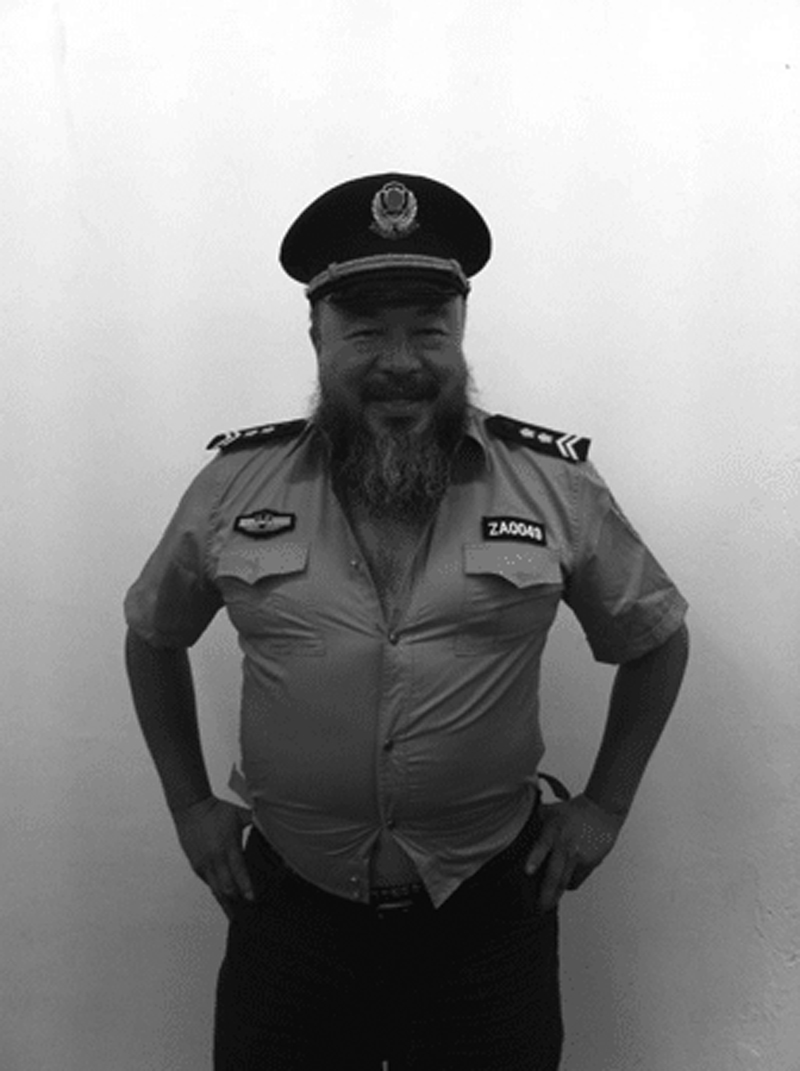
    To mock those limiting his movements and spying on him 24 hours a day he donned a police uniform – several sizes too large for his trim six pack – and posed for foreign news correspondents. Freedom from last year’s incarceration appears to have emboldened him. But one of his legal team has already ‘disappeared’. We fear he won’t be laughing when he starts a life sentence of mopping lavatories in Mongolia.

    David Lee

    The Jackdaw, July 2012

  • Hitting the right tone (or tits first)

    Hitting the right tone (or tits first)

    Almost part of The Season now, the only surprise these days about the annual BP Portrait Award is that the Queen doesn’t cut the ribbon and hand out the rosettes. As ever, this year is as popular with the public as any art exhibition, with large numbers jostling and genuinely engaging with the work eagerly discussing merits and demerits of more conspicuous pieces.

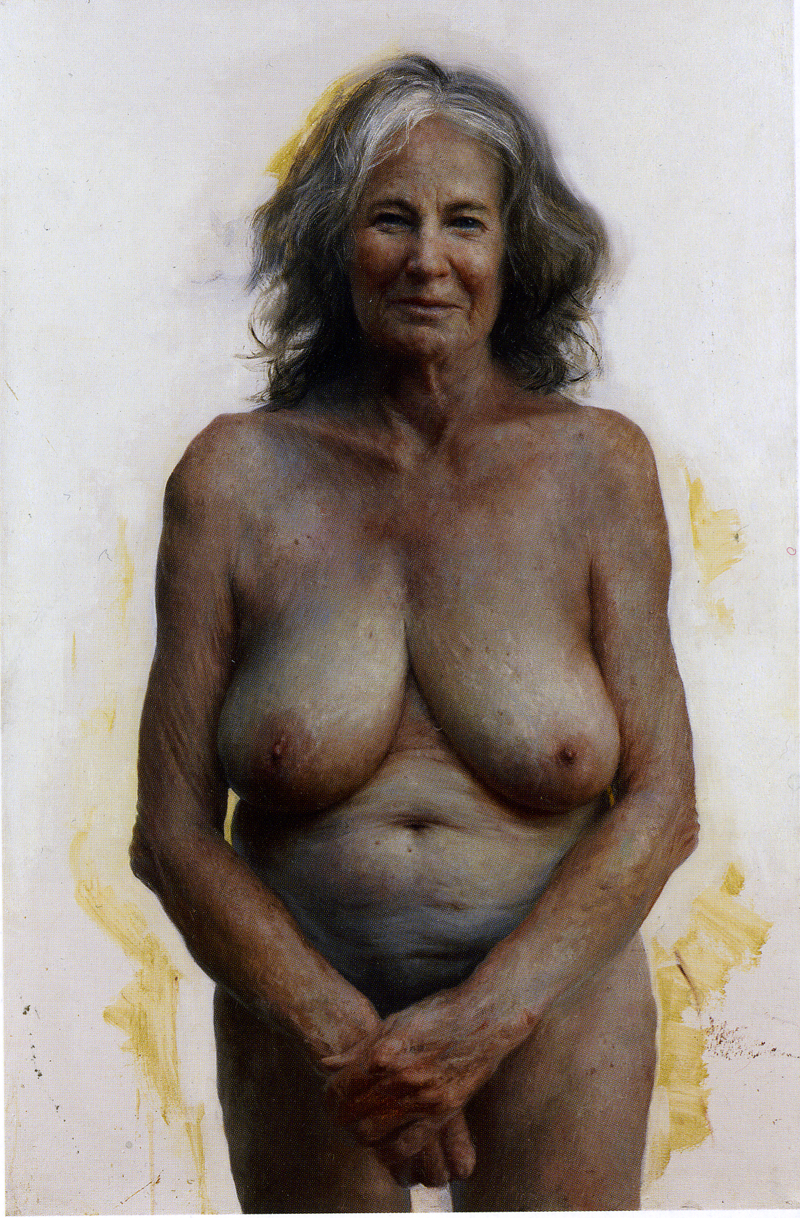
    As usual the winning picture, Auntie by 26-year-old American Aleah Chapin, is not the most refined effort though it deserves commendation –­ if only because the sitter has comfortably the noisiest breasts in the show. One subject of the picture is perhaps what the ageing process does to flesh and muscle, although the painter has presented it in an original and not necessarily unflattering way, suggesting that while the run in to death might be sad it is not always unsightly.

    Somewhat off sharp focus and pinned specimen-like to an unfinished background to which the figure’s outline is here and there uncomfortably cut, the sitter confronts us very slightly as if from the past, as though the painter has approached her subject wistfully. Auntie seems not to be fully in the present and invites thoughts of how in old age personalities, histories, gradually dissolve. It is a nicely judged picture, and there’s love in it.

    Isabella Watling presents The Importance of Being Glenn. Less conspicuous and subtler than the winner, it is duller but arguably more artfully painted. Watling is the more impressive painter for having been classically trained at the Charles H Cecil Academy in Florence, where she is still a student. Indeed, the winner of the Young Artist’s prize, Jamie Routley, is also a graduate of this school, as is another potentially successful young artist Tim Gatenby, for a portrait of his grandmother. Any of these three might win the prize in the future. The work of the Cecil Academy’s graduates – the impressive Frances Bell is another – stands out in the context of those paintings which use overbearing narratives, a cornucopia of details, sloppy painting and overblown heads copied from photographs or projections. Look out for this quartet, their pictures sit back and wait for the discerning passer-by.

    There were also convincing efforts by Antonio Barahona, Roni Taharlev, Benjamin Sullivan and Ben Ashton, all of whom rely on expression through observation rather than deliberate sloppiness and vulgar gimmicks.

    An intriguing oddity is a stylised scene in a Japanese sushi restaurant, painted by Carl Randall (who won the Travel Award), which is not strictly speaking a portrait so much as a novel documentary. Seen almost from above, assorted diners are trapped in their own worlds and silhouettes while troughing busily with chopsticks.

    One welcome addition this year is the judges’ statements – albeit too brief – as to why they selected the prizewinners. This should be done as a matter of routine in all competitions of this sort. If organisers are to continue with such elaboration it must be better done next year. Third-prize winner, Alan Coulson, is praised as follows: “The modulation of tone and attention to detail successfully brought the style and subject together.” ‘Modulation of tone’ is a cliché, doubly unhelpful in this instance because Coulson’s isn’t a tonal painting. Perhaps what is really meant here is the even gradation from light to dark, which is indeed carefully modulated in the sitter’s white T-shirt, but nowhere else. Looking at the list of judges, it occurs that there isn’t a painter present, an accomplished sculptor yes, but not a painter. A painter as a judge in a painting prize may be too obvious a step for the State Art establishment but it would have saved them making such a ham-fisted mistake.

    The second prizewinner, meanwhile, was chosen because it was “intensely atmospheric, thoughtful and focused” – “murky” seems more appropriate. If you’re desperately trying to find something to say this is the kind of adaptable phrase applicable to most paintings. When justifying a choice, it must be done more convincingly than this by avoiding such flannel, so that we viewers enjoy the benefit of the judge’s greater expertise – then we are able to say “Oh yes, well spotted, so it is”, and not respond with a bewildered “Eh?”. As it stands with this year’s explanatory efforts one can have no confidence that the judges have a clue why those selected for honour are outstanding in the company.

    For all its usual failings – not least the fact that a good twenty pictures don’t deserve to be hung at all – this is a moderately diverting exhibition in which to dodge the showers.

    The BP Portrait Award is at the National Portrait Gallery until September 23rd; the Scottish National Portrait Gallery, Edinburgh from November 3rd to January 27th; and the Royal Albert Memorial Museum in Exeter from February 9th to May 19th, 2013.

    David Lee

    The Jackdaw, June 2012

  • Margate Express on Central Line

    Margate Express on Central Line

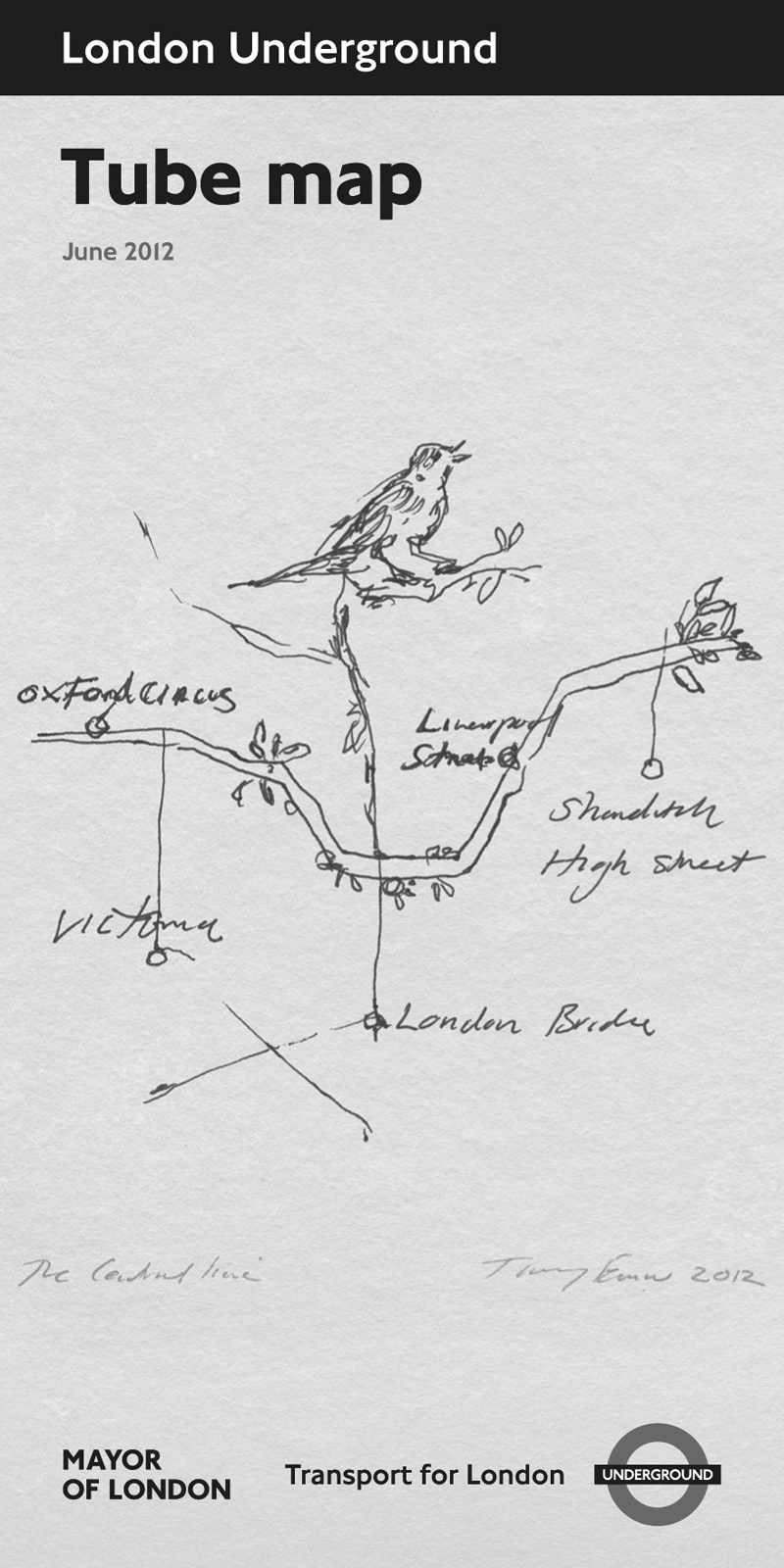
    The latest masterpiece from the Professor of Drawing is the cover for the tube map. She does a fair warbler with its beak open and trots it out at regular intervals. “When in doubt scribble a bird with its beak open,” advised the Prof as she stepped down from the Margate Express. It was commissioned for a special map to be handed out during the Olympics so that all the foreign visitors will be overwhelmed by the wealth of artistic talent in our country. Said the mayor of London, whose brilliant idea it was to approach the Professor: “How appropriate it is that our Olympic map should echo the advice of the mighty Apelles who drew birds as symbols of an athlete’s freedom of spirit.” Meanwhile, the willing idiot in charge of art on the underground spewed out what she always says when a new map is published: “The artwork presents a moving and unique interpretation of the capital.” Mrs Margi Doonham of Nottingham, who was up the smoke bargain-hunting for suicide potions, said after studying her map that she knew a disabled artist who could draw a better bird holding the pencil up his arse.

    She likes birds does the Margate Express – and every one a masterpiece. Some years ago we reported on her sculpture outside the Anglican Cathedral in Liverpool. It was sixty grand’s worth (courtesy of the BBC who for some reason paid for it) of tiny bird on a pole which some unimpressed scouser promptly sawed off. It was found nearby in a jiffy bag and reattached, following which it was nicked again. We are unsure of its current status, but do let us know if you are privy to information.

    David Lee

    The Jackdaw June 2012

  • One for the Royal Collection

    One for the Royal Collection

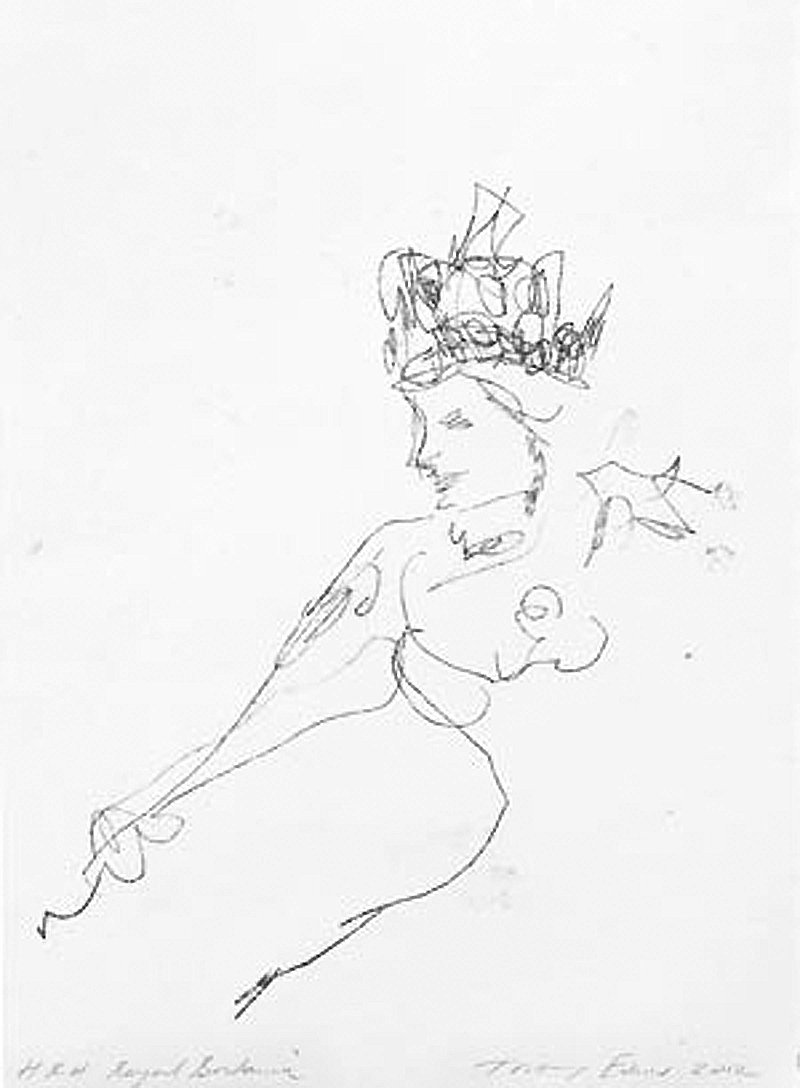
    It’s the headgear that does it. Gives it away completely. Without it you’d be none the wiser. But the miner’s lamp makes it beyond any doubt. This is the Professor of Drawing at work on her most important finished presentation piece yet, a celebration of the Wigan pit girls of the 19th century. Such economy of line, every mark counts, each and every one assertive, the impact one of dedication and duty, such superb proportion and foreshortening. It’s as though she was born to draw. So exact is its depiction you could have that miner’s lamp made by an artisan in an afternoon. Every detail is there. Likewise the smock. What seamstress couldn’t run up that durable uniform. She looked exhaustively at hundreds of photographs of pit girls in order to get the portrayal just so. Another triumph for the professor. “People have forgotten how hard these girls worked for a living wage what kept em in grinding poverty,” said the Professor in expansive mode. “They got a lot of stick for being manual but they were amazingly hard working and very glamorous,” she added.

    The pit girl is included in the latest exhibition put on by the professor – she has not after all enjoyed a show of recent work for upwards of six weeks. The new exhibition is in her home town, Margate, which is said to be reborn as a result of its association with her. “She is good for the town,” said Mrs Margi Doonham of Nottingham. “The cake shop has never been busier. And there’s more condoms in bus shelters than ever before. It’s as though the 1950s are back again with crowds piling in on Bank Holiday specials. Long live the Professor. She’ll be Dame Professor soon, and why not?”

    David Lee

    The Jackdaw June 2012