Tag: Turner

  • Laura Gascoigne: Crime Without Punishment

    In May, policemen with shovels moved in again on 79-year-old mobster Robert Gentile’s Connecticut ranch. It’s the third time they’ve searched the property and the second time they’ve dug it up in the hope of finding the 13 masterpieces, including Rembrandt’s Storm on the Sea of Galilee, stolen from the Isabella Stewart Gardner Museum in Boston in 1990. A few years ago Gentile boasted in jail that he knew the whereabouts of the loot, a mistake the old Mafioso – and his missus, if he still has one – is presumably regretting.

    With the $5 million reward still unclaimed after 26 years, expectations of the works’ survival are vanishingly slim. According to the Art Loss Register’s reckoning, 15% of missing masterpieces never reappear, but the fact that some do keeps hope alive. Vermeer’s Lady Writing a Letter to Her Maid, stolen from Russborough House in 1986 by Dublin underworld ‘General’ Martin Cahill in 1986, was tracked down seven years later by Scotland Yard Art and Antiques Squad sleuth Charles Hill, and of course the Tate got back its two Turners nicked from the Schirn Kunsthalle in Frankfurt in 1994 after eight years of dodgy negotiations with Serbian gangsters and the payment of a £3 million ransom, ahem, reward for information.

    If museum heists seem to have passed their heyday, it’s because WikiArt-educated criminals have come to realise that world-famous paintings can’t be shifted. There is still idiocy among thieves, however. The works by Monet, Matisse and Picasso stolen by Romanian gangsters from the Kunsthal Rotterdam in 2012 were eventually incinerated by one of their mothers, on the principle that ovens are the best place for hot potatoes. Some mobsters do ’ave ’em. But museum thieves with half a brain today make sure of their market (black if possible) in advance. Hong Kong was the destination of the Chinese antiquities nicked from English regional museums in 2012 in a spate of burglaries by the romantically named Rathkeale Rovers. Limerick tinkers they may be, but the Rovers twigged that profit margins are wider on intact jade carvings than on melted down Henry Moore bronzes, and there’s less heavy lifting involved.

    Like the hoary ‘Diamond Wheezers’ who tunnelled into Hatton Garden last year, the Rovers were good old-fashioned breakers-and-enterers – the last of their three incursions, into Durham’s Oriental Museum, was through a brick wall. In the digi-crime era, the public has a special affection for analogue thieves. We relish the effrontery, ingenuity and occasional battiness of the stubbornly unmodernised criminal enterprise. We have a particular soft spot for the crackpot with a social conscience like John Bunton, who lifted Goya’s portrait of the Duke of Wellington though an open toilet window at the National Gallery in 1961 in aid of his unemployed bus driver father’s protest against the imposition of the BBC licence fee on the poor. And it pleases us to think of art-loving thieves enjoying quiet possession of their booty, as Vincenzo Peruggia did for two years with the Mona Lisa after liberating her from the Louvre in 1911 with the aim of repatriating her to Italy. Peruggia’s mistake was to expect a reward for his patriotism – a thief has to live – but became a national hero on his arrest.

    Sadly, the ‘gentleman thief’ and the ‘cachet crime’ are becoming history – one reason why Lund Humphries’ new publication Crime and the Art Market by Riah Pryor is not the page-turner you might expect. A former art crime researcher at Scotland Yard and assistant art market editor at The Art Newspaper, Pryor promises in the preface to address the issue of “whether the art market, with its opaque structures and secretive ways of doing business, is fundamentally facilitating criminal activity.” She looks at different categories of crime – forgery, theft and trade in looted antiquities – and different attempts, official and unofficial, to deal with them.

    In the case of looted antiquities, the book is a depressing catalogue of international declarations, conventions and protocols endlessly wriggled out of by rich ‘market’ countries to the continued despoliation of poor ‘source’ ones. We British are expert at deferring ratification: it took us until 2002 to ratify the 1970 UNESCO Convention on the Means of Prohibiting and Preventing the Illicit Import, Export, and Transfer of Ownership of Cultural Property, and last year, when finally ready to ratify the 1999 protocol to the 1954 Hague Convention for the Protection of Cultural Property, we ran out of parliamentary time. On the domestic front, an equally dismal picture emerges of a police force that is underfunded, sclerotic and generally indifferent to a crime it (and the mass of the public) considers low priority. The recovery of stolen art is now mainly left to private consultants with police backgrounds – money attracts cops as well as robbers – and justice is more quickly (though expensively) achieved through the civil courts.

    It’s hard to know who this book is for. It won’t teach professionals anything they don’t know and amateurs will find it disappointing. After challenging the view “that criminals involved in art (particularly forgers) are deserving of an admiration not offered to criminals targeting other markets”, Pryor can hardly regale us with tales of their exploits. She seems equally loath to investigate the shady financial practices that have turned the art market into a global ‘marché ouvert’ for anyone rich enough to retain the services of Mossack Fonseca. The chapter headed When is a Problem a Problem? would be better titled When Is a Crime a Crime? The answer, she suggests, is when the money says so: laws are enforced “where patterns of criminal activity threaten the market’s profit margins.” On page 147 comes the understatement of the century: “Secrecy around the identities of those involved in a transaction, combined with the highly subjective and dynamic value of cultural property, can lead to fears of market manipulation.” Well I never.

    You can’t escape the feeling throughout this book that its author is covering her back in case she never works in the art world again. Her conclusion, when she reaches it, is no conclusion at all: “With no quantifiable means by which to determine how many professionals are tempted into criminal activity and how this compares to other markets, any sweeping conclusion of art market behaviour only ever seems to be based on a foundation of snapshots, gut feeling and anecdotes.” In other words, the exercise is pointless. Still, a few more anecdotes would have leavened the loaf, and some observations from the horse’s mouth might have raised the philosophical tone. Take this pearl of wisdom from the late lamented Peter Scott, cat burglar to the stars and author of Gentleman Thief: “The people I burgled got rich by greed and skullduggery. They indulged in the mechanics of ostentation – they deserved me and I deserved them. If I rob Ivana Trump, it is just a meeting of two different kinds of degeneracy on a dark rooftop.”

    Now that Ivana Trump’s ex-husband is running for President of the United States, will anything change? I’ll give the last word to Charles Hill, who told a Guardian interviewer in 2006: “The amount of beauty matched by moral turpitude in the art world generally, but specifically in the world of art crime, is fascinating. There’s a great fluctuating moral tide and people just bob along on it.”

    Ten years on, the fascination is becoming morbid as the tide of turpitude keeps rising with no sign of any flood barriers going up.  

    Laura Gascoigne
    The Jackdaw

  • ‘The Late’ shows

    Edward Lucie-Smith considers the phenomenon of ‘The Late Style’ in relation to Rembrandt and Turner

    The new Rembrandt show at the National Gallery in London (until January 18th) is clearly meant to challenge the enormous success the same institution enjoyed with its recent exhibition devoted to Leonardo da Vinci. It is a populist homage to one of the undoubted giants of Western European visual culture.

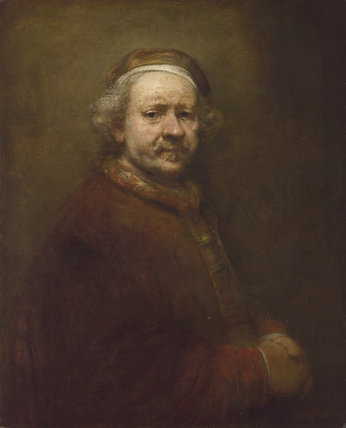
    Instead of trying to embrace the whole man, or at any rate the whole artist, as the Leonardo exhibition did, it focuses on a very specific period of the artist’s life – his last decade and a half, roughly speaking from the time he went bankrupt in 1656 to his death in October 1669, aged 63 (his self-portrait at that age is illustrated here).

    The show has a very particular context, perhaps the result of happenstance. London is currently playing host to another major exhibition devoted to a great master from the past – a painter as well known, and as much of a universal culture hero, as Rembrandt himself.

    This, at Tate Britain, is devoted to the British landscape painter, J.M.W. Turner. Entitled ‘Late Turner – Painting Set Free’ (until January 25th) it focuses on the productions of Turner’s final years, from 1835, when the artist was 40, to his death in 1851, aged 76. Turner began his final phase at an earlier age than Rembrandt, and lasted somewhat longer.

    The idea of the ‘late style’, as a very special, magical phase in the evolution of the work of a great artist, is a comparatively modern invention. To the credit of the organizers, the catalogue of the Rembrandt exhibition is careful to spell this out. As Jonathan Bikker and Gregor J.M. Weber write in an essay entitled ‘Explaining Late Rembrandt’: “At the beginning of the twentieth century the search for specific rules governing the evolution of styles gave rise to a mythology of the aged artistic genius, driven to produce outstanding works in the face of his approaching death.” They add to this: “The concept of ‘Alterstil’ (old age style) emerged to account for late-life creativity…According to the authors who coined the term, the characteristics that defined Alterstil… were a tendency towards abstraction and formal simplicity, combined with greater depth in the subjective and intellectual content. The assumption was that these characteristics can be identified in all art forms and eras.”

    With these two exhibitions, as also with the release in Britain of Mike Leigh’s much lauded new film Mr. Turner, one is therefore dealing with a new phase in the evolution of a myth not as yet formulated in either of the two artists’ own lifetimes. The myth, endorsed by the two museums concerned as instruments of official culture, inevitably affects our own reactions to what is shown.

    One of its effects is to bring the works we are looking at closer to our own contemporary sensibilities. We are certainly not seeing them in the same way as that of the audiences to which they were originally addressed. We are, instead, being presented within a framework where that can confidently be regarded as the productions of genius. It must be immediately noted that the idea of the ‘genius’ – artistic, musical or literary – was itself not fully evolved until, at its earliest, the later years of the 18th century, the period of the Sturm und Drang. There is considerable evidence that Rembrandt’s contemporaries, were often puzzled, or made to feel uneasy, by the stylistic evolution that both artists underwent in the concluding phases of their respective careers.

    The Rembrandt show, held in the cramped basement spaces of the National Gallery’s modern extension, suffers from curatorial overkill. A good selection of paintings from Rembrandt’s last fifteen years is on view, among them a number of acknowledged masterpieces, such as the Jewish Bride from the Rijksmuseum in Amsterdam, which may also be a marital double portrait, and the huge (though still cut down) Conspiracy of the Batavians under Claudius Civilis borrowed from Stockholm.

    There is also an array of self-portraits, which do much to explain why Rembrandt is today regarded as an ‘honorary contemporary’, in a fashion denied to other major painters of the same epoch, such as Rubens. We seem to be offered direct access to the artist’s innermost thoughts and feelings.

    The impact of the show is nevertheless diminished by the fact that the general effect is so cluttered. The paintings are accompanied by a mass of late period drawings and prints, impossible to examine in any detail in the thronging crowd of spectators. One longs to be able to stand back and take an unobstructed look at the major items.

    The Late Turner show at Tate Britain occupies more spacious quarters and is much more logically hung. The artist’s magically vaporous late landscape paintings have long been revered as the very pinnacle of British achievement in the visual arts, and it is an enormous pleasure to see them so generously presented. The catalogue leaves one no doubt, however, about the negative reactions of many of the artist’s contemporaries. His two Venetian scenes dated 1846, Going to the Ball and Returning from the Ball, were exhibited more or less pre-sold at the Royal Academy – Turner was of course a member, an Academician in the strict sense of that term. Yet the buyers pulled out, after unfavourable reactions in the press. The paintings remained unsold, and formed part of the artist’s estate when he died.

    Turner emerges not merely as a visionary, but as someone who had a sophisticated awareness of the processes of change in the Britain of the first half of the 19th century. The celebrated Rain, Steam and Speed – The Great Western Railway (1844) is a good example. The catalogue note on the painting appositely remarks that: “Nature’s sublimity is controlled and condensed by the new industrial paradigm, when water is transformed by heat to produce motive power.”

    Nevertheless, as the exhibition is at some pains to establish, Turner’s art also had deep roots in the classic landscape painting of the past, in particular in the work of Claude and Poussin. There are frequent references to mythological themes, and to be fully understood what he did often needs to be seen within the intellectual framework of an old-fashioned classical education. To force Turner into a totally different mould, as the forerunner of Abstract Expressionism – the prophet of splish, splosh and splash – doesn’t really make sense.

    The fact is that both shows need to be examined with a degree of caution. They propagate an idea, that of the predestined superiority of the Alterstil, as this has been elaborated during the past hundred years or so, which would have been entirely unfamiliar to the two great artists concerned, and also to their contemporaries. The curators concerned offer warnings and qualifications, but the actual titles given to both exhibitions make it plain that the concept lives on. The invitation is to make Rembrandt and Turner over in our own present-day image. For me, that doesn’t work. We need to look at them on their own terms.

  • Selling England by the pound

    Selling England by the pound

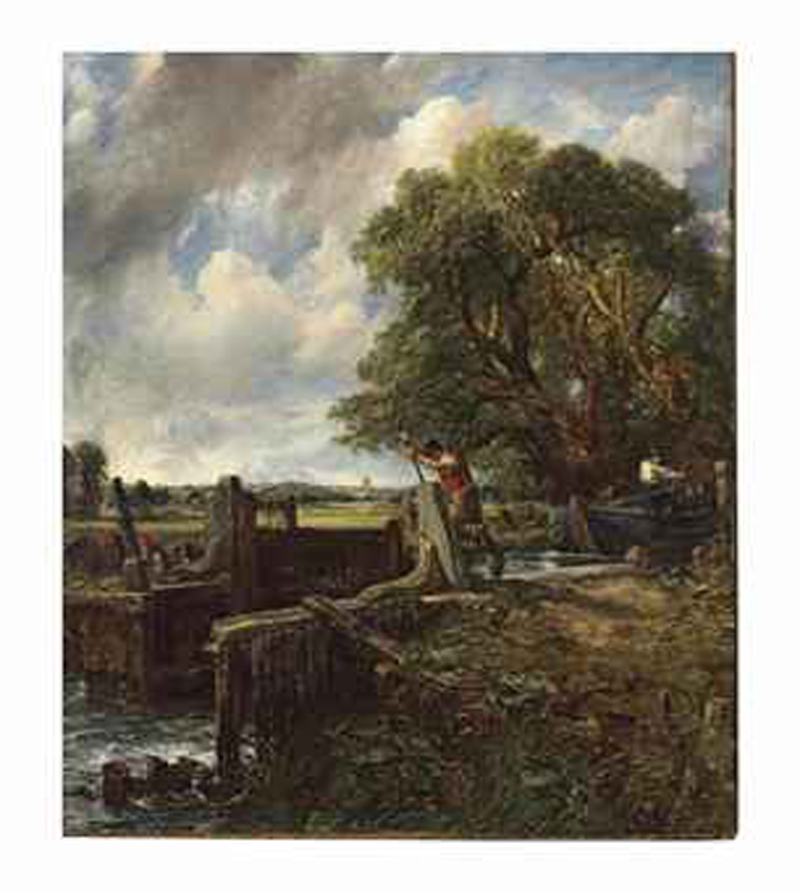
    Today John Constable’s The Lock, painted in 1824, sold at Christie’s for £22.4 million. In the current art market of silly prices some lucky person got the bargain of their lives. Let us hope the picture will be placed in a museum, where people might enjoy it, instead of disappearing into a Swiss warehouse as the investment bauble of some gold-tap billionaire vulgarian. It is the same price as that commanded by ordinary works by the top price sellers in British painting, Turner and Bacon, both of whom have sold work for significantly higher amounts than this. It is the same price a collector might pay for an off-the-peg Monet one wouldn’t inflict even on an enemy. The Lock, being one of the six major works deliberately painted by the artist between 1819 and 1825 for the Royal Academy exhibition in order to cement his reputation, presented the last opportunity for a collector to own one of the major works by the artist of the quintessential English landscape. All the other major pictures are already off the market in museums.

    Why so low a price? Of the top 50 most expensive paintings ever sold either privately or at auction only five are Old Masters, and of the remaining 45 ten are by Picasso, seven by Van Gogh and four by Warhol. The new billionaires, who are not old fashioned men of discernment and discrimination but those who buy conspicuously in order to impress friends, are uninterested in works not instantly recognisable for their “wall power”. Even the most knuckle-dragging mate of a Russian oligarch can recognize Warhol or Picasso but they wouldn’t know a Constable from a concertina and couldn’t recognise anything before 1850, all brown paintings looking alike to them.

    Who bought it? Assuming that The Lock is too sophisticated a picture for nouveau squillionaires, the only two museums in the market at this kind of price are the Getty in California, which two years ago paid £29 million for a Turner view of Rome, and the museum being built from scratch by the Qatari royal family, who are hotly rumoured to have bought the record-breaking The Scream by Munch a couple of months ago. No British gallery could afford a square centimetre of such a work, not that our museums actually need any more examples from Constable’s brush. For example, on the day of The Lock’s sale the Tate, which owns 261 works by the Suffolk miller’s boy, had 13 works on display. It always likes to keep plenty in reserve. There were more works by Constable on show at the Victoria and Albert Museum than at the Tate – the V&A owns 802 items relating to the artist including the full-size oil sketch for the Hay Wain. The National Gallery has nine works by Constable, all of them on display every day of the week free of charge.

    “Painting,” wrote Constable, “is but another word for feeling.”

    David Lee

    The Jackdaw, 3 July 2012

    http://www.bbc.co.uk/news/entertainment-arts-18702667