Tag: Tracey Emin

  • Charles Thomson: Lies, Damned Lies and Serota at the BBC

    Sir Nicholas Serota, director of the Tate Gallery, has used the platform of the BBC in a blatant attempt to deceive the nation. Either that or he is genuinely deluded himself. Both options render him unfit for major public office.

    He was confronted on Radio 4 programme The Reunion: Tate Modern on September 23rd by Sue MacGregor, regarding the Tate’s purchase in 2005 of its trustee Chris Ofili’s work The Upper Room. She observed with wry understatement, “The Charity Commission said you didn’t quite follow the rules here.”

    In 2006, as the BBC then reported, Charity Commission chief executive Andrew Hind said there were “serious shortcomings … In any charity we would be concerned that such basic matters were neglected, but in a charity of the size and stature of the Tate we are very disappointed.”

    The Guardian expounded, “The Tate has broken the law … By law, trustees cannot receive monetary benefit from their charity without express permission, usually from the commission. The Tate failed to seek permission … The Charity Commission’s full recommendations and criticisms, laid out in a lengthy document, also said the Tate failed to manage conflicts of interest … Failed to seek independent valuation of works by artist-trustees … Had no defined policy relating to purchases from artist-trustees … Had insufficiently clear acquisition policies … Kept insufficient records of trustee meetings.”

    The Daily Telegraph called this verdict “one of the most serious indictments of the running of one of the nation’s major cultural institutions in living memory”.

    “After an in-depth review lasting ten months by the Commission”, stated The Times, Serota “accepted the criticisms” and “was genuinely contrite”. The Evening Standard confirmed, “Sir Nicholas said today he accepted all the Charity Commission’s findings”.

    In stark contrast, his response to Sue Macgregor ten years later was an astonishing and shameless attempt to hoodwink the nation and evade blame with a trivialising revisionism that implied gross misconduct by the Charity Commission. To the supportive laughter of his entourage on the programme, Serota declared smoothly – as if it were established fact – the evasive nonsense, “The rules of course were invented after we had flouted them.”

    Serota has a history of obfuscation, whether lies, half-truths, delusions, evasions or omissions. In 2004, he applied for a grant from the Art Fund towards the purchase of The Upper Room. He signed a form saying that there had been no prior commitment to the purchase of the work (a condition of funding). Thanks to journalist Chris Hastings and the Freedom of Information Act, it was revealed that, eight months prior to the application, the Tate had paid a £250,000 deposit. Serota blamed it on “a failing in my head”.

    In 2005, I was quoted in The Observer: “Serota, as the director, chooses the trustees, and the trustees are then responsible for reappointing the director. The director then buys the trustees’ work.” In 2008, this was brought up in Varsity (the Cambridge Student Newspaper), where Serota defended himself with another flagrant falsehood: “I don’t have any part to play in their appointment.”

    The September 2005 Tate board minutes state: “The Director [Serota] reported that two strong candidates were to be interviewed for the position of Artist Trustee by a panel comprising himself, Paul Myners and the Independent Assessor.” In the May 2007 minutes, another trustee interview is on record with a panel of three trustees, the independent assessor and Serota.

    The Board of Trustees of the Tate Gallery Annual Accounts 2005-2006, 2006-2007, 2007-2008, and 2008-2009 all say in the section on trustees: “The key stages of the appointment are overseen by a panel, which will normally include the Director.”

    Also in Varsity, Serota said about the trustees, “Why would I want to win their support?” The simple answer to that is that he is their employee, as he explained in 1993 in the Independent on Sunday, when he hoped to be appointed for a second seven-year term as Tate Director: “Tate trustees fall in and out of love with their director and I’ll only discover whether they have fallen out of love with me in 1995 when they discuss my contract … The jury’s out.”

    On the Radio 4 programme, MacGregor confronted Serota about an event in October 2003 that became public the following year, namely “that Charles Saatchi offered you his entire collection … it was worth 200 million – for nothing.” Serota denied this: “I wish he had … he did have a great collection. Sadly he never did offer it to us.”

    This response is consistent with Serota’s version to the press in 2004, when he said that Saatchi’s offer was not for a gift but for a loan of work, which he (Serota) immediately rejected (none of which was mentioned to MacGregor).

    Surprisingly, Serota’s reply was immediately contradicted on the programme by former Tate trustee, Michael Craig-Martin, who admitted there had in fact been an offer of work: “Unfortunately what was offered to the Tate was not the great collection with the great things in it, most of which were already gone by that time. They had been sold by that time.”


    As it happens, that is incorrect. At the time of the offer in 2003, Saatchi still had in his collection iconic Brit art works, including Damien Hirst’s shark, Tracey Emin’s bed, Rachel Whiteread’s plaster cast of a room, Mark Quinn’s head made from frozen blood, Sarah Lucas’s table with two fried eggs and a kebab, Marcus Harvey’s Myra Hindley painting with children’s hand prints, Ron Mueck’s sculpture of his dead father, the Chapman’s penis-nosed mannequins and Chris Ofili’s Virgin Mary painting with elephant dung.

    Serota continued about Saatchi: “Michael [Craig-Martin] and I with Janet De Botton spent a great deal of time in the late nineties trying to persuade him to give, not his collection, but maybe ten works from his collection as a founding collection for Tate Modern. But I’m afraid he didn’t feel for one reason or another able to do that.”

    This is obviously another failing in Serota’s head. In 2004, the Evening Standard reported that in 1998, “Saatchi offered 86 works by 57 British artists – including Langlands & Bell, Turner Prize winner Martin Creed and Glenn Brown” (as well as Richard Billingham, Richard Wilson and Chantal Joffé). A Tate spokeswoman confirmed the offer of 86 works, which were rejected as “The trustees felt on this occasion the works would be better suited in a collection elsewhere.”

    Regarding The Upper Room scandal, Christopher McCall QC wrote to the press in 2005 condemning “expediency … which has an appeal to an overbearing executive”. The Times said of the Tate: “If it had been a company, the verdict would have sent shareholders into a panic.” No doubt if it had been a government, resignations or sackings would have followed the public outcry. Surely we have the right to expect the same standards across the board in public life, including the arts.

    Serota has not displayed a level of behaviour and integrity to remain a figurehead and step into another prime position as Chairman of the Arts Council. His record is tarnished and far from admitting to his mistakes, he has the blinkered arrogance to pretend they never happened.

    We need leaders who do not have recurrent failings in their head.

    Charles Thomson
    The Jackdaw
  • Laura Gascoigne: Tangled Web – September 2017

    “Why is there so much sewing?” demanded The Art Newspaper’s Christina Ruiz after visiting Christine Macel’s exhibition at this year’s Venice Biennale. “I get it: domestic work, women’s work, is important and undervalued. But is it in itself art? No it is not.”

    There was a time when so-called textile arts were prized above all others; when first unveiled in 1519, Raphael’s tapestries for the Sistine Chapel threatened to eclipse the fame of Michelangelo’s ceiling. But in the 18th century tapestry began to feel fusty as audiences warmed to the immediacy of paint. A work’s value no longer resided in the price of the wool, the skill of the weavers, the total hours spent in production and associated cost, but in the artist’s touch, the signature of authenticity that connected audiences with the creator of the work, usually male.

    In the 1980s, when Rozsika Parker wrote The Subversive Stitch, she pinpointed “the separation of the craft of embroidery from the fine arts” as “a major force in the marginalisation of women’s work”. But on the coattails of conceptualism, ‘women’s work’ has come back from the margins. Since the personal signature of the pen or brush fell under suspicion the needle has returned, not always in the hands of women. While the women are bent over their embroidery frames, the men are stealing the limelight, à la Raphael, with tapestries woven by others to their designs. Chris Ofili’s Weaving Magic has just been the focus of an exhibition at the National Gallery, and there are more tapestries than pots in Grayson Perry’s The Most Popular Art Exhibition Ever! at the Serpentine Gallery (until September 10th).

    If Hockney wants to keep his place as top national treasure, he’d better put down his iPad and pick up a needle. Tapestry, embroidery, knitting, crocheting are all back in the frame and proving highly popular with a public tired of the self-conscious cack-handedness of so much contemporary art. This is art like granny used to make, sweet as apple pie and absolved of the obligation to be serious. From Vidya Gastaldon & Jean-Michel Wicker’s knitted octopus, titled Sex Is Good (1999), shown in Tate St Ives 2013 exhibition Aquatopia to Shauna Richardson’s three 9m lions, crocheted from 36 miles of Swaledale wool and displayed in a glass cage at Twycross Zoo in 2012 as part of the Cultural Olympiad, it’s all a bit of folksy fun.

    Naturally, education departments love it. Imagine the jollity at The Exchange in Newlyn in 2010 when artist Jonty Lees donned a Montgolfier flying helmet and goggles to lead a sewing circle and basket-weaving group in the construction of a full-size hot air balloon. The following year the Science Museum went one better and got participants in its Stitched Science weekend to create an entire Solar System Art Installation from ‘various fibre arts’. True, the results looked a bit of a mess, but sew what? Fibre arts have therapeutic benefits. According to the organisers of the Crafts Council’s ‘cinema knit-along events’ in 2012, “knitting has been proven to enhance cognitive development in children, and well-being in both children and adults.” Sew there.

    It’s not all child’s play: serious issues can be addressed with needles. ‘Political statement knits’ by Lisa Anne Auerbach were a highlight of Wasteland, an exhibition of young Los Angelino artists at the Mona Bismarck American Centre in Paris last year. More ambitiously, at the Minories Gallery, Colchester in 2015 Clare Sams’s installation Knitting Fever recreated the devastation caused by the 2009 floods when a wool shop of that name in Cockermouth spilled its guts through the Cumbrian town. The gallery complimented the artist on using a process “stereotypically viewed as a feminine past-time [sic]” to represent “cataclysmic forces not normally associated with the practice”. Sams’ ‘total knitted environment’ looked a little twee for a cataclysm – acts of God produce more dramatic results than needlework – but she wasn’t going to let that stop her, having already knitted her way through the Hackney Riots and Guantanamo Bay. No knit-wit she.

    Other artist-knitters are not so outward-looking or gender-neutral in their choice of subjects. Given the vogue for ‘bedroom painting’, bedroom knitting was almost bound to follow and, sure enough, in 2012 the Polish-born New Yorker Agata Olek transformed Tony’s Gallery in Brick Lane into a crocheted replica of her boudoir, with walls and floor emblazoned with explicit texts from former lovers. “It is not just another apartment installation,” she assured Metro, “it is the reflection of life, love, trust and lust in current time.” Its tear-jerking title I do not expect to be a mother but I do expect to die alone was a quote from, you’ve guessed it, the queen of the misery stitchers, Tracey Emin. But no artist has taken intimate needlework quite so far as Casey Jenkins in her 2013 performance Casting Off My Womb, in which she knitted a menstrual cycle-length scarf from skeins of wool secreted in her fanny. The work, she told The Guardian, was “primarily about casting off the need for validation from external sources” and “forging a path of self-determination in the face of society’s expectations”.

    Maria Balshaw would say aye to that. Unlike Christina Ruiz, she congratulated Venice Biennale curator Christine Macel in The Art Newspaper on doing “a really good job in challenging some of the gender stereotypes around textiles,” singling out male artist David Medalla for praise for his participatory work A Stitch in Time, first shown in 1968. Medalla’s early lead in removing the sexual stigma from stitching may have laid the ground for the Crafts Council’s 2004 exhibition Boys Who Sew, at which Fernando Penteado established the butch credentials of needlework with a display of samplers embroidered by tattooed inmates of Wandsworth Prison. Since then the social enterprise Fine Cell Work has climbed on the prison wagon and trained 300 prisoners in 20 gaols to spend their lock-up time productively embroidering cushion covers. There’s precious little bunce in it for the lags, but more job satisfaction than stitching mailbags.

    It’s no discovery that men are nimble-fingered (not a lot of people know this, but the young Malevich upset his father with his unhealthy aptitude for Ukrainian cross-stitch). The danger for women of challenging gender stereotypes around textiles is that male artists will seize the initiative. Not content with getting tapestries woven to their designs, brothers are doing it for themselves. In Art Now at Tate Britain in 2010 Andy Holden showed The Pyramid Piece, a 10ft-high knitted replica of a chip off the Great Pyramid of Cheops that he had illegally smuggled home from a family holiday to Egypt at the age of 12. Along with its benefits for cognitive development, knitting is obviously a good way of assuaging guilt.

    The main drawback of needlework, for unreconstructed individualists, is its inflexibility as a means of expression, which is why most attempts to employ it as one, Tracey Emin’s included, have been sew-so. The notable exception is Mr and Mrs Pope, Knitted, Shrunk and Hung (2012), a truly heart-wringing piece of work that – sorry girls! – was created by a male sculptor, Nicholas Pope, with his own fair hands.

    Laura Gascoigne
    The Jackdaw Sept/Oct 2017

  • Laura Gascoigne: Tainted by Experience – March 2017

    When the former controller of BBC Radio 3 John Drummond published an autobiography in 2001, he called it ‘Tainted by Experience’ – an ironic reference to the reason given by a Birtist suit at the Beeb for his being ‘let go’ a decade earlier. I haven’t read the book, but the expression was used by William Varley in a positive sense to describe a group of mature artists showing at Northumbria University Gallery in 2011, and it stuck in my mind. As it happens, Northumbria University Gallery is now itself under new management since its director of 38 years’ standing, Mara Helen Wood, was ‘let go’ by the university executive for being similarly ‘T by E’, as reported by Varley on these pages last year.

    Following the revolt of ‘the people’ against ‘the experts’ currently convulsing western democracies, we face the prospect – daunting or exhilarating, depending which side of the populist fence you’re on – of an expert-free future. If this is a revolution, as some people seem to think, then post-modern art has long been in its vanguard. Ever since Marcel Duchamp (or Baroness Elsa von Freytag-Loringhoven, take your pick) pissed on the art experts with Fountain in 1917, expertise in art has been a dirty word. This causes particular problems for avant-garde painters, since paint, unlike sanitary ware, is an impressionable substance that too readily absorbs the taint of experience. As a measure of contemporary artists’ desperation, an exhibition of young Canadian painters at Pippy Houldsworth in 2008 was titled Learned Helplessness.

    The fashion for bedroom painting, currently running in tandem with the fashion for lumber-room sculpture, appears to support Joseph Beuys’ egalitarian philosophy that “everyone is an artist”. Technique is not the only casualty of this ostensible democratisation; knowledge of art history is another victim. In Elizabeth Fullerton’s Artrage: The Inside Story of the Britart Revolution, Liam Gillick says of his Goldsmiths generation: “We didn’t sit around talking about El Greco… It’s as if we started without any history”. The blanking of history was about more than democratisation; it was a bid by ambitious young artists to turn over a clean sheet and astonish the world with the newness of their art.

    Fifteen years after Gillick was nominated for the Turner Prize, the world is still waiting. As previous nominee Tracey Emin rightly predicted: “You’ll never get a fucking radical winning the fucking Turner Prize”. The reason is that the sheet was never clean. It wasn’t true that the yBas started without any history; they just started with a lot less of it. They referred, deferred even, to history as reverently as the German Expressionists who copied El Greco; the difference was that they refused to look further back than Duchamp. And so, in the place of newness, we got repetition. Those who fish for ideas in a small art historical pond are bound to keep catching the same old fish others have put back. I’m in perfect agreement with Roland Barthes’ claim in The Death of the Author that there’s no such thing as original creation since we all draw on a “ready-formed dictionary”, but it follows that the shorter the dictionary, the more restricted the creative scope.

    Last year’s Turner Prize exhibition was admittedly an improvement, but it has long felt as if the jury is operating a points system whereby nominees are awarded marks for every reference to a post-modern forbear. Rather than democratising contemporary art, this sort of specialist reference-spotting is as much a game for an art-educated elite as identifying classical allusions once was for a cultivated audience of Renaissance humanists. What it produces is elitism on the cheap, shorn of the technical skill and aesthetic pleasure that made Renaissance art enjoyable by all audiences, educated or not. It’s an elitism dressed in sloppy paint and everyday detritus whose learned helplessness is about as convincing as Marie Antoinette’s attempt to pass for a milkmaid.

    The perception that the non-expert is in charge was always as false in art as it now is in politics. The grim reality of our post-truth era is that people tainted by experience in all walks of life are being cleansed from positions of influence to make way for managers. The days of class war may be formally over, but the days of management class war are just beginning. Everywhere the tainted by experience are being pushed aside to make way for management apparatchiks parachuted in to impose blue skies thinking on areas of life in which they are blissfully innocent of expertise. Before Nicky Morgan’s Academy Schools programme hit the Brexit buffers, even parent governors – the original exemplars of taint by experience – were under threat of replacement by professionals with “the right skills”.

    Has anything good ever fallen out of a blue sky? In Waziristan blue skies merely increase the probability of a drone-fired Predator missile landing on your wedding party. The public has been comprehensively duped into directing its ire against ‘experts’ and ‘elites’, when it’s managers who should be in the firing line. Elites don’t always wield power, nor are they necessarily any better off than the Maybot’s JAMs. Art history may be such a specialist subject that the AQA exam board wanted to drop it from its A-level syllabus, but your average art historian is almost tragically lacking in influence and generally about as poor as a church mouse – ditto your average university lecturer or research scientist. The only elite with clout is the managerial one that has got us into the mess we’re currently in, and can be counted on to fail to get us out.

    The battle for elitist art history has been won, for now, and museum directors remain one of the few classes of managers with specialist knowledge and experience in their fields. But the management ideologues are already circling. The Culture White Paper drawn up by Ed Vaizey a year ago announced, on the subject of museums: “We want to ensure that they are as best placed as they can be to continue supporting our aspirations for access, place-making [no, me neither] and soft power.” As if this wasn’t sinister enough, it proposed the creation of a “Commercial Academy for Culture to improve and spread commercial expertise in the cultural sectors.” No mention of improving knowledge.

    In an interview in the Guardian last September, James Flynn – the veteran American academic who revolutionised our understanding of human intelligence by demonstrating that environment is the dominant influence on IQ – was asked how, given the steady global rise in average IQ scores since the 1930s, Americans could have elected Donald Trump as President. His explanation was that “the rise of visual culture means far fewer people read serious novels and history. They live in a bubble of the present, believing what they are told because they have nothing to position it against.”

    I agree about the ‘bubble of the present’, but I question his use of the term ‘visual culture’. It’s visual, yes, but is it culture? Culture doesn’t feed off the present, it grows on the past. Sever its connection to the past and culture dies, clearing the field for commercial expertise in the cultural sector.

    Laura Gascoigne
    The Jackdaw Mar/Apr 2017

  • Dick French: On The Town – July 2016

    Who now remembers the fashion for wearing your trousers backwards? It was all the rage in Camden Town about ten years ago. They had to be the very baggy “gangsta” variety. You rarely see it nowadays. So fashion changes… except in the Art World, which has been stagnant for fifty years.

    I’m looking forward to seeing the new film about Florence Foster Jenkins. It occurs to me that you could make a similar film about Tracey Emin, although there are some who claim to detect real merit in her produce. To paraphrase Boswell: “To think we are the dupes of a common strumpet.”

    To Davies Street to see the exhibition of large drawings by Jenny Saville. The man on the door wouldn’t let me in because the artist was being interviewed for the telly. “Come back in half an hour,” he said.

    It was pissing down and although I had an umbrella I was moistening sideways. I was tempted to give up and take the bus to Bradley’s when I noticed a pub at the top of the street. It’s to be avoided – £6.50 for a pint of nothing special.

    The Gagosian is completely glass-fronted and you can see most things from the street except smaller pictures in a rear gallery and an inner sanctum where the posh totty file their nails. I asked for a price list. “Which particular one are you interested in, Sir?” “I don’t want to buy one. I’m just curious.” “Oh, we can’t possibly divulge that kind of information to the general public.” I bet they can’t.

    Saville can certainly draw. There are some beautifully rendered hands, but she still hasn’t learned to “kill her babies”, as they say in scriptwriting. So what you get is a palimpsest, a collection of “good bits”. Or is she just trying to make them look more “artistic”, as I feel she was doing years ago by embellishing her nudes with diagrams.

    Muse on a Stool I liked. A single image, great knees … but generally there was too much fudging and smudging. I wonder if she ever saw the drawings of the Carracci brothers which were on show at the National Gallery in ’96, The Loves of the Gods. Large scale drawings are rare. In the old days they were pricked through and blown with charcoal in preparation for the finished work, and then perhaps discarded. The Carracci drawings were beautifully restored and are far superior to the finished frescoes in the Farnese Gallery in Rome. This is often the case, as Delacroix was always pointing out.

    Nowadays the ability to draw is often referred to as ‘mere facility’. It’s good to see that Savile’s pushed on without abandoning her natural talent. I admire her work while at the same time feeling a bit sorry for her. It must be dreadful to be within the clutches of the Trump of the art world. I’d hate to be making money for that bastard, but then I’m so noble and we artists live for beauty alone, as Edward Burra so memorably said.

    Looking for an opportunity to vent my spleen I decided to have a look at the Koons exhibition at that cunning little peasant’s place. On the way I popped into the Salisbury and met Mrs Cravat and her daughter who reminded me that there was a one-day show of Bacon’s paintings on Lexington Street. A no-brainer, so we trolled up to Soho via the French. What a curious show it was. Scrappy things from the early ’50s to the ’80s. Beautifully framed, as always. The most unusual piece was an army of stick men marching under the supervision of a giant polar bear or shaggy dog. Mrs C’s daughter thought it looked like a giant tooth and called it a ‘molar bear’.

    There were some nicely observed cornadas, or matador’s wounds, which usually occur in the groin or upper thigh, giving Bacon an opportunity for some soft focus pricks. He’s good at them. As always with late Bacon the canvases were unsuitably large for the motif.

    I’m still an admirer but I wish he’d packed it in around the late ’60s. I suppose it’s difficult when people are chucking money at you. My favourite Bacon has always been what is called The Guggenheim Triptych of 1962. I’ll never forget the last time I saw it reproduced in a Sunday Times colour supplement. I’d never seen or felt anything like it and I can still look at it with complete fascination.

    In the later works he doesn’t seem to have a clue. There’s even a sense of desperation … all that silly letraset, the arrows and the habitual spunk shot to finish off. And what about the cricket pads?

    The most important thing about Bacon was that he occasionally produced work of enormous interest over a period of four decades. Most artists manage about ten years and then go into full production. A young chap in Bradley’s recently asked me if I was retired. I explained to him that I was an artist and artists never retire, they just get worse and worse without noticing.

    These ‘Pop Up’ shows are becoming all the rage. I recently took part in one on Old Queen Street (!). It was well presented in a large office block. Invitation only or £25 at the door. There were lots of exotic cocktails and the food was excellent ‘for them as likes eating’. It was only on for one night and nobody sold anything. Caspar Hornack, one of the organisers, paid me an enormous compliment.

    “Dick”, he asked, “did you ever go to art school?” So it was worth it.

    From Haydon’s Diaries: “Sir Joshua used to say that there was nothing more injurious than the pursuit of health. What are the consequences of following books on health? You find you have been doing wrong all your life. You must break up the habits of fifty years and live the remaining twenty in vain longings, which must not be gratified according to your new system, and in all probability you die at the end of ten because you have been undoing all that brought you to fifty.”

    Haydon was always campaigning for state assistance for art. If only he’d known where it would lead. Be careful what you wish for. Like Bacon, Haydon was a sporadically brilliant artist, suffering bouts of crippling insanity made worse by being out of his time. “The nipple should always be a little above the centre. In Rubens and common nature it is below, which gives a flabby, infirm look.” How true that is, how very true.

    A walk through Hyde Park. I was on my way to the Serpentine to see paintings by Alex Katz, who is highly regarded in America for some reason. I’ve only ever seen one in the life, at the NPG. It was of that fashion woman with a helmet on. Dreadful. It was a Monday and the gallery was closed so I walked along the lake. I remembered the Rolling Stones concert in 1969, and I thought of Pete Brown and his Battered Ornaments, possibly the worst band I’ve ever heard. At college we often used to take the afternoon off and go boating. I always think the best work is done in the mornings.

    There’s a swimming area on the Serpentine cordoned off by a floating barrier. I was once rowing down with an old friend when a girl ducked under the barrier and swam up to our boat. She was wearing a yellow bikini. After chatting for a while as she clung on to the side, she hauled herself out of the water and into the boat. Her top came down, as I’m sure she knew it would – it was 1969. She told us about her life as the ‘kept woman’ of what she called a ‘sugar daddy’. At night she worked as a bunny girl in the Playboy Club. We pulled into the bank under a weeping willow. It’s not easy in a rowing boat. Is this beginning to sound like Tape’s Last Krapp?

    It seems I’ve been thwarted twice to see two of the most “banal, trite and meretricious” artists of all time. I got that expression from a Temperance Seven programme around 1962. It comes in handy from time to time. I was just reading that “Whispering” Pete McDowell had died. He was their vocalist and always sang through a megaphone.

    It’s an expression that could usefully apply to this year’s RA Summer Exhibition. Out of 1,240 exhibits I liked two of them, a beautiful small Bernard Dunstan and a curious metal rocket called Woodburner by Guy Allott. Andrew McIntosh’s caravan was all right and Anthony Eyton was well worth looking at. There were two execrable prints by Biffa Bacon’s mother at £1,100 each, in editions of 100. What can you do with a deluded creature like that? The purpose of a drawing is to define form and suggest space, both of which are extremely difficult. Her drawings do neither of these things.

    And I think that Anselm Kiefer is rather a pompous little man. Trademark stuff, although I liked his rusty submarines last year.

    Few voices are raised at the parlous state of the art world. I can’t understand it. As Philip Larkin wrote: “Why aren’t they screaming?”

    Dick French

    The Jackdaw Jul/Aug 2016

  • Margate Express on Central Line

    Margate Express on Central Line

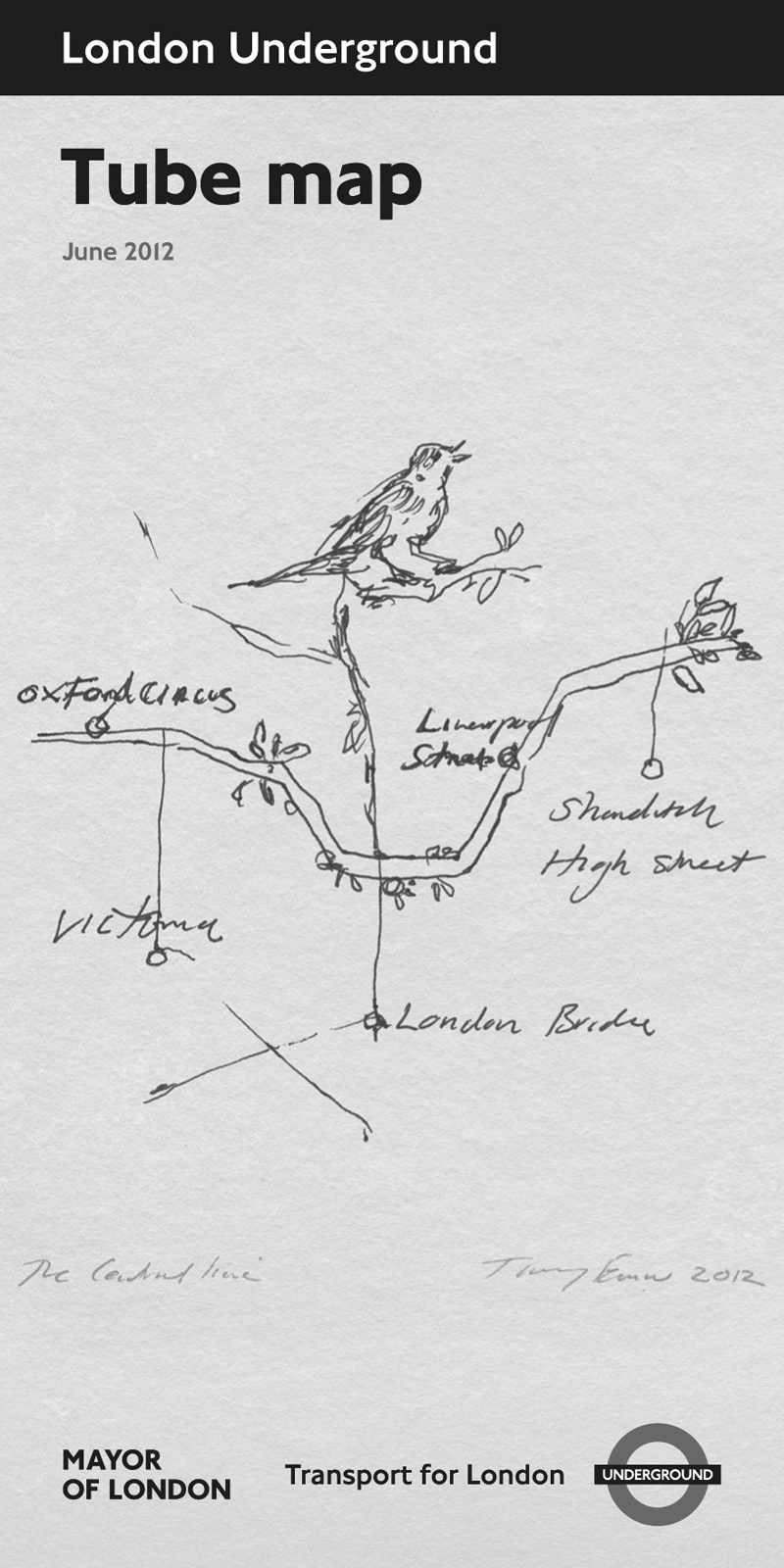
    The latest masterpiece from the Professor of Drawing is the cover for the tube map. She does a fair warbler with its beak open and trots it out at regular intervals. “When in doubt scribble a bird with its beak open,” advised the Prof as she stepped down from the Margate Express. It was commissioned for a special map to be handed out during the Olympics so that all the foreign visitors will be overwhelmed by the wealth of artistic talent in our country. Said the mayor of London, whose brilliant idea it was to approach the Professor: “How appropriate it is that our Olympic map should echo the advice of the mighty Apelles who drew birds as symbols of an athlete’s freedom of spirit.” Meanwhile, the willing idiot in charge of art on the underground spewed out what she always says when a new map is published: “The artwork presents a moving and unique interpretation of the capital.” Mrs Margi Doonham of Nottingham, who was up the smoke bargain-hunting for suicide potions, said after studying her map that she knew a disabled artist who could draw a better bird holding the pencil up his arse.

    She likes birds does the Margate Express – and every one a masterpiece. Some years ago we reported on her sculpture outside the Anglican Cathedral in Liverpool. It was sixty grand’s worth (courtesy of the BBC who for some reason paid for it) of tiny bird on a pole which some unimpressed scouser promptly sawed off. It was found nearby in a jiffy bag and reattached, following which it was nicked again. We are unsure of its current status, but do let us know if you are privy to information.

    David Lee

    The Jackdaw June 2012

  • One for the Royal Collection

    One for the Royal Collection

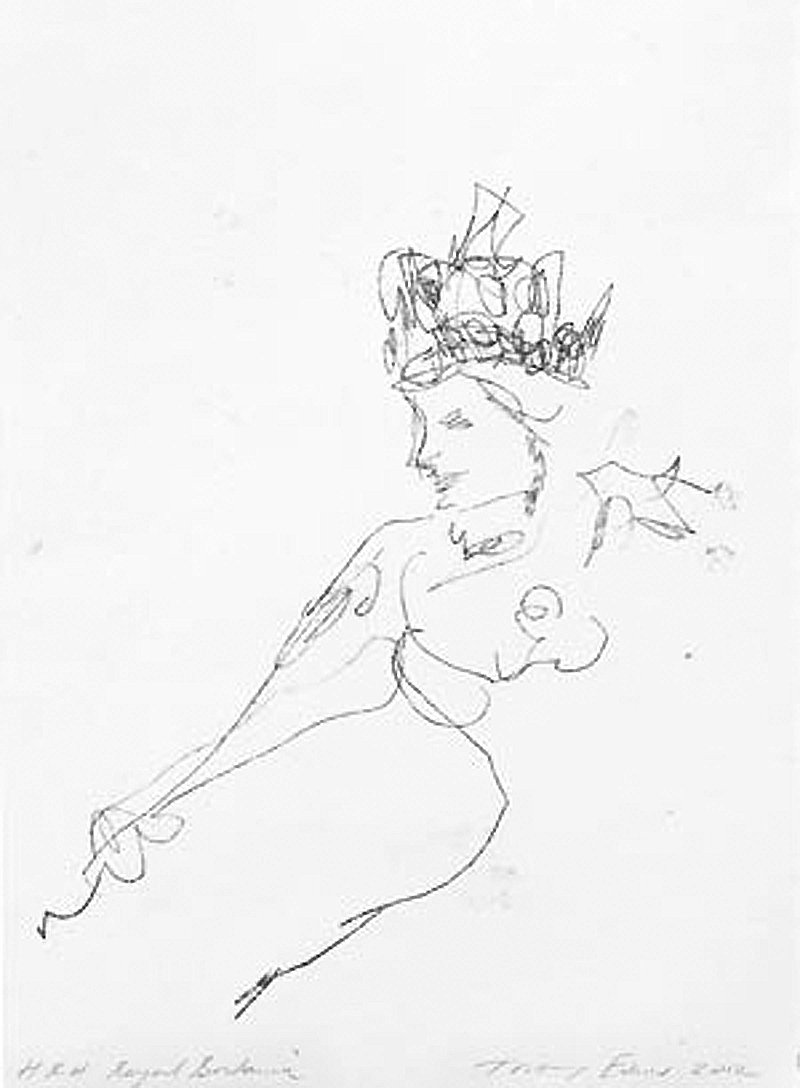
    It’s the headgear that does it. Gives it away completely. Without it you’d be none the wiser. But the miner’s lamp makes it beyond any doubt. This is the Professor of Drawing at work on her most important finished presentation piece yet, a celebration of the Wigan pit girls of the 19th century. Such economy of line, every mark counts, each and every one assertive, the impact one of dedication and duty, such superb proportion and foreshortening. It’s as though she was born to draw. So exact is its depiction you could have that miner’s lamp made by an artisan in an afternoon. Every detail is there. Likewise the smock. What seamstress couldn’t run up that durable uniform. She looked exhaustively at hundreds of photographs of pit girls in order to get the portrayal just so. Another triumph for the professor. “People have forgotten how hard these girls worked for a living wage what kept em in grinding poverty,” said the Professor in expansive mode. “They got a lot of stick for being manual but they were amazingly hard working and very glamorous,” she added.

    The pit girl is included in the latest exhibition put on by the professor – she has not after all enjoyed a show of recent work for upwards of six weeks. The new exhibition is in her home town, Margate, which is said to be reborn as a result of its association with her. “She is good for the town,” said Mrs Margi Doonham of Nottingham. “The cake shop has never been busier. And there’s more condoms in bus shelters than ever before. It’s as though the 1950s are back again with crowds piling in on Bank Holiday specials. Long live the Professor. She’ll be Dame Professor soon, and why not?”

    David Lee

    The Jackdaw June 2012

  • The RA summer show in record time

    The RA summer show in record time

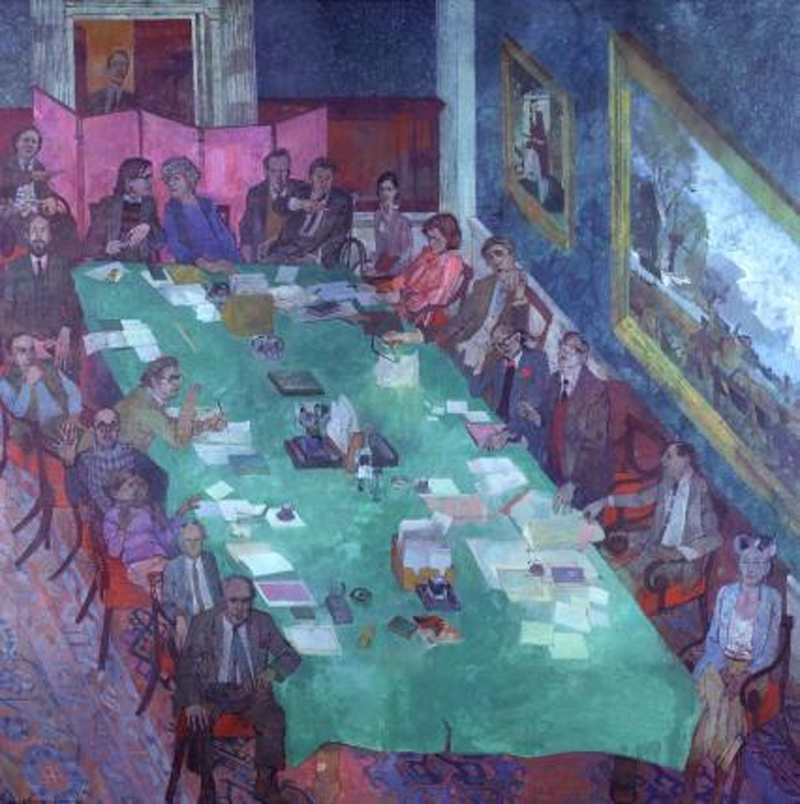
    The Meeting, Royal Academy of Arts by Leonard Rosoman

    Out of respect for one of its recently deceased Academicians, Leonard Rosomon (1913– 2012), the Royal Academy skied one of his best works in the corner of an obscure gallery at this year’s Summer Exhibition (until August 12th). His Committee Meeting, Royal Academy (above), 1979-1984, was on loan from the National Portrait Gallery, where it has probably never been on display. We have in England scores of public galleries and yet is there one with a curator who has the wit to stage a retrospective exhibition of a senior artist like Rosomon? Probably not. For those with an eye on State Art advancement there is no career mileage in such a show, in fact it would probably end any hope of serious preferment. Yet in the last two years alone Tracey Emin, represented in this exhibition by childish scribbles unworthy of even the fridge door, has had three major exhibitions in public galleries. State Art needs a clear-out and re-staffing with individual thinkers.

    Everything in Burlington House this year seemed even more dense and off-putting on the wall than usual, so The Jackdaw’s representative allocated one second on average to each of the 1,474 works before heading off elsewhere in search of art which looked as though it was loved by someone enough to hang it sensitively.

    Highlights spotted at speed were a bold Kiefer and a powerful portrait maquette of footballer Stan Cullis by James Butler, the quality of whose modelling always stands out even when exhibited in sculpture galleries more akin to a jumble sale than an exhibition of serious art. One sculptor phoned the Jackdaw to remonstrate at this shocking treatment and said he would not have allowed his work to be exhibited so contemptuously. Another wrote a despairing unsigned letter saying that the atrocious hanging of the sculpture was no better than most of the trash selected deserved. Everyone else was represented by the stuff they are usually represented by. There will undoubtedly have been other good work hidden away but life’s too short to search it out among such mountains of amateurish material.

    Ah, one interesting development was the removal of the small pictures from the far end into the largest gallery. The irony in this was that the vacated gallery was then used to show one work instead of 250. It was a video of someone scraping out “a modern piece for cello”, of the sort one walks straight past in the Tate. Played this crap by torturers you’d be singing like Placido Domingo inside three seconds, telling them your grandmother was Osama bin Laden’s loyal lieutenant in Eccles.

    Robert Graves
    Epitaph on an Unfortunate Artist

    He found a formula for drawing comic rabbits:
    This formula for drawing comic rabbits paid,
    So in the end he could not change the tragic habits
    This formula for drawing comic rabbits made.

    David Lee

    The Jackdaw June 2012