Tag: Moping Owl
-
Moping Owl: Club Feat
Oh dear. I had expected to be out and about again by now, as did we all, even if it did mean wearing the mask and keeping one’s distance, and hardly daring to look at anyone, let alone breathe. But no: here we all still are, stuck at home and doing as we’re told, good boys and girls to a man, or woman as the case may be – though it’s becoming increasingly hard to tell which is which in these confusing self-identificarious times. And to make life ever more troublesome than it needs to be, there then follows the awkward business, taken with all due care and consideration for the feelings of others – a natural civil duty and obligation after all – of wondering on the most meagre of evidence if we are dealing with a truly delicate plant, a manifest lunatic, or a joke. People do take such offence at the slightest and most innocent provocation, whether imagined or contrived, don’t you find, and we don’t want to end up at the bottom of the river like that lump of old bronze.
At least that genial if tiresome national treasure, Sir (it can’t be long) Cynthia Puppy RA, potter to the stars, doesn’t put us to that trouble. We know perfectly well where we are with him, usually that state of mild embarrassment as when the joke falls flat, yet again. But at least when he’s on the television he seems to prefer to leave his frock in the wardrobe and ankle socks in the drawer. He’s been on it quite a bit lately, supposedly to keep our spirits up amidst the gloom, and he seems somewhat less colourful too so far as I can tell, watching in black and white as I do – a Sony 9†portable c. 1970 since you ask, which I have to give a shake from time to time to get a picture: I mislaid the aerial long ago. And without the Alice Band his hair is rather floppier, and much longer too. I’m surprised Mrs Cynthia, who has been appearing with him on the programme, hasn’t picked up the pudding bowl and given him a trim. She does her own hair, perhaps in the same way, rather fetchingly in grey and white stripes, like a badger, very neat.
Where was I? Oh yes, the programme. It was called Cynthia’s Art Club (I speak from fading memory) in which under his eponymous direction the viewer of every hue and cry, talent, description and proclivity, was encouraged to produce what he, and I fear you and I too, moving with the times as we must, would call an ‘artwork’ on the set theme of the week, safe in the understanding, since we are all artists now, that art wouldn’t come into it.
And so it came to pass that every Tom, Dick and Harriet, Sharon, Jim and Wayne, not to mention Malik and Ramon down the road, nor forgetting old Dan Pearce out in the sticks, set to with a will with whatever was at hand or came to mind – macramé, finger-painting, applique, matchsticks, corks, wool, glue, pencils, coloured pencils, charcoal, ink, even paint: you name it. They then took a photo on the phone of said ‘artwork’, loosely fitting description as painting, drawing, print or sculpture, and pinged it off to Cynthia for adjudication in hope of being singled out for discussion on the programme and virtual exhibition (one Clare Warde’s effort, above).
Cynthia, meanwhile, had been far from idle, calling on both long experience and natural talent slowly to produce – for it had perforce to last the series – one of his pots-cum-sculpture, or sculpture-pots if you insist. It would, we were assured, come to signify and celebrate his experience of the lockdown and what it meant to him, or something like that. And we followed its progress as it grew, or sprouted might be the better word, episode by episode, into something rather more than just a pot or indeed common sculpture: something, how shall I say, more exotic, fetishistic, even organic, like a small triffid, or mutant cactus. And every so often Mrs Cynthia would potter in and say, “Ooh, that’s nice Dear. Yes that’s much better. It’s changed a bit, though, and what’s that chunk of metal doing? Oh, I see. Hmmmâ€. And then she’d potter off.
On the whole Cynthia’s Art Club was all rather charming, in an evening institute kind of way, and certainly very popular. But then art as therapy so often is. Let’s Fill this Town with Artists, as the old song goes. We’re all artists after all, aren’t we?
-
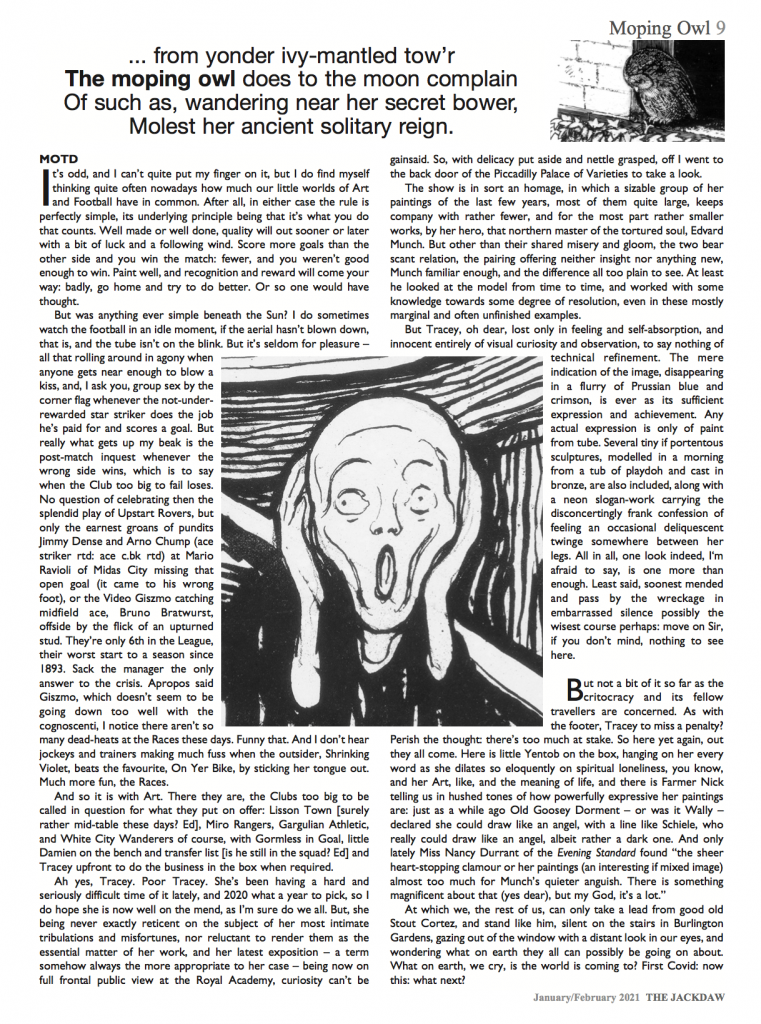
Moping Owl: Nem Con
Goodness knows we have more than enough to mope about these dark days, even without the current plague, what with the evenings drawing in and the weather on the turn, again. It seems to happen every year, Winter. Was it always like this, this cold, wet, windy, foggy, snowy thing, with a spot of flu thrown in for good measure? I blame Global Warming, or Climate Change as everyone now calls it, hedging their bets.
Of course the plague doesn’t help, especially at my age, and I can’t say I’m looking forward to being confined to barracks yet again, alone and warming my five wits as best I can in this draughty old belfry, to venture out only at risk of neighbourly denunciation by the horrid old crow next door, and possible debility and death. I know it’s for my own good and, if I didn’t, I know I’d soon be told so by lovely Fiona Gloom or sweet Sophie Despondency on the evening News. Get a grip they’d say, think of others, and do your bit of shielding, whatever that is.
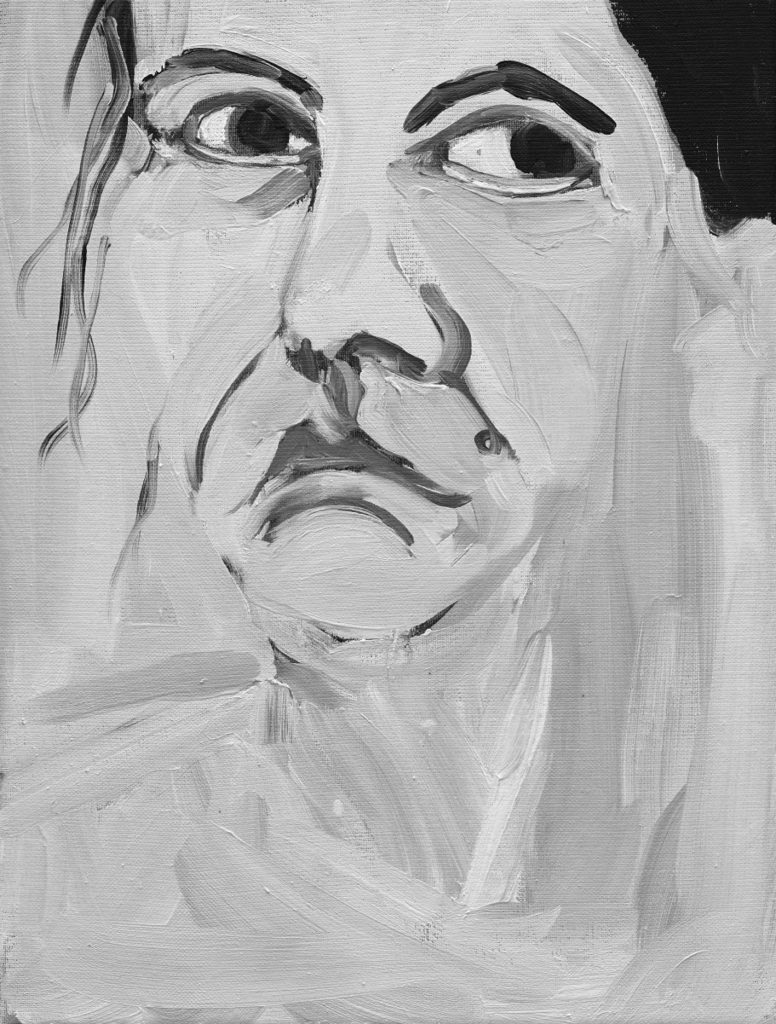
It is a public duty, I know. It makes me almost ashamed to mope at all, though only almost. But then life is strange, and rather wonderful too, and, blow me off my twig, what should happen but that Art appears, smack on cue, to take my mind off such selfish introspection and despair and give me, as I knew it would, something really worth moping about. And, just so, across the wire the message comes, Chantal Joffe (say no more, I hear you cry) is to have another show to follow the one she had, when was it now? – ah yes, the week before last. Gosh, how Time flies.
I’m not sure quite which is the more dispiriting. One can just about understand, though not necessarily forgive, a Barrow Boy, Spiv or Snake-oil Salesman for making a few bob flogging off dodgy goods. After all, there’s always been more than something of the back-street market to the art trade, good times or bad: caveat emptor and all that. And, again, who can really blame an artist for cashing in on a manifest lack of talent given half a chance. Take it while it’s going I say. After all, no one’s forced to buy the stuff.
So no: it’s not the chancers who make my very heart faint and my poor soul grieve so much as the fellow travellers, useful idiots, critics, administrators and curators and, not least, self-serving artists, who by their abandonment of critical judgement keep the whole sad charade on the road. Theirs is the greater betrayal. Trahison des clercs says it all.
I’ve nothing against Miss Joffe, who has shown all over the world, has works in pretty well every major collection, clearly can’t draw or paint to save her life, and is not all that bright if what follows is anything to go by. Along with her new paintings, the show, we’re told (wait for it), ‘premieres’ (no, don’t laugh) some pastel self-portraits (illustrated), about which she has this to say: “You can get a kind of brutality with pastel that you can’t with paint. With paint there’s always an extension of your arm and brush. Whereas pastel is so primitive. You can’t draw hard enough.†Well, I mean to say, I know we now see through a glass darkly but what on earth is all that about? I still feel quite dizzy, and I’ve only read it twice.
The show is called Story, and many of the paintings are of her mother. They consider, so Victoria Miro’s in-house hack helpfully informs us – chez whom the show of course takes place – “consider issues of aging, motherhood and invisibilityâ€, doubtless with profound conclusions drawn, albeit un-vouchsafed as yet. She brings a “combination of insight and integrity, as well as psychological and emotional force, to the genre of figurative artâ€: at which point I feel we should all take a deep breath and put our heads between our knees for minute or two. Whew. Figurative art a genre, eh? Roll over Rembrandt, Rubens, Velasquez what?
But on we plough: “Defined by its clarity, honesty and empathetic warmth (one can never have too much empathy) her work is attuned to our awareness as both observers and observed beings, apparently simple yet always questioning, complex and emotionally rich.†No, nor do I.
A book accompanies the show in which we find Olivia Laing, novelist and soi disant cultural critic, treading water somewhat, and not exactly waving: “Over the years, a kind of hardening takes place, a process of separation and individuation on both sides… The mother recedes inch by inch, becoming smaller and harder, emerging as a person with needs and sadnesses in her own right.†Receding and emerging, smaller and harder: I don’t like the sound of that. Let’s hope there’s a vaccine soon.
Back with the scribe, Chantal’s “is a deceptively casual brushstrokeâ€, though I’m not so sure that deceptive is quite the word: casual will do. “Her paintings only waveringly adhere to their source (yes: we can see that) – be it a photograph, magazine page, or even a reflection in a mirror – instead reminding us that distortions of scale and form can often make a subject seem more realâ€, or perhaps not. “Notions of sensuality and self-disclosure (sounds interesting) are parcelled up in works of mobile immediacy.†Mobile immediacy – well there’s something to set the imagination adrift, I must say: swings and chandeliers spring to the febrile, hopeful mind. Mobile immediacy – I shall try to remember that, if not for long. “Hers are deeply questioning images about ever-shifting human connections (those chandeliers again) and the endless intricacies of looking.†Answers on one side of the paper only, the deeper the better.
So there we have it: what justification there is rests either on the narrative alone, as read in the imagery, or on the artist’s subjective experience of its making: of the actual technical quality and resolution of the work as work, painting as painting, drawing as drawing, not a word.
Chantal is a graduate of Camberwell and the RCA, both renowned painting schools in their time, and now a Royal Academician, its Professor of Painting no less, elected by a body that nowadays counts amongst its number such as Our Tracy, Yinka Shinybone, Bob-n’Rob, Young Grayson, and the Misses Dean and Wearing. Some years ago it gave her its Wollaston Prize, nem. con. – which is to say 25,000 of the best and brightest for ‘the most distinguished painting in the summer show’ – worthy heir indeed to the shades of Reynolds, Turner, Lawrence, Millais, Spencer… Perhaps trahison des clercs isn’t strong enough.
-
Moping Owl: Flowers
I don’t know about you, but I find it’s becoming increasingly hard to keep up in this brave new art world of ours, fly as I might. Perhaps it’s just my tired old wings, but I have a horrid feeling it might be rather more than that, even if I do manage to catch up with whatever it is for half a furlong. Taking in air significantly as I heave alongside, yet still peering keenly through the misted specs, it’s ten-to-one on I’ll still make neither head nor tail of what it is I’ve actually caught up with. All that effort spent and innocent curiosity frustrated: it is a shade dispiriting don’t you feel: but anno domini I suppose, as we used to say.
I mean here we all are, doing as we’re told, still masked-up beak and wattle, soaping the talons at every turn and dutifully keeping our distance, stuck in Zoom-space and desperate for release and something to look forward to. So when a note came pinging through the aether from the chap at the Pace Gallery – you know: tradesman’s entrance at the back of the Academy, up the stairs and off to the right, the old servants’ quarters, chambres de bonnes – announcing its reopening in September with a show entitled Bloom, ahaa, ahaa, I said to myself a couple of times, ahaa ahaa; at last, something to look forward to. I rather like pictures of flowers.
But how soon the heart sinks, and all the farther and heavier when jacked up a bit first. It didn’t take long. Bloom, it transpires, is a show of the work (detail illustrated) of yet another world-famous artist we’ve never heard of called Trevor, Trevor Paglen to be precise, American and in his mid-forties. He is known, we learn, “for investigating the invisible through the visibleâ€, which is a start of sorts, I suppose, for all its rather darkly Pauline cast of mind. Where he actually lines up, though, sounds more like the start of the Grand National than the Derby. A ‘Wide-reaching approach’ is the formula favoured here – not something approaches often are in my admittedly limited experience, except at Cheltenham or Aintree – and his “spans (again an unusual thing for any self-respecting approach to do) image-making, sculpture, (now there’s a surprise) investigative journalism (that’s more like it), writing, engineering, and numerous other disciplines.â€
Quite the Renaissance Man. It’s tempting to have a guess at what those others might be – brain surgery? quantum physics? ballet dancing? experimental geography? sudoku? It’s a dangerous game, though, for, who knows, we may be right. But let’s press on. He has written “five books and numerous articles on … experimental geography (there you are: hole in one), state secrecy, military symbology, photography and visuality of all thingsâ€. His “investigation into the epistemology of representation can be seen in his Symbology and Code Names series which … explore questions surrounding military culture and language.†Does one ‘explore’ a question? Perhaps. So what has he discovered? What are the answers to these questions? We still long to know. Do tell.
“Among his chief concerns [is] learning how to see the historical moment we live inâ€. I find waking up in the morning and opening my eyes a not unreasonable start, or approach if you’d rather. He is also keen on “developing the means to imagine alternative futuresâ€, at which point I’d rather leave him to puzzle it out for himself, or dream on – our Trev is a laureate of the Macarthur Genius Prize after all. Just speaking for myself, I’d have thought the usual means by which to imagine is the imagination and, as for the future, can there ever be an alternative? I suspect we’ll be rather stuck with the future we get, when it comes of course, as it does, like it or not, later today if not before: che sera. But who am I to say? These are deep waters, Watson. Moving fingers. Questions, questions: answers on one side of the paper only, and don’t forget to put your examination number in the top right-hand corner.
But to be fair, if I must, the words above are not his, though I’m sure he crossed the eyes and dotted the teas, but those of Mr Pace-Gallery, all taken down in faithful dictation by Jessica, his lovely secretary, or was it Barry. So what has Trev to say for himself? Here goes: pace yourself. “Computer vision and artificial intelligence have become ubiquitous (gosh). The works in this exhibition seek to provide a small glimpse into the workings of platforms that track faces, nature and human behaviour … I am interested in exploring the numerous examples of computer training sets creating AIs that reflect and perpetuate unacknowledged forms of racism, patriarchy and class division that characterise so much of society.†No, nor do I: not a word. Reflected and perpetuated yet unacknowledged? Hmmm. A mystery.
The eponymous Bloom of the exhibition is “a series of large-scale photographs that depict flower formations, flowers, leaves, petals, stalks, that sort of thing, conceptualised by various computer vision algorithms created to analyse the constituent parts of real-life photographsâ€; at which point I fear I’ve quite lost the thread along with the will to live. What, quite, goes up the universal cry, is a real-life photograph, for goodness sake? And its constituents? – all those algorithms for a scrap of paper and few chemicals exposed to light? That old combination of sledge-hammer and nut springs unbidden to the mind. But wait: there’s more if you can bear it. “The colours and shapes … represent similar areas that the AI has detected in learning from other images of flowers. They do not represent real-to-life colours, good heavens no, there’s not much algorithmic fun in that, so much as what the AI thinks the different parts of the images are, if you see what I mean.†I think I’d better go and sit down for a while, if you don’t mind, in the garden, somewhere in the shade, with that jar of snake-oil cream I picked up in Brixton market, to keep off the midges.
-
Hitting the bottle
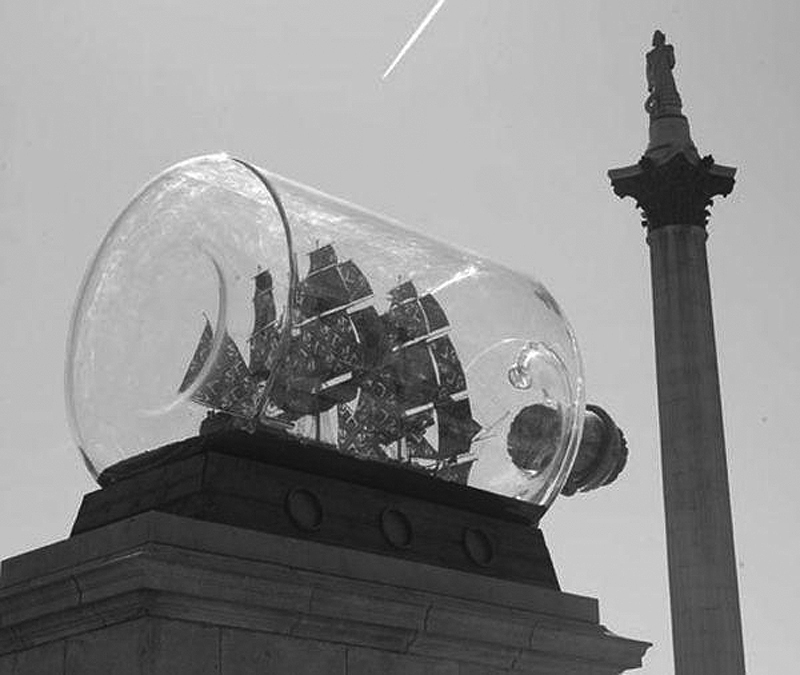
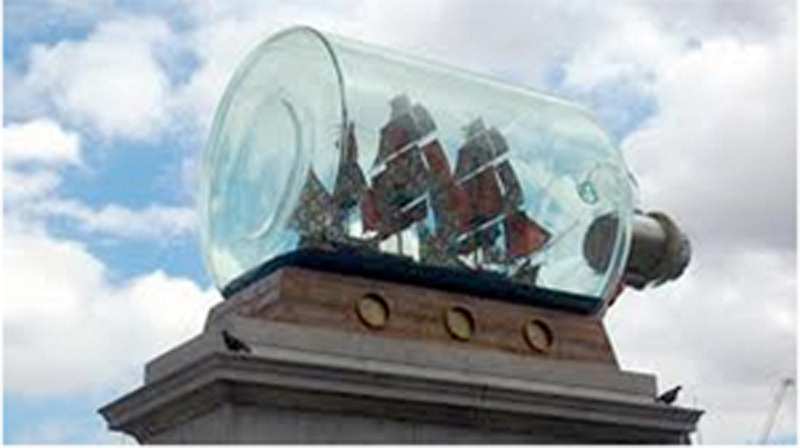
 The National Maritime Museum in Greenwich has bought for £362,500 the ship in a bottle by Yinka Shonibare which had sat ornamentally becalmed on the fourth plinth in Trafalgar Square for the previous 18 months. It is the Greenwich museum’s job to collect ships and related tackle and, lately, any sea-related nonsense deemed ‘challenging’ by State Art’s omniscient spivs. It is significant, if you hadn’t realised, that the ship’s sails are made from patterned ethnic material of the sort usually swathed around gigantic arses in Dalston market. This encourages what one of the Tate’s finest drivellers grandly declares as “a transformation of perceptionâ€. Elsewhere, the same stuff is said to make an incisive comment on Britain’s nasty maritime heritage, “an exploration of colonialism and post-colonialism†no less. Needless to say we are not informed into what our “perception†is “transformedâ€, nor how “colonialism†is “explored†by deploying some patterned swatches purchased from a Brixton stall. I suppose we must now accept this species of commentary as the naturally occurring guff which will in perpetuity follow conceptual art wherever it goes.
The sculpture, dubbed Nelson’s Ship in a Bottle, has recently been unveiled on a plain ziggurat base bang outside the National Maritime Museum’s main entrance. Here its presence will doubtless be interpreted as a Blair-like mea culpa for the historical misdeeds of our racist, slave-driving antecedents. Others may interpret its prominence and worship as illustrative of an abject and risible political correctness. Whatever, the bottle is a pretty enough toy untroubled by art. I wish to investigate briefly this apparently straightforward purchase because it reveals the questionable ways in which contemporary art is conducted by a small number of people for the benefit of an equally small number of other people who pop up ubiquitously pulling strings in proceedings such as these. It is curious indeed how the names are always the same ones. These ‘questionable ways’ may be baldly summarised as follows:
1. We are never told the whole truth, even by public relations’ companies paid to deal with inquiries, and especially concerning the actual cost of anything. State Art is terrified of you knowing the truth, which is the reason why so frequently it is caught out lying.
2. Obtaining accurate and complete information from arts bodies requires Kafkaesque determination and, when finally a morsel is vouchsafed, it is always uncooperatively partial and might easily contradict what has been released before.
3. State Art has to be secretive in order to make the public believe that the visual arts are kept cruelly on the breadline and are not, as is the truth, awash with quite staggering amounts of cash which miraculously come available for the right people. If you are a Yinka Shonibare, with access to the engines of State Art, whose institutions you have dutifully served, this system is a licence to print money.
4. The number of bodies dealing with contemporary art is far too numerous and wastefully duplicating of effort and resources, and any independence in their policies and actions is compromised by frequent interchange between them of the same few personnel.
Three issues ago Moping Owl asked why we needed to buy Shonibare’s ship when, she thought, we already owned it. Didn’t we? Had we not already commissioned and paid for it to sit on the plinth? Well yes, sort of. Owl’s was a natural mistake, especially in view of what we had already been led to believe by what, up to that point, we now know had been an economical rationing of information. £362,500 is three times the record price paid at auction for any work by Shonibare. To pay apparently so much over the odds is surely just a little questionable, but the truth is that this figure is nowhere near what was actually paid for it. The real price far exceeded the published number, but you won’t have found the full, accurate cost in any newspaper because even now we can’t be certain we know all the amounts involved.
When the purchase was gleefully trumpeted, as though we’d just acquired for peanuts a lost masterpiece by Praxiteles, a breakdown of the cost was supplied. This was based on the interesting claim put about by the artist’s dealer that an unnamed South Korean businessman had been prepared to pay £1.25 million in order to display the bottle in his garden. This outcome was described as “a real possibility†– which sounds to me a bit like the belief among, say, QPR fans that there is ‘a real possibility’ of their team winning the Premiership next season. This sum was apparently accepted even though, at that time, the price was ten times more than had ever previously been paid for a work by the artist. Complicated tax concessions applicable to a purchase by a British museum meant that the top line price was reduced to £650,000, the Treasury having waived the difference. This lower sum was made up as follows:
£140,000: production costs funded by the Greater London Authority
£97,500: 15% museum discount from Stephen Friedman Gallery
£50,000: Grant from the Art Fund ***
£264,300: Contributions from the public via a fundraising appeal ***
£49,100: National Maritime Museum contribution ***
£49,100: Matched contribution by Stephen Friedman Gallery and James Cohan Gallery, New York, on behalf of Yinka Shonibare, MBE
(*** These sums total £363,400; that is, close to £362,500.)
As far as I can ascertain at least three additional sums that were paid have not been included in this final account. The Arts Council awarded £70,000 for this project, as it does for all fourth plinth commissions; the Greater London Authority, in addition to its £140,000 production costs, gave an “artist’s fee†of £30,000; and the Henry Moore Foundation gave a grant of £20,000 to the artist for this project. In the privileged wonderland of State Art these additional sums, a mere £120,000, are pocket money. But we still paid them, and the total involved is five times the average Briton’s annual income. I can see no reason why these omitted additional sums should not have been deducted from the price paid by the Museum. Why were they not included in the reckoning? And how many other charities, trusts etc., contributed amounts which disappeared into the coffers when first the project was mooted? The £140,000 contributed by the Mayor’s office for production costs was, according to the initial agreement, to be repaid if the work sold. This is apparently true of all works made for the plinth, though we are unaware of any sums ever having been repaid from previous occupancies.We must assume that Boris is sat waiting eagerly for his refund (after all he can buy one-tenth of a new Routemaster for £140,000). Despite repeated requests for information nothing remotely resembling candour has emerged from the Mayor’s office. The fact is that the GLA alone paid Shonibare in production costs and fees a sum far is excess of the highest amount the artist’s work had ever previously sold for. And we didn’t even get to own it. Is the Arts Council’s £70,000 equally reimbursable upon the sale of a work? If not, it should be. The Arts Council, perennially bleating about its poverty, should surely be on the case for a return of its investment. As usual our requests to them for information have been ignored. They are far too busy producing worthless pamphlets of self-congratulation.
The price paid by the NMM was independently assessed by Haunch of Venison and Roche Court, a minor secondary market sculpture dealer in the West Country. Haunch of Venison is a gallery owned by Christie’s who, coincidentally, sold the previously highest priced work of Shonibare, a large installation, for $194,500 last November. (Another installation was sold by Christie’s in April this year for as little as $98,500.) It is hard to see how any objective person could have verified a price of £1.25 million ($1.94 million) for a sculpture by this artist, even one which had sat prominently hawking itself in the centre of London for the previous year and a half. Given that they have a monopoly of sale on Shonibare’s sculpture (Sotheby’s has never offered a work by him) it was not in Christie’s – of course I mean in Haunch of Venison’s – interest to undervalue this piece. In other walks of life we might call this a conflict of interest. Shonibare was handsomely reimbursed twice for this bottle; once when he made it and a second time when he sold it. Additionally, we had a right to expect a knockdown price from the 50-year-old artist whose career has been generously supported by the State. Shonibare is an executive member of the Usual Suspects Club. He was nominated for the Turner Prize in 2004, the year Jeremy Deller won (Deller, incidentally, is one of two artists on the selection committee for the Fourth Plinth, both of them Turner Prize winners). His fledgeling career was made easier by cash grants from both the Arts Council and the Greater London Arts Board and he has enjoyed exhibitions in virtually every Arts Council-funded gallery throughout the country, as well as at the Tate. He has also served on Arts Council committees and bought works of his choice for the Arts Council collection. His present visibility would have been inconceivable without expensive public promotion. This should have been reflected in the price for the bottle. After all, we didn’t owe Shonibare anything, quite the reverse. He has made a strong career on the back of crucial public investment in him and, in my view, he has used that reputation to inflate the bottle’s price when selling it back to us. What a marvellous system this is if you are, as the Arts Council put it, “the right kind of artistâ€.
At the very minimum we paid the following for the bottle:
£362,500 published cost
£140,000 Greater London Assembly
£30,000 fee also from the GLA
£70,000 Arts Council grant
£20,000 Moore Foundation grant
(£622,500 in total).
When the work’s sale to Greenwich was completed Shonibare said: “I am absolutely delighted and touched by the public’s generosity.†I bet he is.
David Lee
The Jackdaw, Jul-Aug 2012