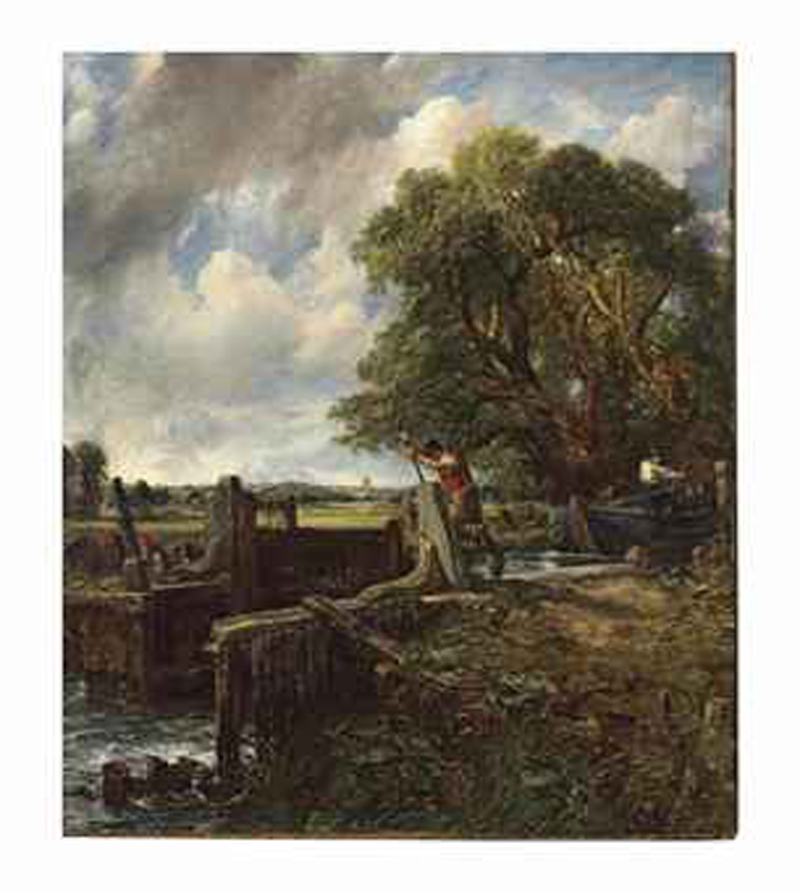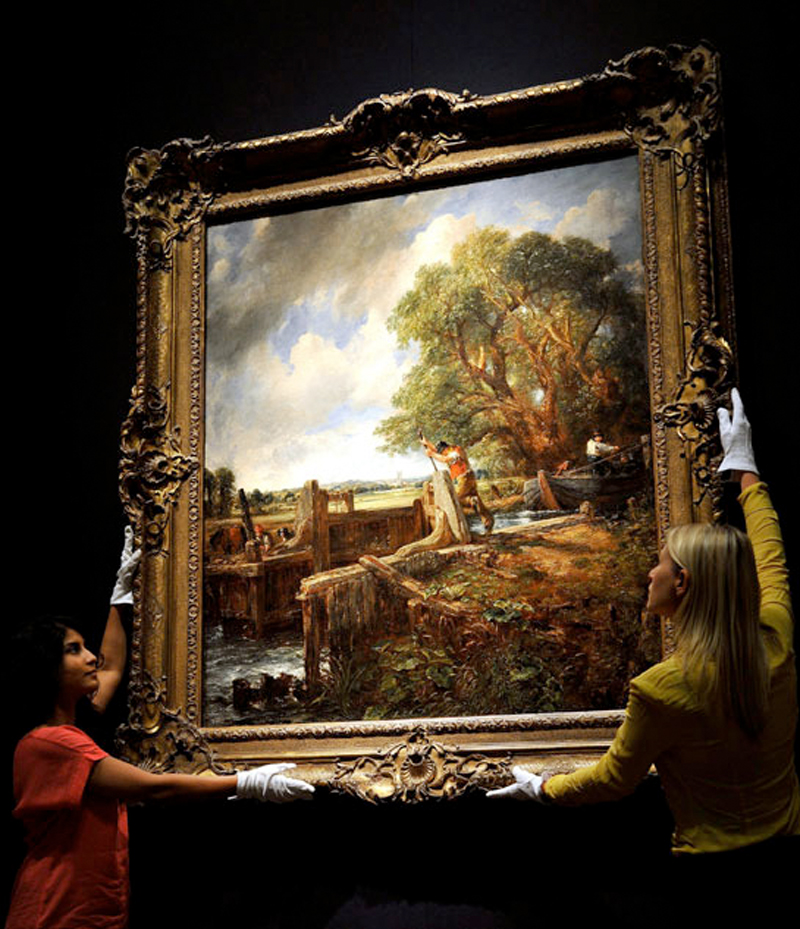
 It won’t have escaped the eagle eyes of either of The Jackdaw’s readers that our favourite bit of raven-tressed gallery fluff, Griselda van Bonkhorst, resurfaced pretending to hold up Constable’s The Lock. She was last found swooning over a Rembrandt and before that upstaging a Stubbs with her impeccable embonpoint. What with her fashionably unironed T-shirt and sexy rubber gloves she was looking quite the oil painting you’d expect. Knowing his daughter’s childhood dream of running her own little farm shop in the Cotswolds, her father’s plan to buy her into an auctioneers in order to see GvB married off to a quality suit has not yet paid dividends: she still awaits Mr Right.
She is assisted here by fellow ornament Moondance van Dongen, a distant relative of the atrocious Dutch Modernist. Employed for her looks and Low Country subtleties and savoir faire, Moondance actually has to work for a living, her daddy having lost all his money speculating in Spanish property – currently she is heir to three miles of weed-cracked concrete the wrong side of Almeria.
Griselda is not too chuffed about this competition for the eligibles of the Square Mile and is hatching secret plans to cause Moondance a nasty accident with a priceless ceramic. Meanwhile, dear old Grizzy looks dreamily up the Stour valley and sees her Range Rover splashing mud over the strawsuckers as she races to open her emporium where, don’t ya know, today’s special bargain is muddy carrots at ten guineas a pound. You can’t hold back a nice bit of skirt.
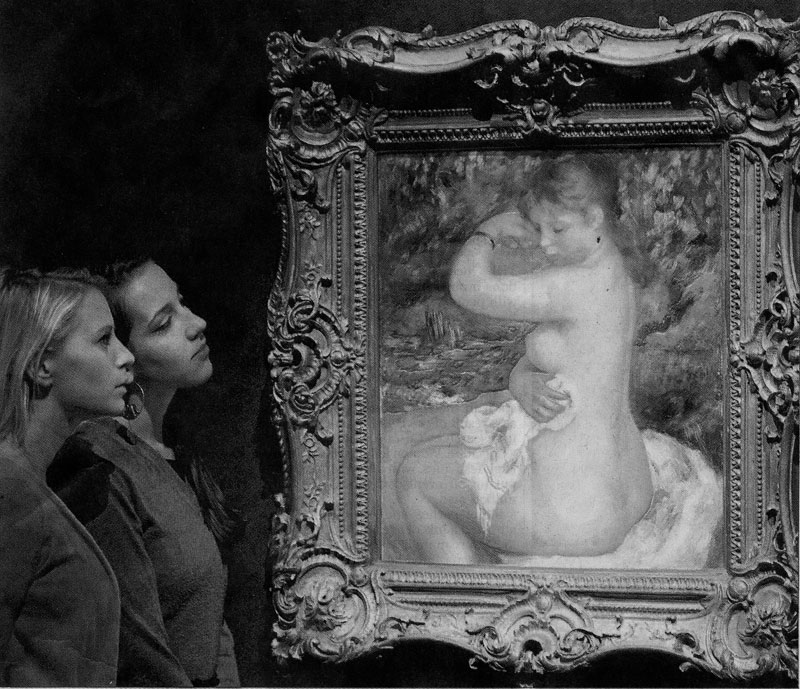 COME ON LADS WHAT’S IT WORTH?
Having so far failed to attract their beaux, Griselda and Moondance agreed with the publicity stills man that for the Renoir they would be shot close up to expose their aristocratic profiles in contrast to that of the undressed plebeian model. They might then make the society pages of Country Life or The Lady or any of the other publications in which fillies of the van Bonkhorst and van Dongen pedigree can offer themselves for gentleman suitors of comfortable means.
Griselda looks disapprovingly at the pie-eating Impressionist hussy and can only wonder if the artist set up his mistress with a little shop in Normandy selling calvados and cider produced locally (in Bulgaria). Moondance, meanwhile, peers quizzically at individual brushstrokes having just been informed by mischievous porter Bentley (himself in search of a rich old suit) that Renoir was famous for having said that he painted with his dick. Poor old Moondance, never the brightest penny in the till, will eventually get the meaning but at the moment she is stuck imagining the blisters on poor old Pierre’s peashooter.
David Lee
The Jackdaw, Jul-Aug 2012