Tag: Turner Prize

  • Art: Cool and Uncool – William Varley Reviews Addicted to Sheep

    So, as all cool sentences begin, I think that the best TV programme I saw last was Addicted to Sheep. In many ways this BBC4 documentary was reminiscent of the French film Être et Avoir about a remarkable teacher in a school in the remote Auvergne, although a good deal less winsome. It focused on the lives of the Hutchinson family, tenant farmers in Upper Teesdale. In their remote valley ewes are called “yowes” and at the children’s school they still sing “There is a green hill far away”. The Hutchinson children help with the lambing, including the gruesome task of dealing with still-born lambs.

    What is so admirable about them is that they have an uncomplaining, unflinching attitude to a life that is harsh and elemental. I doubt whether they have recently visited their nearest gallery, the Bowes Museum at Barnard Castle, or the Baltic at Gateshead. I also suspect that the issues which so exercise the post modern, post Christian urban élites: multiculturalism, egalitarianism, transnational progressivism (no borders), environmentalism, feminism and the rest of that plethora of right-on attitudes, don’t preoccupy them. For a start, they don’t have the time. Without wishing to patronise them, they probably believe that the acronym L.G.B.T. stands for a brand of sheep dip. All of this, in the opinion of the ‘enlightened’, particularly art world instrumentalists, makes them seriously uncool.

    How does one define ‘cool’? There are still people around who think that it’s a gently meandering style of jazz, but most of us know that it’s simply a matter of a self-appointed élite determining what is acceptable and unacceptable. It’s a phenomenon which transcends ages and classes, from the tiny tyrant berating her parents for not recognising the world significance of ‘One Direction’ to the State Art apparatchik wincing as he patiently fields one’s less than enthusiastic reaction to a ‘challenging’ new installation. In Jonathon Rose’s brilliant book, The Intellectual Life of the British Working Classes, the anthropologist Mary Douglas describes it thus:


    Art trends may have as brief a shelf life as stock exchange trends, and they depreciate rapidly if one fails to catch the latest wave in architecture, or literary theory. The names that Bohemia adopted for itself – avant-garde, advanced, progressive, le dernier cri, new wave, cutting edge, modernist, postmodernist – all reflect the Anxiety of Cool, the relentless struggle to get out in front and control the production of new cultural information. Bohemia is ‘subversive’ only in that it seeks to wean consumers away from older cultural products in order to sell them new ones.


    That description is one of brash economics but, of course, we’re all familiar with the broader pattern of Cool, the Godfather of which is Marcel Duchamp.

    Ad Reinhardt once remarked that all artists had to make a choice between Mondrian and Duchamp, between advocates of the hand- made, and those of the ready-made. As Jackdaw readers know, Duchamp, asserting that all art was mere taste, allegedly exhibited a urinal under the title of Fountain at the Armory Show in New York in 1913. Actually, as Jackdaw readers also know, that anarchic gesture was performed by one of his girlfriends as the Armory Show was ‘unselected’. Still, as someone who was intoxicated by word-play, puns and conceits, he was the epitome of the intellectual dandy. Apparently effortlessly, he invented kinetic art, optical art, conceptual art, and his great hermetic narrative, The Large Glass. Consolidating these innovations he left to allegedly mediocre followers.

    His biographer Robert Lebel wrote that he regarded the ready-mades as sacralisation or transubstantiation. (How God-like is that?) However, “His real motive with them was to depreciate our ordinary and tacitly accepted notions of value in order to exalt the strictly private and sovereign choice which is accountable to no one. With the ready-mades”, said Lebel, “he meta-ironically demonstrated his incontestable power to be TAKEN AT HIS OWN WORD which is the unmitigated artist’s privilege.” You can see where that gets us: art is anything you say it is, a situation that leads inexorably to the empty stunts of the Turner Prize and the vulgar extravagances of the Pinault Collection. Still, for his loyal disciples in the State Art Establishment his reputation is unassailable. There have been notable heretics from the general orthodoxy though. In his book The Banquet Years, examining the pioneering days of Modernism, Roger Shattuck remarked that Duchamp’s strategy of ‘nominating’ useful objects to art status was “essentially self-consuming, a reversion to dead level after an initial shock.” More recently, in The Winter of our Culture, Jean Clair (real name Gérard Régnier) the former Director of the Picasso Museum in Paris, described Duchamp’s Armory Show as “works of provocation and derision presented by a cynical dandy”.

    The High Priestess of Cool was, of course, Susan Sontag. During the ’60s and ’70s she was the doyenne of American intellectuals and in her seminal book Against Interpretation, she issued two decrees that in retrospect seem to have underpinned the visual art that developed afterwards. Attacking the discrimination between hierarchies of art as ‘philistine’, she effectively substituted a plateau view of culture for the existing pyramidal order. Henceforth, there was to be no qualitative distinction to be made between high and popular culture, art and entertainment. In this scenario, Elvis Presley could give Mozart a friendly wave across a level playing field. The ‘dumbing down’ consequences of this were, of course, appalling and eventually she could see it. She died 12 years ago, but shortly before her death she condemned ‘the triumph of a pernicious relativism.’

    I am not prepared to say the satisfactions derived by art are no different structurally, in context, or in quality or in importance, from other kinds of satisfactions. I am not prepared to think that the satisfaction I might get in front of a Chardin, a Vermeer or a Vuillard is in any way similar to the satisfaction I would get watching a beautifully pitched baseball or inspecting a shoe collection.

    Her recantation was welcome, but it was too little, too late: the damage to the impermeability of high culture had already been done.

    The other hugely influential aspect of her ‘new sensibility’ was the idea (echoing Matthew Arnold perhaps) that art should concern itself with the moral criticism of life and be used as ‘a tool for changing consciousness’. Whether or not her writings were the cause or whether the true believers in an art for use developed their own ideology, in subsequent decades a veritable deluge of issues appeared. They mostly consisted of that left liberal menu of Goodthink favoured by the BBC that I’ve already mentioned: multiculturalism etc.. They are very useful for ‘virtue signalling’. “Let’s do the Holocaust”, artists would say, “or perhaps child abuse”. This is empty posturing, a bit like wearing Aids ribbons. It’s also about as far removed from Kathe Kollwitz’s nightmare visions as it’s possible to be. As the wife of a Berlin doctor Kollwitz knew poverty and illness at first hand. Her emotion was earned, not affected. Still, quangocrats and councillors who dole out funding love emotional incontinence. Current affairs and politics are things they can understand: the structural music of painting invariably remains a mystery to them. And insofar as they reinforce the fallacy that visual art is simply a medium or receptacle of a socio-political statement, it’s a godsend to those media hacks deputed to discuss them.

    Some issues, however, are so uncool that they’re off limits. Take the case of Kamel Daoud, for instance. This distinguished Algerian (Muslim) novelist wrote an article in Le Monde in late January denouncing the wave of sexual assaults that had occurred during Cologne’s New Year’s Eve celebrations. He didn’t temporise, calling the assailants Muslim men:

    The refugee-immigrants come from the vast universe of sorrow and horror which is the sexual misery of the Arab-Muslim world. The subjugation of women is the psychological Gordian knot at the core of the world of Allah, and hence the inspiration of the death cult that claims to defend it.

    You can easily guess the reaction to that: an academic fatwa; and erstwhile friends telling him, with the greatest kindness, to stick to writing novels and, politically, to shut up. Our politicians, of course, favour the ‘Religion of Peace’ narrative and as far as our art world is concerned, in contrast to the scathing visual indictments of Abu Ghraib how many denunciations of suicide, bombings, jihadist beheadings and the like can you think of? None? I can think of one. A couple of years ago in an exhibition in Rome I saw a small black singlet in the form of a hijab presented by the Egyptian feminist Ghada Amer. Unsurprisingly she now lives in New York.

    Another aspect of cool is the cult of novelty. I remember Lawrence Gowing back in the ’60s presenting the imperative to many young artists “to make it new”. At the time it worried me, being far too prescriptive. As someone who believes that originality should be involuntary rather than willed, I would have advised “Make it good”. Giles Auty in The Jackdaw was scathing in identifying the ‘novelty trap’ in which ‘ism’ inexorably succeeds ‘ism’ and thereby invalidates its predecessor. (Auty estimated that about 40 ‘isms’ occurred in the 20th century, each having about 2.25 years of life.) In his irreverent article he suggested that, according to the novelty narrative, “western art should be read as a kind of art-historical relay race which culminates in the death of painting … because there are no more apparent avenues left to explore”, a process which he maintained was “both spurious and infantile”. Astutely, he demonstrated how the art world had hijacked from science the rhetoric of progress with the consequence that anyone who refused to embrace it was certifiably reactionary and uncool. Of course there are some exceptional exponents of hybrid media such as the prodigious William Kentridge, but the strategy of State Art is to impose novelty on a baffled public. Amongst that public there are some blasphemers, though. The late Henning Mankell believed that “One of the tasks of art is to provide people with companions. I have seen people in paintings who I hope to meet in the street one of these days…” How uncool can you get? The Scottish prose-poet Nan Shepherd, ‘married’ one might say, to the Cairngorms, had a similar capacity for empathy. The ‘technoscape’ may be cool but engaging with actual landscape is extraordinarily rewarding. Like Wordsworth in The Prelude, she believed that “sustained contemplation of outer landscapes led to a subtle understanding of the spirit.” Her attitudes correspond almost exactly with those of several painters I respect. All of her senses were engaged when experiencing landscape and art, of course, should be enjoyed through the senses. She could smell the rain: so could Constable. (Those experiences and spiritual rewards are also shared by the Hutchinsons.)

    When I reflect on State Art’s prioritising of novelty, however, I recall Andrew Brighton’s observations in Consumed by the Political in which he said, “The propagating of serious art amongst people who are relatively uneducated is an act of cultural aggression” and, emphasising the underlying totalitarianism of this ostensibly generous agenda suggested that, “The idea that people without art are lesser or inferior beings is a ridiculous assumption, a piece of moral vanity akin to a religionist’s belief that only those of their faith or sect are capable of real virtue.”

    Hard it may be for the quangocrats to grasp this, but there are thousands of people who live happy, fulfilled lives entirely without art. The irony is that the attempt of the Kulturkampf to dragoon people into an involvement with art is founded more upon a campaign of exclusion rather than inclusion. But to return to the Hutchinsons. My lingering image of the Addicted to Sheep documentary is of their eldest daughter, about 10 years old, sitting in the landscape making a painting by using her eyes – and making a pretty good fist of it (above). All is not lost.

    William Varley
    The Jackdaw
  • Charles Thomson: Lies, Damned Lies and Serota at the BBC

    Sir Nicholas Serota, director of the Tate Gallery, has used the platform of the BBC in a blatant attempt to deceive the nation. Either that or he is genuinely deluded himself. Both options render him unfit for major public office.

    He was confronted on Radio 4 programme The Reunion: Tate Modern on September 23rd by Sue MacGregor, regarding the Tate’s purchase in 2005 of its trustee Chris Ofili’s work The Upper Room. She observed with wry understatement, “The Charity Commission said you didn’t quite follow the rules here.”

    In 2006, as the BBC then reported, Charity Commission chief executive Andrew Hind said there were “serious shortcomings … In any charity we would be concerned that such basic matters were neglected, but in a charity of the size and stature of the Tate we are very disappointed.”

    The Guardian expounded, “The Tate has broken the law … By law, trustees cannot receive monetary benefit from their charity without express permission, usually from the commission. The Tate failed to seek permission … The Charity Commission’s full recommendations and criticisms, laid out in a lengthy document, also said the Tate failed to manage conflicts of interest … Failed to seek independent valuation of works by artist-trustees … Had no defined policy relating to purchases from artist-trustees … Had insufficiently clear acquisition policies … Kept insufficient records of trustee meetings.”

    The Daily Telegraph called this verdict “one of the most serious indictments of the running of one of the nation’s major cultural institutions in living memory”.

    “After an in-depth review lasting ten months by the Commission”, stated The Times, Serota “accepted the criticisms” and “was genuinely contrite”. The Evening Standard confirmed, “Sir Nicholas said today he accepted all the Charity Commission’s findings”.

    In stark contrast, his response to Sue Macgregor ten years later was an astonishing and shameless attempt to hoodwink the nation and evade blame with a trivialising revisionism that implied gross misconduct by the Charity Commission. To the supportive laughter of his entourage on the programme, Serota declared smoothly – as if it were established fact – the evasive nonsense, “The rules of course were invented after we had flouted them.”

    Serota has a history of obfuscation, whether lies, half-truths, delusions, evasions or omissions. In 2004, he applied for a grant from the Art Fund towards the purchase of The Upper Room. He signed a form saying that there had been no prior commitment to the purchase of the work (a condition of funding). Thanks to journalist Chris Hastings and the Freedom of Information Act, it was revealed that, eight months prior to the application, the Tate had paid a £250,000 deposit. Serota blamed it on “a failing in my head”.

    In 2005, I was quoted in The Observer: “Serota, as the director, chooses the trustees, and the trustees are then responsible for reappointing the director. The director then buys the trustees’ work.” In 2008, this was brought up in Varsity (the Cambridge Student Newspaper), where Serota defended himself with another flagrant falsehood: “I don’t have any part to play in their appointment.”

    The September 2005 Tate board minutes state: “The Director [Serota] reported that two strong candidates were to be interviewed for the position of Artist Trustee by a panel comprising himself, Paul Myners and the Independent Assessor.” In the May 2007 minutes, another trustee interview is on record with a panel of three trustees, the independent assessor and Serota.

    The Board of Trustees of the Tate Gallery Annual Accounts 2005-2006, 2006-2007, 2007-2008, and 2008-2009 all say in the section on trustees: “The key stages of the appointment are overseen by a panel, which will normally include the Director.”

    Also in Varsity, Serota said about the trustees, “Why would I want to win their support?” The simple answer to that is that he is their employee, as he explained in 1993 in the Independent on Sunday, when he hoped to be appointed for a second seven-year term as Tate Director: “Tate trustees fall in and out of love with their director and I’ll only discover whether they have fallen out of love with me in 1995 when they discuss my contract … The jury’s out.”

    On the Radio 4 programme, MacGregor confronted Serota about an event in October 2003 that became public the following year, namely “that Charles Saatchi offered you his entire collection … it was worth 200 million – for nothing.” Serota denied this: “I wish he had … he did have a great collection. Sadly he never did offer it to us.”

    This response is consistent with Serota’s version to the press in 2004, when he said that Saatchi’s offer was not for a gift but for a loan of work, which he (Serota) immediately rejected (none of which was mentioned to MacGregor).

    Surprisingly, Serota’s reply was immediately contradicted on the programme by former Tate trustee, Michael Craig-Martin, who admitted there had in fact been an offer of work: “Unfortunately what was offered to the Tate was not the great collection with the great things in it, most of which were already gone by that time. They had been sold by that time.”


    As it happens, that is incorrect. At the time of the offer in 2003, Saatchi still had in his collection iconic Brit art works, including Damien Hirst’s shark, Tracey Emin’s bed, Rachel Whiteread’s plaster cast of a room, Mark Quinn’s head made from frozen blood, Sarah Lucas’s table with two fried eggs and a kebab, Marcus Harvey’s Myra Hindley painting with children’s hand prints, Ron Mueck’s sculpture of his dead father, the Chapman’s penis-nosed mannequins and Chris Ofili’s Virgin Mary painting with elephant dung.

    Serota continued about Saatchi: “Michael [Craig-Martin] and I with Janet De Botton spent a great deal of time in the late nineties trying to persuade him to give, not his collection, but maybe ten works from his collection as a founding collection for Tate Modern. But I’m afraid he didn’t feel for one reason or another able to do that.”

    This is obviously another failing in Serota’s head. In 2004, the Evening Standard reported that in 1998, “Saatchi offered 86 works by 57 British artists – including Langlands & Bell, Turner Prize winner Martin Creed and Glenn Brown” (as well as Richard Billingham, Richard Wilson and Chantal Joffé). A Tate spokeswoman confirmed the offer of 86 works, which were rejected as “The trustees felt on this occasion the works would be better suited in a collection elsewhere.”

    Regarding The Upper Room scandal, Christopher McCall QC wrote to the press in 2005 condemning “expediency … which has an appeal to an overbearing executive”. The Times said of the Tate: “If it had been a company, the verdict would have sent shareholders into a panic.” No doubt if it had been a government, resignations or sackings would have followed the public outcry. Surely we have the right to expect the same standards across the board in public life, including the arts.

    Serota has not displayed a level of behaviour and integrity to remain a figurehead and step into another prime position as Chairman of the Arts Council. His record is tarnished and far from admitting to his mistakes, he has the blinkered arrogance to pretend they never happened.

    We need leaders who do not have recurrent failings in their head.

    Charles Thomson
    The Jackdaw

  • Laura Gascoigne: Tainted by Experience – March 2017

    When the former controller of BBC Radio 3 John Drummond published an autobiography in 2001, he called it ‘Tainted by Experience’ – an ironic reference to the reason given by a Birtist suit at the Beeb for his being ‘let go’ a decade earlier. I haven’t read the book, but the expression was used by William Varley in a positive sense to describe a group of mature artists showing at Northumbria University Gallery in 2011, and it stuck in my mind. As it happens, Northumbria University Gallery is now itself under new management since its director of 38 years’ standing, Mara Helen Wood, was ‘let go’ by the university executive for being similarly ‘T by E’, as reported by Varley on these pages last year.

    Following the revolt of ‘the people’ against ‘the experts’ currently convulsing western democracies, we face the prospect – daunting or exhilarating, depending which side of the populist fence you’re on – of an expert-free future. If this is a revolution, as some people seem to think, then post-modern art has long been in its vanguard. Ever since Marcel Duchamp (or Baroness Elsa von Freytag-Loringhoven, take your pick) pissed on the art experts with Fountain in 1917, expertise in art has been a dirty word. This causes particular problems for avant-garde painters, since paint, unlike sanitary ware, is an impressionable substance that too readily absorbs the taint of experience. As a measure of contemporary artists’ desperation, an exhibition of young Canadian painters at Pippy Houldsworth in 2008 was titled Learned Helplessness.

    The fashion for bedroom painting, currently running in tandem with the fashion for lumber-room sculpture, appears to support Joseph Beuys’ egalitarian philosophy that “everyone is an artist”. Technique is not the only casualty of this ostensible democratisation; knowledge of art history is another victim. In Elizabeth Fullerton’s Artrage: The Inside Story of the Britart Revolution, Liam Gillick says of his Goldsmiths generation: “We didn’t sit around talking about El Greco… It’s as if we started without any history”. The blanking of history was about more than democratisation; it was a bid by ambitious young artists to turn over a clean sheet and astonish the world with the newness of their art.

    Fifteen years after Gillick was nominated for the Turner Prize, the world is still waiting. As previous nominee Tracey Emin rightly predicted: “You’ll never get a fucking radical winning the fucking Turner Prize”. The reason is that the sheet was never clean. It wasn’t true that the yBas started without any history; they just started with a lot less of it. They referred, deferred even, to history as reverently as the German Expressionists who copied El Greco; the difference was that they refused to look further back than Duchamp. And so, in the place of newness, we got repetition. Those who fish for ideas in a small art historical pond are bound to keep catching the same old fish others have put back. I’m in perfect agreement with Roland Barthes’ claim in The Death of the Author that there’s no such thing as original creation since we all draw on a “ready-formed dictionary”, but it follows that the shorter the dictionary, the more restricted the creative scope.

    Last year’s Turner Prize exhibition was admittedly an improvement, but it has long felt as if the jury is operating a points system whereby nominees are awarded marks for every reference to a post-modern forbear. Rather than democratising contemporary art, this sort of specialist reference-spotting is as much a game for an art-educated elite as identifying classical allusions once was for a cultivated audience of Renaissance humanists. What it produces is elitism on the cheap, shorn of the technical skill and aesthetic pleasure that made Renaissance art enjoyable by all audiences, educated or not. It’s an elitism dressed in sloppy paint and everyday detritus whose learned helplessness is about as convincing as Marie Antoinette’s attempt to pass for a milkmaid.

    The perception that the non-expert is in charge was always as false in art as it now is in politics. The grim reality of our post-truth era is that people tainted by experience in all walks of life are being cleansed from positions of influence to make way for managers. The days of class war may be formally over, but the days of management class war are just beginning. Everywhere the tainted by experience are being pushed aside to make way for management apparatchiks parachuted in to impose blue skies thinking on areas of life in which they are blissfully innocent of expertise. Before Nicky Morgan’s Academy Schools programme hit the Brexit buffers, even parent governors – the original exemplars of taint by experience – were under threat of replacement by professionals with “the right skills”.

    Has anything good ever fallen out of a blue sky? In Waziristan blue skies merely increase the probability of a drone-fired Predator missile landing on your wedding party. The public has been comprehensively duped into directing its ire against ‘experts’ and ‘elites’, when it’s managers who should be in the firing line. Elites don’t always wield power, nor are they necessarily any better off than the Maybot’s JAMs. Art history may be such a specialist subject that the AQA exam board wanted to drop it from its A-level syllabus, but your average art historian is almost tragically lacking in influence and generally about as poor as a church mouse – ditto your average university lecturer or research scientist. The only elite with clout is the managerial one that has got us into the mess we’re currently in, and can be counted on to fail to get us out.

    The battle for elitist art history has been won, for now, and museum directors remain one of the few classes of managers with specialist knowledge and experience in their fields. But the management ideologues are already circling. The Culture White Paper drawn up by Ed Vaizey a year ago announced, on the subject of museums: “We want to ensure that they are as best placed as they can be to continue supporting our aspirations for access, place-making [no, me neither] and soft power.” As if this wasn’t sinister enough, it proposed the creation of a “Commercial Academy for Culture to improve and spread commercial expertise in the cultural sectors.” No mention of improving knowledge.

    In an interview in the Guardian last September, James Flynn – the veteran American academic who revolutionised our understanding of human intelligence by demonstrating that environment is the dominant influence on IQ – was asked how, given the steady global rise in average IQ scores since the 1930s, Americans could have elected Donald Trump as President. His explanation was that “the rise of visual culture means far fewer people read serious novels and history. They live in a bubble of the present, believing what they are told because they have nothing to position it against.”

    I agree about the ‘bubble of the present’, but I question his use of the term ‘visual culture’. It’s visual, yes, but is it culture? Culture doesn’t feed off the present, it grows on the past. Sever its connection to the past and culture dies, clearing the field for commercial expertise in the cultural sector.

    Laura Gascoigne
    The Jackdaw Mar/Apr 2017

  • Laura Gascoigne: Is It The Real World Or An Exercise? – November 2016

    The Ukrainians have a lot of empty plinths where statues of Lenin once stood and last July, taking a leaf out of the Gormley Sutra, steps were erected around the one in Kiev’s Bessarabska Square so that people could climb up to admire the view and/or take selfies. The installation, Inhabiting Shadows, was the work of Mexican artist Cynthia Gutiérrez, apparently intended to prompt reflection on “imposed memory, system failure, emptiness, identity, and occupying space.”

    You don’t have to be an artist to play this game. Elsewhere in the Ukraine, protestors have filled the vacuum: in Odessa, Lenin’s place has been taken by Darth Vader (right). Which of these gestures seems the more artistic? One has humour, the other a pretentious title, but both make similar points, the first more forcibly. When it comes to politics, protest has the advantage over art of single-point perspective: it doesn’t offer the viewer a range of potential meanings, and it often pips art to the post. The 2,500 used life jackets laid out by the International Rescue Committee in Parliament Square to coincide with the UN summit on the migrant crisis on September 19th took most of the wind out the inflatable lifeboats with which Ai Weiwei clad the facades of the Palazzo Strozzi for his retrospective opening four days later. The IRC’s installation was nameless, anonymous and free; Ai Weiwei’s was fashionably titled Reframe, stamped with the artist’s identity and priced accordingly.

    As so often, it’s only money changing hands that distinguishes art from reality; outside the gallery context it’s becoming impossible to tell them apart. No sphere of life, however homely, is proof against artists who have appropriated gardening, cooking and even knitting as means of expression. Undeterred by the embarrassing flop of Mexican artist Abraham Cruzvillegas’s Turbine Hall installation of planters titled Empty Lot in which nothing but a few straggly weeds came up – my plan of scattering dope seeds had to be abandoned when I couldn’t remember where I’d hidden them – the South London Gallery has got another Mexican artist, Gabriel Orozco (I’m beginning to understand Donald Trump’s concern there will soon be no Mexicans left south of the border) to design an accessible garden connecting the gallery with the adjoining housing estate. It opened in October. As Kew is involved, presumably this time plants will grow. As a community initiative it’s a sweet idea, but as a conceptual statement the Modern Slavery Garden at this year’s Chelsea Flower show – designed by Tanzanian-born Juliet Sargent and planted by slavery survivors – put it in the shade.

    At this point, I have to confess to a guilty secret: I’m an avid consumer of ‘Metro Bites’ when on the Tube. This silly season, almost every story had the makings of an artwork. In the space of one week in July, there were items about a 96-year-old crack shot granny from Tilburg who since her first taste of a funfair shooting range aged 16 has preferred rifle shooting to sex; a husband in Dudley who murdered his wife for selling his Elvis tribute concert ticket; and two smuggler brothers caught at Plymouth Station with £24,000 of heroin in Kinder eggs up their bottoms – all of which seemed to have more to say on issues of feminism, identity and general abjection than anything in the current Turner Prize. Imagine the improvement to Anthea Hamilton’s strangely anus-free bottom if a Kinder egg could be seen popping out of it. But this summer’s prize-winning Metro artist manqué has to be the recovered drug addict from Halifax who had himself buried alive for three days in order to live-stream exhortations from beyond the grave discouraging other addicts from joining him. (Whether he rose again has not been reported.)

    If you think these sorts of ‘true life’ stories are not material for art, Chinese artist Xu Bing would disagree. The plot of his new film, The Dragonfly Eyes, released in January, was based on the case of a husband who sued his cosmetically enhanced wife for tricking him into producing ugly children. In contemporary art, there is no silly season; it runs from January to December. Appropriately, it was the subs at Metro who came up with the inevitable Turner Prize headline ‘Butt Is It Art?’ So much is art these days that ‘But is it real?’ is a more pertinent question. As Gavin Haynes commented in his Guardian report on a hoax Corbyn talk staged by Lancaster University art student Lucie Carter in May: ‘The question “Is Jeremy Corbyn art?” hasn’t been asked very often. Most people are still trying to answer the deeper question: “Is Jeremy Corbyn politics?”’.

    We live in an increasingly virtual world where a couple can divorce because of infidelities committed by their alter egos in Second Life and a bored schoolboy can shine a laser pen at a police helicopter when his PlayStation breaks down. It won’t be long before we’re all as thoroughly confused as the panicked security man recorded during the 9/11 attacks asking: “Is this ‘real world’ or an exercise?” No wonder most of us are way beyond caring whether art is imitating life or vice versa. The bored schoolboy was handed a six-month referral order with obligatory attendance on a ‘thinking course’, when what he – and the rest of us – could really do with is a dose of the ‘boundary training’ prescribed to Osborne’s psychiatrist brother with the wandering hands. Without it, the situation is becoming dangerous. When a woman was stabbed at last year’s Art Basel Miami, no one intervened because they thought it was an art performance. If it had been, they would have been ejected by security.

    Leaving ‘real world’ problems to one side, has the loss of boundaries benefited art? Not in the opinion of Anselm Kiefer, who gave this analysis of the situation in a speech in 2008: “There is a special border, the border between art and life, which often shifts deceptively. Yet, without this border, there is no art. In the process of being produced, art borrows material from life, and the traces of life still shine through the completed work of art. But at the same time, the distance from life is the essence, the substance of art. The more scarred the work of art is by the battles waged on the borders between art and life, the more interesting it becomes.” His position is more nuanced than Nietzsche “Truth is ugly. We have art lest we perish from the truth.” But how could Nietzsche have foreseen the course of art? As it was, the great philosopher made the wrong call. It is falsehood that is ugly – without truth, we are in danger of perishing from art.

    “Can you use real life as a subject?” was the question Gormley posed with his Fourth Plinth project. Which prompts another question: does a plinth make a more eloquent statement by remaining empty? I passed the Fourth Plinth between installations the other week, and it seemed to me that it did.

    Laura Gascoigne
    The Jackdaw Nov/Dec 2016

  • Editorial – May 2017

    TATE BRITAIN NEEDS ITS IDENTITY BACK

    In recent issues I’ve described how since 1945 the education, bureaucracy and exponentially increasing cash for the visual arts have been usurped and dominated by an evolving one-track mindset which, in these pages, is called State Art. This sinister subversion of the institutions, predicted before and after the last war by Eliot, Wyndham Lewis and Orwell among others, is complete with the recent appointment of Doctor Balshaw as overall Director of the Tate (see last editorial). She understands nothing but that which is ‘Contemporary’, a qualification (if that is an appropriate description) which makes her uniquely unsuitable for running three galleries with what should be historical and scholarly functions.

    The sad truth now is that the Tate has become a gallery of contemporary art with a marginalised historical concession on the side, whereas its original function was the reverse of this. The revolution that has taken place for this to happen over the last half century is an object lesson in change by incremental stealth. It is the perfect demonstration of what Rudi Dutschke meant when, confronted with the fact that a successful immediate proletarian revolution was impossible in western Europe, he referred to the necessity to operate clandestinely from inside, a process he famously dubbed “the long march through the institutions”. This would, he predicted, lead to the eventual substitution of one establishment by another independent of any popular support. And in the case of the contemporary visual arts this means a far more repressive, hidebound and authoritarian regime than the one it replaced.

    Writing in 1971 political scientist Leonard Schapiro observed: “[T]he true object of propaganda is neither to convince nor even to persuade. But to produce a uniform pattern of public utterances in which the first trace of unorthodox thought reveals itself as a jarring dissonance.” He was referring to Stalinism but he might just as easily have said it about an equally dictatorial State Art. Such is the blind faith in the New Scripture for Contemporary Art, and the impossibility of apostasy from it (like membership of the Euro the only exit from State Art is a door marked Disaster), that any attempt to question the evolving orthodoxy and monopoly has condemned any would-be non-conformist to immediate ostracism. The predictable chorus of positive opinion at the appointment of Dr Quack is evidence of this common fear of being targeted as a “jarring dissonant” and the career disaster it portends. Her inadequacies are blindingly obvious but who in the arts commentariat actually mentioned them? There is now a terror in the visual arts of telling even a fraction of the truth. Thus has State Art been allowed to prosper in a parallel universe impenetrable to public interest and criticism which renders its functionaries untouchable and self-perpetuating, and – like Moonies – eternally pleased with themselves.

    With Dr Q’s appointment, and the earlier elevation of a contemporary art specialist to head Tate Britain, the takeover of the institutions is complete. We have arrived at Dutschke’s Year Zero. The art of Now has become its own justification, as if nothing before matters. This is the curious process by which an uncoupled past has become an irrelevance. If it goes in any direction at all the story of art now travels backwards, and not very far back at that. State Art-approved galleries have become locked in the bubble of a continuous present inside which nearly all recent ‘masterpieces’ and ‘challenges’, ‘subversions’ and ‘explorations’ are almost instantly forgotten because really they were meritless to start with and their importance routinely overstated. Yesterday’s work is replaced swiftly by today’s and accompanied by the now familiar hyperbole, for in the visual arts we are trapped on the treadmill of perpetual mediocrity.

    Consider this. In 1946 there were two curators and one director at the Tate. There are now 17 directors alone. On the Tate’s website they don’t publish a full staff organisation chart, most probably because that would give away the scale of empire-building that has recently gone on there (despite its predictable annual cries of poverty). Instead 46 staff are listed as examples of what they call “the broad range of academic and professional expertise in the organisation”. In fact, the ‘range’ it describes is the narrowest of bottlenecks. Over two thirds of the staff on this list are modern and contemporary curators, mainly the latter; a fifth relate to art before 1920; and the rest are dedicated to conservation and managerial wonks with mystifying job titles.

    Such a bias in favour of the contemporary is justified at Tate Modern but it isn’t a prejudice appropriate at Tate Britain or the two satellites reliant on its historical collection. These galleries should show and research what is established and not that which is either speculative, market driven or the current whim of a dominant, highly prejudiced clique of curators and their favourite dealers.


    And so it is urgently necessary to split off Tate Modern from the rest of the franchise. A different ethos must apply at Tate Britain, a gallery whose historical works should be its justification not its embarrassment. Not all the Tate’s galleries should have to pay the necessary lip service to Schapiro’s “uniform pattern” demanded by State Art, as is currently the case.

    This dismantling of Serota’s unwieldy empire has been mooted before but now he’s gone for good it’s an urgent necessity, especially when we have a scholarly nobody in charge of the world’s most important collection of historical British art. It is a serious crime of negligence to abandon the organisation to the leadership it has. Having someone in charge of Tate Britain who has no credibility in the history of British Art might be fine in a gallery of contemporary art – even then it’s not exactly desirable – but it is perverse in an institution which began life in 1897 as the National Gallery of British Art ­– which was, incidentally, run until 1954 by the National Gallery.

    Tate Britain today is heading relentlessly in the direction of becoming a museum of Modern and Contemporary British art with some history attached. If you have a person in charge whose knowledge stretches back only to the week before last this continued drift is inevitable.

    The space for work before 1920 is constantly being squeezed. Currently the building is split into three parts. The vast middle strip, the Duveen Galleries, is customarily wasted promoting an over-rated contemporary. At the moment it is White Cuber Cerith Wyn Evans with sprawling, incoherent patterns of white neon tubing signifying only he knows what. A ‘Senior Curator of Contemporary Art’ writes of this piece on an ‘information’ board: “In this commission CWE has responded to the space of the Duveen Galleries by creating a neon installation which focuses on ideas around the folds and flows of energy via material and immaterial conduits.” Only the author knows what that means. So the gallery’s middle third is wasted.

    The eastern third is modern British art since roughly 1920, much of it minor and nearly all of it illustrative of the Modernist Creed. At the far end Hockney currently occupies galleries which usually act as a graveyard for the latest Turner Prize. In the front corner is the Turner annexe, now also used to house Constables which used to live in what is a new ‘installation’ space.

    The western third used to be all history and is the most popular section. Visited but not crowded it is a perfect place to study those pictures which are hung well enough for the purpose; that is, low enough and not skied as many paintings are here. A shop has intruded at the south end to make way for an ‘Art Now’ gallery on the ‘modern’ side where the shop used to be. Large installation spaces and a photography gallery have also cut sizeable chunks out of this wing. The impression is of a distant history tolerated by being piled high in a restricted space, but which is far from celebrated.

    Tate Britain urgently needs it own identity. The current regime will not deliver this because all they are capable of understanding is “material and immaterial conduits”.

    David Lee
    The Jackdaw May/Jun 2017

  • Editorial – November 2016

    Art Education is Stuck

    Two years ago someone suggested I answer the question ‘What Happened to Art Education?’. This appealed slightly because it was a subject about which I thought I ought to know more than was the case. Something is clearly awry when so many complaints are aired about the poverty of tuition and when degree shows have become such forgettable, even laughable accumulations of artless clutter.

    My own experience of teaching in art colleges has been limited. In the 1980s I was a tutor in the Photography Department at the Royal College of Art. Admittedly I was hopeless at it. Eventually I quit because of personal embarrassment that my contribution was inadequate and that students deserved better. One problem was that I couldn’t discover precisely how judgements of quality were arrived at – so much seemed arbitrary and capricious, obvious to others but opaque to me. During those years, and subsequently, I lectured and talked at many colleges around the country without ever considering myself an educationalist. Despite overwhelming feelings of being a charlatan imminently in danger of humiliating exposure, to my shame I never refused offers of work – infrequent as these were I needed the paltry fees they generated.

    Not surprisingly the possibility of researching the story of how art education had come to be the way it is aroused my curiosity. As a functionary on art papers for over 25 years I’ve received hundreds of complaints from art students about the absence of practical instruction and of the coercion applied to force students to work in ways contrary to their natural instincts.

    In contemporary art’s administration and education a dead end has undoubtedly been reached. For example, we’ve had nearly thirty years of sameness from the Turner Prize (see page 26). The kind of stunt featured in it now is much the same as it was decades ago. The unchallenged authority of State Art means that indifferent, instantly forgettable work will endure apparently in perpetuity. This year it’s a pile of coins, a few years back it was a pile of ash, and before that piles of second-hand furniture, clothes, rice and stones. Who now recalls (or cares) what all these pile-stunts ‘challenged’ or ‘subverted’? I know I can’t. For the first time stylistic evolution has stopped dead. We’ve reached the end of art history and the beginning of terminal boredom.

    In fine art education we have also attained the equivalent nihilist cul de sac courtesy of State Art’s stranglehold. Those who were taught to do nothing practical now demand others do the same, because this is all they know and their continued employment depends on conformity to an intolerant and self-satisfied orthodoxy. Around 1980, for the first time in 140 years, art education stopped evolving. Everything associated with the past had been dropped and replaced by the ultimate democratic liberty of everyone doing whatever they please.

    In this issue I am publishing my research findings. I’ve tried to précis the story of fine art education from its origins, concentrating on England, and particularly since 1945 when the downhill slalom began.

    I encourage those with greater experience and knowledge to correct any errors and misapprehensions. Within reason I’ll publish all replies. The detailed story of what has happened to lead us to the present dead end needs telling. Regrettably, the inconvenient truth is that at the moment the Government can only afford to issue art students with a vocationally worthless but very costly piece of paper.

    I haven’t been able to propose any way forward because I’m not sure there is one, the current system being so securely rooted in the Establishment. No improvement will take place while a convenient consensus continues to exist between political parties that State Art is all there is. The Left supports State Art because it wants to be seen as progressive, anti-élitist and open-minded while the Right is terrified of being labelled stuffy, reactionary and uncool. Thus, whoever is wielding power State Art will always remain the art of the State.

    At the end of the piece I’ve made some recommendations. If adopted these would make it easier for those who wish to receive a traditional art education without having to experience the prejudice which currently prevents them receiving equal treatment.

    David Lee
    The Jackdaw Nov/Dec,  2016

  • Sense and Sensibility

    HalfordsSo it’s goodbye Cornelissens hello Halfords.

    Laura Gascoigne parks her brush and tries to follow the instructions for flatpack art, but has the picture upside down

    It’s a dull job being a customs officer, sitting on the border twiddling your thumbs until the next teenage drugs mule comes along. So it must have added to the gaiety of nations when in 2010 the EU Commission passed a ruling imposing full VAT import duty on electrical components and household appliances used in art. Henceforth disassembled light tubes from a Dan Flavin sculpture would be charged full whack at 20% of the work’s value instead of the preferential ‘art’ rate of 5%. It might be art when assembled in the gallery, ran the argument, but disassembled in transit it counted as light fittings. Sic transit gloria artis mundi.

    The wheels of the European Commission grind exceedingly slowly, but they’d better sort this one out before it causes tailbacks at Dover while fine art carriers loaded with DIY supplies discuss the finer points of art theory at Customs. Outsider artists have always used materials from hardware stores – nail mosaics are a popular genre, and a sealant Jesus sold a few years ago for £750 – but now that the definition of ‘found object’ has been extended to objects found in the aisles of Wickes, the DIY aesthetic has official sanction.

    We should have seen it coming when Jim Lambie was given planche blanche in 2003 to cover the floor of the Duveen Galleries at Tate Britain in trippy stripes of multicoloured vinyl tape. The previous year, the Taiwanese artist Michael Lin had carpeted the Palais de Tokyo in Paris in giant pink flowers inspired by Taiwanese embroidery. Since then the flooring contractors have been gaining ground, and commercial galleries are now entering the market. Two years ago the Alan Cristea Gallery transformed itself into a flooring showroom with the site-specific installation D.I.Y by Richard Woods, who covered walls and floor “in his trademark vibrantly-coloured and exaggerated wood-grain motif… installed as parquetry”. Naffness being a key ingredient in the DIY aesthetic’s demotic appeal, there is now apparently an art market for parquet.

    When Martin Creed clad the walls and floors of the downstairs toilets at the London Library’s new Mason Yard extension in his trademark vibrantly-coloured patchwork of marble tiles, I suspect he didn’t do the grouting himself, belonging as he does to the ‘You Do It’ YBA boomer generation. Today’s austerity generation of DIY strivers is more hands-on. For the tar and rubber paintings in his exhibition Freedom of Assembly at White Cube, Bermondsey (until July 5th), African American social practice artist Theaster Gates conscientiously developed “good roofing strategies… to arrive at painting or at least to get to the essence of roofing.”

    The aim these days is no longer for a high-tech Hirstian finish designed to appeal to billionaire collectors, but for a low-tech Bodgit & Scarper look – an abject object – worthy of exhibition in a socially responsible public gallery. It’s one in the eye for modernism’s utopian belief in the transformative power of functional form. As Ralph Rugoff said of the 30 international artists in the Hayward Gallery’s 2010 exhibition The New Décor, “what unites them is their ability to transform objects we associate with the everyday – a bed, a shelf, a lamp – into something uncanny and compelling [so as to] open up the discussion about interior space… with interpretations ranging from the absurd to the abject to the lyrical.”

    In this context, the lyrical tends to take the form of nostalgia for the bright new dawn of the post-war DIY movement. Today’s social anthropologists may claim that self-assembly furniture puts the contemporary male in touch with his hunter-gatherer roots – apparently it’s a stag night ritual in Sweden for the groom to bid a final adieu to bachelordom by assembling a piece of IKEA furniture – but wrestling a flat pack to the ground in a drunken stupor is a piece of piss compared with the challenges facing the original DIY pioneers. Their frontier spirit was celebrated in Untitled: Simparch, a 2005 exhibition at Tate Modern in which a group of American artists used instructions from the 1960s popular manual Plywood Working for Everybody to produce a range of exhibits from a ‘Fishing Tackle Cabinet’ to a ‘Storage Headboard’. The Tate described these objects, unfairly I thought, as “elements of an affluent, post-war vision of suburban domestic living” whose need was “fuelled by the ownership of material goods rather than basic necessity”. It seems to me that a fishing tackle cabinet is a must-have accessory for any hunter-gatherer, ditto a cupboard for storing trophy heads.

    But seriously, can this stuff be considered art? Those with doubts on the subject may be reassured to learn that amongst Franz Kafka’s early works was a volume entitled Accident Prevention Regulations in the Use of Wood-Planing Machines, dating from the author’s formative period in ’elf and safety (during which he is also said to have invented the hard hat). A Kafkaesque edge of surrealism is what most DIY artworks appear to aspire to. In 2003 the artist-run gallery Cubitt, at the cutting-edge of plywood as of so much else, hosted an exhibition cheerily titled HEY PRODUCTION! that took its cue from another pioneering handbook, Victor Papanek and James Hennessey’s Nomadic Furniture (1973). The show was organised by the self-styled Copenhagen Free University, a Danish outfit specializing in disseminating “forms of knowledge that are fleeting, fluid, schizophrenic, uncompromising, subjective, uneconomic, acapitalist, produced in the kitchen, produced when asleep, arisen on a social excursion – collectively”. They may have missed the passage in Kafka’s handbook warning against operating machinery when asleep, but fortunately no injury seems to have resulted.

    It’s fair to say that, apart an unhealthy obsession with subverting sideboards and debunking bunk beds – The New Décor included a bed shaped like an LA freeway overpass by Cuban carpentry collective Los Carpinteros – the DIY art movement does no real harm. All art is Do-It-Yourself, after all. If you’re alone in your studio, who else is going to do it? And functional failure is something every artist is familiar with. As the Swiss sculptor Urs Fischer put it in an interview: “As soon as I start to work with materials, things go wrong.” Still, when Baudelaire defined ‘modernity’ as “the ephemeral, the fugitive, the contingent; the half of art whose other half is the eternal and the immutable,” he wasn’t thinking of plywood, he was thinking of paint, a medium in which an eternal and immutable record of the ephemeral and fugitive can be trapped. DIY art is a whole other ball game: it makes a fetish of the fugitive and laughs at eternity. In Baudelaire’s artistic terms, it’s a game of one half.

    On this year’s Turner Prize shortlist is a collective of designers and architects calling themselves Assemble who “embrace a DIY sensibility”, according to the Tate. They’ve been nominated for their work with local communities improving a rundown estate in Toxteth, Liverpool and ‘rethinking’ an adventure playground in Dalmarnock, Glasgow. Adrian Searle predicts that making the world a better place through DIY efforts “is something artists… are going to have to be doing a lot more of in the coming years”. He may have a point, but it’s a limited one. DIY efforts can turn pedestrian dreams into reality, but only art can turn pedestrian reality into dreams.

    Laura Gascoigne

  • The way we are now – why ‘avant garde’ is now an obsolete term

    McQueen copyThe Times – God bless its little cotton socks – has just been celebrating the triumphal return of the 1990s as a creative force. “Suddenly contemporary art” it crows, “was part of popular culture. The Royal Academy’s landmark Sensation show in 1997 was a turning point.”

    It was so indeed, but not exactly in the terms the article intends. Here in Britain, Sensation marked perhaps the very last moment when it was possible to talk about an avant-garde in the visual arts with any appearance of authenticity. The show was widely hailed as the beginning of something – as the moment when the visual arts in Britain turned over a new leaf, as the moment indeed when British artists surged to the very forefront of innovation, displacing both the French and the Americans, who, each in turn, had carried forward the baton in the race to create what was entirely and indubitably new.

    Looking back now, the exhibition seems, on the contrary, to have marked the instant when the hands of the clock moved on, and the whole notion of avant-gardism ran out of steam. To quote the Times once again: “The beginning of the decade was all about exhibitions in abandoned warehouses and empty office blocks. By the end, thanks to Damien Hirst and his gang of barricade-storming rebels and Charles Saatchi, the ad-man-turned-art-dealer, it was more champagne and cocaine and exploding auction prices.” Only a little further on was the day when Tracey Emin RA, once high priestess of the YBA Movement, would celebrate her 50th at Annabel’s, London’s most establishment nightclub, in the company of Princess Eugenie, granddaughter of H.M. the Queen.

    The avant-garde came late to Britain, and imploded late. Long before 1997 there had been signs that the impetus to innovate was beginning to falter. It is, I think fair to say that most of its energy was already exhausted towards the end of the 1970s, when the terms Post Modern and Post Modernism came into vogue. Art was no longer defined by its urge towards novelty, by its eager embrace of some definition of the new. Instead, it was characterized by its relationship to what already existed in the recent past. This impulse has been further defined by the fashion for ‘appropriation’ – that is, for making exact copies of images that already exist as a paradoxically innovative act.

    It is possible to look at the present situation in the visual arts using several different perspectives. One is the immense expansion of the contemporary art world. The old avant-gardes were confined to Western Europe and the United States, with perhaps an acknowledgement of what happened in Russia in the first two decades of the 20th century, and a dim consciousness of certain developments in Latin America. This expansion owes much to modern communications – first to the fact that colour printing became radically cheaper, which led in turn to the birth of the musée imaginaire or museum without walls. Secondly, to the digital revolution and the birth and rapid growth of the Internet, which has made possible the immediate diffusion of images from a huge variety of different sources. Google, and ye shall find.

    This means that it is increasingly hard to see any clear direction in the general progression of art. If we are looking for the proverbial ‘shock of the new’, it often seems that the shock of the exotic (something unfamiliar, coming from a culture very different from our own) will do just as well instead. It is, of course, necessary to acknowledge, when saying this, that the original 20th century avant-garde made free use of certain exotic sources – look for example at the relationship between Cubism and what Picasso described as “l’art négre”.

    Of course there is yet another paradox here, which is that the appeal of African tribal art to Picasso and a group of his artistic contemporaries was precisely its (to them) hermeticism – the fact that they in fact knew little and cared less about what the tribal artists were trying to express. Now we not only see too much – we are also in a position to know too much. Just go to Google, and ask the right questions. It is impossible to resist asking, knowing that the answers are within such easy reach. Today there is really no such thing as an innocent eye.

    Another important factor here has been the influence of official institutions – in particular museums of modern and contemporary art. These offer one of the main channels through which contemporary art now reaches a mass public. One may argue that television and the Internet are in practical terms just as important, but the fact is that these institutions see themselves as being entitled to govern the agenda. Their priorities are set by two things. First, those in charge of them (though they may vigorously deny this) see themselves as the high priests of a cult. A lot of the more characteristic manifestations of contemporary art, as presented by official organizations, now quite openly call for the response, “Lord, I believe – help Thou mine unbelief.” Or, in more demotic form, “I believe you – thousands wouldn’t.” There are, notoriously, often no objective correlatives that can be used as measures of quality, or even of interest.

    Secondly, museums – not surprisingly – feel a strong sense of responsibility towards those who supply their funding. The problem here is that the givers of money often tend to measure success in brutally populist terms. How many people are coming through the doors? What is the demographic breakdown, in terms both of generation and of class. Are a full range of taxpayers getting their money’s worth?

    The result has been a rush towards supposedly populist forms, chief among them performance art and video. The problem here is that what museums deliver using these media, often in spaces not very suitable for the purpose, compares unfavourably with what the audience gets from better established forms of artistic expression that overlap – i.e. with theatrical performance (nowadays often very radical and imaginative, in addition to being a great deal more disciplined), and things seen in cinemas and on television. In addition to this, where film is concerned, the technical resources available outside the museum or fine-art context are often much richer and more sophisticated. Money talks ­– this is why the best television commercials often far outstrip, in terms of technical finesse, anything presented as ‘artist’s video’.  It is no wonder that a number of artists who made their reputations in that field have now made the transition to being career film directors. The recent career of Sam Taylor-Johnson offers a case in point.

    It is worth noting, in this context, that looking at painting or sculptures is, in general, a different kind of looking from looking at video or even at performance. Video demands that you look from a fixed point of view, and the same is true of many, though not absolutely all, examples of performance art. Video and performance both impose a fixed time span on the audience. With paintings and sculptures the situation is different. You look from the angle and distance you choose. You look for a moment, or for a much longer span. You are free to walk away, then look again from a different viewpoint. Both physically and psychologically it is a very different kind of experience.

    In this connection it is perhaps worth noting that Tate Modern’s current director, Chris Dercon, is due to leave the institution in 2017, to become director of the  experimental Volksbühne theatre in Berlin. In recent months, Tate Modern, having made a big deal about providing new spaces for performance art, has gone rather quiet on the subject. One wonders if its enthusiasm for this art-form will survive Mr Dercon’s departure?

    A conspicuous feature of the contemporary art world as we now have it is its close alliance to the fashion industry. To a large extent, this is something inherited from the earliest phases of the Modern Movement. One thinks in particular of the huge impact made by Diaghilev’s Ballets Russes on the Paris fashion industry. The impact of the Ballets Russes on the leading pre-World war couturier Paul Poiret is well known, but the influence was more general than this. Maison Paquin, for example, hired Leon Bakst, one of the chief Ballets Russes designers, to sketch ensembles for its collections. Chanel had a Russian phase, with outfits that echoed the shapes of Russian peasant tunics.

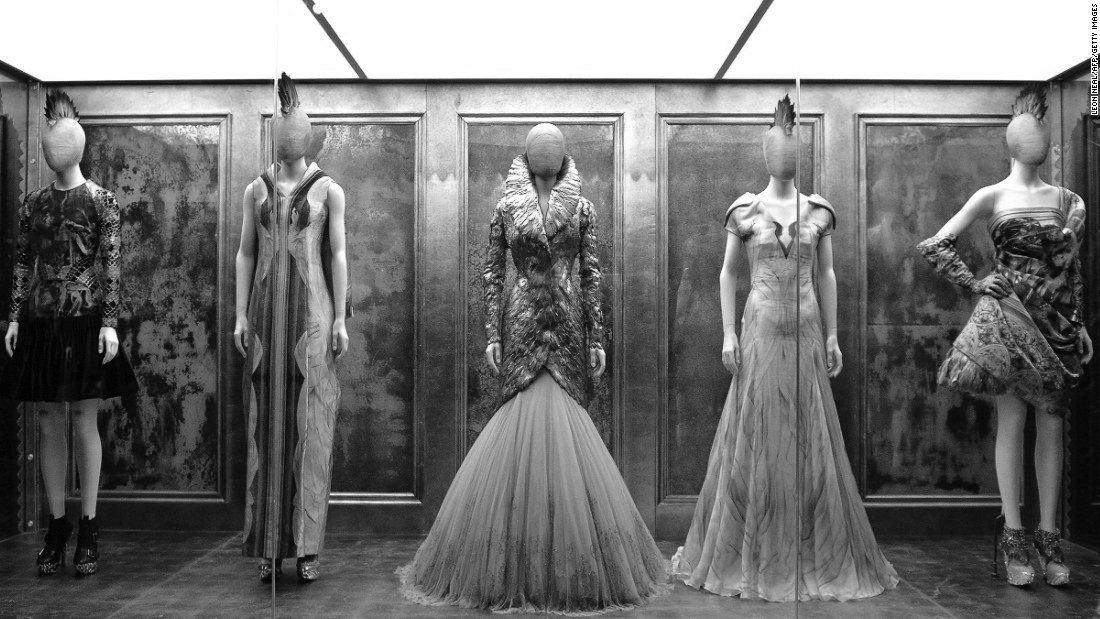
    During the past year, probably the most successful exhibition staged by any major London museum has been Savage Beauty (see illustration) at the V & A, a retrospective devoted to the work of the designer Alexander McQueen. More than 480,000 people saw it, and special late-night showings had to be laid on for the two weekends at the end of its run. Public enthusiasm for the event is, in current circumstances, not surprising. The fashion industry commands powerful PR. It is also much less bound by theories and intellectual constraints than the art world and it certainly has no inhibitions about luxury, and no shame about the money required to support luxury. Yet fashion is conservative in this sense – it gives you something to ‘see’. However ridiculous some of its visual inventions may be, fashion design never neglects the purely visual effect.

    Wear it if you can afford it. Wear it if you dare. And you can be damn sure that people are going to look at you and that they will probably remember what they saw.

    Fashion designers also, as it happens, have much less self-consciousness about ‘appropriation’ than today’s would-be avant-gardists. Fashion designers have always been magpies – they borrow without shame and recycle without inhibition. The point, for them, is to give what is borrowed a new twist. If the audience doesn’t recognise where a particular idea or effect originated, so much the better. With appropriation-art the opposite is the case. You have to know what is being so sedulously copied, otherwise you’re out of the loop.

    One refuge for avant-garde aspirationists, lacking visual inventiveness, has been to take refuge in supposedly radical politics. The visual arts have had an uneasy relationship with politics ever since the French Revolution. It was particularly strong in France during the first two-thirds of the 19th century, and reached a kind of climax in the days of the Paris Commune. This involvement, and the price that could be paid for it, is illustrated by the career of Gustave Courbet.

    There was certainly political involvement between some elements of the visual arts avant-garde and the political left during the first half of the 20th century, but the relationship was always uneasy, as the history of the Surrealist Movement amply illustrates. One still gets a great deal of talk on this subject today. The current Venice Biennale, due to finish on November 22nd, features continuous readings from the three volumes of Karl Marx’s Das Kapital. Whether anyone will pay attention to the words of this text – anymore than most of the traditionally religious pay attention to the actual words of the Mass when recited in Latin – must, I think, be seriously in doubt. In fact, left wing events, safely quarantined in museums, are now a familiar form of preaching to the converted. A good example, here in London, was Mark Wallinger’s installation, State Britain, which won the Turner Prize in 2007. This was a faithful reconstruction of the Peace Camp by the late Brian Haw, which existed for a while out in the open, directly in front of the Houses of Parliament. The Tate Britain web site rather smugly notes that: “Mark Wallinger’s work is noted for its succinct social commentary and political resonance.”

    Yes, indeed. And forgive my asking, but if this now almost-forgotten work ever had any real political impact, in which location would that have been more likely to happen?

    The avant-garde, as we once knew it, is as dead as the proverbial dodo. It is not going to rise again like Lazarus. It’s time we looked for something else, even if we don’t yet know what that is. London is now, for better or worse, a world metropolis. It is full of bright young artists from everywhere you can think of, all enthusiastically making work – much of which can be at least loosely described by the two nouns ‘painting’ and ‘sculpture’. Definitions can wait. Forget the museums. Go to the bustling galleries in Shoreditch and take a look.

    Edward Lucie-Smith

    September/October 2015

  • Tate trustees and the public interest

    Tate trustees and the public interest

    In 2011 the Tate named two new trustees, one of whom is painter Tomma Abts. She is a 44-year-old German, recently appointed Professor of Painting at the Kunstakademie in Düsseldorf, who won the Turner Prize in 2006. As an artist trustee, she replaced Jeremy Deller, who won the Turner Prize in 2004. Abts’s paintings are all the same small size (48 x 38 cms) – it is claimed this tic is conceptually crucial for a reason never convincingly explained – and consist of polite abstract designs which might have looked original on curtains at the 1954 Ideal Home Exhibition. So much for the Cutting Edge. The Tate claims her pictures “possess a formal definition and coherence that suggests that they could never have existed any other way … [and] seem to achieve what only painting can, inhabiting both this reality as an object or ‘thing’, and a parallel world with its own set of rules and relationships that demand to be judged on their own terms.” As per with their interpretive literature, all helpful stuff. Am I being cynical? Yes. Why? Because using any sensible criteria Abts doesn’t deserve to be a trustee of an important British museum.

    The job of Tate trustees is to oversee the efficient running of the gallery “as guardians of the public interest” – and please note that it says ‘the public interest’ not ‘State Art’s interest’, for as you will discover these two mutually exclusive agendas tend to become blurred in the minds of certain individuals. Improbable as it sounds, guidelines for the functions of trustees are drawn up by the Tate itself, not by  independent arbiters. Such complacency hardly reassures an outsider that the public interest, rather than the Tate’s, is being looked after. Indeed, such self-scrutiny is hardly better than the continuing disgrace of policemen investigating their own mistakes.

    In 2008 the number of trustees was increased from 12 to 14 and as required by the Museums and Galleries Act 1992 “at least three” of these must be artists. Thirteen are appointed by the Prime Minister and the last is nominated by the trustees of the National Gallery from among their own membership. Unlike their fellow trustees, who are mainly those with business expertise, and who can serve up to two terms of four years (a period of office trimmed recently from five), artist trustees currently serve only one term of four years. You may find it odd – I certainly do – that while there are three contemporary artists with gilt-edged State Art credentials on the Tate’s board of trustees there is no place for a single art historian. I’m obviously old-fashioned because a museum of historical art with no art historians sitting on its governing board seems verging on the perverse.

    When an artist trusteeship becomes vacant it is widely advertised in the papers, giving the impression that any capable, knowledgeable, articulate artist of repute might apply. Nothing could be further from the truth, for there is a codicil written in invisible ink along the bottom of these ads, which reads: “If you have not won or at the very least been nominated for the Turner Prize, kindly fuck off and don’t waste our time.” The Tate squanders scarce cash paying for these advertisements which are nothing short of a calculated deception. Artist trustees are in fact a self-appointed clique comprising only winners of the Turner Prize with a couple of reliable also-rans chucked in. Since new regulations were imposed in 1992 the only exceptions to this rule have been Julian Opie, who famously refused his nomination for the Turner on the grounds that the prize “had become a frivolous publicity stunt”, and Bob and Roberta Smith, the sobriquet of a dimwit called Patrick Brill, who is otherwise a regular purveyor of infantile stunts at Millbank – you may recall his Tate Christmas tree whose lights visitors were asked to illuminate by peddling a generator. He’s very concerned about the environment apparently.

    Being a trustee involves attending six meetings a year and is said to require a day a month in reading and preparation. I must point out that the Tate’s artist trustees are easily the worst attenders at these meetings, and are frequently absent. In the case of Anish Kapoor (Turner Prize winner, 1991) his absenteeism, which included missing half the meetings in two consecutive years and scarpering early from others, would have surely seen him sacked from the board of any efficiently run private enterprise.

    Of currently serving artist trustees two are Germans – besides Abts the other is magazine photographer Wolfgang Tillmans (Turner Prize winner, 2000). Could they really not find a British photographer, or even a British abstract painter, worthy of these positions? Admittedly, Germans do most things better than we do but surely this is insulting to British artists. And how can a professor at a German art school, which presumably requires her to actually attend some of the week, perform the duties of a trustee required to be resident here?

    The process by which artist trustees are selected ­– laughably characterised as “an open competition” or “an open competitive process” – is indicative of what happens when a clique achieves a complacent monopoly and is allowed by servile arts commentators to get away with it. Minutes of meetings make it clear that artist trustees are encouraged to invite applications from those they consider suitable as their own replacements, especially when candidates who have responded to the ads are not considered worthy, which one may reasonably surmise is always. Indeed, I wonder if there was ever a case of a successful artist trustee having responded to the ads rather than having been – that weasel word – ‘invited’ to apply… And so Turner Prize winners beget other Turner Prize winners, or at the very least other near-misses of that persuasion.

    Candidates for artist trusteeships are interviewed by a panel comprising trustees, including the artists, plus an “independent assessor” who is present to ensure that legal niceties, “best practice” etc., are observed and everything looks above board. But how can it be above board when only Turner Prize winners are appointed? Perhaps this independent assessor ought to be involved from the start of the process in order that more than Turner Prize nominees might be seriously considered, if for no other reason than to keep up appearances of openness. Eyebrows would be raised at such a narrowness of potential candidates in any other sphere of public life: imagine, for example, the Commander-in-Chief of the armed forces always being selected from the same regiment.

    You may ask why is it so important for the convenient running of the Tate that its artist trustees are always winners of the Turner Prize. The answer is for the obvious reason that having been awarded a career-changing gong by the institution of which they are now overseers, they will never rock the boat by asking too many tricky questions about the Tate’s direction in its dealings with contemporary art. This is one of many ways by which State Art has become institutionalised: no one but the reliably subservient is ever allowed on the inside to question Tate, or indeed Arts Council, policies.

    On the other hand these parti pris trustees can be useful when outside criticism of the Tate becomes noisy. For example, in July 2004 Trustees discussed newspaper coverage of a Tate work, Rodin’s The Kiss, which Cornelia Parker (who was nominated for the Turner in 1997, the year it was won by Gillian Wearing, inevitably herself a recent artist trustee), had the previous year controversially wrapped up with a mile of string. This stunt was claimed by the artist to be “challenging the claustrophobic nature of relationships”. Artist trustees present in the meeting (which included the aforementioned Wearing) were able to defend their fellow artist for the benefit of other sceptical trustees. They pointed out that it was the job of the Tate to provoke controversy and discussion, which this work did.

    It is in the interests of these artist trustees to support the Director. They know they will be serving only for a brief period following which they might reasonably look forward to the reward of a Tate retrospective or other continued patronage, purchases etc..

    Serota has stated a preference for such younger trustees. Referring to the trusteeship of Anthony Caro many years before, he remarked in 1998 to the Sunday Times: “Tony was well over 60 when he became a trustee. He was a very effective trustee, actually. He cared passionately about certain things and was a powerful force … but it just seems to work better when you have artists who are a new generation, or indeed erring on the younger side, really.” And we know why he thinks it “seems to work better”, because older artists of a more independent, more knowledgeable, more experienced character might argue cogently for a policy or direction other than the one being pursued by the Director. They have nothing to lose by disagreeing with him. Let’s face it, the current crop of artist trustees is in Serota’s pocket. They owe him and he knows it. He can rely on their support without a second thought.

    In a 2008 interview Serota said of his trustees: “I don’t have any part to play in their appointment”. Remember this, it’s important and we’ll return to it in a second.

    Many years ago Serota said that public nominations for the Turner Prize (perhaps you don’t remember that ridiculous charade whereby we all wasted our stamps and faxes) were seriously considered by the judges. We discovered in 2006 what we already knew, courtesy of an indiscreet Turner Prize judge, that this was in fact a lie and they were binned with risible disregard. We also discovered at the same time, and from the same source, that Turner Prize judges were given a list of appropriate artists and exhibitions – just to help them along you know, point them in the right direction. And there we were thinking in the innocence of our ignorance that they might nominate anyone…

    Serota also stated in 2005 that the Tate only rarely acquired work by serving trustees. The Jackdaw checked up on that and discovered (see the editorial for Dec/Jan 2006 on our website) that he wasn’t telling the truth. Indeed, this whopper cost him a bollocking from the Charity Commission. There were also a number of other flagrant economies with the truth concerning the Tate’s acquisition of work by serving trustee Chris Ofili, who was naturally a Turner Prize winner (1998), which also resulted in another six of the best from the CC. (I almost mentioned here the fact that in the last editorial – also on our website – we indicated how the Tate recently misled us over their attendance figures, but you must be getting fed up with that one.)

    So, bearing in mind Serota’s far from perfect form, when he remarks “I don’t have any part to play in their appointment” I need to ask myself: ‘Do I give him the benefit of the doubt and believe him this time?’ Well, as it happens, no I don’t. Even cursory familiarity with the Trustees’ minutes betrays this one as untrue. On the contrary he is frequently involved in their appointment; indeed, the process of Trustee appointment is administered by his own office. He even attends candidate interviews “in an advisory capacity”. Presumably he offers ‘advice’ which plays no material part in the process, so why is he there in the first place? Indeed, we read on: “The key stages of the appointment are overseen by a panel which will normally include the Director.” (Who, presumably, doesn’t play any part.) On one recent occasion he encourages artist trustees to nominate likely candidates for their replacement knowing only too well the sort of artists they are likely to suggest. No part?

    Let’s have this one straight: Serota is ‘advising’ on the appointment of someone, a trustee, who will function as his own employer. This is a wretched abuse of the supposed ‘independence’ of process and would be considered as much in any other public body. It is, as usual, as blatant a conflict of interest (not to mention a betrayal of ‘the public interest’ about which the process purports to be so concerned) as you would expect to find at the Tate, whose management of conflicts of interest, incidentally, was declared woefully inadequate by none other than the Charities Commission.

    The Tate should not be involved with either the compiling of its own trustees’ duties, or in the nomination or selection of Trustees themselves. How can ‘the public interest’ be considered served when the organisation under scrutiny is writing the job description of its own scrutineers. If we are to have artist trustees let’s have them from a cross-section of the artist community and not just those representing the Turner Prize. And let’s have some eminent art historians in there too.

    David Lee

    The Jackdaw May-June 2011

  • Turner Prize No. 27 … 28 … 29 …

    Turner Prize No. 27 … 28 … 29 …

    Some bird in daft boots striding with the confident air born of State Art insight; in the background, Villa Joe by Paul Noble, 2005

    Having slipped into its tedious annual routine, the Turner Prize is upon us again, at Tate Britain, until January 6th; the winner – £25,000 better off – is announced to a live television audience of well into double figures on December 3rd. Those responsible for organising this banquet of self-congratulation continue to fanfare its importance, but it is in truth many years since the Turner Prize introduced an artist of any lasting significance whose work lives in the mind’s eye: it is a safe bet that in a hundred years no one will be looking at any of this work.

    We have now had 27 years of the same ‘cutting edge’, for which lasting importance is routinely claimed; 27 years of ‘challenges’ forgotten almost immediately; 27 years of assorted ‘subversions’, ‘dissolvings’, ‘explorings’, ‘exploitings’ and ‘juxtaposings’ which have altered nothing; and at least a decade of winners whose names only half a dozen addicts of State Art can (or want to) remember. Cubism only took five years and even Impressionism was done for after ten.

    We have reached the end of the avant garde. Without any locomotive power left, the gravy train is slowing down at the terminus, petering out with the buffers in sight, driven along at snail’s pace only by its own momentum and the willing shoulders of Serota’s lackeys. The Turner Prize is fucked, and only those involved with it can’t see the truth.

    In the 18th century art was the preserve of aristocrats; in the 19th it was in thrall to industrialists; in the 20th it was all done for the benefit of the better educated; and in the 21st it was the exclusive domain of art students and others in a new art industry sustained by a tidal wave of taxpayer subsidy. So much for outreach.

    And so to 2012 and the Buggin’s Turner Prize. As you would guess from her name, the person called Spartacus Chetwind is an ass. If she applied both brain cells to the task, and bought a very large cardboard comb, she might just qualify as an entertainer at children’s parties. “Her carnivalesque live events,” claims the Tate’s Chief  Snake Oil Saleswoman, “dissolve the boundary between spectator and participant.” That’s so old hat: Quatermass did that sixty years ago.

    As the work of a precocious undergraduate at a regional ‘university’ no one well educated has heard of, Luke Fowler’s photographs, in which any two pictures are spliced together in the hope of achieving a critical mass, might attract bollocksy exegesis from the resident theorist and intellectual. To the rest of us they add up first to bewilderment, and then nothing at all. But he’s not just a photographer isn’t our Luke. Oh no. He up for a spot of film-making too.

    At a pinch it is painful but still possible to sit through a bad film by a Hollywood film director. However ponderous and leavened with noisy special effects, there will be at least some narrative drive to stop eyes drooping. On the other hand there is a bad film made by a Turner Prize nominee. This will be so inept it is unwatchable after three minutes, unless … unless you are lobbying for a salaried position in State Art – then, you must watch with exaggerated attention, take notes, nod knowingly at intervals and sit through it twice just in case the President-For-Life is spying on you for signs of apostasy. This is the case with Fowler’s 90-minute throatslitter about an interminable therapy session in the States. Any of the Prize’s judges who claims to have sat through this tripe, awake, from beginning to end is lying. It is many miles beyond a human being’s tolerance.

    For those of a more conventional mindset Paul Noble makes large, detailed drawings of an imaginary place called Nobson Newtown, which has been exclusively absorbing his attention for 16 years. Like the work of Bosch and Dali, superficially the scenes look realistic but are fantastic panoramas containing no figures but, instead, are populated by totems not dissimilar to Henry Moore’s Glenkiln Cross. Scattered around the empty squares and expanses in between the ‘sculptures’ are a plague of what look like dog turds. Close up the graphite drawing is more laboured than expected, first impressions from a distance having suggested greater fluency. These pictures are dystopian, surreal curiosities and will take you longer to look at than the works by the other three contestants put together. This must constitute a sort of praise – it’s certainly a relief. His sculptures, carved presumably by someone else in black and white marble, are feeble, though doubtless easily saleable by Noble’s dealer Gagosian.

    And that leaves Elizabeth Price who is represented by a 20-minute film called Woolworth’s Choir of 1979. Claimed by the aforementioned Chief Oiler to be “exploring the elastic potential of digital video”, it comes in three parts: views of an empty choir in a medieval church; clips of women disco dancers flinging their arms about; and footage of a fire in a furniture warehouse above Woolworth’s in Manchester’s Piccadilly. No obvious connection occurs between the three overlapping sections. As an experience, it is slow to unfold and ‘artistically’ repetitive; as in … “I’m repeating myself a lot, therefore I must be an artist”. Sadly, Woolworth’s is not incoherent with poetic possibilities, it is incoherent with incoherence.

    David Lee

    The Jackdaw, October 2012