Category: Comment

  • Laura Gascoigne – A Way with the Pixels

    Laura Gascoigne

    In April Lionel Messi put a signed pair of his adidas football boots up for auction at Christie’s. Customised with the names of his wife and sons, they were the ‘game-worn’ boots in which the Barcelona striker scored his 644th goal for his club, beating Pele’s previous record of 643 for Santos. Perfumed with the player’s DNA, they raised $175,000 for a hospital charity.

    That’s a lot of cash for a pair of smelly old boots, but you can just about see how a stinking rich football fetishist might want to splash it to get close to his hero. (I’m assuming it was a he.) It’s less easy to understand how a range of digital footwear designed by 18-year-old ‘crypto-artist’ Fewocious for a virtual shoe brand, RTFKT studios, sold out in seven minutes at the end of February for £2.2 million. 

    What did their purchasers actually buy? A ‘non-fungible token’ or ‘NFT’ asserting their rights to flaunt the virtual merch on their online avatars’ feet: basically, bragging rights. So central have bragging rights become to existence in the online metaverse that they command eye-watering sums in cryptocurrencies. A non-fungible Mars House designed by Krista Kim sold for the equivalent of $512,000 in March. You couldn’t live in it but you could show people around: it was the definition of a show home. 

    Lost already? Bear with me. My 2002 edition of the OED – an actual book – defines the term ‘fungible’ as “precisely or acceptably replacing or replaceable by another item” in law. ‘Non-fungible’ is a more recent coinage designed to sneak the idea of private ownership into a public network – the Internet – originally founded on the utopian principle of being free and open. A non-fungible token, as defined by Wikipedia, is “a unit of data stored on a digital ledger, called a blockchain, that certifies a digital asset to be unique and therefore not interchangeable”.

    For digital artists whose uploaded images could previously be viewed by millions without earning them a crypto-bean, the concept is a game-changer. In February an NFT for a 10-year-old cartoon meme, Nyan Cat, viewed over 180 million times for free on YouTube, earned its creator Chris Torres $590,000 in an online auction on a digital art platform, Foundation, launched just two weeks earlier. Naturally, traditional auctioneers were slavering for a slice of the action. In March Christie’s New York sold its first NFT, Everydays – The First 5000 Days, for $69.3 million. Touted as “one of the most unique bodies of work to emerge in the history of digital art”, it gave the buyer a lot of bang for his crypto-buck, representing the entire life’s work of American graphic designer and animator Mike Winkelmann, known as Beeple. 

    Winklemann has been a busy little Beeple: between 1 May 2007 and 7 January 2021 he drew and posted a digital artwork a day for his two million Instagram followers, and Everydays is a collage of all 5,000. Don’t underestimate Beeple, he’s a talented guy: sharp, proficient and unbelievably fast. His satirical squib Mike Pence: Lord of the Flies appeared within hours of the vice-presidential debate of October 7th, 2020. Everydays is undoubtedly a tour de force, though whether it’s a chef d’oeuvre is another matter. Like Banksy Beeple is simply an illustrator with a gift for visual satire, yet his Christie’s sale price now places him third in the most expensive living artist rankings behind Jeff Koons and David Hockney.

    Hockney has dismissed Beeple’s drawings as “silly little things” and claimed that NFTs are for “ICSs – International Crooks and Swindlers”, but Christie’s have no problem with ICSs. “He showed us this collage,” said Head of Digital Sales Noah Davis, “and that was my eureka moment when I knew this was going to be extremely important”. For “extremely important” read “immensely profitable”, as the sale has opened up a whole new market of wealthy crypto-geeks who would never normally enter a physical gallery but have bags of funny money burning holes in their virtual pockets.

    Christie’s announced that it would accept payment in the relatively new cryptocurrency Ethereum and, as it happened, the winning bidder – who used the pseudonym Metakovan – was later unmasked as Vignesh Sundaresan, owner of Metapurse, an NFT index fund that in 2017 raised $47.5 million on an initial Ethereum coin offering for which the tokens are now worth crypto-zilch. Small world. Like other speculators using the Ethereum platform to sell unregulated securities, metapump-and-dump impresario Sundaresan had found himself on the sharp end of the US Securities and Exchange Commission. So imagine his delight on discovering an unregulated market in which he can operate with impunity: art. The multimillions he splashed on Everydays were a small investment to secure the endorsement of Ethereum by Christie’s. As the art historian Tina Rivers Ryan told Apollo: “Art is being instrumentalised to inflate the value of a particular technology just as much, and perhaps more, than the other way round.” Or as the mafia puts it: “One hand washes the other”.

    The question is, are there enough rich crypto-geeks in the world to support this market? Two aspiring young international crooks and swindlers, Joe Kennedy and Jonny Burt of Unit London, are betting on it with the launch in September of what they claim will be “the first art world-led platform for NFTs”, Institut. Like Davis, they’ve spied an opening for a quick crypto-buck. Why sell pictures when you can sell pixels? With the market growing 800% in the first four months of this year, faster even than Covid, they predict that “NFTs are primed to be the leading emerging asset class for the new virtual economy… The future for artists, and the art market, has never been more exciting”. Yes, if you like flying through the ether by the seat of your pants. 

    A major problem with NFTs for the eco-conscious is that their ‘proof-of-work’ calculations involve banks of processors guzzling energy like there’s no tomorrow to achieve a result formerly secured at the stroke of a pen. In July, when Damien Hirst inevitably entered the fray, he announced that his tokens would be launched on a new environmentally friendly ecosystem called Palm, connected to Ethereum but allegedly 99% more energy-efficient. Just as well, as there are 10,000 of them; Hirst has never done things by halves. Priced at $2,000 a pop, his mini-spot painting NFTs form part of The Currency, a project designed to challenge “the concept of value through money and art”, with a twist in its tail. Collectors will be given the option, before a year is out, of trading in their NFT for the original painting in enamel on handmade paper. If they keep the virtual version, the original will be destroyed. “Anyone who buys The Currency will participate in this work,” prospective buyers have been assured. “It’s not just about owning it.”

    My money’s on the originals winning out, though there’s no accounting for the tastes of techno-geeks so averse to ‘real world’ paper they’d rather not wipe their bums on it. (With this market in mind, trend-aware bog roll brand Charmin has just brought out a new line in NFTPs – non-fungible toilet paper.) Hirst is right: NFTs are the latest manifestation of the disconnect between art and money. But are they the ultimate manifestation? In the metaverse the other half are now living in, I fear not.  
  • Laura Gascoigne: Narrow Lanes to Nowhere

    Rihanna is in trouble again. This time she has offended ‘the Hindu community’ by wearing a pendant featuring the elephant god Ganesha, a fashion choice denounced on Instagram as ‘mad disrespectful’. The Barbadian singer should have known better. She has previous in the fashion department, having already upset the Chinese community by dressing up in ancient Chinese costume for a music video and the Mexican community by donning ‘chola’ dress for Halloween. 

    You know that a point of etiquette has gone mainstream when it reaches the pages of Good Housekeeping. Eighteen months ago the magazine ran a column asking: ‘What Is Cultural Appropriation Exactly, and How Do I Avoid it?’ advising readers: ‘Here’s how to avoid a cultural faux pas’. Exactitude being hard to achieve in an imprecise science, after a loose definition of the term – ‘when a person from one culture adopts the fashion, iconography, trends, or styles from another culture’, especially ‘when the culture being appropriated is that of a historically oppressed group’ – the author confined herself to advising readers on avoiding American Indian, Rastafarian and geisha costumes at Halloween parties, and attached a list of celebrity examples not to follow. Along with repeat offender Rihanna, they included white American model Karlie Kloss for striding down the Victoria’s Secret runway in 2012 in a Navajo war bonnet and little else – a faux pas for which she later tweeted profound apologies.

    You can see why this was offensive to the Navajo Nation. Native Americans have good reason to feel aggrieved at white Americans making light of their culture: when the people who stole your land start raiding your wardrobe, they’re taking the piss. Plus, on top of adding insult to injury, misappropriating fashionistas cause offence by misunderstanding and misusing native traditions.

    There’s nothing new in this. Dominant cultures have always aped the dress styles of supposedly inferior ones, from the turbans sported by Regency fops and the tarbushes teamed with smoking jackets by Victorian gents to the tweeds and flat caps adopted by British aristocrats from the local peasantry. But where fashion merely borrows, fine art steals. In the case of so-called ‘primitive’ art, Modernism stands guilty of misuse on a massive scale. What do you do with a problem like Picasso, never mind the self-identifying ‘savage’ Gauguin? Even the mild-mannered Henry Moore couldn’t keep his roving hands off Toltec-Mayan reclining figures. What does a colliery manager’s son from West Yorkshire understand of 9th century Mexican culture? Nowt. If he’d come up before the elders of the Mayan Nation, he’d have found himself on the naughty step with Karlie Kloss.

    In the eyes of cultural appropriation hawks, the fact that modernist artists regarded the makers of the objects they ripped off as their equals or superiors does not exonerate them from the charge of ‘mad disrespect’ of their meanings and purposes. Still, you may as well try to hold back the tide as stop art and fashion playing around with other visual cultures. Moves to have indigenous cultural traditions established as forms of intellectual property owned collectively by tribal nations face a legal minefield; for now, the court of social media has to do.

    In the case of art, the new strictures cover both style and subject. When the 2017 Whitney Biennial included a painting by white American artist Dana Schutz showing black Mississippi teenager Emmett Till in the open casket in which his mother laid him in 1955 to expose the brutality of his lynching, British mixed-race artist Hannah Black wrote an open letter to the curators demanding the work’s removal and destruction. “It is not acceptable for a white person to transmute Black suffering into profit,” she argued. “The subject matter is not Schutz’s… Non-Black people must accept that they will never embody and cannot understand this gesture.”

    Black was wrong. Mothers everywhere would understand the gesture, though – to adopt her own exclusionary argument – perhaps she’s not a mother so can’t speak for them. From what I saw of Schutz’s work in last year’s Radical Figures show at the Whitechapel, its destruction would be no great loss, but it would set a precedent. If artists are to be forbidden from expressing empathy with victims of injustices committed by their own people, Turner’s Slavers Throwing Overboard the Dead and Dying, Typhoon Coming On is for the chop.

    Within three months of the Whitney debacle another storm had blown up over the erection of Sam Durant’s Scaffold in the sculpture garden of the Walker Art Centre, Minneapolis. The American mixed-race artist’s work, which referred to seven gallows used in historical hangings by the US government, had toured Europe without incident, but its allusion to the hanging of Native Americans in the US-Dakota War of 1862 brought down the wrath of the local Dakota community on the artist’s head, unleashing a torrent of online abuse. Worse, the cause of defending the sculpture was taken up by local redneck ‘patriots’ – all ‘very fine people’, no doubt – who drove around the park hurling abuse at the Native American protestors demanding Scaffold’s destruction. The whole sorry saga ended with the work’s dismantling and burial by tribal elders at an undisclosed location; burning was considered too good for it. Neither side emerged smelling of roses. After calls for her sacking, the Walker’s Cuban-American executive director Olga Viso resigned.

    No wonder museum directors are running scared. Pre-emptive action was bound to follow, with exhibits withdrawn in anticipation of outrage. The first casualty has been the Philip Guston show, meant to open at Tate Modern this spring but postponed after fears that Guston’s cartoon Ku Klux Klan figures would stir up BLM sensitivities. While no one has suggested that Guston, the son of Jewish refugees from pogroms in Odessa, was a Klan supporter, Kaywin Feldman, director of the National Gallery of Art, Washington – one of four venues due to host the show  – employed the ‘A’ word, saying that the artist had ‘appropriated images of black trauma’. It later emerged that she was less worried about upsetting gallery visitors than exposing the fact that 83% of its warding staff are from ethnic minorities while 98% of its curatorial staff are white. Without even showing the non-white guards the putatively offending images, the museum pulled the show. We’ve reached a point where a white artist can’t self-critically address the abuse of blacks by whites if it is thought by a white museum administration that it might upset the sensibilities of black viewers it is too nervous/patronising to consult. 

    Still, all is not lost. In the post-colonial melting pot we live in, the stay-in-your-lane cultural traffic police face the basic problem that their absolutist vision – designed for a world of pedigree pure-breeds – is impossible to realise in practice. Short of DNA-testing all artists to map their ethnicities, would-be enforcers of this uber-discriminatory nonsense have no way of telling which cultural lane an artist belongs in. Artists who straddle several can’t be confined to one.

    Art, like fashion, belongs in the realm of fantasy, a realm beyond the rule of road markings. Appropriation, assimilation, acculturation ­– whatever you choose to call it, the process is unstoppable. Besides, without a bit of swerving and weaving there would be no artistic development. We’d all be stuck in narrow lanes to nowhere.

  • Laura Gascoigne: The Masterpiece Delusion

    Laura Gascoigne

    Thank God for books. When shut off from real life, you can see it reflected in novels. But how accurate is the reflection? Does the mirror distort? In month ten of the no-longer-new-abnormal I sat down with a stack of novels about artists. Some I’d read before, others were new, chief among them the fons et origo of the genre, Émile Zola’s L’Oeuvre, first serialised in French in 1885.

    At 500 pages Zola’s book is certainly an oeuvre, though not a masterpiece. The 14th novel in his Rougon-Macquart series, it’s the one most closely based on personal experience. His friendship with Paul Cézanne, going back to their schooldays in Aix-en-Provence, gave him an early entrée to the Paris avant-garde; at 26 he came out fighting on behalf of Manet and co in a series of critiques of the Salon of 1866. L’Oeuvre, written 20 years later, represents “the Parisian art world as it really was,” claims Edward Vizetelly, its first translator into English as His Masterpiece. The novel is a roman à clef with composite characters that don’t necessarily fit particular locks. Its doomed painter hero Claude Lantier is a mash-up of Cézanne and Manet, while his best friend the novelist Pierre Sandoz is quite clearly Zola and gets all the best lines, eg: “How can a man be sufficiently wanting in self-doubt as to believe in himself?”

    The book is said to have ended their friendship but in fact, apart from the “bluey tinge” of his palette and his lack of social graces, Lantier hardly resembles Cézanne at all. For a start, Zola makes his hero the illegitimate son of a laundress living on a small allowance from a benefactor who recognised his talent. Cézanne’s background was too bourgeois for Zola’s purposes: the son of a provincial banker, his friend lived on a family allowance he was so desperate to keep that he hid the existence of his mistress and son from his father, only marrying in 1886, the year of the old man’s death. No wonder Hortense looks so sour-faced in pictures. The line in the novel Cézanne was least likely to forgive is put into the mouth not of the painter Lantier but the art critic Jory: “And so we waited for my father’s death, and then I married her.”

    But I suspect what Cézanne couldn’t stomach was the melodrama. “A fever stiffened him, he worked on with the blind obstinacy of an artist who dives into his entrails to drag therefrom the fruit that tortures him.” Pur-lease! The mix of metaphors alone would be a turn-off for any painter of apples. And Lantier’s obsession with creating a single masterpiece is ridiculous. What Zola gets right, though, is the dedicated artist’s essential selfishness; as Lantier confesses to the equally doomed heroine Christine on day one: “As for me, when it’s a question of painting, I’d kill father and mother you know”. She couldn’t say she wasn’t warned.

    Solipsistic selfishness is a constant in the characters of artists in novels. “He is an exceptional man,” Vermeer’s friend van Leeuwenhoek warns the heroine of Tracy Chevalier’s Girl with a Pearl Earring. “His eyes are worth a room full of gold. But sometimes he sees the world only as he wants it to be, not as it is. He does not understand the consequences to others of his point of view. He thinks only of his work, not of you.” 

    Clutton, the leader of a gang of young English artists on the loose in Paris in Somerset Maugham’s Of Human Bondage, is a chip off the Lantier monomaniac block: “The only reason that one paints is that one can’t help it… One paints for oneself, otherwise one would commit suicide.” Lantier takes that final option, but Maugham’s hero Philip foresees a less dramatic end for Clutton: he saw him “in twenty years, bitter, lonely, savage and unknown; still in Paris … at war with himself and the world, producing little in his increasing passion for a perfection he could not reach: and perhaps sinking at last into drunkenness.” Clutton’s own hero is a chap he met in Brittany who’s just off to Tahiti – a former stockbroker with a wife and family. “‘He chucked it all to become a painter.’ ‘And what about his wife and family?’ asked Philip. ‘Oh, he dropped them. He left them to starve on their own account.’ ‘It sounds a pretty low-down thing to do.’ ‘Oh, my dear fellow, if you want to be a gentleman you must give up being an artist… An artist would let his mother go to the workhouse.’”

    No prizes for guessing the identity of this ungentlemanly chap. Gauguin had a fascination for Maugham, who returned to him four years later in The Moon and Sixpence, the story of a London stockbroker who abandons his wife and children to go to Paris and become an artist, ending up in Tahiti. Like Lantier’s, his paintings have a strange power. “They seemed to me ugly, but they suggested without disclosing a secret of momentous significance,” is the narrator’s verdict when he first sees them in Paris. Years later in Tahiti he learns from the local doctor of a climactic cycle of paintings burnt on the artist’s orders after his death. “I think Strickland knew it was a masterpiece… He had made a world and saw that it was good. Then, in pride and contempt, he destroyed it.”

    What would the real Gauguin would have made of this romantic flim-flam? I suspect he’d have liked it even less than Cézanne liked Zola’s L’Oeuvre. Gauguin had plenty of pride and contempt, but it was not directed at posterity. He was in fact a rare example of an artist sufficiently wanting in self-doubt to believe in himself. For a reality-check on how artists actually think, novelists could do worse than to read his final memoir, Before and After, written on The Marquesas in 1903. Gauguin was no self-destructive Strickland: “I have worked and spent my life well, intelligently, even courageously, without weeping, without tearing things,” he concludes “– and I have very good teeth.” Nor did he treat his family heartlessly, if you believe Émile’s defence of his father in the preface to the first edition. “It is a good story,” Émile dismisses the Gauguin myth. “It is a pity to contradict it, so many credulous souls have been entertained by it. But alas, it is not true.”

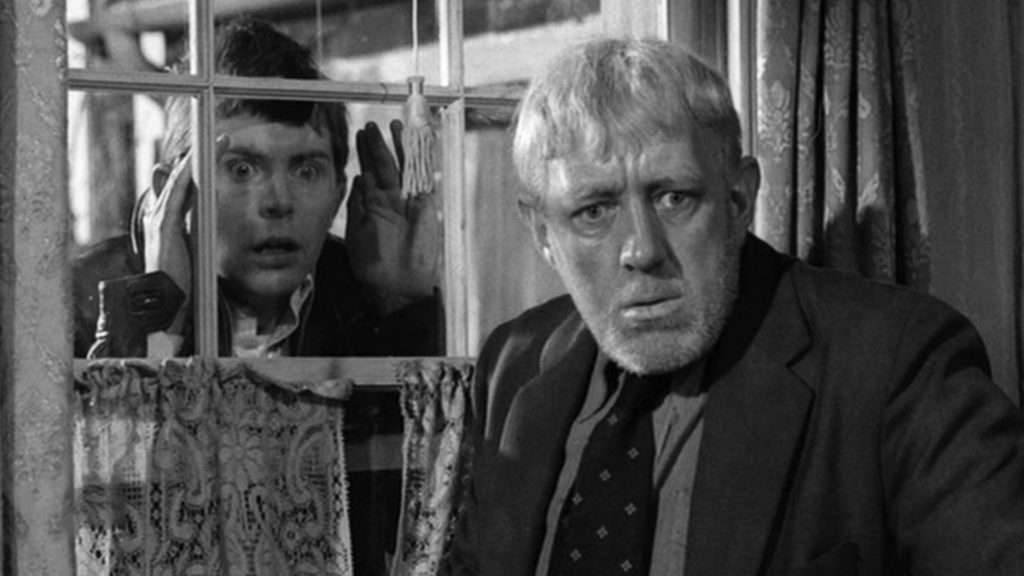
    Many credulous souls are entertained by novels about artists but alas, they’re not true either. The one exception is The Horse’s Mouth, whose author Joyce Cary, like Maugham’s Philip, studied art in Paris but gave it up when he realised he was third-rate. Cary’s anti-hero Gulley Jimson (illustrated, played by Alec Guinness in Ronald Neame’s 1958 film) has the artist’s essential selfishness and ambition to paint masterpieces, but it’s the practicalities – the getting of materials and walls to paint on – that exercise him. There’s no diving into entrails for torturous fruits. Jimson is a desperado, not a fruitcake.

    Of all the novels about art and artists, Cary’s is the only masterpiece. But let’s give the last word to the non-fictional Gauguin: “As you see, everything is serious and ridiculous also. Some weep, others laugh… What is one to do about it? Nothing. All this must be; and, after all, it’s of no consequence. The earth still turns round; everyone defecates; only Zola bothers about it.”

  • Dick French: Art of Jazz, London’s Art Scene

    Dick French

    A curious little book has just come out called The Death of Francis Bacon. The author, Max Porter, won the International Dylan Thomas Prize some time ago. Whenever awards are deployed I always think of Charlotte Rampling who, in her film The Swimming Pool, remarked: “Awards are like haemorrhoids, sooner or later every arsehole gets one.”

    It’s not a very good book. Maybe it was written as a short radio play. However, the author is sound on Bacon’s 20-year decline, which was not so much a decline as a falling off a cliff, about 1970. After that he floundered desperately, grasping at old motifs and habitual tricks, the arrows, the Letraset, the spunk shots … not forgetting the cricket pads. Who could ever?

    Fat Vlad in the Sunday Times writes about the 2017 Soutine show at the Courtauld … “The first and only Soutine exhibition in living memory.” Well, I don’t know how old he is but I vividly remember a splendid Soutine show at the Hayward in the early ’80s. It was enormous and completed banished the effect of all that concrete. Vlad makes much of Soutine’s squalor, the bedbugs in the ear, etc.. But Soutine became successful and quite rich, an elegant hombre about town, if always rather nervous and twitchy. He is supposed to have painted just one nude, part of which is illustrated in his little article. It’s so good I can’t believe that it’s his first. There must be more. Don’t believe everything you read in art books.

    The Carcass of Beef is said to have been a big influence on abstract expressionism. This is nonsense. In spite of the violence of his approach and the seemingly random application of paint, as you look at it you realise that every brushstroke describes form. Look at the dangling stomach sac in the centre, which at first you don’t notice, shiny and translucent, quite sick-making.

    A rather nice book called The Art of Jazz has just come my way. It’s be Alyn Shipton (perhaps he’s Welsh) the chap who says “he…llo” at the start of Jazz Record Requests on the wireless. There are quite a few record covers by Andy Warhol before he became famous. He did them with the aid of an epidiascope before colouring them in.

    Photographs, record covers, paintings and drawings from the old Ragtime syncopaters to the present day… Clearly written it’s a pleasure to read, and such a change from art books. Quite a bit on Cab Calloway, always one of my favourites. A photo of him performing in a white zoot suit is outstanding. He was a major figure in the swing era, although Dizzy Gillespie hated him and once stabbed him in the bum on the bandstand. But it was only a playful jab, half an inch or so. Dizzy needed to improvise but Cab made everyone stick to the score.

    It’s interesting to read about the Los Angeles Zoot Suit Riots of the 1940s. Off-duty servicemen would prowl around looking for ‘hep cats’ to beat up. It was a period of relative austerity in the USA and materials were supposed to be used sparingly. The zoot suit guys liked to flaunt their cloth.

    There is no mention of Louis Jordan in this book which I find odd. He was a major bandleader of the time who also like to flaunt his cloth. Open the Door Richard is one of the earliest tunes I remember. People used to sing it at me all the time. Stanley Kubrick took some photos of the George Lewis band in New Orleans. They were known as the ‘keepers of the flame’ for revivalist jazz. In one of these pictures he entrusts the camera to a local and sits in on the drums.

    And so to the ’60s and London’s New Scene by Lisa Tickner of the Courtauld. I’ve been putting this off because I’m so familiar with the period, and also a little bored with it. But then I never knew much about the financial side of things so I learnt a great deal from this book. Although I’d read Harriet Vyner’s biog Groovy Bob about Robert Fraser I’d forgotten what an arsehole he was. When artists sent him slides he would put them straight in the bin without even looking at them. It was left up to his secretary to rummage them out and send them back with an apologetic letter. Slides were very important in the old days, and very expensive.

    It seems that Kasmin started almost be accident. After wandering into Victor Musgrave’s gallery in Soho he met his wife and became her sex slave. Musgrave didn’t mind and paid Kasmin half a crown a day to get on with it. Looking at the photos I can imagine him dressed as a French maid on all fours with a dustpan and brush, or maybe his duties were more exotic/onerous.

    Eventually Kasmin webbed up with the Marquess of Dufferin and Ava who put up the money for his gallery. Talk about the “Musgrave Ritual”. Nowadays, Kasmin is a dealer in rugs and oriental knick-knacks, a most accomplished spiv.

    What about the art of this era? Revolutionary and vigorous, or thin and forgettable. Edward Lucie-Smith writes: “The public loves artistic virgins, the young artist must in consequence spread his tail, do his little dance, utter a shrill cry, will we look or won’t we? We all know well enough that it is a personality that is on trial, not a collection of works of art.” This is a pretty good evocation of the New Generation exhibitions at the Whitechapel in the mid-’60s. 

    I was all in favour of candy-coloured plastic taking the place of brown lamps. Briefly, it was refreshing. But who wants this stuff nowadays. I imagine a lot of it is in store at various museums but there is a house not far from me on Savernake Road by the overhead railway at the bottom of Hampstead Heath (the unfashionable side) and in the front window they proudly display Philip King’s sculpture Tra La La from the ’65 New Generation show (illustrated). I wonder if King ever read Last Exit to Brooklyn. The playful, optimistic mood of his piece suggests not. Tra La La was a poor Brooklyn tart who ends up being used as a human ashtray. I suppose it was important to get away from all the angst and seriousness of the post-war era, but the angst never really goes away in spite of all the cake-topping.

    Throughout the period it was important to be part of either the homosexual mafia or the Kosher Nostra, a term coined by Leslie Waddington, himself a Jew. Pollock himself was deeply involved with the Manhattan shirtlifters which led of course to his exaggeratedly butch behaviour. But this is a digression.

    The book is interesting until the author gets to the late ’60s with all the protests and sit-ins – the section on Hornsea Art School is tedious in the extreme.

  • Alexander Adams: The Colston Statue Affair

    Alexander Adams

    This article briefly outlines what happened with the toppling of the Edward Colston statue in Bristol, why it happened and its ramifications.

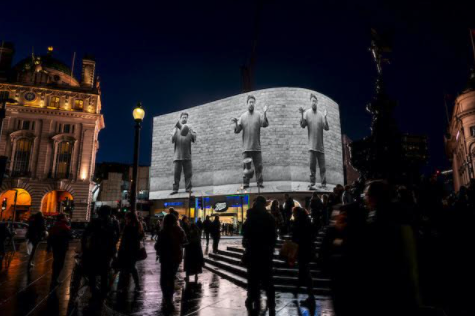
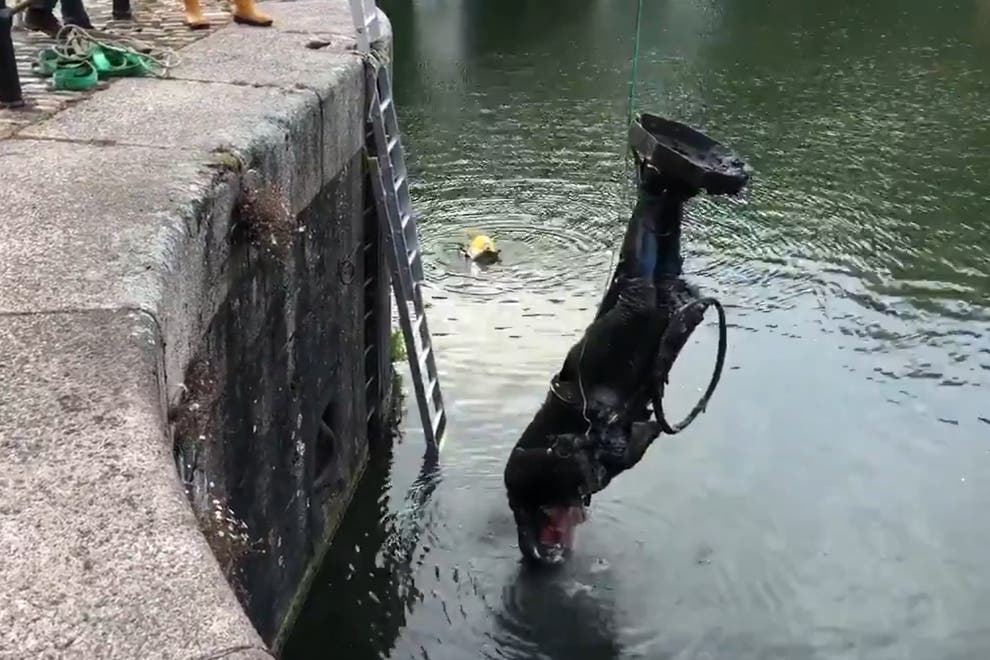
    On 7 June 2020, a large protest took place in the centre of Bristol, ostensibly against racism. The large gathering was in contravention on national and local restrictions on public gatherings due to COVID-19. No dispersal was attempted by police. Some protesters formed a mob that attacked the statue of MP Edward Colston, erected in 1895. It was sprayed with paint, damage and toppled. It was then rolled into the nearby harbour. There were no arrests. The statue was later retrieved by the Council.

    Just as the mob did not detain itself over the personal record of Edward Colston, neither shall we. The heart of the matter is mob violence, threats of violence, vandalism and intimidation. The cause is irrelevant. Ask members of the social-justice mobs that attacked the statues of President Lincoln and Frederick Douglass why they chose those targets and they could not tell you. (A member of the mob that attacked Churchill’s statue in Westminster admitted in a television interview that she “had never met the man”.) The vastness of the mob’s anger is matched only by its ignorance.

    The police watched but did nothing. Apparently, some officers wanted to prevent the attack but were instructed by commanders not to intervene. The mayor was in the police control room. Bristol City Council has long wanted to remove the statue but was not able to force through the political decision. A majority of the polled population of Bristolians opposed removal of the statue. However, the left-wing council and mayor saw the opportunity to use the mob to act on their behalf. Rather than defying authority, the mob was acting in accordance with the wishes of authority in committing this crime and was successful in doing this with the connivance of Council, mayor and police commanders, who all shared a progressive political outlook. The council, which currently has on its website pages the legend #blacklivesmatter, tweeted its approval of the demonstration.

    It was not a statue celebrating slavery. It was not, notwithstanding the hysteria of the defilers, a device for perpetrating or restoring slavery. It was a monument to a respected gentleman, trader, employer, Member of Parliament and benefactor of his home city who happened to be caught up in a legal but ethically reprehensible business. One could not have devised a more perfect embodiment of the moral quagmire that ordinary men and women of good standing became enmeshed within because they were born into a particular era. The individuals that destroyed the statue would, if they had been born three hundred years earlier, have been caught up in exactly the same moral predicament and given it barely a thought. The statue was the ideal tool with which one could teach about how our morals are shaped by our era and how society gives sanction to dubious practices. By destroying the Colston statue, the mob refused to confront the awkward truth it presented: that we are all morally culpable due to the moral constriction of circumstances.

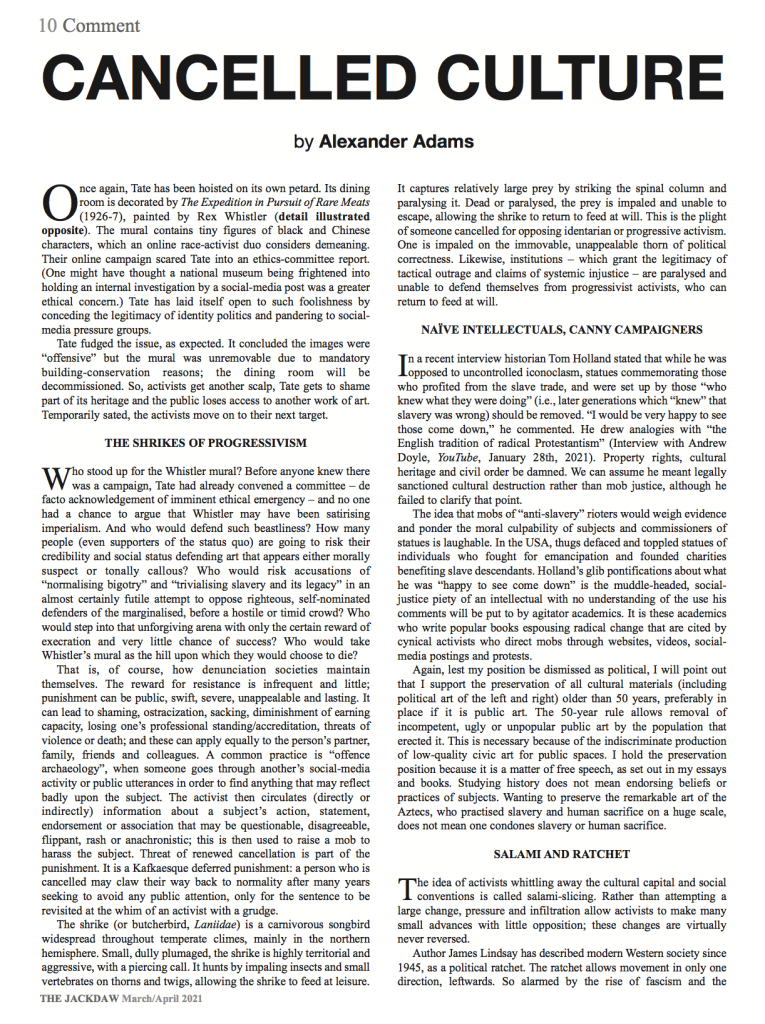
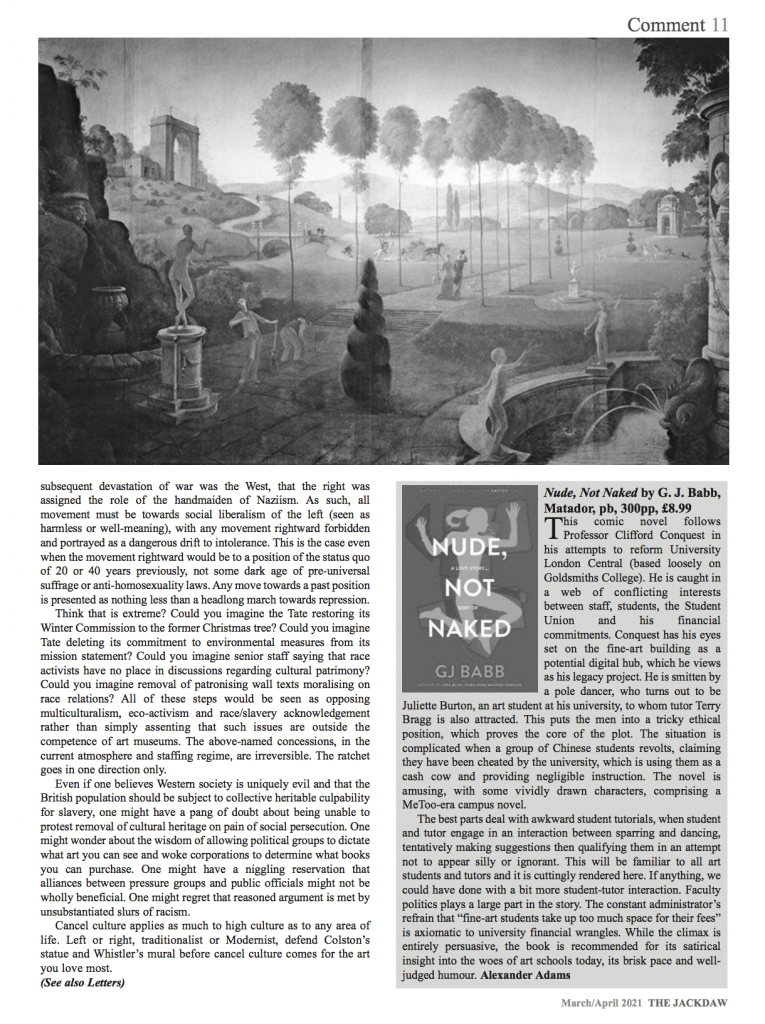
    The following month, serial opportunist Marc Quinn unveiled on the empty plinth without permission a 3D-printed statue of one of the protestors giving a black-power salute. It was taken down after one day. As a sculpture it was a failure – as all one-to-one replications are. (I know because I saw it in person.) It was a chance for a rich, state-supported London artist to wag his finger at Bristolians by (dare one say) colonising the vacant plinth in order to assert his moral superiority. It was half condescending stunt, half replacement tender. While the original Colston statue was a piece of serious artistry and a very handsome piece (see opposite and page 12), the Quinn effort was feeble. However, replacing an accomplished piece of public statuary honouring contributions of an important person with a plastic representation of a protestor who had been duped by local authorities into participating in an act of criminal vandalism is not an inapposite symbol of our era. 

    Collective Guilt

    The justification for destruction of part of the city’s heritage was that the statue celebrated a slaver. I have yet to hear the Council, mayor or protestors condemn the city’s mosques dedicated to a religion founded by a slave-owner. How many of those “anti-slavery activists” have debated Muslim theologians on the tenets that (under some interpretations) countenance slavery today? How many of them wrote letters of protest to the embassies of Chad, Mali and Sudan, where slavery still persists? In truth, there was no “anti-slavery activism” on 7 June; it was a carnival of virtue signalling that culminated in criminal-damage-as-performative-anti-racism.

    If the council puts Colston’s statue in the local museum in its vandalised state as a tourist attraction (rather than returning it to its plinth), I propose they replace it with a memorial to the Atlantic slave trade. Let us have an African slave in chains and with him his African slave-owner. This represents the historical reality that European slavery of Africans relied upon active participation of Africans, who sold to Europeans (and Arabs) prisoners of war, members of other tribes and unwanted members of their own tribes. And slavery wasn’t something only Africans endured – there were many “white” slaves too, including homeless children taken from the streets of London and sent to work in appalling conditions in the Tobacco Plantations in Virginia along with convicts who weren’t all serious felons but were imprisoned because of the consequences of extreme poverty. According to Don Jordan’s book White Cargo: The Forgotten History of Britain’s White Slaves in America, if you were transported from Britain and unlucky enough to end up in a Virginian plantation you could have a red hot bodkin pushed through your tongue before being hanged for stealing a rose from the owner’s garden. It is a must-read book for anyone concerned about Slavery. This portrayal would conflict with those who think in exclusive terms of Westerners as predators and non-Westerners as prey; such a proposal would likely not find favour with Bristol City Council.

    The overriding aim of social-justice activists is to impose upon the population a narrative of inherited collective guilt: white British people (historically and now) are complicit in the unique evils of colonialism and slavery. Thus, all action that collectively punishes this group is acceptable. This includes the destruction of their culture, public humiliation, rote apologies and reparations. None of us (whatever our colour) has experienced slavery or supported it; none of us should be forced to apologise for something our ancestors may (or may not) have approved of. Remember that we are also descendants of people who abolished slavery, forbade it abroad and patrolled the seas to curtail the Atlantic slave trade. Slavery in the Americas under the British took place at a time when there was no universal suffrage and therefore it was not a matter that could be approved of electorally by the British public. After initially participating in slavery abroad, no people ever did more to oppose slavery than the British.

    When a half-educated firebrand lectures you on slavery, ask her what year Britain abolished slavery and you will get no answer. Anti-slavery and anti-racism – in the current forms we see most publicly – are nothing more than excuses for a deep hatred of our society and its founding pillars of tradition, patriotism, capitalism, Christianity and colonialism. Social-justice activists delight in destruction, motivated by moral fervour and burning malice. They are not horrified by racism but secretly delighted, using it as a weapon as against well-meaning ordinary people, getting them to participate in broad coalitions. Activists invent new forms of “institutional/systemic” racism to maintain the illusion that non-racist people are inherently and implicitly racist and thus deserving of the elite’s control and castigation. This is the triumph of the righteous (mainly white) middle-class, university-educated allies of “marginalised minorities” over the hordes of (mainly white) working-class “racist thugs”. It is another manifestation of the class snobbery that refuted – then concealed – the mass rape of children and young women in cities across Britain because they were the “wrong” colour, religion and class.

    It could hardly be clearer than the Communist symbols sprayed on statues to Robert Peel, Churchill and Queen Victoria. Middle-class, university-educated vandals attack patriotic symbols that may not be revered but are widely respected by traditional patriotic, white working-class people. The general sentimental attachment to Baden-Powell, Churchill and Queen Victoria does not entail a complete acceptance of their opinions regarding race but now – in our hyper-charged, social-network-facilitated, emotionally labile cancel culture – accusations are enough to get a person or artefact removed from the public square. Cancel-culture definitions are ever expanding, ever changing, never appealable, never reversible. Offence-taking is used insincerely and tactically to claim territory (via cancellation) and to put people on the defensive; this process intimidates the majority, who become fearful, silent and compliant.

    Take a look at the hundreds of thousands of published pages and hours of lectures/speeches delivered by professionals in education and you will encounter a distorting mirror universe of social justice, where minorities in the West live hunted lives and ordinary social interaction are atrocities upon their dignity. This is a frighteningly alien world where there is talk of “human beings/Brown skins/Black bodies/marginalised voices” because to use the word “people” admits the possibility of a plurality of experiences, lives, viewpoints, tastes, wealth and politics. Social-justice activists literally talk of “skins” as if they were big-game trophy hunters. For activists, the “Black experience” is uniformly monolithic, invariably oppressed, irrefutably one of suffering; it is a narrative they use for material gain and political advantage. 

    What we can do?

    Do you think that taking down statues of Rhodes and Colston will satisfy activists or just encourage them? When actions are not goal-focused, limited and pragmatic but instead a hubristic religious crusade driven by spite and utopianism then they will be unremitting. When you have been trained by school, university and media to believe your society is founded upon injustices of slavery, rape and genocide of other peoples, then no price is too high and no reparations will suffice. Do you think that your culture is safe in the hands of groups which think this way? If these activists – so pliant, so poorly informed, so easily moved to incontinent fury – undeniably forgo empathy for people of the past, can they tolerate contradiction by the living?

    In these pages you will read of the onslaught on historical monuments and cultural artefacts committed by zealots, mainly in the USA. The events of this summer will not end in autumn; they have only just started. All across Britain, there are moves to destroy our culture, especially in London under the direction of the mayor. We must retain our statues. Even if they commemorate individuals we do not agree with, their presence reminds us of how our society has changed. How can we state that slavery was once acceptable if we have erased all public traces of it? Isn’t such action opening the doors to tomorrow’s conspiracy theorists? Either way, erasing history is not a practice that ends well for anyone. 

    Across the country, hectoring agitators, paid lobbyists, obsessive cranks and cynical politicians are (through legal means) attempting to remove public art that belongs to you. Defend physical culture by getting involved. Share this article. Subscribe to The Jackdaw and The Critic. Attend council meetings. Sign petitions. A website to monitor threats to public monuments and co-ordinate resistance is at www.saveourstatues.org.uk. Visit and share it; consider contributing.

    Should anyone think me partisan on this, I remind him/her that I have publicly deplored dismantlement of the Palast der Republik in Berlin, removal of GDR murals and statues, wrote in favour of many architectural projects in Communist countries and currently oppose removal of statues to Marx in the UK. Regardless of whatever you may assume my beliefs to be, I trust even critics will concede it would be misrepresentation to claim I have not consistently defended free expression and opposed iconoclasm. If you believe in these principles, I invite you to do the same and act, especially locally. Apathy and inaction will result in your culture being controlled and the history of your nation (good and bad) being erased.

    Alexander Adams’s book Iconoclasm, Identity Politics & the Erasure of History is published by Imprint Academic on 6 October.

  • William Varley: Art: Cool and Uncool

    William Varley reviews Addicted to Sheep

    So, as all cool sentences begin, I think that the best TV programme I saw last was Addicted to Sheep. In many ways this BBC4 documentary was reminiscent of the French film Être et Avoir about a remarkable teacher in a school in the remote Auvergne, although a good deal less winsome. It focused on the lives of the Hutchinson family, tenant farmers in Upper Teesdale. In their remote valley ewes are called “yowes” and at the children’s school they still sing “There is a green hill far away”. The Hutchinson children help with the lambing, including the gruesome task of dealing with still-born lambs.

    What is so admirable about them is that they have an uncomplaining, unflinching attitude to a life that is harsh and elemental. I doubt whether they have recently visited their nearest gallery, the Bowes Museum at Barnard Castle, or the Baltic at Gateshead. I also suspect that the issues which so exercise the post modern, post Christian urban élites: multiculturalism, egalitarianism, transnational progressivism (no borders), environmentalism, feminism and the rest of that plethora of right-on attitudes, don’t preoccupy them. For a start, they don’t have the time. Without wishing to patronise them, they probably believe that the acronym L.G.B.T. stands for a brand of sheep dip. All of this, in the opinion of the ‘enlightened’, particularly art world instrumentalists, makes them seriously uncool.

    How does one define ‘cool’? There are still people around who think that it’s a gently meandering style of jazz, but most of us know that it’s simply a matter of a self-appointed élite determining what is acceptable and unacceptable. It’s a phenomenon which transcends ages and classes, from the tiny tyrant berating her parents for not recognising the world significance of ‘One Direction’ to the State Art apparatchik wincing as he patiently fields one’s less than enthusiastic reaction to a ‘challenging’ new installation. In Jonathon Rose’s brilliant book, The Intellectual Life of the British Working Classes, the anthropologist Mary Douglas describes it thus:

    Art trends may have as brief a shelf life as stock exchange trends, and they depreciate rapidly if one fails to catch the latest wave in architecture, or literary theory. The names that Bohemia adopted for itself – avant-garde, advanced, progressive, le dernier cri, new wave, cutting edge, modernist, postmodernist – all reflect the Anxiety of Cool, the relentless struggle to get out in front and control the production of new cultural information. Bohemia is ‘subversive’ only in that it seeks to wean consumers away from older cultural products in order to sell them new ones.

    That description is one of brash economics but, of course, we’re all familiar with the broader pattern of Cool, the Godfather of which is Marcel Duchamp.

    Ad Reinhardt once remarked that all artists had to make a choice between Mondrian and Duchamp, between advocates of the hand- made, and those of the ready-made. As Jackdaw readers know, Duchamp, asserting that all art was mere taste, allegedly exhibited a urinal under the title of Fountain at the Armory Show in New York in 1913. Actually, as Jackdaw readers also know, that anarchic gesture was performed by one of his girlfriends as the Armory Show was ‘unselected’. Still, as someone who was intoxicated by word-play, puns and conceits, he was the epitome of the intellectual dandy. Apparently effortlessly, he invented kinetic art, optical art, conceptual art, and his great hermetic narrative, The Large Glass. Consolidating these innovations he left to allegedly mediocre followers.

    His biographer Robert Lebel wrote that he regarded the ready-mades as sacralisation or transubstantiation. (How God-like is that?) However, “His real motive with them was to depreciate our ordinary and tacitly accepted notions of value in order to exalt the strictly private and sovereign choice which is accountable to no one. With the ready-mades”, said Lebel, “he meta-ironically demonstrated his incontestable power to be TAKEN AT HIS OWN WORD which is the unmitigated artist’s privilege.” You can see where that gets us: art is anything you say it is, a situation that leads inexorably to the empty stunts of the Turner Prize and the vulgar extravagances of the Pinault Collection. Still, for his loyal disciples in the State Art Establishment his reputation is unassailable. There have been notable heretics from the general orthodoxy though. In his book The Banquet Years, examining the pioneering days of Modernism, Roger Shattuck remarked that Duchamp’s strategy of ‘nominating’ useful objects to art status was “essentially self-consuming, a reversion to dead level after an initial shock.” More recently, in The Winter of our Culture, Jean Clair (real name Gérard Régnier) the former Director of the Picasso Museum in Paris, described Duchamp’s Armory Show as “works of provocation and derision presented by a cynical dandy”.

    The High Priestess of Cool was, of course, Susan Sontag. During the ’60s and ’70s she was the doyenne of American intellectuals and in her seminal book Against Interpretation, she issued two decrees that in retrospect seem to have underpinned the visual art that developed afterwards. Attacking the discrimination between hierarchies of art as ‘philistine’, she effectively substituted a plateau view of culture for the existing pyramidal order. 

    Henceforth, there was to be no qualitative distinction to be made between high and popular culture, art and entertainment. In this scenario, Elvis Presley could give Mozart a friendly wave across a level playing field. The ‘dumbing down’ consequences of this were, of course, appalling and eventually she could see it. She died 12 years ago, but shortly before her death she condemned ‘the triumph of a pernicious relativism.’

    I am not prepared to say the satisfactions derived by art are no different structurally, in context, or in quality or in importance, from other kinds of satisfactions. I am not prepared to think that the satisfaction I might get in front of a Chardin, a Vermeer or a Vuillard is in any way similar to the satisfaction I would get watching a beautifully pitched baseball or inspecting a shoe collection.

    Her recantation was welcome, but it was too little, too late: the damage to the impermeability of high culture had already been done.

    The other hugely influential aspect of her ‘new sensibility’ was the idea (echoing Matthew Arnold perhaps) that art should concern itself with the moral criticism of life and be used as ‘a tool for changing consciousness’. Whether or not her writings were the cause or whether the true believers in an art for use developed their own ideology, in subsequent decades a veritable deluge of issues appeared. They mostly consisted of that left liberal menu of Goodthink favoured by the BBC that I’ve already mentioned: multiculturalism etc.. They are very useful for ‘virtue signalling’. “Let’s do the Holocaust”, artists would say, “or perhaps child abuse”. This is empty posturing, a bit like wearing Aids ribbons. It’s also about as far removed from Kathe Kollwitz’s nightmare visions as it’s possible to be. As the wife of a Berlin doctor Kollwitz knew poverty and illness at first hand. Her emotion was earned, not affected. Still, quangocrats and councillors who dole out funding love emotional incontinence. Current affairs and politics are things they can understand: the structural music of painting invariably remains a mystery to them. And insofar as they reinforce the fallacy that visual art is simply a medium or receptacle of a socio-political statement, it’s a godsend to those media hacks deputed to discuss them.

    Some issues, however, are so uncool that they’re off limits. Take the case of Kamel Daoud, for instance. This distinguished Algerian (Muslim) novelist wrote an article in Le Monde in late January denouncing the wave of sexual assaults that had occurred during Cologne’s New Year’s Eve celebrations. He didn’t temporise, calling the assailants Muslim men:

    The refugee-immigrants come from the vast universe of sorrow and horror which is the sexual misery of the Arab-Muslim world. The subjugation of women is the psychological Gordian knot at the core of the world of Allah, and hence the inspiration of the death cult that claims to defend it.

    You can easily guess the reaction to that: an academic fatwa; and erstwhile friends telling him, with the greatest kindness, to stick to writing novels and, politically, to shut up. Our politicians, of course, favour the ‘Religion of Peace’ narrative and as far as our art world is concerned, in contrast to the scathing visual indictments of Abu Ghraib how many denunciations of suicide, bombings, jihadist beheadings and the like can you think of? None? I can think of one. A couple of years ago in an exhibition in Rome I saw a small black singlet in the form of a hijab presented by the Egyptian feminist Ghada Amer. Unsurprisingly she now lives in New York.

    Another aspect of cool is the cult of novelty. I remember Lawrence Gowing back in the ’60s presenting the imperative to many young artists “to make it new”. At the time it worried me, being far too prescriptive. As someone who believes that originality should be involuntary rather than willed, I would have advised “Make it good”. Giles Auty in The Jackdaw was scathing in identifying the ‘novelty trap’ in which ‘ism’ inexorably succeeds ‘ism’ and thereby invalidates its predecessor. (Auty estimated that about 40 ‘isms’ occurred in the 20th century, each having about 2.25 years of life.) In his irreverent article he suggested that, according to the novelty narrative, “western art should be read as a kind of art-historical relay race which culminates in the death of painting … because there are no more apparent avenues left to explore”, a process which he maintained was “both spurious and infantile”. Astutely, he demonstrated how the art world had hijacked from science the rhetoric of progress with the consequence that anyone who refused to embrace it was certifiably reactionary and uncool. Of course there are some exceptional exponents of hybrid media such as the prodigious William Kentridge, but the strategy of State Art is to impose novelty on a baffled public. Amongst that public there are some blasphemers, though. The late Henning Mankell believed that “One of the tasks of art is to provide people with companions. I have seen people in paintings who I hope to meet in the street one of these days…” How uncool can you get? The Scottish prose-poet Nan Shepherd, ‘married’ one might say, to the Cairngorms, had a similar capacity for empathy. The ‘technoscape’ may be cool but engaging with actual landscape is extraordinarily rewarding. Like Wordsworth in The Prelude, she believed that “sustained contemplation of outer landscapes led to a subtle understanding of the spirit.” Her attitudes correspond almost exactly with those of several painters I respect. All of her senses were engaged when experiencing landscape and art, of course, should be enjoyed through the senses. She could smell the rain: so could Constable. (Those experiences and spiritual rewards are also shared by the Hutchinsons.)

    When I reflect on State Art’s prioritising of novelty, however, I recall Andrew Brighton’s observations in Consumed by the Political in which he said, “The propagating of serious art amongst people who are relatively uneducated is an act of cultural aggression” and, emphasising the underlying totalitarianism of this ostensibly generous agenda suggested that, “The idea that people without art are lesser or inferior beings is a ridiculous assumption, a piece of moral vanity akin to a religionist’s belief that only those of their faith or sect are capable of real virtue.”

    Hard it may be for the quangocrats to grasp this, but there are thousands of people who live happy, fulfilled lives entirely without art. The irony is that the attempt of the Kulturkampf to dragoon people into an involvement with art is founded more upon a campaign of exclusion rather than inclusion. But to return to the Hutchinsons. My lingering image of the Addicted to Sheep documentary is of their eldest daughter, about 10 years old, sitting in the landscape making a painting by using her eyes – and making a pretty good fist of it (above). All is not lost.

  • Charles Thomson: Lies, Damned Lies and Serota at the BBC

    Charles Thomson

    Sir Nicholas Serota, director of the Tate Gallery, has used the platform of the BBC in a blatant attempt to deceive the nation. Either that or he is genuinely deluded himself. Both options render him unfit for major public office.

    He was confronted on Radio 4 programme The Reunion: Tate Modern on September 23rd by Sue MacGregor, regarding the Tate’s purchase in 2005 of its trustee Chris Ofili’s work The Upper Room. She observed with wry understatement, “The Charity Commission said you didn’t quite follow the rules here.”

    In 2006, as the BBC then reported, Charity Commission chief executive Andrew Hind said there were “serious shortcomings … In any charity we would be concerned that such basic matters were neglected, but in a charity of the size and stature of the Tate we are very disappointed.”

    The Guardian expounded, “The Tate has broken the law … By law, trustees cannot receive monetary benefit from their charity without express permission, usually from the commission. The Tate failed to seek permission … The Charity Commission’s full recommendations and criticisms, laid out in a lengthy document, also said the Tate failed to manage conflicts of interest … Failed to seek independent valuation of works by artist-trustees … Had no defined policy relating to purchases from artist-trustees … Had insufficiently clear acquisition policies … Kept insufficient records of trustee meetings.”

    The Daily Telegraph called this verdict “one of the most serious indictments of the running of one of the nation’s major cultural institutions in living memory”.

    “After an in-depth review lasting ten months by the Commission”, stated The Times, Serota “accepted the criticisms” and “was genuinely contrite”. The Evening Standard confirmed, “Sir Nicholas said today he accepted all the Charity Commission’s findings”.

    In stark contrast, his response to Sue Macgregor ten years later was an astonishing and shameless attempt to hoodwink the nation and evade blame with a trivialising revisionism that implied gross misconduct by the Charity Commission. To the supportive laughter of his entourage on the programme, Serota declared smoothly – as if it were established fact – the evasive nonsense, “The rules of course were invented after we had flouted them.”

    Serota has a history of obfuscation, whether lies, half-truths, delusions, evasions or omissions. In 2004, he applied for a grant from the Art Fund towards the purchase of The Upper Room. He signed a form saying that there had been no prior commitment to the purchase of the work (a condition of funding). Thanks to journalist Chris Hastings and the Freedom of Information Act, it was revealed that, eight months prior to the application, the Tate had paid a £250,000 deposit. Serota blamed it on “a failing in my head”.

    In 2005, I was quoted in The Observer: “Serota, as the director, chooses the trustees, and the trustees are then responsible for reappointing the director. The director then buys the trustees’ work.” In 2008, this was brought up in Varsity (the Cambridge Student Newspaper), where Serota defended himself with another flagrant falsehood: “I don’t have any part to play in their appointment.”

    The September 2005 Tate board minutes state: “The Director [Serota] reported that two strong candidates were to be interviewed for the position of Artist Trustee by a panel comprising himself, Paul Myners and the Independent Assessor.” In the May 2007 minutes, another trustee interview is on record with a panel of three trustees, the independent assessor and Serota. 

    The Board of Trustees of the Tate Gallery Annual Accounts 2005-2006, 2006-2007, 2007-2008, and 2008-2009 all say in the section on trustees: “The key stages of the appointment are overseen by a panel, which will normally include the Director.”

    Also in Varsity, Serota said about the trustees, “Why would I want to win their support?” The simple answer to that is that he is their employee, as he explained in 1993 in the Independent on Sunday, when he hoped to be appointed for a second seven-year term as Tate Director: “Tate trustees fall in and out of love with their director and I’ll only discover whether they have fallen out of love with me in 1995 when they discuss my contract … The jury’s out.”

    On the Radio 4 programme, MacGregor confronted Serota about an event in October 2003 that became public the following year, namely “that Charles Saatchi offered you his entire collection … it was worth 200 million – for nothing.” Serota denied this: “I wish he had … he did have a great collection. Sadly he never did offer it to us.”

    This response is consistent with Serota’s version to the press in 2004, when he said that Saatchi’s offer was not for a gift but for a loan of work, which he (Serota) immediately rejected (none of which was mentioned to MacGregor).

    Surprisingly, Serota’s reply was immediately contradicted on the programme by former Tate trustee, Michael Craig-Martin, who admitted there had in fact been an offer of work: “Unfortunately what was offered to the Tate was not the great collection with the great things in it, most of which were already gone by that time. They had been sold by that time.”

    As it happens, that is incorrect. At the time of the offer in 2003, Saatchi still had in his collection iconic Brit art works, including Damien Hirst’s shark, Tracey Emin’s bed, Rachel Whiteread’s plaster cast of a room, Mark Quinn’s head made from frozen blood, Sarah Lucas’s table with two fried eggs and a kebab, Marcus Harvey’s Myra Hindley painting with children’s hand prints, Ron Mueck’s sculpture of his dead father, the Chapman’s penis-nosed mannequins and Chris Ofili’s Virgin Mary painting with elephant dung.

    Serota continued about Saatchi: “Michael [Craig-Martin] and I with Janet De Botton spent a great deal of time in the late nineties trying to persuade him to give, not his collection, but maybe ten works from his collection as a founding collection for Tate Modern. But I’m afraid he didn’t feel for one reason or another able to do that.”

    This is obviously another failing in Serota’s head. In 2004, the Evening Standard reported that in 1998, “Saatchi offered 86 works by 57 British artists – including Langlands & Bell, Turner Prize winner Martin Creed and Glenn Brown” (as well as Richard Billingham, Richard Wilson and Chantal Joffé). A Tate spokeswoman confirmed the offer of 86 works, which were rejected as “The trustees felt on this occasion the works would be better suited in a collection elsewhere.” 

    Regarding The Upper Room scandal, Christopher McCall QC wrote to the press in 2005 condemning “expediency … which has an appeal to an overbearing executive”. The Times said of the Tate: “If it had been a company, the verdict would have sent shareholders into a panic.” No doubt if it had been a government, resignations or sackings would have followed the public outcry. Surely we have the right to expect the same standards across the board in public life, including the arts.

    Serota has not displayed a level of behaviour and integrity to remain a figurehead and step into another prime position as Chairman of the Arts Council. His record is tarnished and far from admitting to his mistakes, he has the blinkered arrogance to pretend they never happened.

    We need leaders who do not have recurrent failings in their head.

  • Giles Auty: Money Culture Notes

    Giles Auty

    This was the last piece Giles submitted to The Jackdaw. He died suddenly in September, aged 86.

    It’s all about the money honey. When I awoke to see the front cover of the weekend Australian’s review section on June 20th it was rather like being thrown back into some weird and most unwelcome dream. Did I really read “POLE POSITION: up close with Pollock’s $430 million masterpiece by Rosemary Neill?”

    Regrettably I did. Should we also bring back Gough Whitlam if we could? Sadly he’s as deceased as the inflated reputation of Blue Poles really ought to be. But what the hell? Ever heard of Clement Greenberg a leading critic of Pollock’s day and Pollock’s most consistent supporter? Clearly not because we have Greenberg’s word that Pollock considered Blue Poles a failure while Greenberg himself thought Blue Poles “an absolute failure and a ridiculous thing to buy”.  (See Patricia Anderson’s biography of Elwyn Lynn my predecessor as art critic at The Australian). On the basis of the definitive exhibition of Pollock’s work I saw at the Tate Gallery in London in 1999 there were quite a few better Pollocks than Blue Poles. But they are not in Australia so cannot possibly be as good.  In April 2006 I wrote a 4,000 word essay for Quadrant which dispelled the miasma of nonsense which continues to surround this entire subject. But Australia will sadly never grow up in some ways, which is why we lag behind so markedly in terms of our whole culture. That essay forms part of a 50 piece anthology of my writing Culture at Crisis Point (Connor Court 2016) if you feel inclined to dig it up. The man who actually flogged Blue Poles to the then Australian National Gallery, New York-based Australian Max Hutchinson, proposed that Blue Poles along with Picasso’s Guernica and Monet’s Waterlilies is one of the five or six great works of art painted since the Renaissance. So what other pair of works might Mr. Hutchinson have picked to make up his handy half dozen?

    The task of choosing between the lifetime productions of the likes of Caravaggio, Velazquez, Rembrandt, Vermeer, Tiepolo, Goya, van Gogh, Manet, Matisse and Picasso – to name but a handy ten – would be a daunting one even for someone who knows the complete works of all ten quite intimately. God alone knows what students are taught on art history courses these days even if such courses still exist. The National Gallery of Australia has a very poor record even in more recent times in its purchasing; for example, it made a colossal error of judgment in buying David Hockney’s very weakly conceived A Bigger Grand Canyon – and paying an inflated price for it  (over A$ 4 million) when it could have bought Australian William Robinson’s even bigger and infinitely more accomplished Creation Series: The Ancient Trees for $250,000. I was prepared to put myself in serious debt to buy the latter but lost out to a Sydney doctor who very wisely snapped it up and built a special room to house it.

    I have never of course served on the board of any public gallery in Australia although prior to coming here I reviewed art in more than a score of different countries. Rhetoric as we know describes language designed to persuade and impress. Its natural habitat is politics and advertising but in both of those fields long acquaintance has persuaded intelligent minds to recognize its nature and dilute its effectiveness. Regrettably the toxicity of such language still has a fatal effect in areas where the ubiquity of its use remains unrecognized. In no area is this truer than the visual arts. The 20th century, which was dominated by 

    Modernism, saw the rise and fall of about 40 readily identifiable and significant art movements in the Western world alone. Can there really have been an art movement for every two-and-a-bit years of an entire century?  But who can even begin to tell you what Orphism, say, or Rayonism were? Yet many people believed that both were vital art historical movements. So why have we shown such a continued obsession with novelty?

    Right from word go Modernism liked to portray itself as a liberating force but was never anything of the kind. Sadly all too many made a naïve connection between what was happening in art and the genuine breakthroughs which were happening in technology.  And art very cleverly annexed a similarly favourable rhetorical language. In short to situate yourself on the side of ‘progress’, ‘advance’, ‘evolution’ and ‘experimentation’ was to grab a positive propagandist language by the throat. Like Pollock, many artists are not especially bright or literate and evidence exists that if Pollock had not effectively killed himself (and someone else) when drunk he would have reverted to more of a directly surreal way of working.

    Blue Poles is the sole work by Pollock most Australians will ever see so all rely on writers such as Rosemary Neill to put the work in some realistic context. $430 million did you say? Australia is a money-conscious country which has yet to educate itself in any other form of evaluation. The real reward of very good art is inherent because true artists are not bankers and do not think as such. In days when I wrote for The Australian I was hauled before the editor for describing Australian culture as ‘rather less than effervescent’ in another publication. In a recent issue of The Spectator James Delingpole, whom I know, talks of his growing affection for Australia. I came to Australia a quarter of a century ago with very similar feelings and resisted an invitation from the then Spectator owner Conrad Black to return home. For a country of its size Australia has performed very poorly in terms of almost any sort of culture and the example set by official bodies such as our museums for sure do not help. Rosemary Neill’s article on Pollock takes a long step backwards which we can all really do without but will surely not cost her her job.