Category: Comment

  • Art: Cool and Uncool – William Varley Reviews Addicted to Sheep

    So, as all cool sentences begin, I think that the best TV programme I saw last was Addicted to Sheep. In many ways this BBC4 documentary was reminiscent of the French film Être et Avoir about a remarkable teacher in a school in the remote Auvergne, although a good deal less winsome. It focused on the lives of the Hutchinson family, tenant farmers in Upper Teesdale. In their remote valley ewes are called “yowes” and at the children’s school they still sing “There is a green hill far away”. The Hutchinson children help with the lambing, including the gruesome task of dealing with still-born lambs.

    What is so admirable about them is that they have an uncomplaining, unflinching attitude to a life that is harsh and elemental. I doubt whether they have recently visited their nearest gallery, the Bowes Museum at Barnard Castle, or the Baltic at Gateshead. I also suspect that the issues which so exercise the post modern, post Christian urban élites: multiculturalism, egalitarianism, transnational progressivism (no borders), environmentalism, feminism and the rest of that plethora of right-on attitudes, don’t preoccupy them. For a start, they don’t have the time. Without wishing to patronise them, they probably believe that the acronym L.G.B.T. stands for a brand of sheep dip. All of this, in the opinion of the ‘enlightened’, particularly art world instrumentalists, makes them seriously uncool.

    How does one define ‘cool’? There are still people around who think that it’s a gently meandering style of jazz, but most of us know that it’s simply a matter of a self-appointed élite determining what is acceptable and unacceptable. It’s a phenomenon which transcends ages and classes, from the tiny tyrant berating her parents for not recognising the world significance of ‘One Direction’ to the State Art apparatchik wincing as he patiently fields one’s less than enthusiastic reaction to a ‘challenging’ new installation. In Jonathon Rose’s brilliant book, The Intellectual Life of the British Working Classes, the anthropologist Mary Douglas describes it thus:


    Art trends may have as brief a shelf life as stock exchange trends, and they depreciate rapidly if one fails to catch the latest wave in architecture, or literary theory. The names that Bohemia adopted for itself – avant-garde, advanced, progressive, le dernier cri, new wave, cutting edge, modernist, postmodernist – all reflect the Anxiety of Cool, the relentless struggle to get out in front and control the production of new cultural information. Bohemia is ‘subversive’ only in that it seeks to wean consumers away from older cultural products in order to sell them new ones.


    That description is one of brash economics but, of course, we’re all familiar with the broader pattern of Cool, the Godfather of which is Marcel Duchamp.

    Ad Reinhardt once remarked that all artists had to make a choice between Mondrian and Duchamp, between advocates of the hand- made, and those of the ready-made. As Jackdaw readers know, Duchamp, asserting that all art was mere taste, allegedly exhibited a urinal under the title of Fountain at the Armory Show in New York in 1913. Actually, as Jackdaw readers also know, that anarchic gesture was performed by one of his girlfriends as the Armory Show was ‘unselected’. Still, as someone who was intoxicated by word-play, puns and conceits, he was the epitome of the intellectual dandy. Apparently effortlessly, he invented kinetic art, optical art, conceptual art, and his great hermetic narrative, The Large Glass. Consolidating these innovations he left to allegedly mediocre followers.

    His biographer Robert Lebel wrote that he regarded the ready-mades as sacralisation or transubstantiation. (How God-like is that?) However, “His real motive with them was to depreciate our ordinary and tacitly accepted notions of value in order to exalt the strictly private and sovereign choice which is accountable to no one. With the ready-mades”, said Lebel, “he meta-ironically demonstrated his incontestable power to be TAKEN AT HIS OWN WORD which is the unmitigated artist’s privilege.” You can see where that gets us: art is anything you say it is, a situation that leads inexorably to the empty stunts of the Turner Prize and the vulgar extravagances of the Pinault Collection. Still, for his loyal disciples in the State Art Establishment his reputation is unassailable. There have been notable heretics from the general orthodoxy though. In his book The Banquet Years, examining the pioneering days of Modernism, Roger Shattuck remarked that Duchamp’s strategy of ‘nominating’ useful objects to art status was “essentially self-consuming, a reversion to dead level after an initial shock.” More recently, in The Winter of our Culture, Jean Clair (real name Gérard Régnier) the former Director of the Picasso Museum in Paris, described Duchamp’s Armory Show as “works of provocation and derision presented by a cynical dandy”.

    The High Priestess of Cool was, of course, Susan Sontag. During the ’60s and ’70s she was the doyenne of American intellectuals and in her seminal book Against Interpretation, she issued two decrees that in retrospect seem to have underpinned the visual art that developed afterwards. Attacking the discrimination between hierarchies of art as ‘philistine’, she effectively substituted a plateau view of culture for the existing pyramidal order. Henceforth, there was to be no qualitative distinction to be made between high and popular culture, art and entertainment. In this scenario, Elvis Presley could give Mozart a friendly wave across a level playing field. The ‘dumbing down’ consequences of this were, of course, appalling and eventually she could see it. She died 12 years ago, but shortly before her death she condemned ‘the triumph of a pernicious relativism.’

    I am not prepared to say the satisfactions derived by art are no different structurally, in context, or in quality or in importance, from other kinds of satisfactions. I am not prepared to think that the satisfaction I might get in front of a Chardin, a Vermeer or a Vuillard is in any way similar to the satisfaction I would get watching a beautifully pitched baseball or inspecting a shoe collection.

    Her recantation was welcome, but it was too little, too late: the damage to the impermeability of high culture had already been done.

    The other hugely influential aspect of her ‘new sensibility’ was the idea (echoing Matthew Arnold perhaps) that art should concern itself with the moral criticism of life and be used as ‘a tool for changing consciousness’. Whether or not her writings were the cause or whether the true believers in an art for use developed their own ideology, in subsequent decades a veritable deluge of issues appeared. They mostly consisted of that left liberal menu of Goodthink favoured by the BBC that I’ve already mentioned: multiculturalism etc.. They are very useful for ‘virtue signalling’. “Let’s do the Holocaust”, artists would say, “or perhaps child abuse”. This is empty posturing, a bit like wearing Aids ribbons. It’s also about as far removed from Kathe Kollwitz’s nightmare visions as it’s possible to be. As the wife of a Berlin doctor Kollwitz knew poverty and illness at first hand. Her emotion was earned, not affected. Still, quangocrats and councillors who dole out funding love emotional incontinence. Current affairs and politics are things they can understand: the structural music of painting invariably remains a mystery to them. And insofar as they reinforce the fallacy that visual art is simply a medium or receptacle of a socio-political statement, it’s a godsend to those media hacks deputed to discuss them.

    Some issues, however, are so uncool that they’re off limits. Take the case of Kamel Daoud, for instance. This distinguished Algerian (Muslim) novelist wrote an article in Le Monde in late January denouncing the wave of sexual assaults that had occurred during Cologne’s New Year’s Eve celebrations. He didn’t temporise, calling the assailants Muslim men:

    The refugee-immigrants come from the vast universe of sorrow and horror which is the sexual misery of the Arab-Muslim world. The subjugation of women is the psychological Gordian knot at the core of the world of Allah, and hence the inspiration of the death cult that claims to defend it.

    You can easily guess the reaction to that: an academic fatwa; and erstwhile friends telling him, with the greatest kindness, to stick to writing novels and, politically, to shut up. Our politicians, of course, favour the ‘Religion of Peace’ narrative and as far as our art world is concerned, in contrast to the scathing visual indictments of Abu Ghraib how many denunciations of suicide, bombings, jihadist beheadings and the like can you think of? None? I can think of one. A couple of years ago in an exhibition in Rome I saw a small black singlet in the form of a hijab presented by the Egyptian feminist Ghada Amer. Unsurprisingly she now lives in New York.

    Another aspect of cool is the cult of novelty. I remember Lawrence Gowing back in the ’60s presenting the imperative to many young artists “to make it new”. At the time it worried me, being far too prescriptive. As someone who believes that originality should be involuntary rather than willed, I would have advised “Make it good”. Giles Auty in The Jackdaw was scathing in identifying the ‘novelty trap’ in which ‘ism’ inexorably succeeds ‘ism’ and thereby invalidates its predecessor. (Auty estimated that about 40 ‘isms’ occurred in the 20th century, each having about 2.25 years of life.) In his irreverent article he suggested that, according to the novelty narrative, “western art should be read as a kind of art-historical relay race which culminates in the death of painting … because there are no more apparent avenues left to explore”, a process which he maintained was “both spurious and infantile”. Astutely, he demonstrated how the art world had hijacked from science the rhetoric of progress with the consequence that anyone who refused to embrace it was certifiably reactionary and uncool. Of course there are some exceptional exponents of hybrid media such as the prodigious William Kentridge, but the strategy of State Art is to impose novelty on a baffled public. Amongst that public there are some blasphemers, though. The late Henning Mankell believed that “One of the tasks of art is to provide people with companions. I have seen people in paintings who I hope to meet in the street one of these days…” How uncool can you get? The Scottish prose-poet Nan Shepherd, ‘married’ one might say, to the Cairngorms, had a similar capacity for empathy. The ‘technoscape’ may be cool but engaging with actual landscape is extraordinarily rewarding. Like Wordsworth in The Prelude, she believed that “sustained contemplation of outer landscapes led to a subtle understanding of the spirit.” Her attitudes correspond almost exactly with those of several painters I respect. All of her senses were engaged when experiencing landscape and art, of course, should be enjoyed through the senses. She could smell the rain: so could Constable. (Those experiences and spiritual rewards are also shared by the Hutchinsons.)

    When I reflect on State Art’s prioritising of novelty, however, I recall Andrew Brighton’s observations in Consumed by the Political in which he said, “The propagating of serious art amongst people who are relatively uneducated is an act of cultural aggression” and, emphasising the underlying totalitarianism of this ostensibly generous agenda suggested that, “The idea that people without art are lesser or inferior beings is a ridiculous assumption, a piece of moral vanity akin to a religionist’s belief that only those of their faith or sect are capable of real virtue.”

    Hard it may be for the quangocrats to grasp this, but there are thousands of people who live happy, fulfilled lives entirely without art. The irony is that the attempt of the Kulturkampf to dragoon people into an involvement with art is founded more upon a campaign of exclusion rather than inclusion. But to return to the Hutchinsons. My lingering image of the Addicted to Sheep documentary is of their eldest daughter, about 10 years old, sitting in the landscape making a painting by using her eyes – and making a pretty good fist of it (above). All is not lost.

    William Varley
    The Jackdaw
  • Laura Gascoigne: Entertainment Value – March 2019

    Laura Gascoigne
    March/April 2019

    During a bibulous press trip dinner a few years ago, a travel journalist laid into me about art criticism. How could I set myself up as a judge of contemporary art when it was all a matter of taste and no one could predict the verdict of history? I spluttered something about not sitting in judgment but informing readers about what artists were doing, when the arts editor of a local paper came to my rescue with the simple statement: “Art criticism is entertainment”. He took everyone at the table by surprise and put an end to the argument at a stroke.

    The surprise was because most art criticism these days is too boring to be described as entertainment, but that was not always the case. Nineteenth century reviews of contemporary exhibitions crackle with coruscating wit, insights and insults, and still make rollicking reading today. But they were written at a time when painting and sculpture were popular art forms which everyone felt qualified to sound off about, before modernism invented specialist art demanding specialist art critics.

    In the current anti-elitist climate, the modernist composer Arnold Schoenberg’s dictum:  “If it is art, it is not for all, and if it is for all, it is not art,” would get him beaten up by yellow vests. In Victorian England he would have got the bum’s rush from the crowds that flocked to see John Martin’s Last Judgment triptych on its national tour, when it attracted 50,000 visitors in Glasgow and more than two million in Edinburgh, if contemporary visitor figures are to be believed. The fact that in 2011, after decades of neglect, Martin’s crowd-pleasers were re-anointed as art in a major exhibition at Tate Britain suggests that art and entertainment are not incompatible – dangling the possibility that if contemporary art were a little less boring our galleries would not have to struggle quite so hard to generate the impression of public enthusiasm for exhibitions that are nine-tenths empty.

    Victorian art was moralistic but fun; too much of ours is moralistic and deadly dull. Our public galleries vacillate between serious exhibitions that are dry as dust and interactive ones with an element of play, on the principle that what is lost on the roundabouts will be gained on the swings. Yet even play apparatus is given a moral dimension. The kids taking advantage of superfuse three-person swings currently set up outside Tate Modern might not enjoy themselves so much if they knew the installation was “conceived as an assembly line for collective movement” and that their job was  “to combat social apathy through collaborative action,” challenging  “society’s apathy towards the political, environmental and economic crises of our age”. (I’d like to see a notice to this effect put up beside the swings in our local children’s playground to ensure that all that unproductive, morally neutral pendulism doesn’t go to waste.)

    It’s a misconception that entertainment is essentially frivolous. It doesn’t have to be, as the American artist Steve Powers proved in 2008 when he installed a waterborne Thrill Ride on Coney Island, inviting trippers to pay a dollar to see hooded actors torture each other à la CIA. The nation that gave us Hollywood films understands that people can be entertained by anything, comic or tragic, that grabs their attention. Whether it’s “a clown with his pants falling down” or a plot  “simply teeming with sex… it could be Oedipus Rex,” as Judy Garland sang in The Band Wagon, “that’s entertainment”. The Jam took a rather different view of the subject in their homonymous punk era song, with its  “lights going out and a kick in the balls… a freezing cold flat and damp on the walls”. Each to his own: The British never really bought into Hollywood pzazz, but that doesn’t mean we don’t need entertaining. No one wants to be bored, especially not if they have to pay for it.

    Like the rest of you, I suspect, I was initially shocked to hear that Jeff Koons has been given a show at the Ashmolean. What’s a university museum stuffed with treasures doing showcasing a load of pumped-up tat only famous for selling for inflated prices? I can’t be bothered to go and gawp at it myself – I prefer Samsung’s Michelangelo’s David mounted on a washing machine, an honest-to-goodness advertising stunt – but on reflection I’m not sure it’s such a bad idea. Not only will it get people who have never stepped inside the place through the doors – while relieving them of their money – it might also act like an expectorant to dislodge the phlegm clogging the visual faculties of the great British public. As Sarah Lucas once observed with her usual frankness: “I think the public does like contemporary art, and when they take a stance against it and think it’s a load of bollocks, that’s how they like it.”

    Art, the stuff you love to hate: anything’s better than indifference. In Painting as a Pastime, Winston Churchill divided human beings into three classes: “those who are toiled to death, those who are worried to death, and those who are bored to death”. The first two classes are never going to visit galleries, so please let’s avoid piling on the boredom for the third class who might turn to art in the hope of relief. Would I rather a Jeff Koons exhibition to the terminal ennui and sanctimony of last year’s Turner Prize? A thousand times yes. At least Koons, bless his shiny baubles, isn’t trying to moralise. He knows he’s an entertainer and he’s justly proud of it, like any artist who achieves the miracle of becoming popular. Look at David Hockney, a consummate showman, and Grayson Perry ditto. If they’re honest with themselves, every artist who becomes a household name must accept this fact in the privacy of their studio. The confession “when I am alone by myself, I have not the urge to think of myself as an artist in the great and ancient sense of the term… I am only a public entertainer who has understood his time” may have been put into Picasso’s mouth by the Italian satirical novelist Giovanni Papini, but if Pablo didn’t actually say it he should have.

    Until relatively recently, avant-gardists from the Dadaists to Dali were shameless entertainers  – the Italian Futurists Marinetti and Russolo packed out the London Coliseum with their Art of Noises. It was modernism that killed off art as entertainment, with art criticism as collateral damage. We can thank conceptualism, courtesy of Koons, Hirst and co, for reviving the corpse. It’s no coincidence that in 2016 the Hollywood entertainment conglomerate Endeavor reportedly took a 70% stake in Frieze ahead of its LA launch this February.

    Purists will choke on their Pepto Bismol, but we have to stop being pompous about art if we want the general public to take an interest. “The English may not like music, but they absolutely love the noise it makes,” Thomas Beecham recognised in his wisdom, and AJA Symons made the same point about art when he remarked: “Comparatively few people care for art at all, and most of these care for it because they mistake it for something else.” If we want visitor figures to justify public funding, then we’d better not correct people’s mistakes.

  • Charles Thomson: Lies, Damned Lies and Serota at the BBC

    Sir Nicholas Serota, director of the Tate Gallery, has used the platform of the BBC in a blatant attempt to deceive the nation. Either that or he is genuinely deluded himself. Both options render him unfit for major public office.

    He was confronted on Radio 4 programme The Reunion: Tate Modern on September 23rd by Sue MacGregor, regarding the Tate’s purchase in 2005 of its trustee Chris Ofili’s work The Upper Room. She observed with wry understatement, “The Charity Commission said you didn’t quite follow the rules here.”

    In 2006, as the BBC then reported, Charity Commission chief executive Andrew Hind said there were “serious shortcomings … In any charity we would be concerned that such basic matters were neglected, but in a charity of the size and stature of the Tate we are very disappointed.”

    The Guardian expounded, “The Tate has broken the law … By law, trustees cannot receive monetary benefit from their charity without express permission, usually from the commission. The Tate failed to seek permission … The Charity Commission’s full recommendations and criticisms, laid out in a lengthy document, also said the Tate failed to manage conflicts of interest … Failed to seek independent valuation of works by artist-trustees … Had no defined policy relating to purchases from artist-trustees … Had insufficiently clear acquisition policies … Kept insufficient records of trustee meetings.”

    The Daily Telegraph called this verdict “one of the most serious indictments of the running of one of the nation’s major cultural institutions in living memory”.

    “After an in-depth review lasting ten months by the Commission”, stated The Times, Serota “accepted the criticisms” and “was genuinely contrite”. The Evening Standard confirmed, “Sir Nicholas said today he accepted all the Charity Commission’s findings”.

    In stark contrast, his response to Sue Macgregor ten years later was an astonishing and shameless attempt to hoodwink the nation and evade blame with a trivialising revisionism that implied gross misconduct by the Charity Commission. To the supportive laughter of his entourage on the programme, Serota declared smoothly – as if it were established fact – the evasive nonsense, “The rules of course were invented after we had flouted them.”

    Serota has a history of obfuscation, whether lies, half-truths, delusions, evasions or omissions. In 2004, he applied for a grant from the Art Fund towards the purchase of The Upper Room. He signed a form saying that there had been no prior commitment to the purchase of the work (a condition of funding). Thanks to journalist Chris Hastings and the Freedom of Information Act, it was revealed that, eight months prior to the application, the Tate had paid a £250,000 deposit. Serota blamed it on “a failing in my head”.

    In 2005, I was quoted in The Observer: “Serota, as the director, chooses the trustees, and the trustees are then responsible for reappointing the director. The director then buys the trustees’ work.” In 2008, this was brought up in Varsity (the Cambridge Student Newspaper), where Serota defended himself with another flagrant falsehood: “I don’t have any part to play in their appointment.”

    The September 2005 Tate board minutes state: “The Director [Serota] reported that two strong candidates were to be interviewed for the position of Artist Trustee by a panel comprising himself, Paul Myners and the Independent Assessor.” In the May 2007 minutes, another trustee interview is on record with a panel of three trustees, the independent assessor and Serota.

    The Board of Trustees of the Tate Gallery Annual Accounts 2005-2006, 2006-2007, 2007-2008, and 2008-2009 all say in the section on trustees: “The key stages of the appointment are overseen by a panel, which will normally include the Director.”

    Also in Varsity, Serota said about the trustees, “Why would I want to win their support?” The simple answer to that is that he is their employee, as he explained in 1993 in the Independent on Sunday, when he hoped to be appointed for a second seven-year term as Tate Director: “Tate trustees fall in and out of love with their director and I’ll only discover whether they have fallen out of love with me in 1995 when they discuss my contract … The jury’s out.”

    On the Radio 4 programme, MacGregor confronted Serota about an event in October 2003 that became public the following year, namely “that Charles Saatchi offered you his entire collection … it was worth 200 million – for nothing.” Serota denied this: “I wish he had … he did have a great collection. Sadly he never did offer it to us.”

    This response is consistent with Serota’s version to the press in 2004, when he said that Saatchi’s offer was not for a gift but for a loan of work, which he (Serota) immediately rejected (none of which was mentioned to MacGregor).

    Surprisingly, Serota’s reply was immediately contradicted on the programme by former Tate trustee, Michael Craig-Martin, who admitted there had in fact been an offer of work: “Unfortunately what was offered to the Tate was not the great collection with the great things in it, most of which were already gone by that time. They had been sold by that time.”


    As it happens, that is incorrect. At the time of the offer in 2003, Saatchi still had in his collection iconic Brit art works, including Damien Hirst’s shark, Tracey Emin’s bed, Rachel Whiteread’s plaster cast of a room, Mark Quinn’s head made from frozen blood, Sarah Lucas’s table with two fried eggs and a kebab, Marcus Harvey’s Myra Hindley painting with children’s hand prints, Ron Mueck’s sculpture of his dead father, the Chapman’s penis-nosed mannequins and Chris Ofili’s Virgin Mary painting with elephant dung.

    Serota continued about Saatchi: “Michael [Craig-Martin] and I with Janet De Botton spent a great deal of time in the late nineties trying to persuade him to give, not his collection, but maybe ten works from his collection as a founding collection for Tate Modern. But I’m afraid he didn’t feel for one reason or another able to do that.”

    This is obviously another failing in Serota’s head. In 2004, the Evening Standard reported that in 1998, “Saatchi offered 86 works by 57 British artists – including Langlands & Bell, Turner Prize winner Martin Creed and Glenn Brown” (as well as Richard Billingham, Richard Wilson and Chantal Joffé). A Tate spokeswoman confirmed the offer of 86 works, which were rejected as “The trustees felt on this occasion the works would be better suited in a collection elsewhere.”

    Regarding The Upper Room scandal, Christopher McCall QC wrote to the press in 2005 condemning “expediency … which has an appeal to an overbearing executive”. The Times said of the Tate: “If it had been a company, the verdict would have sent shareholders into a panic.” No doubt if it had been a government, resignations or sackings would have followed the public outcry. Surely we have the right to expect the same standards across the board in public life, including the arts.

    Serota has not displayed a level of behaviour and integrity to remain a figurehead and step into another prime position as Chairman of the Arts Council. His record is tarnished and far from admitting to his mistakes, he has the blinkered arrogance to pretend they never happened.

    We need leaders who do not have recurrent failings in their head.

    Charles Thomson
    The Jackdaw

  • Laura Gascoigne: The Blag Trade – January 2019

    Laura Gascoigne
    January/February 2019

    It had to happen: The Apprentice has been let loose on the art market. For episode 8 of the latest series, contestants were corralled in the Centre Hall of Glasgow’s Kelvingrove Art Gallery to be informed by Alan Sugar from a Big Brother screen: “The global art market is worth a massive £47 billion”, and told to get a slice of the action. Their task was to choose the work of one of three Glasgow-based artists – the line drawings of Sophie Morgan, the surreal animal sculptures of Solveig Einarsdottir or the semi-abstract canvases of Eleanor Carlingford – and flog them to a) corporate clients and b) the general public.

    Two team members nominated themselves project managers, Jasmine of Team Typhoon on the grounds that she loves art and visits galleries and Jackie of Team Collaborative because she minored in Fine Art and her dream job is to be an art dealer. This did not, however, prepare her for the brief presented by the first corporate client, a maker of luxury sound systems, to find a piece that reflected “three key pillars: innovation, provenance and experience”.

    “What would your interpretation of that be?” Daniel, appointed Team Collaborative’s art dealer, asked his colleagues. “Innovation, that was obviously, like, something innovative, out there,” hazarded Camilla, a member of the sub-team in charge of merchandising. “Do you know what provenance means?” interposed Jackie. “ I think it’s like, so, provenance, provoke?”, suggested Camilla. “I thought provenance was in relation to the province you’re from,” offered her sub-team-mate Sarah Ann. “Okay, so nobody knows,” concluded Jackie.

    They were more successful at flogging art to the public, though Jackie was marked down for jumping the gun and selling Einarsdottir’s welcome mat spelling HOME SWEET HOME in Gummy Bears to a punter off the street while her corporate clients were away making up their minds. Innovation, tick. Provenance, query. Experience, nil. But she did better than Jasmine, who achieved the extraordinary feat of being fired by Lord Sugar for being too corporate.

    The interesting thing about this experiment in salesmanship is that the contestants who claimed some knowledge of art fared worse. Team Typhoon’s art dealer Tom, who came from a family of artists, opened negotiations with Carlingford: “We’re looking at 40-50% commission” and earned the riposte: “Which half of the painting did you paint?” But Daniel, who confessed: “My and Jackie’s selling styles differ in the sense that she knows what she’s talking about and I haven’t a fucking clue,” was a revelation even to himself. He breezed into Carlingford’s studio and verbalised thus: “My eye was initially drawn to this one here. It almost seems quite dark and sinister from one perspective but then, when you keep looking at it, it’s got this brightness that emits from the centre of the picture. Could I ask what your personal take on this one is?” “I could only reiterate what you’ve just said,” the artist beamed. “Top blagging” was the verdict of The Sun’s reviewer. “A load of Jackson Pollocks,” was Lord Sugar’s. Whatever, it worked. Daniel had an instinctive grasp of the business: “There’s a fine line between interpretation and blagging, a fine line that I’m probably treading very dangerously at this moment, but that’s art for you.”

    The programme aired the week after the cinema release of Nathaniel Kahn’s art market documentary, The Price of Everything. Shift location to New York and Chicago and tack a few zeros onto the sums involved, and the film is a high-end carbon diamond copy of Glasgow Art Apprentice. The artists, this time, include Jeff Koons, George Condo and Larry Poons; the dealers/auctioneers Jeffrey Deitch, Dennis Yares and Amy Cappellazzo, and the collectors the nonagenarian Stefan Edlis, a gift to any documentary filmmaker. Pearls of wisecracking wisdom fall from Edlis’s lips like Mel Brooks one-liners: “To be an effective collector, deep down you have to be shallow…” and “We’re lemmings… In the art world there are a lot of followers and few leaders, which is OK if you follow the right leaders,” are just two of them.

    Edlis and the octogenarian Poons are the stars of the show. Having committed the crime of abandoning the style that made him famous in the 1960s, Poons went to ground in upstate New York, where we catch him shuffling through snow to his studio barn to daub canvases twice his height with delirious colour. “A lot of people thought I was dead for a long time,” he freely acknowledges, but in a Koons v Poons contest he wins hands down through sheer conviction. He demolishes the idea that the best artist is the most expensive with the simple question: “How could it be true?” There’s a poignancy to his childish delight at being brought back from the dead by Yares for a show on Fifth Avenue. Dwarfed by his multicoloured canvases, he’s like a kid in a sweet shop, but art critic Barbara Rose casts a damper on the proceedings with her explanation of the renewed interest in his work: “They do a calculation – it’s sick – which is the most undervalued painter.”

    For a masterclass in sick calculations apply to Amy Cappellazzo, Sotheby’s Chairman of Global Fine Arts. Asked how you value priceless art, she responds pragmatically: “You say something is priceless and then you sort of work backwards.” There’s a wonderfully bitchy exchange between her and Edlis about Koons’s sculptures being seen in lobbies. “It’s going to hurt him,” predicts Cappellazzo. “You never get out of the lobby once you’re in there”. Koons himself comes across as the charlatan you’d expect, standing in a factory full of assistants knocking off copies of old masters for his Gazing Ball Paintings. He talks more reflective balls than our own dear Antony Gormley, insisting in his silky-soft snake oil salesman voice that all these images painted by other people “are created through systems. I’m responsible for every one.” As blagging goes it’s not a patch on Daniel’s, but it works on Americans. Deitch’s description of Koons as the archetypal American salesman is intercut with footage from The Wolf of Wall Street. Interestingly, Daniel also compares himself to Jordan Belfort.

    The unholy marriage between art and money is not new; as curator Paul Schimmel observes in Kahn’s film: “There’s no golden age without gold”. This much was obvious even to Gulley Jimson, who offers this cogent analysis of the relationship between artist and patron in The Horse’s Mouth: “It’s all in the game. Hickson is a business man. And I’m a painting man. He makes money for fun and needs art to keep him alive. I paint pictures for fun, and need money to keep me alive.  He wants to boost the pictures and get fun out of them, and I want to get some money and paint new pictures.”

    Kahn hopes his film will encourage audiences “to open their eyes to seeing art again on their own terms”. Not everyone, though, is capable of seeing. Cappellazzo distinguishes between “three kinds of people in the world: those who see, those who see when they’re shown, and those who will never see”. If you can see, and you can blag, you’ve got it made. Daniel, my lad, you’re wasted on The Apprentice. In a £47 billion global art market, what sounds like Jackson Pollocks to Lord Sugar is gold dust.

  • Laura Gascoigne: We’re on a Gender Bender – November 2018

    Laura Gascoigne
    November/December 2018

    It’s official: you can no longer walk into a room and say: “Hi guys!” In July Woman’s Hour host Jane Garvey objected on Twitter that she is not a “guy” and doesn’t wish to be addressed as one, since when that mode of address – friendly, casual, non-committal – has been formally outlawed. An office-worker friend of my son received an email to that effect from his employers.

    I don’t know about other Jackdaw readers, but if it’s a choice between “guys” and “dolls” I’m with the guys. Because there is now a choice, and it’s getting wider by the minute: the acronym ‘LGBT’ recently acquired an added + sign as the possible permutations are now so numerous that it seems discriminatory towards dyslexics to tack on more letters.

    I realised how far we’d come when the black singer Gabrielle joked in an interview with Simon Hattenstone in August: “I’m coming back as a white male, honey,” and I took her literally. But it’s no use yearning for a simpler time when a tranny meant a white van and a white van man was accepted as a man on face value, no further examination necessary. Those days are past. Then people worried about STDs; now their most pressing anxiety is sexual IDs. No wonder they feel compelled to wear their sexuality on their sleeves, lapel badges, sweatbands, dog tags, wherever – or, in the case of artists, on their art.

    Fifty years ago, when swinging sixties activist Caroline Coon painted large canvases of vaginas, they weren’t pretty. The poet Christopher Logue, who was given one (not in that sense necessarily) by the artist, was embarrassed to hang it and passed it on to my husband, who kept it in a cupboard before handing it back. But Coons wasn’t making a statement about her sexual identity, she was basically just letting it all hang out. Now the statements are getting personal, and the scale bigger.

    Four years ago, the Japanese artist Megumi Igarashi made a kayak with a cockpit modelled on her own vagina and rewarded crowd-funders of the project with complimentary copies of 3D-printer data allowing them to reproduce the work. Igarashi, who describes herself as a ‘decorative vagina artist’, was amused and somewhat flattered when ten policemen turned up to arrest her. After a complex legal battle during which the nation that invented the shunga print struggled to define obscenity she was eventually released, only to be rearrested six months later. In modern Japan, apparently, a woman can’t model her own canoe. Fortunately here in Britain our police force is so enfeebled that it can no longer get it up for obscenity charges, so when Leeds art student Jenna Tilley installed a wall of multicoloured Plasticine labia in her graduation show last summer the local constabulary turned a blind eye. True, her flower arrangement was unexciting; Constance Spry would have done a better job.

    But here’s a strange thing. You would think, wouldn’t you, that in these enlightened times when Courbet’s Origin of the World is censored by Facebook, pussies would be off limits to male artists, but no: everything is now up for grabs. In 2015 when Anish Kapoor installed his 60 x 10m rusted flower titled Dirty Corner on the lawns at Versailles and announced that it represented “the vagina of the queen”, vandals inevitably reached for the spray cans – well, it was asking for it – but they turned out to be anti-Semites, not feminists. Jonathan Jones even went so far as to compliment Kapoor in the Guardian on seeming “much more interested in vaginas than he is in penises, which is rare and commendable in a modern male artist” – an interest attributed to “his desire to imagine the body from within and open our imagination to the mystery of being”. Actually this interest is not so rare in modern male artists. JJ would presumably also have approved of Jamie McCartney’s The Great Wall of Vagina, constructed that same year from plaster casts of 400 vulvas with the commendable aim of promoting “freedom from genital anxiety”. 

    While British artists get in touch with their feminine insides, it has been left to Russia to keep the male end up. In 2010 the guerilla art collective Voina spray-painted a 65m phallus, Penis in FSB Captivity, on the underside of a drawbridge facing the Federal Security Service’s offices in St Petersburg. Astonishingly, it was nominated for a prize by Moscow’s National Centre of Contemporary Arts. Less astonishingly, despite being renamed Member in FSB Captivity at the Culture Ministry’s request it was eventually withdrawn from competition. The FSB doesn’t need lessons from artists in standing up for Mother Russia. But Russia is not the last redoubt of unreconstructed artistic masculinity: there is also Australia, where ‘the world’s only penis painter’ Tim Patch, aka Pricasso, has taken Renoir literally and made a career of painting with his prick. Unlike Renoir he does not use his tool to conjure titillating visions of sun-dappled nudes: in a live appearance in 2016 on ITV’s This Morning he wasted his creative energies on a double portrait of Phillip Schofield and Holly Willoughby.

    Though technically impressive, Patch’s effort was nowhere near as striking as the tachiste effects achieved by the paint-filled Plop Eggs hatched from Swiss artist Milo Moiré’s snatch at Art Cologne in 2014. (You can watch it on YouTube, if you’re old enough.) In this artistic battle of the sexes the girls are on top and, unlike the empathetic Kapoor, they’re taking advantage. Their depictions of the male organ are unchivalrous – instead of magnifying their subject, they belittle it. Look at their disrespectful treatment of Donald Trump. It was bad enough when Illma Gore’s nude portrait Make America Great Again (2016) gave the wannabe POTUS a teeny weiner, but imagine the germophobe pussygrabber’s horror at seeing himself immortalised in menstrual blood by Sarah Levy in her portrait, Whatever (2016) – a startlingly good likeness, especially the flesh tones.

    Even when inflating male endowments, women artists don’t flatter them. When Canadian ‘art-pop provocateur’ Peaches climbed into an 11m penis-shaped windsock and crowd-surfed the audience at Glasgow’s SWG3 in 2016 during a rendition of her anthem, Dick in the Air, I’m not sure it was entirely complimentary. That said, actress Kate Beckinsale did look very lovely inside the inflatable penis she donned for an Instagram picture posted that year with the caption: “Just a girl trying to make it in a man’s world.”

    How confusing it all is. Perhaps it will become clearer in Nottingham Contemporary’s autumn exhibition Still I Rise, which promises to apply “a gendered perspective, grounded in intersectional, queer and feminist thinking” to the problem. Or perhaps not. I can’t help sympathising with the Liverpool ReSisters responsible for the rash of stickers reading ‘Women don’t have penises’ that appeared in August on the knobs of Gormley’s iron avatars on Crosby Beach (illustration). Needless to say, their protest against proposed changes to the Gender Recognition Act allowing guys to ‘self-identify’ as dolls unleashed a torrent of accusations of trans-phobia. All the poor girls wanted was some certainty in an uncertain world, but in matters of sexual identity nothing is certain – not while we’re on this gender-bender, anyway. Let’s hope it doesn’t leave us with a splitting headache.

  • Laura Gascoigne: Only A Matter of Time – September 2018

    Laura Gascoigne
    September/October 2018

    “This is an urgent message. Time is running out!” warned an automated voice on my phone one morning. I slammed the phone down assuming it was a sales pitch, but whatever the voice’s motive it wasn’t wrong. According to the Bulletin of the Atomic Scientists the election of Donald Trump in 2016 inched the Doomsday Clock forward to two minutes 30 seconds to midnight, closer to the apocalypse than at any time since 1953, when America embraced the hydrogen bomb. God knows where it stands after the recent fusillade of incendiary tweets from the Potus with the shortest fuse in history; our best hope is that it’s quivering with indecision.

    I don’t know how seriously we should take the BAS’s prophecy of doom, given that another contributory factor to its risk assessment was the danger posed to humanity by self-driving cars. But it does lend a sense of urgency to the question: is life too short for artists’ video?

    Don’t get me wrong, I’m not against the art form per se. In the 15 years since I first sounded off in this column on the subject of Tate Modern’s inaugural film and video exhibition, Time Zones, focused on artists who aimed “to mimic the passing of time”, so-called ‘moving image arts’ have moved on. Art schools may no longer teach painting and drawing but they do teach filmmaking, and some of their graduates have gone on to make successful features and (in the case of Steve McQueen, though not Sam Taylor-Johnson) win Oscars for them. As with any art form, there is good and bad. The problem is no longer quality, it’s quantity.

    With a few exceptions, this year’s Liverpool Biennial is wall-to-wall film. In less than a week you haven’t a hope of seeing them all, let alone starting at the beginning and watching through to the end. In a day and a half I managed this feat with a few of the shorter ones, others I dipped in and out of before rushing onto the next thing. Living as we do under what French cultural theorist Paul Virilio has defined as a ‘dromocracy’ in which time = money and speed = power, ‘durational arts’ ought by rights to be regarded as a waste of time. Yet our art institutions are devoting more and more of this precious commodity to them. Why?

    The easy answer is that moving images hold the attention in a way still images don’t. A recent study published in the American journal Psychology of Aesthetics, Creativity and the Arts found that people spend an average of 28 seconds in front of ‘important’ works of art (ie ones they need to tick off their bucket list). No change there – the figure has remained more or less constant for 15 years. The difference now is that most of those seconds are spent taking selfies, or what the authors of the study have dubbed ‘arties’.

    Another advantage of video art, then, is that it’s screened in the dark. But apart from this, what’s in it for the artists? Most filmmakers, one imagines, structure their films in the expectation that audiences will watch them through from beginning to end. So it would be a courtesy to artists and audiences alike for organisers to provide some sort of timetable or app enabling footsore biennial trekkers to time their arrival at different venues to coincide with the start of the film they’re interested in seeing. But this seems to be beyond the capacity even of individual museum spaces. At Tate Modern’s Joan Jonas exhibition I totted up the running times of the dozen films on offer and the total came to four hours, two minutes and 30 seconds. (A little sad, I know, but I was bored.) That didn’t include the other half dozen films screened in The Tanks whose running times weren’t listed. There was no apparent attempt to stagger the screenings. Given that it took me nearly an hour to get around the show just reading the wall texts, it would have taken a devotee of Jonas – someone who had made a pilgrimage to the exhibition – the best part of a day, even if the films were programmed so that one finished as another started.

    Jonas’s whimsical works were not meant to be seen like this. Many are records of performances now mostly of interest to aspiring performance artists or art historians, made over the course of a 50-year career with modest means for screening in makeshift venues, not for consuming in bulk in a Blavatnik Building gross-out. No surprise, then, that on a Sunday afternoon even the free section of the exhibition in The Tanks was deserted apart from a few people drifting aimlessly about. If the Psychology of Aesthetics boffins had come and timed the average attention span of this audience, I doubt it would have stretched the full 28 seconds.

    In his review of last year’s Edinburgh Art Festival, Jonathan Jones thanked god for video art. Yes, he actually pronounced those words. “In the shadows of an instant-culture age,” he went on, “perhaps only time-consuming video installation can make us lose track of the world and be truly absorbed in art… Good video art,” he concluded, “can set us free from time”. So can good feature films, and for longer periods. They do it by means of narrative, a device once despised by video artists but increasingly in evidence at the Liverpool Biennial in short films such as Mathias Poledna’s Indifference – a gripping piece of cinematography that is basically a mini-feature, just as Mohamed Bourouissa’s equally watchable Horse Day is a documentary by any other name.

    Setting us free from time is not video art’s USP. Rather than freeing us from time, the best artists’ films and videos focus our attention on its passing by finding unusual ways of measuring it. In The Magic Mountain Thomas Mann pooh-poohed the idea of ‘telling time’ as narrative: “That would be an absurd undertaking. A story which read: ‘Time passed, it ran on, the time flowed onwards and so forth – no one in his senses would consider that a narrative. It would be as though one held a single note for a whole hour and called it music.” He was obviously not familiar with durational art. With hindsight, though, I’m prepared to admit that Tate Modern’s Time Zones exhibition had a point: the obvious subject for time-based art is time. It’s the principal theme of the tragicomic video animations of David Theobald – measured out in winking kebab shop signs, crazy golf courses and naff rite-of-passage greetings cards – and of Mark Formanek’s Standard Time, a record of a 2009 performance outside Rotterdam Central Station in which a team of 36 workmen in hard hats equipped with ladders scrambled to keep a digital clock constructed from planks of wood ticking for 24 hours.

    But the most successful exercise in ‘telling time’ is Christian Marclay’s The Clock, coming to Tate Modern in September. “It doesn’t just tell the time, it also tells us that we are going to die,” was how Charles Spencer sold this 24-hour durational marathon to modern art-averse readers of the Telegraph. Not only does Marclay turn clockwatching into an art, he entertains us while the seconds tick by to Doomsday. 

  • Laura Gascoigne: What’s At Ishoo with Political Art?- July 2018

    Laura Gascoigne
    July/August 2018

    When the betting opened on this year’s Turner Prize in April, Forensic Architecture were favourites to win at 13/8. Architects just can’t stay away from art; they keep turning up in the Turner like bad pennies. It’s only three years since the prize was won by Assemble, that well-meaning group of socially minded young things who repaired sink estates with bits of hardboard and sticky-backed plastic. This lot are different, international, flashier, more hi-tech, more pretentious – based at Goldsmiths – and more obviously political. They’re part of a Turner Prize shortlist which, Tate Britain’s director Alex Farquharson proudly announced at the press launch, shows “how artists are tackling the most pressing political and humanitarian issues of the day”. The work of the other three nominees, Naeem Mohaiemen, Luke Willis Thompson and Charlotte Prodger, deals respectively with post-colonial identity, violence in minority communities and – I quote from the press release, because I have no idea what it means – “relationships between queer bodies and landscape, language, technology and time”. (“Is that a Henry Moore I see in the distance, Mummy? No darling, it’s a queer body in the landscape”).

    Forensic Architecture are not single-ishoo artists, nor are they artists at all in the usual sense. They are a self-styled ‘research agency’ including among its 15 or 16 members (there seems to be some doubt about the actual number) designers, lawyers, investigative journalists, archaeologists and scientists as well as architects and yes, a couple of artists, on a mission to fight human rights abuses around the world. Like capeless crusaders armed with a burning sense of righteousness, overweening confidence and advanced computer skills, they fly in to support NGOs and human rights groups involved in court cases and official enquiries into miscarriages of justice, from the neo-Nazi murder of a Turkish-born internet café owner in Kassel in 2006 to the forced disappearance of 43 Ayotzinapa students on their way to a protest in Mexico City in 2014. Their support is technological and, on the evidence of exhibitions with titles like Towards an Investigative Aesthetics, consists mainly in constructing scale models of crime scenes, plotting the ‘narrative timelines’ of key players in human rights violations on maps, splicing video footage with CGI animations and summarising the results on enormous wall charts they call ‘murals’.

    Muriels of the arty old-school sort they ain’t. The investigative aesthetic – as developed so far – is that of a corporate presentation at a global business convention designed to sell you something, in this case the concept of Forensic Architecture, Aesthetics, Oceanography, whatever. Adrian Searle tied himself in worse than usual knots trying to explain to Guardian readers how the group members “interrogate not so much architecture as space itself – the spaces between walls and windows, borders and intentions”. Their work has been described as “data-driven spatial investigation”. Basically it’s CSI with CAD or Tin Tin with blueprints, depending on your generation and cultural perspective.

    As one of the shows for which they’ve been nominated, Counter Investigations, was at the ICA earlier this summer, I went along to see what the fuss was about. Not since visiting the Joseph Beuys exhibition at Tate Modern in 2005 have I seen so many pairs of eyes glued to wall texts, though to be fair in this case there really was nothing else to look at apart from maps, charts and videos with robotic mid-Atlantic voiceovers. What all this actually contributed to any of the group’s chosen causes was hazy, but an air of sanctimony and self-congratulation hung over it all. I was struck by the fact that all their interventions were in places like Syria, Palestine and Mexico where they could play a hipster version of the classic ‘white saviour’ role – there’s a distinct lack of BME faces on their website. I wondered why they didn’t occupy themselves like Assemble with domestic problems, before I discovered that they’re developing a 3-D video of the Grenfell Tower fire using crowd-sourced phone footage – imagine, our very own Towering Inferno for Google Glass-wearers! – and began to feel sick.

    So, if they care so much about humanitarian causes, why are Forensic Architecture fannying around in art galleries? Why not join the NGOs they ‘support’? More to the point, why are they showing in an exhibition ‘supported’ by BNP Paribas, a French bank that – like so many corporate entities known for their philanthropy – has a multitude of sins to cover. This is a multinational that in July of last year was fined $246 million by the US Central Bank for rigging foreign exchange rates, two years after paying a settlement of $8.9 billion in the US Courts for sanctions-busting in Sudan, Iran and Cuba. In the interim, the bank that shares initials with the British National Party paid out $40 million to a former Israeli employee who successfully sued it for anti-Semitism after being penalised for objecting to a training video in which an actor dressed as Hitler, accompanied by staff in Nazi uniforms, played the CEO of German rival Deutsche Bank. Well, it does sound more entertaining than Forensic Architecture’s videos.

    Funny, isn’t it, how the more disengaged from politics we become, the more political art is rammed down our throats. I suppose it’s meant to distract us from the mess we’re in: bread and circuses for the ABC1 classes. It works best when the politics is foreign, less well when they get too close to home. In America last December when Swiss-Icelandic artist Christoph Büchel had the bright idea of posting a petition campaigning to have Trump’s Mexican wall prototypes in Otay Mesa, San Diego, designated a national monument, it caused an outcry. Why? Given that they cost around $4 million dollars it seems a pity to waste them, and in photographs they do look very like a henge – a modernist Mexican Carnac. Büchel has previous. During the 2015 Venice Biennale he turned the deconsecrated church of Santa Maria della Misericordia into a functioning mosque only to have it closed by the authorities two weeks later, despite a long and venerable history of church-mosque conversions and vice versa. His Trumphenge idea drew the loudest protests from fellow artists and ‘cultural professionals’, more than 500 of whom signed an open letter of condemnation. Ben Luke argued in The Art Newspaper that it “could be compelling if allied to a condemnation of Trump’s extremism” but, as signatories to the letter had complained, Büchel was more interested in “spectacle and irony” than “critically dismantling oppressive structures that undermine the lives of the most vulnerable”.

    Surely spectacle and irony are what the political art of the past, from Goya to Grosz to Guston, was always about? Critical dismantling is for critics; artists compel through visual imagery, sometimes involving humour, always touching nerves. In one of the interminable texts in their ICA show Forensic Architecture referred dismissively to “photojournalistic trophy shots”, but I’d have given the whole of their exhibition for one truly memorable news photograph. Everything may be political, but not everything political is art. Art requires a degree of visual interest and a modicum of imagination, two ingredients conspicuously missing from Forensic Architecture’s nerveless brand of political posturing, which could only ever find a place on the self-serving merry-go-round of international contemporary art. ‘Ring-a-ring-o’roses, A pocket full of poses, At-ishoo! At-ishoo! We’ve won the Turner Prize.’ Let’s hope not.

  • Selby Whittingham: Tate Modern or Tate Theatre

    A survey by the Office for National Statistics in May revealed that the British are changing their spending habits. Instead of filling our homes to the rafters with consumer durables and not-so-durables, we’re spending our spare cash on ‘experiences’, including recreation and, yes, culture. “People are interested in servicing a lifestyle rather than buying stuff,” one trend forecaster commented in The Guardian, while a senior executive from IKEA predicted gloomily: “In the west, we have probably hit peak stuff”.

    Does this mean fewer family trips to the mall and more museum visits? The contemporary museum sector certainly hopes so, and to bring the hope closer to reality it is doing it best to make the two experiences as similar as possible. This is an ambition not confined to Britain. Is it any coincidence that Rome’s two contemporary art museums, MACRO and MAXXI, have names like megastores? It wouldn’t surprise me if the Pompidou called its next outlet Géant Casino.

    The mallification of the contemporary art experience is international, but here in Britain, where entry is free, we lead the world. Last year Tate Modern logged 5.7 million visitors (don’t you love the precision of the decimal point?) and this year, with the added attraction and capacity of Herzog & de Meuron’s new Switch house extension, it’s hoping to swell attendance figures to over 6 million.

    Architecturally, malls and contemporary art galleries have much in common: both incorporate awesomely large atria designed to instill a sense of limitless possibility, and both feature fancy escalators and rubbish cafés run by stressed and underpaid staff. Ah yes, you say, but here your parallel hits the buffers: people go to shopping malls to shop. Not strictly true, is my reply: visiting malls is a leisure activity. People go to malls to look at stuff and at each other, especially when travelling up and down the escalators, much as the ancient Greeks did in the agora, though without the escalators. Window-shopping is a group activity, a sociable way of servicing a lifestyle. As an experience, the ONS might well put it in the same category as visiting Tate Modern.

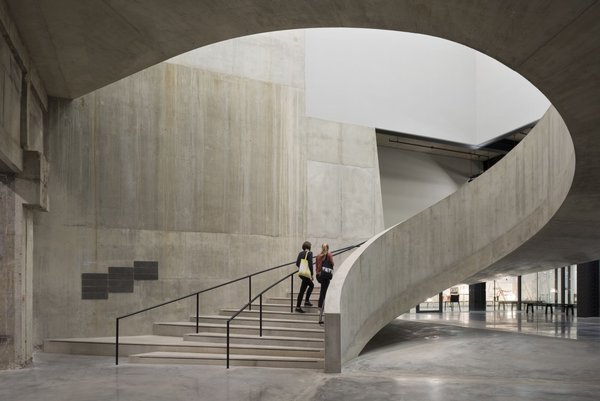
    In the run-up to the Switch House’s opening we were forewarned that much of its 60% of extra space would be devoted to social interaction. Museums used to be about conservation. Now, with a minor anagrammatic rearrangement, they’re about conversation. Like shopping malls, contemporary galleries are places to hang out in, with the shop window or exhibition displays serving as talking points. As Jacques Herzog explained to The Observer about the design of the Switch House, “the stairs are wider than we need them; we want to invite people to have a different kind of experience than to rush from one gallery to another”.

    Lee Mawdsley

    All well and good, but you can’t get round a gallery this size without rushing, especially not if you linger on the stairs. I lost the ability to focus less than halfway through, and I call myself an art critic. The problem is not just one of scale; the trouble starts, ironically, with the gallery’s departure from the mall model. Art galleries, like shops, used to be full of covetable objects ordinary people could fantasise about owning – modest-sized works, originally made for private consumption, put on public display for the benefit of the general population. The Switch House galleries are mostly full of large-scale works created with public display in mind. Like public sculptures, they are made for rushing past.

    The mystery of this so-called gallery extension which has so far cost £58 million of public money is how relatively little art there is in it: only three of its ten floors are exhibition galleries, four if you count the Tanks. But this didn’t stop the panel assembled for the press launch – including poor little Sadiq, whistled up at short notice as a multicultural mascot – from harping on about how transformative it would all be. It’s unfortunate that the most conspicuous evidence of the economic transformation so far triggered by the old Tate Modern should be Richard Rogers’s Neo Bankside luxury apartments with their litter of posh nosh outlets underneath. Looking south from Switch House’s 10th floor viewing platform, it’s hard to imagine the Tate’s regenerative effect rippling out towards the North Downs without the swathes of intervening social housing being swept away and replaced with Tory nastytecture and overpriced cafés.

    Bilbao has a lot to answer for. If the Basque government hadn’t hit the community jackpot with Frank Gehry’s Guggenheim Museum none of this would have happened. As it is, any city council in need of an economic boost reaches for the starchitects. The only city manfully resisting the tide seems to be Helsinki, still refusing to give the go-ahead to its Guggenheim outlet more than a year after the Paris-based architects Moreau Kusunoki won the competition to design it.

    Bilbao claims to have recouped the Guggenheim’s construction costs within three years of opening. Even allowing for some prestidigitous book-balancing on Bilbao’s part, there’s precious hope of Tate Modern repeating this feat, with a £30 million funding hole that still needs filling. On the eve of the Switch House’s opening, Serota as good as admitted to The Art Newspaper that if the Tate didn’t seize the opportunity of “unwrapping the building” to hook some late donations it would be this year, next year, sometime, never before the debt was paid. Slim chance of our new tightwad PM delivering on Osborne’s previous promise of an extra £6.8 million of annual funding – and extra funding will be needed, not just to service the debt.


    As with any expanded operation, the elephant in the gallery extension is the payroll. Billionaire donors who will happily part with capital to get their names on a museum building don’t give a stuff about the extra numbers of staff needed to keep it open. They leave such practicalities to museum administrators and the public bodies that fund them. If it came to keeping museum staff in jobs and pensions, your average billionaire would hand straight over to Dominic Chapell.

    In America, where more than $5 billion has been spent on museum expansion in the past nine years, administrators are getting wise. The Met, which reported a $10 million deficit this year, has mothballed plans for a David Chipperfield-designed modern and contemporary wing and, along with MoMA and the Brooklyn Museum, has announced plans to cut staff. The Met’s 2,300 staff – who, unlike museum staff in Britain, are properly paid – cost $200 million in salaries and benefits in 2013. MoMA, which spent $87 million on its 800 employees in the same year, has scaled back plans for a new extension.

    Double your gallery space and you double your warding costs, at least in theory. One reason, I suspect, why Tate Modern’s Switch House galleries are almost entirely given over to large sculptural installations is that they require less security – the worst you can do is steal a Carl André brick. Meanwhile the more vulnerable paintings and nickable sculptures have been squeezed into a few crowded galleries in the old Boiler House to save on warders.

    The dawn of the artist’s statement was bad enough; the arrival of the statement building has made things worse. Combine the two, and you get a tower of babble. Is the new Tate Modern worth the £260 million investment? If it ever has to charge for entry, we’ll find out.

    Selby Whittingham
    The Jackdaw 

  • Laura Gascoigne: No Offence But… – May 2018

    Laura Gascoigne
    May/June 2018

    Was Stone Age society more open-minded than ours? In December, just before Instagram was flooded with pictures of Kim Kardashian’s 37-year-old butt crack, Facebook decreed that an image featuring the front bottom of the 30,000-year-old Venus of Willendorf was “dangerously pornographic” and removed it, until forced to apologise two months later to the statue’s owner, the Naturistorisches Museum in Vienna. In France, meanwhile, Paris schoolteacher Frédéric Durand-Baïssas is pursuing the social media giant through the courts for closing his account in 2011 after he posted a photograph of Courbet’s The Origin of the World.

    Expect more of the same from the Pussy Police if the British Museum includes Rodin’s Iris, likened by Germaine Greer to a Sheela-na-Gig, in its summer exhibition. Modern women must be protected at all costs from references to their sexuality by men. In the #MeToo era, offence is the new righteousness and failure to take it is a sin. No woman is exempt from this obligation: when French female film stars d’une certaine âge lined up to protest that unwanted male attention was no big deal (and, in Brigitte Bardot’s case, that they sometimes enjoyed being complimented on their “nice little backside”), they were effectively told by their sisters to shut up and get back in the kitchen.

    The latest offender, surprisingly, is Maria Balshaw, who triggered the resignation of Tate artist-in-residence Liv Wynter with a comment in The Times in February that she has never had any trouble from men, having been “raised to be a confident woman who, when I encountered harassment, would say: ‘Please don’t…’ or something rather more direct.” Wynter described Balshaw’s comment as a “huge slap in the face” – an interesting metaphor, given that a slap in the face is what women once administered to men who harassed them. The former victim of domestic abuse accused the Tate of “simultaneously profiting off my ‘survivorness’ and the work I dare to make about it”. 

    It may be time to launch an antisocial media campaign, #NotI, celebrating the survivorness of a generation of women who learned to deflect unwanted male attention without taking offence. Not much chance of the next generation learning. In March the Labour MP for Great Grimsby, Melanie Onn, called in Parliament for catcalling and wolf whistling to be classed as hate crimes, praising Nottinghamshire Police for a pilot scheme that defines misogynistic acts as “incidents against women that are motivated by an attitude of a man towards a woman and includes behaviour targeted towards a woman by men because they are a woman.” (Apparently ‘upskirting’ and ‘downblousing’ are already illegal in Scotland. No mention of ‘upkilting’, though. Don’t boys’ sensitivities need protecting, or is it just that girls aren’t interested?)

    Which brings me to Manchester Art Gallery. Apologies for dredging up Hylas and the Nymphs again, but the swamp needs draining. For the benefit of anyone who missed the hoo-hah, on 29 January Sonya Boyce, the subject of a retrospective at MAG, staged the removal of John William Waterhouse’s painting of semi-naked nubiles as part of an evening ‘takeover’ of the 19th century galleries. All hell broke loose: accusations of censorship rained down and Boyce found herself in the eye of a storm of vitriol. Within a week, the picture was back in place. A week is a long time in sexual politics.

    The decision, Boyce insisted, had been consensual. She had canvassed female opinion among museum staff, from curators to attendants and cleaners, and found “a discomfort” about the presentation of the idealised female form as ‘femme fatale’ and the misrepresentation of Hercules’s Argonaut toy boy as heterosexual. Her conclusion was that “we need to not be binary about how we’re thinking around questions of gender and masculinity and femininity, that we need to complicate some of those questions.” As if they weren’t already complicated enough, she invited a troupe of local drag queens, The Family Gorgeous, to wade into the muddied waters by camping it up in front of various Victorian pictures. 

    By now the Curator of Contemporary Art, Clare Gannaway, felt compelled to apologise on the gallery’s behalf for having “collectively forgotten to look at this space and think about it properly”. Had they looked they might have noticed, as David Lee pointed out in the last issue, that between Etty’s Ulysses and the Sirens and Mengin’s Sappho they were in deeper trouble than Waterhouse’s lily pond, and boarded up the entire 19th century gallery. Funny how people who claim art should challenging always seem to be the first to complain. Boyce herself admitted that her film SIX ACTS incorporating footage of her camp takeover team was “very troublesome”. It’s obviously better to give than to receive, where offence is concerned. Or is it only contemporary art that’s allowed to offend, just as it’s only non-normative-male sensitivities that need protecting?

    In 2002 I was involved with the Japanese newspaper Mainichi Shimbun in touring the Tate exhibition The Victorian Nude around Japan. God knows what the Japanese made of it – my own jaw dropped in front of Waterhouse’s St Eulalia, the picture that got him elected to the RA. The show was curated by Alison Smith, then newly arrived at Tate Britain and now Lead Curator, British Art to 1900. Could it ever have been staged today? Not without reams of exculpatory wall texts. But while contemporary curators agonise over collective forgetfulness, public taste goes on its merry way. Gallery attendants reported to Boyce that young girls often took selfies in front of Hylas and the Nymphs and middle-aged men liked to linger over it. Not just middle-aged men, but middle-aged women #MeToo. I’ve always found the picture riveting, it gives me goose bumps: it’s not the nudity so much as the viscousness of the paint and the way it conveys the water’s surface tension. Monet’s Nymphéas are merely colourful; Waterhouse’s are clammy.

    I disagree with Anthony Daniels’ verdict in the last issue that the painting is “the most abominable kitsch”. I’m not sure I even agree that kitsch is abominable. “Taste,” said Sickert, “is the death of a painter” and Waterhouse was a painter to his bones: the child of two painters, the nephew of two more, the husband of another. Born in Rome, he imbibed Classical mythology with his mother’s milk and understood the pantheistic background to the word ‘nymph’. What about religious tolerance for animists? 

    In a debate on censorship in the Spring issue of RA magazine, Mark Hudson imagines himself enjoying a tour of a Museum of Art by Bad People and argues that art should be celebrated not just “for its beautiful life-enhancing qualities but for the way it illuminates the irreconcilable contradictions and complexities of the world around us”. I doubt John William Waterhouse was a bad person. He was simply an artist to whom painting came as naturally as breathing; when his subjects went out of fashion, so did he. In 1978, when the Mappin Art Gallery Sheffield tried to revive his reputation with a solo show, John Russell Taylor wrote in The Times: “Waterhouse is not really a forgotten painter; it is just that no one remembers him”. If Boyce’s action was a publicity stunt, which she denies, it backfired badly. Waterhouse’s painting has been splashed all over the papers, while Boyce’s SIX ACTS has been politely ignored. No one remembered Waterhouse? They do now.

  • Laura Gascoigne: Visual Experience with Knobs On – March 2018

    Laura Gascoigne
    March/April 2018

    In the Royal Academy’s Tennant Gallery a man in goggles is lurching around waving his arms like someone conducting an orchestra on ketamine. It could be a piece of performance art, but it’s too amusing. In fact the man isn’t air-conducting, he’s air-drawing and the results are appearing in real time on a screen.

    Time is the only thing about this operation that’s real because it’s an experiment in virtual reality, one of three “exploring emerging technologies” connected with the RA’s exhibition From Life. The technology comes courtesy of HTC Vive, the exhibition’s Virtual Reality Partner, and coincides with the launch of VIVE Arts, a multimillion-dollar VR program “set to change the way the world creates and engages with the arts”.

    The air-drawing exercise is the contribution of Humphrey Ocean RA, its object being to create a 3-D figure to occupy a chair in virtual space. The figure on this occasion looks like Jabba the Hutt made of dayglow Play-Doh, and not wanting to blunder about like a blindfolded idiot and draw something worse I choose the Yinka Shonibare option of entering a neoclassical painting by Gavin Hamilton, with added Townley Venus draped in batik. A warning to VR goggle-wearers: do not adjust your set. I twiddled a knob at the side of mine, imagining they were binoculars, and it looked as if Gerhard Richter had taken a squeegee to Hamilton’s view until the attendant fixed it. Even then the visual experience felt no more real than a 3-D view of the Acropolis seen through a 1950s stereoscopic slide viewer. But contemporary armchair travellers wishing to enjoy it in the comfort of their homes may be pleased to hear that it’s available on Viveport HTC’s global VR app store. Like most things digital, Virtual Reality poses as ‘shared experience’ but is essentially sol-app-sistic.

    Along with Google Arts & Culture, another partner of the RA show, HTC VIVE has been busily “investing in the arts and culture space”. The same company is behind The Ochre Atelier in Tate Modern’s Modigliani exhibition, a virtual recreation of the artist’s last Paris studio with the declared aim of “bringing visitors closer to the artist’s world”. Unlike the VR experiences in From Life, for which on a weekday afternoon I was the only taker (the man in goggles being an off-duty attendant), on a Saturday evening The Ochre Atelier attracted a half-hour queue. Fortunately I had taken a copy of The Jackdaw for company.

    It was a relief to find that as a “seated experience” this doesn’t involve floundering about like a fool in public, and the visual quality is also far more ‘real’. You sit in a chair between the stove and the easel while a cigarette burns endlessly in an ashtray and street noises drift in through an open window. When you fix an object in your sights the voice of a Tate curator divulges a related snippet of information, such as the extraordinary fact that drink was a comfort to Modigliani, “not a vice” – something that will be a comfort to piss artists everywhere. What fascinated me was the half-open frosted window through which, by craning your neck to the left or right, you can catch glimpses of the buildings opposite. I was seriously tempted to get up and look out of it. But as far as getting an insight into an artist’s mindset ­– as opposed to headset – you’d learn more from a visit to a living artist’s studio. You might even get a drink.

    Studies reveal that gallery-goers spend less than 30 seconds in front of a picture, yet they are prepared to queue for 30 minutes for a 6-minute VR experience. Why? Because looking no longer counts as an experience. VR is just another step in the creeping annexation of the concept of ‘experience’ by technology, until people no longer trust their senses to work unaided without some sort of digital prosthesis. The VR people smell money in art and they’re getting in there. Last year in Knokke the VR company BDH marked the 50th anniversary of Magritte’s death with a cinema installation in a bowler hat – “an illusion René would adore”, cooed the critic of Le Soir – and for the Bosch500Fest in ’s-Hertogenbosch they installed a virtual Garden of Earthly Delights in the artist’s studio. “We are impressed by the authenticity of the experience,” declares the festival’s director Lian Duif on the company’s website. The reaction of the man on the street in Austin, Texas enjoying the experience via Google Cardboard Viewer is more effusive. “This painting is 500 years old? The whole thing? That’s wild, that’s dope, it’s 500 years old!”

    Dali will be next, as sure as clocks is cheese. In the meantime, contemporary artists are getting on board. A new VR platform, Acute Art, which launched in January with a mission to “encourage art’s transition from the physical art world to the new age”, has signed up Olafur Eliasson, Jeff Koons and Marina Abramovic. Eliasson has created a VR rainbow, Koons is working on resuscitating the Greek courtesan Phryne – as a shiny Phryne, “to bring the affirmation of self into VR” – and Abramovic, concerned about “the climate crisis shaking the IRL world” (that’s the ‘In Real Life’ world to you and me) is developing an interactive work giving audiences the option of saving her avatar from rising waters in a tank or leaving her to drown. Which would you choose?

    Not to be left behind, during Nobel Week in Gothenburg last December Anish Kapoor gave assembled Laureates a preview of his debut VR work, Into Yourself-Fall, and took part in a discussion with Daniel Birnbaum on the theme of ‘Artistic Truth in Virtual Space’. Birnbaum popped up again in January as curator of the Verbier Art Summit, ‘More than Real: Art in the Digital Age’, at which keynote speakers included Eliasson and Acute Art’s founder Dado Valentic. “Technology will change art in the most fundamental way,” Birnbaum predicted, paraphrasing Walter Benjamin in his statement that “it is art’s task to create a demand which can only be fully satisfied later”. And there was me thinking that was the task of business.

    It is possible to do good things with VR. I’m prepared to believe that Alejandro Iñárritu’s 6-minute VR essay Carne y Arena recreating the experience of Mexican migrants crossing the Sonoran desert into America deserved the special Oscar it was awarded last November. Film directors tend to make better films than artists. And VR is a useful tool for reimagining ancient sites like the Baths of Caracalla, or restaging historic events like Mat Collishaw’s recreation at Somerset House last summer of Fox Talbot’s first photographic exhibition. It’s not so great, yet, at “fully immersive, experiential sexual technology” as attempted by Ed Fornieles in Truth Table: Be Everyone, Fuck Everyone at Carlos/Ishikawa last September, though the porn sites are working on it. But however good the quality gets, VR will never bring us closer to an artist than standing a foot away from the surface of a canvas painted 500 years ago. That’s wild, that’s dope. No invention of technology will ever be more miraculous than the naked eye, an instrument whose pleasures most of us have not begun to exhaust. Let’s not forget how to use it.