Category: Editorials

  • Mickey Mouse museums

    The word ‘Disneyfication’ is usually pejorative, implying noise, trashiness and escapist superficiality. Not any more. It was only a matter of time before ‘difficult’ history and learning were sweetened to something more palatable and instantly gratifying. Serious cultural commentators are now using this word to describe a useful policy designed to increase the appeal of museums and historical sites. Boring ruins, they say, should be reconstructed into what we think they might have looked like. It doesn’t matter if it’s, well, a bit wrong. In this new world nothing will be left to the imagination. In one instance the laughable Dulux job worked on Knossos by archaeologist Arthur Evans receives commendation. As a 20­year­old undergraduate I stood laughing in this famed Minoan palace: the painted murals, based on the faintest possible scattered fragments, were more Hollywood than belonging to the cradle of western civilisation. For me there was more truth in the few uneven shallow steps around the apron stage of a small outdoor theatre: 40 years on this contemplative place of escape remains vivid in my mind’s eye. As Knossos so plainly demonstrates, Mickey Mouse is not the answer.

    Disneyfication has already gone quite far enough. Museum shops, for example, used to be places where you could expect a decent stock of theme-related non­fiction. They now hawk fudge by the ton in the belief that the population is addicted to it. Museums seem no longer to want to educate us properly, prefering to fill our minds with the sentimental equivalent of, yes, fudge. Insulting our intelligence they assume that we prefer entertainment, some sort of untaxing ‘experience’ between expensive snacks.

    Potentially serious museum content is routinely reduced in thematic museums to buttery sentiment dished up for those who enjoy easy listening, easy reading, easy everything. No effort required here, they announce: we’ve done your thinking for you, so hurry along. Everything easy, so it can be easily forgotten. As in schools, subjects must be made digestible so that no one is made to feel thick, and if understanding can’t be made effortless then a flanking manoeuvre and ‘a form of words’ must be found to circumvent it. Effort has become the enemy of the state.

    Recently I visited two mines in Wales. Both are as visually eye-opening places as the most breathtaking natural phenomena. The first, Parys Mountain in Anglesey, overlooks the town and former port of Amlwch on the island’s north coast. It is manned by a single volunteer, a knowledgeable geologist and industrial archaeologist who works in what looks like a converted caravan at the edge of a makeshift car park. It costs nothing to enter but this extensive, fascinating site occupied a full afternoon with time flying. The second was a slate mine at Blaneau Ffestiniog in Snowdonia which had been Disneyfied to near death by those sticklers for historical truth – yes, Disney themselves. It cost the business end of forty quid for a family to enter and the ‘galleries’ were the mere prelude to a ‘Victorian’ street selling tat.
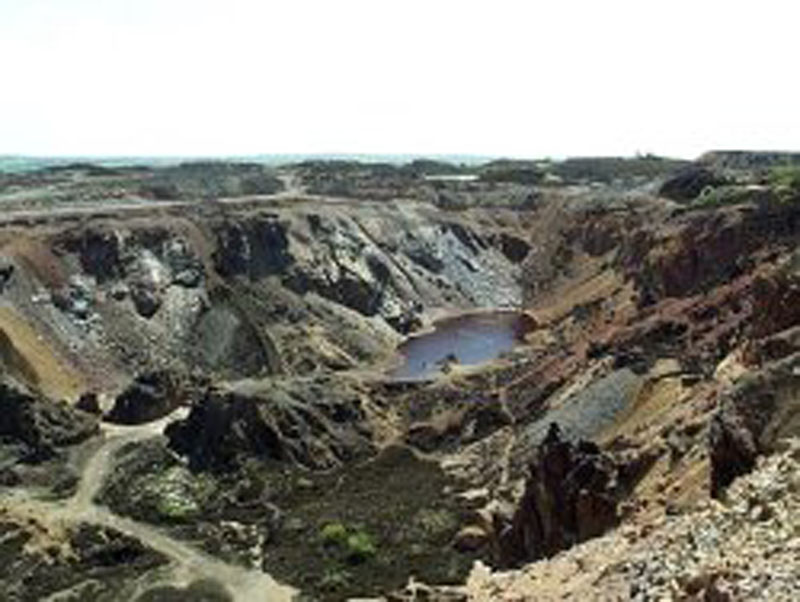
    At Parys the top of a Pre-Cambrian mountain was removed, like the top of a boiled egg, in search of copper and other valuable metals. Though there had been mining here since the Bronze Age, following Agricola’s subduing of the Ordovices in north west Wales in the mid-first century AD mining began in earnest. Alternate periods of desuetude and reworking over the intervening centuries, often caused by lucky speculative strikes, produced craters and spoil heaps rich in oxide colours and unique lichens acidic in hue. Visitors take themselves around the site aided by a map and an information leaflet in which each area and process in ore extraction is explained. When the Victorian mine was at its height the experience of workers, dangling perilously on ropes and climbing up a linked succession of high ladders burdened with sacks of rock, must have been indistinguishable to the modern mining photographs taken in Africa and South America by Sebastiao Salgado where similar conditions are still in operation. The horrifying casualties in Angola, Congo and Brazil must have been replicated here in Parys.

    Nothing is required here of visitors except their attention. We must stand and work it out, reconfigure it all forwards and backwards through time. It requires speculation to piece together and imagine the complicated symbiosis of work and life; the choking fumes of smelters and roasting kilns and the dangers of drift mining into unstable seams; the washing, filtering and precipitation of product, right down to the relatives of the miners who built clippers in local harbours to transport assorted quarries. No manikins or tableaux here illustrate the obvious fact that on this spot proletarian men and women were worked like animals to an early grave.

    The biggest crater, to the bottom of which you can scramble investigating and comparing veins and coloured ores, would hold two sports stadiums one above the other. Young people may roam, fossicking as they will for oddities. Beyond, at the farthest point in the production, there is the pretty view down to the sea at Amlwch. The town was built to lodge miners and armies of surface women labourers who broke up stones for a bob a day. Except for the numbing drunkenness, which required the building of a devoted brewery, the lives of these long-travelling searchers after a wage can’t have been worse than the hard-labouring prisoners of Dartmoor.

    There is at Parys any amount of time to reconstitute the life built around metal. Getting to the end of the process through wheelhouses, evaporation beds, blue-collar accommodation, beam engines and windmills, smelters and the foundations of scattered works buildings feels like an achievement. From a handful of rock hewn deep below to shining copper pipes in a Black Country engine house here was a microcosm of Victorian industrial economy based on enterprise, ingenuity and brave investment with all the incumbent dangers and exploitations.

    The mine was the centre of a diverse local economy. Copper was sent by boat to Liverpool and South Wales where, among other uses, it was cast into plates for copper-bottoming warships: HMS Victory had its timbers coated in copper mined here to prevent rotting and infestation of the wood; and the pools of metal-rich water on site at Parys were used for soaking ships timbers to the same end. By­products included industrial chemicals and a significant manufactory in the town for artists’ colours. All that is now left are the workings, deserted on most days. Please visit this remarkable place if you are about the vicinity.
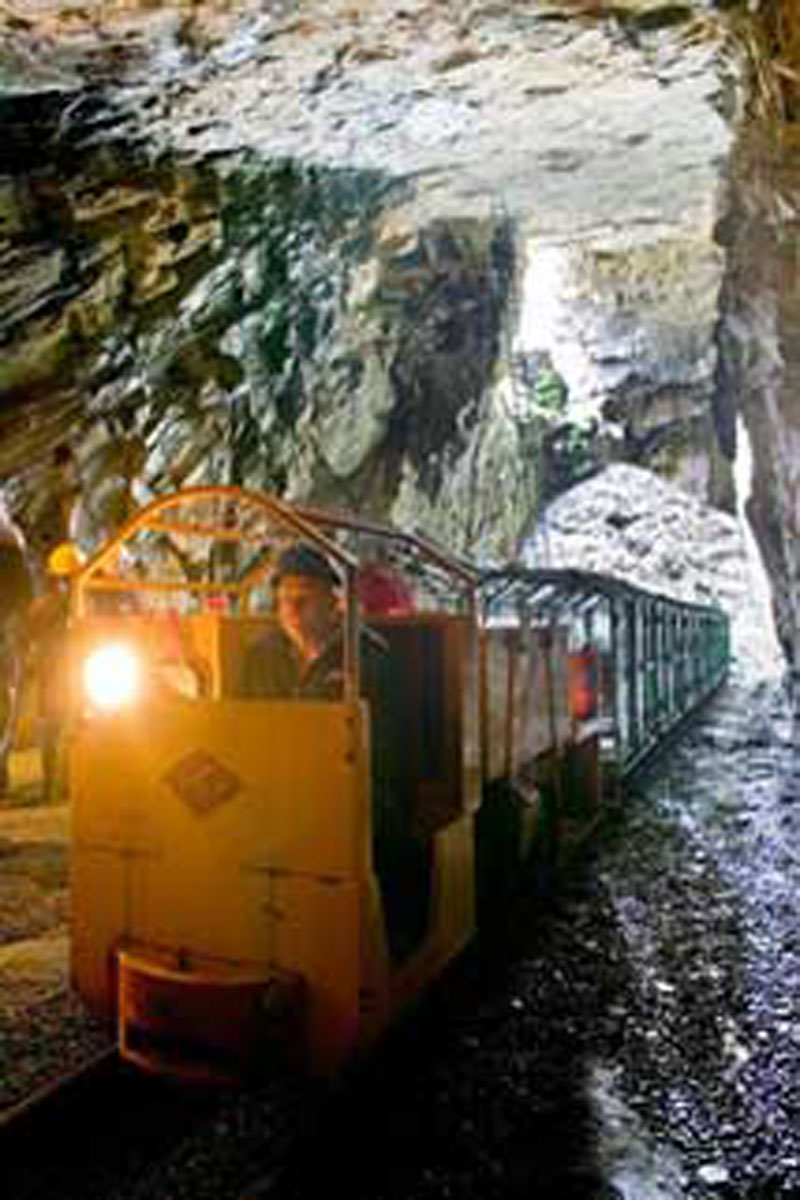
    The “international award-winning” mine at Ffestiniog is at the centre of the slate industry upon which the whole of Snowdonia once thrived. It is part open cast and part subterranean in sixteen sloping seams. Mining is evident on almost every road through this damp upland whose cold appearance owes more to man than Nature. The region is criss­crossed with narrow-gauge railways first built to transport the sheets of slate to new ports north and south. Cavernous open cast workings, so treacherous for the thousands of labourers carrying heavy weights up and down a Hell of ever-deeper and ­narrower terraces, were sites of special interest for tourists even in the 19th century. Most are now overgrown and unvisitable except to the intrepid armed with an OS map and those prepared to ignore melodramatic warning signs.

    The industrial revolution was roofed and sometimes floored with Snowdonia slate while those lucky enough to be at school learned numbers and letters by chalking on the lower grades, though what precisely constitutes a lesser grade of material you won’t be told here. The better-off were frequently buried under or in front of a slate slab.

    The Llechwedd slate caverns are at their worst a satire on maudlin Welshness; a harpist, the local MP’s wife no less, twangs you through the gloom. Whilst being instructed with little beyond the obvious, groups are marshalled around deep workings with time controlled to the second, and then the lights go out. The son et lumiere cost £130,000, we are proudly informed, and involves “the latest silicon chip technology”. How very reassuring. Nothing is allowed to impede the relentless, hard-hatted progress to the stack of fudge at the door.

    No time is given to dwell, to be alone with speculations. The truth is I learned next to nothing about slate mining, excepting the basics of its cutting, but little of the larger industry of which it formed part. The only booklet for sale in the shop was useless, years out of date, and a more expensive book helpfully described slate’s rail distribution but didn’t address the subject as a whole. Everything uttered by the living guides and the taped Welsh ‘characters’ seemed aimed at a backward toddler. We were asked at one point to observe a minute’s silence to think about those teams who toiled long hours for a pittance entombed in the cold dark boyo. At the instant when the inevitable male voice choir intruded over the tannoy nuking Cardiff suddenly seemed a viable option. We weren’t told how many workers had been killed, or about life expectancy, or the many uses to which their product was put. Nor were we told why when they were building the visitor centre at the summit of Snowdon it was cheaper to fetch slate from China than to walk it around the corner on a cart.

    The very worst thing that can happen to any museum is the assistance of Disney. As a threat to truth and knowledge, and as rationers of serious information, these people and their infantilism should be prevented from entering the country.

    Whether it is education, museums or the BBC, we should cease being such passive and willing consumers of fudge.

    How State Art brought the good news to Essex. Yet another contemporary art gallery has opened, this one in Colchester. Years late and eye-wateringly over budget, it is another organisational triumph for an Arts Council which couldn’t deal drugs in Brixton. Designed by Raphael Vinoly it is finished in thin metal sheeting, little thicker than oven foil, painted gold and with shoddy workmanship everywhere evident – it flexes like a beer can when you poke it. It has all the short-lived allure of an impulse buy. Inside is an overpriced café (may I recommend The George on the High Street, it’s cheaper and more comfy) and a shop which doesn’t yet sell fudge but does, helpfully, sell reflective socks for bike riders.

    The building’s walls are curved, lean inwards, outwards – indeed, in every direction except perpendicular – which makes it unsuitable for showing paintings, a medium which those in charge hereabouts apparently consider “fuddy-duddy”. Acres of wasted wall space and wide corridors meet the visitor so he can wander while admiring white rendering and a winning view of the bus station. After so much trouble how could they have ended up with a place so obviously exclusive and limiting to future options?

    The opening show comprising otherwise unrelated stuff dragged together under the rubric ‘Camulodunum’, the Roman name for the fortress, capital and then colony, is feeble and includes not a single painting. This omission will be passed off by those in charge as a bold statement of their State Art credentials and not, of course, of the more obvious truth that State Art and its gauleiters are, for the most part, narrow-minded dullards who do as they are told. The exhibition is said to be about re­interpreting the past; Grayson Perry, Ai Weiwei (yes, the fashionable fat martyr himself), Sarah Lucas, Smithson, Warhol … It’s a real yawner. Two evenings work at the most to organise.

    Why go to so much trouble for something so negligible, so very predictable? This golden shed is a monument to a national artistic dictatorship which is incurably hubristic and perennially unwilling to meet people half way. It is a shining example of how to waste £26 million promoting the fads of a few.

    I made a mistake in the last editorial where it was stated that the Royal Academy school charges fees. It doesn’t. I am relieved to hear, therefore, that students are paying precisely what tuition from Professor of Painting Gary Hume is worth.

    http://www.parysmountain.co.uk/

    http://www.llechwedd-slate-caverns.co.uk/

    David Lee

    The Jackdaw Nov-Dec 2011

    November/December 2011 is the 100th issue of The Jackdaw. I considered commemorating this momentous numerical milestone but nothing immediately suggesting itself was either cheap enough or worth the effort. I’ll try harder for the thousandth.

     

  • The RA is not a charity

    The RA is not a charity

    Inspired by landscape painter Patrick Cullen, The Jackdaw Sept-Oct 2011 reprinted pieces about the Royal Academy that have appeared in The Jackdaw over the last eleven years. All deal with the genuine fears of artists that the Summer Exhibition is progressively a closed shop whilst being marketed as an ‘Open’. Patrick’s research succinctly reinforces previous claims made by artists that the chances of an outsider featuring in the Summer Exhibition are now so seriously diminished that no gambling man would ever accept such long odds. Justifiably over the years this has become a common lament because, as Patrick demonstrates, an inverse logic now seems to apply: as the cost of having a work considered increases (currently £25 per item) so the chance of successful selection is reduced. Even a less cynical person than myself must conclude that the Summer Exhibition has become a calculated ploy to fleece lesser-known artists, many of whom can ill-afford the submission fees in the first place. This is done in order to shore up the finances of a membership-only club many of whose beneficiaries are already well-to-do artists; indeed some are among the world’s wealthiest. This Robin-Hood-in-reverse ploy is surely a perverse betrayal for an organisation purporting to be a charity. Where the Royal Academy is concerned, it would seem that charity not only begins at home but ends there as well.

    The Academy is a registered charity whose annual accounts may be examined on the Charity Commission’s website. (Did you know, for example, that the President of the RA trousers sixty grand a year? And there I was thinking he gave his time selflessly for God, the Coalition and the dog’s bollocks of gold chains.) Notwithstanding our frequent claims in these pages that it is no longer an ‘Academy’ using any accepted definition of that term – and how can it be when a downright charlatan like Gary Hume is Professor of Painting? – I have arrived at the conclusion that it is no longer a charity either, if, that is, it ever was one. My purpose here is to demonstrate that the Royal Academy is a business, pure and simple, and bears negligible resemblance to a charity. It does less and less for artists in general and more and more for its Academicians in particular.

    My understanding of charity is doubtless an old-fashioned one. She stands among Giotto’s virtues in the Arena Chapel, the junoesque rustic dispensing grain, veg and manna to the needy. A modern equivalent is The Salvation Army, an organisation for which I have personal fondness. Somewhat of a laughing stock these days with their Victorian uniforms, simple principles and enthusiastic (if not exactly euphonious) brass bands at Christmas time, they look after the poor, lonely and deserted. They perform visible good works and they do it without living high on the hog by siphoning off donations to pay for posh offices, flamboyant places of worship or overpaid officials. They cared for two of my relatives, one of whom, a vagrant grandfather persecuted with imprisonment by those unsympathetic to his irrepressible free spirit, lived and died in a Salvation Army hostel, the last of many with which he had over 40 years of wandering become acquainted. The Army’s charitable works are conspicuous and basic – hot soup, shelter, a bunk, a bath and a kind word for the homeless.

    Using the Sally’s criterion of free giving the Royal Academy scarcely looks anything like a charity. It is a strange charity indeed whose main beneficiaries are the organisation’s own members; namely, the 116 Royal Academicians, many of the most celebrated artists of the day, for whom its Mayfair stately home functions as a gentlemans’ club.

    Exactly what services does the Academy supply to the public to deserve its charitable status? It runs an art school in its basement, much like any other for which students pay fees. It puts on exhibitions for which it extorts stiff admission charges effectively excluding all but the better off who don’t need charity anyway. It is a business which mounts exhibitions, flogs unnecessary souvenirs and feeds and waters the well-heeled. On the face of it the Royal Academy gives nothing away to anyone sufficiently disadvantaged to merit the description ‘charitable institution’.

    In its defence it doesn’t receive a farthing from the Arts Council, although there’s no reason why it shouldn’t qualify. Another ‘charity’, the Whitechapel Art Gallery, which receives £1.5 million per year in public subsidy as well as regular infusions from the National Lottery in fulfilment of seemingly permanent lebensraum ambitions, is charging a steep admission of £9.50 for its current Thomas Struth retrospective (and if you book in advance they’ll throw in lunch for thirty of forty quid apiece). What does the Whitechapel give in return for its charitable status if not free admission to the shows it mounts? I’ve sang this song before, and it’s always been received with deafening indifference, but what is a charity doing subsidising the promotion of a famous German photographer whose works are now selling at auction for over a million dollars apiece and who is represented by two of the world’s wealthiest dealers? I don’t get it. How does any of this constitute ‘charity’? The dealers themselves should be paying for the privilege of promoting their artist in this public arena in order that the Whitechapel can show the work free of charge and therefore make at least some stab at fulfilling its charitable educational responsibilities. For the duration of the Struth exhibition at least, the Whitechapel is not a charity at all, it is, like the RA, a business.

    Defenders of the Academy are ever eager to announce as loudly as they can shout it, that it receives no public subsidy, a statement that has become accepted wisdom. This is the kind of half truth many of us expect nowadays from arts organisations eager to parade their thrift, enterprise and cost-effectiveness. Needless to say, it isn’t true. There is the small matter of its premises, Burlington House, for which the Academy holds a 999-year lease (850 years of which remain) vouchsafed at a peppercorn rent by the Secretary of State for Employment, Transport and the Regions. A massive building, a palace indeed, with a suite of arguably the finest rooms in Britain, a furlong from Piccadilly Circus … What, I wonder, might the Candy brothers extract for this peach? No public subsidy? Pull the other one.

    Leaving aside its objective “to engage with the widest possible public”, which it doesn’t and never has done, in its declaration of charitable objectives the Academy states a purpose “to represent the professional interests of all artists and architects to the public and to government.” Its only real connection with “all artists” is the annual Summer Exhibition, the first of which was staged in 1769 and hung 136 works by the 34 founding members. Helping artists, whose average income incidentally is below the Government’s poverty line, is an aim worthy of a charity. But the Academy is gradually reneging even on this, for the small charitable purpose it performs in showing the work of those who have little opportunity to exhibit elsewhere is now badly eroded. The impression any outsider might form is that the Academy would, if it might get away with burying such bad news, rid itself completely of outside submissions to the Summer Exhibition, but it can’t because of the money this contributes to a precarious balance sheet.

    Details of the Summer Exhibition’s finances are omitted from the accounts so I’ve had to work them out for myself. I visited the exhibition a fortnight before it finished in order to make a record of sales. My rough figures are probably only as good as the doubtless desultory information provided.

    There were over 12,000 entries to this year’s exhibition, 1,117 of which were displayed. A thousand will have been the work of the RAs themselves. So 11,000 entries at £25 each is £275,000. Assuming that half of the average annual 150,000 attendance pay the exhibition entrance charge as non­members at £10 apiece, this delivers another £750,000. With a fortnight still to go, although one suspects the overwhelming majority of sales were long completed, the number of works sold was 3,812, of which 3,436 were editioned prints. The number of works sold by RAs was 1,004 (26%) and by outsiders 2,808 (74%). The total value of works sold was £3,199,975, of which £1,648,499 (52%) was generated by RAs. In terms of their value to the Academy, Academicians, though they sell half the number of works, are worth more than outsiders: the average cost of a sold work by an RA being £1,642 against the equivalent figure for an outsider of £553. But this doesn’t take into account the fact that the work of non-members, as Patrick Cullen demonstrates below, occupies only 29% of the overall space. (Interestingly, only 7% of the works sold are paintings and sculpture, the other 93% are editions – comprising 90% prints and 3% photographs).

    The Academy takes a 30% commission on all sales, including those of RAs – which generates another £960,000. The prima facie revenue of the Summer Exhibition, therefore, comes to ca. £1,985,000; a figure that might easily be doubled when you consider – and this may surprise you as it did me – that its shops and restaurants contribute more revenue (£9 million) than exhibition takings (£8.5 million) throughout the year. When costs are taken into account I assume the profitability of the Summer Exhibition is in the region of £3 million. To understand something of the importance of the milch cow that is the Summer Exhibition to the overall financial health of the Royal Academy, in the last published accounts the annual surplus was as low (on a turnover of £31 million) as £600,000.

    Far from reducing the number of outsiders exhibiting, the Academy should be encouraging more participation from non-members because not only would they be conforming better to their charitable purpose of representing “all artists”, but they would also make more money. With this in mind they should make more room for outsiders by ejecting the works of Honorary RAs like Jeff Koons. He and his ilk don’t need to exhibit at the Royal Academy, State Art being more than generous to them already. To have hidden in the corner of the courtyard the major work of an RA sculptor, James Butler, whilst giving prominence to the already over­-exhibited gaudy tat of Koons was an insulting mistake. Is promoting Koons, or Ruscha, or Kiefer, really consistent with the Academy’s charitable status? No it isn’t, indeed it is completely unjustified and inconsistent with it. Likewise, the now accepted practice of inviting artists, usually the friends of RAs, should also be stopped for it is a naked scam. The space released should be given to more of those from the open submission.

    Furthermore, in order to rectify the system by which poorer artists have their pockets rifled in order to keep the RAs in the club to which they have become accustomed, the Academy should charge RAs 40% or even 50% commission on sales. This is the least of what they would pay an art dealer. An increased figure for RAs would allow a reduction to the existing 30% for those not fortunate to be members. This would enable the Academy to fulfil one function of any charity, this being the voluntary redistribution of wealth from those who are prosperous to those who struggle.

    If the Royal Academy doesn’t wish to help more artists by showing and selling their work, and thereby allowing them a better than basic living, its bogus charitable status should be removed and it should be re­classified as the business it is and taxed as such. At the moment it serves no obvious charitable function.

    http://www.patrickcullen.co.uk/

    http://www.royalacademy.org.uk/exhibitions/summer-exhibition-2012/

    David Lee

    The Jackdaw Sept-Oct 2011

  • Gruel for the masses

    Gruel for the masses

    The State should be more circumspect than to behave like a private collector. Unfortunately, collecting and exhibiting in national collections according to narrow personal tastes and loyalties is established practice. Those employed to run Contemporary Art are selected because they have been carefully programmed in the tenets of State Art and if they have doubts keep quiet about them. But functionaries of State Art are not spending their own money and therefore in the policies governing collection and exhibition they should reflect the best from the full range that is being produced and not just follow those few desperately eking out the fag end of Opportunism. A damaging aspect of State Art has always been that it refuses to acknowledge anything outside its own narrow prejudices, which stop dead at those artists represented only by major art dealers and sold expensively in rigged markets by auction houses. Healthy dividing lines between museum curators and directors, auction houses and the most fashionable art dealers no longer exist. The system stinks worse than an open sewer, but many love the smell and wish to waft it over the rest of us so we might come to like it too.

    State Art apostles all help one another in pursuance of their little ambitions. They are a happy club who play hard. Their governing Synod, which comprises all of those contributors to the unhealthy smell noted above, swarm off one week to Margate aboard the same train, the next week to Wakefield aboard the same train, days later they commune aboard the same flight to Venice, and the week after that they chink glasses again at the Basel Art Fair – it’s a hard life is State Art. Decisions made among themselves during these junkets will be imposed everywhere. What results from this process is the repeated exhibition of the same few artists. This keeps the rest of us in ignorance of so much that might otherwise have been stimulating. Most of my generation will never know what we have missed because we have lived our entire professional lives under a State Art regime administered by curators terrified to jeopardise their careers by thinking for themselves. Predictability being the worst of State Art’s crimes, we are never surprised.

    Also like many of my generation, I suspect, I no longer feel the urge to see everything, having already viewed so much so often that hasn’t justified its hysterical praise by those with mysterious interests in promoting it. I’m sure Miro was a fascinating old cove but I’ve visited his studio in Palma and, to be honest, provided with a large enough mop and baths of black and the primaries, a toddler could produce in an afternoon most of the work on display there. Miro at the Tate? No thanks. Likewise Emin at the Hayward. Seen them before, and life is too short to indulge further the solipsism of an idiot. The problem for those of us with decades of exhibitions behind us is that this sort of material, the kind of thin work we are constantly exhorted to idolise,  has become unavoidable. It gets everywhere. Nowhere is safe from it.

    I recently visited the Orkneys for its birds and stones. Knowing that the Pier Arts Centre in Stromness held a donated collection of carefully selected minor works by important 20th century British artists, this was an early port of call. The permanent collection is the generous gift of Margaret Gardiner, who wrote an acclaimed biography of Barbara Hepworth and had an eye for quality which probably exceeded her modest purse. Nevertheless, she accumulated covetable, domestic-sized pieces by Hepworth, Moore, Nicholson, Piper, Heron, Frost, Lanyon and others, all of which will spark memories in knowledgeable viewers while touching those nerves and recesses where appreciation resides. The original gallery, at the heart of a busy harbour, has been done up courtesy of the Arts Council Lottery (£4 million) and there is now room for temporary displays and craftsy souvenirs. I was hoping to see here work by artists from north of Inverness and Aberdeen – the likes of Frances Walker for example – those whom one is unlikely to encounter elsewhere. No such luck.  What they had on display were some scribbles and unsavoury looking skidmarks by Cy Twombly, of the ‘highly significant’ sort which cause State Art fanatics to collapse in a religious swoon, and a collection of inept portraits and even worse ‘landscapes’ by another fashionable and ludicrously expensive American artist, Alex Katz. (Twombly is represented by Larry Gagosian; Katz by Pace Wildenstein.) Both are described as ‘influential’. God help us, who with?

    Katz’s portraits were trendily wooden, flat and unmodelled, the sitters characterless, boneless in some cases, and tediously stylised. Anyone whose eye has been nurtured by rich historical portraiture from Al Fayum and the Roman republic to Ravenna, Moroni, Rembrandt, Lawrence and Spencer couldn’t possibly see anything other than low-fat insipidity in Katz’s daubs. And his small landscapes, truly awful pictures, were so awkward and incompetent they were unworthy of hanging in a Women’s Institute. But no, they had been air-freighted 700 miles north of London for the benefit of Orcadians and those, like me, doggedly twitching for whimbrel and black guillemot. (Incidentally, en passant, the former you can more often hear than see and the latter, considerable rarities elsewhere on northern coasts, bobble about common as muck in Scapa Flow. Youalso ought to know about the corsair ravages of great skuas marauding in press gangs on Hoy – more engaging than either Twombly or Katz could ever be – but that’s for a different and probably a better magazine.) The presence of Katz in the northern isles wouldn’t have been quite so annoying had I not seen the same shallow gimmickry only a few months before, by accident note, in the National Portrait Gallery. I’d been bewildered then by what was officially considered to give this stuff precedence over works by effortlessly superior British portrait painters. Both Twombly and Katz are part of the Artists’ Rooms series which are enjoying a permanent tour of the country. This is the “generous gift”, by the way, for which we paid Anthony d’Offay £42 million. Artists’ Rooms, organised by the Tate, are the process, it would seem, by which nobody in the country will be safe from the tradenames of State Art. They are coming to a place near you whether you like it or not.

    On the way south I didn’t stop for Jeff Koons at the Scottish National Gallery of Modern Art in Edinburgh (another Artist’s Room) having seen the trash he has to offer too many times before. I stopped instead at Wakefield where a £35 million museum (Arts Council Lottery: £5.5 million) designed by David Chipperfield has opened in honour of local artist Barbara Hepworth (1903-1975).  This shed of grey slate, forbiddingly windowless for the most part,  replaces the old Wakefield Art Gallery which was housed in the municipal Edwardian pile up the hill. Despite the beauty of a small number of masterpieces it contained, that was a gloomy, unloved place where, not surprisingly, few ventured. Despite its off-putting appearance, the new grey gallery is an improvement and stands beside an attractive weir (grey heron, grey wagtail) on the Calder 25 minutes walk from the railway station. Inevitably, the building has been overpraised by architecture scribblers. It is nothing at all remarkable, but is agreeable enough inside. Apart from the foyer, which is coloured in regulation Serota mud, the rest is white and spacious, the light a mixture of rationed natural and mains. The whole place is blighted by that self-inflicted virus of modern galleries and museums, patrolling attendants armed with squawking radios which destroy all attempts at uninterrupted concentration.

    The historic Wakefield collection, mainly mid-century Modernism which is representative more than notable, is scarcely worth writing home about for anyone well acquainted with the field, but is augmented by apposite loans from elsewhere, mainly the Tate – a sensible use of their hidden reserves. From a loyalty point of view the display does Hepworth no favours. Gabo was more inventive in three dimensions with form, materials and especially string, while Moore, represented by two fine early sculptures, a reclining figure carved in writhing elm and the modelled cement head, render the nearby Hepworths stodgy and a bit simple. Her drawing of a surgical operation – these are usually her best things when seen reproduced small in books – looked vague next to one of Moore’s best shelter drawings. In this company Hepworth might be second rate but she’s still world famous in Wakefield.

    Given that Arts Council money has gone in, they and their lieutenants, and particularly the dead hand of their State Art doctrine, are already calling the shots in the exhibition programme. The opening show is throwaway stuff. Doubtless during the selection process political correctness intervened something like this: we need a young female sculptor with impeccable State Art credentials, phone Serota.  The chosen candidate was one Eva Rothschild, who is Irish. Fresh from the ponderous, overblown constructivism she served up last year at Tate Britain, she arrives here with playground materials and colours, inarticulate tangles of stuff on stands signifying heaven only knows what.  Beside the humanist Hepworth this skip-fodder insults her memory.

    Apart from Hepworth and Moore, think of the important contribution of Yorkshire to British sculpture in the last century – national figures like Kenneth Armitage, George Fullard, Austin Wright, Ralph Brown, Hubert Dalwood and all those gifted tutors and Gregory Fellowships at Leeds. The new museum had years to plan a retrospective of an important local sculptor, or a mixed show of work ripe for reassessment, but instead they present scraps by yet another over-exhibited fashionable novice with no discernible sculptural ability. As usual with the Arts Council, their programming is a lazy failure.

    Needless to say the Council’s finest snake oil salesmen have been scratching their heads over Rothschild. Following months of screwed up paper they cobbled together this salvo of lucidity: “This exploration of the intrinsic power and meanings carried by objects produced a transformational encounter between the animal forms and the symbolic and narrative potential of Rothschild’s work.” One of these days, soon I hope, they will realise they are communicating with fellow humans.  But the Arts Council don’t do editing or clarity, and neither is conciseness in their lexicon: “There is a playful defiance of gravity and materiality in many of these sculptures that probe, test and occupy the gallery space.” Probe, test, occupy the gallery space … No, you’ve got me there. Perhaps the good folk of Cleckheaton and Goole are fluent in this guff, but I doubt it.

    David Lee

    The Jackdaw Jul-Aug 2011

  • Tate Trustees and the public interest

    The Tate recently named two new trustees, one of whom is painter Tomma Abts. She is a 44-year-old German, recently appointed Professor of Painting at the Kunstakademie in Düsseldorf, who won the Turner Prize in 2006. As an artist trustee, she replaced Jeremy Deller, who won the Turner Prize in 2004. Abts’s paintings are all the same small size (48 x 38cms) – it is claimed this tic is conceptually crucial for a reason never convincingly explained – and consist of polite abstract designs which might have looked original on curtains at the 1954 Ideal Home Exhibition. So much for the Cutting Edge. The Tate claims her pictures “possess a formal definition and coherence that suggests that they could never have existed any other way … [and] seem to achieve what only painting can, inhabiting both this reality as an object or ‘thing’, and a parallel world with its own set of rules and relationships that demand to be judged on their own terms.” As per with their interpretive literature, all helpful stuff. Am I being cynical? Yes. Why? Because using any sensible criteria Abts doesn’t deserve to be a trustee of an important British museum.

    The job of Tate trustees is to oversee the efficient running of the gallery “as guardians of the public interest” – and please note that it says  ‘the public interest’ not ‘State Art’s interest’, for as you will discover these two mutually exclusive agendas tend to become blurred in the minds of certain individuals. Improbable as it sounds, guidelines for the functions of trustees are drawn up by the Tate itself, not by independent arbiters. Such complacency hardly reassures an outsider that the public interest, rather than the Tate’s, is being looked after. Indeed, such self-scrutiny is hardly better than the continuing disgrace of policemen investigating their own mistakes.

    In 2008 the number of trustees was increased from 12 to 14 and as required by the Museums and Galleries Act 1992 “at least three” of these must be artists. Thirteen are appointed by the Prime Minister and the last is nominated by the trustees of the National Gallery from among their own membership. Unlike their fellow trustees, who are mainly those with business expertise, and who can serve up to two terms of four years (a period of office trimmed recently from five), artist trustees currently serve only one term of four years. You may find it odd – I certainly do – that while there are three contemporary artists with gilt-edged State Art credentials on the Tate’s board of trustees there is no place for a single art historian. I’m obviously old-fashioned because a museum of historical art with no art historians sitting on its governing board seems verging on the perverse.

    When an artist trusteeship becomes vacant it is widely advertised in the papers, giving the impression that any capable, knowledgeable, articulate artist of repute might apply. Nothing could be further from the truth, for there is a codicil written in invisible ink along the bottom of these ads, which reads: “If you have not won or at the very least been nominated for the Turner Prize, kindly fuck off and don’t waste our time.” The Tate squanders scarce cash paying for these advertisements which are nothing short of a calculated deception. Artist trustees are in fact a self-appointed clique comprising only winners of the Turner Prize with a couple of reliable also-rans chucked in. Since new regulations were imposed in 1992 the only exceptions to this rule have been Julian Opie, who famously refused his nomination for the Turner on the grounds that the prize “had become a frivolous publicity stunt”, and Bob and Roberta Smith, the sobriquet of a dimwit called Patrick Brill, who is otherwise a regular purveyor of infantile stunts at Millbank – you may recall his Tate Christmas tree whose lights visitors were asked to illuminate by peddling a generator. He’s very concerned about the environment apparently.

    Being a trustee involves attending six meetings a year and is said to require a day a month in reading and preparation. I must point out that the Tate’s artist trustees are easily the worst attenders at these meetings, and are frequently absent. In the case of Anish Kapoor (Turner Prize winner, 1991) his absenteeism, which included missing half the meetings in two consecutive years and scarpering early from others, would have surely seen him sacked from the board of any efficiently run private enterprise.

    Of currently serving artist trustees two are Germans – besides Abts the other is magazine photographer Wolfgang Tillmans (Turner Prize winner, 2000). Could they really not find a British photographer, or even a British abstract painter, worthy of these positions? Admittedly, Germans do most things better than we do but surely this is insulting to British artists. And how can a professor at a German art school, which presumably requires her to actually attend some of the week, perform the duties of a trustee required to be resident here?

    The process by which artist trustees are selected – laughably characterised as “an open competition” or “an open competitive process” – is indicative of what happens when a clique achieves a complacent monopoly and is allowed by servile arts commentators to get away with it. Minutes of meetings make it clear that artist trustees are encouraged to invite applications from those they consider suitable as their own replacements, especially when candidates who have responded to the ads are not considered worthy, which one may reasonably surmise is always. Indeed, I wonder if there was ever a case of a successful artist trustee having responded to the ads rather than having been – that weasel word – ‘invited’ to apply… And so Turner Prize winners beget other Turner Prize winners, or at the very least other near-misses of that persuasion.

    Candidates for artist trusteeships are interviewed by a panel comprising trustees, including the artists, plus an “independent assessor” who is present to ensure that legal niceties, “best practice” etc., are observed and everything looks above board. But how can it be above board when only Turner Prize winners are appointed? Perhaps this independent assessor ought to be involved from the start of the process in order that more than Turner Prize nominees might be seriously considered, if for no other reason than to keep up appearances of openness. Eyebrows would be raised at such a narrowness of potential candidates in any other sphere of public life: imagine, for example, the Commander-in-Chief of the armed forces always being selected from the same regiment.

    You may ask why is it so important for the convenient running of the Tate that its artist trustees are always winners of the Turner Prize. The answer is for the obvious reason that having been awarded a career-changing gong by the institution of which they are now overseers, they will never rock the boat by asking too many tricky questions about the Tate’s direction in its dealings with contemporary art. This is one of many ways by which State Art has become institutionalised: no one but the reliably subservient is ever allowed on the inside to question Tate, or indeed Arts Council, policies.

    On the other hand these parti pris trustees can be useful when outside criticism of the Tate becomes noisy. For example, in July 2004 Trustees discussed newspaper coverage of a Tate work, Rodin’s The Kiss, which Cornelia Parker (who was nominated for the Turner in 1997, the year it was won by Gillian Wearing, inevitably herself a recent artist trustee), had the previous year controversially wrapped up with a mile of string. This stunt was claimed by the artist to be “challenging the claustrophobic nature of relationships”. Artist trustees present in the meeting (which included the aforementioned Wearing) were able to defend their fellow artist for the benefit of other sceptical trustees. They pointed out that it was the job of the Tate to provoke controversy and discussion, which this work did.

    It is in the interests of these artist trustees to support the Director. They know they will be serving only for a brief period following which they might reasonably look forward to the reward of a Tate retrospective or other continued patronage, purchases etc.

    Serota has stated a preference for such younger trustees. Referring to the trusteeship of Anthony Caro many years before, he remarked in 1998 to the Sunday Times: “Tony was well over 60 when he became a trustee. He was a very effective trustee, actually. He cared passionately about certain things and was a powerful force … but it just seems to work better when you have artists who are a new generation, or indeed erring on the younger side, really.” And we know why he thinks it “seems to work better”, because older artists of a more independent, more knowledgeable, more experienced character might argue cogently for a policy or direction other than the one being pursued by the Director. They have nothing to lose by disagreeing with him. Let’s face it, the current crop of artist trustees is in Serota’s pocket. They owe him and he knows it. He can rely on their support without a second thought.

    In a 2008 interview Serota said of his trustees: “I don’t have any part to play in their appointment”. Remember this, it’s important and we’ll return to it in a second.

    Many years ago Serota said that public nominations for the Turner Prize (perhaps you don’t remember that ridiculous charade whereby we all wasted our stamps and faxes) were seriously considered by the judges. We discovered in 2006 what we already knew, courtesy of an indiscreet Turner Prize judge, that this was in fact a lie and they were binned with risible disregard. We also discovered at the same time, and from the same source, that Turner Prize judges were given a list of appropriate artists and exhibitions – just to help them along you know, point them in the right direction. And there we were thinking in the innocence of our ignorance that they might nominate anyone…

    Serota also stated in 2005 that the Tate only rarely acquired work by serving trustees. The Jackdaw checked up on that and discovered (see the editorial for Dec/Jan 2006 on our website) that he wasn’t telling the truth. Indeed, this whopper cost him a bollocking from the Charity Commission. There were also a number of other flagrant economies with the truth concerning the Tate’s acquisition of work by serving trustee Chris Ofili, who was naturally a Turner Prize winner (1998), which also resulted in another six of the best from the CC. (I almost mentioned here the fact that in the last editorial – also on our website – we indicated how the Tate recently misled us over their attendance figures, but you must be getting fed up with that one.)

    So, bearing in mind Serota’s far from perfect form, when he remarks “I don’t have any part to play in their appointment” I need to ask myself: ‘Do I give him the benefit of the doubt and believe him this time?’ Well, as it happens, no I don’t. Even cursory familiarity with the Trustees’ minutes betrays this one as untrue. On the contrary he is frequently involved in their appointment; indeed, the process of Trustee appointment is administered by his own office. He even attends candidate interviews “in an advisory capacity”. Presumably he offers ‘advice’ which plays no material part in the process, so why is he there in the first place? Indeed, we read on: “The key stages of the appointment are overseen by a panel which will normally include the Director.” (Who, presumably, doesn’t play any part.) On one recent occasion he encourages artist trustees to nominate likely candidates for their replacement knowing only too well the sort of artists they are likely to suggest. No part?

    Let’s have this one straight: Serota is ‘advising’ on the appointment of someone, a trustee, who will function as his own employer. This is a wretched abuse of the supposed ‘independence’ of process and would be considered as much in any other public body. It is, as usual, as blatant a conflict of interest (not to mention a betrayal of ‘the public interest’ about which the process purports to be so concerned) as you would expect to find at the Tate, whose management of conflicts of interest, incidentally, was declared woefully inadequate by none other than the Charities Commission.

    The Tate should not be involved with either the compiling of its own trustees’ duties, or in the nomination or selection of Trustees themselves. How can ‘the public interest’ be considered served when the organisation under scrutiny is writing the job description of its own scrutineers. If we are to have artist trustees let’s have them from a cross-section of the artist community and not just those representing the Turner Prize. And let’s have some eminent art historians in there too.

    David Lee

    The Jackdaw May-Jun 2011

  • You read it here first

    In due course, when it has become accepted as a truism, I expect Lee’s First Paradigm – as I’ve modestly decided to name my new theory – to gather a Nobel Prize. LFP concerns museum attendance, and it goes like this: “The proportion of any indigenous population sufficiently stimulated by a love of art and history to visit museums is a constant.”

    Like all beautifully simple ideas I can’t understand why someone didn’t think of this before. Having poured over many lists of figures and statistics it becomes obvious that the numbers of home nationals visiting museums is resistant to all social engineering. No attempt to force the masses to drink at the well of art will ever succeed. It seems to me, therefore, that no point is served wasting scarce resources, curatorial or financial, endeavouring further in this regard. Museums might safely rid themselves of their ‘outreach’ departments and the layers of personnel who sit about trying to dream up ways of persuading flatulent couch potatoes through Robert Smirke’s octastyle portico at the British Museum. Art appreciation, the thought-provoking ambience of museums, even the language of sensitiveness and reverence for the past, these are a closed shop whose doors can not be forced open for those congenitally ill-disposed to appreciate them. The commitments to understanding art and to developing a love of museums alight upon a person without either warning or calculation, and often without rhyme or reason, most often when we are still young. Indeed, as with the incidence of ginger hair or lefthandedness, museum-going is more likely genetically encoded than it is the result of response to stimuli such as, say, an advertisement for Pompeo Batoni along the side of a double-decker bus. Like it or not, and it is an unpalatable fact for the do-gooding and politically correct to swallow, museums will always be for those who gravitate to what they have on offer driven there by some innate predisposition, curiosity or intelligence.

    In what follows, I shall have to assume – against my better judgement and experience – that the attendance figures with which I’ve been supplied bear at least some relationship to the truth…

    The journey to LFP began as a result of a serious short item thrown away at the end of the last editorial. There, I reflected upon the latest fiction from the Tate Gallery. They claimed that one justification for spending £45 million to renovate and rearrange Tate Britain – whose last building project was completed only ten years ago – was the increase in attendance at the museum over the previous decade leading to unanticipated wear and tear. Using their own figures I demonstrated how in fact the attendance at Tate Britain had actually gone down by 12.5% in the previous ten years, and over the previous 17 years by as much as 28%. In fact, in the 21 years of President-For-Life Serota’s imperium, with its routine claims of overwhelming Turner Prize popularity, huge public support for State Art in general, and greatly widened audience participation among Kalahari bushmen, Liverpudlian delinquents etc. etc., attendance at Tate Britain has not increased at all.

    Having over recent decades become used to politicians’ lies of omission, we all know that you can prove any old cobblers with statistics, but the Tate’s statement was demonstrably factually incorrect. I repeat: according to their own figures in the last ten years attendance at Tate Britain has dived by an eighth.

    Until recently it was common to see museum directors justifying their insistent pleas for yet more taxpayers’ cash with claims, naturally never substantiated, that their museums were more popular than at any time since the opening of Alexander’s library. These same directors rely on a docile press not to check such ex cathedra pronouncements. Those malingering time-servers called ‘Chief Arts Correspondents’ have much to answer for: they merely copy out what they’ve been told in press releases without ever thinking to verify any of it, although surely this should be their principle function. Admittedly they have to be wary of whose feet they tread on, for fear of suddenly finding themselves outside the loop, not to mention off the party and junket circuit.

    Attendance figures at Tate Britain fluctuate but neither increase nor decrease. The graph of visitor numbers is a modestly undulating flat line. In long periods of peace time, such as those of the last thirty years, figures rise and fall slightly according to a number of unpredictable variables: the whims of audiences; the weather; the economy; the presence of a popular (or ignored) blockbuster in exhibition schedules; and, crucially, the capriciousness of foreign tourists. Did you know for example that only one in four tourists visiting London make their way to the British Museum which, being free to enter, has to constitute the best value for money anywhere in the world? It begs the question: if not for this what the hell do the other three-quarters bother coming here for? This result, by the way,  undermines the fact that most foreigners state their main reason for visiting is our free galleries and museums.

    The popularity of our national museums is not, as is implied by their directors, a result of more British people visiting because of the sterling efforts made by their superfluous ‘outreachers’ or their overmanned and overpaid marketing regimes, or even their wrongheaded policies of dumbing down displays in order to attract idiots, but because more foreigners have been tempted through their free portals. The single biggest factor in national museum attendance is not the damascene conversion to culture of indigenous telly addicts but the relative buoyancy of foreign tourism. Post-1945, as soon as food rationing ended in ’54 and cheap travel kicked in, attendance figures rise steeply. In the case of the British Museum the proportion of foreign visitors has been as high as 55% (2001) and 60% (2010) of total attendance, although the museum sometimes claims, based on casual estimates, that the figure is as low as a third. In my weekly experience of the British Museum this is surely a serious underestimate as virtually every other visitor is, to my eye, almost always conspicuously a tourist.

    One might have predicted that the rapid increase over the last generation in the proportion of those taking a ‘university’ education would have resulted in an audience increase, museum-going customarily being considered a pursuit of the better educated. No evidence in published figures supports such a conclusion. Accepting that the better educated are those who attend museums, I am tempted to conclude that, despite the obviously engineered improvements in exam results and wholesale increases in the armies of unemployed now brandishing worthless degree certificates, the overall educational standard of the population would appear to be at best unaltered.

    Likewise, the disgraceful obsession, also relentlessly accelerated during the last generation, of museums actively encouraging disruptive parties of noisy schoolchildren, who constitute between 12% and 15% of total attendance figures. These too would not appear to have translated into any discernible increase in the numbers of adult museum-goers. The latest figure, by the way, for museum attendance is that 37% of the adult population of the UK visit a gallery or museum once a year, although museum bodies routinely claim the proportion to be between 50% and 60%. The truth is we don’t really know and, as you will discover below, the figures are hopelessly unreliable.

    The British Museum has kindly supplied me with their attendance records from 1760 (12,000 visitors), the year in which it opened in Bloomsbury. Like those at Tate Britain, audience levels at the BM have in the last generation reached a plateau of maturity. If there is on average a tiny edging upwards, this can be put down to a rising population. There is also the matter, indicated in several recent surveys, that the same people are tending to visit museums more frequently: I alone, for example, constitute around 50 in the museum’s annual attendance figure. Over the last 25 years numbers visiting the British Museum have gone down slightly as a proportion of the country’s population. This is explained by the fact that in the last ten years, that is in the aftermath of 9/11, fewer foreigners have visited Britain; indeed, fewer in 2006 than in 1991 despite the collapse in the cost of airline tickets.

    During the 19th century blocks of annual figures rise by the same number (c.14,000) every year, suggesting they were either estimated or made up: they are certainly too suspect for drawing any serious conclusions. Two figures which stand out are those for 1851, the year of the Great Exhibition, and 1862, when another similar International Exposition was mounted. In 1851 the attendance of 2,615,380 was the same proportion of the indigenous population as is the annual attendance today, although there were undoubtedly included a higher proportion of British nationals then than now, because foreign travel was neither as cheap and convenient nor as common in 1851 as it is today. It would take the British Museum until 1972, the year of the hugely popular Tutankhamun exhibition, to achieve an attendance figure higher than that achieved in 1851 – and this despite the considerably more than doubling of the population during the intervening period.

    Museum directors have been bombarded by threats and menaces from successive Ministers to make their institutions more popular to those who are uninterested in them. This, Ministers think, will better justify the museums’ public subsidies – £45 million p.a. in the case of the BM. LFP suggests this is impossible because in a period of settled peace the base figures for those visiting museums scarcely alters. With the benefit of LFP, museums might now resist the populist urgings of ignorant politicians and safely return to their core purpose of scholarship.

    David Lee

    The Jackdaw Mar-Apr 2011


  • Leave museums alone

    Mallard

    There is an argument that if it were not for the largesse of the National Lottery since 1994 our museums and galleries would still be trudging knee-deep through the Dark Ages. I happen not to subscribe to the view that the experience of visiting my favourite museums and works of art has been improved in any way by having hundreds of millions spent on the buildings and galleries housing them; in fact the reverse is often true. It is unfathomable to me why museums bother wasting massive sums in the delusion that these often tackily refurbished places will suddenly become miraculously more appealing, and particularly to those who are anyway demonstrably uninterested in culture, history or objects. For my own part, the pictures, sculptures and artefacts which have become a part of my life are still there, the same as ever, revered the same as before.

    In many ways I preferred those more civilised Dark Ages before museums became playgrounds and refectories flogging food the low paid can’t afford. Those were the golden days when galleries were escapes from barbarism. Is it really too much to expect school parties to keep their mouths shut when they enter museums and galleries? And why aren’t they promptly kicked out when they do? The National Gallery, for example, is no longer a place of retreat, for concentration there is now virtually impossible.

    The record of the Lottery is a grim one in the visual arts. Only a collection of fools could have got it so wrong. Courtesy of the Arts Council-administered Lottery the Ashmolean has been converted into a department store; the British Museum has received a hideous swimming-pool roof and some fraudulent stonework; and new galleries of wince-inducing ugliness and irrelevance to their local communities have spread across the country like a pox (see page 12 for the latest of these). And don’t forget the cool billion that was wasted on the Dome – no one now mentions that disgrace. Then there have been the stillborn basket cases. New words are required for the chronic incompetence and waste represented by the Earth Centre near Doncaster and the Popular Music Museum in Sheffield, both of which are dead, and The Public in West Bromwich that is only nominally alive. There are, to boot, currently running sores in Newcastle and Colchester and more bailings-out than were ever managed by the brave crews of Bomber Command.

    Many changes to museums have been carried out not because they were necessary but for the singularly rotten reason that money was available to be spent. Also, a new belief – one which among politically correct jobsworths is treated as Holy Writ – spread through the land deeming that museums are dull places which can be made “more accessible” to those who don’t care for museums and won’t enter one even when they are free. The theory is that if you take an object which is marvellous anyway and anywhere and put it in a new place which looks more like a Bond Street shop, and then you surround it with information boards, films and painted narrative scene settings as if it were playing a walk-on role in a period soap opera, it will come alive and be instantly worshiped by an idiot. Such treatment actually achieves the opposite: it more often kills artefacts stone dead, because their special aura of mystery is neutralised and our imagination is prevented from working with their peculiar secrets.

    This theory is doubly flawed because art is not truly understood or appreciated, or loved, because of what you read about it but because of the enigma of what it is and what it signifies beyond words. The way to encourage a fascination with history and a precious appreciation of the beautiful is not achieved by ‘context’ or ‘explanation’ but by looking; hard looking pure and simple. Filling visitors’ heads with parrotable sound bites impedes the slow-burn of appreciation. Deciphering for oneself is the springboard of all genuine enquiry and enduring interest. Following on from that comes naming, further discovery and, perhaps eventually, scholarship. A great work of art will always speak for itself more eloquently than the words of any interpreter, especially those manglers of language who seem to find job security in galleries and museums. Yes, information helps but it isn’t essential and it should be kept inconspicuous and to the point.

    Museums should not spoon-feed visitors: they should encourage discovery and lifelong interest through observation and the arousing of curiosity. To aim the displays of museums at the hitherto uninterested is wasted effort. Those from any background who want genuinely to be involved in art will first catch on and then catch up.  In the meantime the quiddity of the object must remain sacrosanct and unpolluted.

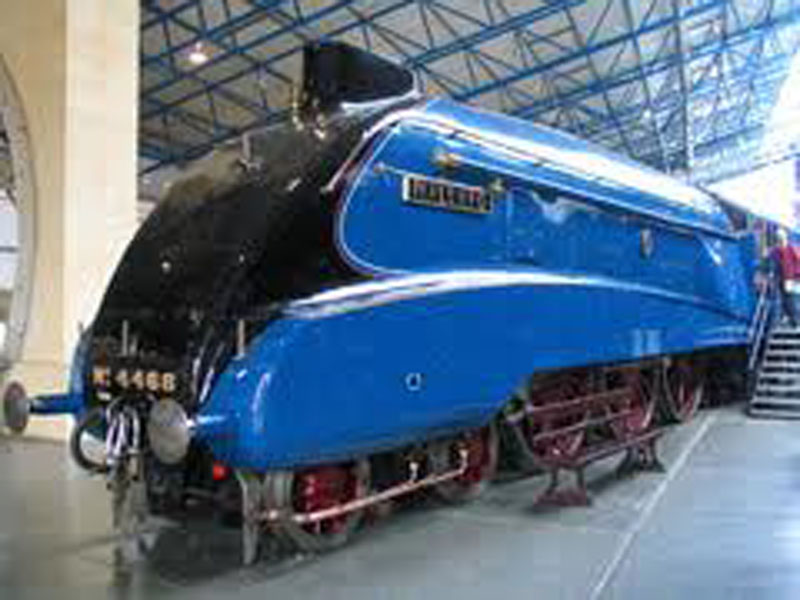
    I am sent on this sad line of enquiry by recent information that one of my favourite haunts, the National Railway Museum in York, will soon embark on a £25 million renovation. My mood fell through the floor when I heard. This museum doesn’t need revamping – it’s not that long ago for heaven’s sake that it was the European Museum of the Year – but a new generation of curators must leave its collective pawprint. The NRM is housed in buildings, both new and Victorian, around extensive sidings that were once home to York carriage and engineering works flanking the great arcing railway station that is the masterpiece of Thomas Prosser.  The NRM is part of the Science Museum and the mainstay of its massive collection is its hundred-plus steam, diesel and electric locomotives and many hundreds of other items of rolling stock. It also houses an astonishing Aladdin’s Cave of evocative memorabilia and models exhibited in that congested Victorian manner of ingeniously ordered chaos. The locomotives cover the period from before the opening of the first passenger railway in 1830 to recent abortive schemes such as our famous tilting train, which tilted at windmills but not much else. The collection is either working on heritage lines or loaned to sibling museums up and down the country, including at Shildon, the NRM’s informative annexe in rural County Durham.  The Main Hall in York, opened in 1975, is laid out like a steam-age roundhouse with a working turntable – the only one left of four originally on this site – which enables easy movement and storage of locomotives in radial bays. Parked in its spokes, it contains up to two dozen locomotives. Here is as comprehensive an introduction to the improving design of British engines, as form and shape were altered and streamlined to meet enhanced performance, as can be witnessed anywhere. To my mind this is as absorbing a display of sculpture and social history as any in the Tate.

    I have visited the NRM dozens of times and on each occasion found something unexpected to dwell on. To get beyond mere awe, which is the response of most who are suddenly confronted with Gresley’s Mallard or a Collett ‘King’, requires only a willing attention to detail. I honestly doubt if any visitor, ever, to this marvellous free museum has ever left disappointed or uneducated, or has ever uttered the request for “more thematic displays” and “greater contextualisation”, or whatever.

    If ever a museum did not need touching it’s this one, but they are intent on changing it and absolutely nothing is going to stop them.  They will get rid of the turntable and a large number of engines in order to get to grips with, oh yes, some ‘thematic displays’ and ‘contextualising’ which will doubtless reduce the fewer engines to illustrating whatever it is the marketers and schools- and ‘outreach’- programmers have told them they want. The thematic displays will bear the headings Moving People, Moving Goods, Building and Running Railways, Railway Nations and Cultural Concourse (don’t ask; no idea). They should forget about such trash, pack in as many locos as possible, some of them steaming up, and leave people to get on with it, work it out for themselves and take what they can from these gloriously aromatic objects. And leave that working turntable alone for it is the nucleus of the museum’s connection to an atmospheric past.

    Four million quid of the twenty five will be better spent returning Mallard and the Flying Scotsman to steam. The latter, the most famous engine and the most perfectly designed, has been scandalously scattered in bits across a workshop floor for years with scarcely a sign of progress in its restoration to full working order. Someone’s head should roll for that.

    We are broke. Let us have a moratorium for ten years on all unnecessary museum renovations, refurbishments and rebuildings, and leave exhibits where they are.

    Economics and statistics are not State Art’s strong suits. Only a month after the Tate discovered it will lose 15% of its Government grant over the next few years there was an announcement of an imminent £45 million renovation to Tate Britain. (So this is what the gallery’s sixteen directors have been up to. They must be exhausted.) This new development comes eight years after the last Millbank upgrade that gave us the architecturally undistinguished rear entrance complete with dangerous staircase. We are informed that £30 million has so far been raised which means work may commence in February. If no more money is forthcoming construction will presumably cease two thirds of the way through. Either that or the Ministry of Culture will be bounced into stumping up the rest in order to prevent an embarrassing hiatus in the work. We are advised that part of the reason for the need to upgrade is that over the last ten years there has been a 60% increase in the number of visitors. Putting it at its most charitable this is a deliberate misrepresentation of a sort increasingly typical of the Tate.  The last attendance figure available, that for 2009, is 1,595,000; the figure for 1999 is 1,822,427 – a decrease of 12.5%. If you compare the latest figure with 1994’s 2,226,399, the largest ever annual attendance at Millbank, the decrease is 28%! The Tate has deliberately made it seem as though the museum is more popular than ever by using the comparatively low figures after 2000 when, following the opening of Tate Modern in the Spring, attendance at Tate Britain instantly collapsed to half of what it had been in the 1990s. Casuistry with visitor numbers should not be used as an excuse to embark on a building programme.

    The economics of the extension to Tate Modern are even more baffling. Of the £215 million required “roughly half”, we are recently informed by the President-For-Life himself, has so far been raised – £50 million of it in a one-off gift from the Department of Culture. The latest donation, by the way, was from the Sultan of Oman who for his generous cheque was awarded a loan of six masterpieces by, among others, Turner, Constable, Gainsborough and Stubbs, for an exhibition in the Gulf. Work behind Bankside has been busily proceeding for six months and resulted in a massive hole in the ground. If no more cash is raised the building will, one assumes, grind to a stop half way up. Only in the quango sector could you get away during a recession with starting a building costing £215 million when you have only sufficient cash for the foundations.

    David Lee

    The Jackdaw Jan-Feb 2011