Tag: Chris Ofili

  • Laura Gascoigne: Tangled Web – September 2017

    “Why is there so much sewing?” demanded The Art Newspaper’s Christina Ruiz after visiting Christine Macel’s exhibition at this year’s Venice Biennale. “I get it: domestic work, women’s work, is important and undervalued. But is it in itself art? No it is not.”

    There was a time when so-called textile arts were prized above all others; when first unveiled in 1519, Raphael’s tapestries for the Sistine Chapel threatened to eclipse the fame of Michelangelo’s ceiling. But in the 18th century tapestry began to feel fusty as audiences warmed to the immediacy of paint. A work’s value no longer resided in the price of the wool, the skill of the weavers, the total hours spent in production and associated cost, but in the artist’s touch, the signature of authenticity that connected audiences with the creator of the work, usually male.

    In the 1980s, when Rozsika Parker wrote The Subversive Stitch, she pinpointed “the separation of the craft of embroidery from the fine arts” as “a major force in the marginalisation of women’s work”. But on the coattails of conceptualism, ‘women’s work’ has come back from the margins. Since the personal signature of the pen or brush fell under suspicion the needle has returned, not always in the hands of women. While the women are bent over their embroidery frames, the men are stealing the limelight, à la Raphael, with tapestries woven by others to their designs. Chris Ofili’s Weaving Magic has just been the focus of an exhibition at the National Gallery, and there are more tapestries than pots in Grayson Perry’s The Most Popular Art Exhibition Ever! at the Serpentine Gallery (until September 10th).

    If Hockney wants to keep his place as top national treasure, he’d better put down his iPad and pick up a needle. Tapestry, embroidery, knitting, crocheting are all back in the frame and proving highly popular with a public tired of the self-conscious cack-handedness of so much contemporary art. This is art like granny used to make, sweet as apple pie and absolved of the obligation to be serious. From Vidya Gastaldon & Jean-Michel Wicker’s knitted octopus, titled Sex Is Good (1999), shown in Tate St Ives 2013 exhibition Aquatopia to Shauna Richardson’s three 9m lions, crocheted from 36 miles of Swaledale wool and displayed in a glass cage at Twycross Zoo in 2012 as part of the Cultural Olympiad, it’s all a bit of folksy fun.

    Naturally, education departments love it. Imagine the jollity at The Exchange in Newlyn in 2010 when artist Jonty Lees donned a Montgolfier flying helmet and goggles to lead a sewing circle and basket-weaving group in the construction of a full-size hot air balloon. The following year the Science Museum went one better and got participants in its Stitched Science weekend to create an entire Solar System Art Installation from ‘various fibre arts’. True, the results looked a bit of a mess, but sew what? Fibre arts have therapeutic benefits. According to the organisers of the Crafts Council’s ‘cinema knit-along events’ in 2012, “knitting has been proven to enhance cognitive development in children, and well-being in both children and adults.” Sew there.

    It’s not all child’s play: serious issues can be addressed with needles. ‘Political statement knits’ by Lisa Anne Auerbach were a highlight of Wasteland, an exhibition of young Los Angelino artists at the Mona Bismarck American Centre in Paris last year. More ambitiously, at the Minories Gallery, Colchester in 2015 Clare Sams’s installation Knitting Fever recreated the devastation caused by the 2009 floods when a wool shop of that name in Cockermouth spilled its guts through the Cumbrian town. The gallery complimented the artist on using a process “stereotypically viewed as a feminine past-time [sic]” to represent “cataclysmic forces not normally associated with the practice”. Sams’ ‘total knitted environment’ looked a little twee for a cataclysm – acts of God produce more dramatic results than needlework – but she wasn’t going to let that stop her, having already knitted her way through the Hackney Riots and Guantanamo Bay. No knit-wit she.

    Other artist-knitters are not so outward-looking or gender-neutral in their choice of subjects. Given the vogue for ‘bedroom painting’, bedroom knitting was almost bound to follow and, sure enough, in 2012 the Polish-born New Yorker Agata Olek transformed Tony’s Gallery in Brick Lane into a crocheted replica of her boudoir, with walls and floor emblazoned with explicit texts from former lovers. “It is not just another apartment installation,” she assured Metro, “it is the reflection of life, love, trust and lust in current time.” Its tear-jerking title I do not expect to be a mother but I do expect to die alone was a quote from, you’ve guessed it, the queen of the misery stitchers, Tracey Emin. But no artist has taken intimate needlework quite so far as Casey Jenkins in her 2013 performance Casting Off My Womb, in which she knitted a menstrual cycle-length scarf from skeins of wool secreted in her fanny. The work, she told The Guardian, was “primarily about casting off the need for validation from external sources” and “forging a path of self-determination in the face of society’s expectations”.

    Maria Balshaw would say aye to that. Unlike Christina Ruiz, she congratulated Venice Biennale curator Christine Macel in The Art Newspaper on doing “a really good job in challenging some of the gender stereotypes around textiles,” singling out male artist David Medalla for praise for his participatory work A Stitch in Time, first shown in 1968. Medalla’s early lead in removing the sexual stigma from stitching may have laid the ground for the Crafts Council’s 2004 exhibition Boys Who Sew, at which Fernando Penteado established the butch credentials of needlework with a display of samplers embroidered by tattooed inmates of Wandsworth Prison. Since then the social enterprise Fine Cell Work has climbed on the prison wagon and trained 300 prisoners in 20 gaols to spend their lock-up time productively embroidering cushion covers. There’s precious little bunce in it for the lags, but more job satisfaction than stitching mailbags.

    It’s no discovery that men are nimble-fingered (not a lot of people know this, but the young Malevich upset his father with his unhealthy aptitude for Ukrainian cross-stitch). The danger for women of challenging gender stereotypes around textiles is that male artists will seize the initiative. Not content with getting tapestries woven to their designs, brothers are doing it for themselves. In Art Now at Tate Britain in 2010 Andy Holden showed The Pyramid Piece, a 10ft-high knitted replica of a chip off the Great Pyramid of Cheops that he had illegally smuggled home from a family holiday to Egypt at the age of 12. Along with its benefits for cognitive development, knitting is obviously a good way of assuaging guilt.

    The main drawback of needlework, for unreconstructed individualists, is its inflexibility as a means of expression, which is why most attempts to employ it as one, Tracey Emin’s included, have been sew-so. The notable exception is Mr and Mrs Pope, Knitted, Shrunk and Hung (2012), a truly heart-wringing piece of work that – sorry girls! – was created by a male sculptor, Nicholas Pope, with his own fair hands.

    Laura Gascoigne
    The Jackdaw Sept/Oct 2017
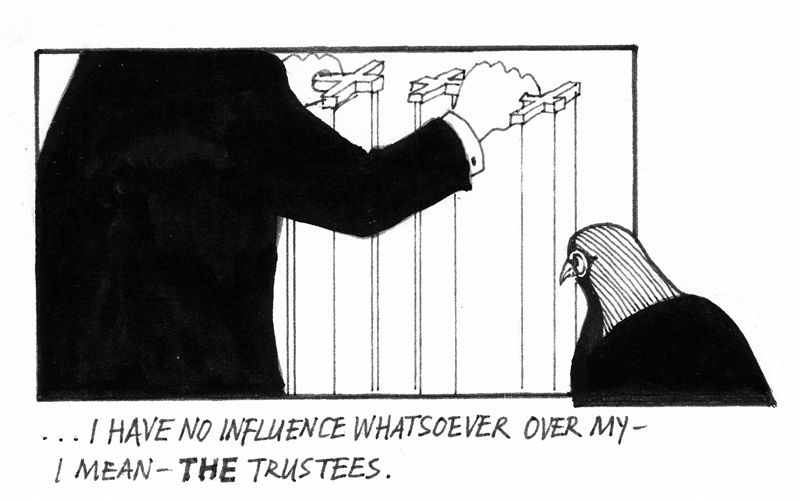
  • Tate Trustees and the public interest

    The Tate recently named two new trustees, one of whom is painter Tomma Abts. She is a 44-year-old German, recently appointed Professor of Painting at the Kunstakademie in Düsseldorf, who won the Turner Prize in 2006. As an artist trustee, she replaced Jeremy Deller, who won the Turner Prize in 2004. Abts’s paintings are all the same small size (48 x 38cms) – it is claimed this tic is conceptually crucial for a reason never convincingly explained – and consist of polite abstract designs which might have looked original on curtains at the 1954 Ideal Home Exhibition. So much for the Cutting Edge. The Tate claims her pictures “possess a formal definition and coherence that suggests that they could never have existed any other way … [and] seem to achieve what only painting can, inhabiting both this reality as an object or ‘thing’, and a parallel world with its own set of rules and relationships that demand to be judged on their own terms.” As per with their interpretive literature, all helpful stuff. Am I being cynical? Yes. Why? Because using any sensible criteria Abts doesn’t deserve to be a trustee of an important British museum.

    The job of Tate trustees is to oversee the efficient running of the gallery “as guardians of the public interest” – and please note that it says  ‘the public interest’ not ‘State Art’s interest’, for as you will discover these two mutually exclusive agendas tend to become blurred in the minds of certain individuals. Improbable as it sounds, guidelines for the functions of trustees are drawn up by the Tate itself, not by independent arbiters. Such complacency hardly reassures an outsider that the public interest, rather than the Tate’s, is being looked after. Indeed, such self-scrutiny is hardly better than the continuing disgrace of policemen investigating their own mistakes.

    In 2008 the number of trustees was increased from 12 to 14 and as required by the Museums and Galleries Act 1992 “at least three” of these must be artists. Thirteen are appointed by the Prime Minister and the last is nominated by the trustees of the National Gallery from among their own membership. Unlike their fellow trustees, who are mainly those with business expertise, and who can serve up to two terms of four years (a period of office trimmed recently from five), artist trustees currently serve only one term of four years. You may find it odd – I certainly do – that while there are three contemporary artists with gilt-edged State Art credentials on the Tate’s board of trustees there is no place for a single art historian. I’m obviously old-fashioned because a museum of historical art with no art historians sitting on its governing board seems verging on the perverse.

    When an artist trusteeship becomes vacant it is widely advertised in the papers, giving the impression that any capable, knowledgeable, articulate artist of repute might apply. Nothing could be further from the truth, for there is a codicil written in invisible ink along the bottom of these ads, which reads: “If you have not won or at the very least been nominated for the Turner Prize, kindly fuck off and don’t waste our time.” The Tate squanders scarce cash paying for these advertisements which are nothing short of a calculated deception. Artist trustees are in fact a self-appointed clique comprising only winners of the Turner Prize with a couple of reliable also-rans chucked in. Since new regulations were imposed in 1992 the only exceptions to this rule have been Julian Opie, who famously refused his nomination for the Turner on the grounds that the prize “had become a frivolous publicity stunt”, and Bob and Roberta Smith, the sobriquet of a dimwit called Patrick Brill, who is otherwise a regular purveyor of infantile stunts at Millbank – you may recall his Tate Christmas tree whose lights visitors were asked to illuminate by peddling a generator. He’s very concerned about the environment apparently.

    Being a trustee involves attending six meetings a year and is said to require a day a month in reading and preparation. I must point out that the Tate’s artist trustees are easily the worst attenders at these meetings, and are frequently absent. In the case of Anish Kapoor (Turner Prize winner, 1991) his absenteeism, which included missing half the meetings in two consecutive years and scarpering early from others, would have surely seen him sacked from the board of any efficiently run private enterprise.

    Of currently serving artist trustees two are Germans – besides Abts the other is magazine photographer Wolfgang Tillmans (Turner Prize winner, 2000). Could they really not find a British photographer, or even a British abstract painter, worthy of these positions? Admittedly, Germans do most things better than we do but surely this is insulting to British artists. And how can a professor at a German art school, which presumably requires her to actually attend some of the week, perform the duties of a trustee required to be resident here?

    The process by which artist trustees are selected – laughably characterised as “an open competition” or “an open competitive process” – is indicative of what happens when a clique achieves a complacent monopoly and is allowed by servile arts commentators to get away with it. Minutes of meetings make it clear that artist trustees are encouraged to invite applications from those they consider suitable as their own replacements, especially when candidates who have responded to the ads are not considered worthy, which one may reasonably surmise is always. Indeed, I wonder if there was ever a case of a successful artist trustee having responded to the ads rather than having been – that weasel word – ‘invited’ to apply… And so Turner Prize winners beget other Turner Prize winners, or at the very least other near-misses of that persuasion.

    Candidates for artist trusteeships are interviewed by a panel comprising trustees, including the artists, plus an “independent assessor” who is present to ensure that legal niceties, “best practice” etc., are observed and everything looks above board. But how can it be above board when only Turner Prize winners are appointed? Perhaps this independent assessor ought to be involved from the start of the process in order that more than Turner Prize nominees might be seriously considered, if for no other reason than to keep up appearances of openness. Eyebrows would be raised at such a narrowness of potential candidates in any other sphere of public life: imagine, for example, the Commander-in-Chief of the armed forces always being selected from the same regiment.

    You may ask why is it so important for the convenient running of the Tate that its artist trustees are always winners of the Turner Prize. The answer is for the obvious reason that having been awarded a career-changing gong by the institution of which they are now overseers, they will never rock the boat by asking too many tricky questions about the Tate’s direction in its dealings with contemporary art. This is one of many ways by which State Art has become institutionalised: no one but the reliably subservient is ever allowed on the inside to question Tate, or indeed Arts Council, policies.

    On the other hand these parti pris trustees can be useful when outside criticism of the Tate becomes noisy. For example, in July 2004 Trustees discussed newspaper coverage of a Tate work, Rodin’s The Kiss, which Cornelia Parker (who was nominated for the Turner in 1997, the year it was won by Gillian Wearing, inevitably herself a recent artist trustee), had the previous year controversially wrapped up with a mile of string. This stunt was claimed by the artist to be “challenging the claustrophobic nature of relationships”. Artist trustees present in the meeting (which included the aforementioned Wearing) were able to defend their fellow artist for the benefit of other sceptical trustees. They pointed out that it was the job of the Tate to provoke controversy and discussion, which this work did.

    It is in the interests of these artist trustees to support the Director. They know they will be serving only for a brief period following which they might reasonably look forward to the reward of a Tate retrospective or other continued patronage, purchases etc.

    Serota has stated a preference for such younger trustees. Referring to the trusteeship of Anthony Caro many years before, he remarked in 1998 to the Sunday Times: “Tony was well over 60 when he became a trustee. He was a very effective trustee, actually. He cared passionately about certain things and was a powerful force … but it just seems to work better when you have artists who are a new generation, or indeed erring on the younger side, really.” And we know why he thinks it “seems to work better”, because older artists of a more independent, more knowledgeable, more experienced character might argue cogently for a policy or direction other than the one being pursued by the Director. They have nothing to lose by disagreeing with him. Let’s face it, the current crop of artist trustees is in Serota’s pocket. They owe him and he knows it. He can rely on their support without a second thought.

    In a 2008 interview Serota said of his trustees: “I don’t have any part to play in their appointment”. Remember this, it’s important and we’ll return to it in a second.

    Many years ago Serota said that public nominations for the Turner Prize (perhaps you don’t remember that ridiculous charade whereby we all wasted our stamps and faxes) were seriously considered by the judges. We discovered in 2006 what we already knew, courtesy of an indiscreet Turner Prize judge, that this was in fact a lie and they were binned with risible disregard. We also discovered at the same time, and from the same source, that Turner Prize judges were given a list of appropriate artists and exhibitions – just to help them along you know, point them in the right direction. And there we were thinking in the innocence of our ignorance that they might nominate anyone…

    Serota also stated in 2005 that the Tate only rarely acquired work by serving trustees. The Jackdaw checked up on that and discovered (see the editorial for Dec/Jan 2006 on our website) that he wasn’t telling the truth. Indeed, this whopper cost him a bollocking from the Charity Commission. There were also a number of other flagrant economies with the truth concerning the Tate’s acquisition of work by serving trustee Chris Ofili, who was naturally a Turner Prize winner (1998), which also resulted in another six of the best from the CC. (I almost mentioned here the fact that in the last editorial – also on our website – we indicated how the Tate recently misled us over their attendance figures, but you must be getting fed up with that one.)

    So, bearing in mind Serota’s far from perfect form, when he remarks “I don’t have any part to play in their appointment” I need to ask myself: ‘Do I give him the benefit of the doubt and believe him this time?’ Well, as it happens, no I don’t. Even cursory familiarity with the Trustees’ minutes betrays this one as untrue. On the contrary he is frequently involved in their appointment; indeed, the process of Trustee appointment is administered by his own office. He even attends candidate interviews “in an advisory capacity”. Presumably he offers ‘advice’ which plays no material part in the process, so why is he there in the first place? Indeed, we read on: “The key stages of the appointment are overseen by a panel which will normally include the Director.” (Who, presumably, doesn’t play any part.) On one recent occasion he encourages artist trustees to nominate likely candidates for their replacement knowing only too well the sort of artists they are likely to suggest. No part?

    Let’s have this one straight: Serota is ‘advising’ on the appointment of someone, a trustee, who will function as his own employer. This is a wretched abuse of the supposed ‘independence’ of process and would be considered as much in any other public body. It is, as usual, as blatant a conflict of interest (not to mention a betrayal of ‘the public interest’ about which the process purports to be so concerned) as you would expect to find at the Tate, whose management of conflicts of interest, incidentally, was declared woefully inadequate by none other than the Charities Commission.

    The Tate should not be involved with either the compiling of its own trustees’ duties, or in the nomination or selection of Trustees themselves. How can ‘the public interest’ be considered served when the organisation under scrutiny is writing the job description of its own scrutineers. If we are to have artist trustees let’s have them from a cross-section of the artist community and not just those representing the Turner Prize. And let’s have some eminent art historians in there too.

    David Lee

    The Jackdaw May-Jun 2011