Tag: Hepworth

  • Art’s urbane guerillas hit Wakefield: the Hepworth Museum

    Art’s urbane guerillas hit Wakefield: the Hepworth Museum

    Brian Lewis, Pontefract’s poet laureate and a painter to boot, bravely exposed the neglect of local artists when the visiting functionaries of State Art arrived for the opening of the Hepworth Gallery in Wakefield

    In the cultural war which challenges the dominance of the London art world we are the first shock troops of a new guerilla army which urges artists to get out onto the streets and protest by using art to confront art.

    What follows is an account of what happened when we attacked the Hepworth in Wakefield using a 6,000-word didactic leaflet, 21 paintings and a small piece of sculpture called Don’t Have Any More Mrs Moore. We called our guerrilla attack Operation Good Morning Mr Courbet.

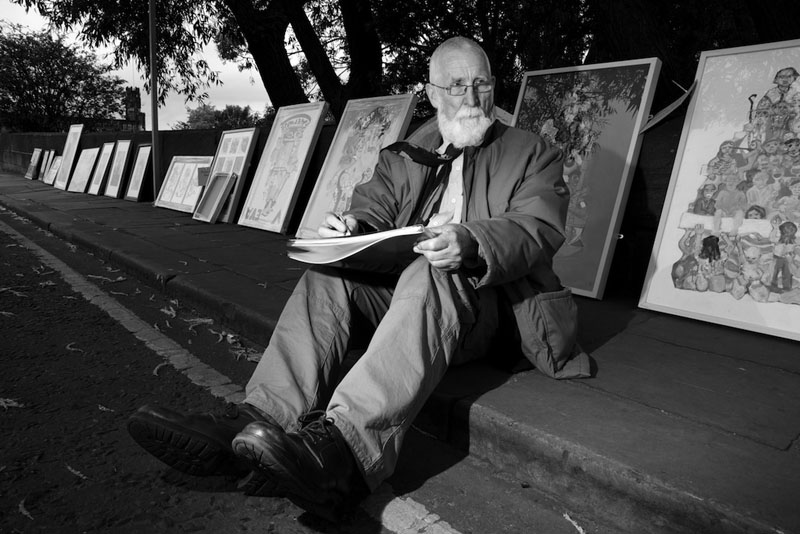
    We had been led to believe that Prince Charles was coming to open David Chipperfield’s £35 million gallery in Wakefield and that for security reasons the police were likely to clear the nearby Chantry Bridge prior to his arrival. Arguing that they would find it more difficult to evacuate us if our two advertisement boards and framed pieces were already in position, we tied 8ft x 3ft horizontal boards to roadside railings and bollards. Both faced the Hepworth’s entrance and read ‘Alternative Exhibition – Free University of Chantry Bridge, Wakefield’.

    The Free University reference was understood in parts of the district. We had recently held an exhibition six miles away in the Heritage gallery in the ex-mining town of Castleford. At its Bridge Arts Gallery we had workshops, a rolling exhibition programme, and were also offering writing, publishing events and a UK premiere of a piece of music composed by the Professor of Creative Technology at Leeds Met University based on an ex-miner’s poem. In Castleford we were called the Free University of Castleford on Aire. The new name, The Free University of Chantry Bridge, Wakefield was chosen because it suggested that our rabid arts collective had seen the Hepworth, been shocked by its appearance, and pupped.

    Good Morning Mr Courbet

    Our pamphlet was called No, No. No – Hepworth because it is direct, but the sub-heading was chosen because it is the title of a painting which shows a local patron doing honour to a local journeyman artist. Courbet is also appropriate for another reason. When he was refused hanging space at the 1855 Paris Exposition Universelle he erected his own temporary structure next door to the main pavilion and showed 40 of his own pictures, including Burial at Ornans and The Artist’s Studio, which now hold pride of place among the Grands Machines of the Louvre.

    The Chantry Bridge exhibition was mobile and although this was not explained to anyone the west end of the bridge area was its holding bay. The plan was to draw attention to our leaflets and pictures by shifting some of the 21 framed images close to the grass by the pedestrian bridge which every visitor would pass over that night on their way to the opening at 6.00pm. Using this location we would hand visitors the No, No, No – Hepworth or Good Morning Mr Courbet 6,000-word essay-cum-tract. We had planned a pincer movement attack: paintings to look at and a tract to read.

    This had been printed in an edition of 250 by a local printer (localism is always a good greasy slice of halal to slap across the chops of a prestigious gallery) and consisted of 16 numbered pages which came folded from a piece of A3 paper. It cost £75 to print. We did the design ourselves.

    In all ways it was massively non-PC and went against all the rules of modern advertising. It was not in colour, recognized no sponsors and took little regard for people who had dodgy eyesight. It was knocked up by a couple of blokes in a basement in Pontefract who had combined ages of 136 years.

    We knew that most people wouldn’t read it, but a few might. Online petitions bother no one and make it seem that you are doing something when you’re not.  Those in authority might read on and our leaflet was aimed to get up their nose and along with the paintings make us visible. The size of the tract was very important. Mail goes from the hall floor into the recycling box with scarce a glance. This went directly into the pocket or shoulder bag.

    Drums and trumpets sounding outside a critical arts board meeting has a similar immediacy. Both loud music and tract publishing are in the tradition. Action precedes argument. Move your feet and your arse will follow, or put with more finesse by existentialist philosopher Jean-Paul Sartre (he whispered little else in Simone De Beauvoir’s ear): “In the absence of certainty action must take the place of speculative thought.”

    At first very little happened (we discovered there was to be no Royal Visit). A few locals stopped to talk although most were on their way to work.

    I had been having an email and a ‘letters to the local newspaper’ correspondence with the leader of Wakefield MDC, Peter Box. The dialogue had been going on for about a month. From my side it concerned the need to watch the promotional data supplied by their consultants, the questioning of why we should be promoting a ‘mausoleum artist’ and the proposed programme of retrospectives by what are inevitably described as ‘eminent international artists’. I considered that even when the running of the gallery was passed onto the Hepworth Trust it would still have a call on the public purse through Arts Council England or through English Heritage. I forecast that the wider agenda of regenerating a derelict area might have a bearing on the level of financial commitment by the council.

    In the middle of the night, 4.30 am to be precise, I’d emailed him and told him that two days before I’d received a telephone message. The speaker told me that the Hepworth knew there would be a demonstration on the Bridge and had offered to be some sort of broker. She said that although the Hepworth Gallery was happy with the demonstration the Council was ‘likely to take strong action’.

    My email said that I had a perfect right to demonstrate. I pointed out that having done National Service, bullying or imprisonment held no fears for me. I have a big white beard and, therefore, I said, I relished the thought of police involvement and that having photographs of a Santa look-alike handcuffed would suit me fine, for at the very least a photograph would cause industrial disputes in Lapland.

    The first call I received that morning came from the Constituency Manager of my MP, Yvette Cooper. Yvette had asked her to find out if Peter knew what I was doing. Presumably Peter had phoned her. I said I would phone Ms Cooper a bit later.

    At nine I was joined by one of my sons carrying tea in a paper cup. He is a man who could be relied upon to argue forcibly if needed. Porl, a professional photographer, came a little later. The witnesses and two cameras could be useful.

    I knew an emissary would come from the council and at 11 am, just after they had started the initial party for ‘100 very special guests’, he rolled up. Wakefield’s Deputy Chief Executive was someone I’d known for years and liked. He made the obvious point that I had a right to protest, to which I replied ‘You’re right there’. Then he said: ‘Peter says that are you aware that the Hepworth family are gathering this lunch time and today is the anniversary of her death.’

    There they had me. Sentiment took hold.  As soon as he said it I knew that I was not going to upset a family gathering, any family gathering, by speaking ill of granny.

    I thought quickly. ‘I will not give the leaflet out today, even though the main arts gathering is on tonight, but I will not remove the paintings. On your part I want you to say that you will read the leaflet and pass copies down the appropriate line of management. This printing has cost me a good slice of this week’s pension. I will do that but only for tonight, tomorrow is another day.’

    Compromise brought conciliation. ‘What exactly is your target?’ he asked. I took out the leaflet and read the back page. ‘This pamphlet’s targets are the London art world and the type of art they promote; arts consultants, their data and the withdrawal of funding from other local arts organisations. It chronicles overspending on fine arts and the consequent neglect of local artists, writers, publishers, theatre companies and museums.  Hopefully it will become the start of a debate about why and how we fund the arts in the UK and how it differs from how they are funded elsewhere.’

    Ten minutes later I was talking with both the newly appointed Chief Executive and Wakefield’s senior arts officer. I was blunt and they were amiable but they listened carefully and promised to read the leaflet. I assured them that we would meet again.

    They were followed by a procession of friends who knew about the ‘exhibition demonstration’ and Wakefield officers, mostly people I knew because of my work on regeneration. They told me bits and bobs about plans for the rest of the weekend and how they intended doing up the area. There were other hard-handed men and the occasional hard-hatted woman who knew about art and what they liked.

    Then the police arrived. They had been sent by someone – exactly who I’m not sure – but they were fine. They informed me that I was committing the technical offence of obstructing a public highway but agreed that since I had avoided putting up a price list I wasn’t trading. They exercised their right of discretion and the right of demonstrating seemed to overrule everything.  Then the last-but-one visitor came. He was ‘a Hepworth’, the only member of the family to bear the name. He was followed by torrential downpour so we turned the pictures to the wall and five of us retreated under a convenient medieval bridge extension and talked about his cousin Barbara and why our demonstration was called ‘Good morning Mr Courbet’. His views about her work were close to mine. When we emerged from under the bridge we saw a wet cyclist on a lightweight bike. I was about to meet for the first time the publisher of a scurrilous journal.

    Was the tiring day on the bridge worth the effort? And what had we learnt?

    1. Paintings need to be small enough to fit into bin liners and have robust frames. It is best to have a number of solid frames in three sizes. Uniformity makes the exhibition look more professional.

    2. John, our market frame-maker, showed that by using handwrap (a sort of clear film) on a handle you protect the frames, have something to attach titles to, but more important you could attach painting and display boards to bollards and railings.

    3. You need someone close at hand with a car big enough to carry away the paintings.

    4. Make sure that some of your pictures are explicit and targeted. If you’re hitting out at someone, have a hand-out which explains what you’re doing. The quality of the work is important. The majority must be able to sit happily in a public gallery. Avoid anything that is called ‘abstract’.

    5. Take on big subjects such as Arts Council policy.

    6. Don’t sloganise. Contrary to received wisdom people really enjoy reading a developed argument.

    http://www.pontefractpress.com/

    http://www.hepworthwakefield.org/

    The Jackdaw Jul-Aug 2011

  • Another marvel of the Modern Age: the Hepworth Museum

    Brian Lewis, poet and painter of Pontefract and champion of regional arts, reflects upon the Hepworth Museum in Wakefield, home town of the eponymous sculptor

    “Inside it is beautiful”

    The PR company who is responsible for naming the new Wakefield Art Gallery which is rising on land between the canal and the River Calder has decided to call it ‘Hepworth’ as distinct from ‘The’ Hepworth or ‘A’ Hepworth. If I was choosing from the three alternatives I would take the third – because there is at least another museum of that ilk in St Ives. Babs, or Barbarella Heptonstall, as I prefer to call her, is ‘World Famous’ in Wakefield. Shirley, an erstwhile next door neighbour who followed her through Wakefield Girls’ High School once said to me, ‘You had her rammed down your throat. It was as if no one else in the school had ever done anything. Mind having triplets was quite an achievement.’

    When I asked Lord Geoffrey Lofthouse, one time NUM chairman at Acton Hall colliery and Deputy Speaker of the House of Commons, why he had agreed to unveil one of her pieces, he replied: ‘I like the Chairman of the Arts Council and I did it out of respect to him. I never mentioned her by name and as far as the so-called statue is concerned I’ve seen better things fall from the roof of the pit.’ The piece of art in question was a cast of the one of the larger members of The Family of Man ménage and thought of as ‘one of her significant pieces’.

    When local ne’er-do-wells kidnapped a lesser member of ‘The Family’ and sold it to a scrap merchant in Leeds I drew a cartoon for the Yorkshire Arts Magazine. In those days the Arts Council was regionalised and capable of laughing rather than twittering. The statue was found almost immediately. The drawing showed a couple of hippies in conversation. ‘Pretty crap as villains but what critics’. The Chief Executive of the Bretton Sculpture Park was not amused. Shirley is 78, Geoffrey 88 and I have my bus pass, so it may be that we are out of touch with the times, but I don’t think so. I have asked the men and women on top of the Upton omnibus – people of all ages – and they do not know what Hepworth is, was or might become. I did not have a 100% nil response. One said, ‘I know it is that sort of grey warehouse just down from the Private Shop. The one where the blind needs fixing.’ Of course you would not think that it was so unpopular if you read the puffs and farts which the sponsors of the package create as we precede to delivery in May 2011 and come to believe that this gallery was needed and that it was popular. And that Wakefield had the hotels, businesses, general infrastructure to sustain and encourage growth. As a decade ago the Guggenheim was to Bilbao so would be the Hepworth to Wakefield. Tourists would flock and the economy would revive.

    The reality is that the railway which will deliver the customers and lies close to the Hepworth is virtually derelict, the riverside uncared for, the promised regeneration of the area on hold, Labour is in opposition and the Regional Development Agency is finished.

    Then why is it being built? The cynic in me suggests that it could be to do with the ownership of the works of art. What better investment-publicity than to have national exposure in the papers of a name on a plinth of a statue you own. On the other hand it may be that an outmoded fascination with iconic buildings and international architects has led funding agencies to believe that this stylish building has enough merit to persuade people to flock to Wakefield. I love the thought that early next year a woman in upstate New York will wake, tap her beau on the shoulder and say, ‘Fancy going to Yorkshire to see David Chippingfield’s Hepworth’ … but I don’t think it will happen. What is more likely to take place is that the New Yorkers, and indeed anyone south of Sheffield, will stay away and that the people like me who live in the surrounding towns will be given an unwanted building and associated revenue costs because of a narrow attitude to aesthetics which is mixed with influence and power. This troubles me.

    This is the story of what happens when a government finds itself part of a tangled knot of silly ideas and promises but, even in a recession when ‘moments have to be seized’, lacks the confidence to cut it with a sword. As the Jackdaw points out with a regularity which after eight years of reading I still find convincing we are in the hands of a band of mandarins which that wise bird defines as the purveyors of State Art. I wont go there. Most people will know the story. ‘Old Nick’ Serota – he’s 62 – Hampstead-born to a mother who was the Ombudsman. After Cambridge got a job at the Arts Council and was subsequently director of two of their galleries, MOMA Oxford and the Whitechapel, and then he met Anthony Gormley who made a sculpture out of sliced loaves. From then on Serota managed to appoint his people into positions of power and influence. Today he is on more money than the Prime Minister (£165,000 as against £142,500) and at present has a Tate Modern gallery dominated by 100,000,000 hand-painted porcelain seeds upon which we should have been able to go walkabout; that is, if it hadn’t been deemed a health and safety risk.

    It’s not been all plain sailing. In Leeds the burghers said that they did not want Gormley’s Big Brick Man. It was a distraction and clashed with the eloquence of some neo-renaissance mill chimneys though it did confirm their views on State Art modernism, for you climbed stairs having entered up its arse and then looked out of its ears. However, most of Old Nick’s time has not been wasted so it was not to read that he considered that the new Hepworth gallery was ‘One of the most exciting and beautiful galleries in the United Kingdom’.

    Of course, much of this would be too daft to laugh at – a squabble of opinions – if it wasn’t for the fact that the emphasis on the Hepworth costs money.  Exactly how much is difficult to tell. A recent letter in the local paper put the cost of building at £35 million – not denied by the Wakefield MDC ‘culture secretariat’ who usually jump in to rectify misinformation contained in ‘Letters to the Editor’. New staff are also required and revenue to run the place.

    As someone who was on the Board of the Regional Arts Association (now Arts Council England, Yorkshire) and has written about its impact on community development in Sheffield when the consultancy-led Museum for Popular Music went under, I have been there before. Built with £15 million Lottery money and Arts Council revenue support it opened on May 1st, 1999 and closed on June 20th, 2000. This was not before small arts clients across the region had grants cut as an abortive salvaging operation clicked into place.

    I have been there before, bought the tee shirt – but this time it has an elegant hole in it.

    http://www.pontefractpress.com/

    http://www.hepworthwakefield.org/

    The Jackdaw Jan-Feb 2011

  • Gruel for the masses

    Gruel for the masses

    The State should be more circumspect than to behave like a private collector. Unfortunately, collecting and exhibiting in national collections according to narrow personal tastes and loyalties is established practice. Those employed to run Contemporary Art are selected because they have been carefully programmed in the tenets of State Art and if they have doubts keep quiet about them. But functionaries of State Art are not spending their own money and therefore in the policies governing collection and exhibition they should reflect the best from the full range that is being produced and not just follow those few desperately eking out the fag end of Opportunism. A damaging aspect of State Art has always been that it refuses to acknowledge anything outside its own narrow prejudices, which stop dead at those artists represented only by major art dealers and sold expensively in rigged markets by auction houses. Healthy dividing lines between museum curators and directors, auction houses and the most fashionable art dealers no longer exist. The system stinks worse than an open sewer, but many love the smell and wish to waft it over the rest of us so we might come to like it too.

    State Art apostles all help one another in pursuance of their little ambitions. They are a happy club who play hard. Their governing Synod, which comprises all of those contributors to the unhealthy smell noted above, swarm off one week to Margate aboard the same train, the next week to Wakefield aboard the same train, days later they commune aboard the same flight to Venice, and the week after that they chink glasses again at the Basel Art Fair – it’s a hard life is State Art. Decisions made among themselves during these junkets will be imposed everywhere. What results from this process is the repeated exhibition of the same few artists. This keeps the rest of us in ignorance of so much that might otherwise have been stimulating. Most of my generation will never know what we have missed because we have lived our entire professional lives under a State Art regime administered by curators terrified to jeopardise their careers by thinking for themselves. Predictability being the worst of State Art’s crimes, we are never surprised.

    Also like many of my generation, I suspect, I no longer feel the urge to see everything, having already viewed so much so often that hasn’t justified its hysterical praise by those with mysterious interests in promoting it. I’m sure Miro was a fascinating old cove but I’ve visited his studio in Palma and, to be honest, provided with a large enough mop and baths of black and the primaries, a toddler could produce in an afternoon most of the work on display there. Miro at the Tate? No thanks. Likewise Emin at the Hayward. Seen them before, and life is too short to indulge further the solipsism of an idiot. The problem for those of us with decades of exhibitions behind us is that this sort of material, the kind of thin work we are constantly exhorted to idolise,  has become unavoidable. It gets everywhere. Nowhere is safe from it.

    I recently visited the Orkneys for its birds and stones. Knowing that the Pier Arts Centre in Stromness held a donated collection of carefully selected minor works by important 20th century British artists, this was an early port of call. The permanent collection is the generous gift of Margaret Gardiner, who wrote an acclaimed biography of Barbara Hepworth and had an eye for quality which probably exceeded her modest purse. Nevertheless, she accumulated covetable, domestic-sized pieces by Hepworth, Moore, Nicholson, Piper, Heron, Frost, Lanyon and others, all of which will spark memories in knowledgeable viewers while touching those nerves and recesses where appreciation resides. The original gallery, at the heart of a busy harbour, has been done up courtesy of the Arts Council Lottery (£4 million) and there is now room for temporary displays and craftsy souvenirs. I was hoping to see here work by artists from north of Inverness and Aberdeen – the likes of Frances Walker for example – those whom one is unlikely to encounter elsewhere. No such luck.  What they had on display were some scribbles and unsavoury looking skidmarks by Cy Twombly, of the ‘highly significant’ sort which cause State Art fanatics to collapse in a religious swoon, and a collection of inept portraits and even worse ‘landscapes’ by another fashionable and ludicrously expensive American artist, Alex Katz. (Twombly is represented by Larry Gagosian; Katz by Pace Wildenstein.) Both are described as ‘influential’. God help us, who with?

    Katz’s portraits were trendily wooden, flat and unmodelled, the sitters characterless, boneless in some cases, and tediously stylised. Anyone whose eye has been nurtured by rich historical portraiture from Al Fayum and the Roman republic to Ravenna, Moroni, Rembrandt, Lawrence and Spencer couldn’t possibly see anything other than low-fat insipidity in Katz’s daubs. And his small landscapes, truly awful pictures, were so awkward and incompetent they were unworthy of hanging in a Women’s Institute. But no, they had been air-freighted 700 miles north of London for the benefit of Orcadians and those, like me, doggedly twitching for whimbrel and black guillemot. (Incidentally, en passant, the former you can more often hear than see and the latter, considerable rarities elsewhere on northern coasts, bobble about common as muck in Scapa Flow. Youalso ought to know about the corsair ravages of great skuas marauding in press gangs on Hoy – more engaging than either Twombly or Katz could ever be – but that’s for a different and probably a better magazine.) The presence of Katz in the northern isles wouldn’t have been quite so annoying had I not seen the same shallow gimmickry only a few months before, by accident note, in the National Portrait Gallery. I’d been bewildered then by what was officially considered to give this stuff precedence over works by effortlessly superior British portrait painters. Both Twombly and Katz are part of the Artists’ Rooms series which are enjoying a permanent tour of the country. This is the “generous gift”, by the way, for which we paid Anthony d’Offay £42 million. Artists’ Rooms, organised by the Tate, are the process, it would seem, by which nobody in the country will be safe from the tradenames of State Art. They are coming to a place near you whether you like it or not.

    On the way south I didn’t stop for Jeff Koons at the Scottish National Gallery of Modern Art in Edinburgh (another Artist’s Room) having seen the trash he has to offer too many times before. I stopped instead at Wakefield where a £35 million museum (Arts Council Lottery: £5.5 million) designed by David Chipperfield has opened in honour of local artist Barbara Hepworth (1903-1975).  This shed of grey slate, forbiddingly windowless for the most part,  replaces the old Wakefield Art Gallery which was housed in the municipal Edwardian pile up the hill. Despite the beauty of a small number of masterpieces it contained, that was a gloomy, unloved place where, not surprisingly, few ventured. Despite its off-putting appearance, the new grey gallery is an improvement and stands beside an attractive weir (grey heron, grey wagtail) on the Calder 25 minutes walk from the railway station. Inevitably, the building has been overpraised by architecture scribblers. It is nothing at all remarkable, but is agreeable enough inside. Apart from the foyer, which is coloured in regulation Serota mud, the rest is white and spacious, the light a mixture of rationed natural and mains. The whole place is blighted by that self-inflicted virus of modern galleries and museums, patrolling attendants armed with squawking radios which destroy all attempts at uninterrupted concentration.

    The historic Wakefield collection, mainly mid-century Modernism which is representative more than notable, is scarcely worth writing home about for anyone well acquainted with the field, but is augmented by apposite loans from elsewhere, mainly the Tate – a sensible use of their hidden reserves. From a loyalty point of view the display does Hepworth no favours. Gabo was more inventive in three dimensions with form, materials and especially string, while Moore, represented by two fine early sculptures, a reclining figure carved in writhing elm and the modelled cement head, render the nearby Hepworths stodgy and a bit simple. Her drawing of a surgical operation – these are usually her best things when seen reproduced small in books – looked vague next to one of Moore’s best shelter drawings. In this company Hepworth might be second rate but she’s still world famous in Wakefield.

    Given that Arts Council money has gone in, they and their lieutenants, and particularly the dead hand of their State Art doctrine, are already calling the shots in the exhibition programme. The opening show is throwaway stuff. Doubtless during the selection process political correctness intervened something like this: we need a young female sculptor with impeccable State Art credentials, phone Serota.  The chosen candidate was one Eva Rothschild, who is Irish. Fresh from the ponderous, overblown constructivism she served up last year at Tate Britain, she arrives here with playground materials and colours, inarticulate tangles of stuff on stands signifying heaven only knows what.  Beside the humanist Hepworth this skip-fodder insults her memory.

    Apart from Hepworth and Moore, think of the important contribution of Yorkshire to British sculpture in the last century – national figures like Kenneth Armitage, George Fullard, Austin Wright, Ralph Brown, Hubert Dalwood and all those gifted tutors and Gregory Fellowships at Leeds. The new museum had years to plan a retrospective of an important local sculptor, or a mixed show of work ripe for reassessment, but instead they present scraps by yet another over-exhibited fashionable novice with no discernible sculptural ability. As usual with the Arts Council, their programming is a lazy failure.

    Needless to say the Council’s finest snake oil salesmen have been scratching their heads over Rothschild. Following months of screwed up paper they cobbled together this salvo of lucidity: “This exploration of the intrinsic power and meanings carried by objects produced a transformational encounter between the animal forms and the symbolic and narrative potential of Rothschild’s work.” One of these days, soon I hope, they will realise they are communicating with fellow humans.  But the Arts Council don’t do editing or clarity, and neither is conciseness in their lexicon: “There is a playful defiance of gravity and materiality in many of these sculptures that probe, test and occupy the gallery space.” Probe, test, occupy the gallery space … No, you’ve got me there. Perhaps the good folk of Cleckheaton and Goole are fluent in this guff, but I doubt it.

    David Lee

    The Jackdaw Jul-Aug 2011