Tag: David Lee

  • Faking it

    Faking it

    “Maybe a man’s name doesn’t matter all that much.” (Orson Welles in F For Fake)


    As so many gifted painters have discovered to their cost, having an unusual talent is not necessarily a passport to a meteoric career. So many whose abilities deserve to be recognised, or at the very least acknowledged, struggle cruelly in obscurity if not in the proverbial garret. Such neglect may drive certain temperaments to desperate measures. The inability of the meritorious to make a living is doubly harsh when the infantile antics and stunts of contemporary art are plastered daily across the newspapers. When only the most strident and outrageous get noticed the world of art becomes a strange and unfair place.

    An art college lecturer recently advised her imminently graduating painters and sculptors that if they wished for a successful career they should employ with immediate effect the most expensive public relations company they could afford. She was effectively informing her charges of the unpleasant truth that in contemporary art it’s not the quality of the work produced that will make you famous, but more importantly how shrewdly and relentlessly you are marketed and branded as an individual. In terms of high sales and escalating prices, success in art is unfortunately directly proportionate to the public visibility of the artist. Thus has our age of mindless celebrity worship sullied even the hallowed halls of art.

    As the last hundred years have proved, dealers in Modern Art can sell any old rubbish against the perception of success and a secure investment. In the world of those collectors desperate to be fashionable it won’t matter what a work looks like, because to them art is like so many shoes, cars, handbags or jewels – they will buy anything if the label is recognisably expensive and their friends are suitably impressed by them having paid so much for so little. These few words tell you most of what you need to know about the depressing condition of official contemporary art and its market. It is also why good artists of more conventional abilities have a harder time of it than they deserve.

    There is, however, another way to make it as an artist, though it is not one recommended for those of a nervous disposition. This requires being that increasing rare species a gifted painter … and serving four months in Brixton for wholesale faking of works by famous artists. No better way exists of getting noticed and nothing on an artist’s CV looks quite so impressive as a stretch for forgery. It is hard for many of us to resist a talented and essentially harmless rogue. The names of these great fakers live in folklore: Hans van Meegeren (Vermeer), Elmyr de Hory (Picasso, Modigliani, van Dongen), Tom Keating (Samuel Palmer, Cornelius Krieghoff), Eric Hebborn (old master drawings, including Leonardo da Vinci), the great Shaun Greenhalgh (Lowry, Gauguin, Hepworth) – and in the case of the avuncular and telegenic Keating he became better known to the public than the names of the artists he faked. In a world where publicity is the key to artistic success, money can’t buy the quantity of front-page publicity received for perpetrating an infamous crime. Ironically, fakers frequently enjoy stellar careers once they are going straight. Cynics might even argue that it’s well worth enduring a brief diet of bread and water in order to enjoy a comfortable career thereafter.

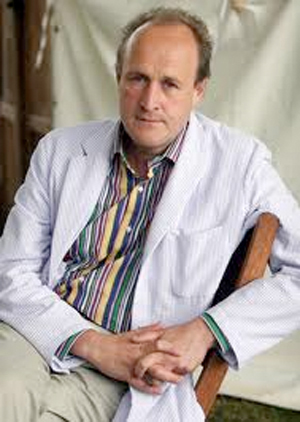
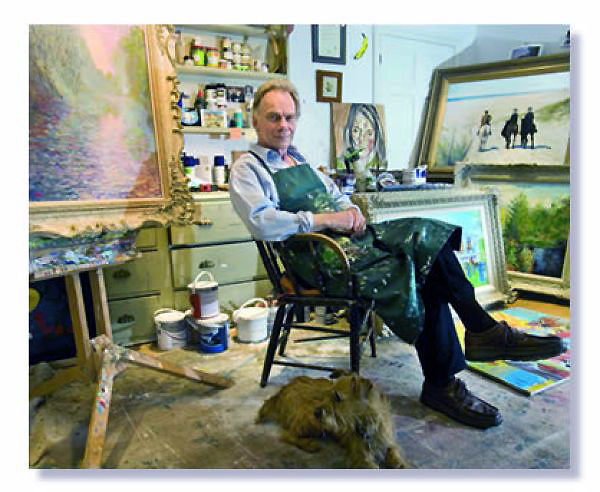
    John Myatt is only the latest in a long line of great British forgers with notoriety and infamy as his calling cards. The extent and audacity of his crime were breathtaking – I still can’t believe he got away with it. He was part of arguably the most sophisticated fraud in the faking of paintings ever perpetrated, and certainly the most impressive in recent memory. Over a period of nine years beginning in 1986 he faked as many as 200 works by assorted 20th century painters and draughtsmen, only sixty of which have ever been recovered by police. Some of the remainder are undoubtedly still hanging in museums and private collections where they are being revered and enjoyed as originals.

    Many puritans will find John’s record objectionable. He was, after all, polluting the oeuvres of famous artists with lies: is there a more serious crime against art than this? Perhaps not. Others may sympathise, and even admire his exposure of bogus expertise among those claiming special insight. Let’s face it, few revelations are as satisfying as seeing a self-important connoisseur covered in egg. Unfortunately, I have personal experience of this. Awarding first prize in a landscape painting competition to an unknown artist for a work far more accomplished than the amateurish standard of the other entries, I remarked to the organisers how the picture looked vaguely familiar. Indeed, the winner had copied accurately a work from the reserve collection of the Tate Gallery and passed it off as his own invention. I ought to have recognised it instantly, but didn’t. When the deceit emerged, newspapers and colleagues enjoyed sport at my expense.

    John reminded us how the apparent superiority and invulnerability of those in the art trade is in fact all too often a trick of the light, and the flash suit. He deserves our thanks for that.

    Always a keen painter at school John moved on logically to art college and for a while thereafter he was – like so many frustrated painters – a teacher of art in a secondary modern. Confident in his technique, he fell into faking at a time when, as a single parent, he was struggling to support his children. Then, like so many other fakers, once illegality and its ready profits had him in its clutches he couldn’t extricate himself. There is no question he boasts all the requisite qualifications for a top forger, principle among which is being able to examine the works of a celebrated artist and absorb their subjects, forms and colours to the degree that he is then able to create a convincing new work from scratch. He came unstuck only when his ‘Giacomettis’ and ‘Ben Nicholsons’ were shown to scholars so steeped in the work of these artists they were probably as adept at identifying a fake as the artist himself would have been.

    Since he came out of prison John has turned his dishonesty to honest profit, producing versions of masterpieces for those who admire but can’t afford the multi-million pound originals. And he is brilliant at it, the adopted styles being instantly recognisable. A fascinating aspect of what John does is the way looking at what he paints is complicated by a personal history one can’t overlook. You aren’t just getting a copy of a masterpiece or an interpretation of a style by a great copier, you’re getting the work of someone whose efforts were at one time actually confused with the real thing. He is asking us to decide for ourselves if the authenticity of what we see is quite as important as we are led to believe it is. Scholars and historians will, naturally, want to know they can rely on the veracity of what they are looking at, but for the rest of us does it really matter that much? Most of us can live with a harmless deception. Viewing a work which is not by the artist you suppose is hardly the end of the world.

    Ask yourself this: what is the difference between looking at a Monet and viewing something which you believe to be a real Monet? The answer is nothing; that is, at least while ignorance prevails. It has recently been proven by psychological experiment that belief in the authorship of a painting is not only crucial to its appreciation but also seriously affects how long we are prepared to look at it. Belief in the originality of what we are looking at, its association with a famous name, causes greater enjoyment. But if we appreciate a painting why do we not continue to like the same painting when its authorship is downgraded. Should it really make so much difference?

    Consider this very recent example of faking. A wealthy resident of Venice from a noted family visited his friends’ houses socially for years and coveted their collections of Old Masters. Using quite exceptional guile and planning, he had created exact facsimiles of their works and placed the copy in the original frame while the owners were out of town. Over a period of years he amassed several dozen original old masters using this method, which he proceeded to sell. So brilliant were the copies that the paintings’ owners were none the wiser that they weren’t looking at the originals, until police alerted them to the truth. The perpetrator of this crime realised that for most people who look, or glance, at art there is no difference in impact between an original and a copy. How many of us could honestly tell the difference? Where art is concerned most of us believe what we are told by those we assume know more than ourselves. We accept appearances at face value, and are happy to enjoy innocently.

    So why not indulge yourself in a little self-deception with an original John Myatt? If you can’t afford a real Monet, Matisse or Modigliani then a Myatt is undoubtedly the next best thing. It is expertly done, pleasing to look at … and just think of the stories, true or false, you might tell your friends about it. http://www.washingtongreen.co.uk/artists/john_myatt/

    David Lee
    October 2012
     

  • Rothko vandalism

    Rothko vandalism

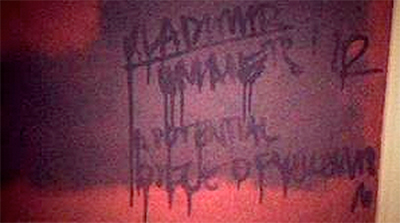
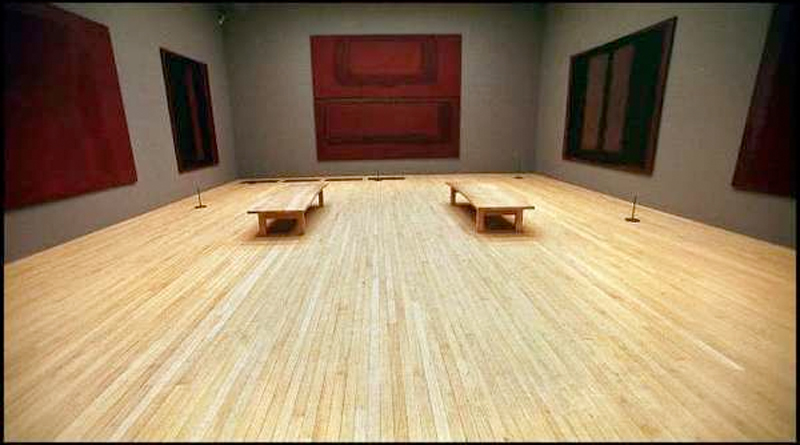
    Last year it was Poussin in the National Gallery, this year Rothko at the Tate. There will have been other examples of vandalism in between these which galleries hushed up, and it is likely that you wouldn’t have known about the Rothko episode had it not been witnessed and photographed. Museums don’t like admitting to attacks on their collections because they wouldn’t want to suggest it’s easy to get away with… The truth is that vandalism is undoubtedly more prevalent than is admitted.

    Outrage is the knee-jerk reaction on such occasions, but by now we should expect damage. Every work of art in every museum is a sitting duck to unintended injury as well as to deliberate vandalism. This is because museum visitors, and especially children, are ignorant and ill-mannered. They get too close and prefer to look with their fingers. Sculpture is especially at risk. Simply by putting art on show so it can be seen properly ensures its vulnerability. Vandalism, and the ease with which it can be perpetrated, are risks that have to be taken despite the potential for disaster.

    The perpetrator of the Rothko graffiti is wearyingly typical of  the Identikit gallery vandal. He is a white, male, disgruntled, barely sane ‘artist’ of no discernible ability. His website, Yellowism, is in the grand tradition of Modernist art manifestos, it being a ragbag of  pompous, semi-literate gibberish. He is also without the true courage of his proclaimed anarchic convictions. Scribbling half-heartedly in the bottom corner of a painting for no good reason other than ephemeral self-advertisement is a feeble stunt. Whatever happened to the grand statement born of blind belief? When suffragette Mary Richardson savagely attacked Velasquez’s Rokeby Venus in the National Gallery with a kitchen knife in 1914 she was perhaps misguided in her choice of target but my word there’s no doubting her vehement commitment to the cause. In comparison to Richardson, this Rothko attacker is a pathetic wimp. They should film him being given a good thrashing outside Tate Modern, call it a ‘Conceptual Video’ and enter it for the Turner Prize.

    With the arsenal of chemicals and sci-fi gadgetry at a modern restorer’s disposal, the painting will be back on display within weeks and exhibit no evidence of its recent tribulations. And alarmist headlines about the financial value of the picture being affected are just crass populism. The Rothko will never be sold, therefore it can have no financial value. If anything the picture’s artistic stock will have risen, given the notoriety it has now achieved and the fatuous incentives some people require to visit museums.

    More perplexing is the accelerating frequency with which damage to important works is occurring. With museums having annual grants from central and local government frozen or reduced, security may not be what it should be. The idiot responsible for damaging the Rothko was able to do his worst and then calmly walk out of the Tate unhindered. This suggests laxity. When the Poussin was damaged last summer in the National Gallery, wardens had only weeks before been instructed to oversee two galleries instead of one. At the time it was suggested the damage would not have happened had the gallery been fully patrolled as before. Maintaining proper surveillance despite cutbacks will not eliminate vandalism, but it might impede its worryingly increased incidence.

    It would appear that enhanced searches at the entrance of national museums, like the airport security imposed already in some continental galleries, is inevitable here also. It may help, but sadly nothing will stop determined unhinged artists from getting through.

    David Lee

    October 2012
  • How state art robs the people

    How state art robs the people

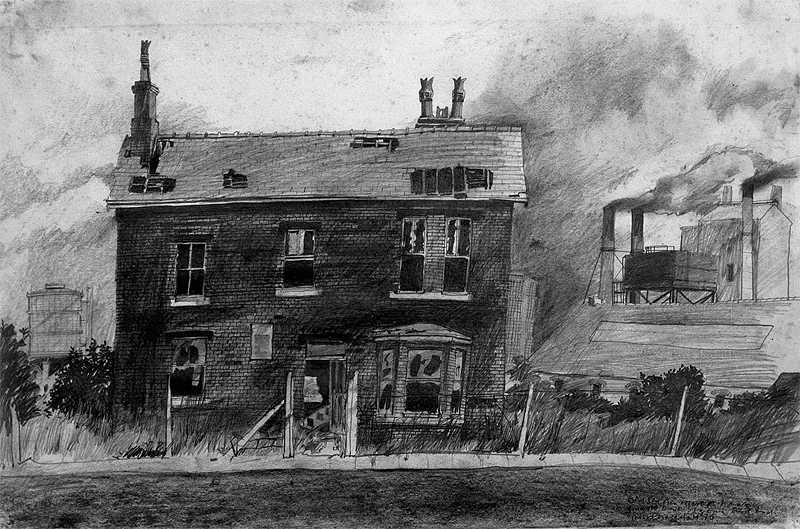
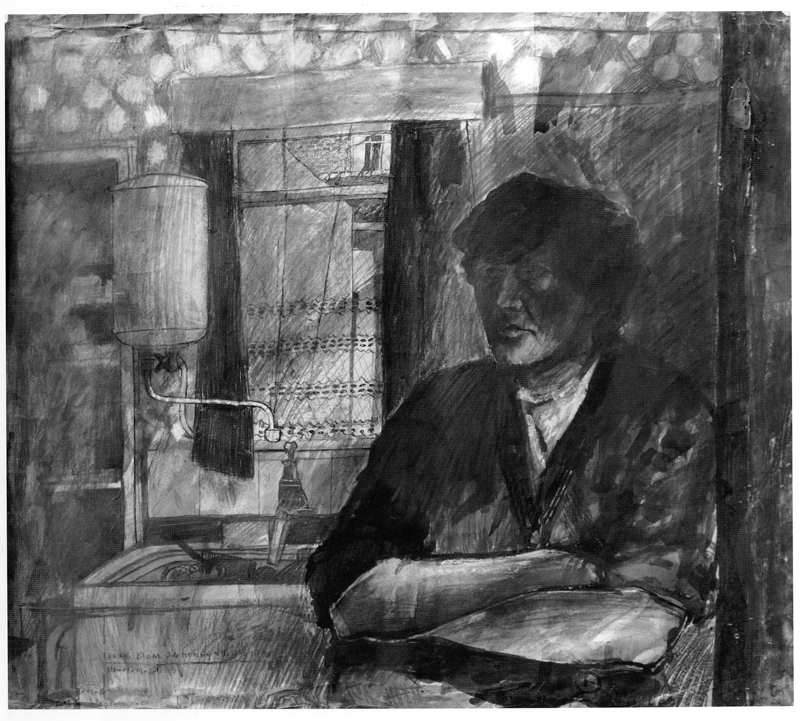
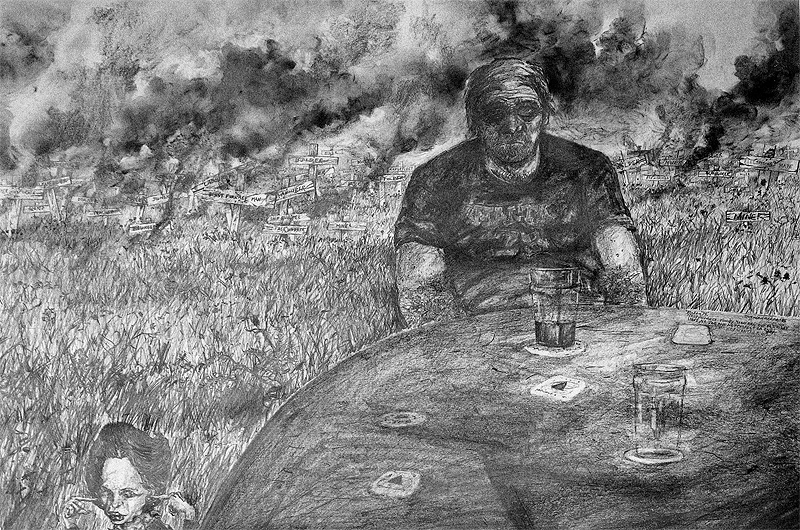
    Chances are you won’t have heard of David Mulholland (1946-2005), a painter of and from Middlesbrough. Until last year, when a group of friends devoted to the preservation of his memory sent me some of his pictures, neither had I. The work hit me immediately as authentic, born of intimate feeling for its subject. Most affecting were powerful graphite and wash drawings of blackened industrial places populated by persevering working people. Having edited a couple of art papers for over twenty years, I felt that if anyone had a right to have heard of David Mulholland then it was at the very least someone in my position.

    What follows is a lament for the establishment’s theft of the richness of our culture. Over decades now, by advancing its prejudices to the exclusion of everything else, art authorities have conspired to deny us sight of so many whose works were valuable testimonies of their time and experience. For their own ends, these all-powerful administrators have kept us in the dark.

    David Mulholland is typical of many accomplished and original 20th century British artists whose names are deservedly kept alive by friends who loved him and knew his worth as both commentator and poet, but who is unknown to the rest of us. No galleries funded by the Arts Council, for example, would dare show the work of these artists even if they wanted to. Mulholland is typical of painters derided by the self-appointed in State Art and sneered at by decision makers. By arts bodies obsessed with ‘innovation’ and the ‘cutting edge’ he is, in that infamous Arts Council phrase “the wrong kind of artist”. Yes, those are the words they use – the wrong kind of artist. What right have they to use a phrase like that? Who do these people think they are?

    As one who described with affection his experience of the hard lives and resilience of poor people, and evoked the gaunt beauty of the tough places in which they lived and worked, Mulholland was “the right kind of artist”. The only kind of artist. He is certainly among those whose work is likely to survive appreciated long into the future. His work was done because it needed to be made, because the observations of a brutal working life and cruel industry, of pleasures and strifes, of hard graft and redundancy, demanded interpretation by an artist. Mulholland’s work doesn’t need a page of unreadable tosh by one of Serota’s army of scribblers in order for you to know what it’s about. Its love for a location and people speaks for itself. In the future, say a century or more from now, those looking at Mulholland’s work will understand without prompting its concerns and causes, what stories it has to tell, and why it has lasted. In all good art, these qualities are self-evident, although in some artists they may take longer to appreciate.

    Mulholland was born in South Bank, a community on the Tees built around quaysides, three blast furnaces, steel rolling mills and fingers of cindery railway sidings. In photographs of the place in its heyday, and before the works closed, it looks smokily Soviet in its concentration of polluting ad hoc production. It’s the sort of place which, if you are born there, is in your blood forever. As landscape painter Len Tabner, another important local and friend of Mulholland, said at the recent opening of his memorial exhibition at the Dorman Museum in Middlesbrough, “Dave went all the way to Byam Shaw and to the Royal College of Art in London but only ever painted South Bank.” Apart from a brief foray as a young seaman, when he painted foreign scenes, it remained that way. He eventually returned home, taught art unconventionally in a secondary school, painted his life and friends, and sometimes the surrounding countryside. His work records a personal journey and history.

    Given the enormous sums now thrown uncritically and unchallenged at contemporary art, one ought to feel safe that excellence in whatever style or medium is somewhere being brought to our attention. But despite the fact that, courtesy of the National Lottery, there are expensive immense new galleries all over the country, the opposite continues to be true. The same few artists dominate news, features and critical coverage. They also dominate all the new galleries because these are controlled exclusively by State Art believers. For them, a foreign artist of no discernible distinction, spotted amidst the trendy jumble and waffle of an international biennale, will always take precedence over the likes of Mulholland.

    If you live in the north, as I do increasingly, you can find Anish Kapoor signing books in Middlesbrough – where his £2.5 million ‘regenerating’ fishing net was unveiled two years ago and still stands bleakly abandoned and pointless in wasteland – and at a retrospective in the Yorkshire Sculpture Park (see Moping Owl, p. 10). In London he is at Lisson Gallery, all over the Royal Academy, and even lording it over the Olympics’ site. No wonder he needs 25 assistants and three studios to churn out his coloured holes and facile shiny mirrors to meet demand. Such a monoculture as is represented by Kapoor doesn’t add to the diversity we deserve, because the rooms he and his ilk occupy with stupefying frequency are denied to others. Newspaper profiles of Kapoor last aired only three months ago when The Orbit was unveiled – having already appeared on dozens of occasions over the last twenty years –  have again been warmed up and paraphrased by others for his new shows in London and Yorkshire. This insulting process of indoctrination goes unmentioned elsewhere, as though it’s taken for granted that only a handful of artists merit such relentless promotion. The only difference in these disgustingly fawning and uncritical pieces is the sentence where they state what Kapoor is currently worth – and it keeps getting bigger, the last number cited being £80 million. For the rest of us, it is impossible not to know Kapoor’s life story off by heart. If only it were interesting. If only all this approbation were the result of his having produced something truly outstanding and comparable with the best from the past… But all that emerges is more of the same branded deluxe ornaments for the grotesque mansions of the immodest rich. And please believe me when I say there is no point in visiting his exhibition at the Yorkshire Sculpture Park, because you’ve seen it many many times before. It takes seconds to walk around. And, do you know what, some of the holes are so dark you can’t be quite sure where the bottom is. How clever is that?

    The neglect of so many for the sake of so few is a phenomenon of the celebrity culture. How long will it be before this system is exposed as a monumental racket dreamed up by a cabal of public officials, commercial dealers and auctioneers with the aim of creating false gods, rigging the market and handsomely feathering the nests of all concerned. Watching this process as it unfolds is sickening and the fact that they have not seen fit to investigate this monopoly brings disgrace on the Culture Select Committee of the House of Commons. They could have made a difference, if only by establishing once and for all that such an all-powerful orthodoxy exists in contemporary art, whose purpose is to discriminate against the likes of David Mulholland.

    Increasingly, I resent this editing of what we’ve been allowed to see, dictated as it is by the tastes of half a dozen bureaucrats with Serota at their head. This President-For-Life has singlehandedly done more damage than anyone in the history of British art to the public’s ability to see the work of a wide range of British artists. He is a self-important scourge building ever greater monuments to his own vanity and tastes, and yet he receives an uncritical press. When is this fellow going to go, and leave us alone? How long will it be before curators in regional galleries can see all art again for its qualities and not be forced to follow trends out of fear for their careers?

    If it is not the work of regional galleries to show the work of their best local artists what is it their job to do? And what an irony it is that the modern art gallery in Middlesbrough is showing coincident with Mulholland’s memorial show an exhibition dealing with “concepts of ‘home’” … starring Tate trustee Jeremy Deller.

    David Mulholland spoke a local language, a ‘home’ language, which is understood internationally by all people. No human being is excluded from its sentiments. State artists talk an international language which, like esperanto, is understood by hardly anyone. There ought to be room for both persuasions, but we are force fed only one.

    David Lee

    The Jackdaw November-December 2012

    www.davidmulholland.co.uk

  • Turner Prize No. 27 … 28 … 29 …

    Turner Prize No. 27 … 28 … 29 …

    Some bird in daft boots striding with the confident air born of State Art insight; in the background, Villa Joe by Paul Noble, 2005

    Having slipped into its tedious annual routine, the Turner Prize is upon us again, at Tate Britain, until January 6th; the winner – £25,000 better off – is announced to a live television audience of well into double figures on December 3rd. Those responsible for organising this banquet of self-congratulation continue to fanfare its importance, but it is in truth many years since the Turner Prize introduced an artist of any lasting significance whose work lives in the mind’s eye: it is a safe bet that in a hundred years no one will be looking at any of this work.

    We have now had 27 years of the same ‘cutting edge’, for which lasting importance is routinely claimed; 27 years of ‘challenges’ forgotten almost immediately; 27 years of assorted ‘subversions’, ‘dissolvings’, ‘explorings’, ‘exploitings’ and ‘juxtaposings’ which have altered nothing; and at least a decade of winners whose names only half a dozen addicts of State Art can (or want to) remember. Cubism only took five years and even Impressionism was done for after ten.

    We have reached the end of the avant garde. Without any locomotive power left, the gravy train is slowing down at the terminus, petering out with the buffers in sight, driven along at snail’s pace only by its own momentum and the willing shoulders of Serota’s lackeys. The Turner Prize is fucked, and only those involved with it can’t see the truth.

    In the 18th century art was the preserve of aristocrats; in the 19th it was in thrall to industrialists; in the 20th it was all done for the benefit of the better educated; and in the 21st it was the exclusive domain of art students and others in a new art industry sustained by a tidal wave of taxpayer subsidy. So much for outreach.

    And so to 2012 and the Buggin’s Turner Prize. As you would guess from her name, the person called Spartacus Chetwind is an ass. If she applied both brain cells to the task, and bought a very large cardboard comb, she might just qualify as an entertainer at children’s parties. “Her carnivalesque live events,” claims the Tate’s Chief  Snake Oil Saleswoman, “dissolve the boundary between spectator and participant.” That’s so old hat: Quatermass did that sixty years ago.

    As the work of a precocious undergraduate at a regional ‘university’ no one well educated has heard of, Luke Fowler’s photographs, in which any two pictures are spliced together in the hope of achieving a critical mass, might attract bollocksy exegesis from the resident theorist and intellectual. To the rest of us they add up first to bewilderment, and then nothing at all. But he’s not just a photographer isn’t our Luke. Oh no. He up for a spot of film-making too.

    At a pinch it is painful but still possible to sit through a bad film by a Hollywood film director. However ponderous and leavened with noisy special effects, there will be at least some narrative drive to stop eyes drooping. On the other hand there is a bad film made by a Turner Prize nominee. This will be so inept it is unwatchable after three minutes, unless … unless you are lobbying for a salaried position in State Art – then, you must watch with exaggerated attention, take notes, nod knowingly at intervals and sit through it twice just in case the President-For-Life is spying on you for signs of apostasy. This is the case with Fowler’s 90-minute throatslitter about an interminable therapy session in the States. Any of the Prize’s judges who claims to have sat through this tripe, awake, from beginning to end is lying. It is many miles beyond a human being’s tolerance.

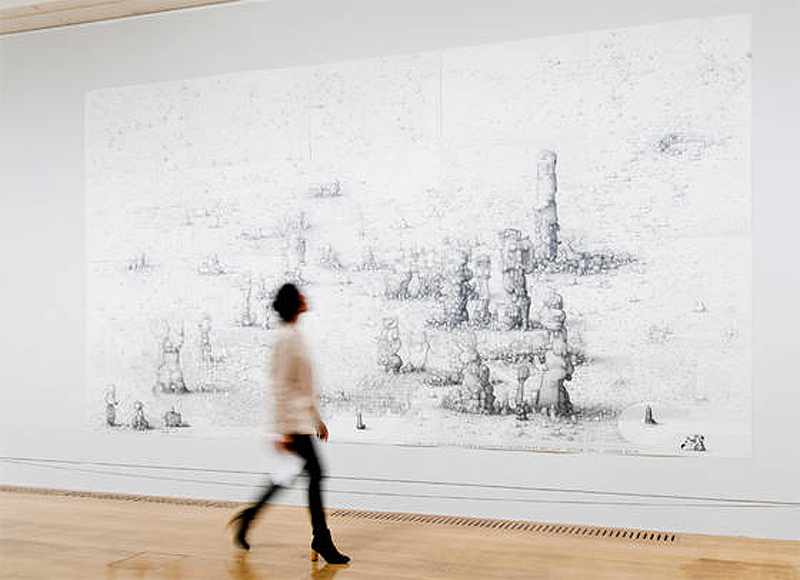
    For those of a more conventional mindset Paul Noble makes large, detailed drawings of an imaginary place called Nobson Newtown, which has been exclusively absorbing his attention for 16 years. Like the work of Bosch and Dali, superficially the scenes look realistic but are fantastic panoramas containing no figures but, instead, are populated by totems not dissimilar to Henry Moore’s Glenkiln Cross. Scattered around the empty squares and expanses in between the ‘sculptures’ are a plague of what look like dog turds. Close up the graphite drawing is more laboured than expected, first impressions from a distance having suggested greater fluency. These pictures are dystopian, surreal curiosities and will take you longer to look at than the works by the other three contestants put together. This must constitute a sort of praise – it’s certainly a relief. His sculptures, carved presumably by someone else in black and white marble, are feeble, though doubtless easily saleable by Noble’s dealer Gagosian.

    And that leaves Elizabeth Price who is represented by a 20-minute film called Woolworth’s Choir of 1979. Claimed by the aforementioned Chief Oiler to be “exploring the elastic potential of digital video”, it comes in three parts: views of an empty choir in a medieval church; clips of women disco dancers flinging their arms about; and footage of a fire in a furniture warehouse above Woolworth’s in Manchester’s Piccadilly. No obvious connection occurs between the three overlapping sections. As an experience, it is slow to unfold and ‘artistically’ repetitive; as in … “I’m repeating myself a lot, therefore I must be an artist”. Sadly, Woolworth’s is not incoherent with poetic possibilities, it is incoherent with incoherence.

    David Lee

    The Jackdaw, October 2012
     

  • A modern masterpiece

    A modern masterpiece

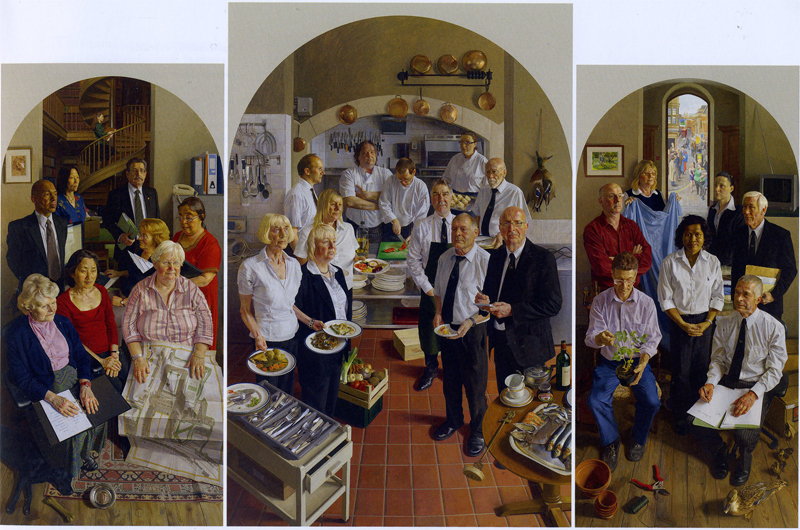
    This large triptych of almost medieval ambition by Ben Sullivan, depicting the 27 non-academic staff of All Souls College in Oxford each of whom sat for the artist, was exhibited briefly during the autumn in the Ashmolean. It is now in its intended permanent home in the southernmost of Hawksmoor’s twin towers at the college. It has been four years in the making and gone through many revisions of approach and scale. In 2003, Sullivan was, at 26, the youngest ever artist elected to the Royal Society of Portrait Painters.

    The All Souls triptych is oil on canvas, and its dimensions 155 x 75 cms for the side panels and a central  panel of 175 x 115 cms. The left panel shows the professional and administrative staff, the central panel concerns those involved with food, and the right-hand panel introduces porters and those staff responsible for accommodation, repairs and gardening.

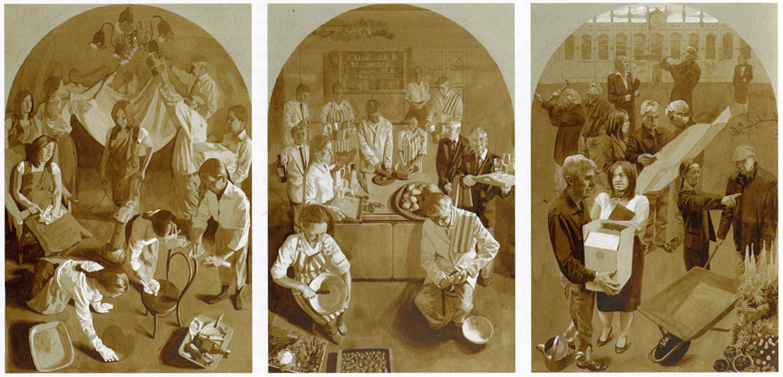
    This is an important painting which should be shown in the National Portrait Gallery along with its preparatory sketches.

    Of the commission Sullivan has written:

    “The draft proposal was influenced by stylistic and compositional elements from Stanley Spencer’s paintings at Sandham Memorial Chapel at Burghclere. This was a natural point of reference as, like Spencer, I wanted to give an account of people’s day to day activities: to celebrate them as individuals and to elevate and dignify their work. Given the almost religious reverence to be shown to both persons and their tasks, a triptych seemed to be the perfect format.”

    David Lee

    The Jackdaw, October 2012
  • The end of Henry Moore in public?

    The end of Henry Moore in public?

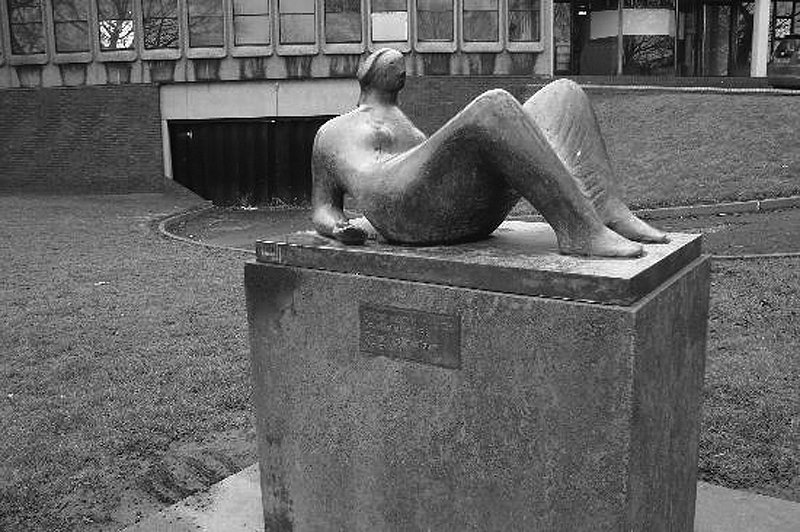
    Henry Moore’s Reclining Figure (1952/3) has been removed from outside the civic centre in Castleford in order, it is claimed, to protect it from theft by scrap metal merchants. Erected in 1980 (in the sculptor’s home town no less), it is not known when or where the work will be returned to view – presumably when all the, er, charming, alternative scrap metal merchants have been packed off home to Limerick and Romania. Castleford’s does seem an over-reaction to the spate of sculpture pinching. All the other recent high profile thefts have taken place at secluded sites, graveyards, parks and country houses, not from the central square of a town whose inhabitants are milling about all night drinking and smoking their benefits away. Presumably the local councillors could instigate inexpensive measures to prevent its illegal removal. If Castleford is right on this there will soon be no Moores in any town.

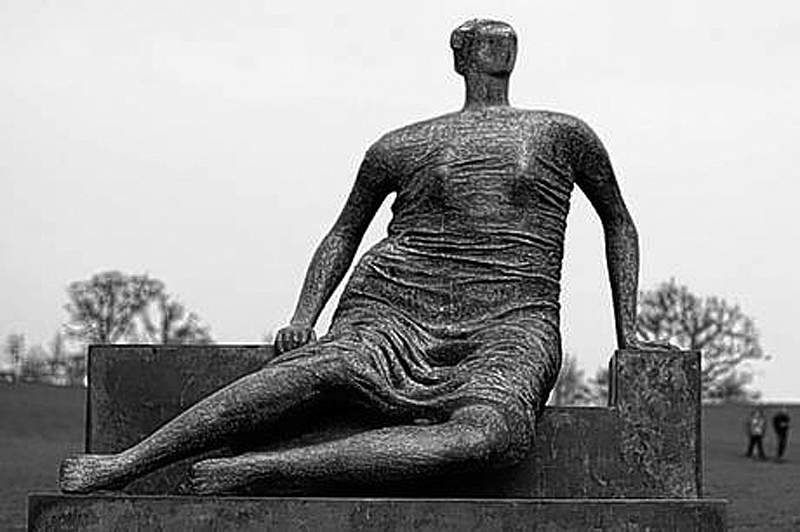
    This figure, Draped Seated Woman of 1957/58, one of Henry Moore’s most eye-catching bronzes, is to be sold by Tower Hamlets council. (As readers of Private Eye will know, Tower Hamlets seems to be run as a sort of private fief by an Asian mafia.) The sculpture used to be sited on the green in the middle of a Stepney council estate, which was demolished. It has been on display at Yorkshire Sculpture Park since 1997 having been removed from the East End because it was attracting graffiti and other vandalism. The council, which is inevitably claiming chronic poverty, is hoping it will fetch £20 million. It couldn’t now be returned to so rundown a location for fear that it might be vandalized by culture-loving locals or stolen and melted down by our colourful friends in the itinerant community. Public art is a worthily altruistic idea but there are limits, and placing large sculptures made of bronze on council estates might be one of them.

    Make no mistake the dangers to sculpture are real. One of Moore’s important large bronzes has already been stolen and melted down. And in the case of the Harlow Family Group, a stone carving, this was decapitated and, following repair, had to be moved for its own safety from the site chosen for it by Moore to an indoor location where it can’t be seen properly.

    Any sale of Draped Seated Woman would be expressly against the spirit of Moore’s wishes. He was prepared to sell it to the council for £6,000 only if it was displayed in an underprivileged area – he was a working class lad himself. Opponents of the sale have alleged that the mayor only wishes to sell it in order to feed contracts to his business cronies. Doubtless their interest in culture rose to fevered excitement in February of this year when an equivalent piece by Moore was sold for £17 million. It has been proposed that the sculpture could be re-sited in Canary Wharf.  Given Moore’s conditions, removal of the figure from a council estate to the home of global finance would surely too cynical a betrayal.

    The Jackdaw’s preference would be to see this impressive figure in the secure grounds close to the entrance of the British Museum. Visitors might then see it and within a few yards recognize its sculptural antecedents, the draped figures on the Parthenon frieze, which were such an inspiration to Moore.

    There are well over fifty works by Moore around the country on public sites, some of which are housing estates. In these straitened times, which can only get worse, local authorities may be tempted to see the wisdom of selling an asset which might realize sufficient cash to build a new school.

    “Drapery played a very important part in the shelter drawings I made in 1940 and 1941 and what I began to learn then about its function as form gave me the intention, sometime or other, to use drapery in sculpture in a more realistic way than I had ever tried to use it in my carved sculpture. And my first visit to Greece in 1951 perhaps helped to strengthen this intention . . . Drapery can emphasise the tension in a figure, for where the form pushes outwards, such as on the shoulders, the thighs, the breasts, etc., it can be pulled tight across the form (almost like a bandage), and by contrast with the crumpled slackness of the drapery which lies between the salient points, the pressure from inside is intensified . . . Drapery can also, by its direction over the form, make more obvious the section, that is, show shape. It need not be just a decorative addition, but can serve to stress the sculptural idea of the figure.” Henry Moore, 1955

    “Sculpture is an art of the open air. Daylight, sunlight, is necessary to it and for me its best setting and complement is nature. I would rather have a piece of my sculpture put in a landscape, almost any landscape, than in, or on, the most beautiful building I know.” Henry Moore, 1951

     David Lee

    The Jackdaw, October 2012
  • Another portrait of the Queen

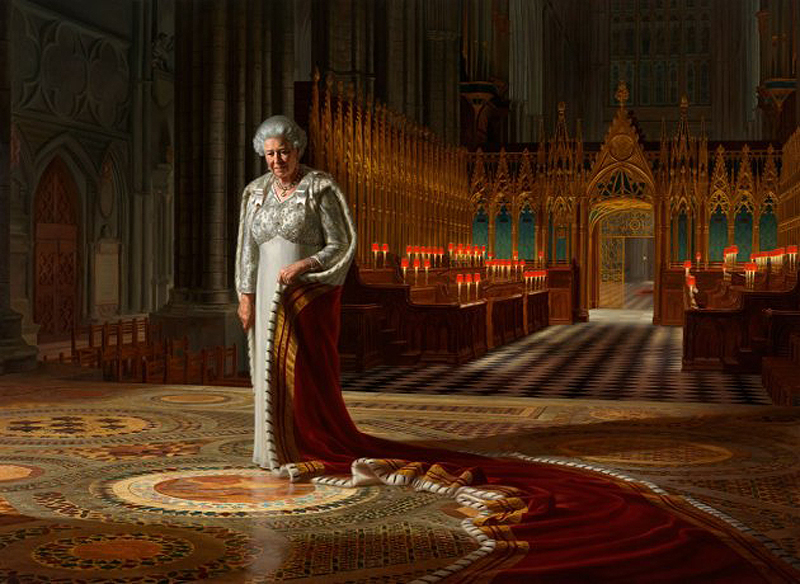
    A portrait of the Queen by Australian artist Ralph Heimans has gone on show at the National Portrait Gallery in Canberra. It shows the monarch at night in Westminster Abbey standing on the spot where she was crowned 60 years ago. She looks like a giant genie has suddenly appeared from the train of a dress and she has succumbed to suspended animation. One gathers she is meant to appear pensive, as though wondering why she didn’t buy Frankel when she had the chance – she might even be pondering the fate of the Liverpool Empire. A typically Australian effort; massive (it is eleven feet by nine feet), ambitious, unsubtle and a little heavy, don’t you think, on the melodrama and narrative?

    Many confuse a photographic appearance with a picture being well painted. This is an easy but fundamental mistake. Here, every detail is painted, the only omissions being real life not theatre and vigour in the execution. In close up the sitter wears the leathery look of a souvenir sailor.

    David Lee

    The Jackdaw October 2012
  • BBC arts programming… and the shock of something good

    BBC arts programming… and the shock of something good

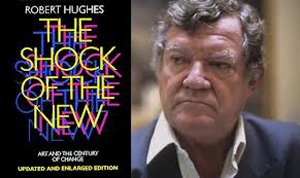
    My word what a revelation Robert Hughes’ The Shock of the New has been second time around. It was pretty good when first aired all those lifetimes ago in 1980. The fourth episode, it had Utopia in the title, reviewing the history of trendy architecture in the 20th century, was the best television about art for decades. It was alive with the authority, enthusiasm and cleverness of its presenter … and of how many current art presenters could one honestly use those words? It should be compulsory viewing in all schools and colleges with tests at the end to ensure attentiveness. Everything is there, from fact to polemic, beautifully expressed by Hughes, and edited with lengthy holds on the buildings themselves so an eager viewer might understand precisely what point the author is making. It encourages its audience to look at the screen, and then to look about them at the buildings in their own lives. And Hughes is one hell of a stimulating guide, whose opinions and insights you want to follow up with a visit to the library. He makes you want to know more.

    One can’t help thinking with regret (and deep resentment) that no way would the BBC commission anything as good as this now. They wouldn’t have the guts to aim so high. They’d think it far too highbrow and well beyond the level of those who wouldn’t watch an art programme whatever the depths plumbed to accommodate their ignorance. The terror of being accused of elitism has bred cowardice. No longer has the BBC the confidence required to say to someone of Hughes’s extraordinary talent: ‘Here’s the money, go and surprise us’.

    Instead, the BBC prefers presenters who know next to bugger all, those who puff their friends and bowl underarm questions; those who genuflect before State Art orthodoxy. Being expert in nothing these people are affably protean, capable of repeatedly delivering the obvious observation about any topic for which weak inexperienced researchers have copied and pasted paragraphs from Wikipedia. (The excellent Mary Beard is the sole exception to this.) Arts programmes on the BBC are now so uncritical they are little more than adverts for their subjects. And the other channels are even worse.

    Come back dear Robert, we’ll even forgive you the sycophancy of more recently calling Hockney ‘the greatest living watercolorist’, which, of course, he wasn’t and still isn’t. It’s only a pity that the recently deceased Hughes can’t bring the programme beyond the 1970s. Can you imagine Yentob trying to update The Shock of the New? What a shudder-inducing thought that is. The result would be pitiable PC guff cobbled together from the State Art handbook.

    Finally, as an example of how low ambitions for programme making can sink, the ‘expert’ presenters of a recent series concerning art on BBC2 were told that they could not use a phrases such as ‘figurative art’ and ‘Impressionism’, unless they were defined, because viewers wouldn’t understand them. How thick does the BBC believe its audience to be? And is such an audience even worth bothering about? This indicates how little faith the BBC has in its viewers to self-educate, and the depths it is willing to plumb to patronise an audience. In the chase for crude ratings the BBC’s obligation to educate has been sacrificed. Its policy has pleased nobody.

    The real shock in The Shock of the New is its identification of the frightening collapse in standards of BBC arts programme making since 1980.

    David Lee

    The Jackdaw October 2012
     

  • The Motya Charioteer

    The Motya Charioteer

    Explanations to date concerning this marvellous figure are inadequate.
    What precisely is it? Where did it come from? And what date is it?

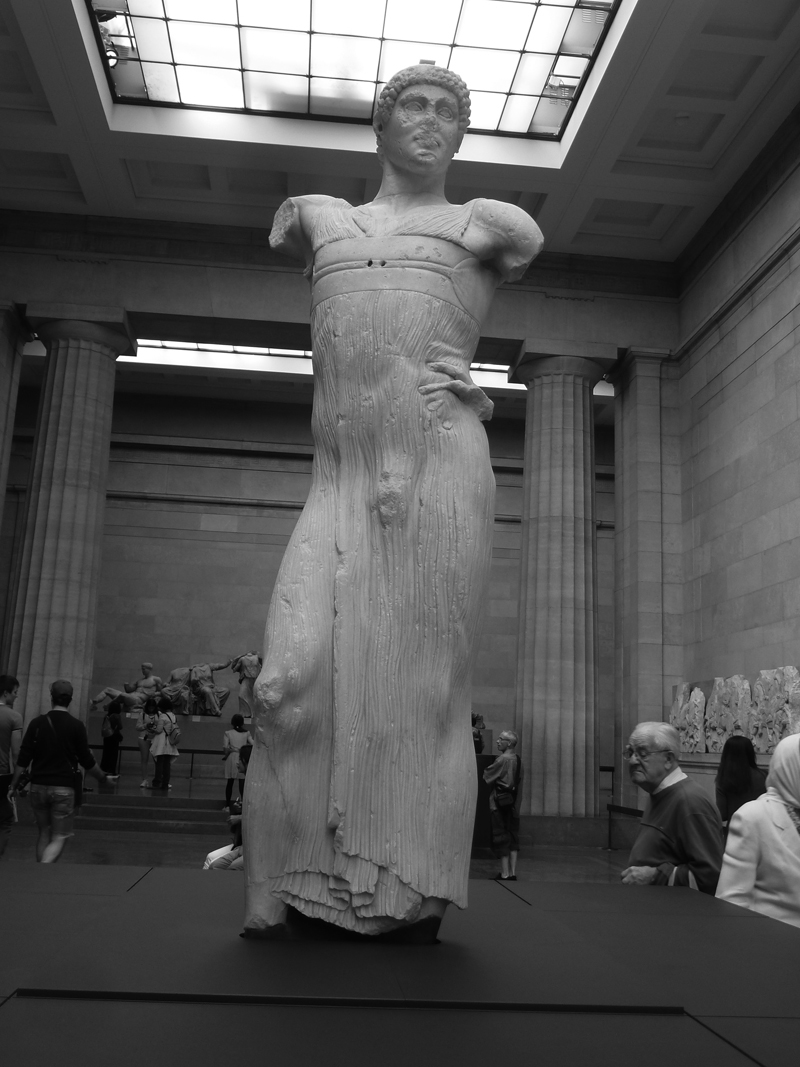
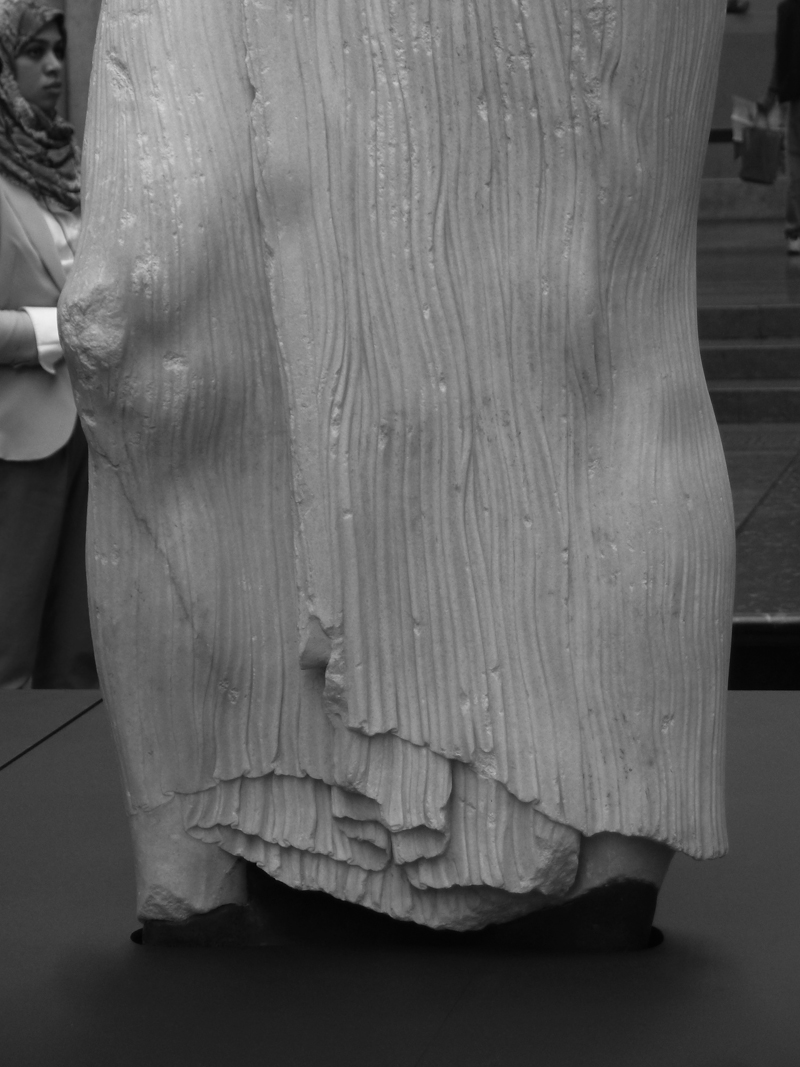
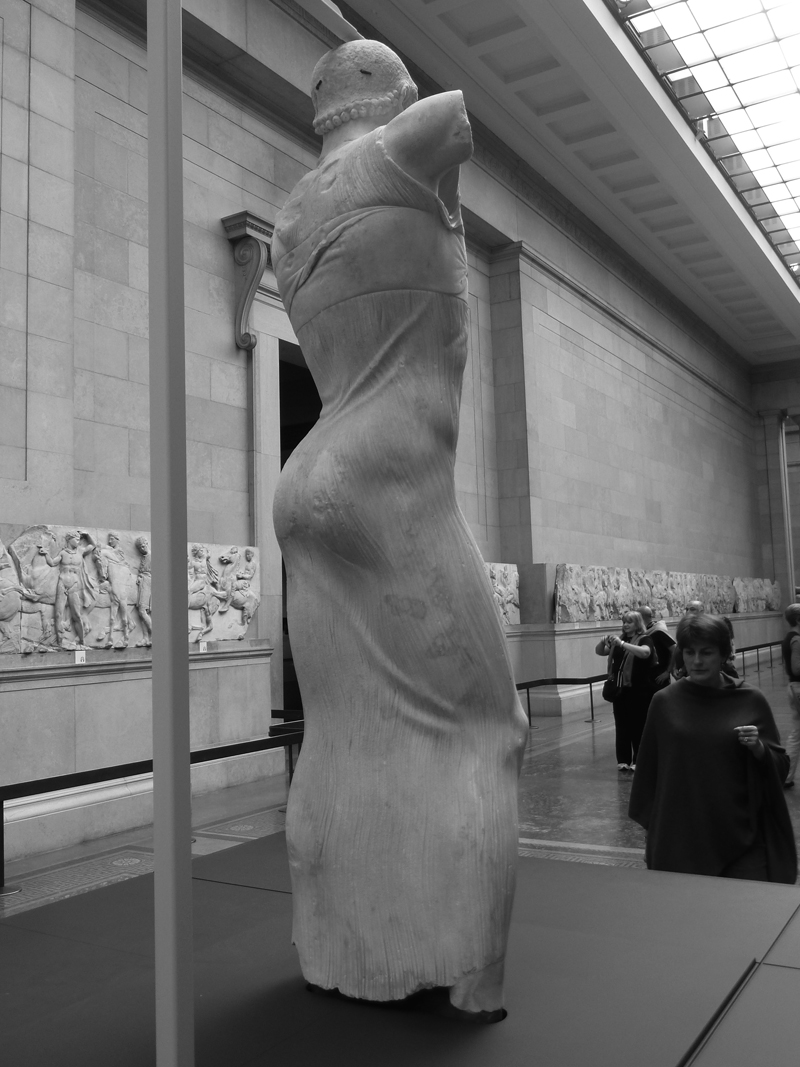
    The Motya Charioteer stood for six weeks until the middle of September in the large gallery housing the Parthenon pediments and frieze in the British Museum. It was worth making a special effort to see it more than once as it is among few great works – it is reproduced as standard in most of the better literature of classicism – of ancient art to visit London in recent times. Certainly nothing else in the Cultural Olympiad – so lavishly praised by those who organised it and their dutiful footsoldiers – could touch it for sculptural virtuosity and immediate aesthetic impact. The time required to take in this figure properly far exceeded the twenty minutes needed to dawdle through Damien Hirst’s retrospective at Tate Modern – that institution’s imaginative and unexpected contribution to the art events stapled to the Olympics’ coattails. Additionally the Motya Charioteer was given free of charge.

    This was no off-the-shelf piece like so many antique sculptures in so many museums. On the contrary, it looked to be the work of an important artist, whose name we ought to know, and even may know, but which we will never now discover. The material is pale yellow limestone whose origin is described vaguely as “Greek or Turkish” – modern analysis can surely be more specific than this.

    It was unearthed in 1979 on the tiny island of Motya off the western coast of Sicily close to Marsala where it is housed in a regional museum from which it is rarely loaned. Universally praised for its beauty, not least in British newspapers when it first went on show at the Museum, it is already considered a key piece in classical sculpture. It was, curiously, found among mainly architectural rubble. Motya was a longstanding Phoenician city fortress until it was conquered following a destructive siege by a native Sicilian in 397 BC. It was later taken over by the Carthaginians until in 241 BC it was subsumed into an expanding Roman republic. The debris in which the sculpture was found is said to have been piled up to protect a sanctuary area  of the Phoenician city during the siege of 397 BC. Quite why a sculpture of such obvious refinement should have been condemned to a spoil heap is unknown.

    Sicily, the larger part of which was a Greek colony, was an area renowned in the ancient world for its successful charioteers and for its horse breeding. It has been speculated that this piece was commissioned by a victorious charioteer in the Greek part of Sicily to celebrate an important triumph in the hippodrome. At some point it was looted by the Phoenicians and taken to Motya where its qualities were not apparently appreciated. If you are a scholar desperately in search of an explanation this seems as fanciful a story as any other wild speculation. (With the scholarship of ancient sculpture it only takes a couple of recountings before a speculation becomes accepted fact.)

    Dated circa 460 BC by the British Museum, this makes the Motya Charioteer around a generation earlier than the Parthenon marbles. In textbook terms, the piece is described as Transitional; that is, it bridges the missing link, as it were, between Archaic and so-called Severe sculpture (the kouroi centuries) and the more realistic classical ideal characteristic of the best of the Periclean Acropolis. Another of the ‘missing links’ of the same period, the Kritos Boy, found on the Acropolis, only bears a resemblance to the charioteer in the head.

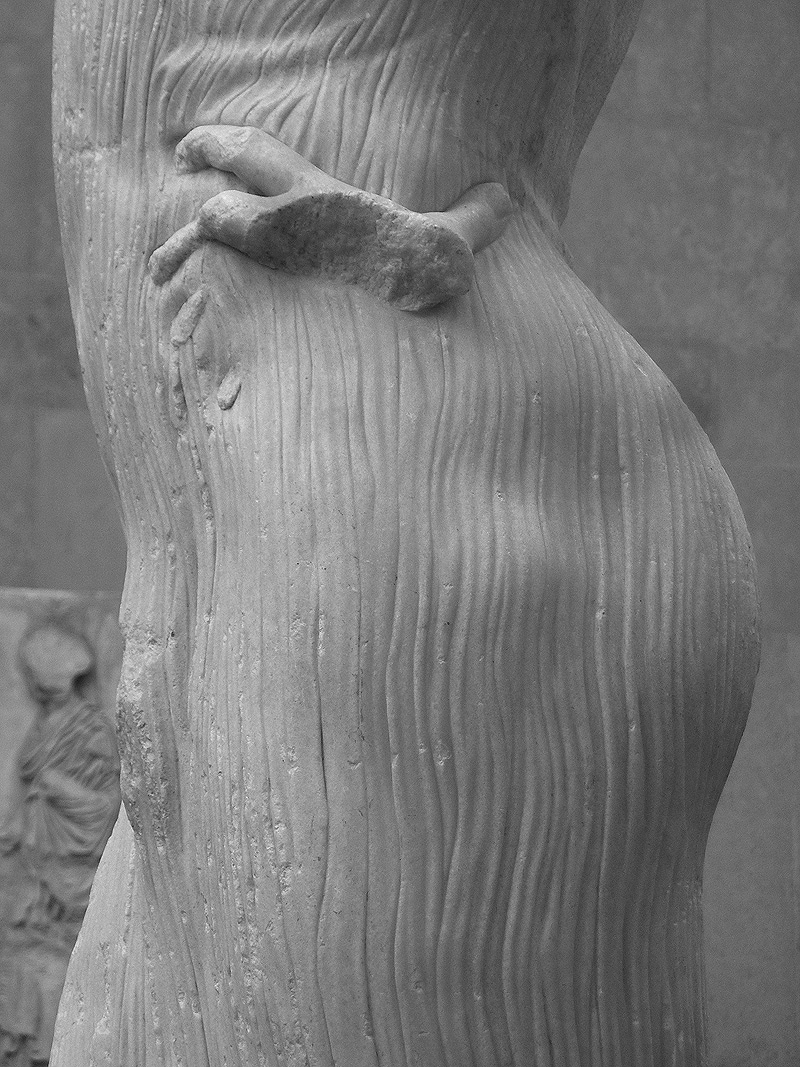
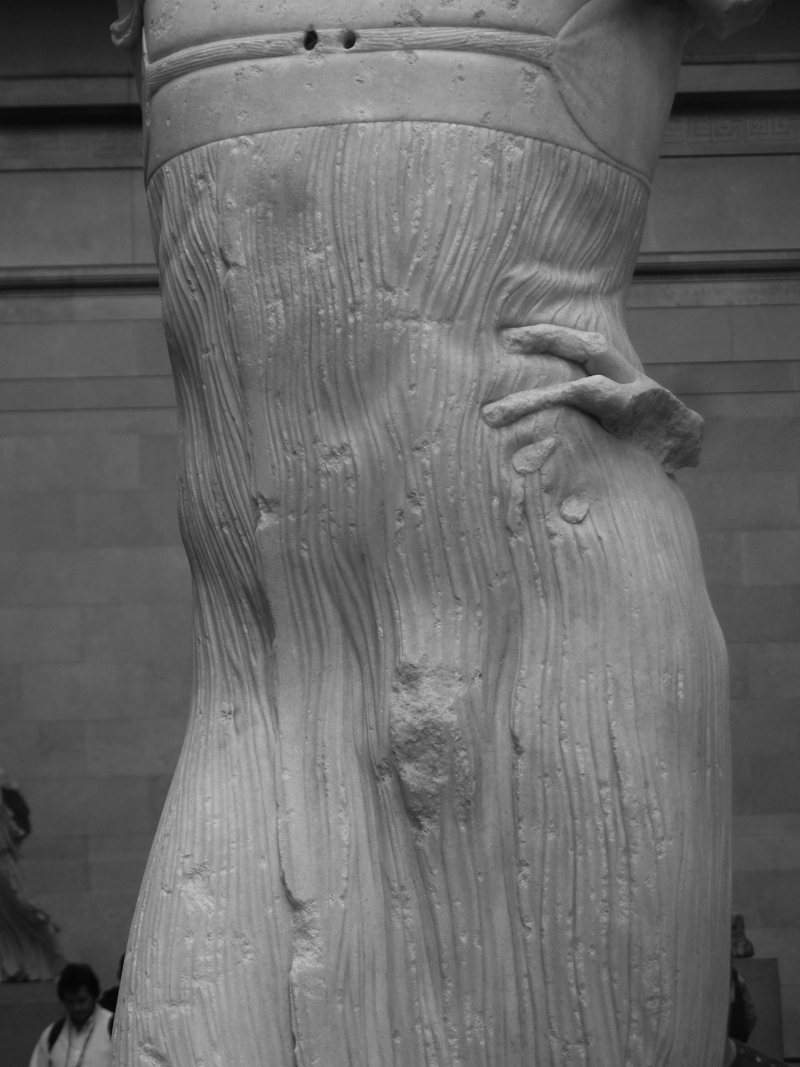
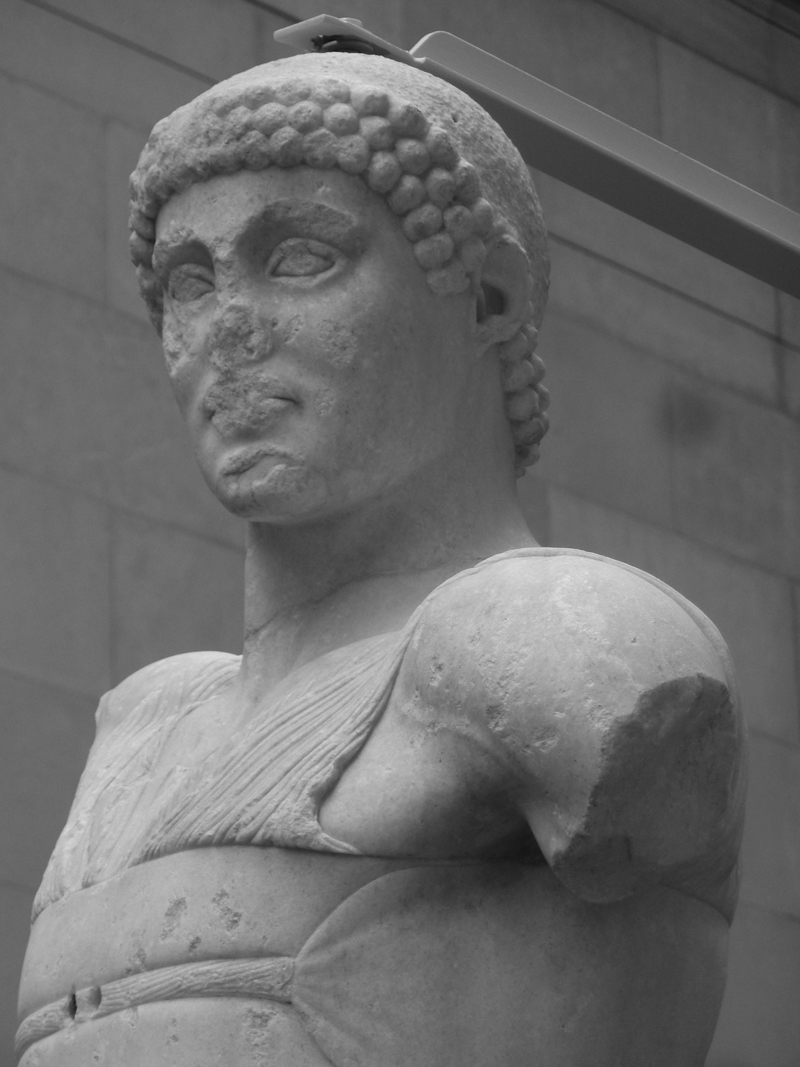
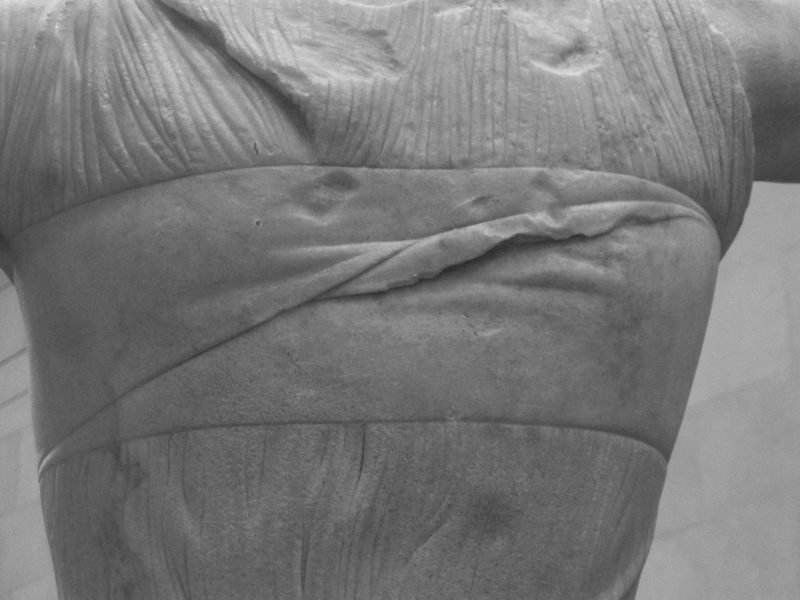
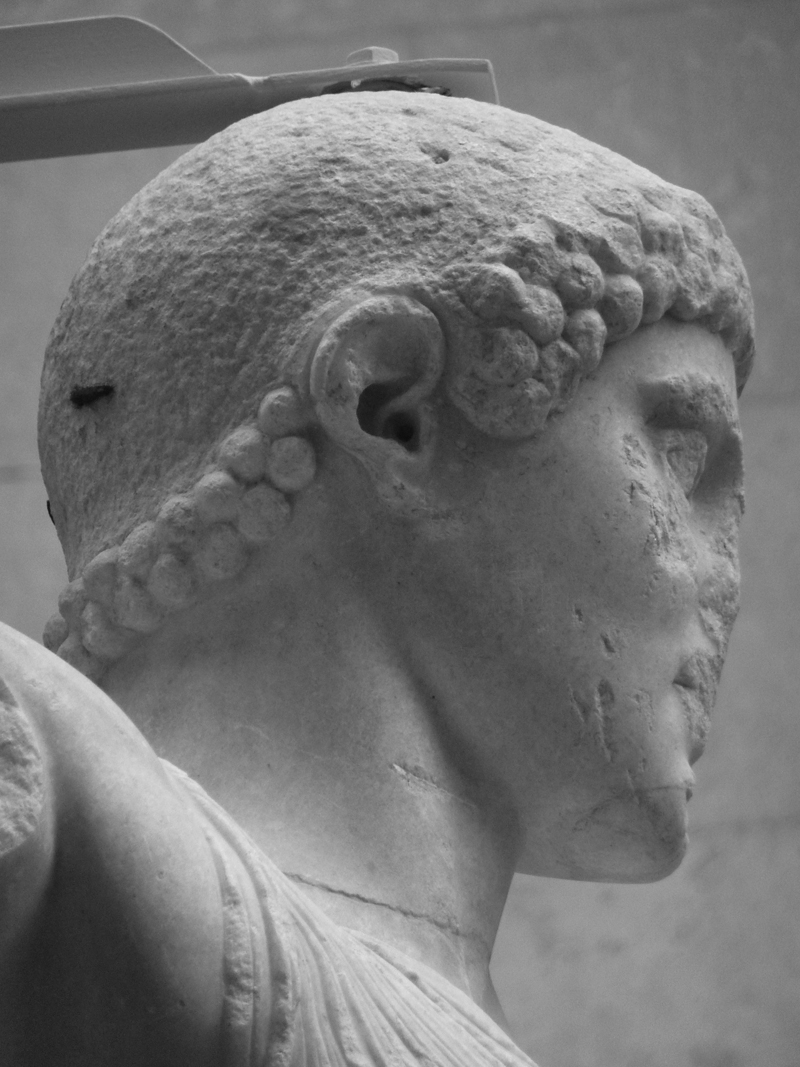
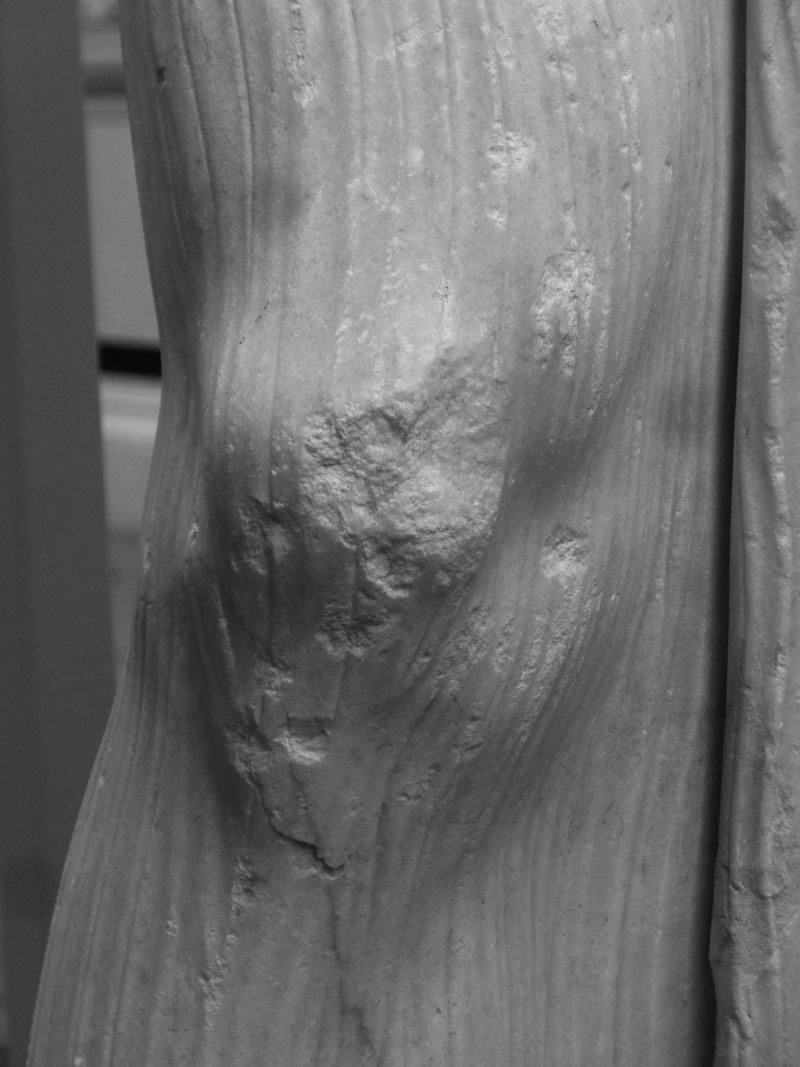
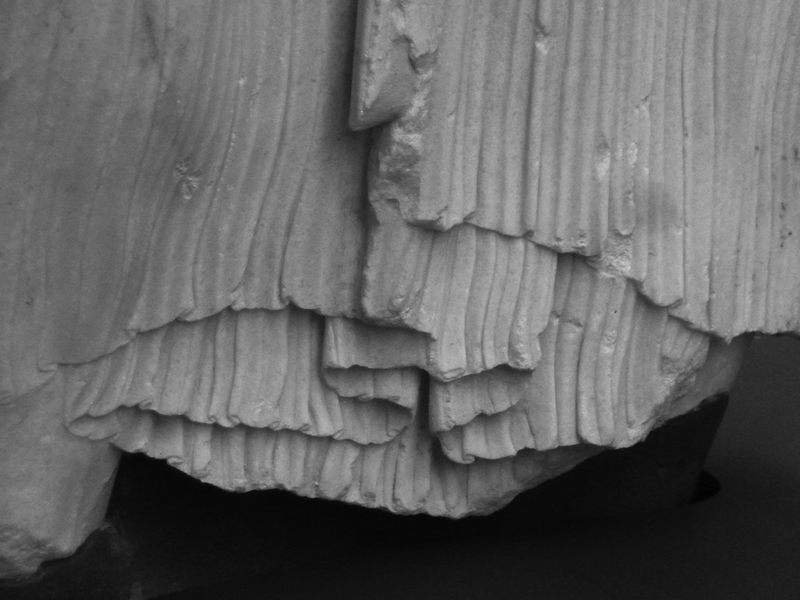
    The carving quality of this figure is breathtaking; an otherwise naked body is seen through a light, diaphanous, skin-hugging robe of a crinkle-cut material similar to cheese cloth. In style the piece is a fascinating enigma. Stylised facial features are indicative of an early-to-mid 5th century BC date. The rest of the figure, however, is less hieratic, more realistic, more human, indeed more suggestive of a carving style and understanding of anatomy seen in some of the figures of the Parthenon pediment itself – it anticipates the so-called ‘wet look’ prevalent in carving in the half century following completion of the Parthenon sculptures. One is forced to state that were this charioteer headless,  experts would surely have to date him fifty years after the current speculation. There is nothing in Greek sculpture of 460BC which resembles even a little in style the body of the Motya Charioteer from the head down. It could not by itself be called ‘Transitional’, or any other name implying fence-sitting. In terms of its style, wherever it was the body of the charioteer was heading, it had already arrived there.

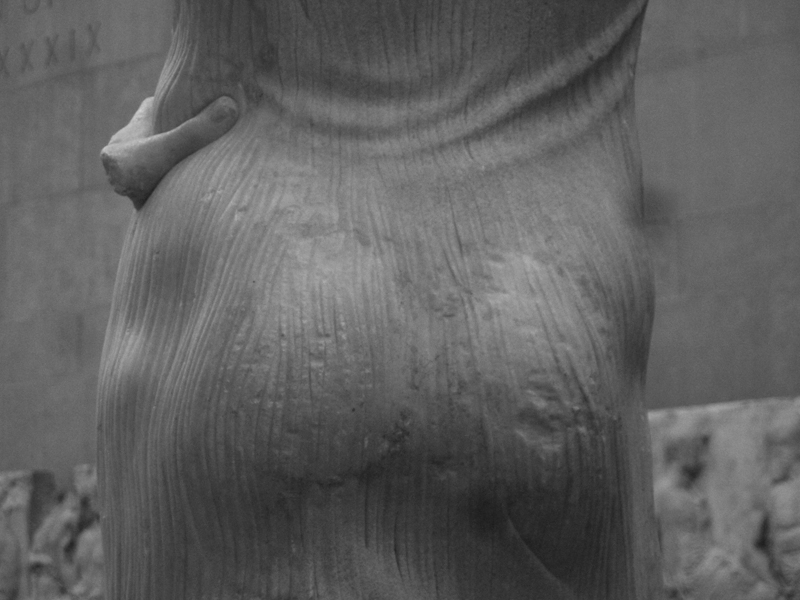
    Being so particular even personal in its details, it is difficult to imagine this figure not having been carved from life, or at least done by reference to drawings. Detailed observations of anatomy are acute and subtle in a figure superlatively athletic. He is built more like a pentathlete than a chariot racer. The only modern equivalent of this chap’s superb physique, especially the buttocks, are those on the most muscular ballet dancers. This fellow has the bodily tone expected of a jumper or a thrower, or at least of a discipline requiring exceptional stamina and strength. Those whose specialism is controlling horses at speed, jockeys, carriage drivers, trotters etc., are not known for their highly developed musculature or domineering size; lightness and agility are more favoured for these pastimes which require deft control and empathy before brute force.

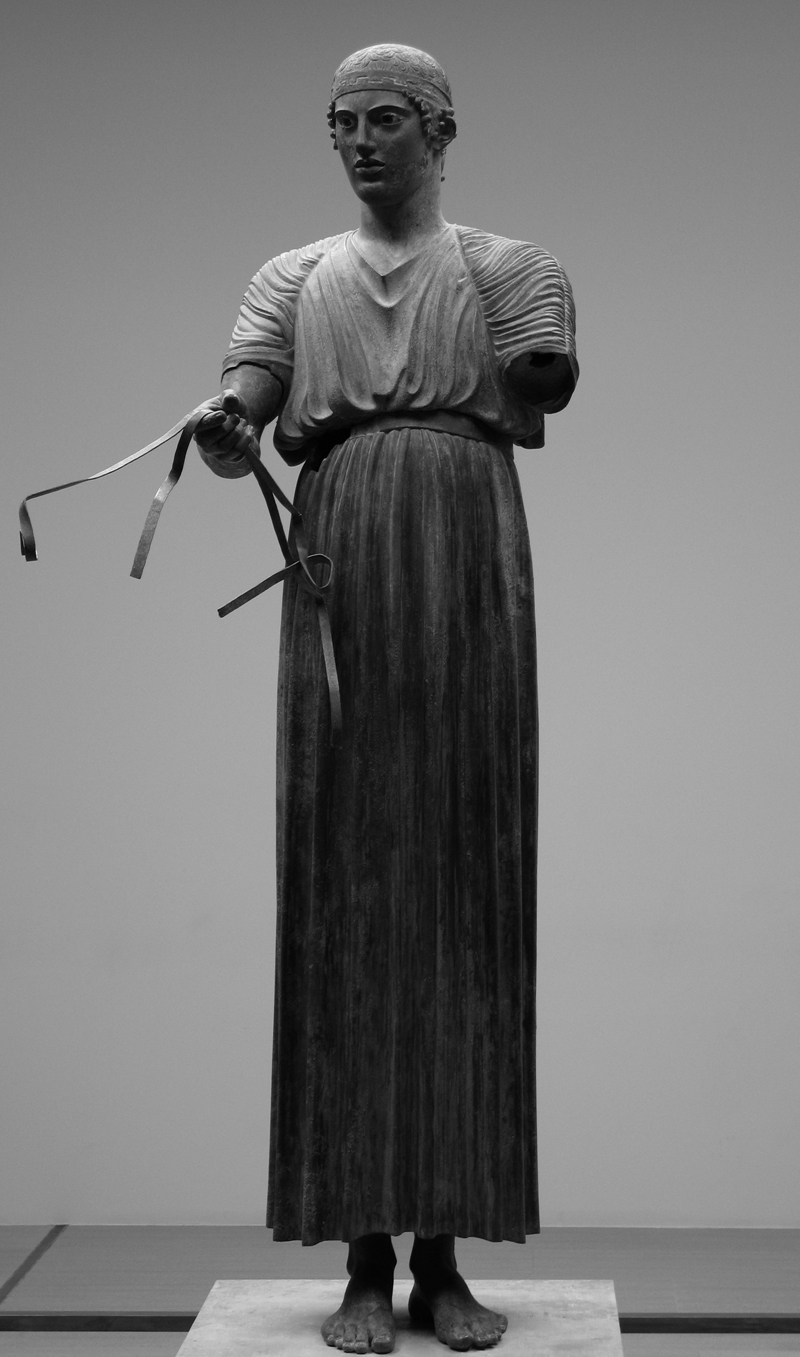
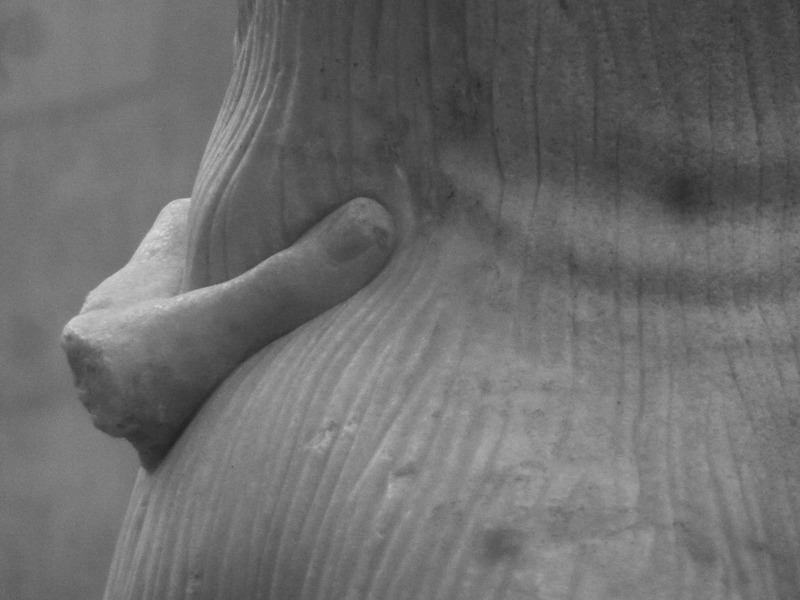
    The figure was dug up in 1979 on the tiny island of Motya off the west coast of Sicily, where the sculpture is housed in a regional museum. He is said to represent a charioteer because his long garment – in being long – seems akin to those worn by charioteers in vase decoration and incised on gems. Another charioteer, albeit in bronze, in the Delphi Archaeological Museum, discovered at Delphi in 1879, wears a long dress harnessed at the chest. If you squint at this figure through half-closed eyes from a distance of half a mile you might conclude that the figures are similar, if only in the number of arms and legs. There are, however, significant differences of emphasis between these two works. One is holding reins, and is therefore clearly in position on a chariot. The Motya figure is more informal. Avoiding the flat-footed frontality of earlier wooden poses, the sculptor places the figure’s weight on one leg while gently twisting the torso – the convincing expression of this inflection is best seen from behind. The restrictive fastening for his long robe, which is itself impossibly twisted at the back, is decorative, the metal clasp missing. He was also originally wearing elaborate headgear, probably of copper or silver. Such impedimentary accoutrements would surely not have been worn during the race. Further supporting the informal attitude of this figure, he is attired then not as a recently victorious athlete but for subsequent presentation to the crowd. One hand is louchely resting on his hip. The other arm, amputated near the shoulder, is raised in some sort of acknowledgement or greeting, or even blandishment. It has been proposed that he is attaching his victor’s laurel wreath. This is improbable, the arm being in the wrong place for that action – it is not even close to the angle needed; that is, if other wreath-fingerers in an adjacent BM gallery are indicative of the pose required. Is it likely that he has one hand on his hip and the other fiddling with his laurel. This sort of cartoon campness might have been convincing in Up Pompeii but surely not for the depiction of a great champion. If this fellow is a charioteer, he is being observed at the post-race press conference having slipped into something a little more comfortable.

    Delphi Charioteer

    As close examination reveals he put on his garb like a dressing gown, one side drawn over the other and fastened tightly at the top; in contrast the Delphi charioteer – dated by inscription to 479 BC, and therefore roughly contemporaneous with our more effete fellow – pulled his kit over his head. Though the rear view of the Motya figure suggests that the pose is stretching the drainpipe of fabric taut, the front is decoratively bunched implying a freedom of movement in the fabric at variance with the tension behind. The could be sculptor’s licence, a decorative flourish. Whatever it is doing, it is certainly an inconsistency, and he could not have tolerated such copious billowing cloth while jiggling on the narrow platform of a chariot for fear of dangerously ensnaring himself in the folds. Whether he is a charioteer or not, this is the most impractical gear for the dangerous job of driving at breakneck speed a chariot drawn by four horses.

    Please correspond your thoughts on this figure to

    dg.lee@virgin.net

    David Lee

    The Jackdaw September 2012
  • Top people

    Top people

    The new Culture Minister is Maria Miller. Her background is in marketing (Texaco and an ad agency) which means she’ll be in heaven when blather is required. She was born in Wolverhampton and is MP for Basingstoke, both places whose connections to Culture are so obvious they don’t need repeating here. She joined the Conservative Party aged 21 when Mrs Thatcher was PM – the year after the miner’s strike. Not surprisingly, therefore, nothing in her constituency notes suggests even the remotest interest in art, though she is instrumental in the Campaign for a Phosphate Free Basingstoke. We recommend she begins her job by inserting a hand grenade firmly up Ed Vaizey’s arse and watching closely for signs of life.

    http://www.culture.gov.uk/news/news_stories/9320.aspx

    Peter Bazalgette, the television auteur who brought you Big Brother, has been appointed Chairman of the Arts Council. He will probably do nothing at all and replaces the previous person who did nothing at all next January. A monkey could be an effective Chairman of the Arts Council. Let’s face it, how difficult is it to give money to the same recipients every year?

    http://www.artscouncil.org.uk/news/arts-council-news/sir-peter-bazalgette-new-chair/

    David Lee

    The Jackdaw September 2012