Recent Articles

  • Selby Whittingham: Tate Modern or Tate Theatre

    Selby Whittingham

    A survey by the Office for National Statistics in May revealed that the British are changing their spending habits. Instead of filling our homes to the rafters with consumer durables and not-so-durables, we’re spending our spare cash on ‘experiences’, including recreation and, yes, culture. “People are interested in servicing a lifestyle rather than buying stuff,” one trend forecaster commented in The Guardian, while a senior executive from IKEA predicted gloomily: “In the west, we have probably hit peak stuff”.

    Does this mean fewer family trips to the mall and more museum visits? The contemporary museum sector certainly hopes so, and to bring the hope closer to reality it is doing it best to make the two experiences as similar as possible. This is an ambition not confined to Britain. Is it any coincidence that Rome’s two contemporary art museums, MACRO and MAXXI, have names like megastores? It wouldn’t surprise me if the Pompidou called its next outlet Géant Casino.

    The mallification of the contemporary art experience is international, but here in Britain, where entry is free, we lead the world. Last year Tate Modern logged 5.7 million visitors (don’t you love the precision of the decimal point?) and this year, with the added attraction and capacity of Herzog & de Meuron’s new Switch house extension, it’s hoping to swell attendance figures to over 6 million.

    Architecturally, malls and contemporary art galleries have much in common: both incorporate awesomely large atria designed to instill a sense of limitless possibility, and both feature fancy escalators and rubbish cafés run by stressed and underpaid staff. Ah yes, you say, but here your parallel hits the buffers: people go to shopping malls to shop. Not strictly true, is my reply: visiting malls is a leisure activity. People go to malls to look at stuff and at each other, especially when travelling up and down the escalators, much as the ancient Greeks did in the agora, though without the escalators. Window-shopping is a group activity, a sociable way of servicing a lifestyle. As an experience, the ONS might well put it in the same category as visiting Tate Modern. 

    In the run-up to the Switch House’s opening we were forewarned that much of its 60% of extra space would be devoted to social interaction. Museums used to be about conservation. Now, with a minor anagrammatic rearrangement, they’re about conversation. Like shopping malls, contemporary galleries are places to hang out in, with the shop window or exhibition displays serving as talking points. As Jacques Herzog explained to The Observer about the design of the Switch House, “the stairs are wider than we need them; we want to invite people to have a different kind of experience than to rush from one gallery to another”. 

    All well and good, but you can’t get round a gallery this size without rushing, especially not if you linger on the stairs. I lost the ability to focus less than halfway through, and I call myself an art critic. The problem is not just one of scale; the trouble starts, ironically, with the gallery’s departure from the mall model. Art galleries, like shops, used to be full of covetable objects ordinary people could fantasise about owning – modest-sized works, originally made for private consumption, put on public display for the benefit of the general population. The Switch House galleries are mostly full of large-scale works created with public display in mind. Like public sculptures, they are made for rushing past. 

    The mystery of this so-called gallery extension which has so far cost £58 million of public money is how relatively little art there is in it: only three of its ten floors are exhibition galleries, four if you count the Tanks. But this didn’t stop the panel assembled for the press launch – including poor little Sadiq, whistled up at short notice as a multicultural mascot – from harping on about how transformative it would all be. It’s unfortunate that the most conspicuous evidence of the economic transformation so far triggered by the old Tate Modern should be Richard Rogers’s Neo Bankside luxury apartments with their litter of posh nosh outlets underneath. Looking south from Switch House’s 10th floor viewing platform, it’s hard to imagine the Tate’s regenerative effect rippling out towards the North Downs without the swathes of intervening social housing being swept away and replaced with Tory nastytecture and overpriced cafés.

    Bilbao has a lot to answer for. If the Basque government hadn’t hit the community jackpot with Frank Gehry’s Guggenheim Museum none of this would have happened. As it is, any city council in need of an economic boost reaches for the starchitects. The only city manfully resisting the tide seems to be Helsinki, still refusing to give the go-ahead to its Guggenheim outlet more than a year after the Paris-based architects Moreau Kusunoki won the competition to design it. 

    Bilbao claims to have recouped the Guggenheim’s construction costs within three years of opening. Even allowing for some prestidigitous book-balancing on Bilbao’s part, there’s precious hope of Tate Modern repeating this feat, with a £30 million funding hole that still needs filling. On the eve of the Switch House’s opening, Serota as good as admitted to The Art Newspaper that if the Tate didn’t seize the opportunity of “unwrapping the building” to hook some late donations it would be this year, next year, sometime, never before the debt was paid. Slim chance of our new tightwad PM delivering on Osborne’s previous promise of an extra £6.8 million of annual funding – and extra funding will be needed, not just to service the debt.

    As with any expanded operation, the elephant in the gallery extension is the payroll. Billionaire donors who will happily part with capital to get their names on a museum building don’t give a stuff about the extra numbers of staff needed to keep it open. They leave such practicalities to museum administrators and the public bodies that fund them. If it came to keeping museum staff in jobs and pensions, your average billionaire would hand straight over to Dominic Chapell. 

    In America, where more than $5 billion has been spent on museum expansion in the past nine years, administrators are getting wise. The Met, which reported a $10 million deficit this year, has mothballed plans for a David Chipperfield-designed modern and contemporary wing and, along with MoMA and the Brooklyn Museum, has announced plans to cut staff. The Met’s 2,300 staff – who, unlike museum staff in Britain, are properly paid – cost $200 million in salaries and benefits in 2013. MoMA, which spent $87 million on its 800 employees in the same year, has scaled back plans for a new extension. 

    Double your gallery space and you double your warding costs, at least in theory. One reason, I suspect, why Tate Modern’s Switch House galleries are almost entirely given over to large sculptural installations is that they require less security – the worst you can do is steal a Carl André brick. Meanwhile the more vulnerable paintings and nickable sculptures have been squeezed into a few crowded galleries in the old Boiler House to save on warders. 

    The dawn of the artist’s statement was bad enough; the arrival of the statement building has made things worse. Combine the two, and you get a tower of babble. Is the new Tate Modern worth the £260 million investment? If it ever has to charge for entry, we’ll find out.

  • Selby Whittingham: Rhodes Revolution or Reform

    Selby Whittingham

    “Rhodes will likely fall,” gloomily writes Professor Nigel Biggar (UnHerd, July) after a decision by Oriel College, of which he was once chaplain, in favour of that. Another Rhodes watcher, Lars Larundson, says that the vote was taken amid thunder, lightning and torrential rain, perhaps an indication of internal dissension as much as of Rhodesian displeasure (The Critic, 25 June). Now a final decision has been postponed until January. In 2016 the college had backtracked after protests from alumni. At that time I wrote a piece for The Jackdaw (No.126). I will not repeat what I said then, except to stress that the statue of a donor such as Rhodes, and part of a building erected with his money, is in a quite different category from that of, say, Colston at Bristol. It is pointed out anew that the statue is part of the whole scheme of the facade, and that other statues on it could be condemned for being tarred with the same racist brush. Indeed those of James I and Charles I outside the 17th hall might not escape anti-slavery rage.

    Readers of defences of Rhodes by Biggar complain that he does not give the whole story. But he says that the attacks on Rhodes do not either and he is trying to provide balance. One would hope that a university would have the same aim and not cowardly cave in to a pressure group such as Black Lives Matter, some of whose supporters have said that they are not interested in the facts or in statues. While the dons might reasonably sympathise with their complaints of present-day injustices, there are also the interests of the host people in their history and culture which deserve protection. The protesters will of course respond that White Britons are not the ones who have been seriously disadvantaged. As happens in this and other political disputes, all passion is on the side of the revolutionaries, while the conservatives mount a wan defence.

    Remedies that are proposed are mostly impractical or bad. Museums are already overfull.  Unless the statue is Grade I* it will be relegated to stores which are overflowing. At the National Gallery the statue of Wilkie, placed there as a memorial after his death, long ago was removed and migrated to a Tate store. At the Tate a bust of Ruskin in the Duveen Turner wing vanished from sight. So far the portrait of Sir Charles Clore in the Clore wing has remained in situ, but for how long? What about the huge Picton monument in St Paul’s Cathedral? Is that a public space? It is governed by the cathedral chapter not the City of London and such monuments belong to the deceased’s family. Maybe the V&A would gladly house it, but how much space does it have to show church monuments if there is a spate of purges? As for replacing statues of bigwigs by those of saints, what would happen to the even vaster papal ones in St Peter’s Rome?

    Then there is the suggestion that statues of British “worthies” should be replaced by those of worthier people of the past or today. But where are the worthy sculptors? Granted that some Victorian busts and statues are mediocre, they are not kitsch as so many contemporary ones are. Another idea is for changing figures as on the fourth plinth in Trafalgar Square. That on the whole is not an encouraging precedent – look at the latest effort. Some argue that individuals should cease to be honoured. But where would art be without exceptional – not necessarily exceptionally good – individuals?  Or indeed advances in other professions too.

    Thanks to their inventions, creativity and enterprise such people have enabled Europe to take a lead over past civilisations such as those of the Middle East, India and China.  As always in history, this led to colonialism and sometimes slavery. “We have the Maxim gun, and they have not”.  If the position had been reversed, it would have been the Europeans who would have been exploited. Indeed the Arabs and Turks were encroaching on Europe late on. No doubt some would argue that they behaved better than the Crusaders, but the latter were trying to reverse previous conquests. It is not very helpful to go so far back in history. Not that one need to. Zimbabwe is not a great improvement on Rhodes’ Rhodesia and in material ways a decline on later British colonial rule, though it is true that it gives greater status to blacks and the partly illusory benefits of sovereign independence.

    Like prejudice in general racial prejudice is ubiquitous and goes back to an animal instinct teaching fear and caution when encountering the unknown or alien or generalising from one or two bad experiences. A Greek friend tells me that she encountered notices in Kensington saying “No Greeks” as well as “No Irish, No Blacks”, which seems a bit hard when Greece was on the British side in World War II. Humans are programmed to generalise, often on very little experience, whereas people should be treated as individuals. Unfortunately some utopians are opposed to individuality. Thus Neil MacGregor proposes a monument to the poor in Glasgow, saying “of course this could only be abstract”.  Maybe abstraction sometimes has a place (such as for the Cenotaph), but in this case would not the pathos of a figurative work be far more moving?

    However, conservatives cannot just rely on such arguments.  Revolutions occur for a reason. Longstanding frustration with oppression or inferior status will boil over, as we have seen in the case of Ireland. The source of the present Black Lives Matter campaign, apart from the usual imitation of all things American, is the failure of Britain to appreciate that it was not enough to give large populations of Caribbeans and Asians a home. They had to be given both respect and opportunities. Governments were too slow to realise this and have reaped the consequences. It is true that much has been done by them in recent decades to rectify this. But revolutions often occur after reform and liberalisation are belatedly embarked on. What is needed now is a recognition that harmony not statuecide (which will only provoke, and has provoked, a violent reaction from militant conservatives) should be the aim, and to that end rational and informed discussion is needed, above all in a university city such as Oxford.  Black Lives Matter, in its extreme form, is part of the current illiberal puritanism which wants, not merely to restrain, but in a search for Utopia to stamp out evils that are currently topical such as racism, sexism, homophobia and smoking. It fails to recognise that all human beings are imperfect and that they and their predicament cannot simply be reduced to Black and White.

  • Moping Owl: Club Feat

    Oh dear. I had expected to be out and about again by now, as did we all, even if it did mean wearing the mask and keeping one’s distance, and hardly daring to look at anyone, let alone breathe. But no: here we all still are, stuck at home and doing as we’re told, good boys and girls to a man, or woman as the case may be – though it’s becoming increasingly hard to tell which is which in these confusing self-identificarious times. And to make life ever more troublesome than it needs to be, there then follows the awkward business, taken with all due care and consideration for the feelings of others – a natural civil duty and obligation after all – of wondering on the most meagre of evidence if we are dealing with a truly delicate plant, a manifest lunatic, or a joke. People do take such offence at the slightest and most innocent provocation, whether imagined or contrived, don’t you find, and we don’t want to end up at the bottom of the river like that lump of old bronze.

    At least that genial if tiresome national treasure, Sir (it can’t be long) Cynthia Puppy RA, potter to the stars, doesn’t put us to that trouble. We know perfectly well where we are with him, usually that state of mild embarrassment as when the joke falls flat, yet again. But at least when he’s on the television he seems to prefer to leave his frock in the wardrobe and ankle socks in the drawer. He’s been on it quite a bit lately, supposedly to keep our spirits up amidst the gloom, and he seems somewhat less colourful too so far as I can tell, watching in black and white as I do – a Sony 9” portable c. 1970 since you ask, which I have to give a shake from time to time to get a picture: I mislaid the aerial long ago. And without the Alice Band his hair is rather floppier, and much longer too. I’m surprised Mrs Cynthia, who has been appearing with him on the programme, hasn’t picked up the pudding bowl and given him a trim. She does her own hair, perhaps in the same way, rather fetchingly in grey and white stripes, like a badger, very neat.

    Where was I? Oh yes, the programme. It was called Cynthia’s Art Club (I speak from fading memory) in which under his eponymous direction the viewer of every hue and cry, talent, description and proclivity, was encouraged to produce what he, and I fear you and I too, moving with the times as we must, would call an ‘artwork’ on the set theme of the week, safe in the understanding, since we are all artists now, that art wouldn’t come into it.

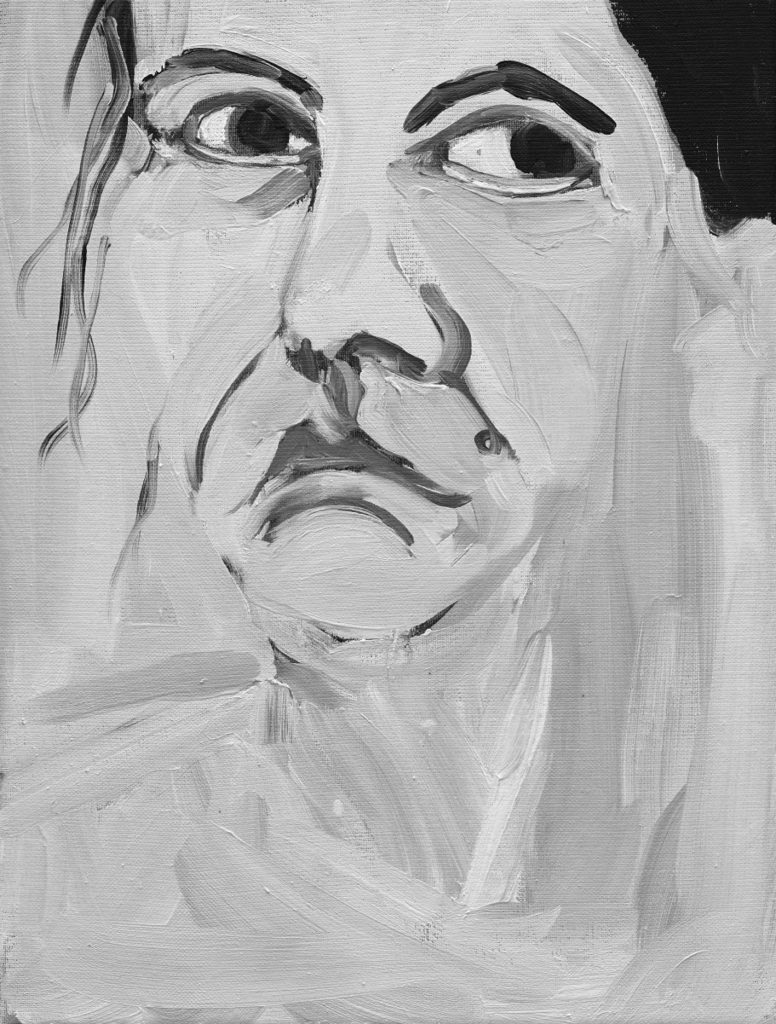
    And so it came to pass that every Tom, Dick and Harriet, Sharon, Jim and Wayne, not to mention Malik and Ramon down the road, nor forgetting old Dan Pearce out in the sticks, set to with a will with whatever was at hand or came to mind – macramé, finger-painting, applique, matchsticks, corks, wool, glue, pencils, coloured pencils, charcoal, ink, even paint: you name it. They then took a photo on the phone of said ‘artwork’, loosely fitting description as painting, drawing, print or sculpture, and pinged it off to Cynthia for adjudication in hope of being singled out for discussion on the programme and virtual exhibition (one Clare Warde’s effort, above).

    Cynthia, meanwhile, had been far from idle, calling on both long experience and natural talent slowly to produce – for it had perforce to last the series – one of his pots-cum-sculpture, or sculpture-pots if you insist. It would, we were assured, come to signify and celebrate his experience of the lockdown and what it meant to him, or something like that. And we followed its progress as it grew, or sprouted might be the better word, episode by episode, into something rather more than just a pot or indeed common sculpture: something, how shall I say, more exotic, fetishistic, even organic, like a small triffid, or mutant cactus. And every so often Mrs Cynthia would potter in and say, “Ooh, that’s nice Dear. Yes that’s much better. It’s changed a bit, though, and what’s that chunk of metal doing? Oh, I see. Hmmm”. And then she’d potter off.

    On the whole Cynthia’s Art Club was all rather charming, in an evening institute kind of way, and certainly very popular. But then art as therapy so often is. Let’s Fill this Town with Artists, as the old song goes. We’re all artists after all, aren’t we?

  • Moping Owl: Nem Con

    Moping Owl: Nem Con

    Goodness knows we have more than enough to mope about these dark days, even without the current plague, what with the evenings drawing in and the weather on the turn, again. It seems to happen every year, Winter. Was it always like this, this cold, wet, windy, foggy, snowy thing, with a spot of flu thrown in for good measure? I blame Global Warming, or Climate Change as everyone now calls it, hedging their bets.

    Of course the plague doesn’t help, especially at my age, and I can’t say I’m looking forward to being confined to barracks yet again, alone and warming my five wits as best I can in this draughty old belfry, to venture out only at risk of neighbourly denunciation by the horrid old crow next door, and possible debility and death. I know it’s for my own good and, if I didn’t, I know I’d soon be told so by lovely Fiona Gloom or sweet Sophie Despondency on the evening News. Get a grip they’d say, think of others, and do your bit of shielding, whatever that is.

    It is a public duty, I know. It makes me almost ashamed to mope at all, though only almost. But then life is strange, and rather wonderful too, and, blow me off my twig, what should happen but that Art appears, smack on cue, to take my mind off such selfish introspection and despair and give me, as I knew it would, something really worth moping about. And, just so, across the wire the message comes, Chantal Joffe (say no more, I hear you cry) is to have another show to follow the one she had, when was it now? – ah yes, the week before last. Gosh, how Time flies.

    I’m not sure quite which is the more dispiriting. One can just about understand, though not necessarily forgive, a Barrow Boy, Spiv or Snake-oil Salesman for making a few bob flogging off dodgy goods. After all, there’s always been more than something of the back-street market to the art trade, good times or bad: caveat emptor and all that. And, again, who can really blame an artist for cashing in on a manifest lack of talent given half a chance. Take it while it’s going I say. After all, no one’s forced to buy the stuff.

    So no: it’s not the chancers who make my very heart faint and my poor soul grieve so much as the fellow travellers, useful idiots, critics, administrators and curators and, not least, self-serving artists, who by their abandonment of critical judgement keep the whole sad charade on the road. Theirs is the greater betrayal. Trahison des clercs says it all.

    I’ve nothing against Miss Joffe, who has shown all over the world, has works in pretty well every major collection, clearly can’t draw or paint to save her life, and is not all that bright if what follows is anything to go by. Along with her new paintings, the show, we’re told (wait for it), ‘premieres’ (no, don’t laugh) some pastel self-portraits (illustrated), about which she has this to say: “You can get a kind of brutality with pastel that you can’t with paint. With paint there’s always an extension of your arm and brush. Whereas pastel is so primitive. You can’t draw hard enough.” Well, I mean to say, I know we now see through a glass darkly but what on earth is all that about? I still feel quite dizzy, and I’ve only read it twice.

    The show is called Story, and many of the paintings are of her mother. They consider, so Victoria Miro’s in-house hack helpfully informs us –  chez whom the show of course takes place – “consider issues of aging, motherhood and invisibility”, doubtless with profound conclusions drawn, albeit un-vouchsafed as yet. She brings a “combination of insight and integrity, as well as psychological and emotional force, to the genre of figurative art”: at which point I feel we should all take a deep breath and put our heads between our knees for minute or two. Whew. Figurative art a genre, eh? Roll over Rembrandt, Rubens, Velasquez what?

    But on we plough: “Defined by its clarity, honesty and empathetic warmth (one can never have too much empathy) her work is attuned to our awareness as both observers and observed beings, apparently simple yet always questioning, complex and emotionally rich.” No, nor do I.

    A book accompanies the show in which we find Olivia Laing, novelist and soi disant cultural critic, treading water somewhat, and not exactly waving: “Over the years, a kind of hardening takes place, a process of separation and individuation on both sides… The mother recedes inch by inch, becoming smaller and harder, emerging as a person with needs and sadnesses in her own right.” Receding and emerging, smaller and harder: I don’t like the sound of that. Let’s hope there’s a vaccine soon.

    Back with the scribe, Chantal’s “is a deceptively casual brushstroke”, though I’m not so sure that deceptive is quite the word: casual will do. “Her paintings only waveringly adhere to their source (yes: we can see that) – be it a photograph, magazine page, or even a reflection in a mirror – instead reminding us that distortions of scale and form can often make a subject seem more real”, or perhaps not. “Notions of sensuality and self-disclosure (sounds interesting) are parcelled up in works of mobile immediacy.” Mobile immediacy – well there’s something to set the imagination adrift, I must say: swings and chandeliers spring to the febrile, hopeful mind. Mobile immediacy – I shall try to remember that, if not for long. “Hers are deeply questioning images about ever-shifting human connections (those chandeliers again) and the endless intricacies of looking.” Answers on one side of the paper only, the deeper the better. 

    So there we have it: what justification there is rests either on the narrative alone, as read in the imagery, or on the artist’s subjective experience of its making: of the actual technical quality and resolution of the work as work, painting as painting, drawing as drawing, not a word.

    Chantal is a graduate of Camberwell and the RCA, both renowned painting schools in their time, and now a Royal Academician, its Professor of Painting no less, elected by a body that nowadays counts amongst its number such as Our Tracy, Yinka Shinybone, Bob-n’Rob, Young Grayson, and the Misses Dean and Wearing. Some years ago it gave her its Wollaston Prize, nem. con. –  which is to say 25,000 of the best and brightest for ‘the most distinguished painting in the summer show’ – worthy heir indeed to the shades of Reynolds, Turner, Lawrence, Millais, Spencer… Perhaps trahison des clercs isn’t strong enough.

  • Moping Owl: Flowers

    I don’t know about you, but I find it’s becoming increasingly hard to keep up in this brave new art world of ours, fly as I might. Perhaps it’s just my tired old wings, but I have a horrid feeling it might be rather more than that, even if I do manage to catch up with whatever it is for half a furlong. Taking in air significantly as I heave alongside, yet still peering keenly through the misted specs, it’s ten-to-one on I’ll still make neither head nor tail of what it is I’ve actually caught up with. All that effort spent and innocent curiosity frustrated: it is a shade dispiriting don’t you feel: but anno domini I suppose, as we used to say.

    I mean here we all are, doing as we’re told, still masked-up beak and wattle, soaping the talons at every turn and dutifully keeping our distance, stuck in Zoom-space and desperate for release and something to look forward to. So when a note came pinging through the aether from the chap at the Pace Gallery – you know: tradesman’s entrance at the back of the Academy, up the stairs and off to the right, the old servants’ quarters, chambres de bonnes – announcing its reopening in September with a show entitled Bloom, ahaa, ahaa, I said to myself a couple of times, ahaa ahaa; at last, something to look forward to. I rather like pictures of flowers.

    But how soon the heart sinks, and all the farther and heavier when jacked up a bit first. It didn’t take long. Bloom, it transpires, is a show of the work (detail illustrated) of yet another world-famous artist we’ve never heard of called Trevor, Trevor Paglen to be precise, American and in his mid-forties. He is known, we learn, “for investigating the invisible through the visible”, which is a start of sorts, I suppose, for all its rather darkly Pauline cast of mind. Where he actually lines up, though, sounds more like the start of the Grand National than the Derby. A ‘Wide-reaching approach’ is the formula favoured here – not something approaches often are in my admittedly limited experience, except at Cheltenham or Aintree – and his “spans (again an unusual thing for any self-respecting approach to do) image-making, sculpture, (now there’s a surprise) investigative journalism (that’s more like it), writing, engineering, and numerous other disciplines.”

    Quite the Renaissance Man. It’s tempting to have a guess at what those others might be – brain surgery? quantum physics? ballet dancing? experimental geography? sudoku? It’s a dangerous game, though, for, who knows, we may be right. But let’s press on. He has written “five books and numerous articles on … experimental geography (there you are: hole in one), state secrecy, military symbology, photography and visuality of all things”. His “investigation into the epistemology of representation can be seen in his Symbology and Code Names series which … explore questions surrounding military culture and language.” Does one ‘explore’ a question? Perhaps. So what has he discovered? What are the answers to these questions? We still long to know. Do tell.

    “Among his chief concerns [is] learning how to see the historical moment we live in”. I find waking up in the morning and opening my eyes a not unreasonable start, or approach if you’d rather. He is also keen on “developing the means to imagine alternative futures”, at which point I’d rather leave him to puzzle it out for himself, or dream on – our Trev is a laureate of the Macarthur Genius Prize after all. Just speaking for myself, I’d have thought the usual means by which to imagine is the imagination and, as for the future, can there ever be an alternative? I suspect we’ll be rather stuck with the future we get, when it comes of course, as it does, like it or not, later today if not before: che sera. But who am I to say? These are deep waters, Watson. Moving fingers. Questions, questions: answers on one side of the paper only, and don’t forget to put your examination number in the top right-hand corner.

    But to be fair, if I must, the words above are not his, though I’m sure he crossed the eyes and dotted the teas, but those of Mr Pace-Gallery, all taken down in faithful dictation by Jessica, his lovely secretary, or was it Barry. So what has Trev to say for himself? Here goes: pace yourself. “Computer vision and artificial intelligence have become ubiquitous (gosh). The works in this exhibition seek to provide a small glimpse into the workings of platforms that track faces, nature and human behaviour … I am interested in exploring the numerous examples of computer training sets creating AIs that reflect and perpetuate unacknowledged forms of racism, patriarchy and class division that characterise so much of society.” No, nor do I: not a word. Reflected and perpetuated yet unacknowledged? Hmmm. A mystery.

    The eponymous Bloom of the exhibition is “a series of large-scale photographs that depict flower formations, flowers, leaves, petals, stalks, that sort of thing, conceptualised by various computer vision algorithms created to analyse the constituent parts of real-life photographs”; at which point I fear I’ve quite lost the thread along with the will to live. What, quite, goes up the universal cry, is a real-life photograph, for goodness sake? And its constituents? – all those algorithms for a scrap of paper and few chemicals exposed to light? That old combination of sledge-hammer and nut springs unbidden to the mind. But wait: there’s more if you can bear it. “The colours and shapes … represent similar areas that the AI has detected in learning from other images of flowers. They do not represent real-to-life colours, good heavens no, there’s not much algorithmic fun in that, so much as what the AI thinks the different parts of the images are, if you see what I mean.” I think I’d better go and sit down for a while, if you don’t mind, in the garden, somewhere in the shade, with that jar of snake-oil cream I picked up in Brixton market, to keep off the midges.

  • Alexander Adams: Women in Art Today

    Alexander Adams

    We are told that in many fields women face systematic disadvantage and are under-represented. It has become a core belief of many and goes almost unchallenged. When politicians came under pressure regarding supposed gender discrimination in the workplace, the British government conducted a survey of arts organisations. The 2018 report found that women comprise 56% of the British arts-sector workforce. The Arts Council of England has a National Council comprising 53% women and an overall workforce of 65% women. This evidence seems to contradict the narrative that British organisations reflect male power. At the very least, female administrators and human-resources staff must be implementing a form of patriarchy which is proving strangely ineffective. 

    I wondered why the female-disempowerment story had such currency when reality appeared to contradict that. So, starting in July 2018 for 12 months, I collected data on the press releases that I encountered as a critic in the forms of emails, publisher catalogues, magazine advertisements and notices on specialist websites regarding the international art world. I neither screened nor sought out data. I wanted to test the narrative that women in the arts face obstacles that their male colleagues do not – in other words, women are subject to widespread sexism due to the actions of individuals, organisations and systems. I daily checked every public statement relating to living individuals of ascertainable gender, classing each entry under appointment, prize/award or event. I tallied data monthly and derived from it percentages. I discounted any announcements relating to dead artists, non-fine-art events, events without an identifiable artist and previously announced events. Announcements relate to events in Europe, North America, Australia and a few from other regions. 

    The event data are numbers of opportunities not individuals because it was impossible to count individuals in events such as art fairs. Thus an event of 2 male artists is listed as “1 male opportunity”; an exhibition of 8 men and 3 women is listed as “1 mixed opportunity”. Each entry of unknown gender or mixed gender is counted as 0.5 male and 0.5 female opportunities.

    Although the system was neither comprehensive nor watertight, it produced remarkably clear consistent data.

    1.  Women outnumber men in recent appointments.

    Data shows that, in the cases documented, women are appointed to a greater number of permanent positions than men in public and private venues, arts organisation and to more temporary positions as organisers, directors and curators of events. This strongly suggests that there is no bias against women in hiring and promotion of individuals for permanent and temporary positions. It is fair to conclude there is no systematic bias against women being appointed to jobs within the fine arts. If, as it seems, a) women are entering existing positions at a greater rate than men and b) they are entering at a greater rate than that of the increase of positions in the field overall, then the field is becoming increasingly female populated.  

    2.  Female artists outperform male artists in recent fine-art prizes and awards.

    Considering the multiple estimates of the population of artists dividing 40-45% female and 55-60% male, female artists win more prizes than men proportionate to the percentage of the artist population that they comprise. All other things being equal, a female artist is two to three times more likely than a male artist to receive an award or prize. It is fair to conclude there is no systematic bias against female artists receiving prizes and awards.

    3.  There is over-performance of women artists in recent fine-art prizes and awards.

    Working on the basis that women form 40-45% of all professional active fine artists, we can see a measurable consistent over-performance by female artists. Different women were receiving prizes, awards, honours, scholarships and so forth, so it was not a case of a few skilled individuals winning multiple prizes due to personal merit and thereby distorting data. Male artists are under-represented in terms of fine-art prizes and awards. It is fair to conclude that female artists statistically over-perform and male artists under-perform in the area of receiving prizes and awards. 

    4. Female artists are represented in recent arts events at a level commensurate with that which they form in the artist population.

    Working on the basis that women form 40-45% of all professional and active fine artists, we can see that they have opportunities commensurate with their proportion of the artist population. The figure is remarkably consistent month-on-month. It is the largest dataset in the survey and the most consistent in terms of percentages. It is fair to conclude there is no systematic bias against women artists participating in fine-art events.

    5.  Recent female-only events outnumber male-only events.

    The total number of specifically male-only events was very small compared to specifically female-only events. For whatever reasons, fewer events around single-gender bases were devoted to male artists than female ones. It is fair to conclude that specifically single-gender events significantly favour female artists by providing more opportunities for female artists than for male artists. 

    6.  The dataset is of adequate size.

    The larger is the dataset the greater the consistency. Appointments and Prizes/Awards – the groups with the least amount of data – fluctuated most; Events had most entries and was most consistent. Inevitably, a study with a larger dataset would be more accurate.

    7.  The data is internally consistent.

    Data did not fluctuate dramatically over period and did not seem to be seasonally affected. Even in months with relatively little data, percentages for these months remained consistent with high-data months. This suggests that the data is relatively reliable and consistent. It also suggests that as trends were stable that the data shows a persistent state rather than a temporary situation.

    8.  The data seems a reasonable reflection of reality. 

    There is no indication – factually, logically or anecdotally – that this data is not a workable approximation of reality. The data reflects the experiences of most artists, art critics, art collectors and other art professionals rather than any political narrative.    

    9. These conclusions are in need of future correlation and correction. Further statistical models and datasets are needed to confirm or disprove the conclusions above. 

    Overall, these figures – while being a limited dataset – are an indication of what is likely the true state of affairs. To my knowledge, this is the first time such data has been compiled and for that reason alone it is of value. A more comprehensive survey is needed. However, there is nothing in this data or the conclusions that seems not broadly representative of the current situation.

  • Alexander Adams: New Order – September 2017

    Alexander Adams
    September/October 2017

    New Order

    An Allegory

    Once upon a time there was a society which made objects that had meaning and that people enjoyed looking at. The society put these objects in museums so that more people could enjoy them. Then an elite of that society decided that the objects did not matter so much but the skin colour and reproductive organs of the object-makers mattered a lot. Displaying objects made by people of certain skin colours or possessing certain reproductive organs pleased other people and made them feel virtuous. The elite counted the numbers of museum objects made by people of certain skin colours or possessing certain reproductive organs. These statistics measured how virtuous the society was compared to other societies. More and more people were encouraged to visit the objects to display their virtue or to acquire virtue. The elite wanted all the people to visit the objects even though some people preferred to do other things. When the elite persuaded people of certain skin colours or possessing only small amounts of money to visit the objects, the elite said it made society better when actually all it did was make the elite feel less guilty. It was known that most people liked meaningful or beautiful objects but it was decided by the elite that the virtuous statistics were more important. The elite decided that people’s unhappiness about the elite using people’s money to buy for museum objects that were neither meaningful nor beautiful was caused by people not being virtuous enough. Some people thought the idea of virtuous statistics was silly but most of them did not say that because it would have been rude.

    Murder Machines

    This year a sculpture by Sam Durant entitled Scaffold was erected in a sculpture park managed by Walker Art Center, Minneapolis. The wooden sculpture juxtaposed elements of playground-activity structures and gallows. One minor aspect of Scaffold referred to the hanging of Dakota Native Americans in 1862 as part of struggles between the Dakota Nation and the American government. That reference had been missed until it was pointed out, at which time a campaign to remove the sculpture was begun by the Dakota. “This is a murder machine that killed our people because we were hungry,” said a member of the Dakota Nation, equating Scaffold with an actual gallows that hanged members of the Dakota. In May the museum destroyed Scaffold and the artist renounced his work. 

    This year there was a protest by some black artists against the display at the Whitney Biennial of a painting of murdered black activist Emmett Till. Black activists lobbied to have the painting by Dana Schutz, a white artist, removed as offensive and hurtful. “The subject matter is not Schutz’s,” said one protestor, claiming ownership and authority over the representation of a historical event.  

    In these two cases, activists claimed ownership over aspects of history in order to suppress art works. In one case it resulted in the destruction of art. Pressure groups have noticed the weakness of curators, administrators and politicians and their unwillingness to protect art from censorship. Sympathetic towards notions of social justice, administrators sometimes submit to emotional blackmail by groups which demand censorship.  

    Delacroix did not have to be Greek to paint Massacre at Chios; Sargent did not have to be either British or a combatant to paint Gassed; Callot did not seek approval of relatives of hanged men before publishing prints. These are iconic touchstones for appreciating events in world history, yet according to supporters of identity politics such art should not be made now. Groups should own their histories, curb free speech and suppress or destroy art deemed offensive. There was a time, not so long ago, when we derided Soviet agronomists’ dismissal of Mendelian genetics as “bourgeois” and Nazi ministers damning branches of science as “Jewish”, yet today art can be “too white and male”. 

    Identarianism

    Identarianism (or identity politics) is a political belief system which has had huge influence over politics in Western countries for the last three decades. It sprang from New Left principles developed in the wake of failed attempts at revolution in 1968 and revelation of the atrocities and failures of Communism. It seeks to advance social justice and enforce relative equality through incremental advances in social capital of supposedly disadvantaged subsets such as women, ethnic and sexual minorities and so forth. There is commensurately punitive retraction of rights from supposedly advantaged groups such as men, white people and so forth. 

    Identarianism is essentially a political manifestation of Post-Modernism which acts by harnessing factional interests. In the same way Marxism co-opted movements of emancipation, workers’ rights, anti-clericism, anti-colonialism and so on, Identarianism gathers factional interests under the umbrella of Post-Modernist relativism by promising social justice.

    Here are some tenets of Identarianism:

    1. Every person has involuntary affiliations from birth (ethnicity, sex, sexual orientation, physical ability, family religion, etc.) and shares a common identity with other members of his or her subsets. These identity subsets are not generally mutable. (Mutability of gender and sexual orientation are controversial issues within Identarianism.) Subset identities necessarily form a strong part in determining one’s outlook. People do not have universal qualities (as in the Enlightenment model of universal rights) but have compound qualities derived from their subset identities. Equality is therefore relative not universal.

    2. Subsets are subject to pervasive networks of personal, institutional and social prejudice, discrimination and disadvantage. This oppression is collective and endemic.

    3. Social, legal, political and financial power – and its converse – is heritable. 

    4. Privilege and guilt is collective and heritable. 

    5. Subset members have a right to demand redress or reparations for collective discrimination and oppression by oppressing subset(s).

    6. Subset members can work together to promote the fulfilment of their potential (called “equity”; see below) and to reduce power/privilege of other subsets. Subsets can work together to form tactical alliances in order to achieve social and legal change. Dialogue is power negotiation between inherently unequal subsets; compromise is acceptance of oppression.

    7. Identities are formed of multiple subsets and these overlapping definitions are described as examples of intersectionality.

    8. Some subsets experience more discrimination (or privilege) than others. This is (relatively) quantifiable. An individual’s position is determined by his or her specific intersectionality.  

    9. Culture and language are sources of power/oppression and should be used to enact social justice. Social justice is either a) the relative equalisation of power/privilege of subsets or b) realisation of potential in unequal ways (see below).

    10. One cannot understand or judge members of another subset. A subset culture is unique and the experience of its members is unfathomable. Only members of a subset have the right to speak about the experience of members of that subset.

    11. It is injurious for a person to use or appropriate culture, history or language of another’s subset. 

    12. One best understands – and is understood by – members of one’s own subsets. Each subset has a shared culture. It is not expected or encouraged for a person to form voluntary personal affiliations across subset boundaries except for purposes of temporary political action. Strong affiliation for another’s subset is akin to appropriation. 

    13. Exercise of imagination, empathy and fantasy are opportunities for potential (even unconscious) prejudice, misapprehension and distortion to occur and should therefore be avoided. 

    14. Any of the rules above can be broken to promote a subset, prove the truth of identity politics or to otherwise further the cause of Identarianism. 

    An example of rule 14 modifying rule 11 is that it would be fair for a black person to appropriate white Western culture because the black man is relatively disadvantaged. If a white man appropriates black culture this is an act of oppression. If a black man claims he is interested only in black art this is expected (rule 12). If a white man claims he is only interested in art by white men this is narrow-minded bigotry. 

    Never Fast Enough, Never Far Enough

    Identarianism is not a fuzzy warm principle of being nice to people and treating others equally – quite the contrary. It demands people be treated unequally. It divides people into subsets, classifies individuals’ worth minutely with matrices of privilege and social status, undercuts individuals’ autonomy and discourages (even curtails) individuals’ forming personal taste. It is incompatible with humanistic Enlightenment values. It accommodates factional interests and dehumanises opponents. It seeks to suppress free speech and free thought. Identarianism is dictatorial and dehumanising to its core; as an ideology it is riven by contradiction, hypocrisy and double-think. Identarianism is part nihilistic revolutionary movement, part narcissistic cult of selfhood, part religion of moral fury. It nurtures a culture of self-hatred, guilt and contempt for Western civilisation even – especially – among middle-class white people. 

    Look at the groups removing “politically objectionable” statues. Look at university-student mobs which shout down or assault public speakers. Look at student bodies which demand “safe spaces” and ban discussion as “hate speech”. This is Identarianism in its purest form, where it expresses the mentality and emotional tenor of even those who consider themselves moderates. Most activists do not fully understand the origins, tenets and implications of their ideology. No matter. Consider the Cultural Revolution, when commissars harnessed the anger of young idealists to instigate an orgy of righteous cultural destruction. Identarianism is not simply another way of viewing society, which can co-exist with other outlooks; it is an entity which has evolved to suppress opposition and destroy cultural expression. 

    Identarians do not have much time for old art because a) its artists and subjects do not reflect the demographic profile of today’s society; b) it rarely has a clear “socially progressive” message; and c) it resists co-option to Identarian aims. Beyond justifying the general Marxist declaration that spousal portraits and paintings of livestock and land constitute evidence of the capital classes recording possession of chattels, old art cannot be used to further social justice. This is, to be fair, an accurate assessment in purely political terms if one has didactic aims and no aesthetic, cultural or historical curiosity. If I were a curator in the Identarian movement, I would be consigning old art to the vaults and lobbying for deaccession rights. 

    To Identarians, when change seems so gradual and the historic burden so outrageous, implementation of affirmative action (including – unstated – quotas) seems not only desirable but necessary and those who will be disadvantaged by quotas are unavoidable collateral damage. Individuals who advocate caution are revanchists. For a firebrand who believes he or she is on the right side of history, change cannot come fast enough or go far enough. 

    New Criticism and Post-Modernism

    To understand why Identarianism has such purchase inside the art world one needs to understand New Criticism. 

    New Criticism in art history is an outgrowth of Marxist analysis of culture. It produces socio-economic critiques of art production/reception and is driven by theory in the fields of women’s/black/queer/post-colonialist studies. New Criticism is leftist, more theoretical than historical and underpinned by French post-structuralist philosophy. New Criticism is at the core of most art-history university education, existing uneasily alongside traditional art history. A common strand in New Criticism is distrust of aesthetics, formalist analysis of art and anything that could be construed as connoisseurship. New Criticism, Post-Modernism and identity politics began in the late 1960s and developed in parallel and in symbiosis.  

    New Criticism is predicated upon the fracturing of the consensus in Western values. Post-Modernism states that an infinite variety of perspectives and interpretations means consensus is both impossible and irrelevant. (“All values are relative” is an unqualified assertion of an unconditional truth which negates itself, but never mind.) Where all values are relative there can be no society-wide standards for appreciation and evaluation of art; hence the development of multiple strands within New Criticism, each with different concerns, languages and value systems. Whereas Modernist art was judged carefully in terms of its visual content, Post-Modernist art exists in a zone free of all formalist analysis; its appearance is not only inscrutable and illegible but actually arbitrary and meaningless in visual terms. 

    Nowadays many art critics, curators and theoreticians do not enjoy art; they do not like looking at art or discussing how it operates visually; New Criticism says that this is unimportant as only contextual power structures around art production and reception matter. This ideology breeds theoreticians with a positive disdain towards the visual qualities of art.  New Criticism and Identarianism are tools for identification of power structures and are antipathetic towards aesthetic appreciation, ambiguity, personal reflection, dissent, individualism and even pleasure. Pleasure in appreciation of form and technique, interest in creative decisions, appreciation of beauty, wonder at the experience of being transported into a different world or era, delight in discovery, joy through empathetic engagement – all these are alien to New Criticism and Identarianism.  

    What Art Is

    While New Criticism can provide insights into aspects of art production/reception, it never comes close to describing (let alone explaining) our responses to art as a whole or delineating why we respond more strongly to certain objects rather than to other similar objects. Syncretic criticism on a grounding of formalist analysis, traditional art history, aesthetics, iconography and literary and scientific knowledge – directed by self-scrutiny – is a more valuable approach to art criticism. To advocates of New Criticism that sounds suspiciously like bourgeois connoisseurship – perhaps it is. 

    I have previously given  the definition of fine art as follows: a non-utile physical object appreciated primarily for its appearance which can function on an aesthetic and emotionally engaging level when shorn of all original cultural context (e.g. cave painting, Cycladic art, African tribal objects viewed as art rather than religious devices, etc.). (Technically, that means Conceptual art is not art, but that’s another subject.) Although mythology, allegory, literary sources and biographical information can inform readings, they are never central or even primary. It does not matter how sophisticated an argument is put forward in a work of visual art (a medium which by its nature is unsuited to conveying complex intellectual ideas), if a work of art is not appreciated on either a human/emotional level or aesthetic basis it will sink from view. Museum basements are full of prize-winning allegories which are unendurably tedious even for cultured visitors. Syncretic criticism can ably discuss and explain why certain works of art succeed or fail; New Criticism cannot, though – to be fair – its proponents do not believe art can succeed or fail.

    Modernists and traditionalists should make common cause against Identarianism. While Modernists and traditionalists disagree about aesthetics, both groups care passionately about the appearance of art. Identarians do not. They do not believe that aesthetics exist. New Criticism (which subordinates art’s visual character to political readings), Feminism (which seeks redress for perceived historical injustice) and Identarianism (which states that culture is a tool to be used to combat privilege) bolster curators who believe that art which cannot be turned to political purposes should be dismissed, subordinated or suppressed. 

    Women’s Art

    Due to multiple causes, in terms of proportion, women artists working in major art fields were in a minority until the late 20th Century. The lack of women in the Western canon is complex and relates to at least four social factors which led to one significant consequence:

    A.   Social pressure strongly discouraged women of upper and middle classes from pursuing manual crafts for income.

    B.   Women had difficulty in studying art because of restrictions on entering academies, apprenticeships and gaining access to male life models, which led to few women gaining high-level skills, experience and qualifications.

    C.   Women were often barred from joining guilds and societies and were therefore impeded from engaging in professional commissions and making their livelihoods.

    D.   Childcare and domestic duties often restricted the amount of time women had to make art.

    Consequently, women artists rarely practised large-scale history/religious oil painting and stone carving – genres and mediums that were central to art historical canons. Instead women artists often practised the “minor” arts of drawing, watercolour painting, pastel painting, crafts and folk art. These fields have traditionally been classed subsidiary to oil painting and stone carving – much to the chagrin of practitioners both male and female. Therefore there were relatively few women artists working at a professional level before the late 19th Century and thus there is little historical art by women in museums.

    Here is the sleight of hand which justifies affirmative action: “Look at the statistics of how little art by women is included in art-museum collections. This demonstrates there is an implicit masculine bias in judging what is suitable for art canons and proves there is a campaign of exclusion and suppression which continues to this day.” Historically there were specific restrictions on women entering the fine arts. However, today cohorts of fine-art graduates are often female dominated. Many administrators, curators, tutors and scholars are women. In my experience, lower and middle ranks of arts administration are hugely dominated by women, who are rapidly rising to top positions. Of the journals I write for, half have female editors; every single editorial assistant is female. The staffs of publishing house press departments are almost all female. Roughly 90% of the museum press officers I have liaised with are female. I would love to meet a caste of oppressive bearded patriarchs in the arts so I could gaze upon them in wonder and curiosity. I could shake their hands and wish them farewell.

    A statistical imbalance from a broad swathe of history is used to justify affirmative action applied to the current art scene where no exclusion exists. The just campaign for equal rights has been won; the new cause is for preferential rights. To the assertion that women/minorities faced worse discrimination in the past and that quota programming is a small price to pay, one can say two things: firstly, the price is heavy enough for individuals who have to bear the burden of this “historic redress” and, secondly, discrimination in the past was wrong and it is wrong today.

    Equity Not Equality

    Equity is different from equality. Equality means parity and neutrality. Equity means reward determined by input or worth, not necessarily equal. Equality is problematic for Identarians and Post-Modernists because it produces inconvenient results. Despite decades of equal opportunity, certain demographic groups tend to choose particular academic subjects less often and – as groups – perform on average better or poorly within their population cohorts. So, faced with this situation, Identarians have reversed the target. No longer is it equality of opportunity which is important, it is equality of outcome. This is equity, in Post-Modernist terms. 

    Since oppressed individuals struggle against society, academia and privilege, they should be given preferential treatment to compensate for their disadvantages. The individual is valued as a victim, to be patronised and promoted regardless of his/her unique circumstances and actions. He/she is merely a figurehead, role model or token. The humanistic values of equality of worth, dignity and rights as ideals are nullified by a capricious and inscrutable system which not only denies equality as a target but even as a possibility. 

    In employment this leads to affirmative action, in academia to equity recruitment, in culture to quota programming.         

    Quotas v. Art

    Many Feminists (including Dr Balshaw) suggest that active steps must be taken to increase the public presence of female artists. Here are five flaws to collecting and exhibiting art on the basis of statistics:

    Firstly, targets diminish art. They reduce every artist (indeed every person) to a representative of subsets categorised by gender, race, etc. Artists become featureless interchangeable tokens in abstract calculations. It neglects the subject, quality and intellectual content of art and makes labels more important than art. It views artists as more important than art.

    Secondly, targets patronise artists. The reputations of Barbara Hepworth, Gwen John, Frida Kahlo and many other women have risen as high in their fields as those of male counterparts. Their art has become recognised without quota programming, on its intrinsic merit as art. Fairly or unfairly, quota programming will cast a shadow over the new generation of female artists who will benefit from it. 

    Thirdly, targets patronise viewers. A generation of viewers will be subject to second-rate art promoted through a quota system. It will teach the lesson: what you do is less important that who you are. Inspiring examples of women (and men) attaining success through hard work, skill and invention will be replaced by the example of passive mediocre individuals who were selected because their skin colour or reproductive organs fulfilled a quota. A more dispiriting message is hard to imagine.

    Fourthly, targets are unworkable. Should half of all the art we view be produced by women? How would that be calculated: by number of artists or artworks? What about unattributed works? Will living artists have to register data or will a committee verify data to prevent artists wrongly self-identifying in order to gain advantage? Who will arbitrate these matters? 

    Fifthly, targets are meaningless. In what way is a museum which displays 50/50 male and female artists a good museum? Viewers who are engaged by art not artists would be content with museums completely filled with women’s art if that art were the best art available. An obsession with statistics is the only fixed point in Identarian arts policy because all other issues – what is art, how can one judge art, what is art for – are all rendered unanswerable (or null) by Post-Modernism. 

    Predictions

    From the statements of Dr Balshaw, her track-record at the Whitworth Art Gallery and Tate’s recent policies, we can guess that her tenure will be marked by three aims: a) a drive to increase levels of attendance; b) attempting to alter visitor demographics; and c) altering the demographics of artists represented. Here are some predictions:

    1. Collection and exhibition of art will be increasingly driven by the imperative to promote female/minority artists regardless of aesthetic or formal qualities of their art. There will be a drive to pack the collection with art by women/minorities in an attempt to reach arbitrary statistical targets. The contemporary collection will become a massive ever-inflating multi-million-pound experiment in social engineering grounded on untested principles, driven by ideology and set to utilitarian goals: to demonstrate virtue and make visitors virtuous.

    2. As in all politically driven economies which prioritise production and performance targets (centralised national economies, educational and health-care systems, etc.), there will be an increasing tendency to distort, partially report and fabricate figures to suggest increased attendance and greater consumption of art by minorities and the poor. Targets will be altered and definitions manipulated to compensate for poor results.

    3. There will be an increase in the practice of piggybacking shows of lesser known female/minority artists by attaching them to shows of more popular artists, regardless of whether the linkage is artistically/aesthetically appropriate. Attendees of Tate Liverpool’s exhibition of Leonora Carrington will remember a neighbouring room devoted to Cathy Wilkes. Both exhibitions were on the same ticket. Many visitors – seeing a room filled with contemporary art unrelated to Carrington – did not even enter the Wilkes room. However, Tate reports attendance of the Wilkes and Carrington shows as equal.  

    4. Space devoted to historical (pre-Modern art) in Tate Britain will be steadily reduced. Presentations of historical art will increasingly disregard art-historical standards. Curatorial staff and financial resources will be redirected towards contemporary art. Departing staff who handled pre-Modern art will not be automatically replaced. 

    5. Interpretative texts will reduce discussion of stylistic aspects and will highlight social dimensions of art. In an attempt to make texts as accessible as possible, they will be simplified to a degree that errors will become frequent, undetected by staff who will be under-informed about art history.

    The Fate of the Tate

    The Tate has numerous problems. It has multiple subjects to cover (British, contemporary and world art). It does too many things (maintaining and expanding a collection, hosting exhibitions, running a website, maintaining four venues and organising education/outreach programmes, publishing, conservation, research, hospitality, retail, fundraising, membership services, publicity and so on). It has too many staff. It has too much art. It must continually increase income. It must continually increase attendance. The Tate’s fundamental problem is that it does not know why it exists; this will only get worse over Dr Balshaw’s era, with its promised blend of identity politics, populism, community events, pop culture and an influx of school parties, not to mention a massive acquisition drive.

    When the existence of museums depends on popular consent and museum funding depends on reaching a mass audience, curators tend to make art as approachable as possible. Yet the more art is presented as just another piece of everyday life, the more averagely informed people wonder what the purpose of an art museum is. Making art more popular by adapting it to ape pop culture (or by co-opting pop culture as art) increases engagement but decreases respect towards art. Pop culture in museums cannot help but be a feeble denatured mimicry of the pop culture that fills the rest of the world.  

    People are not helpless dolts. Many of them yearn to have new experiences, to learn, to overcome obstacles. Rather than saying “fine art means whatever you want and it’s just ordinary life”, tell them “fine art is complicated and dense but if you invest time and thought you will get unique rich experiences and insights into the world and human nature”. If you were told (the lie) that fine art is just ordinary life, why would you bother with art?  

    In a Post-Modern multi-cultural age, cultural institutions lose morale and direction because they have no moral or intellectual underpinning. If museum staff do not believe fine art has intrinsic value as art (not just as a demographic signifier) then they cannot explain art. If even experts cannot explain why art is important, they (and their museums) deserve to go. Dr Balshaw, who studied English and critical theory not art history, is an arts-venue manager who has demonstrated little knowledge of art history and is thus in the worst possible position to put forward an intellectual and moral case for high art. 

    Instead of experiencing fascination slowly develop in a quiet gallery, today’s teenager is inside a cultural mall facing a Sam Taylor Wood video installation in a noisy, overcrowded room. “Seen better on YouTube,” he says and wanders off – and who would disagree? Frankly, I’d rather be watching YouTube too. Arts-venue managers (as opposed to art historians, who used to run museums) are terrified of silent static art, of allowing visitors to choose to engage or walk away, and – like an anxious mother – chop art into tiny morsels without context or jangle bright geegaws such as interactive experiences to capture attention. But that is exactly what everyone experiences elsewhere all the time. Why go to a museum to bow your head over a museum-specific mobile-phone app when you could do that sitting at home? 

    But surely those morsels entice visitors to learn more. Oh? Where? In a chaotic museum which cannot properly display that art, label it informatively or explain why it is important? Showing films, staging concerts, hosting performances, holding lectures, providing educational activities – all of these are done better, cheaper and smarter by cinemas, private galleries, concert halls and schools with facilities adapted to those purposes and staffed by professionals who are experts. The only thing an art museum does better than any other venue is displaying painting and sculpture. It could almost have been designed for that purpose. 

    The Tate is so intent on being second-rate in as many areas as possible it neglects its core mission. A museum such as the Tate should conserve, present and explain art objects of the highest aesthetic quality and historical worth. Clarity, focus and excellence – and the respect that would generate – will secure the future for a slimmed Tate. But the circus must go. Exhibiting and collecting a cross-section of the entirety of the world’s high and pop culture in its myriad manifestations in a museum barely capable of presenting its limited collection of British and Western Modernist art up to 1970 is not only impossible, it is insanity. 

    Accept that not everyone will be interested in fine art, as not everyone is interested in classical music, historical monuments and public gardens. So be it. High art has always been a minority interest. Is high art elitist? No. It returns as much as one is willing to put in, like all areas of the arts which require effort before providing rewards of lasting value. The drive to make high art a mass viewing activity is motivated by curatorial self-interest, cultural insecurity and financial necessity. It is not viable. If a museum has (due to poor decision-making) an unmanageably vast collection and an enormous number of staff and consequently locks itself into an unsustainable counter-productive cycle of performance targets to attain ever-greater income simply to survive then it deserves to fail.

    I have no personal animosity towards Dr Balshaw. Certainly, anyone who has run a large arts venue financially successfully has admirable abilities. However, anyone whose approach to leadership is essentially managerial, whose principles are informed by identity politics and Post-Modernism, who has no apparent belief in the functions and value of high art (distinct from pop culture) and who cannot identify or defend the core mission of a national art collection will only make worse the situation at an already unwieldy, organisation. Instead of being the Tate’s most suitable fundraising director, Dr Balshaw may, sadly, be the Tate’s least suitable director.
  • Alexander Adams: Why are Artists Poor? – July 2017

    Alexander Adams
    July/August 2017

    Why Are Artists Poor?

    Imagine the most absurd and outrageous provocations about art that you can. For example: there is no such thing as a pure work of art; artists are unusually ill-informed; there is no market reward for good art; government subsidies make artists poor. Both defensive supporters of state funding and critical traditionalists will be muttering that art should not be viewed as an economic product or an investment. Both sides believe that art and money should be separated; the influence of money in the art market is deleterious to the production/appreciation of art. Yet how many of these assumptions are accurate and where is the economic evidence to back up these views? 

    Artist and social economist, Professor Hans Abbing has looked at the fine arts (encompassing dance, classical – not pop – music, opera and theatre but primarily concentrating on the visual fine arts) and sees an economy that does not function like any other. In Why Are Artists Poor? Abbing seeks to understand how this singular market operates, drawing on academic research and statistics and demonstrating through anecdotal examples. Some of Abbing’s findings make profoundly uncomfortable reading for people who accept many common assumptions about the arts. Here are Abbing’s main findings: 

    Art is Used as a Social Marker

    Abbing states that class largely determines one’s attitude to high and low art. “As long as there is social stratification and as long as art products are used to mark a person’s position on the social ladder, an asymmetric judgment of art products will exist. People higher on the ladder look down on the art of people lower than them, while the latter do not look down on, but look up to the art of the former.” Those ascending the social ladder will wish to consume high art while those descending will cling to high art despite straitened circumstances. This explains why a carpet tycoon in China buys an Andy Warhol as a symbol of his improved social status and great wealth, while an unemployed professor will still love Mondrian and Mahler even if deprived of his former position.

    The fine/high arts are largely consumed and produced by the middle and upper classes. One could also view it another way: art of amateur and unqualified makers (produced by a constituency with a greater proportion of lower-class producers) is categorised as low, hobby or folk art not as high art. There seems a consensus that less-educated people believe that high-brow art is “not for them”; in other words, it is made for the middle and upper classes. It may also be that they feel alienated by contemporary art. We can all think of individual exceptions but data about exhibition attendance bears out Abbing’s thesis.

    Abbing admits in an appendix that attitudes towards the high/low divide are changing and that this lower-class deference and upper-class disdain has altered over recent years.

    The Art Economy is Self-Deceiving

    The sensitivity, self-deceit and hypocrisy about the connection between aesthetic appreciation and financial value are distinctive to the arts. This comes from the peculiarities of the special economy of high-status luxuries and the quasi-sacred status of items which are also commodities. We love and value art because it seems to stand apart from monetary considerations; the more we love particular examples of art, the more valuable they become as commodities. Knowledge of the value of items makes us uneasy and suspicious of their quality as art. Yet we do not find the enormous value of rare gemstones impairs our aesthetic appreciation of them. A fan of gems would not decide to boycott a display of gemstones because they were too famous and valuable, yet art lovers often are swayed by such considerations. In the art economy so much is paradoxical.

    Abbing notes that denial of economic value (or sabotaging of marketability) is used to maintain/emphasise material’s high-art status, in contrast to low art, which is popular and commercial in nature. Self-abnegating behaviour can drive up the monetary value of an artist’s products. It is not necessarily (or even primarily) a deliberate economic strategy, though it could be used that way; it is most likely the result of scarcity pricing and the market’s craving for iconic “authenticity”. Greater non-marketability > increased perceived authenticity > elevated status > increased demand > increased price. 

    Winners Take All

    The rewards of the arts are not proportionately distributed. If famous Anish Kapoor has 10 exhibitions, less famous Julian Schnabel does not get to 9 exhibitions (equivalent to 90% of Kapoor’s recognition). Schnabel gets maybe 2 exhibitions even though his name recognition is perhaps 90% of Kapoor’s. There is a limit to the number of exhibition slots available. Likewise, magazines and newspapers have a limited capacity to review exhibitions and averagely educated members of the public may recognise the names of only 10 living artists. The difference in recognition between being 9 and 10 on that list is small; the difference between being number 10 and 11 on that list may be huge. Similarly, a graph of all living artists’ income per annum would be flat at zero and near-zero for almost the entire X axis showing the low income of the majority, grow slightly for the small number who make a living income and then reach a sheer wall for the tiny number of super-rich artists. This is a form of winner-take-all situation. 

    Negative as they may seem, winner-takes-all conditions provide opportunity for great fame and income in contrast to the poverty of most practitioners, which in turn adds to the excitement and appeal of being an artist. Artists, especially professional ones, are risk-takers. If unionisation or an income-equalising scheme were proposed, neutral risk calculation suggests a way to equalise income disparity should be in most artists’ best interests. However, human instinct being what it is, most artists would conclude that they are talented and lucky enough to benefit from a win-big economy rather than a share-small one. It is the calculation of every person who ever laid a wager.    

    Artists are Ill-Informed Gamblers

    Abbing posits “more than other professionals, the average artist is inclined to overestimate his or her skills” and “the average artist is less well informed [about his profession] than other professionals”. Considering the way adolescents form an attachment to art (due to emotional rather than pragmatic considerations without even the vaguest of overviews of the career prospects available to artists), it is hardly surprising that future artists are often ignorant of the factors that will determine their likely income and success. In a time when most of the standard aesthetic/skill measurements are no longer indicators of potential success, how can any art student assess his career prospects? In such circumstances, the decision to enter the profession cannot be anything other than a hopeful gamble made by people who consider themselves unfit for “normal” jobs (even though numerous artists actually have second jobs which they perform competently). Artists cleave to a life in the arts not despite the poverty but partly because of poverty which acts as a badge of authenticity and a demonstration of unwillingness to compromise. The lack of reward in a perverse way validates a financially unsuccessful career: it shows how selfless and dedicated an artist has been, when in reality it might just indicate that this artist is no good. Entrants to art schools are also ill-informed about the many hidden, informal and unspoken barriers that exist in the art world, with its web of gatekeepers, conventions, rules and social contacts.  

    I would add that artists think they are more in control of their careers than they actually are. Changing taste, external market conditions and luck are all beyond an individual’s control. 

    Subsidies Create Poverty

    A large number of artists earn nothing at all from their art; in fact a significant number incur overall debts to pay for material costs while failing to sell art (admittedly, some may not be offering art for sale). Artists are much more impoverished today than in previous eras because many function in a market detached from selling. In terms of income from gifts/subsidies (private and public) compared to income from the market, artists rely on the former to a degree unparalleled in any other profession with the exception of the clergy – another example of low-earning professionals being subsidised for the public good. Thus the exceptionality of the art economy is again apparent.  

    The arts is a paradoxical economy because for a long period (at least since 1945) the majority of artists have had low incomes from art; according to economic theory this commonly known information should cause a contraction in the number of people entering the profession, which would lead the overall consumption of art being spread between a smaller number of producers, thereby raising the average income. Yet, clearly, this has never happened. In fact, the reverse: there are evermore art graduates at a time when incomes from art are at an all-time low. Apparently, the social cachet, personal satisfaction and tiny possibility of great wealth outweigh the statistics.  

    Due to the general esteem in which the high arts are held, it is deemed socially beneficial to subsidise art and artists, partly in order to alleviate poverty. This is a contributory factor in establishing and maintaining a web of government support, patronage and material advantage afforded the arts.

    Abbing writes: “The total amount of financial assistance for artists has no effect on artists’ incomes. […] Irrespective of developments in spending, donations, subsidies and social benefits, the incomes of artists have remained relatively low throughout the West for more than a century now, and most pronouncedly since the Second World War. If there is a trend in the second half of the twentieth century, it is a downward one. […] In countries like the Netherlands where there is extensive subsidisation of the arts, the artist’s average income is the same or lower than of artists in countries like the US and England, where subsidisation levels are lower.”

    This conclusion contradicts most received wisdom. “If the sole aim is to reduce poverty in the arts then the best policy is to reduce overall subsidisation of the arts”. That sets aside the issue of the social benefits of subsidisation. The bare figures suggest that if the purpose of government art subsidies is to benefit artists financially, it is not working.   

    The State Encourages the Oversupply of Artists

    The Dutch BKR plan bought art for local government bodies directly from artists as a form of subsidy; it operated between 1949 and 1987. Spending on the plan escalated to unsustainable levels as the number of participating artists grew. When the plan was cancelled, there was a reduction in the number of students applying for fine-art courses, an increase in the number of artists leaving the profession and a cooling effect on the general increase in the number of artists joining the profession. 

    The past restrictions of academic and guild membership – which restricted the number of producers and set certain standards and conditions and kept prices relatively high – no longer apply. Educational artistic qualification in terms of BA and MA degrees is abundant and easily obtained. Government policy is to encourage the provision of ever-wider art education.

    The public subsidisation of the arts – insofar as it reaches artists directly – encourages people to join the art profession and contributes to commercially unsuccessful artists staying in their careers, which artificially sustains a high number of producers and perpetuates the impoverishment of artists in general. Income from the state allows artists to cut back on their second jobs to devote more time to artistic production. Although society as a whole considers sponsorship (direct and indirect) of artists a social benefit, it may actually be harming artists by swelling the production of art there is no market for. Increased state funding increases the number of artists and art production.

    Art Funding Goes to the Middle Class

    The common goal of expanding the reach of the arts to groups which under-consume them is not efficiently met through public subsidy (such as support for artists, venues, ticket discounts, tax relief, etc.). Subsidies tend to disproportionately reach the middle-class white producers and consumers who are already engaged by the arts, thus sustaining the status quo rather than bringing in consumers from other demographic groups. Government arts policy may be explicitly oriented towards social outreach but its effects channel money into the arts consumed by policy administrators and their milieu. 

    The State has Artistic Preferences

    The patronage system of local and central government and public arts bodies replaced the patronage of monarchy, nobility and church; nowadays the arts serve their state patrons in an indirect manner. When a king won a battle he would commission depictions to commemorate his triumph and impress visiting ambassadors; the British Council does not commission propagandist art but it does select art that conforms to certain expectations, which it uses in a form of soft power in its cultural diplomacy. This art indirectly says “Britain is a liberal, tolerant, multi-cultural nation exploding with technical and artistic innovation (and is a great holiday destination and good place to trade with)”. The art is made independently but is often chosen because it conforms to – or at least, does not contradict – the establishment consensus. State-supported art is national and political marketing, directly both domestically and internationally. We could imagine the Arts Council funding a theatre production excoriating white patriarchal hegemony but it would be unthinkable that a White Supremacist play would be subsidised even though the latter might be more artistically provocative, more politically challenging and more in need of financial support. In the arts, “diversity” never means true diversity.

    Without state sponsorship fully staged ballet and opera with live orchestras would likely become extinct, but a reduction in grants which caused the closure of Turner Contemporary, The Baltic and some other venues, would result in Wolfgang Tillmans and Gillian Wearing exhibiting slightly less often. In some areas subsidies keep an entire art form financially viable, in others they promote art which is already self-sustaining or already saturating the market.

    As David Lee has suggested, the Arts Council in itself is not the problem; the problem is the narrowness of the art it perceives as worthy of subsidy and – even within the State Art range – the disproportionate favouritism shown to a handful of practitioners already well supported by commercial galleries and foreign state sponsorship.

    The Amateur-Professional Divide

    There is an important deficiency in Abbing’s analysis, which he admits. What is the status of the amateur-art economy? All manner of visual art material is made, consumed and circulated – and in quantities that far outweigh the traded art in the professional art world – which does not obey the economic rules that apply to professional art. That art is children’s art, hobby and recreational art, copying, private sketching, artefacts from art therapy and other types of art which generally go unexamined through professional channels. Talented amateurs often produce work as good as – or better than – their professional counterparts and are often more risk-averse, financially savvy and better informed than others who have whole-heartedly committed to making art. 

    Abbing makes a distinction between the fine arts and applied arts, noting that the income imbalances, reward range and oversupply of makers in proportion to consumers in the applied-art field is much closer to a normal economy than the singular fine-art economy, an intelligent distinction. Abbing states “in practice the distinction [between amateur and professional] is socially constructed”. Perhaps the emphasis could be not upon the status of the producer but the status of the economic activity. 

    Abbing’s approach does not deal with art that is produced for (relatively) private consumption and which has negligible monetary value. Is this amateur art also part of the same economy as art produced professionally or semi-professionally? Just because material has no measurable financial value, does not mean it has no economic worth; economics embraces non-monetary transactions, as Abbing notes. Amateur art fulfils some of the criteria of (professional) fine art yet also does not fulfil other criteria. Amateur producers are often not professionally trained/qualified, tend to avoid risk, produce erratically, do not seek/receive income for producing, do not need the approval of venues/collectors, do not interact with the public, are ineligible for subsidies, prizes and public gifts, etc. Yet, in purely material terms, amateur producers can produce items identical to those made by professionals, albeit lacking the cachet and monetary value. Abbing suggests that low, amateur and poorly regarded fine art actually has greater aesthetic qualities than high – or what our editor would call “state” – art. High-art producers are marked by their disregard for – or spurning of – aesthetic qualities, whereas low-art producers strive to create beautiful or attractive art involving the use of craft skills.

    The most obvious answer to this conundrum is that the art economy is a spectrum rather than distinct field, with amateur art falling between fine and applied arts (with artists periodically moving between amateur and professional statuses). This raises the difficulty of definition and whether or not Abbing’s fine-art economic criteria apply in a binary fashion or in variable degrees. Abbing’s thesis is that the fine-art economy is distinctly different because of a) the extreme degree of inequality, barriers to entry, the consumption and production, etc. in that field and b) the unique paradigms that apply to that field and not to others. In various ways, amateur art seems to contradict both distinctions of Abbing’s posited economic model.  

    Conclusions

    Abbing seeks to overturn many of our assumptions about the relationship between money and art. This book raises two questions: 1. How true/accurate are Abbing’s conclusions (some of which he admits are in need of further data)? 2. Would interested parties be willing to accept his conclusions? The findings go against many of our common cultural assumptions, vested interests and current socio-economic structures. It is quite possible that Abbing is right on many points – and logic, evidence and intuition suggest that most of the economic observations are correct – but that we simply refuse to accept them or act upon them.

    Do not think that Abbing is pushing a political agenda in favour of free-market capitalism or abandonment of artistic subsidy. Abbing admits that there are many legitimate reasons why the arts are subsidised but he suggests that the many common justifications for art subsidies are spurious. The true reasons for art subsidies are rather too self-interested and elitist to be made plain.

    Why Are Artists Poor? should be required reading for everyone in arts administration and planning, and it is recommended reading for any serious-minded person thinking of becoming an artist. 

  • Alexander Adams: What is Critical Theory and Why Should I Care?

    Alexander Adams

    “Was Lt Columbo’s name really Frank? We’ve all seen the freeze-frame close-ups of Columbo’s ID badge which states that his first name is ‘Frank”. But should we consider this canonical?”

    I’m becoming more and more confused by this ‘canonical’ business. The above is from Columbophile website. I love his joke about the Jewish lady who was walking down the street when she met a flasher. He whipped open his raincoat and she bent down to have a closer look. ‘Huh!’, she said. ‘Call that a lining?’

    At Browse and Darby on Cork Street for a small show of paintings called Off the Radar selected by William Packer. Some of these artists I remember from the Royal College. Leonard Rosoman was supposed to be my personal tutor. He is represented here by a rather good portrait of Jamie Scott. During his time as my tutor he never spoke a word to me. I asked Cyril Reason, another tutor, about this and he explained that Leonard was frightened of me. Jean Cooke I also remember. She was a nice woman but suffered from John Bratby. The only thing I remember her saying is “Ooh mi cystitis is really killing me this morning”. Her picture Up the road and pigeon die is worth a look.

    Deep in the bowels of the Sainsbury wing at the NG is an exhibition of the work of Mantegna and Bellini. The Venetian Bellini was one of the earliest artists to use landscape as an important ingredient of a picture and he did it in a less ‘wooden’ style than heretofore. The Paduan Mantegna was married to Bellini’s sister so they were kind of rivals. Mantegna was rather more formally and classically inclined, best known for his Triumph of Caesar. It’s good to see this series again, and illuminated much better than they were recently at the Royal Academy.

    The Feast of the Gods by Bellini is a good example of the way artists used to collaborate. It was touched up later by Titian, and then Dosso Dossi. The Assassination of St Peter Martyr, which is in the National Gallery, demonstrates the importance landscape held for him, about two thirds of it being taken up by a forest. The Drunkenness of Noah, also by Bellini, shows a near naked Noah sprawled out with three attendant figures. The central one behind him has a facial expression of slavering lechery, similar to that of the chief skinner in Ribera’s St Bartholemew, but more of that later.

    Bellini made a copy of Mantegna’s Presentation of Christ in the Temple. He did it from a tracing. What they did to babies in those days was extraordinary. The baby here being proffered to the priests is wrapped up tightly in white bandages and apart from the head would have been unable to move. It’s a wonder they didn’t gag it for good measure. Is this what’s meant by swaddling? Minerva expelling the vices from the Temple of Virtue by Mantegna is interesting mainly for his depiction of the vices. There’s a wonderful fat one in the bottom right corner.

    The drawings are very interesting, especially Mantegna’s Virtus Combusta. The description of it in the catalogue is delicious: ‘Pen and brown ink and point of the brush on a brown ground, heightened with white, the black background over red on paper.” Poetry. Blindfolded Virtue is being led to a pitfall by sundry malefactors. There are many other beautiful drawings. The Virgin and Child with Angel by Mantegna – tonally exquisite.

    There’s a priest in these parts who wanders around in a floor-length cassock, with a squarish hat and a pimple on top. He’s very furtive looking with a purplish complexion, and terribly thin. An obvious self-flagellant and wearer of the barbed wire garter. I wouldn’t be surprised if he’s got hairy palms. The other day he was bending down to talk to a small boy and I felt like Alfred Hitchcock who, upon witnessing a similar scene, wound down the window of his limo and shouted “Run! Run little boy! Run for your life!”

    “We have seen in our times men sent to the flames or the hangman’s hands on the grounds of their rejecting the holy word of god as the prelates interpret it. These prelates have lifted up their eyes as they were swooning with joy at the salvation of the sinner, though deeply regretting the agony inflicted. They love the pain of others for in it their own power is made manifest. It’s the one thing that man wants. Not knowledge, not virtue, but power.” So wrote Machiavelli. Some of the horrors of the life religious are on display at the Dulwich Picture Gallery in a show of paintings by José Ribera.

    One of the chief horrors (still common in the Middle East) is the strappado. The miscreant has his hands pinioned behind his back and is hoisted by the wrists, sometimes to a great height. Occasionally they would be suddenly jerked down a bit, just for jolly. The arms would steadily assume a vertical position as shoulder dislocation advanced. At what point death would ensue is uncertain. Perhaps they did them a favour and let them drop. Still it was for their own good, to protect them from eternal damnation in the fiery pits.

    Ribera was also preoccupied by the gruesome fate of St Bartholemew, who was flayed alive. There are several versions of this theme but the best is in the first room. Unfortunately it has been covered fairly recently in high-gloss varnish, which renders close scrutiny impossible. You have to stand well back to avoid the glare. There are many ways to varnish a picture and many different varnishes – you can even get a matt one. The one they’ve used here is most unfortunate. But it is a great picture.

    The chief skinner is shown sharpening his tool with a look of enormous relish, almost lechery, and this motif recurs in all the other versions. Most of the pictures in this show are to do with inflicting pain. St Peter was crucified upside down and Ribera went to great lengths to figure out how this was achieved. Not easy. The base of the cross is notched and morticed to allow the passage of the ropes attached to the ankles of the unworthy saint before he was hauled up and planted head down. It looks like his head would have been fairly close to the ground so bystanders must have been tempted to give him a good kicking, or maybe not as this would have shortened the agony.

    Writing about pictures with such enormously powerful subject matter is a difficult business. I suppose you can consider Caravaggio in aesthetic or compositional terms, but not these. And for a religious person they must be something else altogether; they are after all devotional items. Perhaps to get inside Ribera you have to go to the drawings, many of which are on display here. It seems clear that the sadistic tendency was there all along, it was inherent in Ribera’s make-up and he managed to harness it to religiosity.

    Regular readers will be aware of my friend Mistress Trish, who runs a dungeon down in Warren Street. It might be a good idea to take her along to Dulwich to give her a few new ideas. She’s got a houseboat and one of her clients has been enquiring about keelhauling. I advised her against it, for that way madness lies … and quite a bit of trouble. I recommended she stick with walking the plank.

    Like the universe the cosmic conceit of the art trade is expanding forever. Some of us thought that the gravity of logic or aesthetic sensibility would somehow cause it to slow down and contract, but no such luck. There must be some weird dark matter involved. The joke persists, as can be seen at Tate Bankside.

    “I’ve suffered for my art, and now it’s your turn!” could well be the motto of the artist responsible for the new display in the Boiler Room. There’s absolutely nothing in it until you get to the bottom of the ramp. There, gangs of schoolchildren are cavorting on the floor, which has been laid with some sort of heat sensitive tiles reacting to foot or body pressure, leaving a mark behind. Off to one side is a smallish room to which you are admitted after having your hand stamped with a long number. Inside it’s like a Turkish bath but the steam is something akin to a mixture of menthol eucalyptus vapour which promotes the tears you should shed for the plight of refugees. I felt like erecting a large sign reading “Art is not Elastoplast”.

    Oh, just one more thing. I popped into the National Portrait Gallery to see the BP prize. A little man told me it had finished the previous week. “You’ll have to go to Wolverhampton,” he quipped.

  • Alexander Adams: The Road to Reparation – May 2018

    Alexander Adams
    May/June 2018

    The Road to Reparation – The Restitution Question

    This essay will discuss reparations. The definitions of “restitution” and “reparations” used in this essay are as follows: restitution is the return of specific unlawfully acquired goods to the lawfully determined owner or descendants (or estate) thereof; reparations are the return of goods or payment of compensation by one state to another, punitive in basis, regardless of how legal the acquisition was. I do believe in the correctness of restitution of property stolen in the recent past and for which there is a provable provenance. Likewise, objects illegally acquired by looting or illegal excavation must be returned to the country of origin if there is some certainty about the point of origin, when the acquisition is recent. However, this essay will argue against reparations on the grounds of cultural inequity. Items assigned new owners will not be called “returned” because (as discussed below) many of them will not be going back to rightful beneficiaries; these items will be described as “reparated”. Advocates will be called “reparationists”.

    Recent disputes – and those which would emerge en masse if repatriation of artefacts were to become widespread – are closer to reparation rather than restitution, as the exact legality of the original acquisition is considered largely irrelevant by the claimants and campaigners, so this essay dwells of reparation. Additionally, restitution is widely accepted in legal and social terms and though there are fringe cases that are contentious, the principle seems just. The case for reparations is quite the contrary.

    Moral Victories over the Dead

    In November 2017, President Macron of France announced the return of artefacts from a French public collection to Burkina Faso. This was lauded in an article titled “The restitution revolution begins”. Note the triumphant activist tenor of the author, a professor of art history in Paris and Berlin universities.

    There are some apparently reasonable grounds in favour of reparations: some cultural goods and human remains were taken from a people or territory without consent of the occupants; some artefacts were bought under duress or without fair compensation; and some artefacts were grievous losses to the communities which prized them for symbolic or religious reasons.

    The claims for reparations are made by aggrieved groups, foreign states and anti-colonialists, especially Leftists. The motivations are not as straightforward as they seem. It is not merely that artefact X is important to a non-Western culture and unfairly gained. For example (as we shall see below), the artefact is often not important to the claimant and was not gained unfairly. We must understand that reparations are symbolic victories over long-gone colonists, states and social attitudes by activists seeking emotional gratification. Specificities undermine the idea that any particular act of reparation is clear and just because the truth (legal and factual) is murky and not always in favour of the claimant. The truth does not matter to reparationists because reparation is a moral contest between today and yesterday. Each act of reparation is an act of courageous revenge upon an opponent that is dead and mute. As long as we understand this, we can comprehend why the drawbacks of reparations do not deflect reparationists.

    Reparations are a form of retroactive historical justice. Another example is the recent mass pardoning of soldiers from the Great War executed for desertion. It is reasonable to criticise the executions and wish that psychiatric medicine had been more advanced than it was. It is unreasonable to presume to apply standards of our era to actions of a long-past era. We assume that we would have acted differently in their place and that we can judge on a subject of which we know little set in a world of which we know less. Retroactive justice is founded upon monstrous hubris and vast ignorance. Retroactive justice is indicative of overweening vanity and a dearth of self-knowledge. The way to address previous perceived injustices that are beyond the reach of current legal resolution is to conduct our lives and shape our laws to prevent future injustices. The dwelling upon historical injustice is one of the core tenets of ideological extremists who loathe the status quo.

    Reparationists fixate upon symbolic repatriation of objects because it looks easy. As we will see, reparations are as entangled, intractable and impossible to resolve as any aspect of historical justice.     

    Deaccessioning Leads to Reparations

    This summer Deaccessioning and Its Discontents: A Critical History by Martin Gammon will be published. In this book (which I hope to review in full), the case will be made for deaccessioning as a financial necessity for museums. One of the principle problems with deaccessioning is that it will breach the golden rule that museums do not deaccession items, something almost universally observed by British museums. If it becomes possible and increasingly common for museums to deaccession, we would see an immediate intensification of claims upon non-Western artefacts in Western museums. The pressure of anti-colonialist activists will increase against administrators and politicians who do not seem confident in the value of the Western civilisation. Presidents such as Macron will give away artefacts for a favourable headline. Politicians could hardly be bought more cheaply.

    Deaccessioning would allow social activists to dispose of art they think should not be owned by public institutions: some non-Western historical objects (including human remains), nudes, hunting art, art donated by slave owners and a dozen other categories. If you think this is an exaggeration, consider what is commonly discussed in universities to glimpse the mindset of the next generation of curators and museum directors. For example, here is an abstract of a published paper from 2012: “Anarchist and militant forms of social movement research serve as a starting point for theorizing ethically oriented and embedded social movement research, and theoretical connections with Gramsci’s notion of the organic intellectual are set out. These positions are brought into conversation with an anti-colonial paradigm that recognizes colonialism as a continuing process of imposed and dominating relationships that needs to be both critiqued and resisted in theoretical and activist spaces. This makes it possible to articulate an ethical conception of (militant) activist research with an anti-colonial orientation.” Does any reader think that if such individuals had power in an era when deaccessioning were possible that they would not enact extensive reparations?

    Gradations of Duress

    If reparations are not to be arbitrary, there must be an effort to judge the legality of acquisition. A core tenet of reparationists is that any transaction between colonial power and subject is inherently unequal. According to a Marxist analysis, there is a fundamental division in power between coloniser and colonised; resultant economic systems are weighted in favour of colonisers. To the anti-colonialist, the system of empire is coercive and therefore the basis of colonisation is illegitimate. Therefore any transaction which has legal sanction is not only unfairly weighted through its institutional, legal and economic disparities, it is actually illegal. This is not a position derived from actual analyses of situations but a goal-determined attack on colonialism. It is post hoc justification for an emotional position and is not a legal assessment.

    Western colonisation was only one stage in a series of invasions. Colonies previously enslaved neighbouring territories and confiscated chattels. Anti-colonialists frequently overlook the invasion and colonisation by non-Western powers such as the Han, Mongols, Ottoman and so forth. Many of the items acquired from colonies were booty of that colony’s own colonial imperialism. Anti-colonialism as an ideology (as we know it in the West) is not actually anti-colonialism; it is an analogue to Marxist anti-Western anti-capitalism.   

    If unfavourable trading situations, restrictions resulting from artificial exchange rates, proscriptive property laws and a number of other examples of disparity in trade law delegitimise transactions then almost every historical transaction becomes suspect, regardless of colonialism. How can we assess the correctness of a valuation or exchange rate in a distant historical period? We might consider the trading of a totem pole for a couple of axe heads to be unfair, yet the tribe may have considered the transaction very favourable to them. Perhaps the tribe took pride in having something of theirs taken to a foreign land to be venerated. Totem poles were traditionally left to decay to nothing. The only 19th-century totem poles in existence are those that were acquired by colonists, who preserved them from erosion. Who are we to speak on behalf of those other groups? Is that not simply another form of colonial presumptuousness? Likewise, what legitimacy do claimants today have to speak on behalf of the dead? Reparations will lead to claimants portraying fair acquisitions as cultural theft in order to gain material advantage. 

    Gradations of duress are essentially arbitrary. The lines we draw accord to our political outlooks and practical goals rather than being determined by ethical principles or legal precedent.

    Reparations are Arbitrary Justice 

    One of the core tenets of reparations is that the original owner of the object should have the benefits of ownership. How is that to be determined when the society, state or people have undergone radical change, been divided or disappeared? The recipient people or state may not be the same. There may be rival claimants. Reparation may not correct injustice but only vary the injustice because justice – in any meaningful sense – may be impossible.

    Consider the fictional case of a stone lion in the British Museum. It was commissioned by a Hittite tyrant. He conquered a neighbouring tribe and used their treasure to pay for the carving of sculptures to commemorate his victory. The lion sculpture was lost then later unearthed by the Greeks and taken to Byzantium. Byzantium was conquered by the Ottomans. In the late eighteenth century an English duke purchased the lion illegally from an official at the museum in Istanbul. The lion was taken to the duke’s estate in England and eventually donated by his descendants to the British Museum. To whom does this lion rightfully belong? The British Museum, the museum in Istanbul, the regional government of Anatolia, the Greek state, the descendants of the Hittite king or the descendants of the defeated tribe? Exactly how far back is this moral accounting to go? One suspects it will go back only as far as is convenient. In other words, the beneficiary will ultimately be arbitrary. At this point, any assertion that reparations are moral recompense for the benefit of wronged parties becomes the obvious absurdity it always was. In retrospect, justice of our age will be understood as limited as that of past ages.

    Reparations Fuel Corruption

    Any reparated objects would become the inalienable property of states or museums, which could legally sell the artefacts. This undermines the idea that reparations mean the returning of objects to the societies that previously owned them. Reparations might not lead to people of the recipient state having access to reparated artefacts. The people might not even benefit from proceeds of the sale of reparated artefacts. Many former colonies in the developing world have a serious problem with corruption. That is not to assert that corruption is not present in Western countries but it is widely disapproved of and legislated against here. Government ministers and museum directors in the West cannot legally personally benefit in material fashion from sale of items in public ownership.

    Reparations are considered ethical but they would fund the unethical practices such as corruption. The effects of reparations would be to swell the bank accounts of dictators and support their police states. Reparations would deepen rather than alleviate the problems of recipient countries. Reparations allows reparationists to salve their consciences and dictators of former colonies to enrich themselves, while their people get nothing and centres of learning lose the core of their scholarship. The argument is not that we have a duty to interfere within any other state but that we have to consider the ethical consequences of reparations.

    Reparations are Ineffective

    Reparations will never be enough, because emotional hurt will be sustained for political advantage. Every political ideology has its own simplified narrative, with villains, heroes and shared aims. Reparations will feed into those narratives and artefacts will become cultural prizes, like flags to be captured in a board game. Rather than healing divisions, reparations will lead to endless struggle nurtured by politicians and activists.

    Reparations will incentivise misrepresentation of history. Rival states will compete for reparation of the same object, claiming to represent the descendants of the colonial territory. Museums and scholars will distort facts in order to support a legal case. Courts will have to decide between multiple interpretations of disputed research. States will divvy up spoils in bargaining processes divorced from notional justice. Far from rectifying injustice, reparations will multiply injustices.

    Reparations will fuel social activism in the culture wars. In an age when many curators have little faith in the importance of their institutions and the value of Western civilisation, who will resist social pressure with rational and principled argument? People on social media will swarm from one petition to another, seeking to strike against bastions of imperialism and restore artefacts to ancient noble societies. In reality, it is the gamification of cultural policy masquerading as justice. Individuals will click on a button to receive a jot of pleasure, follow their nomination, gain pleasure when their nomination is reparated or experience indignation when their nomination is rejected, all the time not understanding anything of the history of – or fate of – the object. These people are not campaigners for justice; they are mice in a maze following a trail of micro-rewards. 

    The effect of reparations will be an endless series of one-sentence summaries of colonial history bandied around by ill-informed opinionated individuals within an apathetic population, weakly opposed by demoralised historians. The actual fate of the artefacts – possibly to be sold to enrich corrupt officials or fund a dictator’s police state – is not something to be dwelt on.

    Welfare of Artefacts & Scholarship

    The reason many Chinese visitors come to the British Museum is because much of China’s history was liquidated in the Cultural Revolution. Europe and North America have been relatively safe for portable treasures. Western museums are determined to protect and research artefacts from all cultures. We do not make a habit of destroying, suppressing or deaccessioning artefacts – at least while Identarians are kept at bay. This is not the case in societies where deeply entrenched enmities and political issues lead to the destruction of objects and the distortion of science by the parties which have custodianship of artefacts. 

    Centres of learning have developed, typified by the university museum, where students and scholars can develop knowledge through direct contact with artefacts and devise new scientific processes which allow conservation and non-invasive analysis. This means that objects are cared for nowhere better than in Western museums, extending their existence and benefitting civilisation at large. Through the transfer of ownership the train of knowledge is broken. We lose the insights that derive from centres of learning which further the science through incremental yearly research. Western institutions make research available through publication and internet access. Western institutions make world culture accessible to the world’s population.

    Consider the conservation of items. In Saudi Arabia, the dominant Wahhabi sect has destroyed many historical buildings connected to the life of Mohammed because of the potential idolatrous veneration of important earthly objects. If a reparation judgment assigned an artefact to an owner which we could expect to destroy that object, would the current holder be obliged to send that artefact to its destruction? That is an extreme case, but what about those countries that engage in harmful practices such as the overpainting or destructive alteration of artefacts to restore them? (The issue of our own museums engaging in such practices is ably covered by the ArtWatch organisation.) What about those museums in developing countries which are not able to sufficiently protect items by using dehumidifiers, dim lighting and anti-pest measures? In many cases, if the welfare of artefacts is the priority then Western museums are the safest places for them to reside.

    Conclusion

    To summarise the case against reparations: objects are safest and most accessible in Western museums; objects are best analysed by Western institutions; reparations will unfairly benefit many recipients; reparations will fuel politicking, sectarian division, international disputes, corruption and theft; reparated objects will not necessarily benefit the countries or populations they are given to; the implementation of reparations will damage objects; once started, reparations is a process that will be continuous and expensive, with irreversible results; any reparation process will be impossible to administer fairly and will be subject to counter litigation; reparations will not provide satisfaction.

    Reparation is a process which implies that property – and by extension, the experience of appreciating that property and interacting with its culture of origin – is under the control of a national, sectarian or tribal group which has a claim to authority over that property in perpetuity. This entrenches the Identarian position – that experiences of peoples are discrete and that humanity is a divided population.

    While my previous arguments against Identarian positions of quota programming, suppression of free speech and so forth have had strong and explicable ethical foundations, this argument against reparation relies on pragmatism. It rests on the basis that reparations are impractical, unworkable and unfair rather than unethical per se. Again, like tacit support for “diverse representation” and “affirmative action”, the case for reparations is an extreme position supported by well-meaning moderate people who have not thought through the implications. How can diverse representation be an “extreme position”? The extreme position of identity politics is that people should be classified by surface characteristics and treated collectively rather than judged on personal merit. The underlying idea is dehumanising. The extreme position of reparations is that history should be retroactively engineered to provide us with emotional gratification. The underlying idea is repugnant.

    People who are in favour of the concept of reparations should consider if these are the principles deserving of their support.