Recent Articles

  • The Philistine: Nîmes Old and New

    Anthony Daniels

    I see that the architect, Richard Rogers, is to retire at the age of 87. This is an excellent thing, of course, but unfortunately it comes seventy years too late. Rogers has done as much as anyone to make the world a little uglier (and locally, much uglier); in that sense he has been very successful. He has been a powerful and effective propagandist for inhumanity in his chosen field. No one could deny that he had an ultimate vision: namely, that of the world as a giant airport terminal.

    Of course, he is not the only architect whose life would have been much better spent doing nothing on social security than in employment. I will mention in this connection only another two, Norman Foster and Elizabeth de Portzamparc. I name them because I happened to pass through Nîmes the other day, and I never cease to wonder at the effectiveness of their subversion of beauty there. But if I had to award the palm, it would be to the female of the species.

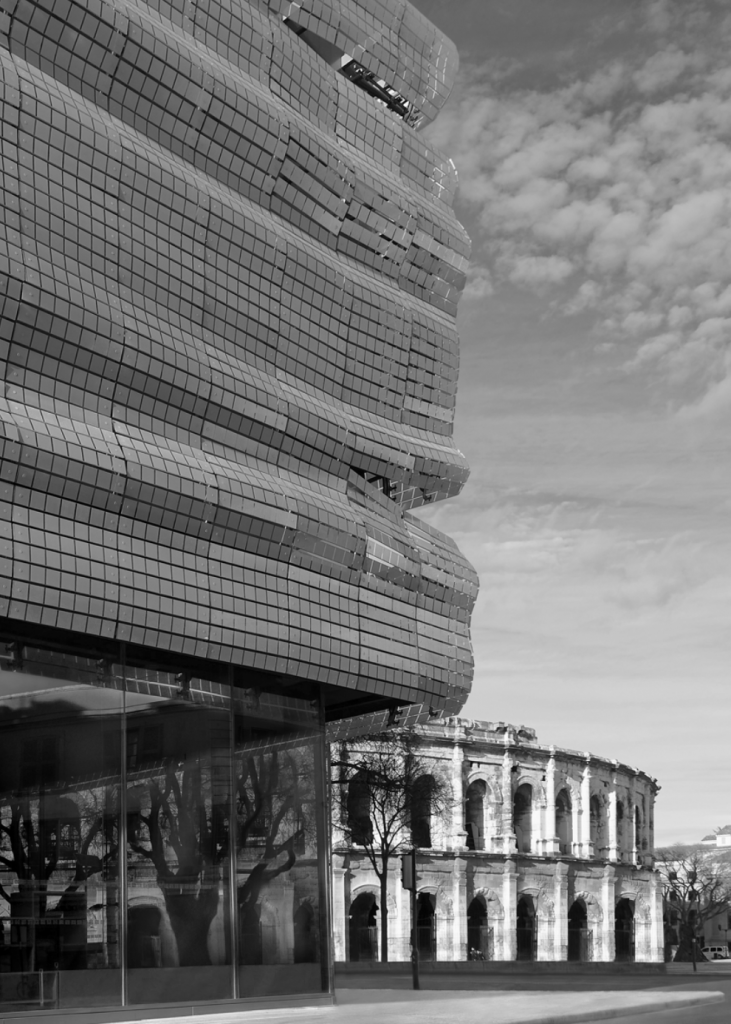
    One of the characteristics of their type of architecture is that it is always expensive financially while cheap aesthetically. The architects have the sense of economy of Louis XIV and the taste of the magpie. For example, Elizabeth de Portzamparc’s Musée de la romanité (above), placed with maximum eyesore-ness opposite Nîmes’ magnificent Roman arena, is covered with bright silvery scales that look as if they have slipped from their moorings, or from a half-scaled fish. Is the building finished? The most one can say is that it is open to the public.

    If Elizabeth de Portzamparc had been a cook, she would have invented dishes such as herring and vanilla ice-cream or oysters in raspberry jam. Her restaurant wouldn’t have lasted a week. As it is, she evidently believes that the greater the clash between what she builds – which is in any case inherently incompatible with anything except itself – and its surroundings, the more valuable it is as provocation, and the greater the monument to herself. She teaches architecture, incidentally: talk about corrupting youth!

    But it takes two to tango, as the cliché has it. Even the worst of architects, such as Foster and Rogers, could have done nothing without powerful patrons. The question is therefore not only one of how architects came to be so destructive of civilized cities, indeed this is the less important question, but how it came about that patrons came to have so little taste. Ortega y Gasset answers implicitly in his essay The Dehumanization of Art: It has been said that the new style, taken in the widest sense, consists of eliminating those elements that are human, all too human, retaining only material that is purely artistic. This seems to imply a great enthusiasm for art. But looking at it from another angle, we are surprised to see an opposite face, that of weariness and disdain.  

    Ortega says, moreover, that the new style divides the population into an elite that understands, and an ignorant philistine mass that does not. (Le Corbusier is quite explicit about it.) No one, not even a nouveau riche tycoon, wants to put himself into the category of the ignorant or philistine, and so he goes along with whatever the self-appointed representative of the enlightened elite tells him. Bestriding the world like a colossus from the purely economic point of view, he is also but a humble flatterer at the court of the emperor with no clothes. Even humbler are the municipal councillors, who are aware of their own nullity.

    The explanation, then, is the triumph of the propaganda campaign of the modernists. But there is never a final or ultimate explanation of anything, and so we must then go on to ask, why was the propaganda so effective?

    The political and cultural magazine, Standpoint, has a regular two-page feature at its rear, one page describing somebody or something overrated, and the opposite page somebody or something underrated. In the May/June issue of this year, the two things compared were classicism and modernism in architecture. The author was Stephen Bayley, a prominent commentator on such matters.

    Modernism, he tells us, ‘revels in optimism and opportunity’. That, of course, is precisely what members of totalitarian parties, communist or Nazi, like about them, and it is no coincidence (as the Stalinists used to say) that there are obvious connections between the modernist sensibility and totalitarianism. Mr Bayley, no doubt unintentionally, makes this clear when he says:

    “It was the poet Arthur Rimbaud who said “Il faut être absolument moderne.” For the first time in history, from about 1870, there was a compulsion to make poetry, art and architecture which owed nothing to tradition, but were, instead, uniquely expressive of contemporary sensibility.”

    Ah yes, the tabula rasa and the New Man, what crimes are committed in thy name! The fact that Arthur Rimbaud said something doesn’t make it true. In fact, what he said was both wrong and vicious: first because it fails to appreciate that no quality (by definition) is more fleeting than modernity, and that creatures such as we who live in time cannot but be modern; and second because it is an open invitation to egotism, insensibility, self-worship and ignorance. Before us nothing, after us, who cares? It is the content of modernity that counts.

    Mr Bayley almost agrees. He tells us ‘terrible buildings – Grenfell, the French banlieues – are terrible not because they are modern but because they are terrible.’ But do they really owe nothing to modernism, rather than from modernity per se, and do they not take their inspiration, if that is quite the word I seek, from it? Mr Bayley once said, in his review of Professor James Stevens Curl’s book, Making Dystopia, ‘there is only a sliver of difference between Walter Gropius’s lofty Bauhaus ideal and a crap council estate’. Even if it were allowed that among the scores of thousands of modernist buildings in the world there are a handful that are not a thorn in the eye, surely the correct response to architectural modernism is Si monumentum requiris circumspice. What a devastating aesthetic effect if you do!

    But Mr Bayley cares nothing for aesthetics, only for ‘optimism and opportunity.’ He tells us:

     â€œIn fact, modernism is the most complete expression of the will to design, a definition of what it is to be human, of making buildings which are appropriate, efficient, comfortable and, if at all possible, beautiful too.” 

    Here is the admission that for him beauty is a kind of optional extra, like electrically-heated seats in a car. It is very low on his list of priorities, as if beauty along with truth and goodness were of but minor importance in human existence.

    Everything that Mr Bayley says is both philistine and inaccurate, teetering on the edge of idiocy. ‘The glory of the modernist mentality is that it is optimistic,’ he tells us. ‘It revels in the beauty and the opportunity of the here and now and the tomorrow.’ It does not occur to him that our today is tomorrow’s yesterday. Why should tomorrow’s people who revel in the beauty and the opportunity of the here and now care about what we did? No wonder so many modernist buildings are worthy only of demolition.

    With regard to classicism, he says that ‘you can tell the quality of an idea by the company it keeps.’ This is a reference to Mr Trump’s executive order that from now on classicism should be the default style for new Federal buildings. But Mr Bayley is a great admirer of Le Corbusier. Le Corbusier was a fascist in the most literal sense. Et alors?

  • Alexander Adams: The Colston Statue Affair

    Alexander Adams

    This article briefly outlines what happened with the toppling of the Edward Colston statue in Bristol, why it happened and its ramifications.

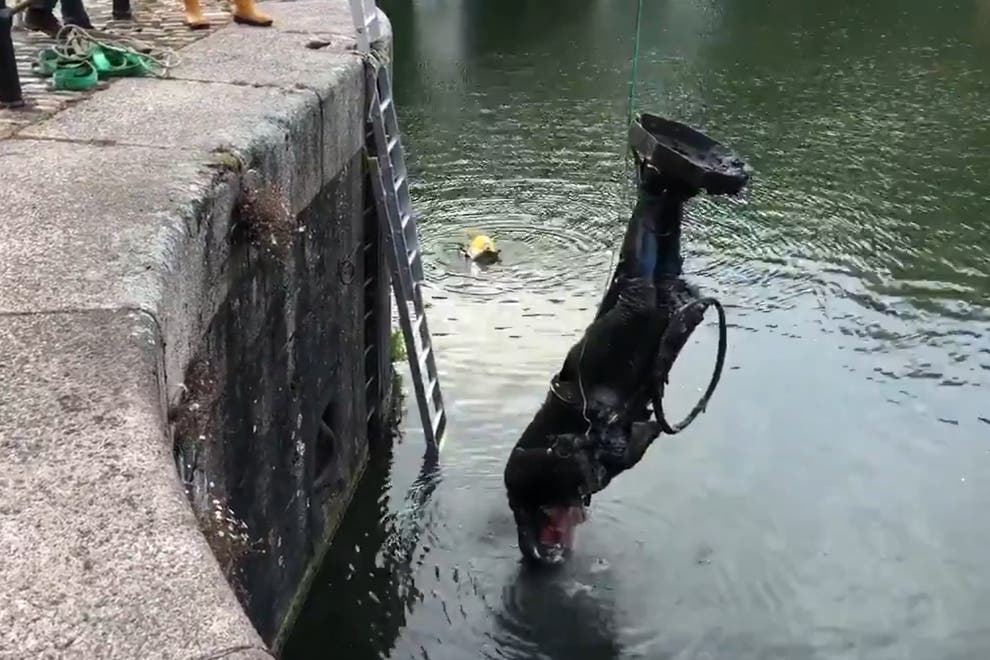
    On 7 June 2020, a large protest took place in the centre of Bristol, ostensibly against racism. The large gathering was in contravention on national and local restrictions on public gatherings due to COVID-19. No dispersal was attempted by police. Some protesters formed a mob that attacked the statue of MP Edward Colston, erected in 1895. It was sprayed with paint, damage and toppled. It was then rolled into the nearby harbour. There were no arrests. The statue was later retrieved by the Council.

    Just as the mob did not detain itself over the personal record of Edward Colston, neither shall we. The heart of the matter is mob violence, threats of violence, vandalism and intimidation. The cause is irrelevant. Ask members of the social-justice mobs that attacked the statues of President Lincoln and Frederick Douglass why they chose those targets and they could not tell you. (A member of the mob that attacked Churchill’s statue in Westminster admitted in a television interview that she “had never met the man”.) The vastness of the mob’s anger is matched only by its ignorance.

    The police watched but did nothing. Apparently, some officers wanted to prevent the attack but were instructed by commanders not to intervene. The mayor was in the police control room. Bristol City Council has long wanted to remove the statue but was not able to force through the political decision. A majority of the polled population of Bristolians opposed removal of the statue. However, the left-wing council and mayor saw the opportunity to use the mob to act on their behalf. Rather than defying authority, the mob was acting in accordance with the wishes of authority in committing this crime and was successful in doing this with the connivance of Council, mayor and police commanders, who all shared a progressive political outlook. The council, which currently has on its website pages the legend #blacklivesmatter, tweeted its approval of the demonstration.

    It was not a statue celebrating slavery. It was not, notwithstanding the hysteria of the defilers, a device for perpetrating or restoring slavery. It was a monument to a respected gentleman, trader, employer, Member of Parliament and benefactor of his home city who happened to be caught up in a legal but ethically reprehensible business. One could not have devised a more perfect embodiment of the moral quagmire that ordinary men and women of good standing became enmeshed within because they were born into a particular era. The individuals that destroyed the statue would, if they had been born three hundred years earlier, have been caught up in exactly the same moral predicament and given it barely a thought. The statue was the ideal tool with which one could teach about how our morals are shaped by our era and how society gives sanction to dubious practices. By destroying the Colston statue, the mob refused to confront the awkward truth it presented: that we are all morally culpable due to the moral constriction of circumstances.

    The following month, serial opportunist Marc Quinn unveiled on the empty plinth without permission a 3D-printed statue of one of the protestors giving a black-power salute. It was taken down after one day. As a sculpture it was a failure – as all one-to-one replications are. (I know because I saw it in person.) It was a chance for a rich, state-supported London artist to wag his finger at Bristolians by (dare one say) colonising the vacant plinth in order to assert his moral superiority. It was half condescending stunt, half replacement tender. While the original Colston statue was a piece of serious artistry and a very handsome piece (see opposite and page 12), the Quinn effort was feeble. However, replacing an accomplished piece of public statuary honouring contributions of an important person with a plastic representation of a protestor who had been duped by local authorities into participating in an act of criminal vandalism is not an inapposite symbol of our era. 

    Collective Guilt

    The justification for destruction of part of the city’s heritage was that the statue celebrated a slaver. I have yet to hear the Council, mayor or protestors condemn the city’s mosques dedicated to a religion founded by a slave-owner. How many of those “anti-slavery activists” have debated Muslim theologians on the tenets that (under some interpretations) countenance slavery today? How many of them wrote letters of protest to the embassies of Chad, Mali and Sudan, where slavery still persists? In truth, there was no “anti-slavery activism” on 7 June; it was a carnival of virtue signalling that culminated in criminal-damage-as-performative-anti-racism.

    If the council puts Colston’s statue in the local museum in its vandalised state as a tourist attraction (rather than returning it to its plinth), I propose they replace it with a memorial to the Atlantic slave trade. Let us have an African slave in chains and with him his African slave-owner. This represents the historical reality that European slavery of Africans relied upon active participation of Africans, who sold to Europeans (and Arabs) prisoners of war, members of other tribes and unwanted members of their own tribes. And slavery wasn’t something only Africans endured – there were many “white” slaves too, including homeless children taken from the streets of London and sent to work in appalling conditions in the Tobacco Plantations in Virginia along with convicts who weren’t all serious felons but were imprisoned because of the consequences of extreme poverty. According to Don Jordan’s book White Cargo: The Forgotten History of Britain’s White Slaves in America, if you were transported from Britain and unlucky enough to end up in a Virginian plantation you could have a red hot bodkin pushed through your tongue before being hanged for stealing a rose from the owner’s garden. It is a must-read book for anyone concerned about Slavery. This portrayal would conflict with those who think in exclusive terms of Westerners as predators and non-Westerners as prey; such a proposal would likely not find favour with Bristol City Council.

    The overriding aim of social-justice activists is to impose upon the population a narrative of inherited collective guilt: white British people (historically and now) are complicit in the unique evils of colonialism and slavery. Thus, all action that collectively punishes this group is acceptable. This includes the destruction of their culture, public humiliation, rote apologies and reparations. None of us (whatever our colour) has experienced slavery or supported it; none of us should be forced to apologise for something our ancestors may (or may not) have approved of. Remember that we are also descendants of people who abolished slavery, forbade it abroad and patrolled the seas to curtail the Atlantic slave trade. Slavery in the Americas under the British took place at a time when there was no universal suffrage and therefore it was not a matter that could be approved of electorally by the British public. After initially participating in slavery abroad, no people ever did more to oppose slavery than the British.

    When a half-educated firebrand lectures you on slavery, ask her what year Britain abolished slavery and you will get no answer. Anti-slavery and anti-racism – in the current forms we see most publicly – are nothing more than excuses for a deep hatred of our society and its founding pillars of tradition, patriotism, capitalism, Christianity and colonialism. Social-justice activists delight in destruction, motivated by moral fervour and burning malice. They are not horrified by racism but secretly delighted, using it as a weapon as against well-meaning ordinary people, getting them to participate in broad coalitions. Activists invent new forms of “institutional/systemic” racism to maintain the illusion that non-racist people are inherently and implicitly racist and thus deserving of the elite’s control and castigation. This is the triumph of the righteous (mainly white) middle-class, university-educated allies of “marginalised minorities” over the hordes of (mainly white) working-class “racist thugs”. It is another manifestation of the class snobbery that refuted – then concealed – the mass rape of children and young women in cities across Britain because they were the “wrong” colour, religion and class.

    It could hardly be clearer than the Communist symbols sprayed on statues to Robert Peel, Churchill and Queen Victoria. Middle-class, university-educated vandals attack patriotic symbols that may not be revered but are widely respected by traditional patriotic, white working-class people. The general sentimental attachment to Baden-Powell, Churchill and Queen Victoria does not entail a complete acceptance of their opinions regarding race but now – in our hyper-charged, social-network-facilitated, emotionally labile cancel culture – accusations are enough to get a person or artefact removed from the public square. Cancel-culture definitions are ever expanding, ever changing, never appealable, never reversible. Offence-taking is used insincerely and tactically to claim territory (via cancellation) and to put people on the defensive; this process intimidates the majority, who become fearful, silent and compliant.

    Take a look at the hundreds of thousands of published pages and hours of lectures/speeches delivered by professionals in education and you will encounter a distorting mirror universe of social justice, where minorities in the West live hunted lives and ordinary social interaction are atrocities upon their dignity. This is a frighteningly alien world where there is talk of “human beings/Brown skins/Black bodies/marginalised voices” because to use the word “people” admits the possibility of a plurality of experiences, lives, viewpoints, tastes, wealth and politics. Social-justice activists literally talk of “skins” as if they were big-game trophy hunters. For activists, the “Black experience” is uniformly monolithic, invariably oppressed, irrefutably one of suffering; it is a narrative they use for material gain and political advantage. 

    What we can do?

    Do you think that taking down statues of Rhodes and Colston will satisfy activists or just encourage them? When actions are not goal-focused, limited and pragmatic but instead a hubristic religious crusade driven by spite and utopianism then they will be unremitting. When you have been trained by school, university and media to believe your society is founded upon injustices of slavery, rape and genocide of other peoples, then no price is too high and no reparations will suffice. Do you think that your culture is safe in the hands of groups which think this way? If these activists – so pliant, so poorly informed, so easily moved to incontinent fury – undeniably forgo empathy for people of the past, can they tolerate contradiction by the living?

    In these pages you will read of the onslaught on historical monuments and cultural artefacts committed by zealots, mainly in the USA. The events of this summer will not end in autumn; they have only just started. All across Britain, there are moves to destroy our culture, especially in London under the direction of the mayor. We must retain our statues. Even if they commemorate individuals we do not agree with, their presence reminds us of how our society has changed. How can we state that slavery was once acceptable if we have erased all public traces of it? Isn’t such action opening the doors to tomorrow’s conspiracy theorists? Either way, erasing history is not a practice that ends well for anyone. 

    Across the country, hectoring agitators, paid lobbyists, obsessive cranks and cynical politicians are (through legal means) attempting to remove public art that belongs to you. Defend physical culture by getting involved. Share this article. Subscribe to The Jackdaw and The Critic. Attend council meetings. Sign petitions. A website to monitor threats to public monuments and co-ordinate resistance is at www.saveourstatues.org.uk. Visit and share it; consider contributing.

    Should anyone think me partisan on this, I remind him/her that I have publicly deplored dismantlement of the Palast der Republik in Berlin, removal of GDR murals and statues, wrote in favour of many architectural projects in Communist countries and currently oppose removal of statues to Marx in the UK. Regardless of whatever you may assume my beliefs to be, I trust even critics will concede it would be misrepresentation to claim I have not consistently defended free expression and opposed iconoclasm. If you believe in these principles, I invite you to do the same and act, especially locally. Apathy and inaction will result in your culture being controlled and the history of your nation (good and bad) being erased.

    Alexander Adams’s book Iconoclasm, Identity Politics & the Erasure of History is published by Imprint Academic on 6 October.

  • William Varley: Art: Cool and Uncool

    William Varley reviews Addicted to Sheep

    So, as all cool sentences begin, I think that the best TV programme I saw last was Addicted to Sheep. In many ways this BBC4 documentary was reminiscent of the French film Être et Avoir about a remarkable teacher in a school in the remote Auvergne, although a good deal less winsome. It focused on the lives of the Hutchinson family, tenant farmers in Upper Teesdale. In their remote valley ewes are called “yowes” and at the children’s school they still sing “There is a green hill far away”. The Hutchinson children help with the lambing, including the gruesome task of dealing with still-born lambs.

    What is so admirable about them is that they have an uncomplaining, unflinching attitude to a life that is harsh and elemental. I doubt whether they have recently visited their nearest gallery, the Bowes Museum at Barnard Castle, or the Baltic at Gateshead. I also suspect that the issues which so exercise the post modern, post Christian urban élites: multiculturalism, egalitarianism, transnational progressivism (no borders), environmentalism, feminism and the rest of that plethora of right-on attitudes, don’t preoccupy them. For a start, they don’t have the time. Without wishing to patronise them, they probably believe that the acronym L.G.B.T. stands for a brand of sheep dip. All of this, in the opinion of the ‘enlightened’, particularly art world instrumentalists, makes them seriously uncool.

    How does one define ‘cool’? There are still people around who think that it’s a gently meandering style of jazz, but most of us know that it’s simply a matter of a self-appointed élite determining what is acceptable and unacceptable. It’s a phenomenon which transcends ages and classes, from the tiny tyrant berating her parents for not recognising the world significance of ‘One Direction’ to the State Art apparatchik wincing as he patiently fields one’s less than enthusiastic reaction to a ‘challenging’ new installation. In Jonathon Rose’s brilliant book, The Intellectual Life of the British Working Classes, the anthropologist Mary Douglas describes it thus:

    Art trends may have as brief a shelf life as stock exchange trends, and they depreciate rapidly if one fails to catch the latest wave in architecture, or literary theory. The names that Bohemia adopted for itself – avant-garde, advanced, progressive, le dernier cri, new wave, cutting edge, modernist, postmodernist – all reflect the Anxiety of Cool, the relentless struggle to get out in front and control the production of new cultural information. Bohemia is ‘subversive’ only in that it seeks to wean consumers away from older cultural products in order to sell them new ones.

    That description is one of brash economics but, of course, we’re all familiar with the broader pattern of Cool, the Godfather of which is Marcel Duchamp.

    Ad Reinhardt once remarked that all artists had to make a choice between Mondrian and Duchamp, between advocates of the hand- made, and those of the ready-made. As Jackdaw readers know, Duchamp, asserting that all art was mere taste, allegedly exhibited a urinal under the title of Fountain at the Armory Show in New York in 1913. Actually, as Jackdaw readers also know, that anarchic gesture was performed by one of his girlfriends as the Armory Show was ‘unselected’. Still, as someone who was intoxicated by word-play, puns and conceits, he was the epitome of the intellectual dandy. Apparently effortlessly, he invented kinetic art, optical art, conceptual art, and his great hermetic narrative, The Large Glass. Consolidating these innovations he left to allegedly mediocre followers.

    His biographer Robert Lebel wrote that he regarded the ready-mades as sacralisation or transubstantiation. (How God-like is that?) However, “His real motive with them was to depreciate our ordinary and tacitly accepted notions of value in order to exalt the strictly private and sovereign choice which is accountable to no one. With the ready-mades”, said Lebel, “he meta-ironically demonstrated his incontestable power to be TAKEN AT HIS OWN WORD which is the unmitigated artist’s privilege.” You can see where that gets us: art is anything you say it is, a situation that leads inexorably to the empty stunts of the Turner Prize and the vulgar extravagances of the Pinault Collection. Still, for his loyal disciples in the State Art Establishment his reputation is unassailable. There have been notable heretics from the general orthodoxy though. In his book The Banquet Years, examining the pioneering days of Modernism, Roger Shattuck remarked that Duchamp’s strategy of ‘nominating’ useful objects to art status was “essentially self-consuming, a reversion to dead level after an initial shock.” More recently, in The Winter of our Culture, Jean Clair (real name Gérard Régnier) the former Director of the Picasso Museum in Paris, described Duchamp’s Armory Show as “works of provocation and derision presented by a cynical dandy”.

    The High Priestess of Cool was, of course, Susan Sontag. During the ’60s and ’70s she was the doyenne of American intellectuals and in her seminal book Against Interpretation, she issued two decrees that in retrospect seem to have underpinned the visual art that developed afterwards. Attacking the discrimination between hierarchies of art as ‘philistine’, she effectively substituted a plateau view of culture for the existing pyramidal order. 

    Henceforth, there was to be no qualitative distinction to be made between high and popular culture, art and entertainment. In this scenario, Elvis Presley could give Mozart a friendly wave across a level playing field. The ‘dumbing down’ consequences of this were, of course, appalling and eventually she could see it. She died 12 years ago, but shortly before her death she condemned ‘the triumph of a pernicious relativism.’

    I am not prepared to say the satisfactions derived by art are no different structurally, in context, or in quality or in importance, from other kinds of satisfactions. I am not prepared to think that the satisfaction I might get in front of a Chardin, a Vermeer or a Vuillard is in any way similar to the satisfaction I would get watching a beautifully pitched baseball or inspecting a shoe collection.

    Her recantation was welcome, but it was too little, too late: the damage to the impermeability of high culture had already been done.

    The other hugely influential aspect of her ‘new sensibility’ was the idea (echoing Matthew Arnold perhaps) that art should concern itself with the moral criticism of life and be used as ‘a tool for changing consciousness’. Whether or not her writings were the cause or whether the true believers in an art for use developed their own ideology, in subsequent decades a veritable deluge of issues appeared. They mostly consisted of that left liberal menu of Goodthink favoured by the BBC that I’ve already mentioned: multiculturalism etc.. They are very useful for ‘virtue signalling’. “Let’s do the Holocaust”, artists would say, “or perhaps child abuse”. This is empty posturing, a bit like wearing Aids ribbons. It’s also about as far removed from Kathe Kollwitz’s nightmare visions as it’s possible to be. As the wife of a Berlin doctor Kollwitz knew poverty and illness at first hand. Her emotion was earned, not affected. Still, quangocrats and councillors who dole out funding love emotional incontinence. Current affairs and politics are things they can understand: the structural music of painting invariably remains a mystery to them. And insofar as they reinforce the fallacy that visual art is simply a medium or receptacle of a socio-political statement, it’s a godsend to those media hacks deputed to discuss them.

    Some issues, however, are so uncool that they’re off limits. Take the case of Kamel Daoud, for instance. This distinguished Algerian (Muslim) novelist wrote an article in Le Monde in late January denouncing the wave of sexual assaults that had occurred during Cologne’s New Year’s Eve celebrations. He didn’t temporise, calling the assailants Muslim men:

    The refugee-immigrants come from the vast universe of sorrow and horror which is the sexual misery of the Arab-Muslim world. The subjugation of women is the psychological Gordian knot at the core of the world of Allah, and hence the inspiration of the death cult that claims to defend it.

    You can easily guess the reaction to that: an academic fatwa; and erstwhile friends telling him, with the greatest kindness, to stick to writing novels and, politically, to shut up. Our politicians, of course, favour the ‘Religion of Peace’ narrative and as far as our art world is concerned, in contrast to the scathing visual indictments of Abu Ghraib how many denunciations of suicide, bombings, jihadist beheadings and the like can you think of? None? I can think of one. A couple of years ago in an exhibition in Rome I saw a small black singlet in the form of a hijab presented by the Egyptian feminist Ghada Amer. Unsurprisingly she now lives in New York.

    Another aspect of cool is the cult of novelty. I remember Lawrence Gowing back in the ’60s presenting the imperative to many young artists “to make it new”. At the time it worried me, being far too prescriptive. As someone who believes that originality should be involuntary rather than willed, I would have advised “Make it good”. Giles Auty in The Jackdaw was scathing in identifying the ‘novelty trap’ in which ‘ism’ inexorably succeeds ‘ism’ and thereby invalidates its predecessor. (Auty estimated that about 40 ‘isms’ occurred in the 20th century, each having about 2.25 years of life.) In his irreverent article he suggested that, according to the novelty narrative, “western art should be read as a kind of art-historical relay race which culminates in the death of painting … because there are no more apparent avenues left to explore”, a process which he maintained was “both spurious and infantile”. Astutely, he demonstrated how the art world had hijacked from science the rhetoric of progress with the consequence that anyone who refused to embrace it was certifiably reactionary and uncool. Of course there are some exceptional exponents of hybrid media such as the prodigious William Kentridge, but the strategy of State Art is to impose novelty on a baffled public. Amongst that public there are some blasphemers, though. The late Henning Mankell believed that “One of the tasks of art is to provide people with companions. I have seen people in paintings who I hope to meet in the street one of these days…” How uncool can you get? The Scottish prose-poet Nan Shepherd, ‘married’ one might say, to the Cairngorms, had a similar capacity for empathy. The ‘technoscape’ may be cool but engaging with actual landscape is extraordinarily rewarding. Like Wordsworth in The Prelude, she believed that “sustained contemplation of outer landscapes led to a subtle understanding of the spirit.” Her attitudes correspond almost exactly with those of several painters I respect. All of her senses were engaged when experiencing landscape and art, of course, should be enjoyed through the senses. She could smell the rain: so could Constable. (Those experiences and spiritual rewards are also shared by the Hutchinsons.)

    When I reflect on State Art’s prioritising of novelty, however, I recall Andrew Brighton’s observations in Consumed by the Political in which he said, “The propagating of serious art amongst people who are relatively uneducated is an act of cultural aggression” and, emphasising the underlying totalitarianism of this ostensibly generous agenda suggested that, “The idea that people without art are lesser or inferior beings is a ridiculous assumption, a piece of moral vanity akin to a religionist’s belief that only those of their faith or sect are capable of real virtue.”

    Hard it may be for the quangocrats to grasp this, but there are thousands of people who live happy, fulfilled lives entirely without art. The irony is that the attempt of the Kulturkampf to dragoon people into an involvement with art is founded more upon a campaign of exclusion rather than inclusion. But to return to the Hutchinsons. My lingering image of the Addicted to Sheep documentary is of their eldest daughter, about 10 years old, sitting in the landscape making a painting by using her eyes – and making a pretty good fist of it (above). All is not lost.

  • Charles Thomson: Lies, Damned Lies and Serota at the BBC

    Charles Thomson

    Sir Nicholas Serota, director of the Tate Gallery, has used the platform of the BBC in a blatant attempt to deceive the nation. Either that or he is genuinely deluded himself. Both options render him unfit for major public office.

    He was confronted on Radio 4 programme The Reunion: Tate Modern on September 23rd by Sue MacGregor, regarding the Tate’s purchase in 2005 of its trustee Chris Ofili’s work The Upper Room. She observed with wry understatement, “The Charity Commission said you didn’t quite follow the rules here.”

    In 2006, as the BBC then reported, Charity Commission chief executive Andrew Hind said there were “serious shortcomings … In any charity we would be concerned that such basic matters were neglected, but in a charity of the size and stature of the Tate we are very disappointed.”

    The Guardian expounded, “The Tate has broken the law … By law, trustees cannot receive monetary benefit from their charity without express permission, usually from the commission. The Tate failed to seek permission … The Charity Commission’s full recommendations and criticisms, laid out in a lengthy document, also said the Tate failed to manage conflicts of interest … Failed to seek independent valuation of works by artist-trustees … Had no defined policy relating to purchases from artist-trustees … Had insufficiently clear acquisition policies … Kept insufficient records of trustee meetings.”

    The Daily Telegraph called this verdict “one of the most serious indictments of the running of one of the nation’s major cultural institutions in living memory”.

    “After an in-depth review lasting ten months by the Commission”, stated The Times, Serota “accepted the criticisms” and “was genuinely contrite”. The Evening Standard confirmed, “Sir Nicholas said today he accepted all the Charity Commission’s findings”.

    In stark contrast, his response to Sue Macgregor ten years later was an astonishing and shameless attempt to hoodwink the nation and evade blame with a trivialising revisionism that implied gross misconduct by the Charity Commission. To the supportive laughter of his entourage on the programme, Serota declared smoothly – as if it were established fact – the evasive nonsense, “The rules of course were invented after we had flouted them.”

    Serota has a history of obfuscation, whether lies, half-truths, delusions, evasions or omissions. In 2004, he applied for a grant from the Art Fund towards the purchase of The Upper Room. He signed a form saying that there had been no prior commitment to the purchase of the work (a condition of funding). Thanks to journalist Chris Hastings and the Freedom of Information Act, it was revealed that, eight months prior to the application, the Tate had paid a £250,000 deposit. Serota blamed it on “a failing in my head”.

    In 2005, I was quoted in The Observer: “Serota, as the director, chooses the trustees, and the trustees are then responsible for reappointing the director. The director then buys the trustees’ work.” In 2008, this was brought up in Varsity (the Cambridge Student Newspaper), where Serota defended himself with another flagrant falsehood: “I don’t have any part to play in their appointment.”

    The September 2005 Tate board minutes state: “The Director [Serota] reported that two strong candidates were to be interviewed for the position of Artist Trustee by a panel comprising himself, Paul Myners and the Independent Assessor.” In the May 2007 minutes, another trustee interview is on record with a panel of three trustees, the independent assessor and Serota. 

    The Board of Trustees of the Tate Gallery Annual Accounts 2005-2006, 2006-2007, 2007-2008, and 2008-2009 all say in the section on trustees: “The key stages of the appointment are overseen by a panel, which will normally include the Director.”

    Also in Varsity, Serota said about the trustees, “Why would I want to win their support?” The simple answer to that is that he is their employee, as he explained in 1993 in the Independent on Sunday, when he hoped to be appointed for a second seven-year term as Tate Director: “Tate trustees fall in and out of love with their director and I’ll only discover whether they have fallen out of love with me in 1995 when they discuss my contract … The jury’s out.”

    On the Radio 4 programme, MacGregor confronted Serota about an event in October 2003 that became public the following year, namely “that Charles Saatchi offered you his entire collection … it was worth 200 million – for nothing.” Serota denied this: “I wish he had … he did have a great collection. Sadly he never did offer it to us.”

    This response is consistent with Serota’s version to the press in 2004, when he said that Saatchi’s offer was not for a gift but for a loan of work, which he (Serota) immediately rejected (none of which was mentioned to MacGregor).

    Surprisingly, Serota’s reply was immediately contradicted on the programme by former Tate trustee, Michael Craig-Martin, who admitted there had in fact been an offer of work: “Unfortunately what was offered to the Tate was not the great collection with the great things in it, most of which were already gone by that time. They had been sold by that time.”

    As it happens, that is incorrect. At the time of the offer in 2003, Saatchi still had in his collection iconic Brit art works, including Damien Hirst’s shark, Tracey Emin’s bed, Rachel Whiteread’s plaster cast of a room, Mark Quinn’s head made from frozen blood, Sarah Lucas’s table with two fried eggs and a kebab, Marcus Harvey’s Myra Hindley painting with children’s hand prints, Ron Mueck’s sculpture of his dead father, the Chapman’s penis-nosed mannequins and Chris Ofili’s Virgin Mary painting with elephant dung.

    Serota continued about Saatchi: “Michael [Craig-Martin] and I with Janet De Botton spent a great deal of time in the late nineties trying to persuade him to give, not his collection, but maybe ten works from his collection as a founding collection for Tate Modern. But I’m afraid he didn’t feel for one reason or another able to do that.”

    This is obviously another failing in Serota’s head. In 2004, the Evening Standard reported that in 1998, “Saatchi offered 86 works by 57 British artists – including Langlands & Bell, Turner Prize winner Martin Creed and Glenn Brown” (as well as Richard Billingham, Richard Wilson and Chantal Joffé). A Tate spokeswoman confirmed the offer of 86 works, which were rejected as “The trustees felt on this occasion the works would be better suited in a collection elsewhere.” 

    Regarding The Upper Room scandal, Christopher McCall QC wrote to the press in 2005 condemning “expediency … which has an appeal to an overbearing executive”. The Times said of the Tate: “If it had been a company, the verdict would have sent shareholders into a panic.” No doubt if it had been a government, resignations or sackings would have followed the public outcry. Surely we have the right to expect the same standards across the board in public life, including the arts.

    Serota has not displayed a level of behaviour and integrity to remain a figurehead and step into another prime position as Chairman of the Arts Council. His record is tarnished and far from admitting to his mistakes, he has the blinkered arrogance to pretend they never happened.

    We need leaders who do not have recurrent failings in their head.

  • Giles Auty: Money Culture Notes

    Giles Auty

    This was the last piece Giles submitted to The Jackdaw. He died suddenly in September, aged 86.

    It’s all about the money honey. When I awoke to see the front cover of the weekend Australian’s review section on June 20th it was rather like being thrown back into some weird and most unwelcome dream. Did I really read “POLE POSITION: up close with Pollock’s $430 million masterpiece by Rosemary Neill?”

    Regrettably I did. Should we also bring back Gough Whitlam if we could? Sadly he’s as deceased as the inflated reputation of Blue Poles really ought to be. But what the hell? Ever heard of Clement Greenberg a leading critic of Pollock’s day and Pollock’s most consistent supporter? Clearly not because we have Greenberg’s word that Pollock considered Blue Poles a failure while Greenberg himself thought Blue Poles “an absolute failure and a ridiculous thing to buy”.  (See Patricia Anderson’s biography of Elwyn Lynn my predecessor as art critic at The Australian). On the basis of the definitive exhibition of Pollock’s work I saw at the Tate Gallery in London in 1999 there were quite a few better Pollocks than Blue Poles. But they are not in Australia so cannot possibly be as good.  In April 2006 I wrote a 4,000 word essay for Quadrant which dispelled the miasma of nonsense which continues to surround this entire subject. But Australia will sadly never grow up in some ways, which is why we lag behind so markedly in terms of our whole culture. That essay forms part of a 50 piece anthology of my writing Culture at Crisis Point (Connor Court 2016) if you feel inclined to dig it up. The man who actually flogged Blue Poles to the then Australian National Gallery, New York-based Australian Max Hutchinson, proposed that Blue Poles along with Picasso’s Guernica and Monet’s Waterlilies is one of the five or six great works of art painted since the Renaissance. So what other pair of works might Mr. Hutchinson have picked to make up his handy half dozen?

    The task of choosing between the lifetime productions of the likes of Caravaggio, Velazquez, Rembrandt, Vermeer, Tiepolo, Goya, van Gogh, Manet, Matisse and Picasso – to name but a handy ten – would be a daunting one even for someone who knows the complete works of all ten quite intimately. God alone knows what students are taught on art history courses these days even if such courses still exist. The National Gallery of Australia has a very poor record even in more recent times in its purchasing; for example, it made a colossal error of judgment in buying David Hockney’s very weakly conceived A Bigger Grand Canyon – and paying an inflated price for it  (over A$ 4 million) when it could have bought Australian William Robinson’s even bigger and infinitely more accomplished Creation Series: The Ancient Trees for $250,000. I was prepared to put myself in serious debt to buy the latter but lost out to a Sydney doctor who very wisely snapped it up and built a special room to house it.

    I have never of course served on the board of any public gallery in Australia although prior to coming here I reviewed art in more than a score of different countries. Rhetoric as we know describes language designed to persuade and impress. Its natural habitat is politics and advertising but in both of those fields long acquaintance has persuaded intelligent minds to recognize its nature and dilute its effectiveness. Regrettably the toxicity of such language still has a fatal effect in areas where the ubiquity of its use remains unrecognized. In no area is this truer than the visual arts. The 20th century, which was dominated by 

    Modernism, saw the rise and fall of about 40 readily identifiable and significant art movements in the Western world alone. Can there really have been an art movement for every two-and-a-bit years of an entire century?  But who can even begin to tell you what Orphism, say, or Rayonism were? Yet many people believed that both were vital art historical movements. So why have we shown such a continued obsession with novelty?

    Right from word go Modernism liked to portray itself as a liberating force but was never anything of the kind. Sadly all too many made a naïve connection between what was happening in art and the genuine breakthroughs which were happening in technology.  And art very cleverly annexed a similarly favourable rhetorical language. In short to situate yourself on the side of ‘progress’, ‘advance’, ‘evolution’ and ‘experimentation’ was to grab a positive propagandist language by the throat. Like Pollock, many artists are not especially bright or literate and evidence exists that if Pollock had not effectively killed himself (and someone else) when drunk he would have reverted to more of a directly surreal way of working.

    Blue Poles is the sole work by Pollock most Australians will ever see so all rely on writers such as Rosemary Neill to put the work in some realistic context. $430 million did you say? Australia is a money-conscious country which has yet to educate itself in any other form of evaluation. The real reward of very good art is inherent because true artists are not bankers and do not think as such. In days when I wrote for The Australian I was hauled before the editor for describing Australian culture as ‘rather less than effervescent’ in another publication. In a recent issue of The Spectator James Delingpole, whom I know, talks of his growing affection for Australia. I came to Australia a quarter of a century ago with very similar feelings and resisted an invitation from the then Spectator owner Conrad Black to return home. For a country of its size Australia has performed very poorly in terms of almost any sort of culture and the example set by official bodies such as our museums for sure do not help. Rosemary Neill’s article on Pollock takes a long step backwards which we can all really do without but will surely not cost her her job.

  • Selby Whittingham: The Temptations of the Wallace Collection

    Selby Whittingham

    “I’m just a slave / only a slave to you, temptation”. So sang Bing Crosby in 1933 in a song, Temptation, repeated by many famous singers since and, in 1970, in a German TV act of Sid Millward & The Nitwits. That shows (it was recorded) Sid presiding over players prey to temptations which are low rather than romantic, ones of vanity, exhibitionism and revenge. “The only way to get rid of temptation is to yield to it” (Wilde). So the Wallace Collection has demonstrated and probably will demonstrate further after its successful attempt to remove the prohibition on lending its works which I and others have deplored (November/December issue). “We will start slowly and see how things go,” says Chairman Horta-Osorío ominously.

    Temptation and the Wallace go together in the pictures which give it its unique character, those of the French 18th century. By contrast the Director, Xavier Bray, has complained that “working at the Wallace is quite a monastic existence because people know they will never get anything out of you.” The temptation has been for the director to supplant the owner, giving him the latter’s powers and excuses for trips abroad to arrange exchanges, which create further temptations. He confessed to the Daily Telegraph in June 2018 that “as soon as you open it up you will get a barrage of requests and we might not be able to deal with it and we will haemorrhage art. We would have to have very strict conditions, saying a work could only travel once every ten years or something.” But what Bray thinks or whatever self-imposed rules are made, subsequent administrations will regard these as of as little consequence as he does those of Lady Wallace, and they will not even need to go to the Charity Commission.  If a donor’s conditions are to be changed, they should be replaced by new ones set by the courts, and not simply swept away by the secretive proceedings of the Commission, requests by Neil Jeffares and myself  for information on the decision of which have gone unanswered.

    Nearly 30 years ago I considered the issue in relation to the Turner Bequest in The Fallacy of Mediocrity. I proposed that a new Act should vest the bequest in a separate trust and that that this should enshrine a clarification and modification of Turner’s prohibition on lending, viz. “The 98 finished oils … should be exhibited constantly together, except that (i) any may be loaned for public exhibition for a period not exceeding 6 months (ii) such loans should be made with regard to the objective of all the finished oils being on view together for most of the time.”  I proposed this clause (which could be improved) hesitantly as any change to a donor’s restrictions is always seized on as a precedent for making further ones. Thus some have said that the disregard of Lady Wallace’s request that the collection should be moved to a new building is a precedent for disregarding the other conditions. Suzanne Higgott in her biography of Sir Richard Wallace, however, has shown that he wished the collection to remain at Hertford House, the only snag, which the government later resolved, being that it was not held freehold. Then people say that Sir Richard, like Turner, lent some of the works, so he could not disapprove of lending. But that presupposes that the museum will lend on grounds that the donor would choose and not for the feeble reasons that are now not uncommon.

    True, some grounds for lending are plausible.  It will allow, said the January-February issue, the Wallace Rubens landscape to be hung beside the National Gallery one for comparison, as the National has long wanted.  However it would already have been possible for both to be displayed together in the Wallace’s basement exhibition rooms. The peace in which I enjoyed the Wallace one a year ago will be broken by exhibition hoopla. The change stems partly from the wish to attract more visitors, however uninterested, and so cause overcrowding. I recently attended a large party in the Great Gallery at which hardly any of the guests bestowed a glance on its masterpieces.  There is of course a benefit in bringing together works by an artist from different collections in a temporary exhibition. In the case of Turner, though, there is an existing congregation of his works which the Tate perversely is set on dispersing. Many of the monographic exhibitions devoted to currently popular artists such as Turner and Monet are driven by the desire to maximise revenue and visitor numbers.

    Many people are either unconcerned about whether conditions are adhered to or are actively hostile to donors, thinking that they have no moral right to impose their ideas on later generations. Yet maintenance of the donor’s ideas contributes to something now popular, diversity.  By contrast museums everywhere that are free to do as they like come to look more and more similar as curators the world round follow trends like sheep. In November I organised an event contrasting the tastes of two of Turner’s more discerning later patrons, which were distinctly different though they were fishing in the same pool.

    One of them, Elhanan Bicknell, was said in the Dictionary of National Biography to have contemplated giving his collection to the National Gallery.  Probably Bicknell decided against that after seeing how ill those of Vernon and Turner fared. Lee Rosenbaum in her Culturegrrl blog has regretted that the bequest of Jayne Wrightsman to the Metropolitan Museum of Art has come with a prohibition on lending.  At least, she says, there is no provision that the works have to remain in their own exclusive rooms as in the cases of some earlier bequests. While the curators “probably must honour the rash promises made to donors that were made by previous directors,” in future gifts conditional on such exclusivity, which “cause the flow and logic of its galleries to be disrupted”, should be refused. That seems wise.  However much worse disruptions are instanced by her in the chaotic new extension to MOMA. And the Wallace had no compunction in quite illegitimately disrupting the flow of its galleries by the insertion of rooms devoted to the works of Freud and Hirst.

    The Burlington Magazine in its November editorial, “Lifting the dead hand”, predictably supported the Wallace decision with the tired old arguments against the tyranny of donors which I answered at length in The Fallacy but which the art establishment has never answered. The point that time has not changed the validity of the preservation of collections intact, even if it has put in question other provisions and other property questions, is never met. The Burlington sanctimoniously states that “it is reasonable to expect a museum to honour the wishes of a donor”, while in fact it believes that it is always legitimate to override them. It does so on the basis of precedent; very often a donor’s conditions have been overturned. But there is no case law precedent for that, only the sloppy way in which the issue has been treated in Britain. One reason for that is that the current owners, the museums, are in a much stronger position than those who might challenge them, standing in the courts for the heirs of donors being restricted.

    In the 19th century England was known as the “Land without Music”. Equally with regard to its museums it might be called the “Land without Law”. And also without taste, a sense of history or of responsibility. What museums were once about was first and foremost conservation and secondarily about the quiet appreciation of art, and not primarily about outreach, education, theorising, propagandising, these last being left to the avant garde, to where they belong, outside the museums and especially outside ones such as the Wallace whose character depends on preserving their integrity. 

  • Alexander Adams: Canon Fodder – November 2017

    Alexander Adams
    November/December 2017

    Alexander Adams investigates the status of the canon in art under Post-Modernism and the dangers of undervaluing it.

    The canon of great art has never been the target of greater ire than it is today, but many leftist critics and their traditionalist opponents misunderstand the canon. The truth is unsettling for both groups. This essay seeks to clarify the nature of the canon at a time when it is an especially contentious subject.

    Great Deeds Against the Dead

    Last year art-history A-level was scrapped due to low take-up, then, after a campaign to reverse the decision, it was reinstated. This allowed New Criticism a foothold in school art-history teaching. When the new curriculum was developed, there was a downgrading of the master artists of Europe. Sarah Phillips, designer of new art-history syllabus, said “It is a global specification. Students won’t just study the work of dead white men. They will have the opportunity to study Islamic architecture and work by men and women of all colours and creeds.” Perhaps students will be tested on artist skin colour in exams. 

    “Art history is the study of power, politics, identity and humanity; it makes perfect sense to keep the exam,” said Jeremy Deller. One doesn’t envy students wanting to learn about painting only to be dragooned into political-education courses and harangued on the purported crimes of their forefathers, who were more likely to have been agricultural labourers toiling in fields than redcoats bayonetting babies in India. Perhaps A-level art history would have better remained decently defunct.  

    Leftist critics characterise the canon as a white male Christian club. That view excludes ancient pre-Christians, undisclosed atheists/agnostics and recent additions to the canon but – those exceptions aside – white Christian men were ones making large-scale oil paintings and stone carvings up until recent centuries so Western European art is necessarily their art. Critics confuse corollary with cause. The canon has never been based on the identity of artists. Indeed, it is heedless of artist identity. Art in the canon is judged on intrinsic and extrinsic qualities without regard to maker. Numerous anonymous ancient and medieval art works are canonical.

    Incidentally, dismissing art because of the maker’s masculinity discards contributions of countless female models, patrons and collectors, not to mention wives, sisters and daughters who worked in studios and even painted parts of pictures. These women believed in and helped to make these paintings; if they could see activists agitating to have these paintings removed from sight they would likely be appalled and baffled at careless condemnation of art they loved.  

    The Exquisitely Efficient Machine 

    The canon is both the group of generally accepted masterworks (and, by inference, their makers) and the principles underlying that selection. Art historians, artists and knowledgeable enthusiasts have approximate lists of great essential art though details vary. There are major and minor figures in the canon and canons for specific countries and mediums. 

    The canon is a distillation of informed judgement over the course of centuries. It is an exercise in both discrimination and tolerance as one accepts the whole without agreeing with every part. Crucially, personal taste is irrelevant. You may not care for Rubens but he is important, influential and innovatory; he cannot be removed by you. The canon provides broad consensus while at the same time compelling no one to praise falsely. The canon cannot be imposed from above by either scholars or social activists. The canon endures despite fashion and politics but the contents of the canon are provisional.

    Dissent regarding the stature of an artist does not damage the canon; on the contrary, it strengthens it by forcing supporters of an artist to examine and refute (or accept) criticism. This process of continual testing winnows substandard art from the canon and proves the fitness of that which remains. It is an exquisitely efficient (though slow) machine for refining our understanding of art. The canon, far from being a machine of oppression and exclusion, is a meritorious mechanism for selecting the most important art on fairly universal principles for the education and pleasure of everyone. The canon has no racial, gender, sexual or personal prejudice. It is regional but not nationalistic. It accepts the professional and amateur, the sacred and profane.

    What is this “Canon”?

    There is no authoritative list of canonical works. The canon, by definition, cannot have a single fixed form. If you want to produce a list of canonical works take all narratives on art history, starting with Pliny going through Vasari and ending today, add respected monographs covering individual art movements and books of masterpieces of art. Add up all mentions or illustrations of individual art works then remove the least frequently cited third of that list, remove all works made in the last 40 years, remove anything made by a living artist. What remains is the canon. 

    The weaknesses of this definition are that it gives greatest statistical weight to recent views, to published (rather than privately expressed) opinions and to works of which we have photographic images. Frequency of citations proves nothing and does not qualitatively measure works. Popularity proves nothing except itself.

    The canon is not democratic nor is it just. It rewards audacity. The cuckoo which ejects the host’s chick from the nest will survive and prosper, so too the brilliant adopter can displace a talented but flawed inventor. Justice has never informed the canon nor can it. The canon is a hierarchy of competence which reflects societal appetite for exceptional achievement and it does not arbitrate historical priority or factual (or emotional) justice.

    Canon Criteria

    The presence of a single work (or body of works) produced by a now-deceased artist in the Western fine-art canon is due to it having at least one of three attributes still considered to apply today: (a) importance or influence, (b) originality or innovation, and (c) outstanding quality within an aesthetic field; with two minor attributes valued: (d) timeliness, and (e) lineage. To be a minor figure an artist needs only one of the minor attributes.

    Attributes (b), (d) and (e) need further comment. Originality need not be actual invention but being the outstanding exponent or populariser of a new material, style or subject. For example, no modern historian now assigns the invention of oil painting to the Van Eyck brothers but they were the first artists to bring the technique to perfection in panel painting and were historically credited as originators. Priority on its own is not enough.

    Timeliness is zeitgeist – encapsulating a particular culture during an era. Lynn Chadwick is a minor canonical figure. His metal sculpture of the 1950s embodies the spirit of an age (post-War figurative sculpture) while it is not strong enough to make Chadwick a major artist. Lineage is an attribute of the canon’s traditional didactic purpose. Perugino, a figure on the periphery of the canon, would probably have sunk from our view if he had not taught Raphael. 

    Man Proposes, the Canon Disposes

    There is something unusual about the way the fine-art canon operates, which may not have been remarked on before. Every artist who is – or has been – in the canon rises once and remains or sinks but he/she never rises for a second time. I cannot think of an example where an artist we regard as canonical has ever dropped out of the canon and later returned to the canon as significant as he/she was before. This is not a matter of fluctuating popularity but one of absolute neglect – a time when an artist was no longer taught or mentioned in general texts, only for that artist to be resurrected. It seems that once history has downgraded an artist gravely, it is a permanent change. I have never read this observation elsewhere.

    During his lifetime Anton Raphael Mengs (1728-79) was considered a genius comparable to Raphael. His paintings displayed great skill; his life drawings are excellent. His place in history seemed assured yet Mengs disappeared from the canon quickly and is hardly more than a footnote in art histories. Viewers found Mengs’s good qualities in other artists and nothing great or original to distinguish his art. Technical brilliance is no meal ticket to Parnassus. 

    Consider the case of Bernard Buffet (1928-99). In France, Buffet was the most lauded painter to mature in immediate post-War period. He was very successful in Japan, where a Buffet museum was founded. For several decades Buffet was hugely famous, fabulously rich and perhaps the worst ever painter to be considered great. His work is as crude, ugly, bombastic, modish and shallow as anything that has been shown on museum walls. Despite prizes and critical acclaim, by the time of his death Buffet was utterly forgotten; more than half of younger readers will never have heard his name let alone seen a Buffet painting in person. 

    The canon makes short work of poseurs such as Buffet and the technically gifted but banal such as Mengs. So, if you despair of the artists of today who are promoted as living links to the canon, fear not. 

    Modernism and the Canon

    Traditionalists beware: the canon is not a sword of truth which makes aesthetic distinctions and slays the dragon of Modernist art. There is no objective aesthetic standard which applies to all art in the canon. Even if we set aside Modernism, in aesthetic terms the canon ranges from the schematic (Byzantine), symbolic (Neolithic), semi-abstract (Cycladic) and decorative/abstract (Celtic manuscripts) to the naïve (Fontainebleau school), idealistic (Michelangelo) and realistic (Caravaggio). Modernist art cannot be excluded from the canon; it has already entered it. The only aesthetic criterion is excellence within a defined field. 

    Those who state “Raphael is part of the canon; in aesthetic terms, Pollock cannot be compared to Raphael; therefore Pollock cannot be part of the canon” are in error. Consider the rules of the canon. Raphael and Pollock are comparable in that they are both great exponents of their schools; their art is artistically influential, culturally important, original and typical of their period and place. In strictly canonical terms, Raphael is closer to Pollock than to Raphael’s own assistant Gianfrancesco Penni. Reverse engineering of what the canon is in order to exclude art one does not like is dishonest. Consider: the canon exists as a collective enterprise regardless of personal taste. One can dislike Pollock; one can argue against his art; one cannot exclude Pollock from the canon ex cathedra. One can propose and advocate for additions or subtractions regarding the canon but propositions will be decided upon collectively over a lengthy historical period.

    Bear in mind that the canon is not necessarily the best art ever produced. It is a collection of the best art that is commonly known and which it is vital (or useful) to be known by artists, scholars, art lovers and those more broadly interested in visual culture. The fact that you might have the world’s most beautiful painting hidden in your attic does not invalidate the canon because the canon is a collective body of knowledge which is comparative, commonly understood, widely accessible and not entirely based on aesthetic worth. There are plenty of beautiful works which are not canonical and plenty of canonical works which are not beautiful. If an ugly work of art meets the criteria for inclusion then it can be included. I would propose Asger Jorn’s more shocking “disfigurations” – defacements of junkshop pictures – as examples of ugly art which has already entered the canon.

    Counter-intuitive as it seems, it is a fact that no aesthetic criteria will fit the canon. Therefore, though aesthetic criteria are crucial to our judgement of art, aesthetic rules cannot generate a canon. Consider the cases of Mengs and thousands of gifted academicians whose art is tediously accurate and which will never supplant the wonky anatomies of Delacroix and Goya. In the article “New Order”, I suggested that viewers, curators and museum directors should continue the traditional approach of selecting and judging work on the bases of primarily aesthetic quality and secondarily historical value. This is not in conflict with the canon. Art appreciation is a personal matter which we practise every day; the canon is a collective endeavour which no individual (or single national or professional body) can arbitrate.

    Masterpieces and Blind Spots

    Due to the way art is discussed, there is a tendency to highlight masterpieces. They provide common reference points. The human memory has a limited capacity and books have limited pages, so (for the non-specialist) Cimabue’s Crucifixion serves to stand for his whole output. However, the canon can select works which are atypical. Meret Oppenheim’s Fur Teacup (1936) is an iconic work of Surrealism and is celebrated as such. It far surpasses the quality of all her other work. (Trust me, I’ve slogged through the monographs.) In that respect Fur Teacup is actually atypical of Oppenheim’s art, being so much better than her other work. The canon being efficient as it is, has pared down her entire output to the only good thing she made. Likewise, Richard Oelze’s masterpiece Expectation (1935-6) is the only work of his that is worth giving time to. The canon recognises masterpieces by journeyman artists.

    Consider the converse. The canon also admits bodies of works when no masterpiece exists. Paul Klee is an established figure in the canon, but there is no single painting, or even handful of paintings, which sums up Klee’s achievements. In Klee’s case any typical painting serves as an introduction to the diffuse body of works. 

    The canon does have weaknesses, mainly due to its didactic presentation of progress. There are marginal cases of artists who do not fit easily into eras or schools. The canon tends to overlook remarkable outsiders. Balthus springs to mind. I would say Balthus deserves to be in a canon of 20th-century painting on merit but he could justifiably be left out as being “unnecessary” to explain any era or movement. William Blake and Stanley Spencer are only relevant to the story of British art and can be completely omitted from an overview of Western art of their times.

    Another weakness of the canon is it has historically undervalued secular subjects, such as the still-life, landscape and marine. Grand subjects often overwhelm intimate reflection. A final series of weaknesses concerns the hierarchy of mediums. Since the rise of the reproduction print and photographic illustration, sculpture has been forced to the margins while painting has taken centre stage. Likewise, while separate canons for printmaking, watercolour and drawing have developed, they are generally viewed as subsidiary to painting and find only marginal places in histories of art.

    Post-Modernists and the Canon

    Post-Modernists loathe the canon for its specific qualities and its existence. The canon accretes slowly and selectively; it cannot be changed for political reasons and it cannot be legislated upon. The fact it does offer recognition for women/minority artists makes the canon even more hateful to Identarians. It is too slow and selective to comply with social-justice-activist demands that women/minorities be elevated en masse immediately and accepted universally. The canon compels no one to like or respect art. The canon rewards accomplishment not identity and – in Identarian eyes – effectively “bribes” women/minority artists by offering recognition to any artist who accepts the status quo and who makes art worthy of the canon. Identarian opposition to the status quo precludes participation in a canon which rewards application, patience, excellence and individuality; Identarians prioritise conformity, victimhood, impatience, birth rights and the right to demand instant change and exercise totalitarian control. The very existence of the canon is repugnant to Identarians, who feel it impedes social justice.

    There is no need to force women into the canon because the canon absorbs great art regardless. One cannot write of 20th- century portraiture or the legacy of Symbolism without mentioning Frida Kahlo, likewise with abstract sculpture and Barbara Hepworth. There are many other examples. Berlinde de Bruyckere is the most original and powerful sculptor of the figure since Giacometti and it would be surprising if her art did not find its way into the canon. Much to our editor’s dismay and disagreement, I suspect Jean-Michel Basquiat is also canon-bound. Traditionalists dislike the speed with which art accretes to the canon and it offends them to see non-traditional schools appended to the Golden Age of (insert preferred artist/school/era here). Traditionalists should propose recent makers of great art and await history’s verdict. The canon may discard all recent art and record a fallow period, as it has done for whole countries and eras. 

    Post-Modernists too reject accretion to the canon. For them the accretion is too slow. They have two views on the canon – that it must be abolished or rewritten. Neither of these authoritarian tendencies can be achieved in a permanent form. Abolition is impossible because people have a natural tendency to form groups, celebrate exceptional excellence and class things in terms of quality and thereby reach group consensus. Rewriting is impossible because no one group can dictate the canon and – as we have seen with political appointees such as Socialist Realist and National Socialist artists – the canon rejects bad art. 

    Post-Modernists hate the canon partly because they do not believe in group consensus. They do not believe that art progresses or that a narrative (other than a socio-economic one) can be drawn from art history. Post-Modernists contend that the idea that multiple groups and individuals over eras can reach agreement is an illusion which conceals collusion, oppression and exclusion.   

    So, if abolition and rewriting are impossible, why now write an article addressing Post-Modernist attitudes towards the canon? 

    Firstly, art history students are suffering because they are not being taught the canon in a thorough way, thus limiting their understanding. Even to oppose the canon you must at least know it. Secondly, we all suffer when political activists manipulate education and curation of art. Thirdly, elevation to the canon is a prize to be striven for and fame has inspired plenty of artists to perform to their best. Fourthly, symbolic changes, even ineffectual ones against weak opponents – and there are no weaker opponents than the dead – encourage further encroachment in other areas of life. 

    Lastly, if traditionalists and moderates wish to oppose Post-Modernism effectively they should examine what the canon really is before they invoke it. If you support the canon you must acknowledge it in its totality, even with schools and artists you dislike, and you must accept it will accrete new art. As I have previously written, traditionalists who battle both Post-Modernism and Modernism will drive away Modernists and moderates, who are their natural allies in opposing Post-Modernism. Traditionalists, Modernists and moderates today all have common cause against Post-Modernist authoritarianism, quota programming and identity politics. They have differing tastes but their principles largely overlap. 

    In the past many Marxists agitated against the canon whilst covertly enjoying its art. They understood that dissidents savour the moral superiority of principled protest while enjoying the fruits of a system they ostensibly oppose. What is different now is that New Left agitators are in positions of power unopposed by conservatives or connoisseurs within institutions or the political class. They can alter curricula, defund research, publish propaganda as art theory and take down pictures in museums; they are in a position to actually suppress and – in the case of historic statues – destroy. 

    The canon is nothing less than a manifestation of our civilisation. To learn from and contribute to the canon (as writers, makers and art lovers) is to contribute to civilisation and is to affirm our belief in collective wisdom, consensus and progress, regardless of our personal taste in art.

  • Giles Auty: The Vital Value of Dissent

    Giles Auty

    From the raised kitchen window of my house I can see most of the birds which regularly visit the garden. In summer these are mostly magpies, currawongs and cockatoos while in winter quite large flocks of pale green female satin bowerbirds arrive which are often accompanied by an all-black male.

    The latter is, in fact, the only bird which could possibly be mistaken for the much more regular but somewhat furtive year-round visitor which is a male blackbird – a species of English thrush which was first introduced into Australia in 1862. In their country of origin such male birds are probably the most prolific creators of endlessly inventive birdsong whereas in Australia my particular example avoids drawing attention to himself now by never singing at all. In short, much larger and angrier indigenous birds of a territorial disposition clearly believe they enjoy sole rights to my garden.

    I do not suggest for a moment that my situation and that of the blackbird are directly analogous yet are perhaps just sufficiently so for me to feel rather more than passing sympathy for his plight.

    I came to work in Australia more than 20 years ago now but had hardly written a word here before an extremely hostile half page appeared in The Age which was composed almost entirely of comments made by known opponents of mine from the English press.  Quite a lot of thought and effort must have gone into preparing that particular form of welcome to these shores. Not to be outdone, Australia’s ABC television shortly concocted a lengthy, similarly abrasive and most dishonestly edited program which likewise made not the slightest attempt at balance. Indeed not long afterwards when my name was recommended by a friend to a well-known ABC radio interviewer she stated: “I can’t possibly have people like that on my show”. Like what exactly you may be tempted to ask? I would still quite like an answer to that question myself.

    Purely by chance I have subsequently heard that particular person interview two of the more vacuous and self-serving people known to British art with an attitude of total reverence. Australia can indeed be a strange and sometimes perverse country. What is of rather greater interest, however, is exactly why that should be so.

    I raise these matters now getting on for two decades after the event not because even a jot of resentment remains but simply because I do not think that large sections of the Australian media have really improved their act noticeably from those somewhat distant days to this. One thing which that does, in effect, is lock Australia into an unnecessary time-warp which reflects very poorly indeed on this country’s desire to be taken seriously on any international cultural stage.

    Typical of such complacent but somewhat parochial blundering, in fact, was the expensively produced, would-be blockbuster exhibition AUSTRALIA which ran at the Royal Academy of Arts in London from September to December 2013.

    Those who carry some knowledge of recent art history in their heads will know that the latter show was designed to build on the goodwill first created by Recent Australian Painting which had been shown at the Whitechapel Art Gallery in London way back in 1961. That was also the show which virtually opened the door for Australian artists keen to establish themselves internationally rather than just locally: Sidney Nolan, Arthur Boyd, Brett Whiteley and Fred Williams were typical beneficiaries of that historic Whitechapel show.

    So just how well was the much more comprehensive follow-up exhibition AUSTRALIA received? When that show ended, a panel of senior British critics voted it the worst major exhibition held in London during 2013. I had formerly been a member of that panel myself while still working in London for The Spectator. Why, then, exactly was a panel of highly experienced critics so disappointed? Should I mention here perhaps that the latter disappointment was not reported particularly widely – or indeed at all – in the Australian media?

    I have been an Australian citizen now for eight years and so feel saddened by any kind of completely unnecessary national flop – let alone one which is artistic in nature. With even a modicum of wider consultation the foregoing reverse could have been avoided very easily. Later in this article I will explain precisely why.

    For the moment, however, I need to return to the little matter of why I was once considered some kind of monster here by at least some authorities. A need clearly existed in certain quarters to silence or at least sideline me – presumably because I was believed not to comply with some form or other of political or cultural orthodoxy.

    I  am a very frank and outspoken art critic I agree but probably no more so than John McDonald from the Sydney Morning Herald, nor the late Robert Hughes who was then writing for Time, nor indeed the late Brian Sewell who was then making a major name for himself as a dissident voice while writing for London’s Evening Standard. All four of us were largely in agreement about some of the more obvious follies of Late Modernism as well as about the extremely unfortunate subsequent effects of judging art by its political conformity or correctness rather than by its intrinsic merit as art. That said, the true and – apparently unforgivable nature – of my personal crime was to be perceived as a political conservative which formerly enjoyed a popularity roughly on a par with rat poison in what some believe to be ‘proper’ art circles in Australia.

    As evidence for those prosecuting my ‘crime’ I had admittedly worked in London for a number of years as visual arts spokesman for the Conservative Advisory Committee for the Arts and Heritage as well as serving on the Art Working Group for the National Curriculum for English and Welsh Schools where my appointment was even rumoured to have been prompted by former British PM Margaret Thatcher.

    It could be pointed out however that a Conservative government was in power in Britain during all my years of working there as an art critic. Clearly if I hoped to contribute at all to government arts programs and policies no other option existed for me at that time. In short I tried consistently to help to create government art policies rather than merely to endorse them.

    My precise political views aside, my lengthy professional experience was at one time evidently welcomed quite widely on matters relating to the arts. Indeed, I had not been in Australia long before I was approached by the then Catholic Archbishop of Melbourne to advise on improvements and refurbishments to St. Patrick’s Cathedral. In the event I personally commissioned the bronze there of Archbishop Mannix by English sculptor Nigel Boonham (see opposite) as well as a number of other works on the then Archbishop’s behalf.

    Before coming to Australia I had reviewed major exhibitions and events in more than twenty different countries including such widely varied venues as the former USSR, Slovenia, Sri Lanka, Singapore, the USA and even Trinidad & Tobago. One truly amazing experience included the unveiling at a private house in Germany of a superb portrait bust of my host by Arno Breker – Hitler’s favourite sculptor – who astonishingly was then still alive.  Although perhaps best known as the creator of the massive neo-classical sculpture for the notorious Berlin Olympics of 1936, Breker was also instrumental during the war in saving a number of French artists in Paris from the unwelcome attentions of the Gestapo.

    At least some of my early experiences of Australia were hardly less bizarre and unexpected than the foregoing. Indeed, on a first trip round the offices of my then employer The Australian a colleague pointed out a fellow journalist in the following manner: “She comes from a very fine old communist family of course”

    That certainly did come as something of a shock to me partly because a section of my compulsory military service had been spent hard up against the front-line of the Russian forces which formerly occupied a large area of Northern Germany. Many years later at a drinks party at Tbilisi in Georgia I met a Russian ex-serviceman who had also served in exactly that same sector. In days past we had been separated, in fact, by only a few hundred metres of ice and snow and thus years later rather enjoyed a few civilised drinks together to celebrate ‘old times’.

    Twenty years ago The Australian was certainly more ambiguous in its political stance than it could be said to be today. Even so, it was probably even then this country’s most conservative serious newspaper so far as its politics, at least, were concerned. But what about other areas of that paper such as education and the arts? Were such sections of the paper formerly allowed to be more or less autonomous thus contributing to the strongly left-leaning bias of both disciplines in Australia’s general life? Indeed, if they were allowed to be so was that because the arts generally were once held – largely by political editors and writers – to be of little or no account? Although my appointment here was very poorly received indeed by the Fairfax press, for example, and by ‘our’ ABC, a substantial section of my new readers at The Australian clearly felt very differently – as did quite a number of very senior Australian artists. One such strongly urged me to apply, in fact, for the then vacant post of director of the National Gallery of Australia – a position for which I was shortlisted.

    Over the years I had also been approached in Britain to join the ranks of arts bureaucracy. One such occasion involved the offered directorship of the Bear Lane Gallery in Oxford – a post occupied by the late Nick Waterlow, former director of Sydney University’s art gallery, when I turned that particular appointment down. 

    Unfortunately while it is certainly possible to retain a dissident voice simply as a critic and writer, such an independent stance is probably much harder to maintain within publicly-funded institutions.  

    What shortly became apparent to me while working here was that it was my fellow journalists rather than the general public who were most opposed to some of the less orthodox and politically correct opinions I expressed.

    Ironically, in view of the extreme hostility which greeted my arrival here I found myself named  some eight months later by English historian Paul Johnson as “one of only four outstanding British art critics of the past forty years” (The Spectator, February 17th, 1996).

    The arts in general have been one of the major victims of what passes here for post-modernist theory. Regrettably for us such thinking also takes root and flourishes most notably in ‘young’ countries such as Australia which generally lack any form of inbuilt self-righting mechanism almost entirely. Basic commonsense can thus often seem to take rather a long holiday from our shores.

    It was my believed opposition to the evident excesses of Late Modernism and then of Post-Modernism in the arts which undoubtedly accounted for much of the strong initial local opposition  – to which I have referred already – to my appointment at The Australian. The tactics employed by my opponents may have seemed a trifle crude yet I suggest that merely showed the depth of their desire that any hint of open opposition to any of their particular artistic codes and beliefs needed to be shut down as quickly as possible. For if I  managed to attract any degree of public support at all who knew where such matters might lead? Perhaps the political left’s iron grip on arts funding of all kinds might even have been marginally loosened?

    In theory the public funding of art of all kinds sounds almost entirely admirable and dates back in recent times, at least, to the theories and enthusiasms of John Maynard Keynes who was the guiding light behind the founding of the Committee for the Encouragement of Music and the Arts (CEMA) in Britain shortly after the outbreak of the Second World War. That led in turn to the setting up of various kinds of Arts Councils immediately after the war including, in time, the Australia Council.

    While public support for orchestras, opera and ballet companies, theatres and such often appears to serve some worthwhile social, artistic and logistical purpose, other forms of support, such as that of favoured individuals, opens the door so obviously to cronyism that the practice becomes very hard indeed to justify whatever safeguards are supposedly put in place.

    Almost all of the foregoing is because most arts funding has by now become politicised in ways which should have been easy to foresee. As just one consequence of this the public often becomes obliged now to support precisely the kind of art and art forms it most dislikes and distrusts. Yet all such art’s funding exists, of course, in the public’s name.

    Just one of the problems afflicting many present-day critics, curators and even art gallery directors is that while being highly trained in Marxist analysis, for example, and other equally arcane and politicised practices, they possess hardly any ability at all by now to use their eyes. That is precisely why, in fact, the huge exhibition AUSTRALIA was basically such a flop. Before going on to explain why, I would also like to extend some degree of sympathy to all Australians involved in the visual arts. Our land is so isolated and travel from it so expensive and tiring that it would be extremely difficult for most Australians to see even a fraction of the major art from all times I have been lucky enough to see myself, largely from my former base in London.

    Much – but by no means all – of what I believe is based on that wealth of experience. I have also seen poor exhibitions here, notably of Turner and Monet, which did little or no justice to their causes. Great tomes and catalogues can also only tell us so much – for to be in the presence of great art can often be an utterly transforming experience. I think here of the greatest exhibition I have ever seen, for example, which was of nearly eighty works by Velazquez in February 1990 at the Prado in Madrid.

    The failure of AUSTRALIA was not just a matter of lack of knowledge – especially of international conditions and expectations – but no less so one of confidence. In the absence of both knowledge and confidence what transpired was both a muddle and a compromise. Fifty five years ago, the Whitechapel show introduced much that was totally unknown to a British public starved of knowledge of international art and starved also of the books which might serve as some valuable form of introduction to it at least.

    Aboriginal art aside, much of the art which Australia produced in its early days was largely a matter of topographical curiosity when marsupials and dingoes, emus and man-eating sharks still shared the value of strangeness at least. Much of the early work in AUSTRALIA therefore became a kind of plodding history lesson for the five people left in the world who were not quite sure who Charles Darwin, William Bligh and Ned Kelly were and similarly had little grasp and understanding of the world-wide history of plein-air painting which was internationally inspired by a short-lived Frenchman, Jules Bastien-Lepage (see illustration), whose influence during his lifetime was greater than that of Manet. Was that interesting fact personally known to you?

    One problem was that the kind of painting exemplified by such as Roberts and Streeton had many exemplars elsewhere in the world with whom reasonably sophisticated gallery-goers would have been thoroughly familiar. I personally like the art of Roberts and Streeton very much but no more so than that of the early Newlyn School artists with which I have long been familiar. When still a full-time painter myself, I formerly rented Stanhope Forbes’s old studio in Newlyn.

    So what else could Australia have showcased that was not only world-class but which was virtually unknown to a British audience? Nolan and Boyd – who both subsequently lived in Britain – were already very well-known in that country – as was the former’s Ned Kelly series around which much of the publicity for the London show was centred. But the latter dated from the late 1940s of course. Had Australian artists achieved nothing of world-class or consequence either since or before that date which would be novel to its audience?

    Much of the art in the most recent section of the show – weirdly named ELIZABETHAN POST-COLONIAL 1950-2013 – was extremely weak and derivative by international standards and artists around whom the whole show could have been built were each represented by only a single, often ill-chosen work. This is where lack of what used to be called aesthetic judgement utterly crippled the show.

    During the years when I still wrote regularly in the mainstream Australian press I pointed out the extraordinary world-class merits of various Australian artists: William Robinson, Lloyd Rees, John Olsen and Kenneth Macqueen to name but four. Robinson and Olsen who are two of the finest Australian artists of the 20th century also have the advantage of working on an epic scale. Rees and Macqueen, by contrast, possessed a lyrical sensitivity that was truly timeless.

    Rees’s pencil drawings of the mid-1930s are perhaps the nearest equivalent that exists to the famous Shoreham paintings of Samuel Palmer from more than a century earlier. Palmer is one of Britain’s best-loved artists but is virtually unknown in Australia. Both he and Rees went through quite brief ‘transcendental’ periods, while the visual poetry of Macqueen at his best is sublimely but unquestionably Australian.

    If you do nothing else this year, source and buy William Robinson’s The Transfigured Landscape (co-published by Queensland University of Technology and Piper Press) which illustrates among many other masterpieces his six-part Creation Series in full. Each work is seven metres or more in width and absolutely world-class in its execution, imagination and spiritual force. Olsen at his best is also unmistakeably Australian in his execution, subject matter and uniquelyAntipodean sense of humour.

    To sum up, what an utterly marvellous visual treat was denied to Britain and what cold, colonial porridge was served up instead. 

    If ever a need existed for the mimsy, left-wing stranglehold on the arts in Australia to be broken, the exhibition AUSTRALIA surely supplied it.

  • Eric Coombes: The Destruction of Art Education and its Implications for School Pupils

    Eric Coombes

    The near-destruction in the western world of a centuries-long tradition of visual education could be described – hyperbolically but not misleadingly – as having been accomplished overnight. The inherited gifts of that tradition are now being casually, ungratefully and even malevolently thrown away. In its chronologically long-range survey, What Happened to Art Education? provides the context in which the extraordinary rapidity and grievousness of this loss displays itself.

    The enormity of the threat to our culture is evident to those responding to David Lee’s essay in last month’s edition of The Jackdaw. There is broad agreement that art education at the higher level has been wrecked by the jettison and denigration of traditional skills (usually by those incapable of acquiring them), and the imposition of the ‘intellectual’ in their place. This judgement is grounded in a true perception of an appalling state of affairs. But we need, in my view, to take care not to make our observations in misleading terms. James Charnley, for example, suggests that ‘[t]he way forward is to take the intellectualism out of art’. This, however, could be taken to imply that what was displaced by ‘intellectualism’ was itself without an important intellectual dimension. It might also seem to presuppose that the practice of ‘art’ as it is now generally promoted at the ‘higher’ level of ‘education’ is dominated by the exercise of intellect. Who provide the models for this exercise? Such towering intellects as Damien Hirst, ‘Professor’ Tracey Emin or Martin Creed? If intellectualism needs to be ‘taken out’, then ‘intellectualism’ must be understood as something hostile to the cultivation of intellect – as an arrogant imposture, the infantile pantomime of self-important pretence that now constitutes ‘education’ in the visual arts. 

    Following the recommendations of the Coldstream and Summerson reports more than forty years ago, a formal requirement was introduced for Dip.A.D. and then degree courses in art and design to include a modest element of ‘complementary’ studies, generally art history, theory and sometimes aesthetics. It is worth remembering that the devil’s work of utilitarianism, though already well advanced, had not yet reduced higher education quite to its present state of ruination; and this requirement was intended to enhance the humane benefits of art education, as education – as something of value in itself, rather than a mere preparation of students for their putative future roles as economic units in a world understood entirely in terms of commerce. (It should, in passing, be emphasized that the political context of crass philistinism in which this attitude has triumphed is by no means attributable to one political party rather than another.) 

    There was no reason why this provision of genuinely intellectual material (wherever the actual provision could properly be so described) would threaten the learning of traditional skills – no more than a course in, say, the philosophy or history of mathematics would hinder a mathematics student from doing mathematics. The bogus intellectualism that now prevails is a very different matter, since it has invaded and subjugated the domain of practice and thoroughly poisoned the soil in which skills were cultivated. 

    What, exactly, are the skills that have been scrapped? Well, in the case of painting, for example, the correct answer is the tritely obvious one: they are those required to make paintings. In what sense are those skills not intellectual, by contrast with what has displaced them? Clearly, some of the necessary operations involved have, in themselves, no significant intellectual dimension – such things as preparing grounds and so on. But consider what a level of organized complexity can be achieved in painting, even in a simple still-life, let alone in such stupendous achievements as, say, Poussin’s Adoration of the Golden Calf. Such a work embodies an awe-inspiring exercise of intelligence. Does that not count as – among other things – an exercise of intellect? In what sense of ‘intellectual’ is this not intellectual, while gobbledygook posturing as thinking is? The uneducated find what is intellectually demanding indistinguishable from the merely confused, illiterate, pretentious or fraudulent, and may therefore suppose that the more something is incomprehensible to themselves the more they must pretend to understand and value it. And, as a few important but disregarded commentators have pointed out, a major problem of the contemporary world is that education is now largely in the hands of the uneducated.

    Before moving on, I want to make one specific point about ‘skills’. Traditionally, the central ‘skill’, for all the visual arts, including architecture, and – partly in a slightly extended sense, sculpture – was that of drawing. I have added scare quotes to the word ‘skill’, not because the word is incorrect in this context, but because it may have inappropriately modest connotations, especially when applied to drawing. If drawing is a skill, it is a skill in much the same sense in which the use of language is a skill, and, like language, it is a medium of thought and not merely the technique for producing artefacts of certain kinds. This is why, before the comprehensive vandalization of art education, drawing was understood to have paramount importance, as something fundamental and indispensible. And unless an understanding of this indispensability is regained, we shall have destroyed our visual tradition, which is as much as to say that we shall have destroyed the visual arts themselves, leaving only a deposit of artefacts as inscrutable items of cultural palaeontology. 

    Here I merely assert this point, essentially without argument. With the editor’s indulgence, I might return to it in a future article, where I would attempt some elaboration, elucidation and justification. But I now turn to an aspect of the present situation not explicitly dealt with in his essay: the predicament of the young person preparing to enter higher education from school, wanting to pursue an interest in the visual arts, but confronted by the chaotic and hazardous wreckage of the art-school system in which help might once have been found. Deprived of life by the managerialist philistines into whose malign custody they were delivered, the mortal remains of serious and sometimes distinguished schools of art now rest in the huge charnel houses that have ousted and plundered them. Under a regime of licensed fraudulence, these bloated conglomerates often boast such preposterously vainglorious titles as The University for the Creative Arts. (What, may one ask, are the uncreative arts?)

    But, it might be objected, they have no difficulty in recruiting students – do they? Well, perhaps not – no more than do any of the other entities now allowed to boast the once meaningful title of ‘university’. What is the significance of this fact, if it is a fact – in a situation where, in consequence of government policies, a university place – no longer perceived, as it once was, as a privilege contingent on achievement – has become, for nearly half of each cohort of school leavers, something like a right which it is almost compulsory to claim? It might be worth reflecting on the hugely varying levels of ability or attainment needed to gain places at these institutions, and – connectedly of course – the unprecedented magnitude of variations in the levels of well-informed esteem, or disesteem, which they enjoy within the informal hierarchy of institutions now labelled ‘university’. 

    Let us consider the likely path to art school taken by able young people in the past. Many children, probably most, will, if encouraged, enjoy using art materials, and often fall happily into the habit of drawing – a habit that can be cultivated, unhampered by cumbersome paraphernalia, using very modest, easily portable materials. As we grow up, those of us who develop a strong interest in the visual arts are usually, I imagine, encouraged by teachers or parents, or, best of all, both. At least, that was, I think, true for many of my generation: I feel less confident that it is still the case. Our interest in making art or, more accurately perhaps, what is not yet art – proto-art – grows along with our discovery (helped by those mentors) through reproductions and visits to galleries, of what is possible – which turns out to be even more revelatory than we had, to begin with, realized. The masters show us what is possible, but this is disclosed gradually, since the ability fully to experience what they reveal itself depends upon the development of perceptual capacities which are cultivated only through acquaintance with their works.

    The particular kind of satisfaction we take in making images becomes inseparable from our sense of participating in an activity defined by the practice of the masters, not simply through knowledge of the fact that it is of the masters, but through finding that our experience of their work leads us towards an intuitive grasp of what – in our tradition – drawing is. This involves the dawning understanding – not necessarily verbally or self-consciously articulated – that when we enjoy a drawing by, say, Rembrandt, we are following the articulation of a thought of Rembrandt’s, inseparable from that particular drawing, and not merely recognizing the subject-matter. We could almost say that we follow that articulation by imagining ourselves making that drawing, and perhaps wanting to do something not the same, but in some sense equivalent, or in the same spirit. The joy that comes from any modest little successes in this endeavour engenders an aspiration, an inner voice which will not be silenced, which may ultimately deflect the young person from the path of prudence. Sensible suggestions to enter the law or accountancy are rejected, and the seduction of art triumphs over the cogently argued merits of social and economic caution.

    It is still possible, though less likely than it was, for sixth formers to be in something like that state when contemplating where to go after school. But the seduction of art no longer leads them to art school (or ‘University of Blah Blah’), or, if it does, they have made a big mistake (I know of one such mistake); for they will almost certainly find themselves required to devote time and energy to what bears no discernible relationship to the difficult but rewarding activity that brought them there, but prevented from trying to do better what they actually want to do. Why would an intelligent young person animated by the joy to be found in drawing, painting and sculpture – which is still what usually leads the young to art – gladly submit to a peremptory requirement to make videos, discover a hitherto undisclosed enthusiasm for ‘installations’, or rejoice in solemn but idiotic projects under the rubric of ‘conceptual art’. What have these things got to do with the visual arts? Not only will students not be taught to draw, they will probably be virtually forbidden to engage in what can properly be called drawing – although they may well be told that photography, videos, installations and, for all I know, pastry-making, yo-yos, pub-crawls, ping pong or bouncy castles are forms of drawing. 

    The consequence is that, the ‘lad or lass’, to borrow some words of Augustus John’s, whose ‘soul is alight with that flame which in the young only art and love can kindle’ will, if both intelligent and well-informed, decline to enter an institution purporting to provide higher education in the practice of the visual arts. Any unfortunate enough to be misled are destined to probable early withdrawal, or to the endurance of shamelessly pretentious diseducation, to frustrated hopes and huge debts, acquired entirely wastefully. I leave it to the reader to judge whether these institutions are filled with lads and lasses whose souls are alight with that flame which, in the young, can be kindled only by videos, installations and ‘conceptual art’. For myself, I have to admit that I regard that hypothesis with scepticism. 

    Degree courses in art, therefore, especially in ‘Fine Art’, may enrol unprecedentedly large numbers – criminally large numbers – of students. Whether they have many young people actually studying the visual arts is another matter entirely. Indeed, one may doubt that successful art students – successful by the criteria (or whims) of the system they have entered – are really interested in art, given that they may have little acquaintance with what it is they would be interested in. More than with most professions, the propensity to pursue a career in art seems until recently often to have had a strong familial element. In all the (not unnumerous) cases where I knew, each of my own older ex-colleagues had a least one child, sometimes more, who had followed father or mother in attending art school. But among my own contemporaries and those following this seems not to be so. I reluctantly advised my own children against this course, despite their great enthusiasm and capacity for drawing and painting, and I know of others, similarly placed, who have done the same. Those most capable and motivated to study art – and also best informed about the condition of art education – may well be those most decisively rejecting degree courses in the practice of art.

    An important consequence of what I’ve so far said is the near certainty that there has been a precipitous decline in the average abilities – abilities of any kind – of students enrolling for art courses. Nearly all young people going on to first-degree-level courses in any subject, including art, will have first completed A-level courses, or some equivalent thereof. It is only after this that full-time study of art can usually begin. Art remains just one subject among many that might be pursued after school, and, for obvious reasons, not one which the academically able always get much encouragement to pursue in the sixth form. There was a time, however, when the academically able sixth former might have continued with art as an extra A-level subject, fitting the work into the spaces between other timetabled subjects. In that way, an officially recognized interest in art, with the possibility of further development, was retained, even as the preconditions for entry to more conventional and secure careers continued to be established. And such a sixth-former might finally be unable to resist the promptings of a soul ‘alight with the flame’ kindled by art. 

    But this route for the academically able has been made more arduous, because of changes in how art is now taught and examined. Superficially, these changes might seem benign. When I did O-level art at school, we took, if I remember rightly (the exact details are unimportant), three three-hour papers: drawing from the human figure (a boy in his gym kit); still-life drawing; and a painted pictorial composition. For the last, one was given a (small) choice of subjects in advance, in order to prepare for the examination, which one did by working out a composition through sketches, and possibly making studies from observation. But this preparatory material was not allowed into the examination room, where one tried to complete a painting in three hours. At A-level, the procedure was essentially the same, except that to the three O-level papers was added a fourth design paper, and, if one might be a candidate for a state scholarship, a paper in art history. 

    There is much to be said against this system, and much was said against it. It was sometimes thought unreasonable to expect candidates to make a painting in a mere stressful three hours. But we could make paintings in those circumstances, and were sometimes not entirely displeased with the results. And whether it was really more intolerable, or potentially unfair, to have to make a painting under these conditions than to write three or four mini-essays under similar conditions for other subjects might be regarded as a moot point. 

    On first consideration, the current system might seem to promote a more serious and more ambitious engagement, since pupils are assessed mostly on projects which need to be sustained over longer periods, during the two years of the GCSE or A-level course, rather than on the outcome of three stressful periods, each of three hours. Projects will probably be based, or supposedly based, on some such abstraction as ‘metamorphosis’, ‘flexibility’, ‘proximity’ (you name it): the tired old genres of landscape, still-life or figure composition are presumably not thought, merely in themselves, to challenge the intellectual and ‘creative’ capacities of the candidate. The development of these projects has to be recorded (or appear to be recorded) in notebooks, written as well as visual, and by the filling of portfolios. Everything has to be explained in written notes, whether standing in need of such explanation or not.

    A minor part of the assessment does involve producing a piece of work under examination conditions, or a very loosely supervised variant of examination conditions. But a total of ten rather than three hours is allowed for this; there are no restrictions on what can be brought in for use during these ten hours; and, as with course work, records must be produced of the preparatory evolution of ideas, which may be needlessly, if not fraudulently, elaborated. Whereas under the old system, the work was sent off to be marked by an examiner unknown to the candidates, under the present system, everything, not just course work, is marked by the candidates’ teachers, though subject to external ‘moderation’. The assessment, at least in theory, is not simply of the quality of the final outcomes, but, at least as importantly, of the processes – as presented – through which those outcomes have supposedly been reached, together with the candidate’s written accounts and written assessment of those processes. If I could bring myself to write a full account of the 55 pages of Edexcel’s mind-numbing ‘specification’ for GCSE in Art and Design, I doubt that any readers (whose patience may already be tried) could bring themselves to read it. Suffice it to say that it is impossible that any intelligent person could regard its multiplication of arbitrarily invented criteria and of bogus distinctions between different aspects of the ‘creative’ process as anything but a kind of bureaucratic or managerialist fantasy: the fantasy that, if something is broken down into enough components, even if those components are themselves invented for the sole purpose of sustaining the fantasy, then assessment can be made more ‘objective’ by reducing its outcome to a kind of arithmetical sum. But some inkling of the quality of thought informing the specification will be gained by an inspection of Edexcel’s preposterous ‘assessment matrix’. (I reproduce here, opposite, the one in use when my daughter did GCSE art. The A-level ‘matrix’ was essentially similar.) It will be seen that each candidate has to be given a mark for two ‘strands’ relating to each of four ‘assessment objectives’. That is, the final assessment is determined by the sum of no less than eight marks – not marks for eight pieces of work, but for qualities supposedly displayed, or not displayed, throughout the ‘course’.

    It will be noticed that no competence of a traditional nature is specifically required (none, that is, of the centuries-old tradition of western art), and the central discipline of drawing is not even mentioned. By contrast, under the old discredited system the ability to draw from observation was not only required, but explicitly examined. As at the ‘higher’ level, it amounts to the same thing, whether drawing is dismissed as unnecessary or obsolete or whether almost anything but drawing itself is promoted in its place as an alleged form of drawing. It is as if we suddenly decided that it was no longer necessary for writers to know how to construct sentences or mathematicians to acquire fluency in using the system of symbols in which mathematical thinking is conducted. (But ‘educationists’ have gone a long way, if not yet quite so far, towards implementing those decisions too.) It should be noted that, even for the most talented, to draw well is very, very difficult, and therefore requires discipline, the demand for which is now regarded with suspicion. It is also the most teachable element in a proper art education. But teaching it requires competent draughtsmen willing to teach, that is to undertake that other ill-regarded and obsolete thing: instruction.

    Under this system, it is, in fact, possible for enlightened teachers, where they preside, to establish a regime in which their pupils receive some genuine visual education. If they have any sense – which is not always the case – art teachers in practice assess their pupils’ work much as they always have done, and then divide the overall mark into eight fantasy marks. They may also, if necessary, prompt their pupils to ‘find’ additional preparatory work or ‘records’ of such, to complete the trail of ‘evidence’ establishing their adequate compliance with the requirements of both ‘strands’ in each of the four ‘assessment objectives’. 

    Despite the enormous amount of nonsense, bogus intellectualism and pretence bound up with it, this system might seem, in significant respects, an improvement on previous systems. Since it demands more work, or at least time, from pupils, does it not now seem a weightier element in the curriculum, and thereby gain in prestige? In fact, any parent whose children have been through the elaborately but counter-productively regulated system we now have will know that, in most subjects, pupils’ workload has become heavier, more time consuming, more onerous and tedious than ever, while it is simultaneously contrived that less than ever is actually learnt. No subject, however, has been made more time-consuming than art, largely through the requirement not only to preserve or record preparatory work, but for pupils to become archivists of their own ephemera. 

    Compared with this system – counter-intuitive though it might at first seem – for academically able pupils, taking perhaps nine other subjects at O-level, and perhaps three others at A-level, the old system had distinct advantages. At A-level, art has become so time-consuming that it is not practicable to take it as an ‘extra’ subject. When my own children were entering the sixth form, we knew of several young people who reluctantly decided against continuing with art at school, mainly because of this hugely time-consuming aspect – not, in these cases, because their parents were otherwise opposed to their doing so. But these were pupils with academic ability at a high level, who had not at that point definitely made up their minds what direction to take after school: for such pupils it would have made sense to take art to A-level only if they had already decided to continue with it as undergraduates. But they were potential candidates for places at ‘top’ universities to study academic subjects, and had not, at that stage, decided against seeking those places.

    Academic high flyers were always likely to be under pressure not to take what was seen as a needlessly risky route through the sixth form to a higher level course in the practice of art. The possibility of their doing so must be further weakened if the objections to continuing with art in the sixth form are reinforced by these additional pragmatic considerations. But we now have the sad and bizarre situation where, in considering the good of both the visual arts themselves and the young people concerned, this is, in itself, something impossible to regret. 

    What about those talented but ‘un-academic’ students, who rightly concern Paul Wilks in his contribution to the previous issue? I strongly suspect that, in the past, the need for their dispensation from the academic entry requirements arose far more from deficiencies in the schools than from innate deficiencies in the entrants themselves. In any event, because of the general devaluing of qualifications, the loss or curtailment of those concessions is probably no longer of much consequence. They may not find it difficult to gain admission to degree courses in ‘Fine Art’, but what prospect does that offer to the talented of exploiting their talents? The very abilities in recognition of which they might once have secured dispensation from the academic entry requirements are precisely those which, in current circumstances, they will have no opportunity to develop. In any case, who would recognize their talents?

    Drawing, Tradition and Peter Clossick

    In 1941, Augustus John contributed A Note on Drawing (from which I quoted a few words in the previous issue) to a book edited by Lillian Browse, containing reproductions of his own drawings. John records his sense of good fortune in having been a student at the Slade, and thereby spared an oppressive training in ‘the substitute for drawing’ prevailing in other places, notably the Royal College of Art or its immediate precursor at South Kensington.  This substitute was ‘Stumping’: ‘An innovation having no roots in tradition, it pretended to provide the student with a means of representing form without risking the use of a line. … the student was instructed to copy the objects placed before him by means of a prolonged smudging and stippling process.’  This system ‘… blighted every trace of talent which suffered under its inexorable discipline.  Many a lad and lass, their souls alight with that flame which in the young only art and love can kindle, were fated, after a course of “Stumping” … to retire beaten at last …’  At the Slade, by contrast, ‘a very different system prevailed under Frederick Brown and his chief lieutenant Henry Tonks.  There “Stumping” was severely banned and the students had to do the best they could with the point of a stick of charcoal and a sheet of “Michelet”. They were even encouraged to study the Old Masters!’.  He continues with some remarks about Brown’s use of ‘rhythmical lines’ and ‘Tonks’ insistence on the Contour [which] was equally sound and in the great Tradition …’

    Two themes in this brief note are closely connected. First, John was repelled by a system which eliminated the risk of using line, because it extinguished for the students the very source of joy, which had motivated them to study art. It did so by making mindless precisely what should engage the mind in the endeavour to find and articulate an intelligible visual ordering in what is drawn. This endeavour cannot bypass the decisions, the revisions of decisions and, indeed, the mistakes and attempted corrections, which are brought to judgement in the determinacy of line. To eliminate this essential feature of visual thought is to render drawing mindless and deny its very nature. It was clearly important—to invoke the second theme—that this ‘substitute for drawing’ had ‘no roots in tradition’, whereas at the Slade drawing was understood and taught as the unifying central strand in ‘the great Tradition’, and students were encouraged to study the Old Masters—a policy whose fruits are illustrated in this book by the astoundingly accomplished drawing after Watteau which won John a prize awarded by Tonks in 1897. The ‘great Tradition’ was defined by a canon, in which the practice of the masters provided models of drawing as a medium of thought. 

    It does not, for present purposes, matter greatly if John was exaggerating (as he probably was), or being to some extent unfair, in his eloquent denunciation of what went on in South Kensington. What does matter is that he intuitively understood drawing as essentially an exercise of thinking, which cannot be reduced to a mere technique, still less to a fail-safe technique. The gesture of drawing a line is an action integral to the draughtsman’s thinking, and the trace remaining is alive with the meaning with which that action imbues it: the risk of not immediately getting it quite right is just the risk that attends and is inseparable from thought itself. To eliminate that risk is to withdraw the mind from its internal relationship to drawing—that is, the relationship in which drawing is thinking, not merely the product of thinking—leaving nothing but an inert routine: a ‘substitute for drawing’.

    It is misconceived, therefore, to take the ‘skill’ of drawing to be merely a technique, merely the means to the end of producing a certain kind of artefact, which might, in principle, be produced, equally well, or more conveniently, by some other technique. Something like this misconception must underlie claims that photography, for example, can be considered a form of drawing, and ‘Stumping’ as described by John could almost be described (with qualifications unimportant in the present context) as a pointlessly laborious procedure for manufacturing substitutes for photographs.

    In a previous issue Dr Selby Whittingham cited Finberg as complaining in 1910 that ‘the only kind of training that is provided for English art students is training in this capacity of reproducing objects of sight accurately.’. Finberg may well have had good reasons for complaint, but his actual words here, if taken perfectly literally, make no sense. Drawings, of their very nature, cannot possibly ‘reproduce’ ‘objects of sight’ (accurately or inaccurately) except, perhaps, in the limiting case where the sole ‘object of sight’ is itself a drawing. Now as in the past, however, visual representation is often naïvely described in this way. Even so sophisticated and powerful a thinker as Ruskin is guilty of this confusion, most obviously (if inconsistently) in The Elements of Drawing – although what is there posited as the object to be copied is an appearance, incoherently understood as an array of coloured shapes, already a kind of picture of the scene to be represented. But an appearance is of a different ontological order from a picture and is logically uncopyable by any physical entity. One might as well say that a debt can be copied by a coin. This common misconception, which is derived from a notoriously fallacious strand of empiricist philosophy, is extraordinarily tenacious, and by no means dead.

    In the practice of art, and even in the practice of criticism, this confusion need not be disastrous: a better understanding advances and articulates itself in the practices themselves, even where less defective conceptions do not emerge into the light of theoretical reflection, or emerge only inchoately in criticism. But it matters much more when, as often happens today, the misconception deforms both teaching and practice. Fifty or so years ago, most art teachers at every level intuitively understood drawing as much more than a technique for making something that might as well be done with a camera, although they probably saw no need, and perhaps lacked the capacity, to explain this at the level of theory. They were content in the knowledge that anyone to whom this was not intuitively self-evident had not yet fully appreciated the gifts of the tradition that defines what the visual arts are. But nowadays the very word ‘tradition’ may meet with incomprehension, bewilderment or automatic, unfocused hostility; and its invocation may aggravate rather than deflect the vindictive resentment of uncultured ignorance. But, to touch again on John’s second theme, it is through the tradition of image making that perceptual capacities are cultivated which sustain drawing as a medium of thought. In this respect, drawing is analogous to language. 

    A photograph, of course, ‘reproduces’ the ‘objects of sight’ no more than a drawing does. But in the confused view we are considering, it might be thought of as a device whereby visual appearances are mechanically copied. The tenacity of the ‘copying’ error derives, presumably, from the experience of naturalistic painting where the vividness or immediacy of the depicted scene may engender the sense of looking at something ‘just like’ the scene itself. Less naturalistic modes of representation may then be conceived of as deviations from a naturalistic norm, although there is, in fact, no norm of naturalism. It is in a way surprising that this misconception remains so common, even among those supposedly educated in the visual arts, and even since the publication of Ernst Gombrich’s justly celebrated book, Art and Illusion. This book made a huge impression, quickly found its way onto countless reading lists and initiated a chain of discussion, still continuing after more than fifty years. Since it is also very readable, quite a few students asked to read it might have actually done so. Few, if any, serious theorists would now endorse all its arguments and conclusions without important reservations (not least about Gombrich’s use of the notion of illusion); but among its indisputable intellectual achievements is that it put beyond all question the erroneousness of the ‘copying’ conception.

    We need, then, to distinguish a visual representation from a mere simulacrum or surrogate, which cannot, as such, embody thought (although it may contain information). This simple conceptual point has many implications for our understanding of the visual arts, and various lines of discussion may converge on it. It has an application to the history of early modernist painting, when associated theorizing was informed (though not always explicitly or clearly) by those implications, largely under the (not necessarily direct) influence of Schopenhauer. There is much more to be said here. But I must content myself with stating the following: A representation, as such, does embody thought about what is represented, which, in the case of visual representation, is essentially thought about how things look, including how things look in imagination and memory. (It is important not to misunderstand this by unduly restricting, a priori, the kinds of thought supposed capable of being internal to perception.) A drawing, as a drawing, is essentially about what it represents: it has the property of aboutness – or ‘intentionality’ to use the philosophical term. We see the drawing as the record and embodiment of the draughtsman’s actions, understood as the movement of essentially communicable thought. The example of the embodied gesture in the decisively drawn line makes the point particularly clear. But the principle must be generalized to include not just line, but all the resources available to the draughtsman. It must also of course, be generalized to include painting, because painting is drawing – drawing with an extended range of materials and tools, and (usually) the additional dimension of colour. And with a little reflection we see that this also extends to sculpture. 

    To understand a drawing, painting or sculpture is not merely to know that it embodies a thought, but to perceive it as doing so. The possibility of its being so perceived is essential to its nature as a work of visual art. It is not enough for it to be arbitrarily associated or linked with some thought, which remains external to its perception. This requirement by no means excludes the possible relevance and efficacy of supplementary information or critical elucidation, but it does exclude what is now typical of state art and of the sad travesty now presented in Fine Art finals shows: things which cannot so much as pretend to bear meaning without elaborate and often absurd ‘explanation’ – alleged meaning which remains entirely unperceivable even when it is made known to the viewer. The requirement of perceivability can be fulfilled only if the materials constituting the work are raised to the status of a medium. The medium of painting, for example, is not just paint but paint as used in the art of painting. And paint functions as a medium only when its use is perceivable as such. However idiosyncratic or personal a particular pattern of use may be, it must produce what can be appropriately seen by the viewer, or else fail as a medium. It is here that we understand the centrality of a tradition within which the necessary perceptual capacities are cultivated through the production and reception of work which itself demands the exercise of those capacities – by both artist and viewers. 

    Culture, as I’ve put it in the Introduction to What is Wrong with Us?, is constituted by its own continuity; and the central duty of education, now extensively abandoned, is to sustain that continuity, which amounts to sustaining us. Traditions are the particular institutions, the social organisms of continuity, needing cultivation and nourishment. The visual tradition was once supported (with varying levels of efficacy!) by the work of the art schools. But the collectivized zombies, the living-dead remnants of the art schools, have joined the apparatchiks of state art in their murderous assault on that tradition. 

    A few recent exhibitions remind us again of how recently the tradition was in a state of vigorous health, and how recently it has been not quite broken, as I nearly said, but marginalized in the sight of the state-art establishment. One is the recent Paul Nash exhibition, although, despite Nash’s great importance and achievement, one might have found in some of its constituents portents of a failure of cultural nerve in the decades following his death. Another, titled The Mythic Method, was at Pallant House. Its subtitle, Classicism in British Art 1920-1950, is actually a little misleading as to the contents, which include the work not just of classicists as usually understood, but also, for example, of Edward Burra, Ceri Richards and Wyndham Lewis, the last represented by a particularly fine portrait. 

    A much smaller exhibition at Felix & Spear, Viewpoints, furnishes a recent example of the resilience of the tradition, still defying the malevolence of the state-art establishment. Organized by Peter Clossick, it displayed one recent work by each of sixteen members of the London Group, of which he is a past president.  Four of these were contemporaries or near-contemporaries as students at Camberwell School of Art between the mid-1970s and the beginning of the 80s: Julie Held, David Tebbs, Susan Wilson and Clossick himself. In picking out these painters, I imply no disrespect for the admirable work of the other exhibitors. But these four are particularly interesting to me in the present context, partly because I am very familiar with their work, but also because they all insist on the importance of the discipline of observational drawing, which was still maintained vigorously at Camberwell when they were students there, although it was already sinking to varying depths of dereliction, corruption, deformation or outright destruction in many, probably most, art schools. From their shared grounding in that discipline has evolved the individuality of quite different, though inter-congenial, artistic personalities – demonstrating that disciplined study, far from flattening individuality, is what supplies the means of realizing it. They have received none of the support, still less the imbecile adulation, lavished on the Hirsts, Emins, Lucases, Creeds etc., but have continued with their serious and life-enhancing work, not in the easiest of circumstances, during the thirty-five years or more since they were at Camberwell. A model for such long-sustained effort could have been provided by one of their most respected mentors there, Tony Eyton, who also had a small painting in the exhibition. Now in his mid-nineties, Eyton has enjoyed considerable success, and  – not only in my opinion – among the most distinguished painters of the last half-century, he continues to be ignored by the state-art establishment.

    A small solo exhibition of paintings by Peter Clossick, also at Felix & Spear, will run through May, under the title of ‘Spirit & Matter’, words which evoke Bomberg’s well-known references to ‘the spirit in the mass’. Clossick’s painting immediately brings to mind the work of Auerbach and Kossoff, of that growth within ‘the great tradition’ which owed so much of its strength to the example and teaching of David Bomberg. Far from being a fault or weakness, it is greatly to Clossick’s credit – central to his strength as a painter – that he does not self-consciously will himself to deviate from their example, by seeking novelty for the sake of novelty in a factitious show of differentiating his work from theirs. He knows that, for the painter, true individuality arises, unforced, only from participation in a shared visual culture, which sustains the media of thought within which individuality evolves. His painting embodies an individual sensibility all the more powerfully, because it does not rely on meretricious contrivance. He is not bamboozled by the contemporary crassness that confuses novelty with originality.

    We might approach his painting by returning to the understanding of drawing as embodied action, which I endeavoured to elucidate earlier. Of course, if this is right, it is not just true, but, in a broad sense of ‘logical’, logically true – true of all drawing, including smoothly finished presentation drawings, and not only of drawing which ostentatiously exhibits the physicality of its production. It is therefore true of all painting; or, if we wish to exercise pre-emptive intellectual caution, at least of all representational painting. But this necessary truth gains a kind of visually exhibited emphasis or salience in Clossick’s painting. It is as if the painter wants to retain, or reconstitute, the early impulse of drawing in the final painting, the kind of drawing which Augustus John’s ‘note’ brings to mind, in which the action of representing finds an obvious image in the clear trace of physical action in the decisively drawn line.

    Typically, space as depicted in Clossick’s painting asserts its significance through the vigour with which it is invoked in the constructed morphology of the paint surface. The thick paint retains the texture which records the movement of the brush or other implement applying it, so that we have a very immediate sense not simply that a complex structure is described as something that was there, but that it has been reconstructed or reimagined in and through the process of making the painting.

    Our perception of space has an essential kinaesthetic dimension, and even when we are just sitting still, that element is integrated into our perceptions – at least subliminally – through memory and imagination, as potential movement. An important aspect of Clossick’s painterly idiom is that it enables such potentiality to be made explicit and salient in the construction of the painting itself, in the gestures embodied in the highly worked surface of the paint. Provided that the depicted space is established by the disposition of sufficiently recognizable forms, it is possible for imagined movement through that space to be embodied in gestures that are not constrained by an imperative exactly to follow a specific form, or which, in following it, withdraw from explicit or determinate definition, to register the less focal character of the attention we give to parts of what we perceive. A clear example of this is provided by Clossick’s painting in the group exhibition: Santon, a vertical-format painting of a reclining female nude. She lies back on a bed, or bed-like raised surface with red covering; her feet are towards us, her right leg crossed over her left, the foot approximately touching the virtual picture plane, so that it is life size. Although it is so close to the viewer, however, the foot is remote from the psychological centre of the attention we give to a person, and, being so close, can be – literally – overlooked. Though not in itself the subject of focal attention, it is at the culmination of a powerful visual thrust towards the viewer from the knee, drawn with an emphatic sweeping thick line, or visual pathway, of dark paint, as much movement through space as description of form in space. At its culmination, that movement is turned back into the virtual space, by the equally emphatic and inventive drawing of the foot – or not so much of the foot, which is rendered with conviction but quite indeterminately, as of that counter-movement itself, as if the foot’s significance lies mainly in its being at a major articulation of the spatial construction. The movement is picked up by an emphatic, but depictionally inscrutable, mark running back from us across the surface of the bed, bringing this space defining movement to rest. This complex movement – from the knee, turning at the foot and back to a point on the bed near to the model’s left hip – marks a kind of semi-enclosure in which the space seems to take on a kind of virtual substantiality or ‘density’ of its own – a quality hard to describe but characteristic of Clossick’s painting. 

    Movement of many kinds is inseparable from human life in all its aspects, and does, of course, take place in time. But a painting is realized in a static object, and cannot simulate movement or the passage of time. To mention this particular ‘incapacity’ is to remind ourselves that representation is surrogacy in respect of movement no more than in respect of physical objects or space. The representation of movement in painting or sculpture is a big topic. But here, in discussing Clossick’s work, I’m concerned not so much with the representation of physical movement in depicted objects as with the movements of thought or perceptual attention involved in the painter’s engagement with his subject-matter, including, but not confined to, the relatively straightforward example given above of imagined movement through the depicted space.

    Clossick usually works on his painting in the presence of its subject, often scraping a painting down at the end of a session, so that only its ‘ghost’ remains when he returns to it. This does not mean that the session was wasted; and the ‘ghost’ serves as the site of further exploration, gathering to itself the memory of what went before and prompting the finer articulation of what is still inchoate. Each session is a stage in the process whereby the painter is getting to know the subject better (including the subjectivity of the human subject), discovering what he thinks about it, gradually bringing into focus his thoughts about its visual and emotional complexity, and finding ways of dealing with them. He tries to reach a point where the perceptual explorations have, as it were, reached a kind of conclusion, and settled themselves into a stable resolution or crystallization which embodies their discoveries and memorializes the process.

    The ease of moving between varying levels of representational determinacy is exploited (not necessarily in a highly self-conscious way) in Raft (earlier titled Carol Floating), which depicts an unclothed woman reclining on what appears to be a bed, which is resting on, not to say nestling in, what it’s irresistible to call a ‘sea’ of broad blue brush marks, which can certainly be ‘read’ as water, but can equally be understood to signify the desultory movements of Carol’s dozing mind, projecting an unresolved image of water, as she dreams of being afloat and drifting away. Here it is as if the painter seeks to incorporate the subjectivity of the model in the construction of the painting.

    This empathic relationship with his human subjects is revealed in many of Clossick’s paintings. One I particularly admired when I saw it some months ago at the Anna Lovely Gallery is Sophia, a tender, sympathetically observed image of vulnerability, which seems to me to have fully achieved that state of ‘stable resolution’. This painting, in my judgement, is one which exemplifies the virtue and individuality of Clossick’s sensibility especially strongly. It also, incidentally, is one where he seems even closer to Bomberg than to Auerbach or Kossoff. The quality of sympathy is especially important in an earlier painting, the portrait of Trevor Aston, who was a close friend of the painter, a troubled man of some distinction whose life ended tragically.

    In conclusion, I return to my starting point in the thought that Clossick seeks to ‘retain or reconstitute the early impulse of drawing in the final painting’. The technique of ‘thick’ painting seems to facilitate that, since it allows for redrawing or additional drawing, even at a late stage, by working freely into the un-dried or semi-dried paint. This engenders a quality of directness equivalent to the directness achieved with ‘drawing materials’. It also accommodates the registration of varying levels of determinacy in the depiction of different elements in the depicted scene, corresponding to the different levels or kinds of attention occurring in our actual experience. In some passages, a close inspection reveals something surprisingly close to line drawing, as in the heads, for example, in Raft and in Santon – drawing which is delicate, and even detailed to perhaps an unexpected degree. Being worked into the surface of the paint, rather than merely superimposed on it, this drawing integrates itself seamlessly into the broad structure of the painting, just as different levels of determinacy come together seamlessly in our perceptions of the world. 

    Postscript

    For relative ease of exposition, I’ve written almost entirely about drawing and painting, and I apologize if this has not achieved ease of comprehension. But I think it worth adding a brief postscript about sculpture. For of course, the discipline of drawing is as vital to sculpture as to painting, especially if we make a small and natural extension of the denotation of ‘drawing’. 

    It is no longer necessary to enter art galleries to observe directly the consequences of the abandonment of drawing. For some time, public spaces have displayed ‘substitutes for sculpture’, to adapt Augustus John’s phrase, in the form of objects made from body casts, by Marc Quinn and other culprits. In addition to this we now have, in the technology of three-dimensional scanners, another ‘substitute for drawing’, the misuse of which is already polluting public spaces with parodies of sculpture, by such as Mark Wallinger. These ‘sculptors’ are completely untouched by any understanding, intellectual or intuitive, of sculptural form. The very notion seems beyond the grasp of them or their supporters. Wallinger’s ‘sculptures’, for example, have all the sculptural energy of petrified blancmange. 
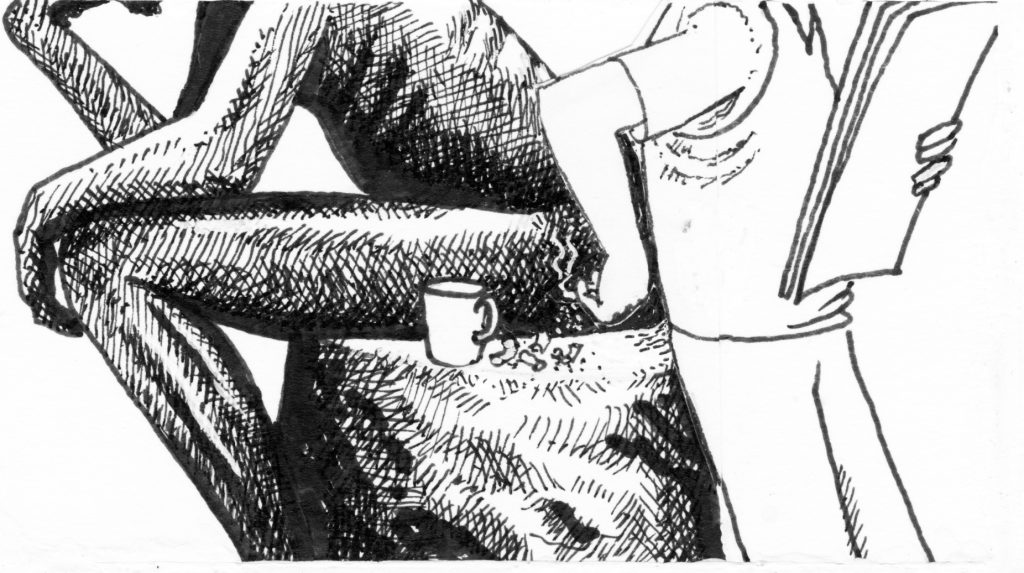
  • Selby Whittingham: Curatorial Incontinence

    Selby Whittingham

    When Napoleon removed Europe’s art treasures to France on the grounds that their rightful place was not with “slaves” but “in the bosom of a free people”, some might cynically think that this was not just a piece of enlightenment, but that it was very convenient that the new home for them happened to be Paris.  Likewise, when curators advocate the removal of restrictions imposed by donors by an enlightened wish to benefit people living today, the cynic will ask if that is the only motive or if a greater one is to satisfy the curiosity, restlessness and ambition of the curator.

    These thoughts are prompted by the decision to allow the Wallace Collection to lend works from its collection, when since 1900 it was held that this was forbidden by the conditions of Lady Wallace’s bequest, a view apparently of  those who had known Sir Richard and Lady Wallace intimately. Other house museums inspired by the Wallace have had similar restrictions, which some, such as the Frick Collection, still honour.

    Such observations were made by the lawyer Sir John Lewis, chairman of the trustees 1997-2004, in a letter in The Times on 5 October. He concluded, “Is this not a clear breach of trust …?” However trust had already been breached a decade ago, on which I wrote in this journal (no. 89, Jan/Feb 2010). The exhibition of works by Freud and Hirst in the main first floor galleries, quite apart from seriously disrupting the permanent collection, was clearly in breach of Lady Wallace’s provision for “a special museum to contain the said collection which shall be kept together, unmixed with other objects of art.”  The jesuitical excuse, accepted then by Lewis, was that the loans and Wallace pictures were in separate rooms and so there was no mixing.  There quickly followed a Watteau exhibition on the first floor with Wallace and borrowed pictures in the same room. The latter may have been of interest to Watteau specialists, but are in such wretched condition as to diminish rather than enhance general appreciation of the artist.

    The usual justifications are trotted out.

    1. The donor (or, in this case, her husband) lent (or sold) works, so she/he would not oppose that now. But one might as well say that, because an artist has altered his paintings, others may do so after his death. To the curator this analogy may seem false, but he is not a collector but a scatterer. To the collector his collection is his work of art, which is why he may wish that it be kept together unchanged in perpetuity.

    2. Who wants a fossilised “capsule for eternity”, asks art lawyer Ludovic de Walden in The Times? Many do. Period rooms are preserved at the V&A and Met and whole houses such as Osborne House. Remaining unchanged is key.

    3. Great works of art do not belong to individuals but to the world. This communist attitude to property is not shared by all.

    4. Art should be circulated round the world so that as many people as possible can see it. But if an object in Museum A is moved to Museum B, it will not be seen by visitors to Museum A. In the case of the Wallace nearly one-third of visitors come from abroad. Many of those and also from the UK will only ever pay one visit, so may never see the lent works, which are likely to be among the most important in the museum (as in the case of the Sheepshanks and Ionides bequests at the V&A as I write).

    5. Lady Wallace’s wording was imprecise. But, in the case of J. M. W. Turner’s bequest it was rightly observed that, if ever conditions were worded so as to prevent escape from them impossible, his were.  But they are totally ignored. And so is the case with other gifts of collections which I discussed in an article commissioned by the late Professor Norman Palmer QC in 1995. Bendor Grosvenor, unconcerned about the rights of the donor, argues that an independent Scotland would have a right to part of the Turner Bequest; that only 25% of the pictures are now on display and that Edinburgh suffers from a dearth of Turners which should be remedied.

    Since 1995 Sir William Burrell’s prohibition on lending abroad has been overturned by the Scottish Parliament, as Turner’s has been by the UK one.  It was admitted that if the proponents of the change chose instead to apply to the courts, they would probably lose. In fact the English courts have never tried such issues. In the Wallace case the application was made to the Charity Commission, which offers a cheap alternative to the courts, and so provides peanut justice, deliberating in secrecy without the donor’s interests represented.

    The Wallace press release refers to the 2017 Mendoza Review of Museums in England, made in response to a Culture White Paper in 2016. Its recommendations highlight “growing and diversifying audiences” and “dynamic collections curation and management”, aims of successive governments which are manna to activist and ambitious curators, some more interested in sociology than in art and their collections (as at Manchester). Populism and penury (caused by reductions in public grants to museums) help prompt acceptance of these aims.

    The National Gallery’s quincentenary Raphael exhibition  promises as usual “works never seen in the UK before or never seen outside where they reside now”.  “Unfortunately,”  it is added, these cannot include the huge Vatican frescoes.  However frescoes are sometimes moved, and so is stained glass. This is patently contrary to the intention of their creators and funders. However we are told that the Raphael frescoes “will be presented in other innovative ways” through new imaging technology. Is that not the true modern way forward? In general leave works where they are for those motivated to go to see them on their own initiatives rather than prompted by the loan exhibition publicity blitz and the bogus “once-in-a-lifetime” opportunity “ending very soon”.

    While the Charity Commission in these matters is something of a joke, the Department of Digital, its ministers and shadowing committee are complete jokes. None of them have an understanding of museums or realise – what is at the heart of the matter – that an essential attraction of museums is that they are all different, and that individuality (which is at the base of fine art) is to be cherished and not legislated away.

    What about the museum trustees? Financiers and professional art historians replace the great and good of yesteryear. If one of the current trustees is a lawyer, Jennifer Eady QC, her field has been employment law. In her statement of qualifications to be a trustee she has said that the Wallace is her “local” museum and that she has “a particular interest in the educational and outreach work of the collection”. No doubt other locals will welcome constant changes in the display and exciting masterpieces borrowed from around the world, but to others this may be poor compensation for the absence of works they had come to see.

    It is overdue to call time on copycat curators and philistine politicians and to leave each museum to its proper destiny. Is this too much to hope when the tomtits of the art world only ever have one song?

    And I said to him, “Dicky-bird, why do you sit
    Singing ‘Willow, titwillow, titwillow?’
    “Is it weakness of intellect, birdie?” I cried
    “Or a rather tough worm in your little inside?”
    With a shake of his poor little head he replied,
    “Oh, Willow, titwillow, titwillow!”