Recent Articles

  • Serpentine Gallery: the black art of hushing it up

    Most readers will be unfamiliar with Bolton and Quinn Ltd, a company which is the subject here. Invisible to the public at large, they operate in a murky hinterland between major galleries and the media encouraging positive coverage of State-approved art. One definition of State Art might simply cite a list of B&Q’s clients, for all the major promoters of Contemporary Art use them as lobbyists, from the Tate to the Arts Council to the Art Fund … and the Serpentine.

    I’ve always wondered what service this company provides for the galleries who pay them, because all the bodies they represent also employ extensive in-house PR departments. If the Tate’s press office (currently comprising twelve members) is so pisspoor that they have to call on additional expertise then surely they should employ people of a higher calibre in the first place. All the organisations prominent in pleading poverty wastefully employ two press offices.

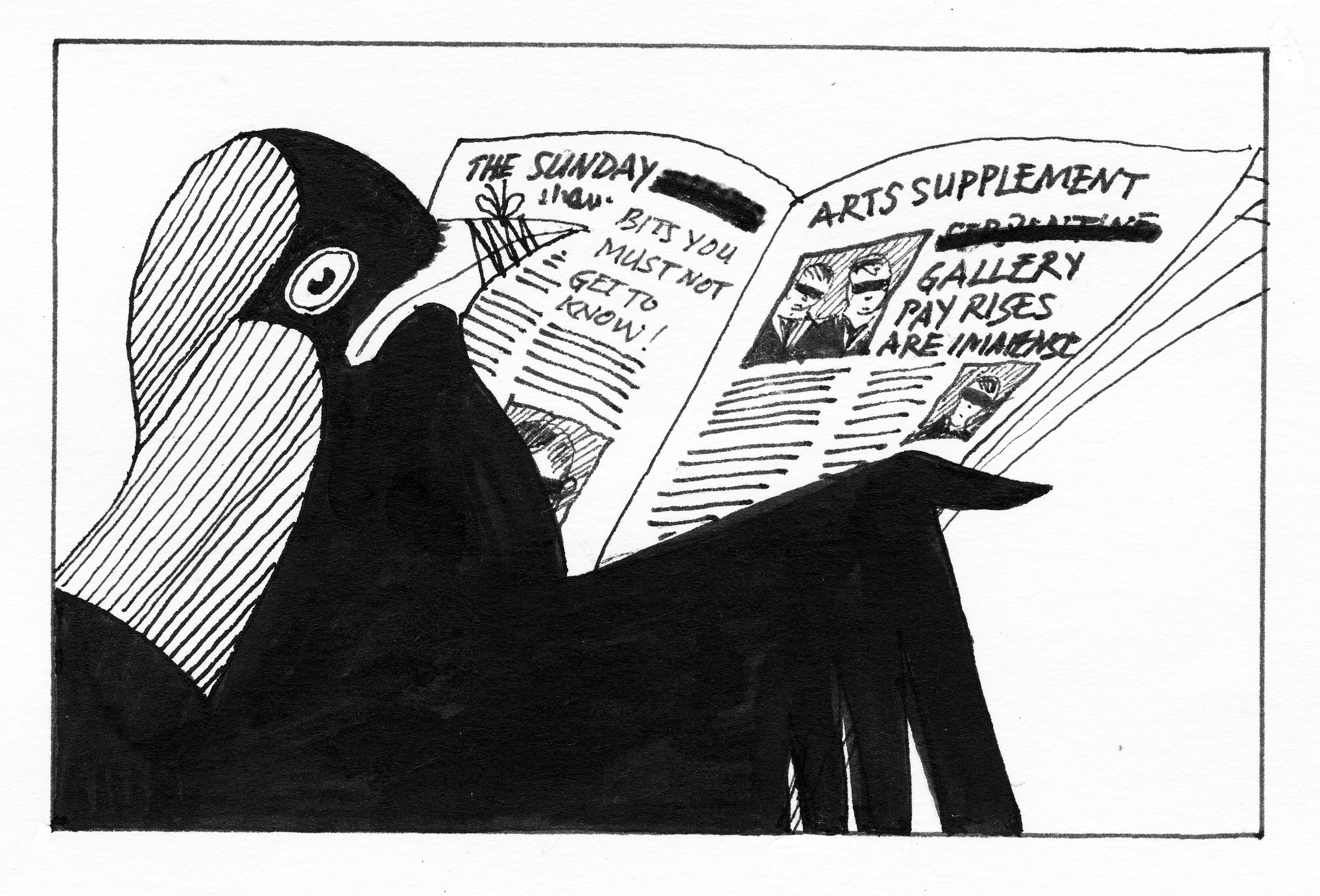
    So what extra-special purchase does contracting B&Q give to those who pay them? I can now call on personal experience to answer this. The last two editorials of The Jackdaw concerned the publicly funded Serpentine Gallery and its two directors who are overpaid by 100% compared to staff in equivalent positions elsewhere. Before Christmas a newspaper was about to trail the Jackdaw’s last editorial and expose the ‘charitable’ 67% and 47% pay increases awarded to the Serpentine’s two co-directors. A reply to these charges from the gallery was considered beyond the capacity of their own media team (all five of them, including a Head of Communications and a Head of Media Relations), whom one can only conclude must be muttonheads. Instead, they called in the household cavalry to charge the cannon. B&Q put their expensive hair-dos together and came up with a riposte so feeble it made me laugh out loud. A teenager on the minimum wage could have concocted something more convincing. So self-evidently accurate were The Jackdaw’s main charges against the Serpentine B&Q didn’t even attempt to answer them, instead resorting in desperation to mutterings about ‘bonuses’. Bonuses for public museum directors? Someone ought to be looking into that! In the end the paper pulled the story at the last minute saying there was no room for it. They still had space, however, for the vital disclosure that Tracey Emin is buying a flat in Manhattan. White Cube, Emin’s shopkeeper, is represented in media matters by … Hello!

    The story of the Serpentine pay increases was run soon afterwards in The Independent, from which many others picked it up. But not before B&Q had approached the paper. It was when I was informed of this that it finally dawned after so many years of bewilderment what precisely the function of B&Q is. They use their extensive contacts to firefight for and lobby on behalf of State Art. Quite how much they get paid for doing this is not revealed in their accounts at Companies House, which effectively tell us nothing.

    What this means is that, when circumstances demand, publicly funded organisations can pay a third party with our cash to assist in preventing us knowing the full story of what these organisations get up to. Thus are the public kept in the dark by use of their own money. If you are a closed monopoly, as State Art is, the advantage of keeping the public as ignorant as possible is an obvious benefit. On their website B&Q refer to this dubious activity as “producing opinion”.

    How might such a relationship work in practice? B&Q are in a strong position to subtly bribe journalists. They can offer trips, home and abroad, and invitations to fancy parties and soirées with all the gubbins of free catalogues, fancy bags and other sweeteners beloved of Fourth Estate liggers. More importantly, they can feed news exclusives about galleries and artists they represent to trusted journalists whose independence of opinion is surely compromised by the relationship.

    The virtual monopoly of favourable comment enjoyed by State Art in newspapers now makes perfect sense to me. David Lee

  • Fat cats in the park

    Arts administrators cleaning up in the name of charity

    In 2011, the Arts Council screamed daily that it was losing over 30% of its annual taxpayer subsidy. “Difficult decisions” and “hard choices” resulted in it cutting completely annual grants to 206 organisations, making many redundant. The Serpentine, meanwhile, was awarded the special status of “a regularly funded organization” – i.e. a reserved Pullman seat aboard the gravy train for life, and no questions asked.

    At a time when fat cats in the City were being daily excoriated for awarding themselves huge pay increases and bonuses during a period of austerity for everyone else they had themselves caused, the two co-directors of the Serpentine (Julia Peyton-Jones since 1991 and Hans-Ulrich Obrist from 2006) were awarded wage increases of 67% and 47% respectively. This inflated their pay to £150,000 and £130,000 a year respectively, a hike which brought both of them within range of what the director of the Tate receives (£161,000); indeed Peyton-Jones earns more than the Prime Minister (£142,500). A quarter of the Serpentine’s basic annual grant from the Arts Council goes on two salaries. Both earn more than the director of Tate Modern (£120,000) and the director of Tate Britain (£89,000). Together they make twice what even the director of the National Gallery earns; £140,000. Heading a small gallery, formerly a tearoom in a park, is costing 74% more a year than Serota himself receives for running an organization with 60 times the turnover, 100s of times the size, and 15 times the number of visitors. Charity definitely begins at home at the Serpentine.

    And why does the Serpentine need two directors anyway? No other minor public gallery needs more than one. On the contrary, they run their often bigger operations for the cost of half of one director at the Serpentine. Neither can Obrist claim to be anywhere near a full-time employee, given the impressive number of outside commissions he has undertaken during his tenure in the park. The Charity Commission, recently taken to task by the Audit Commission for complacency and incompetence, should urgently investigate this profligacy.

    Neither do the directors deserve anywhere near what they receive, for their performance is lamentably below average. It’s not even as though they have a difficult job. Over the last few years half of their main exhibitions have dealt with either Tate trustees or Turner Prize winners or nominees. How difficult is it to draw up a list of those kinds of candidates for exhibition? Dawdling, one could pencil in a year’s exhibitions of that kind over coffee. Their programme is unimaginative and otherwise overly concerned with foreign artists many of us have never heard of and the standard of whose work is on the face of it unexceptional. They have staged no retrospectives of deserving British artists of the kind which were regularly organised by previous regimes, and which made the place unavoidably important. In those days it could at least argue that some public service was being performed. Nowadays, it succours only dealers and rich collectors.

    The current exhibition (until February 9th) features Jake and Dinos Chapman. The brothers have shown recently at the Royal Academy, Tates Britain and Liverpool, the ICA and the British Museum. So why do they need another exhibition at the subsidised Serpentine when their own commercial dealer, White Cube, runs two big premises in central London? Apparently, it requires support from a charity to showcase works by artists already widely exhibited and who are among the wealthiest and most exhibited in contemporary art. This is not ‘Charity’ by any currently known definition of the term.

    For all its millions in public subsidy (and don’t forget it has also collected no fewer than twelve National Lottery awards) the Serpentine fails conspicuously in two respects: for a charity it costs too much to run, is overmanned and pays its top staff double the going rate; secondly, it doesn’t show enough work by British artists of the kind who are deserving but rarely exhibited.

    The Serpentine does no service to the wider community of British artists and its public subsidy should be immediately suspended.

    David Lee

  • The Serpentine as fat cat

    Why should the interests of those in limousines be subsidised by the rest of us?

    What is the difference between a line of black limousines at a Mob funeral in Brooklyn and an identical cavalcade at the opening party of the new Serpentine Gallery annexe in Hyde Park? Well, not as much as you’d think. Although Cosa Nostra are undoubtedly the subtler of the two coteries represented, both have a common interest in protection rackets. In the case of the Serpentine this means inflating the reputation and value of the deluxe ‘branded’ art which will be shown there and will have originated, or will end up, in the collections of the limousines’ occupants.

    Unaware that a shindig was in progress I cycled past the Serpentine while the limos were chrome-to-chrome outside. At first this didn’t register as unusual: another evening, another hoolie for the vain and vulgar at the Serpentine… One has got used to it. But the image of those black limousines, just that few inches too long, that shade too opaque, that chauffeur-wipe too shiny, lingered until it formed an indelible symbol for everything that stinks about State Art. What is passed off as ‘public interest’ and ‘the public appetite for contemporary art’ (the latter is the often repeated favourite lie of President-For-Life Serota himself) is yet another means by which the wealthy protect their interests. The public has no say in what is shown in the Serpentine despite the fact we have always paid for it. And if we don’t like it we can eat cake.

    Here is a publicly funded art gallery which specializes in showing recent art of negligible visible quality, that the public couldn’t care a toss about, which is hawked by the world’s wealthiest and most powerful shopkeepers, has its value maintained by salerooms who rig prices during glamorous soirées, is traded in by billionaire collectors who purport to like it but treat it merely as a secure commodity of exchange, and is endorsed using a new language written by “international curators” no literate outsider can fathom. You couldn’t invent a more perfectly rounded system of self-interest and exclusion.

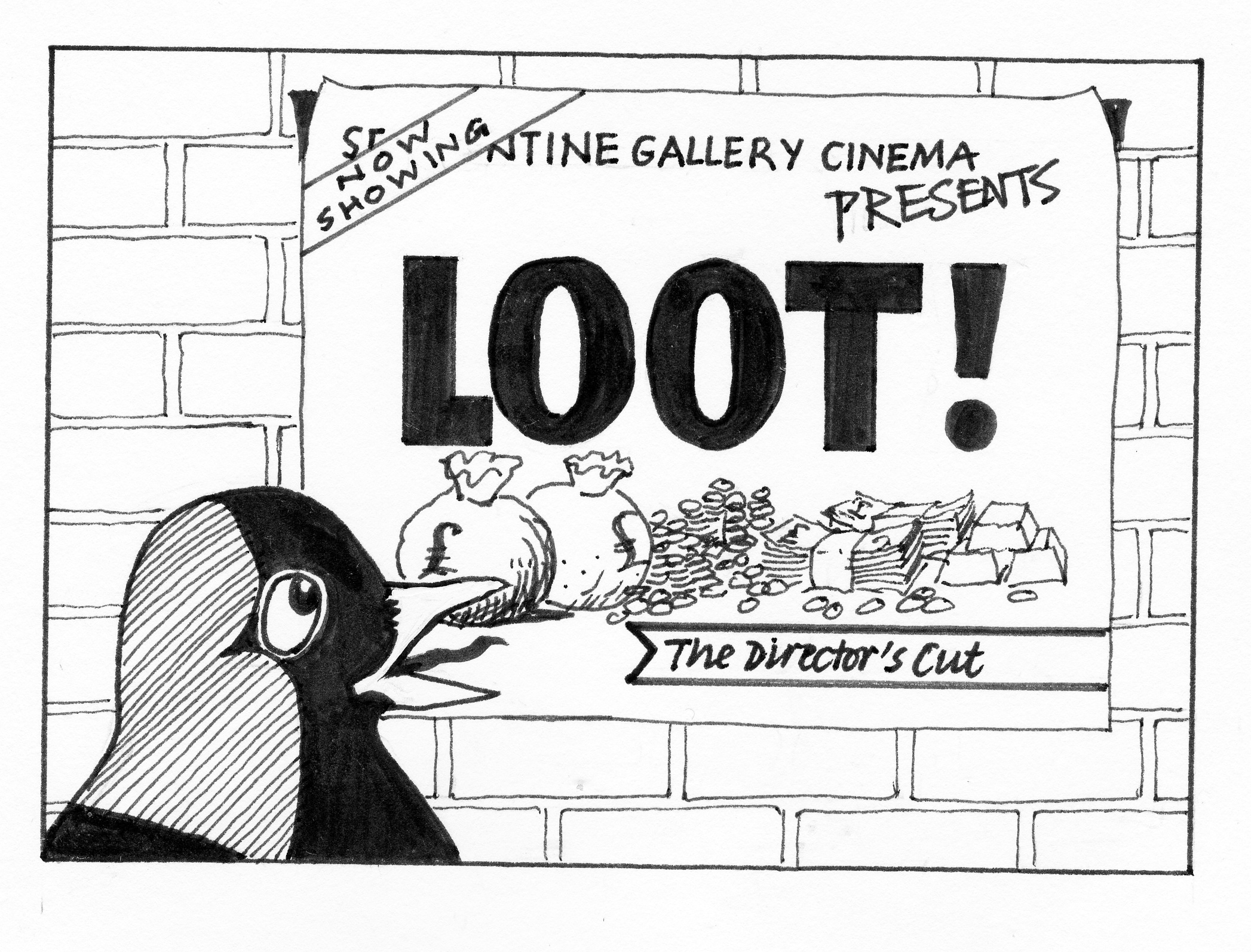
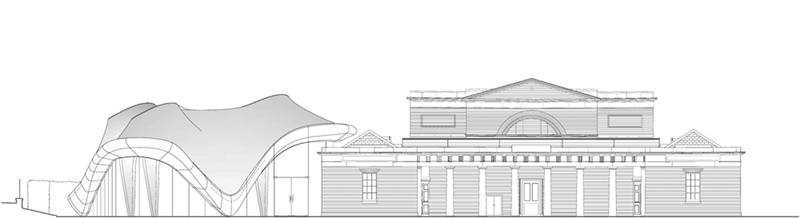
    The limos were celebrating the Serpentine’s latest expansion. A listed neo-classical building of agreeable proportions by Decimus Burton, formerly an arsenal close to the main gallery, has had a café and restaurant designed by Zaha Hadid attached to it. Enjoying limitless freedoms of manoeuvre as it does, State Art never has any problem acquiring permission for one of its chosen architects to tamper with the historically important and therefore supposedly protected. In this case what resembles the roots of a gigantic wisdom tooth have been impacted on the side of a Doric portico. It couldn’t be less sympathetic and like everything gratuitously eye-catching it is unnecessary. New gallery spaces are poky and the café charges £3.38 for a small cup of waiter-delivered coffee. How very charitable – come to think of it just like those other exemplary, public-spirited ‘charities’, the Royal Academy and The Art Fund.

    Between them the limousines paid the £14 million cost for the expansion, as well they might as many of them will be its main beneficiaries. Running costs and an exhibition programme have been underwritten with a £3 million endowment from the Lottery. This comes on top of the minimum £1.3 million a year the gallery has always received from the Arts Council. In fact, in the 19-year history of the National Lottery, the Serpentine has received no fewer than twelve awards totalling £6.8 million. Thus is the Serpentine the means by which money from the poorest, those who buy lotto tickets and scratch cards, is laundered to assist the wealthiest (non-doms many of them) in the appreciation of their investment portfolios. This revolting system is defended by the all-purpose State Art lie that the likes of the Serpentine “provide a public service”. Up to a point, but the real winners are behind all that dark glass.

    The Serpentine is run by a pair perfectly suited to their task: one is a dim socialite who does as she’s told, while the other is a Swiss “international curator” who speaks six languages and has neither penned nor spoken a clear sentence in any one of them.

    So who pays for the Serpentine? You do. Who is it for? Definitely not you. What is its purpose? Mind your own business.

    David Lee

  • The Art Fund subverted: they were only playing leapfrog

    The separate bodies contributing to State Art are now so interrelated, so cosily acquainted, their personnel so readily interchangeable and of identical mindset, that they might as well join forces. (… Liz Forgan is sacked from the Arts Council but remains a Trustee of the Art Fund; James Lingwood swallows his annual  million from the Arts Council and also sits as a Trustee of the Art Fund which has bought a work he commissioned, and so on – I could fill this column ten times over with similar complacent overlaps.) Imagine the savings on personnel and rent alone if the Contemporary Art Society (now funded and run by a former employee of the Arts Council), The Art Fund (headed by an ex-director of the Tate), the Arts and British Councils and the Tates (also directed by a former Arts Council employee) stopped pretending they pursued distinct objectives and pooled resources.

    The Art Fund is the latest to dump any semblance of independence. It is nominally a charity, if, that is, you count bankrolling the already well supplied as ‘charitable’. If the Salvation Army doled out caviare to nobs in Mayfair there would be a fuss. But the Art Fund regularly does the equivalent.

    It was founded by altruists in 1903 solely to help museums buy works of art. It gives £6.3 million a year in grants, spreading it thinly across scores of acquisitions, including some important ones. Its core activities are still nobly worthwhile and more than ever necessary.

    Recently, it announced it would fund two British tours: Jeremy Deller’s ‘immersive works’ (don’t ask) created for the British pavilion at this summer’s Venice Biennale, and Grayson Perry’s six large caricature tapestries on the subject of British life and taste. Why is a charity sponsoring the promotion of Perry and of a Tate trustee, Deller, who are among the most visible, wealthy and successful of recent British artists? And why aren’t their dealers paying for these tours from which they will all benefit? Deller’s exhibition in Venice, funded by the British Council (the tour of his inflatable Stonehenge is already, by the way, covered by the Arts Council), cost over half a million of public money to stage. Why is Deller worth even more from the limited resources of yet another much tinier charity? None of this makes sense. Unless of course there is a privately agreed national consensus between a raft of organisations, public and private, whose objectives – for whatever reason – are to promote the same few reputations.

    In their recent accounts the Fund crows its contribution of £200,000 towards Rachel Whiteread’s infantile defacement of a listed masterpiece, Charles Townsend’s Whitechapel Art Gallery. Again, here is lavish support of a successful, regularly exhibited artist represented by a leading world dealer. Charity? Really? Additionally, they funded the Tate’s purchase for £125,000 of five Whiteread ‘drawings’, or diagrams as they used to be known – they now have 30 of her works.

    The Fund also oversees the annual £100,000 Gulbenkian Museum of the Year whose judges are perennially lazy, predictable and uninspired. It is responsible too for administering ‘Artists’ Rooms’, an overpriced and dubious blunt instrument of State Art which ensures the circulation of work by top brands around regional museums, apparently ­– God help us – in perpetuity.

    The Fund’s magazine, Art Quarterly, formerly a purveyor of scholarly articles, is now a yappy promotional brochure for State Art. The current issue advertises three artist trustees of the Tate, each of whom receives the Fund’s cash. In the case of Wolfgang Tillmans, they contributed £95,000 towards buying 15 of his pictures for Glasgow Art Gallery having the previous year given £62,000 for the purchase of nine others of his works by the Arts Council, which has £450 million a year of its own to spend. The Tate already owns 62 works by Tillmans. Why this obsession with an indifferent German photographer?

    But all is not bleak. In 2011 when the Fund announced public purchase of Yinka Shonibare’s Fourth Plinth bottle the published cost was £362,500. As we demonstrated at the time this was a lie repeated in all newspapers. In their recent accounts the figure has now shot up to £650,000. They’re getting there, slowly.

    David Lee

    The Jackdaw, September/October 2013

  • Serpentine Gallery extension: limousines are good causes

    Serpentine Gallery extension: limousines are good causes

    What is the difference between a line of black limousines at a Mob funeral in Brooklyn and an identical cavalcade at the opening party of the new Serpentine Gallery annexe in Hyde Park? Well, not as much as you’d think. Although Cosa Nostra are undoubtedly the subtler of the two coteries represented, both have a common interest in protection rackets. In the case of the Serpentine this means inflating the reputation and value of the deluxe ‘branded’ art which will be shown there and will have originated, or will end up, in the collections of the limousines’ occupants.

    Unaware that a shindig was in progress I cycled past the Serpentine while the limos were chrome-to-chrome outside. At first this didn’t register as unusual: another evening, another hoolie for the vain and vulgar at the Serpentine… One has got used to it. But the image of those black limousines, just that few inches too long, that shade too opaque, that chauffeur-wipe too shiny, lingered until it formed an indelible symbol for everything that stinks about State Art. What is passed off as ‘public interest’ and ‘the public appetite for contemporary art’ (the latter is the often repeated favourite lie of President-For-Life Serota himself) is yet another means by which the wealthy protect their interests. The public has no say in what is shown in the Serpentine despite the fact we have always paid for it. And if we don’t like it we can eat cake.

    Here is a publicly funded art gallery which specializes in showing recent art of negligible visible quality, that the public couldn’t care a toss about, which is hawked by the world’s wealthiest and most powerful shopkeepers, has its value maintained by salerooms who rig prices during glamorous soirées, is traded in by billionaire collectors who purport to like it but treat it merely as a secure commodity of exchange, and is endorsed using a new language written by “international curators” no literate outsider can fathom. You couldn’t invent a more perfectly rounded system of self-interest and exclusion.

    The limos were celebrating the Serpentine’s latest expansion. A listed neo-classical building of agreeable proportions by Decimus Burton, formerly an arsenal close to the main gallery, has had a café and restaurant designed by Zaha Hadid attached to it. Enjoying limitless freedoms of manoeuvre as it does, State Art never has any problem acquiring permission for one of its chosen architects to tamper with the historically important and therefore supposedly protected. In this case what resembles the roots of a gigantic wisdom tooth have been impacted on the side of a Doric portico. It couldn’t be less sympathetic and like everything gratuitously eye-catching it is unnecessary. New gallery spaces are poky and the café charges £3.38 for a small cup of waiter-delivered coffee. How very charitable – come to think of it just like those other exemplary, public-spirited ‘charities’, the Royal Academy and The Art Fund.

    Between them the limousines paid the £14 million cost for the expansion, as well they might as many of them will be its main beneficiaries. Running costs and an exhibition programme have been underwritten with a £3 million endowment from the Lottery. This comes on top of the minimum £1.3 million a year the gallery has always received from the Arts Council. In fact, in the 19-year history of the National Lottery, the Serpentine has received no fewer than twelve awards totalling £6.8 million. Thus is the Serpentine the means by which money from the poorest, those who buy lotto tickets and scratch cards, is laundered to assist the wealthiest (non-doms many of them) in the appreciation of their investment portfolios. This revolting system is defended by the all-purpose State Art lie that the likes of the Serpentine “provide a public service”. Up to a point, but the real winners are behind all that dark glass.

    The Serpentine is run by a pair perfectly suited to their task: one is a dim socialite who does as she’s told, while the other is a Swiss “international curator” who speaks six languages and has neither penned nor spoken a clear sentence in any one of them.

    So who pays for the Serpentine? You do. Who is it for? Definitely not you. What is its purpose? Mind your own business.

    David Lee

    The Jackdaw, November 2013


  • Olympic legacy: money for nothing

    Olympic legacy: money for nothing

    I am not happy again. We have become used to hearing weekly wails of distress from the Arts Council about how broke they are followed by melodramatic predictions of the cultural desert awaiting as punishment for state parsimony. It is their belief they should be exempted from the austerity allegedly endured elsewhere. Their moans receive sympathetic hearings from a press many of whose specialist commentators are reliant on the Council for an assortment of free trips, home and abroad, and other thinly veiled junketry and blackmail.

    Last month the Council announced quietly that one of their long-delayed projects for the Olympics – a jet of air fired up over the Mersey estuary off Birkenhead – was not going to happen after all, despite having already spent £535,000; that is, £35,000 more than the original budget intended for the finished, installed work. This sum included £40,000 as a personal fee plus £15,000 expenses for the artist, one Anthony McCall. He promised something he couldn’t deliver but won’t be sued or expected to repay any of the money. Apart from low-key reporting of the failure, papers omitted to comment on its wider significance. And it goes without saying that no one at the Arts Council will carry the can for this entirely avoidable fiasco.

    In fact, this was only part of a story concerning the disgraceful waste of £5.4 million which the Council allocated for commissioning special works during Olympic year. Now, a year on from the Olympics, we can evaluate more clearly what we received – the ‘legacy’ if you insist – for a sum approaching the Council’s entire annual visual arts budget. The short answer is nothing; nothing memorable or of any enduring artistic merit, for it was frittered away on ‘community’ trivia. Not a single painting, print, sculpture or ceramic in any gallery or museum. Not a single mural or stained glass window in any civic building. No public sculpture of genuine worth. No, not even a sprawling installation or a soporific video destined for the gallery warehouse. Where anything at all concrete remains from this project it is entirely frivolous. The sum total is three crocheted lions at Twycroft Zoo and a boat made from 1,200 donated wooden objects currently moored … well you tell me.

    In January 2010 the Arts Council announced that as its contribution to the Cultural Olympics it would earmark £5.4 million for 12 works, one each in nine regions of England (£500,000 each) and one each for Scotland (£460,000), Wales (£230,000) and Northern Ireland (£190,000). The object of these commissions, which were collectively dubbed ‘Artists Taking the Lead’ (the Piss, more like), was “to surprise and delight the world with their extraordinary artistic vision”.

    Scotland’s wedge bought them a temporary football pitch in the middle of a forest near Selkirk, on which were played two matches in kits designed by local children – a site now overgrown. (God only knows how they managed to get through half a million on that.) Wales got the fuselage of a DC9 which was towed to four locations; present whereabouts unknown. Northern Ireland got Nest, a warehouse full of donated objects labelled with personal reminiscences. Eastern England got a community event called Home. In Yorkshire they bent the regulations so that those choosing the winner were themselves the recipients of the cash. Their excuse? “It would have been impossible to appoint regional arts experts that did not have these relationships.” You didn’t try hard enough you corrupt bastards! The result was some sort of street happening in Leeds. The north west got its half-million’s-worth of nowt, not even the promised hot air. The south west got Nowhereisland, some soil from the arctic circle towed by boat around the West Country. The West Midlands marched a big puppet of Godiva (now clothed owing to political correctness) down to London. The south east got the wooden boat. The East Midlands is now the proud owner of some knitted lions. The north east got the best piece, ‘Flow’ by Ed Carter, a pontoon on the Tyne complete with original electronic music.

    There is not an atom of visual art in any of this rubbish. It is money which should have been better spent on permanent serious commissions. Why are the Arts Council allowed continually to get away with such shocking waste whilst constantly pleading poverty?

    David Lee

    The Jackdaw, July/Aug 2013

  • 100 Works of Art That Will Define Our Age

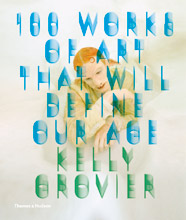
    Kelly Grovier, Thames & Hudson, £35

    Every now and then a book about contemporary art appears which informs it audience in ways that neither the author nor the publisher probably quite intended. This seems to be the case with Kelly Grovier’s 100 Works of Art That Will Define Our Age, newly published by Thames & Hudson, just in time for this year’s Frieze Art Fair. This is, without a doubt, a book that no one interested in contemporary artistic manifestations should ignore. Adorned with a cover that suggests the blurred double vision one suffers after a bad knock on the head, it has a comprehensive suite of illustrations, well reproduced in good colour. The choice of names is extremely informative concerning the state of the art world right now. It is perhaps a little more difficult to be complimentary about the text. The flavour of this is well illustrated by this, the final paragraph of Grovier’s description of Damien Hirst’s diamond encrusted skull, For the Love of God:

    “What a strange geometrical hinge Hirst’s outrageous jaw is. It defines our age eloquently, an era of recycled retro that forgot it was retro. When the skull was first unveiled as part of the British artist’s exhibition ‘Beyond Belief’, the lavish security it enjoyed as though it were the rediscovered crown jewels of a legendary realm, led many to attach to it an invincibility that could laugh in the face of time’s ravaging, as though a work of art that could conquer death had at last been found. Others may have seen little more than a gaudy trick, which the slightest wrinkle of a gallery rug might send smashing into eight thousand broken engagement rings.”

    This at least avoids the total opacity of academic Art English, though the first sentence is baffling enough. The description is energetically hyperbolic, but manages to have its cake and eat it. The author adroitly dodges questions about the ultimate importance of the piece described, whether within a contemporary context or out of it.

    What the book, and its author, can’t avoid are the results of simple statistical analysis. For example, look at these figures: counting occasional pairs – artists who work together – as a single entity, 32 of those listed are based in Britain, mostly it seems in London. A high proportion – perhaps two-thirds ­– are British born. An almost equally large proportion are associated with the so-called YBA movement.

    The next largest group comes from the United States – 26 in all, though seven were not originally American. To this one might add the name of Cy Twombly, always considered to be an American artist, though he spent most of his career in Italy. A conspicuous omission is James Turrell, surely one of the most poetic and fascinating artists now living.

    Conclusion: just short of 60% of the artists who made ‘defining’ artworks in the period under review came from the Anglophone art world. Among these were more Brits than Americans. And the YBA movement, according to the choices offered here, was far and away the most important art movement of its time, regarded in global terms. Does anyone really believe that?

    Other well-represented countries are Germany and France. For Germany, however, the list contains only four German-born artists out of nine – Gursky, Richter, Gregor Schneider and Neo Rauch. The others come from elsewhere – for example, Sean Scully, now completely cosmopolitan, with studios in Bavaria, Barcelona and New York. Scully, who is of Irish extraction, began his career in Britain, and had his first exhibitions here. Other artists living and working in Germany come from Argentina, the Lebanon, Denmark and Italy. To the list of German artists one can add Anselm Kiefer, indelibly German, though he now lives and works in Paris, and Martin Kippenberger, who was born in Dortmund, travelled restlessly, and died in Vienna. Other celebrated German artists are absent – Baselitz, Immendorf, Penck, Fettting. So is Sigmar Polke. Conclusion: German Neo-Expressionism must be thought of as largely a spent force.

    Five French artists are listed, plus Kiefer and also Thomas Hirschhorn, who comes from Switzerland. None of those native to France are primarily painters. Conclusion: the long tradition of French dominance in painting is now in its coffin. In fact, the steep fall in French representation, compared to the situation say fifty or sixty years ago, is a marker for how far French cultural prestige has now declined. Germany counts for far more creatively. Berlin has attracted quite a number of non-German artists who once might have settled in Paris, to be near the centre of things. So, for that matter, has London.

    There is a scattering of artists from Latin America – one from Brazil (Ernesto Neto), one from Colombia (Doris Salcedo), one from Mexico (Gabriel Orozco). Two more artists included, now living in Mexico – Francis Alys, and Santiago Sierra – did not originate there.

    After that: three artists from China (one, inevitably, is Ai Weiwei), Two from India. Two from Poland. Two from Canada. One from Spain. One from Belgium. There is a sole representative from Italy – apart, that is, from Twombly. The book suggests that the only major artistic personality that this traditional home of the visual arts now has to offer is the arch-jester Maurizio Cattelan. One artist from Japan. One from the Netherlands – Marlene Dumas, who, though born in South Africa, has spent her entire career in Amsterdam. And just one from Africa itself – the white South African William Kentridge. There is no black African artist. Chris Ofili, who might seem like a candidate, is British born. He now lives and works in Trinidad. Nobody at all from Russia. The enthusiasm for Russian contemporary art that flourished in the 1980s, at the time of Gorbachev’s perestroika initiative, has now apparently evaporated, displaced, perhaps, by an enthusiasm for China. Clearly the vaunted internationalism of contemporary art world has its limits.

    The book scores fairly high in terms of making a place for female artists. In all, there are 23 inclusions – almost a quarter of the total. Rather strangely, however, no fewer than nine of these are British. Evidently we now, here in Britain, do ‘politically correct’ better than anyone else. Yet the most important feminist artist now living – still very active – is the American Judy Chicago, far more of a pioneer than any of these Brits. However, her epoch-defining installation, The Dinner Party, is some time ago now, which may be a reason for her omission. The Dinner Party is, nevertheless, still available today at the Brooklyn Museum.

    100 Works is extremely interesting and informative about the media used by the hundred artists selected for immortality – or at any rate selected for their potential historical significance. Forty of them – 40% – can be defined as makers of installations. Not quite 18% are painters. The rest are occupied with other creative forms, with photography and video occupying a rather smaller place than one might expect. There are very few old-school public monuments, with a message for anyone who might encounter them. The most conspicuous are Antony Gormley’s Angel of the North, and Rachel Whiteread’s Nameless Library, Holocaust Memorial at the Judenplatz in Vienna.

    There are several points to be made about current installation art. First, it is extremely dependent on official support – it is representative, in most of its manifestations, of that paradoxical entity, the ‘official avant-garde’. Many of the installations celebrated here have been presented at major museums of contemporary art, or as part of major art biennials. That is, they are an accepted component – the ‘circuses’ – of our present ‘bread and circuses’ official culture, characteristic of Western European democracies and also of the United States, but not so prevalent or firmly established elsewhere. The installations are also physically ephemeral for the most part. That is, if you missed them when they were initially shown, you will probably never now catch up with them again. Not even those where the mechanisms involved are almost childishly simple, such as Martin Creed’s The Lights Going On and Off. This means that these art works can only ‘define our age’ through the operation of perhaps unreliable individual memory. Who, in any case, can have managed to see them all at first hand?

    The only way most of us can hope to see them now is through books such as this one, which also attempt to tell us what opinions we should form. Yet wait – there is another paradox here. The conventional art book, text and illustrations on paper, is not nearly as efficient in conveying information about large, often labyrinthine three dimensional objects as film. Meanwhile hybrid art ‘books’ – so called – are increasingly available on portable tablet computers through the use of Apple’s iBook software. If these forty installations were all visible on an iBook, each represented by a film clip or a series of film clips, one would have a much better idea of what they are really like, and therefore of both their strengths and their deficiencies as works of art. This is dinosaur technology inefficiently trying to convey information about what is proclaimed to be a new age.

    I called this a bad book, yet also said that it was a book that no one interested in contemporary art should miss. The reasons are twofold. First, it does undoubtedly offer a lot of information about the current state of contemporary art, though not always information that tends to raise one’s enthusiasm for the subject, nor one’s respect for the artists concerned, nor for the curators and institutions who promote this vision of what the art world should currently be doing. Secondly, the information it offers is radically skewed, but skewed in an interesting way.

    The implicit claim here is that Britain, London in particular, is now the unchallenged centre of the contemporary art world. Bold of Thames & Hudson to publish an ambitious book that says this, as their important American market is not going to like it. Yet the fact that over 30% of the artists included in the book are British or British resident is enough to certify that this is the direction it takes. Accumulating evidence shows that the claim may possibly be true. London has the great museums, the major public spaces for contemporary art, art dealers of all kinds, trusts that supply studio spaces. It also has an enormous number of gifted younger artists, some born here, some foreign. Nevertheless, trying to certify Britain’s new status by a celebration of the fast fading YBAs doesn’t help to make the case. In fact, it tends to undermine it.

    Further, the official museum-supported avant-garde that Kelly Grovier seems keen to celebrate is bizarrely akin, certainly in organizational terms, to the world of the great official Salons, dominant during the closing years of the 19th century. Did Bouguereau and Alma-Tadema define the art of their time? Yes, in a way that’s just what they did.

    http://www.thamesandhudson.com/100_Works_of_Art_That_Will_Define_Our_Age/9780500239070

    Reviewed by Edward Lucie-Smith

    The Jackdaw, October 2013
  • Bob Dylan at the National Portrait Gallery

    Bob Dylan at the National Portrait Gallery

    THE LINE IT IS DRAWN … BADLY
    The now routine phenomenon of paintings by celebrities shown in serious galleries defies belief. You’d think they’d be sniffy about this sort of populist stunt; and you’d be wrong. However bad the work is people swarm to see it, hexed by the name. Photos and paintings by pop stars and television personalities attract record crowds of worshipers. The best attendance at the 170-year-old Walker Art Gallery in Liverpool, for example, is paintings by Rolf (“do you know what it is yet?”… “nope”) Harris.

    Thus in straitened times are museum principles sacrificed in order to sell coffee and muffins. Celebrity daubing is the one area of museum policy where any semblance of honesty flies out the window. Critics and curators lose all sense of propriety and become blinking rabbits trapped in headlights. The thrill of brushing with fame is addictive. Just maybe if we heap on the praise with a bulldozer we’ll get the personal call. Perhaps we’ll become friends. What other reason could there be for this adolescent fawning over the incompetent and conceited?

    So Sarah Howgate, a curator at the National Portrait Gallery appears on the television – a clip is on the BBC news website and will embarrass all concerned for as long as it remains in the archive – either talking gibberish or praising qualities in works brazenly lacking anything resembling accomplishment. Why? Because they are by Bob Dylan. Well Bob, you of all publicity avoiders should know better than to play ball with this demeaning exploitation of your fame. The person who persuaded you into this lapse of judgement and propriety is possibly the same one who talked you into the wince-inducing train crash of that Christmas song album four years ago. Here comes Santa ho ho ho, indeed.

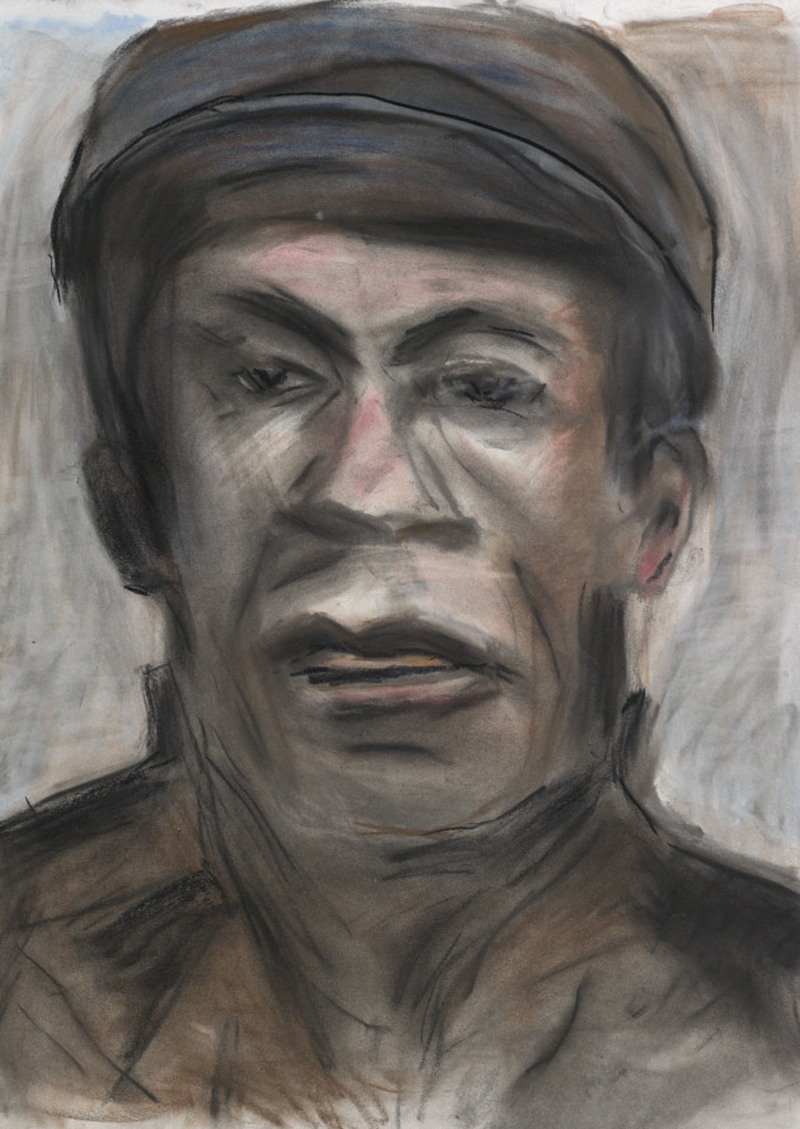
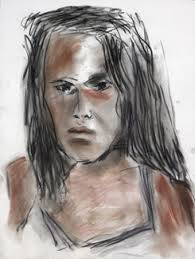
    When not rolling thunder from continent to continent or writing songs of genius (and no one comes near him as the greatest artist of my lifetime), Bob relaxes with a spot of drawing, don’t yer know, and in the last year has done a dozen imaginary pastel ‘portraits’ – one of which, captioned Ivan Steinbeck, is clearly based on his own face. All the same size, they are as crude as Wild West ‘Dead or Alive’ posters – though poor old ‘Red Flanagan’ already looks like a decomposing stiff. The works are so obviously those of an amateur that they might, if entered for an art contest in a scout hut, elicit praise and encouragement if only out of sympathy for the effort made. The only thing missing is the untidy grittiness of pastel, the textural scuffs and drawing-pin holes in the corners. These sheets look suspiciously perfect, as though made by a machine, and the pastel is applied more like make-up or lipstick – it’s horrible. Either Howgate was deliberately lying when she praised this rubbish or she doesn’t have a clue what she’s talking about: neither is an advertisement for her career prospects. The probability is that she was lying having been, as they say in American films, hung out to dry by superiors.

    Then along trots art critic Jonathan Jones of the Guardian, who blogs for England with instant opinions on everything. He told us that “Dylan draws well, with feeling and hard-won accuracy”. He doesn’t. He doesn’t draw any better than literally millions of others. GCSE teenagers have better portfolios of drawings than this. And as for ‘accuracy’? What does that mean in the context of the imagined? That he got the number of eyes and ears right? Why did Jones write this? It’s hard to explain.

    Dylan draws with all the mistakes which are second nature to untutored dabblers, faults too many to enumerate. Typically at this level, errors are duplicated like incurable tics. No improvement occurs from one drawing to the next, nothing having been learned by self-criticism or devoted practice. And because Dylan isn’t in full expressive control of what he does, anything readable into these faces has to be accidental.

    Apart from their status as curiosities no point is served exhibiting this stuff. They would not be shown anywhere, least of all the National Portrait Gallery, were they not by Bob Dylan. If a would-be artist showed Sarah Howgate a portfolio of scribbles like these he’d be on the pavement faster than Usain Bolt.

    Bob, my dear hero, these are intriguing ephemera, but they are without art and best kept to yourself as a little secret between you and your family. And may I humbly suggest that next time you should know your song a little better before you start singing.

    Bob Dylan is at the National Portrait Gallery until January 5th

    David Lee

    The Jackdaw September 2013


  • Beyond criticism

    Beyond criticism

    Laura Gascoigne demonstrates how Artbollocks is now recognised as a joke among almost everyone excepting the time-serving devotees of State Art.

    In January the Guardian’s G2 section published an article by Andy Beckett titled ‘Er, anyone know what transversal means’? It reported on the publication in an American art journal last year of an essay identifying a unique form of English peculiar to the gallery press release. The authors David Levine, an artist, and Alix Rule, a critic and sociology PhD student, had spent two years collating examples in the attempt to codify the language’s distinguishing features. “We’d find some super-outrageous sentence and crack up about it,” said Levine. “Then we’d try to understand the reality conveyed by that sentence.”

    Well whaddya know? The press has finally woken up to Artbollocks, three years after The Jackdaw lost the will to anatomise it. And we thought newspapers were in the business of breaking news. But Levine and Rule had a more newsworthy name for it – International Art English – and a more modern methodology. Their use of language-analysing software gave them a technological edge on The Jackdaw’s researchers, who regard the filing cabinet as an innovation.

    They discovered some interesting things. They noted, for example, that ‘the real’ was mentioned 179 times more often in IAE than Standard English (a figure that sounds suspiciously like a multiple of one). They also detected in its post-structural structure a genetic resemblance to “inexpertly translated French”. They observed that it “has everything to do with English, but is emphatically not English”. They also found it “oddly pornographic” and concluded that, like pornography, it was basically about power – an insider’s coded language that “has made art harder for non-professionals”.

    What their research didn’t explain is how the arts desks of our English-language newspapers have allowed this abstruse verbiage to wash over them for twenty years without objecting – worse, have privileged press releases that use it over those that don’t. For some reason which I’d like to have explained to me – in Standard English – the artists favoured by our leading contemporary galleries, public and private, and reviewed in our national press are invariably promoted in what we old-fashioned types at The Jackdaw still think of as Artbollocks. The language of the press release has become another means of perpetuating artistic class divisions whereby two contemporary art worlds run on parallel tracks, with no points or crossings. The wrong sort of artists come up through the wrong sort of galleries promoted by the wrong sort of press releases written in the wrong sort of language – a language otherwise known as Standard English.

    Nine years ago, John Keane wrote a letter to the Guardian in which he distinguished between three categories of contemporary art: 1) Searle approved (and so reviewed); 2) non-Searle approved but bearing the imprimatur of the art establishment of Charles Saatchi (and so reviewed); 3) the rest (ignored). His conclusion was that, for all the critical attention they got, category three artists might as well be on the planet Tharg. He signed off: “What’s the collective noun for art critics? Herd, I think.” The Guardian’s Letters editor published his letter under the heading Art on Tharg; the paper’s arts editor didn’t commission a review of his exhibition The Inconvenience of History, despite the fact that ideologically speaking – with its focus on Israel and the Occupied Territories – it was core Guardian readership material. If critics are a herd, then arts editors are the cowboys controlling their movements.

    Since Keane wrote his letter things have got worse, not just for artists but for art critics too. Critics are not bad-hearted people. Most of them, left to themselves, like nothing better than to dilate on the merits of the artists they admire, given space to do so. Many are old enough to have started out believing that a critic’s job was to introduce the public to interesting artists they didn’t know about. Keane was himself once a beneficiary of this old belief system, and it’s not really the critics’ fault that he is no longer. The system itself no longer exists. Arts editors, most of whom have little personal interest in or knowledge of the visual arts and regard them as a tiresomely hard sell to a general readership, no longer trust art critics to go out on a limb with reviews of artists they themselves haven’t heard of. They feel safer confining them to critiques of celebrity artists in major galleries. While pop music critics are allowed to write about pub gigs by unknown bands and theatre critics can review fringe productions, it’s considered too risky to let art critics introduce readers to artists whose names might be new to them. But isn’t that’s half the point of being a critic? Surely that’s what arts pages are for.

    I’ve read the Guardian loyally for 20 years and never in all that time do I remember it introducing me to an interesting artist I hadn’t heard of – the only exception being The Guide on Saturdays, with its 100-word reviews of nationwide exhibitions by critics who mostly haven’t been able to see the show. I can’t believe this is all Adrian Searle’s fault. Searle knows what art criticism is about, even if he doesn’t often practise it. “Small events count in painting,” he once wrote, “and still do count, even if writing about such a thing smacks of a kind of connoisseurship that is not just out of fashion, but feels somehow discredited as a way of looking.” The admission, in a review of the RA’s Derain to Kandinsky show in 2002, had more than a whiff of nostalgia about it.

    Most critics in the national press have long since stopped struggling. Waldemar Januszczak made a brief attempt in 2005 at a one-man boycott of exhibitions at the various Tates in protest at their hogging of half the review space – during which time he discovered William Orpen at the Imperial War Museum – but he soon gave up. Younger critics who have never known any different see their job as translating press releases into English. Meanwhile freelances, the last hope of the category three artist, are being squeezed out of the mainstream press by shrinking budgets and left clinging by their fingernails to online perches that are only visited by other critics and the artists being reviewed.

    “The art world is dominated in people’s minds by the thousand artists that are very successful, that are handled by the top fifty dealers around the world. They’re the ones that get all the attention but the real art world is hundreds of thousands of artists around the world who don’t have dealers and are pretty much unrepresented.” Who said that? Not the culture minister from planet Tharg. Charles Saatchi.

    What’s to be done? The cranky old Critics’ Circle of which I’m a member is striking a tiny blow for independence with an exhibition called Critics’ Secrets at the Mall Galleries in June, for which two dozen critics have each selected an established artist they feel the public ought to know about. As a test of the depths of our own ignorance, the experiment has succeeded beyond expectations. Of the 25 names put forward by my fellow critics I’d only heard of seven, this despite spending my waking hours attached to a drip-feed of press releases. Whether their names ever reach the ears of the public is another matter. That will depend on the arts editors.

    Laura Gascoigne


  • Another great artist ignored

    Another great artist ignored

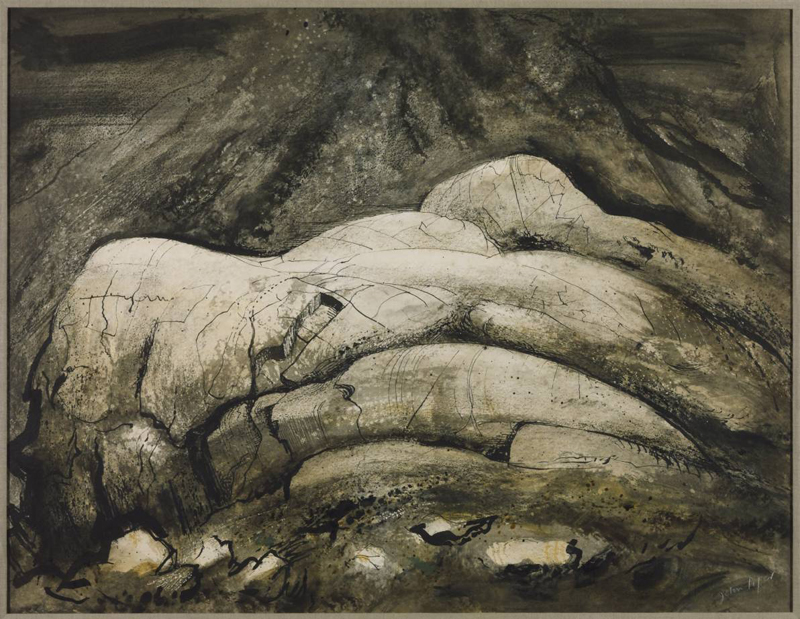
    Of the 183 works by John Piper in the Tate’s collection none is currently on display. One of the major British artists of early Modernism does not have a single item of his work on show in the national collection of British art, of which, incidentally, he was once considered sufficiently eminent to serve as a trustee. How could such an aberration occur?

    As an apostate Modernist, Piper has been marginalised as a glib illustrator of churches and grand houses in a vaguely modish idiom. He is perhaps a victim of his divers interests and abilities; he was writer, typographer, photographer, textile and stage designer, stained glass maker, muralist, printmaker, painter, but ­– especially – a lover of England, its idiosyncracies of belief, custom and culture, and especially of its history, in which he was thoroughly well-read. As a forgotten man he is perhaps the first example of an important artist who, by deviating from the consensus of an official taste which would later emerge as State Art, spoke out and stuck to his convictions. Thus, he managed to get himself on the wrong, ‘Betjeman’ side of the debate when Modernism began to rule the critical roost in English art and commenced its relentless infiltration and systematic cleansing of institutions. There was no schism with his former vanguard friends, Piper simply moved in his own direction rather than following trends and styles he considered useful and intellectually stimulating but limiting as far as his own ambitions were concerned. He inclined towards the deadly sin of Romanticism, being spellbound by land, its natural evolution and the alterations that Man’s brief occupancy had so far wrought upon it. Crucially, he wished to convey his affections to as many as possible, whereas his youthful espousal of Surrealism and Abstraction, though fascinating, were ultimately exclusive, remote and too dismissive of past art. Art, he felt, had become in danger of isolating itself, of communicating only to its few devotees rather than to a wider audience. Most of all Piper relished observation. His concentration was informed by a probing intelligence typical of the genuinely curious.

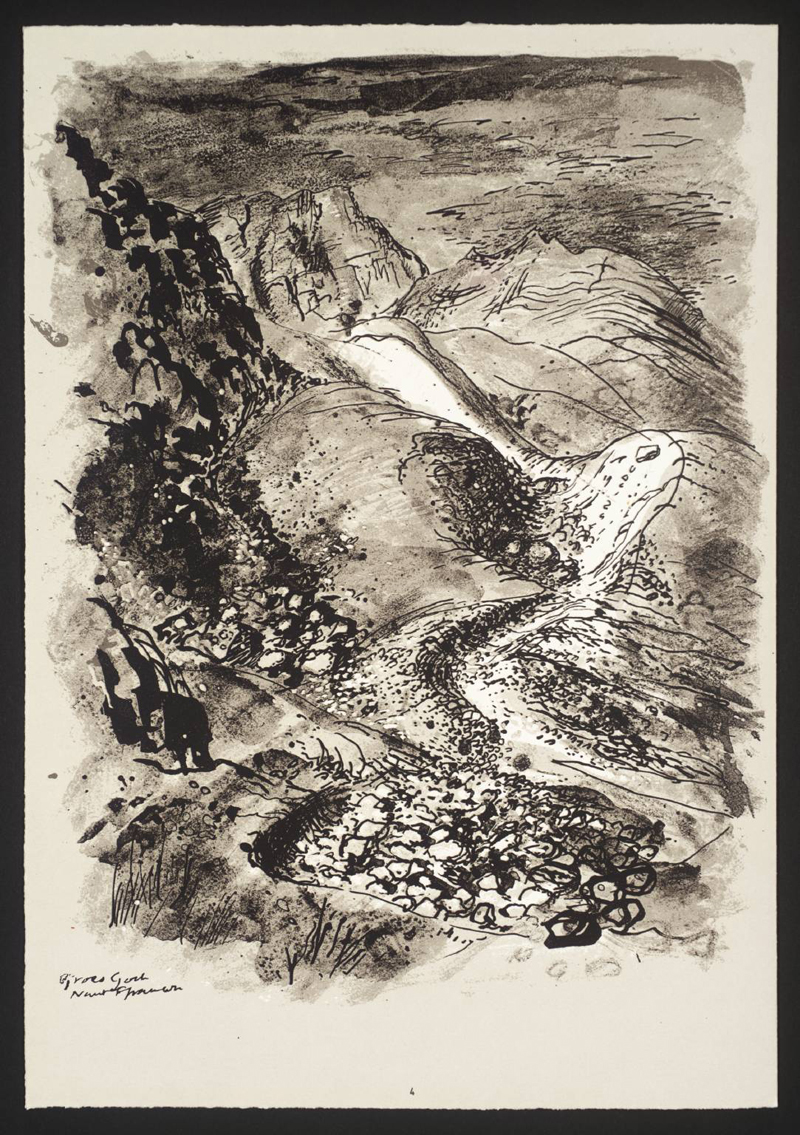
    A small exhibition at Whitworth Art Gallery in Manchester (9 February to 16 June) displayed Piper’s paintings done during the artist’s visits to Snowdonia in the 1940s. It reminds us of what a powerful and original artist he was. Of several outstanding pictures, which are as good as anything by other British artists from this time, one in particular seemed to encapsulate everything Piper sought and stood for. It depicts the Nant Ffrancon valley as a living, dramatic place whose appearance is dictated by its slow forming by glaciation. In such places Piper’s imagination and speculation ran riot. Rock is alive, work in progress. The experience of such a picture encourages even seasoned lookers to see and appreciate more intensely any genius loci. http://www.whitworth.manchester.ac.uk/whatson/exhibitions/johnpiper/

    This astonishing picture was sold two years ago for £17,000 – that is, under half what Hirst was charging at his recent Tate Mart for a signed poster exhibiting no discernible artistic merit. Good luck to the perceptive individual who acquired this modest treasure. But why is it so obviously a silly question to ask if a single British gallery or museum had noticed this profound painting and bothered to bid for it. There is a similar though inferior example from the same series depicting a nearby motif in the Tate’s collection, which needless to say is not on show. £17,000 for a masterpiece when signature decorative froth by Picasso sells for over a hundred million…

    We have the wrong brainwashed curators frightened to acknowledge diversity and following the wrong narrow trends; the wrong art market rigged solely for investment and profit; the wrong craven museum directors too willing to toe the establishment line; and we are constantly force-fed the wrong art which boasts so much yet delivers so little. Piper should be on show and permanently celebrated. He died in 1992, and there has been mounted no retrospective of his work since 1982.

    If your interest in the history of British art extends beyond the fashionable and you haven’t yet read Frances Spalding’s beautifully written joint biography of John and Myfanwy Piper (Oxford University Press, £16.99 pb, a tenner on Amazon) then it’s about time you did: you’re in for a most edifying journey.

    David Lee

    May/June 2013