Visiting Chichester for the first time in my life recently, I was much struck by the modern building at Chichester Cross, admittedly not nearly as bad as the unbelievably terrible Festival Theatre but nevertheless more than sufficient to spoil the townscape. Any jobbing builder of the 18th century would have done a much better job than any British architect of today. If I had my way, I’d close the schools of architecture and outlaw the Royal Institute of British Architects.
The ruination of every British townscape in fashion similar to or worse than that of Chichester Cross seems programmatic, if not outright conspiratorial. It is as if British architects, angry at or humiliated by their own lack of ability, had sought deliberately to besmirch the work of their more able, if untrained, predecessors. Unable to create, British architects can at least destroy. They have done so with a remarkable thoroughness.
Of course, you get used to what you have to live with. British architecture is like a bad smell, after a time you don’t notice it. Not that our neighbours, the French, are very much better; indeed, I think that in some respects they are even worse. But they have smashed up their towns rather less than have we, perhaps because there are more of them to smash up.
My wife tells me to calm down whenever I see some act of architectural vandalism; what is done is done, she says, and cannot be undone. No doubt this is sage advice, from the point of view of reaching a state of personal contentment; and yet I find it impossible to follow it. As La Rochefoucauld said, it is easier to give good advice than to take it.
I once suggested on air to a town councillor that his council had given permission for the construction of several hideous buildings in the midst of multi-secular beauty because of corruption. They had been paid off, I said.
The councillor was furious, even though I was referring to past councils and councillors, not the present crop of nonentities.
‘Are you saying the council is corrupt?’ he spluttered.
‘Don’t you realise,’ I said, ‘that this is the charitable interpretation? If councillors take money it is not very glorious, no doubt, but it is at least something that we can all understand, because we all like money. But if they did it because they thought it was right, because they liked the buildings… no, no, I can’t think as badly of them as that.’
In print, I suggested after the war with Serbia that we turn our cruise missiles on our own buildings, so many of which ought to be demolished. I suggested as a first target the Gifford Hotel in Worcester, a hotel of the early-Ceausescu style built in the vicinity of the cathedral on the site of demolished 18th century buildings.
The unfortunate manager of this vile establishment was asked on to the radio with me.
‘You have to remember,’ he said, ‘that it was built in the 1960s.’
‘That is what I am complaining of.’
‘Have you ever been in it?’
‘I don’t need to go in it. I can see it’s terrible.’
‘What if you came and I gave you lunch?’
‘What has that got to do with it?’ I asked.
But of course, he was right, it had everything to do with it. Freelunchism is, de facto, our ruling ideology.
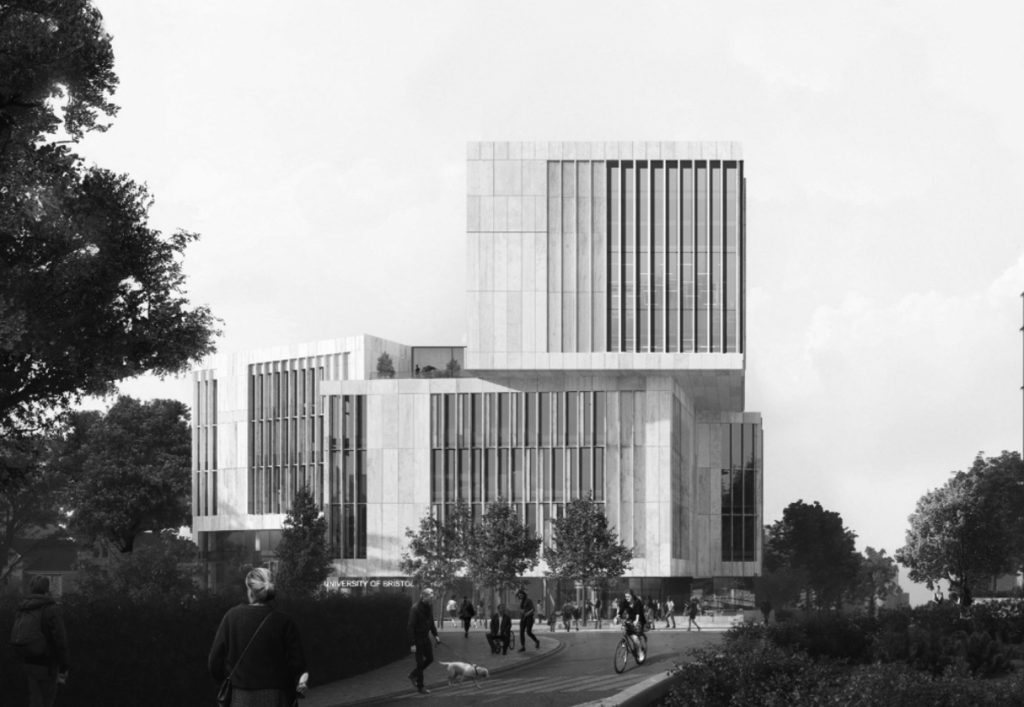
Bristol University is building a new library. The very idea is enough to send shivers down the spine: any British institution that decides to build something new is almost certain to add to the accumulated ugliness of the world.
And so it is in this case. The design that the University has accepted combines banality with monstrosity: a combination that, I suppose, requires talent of a kind to achieve. The building already looks a good candidate for demolition, probably within thirty years, and it hasn’t even been built yet. One can only hope that Bristol’s pullers-down of statues will get to work on it straight away: though of course they prefer to demolish only those things which have some aesthetic value.
One of the partners of the architectural partnership that designed the building was reported as having said: “This inspirational new landmark for Bristol will provide world-class facilities in an inclusive and welcoming environment.†It is worth lingering a moment on this horrible sentence.
In the first place, it is not for the designer of a building to say that it inspires anybody or anything, any more than for me to say that this is a good article. That is for others to decide. In fact, the new library will indeed be inspirational: but only of contempt and despair at the aesthetic incompetence, insensibility and egotism of the architects and their client alike who have inflicted such a thing on a city.
That it will be a landmark is, alas, true, for it is so large that it will be visible from all over the city. But being a landmark is not a good in itself, any more than is originality a good in itself. In the absence of aesthetic quality, it is, rather, a fault, and a grave one. I note that even the architect, who is by no means modest, makes no claim of beauty for the proposed building.
Then comes that terrible word that sounds as a tocsin: ‘world-class’. What does world-class mean? It means second-rate, mediocre, boastful, and aspiring to something that is certain not to be reached. Who would say of Chartres, ‘It is a world-class cathedral?’ or of the Taj Mahal, ‘It is a world-class mausoleum’? Even to think in these terms is to have a mind that makes greeting-card poetry seem profound by comparison.
Then comes the teddy-bear word ‘inclusive’ that is supposed bring comfort to the reader and induce a warm glow of approbation of its utterer. Who can be against inclusion? Dr Verwoerd? But who or what is to be included? Biblioclasts? Illiterates? Terrorists? Fascists? Paedophiles? Drunks? Drug dealers? Prostitutes? Pimps? Graffitists? Vandals? Swindlers? Thieves? Murderers? The word ‘inclusive’ is a lie, when it is not shorthand for deeply-ingrained but shallow ideology.
Here is what another partner is reported to have said: “While we set out to create a contemporary design that echoes the sense of civic dignity imbued with timeless sculptural qualities, the new library is deeply contextual and deliberately responsive to the historical environment of Bristol.†This is the kind of language with which anyone who reads architectural writers in our magazines and newspapers is only too familiar. Trying to fix a meaning to it is like trying to grasp the more slippery kind of seaweed. Someone should write a glossary, for example:
Contemporary – Fit for demolition within twenty years
Contextual – Standing out from its surroundings like a
fungating cancer
Responsive to historical environment – Destructive once and for
all of its surroundings.
There is one thing to be said for architects such as those of the new Bristol University library: they reconcile one to one’s advancing age.
Some years ago, I published an article in which I alleged that one of the most beautiful old towns in England had been devastated aesthetically by corrupt decisions of the council to permit modernist redevelopment. This created a certain stir in the town, and I was asked to appear on the local radio station with a town councillor.Â
‘Are you saying,’ the councillor asked, in a tone that implied that corruption and English town councils were as oil and water, ‘that our councillors are corrupt?’
‘Don’t you realise,’ I replied, ‘that this is the most generous possible interpretation of your decisions? After all, if you took them for the sake of money – well, we all like money and we can all understand corruption. But if you took them for some other reason – well, that is beyond comprehension and too terrible to contemplate. I can’t think that badly of you.’
Of course, the councillor was much too stupid to see the point, namely that it was far, far worse if the town were ruined because neither the councillors nor the architects had any aesthetic discrimination than if it were ruined for mere lucre. Against financial corruption there is at least a conceptually-simple legal remedy; against lack of taste and powers of discrimination there is none.
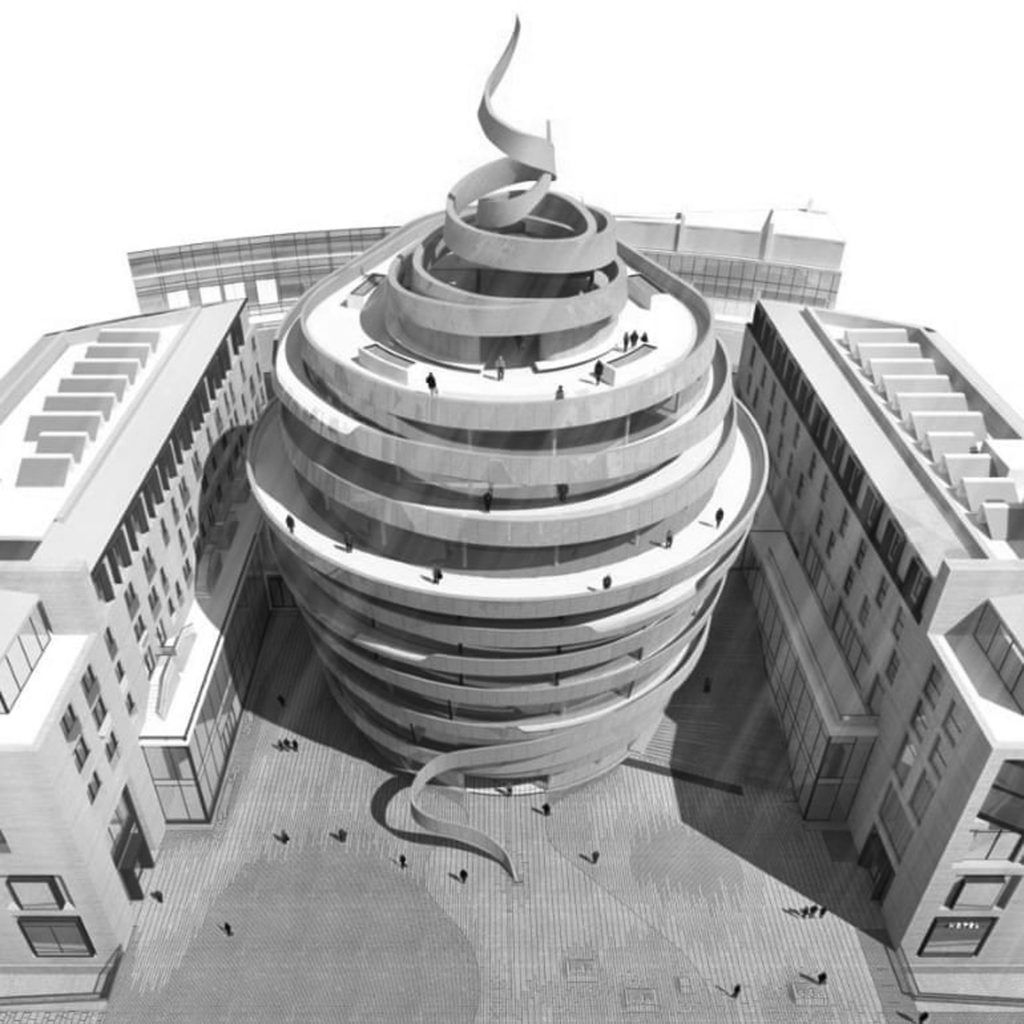
Councillors’ preference for stupidity over corruption as an explanation of their decisions brings me, naturally enough, to Edinburgh City Council’s decision (assisted by the Scottish Government) to allow the construction of a hideous, vulgar and garish building at the centre of the St James’ development, which looks like some Arab oil-sheikh’s gilded condom after repeated usage.
Corruption would, of course, be by far the most acceptable and least damaging explanation of the permission to build this excrescence within striking distance of the Georgian New Town, but far be it from me to allege such a thing.
By their self-justifications shall ye know them. On the St James Quarter website we read that ‘the scheme has been designed to create an intuitive and accessible circuit around the city – anchored by places and experiences that will draw people from one place to the next… connection with great transport links within the retail circuit will aid shoppers’ mobile experience and accessibility.’ Imagine James Craig, the designer of New Town, saying this!
Are there really people who think and talk in such language? I am afraid that there are. I met many of them in the National Health Service. They infest the police, the schools, the universities. The director of the Tate gallery, Maria Balshaw, speaks this language fluently, and perhaps owes the success of her career to her mastery of it.
The Golden Condom is the modern equivalent of the Golden Calf. It is at the very centre of a ‘mixed-use destination of the future’ and ‘boasts a world-class retail, leisure, hotel and residential offer’.
Whenever any British city councillor or developer uses the word world-class, he means, of course, Dubai: that is to say, some vast and brightly lit emporium where people can buy exactly the same products as they can buy in any other such emporium, from Bogota to Banjarmasin. The world that is world-class is a vast shopping mall connected to an airport terminal. In Britain, of course, such places are frequented by the insolvent in pursuit of the unnecessary, that is when they are not consuming world-class pizzas or fair-trade cappuccinos.
As to the architect of the Golden Condom, what can I say? I am now suffering from outrage fatigue. I look at the architects’ latest assaults on the eyes and am struck dumb. Before them, I am as Lot’s wife post-pillarization.
One should not speak ill of the dead, of course, but the length of the interval before one may decently do so depends on the public prominence of the deceased. He or she who lives by notoriety asks to be reprehended by notoriety, and alas it is the aim of many artists (I use the term without entering into the knotty problem of the definition of art) not only to be noticed but to be notorious.
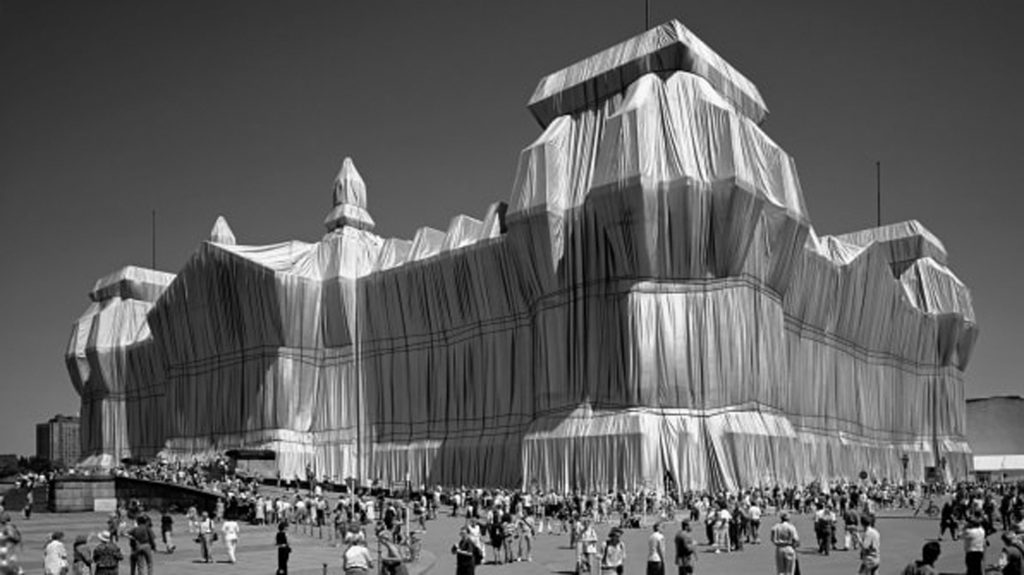
Christo Vladimirov Javacheff, trade name Christo, died recently, his wife and partner in art (if that is what it was), Jeanne-Claude, having predeceased him by eleven years.
If anyone had set out deliberately to expose the triviality and emptiness of the cult of originality in art, he could hardly have done better than to imagine this couple: for they it was who first covered public buildings or monuments in thousands of yards of cloth, temporarily of course, as if to do so were a form of worthwhile artistic expression.
Their most famous ‘work’ was the covering in cloth of the Reichstag in Berlin (top) in 1995. They had covered the Pont Neuf in Paris (middle) with beige cloth in 1985 and also suspended a vast curtain between two mountains in Colorado (bottom), but it blew away a day later. Christo had been given permission to cover the Arc de Triomphe in Paris this autumn, but fate intervened to prevent it. My sense of loss is not great.
“It took years and years of obstinacy to obtain political and administrative permission from the authorities, and to guarantee the production of their works.
One can just imagine the authorities being badgered into submission by the couple’s accusations of their, the authorities’, bone-headed lack of understanding of what they, the couple, were trying to do, and of its great artistic importance. No doubt the couple also had their supporters, the believers in the artistic ‘cutting edge’, as if art were a salami, or of the avant garde, as if art were an army marching towards a battlefield on which the final struggle against artistic imperfection would take place.
Nothing is easier of accomplishment than Christo-type originality. The possibilities are endless. One could, for example, put a tiger in a cage in a public space having first covered the tiger in shaving foam. No one, to my knowledge, has done this before, or anything like it. Furthermore, it would not be very difficult to construct some kind of reason for doing so. The shaving-foam-covered tiger would represent Man’s rape of Nature by industrial production, while the necessity to keep the tiger in the cage would represent Man’s shamefaced acknowledgement that, his rape of Nature notwithstanding, he is still prey to its forces. Of the spouting of bilge there is no end.
Christo started off as a painter, but since he had little new to add to the tradition, he decided to go off in another direction entirely. With no great talent for painting, he probably blamed the medium rather than the lack of capacity in himself. He was like those writers who, finding that they cannot write a novel, declare the novel to be dead.
It took twenty years for the covering of the Reichstag finally to take place in 1995, after the reunification of Germany, although the idea was put forward before the fall of the Wall. All that for two weeks! For, on every occasion, after a few days, the curtain fell and the places returned to their original condition. It was the work that vanished, packed up forever in the coloured glow of its brief but intense scintillation.
Originality, what crimes are committed in thy name!
I see that the architect, Richard Rogers, is to retire at the age of 87. This is an excellent thing, of course, but unfortunately it comes seventy years too late. Rogers has done as much as anyone to make the world a little uglier (and locally, much uglier); in that sense he has been very successful. He has been a powerful and effective propagandist for inhumanity in his chosen field. No one could deny that he had an ultimate vision: namely, that of the world as a giant airport terminal.
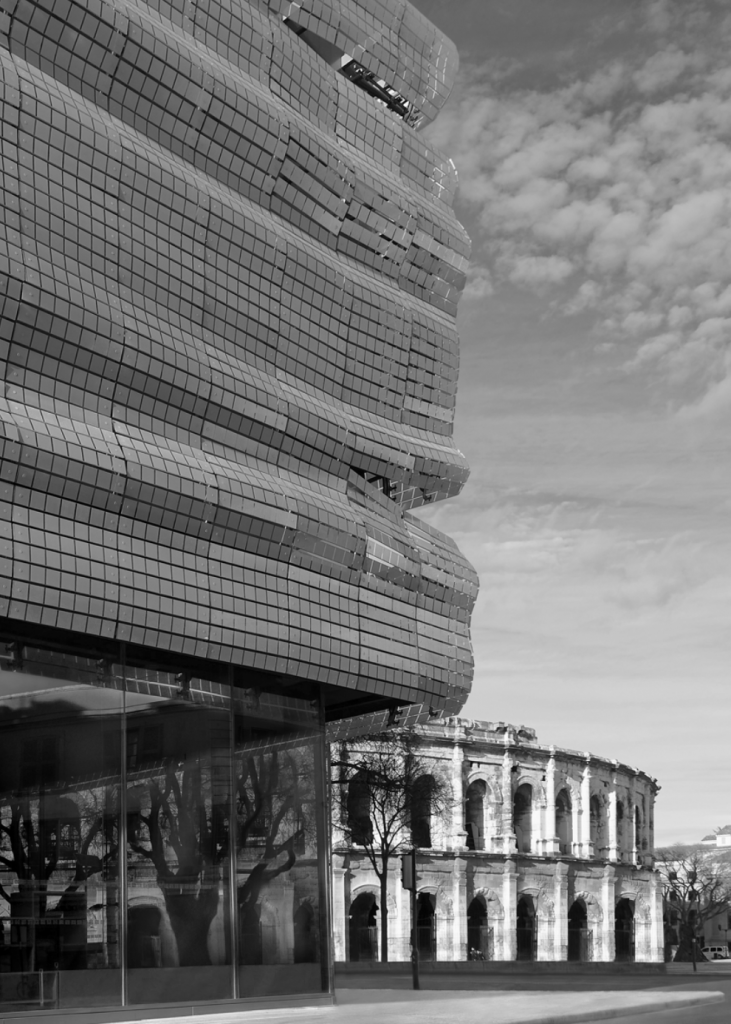
Of course, he is not the only architect whose life would have been much better spent doing nothing on social security than in employment. I will mention in this connection only another two, Norman Foster and Elizabeth de Portzamparc. I name them because I happened to pass through Nîmes the other day, and I never cease to wonder at the effectiveness of their subversion of beauty there. But if I had to award the palm, it would be to the female of the species.
If Elizabeth de Portzamparc had been a cook, she would have invented dishes such as herring and vanilla ice-cream or oysters in raspberry jam. Her restaurant wouldn’t have lasted a week. As it is, she evidently believes that the greater the clash between what she builds – which is in any case inherently incompatible with anything except itself – and its surroundings, the more valuable it is as provocation, and the greater the monument to herself. She teaches architecture, incidentally: talk about corrupting youth!
Ortega says, moreover, that the new style divides the population into an elite that understands, and an ignorant philistine mass that does not. (Le Corbusier is quite explicit about it.) No one, not even a nouveau riche tycoon, wants to put himself into the category of the ignorant or philistine, and so he goes along with whatever the self-appointed representative of the enlightened elite tells him. Bestriding the world like a colossus from the purely economic point of view, he is also but a humble flatterer at the court of the emperor with no clothes. Even humbler are the municipal councillors, who are aware of their own nullity.
The explanation, then, is the triumph of the propaganda campaign of the modernists. But there is never a final or ultimate explanation of anything, and so we must then go on to ask, why was the propaganda so effective?
The political and cultural magazine, Standpoint, has a regular two-page feature at its rear, one page describing somebody or something overrated, and the opposite page somebody or something underrated. In the May/June issue of this year, the two things compared were classicism and modernism in architecture. The author was Stephen Bayley, a prominent commentator on such matters.
Modernism, he tells us, ‘revels in optimism and opportunity’. That, of course, is precisely what members of totalitarian parties, communist or Nazi, like about them, and it is no coincidence (as the Stalinists used to say) that there are obvious connections between the modernist sensibility and totalitarianism. Mr Bayley, no doubt unintentionally, makes this clear when he says:
“It was the poet Arthur Rimbaud who said “Il faut être absolument moderne.†For the first time in history, from about 1870, there was a compulsion to make poetry, art and architecture which owed nothing to tradition, but were, instead, uniquely expressive of contemporary sensibility.â€
Ah yes, the tabula rasa and the New Man, what crimes are committed in thy name! The fact that Arthur Rimbaud said something doesn’t make it true. In fact, what he said was both wrong and vicious: first because it fails to appreciate that no quality (by definition) is more fleeting than modernity, and that creatures such as we who live in time cannot but be modern; and second because it is an open invitation to egotism, insensibility, self-worship and ignorance. Before us nothing, after us, who cares? It is the content of modernity that counts.
Mr Bayley almost agrees. He tells us ‘terrible buildings – Grenfell, the French banlieues – are terrible not because they are modern but because they are terrible.’ But do they really owe nothing to modernism, rather than from modernity per se, and do they not take their inspiration, if that is quite the word I seek, from it? Mr Bayley once said, in his review of Professor James Stevens Curl’s book, Making Dystopia, ‘there is only a sliver of difference between Walter Gropius’s lofty Bauhaus ideal and a crap council estate’. Even if it were allowed that among the scores of thousands of modernist buildings in the world there are a handful that are not a thorn in the eye, surely the correct response to architectural modernism is Si monumentum requiris circumspice. What a devastating aesthetic effect if you do!
But Mr Bayley cares nothing for aesthetics, only for ‘optimism and opportunity.’ He tells us:
“In fact, modernism is the most complete expression of the will to design, a definition of what it is to be human, of making buildings which are appropriate, efficient, comfortable and, if at all possible, beautiful too.â€
Here is the admission that for him beauty is a kind of optional extra, like electrically-heated seats in a car. It is very low on his list of priorities, as if beauty along with truth and goodness were of but minor importance in human existence.
Everything that Mr Bayley says is both philistine and inaccurate, teetering on the edge of idiocy. ‘The glory of the modernist mentality is that it is optimistic,’ he tells us. ‘It revels in the beauty and the opportunity of the here and now and the tomorrow.’ It does not occur to him that our today is tomorrow’s yesterday. Why should tomorrow’s people who revel in the beauty and the opportunity of the here and now care about what we did? No wonder so many modernist buildings are worthy only of demolition.
With regard to classicism, he says that ‘you can tell the quality of an idea by the company it keeps.’ This is a reference to Mr Trump’s executive order that from now on classicism should be the default style for new Federal buildings. But Mr Bayley is a great admirer of Le Corbusier. Le Corbusier was a fascist in the most literal sense. Et alors?