Tag: Eric Coombes

  • Eric Coombes: The Destruction of Art Education and its Implications for School Pupils

    Eric Coombes

    The near-destruction in the western world of a centuries-long tradition of visual education could be described – hyperbolically but not misleadingly – as having been accomplished overnight. The inherited gifts of that tradition are now being casually, ungratefully and even malevolently thrown away. In its chronologically long-range survey, What Happened to Art Education? provides the context in which the extraordinary rapidity and grievousness of this loss displays itself.

    The enormity of the threat to our culture is evident to those responding to David Lee’s essay in last month’s edition of The Jackdaw. There is broad agreement that art education at the higher level has been wrecked by the jettison and denigration of traditional skills (usually by those incapable of acquiring them), and the imposition of the ‘intellectual’ in their place. This judgement is grounded in a true perception of an appalling state of affairs. But we need, in my view, to take care not to make our observations in misleading terms. James Charnley, for example, suggests that ‘[t]he way forward is to take the intellectualism out of art’. This, however, could be taken to imply that what was displaced by ‘intellectualism’ was itself without an important intellectual dimension. It might also seem to presuppose that the practice of ‘art’ as it is now generally promoted at the ‘higher’ level of ‘education’ is dominated by the exercise of intellect. Who provide the models for this exercise? Such towering intellects as Damien Hirst, ‘Professor’ Tracey Emin or Martin Creed? If intellectualism needs to be ‘taken out’, then ‘intellectualism’ must be understood as something hostile to the cultivation of intellect – as an arrogant imposture, the infantile pantomime of self-important pretence that now constitutes ‘education’ in the visual arts. 

    Following the recommendations of the Coldstream and Summerson reports more than forty years ago, a formal requirement was introduced for Dip.A.D. and then degree courses in art and design to include a modest element of ‘complementary’ studies, generally art history, theory and sometimes aesthetics. It is worth remembering that the devil’s work of utilitarianism, though already well advanced, had not yet reduced higher education quite to its present state of ruination; and this requirement was intended to enhance the humane benefits of art education, as education – as something of value in itself, rather than a mere preparation of students for their putative future roles as economic units in a world understood entirely in terms of commerce. (It should, in passing, be emphasized that the political context of crass philistinism in which this attitude has triumphed is by no means attributable to one political party rather than another.) 

    There was no reason why this provision of genuinely intellectual material (wherever the actual provision could properly be so described) would threaten the learning of traditional skills – no more than a course in, say, the philosophy or history of mathematics would hinder a mathematics student from doing mathematics. The bogus intellectualism that now prevails is a very different matter, since it has invaded and subjugated the domain of practice and thoroughly poisoned the soil in which skills were cultivated. 

    What, exactly, are the skills that have been scrapped? Well, in the case of painting, for example, the correct answer is the tritely obvious one: they are those required to make paintings. In what sense are those skills not intellectual, by contrast with what has displaced them? Clearly, some of the necessary operations involved have, in themselves, no significant intellectual dimension – such things as preparing grounds and so on. But consider what a level of organized complexity can be achieved in painting, even in a simple still-life, let alone in such stupendous achievements as, say, Poussin’s Adoration of the Golden Calf. Such a work embodies an awe-inspiring exercise of intelligence. Does that not count as – among other things – an exercise of intellect? In what sense of ‘intellectual’ is this not intellectual, while gobbledygook posturing as thinking is? The uneducated find what is intellectually demanding indistinguishable from the merely confused, illiterate, pretentious or fraudulent, and may therefore suppose that the more something is incomprehensible to themselves the more they must pretend to understand and value it. And, as a few important but disregarded commentators have pointed out, a major problem of the contemporary world is that education is now largely in the hands of the uneducated.

    Before moving on, I want to make one specific point about ‘skills’. Traditionally, the central ‘skill’, for all the visual arts, including architecture, and – partly in a slightly extended sense, sculpture – was that of drawing. I have added scare quotes to the word ‘skill’, not because the word is incorrect in this context, but because it may have inappropriately modest connotations, especially when applied to drawing. If drawing is a skill, it is a skill in much the same sense in which the use of language is a skill, and, like language, it is a medium of thought and not merely the technique for producing artefacts of certain kinds. This is why, before the comprehensive vandalization of art education, drawing was understood to have paramount importance, as something fundamental and indispensible. And unless an understanding of this indispensability is regained, we shall have destroyed our visual tradition, which is as much as to say that we shall have destroyed the visual arts themselves, leaving only a deposit of artefacts as inscrutable items of cultural palaeontology. 

    Here I merely assert this point, essentially without argument. With the editor’s indulgence, I might return to it in a future article, where I would attempt some elaboration, elucidation and justification. But I now turn to an aspect of the present situation not explicitly dealt with in his essay: the predicament of the young person preparing to enter higher education from school, wanting to pursue an interest in the visual arts, but confronted by the chaotic and hazardous wreckage of the art-school system in which help might once have been found. Deprived of life by the managerialist philistines into whose malign custody they were delivered, the mortal remains of serious and sometimes distinguished schools of art now rest in the huge charnel houses that have ousted and plundered them. Under a regime of licensed fraudulence, these bloated conglomerates often boast such preposterously vainglorious titles as The University for the Creative Arts. (What, may one ask, are the uncreative arts?)

    But, it might be objected, they have no difficulty in recruiting students – do they? Well, perhaps not – no more than do any of the other entities now allowed to boast the once meaningful title of ‘university’. What is the significance of this fact, if it is a fact – in a situation where, in consequence of government policies, a university place – no longer perceived, as it once was, as a privilege contingent on achievement – has become, for nearly half of each cohort of school leavers, something like a right which it is almost compulsory to claim? It might be worth reflecting on the hugely varying levels of ability or attainment needed to gain places at these institutions, and – connectedly of course – the unprecedented magnitude of variations in the levels of well-informed esteem, or disesteem, which they enjoy within the informal hierarchy of institutions now labelled ‘university’. 

    Let us consider the likely path to art school taken by able young people in the past. Many children, probably most, will, if encouraged, enjoy using art materials, and often fall happily into the habit of drawing – a habit that can be cultivated, unhampered by cumbersome paraphernalia, using very modest, easily portable materials. As we grow up, those of us who develop a strong interest in the visual arts are usually, I imagine, encouraged by teachers or parents, or, best of all, both. At least, that was, I think, true for many of my generation: I feel less confident that it is still the case. Our interest in making art or, more accurately perhaps, what is not yet art – proto-art – grows along with our discovery (helped by those mentors) through reproductions and visits to galleries, of what is possible – which turns out to be even more revelatory than we had, to begin with, realized. The masters show us what is possible, but this is disclosed gradually, since the ability fully to experience what they reveal itself depends upon the development of perceptual capacities which are cultivated only through acquaintance with their works.

    The particular kind of satisfaction we take in making images becomes inseparable from our sense of participating in an activity defined by the practice of the masters, not simply through knowledge of the fact that it is of the masters, but through finding that our experience of their work leads us towards an intuitive grasp of what – in our tradition – drawing is. This involves the dawning understanding – not necessarily verbally or self-consciously articulated – that when we enjoy a drawing by, say, Rembrandt, we are following the articulation of a thought of Rembrandt’s, inseparable from that particular drawing, and not merely recognizing the subject-matter. We could almost say that we follow that articulation by imagining ourselves making that drawing, and perhaps wanting to do something not the same, but in some sense equivalent, or in the same spirit. The joy that comes from any modest little successes in this endeavour engenders an aspiration, an inner voice which will not be silenced, which may ultimately deflect the young person from the path of prudence. Sensible suggestions to enter the law or accountancy are rejected, and the seduction of art triumphs over the cogently argued merits of social and economic caution.

    It is still possible, though less likely than it was, for sixth formers to be in something like that state when contemplating where to go after school. But the seduction of art no longer leads them to art school (or ‘University of Blah Blah’), or, if it does, they have made a big mistake (I know of one such mistake); for they will almost certainly find themselves required to devote time and energy to what bears no discernible relationship to the difficult but rewarding activity that brought them there, but prevented from trying to do better what they actually want to do. Why would an intelligent young person animated by the joy to be found in drawing, painting and sculpture – which is still what usually leads the young to art – gladly submit to a peremptory requirement to make videos, discover a hitherto undisclosed enthusiasm for ‘installations’, or rejoice in solemn but idiotic projects under the rubric of ‘conceptual art’. What have these things got to do with the visual arts? Not only will students not be taught to draw, they will probably be virtually forbidden to engage in what can properly be called drawing – although they may well be told that photography, videos, installations and, for all I know, pastry-making, yo-yos, pub-crawls, ping pong or bouncy castles are forms of drawing. 

    The consequence is that, the ‘lad or lass’, to borrow some words of Augustus John’s, whose ‘soul is alight with that flame which in the young only art and love can kindle’ will, if both intelligent and well-informed, decline to enter an institution purporting to provide higher education in the practice of the visual arts. Any unfortunate enough to be misled are destined to probable early withdrawal, or to the endurance of shamelessly pretentious diseducation, to frustrated hopes and huge debts, acquired entirely wastefully. I leave it to the reader to judge whether these institutions are filled with lads and lasses whose souls are alight with that flame which, in the young, can be kindled only by videos, installations and ‘conceptual art’. For myself, I have to admit that I regard that hypothesis with scepticism. 

    Degree courses in art, therefore, especially in ‘Fine Art’, may enrol unprecedentedly large numbers – criminally large numbers – of students. Whether they have many young people actually studying the visual arts is another matter entirely. Indeed, one may doubt that successful art students – successful by the criteria (or whims) of the system they have entered – are really interested in art, given that they may have little acquaintance with what it is they would be interested in. More than with most professions, the propensity to pursue a career in art seems until recently often to have had a strong familial element. In all the (not unnumerous) cases where I knew, each of my own older ex-colleagues had a least one child, sometimes more, who had followed father or mother in attending art school. But among my own contemporaries and those following this seems not to be so. I reluctantly advised my own children against this course, despite their great enthusiasm and capacity for drawing and painting, and I know of others, similarly placed, who have done the same. Those most capable and motivated to study art – and also best informed about the condition of art education – may well be those most decisively rejecting degree courses in the practice of art.

    An important consequence of what I’ve so far said is the near certainty that there has been a precipitous decline in the average abilities – abilities of any kind – of students enrolling for art courses. Nearly all young people going on to first-degree-level courses in any subject, including art, will have first completed A-level courses, or some equivalent thereof. It is only after this that full-time study of art can usually begin. Art remains just one subject among many that might be pursued after school, and, for obvious reasons, not one which the academically able always get much encouragement to pursue in the sixth form. There was a time, however, when the academically able sixth former might have continued with art as an extra A-level subject, fitting the work into the spaces between other timetabled subjects. In that way, an officially recognized interest in art, with the possibility of further development, was retained, even as the preconditions for entry to more conventional and secure careers continued to be established. And such a sixth-former might finally be unable to resist the promptings of a soul ‘alight with the flame’ kindled by art. 

    But this route for the academically able has been made more arduous, because of changes in how art is now taught and examined. Superficially, these changes might seem benign. When I did O-level art at school, we took, if I remember rightly (the exact details are unimportant), three three-hour papers: drawing from the human figure (a boy in his gym kit); still-life drawing; and a painted pictorial composition. For the last, one was given a (small) choice of subjects in advance, in order to prepare for the examination, which one did by working out a composition through sketches, and possibly making studies from observation. But this preparatory material was not allowed into the examination room, where one tried to complete a painting in three hours. At A-level, the procedure was essentially the same, except that to the three O-level papers was added a fourth design paper, and, if one might be a candidate for a state scholarship, a paper in art history. 

    There is much to be said against this system, and much was said against it. It was sometimes thought unreasonable to expect candidates to make a painting in a mere stressful three hours. But we could make paintings in those circumstances, and were sometimes not entirely displeased with the results. And whether it was really more intolerable, or potentially unfair, to have to make a painting under these conditions than to write three or four mini-essays under similar conditions for other subjects might be regarded as a moot point. 

    On first consideration, the current system might seem to promote a more serious and more ambitious engagement, since pupils are assessed mostly on projects which need to be sustained over longer periods, during the two years of the GCSE or A-level course, rather than on the outcome of three stressful periods, each of three hours. Projects will probably be based, or supposedly based, on some such abstraction as ‘metamorphosis’, ‘flexibility’, ‘proximity’ (you name it): the tired old genres of landscape, still-life or figure composition are presumably not thought, merely in themselves, to challenge the intellectual and ‘creative’ capacities of the candidate. The development of these projects has to be recorded (or appear to be recorded) in notebooks, written as well as visual, and by the filling of portfolios. Everything has to be explained in written notes, whether standing in need of such explanation or not.

    A minor part of the assessment does involve producing a piece of work under examination conditions, or a very loosely supervised variant of examination conditions. But a total of ten rather than three hours is allowed for this; there are no restrictions on what can be brought in for use during these ten hours; and, as with course work, records must be produced of the preparatory evolution of ideas, which may be needlessly, if not fraudulently, elaborated. Whereas under the old system, the work was sent off to be marked by an examiner unknown to the candidates, under the present system, everything, not just course work, is marked by the candidates’ teachers, though subject to external ‘moderation’. The assessment, at least in theory, is not simply of the quality of the final outcomes, but, at least as importantly, of the processes – as presented – through which those outcomes have supposedly been reached, together with the candidate’s written accounts and written assessment of those processes. If I could bring myself to write a full account of the 55 pages of Edexcel’s mind-numbing ‘specification’ for GCSE in Art and Design, I doubt that any readers (whose patience may already be tried) could bring themselves to read it. Suffice it to say that it is impossible that any intelligent person could regard its multiplication of arbitrarily invented criteria and of bogus distinctions between different aspects of the ‘creative’ process as anything but a kind of bureaucratic or managerialist fantasy: the fantasy that, if something is broken down into enough components, even if those components are themselves invented for the sole purpose of sustaining the fantasy, then assessment can be made more ‘objective’ by reducing its outcome to a kind of arithmetical sum. But some inkling of the quality of thought informing the specification will be gained by an inspection of Edexcel’s preposterous ‘assessment matrix’. (I reproduce here, opposite, the one in use when my daughter did GCSE art. The A-level ‘matrix’ was essentially similar.) It will be seen that each candidate has to be given a mark for two ‘strands’ relating to each of four ‘assessment objectives’. That is, the final assessment is determined by the sum of no less than eight marks – not marks for eight pieces of work, but for qualities supposedly displayed, or not displayed, throughout the ‘course’.

    It will be noticed that no competence of a traditional nature is specifically required (none, that is, of the centuries-old tradition of western art), and the central discipline of drawing is not even mentioned. By contrast, under the old discredited system the ability to draw from observation was not only required, but explicitly examined. As at the ‘higher’ level, it amounts to the same thing, whether drawing is dismissed as unnecessary or obsolete or whether almost anything but drawing itself is promoted in its place as an alleged form of drawing. It is as if we suddenly decided that it was no longer necessary for writers to know how to construct sentences or mathematicians to acquire fluency in using the system of symbols in which mathematical thinking is conducted. (But ‘educationists’ have gone a long way, if not yet quite so far, towards implementing those decisions too.) It should be noted that, even for the most talented, to draw well is very, very difficult, and therefore requires discipline, the demand for which is now regarded with suspicion. It is also the most teachable element in a proper art education. But teaching it requires competent draughtsmen willing to teach, that is to undertake that other ill-regarded and obsolete thing: instruction.

    Under this system, it is, in fact, possible for enlightened teachers, where they preside, to establish a regime in which their pupils receive some genuine visual education. If they have any sense – which is not always the case – art teachers in practice assess their pupils’ work much as they always have done, and then divide the overall mark into eight fantasy marks. They may also, if necessary, prompt their pupils to ‘find’ additional preparatory work or ‘records’ of such, to complete the trail of ‘evidence’ establishing their adequate compliance with the requirements of both ‘strands’ in each of the four ‘assessment objectives’. 

    Despite the enormous amount of nonsense, bogus intellectualism and pretence bound up with it, this system might seem, in significant respects, an improvement on previous systems. Since it demands more work, or at least time, from pupils, does it not now seem a weightier element in the curriculum, and thereby gain in prestige? In fact, any parent whose children have been through the elaborately but counter-productively regulated system we now have will know that, in most subjects, pupils’ workload has become heavier, more time consuming, more onerous and tedious than ever, while it is simultaneously contrived that less than ever is actually learnt. No subject, however, has been made more time-consuming than art, largely through the requirement not only to preserve or record preparatory work, but for pupils to become archivists of their own ephemera. 

    Compared with this system – counter-intuitive though it might at first seem – for academically able pupils, taking perhaps nine other subjects at O-level, and perhaps three others at A-level, the old system had distinct advantages. At A-level, art has become so time-consuming that it is not practicable to take it as an ‘extra’ subject. When my own children were entering the sixth form, we knew of several young people who reluctantly decided against continuing with art at school, mainly because of this hugely time-consuming aspect – not, in these cases, because their parents were otherwise opposed to their doing so. But these were pupils with academic ability at a high level, who had not at that point definitely made up their minds what direction to take after school: for such pupils it would have made sense to take art to A-level only if they had already decided to continue with it as undergraduates. But they were potential candidates for places at ‘top’ universities to study academic subjects, and had not, at that stage, decided against seeking those places.

    Academic high flyers were always likely to be under pressure not to take what was seen as a needlessly risky route through the sixth form to a higher level course in the practice of art. The possibility of their doing so must be further weakened if the objections to continuing with art in the sixth form are reinforced by these additional pragmatic considerations. But we now have the sad and bizarre situation where, in considering the good of both the visual arts themselves and the young people concerned, this is, in itself, something impossible to regret. 

    What about those talented but ‘un-academic’ students, who rightly concern Paul Wilks in his contribution to the previous issue? I strongly suspect that, in the past, the need for their dispensation from the academic entry requirements arose far more from deficiencies in the schools than from innate deficiencies in the entrants themselves. In any event, because of the general devaluing of qualifications, the loss or curtailment of those concessions is probably no longer of much consequence. They may not find it difficult to gain admission to degree courses in ‘Fine Art’, but what prospect does that offer to the talented of exploiting their talents? The very abilities in recognition of which they might once have secured dispensation from the academic entry requirements are precisely those which, in current circumstances, they will have no opportunity to develop. In any case, who would recognize their talents?

    Drawing, Tradition and Peter Clossick

    In 1941, Augustus John contributed A Note on Drawing (from which I quoted a few words in the previous issue) to a book edited by Lillian Browse, containing reproductions of his own drawings. John records his sense of good fortune in having been a student at the Slade, and thereby spared an oppressive training in ‘the substitute for drawing’ prevailing in other places, notably the Royal College of Art or its immediate precursor at South Kensington.  This substitute was ‘Stumping’: ‘An innovation having no roots in tradition, it pretended to provide the student with a means of representing form without risking the use of a line. … the student was instructed to copy the objects placed before him by means of a prolonged smudging and stippling process.’  This system ‘… blighted every trace of talent which suffered under its inexorable discipline.  Many a lad and lass, their souls alight with that flame which in the young only art and love can kindle, were fated, after a course of “Stumping” … to retire beaten at last …’  At the Slade, by contrast, ‘a very different system prevailed under Frederick Brown and his chief lieutenant Henry Tonks.  There “Stumping” was severely banned and the students had to do the best they could with the point of a stick of charcoal and a sheet of “Michelet”. They were even encouraged to study the Old Masters!’.  He continues with some remarks about Brown’s use of ‘rhythmical lines’ and ‘Tonks’ insistence on the Contour [which] was equally sound and in the great Tradition …’

    Two themes in this brief note are closely connected. First, John was repelled by a system which eliminated the risk of using line, because it extinguished for the students the very source of joy, which had motivated them to study art. It did so by making mindless precisely what should engage the mind in the endeavour to find and articulate an intelligible visual ordering in what is drawn. This endeavour cannot bypass the decisions, the revisions of decisions and, indeed, the mistakes and attempted corrections, which are brought to judgement in the determinacy of line. To eliminate this essential feature of visual thought is to render drawing mindless and deny its very nature. It was clearly important—to invoke the second theme—that this ‘substitute for drawing’ had ‘no roots in tradition’, whereas at the Slade drawing was understood and taught as the unifying central strand in ‘the great Tradition’, and students were encouraged to study the Old Masters—a policy whose fruits are illustrated in this book by the astoundingly accomplished drawing after Watteau which won John a prize awarded by Tonks in 1897. The ‘great Tradition’ was defined by a canon, in which the practice of the masters provided models of drawing as a medium of thought. 

    It does not, for present purposes, matter greatly if John was exaggerating (as he probably was), or being to some extent unfair, in his eloquent denunciation of what went on in South Kensington. What does matter is that he intuitively understood drawing as essentially an exercise of thinking, which cannot be reduced to a mere technique, still less to a fail-safe technique. The gesture of drawing a line is an action integral to the draughtsman’s thinking, and the trace remaining is alive with the meaning with which that action imbues it: the risk of not immediately getting it quite right is just the risk that attends and is inseparable from thought itself. To eliminate that risk is to withdraw the mind from its internal relationship to drawing—that is, the relationship in which drawing is thinking, not merely the product of thinking—leaving nothing but an inert routine: a ‘substitute for drawing’.

    It is misconceived, therefore, to take the ‘skill’ of drawing to be merely a technique, merely the means to the end of producing a certain kind of artefact, which might, in principle, be produced, equally well, or more conveniently, by some other technique. Something like this misconception must underlie claims that photography, for example, can be considered a form of drawing, and ‘Stumping’ as described by John could almost be described (with qualifications unimportant in the present context) as a pointlessly laborious procedure for manufacturing substitutes for photographs.

    In a previous issue Dr Selby Whittingham cited Finberg as complaining in 1910 that ‘the only kind of training that is provided for English art students is training in this capacity of reproducing objects of sight accurately.’. Finberg may well have had good reasons for complaint, but his actual words here, if taken perfectly literally, make no sense. Drawings, of their very nature, cannot possibly ‘reproduce’ ‘objects of sight’ (accurately or inaccurately) except, perhaps, in the limiting case where the sole ‘object of sight’ is itself a drawing. Now as in the past, however, visual representation is often naïvely described in this way. Even so sophisticated and powerful a thinker as Ruskin is guilty of this confusion, most obviously (if inconsistently) in The Elements of Drawing – although what is there posited as the object to be copied is an appearance, incoherently understood as an array of coloured shapes, already a kind of picture of the scene to be represented. But an appearance is of a different ontological order from a picture and is logically uncopyable by any physical entity. One might as well say that a debt can be copied by a coin. This common misconception, which is derived from a notoriously fallacious strand of empiricist philosophy, is extraordinarily tenacious, and by no means dead.

    In the practice of art, and even in the practice of criticism, this confusion need not be disastrous: a better understanding advances and articulates itself in the practices themselves, even where less defective conceptions do not emerge into the light of theoretical reflection, or emerge only inchoately in criticism. But it matters much more when, as often happens today, the misconception deforms both teaching and practice. Fifty or so years ago, most art teachers at every level intuitively understood drawing as much more than a technique for making something that might as well be done with a camera, although they probably saw no need, and perhaps lacked the capacity, to explain this at the level of theory. They were content in the knowledge that anyone to whom this was not intuitively self-evident had not yet fully appreciated the gifts of the tradition that defines what the visual arts are. But nowadays the very word ‘tradition’ may meet with incomprehension, bewilderment or automatic, unfocused hostility; and its invocation may aggravate rather than deflect the vindictive resentment of uncultured ignorance. But, to touch again on John’s second theme, it is through the tradition of image making that perceptual capacities are cultivated which sustain drawing as a medium of thought. In this respect, drawing is analogous to language. 

    A photograph, of course, ‘reproduces’ the ‘objects of sight’ no more than a drawing does. But in the confused view we are considering, it might be thought of as a device whereby visual appearances are mechanically copied. The tenacity of the ‘copying’ error derives, presumably, from the experience of naturalistic painting where the vividness or immediacy of the depicted scene may engender the sense of looking at something ‘just like’ the scene itself. Less naturalistic modes of representation may then be conceived of as deviations from a naturalistic norm, although there is, in fact, no norm of naturalism. It is in a way surprising that this misconception remains so common, even among those supposedly educated in the visual arts, and even since the publication of Ernst Gombrich’s justly celebrated book, Art and Illusion. This book made a huge impression, quickly found its way onto countless reading lists and initiated a chain of discussion, still continuing after more than fifty years. Since it is also very readable, quite a few students asked to read it might have actually done so. Few, if any, serious theorists would now endorse all its arguments and conclusions without important reservations (not least about Gombrich’s use of the notion of illusion); but among its indisputable intellectual achievements is that it put beyond all question the erroneousness of the ‘copying’ conception.

    We need, then, to distinguish a visual representation from a mere simulacrum or surrogate, which cannot, as such, embody thought (although it may contain information). This simple conceptual point has many implications for our understanding of the visual arts, and various lines of discussion may converge on it. It has an application to the history of early modernist painting, when associated theorizing was informed (though not always explicitly or clearly) by those implications, largely under the (not necessarily direct) influence of Schopenhauer. There is much more to be said here. But I must content myself with stating the following: A representation, as such, does embody thought about what is represented, which, in the case of visual representation, is essentially thought about how things look, including how things look in imagination and memory. (It is important not to misunderstand this by unduly restricting, a priori, the kinds of thought supposed capable of being internal to perception.) A drawing, as a drawing, is essentially about what it represents: it has the property of aboutness – or ‘intentionality’ to use the philosophical term. We see the drawing as the record and embodiment of the draughtsman’s actions, understood as the movement of essentially communicable thought. The example of the embodied gesture in the decisively drawn line makes the point particularly clear. But the principle must be generalized to include not just line, but all the resources available to the draughtsman. It must also of course, be generalized to include painting, because painting is drawing – drawing with an extended range of materials and tools, and (usually) the additional dimension of colour. And with a little reflection we see that this also extends to sculpture. 

    To understand a drawing, painting or sculpture is not merely to know that it embodies a thought, but to perceive it as doing so. The possibility of its being so perceived is essential to its nature as a work of visual art. It is not enough for it to be arbitrarily associated or linked with some thought, which remains external to its perception. This requirement by no means excludes the possible relevance and efficacy of supplementary information or critical elucidation, but it does exclude what is now typical of state art and of the sad travesty now presented in Fine Art finals shows: things which cannot so much as pretend to bear meaning without elaborate and often absurd ‘explanation’ – alleged meaning which remains entirely unperceivable even when it is made known to the viewer. The requirement of perceivability can be fulfilled only if the materials constituting the work are raised to the status of a medium. The medium of painting, for example, is not just paint but paint as used in the art of painting. And paint functions as a medium only when its use is perceivable as such. However idiosyncratic or personal a particular pattern of use may be, it must produce what can be appropriately seen by the viewer, or else fail as a medium. It is here that we understand the centrality of a tradition within which the necessary perceptual capacities are cultivated through the production and reception of work which itself demands the exercise of those capacities – by both artist and viewers. 

    Culture, as I’ve put it in the Introduction to What is Wrong with Us?, is constituted by its own continuity; and the central duty of education, now extensively abandoned, is to sustain that continuity, which amounts to sustaining us. Traditions are the particular institutions, the social organisms of continuity, needing cultivation and nourishment. The visual tradition was once supported (with varying levels of efficacy!) by the work of the art schools. But the collectivized zombies, the living-dead remnants of the art schools, have joined the apparatchiks of state art in their murderous assault on that tradition. 

    A few recent exhibitions remind us again of how recently the tradition was in a state of vigorous health, and how recently it has been not quite broken, as I nearly said, but marginalized in the sight of the state-art establishment. One is the recent Paul Nash exhibition, although, despite Nash’s great importance and achievement, one might have found in some of its constituents portents of a failure of cultural nerve in the decades following his death. Another, titled The Mythic Method, was at Pallant House. Its subtitle, Classicism in British Art 1920-1950, is actually a little misleading as to the contents, which include the work not just of classicists as usually understood, but also, for example, of Edward Burra, Ceri Richards and Wyndham Lewis, the last represented by a particularly fine portrait. 

    A much smaller exhibition at Felix & Spear, Viewpoints, furnishes a recent example of the resilience of the tradition, still defying the malevolence of the state-art establishment. Organized by Peter Clossick, it displayed one recent work by each of sixteen members of the London Group, of which he is a past president.  Four of these were contemporaries or near-contemporaries as students at Camberwell School of Art between the mid-1970s and the beginning of the 80s: Julie Held, David Tebbs, Susan Wilson and Clossick himself. In picking out these painters, I imply no disrespect for the admirable work of the other exhibitors. But these four are particularly interesting to me in the present context, partly because I am very familiar with their work, but also because they all insist on the importance of the discipline of observational drawing, which was still maintained vigorously at Camberwell when they were students there, although it was already sinking to varying depths of dereliction, corruption, deformation or outright destruction in many, probably most, art schools. From their shared grounding in that discipline has evolved the individuality of quite different, though inter-congenial, artistic personalities – demonstrating that disciplined study, far from flattening individuality, is what supplies the means of realizing it. They have received none of the support, still less the imbecile adulation, lavished on the Hirsts, Emins, Lucases, Creeds etc., but have continued with their serious and life-enhancing work, not in the easiest of circumstances, during the thirty-five years or more since they were at Camberwell. A model for such long-sustained effort could have been provided by one of their most respected mentors there, Tony Eyton, who also had a small painting in the exhibition. Now in his mid-nineties, Eyton has enjoyed considerable success, and  – not only in my opinion – among the most distinguished painters of the last half-century, he continues to be ignored by the state-art establishment.

    A small solo exhibition of paintings by Peter Clossick, also at Felix & Spear, will run through May, under the title of ‘Spirit & Matter’, words which evoke Bomberg’s well-known references to ‘the spirit in the mass’. Clossick’s painting immediately brings to mind the work of Auerbach and Kossoff, of that growth within ‘the great tradition’ which owed so much of its strength to the example and teaching of David Bomberg. Far from being a fault or weakness, it is greatly to Clossick’s credit – central to his strength as a painter – that he does not self-consciously will himself to deviate from their example, by seeking novelty for the sake of novelty in a factitious show of differentiating his work from theirs. He knows that, for the painter, true individuality arises, unforced, only from participation in a shared visual culture, which sustains the media of thought within which individuality evolves. His painting embodies an individual sensibility all the more powerfully, because it does not rely on meretricious contrivance. He is not bamboozled by the contemporary crassness that confuses novelty with originality.

    We might approach his painting by returning to the understanding of drawing as embodied action, which I endeavoured to elucidate earlier. Of course, if this is right, it is not just true, but, in a broad sense of ‘logical’, logically true – true of all drawing, including smoothly finished presentation drawings, and not only of drawing which ostentatiously exhibits the physicality of its production. It is therefore true of all painting; or, if we wish to exercise pre-emptive intellectual caution, at least of all representational painting. But this necessary truth gains a kind of visually exhibited emphasis or salience in Clossick’s painting. It is as if the painter wants to retain, or reconstitute, the early impulse of drawing in the final painting, the kind of drawing which Augustus John’s ‘note’ brings to mind, in which the action of representing finds an obvious image in the clear trace of physical action in the decisively drawn line.

    Typically, space as depicted in Clossick’s painting asserts its significance through the vigour with which it is invoked in the constructed morphology of the paint surface. The thick paint retains the texture which records the movement of the brush or other implement applying it, so that we have a very immediate sense not simply that a complex structure is described as something that was there, but that it has been reconstructed or reimagined in and through the process of making the painting.

    Our perception of space has an essential kinaesthetic dimension, and even when we are just sitting still, that element is integrated into our perceptions – at least subliminally – through memory and imagination, as potential movement. An important aspect of Clossick’s painterly idiom is that it enables such potentiality to be made explicit and salient in the construction of the painting itself, in the gestures embodied in the highly worked surface of the paint. Provided that the depicted space is established by the disposition of sufficiently recognizable forms, it is possible for imagined movement through that space to be embodied in gestures that are not constrained by an imperative exactly to follow a specific form, or which, in following it, withdraw from explicit or determinate definition, to register the less focal character of the attention we give to parts of what we perceive. A clear example of this is provided by Clossick’s painting in the group exhibition: Santon, a vertical-format painting of a reclining female nude. She lies back on a bed, or bed-like raised surface with red covering; her feet are towards us, her right leg crossed over her left, the foot approximately touching the virtual picture plane, so that it is life size. Although it is so close to the viewer, however, the foot is remote from the psychological centre of the attention we give to a person, and, being so close, can be – literally – overlooked. Though not in itself the subject of focal attention, it is at the culmination of a powerful visual thrust towards the viewer from the knee, drawn with an emphatic sweeping thick line, or visual pathway, of dark paint, as much movement through space as description of form in space. At its culmination, that movement is turned back into the virtual space, by the equally emphatic and inventive drawing of the foot – or not so much of the foot, which is rendered with conviction but quite indeterminately, as of that counter-movement itself, as if the foot’s significance lies mainly in its being at a major articulation of the spatial construction. The movement is picked up by an emphatic, but depictionally inscrutable, mark running back from us across the surface of the bed, bringing this space defining movement to rest. This complex movement – from the knee, turning at the foot and back to a point on the bed near to the model’s left hip – marks a kind of semi-enclosure in which the space seems to take on a kind of virtual substantiality or ‘density’ of its own – a quality hard to describe but characteristic of Clossick’s painting. 

    Movement of many kinds is inseparable from human life in all its aspects, and does, of course, take place in time. But a painting is realized in a static object, and cannot simulate movement or the passage of time. To mention this particular ‘incapacity’ is to remind ourselves that representation is surrogacy in respect of movement no more than in respect of physical objects or space. The representation of movement in painting or sculpture is a big topic. But here, in discussing Clossick’s work, I’m concerned not so much with the representation of physical movement in depicted objects as with the movements of thought or perceptual attention involved in the painter’s engagement with his subject-matter, including, but not confined to, the relatively straightforward example given above of imagined movement through the depicted space.

    Clossick usually works on his painting in the presence of its subject, often scraping a painting down at the end of a session, so that only its ‘ghost’ remains when he returns to it. This does not mean that the session was wasted; and the ‘ghost’ serves as the site of further exploration, gathering to itself the memory of what went before and prompting the finer articulation of what is still inchoate. Each session is a stage in the process whereby the painter is getting to know the subject better (including the subjectivity of the human subject), discovering what he thinks about it, gradually bringing into focus his thoughts about its visual and emotional complexity, and finding ways of dealing with them. He tries to reach a point where the perceptual explorations have, as it were, reached a kind of conclusion, and settled themselves into a stable resolution or crystallization which embodies their discoveries and memorializes the process.

    The ease of moving between varying levels of representational determinacy is exploited (not necessarily in a highly self-conscious way) in Raft (earlier titled Carol Floating), which depicts an unclothed woman reclining on what appears to be a bed, which is resting on, not to say nestling in, what it’s irresistible to call a ‘sea’ of broad blue brush marks, which can certainly be ‘read’ as water, but can equally be understood to signify the desultory movements of Carol’s dozing mind, projecting an unresolved image of water, as she dreams of being afloat and drifting away. Here it is as if the painter seeks to incorporate the subjectivity of the model in the construction of the painting.

    This empathic relationship with his human subjects is revealed in many of Clossick’s paintings. One I particularly admired when I saw it some months ago at the Anna Lovely Gallery is Sophia, a tender, sympathetically observed image of vulnerability, which seems to me to have fully achieved that state of ‘stable resolution’. This painting, in my judgement, is one which exemplifies the virtue and individuality of Clossick’s sensibility especially strongly. It also, incidentally, is one where he seems even closer to Bomberg than to Auerbach or Kossoff. The quality of sympathy is especially important in an earlier painting, the portrait of Trevor Aston, who was a close friend of the painter, a troubled man of some distinction whose life ended tragically.

    In conclusion, I return to my starting point in the thought that Clossick seeks to ‘retain or reconstitute the early impulse of drawing in the final painting’. The technique of ‘thick’ painting seems to facilitate that, since it allows for redrawing or additional drawing, even at a late stage, by working freely into the un-dried or semi-dried paint. This engenders a quality of directness equivalent to the directness achieved with ‘drawing materials’. It also accommodates the registration of varying levels of determinacy in the depiction of different elements in the depicted scene, corresponding to the different levels or kinds of attention occurring in our actual experience. In some passages, a close inspection reveals something surprisingly close to line drawing, as in the heads, for example, in Raft and in Santon – drawing which is delicate, and even detailed to perhaps an unexpected degree. Being worked into the surface of the paint, rather than merely superimposed on it, this drawing integrates itself seamlessly into the broad structure of the painting, just as different levels of determinacy come together seamlessly in our perceptions of the world. 

    Postscript

    For relative ease of exposition, I’ve written almost entirely about drawing and painting, and I apologize if this has not achieved ease of comprehension. But I think it worth adding a brief postscript about sculpture. For of course, the discipline of drawing is as vital to sculpture as to painting, especially if we make a small and natural extension of the denotation of ‘drawing’. 

    It is no longer necessary to enter art galleries to observe directly the consequences of the abandonment of drawing. For some time, public spaces have displayed ‘substitutes for sculpture’, to adapt Augustus John’s phrase, in the form of objects made from body casts, by Marc Quinn and other culprits. In addition to this we now have, in the technology of three-dimensional scanners, another ‘substitute for drawing’, the misuse of which is already polluting public spaces with parodies of sculpture, by such as Mark Wallinger. These ‘sculptors’ are completely untouched by any understanding, intellectual or intuitive, of sculptural form. The very notion seems beyond the grasp of them or their supporters. Wallinger’s ‘sculptures’, for example, have all the sculptural energy of petrified blancmange. 
  • Turning Wool into money … or fool’s gold

    Turning Wool into money … or fool’s gold

    Eric Coombes responds to an editorial about the art cash cow

    Is a celebrity a person ‘famous for being famous’, or merely ‘someone in the media that one had never heard of’. Despite being obscure – in this paradoxical and mysterious mode of obscurity – celebrities, however ill-informed and stupid they might be, are entitled to have their ‘opinions’ widely disseminated, and heard, at least with respect, and quite possibly with hysterical enthusiasm – especially if they are ‘comedians’. This entitlement is now regularly exercised, on an almost weekly basis, in supposedly serious discussion programmes such as Question Time.

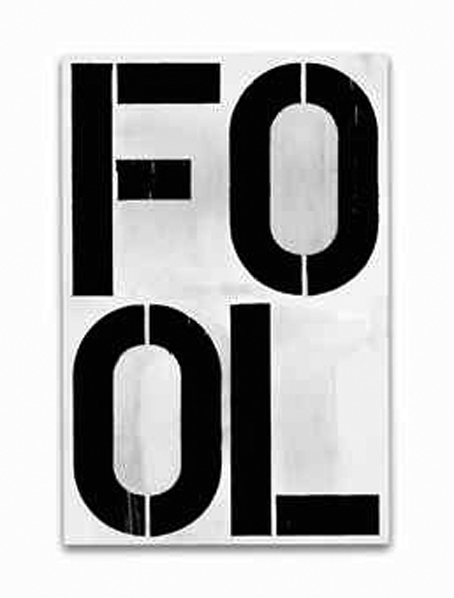
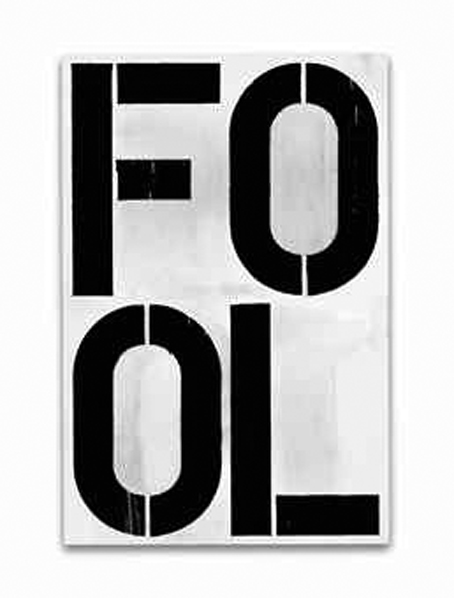
    If we regard his ‘work’ as the equivalent of the celebrity’s ‘opinions’, then the status of Christopher Wool, who appears to have ‘risen without trace’, as described in the Nov/Dec editorial, is strikingly analogous to that of a celebrity with opinions as fatuous and ungrounded as Wool’s ‘art’. As our editor observes, the ‘value’ of a Wool ‘resides purely in its perceived status as a tradeable luxury’. There is nothing new in the craving for social status, and its pursuit through ostentatious display or ‘conspicuous consumption’, to use Thorstein Veblen’s term. But in the past, the ‘work of art’ – as tradeable luxury and vehicle of social display – however vulgar or spurious, at least had observable features that a rich undiscriminating fool could be duped into mistaking for the marks of aesthetic merit. What is new is the sublimation of social display to the point where the vehicle of display is purged of such features, and reduced to its essence as a counter in the game of social display itself.

    The situation is cleverly described by the editor as one where a ‘work of art’ (improperly so-called, to adapt an expression of Collingwood’s) has value in the same sense in which a share certificate has value, and, moreover, appears to function in much the same way. But a share certificate does not pretend to have value merely in itself: it is evidence of a property right, namely part ownership of a company, and in certain circumstances the right of ownership might be upheld by the production of alternative evidence – if, for example, the certificate had been destroyed in a fire.

    We might, therefore, want to take this analogy even further, to the interesting case of money itself. The real value of a banknote consists in nothing but the shared agreement to treat it as having value, by people who know perfectly well that this is the case, if they trouble to think about it at all.  It appears that the monetary ‘value’ of some ‘works of art’, now consists in nothing but their ownership being evidence of the owner’s having the money to buy the ownership of the evidence of the ability to buy the ownership of the evidence … .  Clearly, this sequence moves endlessly in a circle of self-sufficiency, which has no contact with any reality beyond itself.

    The analogy with money need not be laboured. Here too we clearly have circularity – circularity of a kind which characterizes the logical structure of all human institutions. (See John Searle: The Construction of Social Reality. I am using the term ‘institution’ in the widest sense to include not just formal institutions, but all domains of human possibility established by agreements and understandings, very largely tacit.) Is this a vicious circle? Well, despite recent events, presumably not, since the institution of money has not yet collapsed. Vicious circles are small circles, engaging with nothing but the contents of the circle itself. But the institution of money involves a huge circle, and one which is not self-contained, but part of a wider system of mutually supporting institutions which constitute society itself. The entire edifice of culture is constructed out of this unimaginably complex system of interlocking institutions, all depending on agreements, ultimately tacit, of which we may not even be conscious.

    The arts are no exception to this; and, in this respect like money, are connected with the institutions of the wider culture – in and through which people find meaning and satisfaction – by chains of tacit agreement. These chains can form virtuous circles because they are neither small nor self-contained. But traders in Wool and cognate commodities are confined to a small coterie of art-market plutocrats and their jackals, which excludes the wider culture. Tiny and self-contained, this coterie assembles itself into a vicious circle, which sustains a pretence destined eventually to collapse – not before doing much harm. It is parasitic on established institutions, which support it as the body supports lice. It is, however, no more harmful than the vicious circle of state art, which has also detached itself from the institutions of art (properly so-called), and usurped their authority. This true authority – when it exists at all – emerges tacitly in traditions of practice and criticism that are integrated into the wider culture, and belongs to institutions that are quite distinct from such officially constituted entities as the Tate Galleries, or the Arts Council.

  • Performance before content – Eric Coombes is disappointed…

    Performance before content – Eric Coombes is disappointed…

    …by the frivolity and lack of ambition and academic rigour in the 2014 Reith Lectures.

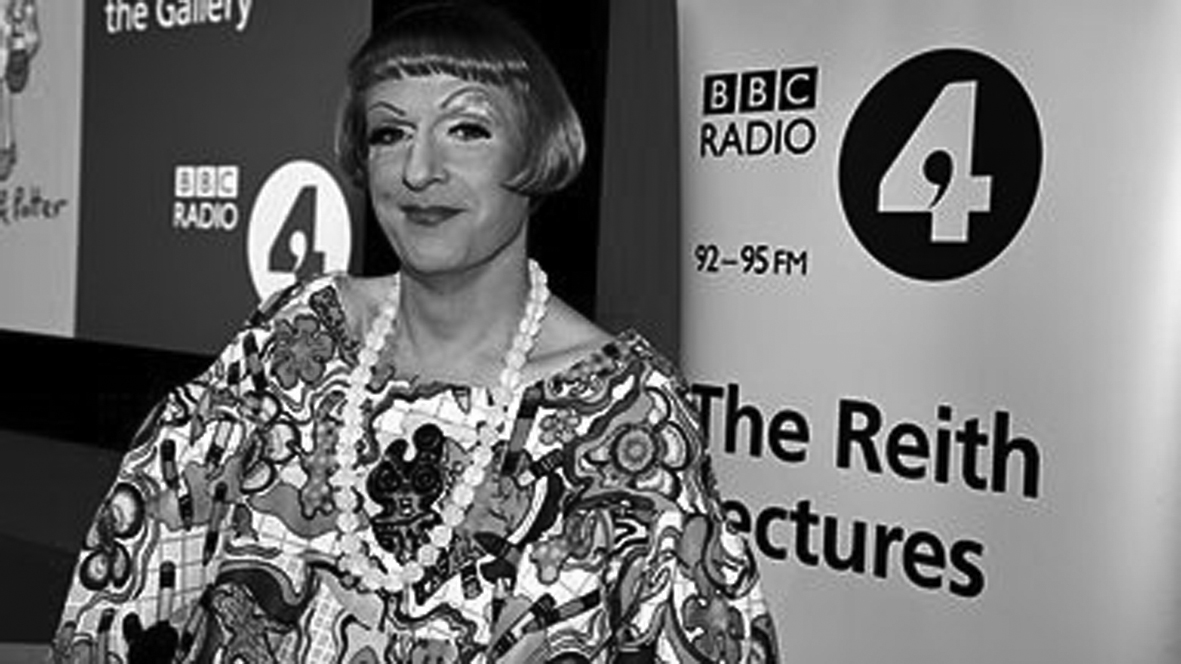
    Immediately after his predictably rapturous greeting at the first performance, Grayson Perry raised the question of why he was asked to give this year’s Reith Lectures. Well, for the first time in their sixty-six years, they were to be given by a “visual artist”. Could one imagine the BBC not to have chosen a winner of, or at least nominee for, the Turner Prize? Gormley having withdrawn a couple of years ago, how many remotely entertainable candidates lay in that small heap of the capriciously favoured? “Professor” Tracey Emin?  Damien Hirst? Even the BBC might have balked at the near-catatonic inarticulacy of a Martin Creed. But Perry vacuously claimed that his selection was explained by his being “a practising artist” – which, in reality, was not even a sufficient condition of eligibility.

    This limitation of the field of candidates was not, of course, mentioned. Does inadvertency, naïvety or cheek account for his drawing our attention to another factor a few minutes later, when he said “… anybody can have a life in the arts ­– even me! An Essex transvestite potter … the mafia has even let me in”?  As he proclaimed this, dressed and painted in a flamboyant caricature of femininity, Perry basked in the sycophantic admiration of that “mafia”, including such luminaries as Nicholas Serota. In a video clip, we glimpse the Lord Patten, laughing with respectful indulgence. Was Perry, brazenly, knowingly but deniably, mocking the ideological conformism of his audience? Far from erecting an obstacle to advancement, his ostentation of social and sexual deviance augmented his value for an establishment delighted to advertise the orthodoxy of its ideological commitment to “inclusiveness”. He is surely far too intelligent not to understand this.

    This is not to say that he was or is acting out a pretence. I have no reason to suppose that he exaggerates his compulsion to indulge in cross-dressing, either for the purpose of publicity, or to exploit the politically correct fashion that inverts the cruelty towards deviance often prevailing in the past. There is neither reason nor need to question his own account of his idiosyncrasies. But a pretence that matters very much lay in the BBC’s affecting to suppose a series of pantomime acts to be the vehicle of serious thought. There is no surprise in the corporation’s colluding with that dispiriting regime of compulsory frivolity, which everywhere imposes itself. But the Reith Lectures have had a special symbolic significance in upholding the BBC’s claim to “enrich the intellectual and cultural life of the nation”, despite the tinyness of their contribution to its total output. They constitute a significant test of the corporation’s commitment to its responsibilities. Previous lecturers have been a somewhat mixed bunch, and, as well as very eminent thinkers, the list includes some whom the criterion of intellectual integrity might have excluded. And one wonders about obvious absences, such as Isaiah Berlin or Ernst Gombrich, whether they were ever invited. Nevertheless, there seems to have been, hitherto, a serious effort to recruit serious thinkers – even if, in some cases, their seriousness might be questionable. There has, of course, been a relaxation of tone in recent years, the talks being given before live audiences and sweetened by the familiarity of their compère, Sue Lawley. But their presentation for the first time this year as pantomime suggests that the assertion of the high-flown sentiments in the foregoing quotation is the bluster of pretence.

    The background to this pantomime is the dominating cult of celebrity, which now draws everything into its moral ambit, where the very notion of an argument’s requiring an attention span longer than a five-year old’s becomes an elitist affront to the general public. With its huge resources, the BBC has not only the duty, but also the capacity to resist this dominance. The blame for the debacle of this year’s Reith Lectures therefore falls squarely on the BBC and, of course, on the state-art establishment to which it complacently defers. Perry himself, like his largely fawning reviewers, was probably unaware of how far he was out of his intellectual depth.

    What was said in the “lectures”?  Many matters connected with the visual arts – practical, sociological, financial etc. – were raised, often autobiographically, and usually flippantly. Specific observations were sometimes shrewd, but never enlightening to the undeluded; and no path of consequentiality led from one to another. Essentially, there was no argument at all, although individual points of unconsummated discussion were half identified by confused gestures. And the failure to take the slightest trouble to get things right, would – or would not that long ago – have disgraced a sixth-former.

    One illustration: In the first “lecture” he announced himself to be “very sceptical of the idea that you can find a kind of empirical way of judging quality, particularly in art”. How bizarre! Would we say of a sonnet by Shakespeare, or a painting by Turner, that it achieved “high quality”? Are these samples of a commodity? His “scepticism” amounts to doubting that there could be non-aesthetic criteria, readily and “empirically” applicable, by which to determine an aesthetic judgement. Who exactly has ever held such an “idea”? The manifest impossibility of such criteria has standardly been taken as central to the philosophical discussion of aesthetic judgement. His confusion here exemplifies a characteristic inability of the uneducated to understand that there is a distinction between empirical and conceptual questions (a distinction that may not be easy to make in a particular case). To be “sceptical” about the existence of such criteria is a little like being “sceptical” about the possibility that two plus two equals five. Since it is not the kind of thing about which further information might show us to be mistaken, it is idle to fuss about purported practical examples. Nevertheless, we should perhaps note that it would be difficult to imagine anything better chosen to illustrate his state of confusion, or his failure to get things right, than his main example of the supposed acceptance of such “empirical” criteria. This was the content of the “Venetian Secret”, a notorious hoax played on Royal Academicians in the late 18th century. But the “Venetian Secret” did not even purport to offer criteria of aesthetic judgement, being concerned only with the technique of painting.

    To the extent that a unifying theme can be discerned, it was identified in the toe-curling words of the embarrassingly unembarrassable Sue Lawley, introducing the third “lecture”.  “So far we’ve tried to assess the nature of what art is”.  Oh dear.  What is art?  A dauntingly big question one might think. Or possibly a small and unimportant question. If a genuine question at all, it is a philosophical question, and the questionability of its genuineness might itself raise philosophical questions, as could the question of whether, if genuine, it is big and grand or small but noisy.

    Such big (or small) questions have, together with their gratuitously assumed burden of objects and practices, entered and colonized the world of state art, as if the philosophy of art – or rather, one part of it, eccentrically construed – were central to, or even constitutive of, the work of artists, qua artists. It is not obvious why competence in this subject should be conferred by the practice of art, nor why it should purport to feature as central to the education of art students, as if directly relevant to artistic practice; rather than arising, if arising at all, in a complementary area of study, established to enhance the humane benefits of that education. When that still happened, these matters were sometimes in the hands of the intellectually competent.

    One consequence of the comprehensive destruction of our system of higher education in the visual arts, from which Perry emerged as a graduate, is a glut of people who deludedly suppose themselves competent in matters entirely beyond their intellectual scope. In the second “lecture” Perry asserted “anything can be art … but I think the boundaries are sociological, tribal, philosophical and maybe even financial.”  Well, can anything “be” art or not? What does that mean?  Does one and the same thing become or cease to be “art” according to whether it falls under the jurisdiction of one or other of this strange ragbag of disparate conceptual regimes? Or is this just a confused way of noticing the obvious point that what is accepted, valued or promoted may vary with circumstances or interests? In this “lecture”, Perry did not notice himself making two crucial but eminently challengeable assumptions: first, that to ask what is art is equivalent to asking how to determine whether some object is a work of art; and secondly, that such a determination would be a matter of definition, or decision procedure, to establish the boundary of a category.  Those assumptions provided Perry with his title “Beating the Bounds” and hence with his pantomime prop, a riding crop, which he brandished at intervals to signify “beating” at some supposedly significant “landmark” on the boundary of art.

    This amused an easily amused audience; but it was hardly enlightening. First: the concept of art cannot properly be considered without some attention to other arts besides the visual, even if the latter is one’s main concern. Secondly, the concept of art is a mental capacity which we exercise in certain kinds of human activity: it is not primarily a principle for categorizing objects in the world. The question of how objects are identified as works of art, if interesting at all, is interesting only if it throws light on that capacity – and that cannot be simply presupposed. And thirdly, though widely assumed, the notion that we grasp a concept only if we can adequately define a corresponding word, or precisely determine the boundary of a category, is fallacious. A distinguished philosopher suggested that it should be dubbed “Socrates’ fallacy”. With much of human life, especially in the arts, it is the central areas that matter: the boundaries are often indeterminable, precisely because their determination is unimportant.

    There is a large philosophical literature on these issues, only some of which is difficult. But the foregoing points are very simple; and although they might not occur spontaneously to every educated person, they would be encountered in the course of a modest dip into that literature, which is enjoined – one might have supposed – by the responsibility of maintaining the intellectual standing of the Reith Lectures. But Perry is not an educated person. I hope that this is not interpreted as a sneer, for I have a good deal of sympathy with him. To learn about his appalling childhood and abusive upbringing – recounted without self pity – is to admire him for defeating the power of conditions which deprived him of most of what we normally take to be needed for healthy mental growth. (I assume that the published account is essentially truthful.) Despite those squalid circumstances, he gained a place at one of the most successfully academic schools in the country, and, for a while, did very well. He is certainly not stupid.

    But these “lectures” exhibit, in some respects, the limitations of an intelligent but previously uneducated first-year student: inability to sustain argument, or even to understand what it would mean, or the need, to do so; complete unawareness of important distinctions; and so on. They also betray that ignorance of one’s own ignorance which imprisons the minds of many beginning students and prevents their progress – an imprisonment from which, of its nature, it is hard to escape, since awareness of the need to escape is absent. It is, of course, impossible here to consider why much of alleged “higher education” not only fails to deal with this problem, but in many areas actually aggravates it – perhaps by continuing that practice of systematically flattering intellectual immaturity which, especially in the arts, appears to constitute a significant part of secondary schooling. The intellectual level of this year’s Reith Lectures surely reflects the diseducation Perry received in the chaos of fraudulence which has engulfed “higher education” in the visual arts.

    And they betray not in content, but in form, the destructive effect on humane discourse of the crass utilitarianism destroying us, which can understand only linear explanations, in which everything is reduced to something other than itself – something simpler and grosser.  In his supposed tour of art’s boundaries, Perry considered not what art is, but only which “art” is most promoted, sold or otherwise rewarded, or what is, for any reason, accepted as art. (And if this is held to be a false distinction, then that needs to be argued.) He was, perhaps, not so much the fraudster in this ridiculous pantomime of pretence, as the contentedly defrauded – the victim of what we laughingly call “higher education” and of the BBC’s irresponsible frivolity.

    Eric Coombes

    The Jackdaw, 2014

  • The importance of being Erno – Eric Coombes questions the reputation of a Brutalist architect

    The importance of being Erno – Eric Coombes questions the reputation of a Brutalist architect

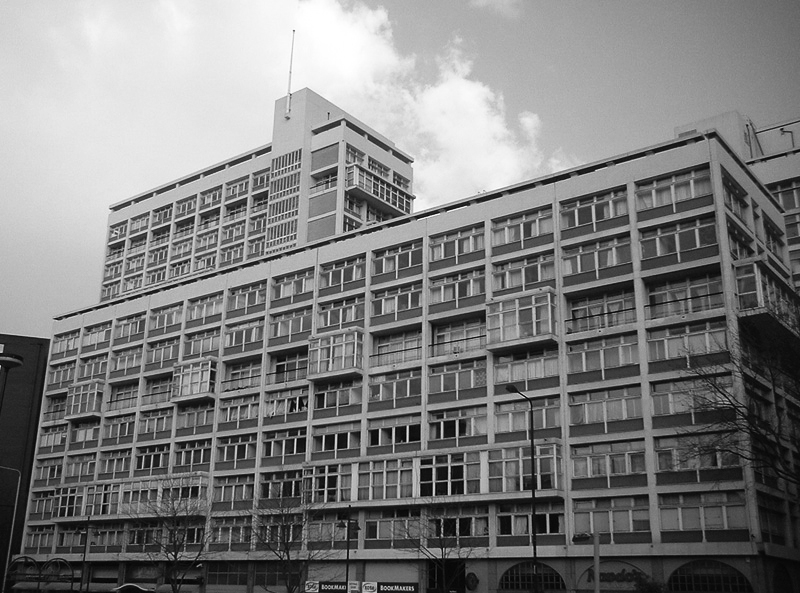
    Sometimes material appears in a “serious” newspaper which—even in our  current cultural condition—is at an astonishingly low intellectual level to come from the prominent “authority” who wrote it. Disagreeable though it is, perhaps one should occasionally draw attention to such material, and subject it to closer inspection. Those who can bear to do so, should read Stephen Bayley’s article in the Daily Telegraph about Ernö Goldfinger’s Alexander Fleming House (now renamed Metro Central Heights), which can be found online at:

    http://www.telegraph.co.uk/culture/art/architecture/10171321/Look-away-Prince-Charles-Goldfingers-Tower-is-wonderful.html

    The quotation from it on p.43 of the Sept/Oct issue fails to convey the scale of the self-important imbecility displayed in the article as a whole.  It begins with a baffling non-sequitur. Having invoked the Japanese notion of “wabi-sabi” (roughly, a spiritual quality conferred by the patina of aging), he continues

    “To be aware of wabi-sabi is to be aware of the language, even the poetry, that mute buildings and dumb things speak.  Until recently, few people thought fine Zen thoughts while passing through the grimly urban and diesel toxic Elephant and Castle in south London. Now we all can. Indeed, will.”

    “Until recently”! By virtue of what power, on what recent occasion, have casual passers-by suddenly been granted this momentous epiphany, which they not only “can” but “will” experience? Is it the power of Bayley’s own eloquence in the article itself? If not, it must be the event of the building’s being listed by English Heritage, which was also the occasion of Bayley’s article; for no other reason is given to expect the rapid transformations of human experience which would justify this astonishing claim. Must we, then, according to Bayley, attribute to English Heritage powers we had not dreamt of its having, powers of a supernatural or, at least, sacerdotal character? Or is English Heritage held in such popular esteem by all those thousands of people moving through that “grimly urban and … toxic” environment every day (some slight relief here in observing Bayley’s immersion in fantasy to be less than total) that the wisdom of its pronouncements fills their minds, and is received so eagerly and uncritically as to transfigure and regulate their perceptions?

    Bayley’s claims are supported by nothing whatsoever but the assumed authority of the workings, or rather lurchings, of his own mind. The entire article consists of mere assertion and egregiously transparent non-sequiturs. What exactly, for instance, is the argument supposed to be in the following?

    … his Trellick Tower in Notting Hill and its twin sister Balfron Tower in Poplar (already listed) are hatefully remembered icons of infamy for those who lazily condemn all modern architecture as heartless and inhumane. Yet a thoughtful appraisal reveals as rich a variety of historical sources in their design as you would find in Vanbrugh: the bravura Futurism of Antonio Sant’Elia, the bold shape-making of Auguste Perret and the structural theories of Le Corbusier, for example.

    Whether or not Bayley has correctly identified them, and whether or not the richness of their “variety” is comparable with what we find in Vanbrugh, why should the discovery of “historical sources” for Goldfinger’s designs have the slightest tendency to establish that the buildings are not “heartless and inhumane”? Is a lack of “historical sources” a necessary condition for a building to possess these regrettable attributes? Would it be impertinent to ask Bayley where he finds grounds for that principle, other than at some chance place where his mind was brought by its randomly veering motions, and came briefly to rest? Not to overstate the point, the principle is not self-evidently true. Since the absence of “historical sources” is unknown in architecture, or even in “architecture”, it entails the intriguing conclusion, which is not—shall we say?—intuitively convincing, that there can be no such thing as a heartless or inhumane building.

    Bayley claims that the listing of Alexander Fleming House “recognises several important things. For example: the fragility of prejudice, the permanence of concrete (which if we are honest, weathers very beautifully) [sic] and the way the solemn gravity [“overbearing joylessness” would come closer here] of great [sic] architecture transcends the spiky little fits and pricks of temporary taste.” Here again we have pure unsupported assertion.  But of what exactly? What does it mean to “recognize” the permanence of concrete?  Was that permanence in doubt, and would such a doubt be allayed by listing the building, any more than listing it would oblige concrete to “weather very beautifully”? How on earth does the listing “recognize” the “fragility of prejudice”? In what sense can prejudice (as the word is now commonly used) be fragile, rather than merely wrong? If this means anything at all, it means that the adverse judgement of the building is wrong, and must be dismissed as prejudice. What is here implicitly alleged to be prejudice is, in fact, the judgement of most people who are aware of the building, including those who have had the misfortune to work in it; and, far from being “fragile”, that judgement appears to remain remarkably robust and stable.

    It is, in any case, unclear, to put it mildly, how far praise of this kind is consistent with the statement that “Alexander Fleming House is confrontational, exactly as its architect intended it to be.  But it was designed as a manifesto, an idealistic statement.” Surely this means that, whether through the beauty of its weathered concrete or in any other implausibly supposed way, it was never intended to please those forced to endure its presence in our capital city—still less to engender the “mystical” experience of “Wabi-sabi”. And this raises a crucial question, never answered or even recognized by the likes of Bayley, who, by carefully ignoring it, aggravate the impotent rage of so many people, when they contemplate the state of our cities and towns: by what moral authority are the Goldfingers, or any of the ego-maniacs practising as “architects” today, licensed to transform huge areas beyond recognition, with enormous oppressive buildings?  Who decreed that the public should be permanently confronted with manifestos that they have never asked to see, but should be forced, repeatedly, to read?

    Are these manifestos au fond religious or quasi-religious?  This thought could lead us, finally, to notice one curious passage, which is extraneous to the main topic, but may nevertheless be significant.  Having emphasized that Goldfinger was “not plagued by any lack of personal confidence”, Bayley adds that “[h]is personal sense of self-worth was practically enhanced by marrying the heiress to the Crosse & Blackwell soup fortune.” Now the wealth of a spouse is not usually regarded as a matter for regret; but this seems to imply not merely that Goldfinger, like most of us, preferred to have more money rather than less, but that he regarded wealth as constitutive of virtue—that he worshipped at the altar of Mammon. This most corrosive of all idolatries, is now a dominant cult (perhaps to an unprecedented extent), which spreads its poisonous doctrines widely, finding many followers among the powerful in all walks of life, including those in government at every level. They worship with dementedly implacable conviction, apparently believing that everything, including personal merit, can and must be assessed in monetary terms. Nowhere do we see this more plainly and forcefully symbolized than in those gigantic temples of Mammon which loom threateningly over once agreeable streets, their repulsive ugliness embodying the ugliness of what they signify. Here, then, Bayley touches, no doubt inadvertently, on an important point, which is caught in a brief flash of indirect illumination. The spoliation of our towns and cities is imposed by the brute power of large property companies, against which local communities are almost defenceless, which have the planning system blatantly stacked in their favour, and which corrupt government, both central and local. Almost limitless, their financial resources are used, one might say, to satisfy both the greed and the vanity of the architects they employ, as if those vices were clearly distinguishable. But the contemporary world of big business, where predatory property developers are in league with big architectural practices (and ruthless lawyers), must cultivate an atmosphere in which merit is identified with the possession of wealth, or the ability to gain it. This is what Bayley suggests, presumably unintentionally, about Goldfinger.  In the church of Mammon, refined distinctions of morality are otiose: the virtues of greed, vanity, arrogance and ruthlessness become inextricable, as they coalesce in the righteousness of ego-mania and megalomania. Our cities and towns have become arenas for the display of zeal in the service of Mammon.

    Even I was surprised to find such drivel, written by a well-known figure, published in a supposedly “serious” newspaper.  I would challenge anyone to find, in the entire article by this alleged critic, anything that could be considered criticism. There is no attempt to discuss Goldfinger’s building in a way that might help the reader to see it as Bayley thinks it should be seen. All is assertion and non-sequitur.

    Postscript

    I was not quite sure how to take The Jackdaw’s own remark about the listing of Alexander Fleming House under News on p.34 (Sept/Oct issue): “Like it or not it is among the great buildings of the New Brutal style and deserves to be preserved.” Is that “great” as in “great painting”, “great poem” or “great mind”? Or “great” as in “great crime”, “great fool” or “great mistake”, where “great” means something like “notable example of its kind”, irrespective of whether that kind is itself good, desirable or admirable? The building is certainly great in the latter sense, and buildings are now, apparently, listed merely on the grounds of their exemplifying some episode of cultural or social history which is of interest and which they record.    One wonders how far the principle might be taken.  Already a zebra crossing has been listed because of its association with the Beatles.  Is a city a museum? Do we regret, for example, that no one had the foresight to insist on parts of the East End of London remaining in conditions which would have continued to foster squalor, disease and infant mortality? Those conditions are undoubtedly a matter of historical interest; but documentary and visual records of them are surely enough. Far from wanting to wipe New Brutalism, or any other manifestation of architectural insolence and crassness from the record, I think it should be fully recorded, if only as a warning. But I fail to understand why that should entail its continuing to deface our towns and to blight the lives of those forced to endure its oppressive presence.

    Eric Coombes

    The Jackdaw, 2014


  • Beyond criticism, or, Notes from fantasy island (a response to Criticism and the collapse of culture)

    Artist Paul Wilks responds to Eric Coombes’s tour de force of an essay (Criticism and the collapse of culture, The Jackdaw Mar-Apr 2011)

    Matthijs Van Boxsel cites, in The Encyclopaedia of Stupidity, a ‘Fame Machine’ devised by Villiers de l’Isle Adam, (1883) in which fame could be manufactured ‘by organic means’. Simply put, the ‘machine’ is a theatre but with a paid audience to respond appropriately and overtly to the performance, call for encores and apply liberal use of the claque; the device never fails to impart Fame. As de I’Isle Adams puts it: “All fame has its claque, that is, its shadow side, its part in deception, in mechanical tricks and in Nothing (for Nothing is the origin of all things).” I invite Jackdaw readers to consider how far his fantasy has become our ‘reality’.

    The long and thoughtful analysis by Dr Eric Coombes (The Jackdaw  ♯ 96) on the links between celebrity culture, Diana-death syndrome, the ‘Sensation’ show (particularly the Myra Hindley ‘portrait’) and the impoverishment of art criticism, suggests the immanent emergence of a culture in which truth and fiction are indistinguishable from one another. Rather than conforming to the whims and currents of such a culture the artist would do well to stay aloof rather than be absorbed into such a maelstrom of self-deception. The malady is now deeply rooted in our everyday experience, be it via tabloid, TV or BBC, politics, celebrity or ‘soap’, surrogate reality permeates our existence at every turn and is entering the genetic structure of Western society.

    The thespians’ edict to ‘suspend disbelief’ before entering a theatre seems now the prerequisite for much everyday experience, let alone an expedition to the Turner Prize.  In Theatre something was to be gained from this exercise in emotional immersion. One’s thoughts may be diverted, adjusted, confirmed or refuted by the performance. In short the audience deliberately subject themselves to a kind of learning process which they may apply to life. But lurking within this helpful edict is the embryo of celebrity culture (it used to be called the ‘Star System’ in the film industry) which now dominates whole swathes of peripheral media. Soap stars ‘become’ their character, actresses devise tortured pasts for their biographers, rock singers live up to the expectations of tabloid journalists, pious politicians bonk their secretarial staff and defraud the public purse, artists and their acolytes spout artbollocks. In this fuzzy land between truth and lies, fact and fiction, the media’s ability to elevate criminals, hucksters and pornographers to celebrity status erodes what small vestige of public morality survives and paves the path to ‘Myra’ at the RA.

    Much of what we are urged to accept as art involves subscribing to a critical fantasy as flimsy as a house of cards yet as opaque as the pyramid of Cheops, and, as Dr Coombes points out, the ambiguity and impenetrability of its language puts it beyond refutation. The starting point of this flimflam, which is the lingua franca of all salesmen, politicos, critics and curators alike, is an ability to first sell oneself the ‘product’. To thus eliminate in oneself any doubts as to its authenticity, importance, or value, and so marooned by one’s lie to oneself one can disseminate it to others with a straight face and placate any doubts regarding this new ‘truth’.

    The Diana phenomena, which Dr Coombes observes as being at the pinnacle of the 90’s fantasy graph, illustrates exactly this blurring of edges between truth and fiction. A bland Sloane who served every public and journalistic fantasy, she played them like fishes in a trout stream. ‘Candle in theWind’, come off it! Before her death we had been battered with her moods for a decade. Yet in life she epitomised the addiction of every self-delusional wannabe in the land, and her death  (utterly appropriate) sent the nation into a dramatic frenzy in which we could all have a ‘part’ and even speak lines. Tears were shed, florists prospered, her island grave attracted thousands.

    Artists who pander to celebrity culture are at risk of falling into this hinterland of echoes and twisted shadows between fact and fiction. The temptation to go-with-the-flow reaches not only the crumbling heights of the RA but is evident in a value system in which all measure of talent is ultimately subordinate to the measure of publicity acumen and financial success. Contest with another artist the merits, or otherwise, of the work of any celebrity artist, and the ripostes quickly resort to expressions of admiration for the subject’s manipulation of the system and invariably conclude with a litany of sale-room prices as the final, undeniable proof. Of what? Talent, skill, originality? Such slavish conformity amounts to a value/aesthetic principle no better than that of the Antiques Road Show; i.e. “I didn’t like it before but I do like it now”. It’s amazing how so many artists are willingly led by the nose by the critical acclaim heaped on the talentless but ‘successful’ few. “Get real !” is the ludicrous response of these happy Lemmings. The frightening aspect of this abandonment of objectivity is that many who bend to this imperative are holders of lecturing posts. With each step towards accommodating the appalling output of celebrity artists, their integrity must, of necessity, become increasingly foggy and doubtful. I know of a lecturer who, despite all contrary evidence, not only ‘revised’ his opinion of ‘our Tracey’ and her drawing skills but, faced with her published One Thousand Drawings, now claims her as one of his own and extols her talents as an exceptional draughtsman as being evident to him way back in art college.

    The closing of the gap between truth and fiction is no accident but neither is it a conspiracy. Most probably it is the inevitable by-product of the chemistry of Capital and Media (or greed and stupidity if you prefer). Dr Coombes’ polemic regarding the demise of coherent art criticism indicates this deeper fault in Western thought. The West’s new ability to ‘suspend disbelief’ at every turn now clashes with a religious value system in which an irrational Faith is the hub of existence. From the expedient blurring of truth and our ‘creative’ relationships with modern history, to Blair’s self-delusion on WMDs, it implies that civilisation now walks a tightrope of what we prefer as truth over the void of the reality. As BB King says,  “better not look down”.

     The Jackdaw May-Jun 2011

  • Criticism and the collapse of culture

    Dr Eric Coombes looks back over the period since 1997 and identifies the collapse in standards of art criticism which has allowed conceptual art to prosper uncritically

    After the recent change of government, this might be a suitable moment to look back to the year in which the recently ejected gang of liars, buffoons and crooks first came to office. And, as our misgivings about their substitutes find ready confirmation, we may well suppose that 1997, with its coincidence of conspicuously symptomatic events, may come to be seen as the year in which our cultural disintegration finally manifested itself as irrevocable.

    For this was also the year in which there occurred the most extraordinary eruption of mass hysteria that any of us had ever witnessed: hysteria in response to the sudden death of a foolish, ill-advised and unfortunate young woman – distinguished by no outstanding virtues and with no claim to general admiration or affection not rooted in fantasy. This fantasy appears to have obsessed the many enfeebled dupes of the mass media, by which it was concocted and sustained with ruthlessly exercised power, and filled the confined space of their imaginative lives with the cheaply manufactured – and therefore profitable – junk of sentimentality and factitious passion.

    Later in the same year, an exhibition at the Royal Academy quickly fulfilled the intentions of its publicity-orientated organizers by reaching a level of notoriety which was, perhaps, unprecedented in recent years, for something promoted under the label of the visual arts. This notoriety derived from the apprehension that so much of the exhibition seemed intended to shock, disgust or offend. Consisting of items from the collection (or stockrooms) of Charles Saatchi, it was suffused by the ethos of the advertising industry in which Saatchi made his enormous fortune, an ethos which also appears to govern his activities as a collector and dealer – the imperatives of advertising and art being, for him, indistinguishable.

    The joyous acclamation, as he pranced into office, of a risibly obvious charlatan; the earth-moving torrent of emotional incontinence – which he exploited – flowing from people who never knew the object, or putative object, of their grief, and whose only loss was delusional or phantasmagorical; and, under a transparent pretence of high-principled seriousness, the filling of the best and most prestigious exhibition space in the metropolis, at the centre of the cultural establishment, with the disgusting and offensive: in their different but connected ways, these three occurrences flaunted the triumph of fantasy over reality, and the infantile over the mature.

    In the exhibition, named Sensation in gloating anticipation of its reception, there was certainly plenty to disgust or offend, as well as the usual large helpings of slightly nauseous tedium, and a certain amount of pitiful incompetence masquerading as sophistication. As was intended, much of this provoked outrage and controversy—if “controversy” is a term that can properly be applied in the absence of anything amounting to reasoned argument. Obscene items by the Chapman brothers, for instance, attracted, understandably enough, a good deal of opprobrium, as did the moronically blasphemous (and formally feeble) contributions of Chris Ofili. But the main focus of outrage was, of course, an image, more than twelve feet high, reproducing on this enormous scale the police mug-shot of the infamous murderess of children, Myra Hindley, a photograph ubiquitously familiar to the British public through featuring, almost invariably, alongside recurrent press reports and commentary about Hindley herself, and about the stupendously evil actions in which she engaged.

    The story of those actions is harrowing; but, since they are familiar, despite occurring more than forty years ago, we need not repeat the appalling details here, but merely remind ourselves, in general terms, of what happened. Hindley and her male accomplice abducted and tortured to death five children, having sexually abused at least four of them. In at least one case, they made a recording, presumably for their later delectation, of the ten-year old victim’s screams and pleading as she died. Her mother later undertook the duty of listening to this recording in order to help the police by identifying the voice as that of her little girl.

    For almost all the British, that photograph instantly evokes thoughts of the murderess and the depravity of her barely imaginable crimes. It is clear, therefore, that the exhibit alluded to matters of great public concern and intense moral anxiety. The outraged felt that, given its scale and prominence, the presence of something so disquieting was such an affront to the bereaved’s feelings of distress that its inclusion should not have been contemplated, let alone implemented. Disagreements about the rights or wrongs of showing Myra were – however squeamishly the metropolitan chattering classes might cringe with embarrassment or disdain from explicit invocations of morality – disagreements about a moral issue.

    Can this moral issue be separated from any serious attempt to assess the exhibit as a work of art? If this was just a cheap publicity stunt, cynically exploiting a merely sensationalist item of negligible artistic merit, then surely the painting’s prominent display was indefensible. If not, if it is a serious work of art – the very least required to justify its showing – then must it not engage in some morally responsible way with the deeply disturbing matters which it evokes? Any such engagement could hardly be understood as separate from or additional to its aesthetic character; and to consider this question is to confront a fundamental issue of aesthetic understanding: Are aesthetic and moral intuitions and judgements entirely distinct, or do they interpenetrate or illuminate each other? Do they, in the last analysis, come together in our efforts to sustain and vindicate a unified cultural domain of that which we ultimately value? Is this why we find it natural to speak in terms of moral beauty, or moral ugliness, and why the concept of grace, for example, can be exercised with equal appropriateness in our thoughts about the aesthetic and the moral? Is there anything to be said for Keats’s famous words: “Beauty is truth, truth beauty”, or is it now impossible to hear them without jeering?

    One should not, of course, require the criticism of art to turn itself into extended philosophical discussion, at a high level of abstraction. But is it not reasonable to suggest that, for serious and responsible criticism, an awareness of these questions must be integral to the context of discourse? So far as art is taken seriously, it finds a place in the wider context of our lives and thoughts, and, in particular, our thoughts about what we value and what concerns us (sometimes by showing us, or even by being, what we value). The role of criticism is, in part, to place art in this wider context, in a cultural space which is constituted, furnished and maintained through discussion (of its nature never closed), a space of shared perceptions, in which we hope to realize in imagination that which we seek to comprehend intellectually. If criticism involves “the common pursuit of true judgement”, then it aims at a widely shared understanding of where and in what we should come together in the ‘truth’ of feeling and imagination. Even the “challenging”, to mention what is usually a weasel usage rightly much mocked in The Jackdaw, can ultimately be valued only if it challenges us to extend the scope of shared sensibility.

    Any serious discussion of Myra’s merits as a work of art, then, would need to consider whether its aesthetic character bears the grave moral weight of its allusions, or in any way illuminates the deeply disturbing matters which it evokes. This would not be to ask what message the painting might convey. The crass philistine notion that the significance of art inheres in its ‘message’ is one that has now invaded art education, where it would once have been treated with the scorn that it deserves. We do not value Dickens, to take an obvious example, because he told us about social evils and the depravity which they engendered, matters of which we or his contemporaries might otherwise have been ignorant. Nor would we have looked to him for solutions; and had he suggested any they would have had no more authority than anyone else’s. What an artist of Dickens’s stature achieves is the means by which what we might or might not otherwise merely know about is made available to the imagination as well as to the intellect, and so unites thought and feeling. Could anything similar be claimed for Myra?

    The photograph on which the painting is based is merely a typical example of its kind, in not flattering an apparently quite plain and even disagreeable-looking young woman, staring unsmilingly directly at the camera. Its strangeness mostly derives from the wooden and unnatural effect, which, as a glance at a few passports will confirm, tends to characterize such photographs. Such epithets as “the face of evil” are not a response to any properties intrinsic to the image, or to the face revealed in it, considered in detachment from the highly specific context of its notoriety; and its blood-curdling power of evocation is entirely a matter of association, relentlessly reinforced over a period of many years. This power of evocation was, of course, the sole reason for using that particular photograph. And apart from the overwhelming size of the painting, its only significant difference from the press reproductions of the police mug-shot was that, on closer inspection, the granular texture of the image, imitating the coarse effect of the half-tone screen used for newspaper printing, was seen to be composed of a child’s hand prints.

    Appropriately enough, for an exhibition informed by the ethos and imperatives of the advertising industry, the scale of the image and the familiar device whereby its texture resolves at close quarters into further imagery—indeed, everything about it—suggest that it would have been quite a good idea for a billboard poster. One could imagine it as an advertisement for a horror movie—the face of the villainess on the hoarding commanding, by sheer size, transient attention from across the street, or revealed at close quarters to be dabbed all over by the desperately scrabbling hands of her helpless child victim. But what was this advertisement an advertisement of? Of Hindley’s crimes? Did they need to be advertised? The very suggestion is preposterous.  Indeed, it could be said that, by this time, their advertisement was actually impossible, in the sense that a fully saturated cloth cannot be wetted. Such was their notoriety that, far from the painting’s advertising Hindley and her crimes, it was she and her crimes which were advertising the painting.

    With this last point in mind, let us return to the outcry against its exhibition. One of the protesters was reported to have said that she objected strongly to the transformation of the murderer of her child into  “an icon to titillate the public for a moment or two, before it moved on to its next, equally momentary, preoccupation or amusement.” (1) And a spokesman for the children’s charity, Kidscape, said “How sad that an artist has to resort to sick exploitation of dead children to get noticed” (2). These unpretentious statements expressed feelings with which any decent person might at least sympathize. But they were made from positions entirely external to the art world and its preoccupations; and it is not difficult to imagine the sniggering disdain with which their apparent lack of sophistication might have been greeted in some quarters. But there is a paradox here. For while these superficially simple-minded comments did not state, they nevertheless implied, a shrewd and sophisticated understanding – showing itself, admittedly, only in a very inchoate form – of what was at stake culturally; an understanding far shrewder, and at a higher level of genuine sophistication than was reached by the self-satisfied panjandrums of the contemporary art establishment, for whom shrewdness means cynicism and sophistication frivolity. It takes only a little reflection and imagination to find in these condemnations the seed of a critical observation far more penetrating than most of the perfunctory remarks of professional critics. These ladies sensed that the decision to exhibit Myra prominently was made in the pursuit of publicity for the sake of publicity, and, in their heart-felt unselfconscious way, made observations which require very little elaboration to arrive at precisely the point reached in the previous paragraph: This is painting as billboard advertisement; but, through exploitation of the notoriety of Hindley’s vile crimes, what is advertised is the advertisement itself.

    If this account is at all right, then we have an emphatically negative answer to the critical question raised above, as to whether this painting engages in any serious way with the grave and disturbing matters to which it alludes: For it is not even concerned with those matters, except to exploit them, since their role in relation to the painting and its projected reception is merely instrumental. In fact, some of the favourable commentary implicitly conceded this point.

    I have suggested that some of the supposedly naïve observations from outside the contemporary art establishment, observations not ostensibly aimed at aesthetic judgement at all, got closer to aesthetic understanding than did the words of many professional critics. What did the latter have to say? Let us take as an example the judgement of Richard Cork – critic at various times for several highly respectable national newspapers and journals; who has been editor of Studio International; a Turner Prize judge; Chair of the Visual Arts Panel at the Arts Council; a member of various other high-level committees and panels disbursing taxpayers’ money, supposedly in support of the visual arts; Henry Moore Senior Fellow at the Courtauld Institute; and even – God help us – Slade Professor of Fine Art in the University of Cambridge. In a review of Sensation, the following was all he had to say by way of direct critical commentary on the painting:

    “Far from cynically exploiting her notoriety, Harvey’s grave and monumental canvas succeeds in conveying the enormity of the crime she committed. Seen from afar, through several doorways, Hindley’s face looms at us like an apparition. By the time we get close enough to realise that it is spattered with children’s handprints, the sense of menace becomes overwhelming.” (3)

    Well, perhaps – for reasons already discussed here – it did have some “sense of menace”. But why, in the absence of some wider context of elucidation in which it found its significance, that claim would count as attributing artistic merit – still less as establishing the status of the painting as an important work of art – this is unexplained.  And how could he say that it “succeeds in conveying the enormity of the crime she committed” – rather than merely reminding us of it – when that enormity was already an established and prominent feature of public consciousness (the “sense of menace” deriving adventitiously from that very condition); and when the painting itself contains no information whatsoever about the crime? Is this not preposterous nonsense?

    If this critic’s intellectual distinction reaches the exalted level at which we could legitimately expect to find the thinking of a recipient of the honours he has gathered, and of an occupant of his numerous positions of power and influence, could he not have said something a little more convincing and a little more developed than this? If he could not have risen above mere assertion, could he not at least have risen above assertion of the patently absurd? Did he feel no obligation to support his favourable judgement with some more extended account, which, by educating our perception of the work, would vindicate the hysterical hyperbole of his praise, justify its exhibition, and excuse the vulgar puerility of the incontinent abuse with which he denounced those who wanted it excluded?

    At the beginning of the article, he had greeted the whole exhibition with glee: “The rebels have stormed the bastions of conservatism, and howls from outraged academicians are still bouncing around the walls of Burlington House.” Its clownish tone reminiscent of a children’s comic, this grotesque rhetoric was either brazenly disingenuous or spectacularly stupid, in so far as it suggested that “the rebels” constituted an arbitrarily excluded group of the talented, bravely triumphing over an unjust and intransigently reactionary establishment. The truth, of course, as the slightest acquaintance with the facts would reveal, is that these people basked in the favour of the contemporary art establishment; and one might reasonably ask how much audacity and military valour were required to storm the bastions of a fortress which was under the command of the invaders’ pugnacious chief ally— namely, the all-powerful exhibitions secretary, Norman Rosenthal. This is, again, preposterous nonsense.

    This is what he wrote about the issue of whether Myra should have been shown: “By making an hysterical attempt to ban Marcus Harvey’s painting of Myra Hindley, the crustiest academicians have revealed just how ugly their censorious hatred can be. If they do fulfil the threat to resign in protest, their departure will be the Academy’s gain. … So I am delighted that the exhibition will open on Thursday, with the Hindley painting defiantly in place. The show’s arrival is a welcome sign that the Academy has belatedly decided to atone for its disgraceful, antiquated intolerance in the past.” (4)

    In the article from which I am quoting, which itself merits the epithet “hysterical”, this triumphalist gibe is all he said about the issue, which is therefore treated as if it were a disagreement entirely confined within the preoccupations of the art world, themselves construed, and almost celebrated, as narcissistic. Again, this is either disingenuous or extraordinarily stupid, since it would be hard to imagine any conflict more calculated to burst out of the art-world’s domain of self-regard, and engage members of the public at large. Those engaged included the protesting mothers of murdered children, and one wonders what they would have made, had it been brought to their attention, not only of Cork’s astoundingly narrow view of the nature of the disagreement, but also of his apparent blank unawareness of the connotations which, in this context of use, would naturally attach themselves to his words. Is there nothing more obvious that springs to mind here that might cause one to think of ugliness and of hatred? Whether they were right or not, is it not in the least possible that the “crustiest academicians” might have been motivated, not by “censorious hatred”, but by its opposite – by compassion and respect for the feelings of the bereaved? (That their artistic judgement might have been sound is, of course, unthinkable.) Did it not occur to Cork that, only through the inadequacy of gross understatement, does “intolerance” fall short of being an appropriate word to describe the attitude of those so comfortable in the prison of their own narcissistic preoccupations and prejudices that they implicitly dismiss without a second thought – dismiss as less important than the freedom to “ignite controversy” (5) – the feelings of a parent whose child has been tortured to death?

    The perverse narrowness of Cork’s view, which we may take as representative of other enthusiasts for the exhibition, seems pathological. How can anyone be so deficient in the capacity for ordinary human sympathy as not even to consider whether, if the bereaved felt as they did, then this might – just might – in itself be sufficient reason for the painting not to be shown? To entertain this thought is not to favour censorship: it is simply to ask whether the prominent exhibition of this painting could, in the circumstances, be reconciled with common decency, and to question the integrity of the motivation for showing it.

    We might notice a contrast between the attitude of the powerful to appeals from the parents of murdered children, and the attitude taken to the hysteria prompted by the death of the Princess of Wales, less than three weeks earlier. Many concessions to what we can only call the mob were made by the establishment – or, more accurately perhaps, by a declining establishment pushed aside by the new anti-traditionalist establishment of shameless ignorance, semi-literacy, contempt for truth, and minimal attention spans. The new establishment exploited the occasion of these concessions for its own advancement, by imposing, for example, with no precedent in customary protocol, the new ham actor Prime Minister as a reader at the princess’s funeral service in Westminster Abbey, and by inserting into the solemn rites a performance by that preposterous figure, Elton John, of a pop song, distinguished by its mawkishness and by the fatuousness of its lyrics. An atmosphere was created in which it seemed almost obligatory, if not to participate in, then at least to respect this orgy of hysteria – although subsequent surveys established that it was, in fact, neither shared in nor respected by most of the population. In this almost totalitarian climate, authority itself was intoxicated by the all-pervasive fumes of hysteria: Unsurprisingly, if in the circumstances incautiously, a few people tried to take mementos from the gigantic heap of ‘tributes’ (so vast as to have become a health and safety hazard), reasoning, no doubt, that one or two teddy bears out of thousands would not be missed, and were, in any case, destined for disposal as refuse, like the contents of skips. But two Slovakian lady tourists were sentenced to twenty-eight days in prison for removing a teddy bear, an offence which, if occurring as ordinary shoplifting – where, at least, a victim of crime could be identified – would scarcely merit a caution, and then only if the police could be bothered to attend. On the other hand, a man who punched someone for the impiety of removing a teddy bear was acquitted of assault. Thus was the impartiality and proportionality of British justice vindicated.

    What, one might ask, would the attitude of a court have been if a sympathizer with the protests of bereaved mothers had punched Normal Rosenthal for what they perceived as an insult to their feelings and the memory of their children? Would a magistrate have acquitted such a sympathizer on the grounds that it was the court’s function to express public outrage, which was, apparently, the view taken in at least one courtroom during the Diana delirium? The question, as they say, answers itself. But then these were uninfluential, unglamorous, working-class people, from such tedious provincial places as Manchester. What importance did they have compared with the cosmopolitan luminary, Norman Rosenthal? To the mass media, their importance had been exhausted many years earlier, when they played a supporting role in relation to the original horror story. If the renewal of their importance was to be permitted, it could only be as a useful element in the concoction of the latest media frenzy, in which they did, indeed, helplessly play their ordained role of enhancing the exhibition’s publicity. (6)

    Apart from the huge disparity in numbers, there are two obvious differences between the grieving parents and the ‘grieving’ mob. One difference is that, while in one case the object of grief was a real person known and loved by the grievers, in the other case it was an image endlessly renewed and elaborated by the popular media in a phantasmagoria taken for, and displacing, reality – an image remotely associated with a real woman who happened to die, but who was completely unknown to the mourners. The second difference is that whereas this image had all the glamour that can be sustained only by colossally expensive artifice, the murdered children were just that:  unglamorous children mourned by unglamorous, unimportant people.

    We see here an aspect of the odious hypocrisy festering at the centre of our debased culture: We supposedly live in a democratic and even egalitarian age; and this might be thought to find confirmation in the flattery of the least educated and the indulgence of the lowest taste, implicit in the prevalence of coarse material and demotic usages swamping the media, and in the triumphalist assertion of populist sentiment following the princess’s death. But the construction by the media, with her co-operation, of the artifice of her fictional image came about only because she occupied an adventitiously acquired position of hereditary wealth and privilege – the negation of egalitarianism. What, on the other hand, of those examples of ordinary people, entirely untouched by hereditary privilege, the unglamorous parents of the murdered children? Would egalitarianism not wish to promote their right to a hearing, and to a level of public respect and consideration commensurate with the magnitude of their suffering, rather than with the lowliness of their unprivileged circumstances? What was the volume of the popular outcry supporting them, and how much hysterical amplification was applied to it by the media, when their supporters demanded respectful deference to their feelings, as the mob demanded deference to their factitious grief for the loss of someone they had never known?

    It would not, in fact, be true to say that no such popular feeling was expressed, or even that it was underreported. But what excited the media was the controversy, or ‘controversy’, and it was, of course, ‘controversy’ that the exhibition’s promoters sought. And in this way, the protesters unwittingly served the purposes of those against whom they were protesting. It was not so much that the protests were ignored, as that the reports of protest were absorbed into the media delirium— appropriated by the publicity machine, and rendered into material for the exercise of such infantile posturing as Cork’s.

    In a book published in the year after these events, Roger Scruton writes: “You will not perceive modern high culture correctly, it seems to me, if you do not see that much of it – perhaps the major part of it – is a pretence.” (7) With the death of Princess Diana, we saw how a pretence fostered by the mass media at the level of popular culture had displaced reality from many people’s minds, and appropriated their emotional lives. With Sensation we are considering something which was certainly presented, both physically and institutionally, at a location in the domain of high culture, and with the ceremony of the corresponding rituals, employing such items of cultural paraphernalia as an illustrated catalogue, dignified by the inclusion of footnoted essays.

    Is this mode of presentation not a pretence in itself? What – other than presentation – distinguishes such an exhibition, and in particular an item such as Myra, as a manifestation of high culture, rather than of the populist culture exemplified by the torrent of images and quasi-fiction about the princess flooding the market? If we do not accept, as we surely should not, that mere presentation as such is enough to determine the issue, then the answer can only come in the exercise of criticism. By this I do not mean anything so crude as the construction of a ranking order, in which anything placed above a certain level would qualify as  ‘high art’. It is rather that assignment to the sphere of high art presupposes the possibility of a certain kind of serious consideration: it suggests that, being worth seeing, hearing or reading more than once, the work could become the subject of discussion and judgement, which would seek to illuminate its character, and, as I put it earlier, to relate it to the wider context of our lives, thoughts and judgements. In the case of Myra, there can be, surely, no doubt about what aspects of our lives, thoughts and judgements constitute the relevant wider context. Where did we find, among professional critics, a discussion of Myra which made a serious attempt to meet this requirement? In the example I have given, there is what might be considered a gesture towards these matters, but nothing whatsoever intelligent or illuminating is said.

    Cork is not unique in his apparent assumption that if an exhibited item is ‘about’ or in some way associated, or even associable, with some important, interesting or disturbing matter, then, ipso facto, that item is replete with significance about the important, the interesting or the disturbing. At almost any exhibition at Tate Modern, for example, wall texts and publicity material are formulated on this principle, evidently by brainwashed zombies. As I write, a wall text in the museum, repeated on the web site (beginning with a moderately strong candidate for inclusion in The Jackdaw’s artbollocks column), informs us that “Ai Weiwei’s Sunflower Seeds challenges our first impressions: what you see is not what you see, and what you see is not what it means.” Then, a few sentences later, “The precious nature of the material, the effort of production and the narrative and personal content make this work a powerful commentary on the human condition.” Why does it? How does it? What comments does the commentary include? And in what sense can this “narrative and personal content” be considered content? Content is what is contained in something, and, in a work of art, disclosed. This ‘content’ is merely the information supplied by curators about the circumstances surrounding, and the activities leading up to, its production, together with some musings prompted by association. One might as well say that the content of a shopping bag includes details of the route to and from the supermarket, and an account of the thoughts going through one’s mind as one made the journeys. Because this  ‘work’ is supposed somehow to allude to conditions under the vile despotism of China, a tacit moral blackmail tries to bully us into according it our respectful sympathy, although no one could possibly guess at this alleged allusion without information which is entirely absent from the structureless expanse which confronts us, and remains external to it when imparted.

    By what criterion is it determined that the associations which we are instructed to contemplate constitute the content of this ‘work’, rather than any that might occur to us spontaneously? I, for example, find myself brooding on the egregious vanity and arbitrary power of imposters who fraudulently assume the authority of alleged expertise to spend large sums of taxpayers’ money on such boring projects as this. Is that part of its meaning? And if the “work seems to pose numerous questions”, by what means are they posed? What is the exact status of the three quoted samples of this numerousness, such as “What does it mean to be an individual in today’s society?”? (I shall not attempt the thankless task of considering whether this is a question at all, rather than a sequence of words in the grammatical form of a question. The curators were, presumably, favoured with the editorial advice of E. J. Thribb, 171/2.) Are the sample questions more legitimate than the following, which (but only with the benefit of the supplementary information) present themselves most spontaneously to me? How, for example, does it come about that a dissident, who has, apparently, suffered serious persecution, including life-threatening police brutality in China, is able to secure the services of a large proportion of the inhabitants of a Chinese city, over a period of two years, to manufacture 100 million hand-painted porcelain sunflowers? What did it all cost, and from whom, other than the sponsor, Unilever, did the money come? And – an unignorable question for me, given that, according to the Tate, part of the ‘content’ is “personal associations with Mao Zedong’s brutal Cultural Revolution (1966-76)” – are any of those promoting this stunt exactly the kind of people – or even some of the actual people – who once looked favourably on Maoism, made absurd excuses for or obstinately denied its unspeakable savagery, and are, perhaps, still committed to the principles of Mao’s ideological cousin in Europe, Gramsci, especially – in view of their privileged positions in the institutional command structures of state art – to the latter’s strategy of a “long march through the institutions”?

    One used occasionally to come across undergraduates who seemed to believe that intellectual labour, as in writing an essay, consists merely in mentioning topics subsidiary to the topic of the set question, or matters in some way associable with it, with no attempt to provide an argument which would evaluate their relevance and importance and bring them into some kind of coherent relationship – or, indeed, actually to say anything. Such students appear to be those who have subsequently prospered in careers as curators, and sometimes as art journalists (one can hardly say “critics”); and we might describe their standard procedure as the attribution of meaning by arbitrary or near-arbitrary association, by whim or according to the imperatives of political correctness. Here,  “attribution of meaning” connotes not an attempt to disclose or elucidate meaning, but the making of vacuous or arbitrary claims, or pseudo claims, couched in the preposterous vocabulary of artbollocks, and feebly indicating a general area in which meaning is allegedly to be found – an area which may be as illimitably general and as portentously vague as “commentary on the human condition”.

    A good, if primitive, example of this empty blather was reported in the best article by far on Sensation that I have come across. Unsurprisingly, this was written, not by a professional critic or a curator, but by the ex-prison doctor and social commentator, Theodore Dalrymple, who interviewed Norman Rosenthal before writing his piece: “[Rosenthal] has the charismatic capacity to antagonize at 100 yards; and when he speaks – hundreds of words to the minute – one feels one is listening to Mephistopheles. “All art is moral,” he said. “Anything that is immoral is not art.”

    There is no such thing, wrote Oscar Wilde, as a moral or an immoral book. Books are well written, or badly written. Presumably, then, Mein Kampf would have been all right had it been better written.  “The picture raises interesting questions,” continued Rosenthal.  “What interesting questions does it raise?” I asked. “Because it must be possible to formulate them in words.” “It raises a question, for instance, about the exploitation of children in our society,” said Rosenthal. “Some might say that the use of a child’s palm to produce a picture of a child murderer, when the child could not possibly appreciate the significance of the use to which its palm was being put, was itself a form of exploitation,” I replied. “If so, it is very minor by comparison with what goes on in the rest of society.” (8)

    Dalrymple’s response here is rhetorically effective: if Rosenthal could defend the work on such preposterously vague and unargued grounds, then Dalrymple could certainly condemn it on grounds much less vague, and with at least the sketch of an argument. But for present purposes, it is more significant that Rosenthal has employed a routine artbollocks tactic of brazen evasiveness: If Myra raises a question “about the exploitation of children in our society”, then what question does it raise? And why are we not told? Why, in the contemporary-art curators’ universe of what we must, I suppose, call “discourse”, are so many questions supposedly ‘raised’ that are never formulated, let alone answered? And how, in any case, could it be plausibly claimed that this work is even about the exploitation of children? It is true that the mind might pass, through a chain of associations, from the thought of children’s suffering to the thought of their being exploited. But such a chain could be initiated as easily by the mere words “suffering children”, or just the word “children”, or, indeed, by anything at all, since a chain of associations can, without straining any particular link, connect anything with anything. If we try to say what it is about this particular painting which has exploitation of children as its content, we are baffled. Certainly it might be allowed, not unreasonably, that it alludes to their murder and suffering. And we could, I suppose, say that the murderers ‘exploited’ those children to satisfy their evil desires – although this would be an extremely odd and grotesquely bathetic characterization of those monstrous events. But it would be absurd to take “exploitation of children in our society” as referring to such extremities of abuse as their torture and murder: it must be understood to allude to some pervasive social pathology, or to structural faults in society, conducive to children’s being harmed for the gratification of adults.

    Now I should be the last to deny that we live in a debased culture which is extremely detrimental to the upbringing of children, and the root of much unhappiness among the young; although I doubt that Rosenthal’s views as to the most relevant factors, assuming that he has any, would coincide with mine, in which those factors include, for example, the ubiquity and ready availability to the young of degrading and corrupting material – such as pornography of the type which is presented (with no obvious implication of moral disapprobation) by the author of Myra in his other exhibits in Sensation. The position of children “in our society” is, indeed, a deeply disturbing matter, and it is partly because this is so that one objects to Rosenthal’s using it in this way – ‘exploiting’ it, as one might say, to give vacuousness a bogus aura of gravity.

    Rosenthal, however, does remind us of La Rochefoucauld’s famous definition of hypocrisy: “the homage that vice pays to virtue”, which could here be further specified as “the homage that intemperance, egomania and frivolity pay to proportionality, compassion and responsibility”. Do we detect, beneath this fountain of bluster, the pressure of a slight sense of uneasiness, adding its force to the flow of incoherent dogmatism, and tingeing it with a defensive sanctimoniousness? To assert as much might be to give Rosenthal more than his due, which, for a man who already has far more than his due, one would wish to avoid. But however that may be, we should notice that, far from rejecting the legitimacy of raising moral questions about the painting, Rosenthal actually asserts, in effect, albeit with characteristic intellectual crudeness, that aesthetic and moral questions are not separable.

    Although we should not accept the reduction of this thought to Rosenthal’s simplistic formulation, he does remind us inadvertently that – however determinedly unfettered megalomania dismisses any but its own views, and, by the brute force of money and institutional power, imposes its own preferences – in the end and of necessity, art must be sustained by a community in which its meanings are shared and its values endorsed. The meaning of idle references to “raising interesting questions” about matters of moral concern, or to “powerful commentary on the human condition”, is not to be found in them, for they contain no meaning at all. But their meaning to or for us lies in what they betray – that even Rosenthal and the apparatchiks at Tate Modern cannot avoid giving minimal, and perhaps unconscious, recognition to the a priori truth, that art necessarily seeks intersubjectivity, and cannot be detached from the cultural conditions of shared values in which, and only in which, it can occur, and which it reciprocally sustains.

    This being so, a work of art as such presents itself as an object of potentially consensual judgement – even if consensus may take some time to reach and is not monolithic (although this is a point which has, for many years, been absurdly exaggerated). But judgement is not the same as instant and uninformed reaction, and requires an ongoing process, involving revision and renewal in response to the needs of changing perspectives. It involves discussion, description and re-description, and comparison of one person’s responses with another’s; it involves the readiness to look at things more than once and to consider whether the experience is rewarding; it involves seeking formulations of one’s views to make them available to others and thereby topics of discussion rather than occasions of mutual incomprehension. At different levels of sophistication, this activity occurs spontaneously, casually and even tacitly among intelligent people, and constitutes the process whereby art is integrated into, and finds its value in, the wider life of the community. What we call “criticism”, those more formalized activities issuing in journalism, books, lectures or essays, arises, or should arise, from this spontaneous process of collaboration in refining and making sense of our responses to art, and is continuous with it.

    If, then, something is placed in the domain of high art, it is necessarily presented as the proper object of aesthetic judgement, and that entails criticism. Nothing could be clearer, as I said above, than that Myra and the other contents of Sensation were so presented. There was a certain amount of assertion and counter-assertion; but where was the criticism – the criticism which, by its very existence, might – if serious – at least have vindicated the presentation of these items in the domain of judgement, even if it did not locate Myra on the exalted level at which Rosenthal would place it? Where, in particular, was the criticism that, taking seriously the earnest view of Myra in which moral significance was intrinsic to the painting’s aesthetic character and artistic virtue, attempted to elucidate what this might actually mean, and, through attention to the work itself, show how this should inform our perception of it?

    Now criticism needs to find a purchase on something which can sustain its attentions. And if there was no such criticism of Myra, perhaps this was because the painting would not sustain it – that there was simply not enough to be said. Of course, if this were so, then, one might argue, it was the critic’s duty to say something to that effect – and, no doubt, in some instances that duty was discharged, though probably not in quite such explicit terms. It could also be argued that it is part of the critic’s role where necessary, to elucidate, possibly employing wider cultural and even quasi-sociological arguments, why a particular item will not sustain serious critical consideration. But this, a kind of second order activity, is difficult, unrewarding and tiresome, and especially uncongenial if needing to be undertaken frequently. A bit like trying to prove a negative, it is entirely different from expressing reservations about, or finding faults in, something which is, nevertheless, a legitimate object of serious discussion.

    It could be wearisome and even daunting to undertake this relentlessly negative task for most of what is promoted under the patronage of state-art apparatchiks and their commercial confederates, whose power is monopolistic, unaccountable and so extensive as to engender hesitancy about crossing them – especially as there has been at least one attempt by the powerful to silence hostile commentary. Moreover, so far as it concerns itself with state art, criticism will tend to become enfeebled and fall sick through lack of healthy exercise; and only the most resolutely independent mind will resist the nagging thought that one cannot dismiss almost everything promoted with so much institutional power and unanimity, backed by so much money, and endorsed with such a unified show of certificated expertise. This thought may create a pressure to make discriminations, although the critic may actually be at a loss to make any, or even to know on what basis to do so; for, as Dr Johnson said, “There is no settling the point of precedency between a louse and a flea.” Whether or not such pressure is felt, and at whatever level of consciousness it is effective, it remains the case that, where motions of discriminating are gone through, their paths often seem arbitrary, random or, indeed, invisible, although followed with a show of factitious conviction – whether in the reasonably mannered but limply unreasoned prose of a Richard Dorment, or with the clownishly splenetic vulgarity of a Waldemar Januszczak.

    The corruption of the contemporary art establishment is, in large part, an intellectual corruption, albeit one which is both exploited and promoted by the grosser and more obvious corruptions of power and greed. And it has putrefied most art institutions caught up in the lethal embrace, financial and regulative, of the state; so that it is now, for example, impossible – literally impossible – for a young person entering higher education from school to find a reputable place at which to obtain a worthwhile education in the practice of the visual arts. I emphasize intellectual corruption, because state art is sustained by a structure of unprecedented nonsense. This structure would collapse if the bonds of demented fantasy holding it together – the absurdly fallacious argumentation, the preposterous non sequiturs, the insanely arbitrary and ungrounded claims – were removed or destroyed, as they would be if subjected to effective public scrutiny in an atmosphere where intelligence and rationality prevailed.

    It is clear that such scrutiny, which should be part of the wider task of criticism, is not being effectively undertaken; either because it is hardly being undertaken at all, or because it is marginalized by institutional or financial power. The promotion and reception of Sensation constitute an especially convincing demonstration of this critical failure. It was all the more striking because the content of the exhibition, and the extravagantly expressed if vacuous claims about moral significance to be found in that content, brought it, in an unusually insistent way, into the wider domain of public concern, where, if the necessary conditions had prevailed, intelligent criticism could have been effective. But if we consider the prevailing conditions, we are immediately reminded of those other events of 1997, whose proximity seems, in retrospect, so appropriate and significant. What was the condition of public discourse that such creatures as Blair and his coterie of mediocrities and buffoons could so easily avoid the light of effective criticism and the widely visible exposure of their easily disclosed intellectual fraudulence? How could their pretensions have been taken so seriously, sometimes by supposedly educated people writing in respectable journals? (Perhaps through conditions similar to those in which the present gang have acceded to office.) What does it tell us about the power and disposition of the media to promote fantasy that so many people – not all of whom could have been sectionable – ‘grieving’ for the princess, were so entirely removed from reality as to suppose themselves to have suffered a personal loss – a delusion compounded by public endorsement, the  ‘leaders of opinion’ being largely impotent, unwilling or frightened to exercise any moderating critical influence?

    This absence of a healthy culture of criticism in the arts is inseparable from the absence of a healthy culture of moral, social and political criticism, and from the degraded state of education. Or perhaps it would be more accurate to say that these are aspects of a single, if complex and multi-rooted, phenomenon. Moreover, the feeble inefficacy of criticism leaves the corruption of the arts unchecked, thereby depleting the cultural resources through which society can examine and evaluate itself. The events of 1997 illustrate this situation not only through their striking if accidental appearance of concatenation, but also because the public discourse surrounding Sensation vividly exemplified the continuity of aesthetic with moral judgement and criticism; and, in so doing, demonstrated, by the very crudeness and trivialization with which that continuity was misunderstood, the degraded and enfeebled condition of both.

    Like so many of the vapid generalizations that now pass for cultural commentary, it is far from obvious what is meant by the often-repeated claim that we live in a ‘post-modern’ culture; but if we understand “post-modernism” to denote the atmosphere of institutionalized and, indeed, almost compulsory frivolity in which we now live, we might allow it some truth. We could regard the events of 1997 as epitomizing that climate. They marked, however, not the beginning of the reign of enforced infantilism, but, at the political level, the beginning of an outstandingly shameless and catastrophic episode within it. And it is very far from clear that we can regard that episode as ended, rather than merely entering a new phase, in which there will be no moderation of the malign influence of government and state-funded agencies on our culture, and in which the half-witted and mendacious platitudes of officialdom will change, if at all, only in exhibiting a crassness slightly less brazen, and being uttered in slightly less oafish tones.

    Nevertheless, it may not be entirely absurd to regard 2010 as a significant year—if only in a desperate attempt to attain the virtuous condition of hope. And it so happens that, early in 2010, an exhibition was held at the Dulwich Picture Gallery which had a different kind of significance, in offering a particularlPaul Nash, y strong and poignant reminder of the strengths of our own visual tradition, now the victim, not merely of official neglect but of official malevolence: This was Paul Nash: The Elements.

    Nash reached early adulthood a few years before the beginning of the First World War, and died in 1946, shortly after the end of the second. His adult life and work, therefore, were dominated by what may well come to be known as the “thirty-years war”. In the years immediately preceding that prolonged and ramifying calamity – in what we are now inclined to see as the last days of England’s serene self-assurance (or complacency) – he made drawings and watercolours that place him firmly in the romantic English tradition of landscape painting. In the best of this work, certain places seem invested with numinous personality, as if the landscape, shaped by centuries of settlement and labour, was saturated and animated by the English people’s sense of belonging. It is in this communication of the enchantment of place that he is so close to Samuel Palmer. In the exhibition, this aspect of his early work is represented by a number of images, including The Orchard, a preparatory work, and The Wanderer, both watercolours. In the latter, a single figure is about to disappear among trees in the middle distance. The landscape has a mysterious quality, which is not easy to describe, and which might have led James King, quoted in the catalogue, to say “there is an air of menace here” (9). One wonders whether such remarks are conditioned by our knowledge of what awaited Nash and his contemporaries only a few years later, the “air of menace” being seen as a premonition of the disaster to come. But it seems to me that what we respond to in this image is an undertone of apprehensiveness, even anxiety, towards the unknown, in an exploration impelled by an indeterminate yearning, such that the lone wanderer is drawn on by his desire to enter more deeply into the domain of enchantment, where he is, as it were, in communion with the land itself, as if with those he loves.

    This sense of the meaningfulness of place is a constant feature of Nash’s work; and even when empty of human figures, as they often are, the landscapes are filled with the resonance of human personality, sometimes concentrated in the character of trees. In 1912, he wrote to a friend: “I have tried … to paint trees as tho they were human beings … because I sincerely love and worship trees and know they are people and wonderfully beautiful people … ” (10). It therefore seems natural that when, with his world shattered, he came to express his anger and anguish about the slaughter and devastation of the war, he painted landscapes empty, or almost empty, of human figures. His most powerful first-world war painting was in this exhibition. Bitterly entitled We Are Making a New World, it is a landscape entirely empty of explicitly human figures; and the vast expanse of earth pounded into a brown mash, a waste land of churned-up mud, could be seen, as in a nightmare, as the site of a sinister parody, a hellish graveyard, in which nature herself is among the dead. The broken remnants of trees seem to stand over anonymous and casually undifferentiated graves, like a company of defeated guardians, and anguishedly evoke, as if in bitter mockery, the crosses over decorously ordered graves, in the seemly burial grounds of a peaceful homeland.

    If we are moved by the pre-war images, it is because they invoke a capacity to find enchantment in the vision of landscape, which we share with Nash, and therefore with each other. Places are depicted as if the rhythms of their physiognomy moved in harmony with the flow of feeling arising from the sense of belonging in them. This response to nature and to place is in itself an intersubjective experience, and therefore an affirmation of community; and for him, we may surmise, this experience was an intimation of, and, perhaps, in the last analysis inseparable from, being at peace with our fellows. Nothing, therefore, could embody his anguish at the violence and destruction of the war, as a gross violation of human life, more than the devastation of the landscape, not merely because it was violently voided of human life, but because the assault on the landscape was also an assault on human life itself, and on the conditions in which peaceful life establishes itself.

    We can, then, see this painting as recording a blasphemy against that very vision which the pre-war images so rapturously celebrate, as if, despoiled and derelict, the numinous dwelling-place has been voided and God expelled by the violent usurpation of the devil. If the redness of the clouds, in the unnaturally coloured sky, signifies the redness of blood, then we might well understand it to echo the despairing cry of Marlowe’s Faust, “See where Christ’s blood streams in the firmament”, and wonder if an entire civilization has sold its soul to the devil. (11)

    At the end of the exhibition, we come to a room of landscapes including the Second-World-War painting, Totes Meer (dead sea). This is a painting of a huge dump of wrecked German aircraft, and is based on drawings and photographs which Nash made at the site in Cowley. The scene is depicted as at dusk, lit by the light of a waning moon. Even without the title, this image would insistently suggest a turbulent sea, and at very first glance, there would probably, for most people, be a moment when the sea was taken to be the literal subject-matter, although it is quickly obvious that the literal content of the painting is the vast spread of wreckage itself. We know that this effect is based on Nash’s visual experience at the site: “The thing looked to me suddenly like a great inundating sea.”(12) The painting is organized so that the fragments of machines fall into patterns gathering themselves into rhythms which enact and elaborate the visual metaphor of a disturbed sea: the shapes of broken wings sweep up with the impetus of advancing waves, picking up each other’s movement in a relay of visual rhymes which runs through the image. The jagged edges of smashed aircraft parts echo the foaming leading edges of breaking waves. The border of sandy ground stretching into the distance at the right suggests a beach onto which the waves are breaking. But the image remains a depiction of the dump, and there is no ambiguity as to its literal content.

    To compare this painting with Myra might seem odd and even perverse. But these works have two features in common, which support comparison (and contrast) relevant to the themes of this essay. First, they both deal with, or at least allude to, very serious matters with obvious moral dimensions. (As a way of distinguishing them from other kinds of art, this is a very rough-and-ready characterization, and I would emphasize the word “obvious”. For it would be quite wrong to say that a Chardin still-life, for example, properly understood, is without potential significance for the moral dimension of life – properly understood.) Secondly, they each employ a device whereby images of different things, logically incompatible if taken literally, come together in one configuration: child’s handprints and murderess’s face; sea and dump of wrecked aircraft. As described earlier, in Myra the granules of the image’s texture, with its distantly-viewed effect of a coarse half-tone screen, are revealed on close inspection to be the handprints of a child. There are thousands of these little handprints, which, if not perfectly identical, fail to exhibit any meaningful variation, and do not, therefore, emerge from their status as mere texture to disclose any further significance – anymore than the dots of the newspaper picture reveal, on closer inspection, more information about anything but the reproduction process. Once the easily grasped point is grasped, there is nothing more to attend to in the painting, since all we have is more handprints, inertly and mechanically repeated across the image, like thousands of instruments playing one note in unison. Far from being drawn in, viewers have nothing to do but move on, unless they are interested in details of technique or qualities of paint, in a way which is quite unconnected with the painting’s alleged significance. The painting simply throws one very simple thought, bombastically amplified, at rather than to the viewer, and, like a brash advertisement, repels reflection rather than inviting us into an ordered space in which reflection may occur.

    Now it might be asserted that, the subject-matter being what it is, the painting ought to be repellent, and should not be inviting. Would such an assertion be widely accepted today, or even be regarded as self-evidently just? If so, this would be another symptom of the degraded state of our culture, which will collapse if it has entirely lost the understanding of itself as the inheritor (however unworthy) of a great tradition. A moment’s reflection should be enough to remind us that that tradition furnishes many examples – canonical examples – of works which powerfully illuminate themes of suffering and evil. And not only do they do so without repelling the attention of the audience, but their capacity to invite and sustain absorbed attention is a necessary condition of their power. There is, perhaps, no more powerful depiction of suffering than the crucifixion panel of Grünewald’s Isenheim Altarpiece. But we are not repelled from looking at it, any more than we refuse to attend performances of Othello because we cannot bear to confront the personification of evil in Iago. On the contrary, it is because evil is presented in the virtual domain of art, and removed, not from the scope of the imagination, but from the immediate urgencies of our own practical lives, that we are enabled to confront it, and reflect on it. (To the minimal extent that Richard Cork says anything coherent at all, in the review quoted earlier, it is vitiated by neglect of this fundamental and, one should have thought, uncontroversial point.) By evoking our response to its visual rhythms and powerful drawing, Grünewald’s painting invites our attention and holds it, as we acquire a more intimate acquaintance with the compellingly realised forms of Christ’s tortured body. It is not the painting that is horrific, but what it contains. The suffering of Christ and the horror of the crucifixion are held before the mind, precisely because the painting draws us into contemplating its content and meaning, and retains our attention. In this way it fulfilled its original devotional function of assisting the faithful to confront the reality of evil, and to meditate on the sinfulness of human nature in bringing it about.

    Totes Meer has the conviction that comes from its origin in direct visual experience, and what is impressive is the way in which the metaphor of wreckage as sea permeates the whole image, without being forced on it – without losing that conviction – and without the particularities of the literal scene being lost. The metaphor, therefore, is far more than an inert equation, or a visual comparison pasted on to the image, as the handprints in Myra are merely pasted into the microstructure of the painting. The detail is fully realised as that of wrecked machinery, with vigorous and decisive drawing, and the image becomes an object of visual absorption, precisely because of this rootedness in the fascinated observation of its literal subject-matter. Although composed of many superficially similar elements, there is no application of a repeated formula. For the viewer, as for Nash, the thought of the metaphorical meaning always informs our perception, and guides our visual exploration, as our gaze moves over the wreckage as depicted. The metaphor is thereby held before the mind, and, as it were, sustained as a focus of meditation.

    The broken aircraft have, of course, been literally smashed in consequence of the violent and lethal conflict in the skies above England. But in the painting, disintegration seems to continue, in a process which is imaginatively assimilated to the ceaseless motion and endlessly destructive power of the sea, as if the literally static remnants of machinery are moving over and against each other like the pounding and crashing of the waves. This is an image of entropy (to use a term which Nash would, presumably, not have used), in which the products of human ingenuity and skill, devoted to an aggressive and destructive purpose, are themselves destroyed, returned to the unstructured condition of the materials from which they were fashioned, and inexorably reabsorbed into the vast undifferentiated ocean of heedless nature, from which they were briefly lifted. The thought insistently suggests itself that this can be understood as an image of the self-destruction of European civilization, which succumbs, like all the works of man, to the inevitability of disintegration. What of the white owl, flying low on the right-hand side of the painting? Nash himself made a slightly ambiguous comment about this, saying that “she isn’t there, of course, as a symbol quite so much as the form and colour essential just there to link up with the cloud fringe overhead.” [my italics for “quite so much”] (13). This comment suggests, not denial of the owl’s symbolic importance, but reluctance to open a path to simplistic or one-dimensional interpretation, by allowing it to be over-emphasized. I have no reason, grounded in documentary evidence, to believe that Nash had Hegel in mind, although that is not impossible for a well-read man of his generation; but I find it hard to resist the thought that the owl could be the Owl of Minerva (goddess of wisdom), who, in Hegel’s famous words, “takes wing only at the onset of dusk”, when “philosophy paints its grey in grey” and “a form of life has grown old”.

    I could imagine its being asked whether what I have written here is any better grounded or any less pretentious than the Tate curator’s words about Sunflower Seeds: “a powerful commentary on the human condition”. Well, it is not for me to say whether there is any critical aptness in my thoughts about Nash’s painting, but I would claim that they relate clearly and mostly directly to the painting itself, and only presuppose knowledge which is the common possession of those to whom they might be addressed in a shared culture. It is true that my concluding remarks about Totes Meer are, in a sense, speculative. But I am not claiming that they give ‘the’ meaning of Totes Meer. These reflections belong to the nimbus of associated thoughts which gather around the image, as such thoughts gather around other images and other works of art, which gain our serious attention. Were they apt, they would help to shape a frame of reference in which it was appropriate to contemplate the work, and might thereby reflexively inform one’s experience of the painting itself. Such musings are part of the process through which a work of art relates itself to our wider interests and concerns, and, to repeat words from earlier in this essay, “finds a place in the wider context of our lives and thoughts”. However inept they may be, my reflections are prompted by the manifest content of the painting. They are not vacuous references to “commentary” that is never expounded, or “questions” that are never formulated; and they are not just loosely tied to the painting with the threads – flimsy, tangled and indefinitely extendable – of contrived associations. The ‘thoughts’ provided in wall texts or on the website for Sunflower Seeds are not the fruit of critical reflection on the ‘work’ itself: they are arbitrarily projected on to it, by curatorial diktat. Far from being prompted by manifest content, they are a substitute for it. They do not gather around the ‘work’: they are merely tethered to it, since it entirely lacks the power of manifest content to prompt, attract or hold them.

    Wall texts of this kind are a kind of criticism, however misplaced – in more than one sense – they often are. And worthwhile criticism always returns our attention to the work under discussion, even though returning attention may seek in the work the resonance of thoughts drawn from a wider field of allusion than was initially supposed relevant. The presentation of Sunflower Seeds is a clear and topical example of how curatorial practice standardly involves precisely the opposite: it directs our attention away from the ‘work’. I suppose that it would be whimsical to wonder if this might be an unconscious response to the fact that there is nothing in the ‘work’ to contemplate. However that may be, much of the feebleness of what often now passes for criticism lies in this failure, or refusal, to attend and help others to attend to the work of art itself; and in the failure to promote, not inconsequential blather, but the discourse of those committed to “the common pursuit of true judgement” – perhaps because judgement itself falls under the prohibition of that vengeful tyrant and potent agent of cultural destruction, political correctness.

    In this essay, I have examined two paintings which allude to very serious matters of ubiquitously shared moral concern – serious and moral in senses requiring no sophistication to discern, and for that reason accessible to the non-specialist public as manifesting the ultimate inseparability of the aesthetic and the moral. And, in arguing for my highly unfavourable aesthetic judgement of Myra, I have tried to show how that judgement is fundamentally the same judgement that rejects any claims it may have to moral seriousness. My highly favourable judgement of Totes Meer is defended by an exactly converse argument: the aesthetic distinction of this painting shows itself in how it holds our attention as a focus of moral reflection. And I would suggest that to compare these two works is to gain some understanding of the cultural decline we have suffered during the half-century which separates their production.

    But it is not just a matter of the paintings themselves—as if we could consider them in isolation. Of equal significance at the present time is the cultural environment in which Sensation was presented. In this environment the promoters were not inhibited from allowing the prominence given to Myra to function as a publicity stunt, and felt free to ignore the protests of those who found it distressing. Nor were they concerned that the exhibition might be a critical disaster. Is there any longer any such possibility in the visual arts? Is the condition of the arts, as embraced and circumscribed by the modern-art establishment, not approximating now to that of celebrity culture, in so far as the very idea of judgement, with its implication that it is right to value some things and wrong to value, or at least to overvalue, others, is simply incomprehensible, or politically incorrect? It is for this reason that celebrity culture is the epitome of the unchallenged and institutionalized frivolity, which pervades all the organs of society – embracing politics, social policy, the arts and, especially, education. Where the concepts of value and of rational discrimination are inapplicable, criticism clearly has no place. But has the corruption of criticism not itself been a factor in allowing the visual arts (as officially recognized) to approach in this respect the condition of celebrity culture, just as a parallel corruption of discourse on social matters is helping to destroy the moral health of society – a process of which the dominance of celebrity culture is itself both a symptom and a cause? That these parallel corruptions are, at root, a single corruption becomes a little clearer, when we consider such an example as Myra, along with the circumstances of its promotion and its reception. And this thought returns us finally to those spectacular manifestations of grotesque sentimentality, delusion, hysteria and infantilism, almost concurrent with Myra’s exhibition in 1997 at Burlington House—manifestations which could have occurred only in a culture from which intelligent critical reflection was absent, or in which it was impotent.

    Footnotes

    1. Conversation reported in “Trash, Violence, and Versace: But Is It Art?”, by Theodore Dalrymple, City Journal, Winter 1998.

    2. Reported in The Independent, August 31st, 1907

    3. “The Establishment Clubbed”, The Times, September 16th, 1997.

    4. Ibid.

    5. Ibid.

    6. For the facts related here concerning the princess’s death and its public aftermath, I have largely relied on the information included in The Late Wicked Princess: Reflections on a State Funeral, an appendix to Ian Robinson’s Untied Kingdom (The Brynmill Press Ltd, 2008). This is the fourth and concluding volume to his series, Coming to Judgement. The arguments of this essay are heavily indebted to his work, which has greatly assisted me in getting my own thoughts into sharper focus. The suggestion that 1997 will come to be seen as a defining moment is his.

    7. Roger Scruton, An Intelligent Person’s Guide to Modern Culture (Duckworth 1998), p. 88. This may be the place to record my intellectual debt to Scruton, which is far from being exhausted by the contents of this book. In more recent publications, he has offered a philosophically sophisticated defence and refinement of intuitions about the nature and value of art, which I take to be consistent with the arguments of this essay.

    8. Theodore Dalrymple, “Trash, Violence, and Versace: But Is It Art?”, City Journal, Winter 1998

    9. David Fraser Jenkins, Paul Nash: The Elements (Scala Publishers Ltd 2010), p.76.

    10. Ibid. p. 109.

    11. These familiar words from Doctor Faustus are invoked by Anthony Bertram, quoted in the catalogue. Ibid. p. 58.

    12. Ibid. p. 160.

    13. Ibid. p. 60.


    The Jackdaw Mar-Apr 2011