Tag: Comment

  • Laura Gascoigne – A Way with the Pixels

    Laura Gascoigne

    In April Lionel Messi put a signed pair of his adidas football boots up for auction at Christie’s. Customised with the names of his wife and sons, they were the ‘game-worn’ boots in which the Barcelona striker scored his 644th goal for his club, beating Pele’s previous record of 643 for Santos. Perfumed with the player’s DNA, they raised $175,000 for a hospital charity.

    That’s a lot of cash for a pair of smelly old boots, but you can just about see how a stinking rich football fetishist might want to splash it to get close to his hero. (I’m assuming it was a he.) It’s less easy to understand how a range of digital footwear designed by 18-year-old ‘crypto-artist’ Fewocious for a virtual shoe brand, RTFKT studios, sold out in seven minutes at the end of February for £2.2 million. 

    What did their purchasers actually buy? A ‘non-fungible token’ or ‘NFT’ asserting their rights to flaunt the virtual merch on their online avatars’ feet: basically, bragging rights. So central have bragging rights become to existence in the online metaverse that they command eye-watering sums in cryptocurrencies. A non-fungible Mars House designed by Krista Kim sold for the equivalent of $512,000 in March. You couldn’t live in it but you could show people around: it was the definition of a show home. 

    Lost already? Bear with me. My 2002 edition of the OED – an actual book – defines the term ‘fungible’ as “precisely or acceptably replacing or replaceable by another item” in law. ‘Non-fungible’ is a more recent coinage designed to sneak the idea of private ownership into a public network – the Internet – originally founded on the utopian principle of being free and open. A non-fungible token, as defined by Wikipedia, is “a unit of data stored on a digital ledger, called a blockchain, that certifies a digital asset to be unique and therefore not interchangeable”.

    For digital artists whose uploaded images could previously be viewed by millions without earning them a crypto-bean, the concept is a game-changer. In February an NFT for a 10-year-old cartoon meme, Nyan Cat, viewed over 180 million times for free on YouTube, earned its creator Chris Torres $590,000 in an online auction on a digital art platform, Foundation, launched just two weeks earlier. Naturally, traditional auctioneers were slavering for a slice of the action. In March Christie’s New York sold its first NFT, Everydays – The First 5000 Days, for $69.3 million. Touted as “one of the most unique bodies of work to emerge in the history of digital art”, it gave the buyer a lot of bang for his crypto-buck, representing the entire life’s work of American graphic designer and animator Mike Winkelmann, known as Beeple. 

    Winklemann has been a busy little Beeple: between 1 May 2007 and 7 January 2021 he drew and posted a digital artwork a day for his two million Instagram followers, and Everydays is a collage of all 5,000. Don’t underestimate Beeple, he’s a talented guy: sharp, proficient and unbelievably fast. His satirical squib Mike Pence: Lord of the Flies appeared within hours of the vice-presidential debate of October 7th, 2020. Everydays is undoubtedly a tour de force, though whether it’s a chef d’oeuvre is another matter. Like Banksy Beeple is simply an illustrator with a gift for visual satire, yet his Christie’s sale price now places him third in the most expensive living artist rankings behind Jeff Koons and David Hockney.

    Hockney has dismissed Beeple’s drawings as “silly little things” and claimed that NFTs are for “ICSs – International Crooks and Swindlers”, but Christie’s have no problem with ICSs. “He showed us this collage,” said Head of Digital Sales Noah Davis, “and that was my eureka moment when I knew this was going to be extremely important”. For “extremely important” read “immensely profitable”, as the sale has opened up a whole new market of wealthy crypto-geeks who would never normally enter a physical gallery but have bags of funny money burning holes in their virtual pockets.

    Christie’s announced that it would accept payment in the relatively new cryptocurrency Ethereum and, as it happened, the winning bidder – who used the pseudonym Metakovan – was later unmasked as Vignesh Sundaresan, owner of Metapurse, an NFT index fund that in 2017 raised $47.5 million on an initial Ethereum coin offering for which the tokens are now worth crypto-zilch. Small world. Like other speculators using the Ethereum platform to sell unregulated securities, metapump-and-dump impresario Sundaresan had found himself on the sharp end of the US Securities and Exchange Commission. So imagine his delight on discovering an unregulated market in which he can operate with impunity: art. The multimillions he splashed on Everydays were a small investment to secure the endorsement of Ethereum by Christie’s. As the art historian Tina Rivers Ryan told Apollo: “Art is being instrumentalised to inflate the value of a particular technology just as much, and perhaps more, than the other way round.” Or as the mafia puts it: “One hand washes the other”.

    The question is, are there enough rich crypto-geeks in the world to support this market? Two aspiring young international crooks and swindlers, Joe Kennedy and Jonny Burt of Unit London, are betting on it with the launch in September of what they claim will be “the first art world-led platform for NFTs”, Institut. Like Davis, they’ve spied an opening for a quick crypto-buck. Why sell pictures when you can sell pixels? With the market growing 800% in the first four months of this year, faster even than Covid, they predict that “NFTs are primed to be the leading emerging asset class for the new virtual economy… The future for artists, and the art market, has never been more exciting”. Yes, if you like flying through the ether by the seat of your pants. 

    A major problem with NFTs for the eco-conscious is that their ‘proof-of-work’ calculations involve banks of processors guzzling energy like there’s no tomorrow to achieve a result formerly secured at the stroke of a pen. In July, when Damien Hirst inevitably entered the fray, he announced that his tokens would be launched on a new environmentally friendly ecosystem called Palm, connected to Ethereum but allegedly 99% more energy-efficient. Just as well, as there are 10,000 of them; Hirst has never done things by halves. Priced at $2,000 a pop, his mini-spot painting NFTs form part of The Currency, a project designed to challenge “the concept of value through money and art”, with a twist in its tail. Collectors will be given the option, before a year is out, of trading in their NFT for the original painting in enamel on handmade paper. If they keep the virtual version, the original will be destroyed. “Anyone who buys The Currency will participate in this work,” prospective buyers have been assured. “It’s not just about owning it.”

    My money’s on the originals winning out, though there’s no accounting for the tastes of techno-geeks so averse to ‘real world’ paper they’d rather not wipe their bums on it. (With this market in mind, trend-aware bog roll brand Charmin has just brought out a new line in NFTPs – non-fungible toilet paper.) Hirst is right: NFTs are the latest manifestation of the disconnect between art and money. But are they the ultimate manifestation? In the metaverse the other half are now living in, I fear not.  

  • Alexander Adams: The Colston Statue Affair

    Alexander Adams

    This article briefly outlines what happened with the toppling of the Edward Colston statue in Bristol, why it happened and its ramifications.

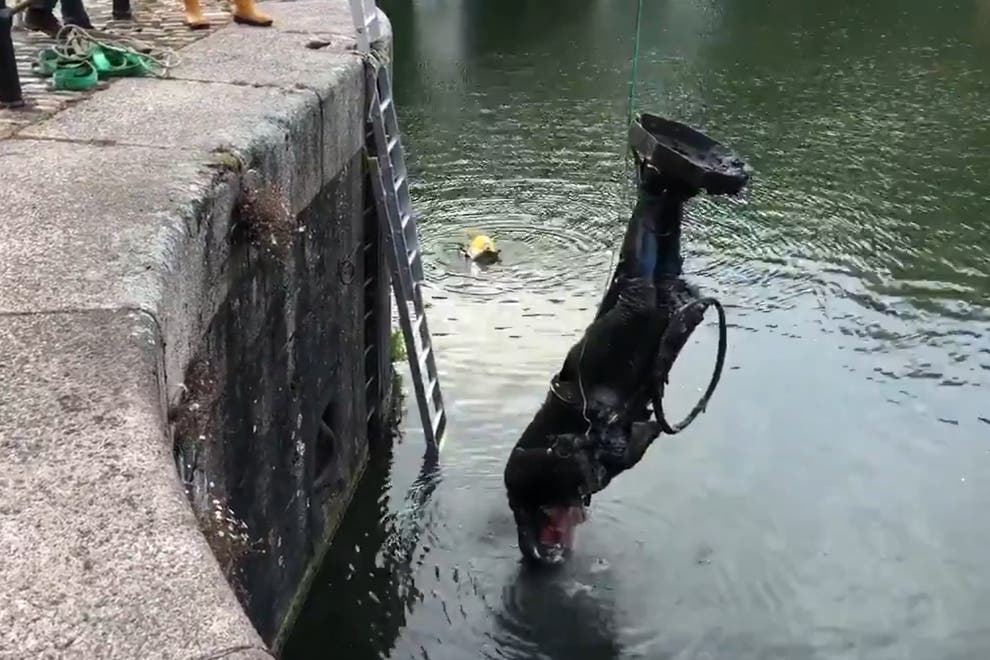
    On 7 June 2020, a large protest took place in the centre of Bristol, ostensibly against racism. The large gathering was in contravention on national and local restrictions on public gatherings due to COVID-19. No dispersal was attempted by police. Some protesters formed a mob that attacked the statue of MP Edward Colston, erected in 1895. It was sprayed with paint, damage and toppled. It was then rolled into the nearby harbour. There were no arrests. The statue was later retrieved by the Council.

    Just as the mob did not detain itself over the personal record of Edward Colston, neither shall we. The heart of the matter is mob violence, threats of violence, vandalism and intimidation. The cause is irrelevant. Ask members of the social-justice mobs that attacked the statues of President Lincoln and Frederick Douglass why they chose those targets and they could not tell you. (A member of the mob that attacked Churchill’s statue in Westminster admitted in a television interview that she “had never met the man”.) The vastness of the mob’s anger is matched only by its ignorance.

    The police watched but did nothing. Apparently, some officers wanted to prevent the attack but were instructed by commanders not to intervene. The mayor was in the police control room. Bristol City Council has long wanted to remove the statue but was not able to force through the political decision. A majority of the polled population of Bristolians opposed removal of the statue. However, the left-wing council and mayor saw the opportunity to use the mob to act on their behalf. Rather than defying authority, the mob was acting in accordance with the wishes of authority in committing this crime and was successful in doing this with the connivance of Council, mayor and police commanders, who all shared a progressive political outlook. The council, which currently has on its website pages the legend #blacklivesmatter, tweeted its approval of the demonstration.

    It was not a statue celebrating slavery. It was not, notwithstanding the hysteria of the defilers, a device for perpetrating or restoring slavery. It was a monument to a respected gentleman, trader, employer, Member of Parliament and benefactor of his home city who happened to be caught up in a legal but ethically reprehensible business. One could not have devised a more perfect embodiment of the moral quagmire that ordinary men and women of good standing became enmeshed within because they were born into a particular era. The individuals that destroyed the statue would, if they had been born three hundred years earlier, have been caught up in exactly the same moral predicament and given it barely a thought. The statue was the ideal tool with which one could teach about how our morals are shaped by our era and how society gives sanction to dubious practices. By destroying the Colston statue, the mob refused to confront the awkward truth it presented: that we are all morally culpable due to the moral constriction of circumstances.

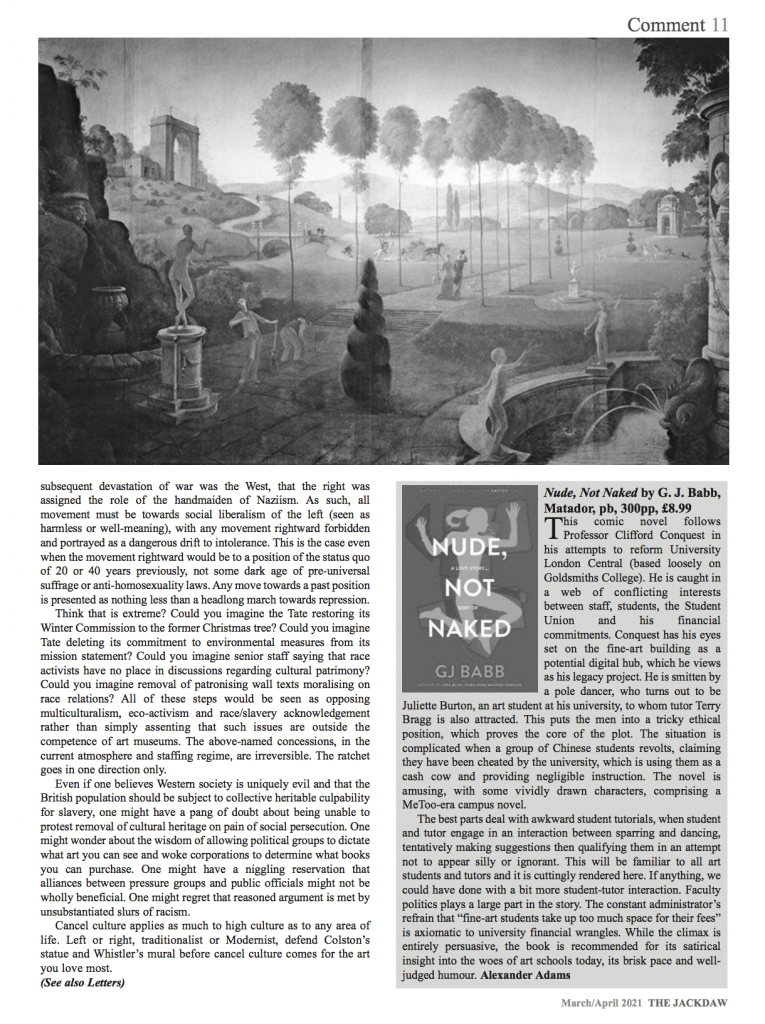
    The following month, serial opportunist Marc Quinn unveiled on the empty plinth without permission a 3D-printed statue of one of the protestors giving a black-power salute. It was taken down after one day. As a sculpture it was a failure – as all one-to-one replications are. (I know because I saw it in person.) It was a chance for a rich, state-supported London artist to wag his finger at Bristolians by (dare one say) colonising the vacant plinth in order to assert his moral superiority. It was half condescending stunt, half replacement tender. While the original Colston statue was a piece of serious artistry and a very handsome piece (see opposite and page 12), the Quinn effort was feeble. However, replacing an accomplished piece of public statuary honouring contributions of an important person with a plastic representation of a protestor who had been duped by local authorities into participating in an act of criminal vandalism is not an inapposite symbol of our era. 

    Collective Guilt

    The justification for destruction of part of the city’s heritage was that the statue celebrated a slaver. I have yet to hear the Council, mayor or protestors condemn the city’s mosques dedicated to a religion founded by a slave-owner. How many of those “anti-slavery activists” have debated Muslim theologians on the tenets that (under some interpretations) countenance slavery today? How many of them wrote letters of protest to the embassies of Chad, Mali and Sudan, where slavery still persists? In truth, there was no “anti-slavery activism” on 7 June; it was a carnival of virtue signalling that culminated in criminal-damage-as-performative-anti-racism.

    If the council puts Colston’s statue in the local museum in its vandalised state as a tourist attraction (rather than returning it to its plinth), I propose they replace it with a memorial to the Atlantic slave trade. Let us have an African slave in chains and with him his African slave-owner. This represents the historical reality that European slavery of Africans relied upon active participation of Africans, who sold to Europeans (and Arabs) prisoners of war, members of other tribes and unwanted members of their own tribes. And slavery wasn’t something only Africans endured – there were many “white” slaves too, including homeless children taken from the streets of London and sent to work in appalling conditions in the Tobacco Plantations in Virginia along with convicts who weren’t all serious felons but were imprisoned because of the consequences of extreme poverty. According to Don Jordan’s book White Cargo: The Forgotten History of Britain’s White Slaves in America, if you were transported from Britain and unlucky enough to end up in a Virginian plantation you could have a red hot bodkin pushed through your tongue before being hanged for stealing a rose from the owner’s garden. It is a must-read book for anyone concerned about Slavery. This portrayal would conflict with those who think in exclusive terms of Westerners as predators and non-Westerners as prey; such a proposal would likely not find favour with Bristol City Council.

    The overriding aim of social-justice activists is to impose upon the population a narrative of inherited collective guilt: white British people (historically and now) are complicit in the unique evils of colonialism and slavery. Thus, all action that collectively punishes this group is acceptable. This includes the destruction of their culture, public humiliation, rote apologies and reparations. None of us (whatever our colour) has experienced slavery or supported it; none of us should be forced to apologise for something our ancestors may (or may not) have approved of. Remember that we are also descendants of people who abolished slavery, forbade it abroad and patrolled the seas to curtail the Atlantic slave trade. Slavery in the Americas under the British took place at a time when there was no universal suffrage and therefore it was not a matter that could be approved of electorally by the British public. After initially participating in slavery abroad, no people ever did more to oppose slavery than the British.

    When a half-educated firebrand lectures you on slavery, ask her what year Britain abolished slavery and you will get no answer. Anti-slavery and anti-racism – in the current forms we see most publicly – are nothing more than excuses for a deep hatred of our society and its founding pillars of tradition, patriotism, capitalism, Christianity and colonialism. Social-justice activists delight in destruction, motivated by moral fervour and burning malice. They are not horrified by racism but secretly delighted, using it as a weapon as against well-meaning ordinary people, getting them to participate in broad coalitions. Activists invent new forms of “institutional/systemic” racism to maintain the illusion that non-racist people are inherently and implicitly racist and thus deserving of the elite’s control and castigation. This is the triumph of the righteous (mainly white) middle-class, university-educated allies of “marginalised minorities” over the hordes of (mainly white) working-class “racist thugs”. It is another manifestation of the class snobbery that refuted – then concealed – the mass rape of children and young women in cities across Britain because they were the “wrong” colour, religion and class.

    It could hardly be clearer than the Communist symbols sprayed on statues to Robert Peel, Churchill and Queen Victoria. Middle-class, university-educated vandals attack patriotic symbols that may not be revered but are widely respected by traditional patriotic, white working-class people. The general sentimental attachment to Baden-Powell, Churchill and Queen Victoria does not entail a complete acceptance of their opinions regarding race but now – in our hyper-charged, social-network-facilitated, emotionally labile cancel culture – accusations are enough to get a person or artefact removed from the public square. Cancel-culture definitions are ever expanding, ever changing, never appealable, never reversible. Offence-taking is used insincerely and tactically to claim territory (via cancellation) and to put people on the defensive; this process intimidates the majority, who become fearful, silent and compliant.

    Take a look at the hundreds of thousands of published pages and hours of lectures/speeches delivered by professionals in education and you will encounter a distorting mirror universe of social justice, where minorities in the West live hunted lives and ordinary social interaction are atrocities upon their dignity. This is a frighteningly alien world where there is talk of “human beings/Brown skins/Black bodies/marginalised voices” because to use the word “people” admits the possibility of a plurality of experiences, lives, viewpoints, tastes, wealth and politics. Social-justice activists literally talk of “skins” as if they were big-game trophy hunters. For activists, the “Black experience” is uniformly monolithic, invariably oppressed, irrefutably one of suffering; it is a narrative they use for material gain and political advantage. 

    What we can do?

    Do you think that taking down statues of Rhodes and Colston will satisfy activists or just encourage them? When actions are not goal-focused, limited and pragmatic but instead a hubristic religious crusade driven by spite and utopianism then they will be unremitting. When you have been trained by school, university and media to believe your society is founded upon injustices of slavery, rape and genocide of other peoples, then no price is too high and no reparations will suffice. Do you think that your culture is safe in the hands of groups which think this way? If these activists – so pliant, so poorly informed, so easily moved to incontinent fury – undeniably forgo empathy for people of the past, can they tolerate contradiction by the living?

    In these pages you will read of the onslaught on historical monuments and cultural artefacts committed by zealots, mainly in the USA. The events of this summer will not end in autumn; they have only just started. All across Britain, there are moves to destroy our culture, especially in London under the direction of the mayor. We must retain our statues. Even if they commemorate individuals we do not agree with, their presence reminds us of how our society has changed. How can we state that slavery was once acceptable if we have erased all public traces of it? Isn’t such action opening the doors to tomorrow’s conspiracy theorists? Either way, erasing history is not a practice that ends well for anyone. 

    Across the country, hectoring agitators, paid lobbyists, obsessive cranks and cynical politicians are (through legal means) attempting to remove public art that belongs to you. Defend physical culture by getting involved. Share this article. Subscribe to The Jackdaw and The Critic. Attend council meetings. Sign petitions. A website to monitor threats to public monuments and co-ordinate resistance is at www.saveourstatues.org.uk. Visit and share it; consider contributing.

    Should anyone think me partisan on this, I remind him/her that I have publicly deplored dismantlement of the Palast der Republik in Berlin, removal of GDR murals and statues, wrote in favour of many architectural projects in Communist countries and currently oppose removal of statues to Marx in the UK. Regardless of whatever you may assume my beliefs to be, I trust even critics will concede it would be misrepresentation to claim I have not consistently defended free expression and opposed iconoclasm. If you believe in these principles, I invite you to do the same and act, especially locally. Apathy and inaction will result in your culture being controlled and the history of your nation (good and bad) being erased.

    Alexander Adams’s book Iconoclasm, Identity Politics & the Erasure of History is published by Imprint Academic on 6 October.

  • William Varley: Art: Cool and Uncool

    William Varley reviews Addicted to Sheep

    So, as all cool sentences begin, I think that the best TV programme I saw last was Addicted to Sheep. In many ways this BBC4 documentary was reminiscent of the French film Être et Avoir about a remarkable teacher in a school in the remote Auvergne, although a good deal less winsome. It focused on the lives of the Hutchinson family, tenant farmers in Upper Teesdale. In their remote valley ewes are called “yowes” and at the children’s school they still sing “There is a green hill far away”. The Hutchinson children help with the lambing, including the gruesome task of dealing with still-born lambs.

    What is so admirable about them is that they have an uncomplaining, unflinching attitude to a life that is harsh and elemental. I doubt whether they have recently visited their nearest gallery, the Bowes Museum at Barnard Castle, or the Baltic at Gateshead. I also suspect that the issues which so exercise the post modern, post Christian urban élites: multiculturalism, egalitarianism, transnational progressivism (no borders), environmentalism, feminism and the rest of that plethora of right-on attitudes, don’t preoccupy them. For a start, they don’t have the time. Without wishing to patronise them, they probably believe that the acronym L.G.B.T. stands for a brand of sheep dip. All of this, in the opinion of the ‘enlightened’, particularly art world instrumentalists, makes them seriously uncool.

    How does one define ‘cool’? There are still people around who think that it’s a gently meandering style of jazz, but most of us know that it’s simply a matter of a self-appointed élite determining what is acceptable and unacceptable. It’s a phenomenon which transcends ages and classes, from the tiny tyrant berating her parents for not recognising the world significance of ‘One Direction’ to the State Art apparatchik wincing as he patiently fields one’s less than enthusiastic reaction to a ‘challenging’ new installation. In Jonathon Rose’s brilliant book, The Intellectual Life of the British Working Classes, the anthropologist Mary Douglas describes it thus:

    Art trends may have as brief a shelf life as stock exchange trends, and they depreciate rapidly if one fails to catch the latest wave in architecture, or literary theory. The names that Bohemia adopted for itself – avant-garde, advanced, progressive, le dernier cri, new wave, cutting edge, modernist, postmodernist – all reflect the Anxiety of Cool, the relentless struggle to get out in front and control the production of new cultural information. Bohemia is ‘subversive’ only in that it seeks to wean consumers away from older cultural products in order to sell them new ones.

    That description is one of brash economics but, of course, we’re all familiar with the broader pattern of Cool, the Godfather of which is Marcel Duchamp.

    Ad Reinhardt once remarked that all artists had to make a choice between Mondrian and Duchamp, between advocates of the hand- made, and those of the ready-made. As Jackdaw readers know, Duchamp, asserting that all art was mere taste, allegedly exhibited a urinal under the title of Fountain at the Armory Show in New York in 1913. Actually, as Jackdaw readers also know, that anarchic gesture was performed by one of his girlfriends as the Armory Show was ‘unselected’. Still, as someone who was intoxicated by word-play, puns and conceits, he was the epitome of the intellectual dandy. Apparently effortlessly, he invented kinetic art, optical art, conceptual art, and his great hermetic narrative, The Large Glass. Consolidating these innovations he left to allegedly mediocre followers.

    His biographer Robert Lebel wrote that he regarded the ready-mades as sacralisation or transubstantiation. (How God-like is that?) However, “His real motive with them was to depreciate our ordinary and tacitly accepted notions of value in order to exalt the strictly private and sovereign choice which is accountable to no one. With the ready-mades”, said Lebel, “he meta-ironically demonstrated his incontestable power to be TAKEN AT HIS OWN WORD which is the unmitigated artist’s privilege.” You can see where that gets us: art is anything you say it is, a situation that leads inexorably to the empty stunts of the Turner Prize and the vulgar extravagances of the Pinault Collection. Still, for his loyal disciples in the State Art Establishment his reputation is unassailable. There have been notable heretics from the general orthodoxy though. In his book The Banquet Years, examining the pioneering days of Modernism, Roger Shattuck remarked that Duchamp’s strategy of ‘nominating’ useful objects to art status was “essentially self-consuming, a reversion to dead level after an initial shock.” More recently, in The Winter of our Culture, Jean Clair (real name Gérard Régnier) the former Director of the Picasso Museum in Paris, described Duchamp’s Armory Show as “works of provocation and derision presented by a cynical dandy”.

    The High Priestess of Cool was, of course, Susan Sontag. During the ’60s and ’70s she was the doyenne of American intellectuals and in her seminal book Against Interpretation, she issued two decrees that in retrospect seem to have underpinned the visual art that developed afterwards. Attacking the discrimination between hierarchies of art as ‘philistine’, she effectively substituted a plateau view of culture for the existing pyramidal order. 

    Henceforth, there was to be no qualitative distinction to be made between high and popular culture, art and entertainment. In this scenario, Elvis Presley could give Mozart a friendly wave across a level playing field. The ‘dumbing down’ consequences of this were, of course, appalling and eventually she could see it. She died 12 years ago, but shortly before her death she condemned ‘the triumph of a pernicious relativism.’

    I am not prepared to say the satisfactions derived by art are no different structurally, in context, or in quality or in importance, from other kinds of satisfactions. I am not prepared to think that the satisfaction I might get in front of a Chardin, a Vermeer or a Vuillard is in any way similar to the satisfaction I would get watching a beautifully pitched baseball or inspecting a shoe collection.

    Her recantation was welcome, but it was too little, too late: the damage to the impermeability of high culture had already been done.

    The other hugely influential aspect of her ‘new sensibility’ was the idea (echoing Matthew Arnold perhaps) that art should concern itself with the moral criticism of life and be used as ‘a tool for changing consciousness’. Whether or not her writings were the cause or whether the true believers in an art for use developed their own ideology, in subsequent decades a veritable deluge of issues appeared. They mostly consisted of that left liberal menu of Goodthink favoured by the BBC that I’ve already mentioned: multiculturalism etc.. They are very useful for ‘virtue signalling’. “Let’s do the Holocaust”, artists would say, “or perhaps child abuse”. This is empty posturing, a bit like wearing Aids ribbons. It’s also about as far removed from Kathe Kollwitz’s nightmare visions as it’s possible to be. As the wife of a Berlin doctor Kollwitz knew poverty and illness at first hand. Her emotion was earned, not affected. Still, quangocrats and councillors who dole out funding love emotional incontinence. Current affairs and politics are things they can understand: the structural music of painting invariably remains a mystery to them. And insofar as they reinforce the fallacy that visual art is simply a medium or receptacle of a socio-political statement, it’s a godsend to those media hacks deputed to discuss them.

    Some issues, however, are so uncool that they’re off limits. Take the case of Kamel Daoud, for instance. This distinguished Algerian (Muslim) novelist wrote an article in Le Monde in late January denouncing the wave of sexual assaults that had occurred during Cologne’s New Year’s Eve celebrations. He didn’t temporise, calling the assailants Muslim men:

    The refugee-immigrants come from the vast universe of sorrow and horror which is the sexual misery of the Arab-Muslim world. The subjugation of women is the psychological Gordian knot at the core of the world of Allah, and hence the inspiration of the death cult that claims to defend it.

    You can easily guess the reaction to that: an academic fatwa; and erstwhile friends telling him, with the greatest kindness, to stick to writing novels and, politically, to shut up. Our politicians, of course, favour the ‘Religion of Peace’ narrative and as far as our art world is concerned, in contrast to the scathing visual indictments of Abu Ghraib how many denunciations of suicide, bombings, jihadist beheadings and the like can you think of? None? I can think of one. A couple of years ago in an exhibition in Rome I saw a small black singlet in the form of a hijab presented by the Egyptian feminist Ghada Amer. Unsurprisingly she now lives in New York.

    Another aspect of cool is the cult of novelty. I remember Lawrence Gowing back in the ’60s presenting the imperative to many young artists “to make it new”. At the time it worried me, being far too prescriptive. As someone who believes that originality should be involuntary rather than willed, I would have advised “Make it good”. Giles Auty in The Jackdaw was scathing in identifying the ‘novelty trap’ in which ‘ism’ inexorably succeeds ‘ism’ and thereby invalidates its predecessor. (Auty estimated that about 40 ‘isms’ occurred in the 20th century, each having about 2.25 years of life.) In his irreverent article he suggested that, according to the novelty narrative, “western art should be read as a kind of art-historical relay race which culminates in the death of painting … because there are no more apparent avenues left to explore”, a process which he maintained was “both spurious and infantile”. Astutely, he demonstrated how the art world had hijacked from science the rhetoric of progress with the consequence that anyone who refused to embrace it was certifiably reactionary and uncool. Of course there are some exceptional exponents of hybrid media such as the prodigious William Kentridge, but the strategy of State Art is to impose novelty on a baffled public. Amongst that public there are some blasphemers, though. The late Henning Mankell believed that “One of the tasks of art is to provide people with companions. I have seen people in paintings who I hope to meet in the street one of these days…” How uncool can you get? The Scottish prose-poet Nan Shepherd, ‘married’ one might say, to the Cairngorms, had a similar capacity for empathy. The ‘technoscape’ may be cool but engaging with actual landscape is extraordinarily rewarding. Like Wordsworth in The Prelude, she believed that “sustained contemplation of outer landscapes led to a subtle understanding of the spirit.” Her attitudes correspond almost exactly with those of several painters I respect. All of her senses were engaged when experiencing landscape and art, of course, should be enjoyed through the senses. She could smell the rain: so could Constable. (Those experiences and spiritual rewards are also shared by the Hutchinsons.)

    When I reflect on State Art’s prioritising of novelty, however, I recall Andrew Brighton’s observations in Consumed by the Political in which he said, “The propagating of serious art amongst people who are relatively uneducated is an act of cultural aggression” and, emphasising the underlying totalitarianism of this ostensibly generous agenda suggested that, “The idea that people without art are lesser or inferior beings is a ridiculous assumption, a piece of moral vanity akin to a religionist’s belief that only those of their faith or sect are capable of real virtue.”

    Hard it may be for the quangocrats to grasp this, but there are thousands of people who live happy, fulfilled lives entirely without art. The irony is that the attempt of the Kulturkampf to dragoon people into an involvement with art is founded more upon a campaign of exclusion rather than inclusion. But to return to the Hutchinsons. My lingering image of the Addicted to Sheep documentary is of their eldest daughter, about 10 years old, sitting in the landscape making a painting by using her eyes – and making a pretty good fist of it (above). All is not lost.

  • Giles Auty: Money Culture Notes

    Giles Auty

    This was the last piece Giles submitted to The Jackdaw. He died suddenly in September, aged 86.

    It’s all about the money honey. When I awoke to see the front cover of the weekend Australian’s review section on June 20th it was rather like being thrown back into some weird and most unwelcome dream. Did I really read “POLE POSITION: up close with Pollock’s $430 million masterpiece by Rosemary Neill?”

    Regrettably I did. Should we also bring back Gough Whitlam if we could? Sadly he’s as deceased as the inflated reputation of Blue Poles really ought to be. But what the hell? Ever heard of Clement Greenberg a leading critic of Pollock’s day and Pollock’s most consistent supporter? Clearly not because we have Greenberg’s word that Pollock considered Blue Poles a failure while Greenberg himself thought Blue Poles “an absolute failure and a ridiculous thing to buy”.  (See Patricia Anderson’s biography of Elwyn Lynn my predecessor as art critic at The Australian). On the basis of the definitive exhibition of Pollock’s work I saw at the Tate Gallery in London in 1999 there were quite a few better Pollocks than Blue Poles. But they are not in Australia so cannot possibly be as good.  In April 2006 I wrote a 4,000 word essay for Quadrant which dispelled the miasma of nonsense which continues to surround this entire subject. But Australia will sadly never grow up in some ways, which is why we lag behind so markedly in terms of our whole culture. That essay forms part of a 50 piece anthology of my writing Culture at Crisis Point (Connor Court 2016) if you feel inclined to dig it up. The man who actually flogged Blue Poles to the then Australian National Gallery, New York-based Australian Max Hutchinson, proposed that Blue Poles along with Picasso’s Guernica and Monet’s Waterlilies is one of the five or six great works of art painted since the Renaissance. So what other pair of works might Mr. Hutchinson have picked to make up his handy half dozen?

    The task of choosing between the lifetime productions of the likes of Caravaggio, Velazquez, Rembrandt, Vermeer, Tiepolo, Goya, van Gogh, Manet, Matisse and Picasso – to name but a handy ten – would be a daunting one even for someone who knows the complete works of all ten quite intimately. God alone knows what students are taught on art history courses these days even if such courses still exist. The National Gallery of Australia has a very poor record even in more recent times in its purchasing; for example, it made a colossal error of judgment in buying David Hockney’s very weakly conceived A Bigger Grand Canyon – and paying an inflated price for it  (over A$ 4 million) when it could have bought Australian William Robinson’s even bigger and infinitely more accomplished Creation Series: The Ancient Trees for $250,000. I was prepared to put myself in serious debt to buy the latter but lost out to a Sydney doctor who very wisely snapped it up and built a special room to house it.

    I have never of course served on the board of any public gallery in Australia although prior to coming here I reviewed art in more than a score of different countries. Rhetoric as we know describes language designed to persuade and impress. Its natural habitat is politics and advertising but in both of those fields long acquaintance has persuaded intelligent minds to recognize its nature and dilute its effectiveness. Regrettably the toxicity of such language still has a fatal effect in areas where the ubiquity of its use remains unrecognized. In no area is this truer than the visual arts. The 20th century, which was dominated by 

    Modernism, saw the rise and fall of about 40 readily identifiable and significant art movements in the Western world alone. Can there really have been an art movement for every two-and-a-bit years of an entire century?  But who can even begin to tell you what Orphism, say, or Rayonism were? Yet many people believed that both were vital art historical movements. So why have we shown such a continued obsession with novelty?

    Right from word go Modernism liked to portray itself as a liberating force but was never anything of the kind. Sadly all too many made a naïve connection between what was happening in art and the genuine breakthroughs which were happening in technology.  And art very cleverly annexed a similarly favourable rhetorical language. In short to situate yourself on the side of ‘progress’, ‘advance’, ‘evolution’ and ‘experimentation’ was to grab a positive propagandist language by the throat. Like Pollock, many artists are not especially bright or literate and evidence exists that if Pollock had not effectively killed himself (and someone else) when drunk he would have reverted to more of a directly surreal way of working.

    Blue Poles is the sole work by Pollock most Australians will ever see so all rely on writers such as Rosemary Neill to put the work in some realistic context. $430 million did you say? Australia is a money-conscious country which has yet to educate itself in any other form of evaluation. The real reward of very good art is inherent because true artists are not bankers and do not think as such. In days when I wrote for The Australian I was hauled before the editor for describing Australian culture as ‘rather less than effervescent’ in another publication. In a recent issue of The Spectator James Delingpole, whom I know, talks of his growing affection for Australia. I came to Australia a quarter of a century ago with very similar feelings and resisted an invitation from the then Spectator owner Conrad Black to return home. For a country of its size Australia has performed very poorly in terms of almost any sort of culture and the example set by official bodies such as our museums for sure do not help. Rosemary Neill’s article on Pollock takes a long step backwards which we can all really do without but will surely not cost her her job.

  • Alexander Adams: Women in Art Today

    Alexander Adams

    We are told that in many fields women face systematic disadvantage and are under-represented. It has become a core belief of many and goes almost unchallenged. When politicians came under pressure regarding supposed gender discrimination in the workplace, the British government conducted a survey of arts organisations. The 2018 report found that women comprise 56% of the British arts-sector workforce. The Arts Council of England has a National Council comprising 53% women and an overall workforce of 65% women. This evidence seems to contradict the narrative that British organisations reflect male power. At the very least, female administrators and human-resources staff must be implementing a form of patriarchy which is proving strangely ineffective. 

    I wondered why the female-disempowerment story had such currency when reality appeared to contradict that. So, starting in July 2018 for 12 months, I collected data on the press releases that I encountered as a critic in the forms of emails, publisher catalogues, magazine advertisements and notices on specialist websites regarding the international art world. I neither screened nor sought out data. I wanted to test the narrative that women in the arts face obstacles that their male colleagues do not – in other words, women are subject to widespread sexism due to the actions of individuals, organisations and systems. I daily checked every public statement relating to living individuals of ascertainable gender, classing each entry under appointment, prize/award or event. I tallied data monthly and derived from it percentages. I discounted any announcements relating to dead artists, non-fine-art events, events without an identifiable artist and previously announced events. Announcements relate to events in Europe, North America, Australia and a few from other regions. 

    The event data are numbers of opportunities not individuals because it was impossible to count individuals in events such as art fairs. Thus an event of 2 male artists is listed as “1 male opportunity”; an exhibition of 8 men and 3 women is listed as “1 mixed opportunity”. Each entry of unknown gender or mixed gender is counted as 0.5 male and 0.5 female opportunities.

    Although the system was neither comprehensive nor watertight, it produced remarkably clear consistent data.

    1.  Women outnumber men in recent appointments.

    Data shows that, in the cases documented, women are appointed to a greater number of permanent positions than men in public and private venues, arts organisation and to more temporary positions as organisers, directors and curators of events. This strongly suggests that there is no bias against women in hiring and promotion of individuals for permanent and temporary positions. It is fair to conclude there is no systematic bias against women being appointed to jobs within the fine arts. If, as it seems, a) women are entering existing positions at a greater rate than men and b) they are entering at a greater rate than that of the increase of positions in the field overall, then the field is becoming increasingly female populated.  

    2.  Female artists outperform male artists in recent fine-art prizes and awards.

    Considering the multiple estimates of the population of artists dividing 40-45% female and 55-60% male, female artists win more prizes than men proportionate to the percentage of the artist population that they comprise. All other things being equal, a female artist is two to three times more likely than a male artist to receive an award or prize. It is fair to conclude there is no systematic bias against female artists receiving prizes and awards.

    3.  There is over-performance of women artists in recent fine-art prizes and awards.

    Working on the basis that women form 40-45% of all professional active fine artists, we can see a measurable consistent over-performance by female artists. Different women were receiving prizes, awards, honours, scholarships and so forth, so it was not a case of a few skilled individuals winning multiple prizes due to personal merit and thereby distorting data. Male artists are under-represented in terms of fine-art prizes and awards. It is fair to conclude that female artists statistically over-perform and male artists under-perform in the area of receiving prizes and awards. 

    4. Female artists are represented in recent arts events at a level commensurate with that which they form in the artist population.

    Working on the basis that women form 40-45% of all professional and active fine artists, we can see that they have opportunities commensurate with their proportion of the artist population. The figure is remarkably consistent month-on-month. It is the largest dataset in the survey and the most consistent in terms of percentages. It is fair to conclude there is no systematic bias against women artists participating in fine-art events.

    5.  Recent female-only events outnumber male-only events.

    The total number of specifically male-only events was very small compared to specifically female-only events. For whatever reasons, fewer events around single-gender bases were devoted to male artists than female ones. It is fair to conclude that specifically single-gender events significantly favour female artists by providing more opportunities for female artists than for male artists. 

    6.  The dataset is of adequate size.

    The larger is the dataset the greater the consistency. Appointments and Prizes/Awards – the groups with the least amount of data – fluctuated most; Events had most entries and was most consistent. Inevitably, a study with a larger dataset would be more accurate.

    7.  The data is internally consistent.

    Data did not fluctuate dramatically over period and did not seem to be seasonally affected. Even in months with relatively little data, percentages for these months remained consistent with high-data months. This suggests that the data is relatively reliable and consistent. It also suggests that as trends were stable that the data shows a persistent state rather than a temporary situation.

    8.  The data seems a reasonable reflection of reality. 

    There is no indication – factually, logically or anecdotally – that this data is not a workable approximation of reality. The data reflects the experiences of most artists, art critics, art collectors and other art professionals rather than any political narrative.    

    9. These conclusions are in need of future correlation and correction. Further statistical models and datasets are needed to confirm or disprove the conclusions above. 

    Overall, these figures – while being a limited dataset – are an indication of what is likely the true state of affairs. To my knowledge, this is the first time such data has been compiled and for that reason alone it is of value. A more comprehensive survey is needed. However, there is nothing in this data or the conclusions that seems not broadly representative of the current situation.

  • Alexander Adams: What is Critical Theory and Why Should I Care?

    Alexander Adams

    “Was Lt Columbo’s name really Frank? We’ve all seen the freeze-frame close-ups of Columbo’s ID badge which states that his first name is ‘Frank”. But should we consider this canonical?”

    I’m becoming more and more confused by this ‘canonical’ business. The above is from Columbophile website. I love his joke about the Jewish lady who was walking down the street when she met a flasher. He whipped open his raincoat and she bent down to have a closer look. ‘Huh!’, she said. ‘Call that a lining?’

    At Browse and Darby on Cork Street for a small show of paintings called Off the Radar selected by William Packer. Some of these artists I remember from the Royal College. Leonard Rosoman was supposed to be my personal tutor. He is represented here by a rather good portrait of Jamie Scott. During his time as my tutor he never spoke a word to me. I asked Cyril Reason, another tutor, about this and he explained that Leonard was frightened of me. Jean Cooke I also remember. She was a nice woman but suffered from John Bratby. The only thing I remember her saying is “Ooh mi cystitis is really killing me this morning”. Her picture Up the road and pigeon die is worth a look.

    Deep in the bowels of the Sainsbury wing at the NG is an exhibition of the work of Mantegna and Bellini. The Venetian Bellini was one of the earliest artists to use landscape as an important ingredient of a picture and he did it in a less ‘wooden’ style than heretofore. The Paduan Mantegna was married to Bellini’s sister so they were kind of rivals. Mantegna was rather more formally and classically inclined, best known for his Triumph of Caesar. It’s good to see this series again, and illuminated much better than they were recently at the Royal Academy.

    The Feast of the Gods by Bellini is a good example of the way artists used to collaborate. It was touched up later by Titian, and then Dosso Dossi. The Assassination of St Peter Martyr, which is in the National Gallery, demonstrates the importance landscape held for him, about two thirds of it being taken up by a forest. The Drunkenness of Noah, also by Bellini, shows a near naked Noah sprawled out with three attendant figures. The central one behind him has a facial expression of slavering lechery, similar to that of the chief skinner in Ribera’s St Bartholemew, but more of that later.

    Bellini made a copy of Mantegna’s Presentation of Christ in the Temple. He did it from a tracing. What they did to babies in those days was extraordinary. The baby here being proffered to the priests is wrapped up tightly in white bandages and apart from the head would have been unable to move. It’s a wonder they didn’t gag it for good measure. Is this what’s meant by swaddling? Minerva expelling the vices from the Temple of Virtue by Mantegna is interesting mainly for his depiction of the vices. There’s a wonderful fat one in the bottom right corner.

    The drawings are very interesting, especially Mantegna’s Virtus Combusta. The description of it in the catalogue is delicious: ‘Pen and brown ink and point of the brush on a brown ground, heightened with white, the black background over red on paper.” Poetry. Blindfolded Virtue is being led to a pitfall by sundry malefactors. There are many other beautiful drawings. The Virgin and Child with Angel by Mantegna – tonally exquisite.

    There’s a priest in these parts who wanders around in a floor-length cassock, with a squarish hat and a pimple on top. He’s very furtive looking with a purplish complexion, and terribly thin. An obvious self-flagellant and wearer of the barbed wire garter. I wouldn’t be surprised if he’s got hairy palms. The other day he was bending down to talk to a small boy and I felt like Alfred Hitchcock who, upon witnessing a similar scene, wound down the window of his limo and shouted “Run! Run little boy! Run for your life!”

    “We have seen in our times men sent to the flames or the hangman’s hands on the grounds of their rejecting the holy word of god as the prelates interpret it. These prelates have lifted up their eyes as they were swooning with joy at the salvation of the sinner, though deeply regretting the agony inflicted. They love the pain of others for in it their own power is made manifest. It’s the one thing that man wants. Not knowledge, not virtue, but power.” So wrote Machiavelli. Some of the horrors of the life religious are on display at the Dulwich Picture Gallery in a show of paintings by José Ribera.

    One of the chief horrors (still common in the Middle East) is the strappado. The miscreant has his hands pinioned behind his back and is hoisted by the wrists, sometimes to a great height. Occasionally they would be suddenly jerked down a bit, just for jolly. The arms would steadily assume a vertical position as shoulder dislocation advanced. At what point death would ensue is uncertain. Perhaps they did them a favour and let them drop. Still it was for their own good, to protect them from eternal damnation in the fiery pits.

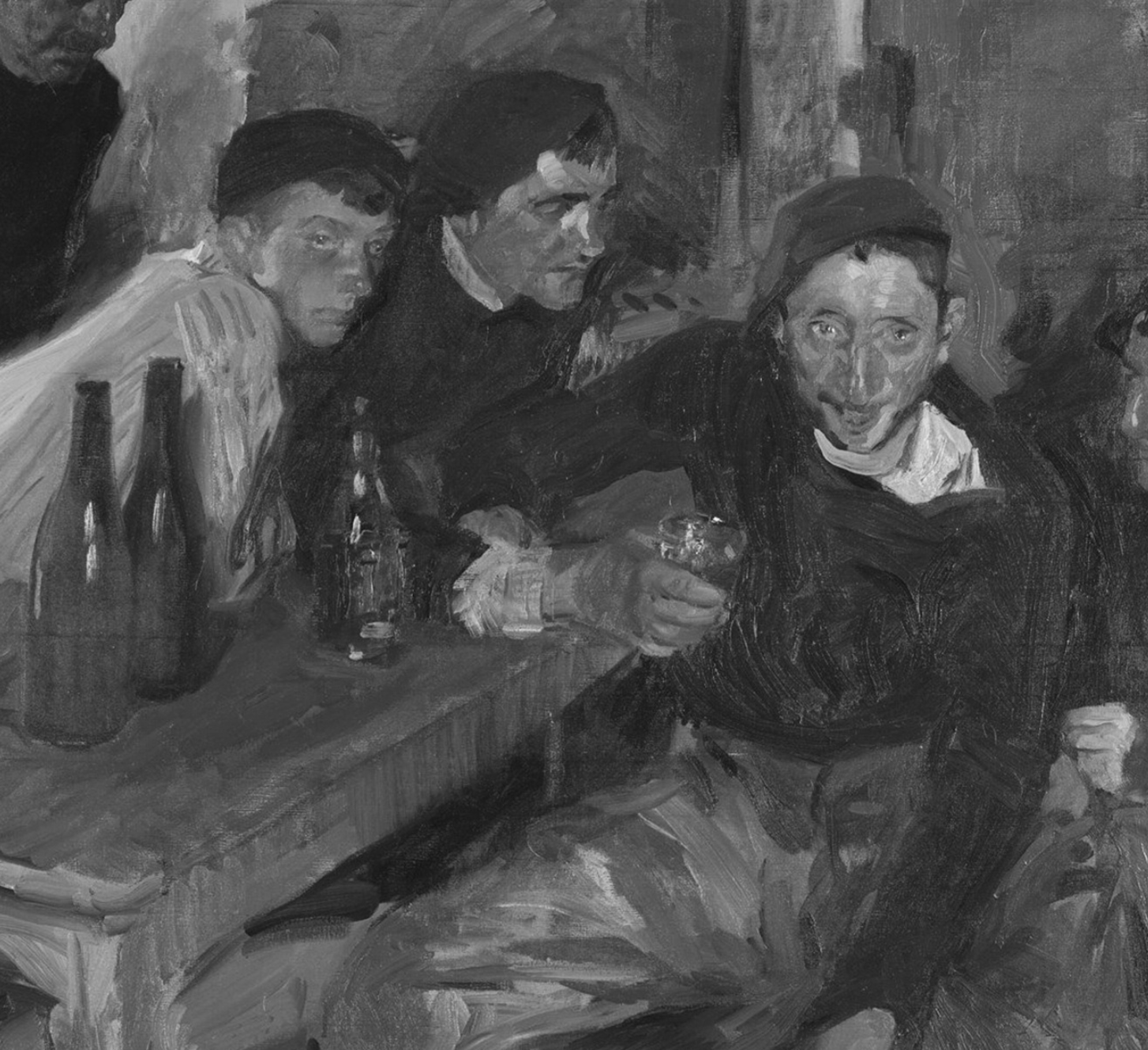
    Ribera was also preoccupied by the gruesome fate of St Bartholemew, who was flayed alive. There are several versions of this theme but the best is in the first room. Unfortunately it has been covered fairly recently in high-gloss varnish, which renders close scrutiny impossible. You have to stand well back to avoid the glare. There are many ways to varnish a picture and many different varnishes – you can even get a matt one. The one they’ve used here is most unfortunate. But it is a great picture.

    The chief skinner is shown sharpening his tool with a look of enormous relish, almost lechery, and this motif recurs in all the other versions. Most of the pictures in this show are to do with inflicting pain. St Peter was crucified upside down and Ribera went to great lengths to figure out how this was achieved. Not easy. The base of the cross is notched and morticed to allow the passage of the ropes attached to the ankles of the unworthy saint before he was hauled up and planted head down. It looks like his head would have been fairly close to the ground so bystanders must have been tempted to give him a good kicking, or maybe not as this would have shortened the agony.

    Writing about pictures with such enormously powerful subject matter is a difficult business. I suppose you can consider Caravaggio in aesthetic or compositional terms, but not these. And for a religious person they must be something else altogether; they are after all devotional items. Perhaps to get inside Ribera you have to go to the drawings, many of which are on display here. It seems clear that the sadistic tendency was there all along, it was inherent in Ribera’s make-up and he managed to harness it to religiosity.

    Regular readers will be aware of my friend Mistress Trish, who runs a dungeon down in Warren Street. It might be a good idea to take her along to Dulwich to give her a few new ideas. She’s got a houseboat and one of her clients has been enquiring about keelhauling. I advised her against it, for that way madness lies … and quite a bit of trouble. I recommended she stick with walking the plank.

    Like the universe the cosmic conceit of the art trade is expanding forever. Some of us thought that the gravity of logic or aesthetic sensibility would somehow cause it to slow down and contract, but no such luck. There must be some weird dark matter involved. The joke persists, as can be seen at Tate Bankside.

    “I’ve suffered for my art, and now it’s your turn!” could well be the motto of the artist responsible for the new display in the Boiler Room. There’s absolutely nothing in it until you get to the bottom of the ramp. There, gangs of schoolchildren are cavorting on the floor, which has been laid with some sort of heat sensitive tiles reacting to foot or body pressure, leaving a mark behind. Off to one side is a smallish room to which you are admitted after having your hand stamped with a long number. Inside it’s like a Turkish bath but the steam is something akin to a mixture of menthol eucalyptus vapour which promotes the tears you should shed for the plight of refugees. I felt like erecting a large sign reading “Art is not Elastoplast”.

    Oh, just one more thing. I popped into the National Portrait Gallery to see the BP prize. A little man told me it had finished the previous week. “You’ll have to go to Wolverhampton,” he quipped.

  • Michael Daley: Selling a Leonardo with Oomph

    Michael Daley: Selling a Leonardo with Oomph

    Michael Daley

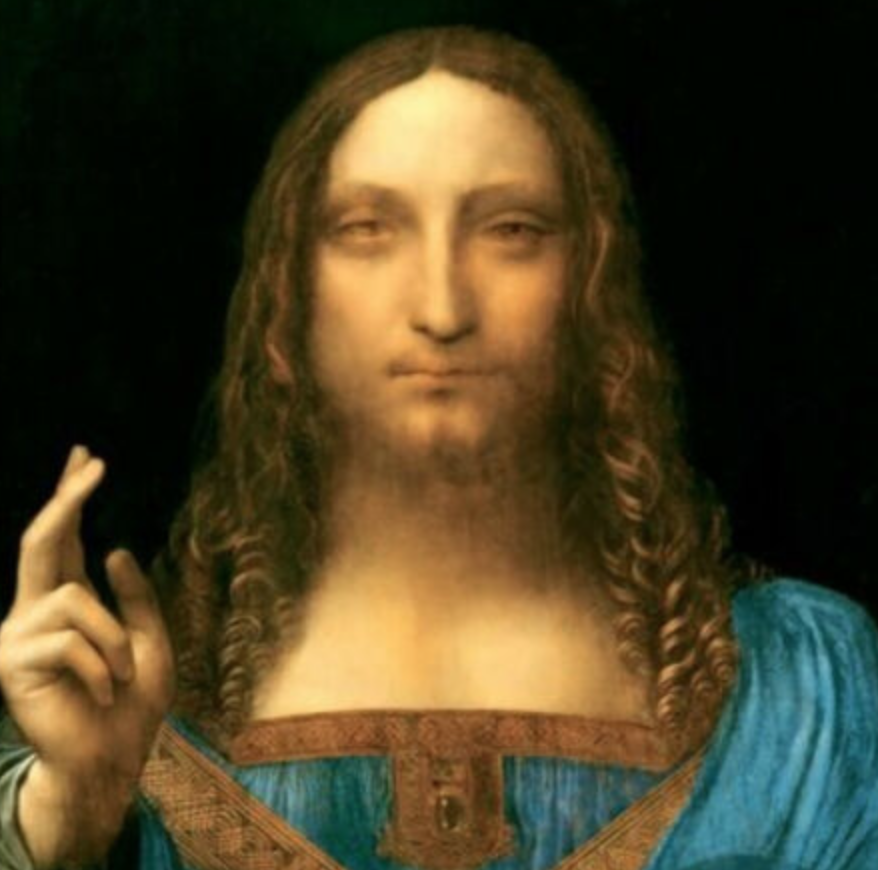
    Questions proliferate on the disappeared $450 million Leonardo Salvator Mundi. Where is it? Who owns it? Who still believes it a Leonardo? Will it be exhibited this year at the Paris Louvre’s big Leonardo exhibition, as promised? Can it be true, as an artnet blogger now claims (on the claimed say-so of “two principals involved in” Christie’s 2017 sale) that the painting was removed on the night of the sale to be installed on the yacht of Saudi Arabia’s supreme ruler, Mohammad Bin Salman? Does Christie’s know more about this imbroglio than it has disclosed? Will the Salvator Mundi ever be seen again?

    In The Last Leonardo, Ben Lewis contributes hugely to knowledge of the picture’s shadowy emergence and subsequent near-mythic elevation. We now know the picture was bought not for “around $10,000”, as claimed, but for $1,175 – for less than the low estimate of $1,200-1,800 on a work described as being “after Leonardo da Vinci” at the St Charles Gallery, New Orleans. We now know that gallery closed down after the Salvator Mundi’s sale and reappeared under the same name but without previous records. We now know Christie’s turned the picture down in 2005. We know the “consortium” of buyers initially comprised Robert Simon, a New York dealer and Alex Parish (a freelance dealer and online picture scout for the Richard Green dealership). We know that before, during and after being exhibited at the National Gallery in 2011-12 as an undisputed autograph Leonardo, the picture was on the market and numerous attempts to sell it privately to museums for between $80 million and $250 million failed.

    Lewis discloses that it was variously rejected by: the Qatari royal family; the Hermitage; the Getty Museum; the Museum of Fine Arts Boston; the Vatican; Berlin’s Gemäldegalerie; and a German auction house whose Leonardo advisor, Professor Hans Ost, was and remains “very sceptical about the attribution”. The initial consortium was running out of money and afraid to offer the picture for auction. As Parish put it to Lewis, “there’s not a deader-in-the-water [work?] than a picture which you put up to auction and then bombs… where do you go from there? Absolutely dead.” Somehow, despite all failures, unimaginable success was to follow. 

    Deliverance began with a third consortium member: “An offer of help came in 2010 from a reputedly well-connected New York old master dealer, Warren Adelson, who has a gallery in a magnificent uptown townhouse. ‘I made a proposal to Robert and Alex to buy a share of the picture,’ Adelson says, ‘because I wanted to run with the ball and help them sell it.’ He negotiated a 33 per cent stake in the painting in return for a $10 million advance payment. It was accepted. As Robert Simon put it ‘there were a lot of expenses. The photography and the storage were expensive. When we insured at its value the insurers wouldn’t allow me to keep it in the gallery. It had to be kept in a vault at an art storage facility. There were my research costs, going to Europe five times, and Milan five times, and London and New York, and going and checking the libraries. Dianne [Modestini, the restorer] was helpful in not requiring us to pay everything in advance.’”

    Lewis wryly observes “nothing in the known universe, no item, no object or quantity of material, has ever appreciated as fast as the Salvator Mundi attributed to Leonardo da Vinci” but, even with a war chest, and Adelson on board, the going remained rough. The picture was offered to the Dallas Museum (for a rumoured $125 – $200 million). The museum’s new director, Max Anderson, was enthusiastic about the chance to “‘acquire a destination painting’ that would draw crowds to the museum.” Parish told Lewis: “We were strung along by him for some time … at the eleventh hour they offered just $40 million and $25 million of that was meant to be a swap with another painting. Apparently some of those Bible Belt people had little or nothing good to say about the picture. One guy – I won’t tell you who – said, ‘Boy, that is one faggy-looking picture of Jesus’ or something to that effect. I was really like, ‘O-o-oh, great. This is going so well.”

    Despite the astronomical leg-up inclusion in the National Gallery’s major Leonardo exhibition as a rediscovered lost autograph Leonardo prototype painting, this Salvator Mundi remained unwanted by museums and could not be risked at auction. Partial success – in the consortium’s inflated terms – was only achieved in 2013 with a controversial lawsuits-generating private sale through Sotheby’s to a Freeport owner who bought at $80 million and immediately sold on to a Russian oligarch for $127 million.

    What then would carry the picture over the line so spectacularly in 2017? When Christie’s got its second chance, it launched a global promotional blitz that rested on two planks: the authority of a claimed unusually broad consensus of endorsement among art historians; and, an absurdly inflated and unfounded provenance taken from the National Gallery’s own unfounded claims that rested on the then – and still – unpublished researches of Robert Simon. ArtWatch UK exposed the unsoundness of Christie’s provenance the day before the sale. 

    Lewis gives an especially attentive account of the precisely focussed means by which this seeming sufficiency of art experts was enlisted. With the single exception of Professor Martin Kemp (who spouted statements galore and made a promotional video for Christie’s immediately ahead of the sale to counter our criticisms) almost none of the listed scholars and curators had then – or has since – gone on record giving reasons for holding the painting to be an authentic autograph Leonardo prototype for all other Salvator Mundi versions. When Lewis asked the consensual scholars he “was not able to verify the verdicts of all the art historians listed in Christie’s catalogue.” His account of how the tongue-tied dozen scholars were assembled is molten:

    “Robert Simon was well aware that he needed to be strategic and accumulate the right allies if his painting was to be authenticated as a fully-fledged Leonardo. ‘Part of the reason for the secrecy was the mechanics, if you will, that Bob had to employ in order to get the utterly fantastic consensus that he compiled,’ says Alex Parish … After the initial period of restoration [there being quite a number – see Figs. 2 to 8], Simon and Parish began showing the picture to close contacts. The first to see it was Mina Gregori, not a Leonardo expert but a close friend of Simon’s who had made some hotly contested attributions to Caravaggio in the past. She came to see the picture in New York in November 2007, and said nothing at all while she was standing in front of it, but as Simon walked back to the lift she turned to him and said, with an Italian sense for melodrama, ‘È lui’ – It’s him.”

    Gregori was a good first choice. The owner of the Martin Kemp-supported La Bella Principessa drawing, Peter Silverman, gave this account of Gregori’s endorsement of that other would-be Leonardo in his 2012 memoir Leonardo’s Lost Princess: One Man’s quest to Authenticate an Unknown Portrait by Leonardo da Vinci:

    “We had become close friends with Mina over the years, and she frequently stayed with us when she visited Paris … I asked her to look at the portrait again, telling her, ‘Mina, people are saying it could be Leonardo. Please sit and study it carefully and give me your honest opinion’ … Mina remained bent over the portrait for a very long time. Finally she called me to her side. ‘Yes,’ she said. ‘It is Leonardo. Allow me to be the first to say so formally.’ I handed her a black-and-white photo, and she wrote the attribution on the back. I still have it.”

    Lewis frequently encountered un-clarity and contradictions: “Several curators and restorers from the Metropolitan Museum saw the partially restored Salvator Mundi in early 2008, but it is not clear what exactly was said about the painting. According to Robert Simon and Christie’s, a majority of the Met experts agreed they were looking at a Leonardo. One of its Italian renaissance specialists, Keith Christiansen, certainly did, and still does. Another senior staff member, Andrea Bayer, deputy director for collections, told me she would not comment on the painting. One senior academic source close to the Met told me, on condition of anonymity, that ‘The Met curators don’t believe that it is by Leonardo. One curator told Simon that the Met would be glad to accept the painting as a gift for study purposes. That means they thought it was a wreck and not by Leonardo.’ Another highly placed museum source informed that one of the Met’s curators ‘judged the painting a Leonardo but didn’t want it in his collection because of its condition’. If the museum’s specialists did consider the possibility that it was a Leonardo, it’s unusual that they made no attempt to make Simon an offer for it at the time – or since.”

    Next stop for Simon was Nicholas Penny, then head of sculpture at the Washington National Gallery who had recently bought a sculpture for the museum from Simon. “‘Robert’s had quite a lot of dealings with me, and I think he probably knew that I was not frightened to stick my neck out,’ Penny told me. Simon showed Penny the painting, and he responded, ‘You have a really interesting problem.’ By that, he did not mean the attribution was an issue. He was referring to the difficulty of establishing widespread agreement in the art historical community for new attributions.” Penny passed the baton to Luke Syson who was organising the National Gallery’s Leonardo exhibition. Syson shared his newly appointed boss’s judgement, telling Lewis in Kempian language: “It had that sense of how the natural is assembled to make the supernatural. The picture seemed to hover somewhere between our realm and the supernatural.”

    Syson and Penny saw an opportunity for a dramatic pictorial debut and an accompanying risk: “They knew that exhibiting a painting such as the Salvator – newly discovered, with uncertain attribution and on the market – would break a universally accepted convention of public collections not to legitimise or promote entrants to the field. To overcome this hurdle, Syson came up with a high-stakes solution. He organised a seminar, a gathering of the world’s top art historians to examine the Salvator in London ‘with an open mind’.” So, a disinterested scholarly perusal was in prospect? Here’s how Lewis saw it:

    “Five great Leonardo experts attended this meeting. From Milan came Professor Pietro Marani, who had supervised arguably the most challenging restoration in art history, that of the Last Supper …  Also from Milan was Maria Teresa Fiorio, who had run two of that city’s major museums and was an unrivalled specialist in Leonardo’s assistants and pupils. Carmen Bambach, the curator of drawings at the Met, had already seen the Salvator in New York on several occasions. [And was one of a quartet of distinguished scholars who rejected the attribution in reviews of the National Gallery exhibition.] From Washington, DC … came David Alan Brown, the revered curator of Italian paintings at the National Gallery of Art, who had long ago in his PhD thesis expressed his belief in the existence of a ‘lost Salvator Mundi’ by Leonardo, depicting ‘a mature bearded Christ … frontally posed and strongly lit from the left against a dark background with his right hand raised in blessing and his left hand holding a globe’.”

    In so contending, the student was then putting down a challenge to the great Leonardo scholar, Ludwig Heydenreich who, in a major study on the Salvator Mundi problem had concluded there was no indication that Leonardo had painted a prototype Salvator Mundi from which all other versions derived. In 1978 another American student, Joanne Snow-Smith, proposed that one version – the de Ganay – was the missing autograph Leonardo prototype painting. In 1982 she produced a book of advocacy (The Salvator Mundi of Leonardo da Vinci), which also failed to gain acceptance. However and astonishingly, much of her unsupported confection of a French royal provenance for the de Ganay version was lifted and applied by Syson in his catalogue entry. (Lewis believes the National Gallery had mistakenly switched versions and that Christie’s simply followed suit: “Luke Syson has since told me that he was mistaken to include this in his catalogue entry”. Lewis reports that research he commissioned shows that, contrary to Snow-Smith’s claim after Heydenreich’s death, the great scholar had not endorsed her thesis and, in truth, had rejected it in scholarly code.

    The last scholar to arrive at the Syson seminar (Penny did not attend) was Martin Kemp. Conspicuously absent, Lewis notes, was (our colleague) Jacques Franck, “a Leonardo expert who was a trained painter rather than an academic, and who had advised Syson on the restoration of the Rocks.” Another omission “the most surprising, was Frank Zöllner. A professor of art history at Leipzig, Zöllner was the author of the best-selling, multi-edition catalogue raisonné of Leonardo’s paintings.” Lewis suggests a possible reason for Zöllner’s absence. He had recently written: “mention must be made of the increasing attempts, above all in recent years, to attribute second and third-class paintings to Leonardo’s hand. In this context it should be noted that the catalogue of paintings presented here is definitive. While there may be works circulating in the fine art trade that stem from Leonardo’s pupils, the likelihood of an original by the master himself is extremely small.’ Syson says that leaving Zöllner off the guest list in London was, in retrospect, ‘a mistake’.”

    A mistake of a not uncommon kind at the National Gallery, it would seem, when attributions are afoot. On 8/9 November 2002 a symposium was held at the Gallery at which 25 art scholars and experts examined another small painting in the conservation department to determine whether a version of the very many Raphaelesque Madonna of the Pinks was the autograph Raphael original, as was being proposed by the Gallery’s Italian Paintings curator, Nicholas Penny. The Gallery later claimed that all present shared Penny’s judgement that the Northumberland version, which had been on display at the Gallery for ten years, was the original autograph Raphael. One Raphael expert excluded from the occasion was our late colleague in ArtWatch, Professor James Beck of Columbia University. As Beck wrote in his 2006 book, From Duccio to Raphael: Connoisseurship in Crisis, “Since the picture … was essentially on the market, a consensus among experts was highly desirable. An undocumented object that lacks the appearance of a consensus will not bring top prices and will rarely be treated seriously. In the past such an accord might have taken years to accomplish, but in today’s globalized world it can occur quickly, especially with the prodding of the public relations apparatus, amply available in world-class museums like New York’s Metropolitan and London’s National Gallery.”

    At the National Gallery’s Salvator Mundi seminar, Lewis notes, “No minutes were taken … No declaration of any kind was signed … No official announcement was issued after it ended. There was no formal process by which the attribution of the painting was conducted. The National Gallery did not ask to have the painting left with it to be examined … as the Albertina Museum and the Academy of Fine Arts in Vienna had done with the Bella Principessa, before reaching a negative conclusion … After the meeting, Syson informed Nicholas Penny that the experts had agreed that the painting was indeed by Leonardo himself … Two weeks after the meeting, Penny contacted Simon and told him that the art historians had judged his painting to be a Leonardo … Penny formally asked if the National Gallery could borrow the painting for its exhibition three years hence, and also asked him to keep it a secret until then.”

    The members of the National Gallery Salvator Mundi seminar had also been sworn to secrecy – as Kemp puts it in his memoir, Living with Leonardo, “All of the witnesses in the gallery’s conservation studio were sworn to confidentiality, and the painting travelled back to New York with Robert. It was becoming a ‘Leonardo’.” Beck had observed with the National Gallery’s Raphael symposium, “No polling of the invitees’ views concerning the putative author of the Northumberland Madonna was conducted … at least as far as I have been able determine. The National Gallery director reasoned that since none of the people who attended … expressed doubts at that time about Raphael’s authorship, they all favoured it, interpreting silence as agreement.” Lewis continues, “However the art historians who attended the National Gallery meeting did not in fact reach an official attribution or an informal consensus about the Salvator Mundi. Nor were they asked to. ‘I have never issued an official opinion on the Salvator Mundi, and in any case, I have never been asked to do so,’ Maria Teresa Fiorio told me. ‘I discussed the painting informally with colleagues, and I do not know by what means my opinion was made known. If the Salvator Mundi was exhibited as an autograph work at the National Gallery, then that was an autonomous decision by my London colleagues.’”

    On the Penny Raphael symposium, Beck reported: “Although an overwhelming majority of the participants were persuaded, and hence a credible consensus was achieved, the claim of unanimity is unwarranted. I learned that at least three of the original 25 do not agree that picture is an autograph painting by Raphael. Indeed, one participant told me with indignation that he had spoken out against the attribution at the symposium itself* [*It is indicative of the climate of such encounters this dissenter insisted that I not identify him]. For the connoisseur the lesson of the Northumberland Madonna must be: beware of the consensus. Factors outside the specific issue can be determining factors, including personal friendships, national and institutional loyalties, and the distinction and power of the museums represented. Arguably in the case of the Northumberland Madonna the entire Anglo-American Art Establishment was co-opted, including Christie’s auction house by the presence of one of its staff, while Sotheby’s was directly involved and did take credit for the sale to the National Gallery, according to its own advertisements. What makes this consensus attribution so intriguing is that until 1991 an equally solid consensus among Raphael scholars held that the picture was nothing more than a good copy **[**The observation was made to me by Michael Daley.]”

    Lewis noted “The final score from the National Gallery meeting seems to have been two Yeses, one No, and two No comments.” He adds “For three years nothing was heard of the National Gallery meeting. Then in the summer of 2011, a few months before the blockbuster Leonardo exhibition opened, the curtain was finally drawn back. Simon issued a press release on 7 July. ‘A lost painting by Leonardo da Vinci has been identified in an American collection,’ it began. He then carefully listed the names of the illustrious art historians to whom he had shown the painting … Simon claimed that there had been ‘an unequivocal consensus that the Salvator Mundi was painted by Leonardo, and that it is the single original painting from which the many copies and versions depend … The Salvator Mundi is now privately owned and not for sale.’” Penny was to be hoist with his own petard: “Penny and Syson knew that this was not factually correct, although it is highly unusual for a public institution to show a painting that it knows is for sale. ‘I did know, of course, that the picture was potentially on the market when we borrowed it,’ says Penny. ‘Some people have professed to be astonished by this, but I’m pretty sure I would have discussed this with the relevant trustees and the chairman’ … Luke Syson told me, ‘I catalogued it more firmly in the exhibition as a Leonardo because my feeling was that I was making a proposal and I could make it cautiously or with some degree of scholarly oomph.’” David Ekserdjian, a Gallery trustee at the time, confirmed to Lewis that he supported the attribution. The Board Chairman was Mark Getty.

    Lewis’s conclusion startles: “Where the institutions of art have rules they are often the wrong ones – out of date, no longer fit for purpose. Museums, for example, are not by convention, allowed to exhibit a work of art that is on the market or to show a newly discovered one with a doubtful attribution – the source of much of the controversy over the Salvator Mundi. But as exhibitions and museums multiply, while the stock of old paintings remains much the same, it is unreasonable to expect curators not to look for pictures with surprises and controversial backstories to put into their shows. Such disputes are part of the reality show of art …”

    Best to treat art as its own reality. Cutting corners on connoisseurship would do the art world no favours.

  • Michael Daley: A Life Drawing

    Michael Daley

    Fans of Tacita Dean will be delighted to learn that she is having yet another exhibition, this time at the Royal Academy… And it’s well up to her usual standard. This time she is “exploring the genre of landscape in the broadest sense.” Well, broad is the word. She’s blown up a number of black and white photos so as to fill the enormous wall space available and touched them up here and there with some white paint. That’s about it. 

    The person from Preston, the one who recently won that silly art prize, but who is not yet wearing her new OBE medal, was sitting in a corner by some large glass cabinets containing four-leaf clovers, collected over the years by Tacita Dean herself. I pretended not to notice. She’s also become a professor you know, at something called Preston University. Like Tacita Dean’s her work is feeble. It’s the sort of stuff most artists would chuck away before starting again.

    What can such a creative possibly feel when confronted by examples of true greatness, or even just competence, as can be found in the new wing of the Royal Academy, such as the wonderful drawing of Leda and the Swan by Michelangelo (below, now thought to be a copy by Rosso Fiorentino)? It doesn’t matter who did it, it’s just as good, quite exquisite. Two Victorian academics apparently tried to have it no-walled on moral grounds. 

    Would Dean or Himid feel shame before work as accomplished as this? I don’t think so. Identity politics and arrogance combine into an impenetrable carapace of self-regard and entitlement. (And how’s that for hyperbole, or hyperbowl as Mr Major, that master of litotes, used to say?) Separating the Dean Department from one of the newly developed wings is a vestibule in which hangs an extraordinary painting by Sir Thomas Lawrence of Satan Summoning his Legions (opposite). More Fuseli than Lawrence at first glance, until you notice the superb handling of paint. Lawrence considered it to be his greatest work but it’s hardly ever been seen as it’s fifteen feet tall and there was nowhere to show it. I wonder if at any time it was anatomically complete, but the groin is featureless. He must have waited around for one of those floating pieces of gauze to come drifting by and captured it at the exact moment it landed. (Thank you. E L Wisty) A great Satanic purple bell end would have made an interesting feature.

    Constable’s small skies and landscapes of Hampstead Heath are very impressive (and very small) and there’s his view of the side of Somerset House which seems to have had a number of small watergates. I’ve been mistaken for some time in thinking that there was only one which is now that great arch of the riverside entrance.

    Thor Battling the Serpent of Milgard by Fuseli is worth a look and you will also find here a cast of the Laocoon which on its own is worth a visit.

    The Annual Summer Exhibition at the Royal Academy has just opened. Hamish Kipper has dumped something large and expensive in the courtyard, which shouldn’t detain anyone for very long. Inside, that lanky old bim, The Widow Twankey, was sporting a bright purple wig surmounted by a tiny orange sombrero. A clown’s onesie and pale green clogs with enormous platforms completed the ensemble.

    In her gloriously exuberant manner she was ranting at a bunch of hacks which left most of the galleries free and enabled me to have a good look round to see what was on offer. Dear Reader, I  don’t know how much they charge at the door if you go along as a civilian, about a score I imagine [A mere eighteen actually. Ed], but in the age of the five pound pint, four of those will make you happier.

    There was one thing that I liked; a glazed box relief of toy unicorns galloping through a forest. It’s by Cathy de Monchaux, someone I’ve never rated before, but it shows imagination, an ingredient absent from almost all current art. Two enormities from David Hockney are on show, back to back. Poor fellow … it must be all that bogey weed.

    It was almost a relief to come across The Brick Woman, who has got herself up to the tenth floor of a block of flats and painted almost every brick in Islington.

    There is an ingenious bear which emerged in 3D from the middle of an oriental carpet and MacFisheries has been hammering tacks into things yet again. What tedium. Entropy always increases. Close down the art schools. 

    The Widow has also produced a range of gyfterie which you can purchase from the RA shop. This ranges from a paper luncheon napkin at £2.50 (although being a dedicated vulgarian she probably calls it a serviette) to handkerchiefs at twenty quid, T shirts at £28 and Teddy Bears at £24. All very reasonable I’m sure.

    It wasn’t until I was strolling away down Piccadilly that it occurred that there had been no sign of the Creative Bachelors. I checked the catalogue, no paper and glue to be found. The Widow was in overall charge this year and there’s a whisper round the paddock that she doesn’t hold with living sculptures.I don’t suppose they are too bothered because they are opening their own gallery soon, as they are cross with Mr Serota for not showing them sufficient respect.

    Readers may be interested to know that The Jackdaw has been banished from the Mall Galleries following an article suggesting judicial skulduggery at the Threadneedle Prize. It matters not as they never anyway got around to  paying for issues they sold.

    To the National Gallery to see the exhibition of Thomas Cole (1801-1848), the English-born American landscape painter. He was from Bolton and sailed to the USA with his parents at the age of 17. By the time he was 28 he’d acquired a patron who paid for him to travel to London where he met Turner and Constable. He was rather daunted by Turner who he considered rather uncouth, having “the appearance and manner of the master of a coasting vessel”. Many of the paintings that inspired him are included in this exhibition, notably Turner’s Hannibal Crossing the Alps and Constable’s Hadleigh Castle. Indeed, the arrangement of the Castle tower over towards the left side of the rectangle was to become a recurrent motif later on in his series The Course of Empire. He pinched, or as they say nowadays appropriated, the sky in Hannibal for one of his later painting. In a way you could say that he tidied up Turner and Constable but that is not to detract from The Course of Empire, a series of seven intriguing paintings (1835/36). You get the feeling that he really enjoyed doing these, especially the Consummation and Destruction with their casts of thousands, and then the perfect melancholy of Desolation, Constable’s castle replaced by a lone standing column with stork’s nest. Earlier parts of the exhibition deal with industrial England. A small hand-coloured etching of The Leader of the Luddites reminded me very much of The Widow Twankey. John Martin also features with his Belshazzar’s Feast and The Deluge.

    Upstairs in Room 1 you can see a selection of works by Ed Rooshay which are supposed to have some connection with Cole. I can’t see it myself. Masking tape and spray gun skies … if you like that sort of thing.