Tag: Tate

  • Another great artist ignored

    Another great artist ignored

    Of the 183 works by John Piper in the Tate’s collection none is currently on display. One of the major British artists of early Modernism does not have a single item of his work on show in the national collection of British art, of which, incidentally, he was once considered sufficiently eminent to serve as a trustee. How could such an aberration occur?

    As an apostate Modernist, Piper has been marginalised as a glib illustrator of churches and grand houses in a vaguely modish idiom. He is perhaps a victim of his divers interests and abilities; he was writer, typographer, photographer, textile and stage designer, stained glass maker, muralist, printmaker, painter, but ­– especially – a lover of England, its idiosyncracies of belief, custom and culture, and especially of its history, in which he was thoroughly well-read. As a forgotten man he is perhaps the first example of an important artist who, by deviating from the consensus of an official taste which would later emerge as State Art, spoke out and stuck to his convictions. Thus, he managed to get himself on the wrong, ‘Betjeman’ side of the debate when Modernism began to rule the critical roost in English art and commenced its relentless infiltration and systematic cleansing of institutions. There was no schism with his former vanguard friends, Piper simply moved in his own direction rather than following trends and styles he considered useful and intellectually stimulating but limiting as far as his own ambitions were concerned. He inclined towards the deadly sin of Romanticism, being spellbound by land, its natural evolution and the alterations that Man’s brief occupancy had so far wrought upon it. Crucially, he wished to convey his affections to as many as possible, whereas his youthful espousal of Surrealism and Abstraction, though fascinating, were ultimately exclusive, remote and too dismissive of past art. Art, he felt, had become in danger of isolating itself, of communicating only to its few devotees rather than to a wider audience. Most of all Piper relished observation. His concentration was informed by a probing intelligence typical of the genuinely curious.

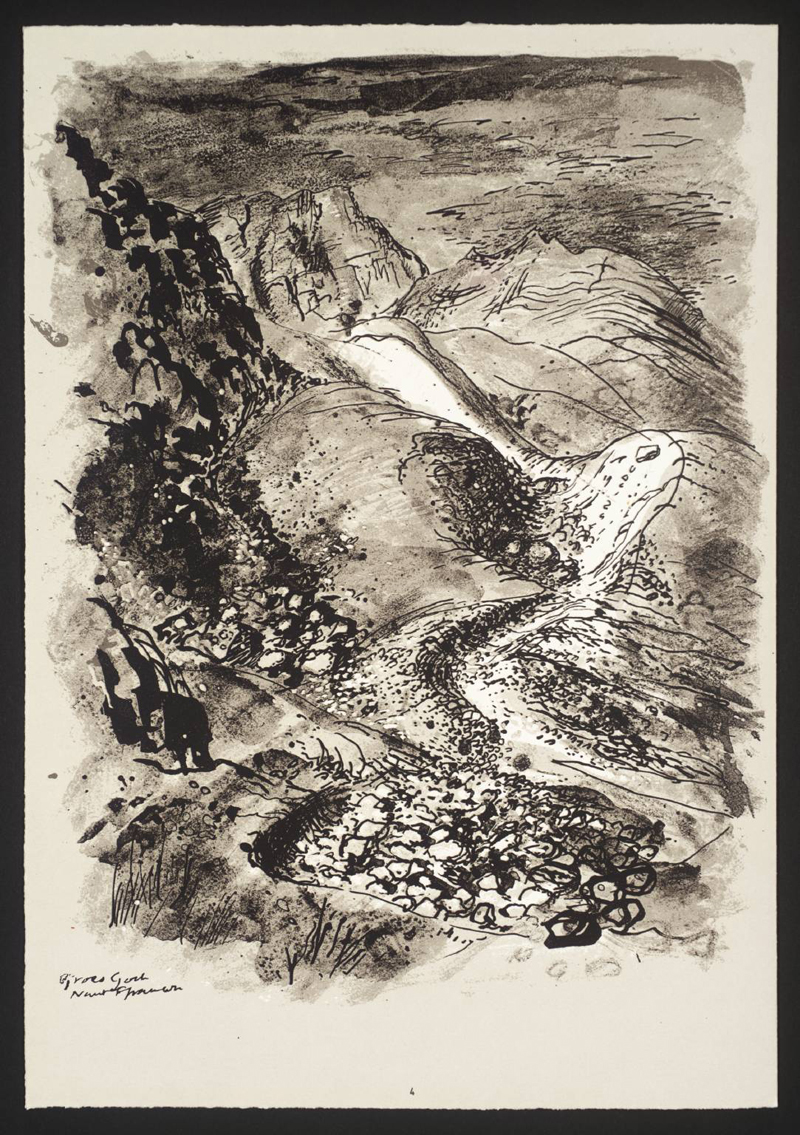
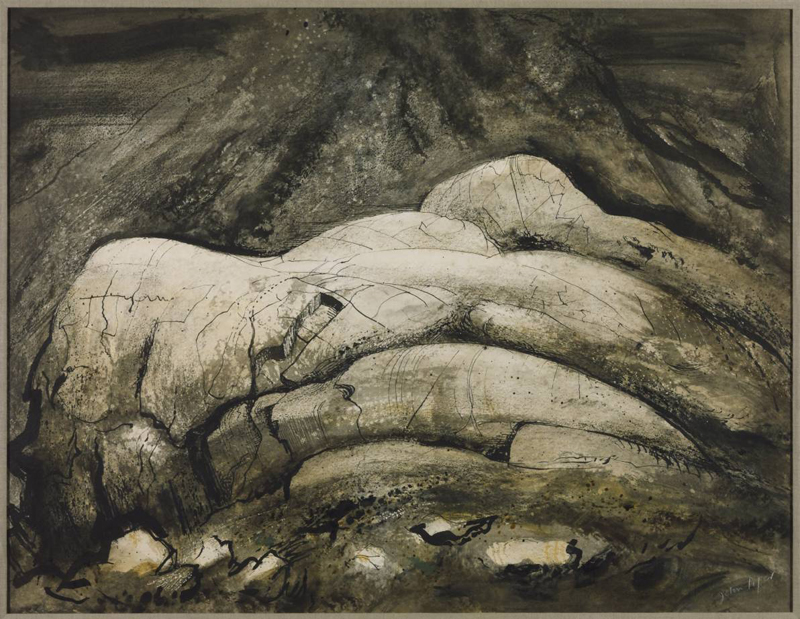
    A small exhibition at Whitworth Art Gallery in Manchester (9 February to 16 June) displayed Piper’s paintings done during the artist’s visits to Snowdonia in the 1940s. It reminds us of what a powerful and original artist he was. Of several outstanding pictures, which are as good as anything by other British artists from this time, one in particular seemed to encapsulate everything Piper sought and stood for. It depicts the Nant Ffrancon valley as a living, dramatic place whose appearance is dictated by its slow forming by glaciation. In such places Piper’s imagination and speculation ran riot. Rock is alive, work in progress. The experience of such a picture encourages even seasoned lookers to see and appreciate more intensely any genius loci. http://www.whitworth.manchester.ac.uk/whatson/exhibitions/johnpiper/

    This astonishing picture was sold two years ago for £17,000 – that is, under half what Hirst was charging at his recent Tate Mart for a signed poster exhibiting no discernible artistic merit. Good luck to the perceptive individual who acquired this modest treasure. But why is it so obviously a silly question to ask if a single British gallery or museum had noticed this profound painting and bothered to bid for it. There is a similar though inferior example from the same series depicting a nearby motif in the Tate’s collection, which needless to say is not on show. £17,000 for a masterpiece when signature decorative froth by Picasso sells for over a hundred million…

    We have the wrong brainwashed curators frightened to acknowledge diversity and following the wrong narrow trends; the wrong art market rigged solely for investment and profit; the wrong craven museum directors too willing to toe the establishment line; and we are constantly force-fed the wrong art which boasts so much yet delivers so little. Piper should be on show and permanently celebrated. He died in 1992, and there has been mounted no retrospective of his work since 1982.

    If your interest in the history of British art extends beyond the fashionable and you haven’t yet read Frances Spalding’s beautifully written joint biography of John and Myfanwy Piper (Oxford University Press, £16.99 pb, a tenner on Amazon) then it’s about time you did: you’re in for a most edifying journey.

    David Lee

    May/June 2013


  • Bone idleness at the Tate

    Bone idleness at the Tate

    For the last meeting of Tate trustees of which minutes have been posted on line (i.e. September 2012), only six of fourteen members bothered to show up. Perhaps it was raining. Trustees, you won’t need reminding, are there to oversee the vigilant running of quangos to ensure public interest is looked after. This is important when the Tate costs taxpayers at least £33 million a year in subsidy. You may be forgiven for believing that the trustees report to the Tate director. In fact, it’s the other war round; the director is – in theory – employed by the trustees and is responsible for implementing their sanctions.

    Trustees were in such short supply at the September confab they were outnumbered by Tate directors, eight of whom attended – incredibly, the Tate now has more directors than trustees, seventeen in total. Two of the three artist trustees failed to attend; in fact, at only one meeting in the previous year have all three artist trustees managed to be present at the same time, which is not surprising given that two of them, for reasons doubtless very convenient to Serota, are German. Magazine snapper Wolfgang Tillmans’s record is especially woeful: on average he attends every other meeting.

    Such lack of commitment is unacceptable in a body that effectively runs contemporary art. Trustees should take their jobs more seriously. Attendance ought to be obligatory not voluntary. After all, an afternoon every two months isn’t so arduous. If MPs have to be rolled in half dead on gurneys to vote, so should Tate trustees. This is an important public duty which many might consider a privilege, so if a candidate under nomination can’t give an assurance of attendance then others should be appointed who are prepared to commit themselves enthusiastically to the unpaid effort involved.

    Poor attendance by artist trustees, especially the Germans, highlights the error of appointing foreigners in the first place. Why weren’t British artists appointed? No, seriously, why weren’t they? Surely some can be found who are subservient enough to the President-For-Life not to preclude their consideration. Germans generally are more inventive, harder working, less squalidly materialistic and better educated than we are, but how can they be expected to feel and understand the historical significance of the Tate in British art life? Foreign artists should not be made Tate trustees because we have sufficient intelligent and independently minded candidates of our own. Naturally, it is very handy for the PFL to have a board of indifferent lackeys who will rubber stamp whatever he wants. After all, the process by which they were all vetted in the first place is controlled from his office. Officially, trustees are appointed by the Prime Minister but unofficially we all know they are chosen by him; his mucky fingerprints can be found over the whole process. (See The Jackdaw’s former investigation of Tate trustees on our website).

    No wonder the trustees have lost control of the Tate when they can’t even be bothered to show up to their infrequent meetings. For example, how could they have allowed building work to start on a Tate Modern extension when such a small percentage – under a quarter – of the required funds had been raised? This was surely irresponsible, with the result that this annexe is squaring up to be the longest building project in British construction history. They could have built five Shards in the time it’s so far taken to erect the shanty arrangement of concrete slabs behind the Turbine Hall – currently being augmented, on visual evidence, at the industrious rate of one breezeblock a week. As it is,  trustees have had to loot endowments given to the Tate for other purposes in order to maintain even this pathetic semblance of progress on the site.

    And finally, a snippet of late news to please trustee Herr Tillmans. Glasgow Art Gallery has just purchased two bog standard snaps by him. This adds to the 63 Tillmans held by the Tate, 9 by the Arts Council and 11 by the British Council. Of these 82 only two are currently on display, at Tate Britain. Why didn’t Glasgow save themselves scarce cash and borrow the 80 pictures expensively stored by the other three public collections?

    David Lee

    The Jackdaw, March-April 2012


  • Evelyn Williams, and another case of the public denied

    Evelyn Williams, and another case of the public denied

    In the last issue I considered the case of a single-minded good artist,  David Mulholland from Middlesbrough, whose memory, in the absence of any official recognition or support, has to be kindled for posterity’s sake by friends and family. By The Jackdaw’s usual standard of eliciting no comment whatsoever, this caused a considerable mailbag from many mentioning other artists who deserved better than the obscurity and indifference they receive. Owing to the recent death of a special artist, there is cause for reiterating this line of criticism of an art establishment hopelessly out of touch with anything but ‘The Contemporary’, such as they choose to see it.

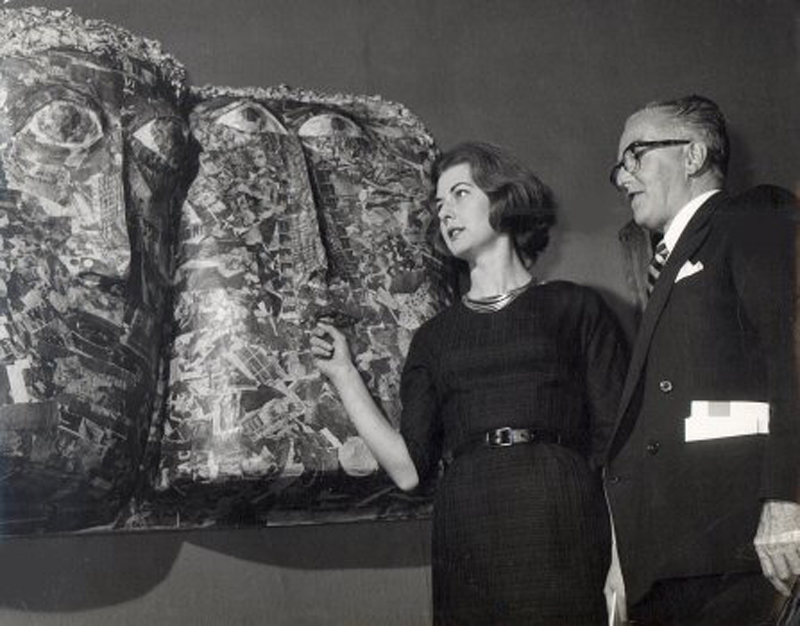
    Grief felt at the death of a memorable artist is mitigated always by the fact that their work – if it is properly accomplished and not merely the species that is famous for fifteen minutes – will live forever. Giotto didn’t need an ‘artist’s statement’ or incomprehensible catalogue introductions for his work to last, because his paintings speak for themselves in a universal language understood across the centuries. His work will continue to communicate clearly its observations of character and stories just as long as human beings are prepared to see,  feel and respond. This is the case also with the art of Evelyn Williams who died aged 83 on November 14th. Her work will endure in spite of the neglect she received from officialdom during a long and productive career. In the same Tate Collection which stores 274 works by Andy Warhol no space can be found for a single piece by Evelyn Williams, who is a far more interesting artist if not so much of a business-minded celebrity phenomenon whose market is carefully rigged. Even in the last two years alone, when 516 works were acquired by the Tate, there was no room for a single one by this important woman artist. There are even ten works in our national collection by American minimalist Robert Ryman, all of them white and doubtless extremely challenging to those of a devoutly all-whiteist fanaticism; but nothing by Evelyn Williams. Here is further evidence that at the nucleus of State Art breeds a deeply entrenched prejudice against anything but pseudo-intellectual nonsense.

    It is an appalling truth that the Tate has ceased to be a collection of British art preserving the very best of what is being done. Instead, it has been stealthily subverted under Serota to become a private collecting fief promoting a narrow orthodoxy related to a handful of dealers and auctioneers. Why is it that so much about today’s Tate stinks? Evelyn Williams is in a long line of single-minded British artists who refuse to run along the pre-ordained tramlines of conceptualism and modernism. She was a thoughtful, modest, intelligent and vulnerable person alive in a world – as she perceived and experienced it – of imminent dangers. Her paintings, sculptures and reliefs are about the fear and anxiety, the affections and frictions, of what it is to have lived the life of an anxious woman and mother. Hers is first and last a woman’s art, an uncompromising take on post-war relationships, intimacy, cares, depression, failure and even alienation. Her subjects take you inside the realm of senses and feelings, probing the unspoken secrecies behind the masks of propriety we all wear. In the way that art has of redeeming the awful, these are beautiful explorations of states of mind most try to avoid. Her work can be relentlessly intense, no question about that, but it is pure in spirit and purpose.

    Three of the more serious newspapers, the Times, the Telegraph and the Guardian, were eventually persuaded to publish obituaries of Williams. As with so many significant but neglected artists who are nevertheless considered worthy of an obituary, her exhibitions were scarcely even acknowledged let alone reviewed in the arts pages of these same papers. Critically, it was as if her work didn’t exist. She is, of course, among the many accomplished artists whose work is ignored for being conventional in appearance and technique and declamatory about emotions. To today’s State Art tyrants such characteristics are considered embarrassing drawbacks.

    Williams was, however, appreciated in the past. As a youngish artist in 1961 she won the sculpture prize (for Two Heads) at the John Moores in Liverpool, when other winners were Peter Blake, David Hockney and Ron Kitaj. These were the days when the Moores was worth winning, well before it was subverted to the cause of State Art where daubs of no merit are greeted by fools with preposterous superlatives. A retrospective exhibition was held in 1972 at Whitechapel Art Gallery; once again well before that gallery’s prostration before the winds of Biennale bluster. Williams continued her brave exploration of inner places that made her work then so widely admired. She worked every day of her life and although her commercial exhibitions continued, sometimes at long intervals owing to the complexity of ideas and their necessarily prolix gestation, a retrospective was never offered in her lifetime. Approached by friends in the last decade of her life, the Walker Art Gallery turned her down for such an honour. She couldn’t exert the pulling power of a Rolf Harris or Paul McCartney.

    Will Williams now receive the lifetime retrospective her work deserves, and which a wide audience should see? It isn’t likely.

    But why should this be, when there are more galleries nationwide which are more spacious than ever before? The answer is that as the public gallery network expands the same orthodoxy is spread across even more outlets. More galleries does not mean a wider selection of work on display; it means the same work by the same few artists spread across even more galleries even more frequently.

    What are called ‘Artists’ Rooms’ are a symbolic example of what is wrong with this rotten system. These ‘Rooms’ are organised by the Tate, the Scottish National Gallery of Modern Art and the Art Fund (how long will it be before the Art Fund can only be contacted via the Tate switchboard?), and they resulted from a bulk purchase, jointly by the Tate and the SNGMA in 2008. We bought for £42 million (£27 million in cash – the figure varies in different reports; we’ve never been told the exact sum – and £15 million in waived tax) retiring art dealer Anthony d’Offay’s gallery stock, which he called his private collection.  A cynic might say that Artists’ Rooms is the process by which the personal collection of one commercially motivated individual now dictates what a large proportion of the art-seeking population is allowed to see in the name of recent art. The same cynic might further add that Artists’ Rooms is the opportunity by which established reputations – such as Warhol’s – are constantly hammered home, and for the smaller ‘Room’ names, it is the instrument by which a more significant brand name can be nurtured.

    Under the auspices of the Art Fund, an organisation which luckily is headed by a former director of Tate Britain, 30 rooms featuring 760 works by 26 artists have been touring the country for four years, mostly as small one-man retrospectives. Some of these are marvellous, not least the extensive collection of photographs by August Sander. There are 232 works by Warhol alone, who gets two rooms to himself travelling at the same time. At the moment they are in Sheffield and Hull, and then Birmingham for four months. That is apart from relatively recent major exhibitions for the same artist at the Tate, the Hayward and other Arts Council galleries.  Warhol is showing somewhere all the time. We will not be allowed to ignore him.

    One of the Artists’ Rooms deals, inevitably, with Damien Hirst. This is currently on show in Walsall Art Gallery. It has been there for two months already and will remain in place for another year. What is happening when a fifty-year-old artist, already over-exhibited at a time when so many unexposed artists can’t get their work shown, is having a thirteen-month long exhibition? What is the reason for such indoctrination? Too often the Artists’ Rooms represent those who are already widely exhibited and who are bastions of the art market.

    Artists Rooms are a blunt instrument whereby approved taste is circulated (inflicted) from the centre. They constitute cheap exhibitions for Arts Council venues up and down the country, whose curators don’t have to originate their own programme. The laziness and ready compliance of these jobsworths is a godsend to State Art.  They can merely exhibit the same few approved brand names for ever. And make no mistake their career will depend upon them favouring these “right” kinds of artists for no individual prospers in State Art by demonstrating initiative or investigating the unorthodox.

    Visit the Hepworth Gallery in Wakefield and you will discover the other reason, besides the dreaded Artists’ Rooms, why thought and broad knowledge among curators is unnecessary. There is a new species of art collectors who caught the disease of wholesale, apparently random acquisition from Saatchi. These people fuel the market for State Art which they buy in quite staggering quantities. Their houses, full of wince-inducing tat bought for eye-watering sums, feature frequently in glossy magazines. Usually they are rewarded for their commitment to the State Art cause with the accolade of a position on a Tate committee, of which there are now dozens. At Serota’s Tate money not knowledge is the essential qualification for co-option.

    One such überbuyer – who has not yet been brought on to any Tate committee – is one David Roberts, a property developer, who has accumulated so much clutter he’s opened his own ‘space’ and has begun feeding pieces to regional galleries, Wakefield being the first venue. Works selected are linked as follows: “This exhibition examines ways in which modern and contemporary artists represent the human

    body in various media to explore psychological and emotional life.” What a perfect criterion that is for the inclusion of a major work by Evelyn Williams. Unfortunately, the trouble is that among Roberts’s 3,000 plus works there is nothing by Williams. But have a guess whose work he does own and whose efforts are on show in Wakefield: enter Warhol and Hirst.

    David Lee

    The Jackdaw January-February 2013

    http://www.evelynwilliams.com/index.htm

  • Tate trustees and the public interest

    Tate trustees and the public interest

    In 2011 the Tate named two new trustees, one of whom is painter Tomma Abts. She is a 44-year-old German, recently appointed Professor of Painting at the Kunstakademie in Düsseldorf, who won the Turner Prize in 2006. As an artist trustee, she replaced Jeremy Deller, who won the Turner Prize in 2004. Abts’s paintings are all the same small size (48 x 38 cms) – it is claimed this tic is conceptually crucial for a reason never convincingly explained – and consist of polite abstract designs which might have looked original on curtains at the 1954 Ideal Home Exhibition. So much for the Cutting Edge. The Tate claims her pictures “possess a formal definition and coherence that suggests that they could never have existed any other way … [and] seem to achieve what only painting can, inhabiting both this reality as an object or ‘thing’, and a parallel world with its own set of rules and relationships that demand to be judged on their own terms.” As per with their interpretive literature, all helpful stuff. Am I being cynical? Yes. Why? Because using any sensible criteria Abts doesn’t deserve to be a trustee of an important British museum.

    The job of Tate trustees is to oversee the efficient running of the gallery “as guardians of the public interest” – and please note that it says ‘the public interest’ not ‘State Art’s interest’, for as you will discover these two mutually exclusive agendas tend to become blurred in the minds of certain individuals. Improbable as it sounds, guidelines for the functions of trustees are drawn up by the Tate itself, not by  independent arbiters. Such complacency hardly reassures an outsider that the public interest, rather than the Tate’s, is being looked after. Indeed, such self-scrutiny is hardly better than the continuing disgrace of policemen investigating their own mistakes.

    In 2008 the number of trustees was increased from 12 to 14 and as required by the Museums and Galleries Act 1992 “at least three” of these must be artists. Thirteen are appointed by the Prime Minister and the last is nominated by the trustees of the National Gallery from among their own membership. Unlike their fellow trustees, who are mainly those with business expertise, and who can serve up to two terms of four years (a period of office trimmed recently from five), artist trustees currently serve only one term of four years. You may find it odd – I certainly do – that while there are three contemporary artists with gilt-edged State Art credentials on the Tate’s board of trustees there is no place for a single art historian. I’m obviously old-fashioned because a museum of historical art with no art historians sitting on its governing board seems verging on the perverse.

    When an artist trusteeship becomes vacant it is widely advertised in the papers, giving the impression that any capable, knowledgeable, articulate artist of repute might apply. Nothing could be further from the truth, for there is a codicil written in invisible ink along the bottom of these ads, which reads: “If you have not won or at the very least been nominated for the Turner Prize, kindly fuck off and don’t waste our time.” The Tate squanders scarce cash paying for these advertisements which are nothing short of a calculated deception. Artist trustees are in fact a self-appointed clique comprising only winners of the Turner Prize with a couple of reliable also-rans chucked in. Since new regulations were imposed in 1992 the only exceptions to this rule have been Julian Opie, who famously refused his nomination for the Turner on the grounds that the prize “had become a frivolous publicity stunt”, and Bob and Roberta Smith, the sobriquet of a dimwit called Patrick Brill, who is otherwise a regular purveyor of infantile stunts at Millbank – you may recall his Tate Christmas tree whose lights visitors were asked to illuminate by peddling a generator. He’s very concerned about the environment apparently.

    Being a trustee involves attending six meetings a year and is said to require a day a month in reading and preparation. I must point out that the Tate’s artist trustees are easily the worst attenders at these meetings, and are frequently absent. In the case of Anish Kapoor (Turner Prize winner, 1991) his absenteeism, which included missing half the meetings in two consecutive years and scarpering early from others, would have surely seen him sacked from the board of any efficiently run private enterprise.

    Of currently serving artist trustees two are Germans – besides Abts the other is magazine photographer Wolfgang Tillmans (Turner Prize winner, 2000). Could they really not find a British photographer, or even a British abstract painter, worthy of these positions? Admittedly, Germans do most things better than we do but surely this is insulting to British artists. And how can a professor at a German art school, which presumably requires her to actually attend some of the week, perform the duties of a trustee required to be resident here?

    The process by which artist trustees are selected ­– laughably characterised as “an open competition” or “an open competitive process” – is indicative of what happens when a clique achieves a complacent monopoly and is allowed by servile arts commentators to get away with it. Minutes of meetings make it clear that artist trustees are encouraged to invite applications from those they consider suitable as their own replacements, especially when candidates who have responded to the ads are not considered worthy, which one may reasonably surmise is always. Indeed, I wonder if there was ever a case of a successful artist trustee having responded to the ads rather than having been – that weasel word – ‘invited’ to apply… And so Turner Prize winners beget other Turner Prize winners, or at the very least other near-misses of that persuasion.

    Candidates for artist trusteeships are interviewed by a panel comprising trustees, including the artists, plus an “independent assessor” who is present to ensure that legal niceties, “best practice” etc., are observed and everything looks above board. But how can it be above board when only Turner Prize winners are appointed? Perhaps this independent assessor ought to be involved from the start of the process in order that more than Turner Prize nominees might be seriously considered, if for no other reason than to keep up appearances of openness. Eyebrows would be raised at such a narrowness of potential candidates in any other sphere of public life: imagine, for example, the Commander-in-Chief of the armed forces always being selected from the same regiment.

    You may ask why is it so important for the convenient running of the Tate that its artist trustees are always winners of the Turner Prize. The answer is for the obvious reason that having been awarded a career-changing gong by the institution of which they are now overseers, they will never rock the boat by asking too many tricky questions about the Tate’s direction in its dealings with contemporary art. This is one of many ways by which State Art has become institutionalised: no one but the reliably subservient is ever allowed on the inside to question Tate, or indeed Arts Council, policies.

    On the other hand these parti pris trustees can be useful when outside criticism of the Tate becomes noisy. For example, in July 2004 Trustees discussed newspaper coverage of a Tate work, Rodin’s The Kiss, which Cornelia Parker (who was nominated for the Turner in 1997, the year it was won by Gillian Wearing, inevitably herself a recent artist trustee), had the previous year controversially wrapped up with a mile of string. This stunt was claimed by the artist to be “challenging the claustrophobic nature of relationships”. Artist trustees present in the meeting (which included the aforementioned Wearing) were able to defend their fellow artist for the benefit of other sceptical trustees. They pointed out that it was the job of the Tate to provoke controversy and discussion, which this work did.

    It is in the interests of these artist trustees to support the Director. They know they will be serving only for a brief period following which they might reasonably look forward to the reward of a Tate retrospective or other continued patronage, purchases etc..

    Serota has stated a preference for such younger trustees. Referring to the trusteeship of Anthony Caro many years before, he remarked in 1998 to the Sunday Times: “Tony was well over 60 when he became a trustee. He was a very effective trustee, actually. He cared passionately about certain things and was a powerful force … but it just seems to work better when you have artists who are a new generation, or indeed erring on the younger side, really.” And we know why he thinks it “seems to work better”, because older artists of a more independent, more knowledgeable, more experienced character might argue cogently for a policy or direction other than the one being pursued by the Director. They have nothing to lose by disagreeing with him. Let’s face it, the current crop of artist trustees is in Serota’s pocket. They owe him and he knows it. He can rely on their support without a second thought.

    In a 2008 interview Serota said of his trustees: “I don’t have any part to play in their appointment”. Remember this, it’s important and we’ll return to it in a second.

    Many years ago Serota said that public nominations for the Turner Prize (perhaps you don’t remember that ridiculous charade whereby we all wasted our stamps and faxes) were seriously considered by the judges. We discovered in 2006 what we already knew, courtesy of an indiscreet Turner Prize judge, that this was in fact a lie and they were binned with risible disregard. We also discovered at the same time, and from the same source, that Turner Prize judges were given a list of appropriate artists and exhibitions – just to help them along you know, point them in the right direction. And there we were thinking in the innocence of our ignorance that they might nominate anyone…

    Serota also stated in 2005 that the Tate only rarely acquired work by serving trustees. The Jackdaw checked up on that and discovered (see the editorial for Dec/Jan 2006 on our website) that he wasn’t telling the truth. Indeed, this whopper cost him a bollocking from the Charity Commission. There were also a number of other flagrant economies with the truth concerning the Tate’s acquisition of work by serving trustee Chris Ofili, who was naturally a Turner Prize winner (1998), which also resulted in another six of the best from the CC. (I almost mentioned here the fact that in the last editorial – also on our website – we indicated how the Tate recently misled us over their attendance figures, but you must be getting fed up with that one.)

    So, bearing in mind Serota’s far from perfect form, when he remarks “I don’t have any part to play in their appointment” I need to ask myself: ‘Do I give him the benefit of the doubt and believe him this time?’ Well, as it happens, no I don’t. Even cursory familiarity with the Trustees’ minutes betrays this one as untrue. On the contrary he is frequently involved in their appointment; indeed, the process of Trustee appointment is administered by his own office. He even attends candidate interviews “in an advisory capacity”. Presumably he offers ‘advice’ which plays no material part in the process, so why is he there in the first place? Indeed, we read on: “The key stages of the appointment are overseen by a panel which will normally include the Director.” (Who, presumably, doesn’t play any part.) On one recent occasion he encourages artist trustees to nominate likely candidates for their replacement knowing only too well the sort of artists they are likely to suggest. No part?

    Let’s have this one straight: Serota is ‘advising’ on the appointment of someone, a trustee, who will function as his own employer. This is a wretched abuse of the supposed ‘independence’ of process and would be considered as much in any other public body. It is, as usual, as blatant a conflict of interest (not to mention a betrayal of ‘the public interest’ about which the process purports to be so concerned) as you would expect to find at the Tate, whose management of conflicts of interest, incidentally, was declared woefully inadequate by none other than the Charities Commission.

    The Tate should not be involved with either the compiling of its own trustees’ duties, or in the nomination or selection of Trustees themselves. How can ‘the public interest’ be considered served when the organisation under scrutiny is writing the job description of its own scrutineers. If we are to have artist trustees let’s have them from a cross-section of the artist community and not just those representing the Turner Prize. And let’s have some eminent art historians in there too.

    David Lee

    The Jackdaw May-June 2011

  • Rothko vandalism

    Rothko vandalism

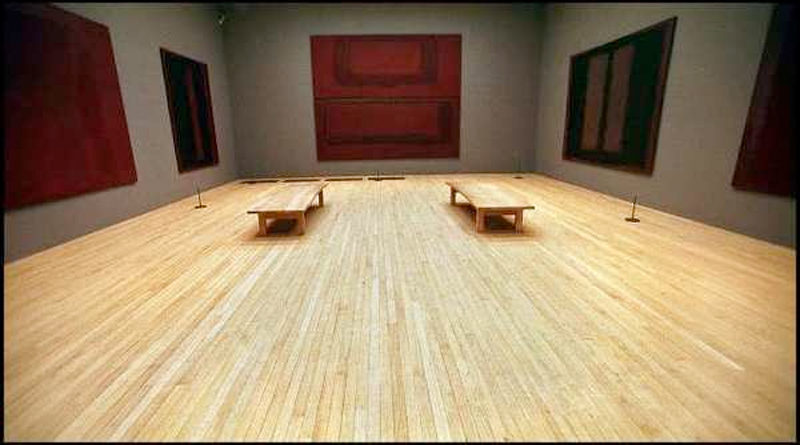
    Last year it was Poussin in the National Gallery, this year Rothko at the Tate. There will have been other examples of vandalism in between these which galleries hushed up, and it is likely that you wouldn’t have known about the Rothko episode had it not been witnessed and photographed. Museums don’t like admitting to attacks on their collections because they wouldn’t want to suggest it’s easy to get away with… The truth is that vandalism is undoubtedly more prevalent than is admitted.

    Outrage is the knee-jerk reaction on such occasions, but by now we should expect damage. Every work of art in every museum is a sitting duck to unintended injury as well as to deliberate vandalism. This is because museum visitors, and especially children, are ignorant and ill-mannered. They get too close and prefer to look with their fingers. Sculpture is especially at risk. Simply by putting art on show so it can be seen properly ensures its vulnerability. Vandalism, and the ease with which it can be perpetrated, are risks that have to be taken despite the potential for disaster.

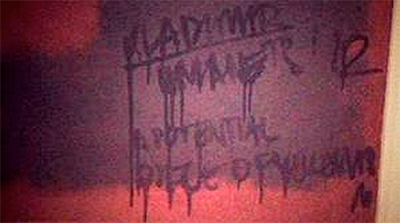
    The perpetrator of the Rothko graffiti is wearyingly typical of  the Identikit gallery vandal. He is a white, male, disgruntled, barely sane ‘artist’ of no discernible ability. His website, Yellowism, is in the grand tradition of Modernist art manifestos, it being a ragbag of  pompous, semi-literate gibberish. He is also without the true courage of his proclaimed anarchic convictions. Scribbling half-heartedly in the bottom corner of a painting for no good reason other than ephemeral self-advertisement is a feeble stunt. Whatever happened to the grand statement born of blind belief? When suffragette Mary Richardson savagely attacked Velasquez’s Rokeby Venus in the National Gallery with a kitchen knife in 1914 she was perhaps misguided in her choice of target but my word there’s no doubting her vehement commitment to the cause. In comparison to Richardson, this Rothko attacker is a pathetic wimp. They should film him being given a good thrashing outside Tate Modern, call it a ‘Conceptual Video’ and enter it for the Turner Prize.

    With the arsenal of chemicals and sci-fi gadgetry at a modern restorer’s disposal, the painting will be back on display within weeks and exhibit no evidence of its recent tribulations. And alarmist headlines about the financial value of the picture being affected are just crass populism. The Rothko will never be sold, therefore it can have no financial value. If anything the picture’s artistic stock will have risen, given the notoriety it has now achieved and the fatuous incentives some people require to visit museums.

    More perplexing is the accelerating frequency with which damage to important works is occurring. With museums having annual grants from central and local government frozen or reduced, security may not be what it should be. The idiot responsible for damaging the Rothko was able to do his worst and then calmly walk out of the Tate unhindered. This suggests laxity. When the Poussin was damaged last summer in the National Gallery, wardens had only weeks before been instructed to oversee two galleries instead of one. At the time it was suggested the damage would not have happened had the gallery been fully patrolled as before. Maintaining proper surveillance despite cutbacks will not eliminate vandalism, but it might impede its worryingly increased incidence.

    It would appear that enhanced searches at the entrance of national museums, like the airport security imposed already in some continental galleries, is inevitable here also. It may help, but sadly nothing will stop determined unhinged artists from getting through.

    David Lee

    October 2012

  • Turner Prize No. 27 … 28 … 29 …

    Turner Prize No. 27 … 28 … 29 …

    Some bird in daft boots striding with the confident air born of State Art insight; in the background, Villa Joe by Paul Noble, 2005

    Having slipped into its tedious annual routine, the Turner Prize is upon us again, at Tate Britain, until January 6th; the winner – £25,000 better off – is announced to a live television audience of well into double figures on December 3rd. Those responsible for organising this banquet of self-congratulation continue to fanfare its importance, but it is in truth many years since the Turner Prize introduced an artist of any lasting significance whose work lives in the mind’s eye: it is a safe bet that in a hundred years no one will be looking at any of this work.

    We have now had 27 years of the same ‘cutting edge’, for which lasting importance is routinely claimed; 27 years of ‘challenges’ forgotten almost immediately; 27 years of assorted ‘subversions’, ‘dissolvings’, ‘explorings’, ‘exploitings’ and ‘juxtaposings’ which have altered nothing; and at least a decade of winners whose names only half a dozen addicts of State Art can (or want to) remember. Cubism only took five years and even Impressionism was done for after ten.

    We have reached the end of the avant garde. Without any locomotive power left, the gravy train is slowing down at the terminus, petering out with the buffers in sight, driven along at snail’s pace only by its own momentum and the willing shoulders of Serota’s lackeys. The Turner Prize is fucked, and only those involved with it can’t see the truth.

    In the 18th century art was the preserve of aristocrats; in the 19th it was in thrall to industrialists; in the 20th it was all done for the benefit of the better educated; and in the 21st it was the exclusive domain of art students and others in a new art industry sustained by a tidal wave of taxpayer subsidy. So much for outreach.

    And so to 2012 and the Buggin’s Turner Prize. As you would guess from her name, the person called Spartacus Chetwind is an ass. If she applied both brain cells to the task, and bought a very large cardboard comb, she might just qualify as an entertainer at children’s parties. “Her carnivalesque live events,” claims the Tate’s Chief  Snake Oil Saleswoman, “dissolve the boundary between spectator and participant.” That’s so old hat: Quatermass did that sixty years ago.

    As the work of a precocious undergraduate at a regional ‘university’ no one well educated has heard of, Luke Fowler’s photographs, in which any two pictures are spliced together in the hope of achieving a critical mass, might attract bollocksy exegesis from the resident theorist and intellectual. To the rest of us they add up first to bewilderment, and then nothing at all. But he’s not just a photographer isn’t our Luke. Oh no. He up for a spot of film-making too.

    At a pinch it is painful but still possible to sit through a bad film by a Hollywood film director. However ponderous and leavened with noisy special effects, there will be at least some narrative drive to stop eyes drooping. On the other hand there is a bad film made by a Turner Prize nominee. This will be so inept it is unwatchable after three minutes, unless … unless you are lobbying for a salaried position in State Art – then, you must watch with exaggerated attention, take notes, nod knowingly at intervals and sit through it twice just in case the President-For-Life is spying on you for signs of apostasy. This is the case with Fowler’s 90-minute throatslitter about an interminable therapy session in the States. Any of the Prize’s judges who claims to have sat through this tripe, awake, from beginning to end is lying. It is many miles beyond a human being’s tolerance.

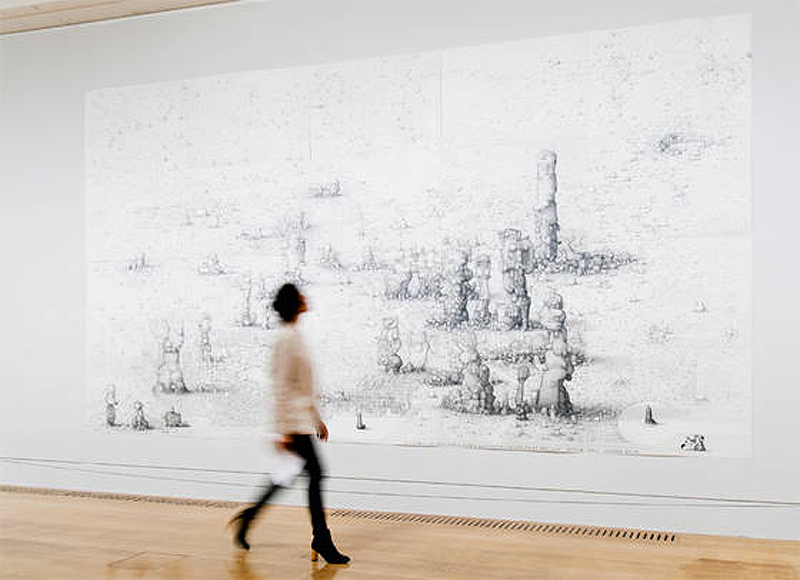
    For those of a more conventional mindset Paul Noble makes large, detailed drawings of an imaginary place called Nobson Newtown, which has been exclusively absorbing his attention for 16 years. Like the work of Bosch and Dali, superficially the scenes look realistic but are fantastic panoramas containing no figures but, instead, are populated by totems not dissimilar to Henry Moore’s Glenkiln Cross. Scattered around the empty squares and expanses in between the ‘sculptures’ are a plague of what look like dog turds. Close up the graphite drawing is more laboured than expected, first impressions from a distance having suggested greater fluency. These pictures are dystopian, surreal curiosities and will take you longer to look at than the works by the other three contestants put together. This must constitute a sort of praise – it’s certainly a relief. His sculptures, carved presumably by someone else in black and white marble, are feeble, though doubtless easily saleable by Noble’s dealer Gagosian.

    And that leaves Elizabeth Price who is represented by a 20-minute film called Woolworth’s Choir of 1979. Claimed by the aforementioned Chief Oiler to be “exploring the elastic potential of digital video”, it comes in three parts: views of an empty choir in a medieval church; clips of women disco dancers flinging their arms about; and footage of a fire in a furniture warehouse above Woolworth’s in Manchester’s Piccadilly. No obvious connection occurs between the three overlapping sections. As an experience, it is slow to unfold and ‘artistically’ repetitive; as in … “I’m repeating myself a lot, therefore I must be an artist”. Sadly, Woolworth’s is not incoherent with poetic possibilities, it is incoherent with incoherence.

    David Lee

    The Jackdaw, October 2012


  • 1988 … Year zero

    1988 … Year zero

    … when branding and art formed a marriage of convenience, argues artist John Kelly.

    1988 is the seminal year, the year that our concepts of art, money and values changed irredeemably.

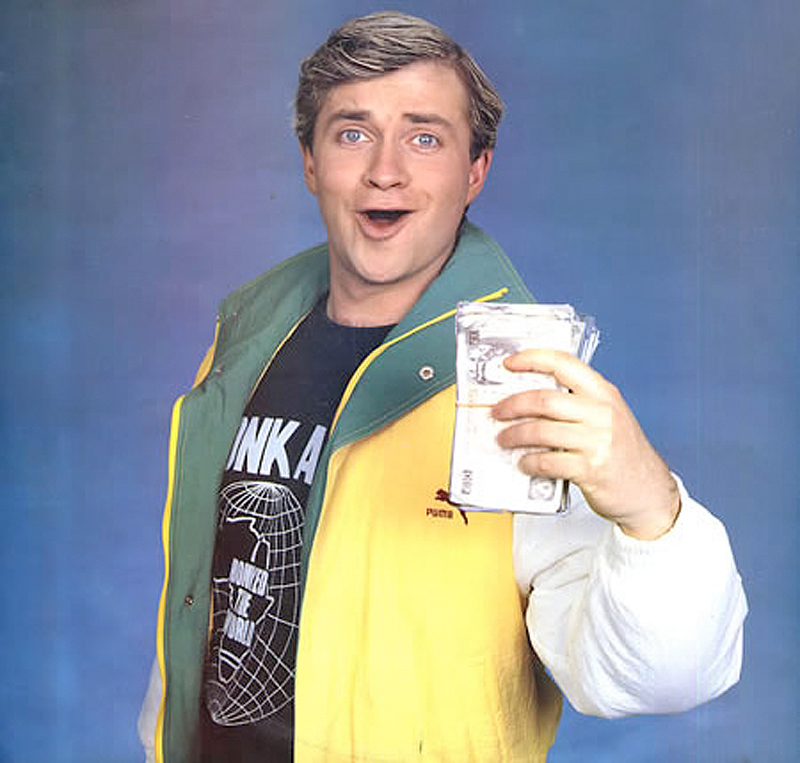
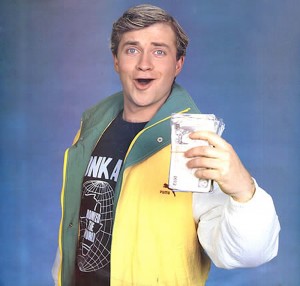
    It was the year I came to London as a 23-year-old artist, having taken an opportunity to play league cricket in London. It was a chance for a young Melbourne man to explore his ancestry and the art and culture of Europe while enjoying the quintessential English game. I would set off in the morning, along the Boundary Road, then lunch in the pavilion at Lord’s, and finally off to the Tate Gallery, only interrupted by comedian Harry Enfield’s 1988 ‘Loadsa Money’ character. Enfield pointed up the greed and vulgarity of a changing society. Gordon Gekko was another;

    “The point is, ladies and gentleman, that greed, for lack of a better word, is good. Greed is right, greed works. Greed clarifies, cuts through, and captures the essence of the evolutionary spirit. Greed, in all of its forms; greed for life, for money, for love, for knowledge has marked the upward surge of mankind.”

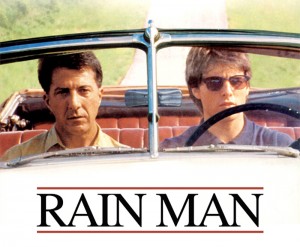
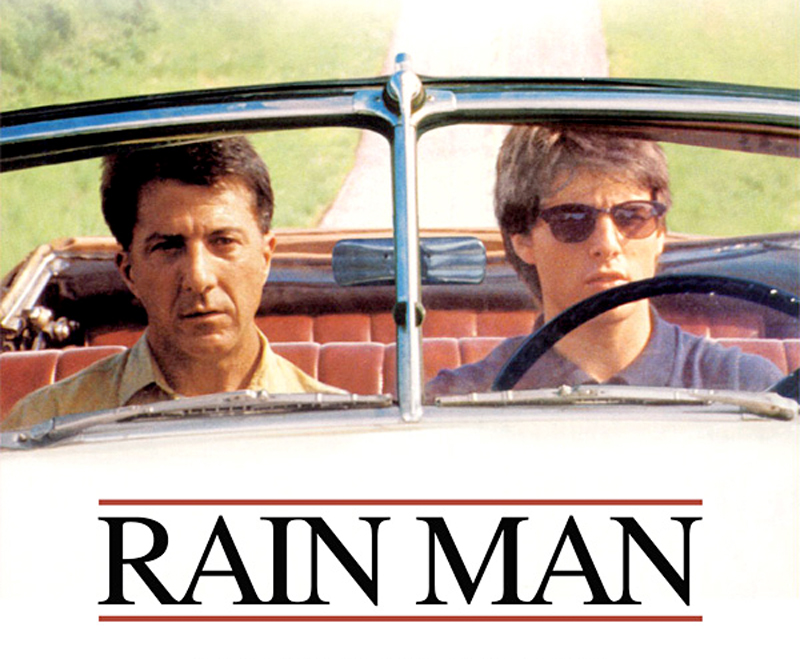
    But the film that made ‘loadsa money’ in 1988 was not Wall Street; it was Rain Man, starring Tom Cruise and Dustin Hoffman. Rain Man is about a performance car salesman yuppie named Charlie (Cruise), who is furious when his estranged father’s estate, worth millions, is bequeathed to a mental institution. To his shock, he learns he has a brother in the care of that institution. The brother, Raymond (Hoffman), is an ‘autistic savant’ whose obsession with airline safety records results in a cancelled flight and a road trip across the United States.

    Cruise personified the yuppie – the young upwardly mobile, urban professional who in the late 1980s began to inhabit all spheres of life, including sport and the arts. The rise of the yuppie was the result, to some extent, of the creep of managerialism, a business philosophy that spread across the globe through government and business. Master of Business Administration (MBA) programmes churned out thousands schooled in a scientific approach to management.

    “Managerialism is the belief that organisations have more similarities than differences, and thus the performance of all organisations can be optimised by the application of generic management skills and theory. To a practitioner of managerialism, there is little difference in the skills required to run a college, an advertising agency or an oil rig. Experience and skills pertinent to an organisation’s core business are considered secondary.”(http://en.wikipedia.org/wiki/Managerialism)

    1988 furnishes an interesting – albeit failed – example of managerialism: the attempted takeover of Britain’s fourth largest bank by an advertising agency, Saatchi and Saatchi. This agency was synonymous with the 1979 election of the Iron Lady, Margaret Thatcher herself, thanks to their ‘Labour isn’t working’ campaign poster and three successive Conservative victories. In 1988, Saatchi and Saatchi launched a takeover bid for the Midland. The agency, created and controlled by brothers Charles and Maurice, were at the forefront of corporate takeovers using financial mechanisms that often deferred payment until future profits arrived. Their targets were not just other advertising agencies; they also bought management companies such as The Hay Group (1984) and Cleveland Consulting (1987). Unfortunately in 1988 the idea of an advertising company running a bank did not sit comfortably with The City; it was described in fact as “insane hubris” by financial journalists. Its failure followed the stockmarket crash of 1987 and the resultant recession badly harmed the Saatchis’ reputation and would eventually see the two brothers depart from the company that bore their name.
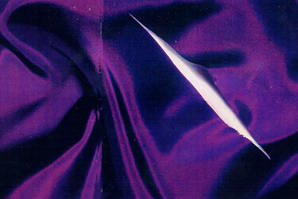
    The late 1980s also saw advertising agency revenues hit by further restrictions on cigarette promotion. Advertisers were unable to refer directly to the product or show people smoking it. It created a paradigm shift in the ad business that in some circles was compared to art, for it relied heavily on aesthetics and concepts placed indirectly in the mind of the consumer. An example is purple silk juxtaposed against a pair of scissors or a gash; this was the code for Silk Cut cigarettes. Charles Saatchi had a long-standing interest in art; Saatchi and Saatchi had the Silk Cut account.

    “Then, in 1988, Charles Saatchi left his wife [Doris Lockhart Saatchi]… Something of the nature of their divorce may be deduced from the fact that Charles Saatchi’s current entry in Who’s Who makes no reference to Doris Lockhart’s ever having even existed.” (Darwent, Charles. Pieces from a confessional, The Independent, 18/10/1998.)

    Lockhart is described as:

    “a sophisticated woman who spoke several languages, knew a great deal about art and wine… She became known during their marriage as an art and design journalist, with particular knowledge of minimalism.”

    1988 is also the year that the business philosophy of branding took hold. The influence of ‘brand equity mania’ would last decades. From footwear to footballers, everything could be branded, including art and artists. In business the defining moment

    “…arrived in 1988, when Philip Morris purchased Kraft for $12.6 billion – six times what the company was worth on paper. The price difference, apparently, was the cost of the word ‘Kraft’. Of course Wall Street was aware that decades of marketing and brand bolstering added value to a company over and above its assets and total annual sales. But with the Kraft purchase, a huge dollar value had been assigned to something that had previously been abstract and unquantifiable – a brand name.” (Klein, Naomi. No Logo, Picador books, 1999.)

    1988 is such a seminal year because of the changes not only in business practices but also in politics. After the cricket season had ended in England, I was wandering around the galleries of Europe while the Iron Lady made her Bruges speech on Britain’s relationship with Europe. This is widely seen as the birth of Conservative Euro-scepticism. As she travelled home, Margaret Thatcher read Sir Roy Griffiths’s report, commissioned by her government, on the National Health Service. It was titled Community Care: Agenda for Action. Griffiths’s business expertise lay in supermarkets: he was vice-chairman of Sainsbury’s. However as a champion of managerialism, this report was to mark a change of direction in the way in which Britain administered psychiatric care. Before Griffiths

    “Mentally ill and mentally handicapped people were generally sent away to large forbidding institutions … many patients became worse rather than better and ‘institutionalised’.  However, there was, in a true sense, asylum for people who could be ‘strange’ in private.” (NHS History; see www.nhshistory.net/shorthistory.html)
    After Griffiths, asylums and psychiatric wards were closed and responsibility for this type of care was transferred to local authorities, where case managers were waiting. The philosophy soon spread throughout the western world and a battle for language ensued. Patients became ‘clients’ and ‘stakeholders’, while ‘benchmarking’ and ‘quantitative reports’ and ‘qualitative reports’ were stacked high.

    Coincidentally it is around this time that the authorities began to increase the funding for contemporary art. Public galleries and artist studios began to proliferate. Is there a link between the way psychiatric care was handled in the community and the proliferation of contemporary arts?  After all, art spaces allow people to act strangely in public, all under the eye of a dedicated management structure.

    An example appears in 1988 with the opening of the Tate’s satellite branch in Liverpool, a precursor of the much bigger Tate Modern in 2000. However, in a sense  Tate Modern also begins in 1988, when its champion, Nicholas Serota, was appointed director of the Tate. In his application for the job, Serota clearly identified the changing management culture. His application

    “…analysed the various areas of Tate work and proposed future stratagems to deal with the imminent crisis caused by restricted government financial support, changing public sector management expectations and increasing art market prices. He saw many areas of the Tate’s operations in need of overhaul…” (Taken from Wikepedia where it is referenced as being from Spalding, Frances (1998). The Tate: A History, pp. 245–252. Tate Gallery Publishing, London.)

    Jay Jopling, Damian Hirst’s dealer takes up the story:

    “After Nick Serota became Tate director [in 1988], he called a meeting because he was concerned about the media lampooning contemporary art. I was very flattered to be asked. Damien had just done a fish cabinet, I invited the tabloids, the Daily Star took a photograph with a bag of chips and ran the headline ‘The world’s most expensive fish and chips’. I thought it didn’t matter if the tabloids were negative – they’d force people to take a view, bring contemporary art to people’s attention. All that is redundant now – artists are household names, part of people’s lives. I certainly didn’t imagine when we started that it would be a business like this.”

    “Jay Jopling’s father, Michael, a landowner, was Margaret Thatcher’s first chief whip in the House of Commons…” (Wullschlager, Jackie. Lunch with the FT: Jay Jopling. See www.ft.com)

    With the political landscape changing, Britain’s relationship with Europe cooling, branding and managerialism spreading, asylums closing and art spaces opening, Cool Britannia was on its way.
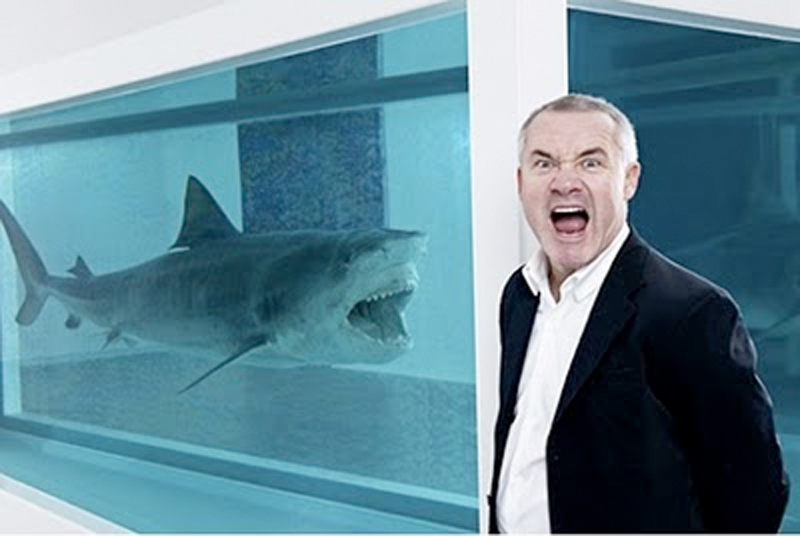
    Because 1988 is such a seminal year, it is here we begin our discussion of Damien Hirst. In that year, he was a second-year art student managing his first exhibition, Freeze, a warehouse show of fellow Goldsmith students in London. Hirst organised the advertising and production and participated as an artist. One of his fellow students in the exhibition, Angus Fairhurst, wrote an essay afterwards: Some went mad and some ran away, the great majority stayed faithful until physical death. Hirst used an edited version of this title for a curatorial project at the Serpentine Gallery in the early 1990s. Both artists were branded Young British Artists (YBAs) and attracted support from Charles Saatchi, whose assistance led to fame and commercial success for Hirst and some other YBAs, though not Fairhurst. In March 2008, 20 years after he wrote his essay and on the last day of one of his few solo exhibitions, Fairhurst ran away to Scotland, where, in a wood, he hanged himself.

    Ever since Irving Stone’s 1934 novel Lust for Life, art, money and psychosis have been closely related. Google the words ‘creativity’ and ‘mental illness’ and you will find a plethora of musicians, writers, painters and the odd comedian who all paid the price of their creativity. The list is not exhaustive. Currently on show at the Tate Modern are Damian Hirst and Yayoi Kusama. Hirst has said:

    “There are so many different ideas it can often feel like the outpourings of an insane mind.” (www.damienhirst.com/texts/2009/feb–takashi-murakami)

    And The Guardian newspaper reported:

    “Kusama’s work cannot be disentangled from the mental health problems she has experienced. She admitted herself to a psychiatric hospital when she returned to Tokyo from the US in the early 1970s and from 1977 has lived voluntarily on an open ward, building a studio across the street and commuting back and forth on a daily basis.” (Brown, Mark. Yayoi Kusama arrives at Tate Modern with a polka at Damien Hirst. 7/2/2012: www.guardian.co.uk/artanddesign)

    Kusama is in her eighties and has had a signature style – dots – since before Hirst was born. She was asked about Hirst’s dots. She replied:

    “… I am very happy that the polka dots that I started using have become a symbol of love and peace around the world with everyone joining hands to use them together in this way.”

    When I see Hirst’s manufactured dot paintings, I do not think of peace and love, I think of Enfield’s Loadsa Money. I Googled the names to see if anybody else had made the connection and was surprised to find only one other person had.

    “And did anyone else think Hirst resembled Harry Enfield’s Loadsa Money character in that embarrassing-for-all-concerned Noel Fielding doc? Walking around going, “That one’s worth a million. I got two million for that. Nah, I don’t care about money. Got seven hundred large [ones] for that one.” (See the comments to this Guardian article:) www.guardian.co.uk/environment/2012/apr/18/damien-hirst-butterflies-weirdly-uplifting)

    Hirst spent years establishing his Loadsa Money character, using the media at every opportunity and staying closely linked to Charles Saatchi. In the mid-1990s it was hard to open a London paper without reading something about him. He was everywhere and for reasons not always connected to art. Diary columns discussed where he was eating and with whom, all the while associating him with money. It seemed orchestrated, pervasive, a type of covert or guerrilla advertising, a branding exercise. Somebody was making Hirst a household name or, at the very least, a minor celebrity (I even remember an interview with him in our antenatal newsletter in 2000).

    Why would it be important to make one’s name so recognisable. We might find the answer in an interview with Hirst himself. Before going to Goldsmiths, the artist worked on a building site. As he tells it, the foreman ridiculed his name and called him Steve instead. For two years he was subjected to this identity abuse. Maybe this event instilled in Hirst a determination to have his real name recognised. He has succeeded. Damien Hirst is often called the most successful artist in the world.

    To reinforce his image and to court publicity, Hirst was outrageous. He had a shark killed and encased in formaldehyde, and is reported to have once stuck a cigarette in his penis in front of journalists. [It was a chicken bone under the foreskin in a Dublin restaurant. Ed] He was daring, a showman, an artist of immense ambition, intelligent, savvy, prolific, but most importantly always associated with large amounts of money. Whether it be his bar bill at the Groucho or the sale of his latest work to Charles Saatchi, it was all in the media. As Kusama generously didn’t, he even threatened to sue British Airways for using coloured dots in its company advertising, which didn’t lead to the courts, but only to more publicity.

    Having, since 1988, used the press to create name recognition – the brand – by the mid-1990s Hirst realised he needed someone from outside the art world to help him exploit his commercial potential. He found this person in Frank Dunphy, an Irish businessman who trained as an accountant. It is a perfect example of managerialism. Dunphy seemed to know little about art, but was expert at extracting favourable contracts for his showbiz clients. In a recent interview (My Life in a Spin, Tim Marlow in conversation with Frank Dunphy. Chichester Art lecture series 2011) he spelt out how he saw ‘Damien Hirst’ as a ‘brand’ he had helped create and commercialise. Dunphy instigated the Pharmacy and later the Sotheby’s auctions, and says his business acumen was instrumental in Hirst’s work becoming intrinsically linked to and defined by its ability to create ‘loadsa money’. For Hirst  this was important:

    “…I had no money as a kid and so I was maybe a bit more motivated than the rest. I used to argue with Angus [Fairhurst] and Sarah [Lucas] about that all the time when we were starting out and struggling. They’d say: ‘You’re obsessed’ and I’d be like, ‘It’s important’.” (O’Hagan, Sean. Damien Hirst: ‘I still believe art is more powerful than money’. The Guardian, 11/3/2012)

    He put it more succinctly when he said:

    “Money is massive.”

    Hirst is no longer a YBA: he is a middle-aged artist embraced by art institutions. If you look at Hirst through orange-tinted glasses, he resembles Alex Delarge in Anthony Burgess’s Clockwork Orange. The 1988 Freeze exhibition of young artists casts Hirst as the “…leader of a gang of Droogs: he is clearly the most intelligent and fearless, and the one who comes up with most of the ideas.”

    Hirst’s journey from punk artist to global brand is not unlike Delarge’s metamorphosis from dysfunctional youth to an instrument of government.

    The Blair government’s experimental programme in the late 1990s was ‘Cool Britannia’, which was begat by ‘Creative Britain’, an earlier government strategy that saw the YBAs used, along with Britpop, to promote Britain.

    Creative Britain was an explicit campaign to brand the UK a ‘cool’, creative place to be. The Culture Secretary of the day was quoted as trying to define the government’s relationship with creativity:

    “What it can do is try to nurture it, encourage it, aid its expression, help it achieve maximum impact, and assist society at large in the understanding and appreciation of what is created.”

    These ideas went global. Australia picked up on this trend and in 2001 Prime Minister John Howard launched a report (prepared by Saatchi and Saatchi), Australians and the Arts. Howard declared that the arts needed to “better communicate”, but went further by saying he wanted the Australia Council and the report to “…mould the presentation of the arts, the content of what is produced, the way it is communicated…”

    Howard probably expressed a little too honestly the underlying agenda of what government was up to. The UK was a little slicker; however, the desired results were still the same: the Blair government had

    “…a deep awareness of global shifts in economics and labour, the government was clear of the direction of the initiative and the reasons for launching a new cultural policy experiment. No government can stand idly by and ignore the potential this has to uplift people’s hearts and at the same time to draw in a major economic return to the country.”

    Fast forward to 2012: Damien Hirst is invited by the Tate and (now Sir) Nicholas Serota to undertake a retrospective as part of the Cultural Olympiad which would run alongside the London 2012 Olympic Games. For all it is a sporting event, the Olympics are also a branding vehicle for the host city. They are not the Olympic Games: they are the London Olympic Games and since the LA games in 1984 the Olympics have been overtly commercial. Hirst’s retrospective is the Tate’s showpiece, connecting the most famous artist in the world to an influx of international visitors, also an overtly commercial project. Just look in the gift shop: “for those who cannot stretch to the £36,800 skull, there is a set of 12 china plates for £10,500, a spotted skateboard for £480, a deckchair for £310 and a butterfly-print umbrella for £195. Butterfly-print wallpaper costs £700 a roll.” (Singh, Anita. Damien Hirst retrospective: Tate gift shop charges £36,800 for plastic skull, Daily Telegraph, 1/4/2012)

    Some would question whether Hirst’s overly branded work should carry the label ‘art’ at all. But it is

    “…because art is determined by institutions with a monopoly of taste, art is only art when it has passed through certain mechanisms. Since money is the accepted medium of exchange for the transfer of power, of which taste is one manifestation, art is only art when it has been exchanged for money. Transactions will, by definition, take place within the system. Art has by extension, therefore, latent art potential when it rests in a conduit before sale, and is therefore not art if it fails to appear in an art market conduit.” (Sigurjónsson, Njörður. The Language of Arts Management: Ontological, Theoretical and Methodological Reductions.)

    Art reflects the culture in which it is made and culture is one of the three pillars of the Olympic movement, the others being (obviously) sport and environmental sustainability. Which in itself raises an interesting question, for Hirst is famous for having wild sharks killed and placed in formaldehyde. Is this meant to highlight the unsustainability of wildlife being indiscriminately killed for entertainment? Do Hirst’s cigarette installations reinforce some abstract health message? Perhaps his drug cabinet installations reflect the prevalence of drugs in sport, or his coloured dots echo the Olympic rings? Such irony is pressed flat by the PR. The Tate is putting this exhibition on because

    “Hirst is widely regarded as one of the most important artists working today and has created some of the most iconic works in recent history.”

    The difference between ironic and iconic is only one letter. The Tate can make its own press release become fact, simply by stating it; it is that powerful. Therefore it is important to understand the underlying rationale of this institution.

    “3.1: Tate’s mission is to increase public knowledge, understanding and appreciation of British art from the 16th century to the present day and of international modern and contemporary art.” (The Tate’s mission is drawn from the 1992 Museums and Galleries Act.)

    We must acknowledge that the Tate is very successful at its mission. Its global influence is enormous and began back in the days of Empire (it opened in 1897) and is today next door to its financial equivalent, The City. In its own words, the Tate;

    “… provides a platform from which you can speak to an audience of millions – opinion formers, industry leaders and consumers alike. Choose a Tate exhibition and together we can build a package to mirror your brand, ethos and style.” (Brand Building, Tate web site.)

    We can take on board the notion that Kraft = cheese without too many qualms: however, a living artist as a brand does not sit so comfortably. Nor does it really tally with Hirst himself, who made his reputation as an anti-conformist while brands – by definition – conform. Damien Hirst is a set of irreconcilable ideas, a contradiction in terms.

    Unless we think of him as a dead artist. Then it is much easier for us to accept him as a brand: his mission as an artist would be over and no work could come forth to contradict the established brand identity. So maybe, conceptually, Damien Hirst is dead. He did once say:

    “‘No way. Museums are for dead artists. I’d never show my work in the Tate. You’d never get me in that place.’” (O’Hagan, Sean. Ibid..)

    It is quite clear that Damien Hirst will continue to be a successful and internationally recognised artist. His retrospective at the Tate will ensure this, and will also make loadsa money. The figures will so impress the managerialists running institutions across the globe that they will buy it in. This will please the Cameron government, who will see it as exporting cultural product; within a short period of time, it will be as a blockbuster in other countries, including Australia. The Tate, the British government, the British Council will promote this work and Hirst will fly the flag of ‘Creative Britain’. But should we believe in this work when one of the main protagonists, Frank Dunphy, has stated that Hirst’s work is simply a brand, and therefore could also be anti-art?

    “I don’t give a damn” might be the reaction of any artist to criticism. Hirst the artist is under no obligation to explain himself on why he does what he does. The question that needs to be asked is why our art institutions, in particular the Tate, are not asking and exploring the science of Hirst, and examining how that reflects the era we have recently lived through. After all, it is its mission to help us understand the work. But how can the Tate do this when it is intricately interlinked into the business of it?

    Nobody can argue that Science Ltd, Damien Hirst’s company, working with Tate Enterprises, is not a fantastic business synergy and a powerful economic efficiency. From the box office to the shop, this co-production between two successful commercial companies is guaranteed to make money. However this synergy creates a strong suspicion that the visitor has been recast as a consumer, rather than as someone seeking greater knowledge and understanding of British art. The question is worth repeating; how can the Tate fulfil its stated mission when it is intrinsically involved in the commercial exploitation of that same work? Especially when considered in the light of its recent statements, viz:

    “Our objective is to secure enough money to support our ambitions, aiming to increase the amount of self-generated income and to maximise grant-in-aid, combining entrepreneurial flair with strong financial management.” (2007-2008 Annual Report, Tate Gallery.)

    But what are its ambitions? Recently it has wanted to expand physically and has created new spaces behind the Tate Modern by redeveloping old oil tanks connected to the former power station.

    The oil tanks are the first phase of an expansion project that will eventually see another 10 floors built above them. After the Cultural Olympiad, they will be reopened periodically while work continues towards the planned overall opening date of 2016. Serota would not be drawn on fundraising.

    These ambitions need money and one might ask at what point management’s need for money compromises the institution’s stated raison d’etre, or, as Eddy puts it, in Absolutely Fabulous when talking to an art gallery assistant: “You only work in a shop, you know. You can drop the attitude.”

    Maybe it is necessary to look at the psychology of what has happened to understand what has gone on. Could it be that the catalyst for Hirst’s career was Charles Saatchi separating from his wife, with her interest in minimalism? Was it Thatcher turning away from Europe and an advancement of a separate British identity? Was it the rise of brand culture, combined with shifts in advertising culture? Was it the introduction of managerialism? Was it the appointment of Nick Serota? Could it be that Harry Enfield created Damien Hirst out of his Loadsa Money character? Maybe I need a psychologist?

    Leon Festinger is one of the 20th century’s great experimental psychologists. His groundbreaking work, A Theory of Cognitive Dissonance, explored the notion of irreconcilable ideas. Hirst and the Tate are a case in point. Hirst has been dismissed by esteemed critics across the globe, yet his success and fame simply keep on growing, with the assistance of art institutions such as the Tate, which, instead of interrogating the art, actually assist in exploiting it. Why? Self-interest is a powerful motive, as any evolutionary psychologist will tell you; management is first and foremost about survival, followed by expansion.

    So how does Festinger’s theory help us explain why the Tate benignly contributes to the narrative that is ‘Damien Hirst’ the brand? Festinger developed his cognitive dissonance theory after he infiltrated a group of doomsday cultists who believed an alien – Sananda – had communicated the date and time of the end of the earth. Luckily for them she (the alien, that is) would swing by in her spaceship to save the true believers a few moments beforehand. They gathered together at the appointed time, having disposed of all their earthly goods.

    Festinger’s initial question was simple: what would happen after the prophecy failed. Logically, the group should have disbanded in acrimony. However when the predicted time of doom passed, the group, which was led by an ordinary housewife, albeit one with a direct line to Sananda, did not break up: on the contrary, the cult solidified, explaining the failure on the basis that its prayers had saved the world (Sananda had informed them of this). Incredibly, the cult grew as a result.

    Festinger explains it thus:

    “The psychological opposition of irreconcilable ideas (cognitions) held simultaneously by one individual created a motivating force that would lead, under proper conditions, to the adjustment of one’s belief to fit with one’s behaviour – instead of changing one’s behaviour to fit one’s belief (the sequence conventionally assumed).” (Slater, Lauren. Opening Skinner’s Box. Quieting the mind; The experiments of Leon Festinger, Page 113)

    The Tate managers seem to regard the public as members of a consumer cult who will not only flock to watch artists being strange in public, but will actually pay to see it – and then consume the merchandise. We can trace the progression of this thinking from Thatcherism, Saatchi and Saatchi, New Labour and its re-branding of ‘Cool Britannia’ through to the opening of Tate Modern in 2000. They have successfully commercialised and normalised activity that might have once had you ensconced in an institution. And what of all the players?

    “Some went mad and some ran away, the great majority stayed faithful until physical death.”

    John Kelly

    The Jackdaw September – October 2012
  • Olympic posters: our native genius

    Olympic posters: our native genius

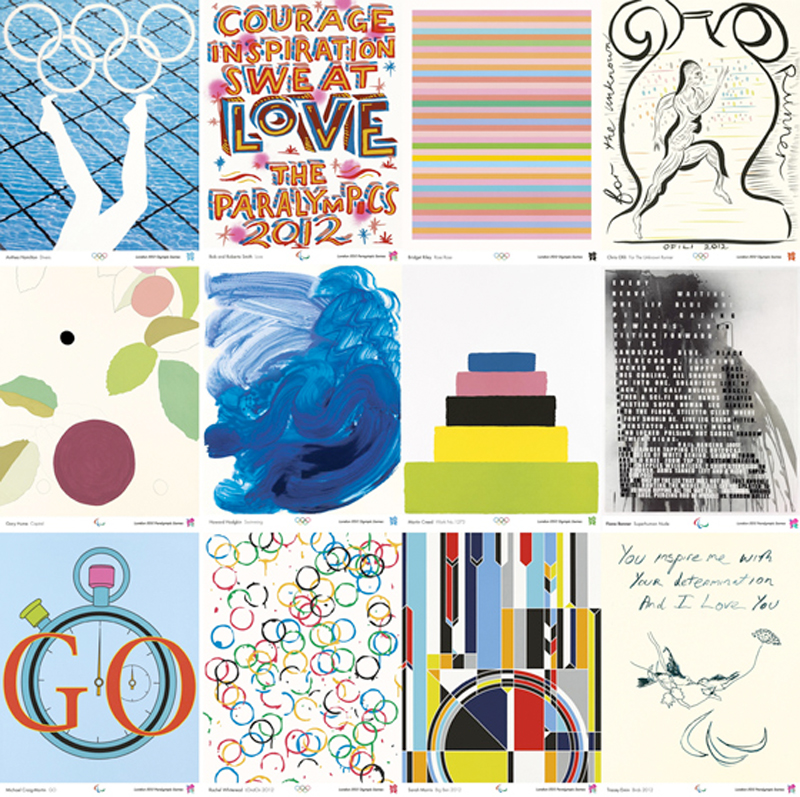
    The Turner Prize nominees and winners came up with a predictable set of embarrassing posters for the Olympics. Apart from the perpetrators themselves, no one could be found to say a good word about their efforts. Someone needs to get a grip. First we were presented with an inept logo which had cost £400,000 for what looked like two minutes work; then there was an artless rollercoaster sculpture selected by the President-For-Life; and now this lot of fashionable scribblers who couldn’t design a wheel from blueprints have done their worst, also, very conveniently, courtesy of the President-For-Life. Inevitably, as with Gibbereesh’s rollercoaster the PFL chose his reliable lackeys from the Turner Prize not to mention a serving Tate Trustee, Bob and Roberta Smith, i.e. one of those currently responsible for employing him.

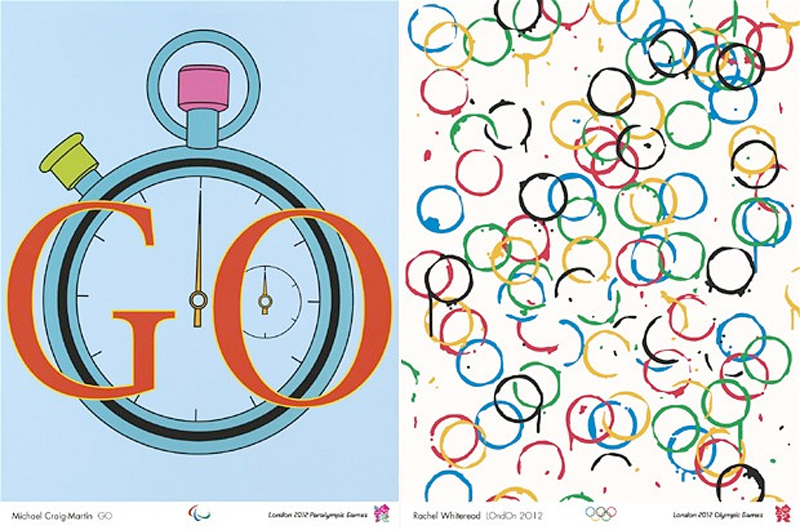
    Rachel Whiteread and Gary Hume excelled themselves with lovely colouring in – if their efforts had arrived crumpled from the nursery you might have fixed them proudly to the fridge. Bridget Riley knocked off her usual stripes. Each small poster – and these are nothing like the grand sheets of Lautrec – will be available to buy for £7 when an exhibition of the works opens at the Tate next summer.

    Now for the good news, that is if you are one of the participating artists. The posters are being released as signed prints courtesy of Counter Editions, thus enabling the artists to reward themselves in the manner to which they have become accustomed. Bridget Riley’s stripes, for example, is in an edition of 250 and started at £3,000 an impression – yes, that’s a gross of £750,000 for one signed screenprint, and it has already sold out. The Margate Express has hers in an edition of 300 at a throwaway £1,800 apiece – a mere £540,000… It is also sold out. The gross will, of course, have been far greater than the sums cited here as the cost of each print increased as the edition sold out. Still available however are ‘Professor’ Gary Hume’s blots (near right), a snip at £540 in an edition of 250 (£135,000 minimum gross) and Howard Hodgkin’s blue wave (£1,300, ed 300, minimum gross £394,000 – far right). No wonder the artists stood in a line laughing when their works were unveiled.

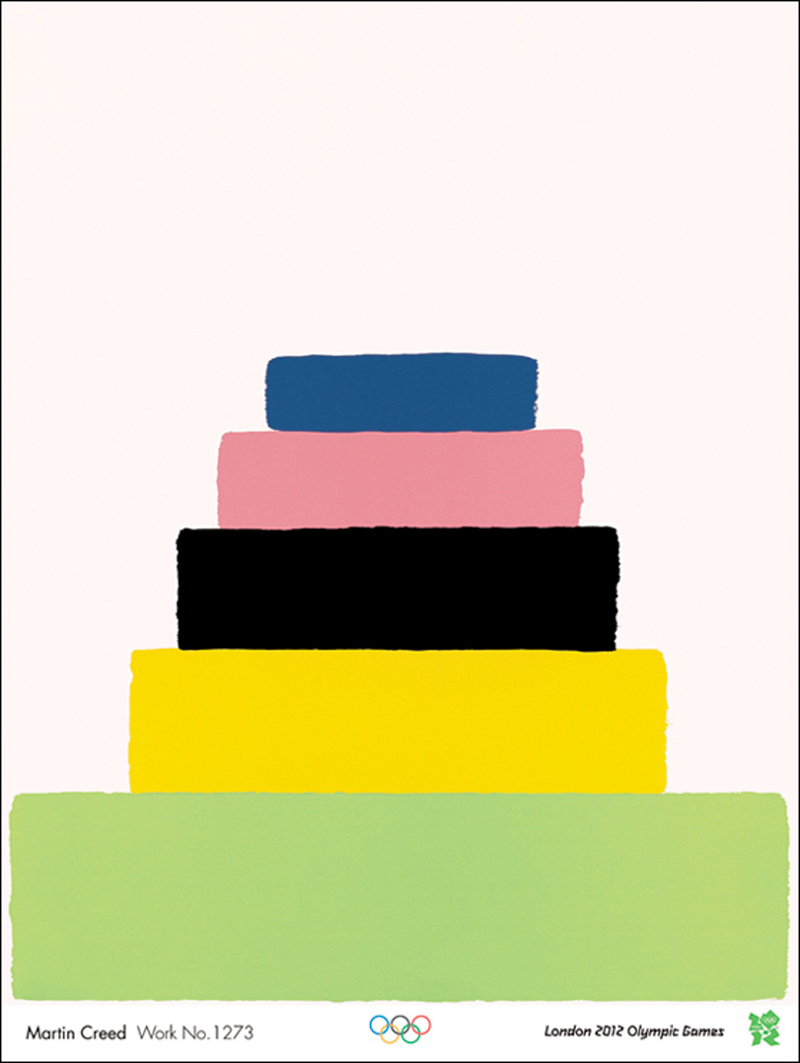
    Martin Creed, at last now widely regarded as educationally subnormal, said of his inspired marvel (£490, lithograph edition 250, minimum gross £122,500): “The colours are based on the Olympic colours but they are changed to make them nicer.” Here is the Mental Paralympian of State Art talking.

    What we got in this project was the usual bunch of over-rated contemporary artists promoting themselves and their art and not the Olympics. We can’t discover from anywhere what the deal was with the artists; were they actually paid to come up with their contributions or was their remuneration to be the loud ker-ching of limited editions? If you come across any information please let us know.

    … And then there was the dear old Margate Express. No are event is nowadays complete without her embonpoint rippling over the proceedings. On the same page of the papers when these Olympic efforts were announced you could look across from the Express’s maudlin scribble to Leonardo da Vinci’s drawing of hands on show in the National Gallery. An unfair comparison, yes, but it is surely impossible to look from one to the other and not think what a catastrophic deterioration has occurred not only in the technical ability of artists but in the willingness of those responsible for protecting standards in art to promote such conspicuous rubbish.

    By the way, if you wish to purchase all 12 of the posters you can buy the set in a nice box for £11,805. A commemorative heirloom for all the family to enjoy, and what a bargain.

     David Lee

    The Jackdaw, Jan-Feb 2012

    Latest News

    These posters are beginning to reappear on the market.

    Three editions sold out within days: they were Tracey Emin, Rachel Whiteread and Bridget Riley.  Now , one of the Rileys is being sold  at auction with an estimate of  £2,000-£3,000. This poster racket was not only a scam to line the pockets of already well-to-do artists but also to allow a quick turnover to collectors eager to cash in on the fever generated by the actual events.

    The complete set of posters are no on view/on sale at Tate Britain until September  23rd. So buy now. They’re crap, but what an investment.

  • Hitting the bottle

    Hitting the bottle

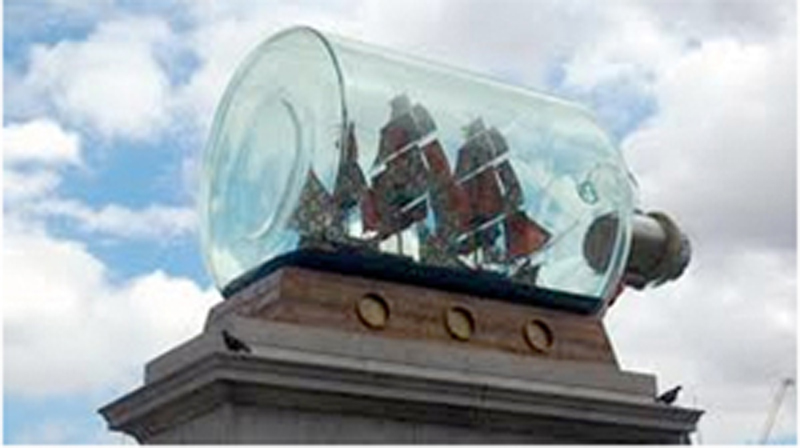
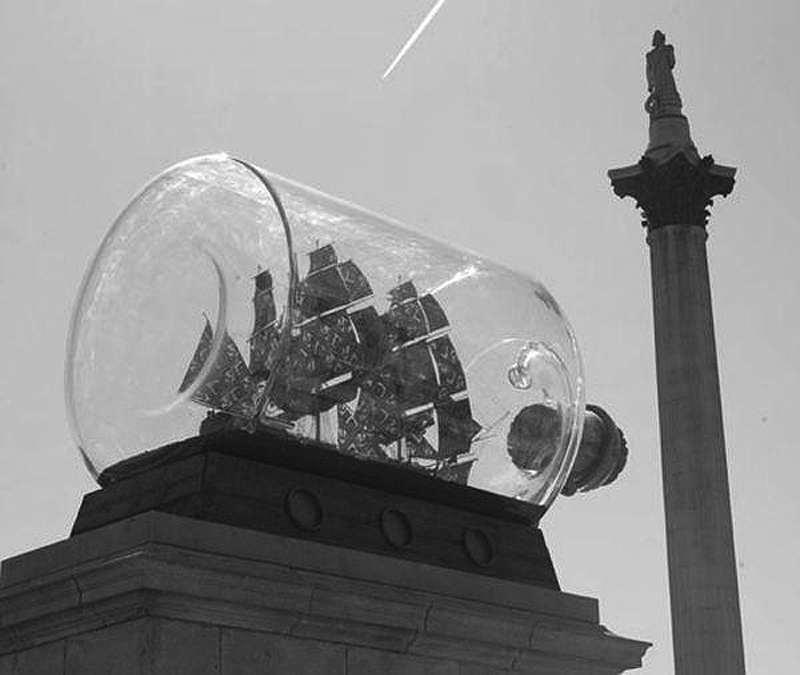
    The National Maritime Museum in Greenwich has bought for £362,500 the ship in a bottle by Yinka Shonibare which had sat ornamentally becalmed on the fourth plinth in Trafalgar Square for the previous 18 months. It is the Greenwich museum’s job to collect ships and related tackle and, lately, any sea-related nonsense deemed  ‘challenging’ by State Art’s omniscient spivs. It is significant, if you hadn’t realised, that the ship’s sails are made from patterned ethnic material of the sort usually swathed around gigantic arses in Dalston market. This encourages what one of the Tate’s finest drivellers grandly declares as “a transformation of perception”. Elsewhere, the same stuff is said to make an incisive comment on Britain’s nasty maritime heritage, “an exploration of colonialism and post-colonialism” no less. Needless to say we are not informed into what our “perception” is “transformed”, nor how “colonialism” is “explored” by deploying some patterned swatches purchased from a Brixton stall. I suppose we must now accept this species of commentary as the naturally occurring guff which will in perpetuity follow conceptual art wherever it goes.

    The sculpture, dubbed Nelson’s Ship in a Bottle, has recently been unveiled on a plain ziggurat base bang outside the National Maritime Museum’s main entrance. Here its presence will doubtless be interpreted as a Blair-like mea culpa for the historical misdeeds of our racist, slave-driving antecedents. Others may interpret its prominence and worship as illustrative of an abject and risible political correctness. Whatever, the bottle is a pretty enough toy untroubled by art. I wish to investigate briefly this apparently straightforward purchase because it reveals the questionable ways in which contemporary art is conducted by a small number of people for the benefit of an equally small number of other people who pop up ubiquitously pulling strings in proceedings such as these. It is curious indeed how the names are always the same ones. These ‘questionable ways’ may be baldly summarised as follows:

    1. We are never told the whole truth, even by public relations’ companies paid to deal with inquiries, and especially concerning the actual cost of anything. State Art is terrified of you knowing the truth, which is the reason why so frequently it is caught out lying.

    2. Obtaining accurate and complete information from arts bodies requires Kafkaesque determination and, when finally a morsel is vouchsafed, it is always uncooperatively partial and might easily contradict what has been released before.

    3. State Art has to be secretive in order to make the public believe that the visual arts are kept cruelly on the breadline and are not, as is the truth, awash with quite staggering amounts of cash which miraculously come available for the right people. If you are a Yinka Shonibare, with access to the engines of State Art, whose institutions you have dutifully served, this system is a licence to print money.

    4. The number of bodies dealing with contemporary art is far too numerous and wastefully duplicating of effort and resources, and any independence in their policies and actions is compromised by frequent interchange between them of the same few personnel.

    Three issues ago Moping Owl asked why we needed to buy Shonibare’s ship when, she thought, we already owned it. Didn’t we?  Had we not already commissioned and paid for it to sit on the plinth?  Well yes, sort of. Owl’s was a natural mistake, especially in view of what we had already been led to believe by what, up to that point, we now know had been an economical rationing of information. £362,500 is three times the record price paid at auction for any work by Shonibare. To pay apparently so much over the odds is surely just a little questionable, but the truth is that this figure is nowhere near what was actually paid for it. The real price far exceeded the published number, but you won’t have found the full, accurate cost in any newspaper because even now we can’t be certain we know all the amounts involved.

    When the purchase was gleefully trumpeted, as though we’d just acquired for peanuts a lost masterpiece by Praxiteles, a breakdown of the cost was supplied. This was based on the interesting claim put about by the artist’s dealer that an unnamed South Korean businessman had been prepared to pay £1.25 million in order to display the bottle in his garden. This outcome was described as “a real possibility” – which sounds to me a bit like the belief among, say, QPR fans that there is ‘a real possibility’ of their team winning the Premiership next season. This sum was apparently accepted even though, at that time, the price was ten times more than had ever previously been paid for a work by the artist. Complicated tax concessions applicable to a purchase by a British museum meant that the top line price was reduced to £650,000, the Treasury having waived the difference. This lower sum was made up as follows:

    £140,000: production costs funded by the Greater London Authority

    £97,500: 15% museum discount from Stephen Friedman Gallery

    £50,000: Grant from the Art Fund ***

    £264,300: Contributions from the public via a fundraising appeal ***

    £49,100: National Maritime Museum contribution ***

    £49,100: Matched contribution by Stephen Friedman Gallery and James Cohan Gallery, New York, on behalf of Yinka Shonibare, MBE

    (*** These sums total £363,400; that is, close to £362,500.)

    As far as I can ascertain at least three additional sums that were paid have not been included in this final account. The Arts Council awarded £70,000 for this project, as it does for all fourth plinth commissions; the Greater London Authority, in addition to its £140,000 production costs, gave an “artist’s fee” of £30,000; and the Henry Moore Foundation gave a grant of £20,000 to the artist for this project. In the privileged wonderland of State Art these additional sums, a mere £120,000, are pocket money. But we still paid them, and the total involved is five times the average Briton’s annual income. I can see no reason why these omitted additional sums should not have been deducted from the price paid by the Museum. Why were they not included in the reckoning? And how many other charities, trusts etc., contributed amounts which disappeared into the coffers when first the project was mooted? The £140,000 contributed by the Mayor’s office for production costs was, according to the initial agreement, to be repaid if the work sold. This is apparently true of all works made for the plinth, though we are unaware of any sums ever having been repaid from previous occupancies.We must assume that Boris is sat waiting eagerly for his refund (after all he can buy one-tenth of a new Routemaster for £140,000). Despite repeated requests for information nothing remotely resembling candour has emerged from the Mayor’s office. The fact is that the GLA alone paid Shonibare in production costs and fees a sum far is excess of the highest amount the artist’s work had ever previously sold for. And we didn’t even get to own it. Is the Arts Council’s £70,000 equally reimbursable upon the sale of a work? If not, it should be. The Arts Council, perennially bleating about its poverty, should surely be on the case for a return of its investment. As usual our requests to them for information have been ignored. They are far too busy producing worthless pamphlets of self-congratulation.

    The price paid by the NMM was independently assessed by Haunch of Venison and Roche Court, a minor secondary market sculpture dealer in the West Country. Haunch of Venison is a gallery owned by Christie’s who, coincidentally, sold the previously highest priced work of Shonibare, a large installation, for $194,500 last November. (Another installation was sold by Christie’s in April this year for as little as $98,500.) It is hard to see how any objective person could have verified a price of £1.25 million ($1.94 million) for a sculpture by this artist, even one which had sat prominently hawking itself in the centre of London for the previous year and a half. Given that they have a monopoly of sale on Shonibare’s sculpture (Sotheby’s has never offered a work by him) it was not in Christie’s – of course I mean in Haunch of Venison’s – interest to undervalue this piece. In other walks of life we might call this a conflict of interest. Shonibare was handsomely reimbursed twice for this bottle; once when he made it and a second time when he sold it. Additionally, we had a right to expect a knockdown price from the 50-year-old artist whose career has been generously supported by the State. Shonibare is an executive member of the Usual Suspects Club. He was nominated for the Turner Prize in 2004, the year Jeremy Deller won (Deller, incidentally, is one of two artists on the selection committee for the Fourth Plinth, both of them Turner Prize winners). His fledgeling career was made easier by cash grants from both the Arts Council and the Greater London Arts Board and he has enjoyed exhibitions in virtually every Arts Council-funded gallery throughout the country, as well as at the Tate. He has also served on Arts Council committees and bought works of his choice for the Arts Council collection. His present visibility would have been inconceivable without expensive public promotion. This should have been reflected in the price for the bottle. After all, we didn’t owe Shonibare anything, quite the reverse. He has made a strong career on the back of crucial public investment in him and, in my view, he has used that reputation to inflate the bottle’s price when selling it back to us. What a marvellous system this is if you are, as the Arts Council put it, “the right kind of artist”.

    At the very minimum we paid the following for the bottle:

    £362,500 published cost

    £140,000 Greater London Assembly

    £30,000 fee also from the GLA

    £70,000 Arts Council grant

    £20,000 Moore Foundation grant

    (£622,500 in total).

    When the work’s sale to Greenwich was completed Shonibare said: “I am absolutely delighted and touched by the public’s generosity.” I bet he is.

    David Lee

    The Jackdaw, Jul-Aug 2012


  • Damien Hirst’s wonder year

    With Dead Head

    Glyn Thompson, the pickler’s first teacher, sets the artist’s early record straight…

    Hirst scholars will have noted a change in the authorised chronology in the Tate Modern Hirst retrospective catalogue to a venerable biographical item, the entry for March 2002 (The Reliance, Leeds). In the corrected Tate chronology the former title, Damien Hirst’s Art Education, now reads as Fountain Footnotes (The Kominski Suite), the result of due diligence carried out by Loren Hansi Momodu. However, neither titles are strictly correct, since that on the invitation to the private view, delivered to the White Cube in Hoxton Square in late February 2002, read Fountain Footnotes (The Kominski Suite) some drawings, from a private collection, from the archaeology of Damien Hirst’s art education. The exhibition entitled ‘Damien Hirst’s Art Education – Reprised’, opening this month, thus consolidates the position of The Reliance in the authorised Hirst chronology.

    As a consequence of this more comprehensive due diligence, the reinstatement of Jacob Kramer to Hirst’s chronology allows new light to be cast on a significant moment in his art education hitherto obscured by the mis-identification of his alma mater as ‘Leeds College of Art’. To his credit, Hirst has corrected this mistake – in On The Way to Work (2001) and in the interview with Nicholas Serota in the Tate Retrospective catalogue – but this has had little effect on either authorised and unauthorized biographies. His own website, and that of his dealer/gallery, White Cube, and Debrett’s, have no entry at all for the years 1983/4, which Hirst spent at Jacob Kramer, and wherever one finds his art education discussed, it is at the fictitious ‘Leeds College of Art’ that he is imagined to have studied.

    This omission of Jacob Kramer from the record has focussed attention on Hirst’s post-Goldsmith’s years, encouraging the creation myth of Hirst as self-invented, a construction he appears keen to embrace.

    A further consequence of the belated re-instatement of Jacob Kramer to the record is the exhumation of a strand of Hirst’s privileged lineage which blazons the achievement of Harry Thubron, who had worked at Leeds School of Art before moving to Goldsmith’s, where Hirst was to encounter his shade. But Hirst has failed to fully acknowledge his earlier exposure – at Jacob Kramer; contradicting his claim that there he learnt his art history from books and magazines, in History of Art lectures delivered by myself, Hirst witnessed rare images of Thubron’s own work, both in and absent from the record, work by his students, and exemplars from the history of art. The breadth and range of thematic and visual references the art history lectures provided offers a rare window onto Hirst’s early art education, and it is fortunate for scholarship that the notes, and slides, for every lecture, remain in my personal archive.

    Such lack of historical accuracy may of course be due as much to memory lapse as myth-making; after all, in speaking to Nicholas Serota in 2011, Hirst was casting his mind back almost thirty event-filled  years. But in recounting that “I never looked beyond Leeds – it was where I lived. I’d been unemployed for a year or so … I thought I’d go to art school. I did a one-year Foundation course at Leeds…” Hirst misleads since, born in 1965 and enrolling at Kramer at the age of 18, he could not have been unemployed for a year or so before leaving Jacob Kramer in 1984. Perhaps the reprise, in 1991, one year after he began the Natural History series, of the 1981 self-portrait photograph of himself at the Leeds University medical school morgue, entitled With Dead Head, is itself an expression of this sui generis creation myth, since it would seem to have been produced in order to establish a provenance for a subject also seemingly springing fully formed out of nowhere, augmented with Hirst’s citation of the anatomical drawings he produced at the morgue, whose apparent significance surely demanded display at the Tate, or reproduction in the catalogue.

    Hirst first addressed in 1990, in public, the subject which subsequently became his motif-à-clef, the topos of Vanitas, the subject addressed by the drawings exhibited at Reliance in 2002.

    The third element of his Leeds experience neglected in the record is the core component of the programme he followed at Jacob Kramer, an academic drawing class which all students undertook, under my direction, in the natural history and ethnography sections of the city museum, Hirst’s familiarity with which is confirmed by his description of the very route by which he reached the back-rooms students were privileged to access. The work was required to address not merely aspects of the form and appearance of the objects but also the taxonomic, moral and teleological implications arising from curatorial traditions ideologically circumscribing the display of ‘Nature’, whose epistemological grounding lay in the cabinet of curiosities. This of course imposes an obligation to consider what Hirst is specifically contributing to the subject of Vanitas.

    Arising from the above is the question as to what extent the Damien Hirst who attended Jacob Kramer was in possession, albeit only in microcosm, of the aesthetic which was to propel his entire oeuvre, the institutionalized aesthetic of Appropriationism. That the production of the drawings under discussion was institutionalised is not at issue, since all the work submitted for assessment at Jacob Kramer was executed solely as a consequence of the students’ enrolment; only by satisfying the regulations of the institution could their work acquire validation via the imprimatur of the institution – which is why people go to art school. That institutional endorsement is crucial to Hirst’s identity, as his view that “If it’s in the Tate, it must be Art” confirms, is underlined by Ann Gallagher in her introduction to the catalogue; on page 14 she refers to “… Hirst’s early institutional endorsement, his 1991 show at the I.C.A. in London…”

    Hirst was introduced to the history of appropriationism as a legitimate strategy in the philosophy and practice of modern art at the very latest at Jacob Kramer, during the history and theory of art lectures delivered, by myself, to all students attending the Foundation course.

    Once inscribed within the corpus, in providing a bridge from Hirst’s youthful fascination with the eternal verities to his first mature expressions, the content of the drawings takes on the character of a missing link – as if in attending Jacob Kramer Hirst’s intuitions were for the first time self-consciously critically contextualised by art history and theory. And when so inscribed, the content of the drawings confirms a thematic continuity between Hirst’s deep seated, long-held preoccupations and his mature expressions.

    Glyn Thompson

    The Jackdaw, Jul-Aug 2012