Tag: State Art

  • The RA summer show in record time

    The RA summer show in record time

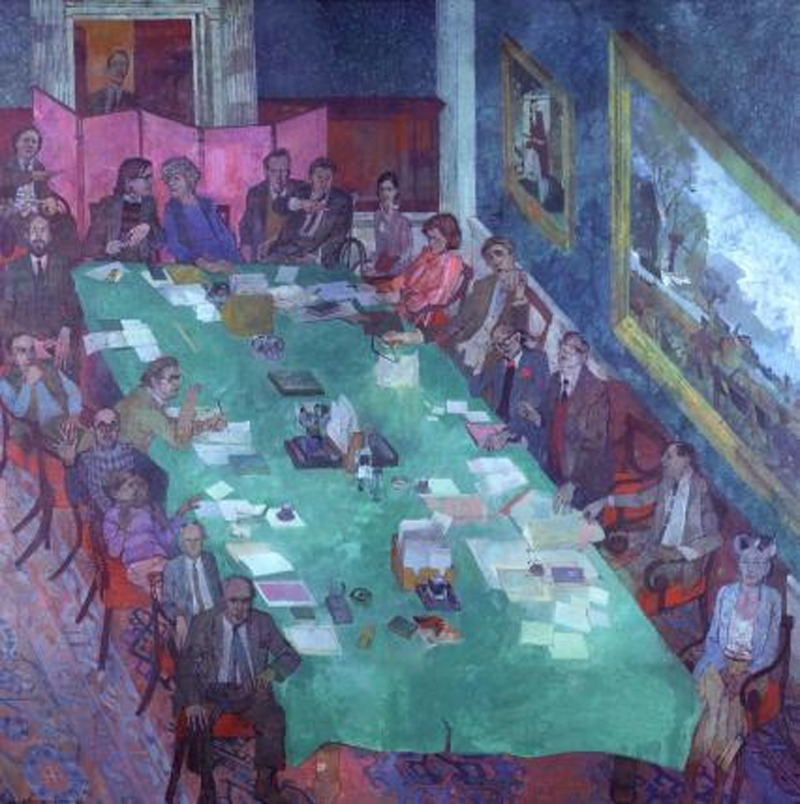
    The Meeting, Royal Academy of Arts by Leonard Rosoman

    Out of respect for one of its recently deceased Academicians, Leonard Rosomon (1913– 2012), the Royal Academy skied one of his best works in the corner of an obscure gallery at this year’s Summer Exhibition (until August 12th). His Committee Meeting, Royal Academy (above), 1979-1984, was on loan from the National Portrait Gallery, where it has probably never been on display. We have in England scores of public galleries and yet is there one with a curator who has the wit to stage a retrospective exhibition of a senior artist like Rosomon? Probably not. For those with an eye on State Art advancement there is no career mileage in such a show, in fact it would probably end any hope of serious preferment. Yet in the last two years alone Tracey Emin, represented in this exhibition by childish scribbles unworthy of even the fridge door, has had three major exhibitions in public galleries. State Art needs a clear-out and re-staffing with individual thinkers.

    Everything in Burlington House this year seemed even more dense and off-putting on the wall than usual, so The Jackdaw’s representative allocated one second on average to each of the 1,474 works before heading off elsewhere in search of art which looked as though it was loved by someone enough to hang it sensitively.

    Highlights spotted at speed were a bold Kiefer and a powerful portrait maquette of footballer Stan Cullis by James Butler, the quality of whose modelling always stands out even when exhibited in sculpture galleries more akin to a jumble sale than an exhibition of serious art. One sculptor phoned the Jackdaw to remonstrate at this shocking treatment and said he would not have allowed his work to be exhibited so contemptuously. Another wrote a despairing unsigned letter saying that the atrocious hanging of the sculpture was no better than most of the trash selected deserved. Everyone else was represented by the stuff they are usually represented by. There will undoubtedly have been other good work hidden away but life’s too short to search it out among such mountains of amateurish material.

    Ah, one interesting development was the removal of the small pictures from the far end into the largest gallery. The irony in this was that the vacated gallery was then used to show one work instead of 250. It was a video of someone scraping out “a modern piece for cello”, of the sort one walks straight past in the Tate. Played this crap by torturers you’d be singing like Placido Domingo inside three seconds, telling them your grandmother was Osama bin Laden’s loyal lieutenant in Eccles.

    Robert Graves
    Epitaph on an Unfortunate Artist

    He found a formula for drawing comic rabbits:
    This formula for drawing comic rabbits paid,
    So in the end he could not change the tragic habits
    This formula for drawing comic rabbits made.

    David Lee

    The Jackdaw June 2012

  • Gruel for the masses

    Gruel for the masses

    The State should be more circumspect than to behave like a private collector. Unfortunately, collecting and exhibiting in national collections according to narrow personal tastes and loyalties is established practice. Those employed to run Contemporary Art are selected because they have been carefully programmed in the tenets of State Art and if they have doubts keep quiet about them. But functionaries of State Art are not spending their own money and therefore in the policies governing collection and exhibition they should reflect the best from the full range that is being produced and not just follow those few desperately eking out the fag end of Opportunism. A damaging aspect of State Art has always been that it refuses to acknowledge anything outside its own narrow prejudices, which stop dead at those artists represented only by major art dealers and sold expensively in rigged markets by auction houses. Healthy dividing lines between museum curators and directors, auction houses and the most fashionable art dealers no longer exist. The system stinks worse than an open sewer, but many love the smell and wish to waft it over the rest of us so we might come to like it too.

    State Art apostles all help one another in pursuance of their little ambitions. They are a happy club who play hard. Their governing Synod, which comprises all of those contributors to the unhealthy smell noted above, swarm off one week to Margate aboard the same train, the next week to Wakefield aboard the same train, days later they commune aboard the same flight to Venice, and the week after that they chink glasses again at the Basel Art Fair – it’s a hard life is State Art. Decisions made among themselves during these junkets will be imposed everywhere. What results from this process is the repeated exhibition of the same few artists. This keeps the rest of us in ignorance of so much that might otherwise have been stimulating. Most of my generation will never know what we have missed because we have lived our entire professional lives under a State Art regime administered by curators terrified to jeopardise their careers by thinking for themselves. Predictability being the worst of State Art’s crimes, we are never surprised.

    Also like many of my generation, I suspect, I no longer feel the urge to see everything, having already viewed so much so often that hasn’t justified its hysterical praise by those with mysterious interests in promoting it. I’m sure Miro was a fascinating old cove but I’ve visited his studio in Palma and, to be honest, provided with a large enough mop and baths of black and the primaries, a toddler could produce in an afternoon most of the work on display there. Miro at the Tate? No thanks. Likewise Emin at the Hayward. Seen them before, and life is too short to indulge further the solipsism of an idiot. The problem for those of us with decades of exhibitions behind us is that this sort of material, the kind of thin work we are constantly exhorted to idolise,  has become unavoidable. It gets everywhere. Nowhere is safe from it.

    I recently visited the Orkneys for its birds and stones. Knowing that the Pier Arts Centre in Stromness held a donated collection of carefully selected minor works by important 20th century British artists, this was an early port of call. The permanent collection is the generous gift of Margaret Gardiner, who wrote an acclaimed biography of Barbara Hepworth and had an eye for quality which probably exceeded her modest purse. Nevertheless, she accumulated covetable, domestic-sized pieces by Hepworth, Moore, Nicholson, Piper, Heron, Frost, Lanyon and others, all of which will spark memories in knowledgeable viewers while touching those nerves and recesses where appreciation resides. The original gallery, at the heart of a busy harbour, has been done up courtesy of the Arts Council Lottery (£4 million) and there is now room for temporary displays and craftsy souvenirs. I was hoping to see here work by artists from north of Inverness and Aberdeen – the likes of Frances Walker for example – those whom one is unlikely to encounter elsewhere. No such luck.  What they had on display were some scribbles and unsavoury looking skidmarks by Cy Twombly, of the ‘highly significant’ sort which cause State Art fanatics to collapse in a religious swoon, and a collection of inept portraits and even worse ‘landscapes’ by another fashionable and ludicrously expensive American artist, Alex Katz. (Twombly is represented by Larry Gagosian; Katz by Pace Wildenstein.) Both are described as ‘influential’. God help us, who with?

    Katz’s portraits were trendily wooden, flat and unmodelled, the sitters characterless, boneless in some cases, and tediously stylised. Anyone whose eye has been nurtured by rich historical portraiture from Al Fayum and the Roman republic to Ravenna, Moroni, Rembrandt, Lawrence and Spencer couldn’t possibly see anything other than low-fat insipidity in Katz’s daubs. And his small landscapes, truly awful pictures, were so awkward and incompetent they were unworthy of hanging in a Women’s Institute. But no, they had been air-freighted 700 miles north of London for the benefit of Orcadians and those, like me, doggedly twitching for whimbrel and black guillemot. (Incidentally, en passant, the former you can more often hear than see and the latter, considerable rarities elsewhere on northern coasts, bobble about common as muck in Scapa Flow. Youalso ought to know about the corsair ravages of great skuas marauding in press gangs on Hoy – more engaging than either Twombly or Katz could ever be – but that’s for a different and probably a better magazine.) The presence of Katz in the northern isles wouldn’t have been quite so annoying had I not seen the same shallow gimmickry only a few months before, by accident note, in the National Portrait Gallery. I’d been bewildered then by what was officially considered to give this stuff precedence over works by effortlessly superior British portrait painters. Both Twombly and Katz are part of the Artists’ Rooms series which are enjoying a permanent tour of the country. This is the “generous gift”, by the way, for which we paid Anthony d’Offay £42 million. Artists’ Rooms, organised by the Tate, are the process, it would seem, by which nobody in the country will be safe from the tradenames of State Art. They are coming to a place near you whether you like it or not.

    On the way south I didn’t stop for Jeff Koons at the Scottish National Gallery of Modern Art in Edinburgh (another Artist’s Room) having seen the trash he has to offer too many times before. I stopped instead at Wakefield where a £35 million museum (Arts Council Lottery: £5.5 million) designed by David Chipperfield has opened in honour of local artist Barbara Hepworth (1903-1975).  This shed of grey slate, forbiddingly windowless for the most part,  replaces the old Wakefield Art Gallery which was housed in the municipal Edwardian pile up the hill. Despite the beauty of a small number of masterpieces it contained, that was a gloomy, unloved place where, not surprisingly, few ventured. Despite its off-putting appearance, the new grey gallery is an improvement and stands beside an attractive weir (grey heron, grey wagtail) on the Calder 25 minutes walk from the railway station. Inevitably, the building has been overpraised by architecture scribblers. It is nothing at all remarkable, but is agreeable enough inside. Apart from the foyer, which is coloured in regulation Serota mud, the rest is white and spacious, the light a mixture of rationed natural and mains. The whole place is blighted by that self-inflicted virus of modern galleries and museums, patrolling attendants armed with squawking radios which destroy all attempts at uninterrupted concentration.

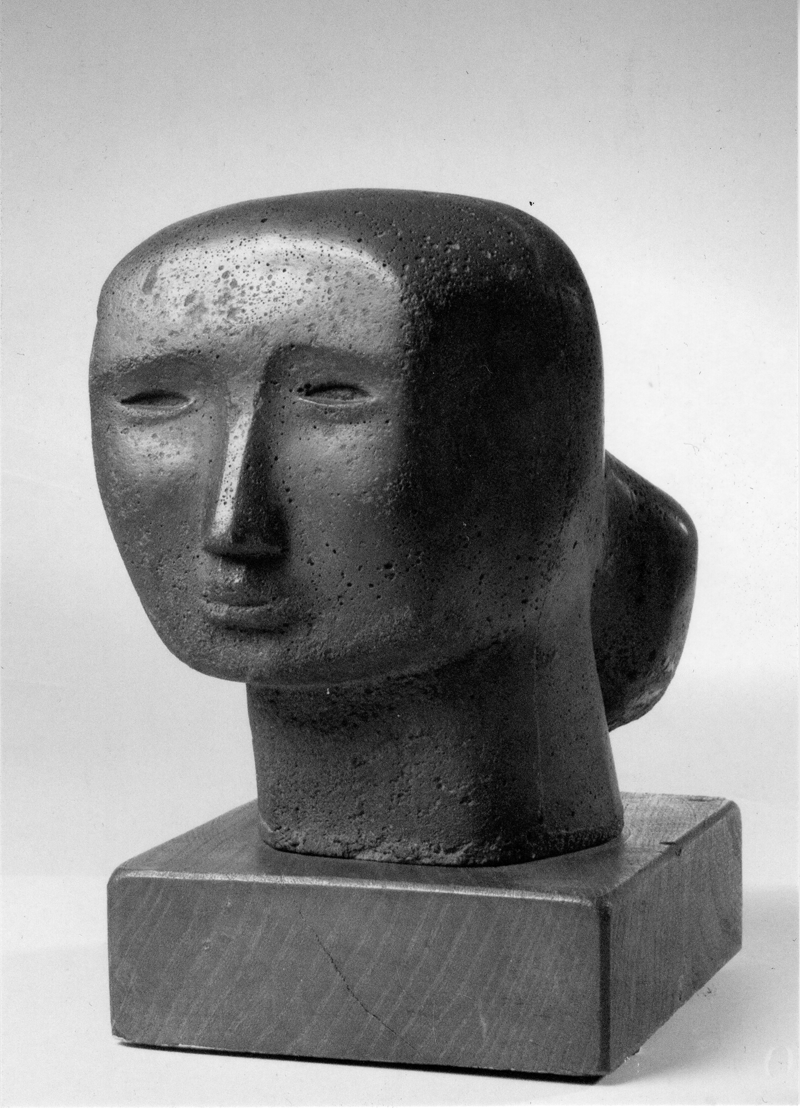
    The historic Wakefield collection, mainly mid-century Modernism which is representative more than notable, is scarcely worth writing home about for anyone well acquainted with the field, but is augmented by apposite loans from elsewhere, mainly the Tate – a sensible use of their hidden reserves. From a loyalty point of view the display does Hepworth no favours. Gabo was more inventive in three dimensions with form, materials and especially string, while Moore, represented by two fine early sculptures, a reclining figure carved in writhing elm and the modelled cement head, render the nearby Hepworths stodgy and a bit simple. Her drawing of a surgical operation – these are usually her best things when seen reproduced small in books – looked vague next to one of Moore’s best shelter drawings. In this company Hepworth might be second rate but she’s still world famous in Wakefield.

    Given that Arts Council money has gone in, they and their lieutenants, and particularly the dead hand of their State Art doctrine, are already calling the shots in the exhibition programme. The opening show is throwaway stuff. Doubtless during the selection process political correctness intervened something like this: we need a young female sculptor with impeccable State Art credentials, phone Serota.  The chosen candidate was one Eva Rothschild, who is Irish. Fresh from the ponderous, overblown constructivism she served up last year at Tate Britain, she arrives here with playground materials and colours, inarticulate tangles of stuff on stands signifying heaven only knows what.  Beside the humanist Hepworth this skip-fodder insults her memory.

    Apart from Hepworth and Moore, think of the important contribution of Yorkshire to British sculpture in the last century – national figures like Kenneth Armitage, George Fullard, Austin Wright, Ralph Brown, Hubert Dalwood and all those gifted tutors and Gregory Fellowships at Leeds. The new museum had years to plan a retrospective of an important local sculptor, or a mixed show of work ripe for reassessment, but instead they present scraps by yet another over-exhibited fashionable novice with no discernible sculptural ability. As usual with the Arts Council, their programming is a lazy failure.

    Needless to say the Council’s finest snake oil salesmen have been scratching their heads over Rothschild. Following months of screwed up paper they cobbled together this salvo of lucidity: “This exploration of the intrinsic power and meanings carried by objects produced a transformational encounter between the animal forms and the symbolic and narrative potential of Rothschild’s work.” One of these days, soon I hope, they will realise they are communicating with fellow humans.  But the Arts Council don’t do editing or clarity, and neither is conciseness in their lexicon: “There is a playful defiance of gravity and materiality in many of these sculptures that probe, test and occupy the gallery space.” Probe, test, occupy the gallery space … No, you’ve got me there. Perhaps the good folk of Cleckheaton and Goole are fluent in this guff, but I doubt it.

    David Lee

    The Jackdaw Jul-Aug 2011

  • Tate Trustees and the public interest

    The Tate recently named two new trustees, one of whom is painter Tomma Abts. She is a 44-year-old German, recently appointed Professor of Painting at the Kunstakademie in Düsseldorf, who won the Turner Prize in 2006. As an artist trustee, she replaced Jeremy Deller, who won the Turner Prize in 2004. Abts’s paintings are all the same small size (48 x 38cms) – it is claimed this tic is conceptually crucial for a reason never convincingly explained – and consist of polite abstract designs which might have looked original on curtains at the 1954 Ideal Home Exhibition. So much for the Cutting Edge. The Tate claims her pictures “possess a formal definition and coherence that suggests that they could never have existed any other way … [and] seem to achieve what only painting can, inhabiting both this reality as an object or ‘thing’, and a parallel world with its own set of rules and relationships that demand to be judged on their own terms.” As per with their interpretive literature, all helpful stuff. Am I being cynical? Yes. Why? Because using any sensible criteria Abts doesn’t deserve to be a trustee of an important British museum.

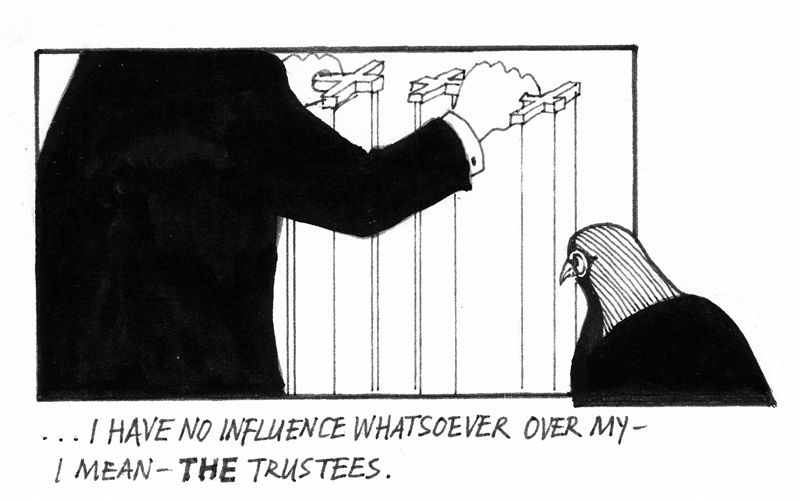
    The job of Tate trustees is to oversee the efficient running of the gallery “as guardians of the public interest” – and please note that it says  ‘the public interest’ not ‘State Art’s interest’, for as you will discover these two mutually exclusive agendas tend to become blurred in the minds of certain individuals. Improbable as it sounds, guidelines for the functions of trustees are drawn up by the Tate itself, not by independent arbiters. Such complacency hardly reassures an outsider that the public interest, rather than the Tate’s, is being looked after. Indeed, such self-scrutiny is hardly better than the continuing disgrace of policemen investigating their own mistakes.

    In 2008 the number of trustees was increased from 12 to 14 and as required by the Museums and Galleries Act 1992 “at least three” of these must be artists. Thirteen are appointed by the Prime Minister and the last is nominated by the trustees of the National Gallery from among their own membership. Unlike their fellow trustees, who are mainly those with business expertise, and who can serve up to two terms of four years (a period of office trimmed recently from five), artist trustees currently serve only one term of four years. You may find it odd – I certainly do – that while there are three contemporary artists with gilt-edged State Art credentials on the Tate’s board of trustees there is no place for a single art historian. I’m obviously old-fashioned because a museum of historical art with no art historians sitting on its governing board seems verging on the perverse.

    When an artist trusteeship becomes vacant it is widely advertised in the papers, giving the impression that any capable, knowledgeable, articulate artist of repute might apply. Nothing could be further from the truth, for there is a codicil written in invisible ink along the bottom of these ads, which reads: “If you have not won or at the very least been nominated for the Turner Prize, kindly fuck off and don’t waste our time.” The Tate squanders scarce cash paying for these advertisements which are nothing short of a calculated deception. Artist trustees are in fact a self-appointed clique comprising only winners of the Turner Prize with a couple of reliable also-rans chucked in. Since new regulations were imposed in 1992 the only exceptions to this rule have been Julian Opie, who famously refused his nomination for the Turner on the grounds that the prize “had become a frivolous publicity stunt”, and Bob and Roberta Smith, the sobriquet of a dimwit called Patrick Brill, who is otherwise a regular purveyor of infantile stunts at Millbank – you may recall his Tate Christmas tree whose lights visitors were asked to illuminate by peddling a generator. He’s very concerned about the environment apparently.

    Being a trustee involves attending six meetings a year and is said to require a day a month in reading and preparation. I must point out that the Tate’s artist trustees are easily the worst attenders at these meetings, and are frequently absent. In the case of Anish Kapoor (Turner Prize winner, 1991) his absenteeism, which included missing half the meetings in two consecutive years and scarpering early from others, would have surely seen him sacked from the board of any efficiently run private enterprise.

    Of currently serving artist trustees two are Germans – besides Abts the other is magazine photographer Wolfgang Tillmans (Turner Prize winner, 2000). Could they really not find a British photographer, or even a British abstract painter, worthy of these positions? Admittedly, Germans do most things better than we do but surely this is insulting to British artists. And how can a professor at a German art school, which presumably requires her to actually attend some of the week, perform the duties of a trustee required to be resident here?

    The process by which artist trustees are selected – laughably characterised as “an open competition” or “an open competitive process” – is indicative of what happens when a clique achieves a complacent monopoly and is allowed by servile arts commentators to get away with it. Minutes of meetings make it clear that artist trustees are encouraged to invite applications from those they consider suitable as their own replacements, especially when candidates who have responded to the ads are not considered worthy, which one may reasonably surmise is always. Indeed, I wonder if there was ever a case of a successful artist trustee having responded to the ads rather than having been – that weasel word – ‘invited’ to apply… And so Turner Prize winners beget other Turner Prize winners, or at the very least other near-misses of that persuasion.

    Candidates for artist trusteeships are interviewed by a panel comprising trustees, including the artists, plus an “independent assessor” who is present to ensure that legal niceties, “best practice” etc., are observed and everything looks above board. But how can it be above board when only Turner Prize winners are appointed? Perhaps this independent assessor ought to be involved from the start of the process in order that more than Turner Prize nominees might be seriously considered, if for no other reason than to keep up appearances of openness. Eyebrows would be raised at such a narrowness of potential candidates in any other sphere of public life: imagine, for example, the Commander-in-Chief of the armed forces always being selected from the same regiment.

    You may ask why is it so important for the convenient running of the Tate that its artist trustees are always winners of the Turner Prize. The answer is for the obvious reason that having been awarded a career-changing gong by the institution of which they are now overseers, they will never rock the boat by asking too many tricky questions about the Tate’s direction in its dealings with contemporary art. This is one of many ways by which State Art has become institutionalised: no one but the reliably subservient is ever allowed on the inside to question Tate, or indeed Arts Council, policies.

    On the other hand these parti pris trustees can be useful when outside criticism of the Tate becomes noisy. For example, in July 2004 Trustees discussed newspaper coverage of a Tate work, Rodin’s The Kiss, which Cornelia Parker (who was nominated for the Turner in 1997, the year it was won by Gillian Wearing, inevitably herself a recent artist trustee), had the previous year controversially wrapped up with a mile of string. This stunt was claimed by the artist to be “challenging the claustrophobic nature of relationships”. Artist trustees present in the meeting (which included the aforementioned Wearing) were able to defend their fellow artist for the benefit of other sceptical trustees. They pointed out that it was the job of the Tate to provoke controversy and discussion, which this work did.

    It is in the interests of these artist trustees to support the Director. They know they will be serving only for a brief period following which they might reasonably look forward to the reward of a Tate retrospective or other continued patronage, purchases etc.

    Serota has stated a preference for such younger trustees. Referring to the trusteeship of Anthony Caro many years before, he remarked in 1998 to the Sunday Times: “Tony was well over 60 when he became a trustee. He was a very effective trustee, actually. He cared passionately about certain things and was a powerful force … but it just seems to work better when you have artists who are a new generation, or indeed erring on the younger side, really.” And we know why he thinks it “seems to work better”, because older artists of a more independent, more knowledgeable, more experienced character might argue cogently for a policy or direction other than the one being pursued by the Director. They have nothing to lose by disagreeing with him. Let’s face it, the current crop of artist trustees is in Serota’s pocket. They owe him and he knows it. He can rely on their support without a second thought.

    In a 2008 interview Serota said of his trustees: “I don’t have any part to play in their appointment”. Remember this, it’s important and we’ll return to it in a second.

    Many years ago Serota said that public nominations for the Turner Prize (perhaps you don’t remember that ridiculous charade whereby we all wasted our stamps and faxes) were seriously considered by the judges. We discovered in 2006 what we already knew, courtesy of an indiscreet Turner Prize judge, that this was in fact a lie and they were binned with risible disregard. We also discovered at the same time, and from the same source, that Turner Prize judges were given a list of appropriate artists and exhibitions – just to help them along you know, point them in the right direction. And there we were thinking in the innocence of our ignorance that they might nominate anyone…

    Serota also stated in 2005 that the Tate only rarely acquired work by serving trustees. The Jackdaw checked up on that and discovered (see the editorial for Dec/Jan 2006 on our website) that he wasn’t telling the truth. Indeed, this whopper cost him a bollocking from the Charity Commission. There were also a number of other flagrant economies with the truth concerning the Tate’s acquisition of work by serving trustee Chris Ofili, who was naturally a Turner Prize winner (1998), which also resulted in another six of the best from the CC. (I almost mentioned here the fact that in the last editorial – also on our website – we indicated how the Tate recently misled us over their attendance figures, but you must be getting fed up with that one.)

    So, bearing in mind Serota’s far from perfect form, when he remarks “I don’t have any part to play in their appointment” I need to ask myself: ‘Do I give him the benefit of the doubt and believe him this time?’ Well, as it happens, no I don’t. Even cursory familiarity with the Trustees’ minutes betrays this one as untrue. On the contrary he is frequently involved in their appointment; indeed, the process of Trustee appointment is administered by his own office. He even attends candidate interviews “in an advisory capacity”. Presumably he offers ‘advice’ which plays no material part in the process, so why is he there in the first place? Indeed, we read on: “The key stages of the appointment are overseen by a panel which will normally include the Director.” (Who, presumably, doesn’t play any part.) On one recent occasion he encourages artist trustees to nominate likely candidates for their replacement knowing only too well the sort of artists they are likely to suggest. No part?

    Let’s have this one straight: Serota is ‘advising’ on the appointment of someone, a trustee, who will function as his own employer. This is a wretched abuse of the supposed ‘independence’ of process and would be considered as much in any other public body. It is, as usual, as blatant a conflict of interest (not to mention a betrayal of ‘the public interest’ about which the process purports to be so concerned) as you would expect to find at the Tate, whose management of conflicts of interest, incidentally, was declared woefully inadequate by none other than the Charities Commission.

    The Tate should not be involved with either the compiling of its own trustees’ duties, or in the nomination or selection of Trustees themselves. How can ‘the public interest’ be considered served when the organisation under scrutiny is writing the job description of its own scrutineers. If we are to have artist trustees let’s have them from a cross-section of the artist community and not just those representing the Turner Prize. And let’s have some eminent art historians in there too.

    David Lee

    The Jackdaw May-Jun 2011