Recent Articles

  • Mary Wollstonecraft Memorial, Newington Green

    Mary Wollstonecraft Memorial, Newington Green

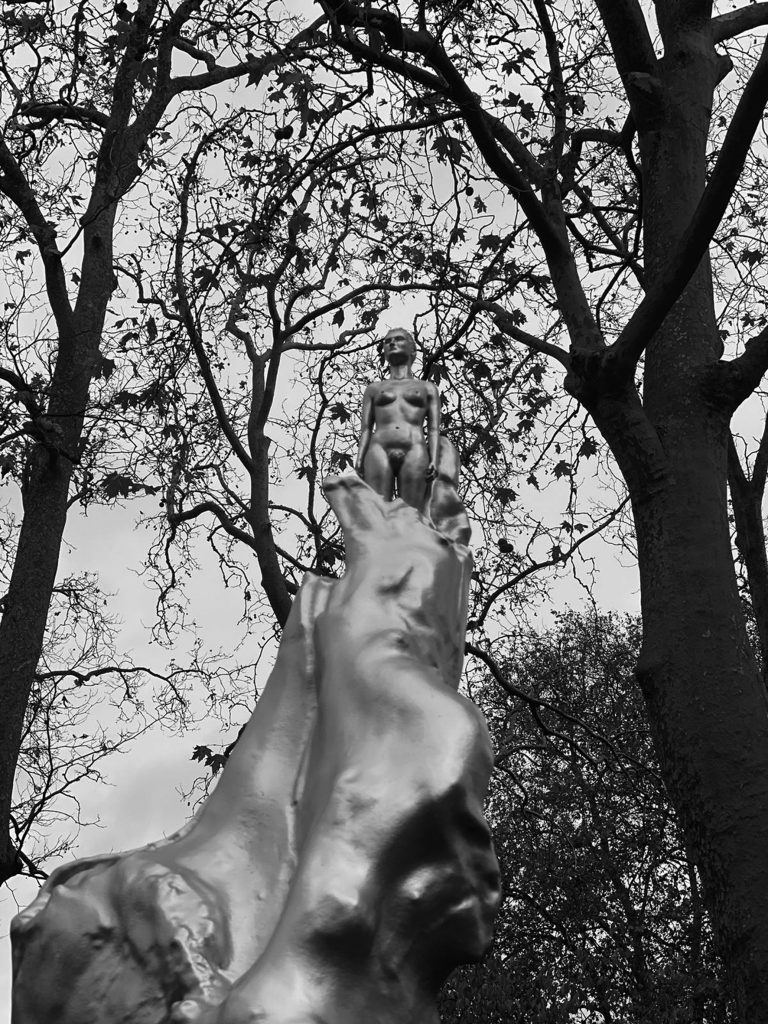
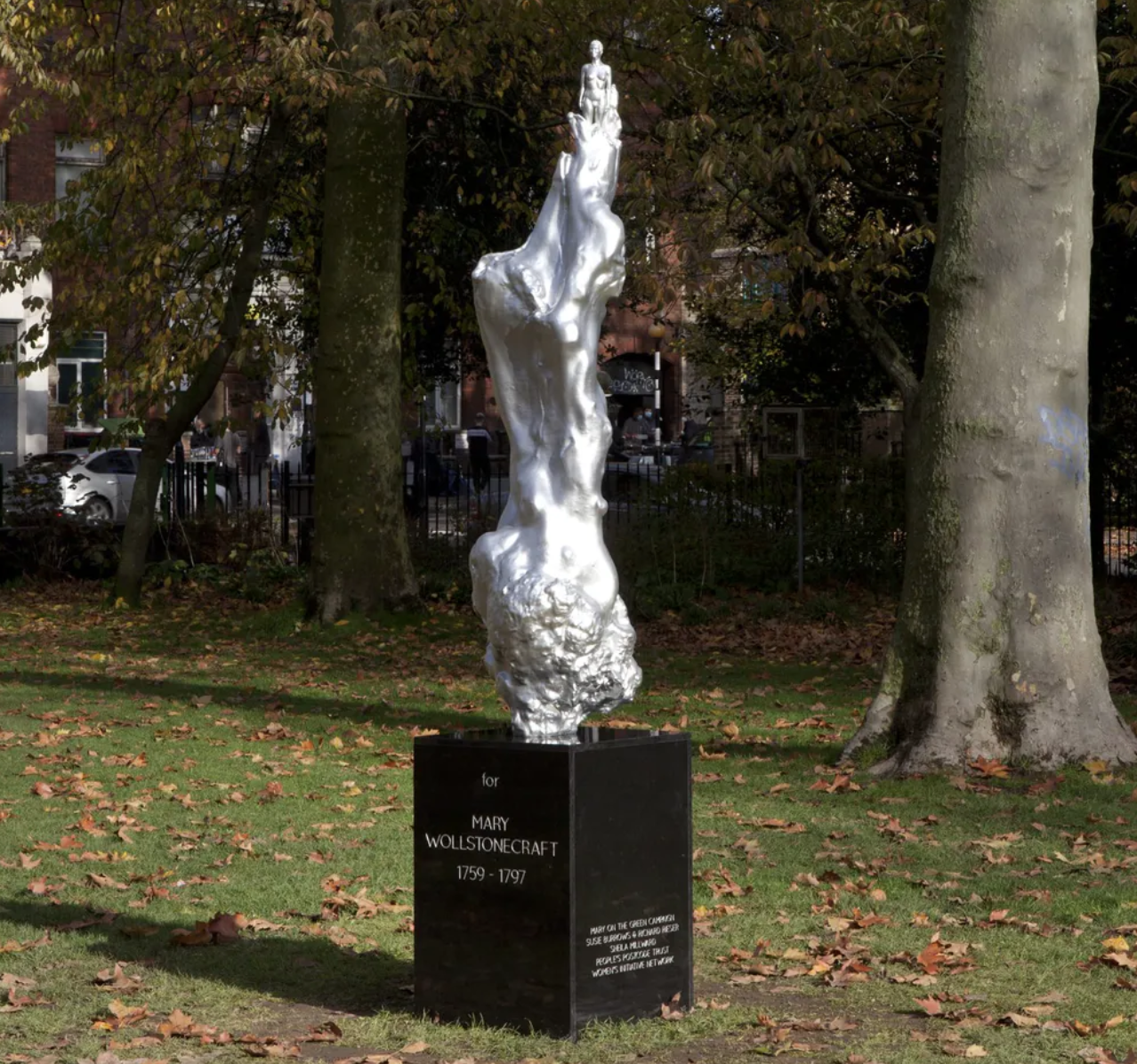
    A silvery bronze sculpture of pioneer feminist Mary Wollstonecraft (1759-1797) by Maggi Hambling has been unveiled on Newington Green in north London. Revolutionary thinker Wollstonecraft lived nearby. The  £143,000 cost, which took ten years to collect, was raised by public subscription, some of which donors may now be wishing they had more productively spent their cash on drugs from dealers trading nearby. Hambling is the author of the equally tacky piece in Covent Garden dedicated to Oscar Wilde, and also that corrugated flotsam, a scallop shell apparently, on the beach at Aldeburgh to Benjamin Britten.

    This one is another publicity seeking effort. How long will it take before those who make these decisions realise Hambling is no sculptor? It is hard to second guess the thinking of those who selected her for this commission Now let’s rehearse the points one by one … Yes, that’s right, all of the wrong reasons for choosing any artist. What we have is a nude woman who closely resembles one of those heroic athletes from the Soviet era. It is insulting to women to characterise them as a sideboard sports trophy. From the back it looks like a half-chewed caramel. Squirting from the top the figure is akin to the memorial of Yuri Gagarin which used to stand in the centre of Moscow, where the tiny stylised figure is launched from the end of a great arc of shiny metal – in that instance a piece of magnificent kitsch. This work isn’t just bad it’s repellent, the commemorated person deserving of so much better. Where are the anarchist statue topplers when you need them? (By the way, we didn’t really mean that.) Whatever your views of Colston as a good or bad individual his statue was a decent piece of sculpture and perhaps even the best work by the artist who made it. We prefer to think of Wollstonecraft as the original thinker presented in the Tate’s agreeable portrait of her, one of John Opie’s more memorable character studies.

    The other entry considered for the commission was by Martin Jennings.

    Local resident, architect Matthew Lloyd, comments:

    This statue by Hambling is so very sad. Even since its unveiling it has been slated, and, yes, by the Guardian too. The Spectator has just now written about it, rather politely I thought, although in clear opposition to it.

    Firstly it is ugly and badly made. The base looks like a budget graveyard memorial – and why is it not in the same material as the upper part? Then there is the middle silver blob and then this extraordinary machete of a naked woman on top. These physical and material mistakes are relatively easy to note when speaking from a design background.

    What I find most regrettable is what ordinary people around here will think and say. And what are local kids – often from poor backgrounds (the very run down/notorious Shakespeare estate is next door) – supposed to make of this sculpture? Will they be able to relate it to their history lessons in any way at all? Will they not be utterly confused by its frank sexuality – instead of seeing it as a worthwhile piece of social/historical commentary? This piece will just add to the constantly confused messaging that, say, schoolgirls (given that this concerns a brave, original and radical historical figure) now have to deal with every day.

    Those of us who live locally now have to put up with this object for the rest of our lives. Maggie Hambling and her commissioners will no doubt be pleased by the furore it has already caused. But this tells us more about them than it considers any response by locals. This is an over-clever, elite public installation that is unskilled and a wasted opportunity.

  • Laura Gascoigne: The Experience Economy – January 2019

    Laura Gascoigne
    January/February 2019

    The buzz of anticipation in the COL Ballroom in Davenport Iowa is audible, the audience murmurating like a flock of starlings; then the first twangs of an electric guitar tuning up, followed by a smoky voice: “I’m going to ask one question before we start: Are y’all experienced?” “Yeah!” roars the crowd, unleashing a 10-minute guitar solo of yowls, howls, skitterings, screeches and kerrangs. August 1968. How experienced was Hendrix? He was 25.

    I don’t know whose idea it was to call the band The Jimi Hendrix Experience – you can bet it wasn’t Jimi’s – but they were ahead of the economic curve. It would be a generation before America woke up to potential value of ‘the experience economy’, identified in 1998 by B Joseph Pine II and James H Gilmore in a ground-breaking article in Harvard Business Review: “Commodities are fungible (no, me neither), goods tangible, services intangible, and experiences memorable.” (Their italics.)

    Economic trickle-down effects, like leaks, always debouch in the wrong places and the experience economy has now seeped into the art gallery, where the trickle is threatening to become a flood. One of the first to open the stopcock has been Tate Modern with its immersive Turbine Hall installations, the most memorable to date being Olafur Eliasson’s The Weather Project, which reportedly drew over two million visitors in 2003. I don’t remember it, not for the reason I’ve forgotten the 1960s but because I was never actually there. Which made me doubly keen not to miss In Real Life, Tate Modern’s latest show by the Danish-Icelandic artist who “puts experience at the centre of his art”.

    Eliasson really understands this game: his exhibition ticks all Pine and Gilmore’s boxes, beginning with its theme: “An effective theme,” they recommend, “is concise and compelling.” Where the Hard Rock Café has rock music and Planet Hollywood has Sylvester Stallone and Arnold Schwarzenegger, Eliasson has climate change. His show was swarming with Gen Zedders taking selfies of their coloured silhouettes cast on the wall by a row of lighting gels, or dancing in rainbow mist falling from the ceiling. There was something for everyone: for the sober-minded, a wall of before-and-after shots of shrinking glaciers; for the frivolous, a spiral mirror tunnel in which to admire their kaleidoscopic reflections; for the mystically inclined, a longer tunnel of radiant fog that made me feel I’d died and gone to heaven. As fog art goes, the experience was feet-in-front-of-your-face ahead of Gormley’s miserable pea-souper at the Hayward in 2007. So top marks all round. But at £18 a ticket? 

    When you own a press pass you forget how the other half lives, but I looked this up and then, for comparison, I looked up the prices of other London visitor experiences: London Sea Life Aquarium – £22; London Dungeon – £24; Jack the Ripper Walking Tour – £19 for two (you’d look suspicious going alone); The Slide at the ArcelorMittal Orbit – £33 for two; The London Bridge Experience – £36 for two (now half-price, and bring your own narwhal horn); Save Humanity: Cocktail Infused Escape Room for Two at the Grid – £60, for which you get to play with AI tools, do crazy puzzles and try to defeat an evil corporation (while enriching the one that dreamt this nonsense up).

    OK, the Eliasson experience offers something these don’t: a sense of satisfaction at being on the right side of ice age history. But face it, this is a competition art can’t win. True, Gormley’s golden-ager adventure playground at the RA was heaving when I went, mostly with bewildered biddies navigating the energised spaces, negotiating the slabworks (I so prefer slobworks) and gawping in disbelief at a roomful of muddy water describing itself as “a kind of primordial soup of matter, space and time”. Gormley’s “invasion of the inside by the outside” may be a novelty worth £22 to Londoners while the Thames Barrier holds up, though probably not to residents of Tewkesbury where primordial soup is free at the point of delivery. There was a tunnel here too, a dark cuboid cloaca which I chose “to navigate around the outside” as I feared it might get clogged with costive biddies and Dyno-Rod might have to be called to flush us out. Such are the risks of “embodied experiences in art”, as they are now known.

    Still, one can’t object to contemporary art installations being sold as visitor experiences, because if they’re not then what is the point of them? The trouble starts when the experience concept is applied to displays of traditional art. The National Gallery has ventured down this path with its immersive extravaganza Leonardo: Experience a Masterpiece, entered through a sort of Alpine pass constructed of mirror blocks prompting visitors to “explore a landscape populated by the ideas of Leonardo as he set about painting the Virgin of the Rocks”. The pass gives access to a mock-up of a conservator’s workshop with a projected image of the painting’s underdrawing; a chiaroscuro room where you can fiddle with dimmer switches to ‘relight’ a photographic tableau of a seated model dressed as the Virgin; and an ‘imagined chapel’ where you can view the actual panel in a variety of different projected settings.

    All of this for £18 standard admission. If the show was almost empty on a Tuesday afternoon, it’s because it breaks Pine and Gilmore’s cardinal rule: “Before a company can charge admission, it must design an experience that customers judge to be worth the price.” A cocktail infusion might have helped. As it was, the best bits were the quotes from Leonardo’s notebooks reflected in the mirror blocks of the mountain pass: “So we can say the earth has a vegetative spirit, and that its flesh is the soil, its bones are the arrangement and connections between stones which form mountains, its cartilage is the tufa rock, its blood the veins of water.” Match that for eco-sentiment, Olafur.

    How memorable are these experiences? I had to go through my photographs before writing this to remind myself. True, no damage was done by the Leonardo experience if you discount the hit to the wallet of having to pay for what is normally free – visitors do eventually get to see the painting. That’s not always the case with Dulwich Picture Gallery’s old master experience Rembrandt’s Light, for which – to highlight the theatricality of Rembrandt’s art – cinematographer Peter Suschitzky (of Star Wars and Mars Attacks! fame) has been commissioned to design atmospheric lighting. For the night paintings, his lighting notes prescribe “darkness contrasted with a soft, warm light, recreating the feeling of Rembrandt’s candlelit studio” – with a consequent reduction in visibility. Meanwhile the spotlight on Christ and St Mary Magdalene at the Tomb is programmed to fade and brighten “emulating the dawn breaking over Jerusalem”. Oy vey! Gilding and lilies come to mind.

    “Experiences, like goods and services, have to meet a customer need,” suggest Pine and Gilmore. Does Rembrandt really need help with his chiaroscuro? In one of his few recorded remarks, he advised a patron: “Hang this piece in a strong light”. No, there’s only one way to experience paintings, and that’s by looking. 

  • Laura Gascoigne: The Gold Standard – November 2019

    Laura Gascoigne
    November/December 2019

    In October of last year, under the title ‘The Midas Touch’, Sotheby’s held a special sale of ‘objets de vertu’ made of gold. “In a world that speaks 6,900 languages,” cooed the catalogue, “the language of gold remains universal”. To prove it, the auction house promised to take collectors “on a journey through the great civilisations of the world”, starting with an ancient Etruscan-style Greek 22ct gold wine cup (estimate £3,500-4,500) and ending with a Dom Perignon Gold Mathusalem 2002 (£15,000-20,000) of vintage champagne to quaff from it and a 24ct gold thread bedding suite by Federico Buccellati (£30,000-50,000) in which to sleep off the effects.

    It was not all luxury items; there was art too. The lots included a Petit Barbu medallion by Picasso (£12,000-16,000); a Monogold Sans Titre by Yves Klein (£800,000-1,200,000); a Piccolo Miracolo by Marino Marini (£15,000-25,000); and a Marc Quinn head of Kate Moss titled Song of the Siren (£300,000-400,000). To keep things in perspective, Sotheby’s threw in a Madonna of Humility goldback by Jacobello del Fiore (£50,000-70,000) and a portfolio of 20 Sebastião Salgado photographs of the Serra Pelada Gold Mine, Brazil (1986) (£80-120,000).

    In uncertain times investors turn to gold, and Donald Trump’s trade wars coupled with the global economic downturn have boosted the price of bullion to its highest level for six years. So it says something for the buoyancy of the art market that a single photograph should be worth more than a solid gold ancient Greek cup. If there’s going to be a rush for gold, it hasn’t yet started: the buyer of Jeff Koons’ Rabbit (1986) at Christie’s New York in May for a record $91m was none other than Robert E Mnuchin, father of Donald Trump’s treasury secretary. The rich like glitter. Mnuchin wasn’t bothered that the Rabbit was made of stainless steel; when polished to a high enough shine, steel passes for bling.

    Still, the language of gold remains universal, and a smattering of it is an asset to any contemporary artist who wants to make it big. In 2010 that great critic of capitalism – or is it communism? – Ai Weiwei produced a glitzy gilded bronze edition of his Circle of Animals/Zodiac Heads, which he trotted around the world from New York to Montreal to Denmark to Moscow before achieving an auction record of £2.8m at Phillips London in 2015. “Maybe I’m just an undercover artist in the guise of a dissident,” he confessed in the auction catalogue. Maybe he’s just a good salesman who knows his market. 

    As Oprah Winfrey once wisely remarked, when you’ve got all the necessities of life the only significant advantage money will buy you is thicker towels. Brought up against this disappointing reality, the mega-rich have to take comfort in exciting envy by splurging on such rarefied necessities as the 24ct gold-plated vacuum cleaner advertised for £800,000 by online retailer Firebox a few years ago, or the 22ct three-ply bog roll sold by Aussie company Toilet Paper Man for a similar sum. In the immortal words of Zero Mostel in The Producers: “If you’ve got it baby, flaunt it, flaunt it!”

    So it showed a degree of sophistication on the part of the American President when in 2017 he turned down the offer of an 18ct golden toilet from Nancy Spector, artistic director of the Guggenheim Museum New York. Titled America, the fully functioning convenience was the work of Italian conceptual prankster Maurizio Cattelan, Padua’s answer to Bristol’s Banksy, and was valued at $6m. But Trump had requested the loan of Van Gogh’s Landscape with Snow and, to a notorious germophobe, a toilet 100,000 people had queued to use when recently plumbed into a gender-neutral restroom at the Guggenheim seemed a poor substitute. Much as he likes riding in gold-plated lifts, the presidential master of the playground cuss is not so stupid that he can’t recognise a piss-take from a libtard art curator when he hears one. Besides, as the Guardian suggested in its report, he may already have a gold throne of his own.

    The Duke of Marlborough doesn’t, and leapt at the chance of installing Cattelan’s at Blenheim Palace for the artist’s autumn retrospective. Plumbed into the guides’ wood-panelled throne room opposite the bedroom Winston Churchill was born in, it was available for use by visitors for just two days before thieves broke in at 4.50am on Saturday 14 September and ripped it out of the wall, causing flood damage. The family had been aristocratically relaxed about security. Only a couple of weeks before, the Duke’s half-brother Lord Edward Spencer-Churchill, who set up the Blenheim Art Foundation, had told the Sunday Times: “It’s not going to be the easiest thing to nick… Firstly, it’s plumbed in and secondly, a potential thief will have no idea who last used the toilet or what they ate. So no, I don’t plan to be guarding it.”

    As it turned out, the thieves were not that fussy. On any self-respecting burglar or cowboy plumber Spencer-Churchill’s press announcement will have acted as a challenge. Almost inevitably, it was taken up. A 66-year-old man was immediately arrested by Thames Valley Police, followed by a 36-year-old accomplice presumably responsible for the heavy lifting. It’s always the old lags, bless ’em, who rise to this sort of bait; they can’t resist the lure of a trophy heist. And what better trophy than a golden bog? I expect Michael Caine is already being fitted up for the part.

    Cattelan, true to form, took it all in good humour, hailing the heist as a piece of performance art. As the work belongs to the Guggenheim it’s no skin off his Pulcinello-sized nose – Spector and Spencer-Churchill can squabble over the insurance. “America was the one percent for the 99 percent, and I hope it still is,” he told the New York Times. “I want to be positive and think the robbery is a kind of Robin Hood-inspired action.” I doubt there’ll be much of a trickledown effect to the poor of Oxfordshire when it’s melted down, as it surely will be. Burglars don’t waste time betting on art futures when they’re sitting on a pile of valuable scrap. 

    The same fate almost certainly befell Douglas Gordon’s solid gold sculpture The Left and Right Hand Have Left One Another after it mysteriously disappeared from its box in Christie’s King Street warehouse in 2012, never to be seen again. Given that the gold was worth half the work’s £500,000 insurance value, this was hardly surprising. What was surprising was that the auction house only informed the artist of the theft more than two weeks after reporting the crime to the police. “I still own the work and I am the creator of the work,” Gordon sniffed to the press. “There’s something going on here about value and the way the artist is treated in all of this.”

    Artists may fool themselves, but the hard truth is that the value of art as a marketable commodity is monetary. Which is why collectors, like burglars, are better off with gold than steel: when the bottom falls out of the art market, they can melt it down.

  • Laura Gascoigne: Dirty Money and Plenty of It – September 2019

    Laura Gascoigne
    September/October 2019

    Among the many examples of the wit and wisdom of Sir Thomas Beecham is the story of the great conductor seeing a tombstone inscribed: “Here lies a great organist and an excellent musician” and remarking in surprise: “What, both in the same grave?” 

    I was reminded of this when seeing Wafic Saïd, a contributor to Boris Johnson’s leadership campaign, described in the press as an “arms dealer and philanthropist”. What, both in the same skin? You may recall the Syrian-Saudi financier as the fixer behind the notorious 1980s Al-Yamamah arms deal with Saudi Arabia, the investigation into which by the Serious Fraud Office was quietly dropped under Tony Blair in 2006. To salve what he has in the way of a conscience, Saïd likes to make charitable donations: a bit to the Royal Shakespeare Company, a bit to the Science Museum, a massive whack to Oxford University for his eponymous business school. Last year he funnelled £340,000 to the Tory party through his British wife Rosemary; the bung for Johnson’s leadership campaign was in her name, while their son Khaled supported Rory Stewart. Hedging your bets, as it’s known in camel racing.

    No complaints from the Electoral Commission: politics is a dirty business, where dirty money is the norm. Higher standards are expected of culture, I can’t think why. Wasn’t Alfred Nobel an arms manufacturer? And the Hunting Art Prize ticked along happily here for a quarter of a century despite the sponsor’s rumoured involvement with nuclear weapons and cluster bombs, before decamping to the land of the free and the Second Amendment in 2006. (Your correspondent even sat on the judging panel and received a case of wine for her services, which she didn’t choke on.) But now that cultured folk seem to have forgotten that lucre is filthy, they’re getting as jumpy about sponsorship as a passel of cats on a hot tin roof. 

    One campaigning group calls itself ‘Culture Unstained’. Culture unstained, eh?  I’ve been racking my brains for a major arts sponsor, from Cosimo de’ Medici on, whose hands have not been stained with dirty dealings of one kind or another. Lucre is filthy, and art depends on it. But this rather obvious fact seems to have escaped campaigners against BP’s sponsorship deal with four of our major cultural institutions: the British Museum, National Portrait Gallery, Royal Shakespeare Company and Royal Opera House. The focus of recent attacks has been the NPG’s Portrait Award, taken over by BP from John Player in 1989 when tobacco staining was considered the greater evil. (The RA, incidentally, still accepts £45,000 a year from Japan Tobacco International, which supported its 2009 exhibition of Anish Kapoor. Put that in your pipe and smoke it. The BM has also been quietly taking JTI’s yen for acquisitions for its Asia Department. It’s apparently OK to accept money from foreign tobacco companies; we don’t care if the Japanese die of cancer as long as our NHS doesn’t have to pick up the tab.)

    But back to BP. So far the NPG and the BM have stuck to their guns, or pumps, though how long the RSC will hold out after Mark Rylance’s ostentatious resignation from the company is another question. In June Rylance announced that he did not wish to be associated with “anyone who wilfully destroys the lives of others… Nor, I believe, would William Shakespeare.” That’s quite a claim to make on behalf of someone who lived through the Elizabethan era of colonial expansion and legalised piracy, but on climate change, perhaps, the bard was blameless: “Shall I compare thee to a summer’s day? Though art more lovely and more temperate than global warming.” 

    Summoning the spirits of dead artists in support of one’s cause is an interesting gambit. I doubt Van Gogh would have been overjoyed at having his recent exhibition at Tate Britain branded with the initials EY, but short of appearing like Banquo’s ghost and spooking VIP guests at the private view by parading his bandaged ear among the canapés there wasn’t a lot he could do about it. With living artists, though, it’s another matter. In November Nan Goldin twisted the NPG’s arm by refusing to go ahead with a planned exhibition unless the gallery dropped its grant from the Sackler Trust, the philanthropic arm of the owners of the drug manufacturer Purdue Pharma currently facing lawsuits in 35 US states for pushing its addictive painkiller OxyContin across America. Goldin has appointed herself the avenging angel of OxyContin addicts, fronting the campaign that drove the Met to sever its ties with the Sacklers in May. Now the repercussions are being felt over here, though it’s not our problem, and the stink of opioids is overpowering the smell of petrol. Having held the line on BP, in February the NPG’s newly formed ethics committee drew it at the Sacklers, who gracefully withdrew their grant “to avoid being a distraction” – for which read “to avoid more bad publicity”. Yes, there’s no such thing as bad publicity but no, no one in their right mind wants to pay for it. 

    Word has it that the NPG were shamed into action by the plucky little South London Gallery, whose trustees under the chairmanship of Frieze founder Matthew Slotover returned £125,000 worth of Sackler funding the month before. Now the gauntlet has been thrown down to Tate Modern, V&A Dundee, MK Gallery, the Ashmolean, the RCA, Dulwich Picture Gallery, the Science Museum, the Royal Museums Greenwich and all other recipients of Sackler generosity ­– the list of shame is as long as the tracks on a junkie’s arm. Woe to any institution that, like the Serpentine, has the Sackler name affixed in Roman capitals to its entablature; it cannot shed it without the family’s permission. While not wishing to be a distraction, the Sacklers may well balk at being erased from history without seeing a penny of their money back. 

    It’s been a tough year for the Serpentine all round. In June its CEO Yana Peel was forced to resign over her husband’s partnership in Novalpina Capital, a private equity firm with a stake in the cyber security group NSO linked to the murder of Jamal Khashoggi. Peel didn’t go without a fight, complaining of “bullying and intimidation” and “toxic personal attacks” – none quite as bad as being dismembered with a bone saw in the Saudi consulate in Istanbul on the eve of your wedding. In her resignation statement she threatened: “If campaigns of this type continue, the treasures of the art community [the community, note, not the art] – which are so fundamental to our society – risk an erosion of private support.”

    I’m not sure she’s right. While there are donors in search of redemptive publicity, support will continue. What no one mentions is how small the sums involved are. The real scandal is not that our cultural institutions are selling themselves for dirty money, but that they’re selling themselves dirt cheap. The BP sponsorship deal at the root of all the fuss is worth £7.5m, split between four institutions over five years. On the scale of ‘big oil’, this is peanuts. Before staining our culture with dirty money, let’s at least make sure there’s plenty of it.

  • Laura Gascoigne: Redrawing Drawing – July 2019

    Laura Gascoigne
    July/August 2019

    It’s hard to know where to start with Ingres’s definition when nobody knows any more what probity means. And yet drawing is enjoying a resurgence. What is going on?

    When David Hockney breezed into the Royal College from Bradford in 1959, he announced his arrival not with naïve etchings of naughty gay boys but with a drop-dead academic pencil drawing of the college skeleton. It proved to be an ironic last hurrah. Almost immediately after, the idea of drawing as an end in itself went down the drain with the rest of the academic wastewater. But ever since, like Incy Wincy Spider, it has been climbing back up.

    The first sign that it was still alive and kicking was the launch in 1973 of The Cleveland International Drawing Biennale. By the time that ran out of puff in 1996 Anita Taylor had picked up the baton with the Rexel Derwent Open Drawing Exhibition (1994), subsequently the Cheltenham Open Drawing exhibition (1996), the Jerwood Drawing Prize (2001) and as of last year, the Trinity Buoy Wharf Drawing Prize. Then came the Guild of St George’s jolly populist Campaign for Drawing, aka The Big Draw, and the Prince’s, now the Royal, Drawing School, both launched in 2000. Dedicated exhibition spaces opened in London in The Drawing Room (2002) and The Drawing Gallery (2004), and a smattering of public exhibitions with sexy titles promoting ‘new drawing practices’ followed: Tate Britain’s The Stage of Drawing: Gesture and Act (2004), Hayward Touring Exhibition The End of the Line: Attitudes to Drawing (2009) and Tate Liverpool’s Tracing the Century: Drawing as a Catalyst for Change (2012). Now, shazam! the DRAW Art Fair has made its debut at the Saatchi Gallery.

    In the meantime, definitions of drawing have been flapping about like loose sheets on an unmanned vessel as curators have gone overboard with attempts to rebrand it. Announcing its exhibition Drawing in Progress in 2010, Middlesbrough Institute of Modern Art – call me mima – claimed the key to the show’s success was “the way in which the advisory panel refused to define the term ‘drawing’ in the traditional way… forcing a reassessment of all the criteria under which we might produce, view, or discuss drawing.” That was telling them.

    In the 20 years since I’ve been keeping tabs, the reassessment has progressed in leaps and bounds: Richard Long’s 1967 drawing with feet on grass in a Wiltshire field now seems positively plodding after James Capper’s use of the ripper teeth of a mechanical digger to take a line for a walk round an Oxford housing estate in 2011. But mostly there’s been masses of drawings on gallery walls, aka ‘interventions in the space’. A leading exponent of this new drawing practice is Austrian artist Otto Zitko, who in 2010 covered three floors of the Arnolfini in an “all-enveloping drawing intervention in situ”. Zitko had previous, having already “improvised across the walls of cultural institutions around the world”. His “expansive abstract drawings”, the publicity told us, “seem to emerge from an unbounded desire to cover every surface – a primal urge to contain the whole of reality within a subjective cocoon or unbroken lines”. Good luck to him. 

    Wall drawings used to be known as ‘muriels’ back in the day when decorating walls was considered a girly activity, before abstract painters like Blinky Palermo got in on the act in the late 1960s and made it macho. But Blinky’s murals were never as expansive as the 69ft wall drawing on the ICA’s concourse wall that won Toby Paterson the Becks Futures Award in 2002 – since when expansive abstract drawing has become a staple of gallery stairwells from Pallant House to Tate Britain. 

    Why stop at walls? For her 2011 Raumzeichnung (‘Drawing in Space’) exhibition at the Sumarria Lunn Gallery, Berlin-based Polish artist Monica Grzymala contrived to “rearticulate the entire space” with sticky tape designed to “depart from the gallery walls” before eventually succumbing “to the will of gravity, the deterioration echoing humanity like some gigantic vanitas”. Never one to pass up the chance of a gigantic vanitas, Anthony Gormley was an early adopter of 3-D drawing or what he calls “activating the space”. (If he would only activate the space between his ears he might finally produce something worth looking at, though on past form we can fairly assume that his autumn show at his Royal Academy will be the usual waste of.)

    Is change in the air? The DRAW art fair in May was largely works on paper, a substantial number of them in humble pencil. And on the evidence of the last Trinity Buoy Art Prize the standard of, whisper it, draughtsmanship is going up, partly thanks to an infusion of young blood from the Royal Drawing School. Yes, the heir to all those Leonardos currently on show at the Queen’s Galley has been doing his bit towards, as the jammy say, ‘giving something back’. DRAW was dominated by the usual array of approved contemporary drawing styles – obsessive, outsider arty, pop arty, cartoonish, illustrational, Twomblyish – but with the best examples the style was less important than the content. As with writing, it helps if you have something to say. Still, no contemporary artist came close to the throwaway line of Jean Cocteau, whose full-frontal nude pencil drawing of a chef with his toque still on his head and his trousers round his ankles made Warhol’s nude hunk on the same stand look flaccid. It would have knocked Hockney’s pretty boys into a cocked hat too.

    All the signs are that we’re inching forward; now it’s public galleries that need to catch up. The British Museum hasn’t done the cause of graphic probity any favours by bigging up Damien Hirst’s beermat portraits of his former Svengali Frank Dunphy, dashed off during breakfast business meetings at The Wolseley and kindly donated under the cultural gifts scheme, thus saving Dunphy £90,000 in tax. The example released for publicity purposes, titled ‘Frank Eggs-ellent Dunphy’ – boom boom – shows the subject as a Dumpty in an eggcup. “Damien Hirst raised money-making and commercialisation of his art to a new level,” explained the BM’s curator of prints and drawings Hugo Chapman, stopping short of calling it an art form. The drawings he described as “very immediate… drawn with great energy… Damien can draw, there’s no doubt about that.” If there wasn’t any doubt, would it need saying? As a draughtsman Hirst is in a GCSE class of his own.

    In his introduction to the catalogue for DRAW, the fair’s French founder Laurent Boudier quoted Ingres without defining either of his terms. So why is drawing the probity of art? Because it shows artists up. Hirst may have hidden his drawings under the table at The Wolseley, but there’ll be nowhere to hide in Room 90 at the BM. As Wyndham Lewis wrote in The Role of the Line in Art: “It is more difficult upon a piece of white paper, your means of expression reduced to a few lines, to deceive the expert spectator than it is with a lot of oil paint upon a canvas.”

    But where, I hear you wail, are today’s expert spectators? Despair not. Given regular exposure to good drawing, spectators will acquire expertise. 

  • Martin Lang: Against life drawing

    Advocating life drawing at art school is a deeply conservative and reactionary position. Arguments in favour of life drawing usually fall into one of two camps (or sometimes both). I am utterly unconvinced by both.

    The first, and weaker, argument contends that it is necessary to learn the rules before you can break them. This is an authoritarian position where you must learn to draw “properly” before you can make other kinds of art. We can almost dismiss this argument out of hand. Imagine discovering a great artist, falling in love with her work, telling others how wonderful it is, but then finding out that her life drawing wasn’t up to much. Would you re-assess your judgement and decide that the art you once loved must be substandard? You probably wouldn’t dismiss your favourite musician if you discovered that he couldn’t read music: this is irrelevant if the music is good. Perhaps cinema might be a better comparison, since artists also work in film. Most people wouldn’t rubbish their favourite director upon finding out that he couldn’t draw very well. So why would you apply this criterion to an artist film maker? In both cases it is irrelevant if the films are good.

    This first argument shifts the focus away from the artwork and onto the artist’s training. To accept the argument is to accept that you are unable to judge the quality of the artwork without knowing something about the artist’s education. This is a useful argument if you do not like Modern or contemporary art, where such training is not discernible. Under this perspective, Mondrian’s grid paintings or Rothko’s colour fields are acceptable only if they can first prove that they are able to make more conservative kinds of art. This is the concession to Modern and contemporary art that the conservative authoritarian makes, reminding us that Picasso was an excellent draftsman before he dedicated his life to learning to draw like a child. If you value any kind of non-representational art (such as abstraction), any kind of de-skilled art, performance or relational art, then the argument that the prior mastery of life drawing is necessary falls short.

    The second, and more sophisticated, argument claims that mastery of life drawing is not necessary, but that it should be learnt anyway. Even if, after hours of classes, the art student is useless at drawing the figure, and even if she has no intention of making any kind of figurative drawing, painting or sculpture, there are still fundamental benefits to studying life drawing. These benefits include discipline (turning up on time, prepared with the necessary equipment), concentration (the ability to work on one thing for extended periods) and looking (training the eye). Proponents of this argument contend that these skills are just as useful for making non-representational and deskilled practices, because they provide the student with a greater sense of aesthetic awareness and a robust work ethic. But I have never once heard anyone who has made this argument call for the reintroduction of still life classes. Imagine bragging that your fine art degree programme obliges students to spend one day a week drawing fruit to enhance their concentration and observational ability. Why not also teach geometry, perspective and colour theory on a weekly, compulsory basis? You could do this, but you would have a deeply reactionary course that would churn out conservative artists. Readers might note that this second argument is also an authoritarian one, since it assumes that all art students learn in the same way. Whatever the student’s learning style, background (religious sensibilities come to the fore here) and whatever their artistic aims, their training must be grounded in observation of the nude human figure.

    Another strand to the second argument maintains that life drawing can be taught in an experimental manner to produce more cutting-edge artists. Examples include where life drawing concentrates on experiential drawing or experimentation with materials, methods and techniques (there are other examples). But this is no longer life drawing, for to teach these things there is no need for a model. Terming it as such only reinforces the assumption that the underlying tradition of life drawing is something that must be preserved, even when it is irrelevant to the tutor’s pedagogic aims and the student’s artistic ambitions.

    Life drawing was developed as a pedagogical tool to train Western artists to make figurative painting and sculpture. The reason that it still exists in some art schools is mostly down to tradition. While life drawing may be useful for some types of artist, it is not applicable to all. I am not saying that its teaching necessarily prohibits the development of good, exciting and relevant artists. My argument is that it is not necessary and does more to hinder the development of such artists than it does to encourage them. To teach it is to enforce a hierarchy: representation over abstraction, traditional forms of art over more avant-garde kinds. It is also to deny art’s radical potential: must art activists first learn such conservative lessons? Embedded within this hierarchical and authoritarian position lies a reactionary and conservative politics. Nostalgia and fascism have always walked hand in hand. Think of Mussolini harking back to the Roman Empire, or Hitler’s love of classical art and architecture. Today we might think of Trump’s slogan “make America great again” and Brexit talk of “taking back control”. We urgently need free thinking artists able to critique contemporary nostalgia, populism and even outright racism and sexism. For that we need a pedagogical approach that is progressive, inclusive, and libertarian. This will allow for more progressive forms of art to develop and emerge – including non-Western kinds. For these reasons, I am against the teaching of life drawing.

    Martin Lang is a lecturer in Fine Art at the University of Lincoln.
    E-mail: mlang@lincoln.ac.uk

  • Laura Gascoigne: Is Art (Finally) Toast? – May 2019

    Laura Gascoigne
    May/June 2019

    In 2014 the Harvard-based science magazine Annals of Improbable Research presented its Ig Nobel prize for neuroscience to a team of researchers from China and Canada who demonstrated that seeing the face of Christ in a slice of burnt toast is perfectly OK. (That year’s Ig Nobel prize for economics went to the Italian government for factoring illegal earnings from prostitution, drugs and smuggling into the nation’s GDP, so you can see that these Harvard science dudes aren’t messing around.) 

    The neuroscientists’ conclusion will have been good news to the assorted idlers, dreamers and general crackpots who not only see things in toast, but profit from their visions. Because there’s money to be made from this stuff. In 2004 Florida housewife Diana Duyser sold a 10-year-old toasted cheese sandwich with an image of the Virgin Mary on eBay for $28,000 to the Golden Palace internet casino, which proclaimed the sacred sarnie “part of pop culture” and used it to raise money for charity. The fact that it had stood on her bedside table for 10 years without rotting was, Duyser declared, a miracle.

    Laugh, but seeing stuff in toast is a recognised phenomenon with a fancy name: pareidolia. I have this on the authority of Susan Hiller, who in 2012 designed a Christmas screensaver for the Guardian featuring a grid of 15 images of Turin Toasts. On the back of her 2011 retrospective at Tate Britain, Hiller’s collection of found pareidolia will, one imagines, have scored higher with connoisseurs of art crostini than the marmite-on-toast celebrity portraits that propelled young Ebbw Vale artist Nathan Wyburn into the semi-finals of Britain’s Got Talent that same year. “It’s so hard for an artist to get recognition,” he would later lament. No offers were forthcoming from the Tate, though Wyburn did make the front page of the Guardian in 2012 with a composite portrait of Rupert Murdoch incorporating 5000 photographs of hacking victims.

    By now those of you with long memories will have a feeling we’ve been here before, and it’s true, we have. We touched on the topic of toast in 2010. But in the art world what goes around comes around in ever-tighter circles, and one has to keep up. So here, instead of Observer Food Monthly, we give you Jackdaw Toast Decennially (give or take a year).

    I knew it was time to revisit the subject when Martin Creed chose Toast as the title of his recent Hauser and Wirth exhibition, promoted with a publicity shot of the great eejit holding a toasted slice of holed ciabatta in front of his face like a carnival mask. (Swizz, isn’t it, how with ciabatta you pay for the holes. Perhaps they factor them into the Italian economy.) Like most of Creed’s ideas, this one wasn’t new – Los Angeles-based artist Matt Johnson got there before him at the 2004 Frieze Art Fair with a Breadface in cast and painted plastic. But Johnson didn’t have the savvy or the dosh to cast a slice of toast in patinated bronze and butter it in gold as Creed did for his Savile Row exhibition, timed to open in December when the oligarchs were out shopping for stocking-fillers. This from the ersatz master of the ephemeral, whose progression from blu-tack to gold-plated bronze is more stomach-turning than a rack-full of celebrity portraits in marmite.

    It won’t have gone down well with RA Schools student Tania Blanco down the road, whose contribution to this year’s Premiums exhibition featured a shelf stacked with packs of Medium Sliced White titled Emergency with accompanying text quoting Kropotkin’s declaration in The Conquest of Bread: “The social revolution must guarantee daily bread for all. After bread has been secured, leisure is the supreme aim…” Leisure presumably not supposed to be spent in Mayfair galleries salivating over slices of bronze toast buttered in gold.

    As it happens, there’s a long and honourable tradition of bread art associated with artists in reduced or confined circumstances. Hans Prinzhorn’s collection of art of the mentally ill included sculptures made by asylum inmate Karl Brendel from chewed bread. Egon Schiele kneaded a thumbnail portrait of a fellow prisoner from bread while banged up in Sankt Pölten penitentiary in 1912 on charges of kidnapping and rape. (For those who can’t afford Creed’s gold-buttered, Ronald S Lauder’s Neue Galerie in New York is currently offering a bronze version of Schiele’s portrait in an edition of 200 at $250 each.) German-Jewish artist internee Pamina Liebert-Mahrenholz sculpted with her bread ration while incarcerated in Holloway Prison in 1939, and Kurt Schwitters, interned in Hutchinson Camp on the Isle of Man, saved leftover breakfast porridge to make sculptures. They filled his attic studio with a stink of mould that made the atmosphere very unpleasant for fellow enemy aliens who sat for portraits at £5 a pop. (A snip at the price, to judge from the examples currently on show in the exhibition Refuge at Abbot Hall, Kendal. Unfortunately the sculptures biodegraded before opportunistic gallerists could have them cast in bronze.)

    There are good reasons for making art from cereals, and there are bad ones. Confinement and boredom are legitimate mothers of invention:  The Minories, Colchester’s 2015 exhibition The First World War in Biscuits demonstrated from 100-year-old examples what an inventive soldier in the trenches could do with a Huntley & Palmer’s No.4 standard whole wheat ration biscuit – baked so hard it had to be dunked but, unlike Schwitters’s soggy porridge, built to last. For creative purposes biscuits have a structural advantage over bread or toast, with the potential for large-scale projects such as the 12ft installation Eating the City created by Chinese multimedia artist Song Dong in the basement of Selfridges in 2006 from 72,000 McVitie’s biscuits. The starchitect of previous biscuit cities in Beijing and Shanghai, Dong was disparaging about the range of materials on offer – China apparently has a wider biscuit selection. Bad workmen blame their tools. Dong’s pre-fab biscuit city was as nothing to the 4ft replica of St Paul’s Cathedral – perfect in every detail, outside and in – built over three years by retired Willesden mechanic George D’Aubney from home-baked fruitcake and unveiled the following year.

    Whether you have to be a fruitcake to make cathedrals from fruitcake is a question for the neuroscientists for another year. But there is a distinguished art historical precedent for D’Aubney’s creation in Andrea del Sarto’s mixed media model of an octagonal baptistery, described for us by Vasari in mouth-watering detail: “The pavement was a vast plate of jelly, with a pattern of mosaic in various colours; the columns, which had the appearance of porphyry, were sausages, long and thick; the socles and capitals were of Parmesan cheese, the cornices of sugar, and the tribune was made of sections of marzipan.”

    All well and good, you’re thinking, but is it art? I refer you to the wisdom of nonagenarian collector Stefan Edlis who, in conversation with filmmaker Nathaniel Kahn for his art world documentary The Price of Everything, mentioned Swiss artist Urs Fischer’s timber-framed house made from bread, exhibited at the Milan Triennial in 2015. “Ask me if it’s art,” he told Kahn and Kahn, like a good comedy straight man, obliged. “Is it art?” he asked. “Well it’s not food,” said Edlis.

  • Art: Cool and Uncool – William Varley Reviews Addicted to Sheep

    So, as all cool sentences begin, I think that the best TV programme I saw last was Addicted to Sheep. In many ways this BBC4 documentary was reminiscent of the French film Être et Avoir about a remarkable teacher in a school in the remote Auvergne, although a good deal less winsome. It focused on the lives of the Hutchinson family, tenant farmers in Upper Teesdale. In their remote valley ewes are called “yowes” and at the children’s school they still sing “There is a green hill far away”. The Hutchinson children help with the lambing, including the gruesome task of dealing with still-born lambs.

    What is so admirable about them is that they have an uncomplaining, unflinching attitude to a life that is harsh and elemental. I doubt whether they have recently visited their nearest gallery, the Bowes Museum at Barnard Castle, or the Baltic at Gateshead. I also suspect that the issues which so exercise the post modern, post Christian urban élites: multiculturalism, egalitarianism, transnational progressivism (no borders), environmentalism, feminism and the rest of that plethora of right-on attitudes, don’t preoccupy them. For a start, they don’t have the time. Without wishing to patronise them, they probably believe that the acronym L.G.B.T. stands for a brand of sheep dip. All of this, in the opinion of the ‘enlightened’, particularly art world instrumentalists, makes them seriously uncool.

    How does one define ‘cool’? There are still people around who think that it’s a gently meandering style of jazz, but most of us know that it’s simply a matter of a self-appointed élite determining what is acceptable and unacceptable. It’s a phenomenon which transcends ages and classes, from the tiny tyrant berating her parents for not recognising the world significance of ‘One Direction’ to the State Art apparatchik wincing as he patiently fields one’s less than enthusiastic reaction to a ‘challenging’ new installation. In Jonathon Rose’s brilliant book, The Intellectual Life of the British Working Classes, the anthropologist Mary Douglas describes it thus:


    Art trends may have as brief a shelf life as stock exchange trends, and they depreciate rapidly if one fails to catch the latest wave in architecture, or literary theory. The names that Bohemia adopted for itself – avant-garde, advanced, progressive, le dernier cri, new wave, cutting edge, modernist, postmodernist – all reflect the Anxiety of Cool, the relentless struggle to get out in front and control the production of new cultural information. Bohemia is ‘subversive’ only in that it seeks to wean consumers away from older cultural products in order to sell them new ones.


    That description is one of brash economics but, of course, we’re all familiar with the broader pattern of Cool, the Godfather of which is Marcel Duchamp.

    Ad Reinhardt once remarked that all artists had to make a choice between Mondrian and Duchamp, between advocates of the hand- made, and those of the ready-made. As Jackdaw readers know, Duchamp, asserting that all art was mere taste, allegedly exhibited a urinal under the title of Fountain at the Armory Show in New York in 1913. Actually, as Jackdaw readers also know, that anarchic gesture was performed by one of his girlfriends as the Armory Show was ‘unselected’. Still, as someone who was intoxicated by word-play, puns and conceits, he was the epitome of the intellectual dandy. Apparently effortlessly, he invented kinetic art, optical art, conceptual art, and his great hermetic narrative, The Large Glass. Consolidating these innovations he left to allegedly mediocre followers.

    His biographer Robert Lebel wrote that he regarded the ready-mades as sacralisation or transubstantiation. (How God-like is that?) However, “His real motive with them was to depreciate our ordinary and tacitly accepted notions of value in order to exalt the strictly private and sovereign choice which is accountable to no one. With the ready-mades”, said Lebel, “he meta-ironically demonstrated his incontestable power to be TAKEN AT HIS OWN WORD which is the unmitigated artist’s privilege.” You can see where that gets us: art is anything you say it is, a situation that leads inexorably to the empty stunts of the Turner Prize and the vulgar extravagances of the Pinault Collection. Still, for his loyal disciples in the State Art Establishment his reputation is unassailable. There have been notable heretics from the general orthodoxy though. In his book The Banquet Years, examining the pioneering days of Modernism, Roger Shattuck remarked that Duchamp’s strategy of ‘nominating’ useful objects to art status was “essentially self-consuming, a reversion to dead level after an initial shock.” More recently, in The Winter of our Culture, Jean Clair (real name Gérard Régnier) the former Director of the Picasso Museum in Paris, described Duchamp’s Armory Show as “works of provocation and derision presented by a cynical dandy”.

    The High Priestess of Cool was, of course, Susan Sontag. During the ’60s and ’70s she was the doyenne of American intellectuals and in her seminal book Against Interpretation, she issued two decrees that in retrospect seem to have underpinned the visual art that developed afterwards. Attacking the discrimination between hierarchies of art as ‘philistine’, she effectively substituted a plateau view of culture for the existing pyramidal order. Henceforth, there was to be no qualitative distinction to be made between high and popular culture, art and entertainment. In this scenario, Elvis Presley could give Mozart a friendly wave across a level playing field. The ‘dumbing down’ consequences of this were, of course, appalling and eventually she could see it. She died 12 years ago, but shortly before her death she condemned ‘the triumph of a pernicious relativism.’

    I am not prepared to say the satisfactions derived by art are no different structurally, in context, or in quality or in importance, from other kinds of satisfactions. I am not prepared to think that the satisfaction I might get in front of a Chardin, a Vermeer or a Vuillard is in any way similar to the satisfaction I would get watching a beautifully pitched baseball or inspecting a shoe collection.

    Her recantation was welcome, but it was too little, too late: the damage to the impermeability of high culture had already been done.

    The other hugely influential aspect of her ‘new sensibility’ was the idea (echoing Matthew Arnold perhaps) that art should concern itself with the moral criticism of life and be used as ‘a tool for changing consciousness’. Whether or not her writings were the cause or whether the true believers in an art for use developed their own ideology, in subsequent decades a veritable deluge of issues appeared. They mostly consisted of that left liberal menu of Goodthink favoured by the BBC that I’ve already mentioned: multiculturalism etc.. They are very useful for ‘virtue signalling’. “Let’s do the Holocaust”, artists would say, “or perhaps child abuse”. This is empty posturing, a bit like wearing Aids ribbons. It’s also about as far removed from Kathe Kollwitz’s nightmare visions as it’s possible to be. As the wife of a Berlin doctor Kollwitz knew poverty and illness at first hand. Her emotion was earned, not affected. Still, quangocrats and councillors who dole out funding love emotional incontinence. Current affairs and politics are things they can understand: the structural music of painting invariably remains a mystery to them. And insofar as they reinforce the fallacy that visual art is simply a medium or receptacle of a socio-political statement, it’s a godsend to those media hacks deputed to discuss them.

    Some issues, however, are so uncool that they’re off limits. Take the case of Kamel Daoud, for instance. This distinguished Algerian (Muslim) novelist wrote an article in Le Monde in late January denouncing the wave of sexual assaults that had occurred during Cologne’s New Year’s Eve celebrations. He didn’t temporise, calling the assailants Muslim men:

    The refugee-immigrants come from the vast universe of sorrow and horror which is the sexual misery of the Arab-Muslim world. The subjugation of women is the psychological Gordian knot at the core of the world of Allah, and hence the inspiration of the death cult that claims to defend it.

    You can easily guess the reaction to that: an academic fatwa; and erstwhile friends telling him, with the greatest kindness, to stick to writing novels and, politically, to shut up. Our politicians, of course, favour the ‘Religion of Peace’ narrative and as far as our art world is concerned, in contrast to the scathing visual indictments of Abu Ghraib how many denunciations of suicide, bombings, jihadist beheadings and the like can you think of? None? I can think of one. A couple of years ago in an exhibition in Rome I saw a small black singlet in the form of a hijab presented by the Egyptian feminist Ghada Amer. Unsurprisingly she now lives in New York.

    Another aspect of cool is the cult of novelty. I remember Lawrence Gowing back in the ’60s presenting the imperative to many young artists “to make it new”. At the time it worried me, being far too prescriptive. As someone who believes that originality should be involuntary rather than willed, I would have advised “Make it good”. Giles Auty in The Jackdaw was scathing in identifying the ‘novelty trap’ in which ‘ism’ inexorably succeeds ‘ism’ and thereby invalidates its predecessor. (Auty estimated that about 40 ‘isms’ occurred in the 20th century, each having about 2.25 years of life.) In his irreverent article he suggested that, according to the novelty narrative, “western art should be read as a kind of art-historical relay race which culminates in the death of painting … because there are no more apparent avenues left to explore”, a process which he maintained was “both spurious and infantile”. Astutely, he demonstrated how the art world had hijacked from science the rhetoric of progress with the consequence that anyone who refused to embrace it was certifiably reactionary and uncool. Of course there are some exceptional exponents of hybrid media such as the prodigious William Kentridge, but the strategy of State Art is to impose novelty on a baffled public. Amongst that public there are some blasphemers, though. The late Henning Mankell believed that “One of the tasks of art is to provide people with companions. I have seen people in paintings who I hope to meet in the street one of these days…” How uncool can you get? The Scottish prose-poet Nan Shepherd, ‘married’ one might say, to the Cairngorms, had a similar capacity for empathy. The ‘technoscape’ may be cool but engaging with actual landscape is extraordinarily rewarding. Like Wordsworth in The Prelude, she believed that “sustained contemplation of outer landscapes led to a subtle understanding of the spirit.” Her attitudes correspond almost exactly with those of several painters I respect. All of her senses were engaged when experiencing landscape and art, of course, should be enjoyed through the senses. She could smell the rain: so could Constable. (Those experiences and spiritual rewards are also shared by the Hutchinsons.)

    When I reflect on State Art’s prioritising of novelty, however, I recall Andrew Brighton’s observations in Consumed by the Political in which he said, “The propagating of serious art amongst people who are relatively uneducated is an act of cultural aggression” and, emphasising the underlying totalitarianism of this ostensibly generous agenda suggested that, “The idea that people without art are lesser or inferior beings is a ridiculous assumption, a piece of moral vanity akin to a religionist’s belief that only those of their faith or sect are capable of real virtue.”

    Hard it may be for the quangocrats to grasp this, but there are thousands of people who live happy, fulfilled lives entirely without art. The irony is that the attempt of the Kulturkampf to dragoon people into an involvement with art is founded more upon a campaign of exclusion rather than inclusion. But to return to the Hutchinsons. My lingering image of the Addicted to Sheep documentary is of their eldest daughter, about 10 years old, sitting in the landscape making a painting by using her eyes – and making a pretty good fist of it (above). All is not lost.

    William Varley
    The Jackdaw
  • Laura Gascoigne: Entertainment Value – March 2019

    Laura Gascoigne
    March/April 2019

    During a bibulous press trip dinner a few years ago, a travel journalist laid into me about art criticism. How could I set myself up as a judge of contemporary art when it was all a matter of taste and no one could predict the verdict of history? I spluttered something about not sitting in judgment but informing readers about what artists were doing, when the arts editor of a local paper came to my rescue with the simple statement: “Art criticism is entertainment”. He took everyone at the table by surprise and put an end to the argument at a stroke.

    The surprise was because most art criticism these days is too boring to be described as entertainment, but that was not always the case. Nineteenth century reviews of contemporary exhibitions crackle with coruscating wit, insights and insults, and still make rollicking reading today. But they were written at a time when painting and sculpture were popular art forms which everyone felt qualified to sound off about, before modernism invented specialist art demanding specialist art critics.

    In the current anti-elitist climate, the modernist composer Arnold Schoenberg’s dictum:  “If it is art, it is not for all, and if it is for all, it is not art,” would get him beaten up by yellow vests. In Victorian England he would have got the bum’s rush from the crowds that flocked to see John Martin’s Last Judgment triptych on its national tour, when it attracted 50,000 visitors in Glasgow and more than two million in Edinburgh, if contemporary visitor figures are to be believed. The fact that in 2011, after decades of neglect, Martin’s crowd-pleasers were re-anointed as art in a major exhibition at Tate Britain suggests that art and entertainment are not incompatible – dangling the possibility that if contemporary art were a little less boring our galleries would not have to struggle quite so hard to generate the impression of public enthusiasm for exhibitions that are nine-tenths empty.

    Victorian art was moralistic but fun; too much of ours is moralistic and deadly dull. Our public galleries vacillate between serious exhibitions that are dry as dust and interactive ones with an element of play, on the principle that what is lost on the roundabouts will be gained on the swings. Yet even play apparatus is given a moral dimension. The kids taking advantage of superfuse three-person swings currently set up outside Tate Modern might not enjoy themselves so much if they knew the installation was “conceived as an assembly line for collective movement” and that their job was  “to combat social apathy through collaborative action,” challenging  “society’s apathy towards the political, environmental and economic crises of our age”. (I’d like to see a notice to this effect put up beside the swings in our local children’s playground to ensure that all that unproductive, morally neutral pendulism doesn’t go to waste.)

    It’s a misconception that entertainment is essentially frivolous. It doesn’t have to be, as the American artist Steve Powers proved in 2008 when he installed a waterborne Thrill Ride on Coney Island, inviting trippers to pay a dollar to see hooded actors torture each other à la CIA. The nation that gave us Hollywood films understands that people can be entertained by anything, comic or tragic, that grabs their attention. Whether it’s “a clown with his pants falling down” or a plot  “simply teeming with sex… it could be Oedipus Rex,” as Judy Garland sang in The Band Wagon, “that’s entertainment”. The Jam took a rather different view of the subject in their homonymous punk era song, with its  “lights going out and a kick in the balls… a freezing cold flat and damp on the walls”. Each to his own: The British never really bought into Hollywood pzazz, but that doesn’t mean we don’t need entertaining. No one wants to be bored, especially not if they have to pay for it.

    Like the rest of you, I suspect, I was initially shocked to hear that Jeff Koons has been given a show at the Ashmolean. What’s a university museum stuffed with treasures doing showcasing a load of pumped-up tat only famous for selling for inflated prices? I can’t be bothered to go and gawp at it myself – I prefer Samsung’s Michelangelo’s David mounted on a washing machine, an honest-to-goodness advertising stunt – but on reflection I’m not sure it’s such a bad idea. Not only will it get people who have never stepped inside the place through the doors – while relieving them of their money – it might also act like an expectorant to dislodge the phlegm clogging the visual faculties of the great British public. As Sarah Lucas once observed with her usual frankness: “I think the public does like contemporary art, and when they take a stance against it and think it’s a load of bollocks, that’s how they like it.”

    Art, the stuff you love to hate: anything’s better than indifference. In Painting as a Pastime, Winston Churchill divided human beings into three classes: “those who are toiled to death, those who are worried to death, and those who are bored to death”. The first two classes are never going to visit galleries, so please let’s avoid piling on the boredom for the third class who might turn to art in the hope of relief. Would I rather a Jeff Koons exhibition to the terminal ennui and sanctimony of last year’s Turner Prize? A thousand times yes. At least Koons, bless his shiny baubles, isn’t trying to moralise. He knows he’s an entertainer and he’s justly proud of it, like any artist who achieves the miracle of becoming popular. Look at David Hockney, a consummate showman, and Grayson Perry ditto. If they’re honest with themselves, every artist who becomes a household name must accept this fact in the privacy of their studio. The confession “when I am alone by myself, I have not the urge to think of myself as an artist in the great and ancient sense of the term… I am only a public entertainer who has understood his time” may have been put into Picasso’s mouth by the Italian satirical novelist Giovanni Papini, but if Pablo didn’t actually say it he should have.

    Until relatively recently, avant-gardists from the Dadaists to Dali were shameless entertainers  – the Italian Futurists Marinetti and Russolo packed out the London Coliseum with their Art of Noises. It was modernism that killed off art as entertainment, with art criticism as collateral damage. We can thank conceptualism, courtesy of Koons, Hirst and co, for reviving the corpse. It’s no coincidence that in 2016 the Hollywood entertainment conglomerate Endeavor reportedly took a 70% stake in Frieze ahead of its LA launch this February.

    Purists will choke on their Pepto Bismol, but we have to stop being pompous about art if we want the general public to take an interest. “The English may not like music, but they absolutely love the noise it makes,” Thomas Beecham recognised in his wisdom, and AJA Symons made the same point about art when he remarked: “Comparatively few people care for art at all, and most of these care for it because they mistake it for something else.” If we want visitor figures to justify public funding, then we’d better not correct people’s mistakes.

  • Charles Thomson: Lies, Damned Lies and Serota at the BBC

    Sir Nicholas Serota, director of the Tate Gallery, has used the platform of the BBC in a blatant attempt to deceive the nation. Either that or he is genuinely deluded himself. Both options render him unfit for major public office.

    He was confronted on Radio 4 programme The Reunion: Tate Modern on September 23rd by Sue MacGregor, regarding the Tate’s purchase in 2005 of its trustee Chris Ofili’s work The Upper Room. She observed with wry understatement, “The Charity Commission said you didn’t quite follow the rules here.”

    In 2006, as the BBC then reported, Charity Commission chief executive Andrew Hind said there were “serious shortcomings … In any charity we would be concerned that such basic matters were neglected, but in a charity of the size and stature of the Tate we are very disappointed.”

    The Guardian expounded, “The Tate has broken the law … By law, trustees cannot receive monetary benefit from their charity without express permission, usually from the commission. The Tate failed to seek permission … The Charity Commission’s full recommendations and criticisms, laid out in a lengthy document, also said the Tate failed to manage conflicts of interest … Failed to seek independent valuation of works by artist-trustees … Had no defined policy relating to purchases from artist-trustees … Had insufficiently clear acquisition policies … Kept insufficient records of trustee meetings.”

    The Daily Telegraph called this verdict “one of the most serious indictments of the running of one of the nation’s major cultural institutions in living memory”.

    “After an in-depth review lasting ten months by the Commission”, stated The Times, Serota “accepted the criticisms” and “was genuinely contrite”. The Evening Standard confirmed, “Sir Nicholas said today he accepted all the Charity Commission’s findings”.

    In stark contrast, his response to Sue Macgregor ten years later was an astonishing and shameless attempt to hoodwink the nation and evade blame with a trivialising revisionism that implied gross misconduct by the Charity Commission. To the supportive laughter of his entourage on the programme, Serota declared smoothly – as if it were established fact – the evasive nonsense, “The rules of course were invented after we had flouted them.”

    Serota has a history of obfuscation, whether lies, half-truths, delusions, evasions or omissions. In 2004, he applied for a grant from the Art Fund towards the purchase of The Upper Room. He signed a form saying that there had been no prior commitment to the purchase of the work (a condition of funding). Thanks to journalist Chris Hastings and the Freedom of Information Act, it was revealed that, eight months prior to the application, the Tate had paid a £250,000 deposit. Serota blamed it on “a failing in my head”.

    In 2005, I was quoted in The Observer: “Serota, as the director, chooses the trustees, and the trustees are then responsible for reappointing the director. The director then buys the trustees’ work.” In 2008, this was brought up in Varsity (the Cambridge Student Newspaper), where Serota defended himself with another flagrant falsehood: “I don’t have any part to play in their appointment.”

    The September 2005 Tate board minutes state: “The Director [Serota] reported that two strong candidates were to be interviewed for the position of Artist Trustee by a panel comprising himself, Paul Myners and the Independent Assessor.” In the May 2007 minutes, another trustee interview is on record with a panel of three trustees, the independent assessor and Serota.

    The Board of Trustees of the Tate Gallery Annual Accounts 2005-2006, 2006-2007, 2007-2008, and 2008-2009 all say in the section on trustees: “The key stages of the appointment are overseen by a panel, which will normally include the Director.”

    Also in Varsity, Serota said about the trustees, “Why would I want to win their support?” The simple answer to that is that he is their employee, as he explained in 1993 in the Independent on Sunday, when he hoped to be appointed for a second seven-year term as Tate Director: “Tate trustees fall in and out of love with their director and I’ll only discover whether they have fallen out of love with me in 1995 when they discuss my contract … The jury’s out.”

    On the Radio 4 programme, MacGregor confronted Serota about an event in October 2003 that became public the following year, namely “that Charles Saatchi offered you his entire collection … it was worth 200 million – for nothing.” Serota denied this: “I wish he had … he did have a great collection. Sadly he never did offer it to us.”

    This response is consistent with Serota’s version to the press in 2004, when he said that Saatchi’s offer was not for a gift but for a loan of work, which he (Serota) immediately rejected (none of which was mentioned to MacGregor).

    Surprisingly, Serota’s reply was immediately contradicted on the programme by former Tate trustee, Michael Craig-Martin, who admitted there had in fact been an offer of work: “Unfortunately what was offered to the Tate was not the great collection with the great things in it, most of which were already gone by that time. They had been sold by that time.”


    As it happens, that is incorrect. At the time of the offer in 2003, Saatchi still had in his collection iconic Brit art works, including Damien Hirst’s shark, Tracey Emin’s bed, Rachel Whiteread’s plaster cast of a room, Mark Quinn’s head made from frozen blood, Sarah Lucas’s table with two fried eggs and a kebab, Marcus Harvey’s Myra Hindley painting with children’s hand prints, Ron Mueck’s sculpture of his dead father, the Chapman’s penis-nosed mannequins and Chris Ofili’s Virgin Mary painting with elephant dung.

    Serota continued about Saatchi: “Michael [Craig-Martin] and I with Janet De Botton spent a great deal of time in the late nineties trying to persuade him to give, not his collection, but maybe ten works from his collection as a founding collection for Tate Modern. But I’m afraid he didn’t feel for one reason or another able to do that.”

    This is obviously another failing in Serota’s head. In 2004, the Evening Standard reported that in 1998, “Saatchi offered 86 works by 57 British artists – including Langlands & Bell, Turner Prize winner Martin Creed and Glenn Brown” (as well as Richard Billingham, Richard Wilson and Chantal Joffé). A Tate spokeswoman confirmed the offer of 86 works, which were rejected as “The trustees felt on this occasion the works would be better suited in a collection elsewhere.”

    Regarding The Upper Room scandal, Christopher McCall QC wrote to the press in 2005 condemning “expediency … which has an appeal to an overbearing executive”. The Times said of the Tate: “If it had been a company, the verdict would have sent shareholders into a panic.” No doubt if it had been a government, resignations or sackings would have followed the public outcry. Surely we have the right to expect the same standards across the board in public life, including the arts.

    Serota has not displayed a level of behaviour and integrity to remain a figurehead and step into another prime position as Chairman of the Arts Council. His record is tarnished and far from admitting to his mistakes, he has the blinkered arrogance to pretend they never happened.

    We need leaders who do not have recurrent failings in their head.

    Charles Thomson
    The Jackdaw