Tag: The Royal Academy

  • Dick French: On The Town – March 2017

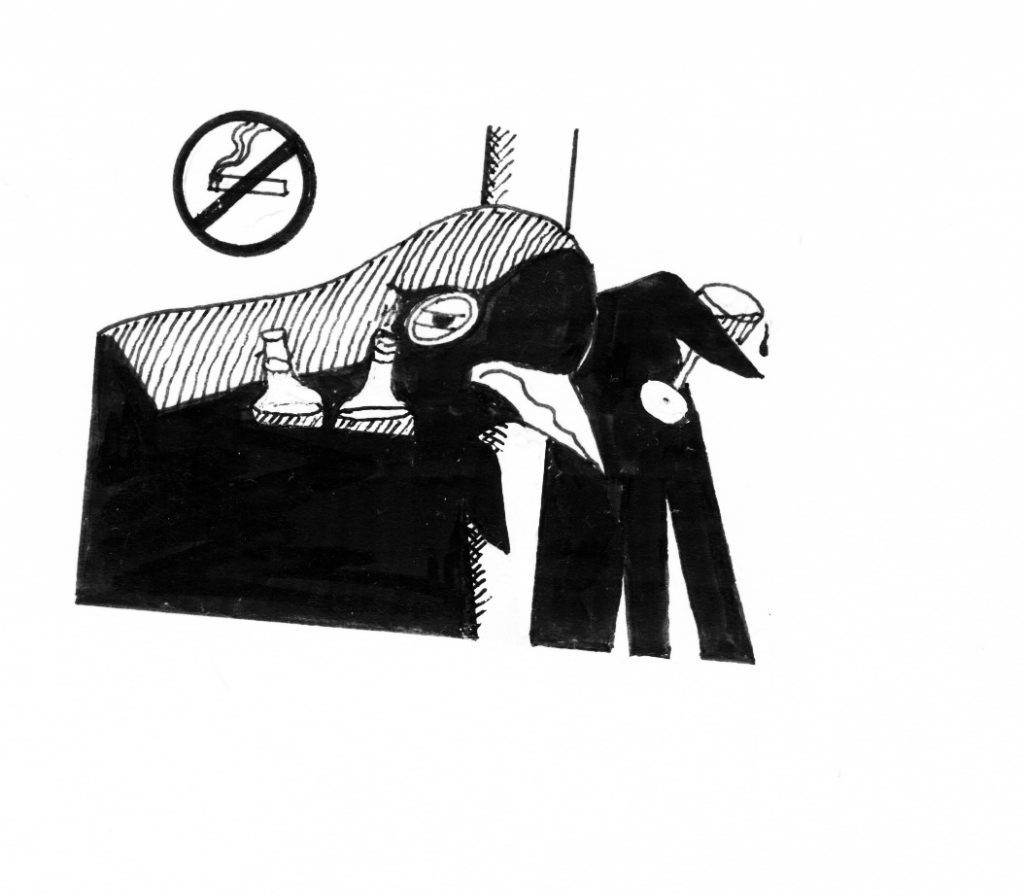
    Now my wedge is worn down to a nubbin so I’m trying to scratch a few dibs out of this art world. I’d done a few beauty panels and I’m punting them round town when I meet this dame in Covent Garden. I’ve known her a year or so and now she’s working the spigot in this bar on Long Acre. Now this is a classy trap, inhabited by the better class of West End rum pots. This Judy is Class A and she dresses in a manner that suggests she’s not afraid of catching cold. I like the way she always lets her bra strap hang down. She’s from that Hungary, where I hear you can commit all manner of depravity in the street without attracting attention. This must be dispiriting for them as likes an audience. I had a nightmare once when I had that Joan Collins over a bar stool of a Friday night in the French and nobody was taking any notice. During the season she’s always glued to the rugby on the tele so I enquire into this situation and she says to me like this: ‘It’s not the rugby Dick, it’s the men.’ And then she pulls me close and whispers in my shell-like, and I reply to her like this: (but this confidential riposte comes out a bit louder than intended, causing no small amusement and then some among the rum pots.)

    ‘A week off work to recover? I don’t believe it. The team maybe!’

    By and by comes Oat Willie. Now this is a curious character and carries a little sack of oats over his left shoulder at hip height. He alternates fistfuls of beer on the right with fistfuls of oats on the left. He’s fond of talking about his practice so much that many of the rum pots consider him to be no great asset to the community and give him the back of their necks. He’s fond of the bogey weed and I personally consider him to be higher than a cat’s back, which is no great commendation. By and by he shuffles off down the bar to gaze at Zoë, for such is the pancake’s name. He even offers her a dip in his little sack but she declines, it being a bit sweaty after a couple of pints. He associates with such low-lifes as John the Stud and Dave the Reptile who really have no business in a high class art blat.

    Dirty Harry sends me a free hack ticket to that Royal Academy to have a glaum at this show of Russian Revolutionary art. So I’m sitting on the No 14 bus admiring the great relief along the front of the Gaumont cinema in Shaftesbury Avenue. It takes you from medieval times to the Charleston and apart from the Parthenon it’s one of the greatest friezes I’ve ever seen. A traffic jam is not always such a bad thing.

    At the Academy they’ve draped the balustrades in red swags and put in a beautiful new crimson stair carpet at the entrances so it’s a bit disappointing when you get inside. It’s not that the pictures are particularly bad, although few of them appeal to me, but most share that “cellar-stored” look common to many early 20th century paintings; cracked, yellowed and dingy. A few things I liked. A painting by Isaak Brodsky which reminded me a bit of George Bellows’s shock worker, a figure stripped to the waist standing on a crane jib. Like Bellows but without the enjoyment in the paint, which is a characteristic of most of these artists. None of them relished the medium. Maybe they couldn’t afford to.

    Israel Lizak is an exception with his painting Walk. It reminded me a bit of Gorky and is an abstraction of an elegant woman in a hat from ’28. And then there’s Vladimir Tatlin who you could say has pride of place with his large model of The Worker’s Flying Bicycle. It never flew but it’s a great idea. And there’s rather a beautiful small photo of the profile of poet Anna Akhmatova by Moisei Nappelbaum (see illustration). She was denounced by the Bolsheviks as ‘half-harlot half -nun’. “Her tormented mouth through which 100,000,000 people scream.” There’s a woman down our street like that.

    On the way out a woman who was clearly upset was saying how sad it had all made her feel. And I had to agree. Apart from all the ghastly goings-on I can’t stand pictures of peasants.

    Up the Burlington Arcade the Fountain Pen Shop has closed down. Some of them cost many hundreds of pounds but were rather beautiful. On Berwick Street the blood oranges have just arrived and the daffodils have come out in the French pub.

    Sent on a mission on your behalf I failed miserably. It had been suggested I look at the David Hockney retrospective, an unpleasant job but someone’s got to do it. The queue was such, hundreds of them, that I lost all enthusiasm. Even after buying a ticket – twenty quid! – you have to wait around for an hour before they let you in.

    I decided to look at the Paul Nash show instead. A wise decision. The first room is called Dreaming Trees. They look like etchings but are mostly pen and ink. The catalogue describes them as ‘Symbolist’, but I disagree. Trees, hills, landscapes and a few ghostly figures which take time to emerge. They convey a sense of mystery which is not transcendent but embedded in the nature of all things themselves. There’s no need to look for anything else, ‘things’ are sufficient for those with eyes to see. Then came the war and a remarkable transformation. He started to work in oil and to make the pictures for which he is most famous.

    “There are men who want the war to last forever. Feeble and inarticulate may be my message. But it will have a bitter truth and may it burn their lousy souls” 1917

    Starburst shell over the Ypres Salient at night … blacks and various shades of viridian, the light from the starburst picking out the troops helmets as they go slightly downhill on the duckboards. In the same room are The Menin Road and We Are Making a New World, the paintings for which he is most acclaimed.

    After the war he turned again to landscapes with rather mysterious qualities but without the intensity of his pre-war work. In the ’20s he went to live in Rye and got to know the 20-year-old Edward Burra – Nash was 35. Burra disliked Nash’s wife Margaret, who was much involved in folk music and morris dancing.

    “Such fun. We do Widdy Come Toddy, Parson’s Fuddle and Fuck a Chickabiddy and Flummox a Bubby Nit in the Navel. And also Maiden Heads Bung-Ho.” (Burra’s letters)

    Nash himself was quietly appalled by how his wife carried on. Burra considered that Nash couldn’t draw but although his figures were rather weak it didn’t really matter in his best work. Then in the ’30s he became committed to the idea of International Modernism which is strange considering how idiosyncratic his work had been. He liked the idea of a life force within inanimate objects and put together arrangements which nowadays look like very ordinary art school exercises. Later on in the ’30s he got involved with the Surrealists.

    There’s an interesting film of him during the Second World War working in the scrapyard of German bombers at Cowley in Oxford, the drawings and photographs of which led to his famous picture Totes Meer of 1940. The chalkiness of a lot of his pictures, which I’ve always considered one of his drawback, didn’t really bother me, until the very late things of wheeling sunflowers which are supposed to be symbolic of death. He died in 1946.

    Dick French
    The Jackdaw Mar/April 2017

  • Dick French: On The Town – November 2016

    Well done Fabienne Jenny Jacquet for her Easel Words in the last issue. She writes very clearly, which is rare for an artist. She is concerned with artists and their dealers’ demands for a neat visual package and a personal ‘brand’. I liked her piece very much. I don’t bother with dealers these days. If anyone is interested in my work I’m quite easy to find. Just ask in Bradley’s Spanish Bar or you could try and see my agent Gregorio who has an office next door … but be warned he’s a very busy man. Madame Jacquet’s paintings look quite interesting. They seem to be knifed on. I must try to get to see them properly. Sock it to the spivs madame. I deeply resent handing over half my hard-earned to some wide boy who runs an art shop.

    To Fortnum and Mason’s to purchase some Gentleman’s Relish. I’m running low and Christmas is coming. On the way I met Dirty Harry in The Chequers. He reminded me that there was a big art show going on in Fortnum’s, the collection of ‘Saatchi of the North’ Frank Cohen, so we popped in. The door was opened by a friendly Irishman in a top hat who explained that the collection was distributed throughout the store on all floors. It was an interesting but puzzling display, but then I’m always saying that.

    How can someone who has bought Edward Burra with his idiosyncratic draughtsmanship, wit and mischief possibly be interested in the feeble, self-important gesturings of Howard Hodgkin? There’s also a creature called Charming Baker extensively represented, whose sculptures must be made for middle-eastern clients – they’ll look good on the dashboard. The ‘Geometry of Fear’ sculptors are also here in force, Armitage, Chadwick, etc.. They seemed to blend into the background.

    The best things were the Burras, especially a magnificent gloomy pub scene from 1946. You can feel the damp and foggy chill and a bit of reeking warmth from the gas stove. Burra himself seems to be standing at the bar as a flame-like ghost floats off towards the left, probably one of those ‘free gifts’ he’s turned to advantage. I’m sure it’s a self-portrait although the nose suggests otherwise.

    I’m also totally baffled by the inclusion of Marc Quinn and his ludicrous travesty of Degas’s ballet dancer. I can only assume that Cohen has a team of advisors, as there is no indication of a personal ‘eye’. It’s a bit of a rag bag really, or, as Edward Burra would say: “It’s all a proper cunt and no mistake dearie.”

    I managed to find the Gentleman’s Relish but these days it comes in a lovely blue porcelain pot at £16.50 a go, and it’s now called Fortnum’s Relish. I wonder if they still do it in Sainsbury’s.

    There were also three paintings by William Roberts that were worth looking at. A chap I once knew who had a small collection of W. Roberts used to say of him, “poor fellow, the world’s passed him by”. He also had a hideous late Picasso hanging over the mantlepiece. It was a cavalier smoking a pipe about five feet by four. I advised him to flog it off while it was still worth something. I’ve not been asked back. Picasso has been highly regarded and sought after for over a hundred years. It can’t go on forever. The tedious old clown will surely be rumbled soon. Don’t forget what happened to Lord Leighton. “But Lord Leighton had a revival” I hear you say. He also had a romantic sensibility and a true appreciation of form.

    To the Royal Academy to see the Abstract Expressionist show. Pride of place is given over to the murderous, shirtlifting old cowpoke Jackson Pollock. I was surprised by the condition of Blue Poles. The last time I saw it was in his retrospective at the Tate 20 years ago and it looked dreadful, the colours not so much faded as intensified in crudity. The colours are paradoxically much more agreeable now. It must have been restored, some task I imagine, or maybe it’s the Aussie air. The cheap cotton duck had yellowed and cracked.

    There was an enormous oriental fellow in a heavy black overcoat and a homburg hat, his arms extended towards it, palms to the painting. I just had to see him from the front. His eyes were tightly shut and he resembled Odd Job in the James Bond film, the chap with the lethal bladed hat brim. I’ll never forget that. It was a perfect example of how people can become deluded by reputation. “It was the vibes man, the vibes.” Oh shut up.

    Blue Poles (opposite), now highly regarded, was considered a failure by Pollock, a retrograde step from what many considered the groundbreaking black and white paintings of his previous series. It was a collaboration. He called in Barnett Newman and an Irishman called Tony Smith. The ‘poles’ were applied by a six-foot length of four by two. Apparently he was anxious not to waste the expensive Belgian linen. Well it doesn’t look like Belgian linen to me. Using oil-based household paint on raw cotton duck, as he invariably did, it’s a wonder they haven’t rotted and fallen apart.

    Most of these pioneering, free-spirited artists were in thrall to Clement Greenberg. This is odd because Greenberg’s qualifications as an art guru were very slight – a summer session at the Art Student’s League and a few lectures at the Hoffman Institute. Previously he had worked on the Partisan Review, trying to make a name for himself in the literary world, in which he was regarded as pompous and intellectually mediocre. He was a posturing fraud but they hung on to his every word. It is said that he’d walk into an artist’s studio, look at a painting and declare “You can’t do that!” And they actually stopped doing it!

    He it was, who conferred the mantle of “greatness” from time to time, on this one or that one. At first Pollock was the man, but his time on the sunlit uplands was surprisingly brief. After a couple of years they all turned against him. That article in Time magazine put everybody’s back up. He became a ghastly bore from whom everyone wanted to escape. Poor man. Whatever you think of his work or his behaviour he was deeply serious.

    There’s a story that all his life he urinated in the sitting position, like most women, and another story about how he pissed into the fieplace at a swanky art party. I hope he didn’t do that sitting down.

    Numbering the paintings was also a Greenberg idea, the problem being that the numbers were not consecutive but picked at random. Then Greenberg changed his mind and proposed titles. Hence Lavender Mist … (‘Sorry about last night darling I must have been a bit lavender.’)

    Greenberg was a Marxist with a belief in the historical inevitability of artistic progress, or was he just flying a kite? Maybe a bit of both, but a sly boots if ever there was one. Someone described his approach as ‘puritanical nonsense applied with Talmudic intensity’. It was all to do with the ‘integrity of the picture plane’ you see.

    There are seven paintings by Rothko in the rotunda and although I didn’t have an epiphany I liked three of them very much, the dark, close-toned ones with the glowing bass lines. Rothko was another one of those ghastly bores who became shunned.

    A stellar bit of hyperbole in the catalogue about Clyfford Still … “The upright living being and spiritual transcendence. Its nemeses are the yawning abysses – by turns molten and glacial which interlock with his upthrusts. An almost Manichean play of luminosity and darkness heightens this dramaturgy, intensified by Still’s scabrous surfaces.” Nice. I like that ‘upthrusts’.

    De Kooning’s paintings have something which sets them apart from the others. You sense a compositional ability and draughtsmanship, particularly in his ‘Women’ series, although the best of these are not included. They’re very strong but he went off badly in the 1960s becoming pale and wishy-washy, chalky abstract landscapes with no tonality.

    There’s a sense of ‘The All American Boy’ about this period and almost everything that came afterwards. An inability to draw was elevated to a virtue along with scorn for the sensuous application of paint. But look back fifty years to George Bellows and the Ashcan School of New York painters and they could draw beautifully and paint as well as any European. What came after this was, of course, Rauschenberg, Johns and Pop Art. That’s historical inevitability for you.

    It’s also interesting that the fashion for ‘tough guy’ artists crossed the Atlantic. We don’t have cowboys in England but at the Royal College of Art in the ’60s there was a fashion for behaving like an East End gangster. Elective mutism or self-imposed thickness was common, along with the sophistry that led to conceptualism.

    Dick French
    The Jackdaw Nov/Dec 2016

    www.frenchonpaper.tumblr.com
    www.vimeo.com/12538534