Tag: Switch House

  • Selby Whittingham: Tate Modern or Tate Theatre

    A survey by the Office for National Statistics in May revealed that the British are changing their spending habits. Instead of filling our homes to the rafters with consumer durables and not-so-durables, we’re spending our spare cash on ‘experiences’, including recreation and, yes, culture. “People are interested in servicing a lifestyle rather than buying stuff,” one trend forecaster commented in The Guardian, while a senior executive from IKEA predicted gloomily: “In the west, we have probably hit peak stuff”.

    Does this mean fewer family trips to the mall and more museum visits? The contemporary museum sector certainly hopes so, and to bring the hope closer to reality it is doing it best to make the two experiences as similar as possible. This is an ambition not confined to Britain. Is it any coincidence that Rome’s two contemporary art museums, MACRO and MAXXI, have names like megastores? It wouldn’t surprise me if the Pompidou called its next outlet Géant Casino.

    The mallification of the contemporary art experience is international, but here in Britain, where entry is free, we lead the world. Last year Tate Modern logged 5.7 million visitors (don’t you love the precision of the decimal point?) and this year, with the added attraction and capacity of Herzog & de Meuron’s new Switch house extension, it’s hoping to swell attendance figures to over 6 million.

    Architecturally, malls and contemporary art galleries have much in common: both incorporate awesomely large atria designed to instill a sense of limitless possibility, and both feature fancy escalators and rubbish cafés run by stressed and underpaid staff. Ah yes, you say, but here your parallel hits the buffers: people go to shopping malls to shop. Not strictly true, is my reply: visiting malls is a leisure activity. People go to malls to look at stuff and at each other, especially when travelling up and down the escalators, much as the ancient Greeks did in the agora, though without the escalators. Window-shopping is a group activity, a sociable way of servicing a lifestyle. As an experience, the ONS might well put it in the same category as visiting Tate Modern.

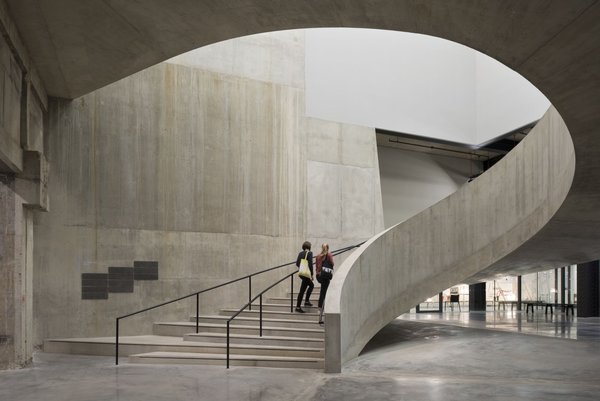
    In the run-up to the Switch House’s opening we were forewarned that much of its 60% of extra space would be devoted to social interaction. Museums used to be about conservation. Now, with a minor anagrammatic rearrangement, they’re about conversation. Like shopping malls, contemporary galleries are places to hang out in, with the shop window or exhibition displays serving as talking points. As Jacques Herzog explained to The Observer about the design of the Switch House, “the stairs are wider than we need them; we want to invite people to have a different kind of experience than to rush from one gallery to another”.

    Lee Mawdsley

    All well and good, but you can’t get round a gallery this size without rushing, especially not if you linger on the stairs. I lost the ability to focus less than halfway through, and I call myself an art critic. The problem is not just one of scale; the trouble starts, ironically, with the gallery’s departure from the mall model. Art galleries, like shops, used to be full of covetable objects ordinary people could fantasise about owning – modest-sized works, originally made for private consumption, put on public display for the benefit of the general population. The Switch House galleries are mostly full of large-scale works created with public display in mind. Like public sculptures, they are made for rushing past.

    The mystery of this so-called gallery extension which has so far cost £58 million of public money is how relatively little art there is in it: only three of its ten floors are exhibition galleries, four if you count the Tanks. But this didn’t stop the panel assembled for the press launch – including poor little Sadiq, whistled up at short notice as a multicultural mascot – from harping on about how transformative it would all be. It’s unfortunate that the most conspicuous evidence of the economic transformation so far triggered by the old Tate Modern should be Richard Rogers’s Neo Bankside luxury apartments with their litter of posh nosh outlets underneath. Looking south from Switch House’s 10th floor viewing platform, it’s hard to imagine the Tate’s regenerative effect rippling out towards the North Downs without the swathes of intervening social housing being swept away and replaced with Tory nastytecture and overpriced cafés.

    Bilbao has a lot to answer for. If the Basque government hadn’t hit the community jackpot with Frank Gehry’s Guggenheim Museum none of this would have happened. As it is, any city council in need of an economic boost reaches for the starchitects. The only city manfully resisting the tide seems to be Helsinki, still refusing to give the go-ahead to its Guggenheim outlet more than a year after the Paris-based architects Moreau Kusunoki won the competition to design it.

    Bilbao claims to have recouped the Guggenheim’s construction costs within three years of opening. Even allowing for some prestidigitous book-balancing on Bilbao’s part, there’s precious hope of Tate Modern repeating this feat, with a £30 million funding hole that still needs filling. On the eve of the Switch House’s opening, Serota as good as admitted to The Art Newspaper that if the Tate didn’t seize the opportunity of “unwrapping the building” to hook some late donations it would be this year, next year, sometime, never before the debt was paid. Slim chance of our new tightwad PM delivering on Osborne’s previous promise of an extra £6.8 million of annual funding – and extra funding will be needed, not just to service the debt.


    As with any expanded operation, the elephant in the gallery extension is the payroll. Billionaire donors who will happily part with capital to get their names on a museum building don’t give a stuff about the extra numbers of staff needed to keep it open. They leave such practicalities to museum administrators and the public bodies that fund them. If it came to keeping museum staff in jobs and pensions, your average billionaire would hand straight over to Dominic Chapell.

    In America, where more than $5 billion has been spent on museum expansion in the past nine years, administrators are getting wise. The Met, which reported a $10 million deficit this year, has mothballed plans for a David Chipperfield-designed modern and contemporary wing and, along with MoMA and the Brooklyn Museum, has announced plans to cut staff. The Met’s 2,300 staff – who, unlike museum staff in Britain, are properly paid – cost $200 million in salaries and benefits in 2013. MoMA, which spent $87 million on its 800 employees in the same year, has scaled back plans for a new extension.

    Double your gallery space and you double your warding costs, at least in theory. One reason, I suspect, why Tate Modern’s Switch House galleries are almost entirely given over to large sculptural installations is that they require less security – the worst you can do is steal a Carl André brick. Meanwhile the more vulnerable paintings and nickable sculptures have been squeezed into a few crowded galleries in the old Boiler House to save on warders.

    The dawn of the artist’s statement was bad enough; the arrival of the statement building has made things worse. Combine the two, and you get a tower of babble. Is the new Tate Modern worth the £260 million investment? If it ever has to charge for entry, we’ll find out.

    Selby Whittingham
    The Jackdaw 

  • Laura Gascoigne: Photography, Wrong Sort Of – January 2017

    “And the Praemium Imperiale Award for Painting goes to… a photographer!” Yep, Cindy Sherman has won the Imperial Japanese gong for mastery of greasepaint for that interminable string of selfies in fancy dress we all wearied of circa 1980. If not for greasepaint, it would have to be for psychological insight – and despite her readiness to raid the dressing-up box and make her ageing self look ridiculous in the name of art, Rembrandt she ain’t.

    Sherman is the least qualified non-painter to win the award so far, but she’s not the first. Bill Viola won it in 2011 and Japan’s own Hiroshi Sugimoto in 2009 – both non-painters who piggyback on the history of painting. But no hard feelings; it’s all water under the interdisciplinary bridge. As Frances Morris established at the opening of Tate Modern’s Switch House: “We don’t any longer have a hierarchy where painting is at the top.”

    As if to settle the point beyond dispute, last year the Tate awarded its annual IK Prize for creative talent in the digital industry to a team from Treviso for an experimental project using artificial intelligence to compare news photographs with works in the collection. Titled Re][cognition – potty punctuation is de rigeur in the digi-world – it set out to answer the question: “Can a machine make us look afresh at great art through the lens of today’s world?”

    The way it worked was this. Every day, a crop of current news photos shot by Reuters’ photographers were shown to the machine, which then scanned the collection at the rate of thousands of images a minute and spat out matches based on object, facial, compositional and context recognition.

    Now this is an area I’ve long been interested in, so I went along to Tate Britain to have a look. For years I’ve been collecting news photographs that echo the compositions of old master paintings. Some subjects are naturally fertile territory – almost every refugee mother and baby is a Madonna and Child, every grieving mother a Mater Dolorosa – but the parallels go further. I was particularly pleased to find a photo of Mick Philpott and his wife Mairead at a press conference following the self-started house fire that killed their six children in 2014 doing a perfect impersonation of Adam and Eve in Masaccio’s Expulsion from Eden.

    Are these coincidences? I don’t think the borrowings are deliberate; it’s more that the educated eye of the photographer, making a snap decision in the heat of the moment, matches the scene with a meaningful image in the memory, and frames it. Photographers, being blessed with human brains – and emotional intelligence – can make split-second calculations machines can’t. (If they could, CCTV would produce prize-winning photographs of people breaking open cash points or mugging old ladies.)

    Of course the matches in Recognition were nonsensical. The machine was reliable enough (though not 100%) at identifying ‘a man wearing a white shirt’ or ‘a woman with dark hair’, but despite its programmers’ claims that it could determine “the age, gender and emotional state of each subject it finds”, it was defeated by the most basic of facial expressions. It saw smiles on the faces of Matteo Renzi at a press conference and Francis Bacon in a portrait by Lucian Freud because their mouths were slightly turned up at the corners. A month-old baby would not have made the same mistake; it would probably have cried. Nor, if consulted, would it have drawn a comparison between a photo of Brazilian President Michel Temer attending the launch of a banking initiative at the Planalto Palace with Anthony Caro’s 1980s sculpture Night Movements, on the basis of “prominent shapes and structures, visual layout, and colours”. If it had, its mother would have worried.

    So it was sensible to include an interactive section where visitors could tap a screen and make their own connections “to see if Recognition can learn from the many personal responses humans have when looking at images”. I had some fun matching a Black Friday photo of a frenzy of red and white shopping bags with Patrick Heron’s Azalea Garden. But I was disappointed to find that visitors’ choices were not recorded on the website, where they would have exposed the machine’s inadequacies. It seems that while a computer can be programmed to fudge a fair approximation of a Rembrandt portrait, left to itself it can’t tell one thing from another.

    If this experiment taught us anything, it was that however anti-hierarchical we may be, it’s too soon to open up the competition to artificial intelligence. Yet in the field of photography, that day may not be far off. I’m not talking about news photographers, who do a job no machine could possibly do and bring an acute visual intelligence to it. I’m talking about ‘fine art photographers’ as exemplified by Wolfgang Tillmans, the first photographer to be awarded the Turner Prize, who (having recently finished a stint as a Tate Trustee) has a solo show opening at Tate Modern in February. Tillmans takes egalitarianism to its logical conclusion, refusing to distinguish between motifs: if the geeks from Treviso programmed a computer to take photographs, they would look like his.

    While Tillmans is larging it at Tate Modern, the work of Roger Mayne will be showing at Graves Art Gallery, Sheffield in the exhibition Street View: Photographs of Urban Life (until March 11th). Mayne, a chemistry graduate of Balliol College Oxford, was egalitarian enough to want to devote five years of his life to photographing slum children on the streets of West London. The slums have long gone, but the photographs look as fresh as the day they were taken – which may be why one was chosen as the poster image for Tate Britain’s photographic survey How We Are. In Mayne’s case the past tense would have been more accurate. In 1956 he was given a one-man-show at the ICA. Today he might take photographs for Reuters, but he would never be given a show at Tate Modern because he is the wrong sort of photographer.

    Photography is now the ultimate democratic medium: anyone and everyone can click a shutter. But which images will last? In 60 years’ time, will people feel a jolt of recognition on seeing a photograph by Tillmans, or blank indifference? For a photographer who calls himself a fine artist, impartial records of reality aren’t enough: to lodge in the human mind, a photograph must mean more to a flesh-and-blood viewer than to a Recognition machine. Here painting still retains the emotional edge that the painter doesn’t have to wait for the ‘decisive moment’ to reveal meaning, since meaning is built into the composition. For what it’s worth, Sherman composes her portraits down to the last hair, which could, I suppose, be thought to bring them halfway towards meeting the criteria for a painting prize. But halfway isn’t far enough. There is still the small matter of artistic expression.

    “Photography doesn’t get nearer experience. Painting gets nearer to it because it can do far more,” said David Hockney in a 1984 interview, before quoting Man Ray: “I photograph what you can’t paint, and I paint what you can’t photograph.” A wise judgment, and one the imperial family would do well to consider when awarding the next Praemium Imperiale.

    Laura Gascoigne
    The Jackdaw Jan/Feb 2017

  • Laura Gascoigne: Reach for the Starchitects – The Switch House

    A survey by the Office for National Statistics in May revealed that the British are changing their spending habits. Instead of filling our homes to the rafters with consumer durables and not-so-durables, we’re spending our spare cash on ‘experiences’, including recreation and, yes, culture. “People are interested in servicing a lifestyle rather than buying stuff,” one trend forecaster commented in The Guardian, while a senior executive from IKEA predicted gloomily: “In the west, we have probably hit peak stuff”.

    Does this mean fewer family trips to the mall and more museum visits? The contemporary museum sector certainly hopes so, and to bring the hope closer to reality it is doing it best to make the two experiences as similar as possible. This is an ambition not confined to Britain. Is it any coincidence that Rome’s two contemporary art museums, MACRO and MAXXI, have names like megastores? It wouldn’t surprise me if the Pompidou called its next outlet Géant Casino.

    The mallification of the contemporary art experience is international, but here in Britain, where entry is free, we lead the world. Last year Tate Modern logged 5.7 million visitors (don’t you love the precision of the decimal point?) and this year, with the added attraction and capacity of Herzog & de Meuron’s new Switch house extension, it’s hoping to swell attendance figures to over 6 million.

    Architecturally, malls and contemporary art galleries have much in common: both incorporate awesomely large atria designed to instill a sense of limitless possibility, and both feature fancy escalators and rubbish cafés run by stressed and underpaid staff. Ah yes, you say, but here your parallel hits the buffers: people go to shopping malls to shop. Not strictly true, is my reply: visiting malls is a leisure activity. People go to malls to look at stuff and at each other, especially when travelling up and down the escalators, much as the ancient Greeks did in the agora, though without the escalators. Window-shopping is a group activity, a sociable way of servicing a lifestyle. As an experience, the ONS might well put it in the same category as visiting Tate Modern.

    In the run-up to the Switch House’s opening we were forewarned that much of its 60% of extra space would be devoted to social interaction. Museums used to be about conservation. Now, with a minor anagrammatic rearrangement, they’re about conversation. Like shopping malls, contemporary galleries are places to hang out in, with the shop window or exhibition displays serving as talking points. As Jacques Herzog explained to The Observer about the design of the Switch House, “the stairs are wider than we need them; we want to invite people to have a different kind of experience than to rush from one gallery to another”.

    All well and good, but you can’t get round a gallery this size without rushing, especially not if you linger on the stairs. I lost the ability to focus less than halfway through, and I call myself an art critic. The problem is not just one of scale; the trouble starts, ironically, with the gallery’s departure from the mall model. Art galleries, like shops, used to be full of covetable objects ordinary people could fantasise about owning – modest-sized works, originally made for private consumption, put on public display for the benefit of the general population. The Switch House galleries are mostly full of large-scale works created with public display in mind. Like public sculptures, they are made for rushing past.

    The mystery of this so-called gallery extension which has so far cost £58 million of public money is how relatively little art there is in it: only three of its ten floors are exhibition galleries, four if you count the Tanks. But this didn’t stop the panel assembled for the press launch – including poor little Sadiq, whistled up at short notice as a multicultural mascot – from harping on about how transformative it would all be. It’s unfortunate that the most conspicuous evidence of the economic transformation so far triggered by the old Tate Modern should be Richard Rogers’s Neo Bankside luxury apartments with their litter of posh nosh outlets underneath. Looking south from Switch House’s 10th floor viewing platform, it’s hard to imagine the Tate’s regenerative effect rippling out towards the North Downs without the swathes of intervening social housing being swept away and replaced with Tory nastytecture and overpriced cafés.

    Bilbao has a lot to answer for. If the Basque government hadn’t hit the community jackpot with Frank Gehry’s Guggenheim Museum none of this would have happened. As it is, any city council in need of an economic boost reaches for the starchitects. The only city manfully resisting the tide seems to be Helsinki, still refusing to give the go-ahead to its Guggenheim outlet more than a year after the Paris-based architects Moreau Kusunoki won the competition to design it.

    Bilbao claims to have recouped the Guggenheim’s construction costs within three years of opening. Even allowing for some prestidigitous book-balancing on Bilbao’s part, there’s precious hope of Tate Modern repeating this feat, with a £30 million funding hole that still needs filling. On the eve of the Switch House’s opening, Serota as good as admitted to The Art Newspaper that if the Tate didn’t seize the opportunity of “unwrapping the building” to hook some late donations it would be this year, next year, sometime, never before the debt was paid. Slim chance of our new tightwad PM delivering on Osborne’s previous promise of an extra £6.8 million of annual funding – and extra funding will be needed, not just to service the debt.

    As with any expanded operation, the elephant in the gallery extension is the payroll. Billionaire donors who will happily part with capital to get their names on a museum building don’t give a stuff about the extra numbers of staff needed to keep it open. They leave such practicalities to museum administrators and the public bodies that fund them. If it came to keeping museum staff in jobs and pensions, your average billionaire would hand straight over to Dominic Chapell.

    In America, where more than $5 billion has been spent on museum expansion in the past nine years, administrators are getting wise. The Met, which reported a $10 million deficit this year, has mothballed plans for a David Chipperfield-designed modern and contemporary wing and, along with MoMA and the Brooklyn Museum, has announced plans to cut staff. The Met’s 2,300 staff – who, unlike museum staff in Britain, are properly paid – cost $200 million in salaries and benefits in 2013. MoMA, which spent $87 million on its 800 employees in the same year, has scaled back plans for a new extension.

    Double your gallery space and you double your warding costs, at least in theory. One reason, I suspect, why Tate Modern’s Switch House galleries are almost entirely given over to large sculptural installations is that they require less security – the worst you can do is steal a Carl André brick. Meanwhile the more vulnerable paintings and nickable sculptures have been squeezed into a few crowded galleries in the old Boiler House to save on warders.

    The dawn of the artist’s statement was bad enough; the arrival of the statement building has made things worse. Combine the two, and you get a tower of babble. Is the new Tate Modern worth the £260 million investment? If it ever has to charge for entry, we’ll find out.

    Laura Gascoigne
    The Jackdaw