Tag: Michelangelo

  • Laura Gascoigne: Tangled Web – September 2017

    “Why is there so much sewing?” demanded The Art Newspaper’s Christina Ruiz after visiting Christine Macel’s exhibition at this year’s Venice Biennale. “I get it: domestic work, women’s work, is important and undervalued. But is it in itself art? No it is not.”

    There was a time when so-called textile arts were prized above all others; when first unveiled in 1519, Raphael’s tapestries for the Sistine Chapel threatened to eclipse the fame of Michelangelo’s ceiling. But in the 18th century tapestry began to feel fusty as audiences warmed to the immediacy of paint. A work’s value no longer resided in the price of the wool, the skill of the weavers, the total hours spent in production and associated cost, but in the artist’s touch, the signature of authenticity that connected audiences with the creator of the work, usually male.

    In the 1980s, when Rozsika Parker wrote The Subversive Stitch, she pinpointed “the separation of the craft of embroidery from the fine arts” as “a major force in the marginalisation of women’s work”. But on the coattails of conceptualism, ‘women’s work’ has come back from the margins. Since the personal signature of the pen or brush fell under suspicion the needle has returned, not always in the hands of women. While the women are bent over their embroidery frames, the men are stealing the limelight, à la Raphael, with tapestries woven by others to their designs. Chris Ofili’s Weaving Magic has just been the focus of an exhibition at the National Gallery, and there are more tapestries than pots in Grayson Perry’s The Most Popular Art Exhibition Ever! at the Serpentine Gallery (until September 10th).

    If Hockney wants to keep his place as top national treasure, he’d better put down his iPad and pick up a needle. Tapestry, embroidery, knitting, crocheting are all back in the frame and proving highly popular with a public tired of the self-conscious cack-handedness of so much contemporary art. This is art like granny used to make, sweet as apple pie and absolved of the obligation to be serious. From Vidya Gastaldon & Jean-Michel Wicker’s knitted octopus, titled Sex Is Good (1999), shown in Tate St Ives 2013 exhibition Aquatopia to Shauna Richardson’s three 9m lions, crocheted from 36 miles of Swaledale wool and displayed in a glass cage at Twycross Zoo in 2012 as part of the Cultural Olympiad, it’s all a bit of folksy fun.

    Naturally, education departments love it. Imagine the jollity at The Exchange in Newlyn in 2010 when artist Jonty Lees donned a Montgolfier flying helmet and goggles to lead a sewing circle and basket-weaving group in the construction of a full-size hot air balloon. The following year the Science Museum went one better and got participants in its Stitched Science weekend to create an entire Solar System Art Installation from ‘various fibre arts’. True, the results looked a bit of a mess, but sew what? Fibre arts have therapeutic benefits. According to the organisers of the Crafts Council’s ‘cinema knit-along events’ in 2012, “knitting has been proven to enhance cognitive development in children, and well-being in both children and adults.” Sew there.

    It’s not all child’s play: serious issues can be addressed with needles. ‘Political statement knits’ by Lisa Anne Auerbach were a highlight of Wasteland, an exhibition of young Los Angelino artists at the Mona Bismarck American Centre in Paris last year. More ambitiously, at the Minories Gallery, Colchester in 2015 Clare Sams’s installation Knitting Fever recreated the devastation caused by the 2009 floods when a wool shop of that name in Cockermouth spilled its guts through the Cumbrian town. The gallery complimented the artist on using a process “stereotypically viewed as a feminine past-time [sic]” to represent “cataclysmic forces not normally associated with the practice”. Sams’ ‘total knitted environment’ looked a little twee for a cataclysm – acts of God produce more dramatic results than needlework – but she wasn’t going to let that stop her, having already knitted her way through the Hackney Riots and Guantanamo Bay. No knit-wit she.

    Other artist-knitters are not so outward-looking or gender-neutral in their choice of subjects. Given the vogue for ‘bedroom painting’, bedroom knitting was almost bound to follow and, sure enough, in 2012 the Polish-born New Yorker Agata Olek transformed Tony’s Gallery in Brick Lane into a crocheted replica of her boudoir, with walls and floor emblazoned with explicit texts from former lovers. “It is not just another apartment installation,” she assured Metro, “it is the reflection of life, love, trust and lust in current time.” Its tear-jerking title I do not expect to be a mother but I do expect to die alone was a quote from, you’ve guessed it, the queen of the misery stitchers, Tracey Emin. But no artist has taken intimate needlework quite so far as Casey Jenkins in her 2013 performance Casting Off My Womb, in which she knitted a menstrual cycle-length scarf from skeins of wool secreted in her fanny. The work, she told The Guardian, was “primarily about casting off the need for validation from external sources” and “forging a path of self-determination in the face of society’s expectations”.

    Maria Balshaw would say aye to that. Unlike Christina Ruiz, she congratulated Venice Biennale curator Christine Macel in The Art Newspaper on doing “a really good job in challenging some of the gender stereotypes around textiles,” singling out male artist David Medalla for praise for his participatory work A Stitch in Time, first shown in 1968. Medalla’s early lead in removing the sexual stigma from stitching may have laid the ground for the Crafts Council’s 2004 exhibition Boys Who Sew, at which Fernando Penteado established the butch credentials of needlework with a display of samplers embroidered by tattooed inmates of Wandsworth Prison. Since then the social enterprise Fine Cell Work has climbed on the prison wagon and trained 300 prisoners in 20 gaols to spend their lock-up time productively embroidering cushion covers. There’s precious little bunce in it for the lags, but more job satisfaction than stitching mailbags.

    It’s no discovery that men are nimble-fingered (not a lot of people know this, but the young Malevich upset his father with his unhealthy aptitude for Ukrainian cross-stitch). The danger for women of challenging gender stereotypes around textiles is that male artists will seize the initiative. Not content with getting tapestries woven to their designs, brothers are doing it for themselves. In Art Now at Tate Britain in 2010 Andy Holden showed The Pyramid Piece, a 10ft-high knitted replica of a chip off the Great Pyramid of Cheops that he had illegally smuggled home from a family holiday to Egypt at the age of 12. Along with its benefits for cognitive development, knitting is obviously a good way of assuaging guilt.

    The main drawback of needlework, for unreconstructed individualists, is its inflexibility as a means of expression, which is why most attempts to employ it as one, Tracey Emin’s included, have been sew-so. The notable exception is Mr and Mrs Pope, Knitted, Shrunk and Hung (2012), a truly heart-wringing piece of work that – sorry girls! – was created by a male sculptor, Nicholas Pope, with his own fair hands.

    Laura Gascoigne
    The Jackdaw Sept/Oct 2017
  • Dick French: On The Town – May 2017

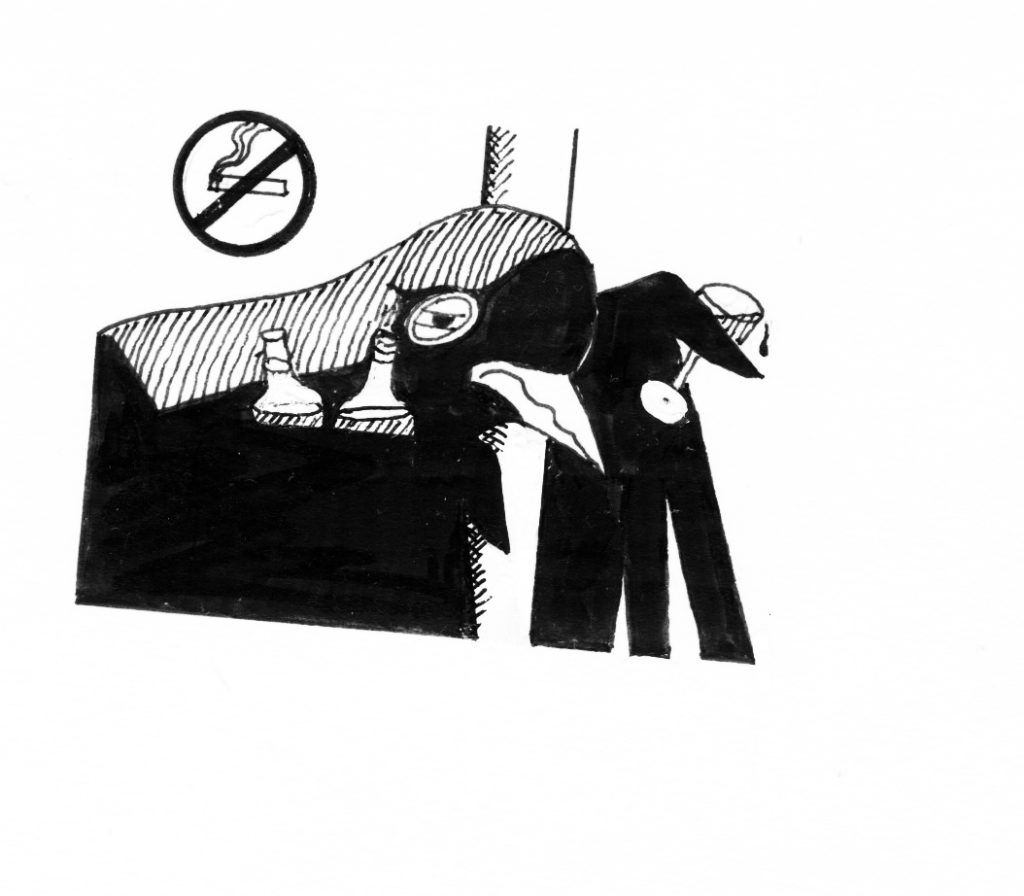
    Mr Wu was on the wireless last night. A very long programme on the World Service, but still I learned very little about him. He speaks as one heavily sedated. Talk about insclutable. He dwells in a large bunker under Berlin with 6,000 three-legged stools and some lifejackets. There was no mention of the poison beans, maybe he’s sold them all. The trailer described him as “one of the world’s most powerful artists”. It is puzzling how an aesthetic black hole can achieve such eminence. His career is enough to make even the most sceptical of us start subscribing to conspiracy theories. He’s one of these artistic accumulators who head things up. There’s a lot of them about. One thinks of MacFisheries, the bloke at the RA who makes animals out of coathangers and map pins. I suppose you could call it a modular approach which prevents you from making a mess… Now what can I heap up next?

    In the 19th century it took a long time for the French to latch on to the importance of Baudelaire. The Parnassian ideal was ascendant and accordingly it was possible to compose what was considered the highest poetry about almost nothing. Plus ça change.

    Art establishments have a primordial and instinctive terror of change. When Baudelaire wrote about “une oasis d’horreur dans un desert d’ennui” he could have been describing Mr Wu and the Art World.

    To the National Gallery for the exhibition of Michelangelo and Sebastiano del Piombo. Sebastiano was from Cesenatico, most famous nowadays for being the birthplace and training ground of ‘Il Pirata’, Marco Pantani, still adored by the tifosi even though almost his entire career was fuelled by coke and EPO. Contrast this with Lance Armstrong who is considered a disgrace.

    An impressive show, although two of the most interesting pieces are already in the National Gallery. One of them, The Raising of Lazarus, is among the earliest purchases of the NG. Something I’d never noticed in this painting is that a group of women close to the raising itself are holding their noses. This I learned from the wall chart, but closer inspection shows this to be untrue. They are raising their veils across the lower parts of their faces to avoid contagion. The plague, both bubonic and pneumonic, had been raging on and off for many years when this painting was being worked on and such a gesture was commonplace. Besides, after three days underground Lazarus must have been a tad smelly.

    Sebastiano composes on the diagonal and the triangle. A striking example of his triangular approach is The Judgment of Solomon. The darkening of the central figure’s head is extremely dramatic but this could be due to deterioration. In some of his paintings he lets the sfumato disintegrate the forms rather in the manner of Beccafumi. The black starts to creep in, especially in a painting of the Virgin and Child in which the infant resembles Charlie Drake. The Virgin’s head is also unsatisfactory – too much face.

    In The Visitation the foetal St John the Baptist is said to be leaping for joy in his mother’s womb during her encounter with the Virgin Mary. A difficult subject to depict. One can almost hear Sir Arthur Streeb-Greebling drawling “Well I think the word difficult is awfully well chosen”.

    There are some wonderful drawings and letters in this show. Michelangelo often worked on both sides of the paper which was expensive in those days. I think he was probably a bit of a skinflint. It’s interesting that Michelangelo drew mostly with the hand when nowadays we are encouraged to draw mostly with the arm.

    Many of these paintings have dramatic bits of landscape in the background in the red-tinged sky. I couldn’t take to The Lamentation. I think it’s the expression on the Virgin’s face. Those upturned eyes and the horizontal body seem insufficiently scourged with its immaculate underpants. Still I suppose this is no place for realism.

    “People don’t buy pictures because they admire them, they buy them because others covet them.” Advice given to Constable, but I can’t remember by whom. An Andy Warhol painting of Chairman Mao has just sold in Hong Kong for $1l million. How long can this crap persist? Warhol was once described as “an ambulant black hole”. And now we’ve got another one in Mr Wu.

    To the Mall to see the painter/stainers exhibition. At the opening I met no less than the Chief Stain himself. He seemed a nice chap. Sporting his enormous bling on a chain round his neck he looked a bit like a sommelier. For once the 1st prize was worth looking at. A large, elaborate, patched-together drawing by Chris Green. Bernadette Tinko showed a small picture of a filthy brown sink, which I rather liked, while opposite Alex Rooney showed a similarly sized clean white sink. I wonder if they know each other. Cherry Pickles shows another rear view mirror piece, A487, and Peter Archer’s Cliff Edge is sensitive.

    The Scrapyard Queen shows another of her car wrecks; as always very well done but I’m always hoping she’ll ring a few changes – naked men draped over the bonnet sipping from golden cans perhaps. But I don’t think she takes me seriously.

    My friend The Sage writes from his grotto in the Yorkshire Dales sending me a copy of the Royal Academy Spring Magazine. I can’t imagine how he gets hold of such things. (Age Concern apparently.) He’s very cross about this woman who’s been appointed Professor of Sculpture at the Royal Academy. She’s called Cathie Pilkington and makes the most atrocious plaster dolls which are supposed to be based on the Little Dancer by Degas. As always in this kind of work the exegesis is of more importance than the thing you have to look at. And there can be few things more unpleasant than what she makes. That such an incompetent can be put in charge of students astonishes me. But it shouldn’t really. After all they have Huge Mary in charge of painting. The Sage described them as “sugar sculptures for cake decorations”. She also intends to “dress, drape, protect or obscure with soft coverings” the RA’s collection of historic casts. She means to display her dolls in a way that will make them seem “tiny but vibrant” against lush velvet curtains. Does that mean she’s going to paint them black?

    To the John Soanes, always one of my favourite places. Unfortunately it was infested by a load of plaster body castings by Marc Quinn. “The museum is an unfinished total artwork. We’re continuing the process.” Oh yeah?

    Even though these things are body casts he’s managed to get them out of proportion. The separate upper and lower parts don’t fit together properly. Someone should grab him by the beard (I imagine he’s got one) and point out shoulder to nipple, nipple to navel, naval to the foothills of the fanny – same distance. Variations do occur of course but with the rather perfect specimen he has grabbed from behind this rule would hold. If her bum was a drug it would be Class A. Her tits too, petite.

    “I think that great art is time travel. Emotional time travel.” What on earth can he mean by this? “Quinn’s works invite us to reflect on the nature and meaning of time”. I should be used to such gnomic utterances by now but I can still be surprised and puzzled.

    And here’s my version of the grab from behind…

    Dick French
    The Jackdaw May/Jun 2017