Michael Daley
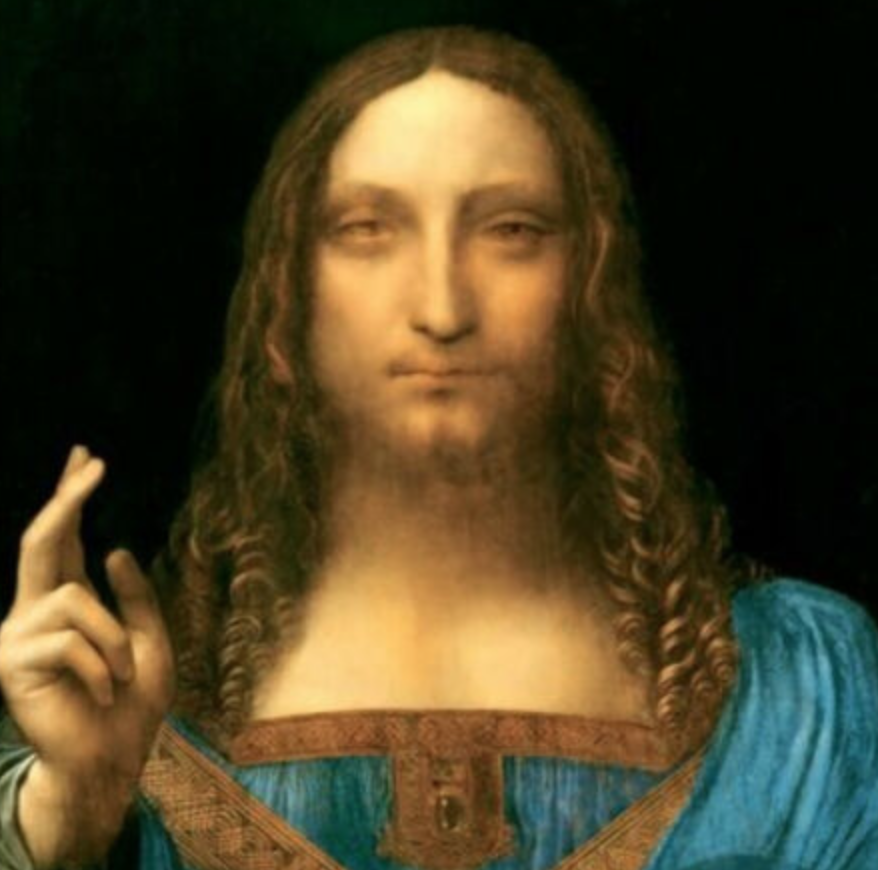
Questions proliferate on the disappeared $450 million Leonardo Salvator Mundi. Where is it? Who owns it? Who still believes it a Leonardo? Will it be exhibited this year at the Paris Louvre’s big Leonardo exhibition, as promised? Can it be true, as an artnet blogger now claims (on the claimed say-so of “two principals involved in†Christie’s 2017 sale) that the painting was removed on the night of the sale to be installed on the yacht of Saudi Arabia’s supreme ruler, Mohammad Bin Salman? Does Christie’s know more about this imbroglio than it has disclosed? Will the Salvator Mundi ever be seen again?
In The Last Leonardo, Ben Lewis contributes hugely to knowledge of the picture’s shadowy emergence and subsequent near-mythic elevation. We now know the picture was bought not for “around $10,000â€, as claimed, but for $1,175 – for less than the low estimate of $1,200-1,800 on a work described as being “after Leonardo da Vinci†at the St Charles Gallery, New Orleans. We now know that gallery closed down after the Salvator Mundi’s sale and reappeared under the same name but without previous records. We now know Christie’s turned the picture down in 2005. We know the “consortium†of buyers initially comprised Robert Simon, a New York dealer and Alex Parish (a freelance dealer and online picture scout for the Richard Green dealership). We know that before, during and after being exhibited at the National Gallery in 2011-12 as an undisputed autograph Leonardo, the picture was on the market and numerous attempts to sell it privately to museums for between $80 million and $250 million failed.
Lewis discloses that it was variously rejected by: the Qatari royal family; the Hermitage; the Getty Museum; the Museum of Fine Arts Boston; the Vatican; Berlin’s Gemäldegalerie; and a German auction house whose Leonardo advisor, Professor Hans Ost, was and remains “very sceptical about the attributionâ€. The initial consortium was running out of money and afraid to offer the picture for auction. As Parish put it to Lewis, “there’s not a deader-in-the-water [work?] than a picture which you put up to auction and then bombs… where do you go from there? Absolutely dead.†Somehow, despite all failures, unimaginable success was to follow.
Deliverance began with a third consortium member: “An offer of help came in 2010 from a reputedly well-connected New York old master dealer, Warren Adelson, who has a gallery in a magnificent uptown townhouse. ‘I made a proposal to Robert and Alex to buy a share of the picture,’ Adelson says, ‘because I wanted to run with the ball and help them sell it.’ He negotiated a 33 per cent stake in the painting in return for a $10 million advance payment. It was accepted. As Robert Simon put it ‘there were a lot of expenses. The photography and the storage were expensive. When we insured at its value the insurers wouldn’t allow me to keep it in the gallery. It had to be kept in a vault at an art storage facility. There were my research costs, going to Europe five times, and Milan five times, and London and New York, and going and checking the libraries. Dianne [Modestini, the restorer] was helpful in not requiring us to pay everything in advance.’â€
Lewis wryly observes “nothing in the known universe, no item, no object or quantity of material, has ever appreciated as fast as the Salvator Mundi attributed to Leonardo da Vinci†but, even with a war chest, and Adelson on board, the going remained rough. The picture was offered to the Dallas Museum (for a rumoured $125 – $200 million). The museum’s new director, Max Anderson, was enthusiastic about the chance to “‘acquire a destination painting’ that would draw crowds to the museum.†Parish told Lewis: “We were strung along by him for some time … at the eleventh hour they offered just $40 million and $25 million of that was meant to be a swap with another painting. Apparently some of those Bible Belt people had little or nothing good to say about the picture. One guy – I won’t tell you who – said, ‘Boy, that is one faggy-looking picture of Jesus’ or something to that effect. I was really like, ‘O-o-oh, great. This is going so well.â€
Despite the astronomical leg-up inclusion in the National Gallery’s major Leonardo exhibition as a rediscovered lost autograph Leonardo prototype painting, this Salvator Mundi remained unwanted by museums and could not be risked at auction. Partial success – in the consortium’s inflated terms – was only achieved in 2013 with a controversial lawsuits-generating private sale through Sotheby’s to a Freeport owner who bought at $80 million and immediately sold on to a Russian oligarch for $127 million.
What then would carry the picture over the line so spectacularly in 2017? When Christie’s got its second chance, it launched a global promotional blitz that rested on two planks: the authority of a claimed unusually broad consensus of endorsement among art historians; and, an absurdly inflated and unfounded provenance taken from the National Gallery’s own unfounded claims that rested on the then – and still – unpublished researches of Robert Simon. ArtWatch UK exposed the unsoundness of Christie’s provenance the day before the sale.
Lewis gives an especially attentive account of the precisely focussed means by which this seeming sufficiency of art experts was enlisted. With the single exception of Professor Martin Kemp (who spouted statements galore and made a promotional video for Christie’s immediately ahead of the sale to counter our criticisms) almost none of the listed scholars and curators had then – or has since – gone on record giving reasons for holding the painting to be an authentic autograph Leonardo prototype for all other Salvator Mundi versions. When Lewis asked the consensual scholars he “was not able to verify the verdicts of all the art historians listed in Christie’s catalogue.†His account of how the tongue-tied dozen scholars were assembled is molten:
“Robert Simon was well aware that he needed to be strategic and accumulate the right allies if his painting was to be authenticated as a fully-fledged Leonardo. ‘Part of the reason for the secrecy was the mechanics, if you will, that Bob had to employ in order to get the utterly fantastic consensus that he compiled,’ says Alex Parish … After the initial period of restoration [there being quite a number – see Figs. 2 to 8], Simon and Parish began showing the picture to close contacts. The first to see it was Mina Gregori, not a Leonardo expert but a close friend of Simon’s who had made some hotly contested attributions to Caravaggio in the past. She came to see the picture in New York in November 2007, and said nothing at all while she was standing in front of it, but as Simon walked back to the lift she turned to him and said, with an Italian sense for melodrama, ‘È lui’ – It’s him.â€
Gregori was a good first choice. The owner of the Martin Kemp-supported La Bella Principessa drawing, Peter Silverman, gave this account of Gregori’s endorsement of that other would-be Leonardo in his 2012 memoir Leonardo’s Lost Princess: One Man’s quest to Authenticate an Unknown Portrait by Leonardo da Vinci:
“We had become close friends with Mina over the years, and she frequently stayed with us when she visited Paris … I asked her to look at the portrait again, telling her, ‘Mina, people are saying it could be Leonardo. Please sit and study it carefully and give me your honest opinion’ … Mina remained bent over the portrait for a very long time. Finally she called me to her side. ‘Yes,’ she said. ‘It is Leonardo. Allow me to be the first to say so formally.’ I handed her a black-and-white photo, and she wrote the attribution on the back. I still have it.â€
Lewis frequently encountered un-clarity and contradictions: “Several curators and restorers from the Metropolitan Museum saw the partially restored Salvator Mundi in early 2008, but it is not clear what exactly was said about the painting. According to Robert Simon and Christie’s, a majority of the Met experts agreed they were looking at a Leonardo. One of its Italian renaissance specialists, Keith Christiansen, certainly did, and still does. Another senior staff member, Andrea Bayer, deputy director for collections, told me she would not comment on the painting. One senior academic source close to the Met told me, on condition of anonymity, that ‘The Met curators don’t believe that it is by Leonardo. One curator told Simon that the Met would be glad to accept the painting as a gift for study purposes. That means they thought it was a wreck and not by Leonardo.’ Another highly placed museum source informed that one of the Met’s curators ‘judged the painting a Leonardo but didn’t want it in his collection because of its condition’. If the museum’s specialists did consider the possibility that it was a Leonardo, it’s unusual that they made no attempt to make Simon an offer for it at the time – or since.â€
Next stop for Simon was Nicholas Penny, then head of sculpture at the Washington National Gallery who had recently bought a sculpture for the museum from Simon. “‘Robert’s had quite a lot of dealings with me, and I think he probably knew that I was not frightened to stick my neck out,’ Penny told me. Simon showed Penny the painting, and he responded, ‘You have a really interesting problem.’ By that, he did not mean the attribution was an issue. He was referring to the difficulty of establishing widespread agreement in the art historical community for new attributions.†Penny passed the baton to Luke Syson who was organising the National Gallery’s Leonardo exhibition. Syson shared his newly appointed boss’s judgement, telling Lewis in Kempian language: “It had that sense of how the natural is assembled to make the supernatural. The picture seemed to hover somewhere between our realm and the supernatural.â€
Syson and Penny saw an opportunity for a dramatic pictorial debut and an accompanying risk: “They knew that exhibiting a painting such as the Salvator – newly discovered, with uncertain attribution and on the market – would break a universally accepted convention of public collections not to legitimise or promote entrants to the field. To overcome this hurdle, Syson came up with a high-stakes solution. He organised a seminar, a gathering of the world’s top art historians to examine the Salvator in London ‘with an open mind’.†So, a disinterested scholarly perusal was in prospect? Here’s how Lewis saw it:
“Five great Leonardo experts attended this meeting. From Milan came Professor Pietro Marani, who had supervised arguably the most challenging restoration in art history, that of the Last Supper … Also from Milan was Maria Teresa Fiorio, who had run two of that city’s major museums and was an unrivalled specialist in Leonardo’s assistants and pupils. Carmen Bambach, the curator of drawings at the Met, had already seen the Salvator in New York on several occasions. [And was one of a quartet of distinguished scholars who rejected the attribution in reviews of the National Gallery exhibition.] From Washington, DC … came David Alan Brown, the revered curator of Italian paintings at the National Gallery of Art, who had long ago in his PhD thesis expressed his belief in the existence of a ‘lost Salvator Mundi’ by Leonardo, depicting ‘a mature bearded Christ … frontally posed and strongly lit from the left against a dark background with his right hand raised in blessing and his left hand holding a globe’.â€
In so contending, the student was then putting down a challenge to the great Leonardo scholar, Ludwig Heydenreich who, in a major study on the Salvator Mundi problem had concluded there was no indication that Leonardo had painted a prototype Salvator Mundi from which all other versions derived. In 1978 another American student, Joanne Snow-Smith, proposed that one version – the de Ganay – was the missing autograph Leonardo prototype painting. In 1982 she produced a book of advocacy (The Salvator Mundi of Leonardo da Vinci), which also failed to gain acceptance. However and astonishingly, much of her unsupported confection of a French royal provenance for the de Ganay version was lifted and applied by Syson in his catalogue entry. (Lewis believes the National Gallery had mistakenly switched versions and that Christie’s simply followed suit: “Luke Syson has since told me that he was mistaken to include this in his catalogue entryâ€. Lewis reports that research he commissioned shows that, contrary to Snow-Smith’s claim after Heydenreich’s death, the great scholar had not endorsed her thesis and, in truth, had rejected it in scholarly code.
The last scholar to arrive at the Syson seminar (Penny did not attend) was Martin Kemp. Conspicuously absent, Lewis notes, was (our colleague) Jacques Franck, “a Leonardo expert who was a trained painter rather than an academic, and who had advised Syson on the restoration of the Rocks.†Another omission “the most surprising, was Frank Zöllner. A professor of art history at Leipzig, Zöllner was the author of the best-selling, multi-edition catalogue raisonné of Leonardo’s paintings.†Lewis suggests a possible reason for Zöllner’s absence. He had recently written: “mention must be made of the increasing attempts, above all in recent years, to attribute second and third-class paintings to Leonardo’s hand. In this context it should be noted that the catalogue of paintings presented here is definitive. While there may be works circulating in the fine art trade that stem from Leonardo’s pupils, the likelihood of an original by the master himself is extremely small.’ Syson says that leaving Zöllner off the guest list in London was, in retrospect, ‘a mistake’.â€
A mistake of a not uncommon kind at the National Gallery, it would seem, when attributions are afoot. On 8/9 November 2002 a symposium was held at the Gallery at which 25 art scholars and experts examined another small painting in the conservation department to determine whether a version of the very many Raphaelesque Madonna of the Pinks was the autograph Raphael original, as was being proposed by the Gallery’s Italian Paintings curator, Nicholas Penny. The Gallery later claimed that all present shared Penny’s judgement that the Northumberland version, which had been on display at the Gallery for ten years, was the original autograph Raphael. One Raphael expert excluded from the occasion was our late colleague in ArtWatch, Professor James Beck of Columbia University. As Beck wrote in his 2006 book, From Duccio to Raphael: Connoisseurship in Crisis, “Since the picture … was essentially on the market, a consensus among experts was highly desirable. An undocumented object that lacks the appearance of a consensus will not bring top prices and will rarely be treated seriously. In the past such an accord might have taken years to accomplish, but in today’s globalized world it can occur quickly, especially with the prodding of the public relations apparatus, amply available in world-class museums like New York’s Metropolitan and London’s National Gallery.â€
At the National Gallery’s Salvator Mundi seminar, Lewis notes, “No minutes were taken … No declaration of any kind was signed … No official announcement was issued after it ended. There was no formal process by which the attribution of the painting was conducted. The National Gallery did not ask to have the painting left with it to be examined … as the Albertina Museum and the Academy of Fine Arts in Vienna had done with the Bella Principessa, before reaching a negative conclusion … After the meeting, Syson informed Nicholas Penny that the experts had agreed that the painting was indeed by Leonardo himself … Two weeks after the meeting, Penny contacted Simon and told him that the art historians had judged his painting to be a Leonardo … Penny formally asked if the National Gallery could borrow the painting for its exhibition three years hence, and also asked him to keep it a secret until then.â€
The members of the National Gallery Salvator Mundi seminar had also been sworn to secrecy – as Kemp puts it in his memoir, Living with Leonardo, “All of the witnesses in the gallery’s conservation studio were sworn to confidentiality, and the painting travelled back to New York with Robert. It was becoming a ‘Leonardo’.†Beck had observed with the National Gallery’s Raphael symposium, “No polling of the invitees’ views concerning the putative author of the Northumberland Madonna was conducted … at least as far as I have been able determine. The National Gallery director reasoned that since none of the people who attended … expressed doubts at that time about Raphael’s authorship, they all favoured it, interpreting silence as agreement.†Lewis continues, “However the art historians who attended the National Gallery meeting did not in fact reach an official attribution or an informal consensus about the Salvator Mundi. Nor were they asked to. ‘I have never issued an official opinion on the Salvator Mundi, and in any case, I have never been asked to do so,’ Maria Teresa Fiorio told me. ‘I discussed the painting informally with colleagues, and I do not know by what means my opinion was made known. If the Salvator Mundi was exhibited as an autograph work at the National Gallery, then that was an autonomous decision by my London colleagues.’â€
On the Penny Raphael symposium, Beck reported: “Although an overwhelming majority of the participants were persuaded, and hence a credible consensus was achieved, the claim of unanimity is unwarranted. I learned that at least three of the original 25 do not agree that picture is an autograph painting by Raphael. Indeed, one participant told me with indignation that he had spoken out against the attribution at the symposium itself* [*It is indicative of the climate of such encounters this dissenter insisted that I not identify him]. For the connoisseur the lesson of the Northumberland Madonna must be: beware of the consensus. Factors outside the specific issue can be determining factors, including personal friendships, national and institutional loyalties, and the distinction and power of the museums represented. Arguably in the case of the Northumberland Madonna the entire Anglo-American Art Establishment was co-opted, including Christie’s auction house by the presence of one of its staff, while Sotheby’s was directly involved and did take credit for the sale to the National Gallery, according to its own advertisements. What makes this consensus attribution so intriguing is that until 1991 an equally solid consensus among Raphael scholars held that the picture was nothing more than a good copy **[**The observation was made to me by Michael Daley.]â€
Lewis noted “The final score from the National Gallery meeting seems to have been two Yeses, one No, and two No comments.†He adds “For three years nothing was heard of the National Gallery meeting. Then in the summer of 2011, a few months before the blockbuster Leonardo exhibition opened, the curtain was finally drawn back. Simon issued a press release on 7 July. ‘A lost painting by Leonardo da Vinci has been identified in an American collection,’ it began. He then carefully listed the names of the illustrious art historians to whom he had shown the painting … Simon claimed that there had been ‘an unequivocal consensus that the Salvator Mundi was painted by Leonardo, and that it is the single original painting from which the many copies and versions depend … The Salvator Mundi is now privately owned and not for sale.’†Penny was to be hoist with his own petard: “Penny and Syson knew that this was not factually correct, although it is highly unusual for a public institution to show a painting that it knows is for sale. ‘I did know, of course, that the picture was potentially on the market when we borrowed it,’ says Penny. ‘Some people have professed to be astonished by this, but I’m pretty sure I would have discussed this with the relevant trustees and the chairman’ … Luke Syson told me, ‘I catalogued it more firmly in the exhibition as a Leonardo because my feeling was that I was making a proposal and I could make it cautiously or with some degree of scholarly oomph.’†David Ekserdjian, a Gallery trustee at the time, confirmed to Lewis that he supported the attribution. The Board Chairman was Mark Getty.
Lewis’s conclusion startles: “Where the institutions of art have rules they are often the wrong ones – out of date, no longer fit for purpose. Museums, for example, are not by convention, allowed to exhibit a work of art that is on the market or to show a newly discovered one with a doubtful attribution – the source of much of the controversy over the Salvator Mundi. But as exhibitions and museums multiply, while the stock of old paintings remains much the same, it is unreasonable to expect curators not to look for pictures with surprises and controversial backstories to put into their shows. Such disputes are part of the reality show of art …â€
Best to treat art as its own reality. Cutting corners on connoisseurship would do the art world no favours.
Michael Daley
Fans of Tacita Dean will be delighted to learn that she is having yet another exhibition, this time at the Royal Academy… And it’s well up to her usual standard. This time she is “exploring the genre of landscape in the broadest sense.†Well, broad is the word. She’s blown up a number of black and white photos so as to fill the enormous wall space available and touched them up here and there with some white paint. That’s about it.Â
The person from Preston, the one who recently won that silly art prize, but who is not yet wearing her new OBE medal, was sitting in a corner by some large glass cabinets containing four-leaf clovers, collected over the years by Tacita Dean herself. I pretended not to notice. She’s also become a professor you know, at something called Preston University. Like Tacita Dean’s her work is feeble. It’s the sort of stuff most artists would chuck away before starting again.
What can such a creative possibly feel when confronted by examples of true greatness, or even just competence, as can be found in the new wing of the Royal Academy, such as the wonderful drawing of Leda and the Swan by Michelangelo (below, now thought to be a copy by Rosso Fiorentino)? It doesn’t matter who did it, it’s just as good, quite exquisite. Two Victorian academics apparently tried to have it no-walled on moral grounds.
Would Dean or Himid feel shame before work as accomplished as this? I don’t think so. Identity politics and arrogance combine into an impenetrable carapace of self-regard and entitlement. (And how’s that for hyperbole, or hyperbowl as Mr Major, that master of litotes, used to say?) Separating the Dean Department from one of the newly developed wings is a vestibule in which hangs an extraordinary painting by Sir Thomas Lawrence of Satan Summoning his Legions (opposite). More Fuseli than Lawrence at first glance, until you notice the superb handling of paint. Lawrence considered it to be his greatest work but it’s hardly ever been seen as it’s fifteen feet tall and there was nowhere to show it. I wonder if at any time it was anatomically complete, but the groin is featureless. He must have waited around for one of those floating pieces of gauze to come drifting by and captured it at the exact moment it landed. (Thank you. E L Wisty) A great Satanic purple bell end would have made an interesting feature.
Constable’s small skies and landscapes of Hampstead Heath are very impressive (and very small) and there’s his view of the side of Somerset House which seems to have had a number of small watergates. I’ve been mistaken for some time in thinking that there was only one which is now that great arch of the riverside entrance.
Thor Battling the Serpent of Milgard by Fuseli is worth a look and you will also find here a cast of the Laocoon which on its own is worth a visit.
The Annual Summer Exhibition at the Royal Academy has just opened. Hamish Kipper has dumped something large and expensive in the courtyard, which shouldn’t detain anyone for very long. Inside, that lanky old bim, The Widow Twankey, was sporting a bright purple wig surmounted by a tiny orange sombrero. A clown’s onesie and pale green clogs with enormous platforms completed the ensemble.
In her gloriously exuberant manner she was ranting at a bunch of hacks which left most of the galleries free and enabled me to have a good look round to see what was on offer. Dear Reader, I don’t know how much they charge at the door if you go along as a civilian, about a score I imagine [A mere eighteen actually. Ed], but in the age of the five pound pint, four of those will make you happier.
There was one thing that I liked; a glazed box relief of toy unicorns galloping through a forest. It’s by Cathy de Monchaux, someone I’ve never rated before, but it shows imagination, an ingredient absent from almost all current art. Two enormities from David Hockney are on show, back to back. Poor fellow … it must be all that bogey weed.
It was almost a relief to come across The Brick Woman, who has got herself up to the tenth floor of a block of flats and painted almost every brick in Islington.
There is an ingenious bear which emerged in 3D from the middle of an oriental carpet and MacFisheries has been hammering tacks into things yet again. What tedium. Entropy always increases. Close down the art schools.
The Widow has also produced a range of gyfterie which you can purchase from the RA shop. This ranges from a paper luncheon napkin at £2.50 (although being a dedicated vulgarian she probably calls it a serviette) to handkerchiefs at twenty quid, T shirts at £28 and Teddy Bears at £24. All very reasonable I’m sure.
It wasn’t until I was strolling away down Piccadilly that it occurred that there had been no sign of the Creative Bachelors. I checked the catalogue, no paper and glue to be found. The Widow was in overall charge this year and there’s a whisper round the paddock that she doesn’t hold with living sculptures.I don’t suppose they are too bothered because they are opening their own gallery soon, as they are cross with Mr Serota for not showing them sufficient respect.
Readers may be interested to know that The Jackdaw has been banished from the Mall Galleries following an article suggesting judicial skulduggery at the Threadneedle Prize. It matters not as they never anyway got around to paying for issues they sold.
To the National Gallery to see the exhibition of Thomas Cole (1801-1848), the English-born American landscape painter. He was from Bolton and sailed to the USA with his parents at the age of 17. By the time he was 28 he’d acquired a patron who paid for him to travel to London where he met Turner and Constable. He was rather daunted by Turner who he considered rather uncouth, having “the appearance and manner of the master of a coasting vesselâ€. Many of the paintings that inspired him are included in this exhibition, notably Turner’s Hannibal Crossing the Alps and Constable’s Hadleigh Castle. Indeed, the arrangement of the Castle tower over towards the left side of the rectangle was to become a recurrent motif later on in his series The Course of Empire. He pinched, or as they say nowadays appropriated, the sky in Hannibal for one of his later painting. In a way you could say that he tidied up Turner and Constable but that is not to detract from The Course of Empire, a series of seven intriguing paintings (1835/36). You get the feeling that he really enjoyed doing these, especially the Consummation and Destruction with their casts of thousands, and then the perfect melancholy of Desolation, Constable’s castle replaced by a lone standing column with stork’s nest. Earlier parts of the exhibition deal with industrial England. A small hand-coloured etching of The Leader of the Luddites reminded me very much of The Widow Twankey. John Martin also features with his Belshazzar’s Feast and The Deluge.
Upstairs in Room 1 you can see a selection of works by Ed Rooshay which are supposed to have some connection with Cole. I can’t see it myself. Masking tape and spray gun skies … if you like that sort of thing.
Michael Daley describes how the main players in State Art have taken spin to a new level.
 Many people remain in awe at the legendary manipulative means by which the political spinmaster, Alastair Campbell, delivered to successive New Labour governments the media coverage they craved. What is not sufficiently appreciated is that compared with art world practitioners of those dark arts, Campbell was an also-ran. Some years ago, when our critical comments on the restoration of a Turner at the Tate were reported in a newspaper, we received a phone call at home from the gallery’s director, Nicholas Serota, demanding to know why we were, as he put it, “so hostile†to his gallery. When we asked why his conservation staff had been less than frank on the radical nature of their restoration, he rang off abruptly, but we knew that he knew that our card had been marked. Discussing the incident with colleagues, we learned that such seemingly intimidating phone calls to critics were common.
Serota’s thin-skinned combativeness led him to invite the dealer, Jay Jopling, on to a “secret Tate committee†to change then prevalent press coverage of trendy contemporary art. Jopling later disclosed how, to thwart negative accounts, the tabloid press were fed a stream of colourful stories that presented these artists not as incompetents but as larky, larger-than-life characters, who made big waves without ever taking themselves seriously. Arts correspondents were invited to see the “Biggest fish and chips in the world†at a preview of Damien Hirst’s shark tank at which journalists were plied with paper cones of posh French fries. Tate-friendly art critics on broadsheet newspapers set about persuading their editors that attacking avant-garde artists made their papers look down-market and “tabloidâ€. The ploys worked: instead of incredulous “You call this art?†coverage, newspapers were flooded with entertaining tales of whacky new art world celebs “having a larf†at The Establishment and getting rich to boot. At the posh end of Fleet Street distinguished columnists who wrote critical articles were precisely blocked by editors fearful of “looking tabloidâ€. The scene was set for British Junk Art to go global – as Christie’s quickly appreciated.
By neutralising the provocations of public sector artists making their names by spitting in the eyes of the public, those artists were turned successively into household names; art market powerhouses; national treasures; and even “iconic†public mascots fit to meet prime ministers and the Queen. If bigging-up art markets counts as a success, for the individual spinmaster the ultimate triumph is turning institutional calamities into perceived triumphs. In this department the Tate is the clear field leader. It boasts no fewer than a dozen press and PR staff, and no fewer than 16 “directors†when, in reality there is only one – Sir Nicholas Serota, who has honed art promotional skills throughout his presently 26 years-long reign of tenure.
The most audacious conversion occurred in 2002 at a moment of great crisis at the Tate. As we described here in 2011-12, in 1994 two Turner paintings had been stolen in 1994 when lent to an insecure regional arts centre in Germany (see Michael Daley, “Ransom or Reward?†Jackdaws 99, 100 & 101). The Tate had taken the insurance money (£24m) and invested it so as to be able to buy back the paintings on their recovery. However, on the insistence of a Government Treasury minister, Paymaster General Geoffrey Robinson, the insurers were bullied into accepting less than a third of that insurance money and accrued interest in exchange for the Tate’s right to have the paintings on their recovery. This netted the Tate £22m at the insurers’ expense. It was done, the Minister said, to help meet Tate Modern’s rising building costs. Out of this ill-gotten windfall the Tate paid a £3m+ gangsters’ ransom demand.
Although the paintings had been sent to Germany on Serota’s personal instruction without an accompanying courier, the task of recovering them was given to Sandy Nairne, the Tate’s Director of Programmes who was responsible for administrative restructuring in preparation for Tate Modern’s opening. Nairne, disappointed not to have been given the directorship of Tate Modern, left the Tate to become director of the National Portrait Gallery. In 2011 he published a remarkably informative book (Art Theft and the Case of the Stolen Turners) on the eight-year-long recovery operation. At one point, with half the ransom paid, one of the Turners had been recovered and secretly returned to Britain. Nairne wanted to release the news. Serota refused on the grounds that by holding back until both were recovered it would be possible to achieve a spectacular publicity coup. Hitherto, Serota said, most of the Tate’s “positive†press coverage had not been real news but “merely promotional materialâ€.
However, there was a serious threat to a first-ever genuine Good-News Story. As Nairne put it, “…someone had talked to the senior crime writer on the Mail on Sunday. He had heard that the painting was back in London… It was imperative to have help with press inquiries… On Nick’s advice, we brought in press consultant Erica Bolton.†(Readers of Jackdaws 112-115 will recall that Bolton & Quinn Ltd was called in at the tiny Serpentine Gallery to help its five-strong press department throttle imminent press coverage of The Jackdaw’s disclosure that astronomically high salaries were being paid to the gallery’s two directors.)
The Tate’s top brass were groomed to deflect hard journalistic questions should news of the partial recovery get out. To the straight question “How much has this operation cost Tate?†the ideal answer was to be: “The combined costs over eight and a half years including insurance, travel, legal fees and investigative expensive accounts amounts to just over three and a half million pounds. Tate took on the additional costs for the investigation when it acquired the title of the two works in 1998.â€
This answer (almost identical to one given to ArtWatch UK by the Tate’s then Chairman, Lord Myners) concealed the reality that the “additional costs†comprised the £3.1m ransom payment to gangsters, permission for which had been sought and given at a secret High Court hearing. In response to an imminent threat of exposure in the Mail on Sunday and an already published damaging disclosure by Geoffrey Robinson that the Tate was pursuing connections with a “particularly nasty bunch†of Serbian gangsters, Bolton drafted a press release in November 2000. It read:
“There has been much speculation over the years about the whereabouts of two paintings by Turner stolen in Frankfurt in 1994. And like the authorities in Germany, Tate has always been interested in any serious information which might lead to their recovery. But currently there is no new information, nor are there any current discussions being conducted. Of course, I remain hopeful that one day the paintings might return to the Tate. Nicholas Serota, Tate Director.â€
On the strictest possible usage, the last point was true: the already recovered Turner had not yet been returned to the Tate – instead, it had been hidden in a commercial store. Nairne does not say whether or not the Tate flatly denied the claims to the Mail but, either way, the subterfuge worked: the well-sourced and accurate story did not appear and the “Genuinely Good News Story†was broken at a triumphant press conference two years later on recovery of the second Turner.
One of the commonest sources of museum world controversy (and therefore of PR spinning) is picture restoration. Another is attacks on works. On July 20th, 2011 we reported on the Artwatch UK website that the day before two Poussin paintings were attacked at the National Gallery. An artist visitor to the Tate who complained to a warder about people standing in front of paintings while having their photographs taken, was told that this was now allowed because staff cut-backs made it impossible to enforce the gallery’s own rules. Children had been reported treating a Donald Judd work as a climbing frame.
When a visitor defaced a Mark Rothko painting at Tate Modern with a permanent marker pen on October 7th, 2012 a spokeswoman minimised the attack: “We can confirm that at 15.25 this afternoon there was an incident at Tate Modern in which a visitor defaced one of Rothko’s Seagram murals by applying a small area of black paint with a brush to the painting.†When the work was returned last month after the restoration the spin was different. The Guardian reported that “Tate Modern yesterday revealed the successful results of one of its most difficult restoration projects.†All restorations are spun in such terms. Restorers have been drilled by their trade associations on planting Good News Stories of miraculous discoveries and recoveries made during restorations. (The British Museum, under Neil MacGregor, Serota’s only, if less abrasively prominent, rival-in-spin, has run courses for restorers with co-opted professional arts journalists advising on the planting of restoration stories in the media.) The Tate issued a press release to a Turner exhibition that presented a restoration-wrecked picture, which had lost one of its two steamboats, as the star of the exhibition. On the Rothko incident, Serota duly described the Tate’s restoration team as one of the best in the world but on the laxness of Tate security he was unrepentant: “It is very important for us not to turn into Fort Knox. We are a gallery not a prison.â€
Although Serota’s loyal lieutenants come and go at the Tate (Sandy Nairne, as mentioned, to the National Portrait Gallery, and, in 2010, Stephen Deuchar, the director of Tate Britain, to the Art Fund) they are not necessarily lost to the gallery ideologically or financially. Deuchar now serves as director of the Art Fund under a chairman, David Verey, who was previously the chairman of the Tate’s board. Shortly before leaving the Tate for the Art Fund, Verey advised Serota to get more funding for already-bought paintings by Chris Ofili, so as to reduce the embarrassing proportion being paid by the Tate for a mass purchase of one of its own trustees’ works. Serota did so by applying for assistance to the Art Fund – against its clearly stated rules – for a cool £75,000, which he was given under the new chairmanship of Verey. When the hugely embarrassing news of this improper payment broke, Serota offered to pay the money back, but the Art Fund said it could be kept, notwithstanding the breach of its rules.
When Deuchar arrived at the Art Fund in January 2010, he promptly announced a new ideological broom: money would no longer be used exclusively to help buy important works of art for the nation: “I have ideas for taking the Art Fund [previously known as the National Art Collections Fund] in new directions†– one being “investing in people, alongside objects†(emphasis added).
At Deuchar’s leaving party at the Tate, Nicholas Serota said to him: “We feel that our friendship to you will be amply repaid.†In January 2010, the Guardian’s Charlotte Higgins noted: “The gallery has just announced that it has been able to buy eight beautiful (if disturbing) William Blake works on paper… with the help of a £141,000 grant from the Art Fund, now run by Stephen Deuchar [who] stepped down as director of Tate Britain in December, with Nicholas Serota, overall director of Tate, quipping that they expected to be the happy recipients of the charity’s largesse. And so, reader, it has come to pass – just a little bit quicker than expected.â€
If the Tate was not disappointed financially, nor will it have been disappointed ideologically as Deuchar pushed at a door already ajar. In 2001 the ‘conceptualist’ Martin Creed was awarded the Tate’s £20,000 Turner Prize for a “work†consisting of nothing other than a device to switch lights on and off continuously. When Madonna handed over the check at the Tate award ceremony, she said: “I want to support any artist who not only has something to say but who has the balls to say it.†Creed seems to have taken her literally: in 2005 he sold 800 variously sized balls to the Scottish National Gallery for Modern Art for £31,500, of which the Art fund contributed £11,500. As the Art Fund puts it today, Creed’s balls had been assembled so as to “roll free for the viewer to interact with.â€
Last year Creed’s prices received a hike: the Art Fund gave the Tate £40,000 to help buy a £122,000 “work†called Lights Going On and Off, the very work with which Creed had won the 2001 Turner Prize. Thus, in little more than a decade, a work which consists of nothing but is now described by the Art Fund as being “widely considered to be the signature work of one of the best known artists of his generationâ€, has been “saved†for the nation. On top of the money, the Art Fund generates Tate-friendly promotional literature for Creed by publishing an interview with him by Michael Craig-Martin, a former Tate and a present Art Fund trustee.
On the back of such in-depth, officially endorsed vacuity, Christies feel emboldened to offer another version of Creed’s on-off work at a sale on July 1st with a guide price of £70,000. For this, a purchaser would receive nothing other than a certificate of “authenticity†giving permission, as Chris Hastings reported in the Mail on Sunday (June 8th, 2014), to use the idea. Copyright law holds that it is not possible to steal ideas, only a particular means of their expression or realisation. Anyone buying this work will, therefore, acquire the valueless part – the idea – but not its historically unique original means of expression (at the Tate). As we were quoted by the Mail as saying, this is “only art in the narrow, loopy confines of the modern contemporary art establishment. Christie’s are just selling pretentious junk to chumps who want to buy into ‘cool’â€. Christie’s can of course shrug off all criticisms: on this basis the auction house will be able to sell certificates of authenticity on any of Creed’s hundred of works. Any number of people might wish to pay to buy permission to run up and down the Tate’s Duveen galleries, or to screw up A4 sheets of paper, or ring lots of bells simultaneously. State-sponsored art hype might strike many as state-sponsored tripe, but when combined with the hype of art market institutions it produces perfect money-making machines that can extract wealth from notions as ineffably precious as the licensed fictive possession of a past event.
In May, Stephen Deuchar explained at a Mellon Centre conference that, although founded to buy traditional art forms, the Art Fund would now pursue newer concepts and had “generously funded†a Martin Creed project. As seen, it has funded many already. Coinciding with Christie’s July auction, Creed’s works are running at the Quay Arts Centre in Newport between June and September in a so-called “Artist Rooms†travelling exhibition. This follows another such at the Tate earlier this year which consisted of… lights going on and off. This Artists’ Rooms series of touring exhibitions is specifically aimed at inducting young people “primarily those aged 13-25†into the delights of modernism. Art world PR does not come darker or more blatantly propagandistic than this. The scheme was created with works donated by the dealer Anthony d’Offay and funded by the Tate and the National Galleries of Scotland on the express purpose of “engaging young people with the art of our time [sic] in order to inspire future generations.†Creed was not part of the scheme but, in order to be so, he donated a roomful of works in 2008, including… his lights going on and off. The Art Fund website promotes the present exhibition as: “Bringing together his works…[so as to offer] audiences the opportunity to experience Creed’s witty, joyful vision of the world around us.†That’s as maybe – but the hype does not disclose how much this latest “investment in people†has cost. Creed was given a retrospective show at the Hayward Gallery this year, called “What’s the pointâ€. When asked what the point of the show was, Creed replied that he doesn’t know. Mandarins and auctioneers of the Tate-stream of contemporary art will know only too well.
 Michael Daley
The Jackdaw, 2014