Tag: ICA

  • Damien Hirst’s wonder year

    With Dead Head

    Glyn Thompson, the pickler’s first teacher, sets the artist’s early record straight…

    Hirst scholars will have noted a change in the authorised chronology in the Tate Modern Hirst retrospective catalogue to a venerable biographical item, the entry for March 2002 (The Reliance, Leeds). In the corrected Tate chronology the former title, Damien Hirst’s Art Education, now reads as Fountain Footnotes (The Kominski Suite), the result of due diligence carried out by Loren Hansi Momodu. However, neither titles are strictly correct, since that on the invitation to the private view, delivered to the White Cube in Hoxton Square in late February 2002, read Fountain Footnotes (The Kominski Suite) some drawings, from a private collection, from the archaeology of Damien Hirst’s art education. The exhibition entitled ‘Damien Hirst’s Art Education – Reprised’, opening this month, thus consolidates the position of The Reliance in the authorised Hirst chronology.

    As a consequence of this more comprehensive due diligence, the reinstatement of Jacob Kramer to Hirst’s chronology allows new light to be cast on a significant moment in his art education hitherto obscured by the mis-identification of his alma mater as ‘Leeds College of Art’. To his credit, Hirst has corrected this mistake – in On The Way to Work (2001) and in the interview with Nicholas Serota in the Tate Retrospective catalogue – but this has had little effect on either authorised and unauthorized biographies. His own website, and that of his dealer/gallery, White Cube, and Debrett’s, have no entry at all for the years 1983/4, which Hirst spent at Jacob Kramer, and wherever one finds his art education discussed, it is at the fictitious ‘Leeds College of Art’ that he is imagined to have studied.

    This omission of Jacob Kramer from the record has focussed attention on Hirst’s post-Goldsmith’s years, encouraging the creation myth of Hirst as self-invented, a construction he appears keen to embrace.

    A further consequence of the belated re-instatement of Jacob Kramer to the record is the exhumation of a strand of Hirst’s privileged lineage which blazons the achievement of Harry Thubron, who had worked at Leeds School of Art before moving to Goldsmith’s, where Hirst was to encounter his shade. But Hirst has failed to fully acknowledge his earlier exposure – at Jacob Kramer; contradicting his claim that there he learnt his art history from books and magazines, in History of Art lectures delivered by myself, Hirst witnessed rare images of Thubron’s own work, both in and absent from the record, work by his students, and exemplars from the history of art. The breadth and range of thematic and visual references the art history lectures provided offers a rare window onto Hirst’s early art education, and it is fortunate for scholarship that the notes, and slides, for every lecture, remain in my personal archive.

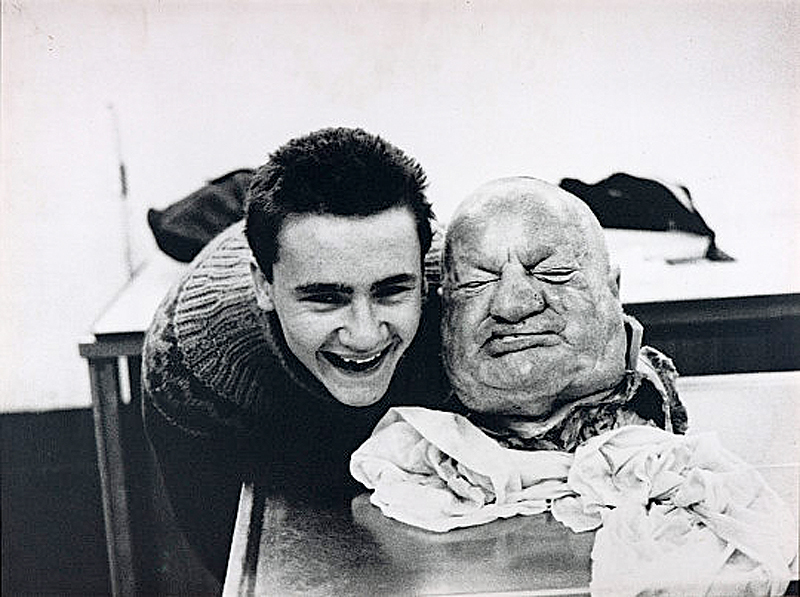
    Such lack of historical accuracy may of course be due as much to memory lapse as myth-making; after all, in speaking to Nicholas Serota in 2011, Hirst was casting his mind back almost thirty event-filled  years. But in recounting that “I never looked beyond Leeds – it was where I lived. I’d been unemployed for a year or so … I thought I’d go to art school. I did a one-year Foundation course at Leeds…” Hirst misleads since, born in 1965 and enrolling at Kramer at the age of 18, he could not have been unemployed for a year or so before leaving Jacob Kramer in 1984. Perhaps the reprise, in 1991, one year after he began the Natural History series, of the 1981 self-portrait photograph of himself at the Leeds University medical school morgue, entitled With Dead Head, is itself an expression of this sui generis creation myth, since it would seem to have been produced in order to establish a provenance for a subject also seemingly springing fully formed out of nowhere, augmented with Hirst’s citation of the anatomical drawings he produced at the morgue, whose apparent significance surely demanded display at the Tate, or reproduction in the catalogue.

    Hirst first addressed in 1990, in public, the subject which subsequently became his motif-à-clef, the topos of Vanitas, the subject addressed by the drawings exhibited at Reliance in 2002.

    The third element of his Leeds experience neglected in the record is the core component of the programme he followed at Jacob Kramer, an academic drawing class which all students undertook, under my direction, in the natural history and ethnography sections of the city museum, Hirst’s familiarity with which is confirmed by his description of the very route by which he reached the back-rooms students were privileged to access. The work was required to address not merely aspects of the form and appearance of the objects but also the taxonomic, moral and teleological implications arising from curatorial traditions ideologically circumscribing the display of ‘Nature’, whose epistemological grounding lay in the cabinet of curiosities. This of course imposes an obligation to consider what Hirst is specifically contributing to the subject of Vanitas.

    Arising from the above is the question as to what extent the Damien Hirst who attended Jacob Kramer was in possession, albeit only in microcosm, of the aesthetic which was to propel his entire oeuvre, the institutionalized aesthetic of Appropriationism. That the production of the drawings under discussion was institutionalised is not at issue, since all the work submitted for assessment at Jacob Kramer was executed solely as a consequence of the students’ enrolment; only by satisfying the regulations of the institution could their work acquire validation via the imprimatur of the institution – which is why people go to art school. That institutional endorsement is crucial to Hirst’s identity, as his view that “If it’s in the Tate, it must be Art” confirms, is underlined by Ann Gallagher in her introduction to the catalogue; on page 14 she refers to “… Hirst’s early institutional endorsement, his 1991 show at the I.C.A. in London…”

    Hirst was introduced to the history of appropriationism as a legitimate strategy in the philosophy and practice of modern art at the very latest at Jacob Kramer, during the history and theory of art lectures delivered, by myself, to all students attending the Foundation course.

    Once inscribed within the corpus, in providing a bridge from Hirst’s youthful fascination with the eternal verities to his first mature expressions, the content of the drawings takes on the character of a missing link – as if in attending Jacob Kramer Hirst’s intuitions were for the first time self-consciously critically contextualised by art history and theory. And when so inscribed, the content of the drawings confirms a thematic continuity between Hirst’s deep seated, long-held preoccupations and his mature expressions.

    Glyn Thompson

    The Jackdaw, Jul-Aug 2012
  • Chalk and cheese

    Chalk and cheese

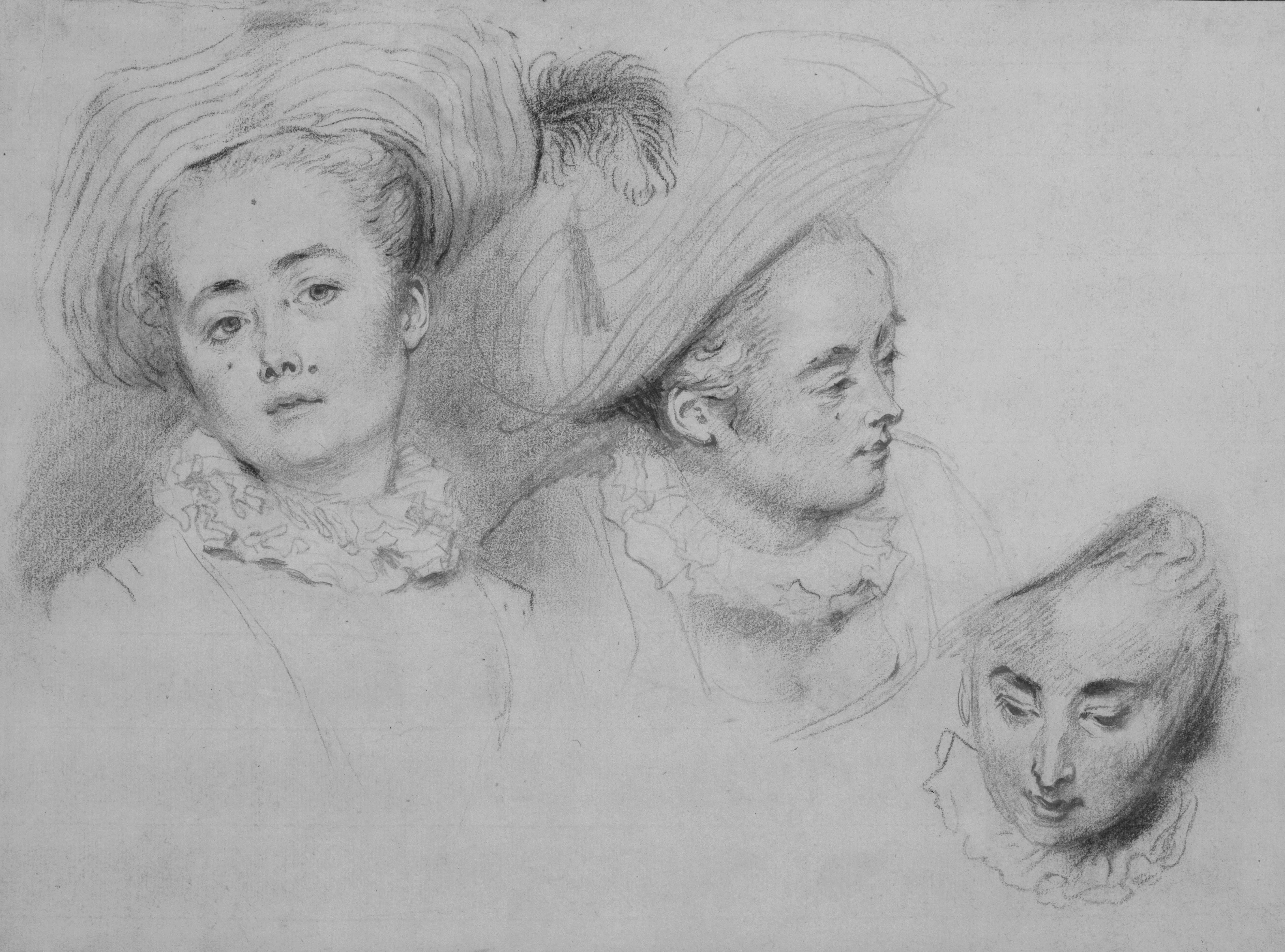
    Three Studies of a Woman Wearing a Feathered Hat, 1716-17, by Jean-Antoine Watteau, red, black and white chalks

    From the Hayward and the ICA to the Royal Academy, and from the public to the private sector, Angus Stewart compares and contrasts the qualities of works on show in London.

    The British Art Show at The Hayward Gallery should be lively – there are 39 artists. It is, according to the Southbank Centre, recognised as the most ambitious and influential exhibition of contemporary British Art. We must hope this claim isn’t true. For if it is, we should be in mourning.

    I’ve been often and have seen no sign of enjoyment, surprise, or admiration. On the contrary, the visitors are lackadaisical, apathetic or bemused and disorientated. Those I questioned were either harshly critical or blasé.

    However, at the Royal Academy the drawings by Jean-Antoine Watteau are giving the public palpable delight. The viewers move slowly, they pause, they look, and they move away with regret, that regret tempered by their anticipation of more masterpieces to come.

    While the silence at the Hayward is discomfiting, the hum at the Royal Academy is warm and harmonious. The few at the Hayward are awkward and ill-at-ease; the Academy’s guests are happily sharing a mutually satisfying dalliance.

    The British Art Show opened last year in Nottingham and after London will visit Glasgow  (Centre for Contemporary Art, May 28th – August 21st) and Plymouth (Arts Centre, September 17th – December 4th). The cost involved in these state-funded shenanigans doesn’t bear thought. Indeed, if the coalition wished to justify cutting the Arts Council budget, this sad show is one reason.

    Being HOT, over the past fifty years ART has consumed state funds as never before. Museums, galleries and performance venues have popped up like fungi following on rain. Each growth has its apologists, and each upholder champions a particular art form, claiming it fulfills a need. More like the need is invented to content those who patronise or administer art and artists.

    Consequently, instead of bringing society together, the purpose of ancient Greek theatre, the modern obsession with individualism centred on the self (of the artist and/or the art) fractures the encompassing community. In the seventies an American in Paris passed me an invitation to a gallery showing an oil painting and several drawings by Jean-Antoine Watteau (1684-1721). I was not taken by the oil, but I was captivated by the chalk drawings. For within them the chalk marks were placed, shaped and adjusted with such precision that reality was subsumed in Watteau’s invention. I was persuaded that the fanciful and faerie-like was as real as the rising up and the setting down of the sun. Watteau, apparently without great effort, could record the mundane as if it is truly miraculous.

    The peculiarities of the first drawings I saw are beyond recall, but my pleasure at Watteau’s artistry was reignited when I saw his eighty-eight works in the Royal Academy’s Sackler Galleries. The Shipwreck is inexplicable, a tumult of water and wind; a magnet to the eye, a tease to the brain. Here and throughout his work Watteau is obsessed with detail, hands are placed as visual punctuation, to indicate distance, presence and association. The multitude of heads he studied, and the faces precisely observed and faithfully sketched, all convey subtle variations of temper and intelligence.

    The Watteau paradox is simple; he saw directly into human psyche and did not flinch from its reality. But when he drew, he left pain, suffering and decay aside. In his day, his work was what we might now reasonably call outsider art. His temperament was not submissive, nor was he subject to external discipline. His biographer, Edme-François Gersaint, wrote: ‘His character was anxious and volatile; he stood by his wishes, was a libertine intellectually but was sober of habit, impatient, shy, cold and awkward in manner, discreet and reserved with strangers, a good but difficult friend, misanthropic, a shrewd and biting critic, always dissatisfied with himself and others and slow to forgive. He spoke little but well.’

    On examination Watteau is an artist outside tradition, rather like Turner. Like Turner he was involved with the theatre, and like Turner he was stubborn and had a particular sense, one concomitantly sweet and sour, of himself and of his fellows. Watteau portrayed dalliance as grace, but we are shown that under the gently rippling surface the buttocks grind like millstones.

    The catalogue, by Pierre Rosenberg and Louis-Antoine Prat, is a joy to behold and an education to absorb (£22.95). The drawings and the text make happy neighbours. As it was Watteau’s habit to collect his drawings in bound volumes the catalogue reader will see the sketches moving as the pages turn. Although the varied use of chalk is flattened, the original’s scale altered, what is revealed is Watteau’s mastery of space and his awareness of the relationship between human forms.

    Concurrently there are ten oil paintings by Watteau, on canvas or panel, on show at the Wallace Collection. They date from 1710 to 1718 and are shown in the context of the collection’s 18th century works. Watteau influenced his own contemporaries and his heirs. In Watteau’s day drawings did not require a story, but paintings were rated on their plot. So Watteau, always the innovator,  spawned the fête galante, a term as meaningful as it is meaningless. A fête galante takes place in the open and records a delightful social gathering wherein the characters sport, play and philander. Almost every figure within these paintings is ambiguous in posture, in tone, and in motive.  The viewer would profit from a vade mecum. Fortunately an excellent guide is to hand:  Watteau at the Wallace Collection by Christoph Martin Vogtherr (£25).

    Happy Dialectics (detail)

    Like Watteau, Nathaniel Mellors has work on show in two London venues, at the Hayward and the ICA (both funded by Arts Council England). The difference between the two artists is great, for Mellors is an impresario; he conceives a product, writes its storyline, evolves its appearance, conducts its manufacture and orchestrates its promotion. The difference in the ‘facture’ of each man could hardly be greater. Watteau was a soloist, he created with his hands and chalks. Mellors is a collaborator. Their work is as different as their working practice.

    Mellors’ concepts are constructs, the result of divers skills and techniques. He is one of the thirty-nine artists at the Hayward. He is represented by Matt’s Gallery, which is funded by the Arts Council to support artists  ‘… to take risks, test their limits and surprise even their own intentions’. Really! Should the taxpayer afford such indulgence?

    The following extracts are culled from Mellors’ exhibition handouts. Like the costs of his gallery, we taxpayers foot his bills.  “‘Our house’ opens with the arrival of a hulking male figure at an English country house. The occupants, a wealthy bohemian family, initially fail to recognise him as human and dub him ‘The Object’… it becomes apparent The Object controls language in the house, roving its rooms at night in search of books that he devours and excretes as odd, foul-smelling sculptures.” (Hayward Gallery, 2011)

    “Mellors’s distinctive body of work combines video, sculpture and writing and explores the complex relationship between language and power. His absurdist, humorous narratives reveal a penchant for satire and the grotesque.” (ICA, 2011, until May 15th) Grotesque and absurd are good words to describe the exhibition as a whole. Nevertheless I admire Mellors and many of his peers for what they have achieved. I applaud their ability to make what they wish a reality.

    Mellors claims to have been influenced by Pier Paolo Pasolini (1922-1975), particularly by his film Salò (The 120 Days of Sodom). Possibly he was, but I doubt he benefited. For Pasolini was very Italian while Mellors is inescapably Anglo-Saxon.  Mellors has roast beef sensibilities; his films are leisurely, haphazard and wearisome. They suggest an intermingling of the bizarre with Midsomer Murders and Bulldog Drummond. Possibly, overall, it is the Britishness of the artworks that is so depressing. Perhaps as a society the British have forgotten how to dance.

    However the Royal Academy can pirouette on a pinhead; it reinvents itself several times each year. The Academy’s events are various and sometimes delightfully unexpected. The Arts Council, however, is encumbered by its past. As has often been reported in this publication, its behaviour has frequently been injudicious. The latest allocations and cuts ensure that the appetite of the wealthy sophisticate will be sated. So while extravagance will continue for the favoured, the seedbeds will be left to chance. The coalition would do well to close the Arts Council, and to sell or allocate its collection. Art will survive, it flows as freely as water – the country does not need extravagance, it needs individuals, like Watteau who made much from little.

    The Jackdaw May-Jun 2011