Tag: Dick French

  • Dick French: On The Town – November 2020

    Dick French
    November/December 2020
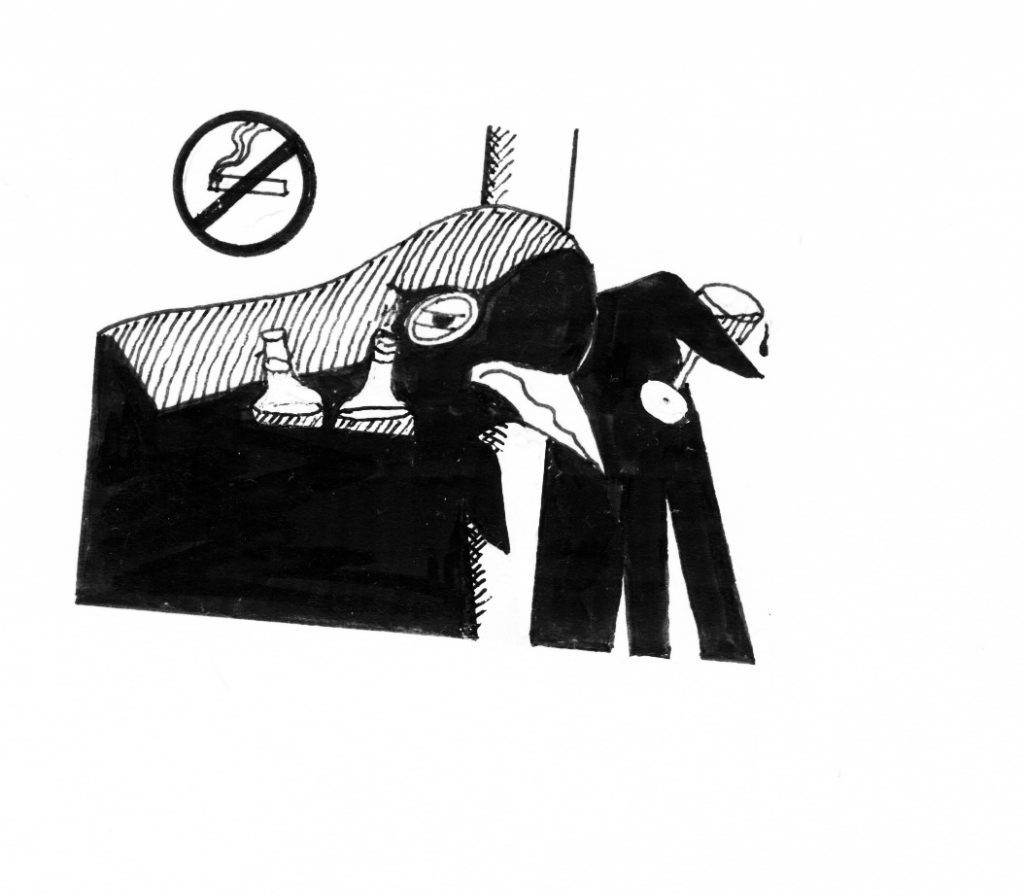
    Rebecca Cains has died. She was only 50. “Death lies on her like an untimely frost.” Also known as “Becky the Scrapyard Queen” on account of the subject matter of her paintings – mostly wrecked cars and vans on roads or in scrapyards. She showed occasionally at the Royal Academy and frequently at Mall Galleries, where, at the time of her death, she was becoming something of a big cheese who sat on committees, etc.. She will be missed by all the hep cats in Bradley’s Spanish Bar where we always ended up jiving to the juke box.

    For many years, while living in Italy, she had been a professional dancer, so she always knew how to get the best out of opponents. The last time I saw her was just before the lockdown when we went to the opening of the Leon Spilliaert show at the RA with Dirty Harry and Mrs Cravat. She looked well and was in good spirits, even though she had been diagnosed with cancer five years before and it had now come back to haunt her.

    She was impressed by Spilliaert’s picture of an absinthe drinker and said that as soon as she got back to darkest Somerset she would attempt a portrait of a cider drinker. I don’t know how far she got with that. She could have had him or her sprawled out over a rusting bonnet nursing a two-litre bottle. The colour and sparkle of the cider would have gone nicely with the rust.

    She was very fond of motoring, up to a point if a little vague. I once asked her what sort of car she was driving. She paused a bit before replying: “It’s a brown car”.

    Throughout her illness she bravely carried on conducting dancing classes; jazz dancing it was, and something else called zumba.

    She leaves two grown-up children, ace guitarist Gianluca and the glamorous Gaia, who is about to start at Camberwell. She can’t fail.

    Spiv, teddy boy, conman, “prize wanker with a pocketful of red herrings”… All these terms have been used to describe Lucian Freud at various times in his career. William Feaver has written a most amusing two-volume biography of Freud. It’s full of great stories but like the Warhol biography I reviewed a few issues back I feel the author is overly enamoured of his subject. This is a little off-putting.

    Rather in the manner of many French intellectuals, Freud was fascinated by the criminal underworld. He had many dodgy friends. Round about the time of the Festival of Britain he was producing some remarkable work. There is a rapt obsessiveness about them that reminds me of Richard Dadd. Think of The Child’s Dilemma, a watercolour in which a child is moving a chess piece with a look of insane concentration. His portrait of Viscountess Rothermere, Mrs Ian Fleming, has something of this, although Evelyn Waugh hated it and said he’d put the tiara on crooked. It looks more like a hat to me. Ian Fleming hated Freud and Freud hated his stay at Goldeneye and, of course, Fleming.

    He came strongly under the influence of Francis Bacon and started to use hog’s hair brushes and thicker paint. His portrait of John Deakin (illustrated) is excellent, but a lot of the others were just dreadful; such as the joint portrait Michael Andrews and his wife. It’s hard to believe that this was the same artist who had painted Interior in Paddington with Harry Diamond standing in his raincoat by the window, fag in hand, beside a potted palm. He wore that raincoat forever. Many years ago I was stuck in the French pub with Harry Diamond. Like many of these celebrated Soho characters he was a colossal bore.

    An American writer noted that Freud was good but not that good. I think this was true. With thin paint he was unique. But his handling of thicker paint, with few exceptions, was indifferent and sometimes downright unpleasant, dry and knotted. From time to time he could do it, as in the portrait of Deakin. The ears and the complexion are great, as is the fluid treatment of the forehead, a human beetroot.

    And what are we to make of his portrait of the Queen? Zorba must have had a good chuckle over that one. 

  • Dick French: On The Town – September 2020

    Dick French
    September/October 2020

    It’s not true that King Juan Carlos is hiding out in Bradley’s Spanish Bar. He only used that cupboard under the stairs while waiting for one of those posh penthouses over the road to be readied for him. Although it is true that he was reluctant to leave after falling for the abundant charms of barmaid Mimi, who at the moment is playing hard to get. I don’t know what his mistress, La Wittgenstein, is going to make of it. Poor old Juan Carlos de Borbón, him with the gammy leg he got shooting African wildlife – elephants are thin on the ground in the West End.

    The Sage writes from The Grotto: a cautionary tale for anyone thinking of deserting the city for country life with all its joys. Excessive rain caused his septic tank to overflow and back up into the house. He had to spend £200 hiring something called a “gulley sucker”. He also tells of a local pub landlord, an ex-farmer, who has erected an electric fence in front of his bar counter.

    I’ve been reading Philip Ziegler’s book about the 14th century Black Death and its social consequences. There was an upsurge of class hatred and after a while a feeling of acceptance, followed by a compulsion to go out and have a good time. There was “a spirited battle between monks and townsmen in Hull, but such affrays in Hull were practically a local sport.” There aren’t so many monks around these days but the compulsion to go out and have a good time survives. When you take statins you don’t need a plague to be haunted by dream images of pestilence and death.

    Nobody will ever know what really happened to Vincent van Gogh. He is supposed to have shot himself in the Champ de Blés after painting the cornfield with crows. But that picture was made ten days before his death. It’s true that he was very worried about his brother Theo, his main source of income and materials, who was also beginning to show the familial traits of mental instability and had quarrelled with his gallery Boussod et Valadon. He was also syphilitic. He became increasingly berserk and died only a few months after Vincent. On the other hand, following his arrival in Auvers, Vincent was on a roll. He was producing a painting a day and he was mentally at peace and under the care of Dr Gachet, a queer fish and homeopath described by Vincent as “even crazier than I am”. But I think generally he was probably a good sort.

    A book by Stephen Naifeh and Gregory White Smith which I’ve just read suggests that Vincent was shot accidentally by two teenage brothers who had been persecuting him for weeks. Many reviewers have pooh-poohed the idea but it strikes me as very interesting. They were both obsessed by Buffalo Bill whose Wild West Show had captivated Paris the previous year. One of them had a pistol thought to be a .38 revolver. The boys also had stage connections and knew some of the girls from the Moulin Rouge who would sometimes arrive in Auvers for a break. They would get these girls to flirt with Vincent, whom they regarded as just a smelly old clochard. One of them put it about that they had caught him tossing off in the woods.

    If he had intended suicide why shoot himself in the stomach, a most disagreeable way to go? And if he shot himself in the Champ de Blés what happened to his easel and equipment, not to mention the painting? Emile Bernard said he dumped all his stuff in a haystack. But it’s possible that the shooting took place in a courtyard close to where he was staying. A woman claims she saw a courtyard full of smoke. It’s certain that the boys were tormenting him, not least because Vincent was unable for some reason to pronounce Buffalo Bill, which always came out as Puffalo Pill. They found this hilarious. One of them slipped a grass snake into his paint box and mucked about with his cadmium red, expensive stuff.

    Lots of people saw him staggering back to the Café de la Mairie where he was lodging. When Theo arrived he found Vincent calmly sitting up in bed puffing on his pipe. The bullet hole was small and there wasn’t much blood. The bullet itself was never extracted, none of the doctors in attendance being qualified to attempt this. I hope they fed him painkillers. The bullet had been fired from some distance and at an odd angle. I’m sure that a 38 calibre bullet fired into the stomach would come out the other side. It may have been something smaller, like a .22 more suited to a teenager’s gun. There is a strong possibility that he was shot accidentally during horse play.

    “N’accuse personne, c’est moi qui a voulu me suicider.” Why did Vincent say this? Gaston and René Secrétan, the brothers, went on to have successful careers, one in banking the other in film music. One wonders about the secrets of the confessional…

    During Vincent’s stay, Auvers-sur-Oise was popular with amateur painters on account of the Barbizon ‘plein air’ style of painting. Other artists did not regard Vincent very highly. “Quel est le cochon qui a fait cela?” said one visitor about Vincent’s work.

  • Dick French: On The Town – July 2020

    Dick French
    July/August 2020

    Reading Pepys again about the plague of 1666. Not one for self-isolating, he was still enthusiastically putting it about: “Thence to Betty Martin and there did tout ce que je voudrais avec her and drank and away by water, home and to dinner. Down to Deptford, loaded half my goods and sent them away into safekeeping.” (He buried his parmesan in the garden.) “So back home and then I found occasion to return in the dark and to Mrs Bagwell, and there nudo in lecto con ella did all that I desired. But though I did intend para demorado con ella la noche, yet when I had done ce que je voudrais I did hate both ella and la cosa, and taking occasion from the uncertainty of sa marido’s return esta noche, did me levar and so away home”.

    These are difficult times if you are trying to write about the antics of the ‘art world’. One can almost hear Sir Arthur Streeb-Greebling drawling… “Well I think the word difficult is awfully well chosen.” It’s like trying to extract a ping-pong ball from a nun.

    I’ve been reading one of Huysman’s most unreadable novels. Called Là-Bas, the hero is trying to write a biography of Gilles de Rais, the notorious medieval mass murderer of children all over France. In the end he repented his sins and went to the stake rejoicing. The writer becomes obsessed with the wicked Madame Chantelouve, but when they get around to performing the deed of darkness he is repelled by her enthusiasm and lewdness. One of Madame Chantelouve’s chums is “a most puissant priest” who claimed to have saved nuns who had been incubus-ridden for two, three or four days” – lucky old nuns. There’s a great deal of diabolism and Madame Chantelouve is intimate with many perverted priests. Sounds like it should be interesting, but for some reason it isn’t. It must be the creeping religiosity. Huysmans became devout in the end as did many writers of the period.

    Beardsley is thought to have died a convert. I’m not so sure. Some have suggested that his swing to the church was more to keep André Raffalovich sweet as he sent him regular cheques. Raffalovich was a Russian Jew converted to Catholicism and a keen saver of souls. It was he and Smithers who kept the poor chap going in the end.

    Brian Reade wrote of “the friendly talons closing in around him.” I think this is close to the truth. Beardsley’s driving force was mischief.

    More on local characters … She seems to glide along the market as her gown trails the ground. All in white layers, even a white headdress and veil she must spend a lot of time at the washing machine. Years ago when I lived on Parkway in Camden Town there was a similar all-white woman. But she was more off the shoulder, sexier, but that was more than 20 years ago – maybe it’s the same woman. She was a great friend of Tullio De’Nardis, the Parkway crimper. Marvellous chap; he used to do Brazilians in the back. In the end he had to banish her from the salon as she insisted on smoking. I’ve got a feeling that when she gets home she has a great white table prepared for a feast with a crumbling wedding cake covered in cobwebs.

    I’ve just discovered the Spanish word for gusset. It’s entretella, so instead of saying I’m as dry as a nun’s knickers (to my Spanish friends in Bradleys) I can now get it right: “Ay caramba, estoy tan seco como la entretela de una monja!” None of them had ever heard of a gusset. I had to draw one for them … not easy.

    Don’t worry it gets better. Did you know that Burne-Jones was Kipling’s uncle? “You may talk o’ gin and beer/when you’re quartered safe out ‘ere, an’ you’re sent to penny-fights an’ Aldershot it, but when it comes to slaughter/you will do your work on water, an’ lick the bloomin’ boots of’im that’s got it.”

    A wonderful euphemism for being gay I’ve just discovered: “He’s light on the loafers.” And this brings us to … I’ve just added to the list of Lockdown’s Heroic Deeds by reading the new biography of Andy Warhol. Over 900 pages.

    “You’re a killer of art, you’re a killer of beauty and you’re a killer of laughter.” So said Willem de Kooning to Warhol at a party. “Oh gee, I’ve always liked your paintings,” came the reply. There was no way of getting to him, he absorbed everything like a sponge. Someone said it was like being with a handful of fog. Before he slipped crab-wise into the fine art world he made a good living as an illustrator, mainly of shoes and boots. He did them in a blotted style transferring the wet drawing to the other side of the page by folding. They were much in demand. He was still churning them out while becoming famous as a pop artist, or rather one of his assistants was.

    Paul Morrissey, his right hand man for longer than most, described him as “autistic, dyslexic, frightened, timid, and with no artistic instincts.” So why do people take him so seriously? Why were so many sucked into his orbit? After all, he was smelly and had crabs. A lifelong addiction to valium caused chronic constipation and he required a daily enema, which I imagine was no great inconvenience. His earnings from the world of commercial art enabled him to take a lease on a large mid-town industrial space which came to be known as The Factory. He had it decked out in silver foil by his friend Billy Name. It was very groovy and became his web. Drugs of all kinds were available, speed being the favourite at first. They didn’t get going on coke until the ’70s, even though it’s much better for you than speed. After all, it is organic, even if it does blow a hole in your nose.

    I feel that the author Blake Gopnik is overly enamoured of his subject and his acolytes. How about this – “Billy Name and his gorgeous and sometimes naked friends from the dance world”… There is a “gorgeous and patrician curator called Sam Wagstaff.”

    Perhaps the greatest hoot of all … one of the Campbell’s soup prints he describes as “the single greatest image in art painting as we know it.” As he knows it perhaps. The fact that the soups came in 32 different flavours is somehow linked to Bach’s 32 Goldberg Variations. 

    A one-time favourite, Freddie Herko, danced out of a fifth-floor window leaving our Svengali to moan “Oh why didn’t he tell us he was going to do it. We could have been there and filmed it.” He expressed similar sentiments about Edie Sedgwick, one time superstar and favoured bit of art candy. He knew that she was going to destroy herself and just wanted to be in on the occasion. He missed out on her overdose of downers a year or so later.

    Maybe his disarming sense of idiocy went some way to alleviate the effect of his passive sadism.

    There was enormous rivalry between Warhol’s downtown crowd and Bob Dylan’s upstate lot. Downtown it was all speed, heroin and poppers. For Dylan it was bogey weed and acid. Both sides were totally drug-addled. Edie Sedgwick went backwards and forwards between the two camps. “Napoleon in rags” was Dylan’s phrase for Warhol and he wrote Like a Rolling Stone about Edie Sedgwick. “How does it feel? How does it feel?” Well I suppose it was pretty numb most of the time.

    I enjoyed this book. It’s full of fascinating details and the author evokes the period very well. Warhol had dreadful rectal problems, anal warts and a fissure.

    When he was bleeding to death in the back of the ambulance after being shot by Valerie Solanas, the driver turned round and said “For an extra 15 dollars I can turn the siren on.” Solanas only got three years and was bailed after one. The first thing she did on release was to phone the studio and ask to come around. Morrissey dissuaded her. She wanted to bring round her manifesto for The Society for Cutting up Men, or SCUM.

    Warhol was said to have become religious towards the end. I think it was more the camp religious iconography that appealed to him.


  • Dick French: On The Town – May 2020

    Dick French
    May/June 2020

    It’s interesting to read the letters of John Ruskin alongside those of Vincent van Gogh. Most people are aware that Ruskin became rather unbalanced with age, but from reading his correspondence with Euphemia (Effie) it seems to me he was quite mad from the start. It’s the manic density that impresses as much as the content. Writing from Switzerland … “Coming down from the high snows my face burned literally scarlet, you may well talk of the Kalydor [A kind of early patent sun cream. Ed] but it must be for me there – that it wanted. Then the costume. Fancy – first – me with a huge pair of dark blue double glassed spectacles. Over there – over the whole face, a green gauze veil – doubled and fastened down in the waistcoat ¬ then a broad straw hat on the top of all – tied down tight with its flaps over my ears – by a handkerchief over the crown of it – tied under my chin! Many a hard days walk have I had so accoutred and enough to frighten anything in the world.”

    Effie herself was rather odd. She wrote about the eldest son of Earl Somers, who is a beautiful drawer, but also rather fond of queer things, such as he wanted to see a massacre and went some months ago to Algiers where he saw two or three really good ones and has come back quite satisfied.”

    Van Gogh’s letters, in contrast, are models of sanity … “One can never study and toil too much from nature. The greatest most powerful imaginations have at the same time made things from nature which strike one dumb.” His descriptive powers are superb: “Flemish sailors eating mussels and drinking beer happens with a lot of noise and movement, while in contrast a tiny figure in black with her little hands against her body comes stealing noiselessly along the grey wall. Framed by raven black hair a small oval face, brown, orange yellow, I don’t know. For a moment she lifts her eyelids and looks with a sideways glance from a pair of jet black eyes. It is a Chinese girl mysterious as a mouse, small bug-like in character. What a contrast to the greys of Flemish mussel eaters.”

    Before the plague I managed to see two very good exhibitions and a dreadful one at the White Cube gallery, which I won’t bother you with. Up the glass staircase at the Royal Academy you can see the works of Leon Spilliaert, of whom I’d never heard. A mysterious painter mainly of Ostend after dark. I’m fond of Ostend. In the ’70s they held an annual open exhibition. I always did rather well in it and one year they awarded me a medal inscribed ‘Europrix – French Dick’. It occupies pride of place just beneath my turntable. I enjoyed the Spilliaert show, as did the Scrapyard Queen and Mrs Cravat. Dirty Harry, on the other hand, didn’t like it at all and sloped off to the pub. He didn’t believe the story of the artist’s insomnia and thought him more likely a shirtlifter on the cruise.

    There are very dark pictures in chalk and watercolour, vague lights here and there, beach scenes and figures on the promenade. A nice one of a girl showing her bloomers as the wind whips up her dress. I think perhaps he was a bit of both. His portrait of an absinthe drinker inspired the Scrapyard Queen to do a picture of a cider drinker as soon as she returned to her lair in the West Country.

    I wonder if the Beardsley expo will be extended after the plague… It’s certainly worth seeing. I vividly remember the Beardsley show at the V&A in ’66 arranged by Brian Reade. It quite turned my head around. Before seeing Beardsley I had been doing wildly over-praised paintings which were a mixture of Abstract Expressionism and Pop Art. Some of them were enormous and weirdly shaped. As I’m not much of a carpenter they always fell to bits. I’d been a raving Modernist since schooldays but now I decided I wanted to be a decadent (or day cadong as it was pronounced).

    I switched to pen and ink for a few years before I started painting again after a visit to the Gustave Moreau museum in Paris. I came to dislike artists who drew habitually with lots of lines. Don’t be precious, dive in, have a go, it doesn’t matter if you make a mess, you can always do another one. Mistakes are for learning. Look properly at the thing in front of you and don’t square it up, it gives the game away.

    Poking around in my library you never know what you might find. I discovered seven books on Beardley, one of them by Brigid Brophy. Marvellous woman, married to Michael Levey, the director of the National Gallery in the ’60s. Kingsley Amis wrote a humorous limerick about her:

    The first chap to fuck Brigid Brophy

    Was awarded the Krafft-Ebbing Trophy

    And ten thousand quid

    Which for what the chap did

    Was regarded as rather a low fee.

    Stephen Calloway’s Beardsley book is the best. I first met him about twenty years ago in the V&A. He seemed to emerge out of a wall, a vision of Victorian loveliness (it was the concealed door in the museum’s print and drawing room). Off he strode in a white linen suit and, I think, button boots, antique gold specs, floppy hair and a long beard. I mentioned this to David Rodgers, an old friend. They both had the most amazingly posh voices and, along with Brian Sewell, were said to make the Queen sound common. Dave was a great fan of the Rolling Stones, who he referred to as the ‘Railing Stains’. After I’d described my Victorian vision he said ‘Oh that’s Stephen Calloway, he’s extraordinary isn’t he? I was at a meeting at the V&A a few weeks ago and people were setting up their computers when Stephen walked in, put his writing case on the table and brought out a bottle of ink and quill pen.”

    I first met Dave when he gave a lecture on Aubrey Beardsley at the Graves Art Gallery in Sheffield. His first job in London was curator of Old Battersea House, a magnificent ruin on the river, full of second division Pre-Raphaelite paintings and the most splendid dry rot I’ve ever seen. Some of the ‘flowers’ of dry rot on the staircase were two or three feet in diameter. Vandalism and break-ins were frequent and led him to leave after a year. I think it’s been renovated now but it would have been lovely to preserve it as it was in ’67. Maybe it could have been “plastinated” and double as a fairground attraction.

    There was a strong link between the Graves and the Aesthetic and Decadent movements in the 1890s. The gallery was run by John Rothenstein whose father William knew everybody from Oscar Wilde, Beardsley and Ernest Dowson to Leonard Smithers, who became extremely important to Beardsley after the Yellow Book dispensed with his services due to his association with Wilde, who was just then embarking on his hard labour.

    Smithers was a Sheffield solicitor who came to London and set up as a purveyor of rare books, which included a variety of ‘under-the-counter material’. He was very successful for a time with a shop in the Royal Arcade off Bond Street. He had a plump but attractive wife with many admirers with whom he would occasionally agree a price. There used to be a Leonard Smithers Society but I don’t know if it’s still going. Along with Beardsley and Arthur Symons he launched a new magazine, The Savoy, a rival to the Yellow Book, which was becoming rather tame. Many considered Smithers a disgraceful fellow, a bit of a cad, but I wish there were more like him around nowadays. I might be able to display more of my pictures. He died in mysterious circumstances in a small room in Fulham with no furniture and hardly any clothes.

    If you were an art school creature in the ’50s and early ’60s you would most likely be a follower of Sickert, a mild Modernist, or a Cézanne still-life merchant. Underneath all this was a curious current mostly ignored but sometimes referred to as Neo-Romanticism  … dark figures in long smocks (they couldn’t do legs) leading white horses to dark pools is how I remember it. Perhaps it was the legacy of the late 19th century. I think every small provincial art school had a crusty old decadent on the strength.

  • Dick French: On The Town – March 2020

    Dick French
    March/April 2020

    Who now remembers the fashion for wearing two pairs of trousers? It was all the rage in Camden Town twenty years ago but you seldom see it now. The outer pair would be cut at the knee to reveal the underlying pair. There’s one chap on Queen’s Crescent who carries on the tradition. Apart from the trousers, he wears nothing but a leather bondage harness and is festooned with pink feather boas, bracelets etc.. And such apparel serves him even in the most inclement weather. He was in the doctor’s waiting room a few weeks ago shooting everyone with a green plastic ray gun with sparks inside. In these grey days such eccentricities are to be encouraged … but never get talking to them. Eccentrics generally turn out to be colossal bores and offer to cast your horoscope.

    What’s all this rubbish about? Well, I’m just trying to get myself warmed up to write about the Picasso show at the Royal Academy (until April 4th – illustrated Self-Portrait, 1918).

    In the 1890s Toulouse-Lautrec would sometimes take acquaintances down narrow streets and up a dark staircase to an attic in a home on the rue de Douai. He would knock on a dingy door opened by a woman visitors described as stooped, old, wrinkled and almost bald. Henri would give her chocolates and flowers and introduce her as Victorine Meurent, the juicy young morsel who had posed for Manet’s Olympia. She was then in her 50s and, like Henri, an alcoholic, but also a painter. I wonder what became of her work.

    In the first room of the Picasso show at the RA is an exquisite drawing of Jane Avril, great dancer and friend of Henri. With a few delicate scratchy lines beneath the eyes Picasso has managed to suggest  that she is not very well. She was suffering from something called Sydenham’s Chorea which caused unco-ordinated staccato bodily movements. This contributed to her unusual dancing style, a strangeness which appealed greatly to the Parisian audiences of the 1890s. This was the time, of course, of Huysman’s A Rebours. After some time working in a brothel she met Henri at the Moulin Rouge and they became a famous duo. She said that she “owed him the fame I enjoyed from the moment his first poster appeared”. Along with La Goulue and Yvette Guilbert she was among the most famous performers of La Belle Epoque.

    Picasso could have met her at the Moulin Rouge or the Café des Innocents in Montmatre, which later became the Café des Decadents and then the Concert du Pendue which featured an opening act partially hanging himself from a ten-foot rope. Is nothing new?

    Another of Jane Avril’s friends was the English entertainer May Belfort who sang Daddy wouldn’t buy me a bow-wow. “I’ve got a pussy cat and I’m very fond of that but I’d rather have a bow-wow-wow…” The innuendo was the same as it is today. Did Uncle Mac have any idea of what filth he was broadcasting to English children on a Saturday morning?

    A thing you notice in this show is that over a certain scale Picasso couldn’t convey form. He resorted to flim-flam and stick-ons or the rather ghastly pastel renditions of his neo-classical period. There’s an interesting series of photos showing the development of Guernica which didn’t change much from the initial drawing out. I’ve never been convinced that it is such a powerful war painting. It’s an agreeable triangular composition of flat shapes about which much ink has been spilt, and about which doubtless many other interpretations are possible.

    “The hairs of my beard, though separated from me, are just as much gods as I am myself.” An egoist then, and how. Looking at this exhibition, and it is huge, you get the overwhelming feeling of ‘Yo Picasso!’ He just couldn’t get away from himself.

    ‘Yo Picasso! Give me the money!’ He was of course obsessed by money and a notorious skinflint.

    He often carried a small Browning pistol given to him by Alfred Jarry. If anyone criticised Cézanne he would “out with that thing”, as Damon Runyan would say.

    Some of the drawings from the series Minotauromachie (illustrated above) are of interest, especially Dora and the Minotaur, in which he uses colour well, a rare thing for him. The Minotaur seems to have been anatomically complete at some stage but he chickened out and scrubbed the ‘cartso’.  He knew his clientèle and didn’t want to put them off.

    He was still occasionally producing work of interest in the ’60s and ’70s, in particular the etchings for La Celestina by Fernando de Rojas and some etchings of brothel scenes after Degas showing a madam and three tarts. A number of largish paintings included here demonstrate that he was much better at drawing. Some of them are quite horrible.

    There are some interesting stories of his early years, in particular about his lifelong friend Manolo, who had been lent a studio while the artist was away and sold all the Gauguins on the wall to Vollard. He also stole Max Jacob’s only pair of trousers but had to return them as no dealer would make him an offer.

    Even when I was young and obsessed with Modernismo I never liked Picasso. I found him quaint, a tedious old clown who could do no wrong. Included in the show are a couple of those very late cavaliers smoking pipes. I have a friend, a merchant banker, who owns on. One day when I might have been a bit merry I advised him to flog it off while it was still worth something. ‘Yo boca grande!’ I was never asked back.

    Dirty Harry offered me a free trip down to Bath to look at an exhibition by Perry Grayson. I don’t think I was the first to turn it down. He is a creature in the depths of crispation, encrusted by his own myth. I have no wish to draw any more attention to his narcissistic obsessions. His work is so feeble that if he didn’t go trolloping around as a Widow Twankey it would never have been noticed. But he is a national treasure…