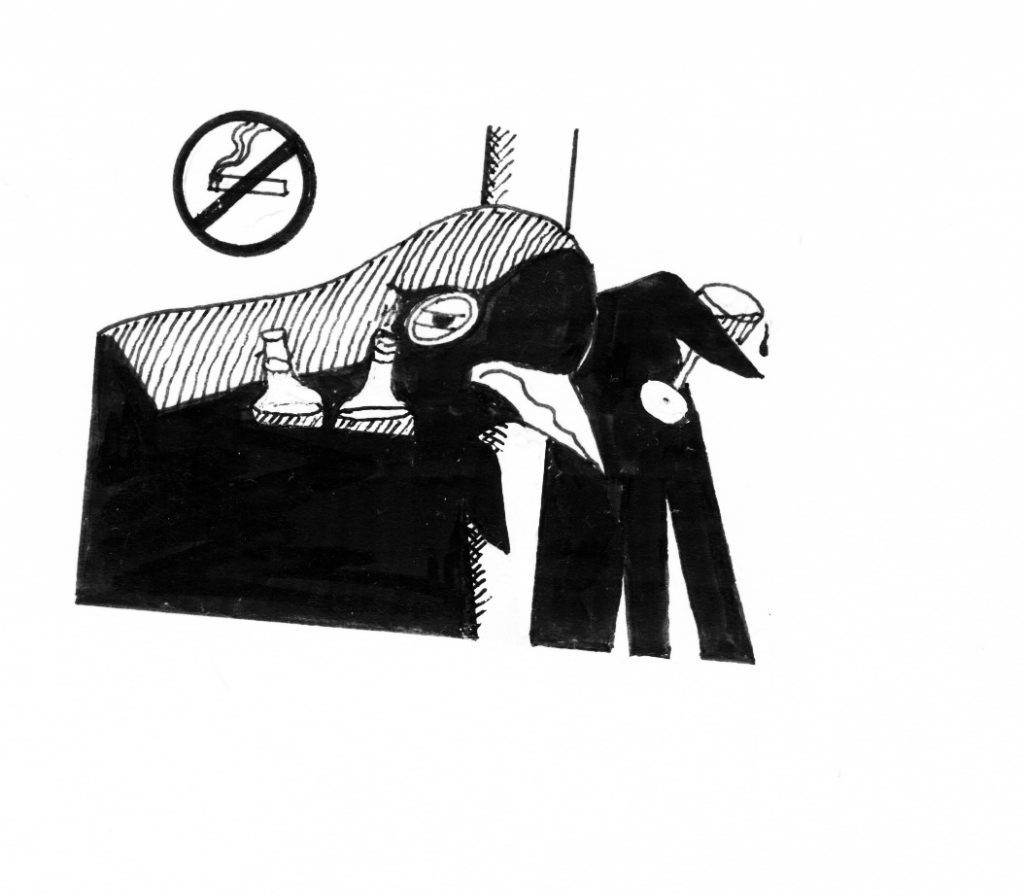
Tag: Covent Garden

  • Dick French: On The Town – March 2017

    Now my wedge is worn down to a nubbin so I’m trying to scratch a few dibs out of this art world. I’d done a few beauty panels and I’m punting them round town when I meet this dame in Covent Garden. I’ve known her a year or so and now she’s working the spigot in this bar on Long Acre. Now this is a classy trap, inhabited by the better class of West End rum pots. This Judy is Class A and she dresses in a manner that suggests she’s not afraid of catching cold. I like the way she always lets her bra strap hang down. She’s from that Hungary, where I hear you can commit all manner of depravity in the street without attracting attention. This must be dispiriting for them as likes an audience. I had a nightmare once when I had that Joan Collins over a bar stool of a Friday night in the French and nobody was taking any notice. During the season she’s always glued to the rugby on the tele so I enquire into this situation and she says to me like this: ‘It’s not the rugby Dick, it’s the men.’ And then she pulls me close and whispers in my shell-like, and I reply to her like this: (but this confidential riposte comes out a bit louder than intended, causing no small amusement and then some among the rum pots.)

    ‘A week off work to recover? I don’t believe it. The team maybe!’

    By and by comes Oat Willie. Now this is a curious character and carries a little sack of oats over his left shoulder at hip height. He alternates fistfuls of beer on the right with fistfuls of oats on the left. He’s fond of talking about his practice so much that many of the rum pots consider him to be no great asset to the community and give him the back of their necks. He’s fond of the bogey weed and I personally consider him to be higher than a cat’s back, which is no great commendation. By and by he shuffles off down the bar to gaze at Zoë, for such is the pancake’s name. He even offers her a dip in his little sack but she declines, it being a bit sweaty after a couple of pints. He associates with such low-lifes as John the Stud and Dave the Reptile who really have no business in a high class art blat.

    Dirty Harry sends me a free hack ticket to that Royal Academy to have a glaum at this show of Russian Revolutionary art. So I’m sitting on the No 14 bus admiring the great relief along the front of the Gaumont cinema in Shaftesbury Avenue. It takes you from medieval times to the Charleston and apart from the Parthenon it’s one of the greatest friezes I’ve ever seen. A traffic jam is not always such a bad thing.

    At the Academy they’ve draped the balustrades in red swags and put in a beautiful new crimson stair carpet at the entrances so it’s a bit disappointing when you get inside. It’s not that the pictures are particularly bad, although few of them appeal to me, but most share that “cellar-stored” look common to many early 20th century paintings; cracked, yellowed and dingy. A few things I liked. A painting by Isaak Brodsky which reminded me a bit of George Bellows’s shock worker, a figure stripped to the waist standing on a crane jib. Like Bellows but without the enjoyment in the paint, which is a characteristic of most of these artists. None of them relished the medium. Maybe they couldn’t afford to.

    Israel Lizak is an exception with his painting Walk. It reminded me a bit of Gorky and is an abstraction of an elegant woman in a hat from ’28. And then there’s Vladimir Tatlin who you could say has pride of place with his large model of The Worker’s Flying Bicycle. It never flew but it’s a great idea. And there’s rather a beautiful small photo of the profile of poet Anna Akhmatova by Moisei Nappelbaum (see illustration). She was denounced by the Bolsheviks as ‘half-harlot half -nun’. “Her tormented mouth through which 100,000,000 people scream.” There’s a woman down our street like that.

    On the way out a woman who was clearly upset was saying how sad it had all made her feel. And I had to agree. Apart from all the ghastly goings-on I can’t stand pictures of peasants.

    Up the Burlington Arcade the Fountain Pen Shop has closed down. Some of them cost many hundreds of pounds but were rather beautiful. On Berwick Street the blood oranges have just arrived and the daffodils have come out in the French pub.

    Sent on a mission on your behalf I failed miserably. It had been suggested I look at the David Hockney retrospective, an unpleasant job but someone’s got to do it. The queue was such, hundreds of them, that I lost all enthusiasm. Even after buying a ticket – twenty quid! – you have to wait around for an hour before they let you in.

    I decided to look at the Paul Nash show instead. A wise decision. The first room is called Dreaming Trees. They look like etchings but are mostly pen and ink. The catalogue describes them as ‘Symbolist’, but I disagree. Trees, hills, landscapes and a few ghostly figures which take time to emerge. They convey a sense of mystery which is not transcendent but embedded in the nature of all things themselves. There’s no need to look for anything else, ‘things’ are sufficient for those with eyes to see. Then came the war and a remarkable transformation. He started to work in oil and to make the pictures for which he is most famous.

    “There are men who want the war to last forever. Feeble and inarticulate may be my message. But it will have a bitter truth and may it burn their lousy souls” 1917

    Starburst shell over the Ypres Salient at night … blacks and various shades of viridian, the light from the starburst picking out the troops helmets as they go slightly downhill on the duckboards. In the same room are The Menin Road and We Are Making a New World, the paintings for which he is most acclaimed.

    After the war he turned again to landscapes with rather mysterious qualities but without the intensity of his pre-war work. In the ’20s he went to live in Rye and got to know the 20-year-old Edward Burra – Nash was 35. Burra disliked Nash’s wife Margaret, who was much involved in folk music and morris dancing.

    “Such fun. We do Widdy Come Toddy, Parson’s Fuddle and Fuck a Chickabiddy and Flummox a Bubby Nit in the Navel. And also Maiden Heads Bung-Ho.” (Burra’s letters)

    Nash himself was quietly appalled by how his wife carried on. Burra considered that Nash couldn’t draw but although his figures were rather weak it didn’t really matter in his best work. Then in the ’30s he became committed to the idea of International Modernism which is strange considering how idiosyncratic his work had been. He liked the idea of a life force within inanimate objects and put together arrangements which nowadays look like very ordinary art school exercises. Later on in the ’30s he got involved with the Surrealists.

    There’s an interesting film of him during the Second World War working in the scrapyard of German bombers at Cowley in Oxford, the drawings and photographs of which led to his famous picture Totes Meer of 1940. The chalkiness of a lot of his pictures, which I’ve always considered one of his drawback, didn’t really bother me, until the very late things of wheeling sunflowers which are supposed to be symbolic of death. He died in 1946.

    Dick French
    The Jackdaw Mar/April 2017

  • Dick French: On The Town – January 2017

    “For we know it’s right, it’s in black and white, and it’s written down in his diary.”

    The immortal words of Benny Hill came to mind as I purchased the complete set of Samuel Pepys’s diaries for fifty quid. This pleased me exceedingly as such a set can usually cost – the venality of bookmongers being so great – well over a hundred. In an old box outside the same shop I discovered a full set of Reginald Perrin videos for just £2. “I didn’t get where I am today without rummaging around in old boxes.”

    Up very betimes and to my workroom and then by omnibus to the alehouse in St Martin’s Lane for my morning draught. By and by comes Mrs Cravat and Calamity Jane. The daughter, a comely wench who weareth the lipsticke, is a rug muncher withal, so dalliance is ill-advised. She runs an alehouse on Warren Street clept The Smugglers and is needed become so tattooed that she resembles a very privateer herself. They provide there a cocke-tail called The Black Spot of rum coffee, sassafrass and jaggery – a vicious little nip. They dined upon neat’s tongue and an udder which did please them exceedingly. But I demurred as my appetite is grown delicate betimes and doth not revive until the evening.

    Returning to my workroom I continue my series of diverse, lewd, impious and obscene drawings, representing men and women in the act of carnal copulation.

    I pondered awhile on that cunning jade Miss Prickens, whose proclivities are the talk of both Whitehall and Covent Garden. She hath abilities beyond those of most women and is said to perform The Whirligig. I decided to send her a message by my boy, e’en though I knew she would be busy.

    To Hampstead to purchase art materials. Whatever happened to Bird and Davis of Kentish Towne? I went there one morning and they had disappeared. The art shop in Hampstead provides carrier bags bearing the legend “Let’s fill this town with artists!” What a horrible thought.

    Just downhill from the art shoppe is an alehouse, The Flask. I was enjoying a morning livener of winter warmer when I noticed that a new beauty salon had opened across the way. It advertised “wart and verruca removal”. I had no idea the good folk of Hampstead suffered such low afflictions. So much for the Chalybeate spring waters… obviously not all they’re cracked up to be. And so I begin to learn modern expressions.

    Down river to Bankside, there to attend an exhibition of curious art pictures in a converted power station. They are by an American fellow, Robert Rauschenberg. To enter this show one must part with £15. I could hire an able bodied seaman at 21 shillings a month for well over a year for this exorbitant sum. A socialite with a finger in many a pie, and a bugger withal, Rauschenberg could not fail, nor did he. The paintings are a congeries of sundry miscellaneous rubbidge, two of which, Charlene and Gold Standard, I liked exceedingly. That latter incorporates a small dog of the sort to be found on record labels. Yellow overall; and projecting some distance from the wall and across the floor. Charlene is mostly a red piece with a segmented circle in the top right hand corner. Both works look much better in photographs, the cheap paint having deteriorated unpleasantly.

    In another room a collection of drawings with not a line in sight. Instead they are transferred from newspaper cuttings with the aid of lighter fluid. They are said ‘to deal with’ Dante’s Inferno. This technique has for decades been used by schoolchildren and I remember it being much discouraged as lazy.

    A most amusing piece is a large shallow tank filled with streaming and occasionally erupting sloppy clay. It reminded me of the snood of porridge looked after lovingly by Adam Lambsbreath in Cold Comfort Farm. “Nat nay nivver say that Robert Poste’s child and to think that I cowdled thee as a mommet.”

    A number of ballet performances are displayed on televisions. The dancers are trolloping about with umbrellas stuck to their backs. I found them unbearably ‘artistic’ and whimsical.

    He did some amusing things with corrugated cardboard but over a long career there was very little development. He finished as he started, a respected member of the institutional avant-garde, and he never drew a line.

    I forgot to mention that on my way to the show I was looking forward exceedingly to the “iconic upwardly soaring escalators” about which I had read so much, and I was not disappointed. Up they soar and down they swoop, although swoop is a misnomer as progress is effective but stately. On my final descent I lighted on the basement, a cavernous space of great cacophony and flashing lights. By and by I realised I was in the midst of a prodigious thunderstorm, but without the wetness thereof and it did please me to wander about up and down.

    Back over the bridge and up to St Paul’s to catch an omnibus, but the traffic so bad that I light on Ludgate Hill and proceed on foot to St Martin’s Lane. Pausing by and by at an ale house in Bull Alley to meet Mrs Bagwell where I had great enjoyment. “Apres avant toccado les mamelles que erant ouvert como siempre, she made shift to fudle mi cosa, but I demurred, it being too publique. ‘Some other time Mrs Bagwell. I am after all in charge of the Royal Navy’. ‘Oh rum bum and concertina!’, she cackled as she flounced off to the company of a bunch of knaves in the next room.

    On betimes to The Salisbury where talk was of that impertinent prating coxcomb Widow Twankey. I would happily see him in the ducking stool were it not that he would probably enjoy it. It would make a good television programme withal, introduced by that tedious pricke Melvyn Barg. Picture the scene. On the banks of the Thames, strapped in with the chair raised to its highest extent, his still dry party frock is caught in a gust of wind and, flying up, reveals a pair of crisp Y fronts. Perry, his secret revealed, is mortified and begs to be released, but it is too late, the beam is already descending.

    Bob Rhodes, artist, friend and dandy has just written to say he is dying of brain cancer and has three months. An unusual man, the like of whom I’ve never met before or since, his sartorial ideal was the striding figure on the Johnny Walker label to which end he always wore tight white trousers and a red crushed velvet long jacket and a neckstock. I was always jealous of his buggers’ grips as I’ve never been able to grow them. I’ve written before here about The School of Pubism which flourished at Sheffield Art School in the mid-’60s. Bob Rhodes was King of the Pubists. The things he could do with chammy leather, kapok and a bit of gloss paint would make your eyes pop out. It was like a desecration of Pop Art. The greatest compliment in those times was for an observer to say “Ooh that’s really sick!” Later on he turned to sculpture and then a series of constructions based on Art Deco cinemas. Some of these were painted Day-Glo pink on the back so that on a white wall they seemed to be hovering in a halo. After moving to Ironbridge in Shropshire he turned his attention to Coalbrookdale. He was keen on the idea that the power station at the end of the gorge created a micro-climate. Whatever its theme his work was always meticulously well made. A later theme was of ruined holiday resorts evoking scenes from J G Ballard.

    A curious thing about Coalbrookdale is that the people who live there have mining rights to their gardens. Bob was rather proud of this, but as far as I knew he never took advantage. He never married but I remember a series of unusual and sometimes spectacular girlfriends, one of whom he kept in a hut in the garden.

    Bob was a champion gurner though he never used a horse’s collar. He always cracked up the opposition by dribbling. I’ll never forget his 21st birthday party when he drank 21 whiskys and ended up in the model’s dais with just his foot poking out. A conscientious tutor, Dave Smith, noticed the problem and took him to the hospital to have his stomach pumped. He was back in the pub by 8.30.

    Bob was also an intrepid potholer. I remember once, deep under Stoney Middleton, dragging him out of a sump on the end of a piece of clothes line. (A sump is when the roof dips down under the water and you go through it hoping to find air on the other side.) Having a carbide lamp on the front of his helmet, he was the best equipped. We were all so ill-kitted it’s a wonder any of us survived.

    Dick French
    The Jackdaw, Jan/Feb 2017